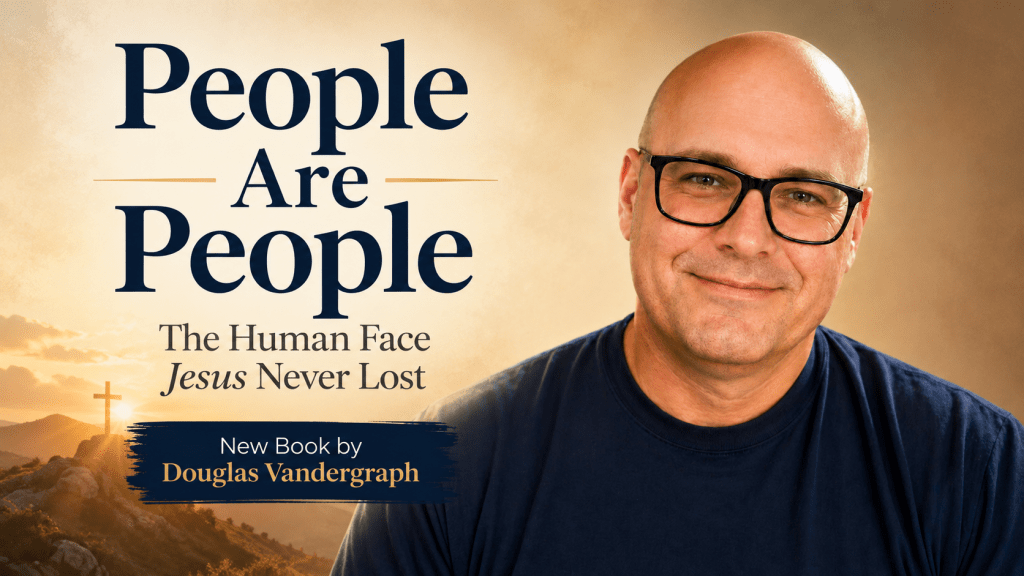
Learning to See Beyond Labels, Failures, Wounds, and the Worst Moments of a Life
Chapter One
Three Words on a T-Shirt
People are people. I was looking down at the Depeche Mode shirt I was wearing when those three words caught my attention. I had seen the shirt before, and I had heard the song many times, but something about the phrase stopped me that day. It reminded me of this Christian message about how completely Jesus understands the person others fail to see, because being seen as a complete human being is one of the deepest needs any of us carries.
Three words should not have felt like a revelation. Of course, people are people. We know that intellectually. Yet we live in a world that continually sorts human beings into categories before deciding how much patience, dignity, mercy, or attention they deserve. We see Democrats and Republicans, conservatives and liberals, believers and unbelievers, successful people and failures, insiders and outsiders, respectable people and troublemakers. We see the employee who disappointed us, the relative who embarrassed us, the stranger whose opinion angered us, and the person whose worst decision became public.
Jesus never looked at people that way. He saw the truth about them, including truths they wanted to hide, but He never allowed one part of their story to become the whole person. That is also central to this deeper Christian book about the grace and truth Jesus brings into real human lives, because Jesus did not offer compassion by pretending sin was harmless, and He did not call people to change by treating them as worthless.
The phrase on my shirt stayed with me because it exposed how easily we forget what should be obvious. Before we can mistreat someone comfortably, we usually have to make that person smaller in our minds. We turn them into an enemy, a stereotype, an embarrassment, a burden, a sinner, a fool, a threat, or a problem that needs to be removed.
Once we reduce someone to a label, cruelty becomes easier.
We no longer have to wonder what happened to them. We do not have to consider what they fear, what they lost, what they survived, or what burden they were carrying when they made the decision we now condemn. The label does all the thinking for us. It tells us what kind of person they are, what motives they must have, what they will probably do next, and whether their pain deserves to matter.
A person says something offensive, and suddenly everything about them is contained in that sentence. Someone makes a terrible choice, and the choice becomes their name. A teenager goes through a rebellious period, and the family begins talking about that teenager as though rebellion is the deepest truth about who they are. A marriage struggles, and one spouse becomes known as the difficult one. A person loses a job, battles an addiction, goes through a divorce, suffers an emotional collapse, leaves a church, questions their faith, or becomes involved in something destructive, and people who once knew their whole story begin speaking as though that chapter is the entire book.
Sometimes the label comes from other people.
Sometimes we place it on ourselves.
We look back at something we did years ago and quietly decide that it revealed our permanent identity. We say, “I failed,” and eventually the sentence becomes, “I am a failure.” We say, “I made a selfish decision,” and over time we begin to believe, “I am nothing but selfish.” We were rejected, so we call ourselves unwanted. We were betrayed, so we call ourselves foolish. We struggled with anxiety, so we decide we are weak. We lost control during a painful moment, and now we fear that one moment exposed everything that is wrong with us.
A label can become a prison even when nobody else knows we are wearing it.
People are people does not mean people are always good. It does not mean every decision deserves approval, every relationship should continue, or every wound should be ignored. It means a human being remains a human being even when the truth about their behavior is painful. It means wrongdoing can be named without pretending the wrongdoer has no value. It means consequences may be necessary without cruelty becoming righteous.
It means we can protect ourselves, establish boundaries, tell the truth, and oppose harmful behavior without surrendering the character Jesus calls us to have.
Jesus understood people better than anyone who has ever lived, and He never confused understanding with approval.
He recognized hypocrisy beneath religious performance. He knew when someone was asking a sincere question and when someone was trying to trap Him. He saw fear beneath anger, desperation beneath unusual behavior, pride beneath public respectability, and shame beneath silence. Jesus was never naïve about human nature. He did not look at destructive behavior and call it harmless. He did not treat sin as a small misunderstanding that could be solved by making people feel better about themselves.
He spoke seriously about repentance, judgment, forgiveness, mercy, integrity, and the condition of the human heart.
Yet even when Jesus saw the complete truth, He still saw a person.
That is where we often struggle. We find it easier to choose one side of the tension. We may emphasize compassion so strongly that we become afraid to tell the truth, or we may emphasize truth so aggressively that compassion disappears. We may excuse everything because we do not want to seem judgmental, or condemn someone so completely that we no longer care whether they are ever restored.
Jesus did neither.
He could speak directly without humiliating someone for entertainment. He could show mercy without pretending change was unnecessary. He could forgive without describing evil as acceptable. He could confront religious leaders fiercely while still grieving over what their hardness was doing to them and to the people they influenced.
His love was not blind.
His truth was not cruel.
Holding those together is difficult because it requires us to remain emotionally present with complicated people. Labels help us avoid that complication. Once we have decided someone is simply selfish, dishonest, foolish, dangerous, lazy, weak, religious, liberal, conservative, or toxic, we no longer have to think deeply about them. We stop asking questions because we believe we already know the answers. We stop listening because we have decided nothing meaningful can come from them.
We stop examining our own hearts because their wrongness makes us feel right.
Sometimes our judgment begins with something real. A person may truly have lied. Someone may genuinely be manipulative. A leader may have abused power. A friend may have betrayed our confidence. A family member may repeatedly create chaos and then expect everyone else to clean it up.
Recognizing those realities is not unloving. Wisdom requires us to notice patterns. Safety requires us to take threatening or harmful behavior seriously. Trust should not be restored merely because someone demands it, and forgiveness does not require us to provide another opportunity for the same person to wound us.
There is still a difference between recognizing what someone has done and deciding that what they have done is all they are.
Jesus never asked people to become careless about evil. He warned His followers about deception, hypocrisy, corruption, and people who would exploit others. He sometimes withdrew from crowds that wanted to control or harm Him. He did not place Himself under the authority of everyone who wanted access to Him.
He could love people without allowing them to determine His identity, movements, or mission.
That matters because Christian teaching about forgiveness has sometimes been used to pressure wounded people into unsafe situations. Someone is told that forgiving an abusive spouse means returning home immediately. A betrayed person is told that grace requires trust before there is evidence of change. A family is expected to welcome a destructive relative back into the same position without accountability because the person apologized.
Boundaries are described as bitterness. Caution is treated like rebellion. Distance is called unforgiveness.
That is not what it means to see people the way Jesus sees them.
Seeing someone as human does not require denying what they did to you. Compassion does not mean volunteering for another injury. Mercy does not remove the need for accountability. Love does not demand that you remain in an unsafe home, return to an abusive relationship, ignore threats, conceal criminal behavior, or protect someone from every consequence of their choices.
People are people, including you.
Your life matters. Your safety matters. Your dignity matters. You are not less valuable than the person who harmed you. Jesus does not ask you to prove your goodness by allowing someone else to destroy you.
There are times when separation is necessary. There are situations in which professional help, legal protection, or the intervention of authorities may be needed. Reconciliation may be impossible unless deep, sustained change takes place. Even when reconciliation becomes possible, restored trust may require time, honesty, evidence, and responsibility.
Forgiveness and access are not the same thing.
You can release your claim to personal revenge without placing yourself back under someone’s control. You can hope that a person changes without becoming the person who must supervise that change. You can pray for someone while refusing to answer their calls. You can stop feeding hatred without pretending the relationship can return to what it was.
Jesus told His followers to love their enemies. He did not say enemies were imaginary. The command matters because enemies are real. Some people will act with cruelty. Some will lie about you, exploit your kindness, resent your boundaries, or punish you for refusing to be controlled.
Loving an enemy does not mean pretending they are safe.
It means refusing to let their behavior determine the kind of person you become.
You do not have to celebrate their suffering. You do not have to build your identity around revenge. You do not have to lie about them, dehumanize them, or become cruel in order to prove that they were wrong. You may oppose what they are doing. You may seek justice. You may warn others. You may remove their access to your life.
Yet you can still remember that they are a human being whose heart, like yours, stands in need of the mercy and transformation of God.
That is not weakness. Hatred is easier.
Hatred simplifies the story. It tells us that we are entirely good because we were injured and that the other person is entirely evil because they caused the injury. It creates a world in which our pain excuses everything we feel, say, or do next. It protects us from the uncomfortable possibility that we can be genuinely wounded and still need to examine what the wound is doing inside us.
Jesus never treated pain as permission to become anything we wanted.
He took suffering seriously. He defended the vulnerable and confronted people who placed unbearable burdens on others. He cared about injustice. He also taught that what grows inside the human heart matters.
Resentment can begin as a response to something terrible and slowly become a force that shapes our thoughts, conversations, relationships, and identity. We may begin by wanting justice and end by wanting another human being destroyed. We may begin by telling the truth about what happened and eventually tell the story in a way that guarantees we never have to examine ourselves.
We may begin with a necessary boundary and eventually build a wall around every relationship.
We may begin by refusing to be mistreated and end by refusing to trust anyone.
The wound may not be our fault, but healing still becomes our responsibility.
That is one of the hardest realities of being human. Someone else can create damage that we must spend years repairing. A parent can speak words that follow a child into adulthood. A spouse can betray trust and leave the injured person questioning every memory. A church can misuse spiritual authority and make someone afraid of Christian community. A leader can exploit loyalty. A friend can reveal something private. A stranger can commit an act of violence that changes a family forever.
The person who caused the wound may never understand its size.
They may never apologize. They may deny what happened, justify it, minimize it, or blame the person they hurt. There are situations in which earthly justice never comes and every unanswered question remains unanswered.
Jesus does not ask us to call any of that good.
He invites us to refuse to let evil write the final definition of our lives.
People are people means the one who hurt you is human. It also means you are more than what happened to you. You are not merely the betrayed spouse, the abandoned child, the rejected friend, the former addict, the person who was fired, the one whose marriage ended, the one who made the public mistake, or the Christian who went through a period of doubt.
Those things may be part of your story. They may have shaped you profoundly. They may explain fears, reactions, and struggles that other people do not understand. But Jesus does not confuse a chapter with the whole life.
When Jesus met people, He often encountered them in moments when others could see only a category.
A tax collector was a traitor working for an occupying power. A woman with a complicated history was the subject of local gossip. A man with leprosy was considered unclean and dangerous to touch. A blind beggar was an interruption beside the road. A doubting disciple was a disappointment. A fisherman who denied knowing Jesus appeared to have proven himself a coward.
The people around them often thought the important questions had already been answered.
They knew what kind of people these were.
Jesus disrupted that certainty.
He saw what was present, but He also saw what grace could make possible.
That does not mean Jesus looked at people through fantasy. He did not imagine goodness where there was none or build His hope on empty promises. He called people to respond. Zacchaeus could not continue exploiting others while claiming that meeting Jesus had changed him. Peter’s restoration did not make his denial insignificant. Mercy opened a door, but the person still had to walk through it.
Grace is not the declaration that nothing matters.
Grace means failure does not have to be final.
That distinction becomes especially important when we look at ourselves. Many people can believe that Jesus forgives humanity in general while struggling to believe He could look at their specific history without disgust. They can talk about salvation, grace, and new life using familiar church language, yet privately remain convinced that one part of their past disqualifies them from peace.
They imagine Jesus seeing the label before He sees them.
Divorced. Addicted. Unfaithful. Angry. Weak. Dishonest. Doubting. Broken. Rejected. Ashamed.
Those words may describe something real. None of them is large enough to contain a human being.
Even the labels we accept with pride can become limiting. Successful. Strong. Responsible. Religious. Dependable. Needed. Those identities may sound positive, but they can create prisons of their own.
The successful person becomes terrified of failure. The strong person becomes afraid to admit exhaustion. The dependable person believes they have no right to need help. The religious person hides questions because doubt would threaten the image others admire. The person who is always needed may secretly fear that nobody would stay if they stopped being useful.
Jesus sees through flattering labels as clearly as condemning ones.
He sees the frightened person beneath the confidence. He sees the loneliness beneath the popularity. He sees the insecurity beneath the arrogance. He sees the desire to be loved beneath the constant need to achieve. He sees the shame beneath anger and the fear beneath control.
He also sees the responsibility we may be avoiding.
There is comfort in being understood, but there is danger in using our history to excuse everything we do. The fact that someone wounded us does not give us permission to wound others. Anxiety may explain why a conversation is difficult, but it does not make cruelty acceptable. A painful childhood may help us understand certain reactions, but it does not remove the need to seek healing and take responsibility for how we treat people.
Jesus sees the reason behind the behavior, and He still calls us to change the behavior.
That is part of His respect for us. He does not reduce us to helpless products of our past. He does not tell us that because we suffered, transformation is impossible. He understands the forces that shaped us without pretending those forces must control us forever.
The world often gives wounded people one of two messages. One message says that what happened to them does not matter and they should stop making excuses. The other says that what happened explains everything and nobody should expect them to change.
Jesus offers something more complete.
What happened to you matters deeply.
What you do with it matters too.
You deserve compassion, and you remain responsible for the life you are building.
You may need time. You may need help. You may need wise counsel, professional care, spiritual guidance, honest friendships, and distance from people who continue causing harm. Healing is rarely simple, and it cannot always be hurried. Some memories must be approached carefully. Some consequences cannot be reversed. Some relationships will never become what we once hoped they could be.
Jesus does not look at your wounds and see a hopeless future.
He sees a person.
That may sound like a small statement, but it changes everything. A label is static. A person is alive. A label tells us what someone has been. A person can repent, learn, heal, mature, take responsibility, repair damage, and become different.
A label closes the story.
Jesus keeps calling people forward.
The Christian faith rests on the belief that human beings can be transformed through the grace of God. Not polished into a more respectable image. Not trained to perform goodness while hiding the same heart. Transformed.
The selfish can learn generosity. The dishonest can become truthful. The bitter can become free. The arrogant can become humble. The frightened can become courageous. The person who caused harm can confess, accept consequences, make repair where possible, and begin living differently.
Transformation does not erase history. It changes what history is allowed to become.
The apostle Peter never stopped being the man who denied Jesus three times, because the New Testament does not conceal that part of his story. He also did not remain merely the man who denied Jesus. His failure became part of a larger life marked by restoration, courage, service, and faithfulness.
Peter could remember the courtyard without living there forever.
That is one of the ways Jesus differs from shame. Shame keeps returning us to the same scene and telling us it is the only place where our identity can be understood. Jesus brings us back to the truth so we can accept responsibility, receive mercy, and move forward differently.
Shame says, “You did this because this is all you are.”
Jesus can say, “You did this, and now you must decide what you will become.”
There is no cheap comfort in that. Responsibility can be painful. Apologies may be rejected. Consequences may remain after forgiveness. Some damage cannot be fully repaired. A person may truly repent and still lose a position, a relationship, a reputation, or an opportunity.
Grace does not always restore the life we had before the failure.
Sometimes it teaches us how to build an honest life after it.
That may be more difficult than pretending the failure never happened. It may also be more beautiful. A person who has faced the truth about themselves can become gentler with the failures of others without becoming careless about wrongdoing. They know what it means to need mercy, so they stop treating mercy as a reward for respectable people.
They also understand that mercy cannot be separated from truth.
There are apologies designed to end discomfort rather than repair damage. There are confessions that demand immediate forgiveness but resist consequences. There are people who use Christian language because it gives them another way to control those they harmed.
“I said I was sorry.”
“God forgave me.”
“You are supposed to forgive.”
“Why are you still bringing this up?”
Those sentences can sound spiritual while avoiding responsibility. Genuine repentance does not tell the wounded person how quickly they must recover. It does not demand restored access as proof of forgiveness. It does not become angry when trust takes time.
A changed person is willing to live differently even when other people remain cautious.
Jesus sees that difference too.
He sees the person who is sincerely trying to change, and He sees the person who wants relief from consequences without transformation. He sees the wounded person who needs time, and He sees when hurt has begun to justify cruelty. He sees the boundary created for safety, and He sees when a boundary has become a weapon used to punish and control.
We rarely see ourselves with that level of clarity.
We tend to emphasize our intentions while judging other people by their actions. We explain the pressure behind our worst moments but treat their worst moments as proof of character. We want our history considered, our wounds acknowledged, and our efforts remembered.
Then we look at someone else and decide one sentence tells us everything.
Jesus said we should examine ourselves before condemning someone else. His image of a person trying to remove a speck from another person’s eye while ignoring a plank in their own is almost humorous because the contradiction is so obvious.
It is also painfully familiar.
We can recognize pride in someone else while calling our own pride confidence. We call their anger dangerous and our anger justified. We call their silence manipulation and our silence self-protection. We call their certainty arrogance and our certainty conviction.
Self-examination does not mean every conflict is equally shared. Sometimes one person has caused most of the harm. Sometimes the facts are not balanced. Jesus did not teach us to invent our own guilt when another person acted wickedly.
He taught us not to use another person’s wrongdoing as protection from examining our hearts.
Someone can be more wrong than you and you can still need to repent of something.
Someone can owe you an apology and you can still need healing from the hatred growing inside you.
Someone can be unsafe and you can still refuse to lie about them.
People are people does not flatten moral reality. It deepens it. It allows us to say that an action was wrong without pretending the person who committed it has stopped bearing the image of God. It allows us to defend the victim without treating vengeance as compassion. It allows us to demand accountability without enjoying humiliation.
Public humiliation has become one of the preferred forms of entertainment in modern life. A person makes a mistake, a recording appears, a post is uncovered, or an accusation spreads, and thousands of strangers begin deciding what that person deserves.
Sometimes the exposure reveals serious wrongdoing that needed to be confronted. Sometimes public accountability is necessary because private systems protected the person who caused harm. Speaking the truth can protect others.
But crowds are rarely satisfied with truth alone.
They want a spectacle. They want a villain. They want permission to say things they would never say while looking into the person’s eyes. They want the emotional pleasure of feeling morally superior together.
The person becomes content.
Their humiliation becomes a shared activity.
Jesus knew what crowds could become. He saw people praise Him one day and demand His death later. He saw how quickly individuals surrendered their judgment to the emotion of a group. He knew that a crowd could transform cruelty into something that felt righteous.
That is why the way Jesus treated the woman caught in adultery matters so much.
The religious leaders brought her into public view. They did not present her as a complicated human being. They presented her as a case. Her shame became a tool in their attempt to trap Jesus.
The man involved was absent. Her history did not matter. Her fear did not matter. Her life did not matter. She had become a problem through which they could test Jesus.
Jesus did not deny that sin mattered.
He exposed the hearts of those holding the stones.
He forced the accusers to remember their own humanity before they destroyed hers. One by one, they left. Then Jesus spoke to the woman without the crowd controlling the moment. He did not condemn her, and He did not tell her to continue unchanged.
Mercy protected her life.
Truth called her toward a different one.
That encounter carries the central tension of this entire book. Jesus did not reduce the woman to her sin, but He did not reduce love to approval. He saw a person worth protecting and a life that needed transformation.
We often want one without the other.
Some people want a Jesus who stands between the woman and the stones but never asks her to change. Others want a Jesus who confronts her sin but seems strangely comfortable with the crowd’s contempt.
The Jesus of the New Testament does both what compassion requires and what truth requires.
He protects human dignity and calls for repentance.
That is the way He looks at us too.
He does not join the crowd rehearsing our worst moment. He does not tell us the moment was meaningless. He sees the complete person: the history, the wound, the choice, the harm, the fear, the excuse, the possibility, and the responsibility.
Nothing has to be hidden from Him because nothing is hidden from Him already.
That can feel frightening until we understand His character. Jesus does not discover the truth about us and then decide whether we are worth loving. He sees the truth from the beginning. His love is not based on incomplete information.
He knows what we regret.
He knows what we have not yet admitted.
He knows where we were genuinely wounded and where we have used the wound as an excuse. He knows the difference between false guilt and conviction. He knows when shame is accusing us of something grace has forgiven, and He knows when we are calling accountability shame because we do not want to change.
He sees all of it without reducing us to any of it.
That is why being known by Jesus can be both comforting and uncomfortable. We want Him to see what everyone else missed. We are less certain we want Him to see what we carefully omitted. We want Him to understand why we reacted. We may not want Him to challenge the reaction.
We want Him to defend the person beneath the failure.
We resist when He asks that person to rise, take responsibility, make amends, forgive, trust, or begin again.
Yet any compassion that leaves us permanently trapped is incomplete. A friend who understands why our habits are destroying us but never speaks honestly may preserve our comfort while failing our life. A parent who understands why a child behaved destructively but never teaches another way has confused affection with love.
Jesus does not fail us that way.
He knows which parts of us need comfort and which parts need correction. He knows where tenderness is required and where courage must begin. He knows when we need patience and when delay has become avoidance.
He sees the human being behind the label, and He refuses to let the label have the final word.
This book begins with three words on a shirt, but it is really about the way we look at one another. It is about the stories we tell ourselves when someone disappoints us. It is about the emotional convenience of labels and the spiritual danger of forgetting that every label is attached to a life.
It is about the person on the other side of the political argument.
It is about the family member whose choices confuse you, the church member who failed, the leader who disappointed everyone, the teenager who seems impossible to reach, the adult child who pulled away, the spouse whose pain comes out as anger, and the stranger whose life makes no sense to you.
It is also about the person in the mirror who cannot stop remembering what they did.
People are complicated. They can be tender and selfish, wise and foolish, faithful and frightened. They can mean well and still cause damage. They can love someone and fail them. They can tell the truth one day and hide from it the next. They can surprise us with courage and disappoint us with weakness.
So can we.
Jesus never built His view of humanity on the illusion that people were simple. He knew what was in the human heart. He knew what people were capable of, and He still came near. He taught, listened, touched, healed, challenged, forgave, and invited.
He did not need human beings to be uncomplicated before He loved them.
He did not need them to be innocent before He offered grace.
He did not need them to remain unchanged in order to preserve their dignity.
That is the way forward for us.
We do not need to become blind to wrongdoing. We need to become capable of seeing more than wrongdoing. We do not need to abandon wisdom and discernment. We need to abandon the kind of condemnation that treats another person’s failure as proof of our superiority.
We do not need to approve of every decision. We need to remember that disapproval does not remove another person’s humanity.
We do not need to give everyone access to our lives. We need to make sure the boundaries protecting us do not become excuses for hatred.
We do not need to deny our mistakes. We need to stop treating them as the final authority over who we can become.
The words on the shirt are simple enough for anyone to understand. Living them is harder.
People are people when they agree with us and when they do not. They are people when they are kind and when they are cruel. They are people when they are strong and when they fall apart. They are people when the truth about them is inspiring and when it is disappointing.
Jesus sees the whole person.
Learning to do the same will require honesty, patience, courage, wisdom, boundaries, accountability, and grace. It will change how we handle conflict, how we speak about those who have failed, how we respond to disagreement, and how we look at our own reflection.
Before any of that can happen, we must recover the truth the world keeps forgetting.
A person is always more than the label we have chosen for them.
Chapter Two
The Comfort of a Label
Labels are useful until we forget what they are.
A label can help us describe something quickly. It can identify a role, explain a relationship, or name a pattern we need to understand. We use labels every day without thinking about them. Parent. Teacher. Manager. Neighbor. Christian. Atheist. Republican. Democrat. Addict. Survivor. Victim. Offender. Leader. Failure. Success.
The problem begins when the label stops describing part of a person and starts replacing the person.
That happens more often than most of us realize.
We meet someone through a single fact, and that fact becomes the lens through which everything else is interpreted. Once we know how they voted, where they worship, what they believe, what they did, where they work, how much money they have, or what kind of trouble they have been through, we begin filling in the rest of their story without asking them.
We assume we know what they care about.
We assume we know why they made certain choices.
We assume we know what they would say before they say it.
We assume we know whether they are kind, selfish, trustworthy, dangerous, intelligent, foolish, sincere, or hopeless.
The label gives us the feeling of knowledge without requiring the work of understanding.
That is one reason labels can be so comforting.
Human beings are complicated. We can be generous in one situation and selfish in another. We can be brave at work and frightened at home. We can speak wisely to a friend while avoiding the same truth in our own life. We can be deeply sincere and still deeply mistaken. We can love someone and hurt them. We can believe something strongly and later realize we were wrong.
Real people do not fit neatly into simple categories.
That uncertainty can make us uncomfortable. It requires patience. It asks us to listen longer than we want to listen. It forces us to hold more than one truth at a time. Someone may have caused genuine harm and still possess qualities that are good. Someone may have done something admirable and still carry serious weaknesses. A person may be wrong about an important issue without being wrong about everything.
Labels remove that complexity.
Once we decide that someone is a bad person, we no longer have to consider anything good in them. Once we decide they are a good person, we may resist evidence that they have caused harm. Once we decide they are one of us, we excuse behavior we would condemn in someone else. Once we decide they are one of them, we interpret even their kindness with suspicion.
The label becomes a shortcut around discernment.
Jesus did not take those shortcuts.
When people brought Him a category, He often looked for the person hidden inside it. They brought Him a tax collector, and He saw Matthew. They brought Him a woman accused of adultery, and He saw someone surrounded by men who had turned her humiliation into a public weapon. Others saw a Samaritan, a beggar, a leper, a doubter, a sinner, or a religious leader. Jesus saw individuals.
He did not pretend the category was meaningless. Matthew really was a tax collector. The woman at the well really did have a complicated history. Thomas really did struggle to believe the resurrection testimony of the other disciples. The religious leaders really did misuse authority and resist the truth.
Jesus did not erase facts.
He refused to let the facts become the whole person.
That difference matters because we sometimes believe that compassion requires us to ignore reality. We fear that seeing someone’s humanity means becoming soft about wrongdoing. We worry that understanding why a person behaved destructively will sound like excusing the destruction.
Jesus showed that we can understand without excusing.
We can recognize the wound behind someone’s anger and still tell them the anger is harming people. We can understand that a person grew up surrounded by dishonesty and still require honesty from them. We can acknowledge that fear contributed to a betrayal without pretending the betrayal did not matter.
Understanding explains. It does not automatically absolve.
That is another reason labels are emotionally convenient. They protect us from the uncomfortable work of holding compassion and responsibility together. It is easier to call someone evil than to understand the path that brought them to a destructive decision while still holding them accountable for making it. It is easier to call someone broken than to expect them to take responsibility. It is easier to call someone a victim than to recognize that a wounded person can also wound others.
Simple labels often serve the emotional needs of the person using them more than the truth of the person receiving them.
Sometimes we use labels because we want distance.
If someone is merely difficult, perhaps we should speak with them. If they are toxic, we may feel justified in dismissing everything they say. If someone is confused, perhaps they deserve patience. If they are stupid, patience no longer seems necessary. If someone disagrees with us, we might have to consider their reasoning. If they are hateful, brainwashed, godless, or fanatical, we can stop listening.
There are situations where words such as abusive, manipulative, or dangerous are accurate and necessary. Clear language can protect people. Naming a harmful pattern may help someone recognize that what they are experiencing is not normal or acceptable.
But even accurate labels must be handled carefully.
A word that identifies a pattern can become a weapon when we use it to claim complete knowledge of another person’s heart. We may recognize manipulation without knowing everything that shaped the manipulator. We may identify abuse without pretending the abuser was born incapable of change. We may establish permanent distance because safety requires it while still admitting that God sees more of that person than we ever will.
The label may tell us what we need to do.
It does not tell us everything the person is.
We also use labels because we want certainty about ourselves.
People like to know where they stand. We want to believe we are good, reasonable, compassionate, faithful, informed, responsible people. Those identities help us move through the world with confidence. But the desire to protect a positive label can make us dishonest.
A good person may find it difficult to admit they acted selfishly.
A loving parent may resist hearing that their words caused pain.
A faithful Christian may hide doubt because doubt appears inconsistent with the label.
A strong person may refuse help until they collapse.
A respected leader may silence criticism because failure threatens the identity on which their confidence depends.
The more tightly we hold a label, the more frightening any contradiction becomes.
This can make repentance almost impossible.
Repentance requires us to admit that something in us needs to change. It asks us to face a truth that may not fit the version of ourselves we prefer. If our identity depends on always being right, then correction feels like destruction. If we must remain the victim in every conflict, any recognition of our contribution feels like betrayal. If we must remain the wise one, we cannot admit that fear influenced our decision.
Jesus did not call people toward shame, but He did call them toward honesty.
He could do that because He offered an identity deeper than performance. A person did not have to prove they had never failed in order to be loved. They did not have to protect every flattering description. They could face what they had done because their worst act did not have to become their permanent name.
That is what grace makes possible.
Grace allows a person to say, “I lied,” without concluding, “I can never become truthful.”
It allows someone to admit, “I harmed people,” without claiming, “I am beyond redemption.”
It allows a parent to say, “I was wrong,” without believing that one failure cancels every good thing they have ever done.
It allows a Christian to admit doubt without assuming faith has disappeared.
Grace gives us enough security to tell the truth.
Without grace, we usually move toward denial or despair. Denial says the failure was not real. Despair says the failure is all that is real. Jesus leads us away from both.
He tells the truth about sin because sin causes real damage. He offers mercy because damage does not have to be the end of the story.
This is why the way Jesus treated Peter matters so much.
Peter did not fail in a minor way. He had declared that he would remain loyal even if everyone else abandoned Jesus. Then, under pressure, he denied three times that he even knew Him. His courage collapsed at the exact moment he had promised it would not.
It would have been easy for Peter to accept a permanent label.
Coward.
Traitor.
Hypocrite.
Failure.
He had evidence for every one of them.
When the rooster crowed and Peter realized what he had done, he wept bitterly. He did not need someone to explain that he had failed. He knew. The danger was not that he would treat his denial casually. The danger was that he would allow the denial to become the final truth about his life.
Jesus did not do that to him.
After the resurrection, Jesus did not pretend the denial had never happened. He brought Peter back to the matter of love and responsibility. Three times, Peter had denied Him. Three times, Jesus asked whether Peter loved Him and then entrusted him with care for others.
That conversation was not sentimental reassurance.
It was restoration with responsibility.
Jesus did not merely tell Peter to feel better. He called him back into faithful action. Peter’s failure was faced, but it was not allowed to become his permanent identity.
The label said Peter was the disciple who denied Jesus.
Grace said Peter was still a person who could love, serve, mature, and become courageous.
Both truths belonged to the story. Only one of them pointed toward the future.
We often struggle to offer that kind of future to people who have disappointed us.
Once someone fails, we begin watching for proof that the label was correct. If they make progress, we call it temporary. If they apologize, we question the motive. If they behave differently, we assume they are pretending. If they stumble, we say, “I knew they had not changed.”
Sometimes that caution is wise. Change should be demonstrated, not merely announced. People who have been repeatedly harmed are not required to ignore patterns because someone makes another promise. Trust must be earned where it has been broken.
But there is also a form of suspicion that refuses to allow anyone to become different.
We may claim we want repentance while making sure the person knows they will never be seen as anything except the one who failed.
We may demand change and then punish them for changing too slowly.
We may say we believe in grace while preserving a permanent record of everything they did before receiving it.
That does not mean every relationship should be restored. A person can truly change, and the relationship may still remain over. Consequences may continue. Trust may never return to its former level. A leader may repent sincerely and still be unqualified to return to the same position.
Restoration to God does not always mean restoration to a role.
But we should leave room for the possibility that a person can become more than what they were.
Otherwise, we deny one of the central claims of the Christian faith.
The New Testament is filled with people whose identities changed. Saul was known for persecuting Christians before becoming Paul, a servant of Jesus who helped carry the gospel across the Roman world. Matthew collected taxes before following Christ. Zacchaeus profited through an unjust system before responding to Jesus with restitution and generosity.
Their pasts were not hidden. Their lives were not trapped there.
Christianity makes little sense if people cannot change.
Yet Christians can sometimes become some of the quickest people to freeze others in place. We remember who someone was before they came to faith. We use an old failure to explain every present difficulty. We speak about another person’s past with a tone that makes mercy sound like a mistake God made.
We forget that we also depend on the fact that Jesus sees more than our history.
Some labels are especially powerful because entire communities reinforce them.
A child may be known as the difficult one in a family. Once the role has been established, every action is interpreted through it. If the child becomes angry, it proves the label. If they remain quiet, they are being manipulative. If they try to change, the family waits for the old behavior to return.
Another child may be known as the responsible one. That sounds better, but it can be just as limiting. The responsible child is expected to absorb pressure without complaint, solve problems created by others, and remain steady while everyone else falls apart. They may reach adulthood believing their value depends on never needing anything.
Family labels can survive for decades.
The successful brother.
The selfish sister.
The emotional mother.
The distant father.
The disappointing son.
The favored daughter.
The relative who always causes trouble.
People change, but the family continues relating to an old version of them.
A forty-year-old person can walk into a childhood home and feel seventeen again because everyone resumes the roles they have rehearsed for years.
Jesus calls us to see people in the present.
That does not require forgetting history. History helps us understand patterns and protect ourselves from repeated harm. But history should not make us blind to growth. A person who once avoided responsibility may have learned to accept it. Someone who was emotionally unavailable may have spent years becoming more honest and present. A rebellious teenager may become a thoughtful adult.
When we refuse to recognize change, we may become part of the reason old wounds remain open.
Parents can do this to children without realizing it. A parent remembers every impulsive decision a teenager made and continues speaking to the adult child as though wisdom never arrived. Advice becomes control. Concern becomes constant correction. The parent insists they are merely being protective, while the adult child experiences every conversation as a reminder that they are not trusted.
Adult children can also freeze parents inside an old label. A father who once struggled to express affection may genuinely try to become warmer, but every awkward attempt is interpreted as proof that he does not care. A mother may recognize that she was controlling and begin respecting boundaries, yet the child assumes every question hides the old motive.
Growth can be imperfect without being false.
When people are learning a new way to live, they may not do it gracefully. A person who has never apologized may sound uncomfortable and clumsy when they begin. Someone learning boundaries may become too rigid before finding balance. A parent trying to listen may still interrupt. A spouse learning emotional honesty may struggle to find the right words.
We should not call every awkward beginning hypocrisy.
Sometimes it is simply inexperience.
Jesus gave people room to begin.
The disciples misunderstood Him repeatedly. They argued about which of them was greatest. They tried to send children away. They wanted to call down fire on people who rejected Jesus. They fell asleep when He asked them to remain awake. They ran when He was arrested.
Jesus corrected them, sometimes sharply.
He did not reduce them to their immaturity.
He continued teaching them because He saw who they could become.
This does not mean patience is endless in every circumstance. Jesus invested deeply in the disciples, but He also spoke honestly when people refused the truth. He allowed the rich young ruler to walk away. He did not chase every person who rejected Him. He did not keep explaining Himself indefinitely to those committed to twisting His words.
Seeing the person does not mean surrendering all judgment about what is possible in a relationship.
Some people are not ready to change.
Some do not want honesty.
Some use every expression of compassion as another opportunity to avoid responsibility.
Wisdom recognizes where someone actually is without declaring that they can never be anywhere else.
That balance is difficult. We may need to accept that a person is currently unsafe while believing they are not beyond the reach of God. We may need to stop lending money to a relative who repeatedly lies while hoping they eventually become honest. We may need to remove someone from leadership while praying that humility grows in them.
We can make decisions based on present reality without claiming authority over someone’s entire future.
Labels also become dangerous when we use them collectively.
It is easier to speak cruelly about groups than individuals. A group does not look back at us. It does not have a face, a trembling voice, a family, or a story we know. We can describe millions of people with one word and then attach motives to all of them.
Liberals are this.
Conservatives are that.
Christians always do this.
Atheists never understand that.
Immigrants want this.
Wealthy people think that.
Poor people refuse to do this.
Entire populations become characters inside stories created by people who may not personally know anyone in the group they are describing.
Once a group has been dehumanized, almost any treatment can be justified.
Jesus lived in a world filled with social and religious divisions. Jews and Samaritans carried generations of hostility. Tax collectors were despised. Gentiles were viewed as outsiders. Religious leaders carefully separated themselves from those they considered sinners.
Jesus did not deny that these groups had real histories, beliefs, and conflicts.
He repeatedly placed individual people in front of the categories.
In the parable of the good Samaritan, the person who showed mercy belonged to the group many listeners would have distrusted. Jesus did not present the Samaritan as an abstract argument about social harmony. He made him the man who stopped, saw suffering, and chose compassion when others passed by.
The label told the listeners what kind of man a Samaritan was supposed to be.
His actions revealed a person.
That is what happens whenever we encounter someone closely enough for the stereotype to break.
The political opponent becomes a father worried about his child.
The immigrant becomes a woman trying to keep her family safe.
The person with an addiction becomes a brother who once dreamed of a different life.
The prisoner becomes someone who committed a serious crime and is also trying to understand whether redemption remains possible.
The wealthy executive becomes a lonely person whose success has not repaired what is broken inside.
The person receiving assistance becomes a worker whose illness, divorce, or unexpected crisis changed everything.
Individual stories do not settle every policy question. They do not remove the need for laws, justice, consequences, or wise decisions. They remind us that policies affect people rather than categories.
A Christian should never become so committed to an argument that human beings disappear inside it.
Jesus did not ask His followers to abandon truth for politeness. He asked them to love their neighbors. Neighbors are not ideas. They are people close enough to inconvenience us.
A neighbor may believe things we oppose. They may vote differently, worship differently, speak another language, or live in a way we do not understand. Loving them does not require pretending those differences are meaningless.
It means the differences do not cancel the command.
That command becomes much easier when we keep people at a distance and much harder when we know their names.
It is easy to say that a group deserves no sympathy. It is harder when a member of that group sits at our table and tells us what happened.
Listening does not guarantee agreement.
It does make careless cruelty more difficult.
Perhaps that is why so much modern communication happens through screens. Distance protects our assumptions. We can react to a sentence without hearing the person’s tone. We can condemn a stranger without seeing the expression on their face. We can join thousands of others in mocking someone we would never confront in the same way if they were sitting across from us.
The screen turns people into content.
We scroll past grief, humiliation, anger, tragedy, celebration, and outrage within minutes. A person’s most painful day appears between an advertisement and a joke. Their failure becomes entertainment before we remember that they will still be living with it after our attention moves elsewhere.
Labels thrive in that environment because they fit into short posts and quick reactions.
Understanding takes longer.
Jesus was willing to take longer.
He stopped.
He noticed.
He asked.
He allowed people to interrupt the expected movement of the day.
A blind man shouted from the roadside, and Jesus stopped while others tried to silence him. A woman who had been suffering for years reached through a crowd and touched His clothing, and Jesus refused to let her healing remain anonymous. He called her forward, not to shame her, but to acknowledge her faith and restore her dignity publicly.
The crowd saw an interruption.
Jesus saw a person.
The ability to stop is part of learning to see.
We do not always need to agree. We do not always need to become involved. We cannot carry every person’s burden or investigate every story. But we can become slower to declare that we know everything from one fragment.
We can ask ourselves what we do not know.
We can remember that the person speaking from fear may sound angry. The person appearing arrogant may be terrified of being dismissed. The teenager acting indifferent may care so deeply that pretending not to care feels safer. The older person resisting change may be grieving a world that no longer feels familiar.
Those possibilities do not make every behavior acceptable.
They keep us curious enough to remain human.
Curiosity can be an expression of mercy. It says, “I do not know your whole story.” It resists the pride of assuming that our first impression is complete. It leaves room for truth we have not yet encountered.
Jesus did not need curiosity in the way we do because He understood human hearts completely. Yet He often asked questions.
“What do you want me to do for you?”
“Why are you afraid?”
“Do you want to get well?”
“Who do you say I am?”
The questions gave people room to speak, reveal desire, and participate in what came next.
We often ask questions only when we are preparing a response.
Jesus listened for the person.
That kind of attention is rare. People can feel when we are studying them merely to place them in a category. They can feel when our questions are traps. They know when we are waiting for one answer that will confirm everything we already believe.
They also know when someone is genuinely trying to understand.
Being understood does not remove responsibility. It may make responsibility possible. People are more likely to face difficult truths when they do not believe the truth will be used to erase their humanity.
Shame makes people hide.
Grace makes honesty possible.
This does not mean we should soften every conversation until nothing clear is said. Some situations require direct words. Jesus could be direct. He called hypocrisy what it was. He confronted people who used religion to burden others. He did not speak vaguely when clarity was needed.
But His confrontations served truth rather than ego.
That is a question worth asking whenever we place a label on someone: What purpose is the word serving?
Are we naming a pattern so we can respond wisely?
Are we protecting someone from harm?
Are we trying to understand what happened?
Or are we using the label to feel superior, avoid compassion, win an argument, or justify contempt?
The same word can serve different hearts.
We can describe someone’s behavior accurately and still speak with hatred. We can use gentle language while quietly controlling them. We can sound compassionate while refusing to expect anything from them because we have decided they are too broken to change.
Jesus cared about the heart beneath the words.
Seeing people clearly requires us to care about ours too.
We should notice how quickly relief comes when someone gives us permission to dismiss another person. We should pay attention to the satisfaction we feel when their failure confirms our opinion. We should examine why some people receive endless explanations while others receive none.
We should ask whether our labels change depending on whether the person belongs to our group.
When someone we admire loses their temper, we call it passion.
When someone we oppose does the same, we call it instability.
When our side changes its position, we call it growth.
When the other side changes, we call it dishonesty.
When a friend protects privacy, we call it healthy boundaries.
When someone we distrust does it, we call it secrecy.
We are rarely as objective as we imagine.
Jesus warned about judging others while ignoring ourselves because He knew how easily moral vision becomes distorted. We see the speck in another person’s eye with remarkable clarity while adapting our entire life around the plank in our own.
Self-examination does not mean we become incapable of judgment.
It means we judge with humility.
We remember that we can be right about someone else and wrong about ourselves at the same time. We can correctly identify their behavior while misunderstanding our motive for confronting it. We can say something true in a spirit that does not resemble Christ.
Truth does not become loving merely because it is accurate.
Sometimes people say, “I am only being honest,” after speaking in a way designed to wound. Honesty becomes a shield against responsibility. They act as though the accuracy of a statement removes the need to consider timing, tone, purpose, or compassion.
Jesus told the truth because He wanted people free.
Cruel people sometimes tell the truth because they want people small.
The words may be similar. The heart is not.
This becomes important when someone’s label begins to change.
A person who has been treated as a failure may not know how to live when they begin succeeding. Someone known as the strong one may resist becoming honest about weakness. A person who has spent years being angry may feel exposed when peace arrives because anger has become familiar.
Labels can be painful and still feel safe.
At least they tell us who we are.
Change creates uncertainty. If I am no longer the abandoned one, how do I relate to people? If I am no longer the person everyone must rescue, what responsibility belongs to me? If I am no longer the family disappointment, will they accept the person I am becoming?
Some people return to destructive patterns because the old identity feels more believable than the new one.
Grace can feel unfamiliar.
Jesus called people into identities they had not yet learned to inhabit. Fishermen became disciples. A tax collector became a trusted follower. A persecutor became an apostle. People who had been pushed to the edges were brought near.
They did not become new people by pretending the past had never happened.
They became new people by refusing to let the past control what happened next.
That process takes time.
Peter was restored, but he still had to grow. The disciples received teaching for years before fully understanding much of it. Transformation was real without being instant in every area.
We should remember that when we look at ourselves.
A failure after progress does not mean all progress was false.
A person learning patience may still become angry.
Someone rebuilding trust may still have moments of fear.
A Christian recovering from shame may still hear the old accusations.
Growth is not always a straight line. It does require honesty about the direction we are moving.
We should not use the complexity of change to excuse endless refusal. A person who repeatedly causes the same harm while rejecting every form of accountability is not merely growing slowly. Grace is patient, but patience is not the same as denial.
Jesus looked for fruit.
Words mattered, but lives revealed whether change was taking root.
That standard protects both compassion and truth. We can leave room for imperfect growth while requiring evidence that the person is actually moving. We can celebrate progress without pretending the work is finished.
Most importantly, we can stop using labels as final sentences.
A label may identify the starting point.
It should not pretend to know the ending.
The person you have dismissed may still surprise you. The family member who has resisted change may finally become ready. The teenager who appears unreachable may be listening more carefully than you think. The person carrying shame may be one honest conversation away from believing that repentance is still possible.
You may surprise yourself too.
The word you have used against yourself for years may describe something you did, something you experienced, or something you once believed. It may not describe the person Jesus is forming.
You may have failed without being a failure.
You may have been abandoned without being unworthy of love.
You may have struggled without being weak.
You may have doubted without losing every trace of faith.
You may have caused harm and still be capable of taking responsibility, making repair where possible, and becoming safer for the people around you.
Jesus does not offer us a flattering label to replace a condemning one.
He offers relationship, truth, grace, and a new way to live.
He sees us before the label.
He sees us beneath it.
He sees us beyond it.
The comfort of a label is that it makes a complicated person feel simple. The danger is that we begin believing the simplicity is true.
People are never that simple.
Jesus knew everything that was wrong with the human heart and still treated human beings as worth approaching. He knew how easily people could betray, deny, manipulate, hide, condemn, and run away. He also knew they could repent, forgive, serve, grow, return, and become faithful.
He did not deny what people were.
He refused to deny what they could become.
Chapter Three
When One Moment Becomes Your Name
Most of us have a moment we wish other people had never seen.
It may have been a sentence spoken in anger, a decision made under pressure, a failure at work, a season of addiction, a broken relationship, a public mistake, or a private choice that eventually became known. Sometimes the moment lasted only a few minutes. Sometimes it stretched across years. Either way, once people know about it, we begin to wonder whether they will ever see us the same way again.
That fear is not imaginary.
People often remember failure more vividly than growth. They may forget years of quiet faithfulness but remember the one time we lost control. They may overlook a hundred acts of kindness and keep returning to the one selfish decision. We can spend a long time becoming different while others continue speaking to the person we used to be.
A mistake becomes a reputation.
A reputation becomes an identity.
Eventually, one moment becomes our name.
This is especially painful when the people defining us are people we love. A stranger’s opinion can hurt, but the judgment of a parent, spouse, child, close friend, or church community can reach places that public criticism cannot. We want the people closest to us to know our whole story. When they reduce us to one chapter, it can feel like being erased while still standing in the room.
The family says, “That is just how he is.”
The spouse says, “She always does this.”
The friend says, “I knew you would let me down.”
The church says, “We have to be careful around someone like that.”
The words may be spoken with frustration, caution, or even sincerity. Yet beneath them is a final judgment: You have shown us who you are, and we no longer expect anything different.
There are times when caution is appropriate. People should pay attention to patterns. Repeated harm is not an accident simply because the person causing it dislikes consequences. A promise of change is not the same as evidence of change. Someone who has broken trust cannot demand that others forget the history immediately.
Still, there is a difference between remembering what happened and refusing to see anything else.
Jesus never treated a person’s worst moment as though it had revealed the only truth worth knowing.
Peter’s denial was public enough to shape how others could have seen him forever. He had been one of the most outspoken disciples. He promised loyalty with confidence, insisting that even if others abandoned Jesus, he would not. Yet when danger came close, Peter denied knowing Him three times.
It was not a small failure.
Peter did not simply remain silent. He separated himself from Jesus verbally and repeatedly. The more pressure he felt, the more strongly he denied the relationship he had once claimed would survive anything.
The rooster crowed, and the meaning of the moment became clear.
Peter wept bitterly.
That detail matters because Peter understood what he had done. He was not casually dismissing it. He did not need a crowd to explain that he had failed. The grief had already reached him.
Shame often arrives after the adrenaline of the moment is gone. While we are afraid, angry, desperate, or trying to survive, we may not see our choices clearly. Then the room becomes quiet. The conversation ends. The other person leaves. The consequences begin. We replay everything and recognize the exact point where we became someone we never wanted to be.
Peter had that kind of moment.
He could not take back the denial. He could not return to the courtyard and say the courageous words he wished he had said. He could only live with the knowledge that when loyalty became costly, fear won.
Many people know what that feels like.
We remember the phone call we did not make, the truth we avoided, the person we failed to defend, or the responsibility we escaped. We imagine what we should have done and create a version of the past where we were wiser, braver, calmer, or more faithful.
Then we compare that imaginary version of ourselves with the person we actually were.
Shame does not merely say, “You did something wrong.”
It says, “Now everyone knows what you really are.”
That is what makes shame different from honest conviction. Conviction directs us toward responsibility, repentance, repair, and change. Shame drives us toward hiding. Conviction says the action must be faced. Shame says the person should disappear.
Jesus restored Peter without pretending the failure was harmless.
After the resurrection, He met Peter by the Sea of Galilee. The setting was not accidental in its emotional effect. Peter was back near the work he had known before following Jesus. He had returned to fishing, and the familiarity of the boat, water, and nets may have felt safer than thinking about what came next.
Jesus prepared food and invited the disciples to eat. Then He spoke with Peter.
He asked him three times whether he loved Him.
The questions have sometimes been treated as though Jesus were humiliating Peter by forcing him to relive each denial. But the conversation does not carry the spirit of revenge. Jesus was not making Peter suffer for emotional satisfaction. He was giving Peter a way to face what happened without being abandoned inside it.
Three denials did not receive three insults.
They received three opportunities to answer love with responsibility.
Each time Peter responded, Jesus entrusted him with the care of others. Peter was not merely told he was forgiven. He was called back into a life of service.
That is how Jesus deals with failure.
He does not erase the past by pretending it never happened. He brings the person through the truth and into a future where the failure does not remain the final word.
Peter would always know that he had denied Jesus. The Gospel accounts would preserve the story. Future generations would read about it. His restoration did not depend on history being rewritten.
It depended on history being redeemed.
There is an important difference.
Rewriting history means denying what happened, minimizing the damage, or creating a cleaner version of ourselves. Redemption allows the truth to remain while changing what comes after it. The failure becomes part of the story without becoming its conclusion.
Many people want redemption but reach for denial because denial feels quicker.
We say the words were misunderstood.
We claim everyone else is overreacting.
We blame pressure, exhaustion, alcohol, childhood, fear, stress, or the behavior of the other person.
Some of those factors may be real. Circumstances affect us. Trauma affects us. Mental and emotional strain can alter how we respond. Understanding those influences matters.
But explanation becomes avoidance when it is used to remove every responsibility.
A person may say, “I acted that way because I was afraid,” and be telling the truth. The fear may deserve compassion. The harm still deserves attention.
Peter denied Jesus because he was afraid.
Jesus did not mock the fear.
He also did not call the denial faithfulness.
Grace does not force us to choose between compassion for the frightened person and honesty about what the frightened person did.
That is one of the reasons Jesus is trustworthy. He does not need to distort the truth in order to love us. His mercy is strong enough to survive complete honesty.
Human beings often love more conditionally.
We say we forgive, but quietly keep the failure nearby in case we need it later. During the next disagreement, we reach back into the past and place the old moment on the table. We may claim it is relevant, though sometimes we are using it because the present argument is not giving us enough power.
A person may apologize, work to change, accept consequences, and live differently for years, yet the old failure remains the easiest way to silence them.
“You are the last person who should talk.”
“After what you did, you do not get an opinion.”
“Do not act like you are better now.”
Those words can become a lifetime sentence.
Accountability looks at the past in order to protect the present and shape the future. Punishment keeps returning to the past because it wants the person to remain beneath it.
The distinction is not always obvious. Wounded people may need to revisit what happened many times. Healing is rarely completed by one apology or conversation. The person who caused harm may become impatient and accuse the wounded person of refusing to move forward, when the real problem is that repair has not been taken seriously enough.
No one gets to demand a healing schedule from the person they hurt.
But it is also possible for pain to become a source of control. A past failure can be used to ensure the other person never stands as an equal again. The wounded person may no longer want understanding, change, or repair. They may want permanent moral authority.
That is not healing either.
Jesus did not restore Peter by pretending Peter had no responsibility. He did not keep Peter permanently beneath the denial. He brought truth and mercy into the same conversation.
That is difficult for us because we often want the emotional security of a permanent verdict.
If the person who hurt us can change, then our story becomes more complicated. We may still choose not to reconcile. We may still maintain distance. The consequences may remain. Yet we lose the simplicity of saying they are nothing but the person they were on the worst day.
Some people resist another person’s growth because the old identity supports the way they understand themselves.
A parent may need the adult child to remain irresponsible because being the rescuer has become the parent’s identity. A spouse may need the other spouse to remain the offender because the moral advantage protects them from examining their own behavior. A church may need the former member to remain rebellious because admitting institutional failure would be painful.
Families and communities can build entire systems around fixed roles.
One person becomes the problem.
Once that role is established, everyone else is protected from scrutiny. The family may carry old wounds, poor communication, favoritism, secrecy, and control, but the identified problem absorbs the blame. Whenever tension rises, attention returns to that person.
The troubled child.
The difficult sister.
The angry father.
The unreliable brother.
The family no longer asks what everyone is contributing because one person has become the explanation.
Jesus disrupted systems like that.
When religious leaders brought the woman caught in adultery before Him, they wanted one person to carry the moral weight of the scene. She had sinned, and they used that fact to present themselves as defenders of righteousness. Her guilt allowed them to stand in the role of accusers.
Jesus did not deny her actions.
He turned their attention toward themselves.
The question was no longer only what she had done. It became whether those holding the stones were prepared to face the truth about their own lives.
That shift did not make all wrongdoing equal. Jesus did not claim that everyone in the crowd had committed the same sin. He exposed the arrogance that allowed them to use another person’s failure as proof of their own purity.
We are often most comfortable condemning the sins that do not tempt us.
A person who has never struggled with alcohol may speak harshly about addiction. Someone whose marriage has been stable may discuss divorce as though every broken marriage has the same story. A person raised in a loving home may judge someone whose reactions were shaped by abuse and instability.
This does not mean moral standards change according to circumstances. It means humility should grow when we recognize that we have not carried every burden another person has carried.
We are not always better because we failed differently.
Some failures are visible. Others hide behind respectability.
The person whose addiction is public may be judged by someone whose greed is praised as ambition. The person who lost control emotionally may be condemned by someone who uses silence to punish others. The person who committed adultery may stand publicly exposed while someone else privately feeds pride, envy, resentment, or dishonesty.
Jesus was especially direct with religious people who were more concerned with appearing clean than becoming truthful.
He described leaders who looked righteous outwardly while corruption remained within. Their danger was not merely hypocrisy in the ordinary sense of saying one thing and doing another. They had become so committed to the appearance of goodness that they could no longer recognize their need for mercy.
A respectable label can make repentance harder than a shameful one.
The person who knows they failed may be ready to seek help. The person admired for being good may defend the image at any cost.
Jesus told a story about a Pharisee and a tax collector praying in the temple. The Pharisee thanked God that he was not like other people. He listed the sins he did not commit and the religious practices he maintained. The tax collector stood at a distance, unable even to lift his eyes, and asked God for mercy.
The Pharisee had created his identity through comparison.
His confidence depended on another person being worse.
That form of righteousness still appears today. We may not pray the same words, but we think them.
At least I did not do what they did.
At least my children did not turn out like theirs.
At least I stayed faithful.
At least I never went to prison.
At least I still attend church.
At least I believe the right things.
The comparison gives temporary relief. It does not create a truthful heart.
Jesus did not praise the tax collector because wrongdoing did not matter. He emphasized the man’s honesty. The tax collector did not defend himself. He did not present his circumstances as an excuse. He recognized his need for mercy.
The door to transformation opened through truth.
That is the door shame tries to keep closed.
Shame tells us that confession will confirm everyone’s worst opinion. It tells us that if we admit what happened, we will lose every claim to dignity. We therefore hide, deny, minimize, or create explanations that leave us innocent.
But hidden failure does not disappear.
It continues shaping us from the shadows.
A secret can influence how we relate to everyone around us. We become defensive when certain subjects arise. We overreact to harmless questions. We assume people are judging us even when they know nothing. We distance ourselves from anyone who might see too clearly.
Sometimes we become harsh toward people who remind us of the part of ourselves we are trying to escape.
A person hiding dishonesty may become intensely judgmental about someone else’s lie. Someone carrying unresolved shame about addiction may speak with contempt about another person who is still struggling. We attack externally what we cannot face internally.
Jesus does not expose people for entertainment.
He brings hidden things into truth because secrecy prevents freedom.
That process can be painful. Confession may change relationships. Admitting wrongdoing may lead to consequences. A person may lose trust, position, comfort, or control. Christianity does not promise that repentance protects us from every earthly result of our actions.
It promises that truth does not have to separate us from grace.
This matters for people who have caused serious harm.
Compassion for the person behind the failure must never become indifference toward the people injured by it. When a leader abuses authority, the first Christian concern should not be restoring the leader’s reputation. It should be telling the truth, protecting those harmed, establishing accountability, and preventing further damage.
Too often, communities rush to rescue the powerful person while asking the wounded to remain quiet for the sake of unity.
They say the leader made a mistake.
They speak about forgiveness before investigating what happened.
They warn that public truth may damage the church, organization, family, or mission.
The offender is treated as a complete person with a future, while the harmed are reduced to obstacles threatening that future.
That is another form of dehumanization.
People are people must apply to everyone in the story.
The person who caused harm is more than the harm, but the person who was harmed is more than a test of someone else’s forgiveness. Their safety, voice, grief, and future matter. They should not be pressured to participate in the restoration of the person who wounded them.
Jesus consistently noticed people whose pain was ignored by those protecting systems, rules, and reputations.
He challenged religious leaders who cared more about appearing righteous than helping those burdened by their leadership. He placed human need above the pride of institutions. He did not use mercy to conceal exploitation.
Grace for the offender and justice for the wounded are not enemies.
Real grace supports truth.
It does not erase evidence, silence witnesses, or protect positions.
It creates the possibility that the person who caused harm can stop hiding, accept consequences, and become different. That transformation may happen far from the role they once held. They may never regain public trust. Forgiveness before God does not automatically qualify someone to return to leadership.
Peter’s restoration was suited to Peter’s failure, calling, and relationship with Jesus. It should not be used carelessly as a formula for every public leader who wants a quick return after serious misconduct.
Restoration is not public relations.
It is the slow work of truth, repentance, responsibility, and changed character.
Some mistakes are made once. Others reveal a pattern. Wisdom must know the difference.
A single angry sentence can cause real damage, but it may not define the normal character of the speaker. Repeated cruelty followed by repeated apologies is something else. A person who lies once under pressure is not identical to someone who has built a life around deception.
Jesus sees the whole pattern.
We usually see fragments.
That limitation should make us humble, but it does not make us helpless. We can judge behavior by its fruit. We can take threats seriously. We can require change. We can refuse to cooperate with manipulation.
What we cannot do honestly is claim that we know everything the person will ever become.
That is especially important for parents.
Children and teenagers make mistakes while their identities are still forming. They are learning how to manage emotions, relationships, freedom, responsibility, and consequences. Their failures can be loud and frightening. A teenager may lie, become disrespectful, make an impulsive decision, reject family values, or become involved with people who increase the danger.
Parents must respond. Love sometimes requires firm boundaries, outside help, and consequences the child will not appreciate.
But the language used during those years may remain long after the crisis ends.
A teenager repeatedly called selfish may begin to believe selfishness is their permanent nature. A child described as lazy may stop imagining themselves capable of discipline. A young person treated as a disappointment may conclude there is no longer anything worth protecting in the relationship.
Correction should name the behavior clearly without turning it into a permanent identity.
“You lied to us” is different from “You are a liar and always will be.”
“What you did was irresponsible” is different from “You ruin everything.”
“This behavior cannot continue” is different from “There is something wrong with you.”
The first statements leave room for responsibility and change. The second statements can become scripts the person carries for years.
Adults are not immune to those scripts.
A fifty-year-old may still hear what a parent said when they were fifteen. The words become an internal voice that appears whenever they struggle.
You never finish anything.
Nobody can trust you.
You are too sensitive.
You will never amount to much.
The parent may not remember saying it. The child may never forget.
Jesus spoke words that named possibility without denying present reality.
He called Simon by the name Peter, connected to rock, long before Peter consistently displayed the steadiness the name suggested. Jesus did not pretend Peter was already mature. He saw what Peter could become through discipleship, failure, correction, grace, and courage.
That did not give Peter an easy journey. In some ways, the name may have exposed the distance between who he was and who he was called to become. Yet Jesus did not define him only by instability.
He called him forward.
We need people who can do that for us.
We need someone who can say, “What you did was wrong,” without implying, “You are beyond hope.”
We need people who can remember our history without using it as a weapon.
We need relationships where apologies do not erase consequences but can begin repair.
We need friends who see where we are still immature and also recognize where growth is occurring.
We also need to become those people for others.
That requires resisting the emotional satisfaction of a permanent verdict.
When someone hurts us, certainty can feel safer than hope. Hope risks disappointment. It asks us to admit that another person’s future may contain something we cannot yet see.
We do not have to rebuild a relationship around that possibility. We can maintain boundaries. We can accept that their change may happen outside our life.
But refusing hatred leaves a small space where transformation remains imaginable.
That space may be all we can offer.
There are people we cannot safely approach again. There are relationships we should not reopen. The most faithful response may be distance, prayer, and silence.
We can still refuse to let contempt become our language.
Contempt is different from anger. Anger says something matters and has been violated. Contempt says the other person is beneath consideration.
Anger can become destructive, but it can also point toward justice. Contempt nearly always closes the door to seeing another human being clearly.
Jesus became angry at hard hearts and exploitation.
He did not become careless about human dignity.
Even when He spoke severe words to religious leaders, His purpose was not to create entertainment for a crowd. He exposed danger and called people to repentance. His lament over Jerusalem showed grief, not delight, at their refusal.
We should examine whether our strongest words carry any grief.
When someone fails publicly, do we hope for truth, protection, accountability, and eventual transformation, or do we secretly enjoy watching them fall?
When a political opponent is humiliated, do we care whether the punishment is just, or are we satisfied because the person belongs to the wrong side?
When a church leader is exposed, do we focus first on those harmed, or become absorbed in proving our earlier opinion correct?
The desire to be right can make another person’s destruction feel rewarding.
That should trouble us.
Their failure does not become good because it confirms our judgment.
We can be relieved that hidden harm was exposed without celebrating the pain surrounding it. We can support consequences without treating humiliation as a sport.
Jesus did not join crowds simply because the crowd had identified a real failure.
He examined the heart of the crowd too.
That lesson becomes personal when we recognize that any of us can become the person in the center.
The safe distance between observer and accused can disappear quickly. A private message can become public. A sentence can be recorded without context. A mistake can travel farther than the explanation. A true failure can become mixed with rumors until the person no longer recognizes the story being told about them.
Some people are falsely accused.
Others are accurately exposed.
Both can experience the terror of losing control over their own name.
When the accusation is false, truth and justice matter. A person should not be asked to accept a label they did not earn merely to appear humble. Jesus Himself was falsely accused and did not treat lies as harmless.
When the accusation is true, the path forward begins with honesty.
Not image management.
Not excuses.
Not anger at being discovered.
Honesty.
A person cannot change what they refuse to name.
The tax collector Zacchaeus offers a picture of that kind of response. His encounter with Jesus did not produce only emotion. It produced action. Zacchaeus committed himself to generosity and restitution. He recognized that his choices had affected real people.
He did not say, “Jesus accepts me, so everyone should stop discussing the past.”
He began changing what he could.
Repentance looks outward as well as inward. It asks not only whether we feel sorry, but what our actions damaged and what repair is possible.
Some damage cannot be repaired directly. The person may have died. The relationship may be closed. Contact may create more harm. In those situations, changed living becomes part of the repair. The person tells the truth, accepts the limits, and refuses to repeat the pattern elsewhere.
A private feeling of regret is not the same as a transformed life.
Peter eventually became known for courage, but the courage was not proven by words beside the sea. It was proven by the life he lived afterward.
That is how a new identity becomes believable.
Time reveals it.
Consistency strengthens it.
Humility protects it.
A person who has truly changed does not need to erase every memory of the past. They can speak about it without defensiveness because they are no longer depending on denial to preserve themselves.
They may say, “I did that. It was wrong. I understand why trust changed. I cannot undo it. I am committed to living differently.”
That kind of honesty has weight.
It does not force anyone to reconcile.
It demonstrates that shame no longer controls the story.
We also need that honesty when the person we must face is ourselves.
Some people have spent years asking others to see them as more than their worst moment while privately refusing to do the same. They may have received forgiveness, completed treatment, made amends, and lived faithfully for a long time, yet they continue introducing themselves internally through the old failure.
Every good thing feels temporary.
Every opportunity feels undeserved.
Every relationship feels threatened by the possibility that the other person will discover who they “really” are.
That is shame speaking in the language of permanence.
The worst thing you have done may reveal something that needed to change. It may have harmed people. It may have consequences you still carry. Grace does not make any of that unreal.
It does mean the worst thing is not the only true thing.
You are also the person who faced it.
The person who apologized.
The person who sought help.
The person who learned restraint.
The person who became honest.
The person who kept going when shame told you to disappear.
Those truths matter too.
Sometimes humility is confused with lifelong self-condemnation. A person believes that remaining ashamed proves they understand the seriousness of their failure. They fear that receiving mercy would mean becoming careless.
But endless self-punishment does not repair the people who were harmed.
It may actually keep the person centered on themselves.
Real humility accepts both responsibility and grace. It does not demand comfort before consequences. It also does not treat personal misery as a substitute for change.
Peter’s tears mattered.
So did what he did after he stopped crying.
There is a time to grieve what we have done. There is also a time to stand up and live differently.
Jesus did not restore Peter so Peter could spend the rest of his life proving how ashamed he was.
He restored him so Peter could serve.
This is one of the reasons the gospel is good news. It does not announce that human failure is unimportant. It announces that Jesus can meet a person inside failure and lead them somewhere failure could not.
The cross will eventually bring us to the deepest expression of that mercy, but we should not hurry there without understanding what mercy asks of us. Grace is not an emotional escape from truth. It is the power to remain in the truth without being destroyed by it.
That is what allows a person to confess.
That is what allows the wounded to set boundaries without hatred.
That is what allows communities to pursue accountability without turning punishment into entertainment.
That is what allows families to stop assigning permanent roles.
That is what allows parents to correct behavior without crushing identity.
That is what allows us to look at our own past and say, “This happened, but this is not where the story has to end.”
People are people even at their worst.
That does not mean their worst should be ignored. It means their humanity survives the moment.
Jesus sees the frightened disciple behind the denial, the wounded person behind the anger, the sinner behind the accusation, and the future hidden behind the failure.
We may need time before we can see any of that.
We may need distance.
We may need justice.
We may need to grieve what was lost and accept that some relationships will never return.
Still, we should be careful about turning one moment into someone’s name.
A human life is longer than its worst hour.
Grace leaves room for the next chapter.
Chapter Four
The Person on the Other Side of the Argument
Disagreement does something strange to the way we see people.
A person can be kind, thoughtful, hardworking, generous, and deeply loved by their family. Then we learn what they believe about one political issue, one church doctrine, one social question, or one public figure, and suddenly every other part of them begins to disappear. The belief moves to the front. The person moves to the back.
We stop seeing a neighbor and start seeing a position.
We stop hearing a life story and start hearing a talking point.
We stop wondering why they believe what they believe because we have already decided what kind of person would believe it.
This can happen in seconds.
Someone mentions how they voted, and we begin sorting them. Someone expresses doubt about a religious teaching, and we decide whether they are faithful or rebellious. Someone supports a policy we oppose, and we attach motives they never stated. We assume they do not care about the poor, the unborn, immigrants, public safety, freedom, justice, families, or truth.
Sometimes they may genuinely lack concern in an important area. People can hold beliefs for selfish, dishonest, fearful, or cruel reasons. Jesus never taught that every opinion deserves equal respect simply because a human being holds it.
He did teach that the human being still matters.
That distinction is easily lost when disagreement becomes personal. We begin with a belief we consider wrong and move quickly toward the conclusion that the person holding it must also be morally defective. Their argument is no longer mistaken. They are stupid. Their conclusion is not merely harmful. They are hateful. Their interpretation of Scripture is not simply different from ours. They are false, corrupt, deceived, or beyond reason.
Those words may sometimes describe real conditions, but we often use them long before we have done the work required to know.
The label saves us from listening.
Listening is difficult when the subject matters deeply. If a disagreement touches our faith, family, identity, safety, or understanding of justice, it can feel dangerous to give the other person room to speak. Listening may feel like surrender. Curiosity may seem like compromise. Respect may sound like approval.
But listening is not agreement.
Understanding someone’s reasoning does not require accepting the conclusion. Learning what shaped a belief does not mean the belief becomes harmless. We can listen carefully and still say, “I believe you are wrong.”
Jesus did that repeatedly.
People approached Him with sincere questions, confused assumptions, hostile challenges, and carefully designed traps. He did not answer every person in the same way because He was not merely responding to words. He was responding to people.
A question asked by a frightened person was not the same as the identical question asked by someone looking for a reason to condemn Him. Jesus could recognize the difference. He answered the need beneath the words when the person was open, and He exposed the motive when the question was dishonest.
We cannot see human hearts as clearly as Jesus did.
That should make us slower, not faster, to declare that we know why someone believes what they believe.
We usually know less than we think.
A person’s political beliefs may be shaped by where they grew up, what their family experienced, whether they have felt protected or threatened by institutions, what kind of work they do, what losses they have survived, and which stories they have been taught to trust. Two sincere people can look at the same problem and fear different dangers.
One person fears government control.
Another fears what happens when powerful private interests face no restraint.
One person fears that compassion without limits will create disorder.
Another fears that order without compassion will crush vulnerable people.
One person emphasizes personal responsibility because they have seen what happens when people avoid it.
Another emphasizes social conditions because they have seen how opportunity is not distributed equally.
Those concerns can lead to opposing conclusions. Some conclusions may be wiser than others. Some may produce better results. Some may cause real harm.
Still, it is possible for people on different sides to care about something real.
We often refuse to grant that possibility because it weakens the emotional simplicity of conflict. It feels easier to believe that our side cares and the other side hates. Our side is informed, and the other side is brainwashed. Our side protects people, and the other side wants power.
Once we accept that people on the other side may possess sincere motives, we have to engage more honestly with their arguments. We can no longer dismiss everything through moral contempt.
Contempt is efficient.
It turns a complicated conversation into a character judgment. We do not have to answer the point because we have already disqualified the person making it. We do not have to admit weaknesses in our own position because acknowledging them might give the enemy something to use.
This is how disagreement becomes war.
The other person is no longer someone to persuade, understand, coexist with, or even love. They become someone to defeat. Every exaggeration becomes justified because the stakes feel too high for fairness. Every insult becomes an act of courage. Every rumor becomes useful if it damages the right target.
Truth becomes secondary to victory.
Christians are not immune to this. Sometimes we become worse because we convince ourselves that God is automatically standing behind our anger.
We attach the name of Jesus to our contempt.
We speak as though harshness proves conviction. We describe people in ways we would never use while praying for them. We share accusations we have not verified because they support the outcome we want. We justify cruelty by saying the truth must be defended.
But truth does not need lies for protection.
Jesus never became dishonest in order to defeat dishonesty. He did not manipulate people to oppose manipulation. He did not abandon the character of God because His opponents behaved badly.
That does not mean Jesus was always gentle in tone.
He spoke severe words to religious leaders who exploited others, performed goodness publicly, and resisted correction. He called out hypocrisy plainly. He warned people about the damage caused by blind leadership. He overturned tables in the temple when sacred space had been corrupted.
Jesus was not polite when politeness would have protected wrongdoing.
Yet even His severity came from something deeper than the desire to humiliate. He was defending truth, confronting exploitation, and calling people to recognize what they had become.
There was sorrow in His confrontation.
He grieved over Jerusalem. He saw the destruction that hard hearts were moving toward. He did not celebrate the fact that people refused Him.
That is one of the differences between righteous anger and contempt.
Righteous anger grieves what evil is doing.
Contempt enjoys feeling above the person doing it.
Righteous anger seeks protection, correction, justice, and change.
Contempt seeks humiliation.
We can often recognize the difference by what we hope happens next. When the person we oppose is exposed as wrong, do we hope they repent and become wiser? Do we hope those harmed are protected? Do we hope truth brings repair?
Or do we hope the person is ruined?
There may be cases where someone must lose influence, authority, access, or freedom because of what they have done. Justice can require serious consequences. A dangerous person may need to be restrained. A corrupt leader may need to be removed.
The question is whether we can support necessary consequences without feeding on destruction.
That is difficult in a culture where public humiliation has become entertainment. We watch strangers fall apart through screens. We share clips of people at their worst. We laugh at breakdowns, mistakes, ignorance, and fear. We call it accountability even when no meaningful accountability is taking place.
A person says something foolish, and thousands of people compete to say something crueler.
The crowd feels righteous because the target was wrong first.
Jesus knew what crowds could become.
A crowd can make individuals feel innocent while participating in something they might never do alone. Responsibility becomes diluted. Each person throws one small stone and tells themselves the entire injury belongs to everyone else.
The story of the woman caught in adultery reveals this clearly. The people surrounding her were focused on the accusation. Jesus brought attention to the accusers. He did not ask whether the woman’s actions mattered. He asked, through His response, what kind of people they were becoming while condemning her.
That question still belongs in every argument.
What are we becoming while trying to prove that we are right?
We may begin with a legitimate concern and end with a heart shaped by hatred. We may defend the vulnerable while becoming verbally violent. We may oppose dishonesty while spreading claims we have not confirmed. We may speak about the dignity of human life while treating the person across from us as though their dignity has disappeared.
Being right about an issue does not make every response righteous.
A person can hold the correct position with an arrogant heart.
A person can defend a true doctrine in a spirit that makes the truth look ugly.
A person can expose wrongdoing and secretly enjoy the attention it brings them.
Jesus cared about both the content of our words and the condition from which they come.
He taught that words flow from the heart. That means an argument is never only an argument. It also reveals something about what has been growing inside us.
This does not mean we should become afraid to speak firmly. Some people use calls for kindness to silence necessary truth. They accuse anyone who challenges them of being unloving. They demand a respectful tone while behaving destructively.
Jesus did not allow false peace to replace truth.
He said difficult things when they needed to be said.
The challenge is to speak in a way that does not erase the person.
A parent may need to tell an adult child that certain behavior is unacceptable. A spouse may need to say that trust has been damaged. A church member may need to confront a leader. An employee may need to challenge an unethical decision. A citizen may need to oppose a policy that harms people.
Clarity is not cruelty.
A boundary is not hatred.
A refusal is not dehumanization.
The character of Christ is not measured by how softly we speak while allowing harm to continue.
It is revealed by whether truth, courage, justice, humility, and love remain together.
That balance is hard because our emotions do not arrive in neat proportions. When we feel threatened, anger may rise before wisdom. When we feel unheard, we may repeat ourselves more loudly. When the issue touches an old wound, the present conversation may carry the force of every similar experience.
We may think we are arguing about a policy while reacting to a childhood memory.
We may believe we are defending doctrine while protecting our fear of uncertainty.
We may think we are confronting disrespect while reliving every time we felt ignored.
The other person may become the face of something much larger than themselves.
That is why some conversations become so intense so quickly. The words in the room are only part of what is being discussed. Each person brings a history.
Jesus saw those histories.
When He spoke with the Samaritan woman at the well, the conversation moved through religious division, personal history, social hostility, and spiritual thirst. Jews and Samaritans did not share a simple disagreement. Their separation carried generations of conflict.
The woman recognized the boundary immediately. She questioned why a Jewish man would ask her, a Samaritan woman, for a drink.
Jesus did not pretend the division did not exist.
He crossed it without becoming dishonest about truth.
Their conversation included disagreement about worship. The woman referred to the places where Samaritans and Jews believed worship should occur. Jesus did not respond by saying every belief was equally correct. He spoke clearly about salvation and the worship of the Father in spirit and truth.
Yet He did not treat her as a theological category.
He knew her personal history. He understood that the conversation was not merely about religious geography. He saw the woman beneath the inherited argument.
That encounter shows us what truth can look like without dehumanization.
Jesus did not flatter her.
He did not insult her.
He invited honest conversation, named what was true, revealed who He was, and allowed her life to move in a new direction.
The result was not that she lost her voice.
She returned to her community and spoke.
People who have been truly seen often become capable of speaking more honestly. Shame makes us defensive. Dignity gives us room to face truth.
Many modern arguments do the opposite. Their purpose is not to invite honesty but to force submission. The goal is to embarrass someone so thoroughly that they become silent.
That may produce quiet.
It rarely produces conviction.
A person humiliated in public may change what they say while becoming more deeply committed to resentment. They learn that honesty is dangerous. They hide their questions and seek communities where their anger will be welcomed.
This is one reason contempt strengthens division.
When people believe they will be mocked for admitting uncertainty, they cling more tightly to certainty. When every mistake becomes proof of wickedness, they stop correcting themselves publicly. When a group treats outsiders as stupid, outsiders become less willing to hear anything from the group.
Humiliation creates resistance.
Jesus could confront people without needing to strip them of all dignity. Even when someone walked away, the encounter left them responsible for the truth rather than merely injured by His ego.
The rich young ruler approached Jesus with a sincere but incomplete understanding of himself. Jesus challenged the center of his security. The man left sorrowful because he was unwilling to release what held him.
Jesus did not chase him down and soften the demand.
He also did not mock him for leaving.
The Gospel describes Jesus looking at him and loving him.
Love did not remove the disagreement.
Love made the disagreement honest.
We need that kind of love in our most difficult conversations.
We need the ability to look at someone, disagree deeply, and still refuse to lie about them.
This sounds basic, but it has become rare. We often exaggerate the other person’s position until it is easier to defeat. We take the most extreme member of a group and use that person to represent everyone. We remove context from statements. We assign motives that have not been admitted.
Then we congratulate ourselves for winning an argument nobody actually made.
Honesty requires us to represent another person’s position fairly, even when we oppose it. It means we should be able to state their concern in a way they would recognize before explaining why we disagree.
That is not weakness.
It is integrity.
A Christian should never need distortion to make truth appear strong.
We also need to recognize when a conversation is no longer useful. Jesus did not answer every accusation. He sometimes remained silent. He sometimes turned away from people committed to trapping Him. He warned His disciples that there were situations where continuing to offer what was sacred would only lead to contempt.
Not every argument deserves our participation.
Some people are not trying to understand. They are collecting words they can use against us. Some conversations exist only to exhaust, provoke, or control. Refusing to continue can be wise.
Silence is not always cowardice.
Walking away is not always defeat.
A person can maintain dignity without remaining available for endless hostility.
The important question is why we are leaving.
Are we stepping away because the conversation has become destructive?
Or are we avoiding a truth we do not want to hear?
Are we protecting peace?
Or protecting pride?
Jesus did not use silence to avoid responsibility. He used it when speaking would serve no good purpose.
We often reverse that. We remain loud when silence would be wise and become silent when courage is required.
Learning the difference takes humility.
Humility does not mean assuming the other person is right. It means admitting that we can be wrong. It means recognizing the limits of our knowledge. It means understanding that our experiences, sources, communities, and fears shape the way we interpret the world.
No human being sees every issue from a completely neutral position.
We all have blind spots.
That does not mean truth is unreachable or every belief is merely personal. It means we should approach truth with enough reverence to know that our possession of it may be incomplete.
The disciples misunderstood Jesus while walking beside Him.
They heard His teaching directly and still argued about status. They imagined power in ways He repeatedly corrected. They interpreted His mission through expectations shaped by their world.
If they could misunderstand while seeing Jesus face to face, we should be cautious about assuming every conclusion we hold is beyond correction.
Some Christians fear that admitting uncertainty will weaken faith.
It can strengthen it.
Faith is not confidence that every interpretation we have formed is perfect. Faith is trust in Jesus even when our understanding requires growth.
Thomas is often reduced to doubt because he refused to accept the other disciples’ report of the resurrection without evidence he could encounter. The label “doubting Thomas” has followed him through history.
But Thomas was not the only disciple who struggled to understand what had happened. The resurrection disrupted everything they believed possible.
Jesus did not discard Thomas.
He met him inside the question.
He invited Thomas to see and respond. Thomas answered with one of the clearest confessions of Jesus’ identity in the New Testament: “My Lord and my God.”
Doubt was part of Thomas’s story.
It was not the whole story.
The encounter should change the way we treat people with questions. A sincere question is not always rebellion. A person may be trying to discover whether faith can survive honesty.
Churches sometimes make doubt more dangerous than it needs to be. A person expresses uncertainty, and others become alarmed. They offer quick answers because the question creates discomfort. They warn the person about deception before listening to what the doubt contains.
The doubter becomes a threat to group confidence.
Jesus was not threatened by Thomas.
Truth does not become fragile because someone asks to see clearly.
There are dishonest questions. There are people who use skepticism to avoid every demand Jesus might make. There are endless arguments designed to keep commitment at a distance.
But we should not assume every question is that kind.
Some questions are acts of courage.
A person may be risking community, family approval, or their entire sense of identity by admitting they are uncertain. They need someone who can listen without panic and speak truth without contempt.
The same principle applies outside church.
Political disagreement often carries hidden fears. One person may fear losing freedom. Another may fear losing protection. One may distrust institutions because institutions failed their family. Another may believe institutions are necessary because private power harmed people they love.
We may still conclude that one response is wiser.
Understanding the fear beneath the position helps us respond to a person rather than a slogan.
It also helps us recognize when fear is driving us.
Fear can make extreme claims feel reasonable. It convinces us that the other side is moments away from destroying everything we value. It tells us ordinary restraint is no longer possible because the situation is too urgent.
Under fear, we begin excusing behavior we once condemned.
We tolerate dishonesty from our side because the other side is worse.
We defend cruelty because the target is dangerous.
We ignore corruption because losing power feels more frightening.
The enemy becomes so evil that anything done against them appears justified.
This is how moral compromise enters through the door of moral certainty.
Jesus did not teach His followers to preserve power at any cost.
He taught them to remain faithful.
Faithfulness may cost influence, popularity, access, approval, or victory. Jesus Himself refused the path of domination. He did not build His kingdom by becoming another version of the powers around Him.
Christians must be careful not to defend Christian values through behavior that contradicts Christ.
We cannot lie for truth.
We cannot dehumanize in defense of human dignity.
We cannot worship power while claiming loyalty to the One who washed feet.
We cannot call hatred courage merely because it is directed toward people we fear.
This does not tell us which policy to support or which candidate deserves a vote. Christians can examine issues and arrive at different conclusions. Some conclusions will still be more consistent with truth, justice, wisdom, and the teaching of Jesus than others.
The point is that no political identity is large enough to contain Christian faith.
Jesus cannot be reduced to a party platform.
Whenever loyalty to a group makes us excuse what Jesus taught us to reject, the group has become more than a tool. It has begun asking for something close to worship.
That danger exists across political divisions.
Any group can promise belonging in exchange for silence.
Any movement can tell us that questioning leaders helps the enemy.
Any side can become skilled at recognizing the other side’s hypocrisy while protecting its own.
Jesus belongs above all of them.
That does not remove Christians from public life. It should make their participation more honest. They should care about justice, truth, the vulnerable, responsibility, freedom, peace, family, and the consequences of policies.
They should also recognize the human being on the other side.
The person voting differently may not be evil.
They may be mistaken.
They may be partly right and partly wrong.
They may see something we have missed.
They may be responding to fears that deserve attention even when their solution creates other problems.
People are people before they are voting blocs.
They are parents trying to imagine a future for their children. They are workers worried about paying bills. They are business owners trying to keep employees. They are patients afraid of illness. They are families who have experienced violence. They are immigrants remembering what they fled. They are citizens who feel forgotten. They are people trying, sometimes poorly, to protect something they love.
A slogan cannot contain all of that.
When we remember the human story, our disagreement may remain. It may even become more serious because we understand the stakes more clearly.
But it becomes less careless.
We stop treating pain as evidence for only our side.
We stop pretending every person in a group shares the same motive.
We become capable of saying, “I believe this is wrong, and I still want to understand why you believe it.”
That sentence requires strength.
It leaves us open to correction without abandoning conviction. It acknowledges that truth matters and that the person speaking matters too.
Marriage needs this kind of strength.
A disagreement between spouses can quickly become a judgment about character. The argument begins over money, parenting, time, work, affection, or household responsibilities. Before long, both people are discussing much more than the original issue.
“You never listen.”
“You do not care.”
“You always make everything about yourself.”
“I cannot depend on you.”
Words such as always and never turn moments into identities. They gather every past frustration and place it inside the current conflict.
The spouse is no longer a person who disappointed us.
They become disappointment itself.
Some marriages contain serious patterns that must be named. A spouse may repeatedly lie, control, threaten, withdraw, spend irresponsibly, or refuse responsibility. Accurate language matters. Safety matters.
But many conflicts become more damaging because people stop speaking about behavior and begin attacking personhood.
A marriage can survive difficult truth more easily than contempt.
Truth says, “This behavior is hurting our relationship.”
Contempt says, “You are the problem with my life.”
Truth leaves room for response.
Contempt makes connection nearly impossible.
Parents can fall into the same pattern with teenagers. A disagreement about school, friends, clothing, technology, driving, or responsibility becomes a struggle over identity. The teenager believes the parent sees them as foolish and untrustworthy. The parent believes the teenager sees them as controlling and outdated.
Both may be reacting to more than the words being spoken.
The parent is afraid the child will make a life-changing mistake.
The teenager is afraid they will never be allowed to become their own person.
Fear makes both sides speak more harshly.
The parent may need to set a firm limit. The teenager may be genuinely wrong. But correction becomes more effective when the young person can still feel that their humanity is intact.
“You are not ready for this freedom because of what happened” is different from “You cannot be trusted with anything.”
The first names a present reality.
The second creates a permanent identity.
Teenagers are still becoming. They need boundaries, but they also need to know that failure does not make growth impossible.
Adults need the same mercy.
Workplaces are full of disagreements that become labels. An employee raises a concern and becomes difficult. A manager makes an unpopular decision and becomes heartless. A colleague communicates differently and becomes incompetent.
Sometimes those judgments are accurate enough to require action. An employee may be consistently disruptive. A manager may truly lack compassion. A colleague may not be qualified for the role.
Professional clarity does not require personal contempt.
A leader can document performance, set expectations, make difficult decisions, and even end employment without treating the person as disposable. An employee can challenge leadership honestly without turning every mistake into evidence that the leader is corrupt.
Leadership reveals whether we believe people are people when power is unequal.
It is easy to respect someone who can benefit us.
The deeper test is how we treat the person whose position makes them vulnerable.
Jesus consistently noticed how power affected people. He warned leaders about burdening others. He taught that greatness should be expressed through service rather than domination.
A Christian leader should not use authority to avoid listening.
Authority may require making decisions others dislike. It does not grant permission to erase their dignity.
This also applies in churches.
Christians can disagree about theology, worship styles, leadership structures, cultural questions, and the interpretation of difficult passages. Some disagreements are serious. Doctrine matters because beliefs shape lives.
Yet theological conviction can become a place where pride hides comfortably.
A person learns enough language to make their contempt sound spiritual. They no longer insult people. They discern them. They do not dismiss another Christian. They question their faithfulness. They do not enjoy being superior. They are defending truth.
The vocabulary changes.
The heart may not.
Jesus confronted people who used religion to elevate themselves. Their knowledge had not made them merciful. Their devotion had not made them humble. They could recognize violations of rules while ignoring the person in front of them.
That danger still exists.
We can know the Bible and fail to resemble Jesus.
We can defend doctrine and neglect love.
We can be correct about a passage and wrong in the way we use it.
Love without truth becomes empty affirmation.
Truth without love becomes a weapon.
Jesus held both because He never forgot the person.
The person on the other side of the argument may remain there. We may explain ourselves carefully and still be misunderstood. We may listen respectfully and receive no respect in return. We may discover that the person is committed to hostility.
Christian love does not guarantee a successful conversation.
It determines who we are within it.
We can refuse to retaliate with the same dishonesty. We can correct false claims without adding new ones. We can end the exchange without one final insult. We can maintain boundaries without turning hatred into a virtue.
We may lose the argument in the eyes of the crowd.
We do not have to lose ourselves.
Jesus faced people who rejected, misrepresented, and mocked Him. He did not allow their contempt to define His character.
That lesson will become even more important as this book moves toward the cross, but we are not there yet. Before we can understand His forgiveness under the weight of violence, we need to see the smaller places where we abandon mercy.
Most dehumanization does not begin with dramatic cruelty.
It begins with ordinary language.
Those people.
Someone like her.
Men like him.
They always.
You know how they are.
The words create distance. Distance makes imagination easier. We stop picturing a face.
Perhaps the next act of faithfulness is smaller than changing anyone’s mind.
Perhaps it begins with remembering that a person is standing behind the position.
They have a history.
They love someone.
They fear something.
They have been wrong before.
So have we.
They may need correction.
So do we.
They may be resisting truth.
We may be missing part of it.
Jesus never asked us to surrender conviction. He asked us to surrender the pride that believes conviction gives us permission to stop loving.
The person on the other side of the argument is still a person.
That truth does not end disagreement.
It changes the way we carry it.
Chapter Five
What Pain Makes Us Believe About People
Pain changes the size of a moment.
A sentence that might have passed quickly on another day can remain with us for years when it reaches an already wounded place. A delayed reply can feel like rejection. A disagreement can feel like abandonment. A correction can sound like contempt. Someone may intend one thing, but our history hears something else.
That does not mean the pain is imaginary.
It means pain has a memory.
The human heart does not enter every conversation empty. We bring what happened before. We bring the betrayal we never expected, the criticism we heard too often, the parent whose affection was unpredictable, the spouse who broke trust, the church that treated questions like rebellion, and the friend who used private information against us.
We bring all of it into rooms where the people around us may know none of it.
Then someone speaks, and an old wound answers.
This can make relationships confusing. One person believes they are responding to what was just said. The other person feels as though they are being held responsible for something that happened years before they arrived.
A husband asks why a bill was not paid, and his wife hears the voice of a father who made her feel incapable.
A mother reminds her adult son about an appointment, and he hears another message beneath it: You still do not believe I can manage my own life.
A manager gives ordinary feedback, and an employee who once worked under an abusive leader feels danger immediately.
A friend needs space, and the person who has been repeatedly abandoned assumes the friendship is ending.
The present moment matters, but it is no longer alone.
Pain has introduced the past.
Jesus met people whose pain had shaped the way they moved through the world. He did not treat them as irrational interruptions. He did not shame them for carrying histories that other people could not see. He recognized the person beneath the reaction.
That compassion matters because wounded people are often judged by the behavior their wounds produce.
The anxious person is called difficult.
The guarded person is called cold.
The person who asks too many questions is called controlling.
The one who hesitates to trust is called bitter.
The person who becomes emotional during conflict is called unstable.
Sometimes those descriptions point toward behavior that genuinely needs to change. Anxiety can become controlling. Guardedness can keep love outside. Questions can become interrogation. Distrust can become accusation. Emotion can become manipulation.
A wound explains why a pattern developed.
It does not make every pattern healthy.
Jesus cared about both the wound and what the wound was becoming.
That is the kind of care we need. It is easy to comfort someone by telling them every reaction is justified because of what happened. It is also easy to dismiss their reaction without considering why it carries so much force.
Neither response sees the whole person.
One leaves them trapped.
The other leaves them ashamed.
Jesus did not come near people merely to make their pain more comfortable. He came near with compassion strong enough to help them move.
The woman who suffered from bleeding for twelve years knew what it meant to become identified by a condition.
The Gospel accounts do not give us her name. We know her through her suffering. For twelve years, her body had been a source of loss, expense, disappointment, and social separation. She had sought help and spent what she had, yet instead of improving, she became worse.
Twelve years is long enough for a problem to become a life.
It is long enough to forget what normal felt like.
It is long enough for other people to stop asking how you are doing because the answer never changes.
It is long enough for hope to begin feeling dangerous.
Her condition would also have carried religious and social consequences. Under the purity practices of her world, ongoing bleeding made ordinary contact complicated. The illness affected more than her body. It affected where she could go, how others responded to her, and whether she could participate in the community around her without being treated as unclean.
She was not simply sick.
She had become separated.
That is what prolonged suffering often does. The pain itself is difficult, but the distance created around it can become almost as heavy. Friends do not know what to say. Family members grow tired. People offer advice that has already been tried. Some become suspicious because the problem has lasted too long.
A person with chronic illness may feel as though others think they are exaggerating.
A grieving person may sense that everyone has decided enough time has passed.
Someone living with anxiety may hear that they should stop worrying.
A person recovering from betrayal may be told to move on.
The message is rarely stated directly, but it is felt: Your pain has lasted longer than our patience.
The woman in the crowd had likely learned to move quietly.
She did not stand in front of Jesus and make a public request. She came from behind and touched His clothing. She believed that even touching the edge of His garment could bring healing.
That movement carries desperation, faith, and fear together.
She wanted help.
She may not have wanted attention.
Many wounded people feel the same way. They want healing without having to explain everything. They want relief without becoming the center of a room. They want someone to understand without requiring them to expose every detail.
The woman touched Jesus, and the bleeding stopped.
She could have disappeared into the crowd with the healing known only to her.
Jesus stopped.
He asked who had touched Him.
The disciples were confused because people surrounded Him on every side. In a pressing crowd, many people were making contact. Yet Jesus distinguished one touch from all the others.
He knew that someone had reached toward Him in faith and need.
The woman came forward trembling.
Jesus did not bring her into the open to humiliate her. He called her “daughter.” He acknowledged her faith and told her to go in peace.
That word mattered.
For years, she had been known through a condition that separated her. Jesus addressed her through relationship.
Daughter.
He did not merely heal her body and let her continue believing she should remain hidden. He restored her publicly enough that the crowd could no longer see only an unclean woman who had violated expectations by touching others.
Jesus gave her dignity in the place where she expected exposure.
People who have been wounded often fear being seen because they assume being seen will lead to rejection. They have learned that vulnerability can become evidence against them. They shared something once, and it was repeated. They admitted fear, and someone mocked it. They asked for help, and the request became proof of weakness.
So they hide.
They may appear independent, private, strong, detached, or difficult to reach. Others may admire their strength without recognizing that the strength was built because dependence once became dangerous.
Jesus did not condemn people for learning how to survive.
He also did not leave them with survival as their only way to live.
There is a difference between surviving and being free.
Survival asks what will get us through the moment. Freedom asks what will allow us to live honestly after the danger has passed.
A child in an unpredictable home may learn to study every facial expression and change in tone. That awareness helps them anticipate conflict. As an adult, the same person may continue monitoring everyone around them, feeling responsible for moods they did not create.
A person betrayed in marriage may learn that trust can be costly. Even in a later healthy relationship, they may search for evidence that betrayal is returning.
Someone raised around anger may become skilled at keeping the peace. They may apologize quickly, suppress disagreement, and accept blame to prevent escalation. Years later, they may struggle to express a simple preference because preference once created conflict.
These responses were not foolish when they developed.
They may have protected the person.
The difficulty is that protection can continue after the original danger is gone.
We may keep wearing emotional armor in rooms where nobody is attacking us.
Then the armor begins injuring the people trying to come close.
A spouse cannot reach the person who expects betrayal.
A friend cannot offer care to someone who interprets every question as intrusion.
A child cannot know a parent who believes emotional distance is strength.
The wounded person may not intend harm. They may be trying to prevent the pain from happening again.
But fear can turn every new person into a representative of the old one.
People are people means the person in front of us deserves the chance to be themselves.
They should not automatically inherit the guilt of everyone who resembles them.
That is difficult when the resemblance is strong.
A new pastor may use a phrase once used by a spiritually abusive leader.
A new partner may be late coming home in a way that recalls an unfaithful spouse.
A supervisor may ask for a meeting, and the employee remembers the day they were unexpectedly fired.
The body can react before the mind has time to explain.
The heart begins defending itself against something that has not yet happened.
We should be compassionate toward that reaction. Shame rarely helps fear become wise. Telling someone they are overreacting may make them feel even more alone inside what is happening.
Compassion can say, “I understand why this feels dangerous.”
Truth may need to add, “This person has not yet done what the other person did.”
Both sentences matter.
Without the first, the wounded person feels dismissed.
Without the second, the wound becomes the authority over every relationship.
Jesus offered people a future that was not controlled by what happened to them.
He did not deny the power of suffering. The New Testament never presents Him as emotionally detached from human grief. He wept. He was moved with compassion. He noticed weariness, hunger, sickness, exclusion, and fear.
He also called people forward.
“Rise.”
“Go.”
“Your faith has made you well.”
“Do not be afraid.”
Those words were not spoken as empty encouragement. They were connected to encounters in which Jesus had entered the reality of the person’s suffering.
He did not shout advice from a safe distance.
He came near enough to touch.
The leper who approached Jesus carried another kind of label that had become larger than his personhood. Leprosy in the biblical world was not only a medical problem. It made someone socially and religiously unclean. The person’s body became something others feared.
He had to live with distance.
Distance from ordinary touch.
Distance from community.
Distance from worship.
Distance from the simple experiences through which people remember they belong.
When the man came to Jesus, he said that if Jesus was willing, He could make him clean.
The request reveals something beyond belief in Jesus’ ability. The man was uncertain about willingness.
He believed Jesus could help.
He did not know whether Jesus wanted to.
That is where many hurting people live.
They do not necessarily doubt that God is powerful. They doubt that His compassion reaches them. They believe mercy exists but imagine themselves standing outside it.
They think Jesus may help good people, faithful people, disciplined people, respectable people, or people whose suffering seems innocent.
They are less certain He would come near them.
Jesus reached out and touched the man.
He could have healed with a word. In other encounters, He did. Yet here the touch mattered. Before the man’s condition could be used as another reason for distance, Jesus crossed the distance.
The one everyone else avoided was touched by Christ.
We can become so familiar with that story that we miss how personal it is.
A person who had likely been treated as contamination was approached as a human being.
Jesus did not become careless about suffering. He restored the sufferer to dignity.
That is the difference Christian compassion should make.
It should bring us near enough to see people whose wounds make others uncomfortable.
Not every kind of nearness is physical. Wisdom and safety still matter. We cannot enter every situation personally, and we should not expose ourselves or others recklessly to danger.
But emotional distance can also become a way of avoiding people whose lives disturb our comfort.
We may pray for the homeless while avoiding eye contact with a person on the street.
We may speak about addiction as a social problem while treating an addicted relative only as an embarrassment.
We may defend people with mental health struggles in public and grow impatient when someone close to us cannot recover on our schedule.
We may praise compassion until compassion interrupts our plans.
Jesus was repeatedly interrupted.
A person called from the roadside.
A grieving father approached Him.
A woman reached through a crowd.
Children were brought near while the disciples tried to preserve order.
Jesus did not treat every interruption as equally urgent, but He did not build His life around avoiding human need.
He saw people.
The disciples often saw inconvenience.
That difference continues inside us.
Pain can make a person inconvenient. They may repeat themselves. They may need reassurance more than once. They may cancel plans, struggle to trust good news, or react strongly to something we consider small.
We should not enable unhealthy dependence or allow another person’s pain to control every part of our life. Boundaries remain necessary. One person cannot become another person’s complete source of stability.
Still, impatience can reveal that we have begun treating the suffering person as a problem to solve rather than a person to love.
Some pain cannot be solved quickly.
It must be accompanied.
That requires a different kind of strength.
Solving gives us a task. Accompanying asks us to remain present when we cannot control the outcome.
Many people are comfortable helping as long as progress is visible. They become frustrated when healing moves slowly, grief returns unexpectedly, or the person experiences another setback.
They want a straight line.
Human healing rarely provides one.
A person may forgive and feel anger again later.
Someone may make progress with anxiety and then experience a difficult week.
A grieving person may laugh sincerely and cry the next day.
A relationship may begin rebuilding trust and then encounter a reminder of the betrayal.
The return of pain does not always mean healing has failed.
Sometimes it means another layer has become ready to be faced.
Jesus did not treat suffering people as projects whose value depended on rapid improvement.
He met them as people.
That should change the way we support someone in pain. We can encourage progress without demanding performance. We can recognize setbacks without declaring the person hopeless. We can set limits while remaining compassionate.
The person may need professional help beyond what we can provide.
They may need a counselor, physician, recovery program, support group, legal advocate, or trained spiritual leader. Love does not require us to become qualified for every role.
Sometimes the most loving thing we can say is, “I care about you, and this needs more help than I know how to give.”
That is not abandonment when we remain honest about our limits and help the person connect with appropriate support.
We should also be careful about turning spiritual language into a substitute for practical care.
A person with severe anxiety may need more than a reminder to pray.
Someone trapped in abuse may need a safety plan, legal protection, shelter, and people who will believe them.
A person with an addiction may need treatment, accountability, medical care, and distance from the environment feeding the addiction.
A grieving person may need time, meals, help with ordinary responsibilities, and someone willing to sit in silence.
Jesus cared about souls without acting as though bodies, safety, hunger, relationships, and daily needs were irrelevant.
He fed people.
He touched people.
He healed people.
He noticed physical exhaustion.
Spiritual seriousness should make us more attentive to human need, not less.
Pain can also become dangerous when it turns inward and becomes identity.
A person may begin by saying, “I was hurt.”
Over time, the sentence becomes, “I am the hurt one.”
Every new experience is interpreted through the role. Relationships are organized around protecting it. The person may resist healing because healing threatens the only identity that now feels secure.
That can be difficult to understand from the outside.
Why would someone resist getting better?
Because pain can provide explanations, protection, attention, or moral certainty. It can tell us why relationships failed and why no one has the right to expect anything from us. It can become a shield against responsibility.
This does not mean the original suffering was false.
A person can be genuinely wounded and later use the wound in unhealthy ways.
We must be able to say both without cruelty.
Jesus asked a man who had been unable to walk for many years, “Do you want to get well?”
At first, the question may seem unnecessary. Of course someone suffering for decades would want healing.
But healing changes more than a body.
It changes routine, responsibility, relationships, expectations, and identity. The life organized around the condition must become something new.
The man answered by explaining why he had not reached the water believed to bring healing. He had no one to help him, and others arrived before him.
Jesus did not shame the explanation.
He told the man to rise, take up his mat, and walk.
The mat that had carried him would now be carried by him.
That is a powerful image of what transformation can require. The thing around which a life had been organized did not simply vanish from the story. Its meaning changed.
The person was no longer defined by lying on it.
He could pick it up and move.
Our wounds may remain part of what we carry. Healing does not always mean forgetting. It does not mean the memory loses every emotional effect. It means the wound no longer determines every direction.
We carry the history.
The history no longer carries us.
That process requires courage because pain can feel familiar even when it is painful. We know how to live guarded. We may not know how to live open. We know how to expect rejection. Acceptance can make us suspicious.
Someone treats us kindly, and we wait for the hidden cost.
Someone apologizes, and we search for manipulation.
Someone remains consistent, and we assume the change cannot last.
Caution may be wise after betrayal. Trust should not be restored without evidence. Yet there may come a point when the evidence is present and fear still refuses to release the old conclusion.
At that point, the wound is no longer only protecting us from danger.
It is protecting us from relationship.
Jesus does not force trust. He does invite freedom.
Freedom may begin with small risks rather than dramatic openness. A person tells one honest sentence. They accept one act of kindness without explaining why they do not deserve it. They allow someone safe to know what frightens them. They recognize that discomfort does not always mean danger.
Healing often grows through experiences that gently contradict what pain taught us.
Pain said nobody stays.
Someone stays.
Pain said honesty will be used against you.
A trustworthy person receives it carefully.
Pain said every disagreement ends in abandonment.
A relationship survives conflict.
Pain said asking for help makes you weak.
Help allows you to become stronger.
Those experiences do not erase the past. They give the heart new evidence.
Jesus gave people new evidence about God.
The leper expected uncertainty about whether Jesus was willing to come near. Jesus touched him.
The bleeding woman expected to remain hidden. Jesus called her daughter.
Thomas feared that hope might not be real. Jesus met him inside the doubt.
Peter knew he had failed. Jesus gave him responsibility again.
Each encounter challenged a painful conclusion.
Unclean does not mean untouchable.
Hidden does not mean unseen.
Doubt does not mean discarded.
Failure does not mean finished.
We should be careful not to turn those statements into slogans detached from reality. A person may still face exclusion. A doubter may be rejected by a community. A failure may lose a relationship or role. Christian hope does not claim that every human response will become merciful.
It claims that human judgment is not the final authority over a life.
Jesus sees more.
That does not make painful treatment hurt less immediately. Being mislabeled can be devastating even when we know the label is incomplete. We still live among people. Their words affect opportunities, families, churches, and reputations.
Someone may know Jesus sees them and still weep because their own family does not.
Faith should not be used to dismiss that grief.
We can trust Christ and remain hurt by human rejection.
Jesus Himself knew rejection.
He was misunderstood by family, opposed by religious leaders, abandoned by followers, mocked by soldiers, and condemned by a crowd. He did not experience human pain from a distance.
That is why His compassion is more than theory.
He knows what it means for people to look directly at a human being and see only what they have decided to see.
Yet He did not allow their vision to define Him.
That is part of what we must learn.
Other people may hold an old picture of us. We cannot always force them to update it. We can apologize, change, remain consistent, and live honestly. Some will still return to the label because the label serves something in them.
We may need to stop building our entire peace around whether they understand.
That is not indifference.
It is accepting the limits of our control.
We should make repair where possible. We should listen when people explain that our behavior still affects them. We should not use personal growth as a reason to silence those who remember the harm.
At the same time, we cannot remain emotionally imprisoned by every person who refuses to recognize change.
A life cannot be lived entirely inside an appeal to a hostile jury.
There comes a point when we must keep walking.
Peter could not force everyone to forget the courtyard. He could live faithfully after it.
The woman healed in the crowd could not control what every person thought about her previous condition. She could receive the peace Jesus gave.
The leper could not recover the years of separation. He could step into a life where separation no longer held the same authority.
We may not receive the ending we hoped for from every relationship.
Some people will never apologize.
Some will never admit they misjudged us.
Some will prefer the version of our story that protects their pride.
Healing may require grieving that reality instead of continuing to chase recognition from someone committed to misunderstanding.
That grief is real.
It is also survivable.
Jesus can become the place where our humanity is no longer being argued.
We do not have to convince Him that our pain mattered.
We do not have to exaggerate the other person’s wrong to make Him take us seriously.
We do not have to hide our own contribution.
He sees the whole story.
That complete vision creates room for honesty. We can admit when we were harmed and when we harmed others. We can release labels we placed on people out of fear. We can recognize that the person who disappointed us may not be identical to the person who wounded us years before.
We can also learn to ask better questions in conflict.
What part of this reaction belongs to today?
What part belongs to something older?
Am I responding to this person or to everyone they remind me of?
Is this boundary protecting me from real danger, or protecting me from every possibility of closeness?
Do I have evidence for what I am assuming?
Questions like these are not accusations. They are ways of making space between pain and decision.
We may still reach the same conclusion. The person may truly be unsafe. The behavior may match the old pattern. The boundary may need to remain.
But the conclusion will come from clearer vision rather than automatic fear.
Seeing people honestly includes seeing ourselves honestly.
We cannot demand that others recognize the human being behind our wounds while refusing to recognize the human beings affected by our reactions.
The spouse walking carefully around our anger is a person.
The child learning not to bring us problems because we become overwhelmed is a person.
The friend exhausted by endless suspicion is a person.
Our pain matters.
So does theirs.
This is where responsibility becomes part of healing.
A wounded person should never be shamed for having wounds. They should also not be told that healing means everyone else must indefinitely absorb whatever the wounds produce.
Love can be patient and still have limits.
A spouse may say, “I understand why trust is difficult, but I cannot continue being accused without evidence.”
A friend may say, “I care about you, but I cannot answer calls throughout every night.”
An adult child may say, “I know you are afraid for me, but your fear cannot control every decision I make.”
Those words do not deny suffering.
They recognize that pain has begun spreading.
Healthy boundaries can become an invitation to healing. They reveal where a wound is demanding more than a relationship can safely provide.
The wounded person may initially experience the boundary as rejection. That does not always mean the boundary is wrong.
Jesus loved people without giving every person unlimited access to Him.
He withdrew to pray.
He left crowds.
He did not answer every demand.
He allowed people to walk away.
His compassion was never the same as emotional captivity.
We should not ask others to become captive to our pain.
We should not become captive to theirs.
People are people on both sides of the wound.
The person who was hurt deserves compassion, safety, truth, time, and support.
The person near them deserves honesty, respect, and freedom from becoming the permanent target of a past they did not create.
The person who caused the original harm remains responsible for what they did.
No one has to be erased for another person to matter.
Jesus consistently made room for the person everyone else had compressed into one condition.
The woman was more than twelve years of bleeding.
The leper was more than a feared body.
The man by the pool was more than decades on a mat.
Thomas was more than doubt.
Peter was more than denial.
Their suffering, conditions, and failures were real.
Jesus did not call unreality compassion.
He saw what was true and refused to stop there.
We need that vision when someone reacts from pain. We can say, “This behavior is hurting me,” while remembering that a frightened person may be standing behind it. We can say, “I cannot remain in this situation,” without declaring the person worthless. We can encourage help without making someone ashamed for needing it.
We also need that vision when we look at ourselves.
The wound may explain why you became guarded.
It does not mean you must remain closed forever.
The betrayal may explain why you expect people to leave.
It does not mean everyone will.
The criticism may explain why correction feels dangerous.
It does not mean every person offering it is trying to destroy you.
The past deserves to be respected.
It does not deserve to become your god.
It does not know everything about the future.
Jesus does.
He sees the person you were before the wound, the person who survived it, the person you became around it, and the person who may still emerge through healing.
Pain may have taught you to see danger everywhere.
Jesus can teach you to see people again.
Chapter Six
The Table We Would Not Choose
There are people we avoid before they ever do anything to us.
We know their reputation. We know what group they belong to, where they spend time, how they live, what they have done, or what kind of trouble seems to follow them. We may never have spoken with them, but we have already been warned. Someone told us what kind of person they are, and we accepted the description as though it were a complete biography.
Sometimes the warning is wise. Certain people are dangerous. Some have established patterns of dishonesty, violence, exploitation, or manipulation. Caution is not a failure of love, and no one is required to ignore credible information in order to appear compassionate.
But much of our avoidance has little to do with safety.
We avoid people because being near them could affect how others see us.
We do not want to be associated with their choices. We do not want friends, relatives, coworkers, church members, or neighbors asking why we were sitting with someone like that. We fear that kindness will look like approval, that conversation will look like agreement, or that being seen in the wrong company will place our own reputation in question.
It is possible to care more about appearing righteous than doing what love requires.
Jesus repeatedly entered that tension.
He did not merely teach people who were considered respectable. He shared space with people whose reputations caused religious observers to become suspicious of Him. Tax collectors, sinners, people carrying public shame, and those pushed toward the edges found themselves close enough to speak with Him.
That disturbed people who believed goodness should always maintain visible distance from failure.
They could understand condemning sinners.
They could understand warning sinners.
They could understand speaking about sinners.
They struggled to understand eating with them.
A meal can seem ordinary to us, but in the world of the New Testament, sharing a table carried meaning. Eating together expressed welcome, relationship, and a degree of social acceptance. It was not merely consuming food in the same room.
A table said, “I am willing to be seen with you.”
That is one reason Jesus’ choice to eat with tax collectors and sinners created such strong reactions. He was crossing a boundary that many religious people considered necessary to protect holiness.
They wondered how someone claiming to speak for God could become comfortable around people whose lives were morally compromised.
The question still appears in different forms.
How can a Christian be friends with someone who does not believe?
Why would a person of faith spend time with people living in ways Christianity does not approve?
Why would Jesus go near people who had not yet changed?
The assumptions beneath those questions reveal how easily we confuse holiness with distance.
Distance can feel clean.
If we remain surrounded by people who believe as we do, speak as we do, and understand the same rules, we can avoid the discomfort of encountering human lives that do not fit our expectations. We can discuss compassion without entering complicated relationships. We can speak about redemption while never sitting close enough to anyone who needs it.
Jesus did not live that way.
When He called Matthew, He approached a man sitting at a tax booth. That detail would have carried immediate moral and social weight for those watching.
Tax collectors were not simply unpopular government employees. They worked within a system connected to Roman occupation and often profited by collecting more than was required. To many Jewish people, a tax collector represented betrayal, greed, and cooperation with foreign power.
Matthew’s occupation was not a neutral detail.
It placed him in a category people despised.
Jesus saw him at the booth and said, “Follow me.”
Matthew rose and followed.
The invitation was simple, but it was not shallow. Jesus was not saying Matthew’s work, choices, or associations did not matter. Following Jesus would change the direction of Matthew’s life. The invitation carried movement.
Jesus did not say, “Remain exactly where you are and add me to your current arrangement.”
He called Matthew away from the booth.
That matters because Christian compassion is sometimes misunderstood as leaving people undisturbed inside whatever is destroying them. But Jesus did not come near merely to make people feel accepted in patterns that were harming them and others.
He came near so they could follow.
The nearness came first.
That order can make religious people uncomfortable.
We often want people to become respectable before we welcome them. We want evidence of change before conversation, proper beliefs before kindness, and cleaned-up lives before relationship. We tell ourselves that distance communicates moral seriousness.
Sometimes it communicates only that people must become worthy of our presence before they can experience it.
Jesus did not wait for Matthew to develop a better reputation.
He called the person everyone already thought they understood.
Then Matthew hosted a meal, and many tax collectors and others joined Jesus and His disciples at the table. The gathering reflected Matthew’s existing world. These were likely the people who knew him, worked with him, and occupied the same social space.
When Matthew encountered Jesus, he did not instantly gain a circle of respectable religious friends.
He brought Jesus near the people already in his life.
That is how change often begins.
A person responding to Christ may still live among complicated relationships. Their friends may not understand what is happening. Their past does not disappear the moment they begin following. Their language, habits, questions, and instincts may still reflect where they have been.
Religious communities sometimes expect a newly changing person to arrive already formed.
We want immediate maturity because immaturity is inconvenient.
We may welcome a person’s story when it can be told cleanly from a stage, with the struggle safely placed in the past. We become less comfortable when transformation is unfolding in real time and still includes confusion, setbacks, unfinished relationships, and consequences.
Jesus was willing to enter unfinished lives.
He did not become like the people around Him in order to reach them. He did not participate in exploitation, dishonesty, or destructive behavior. His presence did not require moral compromise.
He was able to remain fully Himself near people who were not yet living as He taught.
That is a strength many Christians have not learned.
Some isolate themselves because they are afraid the world will change them. Others enter every environment so carelessly that they stop recognizing how it is shaping them. One group calls fear holiness. The other calls compromise compassion.
Jesus shows another way.
He could be present without being absorbed.
He could listen without surrendering truth.
He could offer friendship without pretending every choice was good.
He could sit at a table without allowing the table to determine His character.
That kind of presence requires a secure identity.
When we are unsure who we are, the people around us can easily control us. We change our language, values, and boundaries to gain approval. We become afraid to disagree because we do not want to lose the relationship.
That is not how Jesus approached people.
He did not need to be accepted by them in order to love them. He was free to care because He was not asking them to give Him an identity.
Many unhealthy relationships begin when kindness is driven by need rather than love. We become available because we are desperate to be liked. We tolerate behavior we should confront because we fear abandonment. We call it acceptance, but underneath it is insecurity.
Jesus’ nearness had boundaries because His love was not dependent on being approved.
He could tell people difficult truths.
He could allow someone to walk away.
He could refuse manipulation.
He could leave a crowd.
He could disappoint expectations without losing Himself.
The ability to sit with people who live differently does not require becoming emotionally controlled by them.
It requires knowing what you believe, why you believe it, and who you are trying to resemble.
That kind of grounded compassion is needed far beyond ancient meals.
It is needed in families where one person’s choices have made everyone else uncomfortable.
A son stops attending church.
A daughter enters a relationship the family does not understand.
A brother battles addiction.
A parent makes decisions the adult children believe are irresponsible.
A relative holds political views that create tension at every gathering.
The family begins deciding who will be invited, what can be discussed, and how much contact everyone should have.
Some limits may be necessary. If a person becomes violent, threatening, intoxicated, abusive, or deliberately disruptive, protecting others is appropriate. A family gathering does not have to become an open door to danger.
But exclusion is sometimes used long before safety is the issue.
The family is embarrassed.
They do not want questions.
They want the person to change, and withdrawal becomes a form of pressure.
“You can return when you become someone we are comfortable being seen with.”
That may create compliance.
It may also communicate that love is available only after the person becomes presentable.
Jesus did not use relationship as a reward for respectability.
He used relationship as a place where truth could be encountered.
This does not mean every Christian must remain close to every struggling person. We have limits. Time, energy, emotional capacity, and responsibility matter. No individual can become the answer to every need.
It does mean we should examine why someone’s presence troubles us.
Are they harmful, or are they embarrassing?
Are we protecting vulnerable people, or protecting our reputation?
Are we establishing a necessary boundary, or punishing someone through isolation?
Do we want transformation, or merely conformity?
Those questions can reveal motives we would rather avoid.
The Pharisees who questioned Jesus’ meals believed they were protecting something sacred. Their concern did not appear foolish from within their system. They feared contamination. They believed association communicated approval.
Jesus answered that healthy people do not need a physician, but the sick do. He said He had not come to call the righteous, but sinners.
A physician who refuses to approach sickness cannot heal anyone.
The image does not suggest that sickness is good. It suggests that the presence of sickness is the reason help comes near.
Jesus did not look at morally struggling people and say, “Nothing is wrong.”
He came because something was wrong.
Compassion and diagnosis belonged together.
That is important because some Christians speak as though calling something harmful automatically makes them like the Pharisees. They avoid moral clarity because they fear being judgmental.
But a physician who refuses to name disease is not compassionate.
Jesus came near enough to help and spoke truth clearly enough to make change possible.
The error of the Pharisees was not that they believed sin mattered.
It was that their belief about sin had become separated from mercy, self-examination, and love for the person caught in it.
They could identify sickness in others while remaining unaware of their own need for the physician.
That is one of the dangers of religious distance.
When we surround ourselves only with people who share our language and practices, we can begin mistaking familiarity for transformation. We know the correct answers. We understand the customs. We know when to stand, when to pray, what words to use, and which behaviors to avoid publicly.
That can create the appearance of spiritual health.
Jesus looked deeper.
Religious knowledge can hide pride.
Public discipline can hide cruelty.
Correct language can hide dishonesty.
A clean reputation can hide a heart that has stopped loving.
The people eating with Jesus may have carried obvious failures. The critics carried failures that looked respectable.
Both needed Him.
Only one group seemed to understand that need.
The people most aware of their brokenness often approached Jesus with greater honesty than those whose goodness was publicly admired. The sinner did not need to maintain an image. The religious person had much more to lose by admitting need.
That pattern should concern any Christian who has become comfortable with being seen as good.
The longer people admire us, the harder confession can become.
A pastor may fear admitting exhaustion because the church expects strength.
A parent may hide regret because the family depends on them being right.
A respected employee may conceal a mistake because competence has become their identity.
A longtime Christian may avoid asking questions because others assume their faith never struggles.
A good reputation can become another tax booth.
It can become a place we are afraid to leave because too much of our life has been built around it.
Jesus calls respectable people away from false identities too.
The invitation to follow is not only for those with obvious failure.
It is for everyone who has mistaken a role, reputation, wound, achievement, or belief for the whole self.
Matthew left a booth associated with shame.
Others may need to leave the seat of superiority from which they judge him.
People are people on both sides of the table.
The tax collector is not merely corrupt.
The Pharisee is not merely cruel.
Each is a human being shaped by choices, fears, loyalties, history, and desire. Each is capable of resisting Jesus. Each is capable of responding.
Seeing the Pharisee as human does not require softening Jesus’ warnings about hypocrisy. Harm done through religion can be severe. Leaders who misuse spiritual authority can damage a person’s relationship with God, community, and self.
Jesus confronted that harm directly.
But He confronted religious leaders because repentance was still the proper response. His words were not declarations that transformation had become impossible. They were warnings designed to interrupt a dangerous path.
Even severe truth can be an act of mercy when it is spoken before destruction becomes final.
We should remember that when we face people whose respectability has made them difficult to reach.
Some people do not know they are lost because everyone around them praises the road they are on.
The successful person may be exploiting employees.
The admired parent may be controlling adult children.
The faithful church member may be cruel at home.
The respected leader may be using fear to maintain authority.
Their lives look ordered from a distance.
The people close to them know the cost.
Jesus sees through reputation.
That should comfort anyone harmed by someone others admire. Public praise does not confuse Him. Titles do not protect a person from His vision. He knows what happens behind doors, beneath polished language, and within systems that reward silence.
The human being behind a respected label still matters.
So do the people they harmed.
Christian mercy does not require protecting the image of a powerful person while injured people carry the truth alone.
Sometimes the table we would not choose is the one where uncomfortable truth must finally be spoken.
A family sits together and allows the person everyone avoids to explain what happened.
A church listens to those who were told their concerns were divisive.
A leader receives criticism without using authority to punish the person who offered it.
A parent hears an adult child describe childhood differently than the parent remembers it.
A spouse stops preparing a defense long enough to understand the injury.
These conversations are not automatically healing. People can misuse them. Accusations can be false or distorted. Memory can differ. Listening does not mean accepting every interpretation as fact.
But refusal to listen guarantees that nothing new can be learned.
Jesus asked questions and allowed people to reveal themselves.
He also knew when their words were dishonest.
We need both openness and discernment.
A table is not a courtroom, but truth still matters there.
A person can be welcomed without every claim being accepted.
A relationship can remain compassionate while requiring evidence.
Someone can be heard without being given control.
Jesus’ table was open, but His identity was not negotiable.
That is a useful picture for churches trying to understand welcome.
A church can become so focused on maintaining moral clarity that struggling people sense they must hide before entering. They learn quickly which stories are acceptable and which ones will change the way others look at them.
The person in recovery speaks carefully.
The divorced person wonders whether everyone assumes they caused the marriage to fail.
The teenager with questions stays silent.
The unmarried pregnant woman feels every glance.
The man carrying shame about his past waits for the moment someone discovers it.
The family with an addicted child avoids discussing what is happening.
Everyone gathers in the same building, but some people are spending enormous energy trying not to become the subject of the room.
That is not the freedom Jesus created around Himself.
People knew He saw them.
They also sensed that being seen by Him was different from being exposed by a crowd.
He could name the truth without making humiliation the goal.
Churches should become places where honesty does not automatically remove dignity.
That does not mean leadership ignores serious misconduct. Some disclosures require immediate action, reporting, safeguarding, or removal from responsibility. A church should never use confidentiality to hide abuse or protect an institution.
But people should be able to admit struggle before struggle becomes catastrophe.
If every confession is treated as scandal, people will wait until concealment is no longer possible.
A church that speaks constantly about grace but reacts to failure with panic teaches people to perform.
Performance creates distance.
People sit beside one another without knowing one another.
They share testimonies about victories while hiding the battle still happening.
They know how to appear changed.
They do not know how to be accompanied while changing.
Jesus did not build community around the illusion that everyone at the table had already arrived.
His disciples were learning in public.
They misunderstood, argued, failed, asked foolish questions, and revealed ambition. Jesus corrected them, but He did not require them to pretend maturity they did not possess.
That honesty allowed discipleship to be real.
A church should not celebrate immaturity or excuse harm. It should be a place where growth is expected and incomplete people do not have to lie about being complete.
The world does not need another room where image is more important than truth.
It needs communities where truth is safe enough to face and grace is serious enough to change lives.
That kind of community will be misunderstood.
Jesus was misunderstood because of the people around His table.
Some observers assumed association revealed approval. They could not imagine a love strong enough to remain morally clear while drawing near.
Christians will face the same accusation at times.
Someone may question why you remain kind to a relative whose choices you oppose.
They may wonder why you speak respectfully about someone who failed publicly.
They may assume that listening to a political opponent means endorsing the position.
They may criticize you for refusing to join the humiliation of a person who acted wrongly.
We cannot build our character around avoiding misunderstanding.
Jesus did not.
He also did not use compassion as a way to appear morally superior to religious people. He was not performing openness to gain social praise. His nearness had purpose.
He wanted people restored to God and to a different way of living.
That purpose should guide us too.
There is a kind of tolerance that remains emotionally distant. It says, “Do whatever you want, as long as your life does not inconvenience mine.”
That is not the love Jesus demonstrated.
Love becomes involved enough to care what happens next.
It may ask whether the addicted person has support.
It may help the struggling family find practical resources.
It may tell a friend that a relationship is becoming dangerous.
It may sit through a difficult conversation.
It may refuse to provide money that would continue a destructive pattern while offering food, transportation, treatment options, or steady encouragement.
Love does not always give the thing requested.
It tries to serve the person’s actual good.
That requires wisdom because we can easily confuse rescuing with helping.
A person may repeatedly avoid consequences because someone always steps in. A parent pays every debt, makes every excuse, and repairs every relationship for an adult child. The intention is love, but the result may be delayed responsibility.
Jesus helped people without removing their need to respond.
Matthew had to rise.
Zacchaeus had to make restitution.
Peter had to return to service.
The rich young ruler was allowed to walk away rather than being offered an easier path.
Love can remain present without doing another person’s choosing for them.
That is one of the hardest boundaries to hold.
We may see what could change their life, but we cannot force them to want it.
We can invite.
We can speak.
We can offer help.
We can establish consequences.
We can pray.
We cannot become the will of another human being.
Jesus Himself allowed refusal.
Some people heard Him and left.
Some were offended.
Some preferred status, wealth, power, or familiar belief to the life He offered.
Their rejection did not mean His love had failed.
That matters for anyone carrying responsibility for someone who will not change.
A parent may believe enough love should rescue a child from addiction.
A spouse may believe enough patience should heal dishonesty.
A friend may believe the right words should make someone seek help.
When nothing changes, they blame themselves.
Perhaps I was too firm.
Perhaps I was not firm enough.
Perhaps I should have given more.
Perhaps I should have left sooner.
Some reflection is healthy. We should examine our choices and learn where we enabled, ignored, controlled, or withdrew.
But another person’s refusal is not always proof that our love was inadequate.
Jesus loved perfectly.
People still walked away.
You are not more powerful than human freedom.
Seeing a person means recognizing both their worth and their agency. They are not an object for us to repair. They can make decisions we cannot prevent. They can reject truth, waste opportunities, and choose a path that causes grief.
We may need to let them experience consequences.
That can feel cruel when we are accustomed to rescuing.
It may be the first honest way we have treated them as an adult.
Compassion does not always soften the landing.
Sometimes it stops building cushions beneath the same fall.
The difference between punishment and consequence lies partly in purpose. Punishment may seek to make the person suffer because we are angry. Consequence allows reality to teach what our protection has prevented them from learning.
A parent may stop paying debts created through repeated irresponsibility.
A friend may refuse to lie to an employer or spouse.
A church may remove a leader who has violated trust.
A family may require sobriety before participation in certain gatherings.
Those decisions can be made without saying the person is worthless.
They may be made precisely because the person is capable of responsibility.
Jesus did not treat Matthew as a hopeless product of a corrupt system.
He called him to stand and follow.
The invitation honored the possibility of change.
It also required a decision.
That same respect should shape how we look at people society has dismissed.
We sometimes lower expectations in the name of compassion. We assume a person’s history, poverty, trauma, disability, addiction, or lack of education means they cannot be expected to grow, contribute, choose wisely, or accept responsibility.
Support may be necessary. Expectations may need to be realistic and sensitive to actual limitations.
But hopelessness disguised as kindness is still dehumanizing.
It says, “You are too broken to become more.”
Jesus did not approach people that way.
He saw weakness without confusing it with worthlessness.
He saw barriers without declaring them destiny.
He offered help that invited participation.
The man with the withered hand was told to stretch it out.
The blind man was asked what he wanted.
The person receiving grace was not treated as scenery in someone else’s display of power.
Jesus engaged the will, faith, desire, and response of individuals.
People were not projects.
They were participants.
That should influence how leaders serve.
Whether the setting is a church, business, nonprofit organization, classroom, family, or community, leaders can begin seeing people as categories of usefulness.
High performer.
Problem employee.
Volunteer.
Donor.
Difficult parent.
Promising student.
At-risk youth.
The label determines how much attention the person receives and what kind of future is imagined for them.
A high performer may be valued only for production and ignored when exhausted.
A struggling employee may be discussed as a problem without anyone asking what has changed.
A volunteer may be appreciated only while saying yes.
A donor may receive a level of warmth unavailable to someone with nothing to give.
Jesus warned about social systems that gave honor according to status.
The kingdom of God does not treat wealth, influence, usefulness, or reputation as proof that one person matters more than another.
A person’s value does not rise because they can benefit us.
It does not fall because they need more than they can offer.
This principle is easy to praise and difficult to practice.
Most organizations reward visible contribution. Some structure is necessary. Roles differ. Responsibility and authority should reflect character, ability, trust, and preparation.
Equality of human worth does not mean everyone occupies the same role.
It means no role should become the measure of whether someone deserves dignity.
The person cleaning the room is not less human than the person leading the meeting.
The employee being terminated is not less human than the manager delivering the decision.
The church member who cannot donate is not less significant than the one funding a project.
Jesus entered a world structured by status and repeatedly placed dignity where people did not expect it.
He welcomed children when His disciples considered them interruptions.
He praised the generosity of a poor widow whose offering looked small by public standards.
He washed His disciples’ feet.
He turned greatness downward into service.
That vision challenges every table we build.
Who receives the best seat?
Whose voice is heard?
Who is tolerated only because they are useful?
Who disappears when they can no longer contribute?
Who must hide part of themselves to remain welcome?
These are not merely organizational questions.
They reveal what we believe a person is worth.
A table shaped by Jesus does not remove all order, standards, responsibility, or discernment. It does refuse to make human value dependent on position.
It also makes room for people who cannot repay the invitation.
Jesus once taught that when giving a meal, people should not think only of inviting friends, relatives, wealthy neighbors, and those able to return the favor. He directed attention toward people who could not repay socially.
That teaching exposes how transactional our kindness can become.
We invest where we expect return.
We offer attention to people who can open doors.
We maintain relationships that improve our image.
We call it networking, wisdom, or influence, and sometimes it is simply the ordinary way relationships function.
But Jesus asks whether our love reaches people who cannot advance us.
The lonely person who speaks slowly.
The older relative who repeats stories.
The struggling person who cannot offer advice, contacts, or opportunities.
The child who interrupts efficiency.
The person whose disability requires patience.
The person sitting alone after everyone else has chosen a comfortable table.
Seeing people means noticing who has become socially invisible.
Jesus did not move through the world looking only toward those who could help His mission. The people considered least useful often became central to revealing what His mission was.
The beggar, the sick woman, the child, the leper, and the sinner were not distractions from the work.
They were human beings through whom the character of God became visible.
We should be cautious whenever our goals make people feel like interruptions.
A parent can become so focused on providing for a family that the family experiences constant absence.
A church can become so focused on growth that individual pain becomes inefficient.
A business can become so focused on results that workers become replaceable parts.
A creator can become so focused on audience that every interaction becomes content.
A ministry can become so focused on its message that people become examples rather than lives.
Jesus never lost the human face inside the mission.
He did not love humanity in the abstract while overlooking the individual beside Him.
That is often easier for us.
We care about causes because causes do not make personal demands. We can advocate for compassion publicly while remaining impatient privately. We can support families in principle while neglecting the people in our own home.
The table brings principles close enough to test them.
It is one thing to say people deserve dignity.
It is another to share space with someone whose habits, beliefs, wounds, or reputation make the room uncomfortable.
That discomfort may reveal prejudice.
It may also reveal a legitimate concern.
Wisdom must determine which.
Not every table is safe. Not every person should be invited into every environment. A survivor should not be pressured to share a meal with an abuser for the sake of Christian appearance. A child’s safety should never be risked to demonstrate forgiveness. A person known for violence, predatory behavior, or severe manipulation may require strict limits.
Jesus’ welcome should never be used to remove another person’s right to protection.
People are people includes the vulnerable person whose fear must be taken seriously.
The goal is not universal access.
It is human vision.
We can refuse access and still remember the person.
We can say no without hatred.
We can require supervision, treatment, accountability, or distance without pretending the individual no longer bears dignity.
The person may not like the boundary.
Their anger does not automatically make the boundary unloving.
Matthew’s table reminds us that Jesus came near people before society approved of them.
It does not teach us to abandon wisdom.
It teaches us not to confuse wisdom with disgust.
Disgust pushes people away because their presence makes us feel contaminated.
Wisdom asks what kind of relationship is possible without denying truth or safety.
Sometimes that relationship is close.
Sometimes it is limited.
Sometimes it must remain distant.
Love does not look identical in every situation.
Its character remains recognizable.
It refuses cruelty.
It tells the truth.
It protects the vulnerable.
It leaves room for repentance.
It does not worship reputation.
It remembers that the person across the table, outside the door, or at a necessary distance is still more than the category we have placed them in.
Matthew had a name before Jesus called him.
He had relationships, habits, memories, loyalties, regrets, and reasons. The people who despised tax collectors may not have cared about any of that.
Jesus did.
He saw enough of the man to call him toward a different life.
We will not see others as completely as Jesus does. We can begin by admitting that our current view is incomplete.
The person with a reputation has a story.
The person who embarrasses the family has a story.
The church outsider has a story.
The respected insider has a story that may be more complicated than anyone knows.
The person we avoid may need boundaries.
They may also need someone who can see them without becoming dishonest about them.
Perhaps that is what the table of Jesus represents.
Not approval of every life gathered around it.
Not the removal of truth.
Not the end of accountability.
It is the refusal to believe that a person must become flawless before being worth approaching.
Jesus did not wait for Matthew to become someone else before He saw him.
He saw Matthew clearly enough to believe that someone else could emerge.
Then He said, “Follow me.”
The table was not the destination.
It was where the journey became visible.
Chapter Seven
The Story Everybody Thinks They Know
There is a particular loneliness that comes from being known for the wrong part of your life.
People may know your name. They may recognize your face, remember your history, and have an opinion about what happened. They may speak as though they understand you completely because they know the one fact everyone repeats.
But knowing a fact about a person is not the same as knowing the person.
A town can know your mistakes and still know almost nothing about your fear.
A family can know your choices and still fail to understand what you were trying to survive.
A church can know why you left and never ask what happened before you walked out.
People may know the relationship ended without knowing what the relationship was like. They may know you struggled with addiction without knowing when you first learned that numbness felt safer than pain. They may know you stopped attending church without knowing how often spiritual language was used to frighten, control, or shame you.
Once a story becomes familiar, people stop wondering whether they understand it.
That may have been part of the life carried by the Samaritan woman who met Jesus beside a well.
The Gospel of John does not give us her name. History has remembered her through where she was from and the conversation she had with Jesus. She has often been discussed mainly through her relationship history, as though the most important thing about her was that she had been married several times and was living with a man who was not her husband.
Those details matter because Jesus brought them into the conversation. We should not pretend they were irrelevant.
But we should also be careful not to add details Scripture does not give us.
We are not told why each marriage ended. We do not know whether she was abandoned, widowed, mistreated, divorced, or involved in choices she deeply regretted. We do not know how much control a woman in her world would have possessed over the endings of those relationships. We do not know whether the man she was living with protected her, exploited her, or represented another attempt to avoid being alone.
We know enough to see that her life was complicated.
We do not know enough to make cruelty sound like biblical interpretation.
People often fill silence with judgment. When a story does not provide every detail, we insert the explanation that best fits the label we have already chosen. If we think someone is irresponsible, every missing fact becomes further proof of irresponsibility. If we believe they are manipulative, even their tears become manipulation. If we have decided they are a victim, we may excuse choices that still require responsibility.
Jesus did not need to guess.
He knew her history, yet He did not introduce her to herself through condemnation.
Their conversation began with water.
Jesus was traveling through Samaria and stopped near Jacob’s well around the middle of the day. His disciples had gone into town to buy food. A Samaritan woman came to draw water, and Jesus asked her for a drink.
The request sounded ordinary.
The woman immediately recognized that it was not.
She knew the social and religious boundary between them. He was a Jewish man. She was a Samaritan woman. Their people carried generations of division, suspicion, disagreement, and hostility.
Her response showed that she expected distance.
“Why are you asking me?”
That question appears in many forms throughout human life.
Why are you speaking to me?
Why are you treating me kindly?
Why would someone like you notice someone like me?
What do you really want?
A person who has been repeatedly judged may become suspicious of unexpected kindness. They have learned that attention sometimes carries a hidden price. Someone offers help and later demands loyalty. Someone appears interested and eventually uses the information they were given. A person behaves warmly in private but refuses to acknowledge the relationship publicly.
Kindness can feel dangerous when it has been used as bait.
Jesus did not become defensive about her caution.
He continued the conversation.
He spoke about living water, and she responded with practical questions. The well was deep. Jesus had nothing with which to draw. She was trying to understand what He meant through the reality directly in front of her.
The conversation slowly revealed that Jesus was speaking about a thirst deeper than the one that brought her to the well.
Every person carries that thirst.
We may express it through success, attention, romance, achievement, religion, control, money, approval, pleasure, service, or constant activity. We look for something that can reassure us that we matter and that our life is secure.
Some things satisfy for a while.
A relationship can bring genuine joy.
Work can provide purpose.
Community can offer belonging.
Achievement can create opportunity.
These are not automatically false or harmful. The problem begins when we ask any human relationship, role, or accomplishment to settle the deepest question of who we are.
No person can carry that weight forever.
The Samaritan woman’s history may have included repeated attempts to find safety, belonging, or worth through relationships. We cannot know exactly. Jesus did know, and He moved the conversation toward the place she might have preferred to keep hidden.
He told her to call her husband and return.
She answered that she had no husband.
It was a truthful sentence that did not contain the whole truth.
We often speak that way when we are not ready to lie but do not feel safe enough to reveal everything. We choose the smallest accurate answer. We hope it will satisfy the question.
Jesus acknowledged that she had spoken truthfully and then revealed that He knew the rest.
She had been married five times, and the man she was currently with was not her husband.
This was the moment when she could have expected the conversation to become familiar.
Now He knew.
Now the tone would change.
Now she would become the woman with the history.
But Jesus had known before He asked for water.
His kindness had not been based on incomplete information.
That matters for anyone who has ever wondered what would happen if Jesus truly knew them.
People can love an edited version of us. They may know the story we have made presentable. They know the failure without the worst details, the habit without the secret cost, the relationship without what happened behind closed doors.
We fear that greater knowledge would produce greater disgust.
Jesus does not learn our truth in stages.
He does not discover a hidden chapter and suddenly reconsider His willingness to come near. He already sees the whole life.
That does not make every choice acceptable.
It makes honesty possible.
The Samaritan woman did not have to protect Jesus from the truth about her. He was already standing inside it without abandoning the conversation.
There is something deeply healing about being known without being reduced.
Many people have been known only in ways that made them smaller.
A child tells a parent about a mistake and hears the story repeated for years.
A person confesses an addiction to a friend and is never trusted in any area again.
Someone admits they are struggling emotionally, and every future disagreement is dismissed as instability.
A Christian acknowledges doubt, and people begin treating them as spiritually dangerous.
The confession becomes a permanent lens.
That makes people less willing to tell the truth.
They learn that honesty is not safe, so they become skilled at appearing well. They answer questions carefully. They manage what others know. They speak about old struggles that have already been resolved while hiding the present ones that remain unfinished.
A community may call that hypocrisy.
Sometimes it is survival.
When truth is consistently punished with humiliation, people will protect themselves through concealment.
Jesus created another kind of space.
He did not make truth painless. The woman had to face the fact that He knew. Yet He did not turn her history into entertainment. He did not call the disciples back so everyone could hear the details. He did not make her explain each relationship before allowing the conversation to continue.
He named enough truth to show that nothing was hidden.
Then He kept seeing her.
The woman shifted the conversation toward worship. Some readers treat that move only as an attempt to avoid the personal subject. Perhaps it was. People often move toward theology when theology feels safer than the heart.
We can debate doctrine while avoiding confession.
We can argue about church traditions while refusing to address bitterness.
We can discuss what the Bible teaches about marriage while ignoring cruelty in our own home.
Religious conversation can become a hiding place because it allows us to sound serious without becoming vulnerable.
Still, the woman’s question was not meaningless. Jews and Samaritans disagreed about the proper place of worship. Their division was connected to real history and religious identity.
Jesus answered her honestly.
He did not say every claim was equally true. He did not flatten the differences into a vague message about sincerity. He spoke about the worship of the Father in spirit and truth and connected salvation to the Jewish people.
Compassion did not make Him evasive.
He was speaking to a woman whose life had been judged by others, and He still believed she was capable of hearing serious truth.
That is another way Jesus preserved her dignity.
We sometimes treat wounded or struggling people as though they can handle only comfort. We lower every expectation and avoid every difficult subject because we fear adding to their pain.
There are moments when gentleness requires waiting. Timing matters. A person in immediate crisis may need safety before explanation. Someone grieving may not need a lesson attached to the loss.
But permanent avoidance can become another way of treating people as less capable.
Jesus did not reduce the woman to fragility.
He treated her as someone able to think, question, understand, respond, and carry truth back to others.
The conversation reached the subject of the Messiah. The woman said that when He came, He would explain everything.
Jesus identified Himself to her.
That disclosure is remarkable because it occurred in a conversation many respectable people would never have started.
A Samaritan.
A woman.
A complicated personal history.
A meeting beside a well outside town.
Jesus did not reserve revelation for the people society ranked as most worthy.
He allowed this woman to know who was speaking with her.
Then the disciples returned and were surprised to see Him talking with a woman, though they did not ask their questions aloud.
The woman left her water jar and went back to town.
She told the people to come see a man who had told her everything she had done. She wondered aloud whether He might be the Christ.
The woman who may have expected exposure became a witness.
That does not mean her understanding was complete. She did not return with a polished theological presentation. She shared what had happened and invited others to investigate.
Her testimony began with being known.
“He told me everything I ever did.”
Taken literally, Jesus had not spoken aloud every event of her life. The sentence expressed the experience of complete recognition. She had encountered someone who saw enough to make her feel that the whole story was visible.
Yet she did not return crushed.
She returned with possibility.
This is what shame cannot understand about Jesus.
Shame assumes that complete knowledge must end in rejection.
Jesus shows that complete knowledge can become the beginning of transformation.
The town responded to the woman’s words. People came to Jesus, listened, and eventually said they believed not only because of her report but because they had heard Him themselves.
The person society might have considered unreliable became part of bringing others near.
Jesus did not ask the town to pretend her history did not exist. He allowed something new to become true about her.
She was not only the woman with five former husbands.
She was the woman who said, “Come and see.”
People can carry both histories at once.
A person can have been dishonest and become someone who tells the truth.
A person can have damaged relationships and become capable of building healthier ones.
A person can have left faith and later return with deeper honesty.
A person can have been dependent on others for identity and begin discovering worth that does not disappear when someone leaves.
Grace does not delete the former story.
It refuses to let the former story own every sentence that follows.
This matters in communities where people are constantly introduced through their past.
Someone enters recovery, but the family continues calling them the addict.
A former prisoner finds work, but everyone still sees the crime before the worker.
A divorced person joins a church, and people wonder quietly whose fault it was.
A teenager makes a serious mistake, and the mistake follows them into adulthood through every family gathering.
We may insist that we are simply remembering facts.
Facts can be used without love.
The question is whether our remembering serves wisdom or keeps the person beneath us.
There are reasons history must sometimes remain visible. A person convicted of abusing children should not be given unsupervised access to children merely because they claim to have changed. Someone who committed financial fraud should not automatically be trusted with money. A leader who exploited authority may be permanently disqualified from returning to the same kind of position.
Grace does not create amnesia.
Safety should not be sacrificed to demonstrate forgiveness.
But a person can be prohibited from a role without being treated as though their entire existence has no purpose.
They can accept limits and still grow.
They can make restitution where possible.
They can live honestly within consequences.
They can serve in ways that do not recreate danger.
A changed life does not always return to the place it occupied before.
Sometimes transformation is proven through the humility to accept that.
The Samaritan woman’s story is not a formula for bypassing accountability. It reveals that Jesus can see a life truthfully without reducing it to the truths most likely to attract judgment.
That is the vision we need when people tell us complicated stories.
We should resist the urge to assign a simple role too quickly.
Victim.
Offender.
Hero.
Villain.
Innocent.
Guilty.
Some situations are morally clear. One person may have abused another. One party may have lied, stolen, betrayed, or acted violently. We should not use complexity to blur responsibility.
Yet even when responsibility is clear, personhood remains complex.
A person who caused harm may also have been harmed.
That does not excuse what they did.
It may help explain what must be healed if the pattern is ever going to end.
A wounded childhood can produce an adult who controls others because control once felt like safety. That adult remains responsible for the control. Understanding the origin can help them confront it more effectively.
A person abandoned repeatedly may cling to relationships in destructive ways. The fear deserves compassion. The manipulation still must stop.
Someone raised around dishonesty may lie automatically before recognizing what they are doing. Their history may explain why truth feels dangerous. They still must learn to tell it.
We do not help people by pretending their wounds remove responsibility.
We do not help them by pretending responsibility removes the need for compassion.
Jesus held both.
He knew the Samaritan woman’s relational history, and He spoke to the deeper thirst beneath it. He did not shame her choices, and He did not pretend they had satisfied her.
That kind of truth can feel more personal than condemnation.
Condemnation says, “You are disgusting.”
Truth asks, “Has this way of living given you what you hoped it would?”
One sentence pushes a person into hiding.
The other invites them to see clearly.
We often know when something is not working long before we admit it. We know the relationship is damaging us. We know the anger is controlling the home. We know the attention we chase never lasts. We know we have built a reputation that does not match our private life.
Still, familiar thirst can feel safer than unfamiliar freedom.
The woman kept returning to the well because physical thirst returns. Jesus used that ordinary rhythm to speak about a deeper cycle.
We reach for something.
It gives temporary relief.
The relief fades.
We return.
This pattern can appear in substances, relationships, social media, work, shopping, pornography, food, achievement, or the need for constant approval. The object differs. The cycle remains.
We tell ourselves the next experience will settle what the last one could not.
The next relationship will prove we are lovable.
The next promotion will make us secure.
The next purchase will make life feel new.
The next compliment will silence the criticism inside us.
The next drink will make the evening easier.
The next argument won will make us feel strong.
Then the thirst returns.
Jesus did not shame the existence of thirst.
Human beings were made to desire love, belonging, meaning, and life. The problem is not that we desire too much. It is that we often ask temporary things to answer eternal questions.
People are people, and people get thirsty.
We become desperate.
We choose badly.
We try again.
We hide the cycle because other people make desperation look shameful.
Jesus meets the thirsty person without pretending every cup is harmless.
He offers something deeper than temporary relief.
That invitation does not mean every emotional need disappears instantly. A relationship with Christ does not eliminate loneliness, grief, anxiety, or the need for healthy human connection. Christians can still struggle deeply.
Living water should not be turned into a promise that faith makes ordinary human pain vanish.
It means our identity no longer has to depend entirely on whether another person stays, approves, understands, or forgives.
We can remain wounded by rejection without becoming defined by it.
We can experience loneliness without accepting the conclusion that we are worthless.
We can regret the past without treating regret as our permanent home.
The woman left the water jar.
The jar was not sinful. She still needed water. The detail suggests that something had interrupted the purpose that brought her there. She returned to town carrying urgency rather than the container she had expected to fill.
Encounters with Jesus can rearrange what feels most important.
The ordinary need remains, but the person is no longer moving through the day in exactly the same way.
Perhaps the greatest change was not that the town learned something about Jesus.
It was that the woman moved toward people instead of away from them.
Someone who may have come to the well at an unusual hour, possibly to avoid others, returned directly to those same people with a message.
We should be cautious not to overstate why she came at midday, because Scripture does not explicitly say she was hiding from the town. Still, the contrast remains. She arrived alone and returned as someone inviting others.
Being seen by Jesus changed how she faced people.
Many of us are waiting for people to understand us before we believe we can live freely.
We want the family to revise its opinion.
We want the former spouse to admit what happened.
We want the church to acknowledge its failure.
We want friends to stop repeating the old story.
Those desires are understandable. Truth and repair matter.
But sometimes freedom begins before anyone else changes their mind.
The Samaritan woman did not first gather the town and demand a corrected reputation. She went back carrying something larger than their opinion.
That did not make their judgment harmless.
It made it less final.
There comes a point when we may have to stop asking hostile people for permission to become different.
We can take responsibility for what we did.
We can apologize.
We can accept consequences.
We can live consistently.
We can listen when those harmed explain what still needs attention.
What we cannot do is force everyone to release the story that gives them power over us.
Some people may never see beyond it.
Jesus already does.
This does not mean we should build a fantasy where His vision always agrees with ours. He may see responsibility we are still avoiding. He may reveal that the story we tell about ourselves leaves out what others experienced.
Being fully seen is not the same as being automatically vindicated.
Jesus knew the woman’s truth better than she could present it.
His knowledge did not destroy her.
It opened the way for a more honest life.
We should want that kind of vision, even when it challenges us.
The goal is not to convince Jesus that our version is correct. It is to let His truth free us from both false shame and false innocence.
False shame accepts blame that does not belong to us.
False innocence refuses blame that does.
Some people carry guilt for being mistreated. They believe the abuse happened because they were difficult, foolish, unattractive, disobedient, or spiritually weak. The person who harmed them may have reinforced that belief.
Jesus does not ask victims to repent for what was done to them.
Others build an identity around victimhood that removes every responsibility for what they later did. The harm they suffered becomes an explanation offered whenever someone confronts their behavior.
Jesus does not deny the wound.
He also does not allow it to become permission to harm.
He sees clearly enough to separate what belongs to us from what does not.
That kind of separation can take time. People may need wise counsel, therapy, prayer, community, and distance from those who distorted their understanding. It may be difficult to know which guilt is real and which was assigned by someone else.
The voice of shame often sounds absolute.
Everything was your fault.
Nothing was your fault.
You always ruin things.
You have never done anything wrong.
Jesus brings more precise truth.
This was done to you.
This was done by you.
This must be grieved.
This must be confessed.
This requires a boundary.
This requires an apology.
This cannot be repaired by returning.
This may be repaired through patience and changed behavior.
Precision is merciful because it keeps one part of the story from swallowing everything else.
The Samaritan woman’s personal history was not the only truth about her. Her ethnicity was not the only truth. Her theology was not the only truth. Her gender, social position, and relationship status were not large enough to contain her.
Jesus saw a person capable of conversation, understanding, faith, and influence.
The town may have believed it knew her story.
Jesus showed there was more to tell.
That is true of every person we meet.
The coworker who seems difficult may be living through something no one at work knows.
The church member who appears distant may be protecting a wound caused by another church.
The teenager whose behavior looks defiant may be testing whether love will remain when they stop performing.
The older parent who repeats advice may be struggling with the fear of becoming unnecessary.
The person who talks too much about success may be terrified that failure will make them disappear.
We should not invent hidden pain to excuse obvious behavior.
We can allow the possibility that the story is larger than it looks.
That possibility changes our tone.
It makes us slower to mock.
It makes us more careful with public conclusions.
It encourages questions before verdicts.
It does not require endless access, immediate trust, or agreement.
It requires humility about what we do not know.
Jesus never lacked the information we lack. He still treated people in ways that gave them room to respond rather than merely endure His judgment.
We should do at least as much with our partial knowledge.
There may be someone in your life whose story you believe you know.
You know what they did.
You know why the relationship changed.
You know the sentence they spoke, the promise they broke, or the choice that embarrassed everyone.
Perhaps your understanding is accurate.
Perhaps the boundary must remain.
Still, ask whether you have allowed that moment to become the only thing you are willing to see.
Has the person shown any growth?
Have they accepted responsibility?
Are they trying to communicate differently?
Are you responding to who they are now or preserving the role they once occupied?
The answer may be that nothing has changed.
Recognizing that is not cruel.
Sometimes the most honest thing we can say is that a pattern remains dangerous.
But we should reach that conclusion through attention rather than habit.
We owe people neither false optimism nor permanent blindness.
We owe them truth.
We owe ourselves truth too.
The story others tell about you may contain facts and still be incomplete.
You may have been the one who left.
You may also have spent years trying to repair something that remained unsafe.
You may have failed publicly.
You may also have lived differently since then.
You may have struggled with faith.
You may also have refused to pretend belief you did not feel.
You may have made a destructive decision.
You may also be taking responsibility with more courage than anyone recognizes.
Do not use the incompleteness of their story to avoid the facts it contains.
Do not use the facts it contains to accept an identity Jesus has not given you.
The Samaritan woman did not become important because her history disappeared.
Her encounter became powerful because Jesus knew the history and continued speaking to the person.
That is the hope.
Not that everything will be forgotten.
Not that everyone will approve.
Not that consequences will vanish.
The hope is that no human story is finished simply because people think they know how to tell it.
Jesus sees the chapters they repeat.
He also sees the chapter that has not been written yet.
Chapter Eight
The Man Everyone Had Already Judged
Some people enter a room carrying a reputation before they say a word.
Others never have to enter the room at all. Their name is enough.
Someone mentions them, and the expressions change. People exchange looks. The story begins without explanation because everyone believes they already understands what kind of person is being discussed.
He is dishonest.
She is selfish.
They care only about money.
You know what that family is like.
Do not trust him.
The reputation may have been earned. The person may have made the same harmful choice repeatedly. They may have benefited from other people’s suffering, ignored warnings, broken promises, and treated every relationship as an opportunity to gain something.
There are people whose public image is not the result of misunderstanding.
They are disliked because they have acted in ways that deserve opposition.
Zacchaeus appears to have been one of those people.
He was not merely a tax collector. The Gospel of Luke identifies him as a chief tax collector, and he was wealthy. In a society where tax collectors were already despised for cooperating with Roman authority and profiting through a system vulnerable to exploitation, Zacchaeus occupied a position of influence within that world.
People did not need to invent reasons to resent him.
He likely represented money taken, power misused, and the humiliation of being forced to fund the government occupying their land. Every comfortable part of his life may have reminded someone else of what had been taken from theirs.
Zacchaeus was not simply misunderstood.
He had participated in something unjust.
That makes the way Jesus treated him especially important.
It is easier to talk about seeing the human being behind a label when the label feels unfair. Most of us can sympathize with someone falsely accused, socially rejected, or judged for circumstances beyond their control.
The lesson becomes harder when the person helped create the label.
What do we do with the one who really did lie?
What do we do with the person who chose money over people?
What do we do with a leader who misused authority, a spouse who betrayed trust, a parent who caused lasting harm, or a public figure whose decisions damaged lives?
Seeing the human being cannot mean pretending the wrongdoing was imaginary.
If compassion requires denial, it is not compassion. It is dishonesty.
Jesus did not deny what Zacchaeus represented.
He also did not allow the crowd’s hatred to become the only possible response.
Jesus was passing through Jericho, and Zacchaeus wanted to see Him. The Gospel says he could not because of the crowd and because he was short. So he ran ahead and climbed a sycamore-fig tree.
There is something almost undignified about the picture.
This was a wealthy man with status inside the tax system. He was likely accustomed to people adjusting themselves around his authority. Yet he climbed a tree like a child trying to see over adults.
We are not told exactly why he wanted to see Jesus.
Perhaps he had heard the stories.
Perhaps he was curious about a teacher who spent time with people religious leaders avoided.
Perhaps something inside his successful life had begun to feel empty.
We should not claim more than Scripture gives us. We only know that the desire was strong enough for him to abandon dignity and climb.
Sometimes the first movement toward change does not look spiritual.
It looks like curiosity.
A person listens to a message they expected to dislike.
They walk into a church but sit near the back.
They ask a question and immediately soften it with a joke.
They admit they have been thinking about something but insist it does not mean much.
They climb a tree emotionally, keeping enough distance to observe without having to participate.
We often underestimate curiosity because it lacks the certainty we associate with faith. We want people to arrive ready to confess, believe, and change.
But human beings rarely begin at the end.
A person may first need to see whether Jesus is anything like the people who have spoken in His name.
They may need to know whether questions are allowed.
They may need to discover whether grace is real or merely a religious word offered to respectable people.
Zacchaeus was trying to see Jesus.
Jesus saw him first.
When He reached the tree, Jesus looked up and addressed Zacchaeus by name. He told him to come down because He intended to stay at his house that day.
The crowd must have expected many possible responses from Jesus.
They may have expected confrontation.
They may have expected public rebuke.
They may have enjoyed the possibility that this admired teacher would finally say what everyone believed needed to be said about the corrupt man in the tree.
Jesus did something more unsettling.
He invited Himself into Zacchaeus’s home.
The crowd grumbled.
They said Jesus had gone to be the guest of a sinner.
Their description was not entirely false. Zacchaeus was a sinner. So were they, though his sin may have been more visible and more directly connected to their pain.
What troubled them was not that Jesus misunderstood the man.
What troubled them was that Jesus understood him and still went near.
That is where grace often offends us.
We appreciate mercy when it reaches the kind of failure we understand. We become less enthusiastic when it reaches someone whose choices harmed us.
A person who made a private mistake may seem worthy of another chance.
A person who profited from others’ suffering feels different.
We want justice, and rightly so.
But sometimes what we call justice contains another desire.
We do not merely want the damage repaired.
We want the person who caused it to feel small.
We want them excluded from every room where dignity might be restored.
We want their shame to last long enough to prove that our pain mattered.
That desire is understandable, especially when the person showed no remorse while benefiting from the harm.
It is also dangerous.
The longing for accountability can slowly become the longing for permanent dehumanization.
Jesus did not ask the crowd to call Zacchaeus innocent.
He interrupted their belief that guilt made transformation impossible.
That interruption matters because society often knows only two ways to handle a disgraced person.
We protect them.
Or we destroy them.
Protection hides the truth, minimizes the harm, attacks the wounded, and preserves the person’s position.
Destruction treats exposure as permission to strip away every trace of humanity and every possibility of change.
Jesus offers neither.
He comes near enough for truth to become personal.
We are not given a long record of what Jesus and Zacchaeus discussed inside the house. The Gospel moves quickly to Zacchaeus standing and declaring what he will do.
He said he would give half of his possessions to the poor. He also said that if he had cheated anyone, he would repay four times the amount.
That response tells us something about the difference between grace and mere acceptance.
Jesus’ presence did not leave Zacchaeus comfortable inside exploitation.
It moved him toward generosity and restitution.
The man whose wealth had been built within a corrupt system began talking about giving money away.
The person associated with taking began looking for ways to return.
That is what real encounter with Jesus does.
It changes the direction of a life.
Not always instantly in every area. Not always without future struggle. Human transformation can take time. But grace creates movement.
Zacchaeus did not say, “Jesus came to my house, so everyone needs to stop judging me.”
He did not use acceptance as protection from responsibility.
He began asking what his choices had cost other people.
That is one of the clearest signs of repentance.
Repentance does not remain fascinated with how bad we feel.
It turns our attention toward the harm.
Shame keeps us centered on ourselves.
How could I have done this?
What will people think of me?
Will I lose everything?
Can I still be respected?
Those questions may be unavoidable at first. Consequences are frightening. Exposure can collapse the identity a person has spent years building.
But repentance eventually asks different questions.
Who was affected?
What can be repaired?
What should be returned?
What must change so this does not happen again?
What consequences do I need to accept?
Zacchaeus’s response was practical.
He did not offer a vague apology to the community. He connected change to money, the very place where his failure had become visible.
That matters because apologies can become substitutes for repair.
Someone says, “I am sorry,” and expects the sentence to close the subject. They become irritated if the injured person still needs clarity, time, evidence, or restitution.
But regret is not the same as repair.
A person can feel terrible because consequences arrived without feeling deep concern for those they harmed.
They may be sorry they were discovered.
Sorry their reputation changed.
Sorry their spouse left.
Sorry they lost the position.
Sorry the family no longer trusts them.
Those feelings are real, but they are not yet repentance.
Repentance begins moving outward.
The dishonest person starts telling the truth even when truth is costly.
The controlling person stops treating another adult’s boundaries as rebellion.
The unfaithful spouse answers questions honestly instead of demanding that the betrayed spouse move on.
The leader who misused authority steps down rather than presenting continued influence as proof of forgiveness.
The person who stole returns what can be returned.
The person who spread a lie corrects it before the same audience that heard it.
The shape of repair should have some relationship to the shape of the harm.
Not every wrong can be repaired directly.
A word cannot always be pulled back.
A lost opportunity may not be restored.
The injured person may not want contact.
Someone may have died before the apology could be made.
There are situations where reaching out would reopen wounds or place pressure on the person harmed. In those cases, repentance may require accepting that the desire to apologize does not create a right to access.
The person who caused harm may need to live differently without receiving the emotional relief of being forgiven directly.
That can be part of the consequence.
Real repentance does not make the wounded person responsible for comforting the offender.
It does not say, “I admitted what I did, so now you owe me peace.”
Zacchaeus announced what he intended to do, but the Gospel does not record the reactions of every person he had affected. Some may have distrusted him. Some may have accepted repayment without welcoming him into friendship. Some may have believed the change only after years of different behavior.
Their caution would not necessarily have been a failure of grace.
When someone has used power dishonestly, trust should not return merely because a dramatic promise is made.
A changed person must be willing to live faithfully while others remain uncertain.
That is where humility becomes visible.
The person does not say, “You must believe I have changed.”
They say, through consistent action, “I understand why you do not know yet.”
Words can begin repentance.
Time tests it.
This is especially important when wrongdoing becomes public.
Public failure creates pressure for a public solution. Organizations move quickly to manage the story. Leaders release statements. Churches speak about forgiveness. Families attempt to control who knows what. Everyone wants the crisis to end.
But human damage does not follow a public-relations schedule.
A carefully written apology can appear in hours.
Character cannot be rebuilt that quickly.
Jesus did not treat Zacchaeus’s declaration as a performance designed to restore his image. He recognized it as evidence that salvation had entered the house because the man’s relationship with wealth and people was changing.
The fruit mattered.
Jesus said salvation had come to the house and identified Zacchaeus as a son of Abraham. Then He explained that the Son of Man came to seek and save the lost.
The crowd saw a traitor.
Jesus restored Zacchaeus to a larger story.
Calling him a son of Abraham did not declare his past honorable. It challenged the idea that failure had removed him permanently from belonging.
He had lived in ways inconsistent with the covenant identity he inherited.
Jesus did not say the identity was meaningless.
He called him back into it through transformation.
This is one of the things grace does. It returns people to a humanity their actions have damaged without pretending the damage never occurred.
Wrongdoing dehumanizes the victim.
It can also deform the person committing it.
A liar becomes less capable of relationship because intimacy requires truth.
A greedy person gradually sees people through usefulness.
A controlling person becomes unable to experience love freely because love cannot be forced.
An abusive leader loses the ability to distinguish respect from fear.
Sin is not merely the violation of a rule.
It changes the way a person sees and treats other human beings.
Repentance restores vision.
Zacchaeus had likely learned to see residents of Jericho as accounts, payments, opportunities, and obligations. His work encouraged distance. The less fully he saw the people, the easier exploitation became.
Then Jesus saw him as a person.
That vision began changing the way he saw others.
Grace received becomes mercy extended.
This does not happen automatically. Some people want to be treated as human while continuing to treat everyone else as objects.
They demand compassion for their motives but show little interest in the effects of their behavior.
They want their wounds understood but dismiss the wounds they caused.
They appeal to grace when confronted and return to control once the pressure passes.
That is not the movement we see in Zacchaeus.
He received dignity and began thinking about justice.
Compassion without responsibility would have allowed him to remain the same.
Condemnation without compassion might have pushed him deeper into defensiveness.
Jesus reached the person in a way that made responsibility possible.
We cannot reproduce His perfect knowledge of the heart. We should not assume that inviting someone to dinner will always produce repentance. Some people receive kindness and interpret it as permission. Some exploit every open door.
Wisdom remains necessary.
Still, the story challenges the belief that humiliation is the best tool for producing change.
Most people become defensive when they believe their entire humanity is under attack. They stop hearing the truth because they are fighting for the right to exist.
That does not mean confrontation should be softened until it says nothing. It means the confrontation should distinguish the person from the behavior clearly enough for change to remain imaginable.
“You have lied repeatedly, and I cannot trust your words right now” is direct.
“You are nothing but a liar” turns a pattern into an essence.
“You used your authority to harm people, and you cannot remain in leadership” names both responsibility and consequence.
“You are a monster who can never become anything else” claims knowledge no human being possesses.
We can remove someone from a position without declaring them beyond redemption.
We can report a crime while praying that the person eventually faces the truth.
We can end a marriage, friendship, or partnership when safety and integrity require it without building our future around the need for the other person to remain evil forever.
That final part can be difficult.
When someone has harmed us, their repentance may create complicated feelings.
We may have prayed for them to change. Then change begins, and instead of relief, we feel angry.
Where was this person when I needed them?
Why did it take losing everything before they listened?
Why do other people get to know the improved version while I carry memories of the worst one?
Those emotions are honest.
Another person’s transformation does not erase what their earlier self cost us.
A father may become patient late in life after his children grew up under his anger.
A former spouse may become faithful in a later marriage after betrayal destroyed the first one.
A leader may learn humility only after employees, church members, or family members suffered under their pride.
The change may be real.
The grief may remain real too.
Christian teaching should not pressure wounded people to celebrate before they have had room to grieve.
You can be grateful that someone is no longer harming others and still mourn that they did not change sooner.
You can hope their new life is sincere and maintain distance.
You can recognize repentance without wanting reconciliation.
You can thank God that the pattern ended without pretending the ending repairs everything behind it.
People are people, and people carry more than one emotion at once.
The crowd in Jericho may not have been prepared to celebrate Zacchaeus immediately. Some may have experienced his wealth as evidence of their own loss. His announcement did not return the years, fear, humiliation, or struggle attached to what had happened.
Jesus did not condemn the crowd for caring about justice.
He corrected their belief that justice and redemption could not exist in the same story.
Zacchaeus could repay.
He could not undo.
That difference exists in many broken situations.
We can repair some things.
We cannot reverse time.
The parent can apologize for years of emotional absence. They cannot return to the child’s childhood.
The person recovering from addiction can become trustworthy. They cannot recreate every birthday, holiday, or conversation missed.
The unfaithful spouse can become honest. They cannot give the betrayed person the marriage history they thought they had.
The leader can admit wrongdoing. They cannot erase the fear that affected those under their authority.
Repentance must accept grief that has no complete earthly solution.
That acceptance is part of becoming safe.
An unsafe person often tries to control how others interpret the past.
They want the story shortened.
They become impatient with details.
They accuse wounded people of bitterness when painful memories remain.
They say, “That happened years ago,” as though time has already done the work they refused to do.
A safer person listens without demanding a more convenient account.
They may explain where facts are inaccurate, because honesty matters on every side. But they do not need to remove all discomfort.
They can say, “I understand why that affected you.”
They can allow the person harmed to have emotions that do not flatter the transformation story.
They can accept that being forgiven by God does not force another human being to feel safe around them.
Zacchaeus’s promise of restitution suggests he was ready to bear cost.
Change that costs nothing should be examined carefully.
We often want transformation to preserve everything we gained through the old life.
A dishonest leader wants to repent and keep the title.
A person who built wealth unethically wants forgiveness without returning anything.
A controlling spouse wants a healthier marriage as long as the balance of power remains unchanged.
A parent wants reconciliation with an adult child without respecting adult boundaries.
But repentance will threaten whatever the harmful pattern was designed to protect.
Pride may lose status.
Greed may lose money.
Control may lose access.
Dishonesty may lose admiration.
Avoidance may lose comfort.
Zacchaeus did not merely add generosity to his identity.
He placed his wealth under judgment.
That is why his response had credibility.
The thing that once revealed the direction of his heart became the place where a new direction could be seen.
This challenges the way Christians sometimes speak about conversion.
We may treat faith as a private change of opinion. A person accepts certain beliefs, learns Christian language, attends church, and is considered transformed.
Belief matters deeply. Trust in Jesus is central.
But in the New Testament, encountering Jesus changes how people live among other people.
A faith that never reaches money, power, truthfulness, sexuality, forgiveness, leadership, speech, or treatment of the vulnerable remains suspiciously protected from the parts of life where allegiance becomes visible.
Zacchaeus did not only change what he believed about Jesus.
He changed what he was willing to do with what he owned.
The crowd may have expected Jesus to demand repentance before entering the house.
Jesus’ presence helped repentance emerge.
That pattern should make us think carefully about the order in which we approach people.
We often believe acceptance must be earned through change.
Jesus sometimes offers relationship in a way that awakens the desire to change.
This does not mean every relationship should begin without conditions. A violent person may require strict boundaries before conversation is safe. A person actively deceiving others should not be placed in trusted leadership while someone hopes kindness will transform them.
But in ordinary life, we may withhold basic human warmth from people because we want moral proof first.
The teenager must fix the attitude before the parent offers affection.
The struggling spouse must become easier to live with before tenderness returns.
The person with questions must express correct conclusions before the church makes room for uncertainty.
We reverse the movement of grace.
We say, “Become acceptable, and then I will come near.”
Jesus came near and made a different life possible.
Again, His nearness was not approval. The result proves that. Zacchaeus did not conclude that exploitation no longer mattered because Jesus entered his home.
He concluded that his life had to change.
Grace does not say, “Stay in the tree forever. I accept you there.”
Grace says, “Come down.”
It brings a person out of hiding, distance, observation, and image.
Zacchaeus may have climbed the tree to see without being addressed.
Jesus called him by name.
There are many trees people climb.
Success can become a tree. A person rises high enough to observe life without letting anyone come close.
Humor can become a tree. Every serious moment is turned into a joke before vulnerability can reach them.
Anger can become a tree. It keeps other people far enough away that rejection cannot happen first.
Religion can become a tree. A person studies, teaches, and serves while remaining emotionally hidden from the God they discuss.
Shame can become a tree. Someone watches grace happen to others while assuming they should remain outside it.
Jesus looks up.
He does not confuse distance with disinterest.
He sees the person who came close enough to watch.
Then He calls them toward encounter.
Coming down means losing some control.
From the tree, Zacchaeus could see Jesus while remaining above the crowd. Once he descended, he had to stand among the people who knew his name and hated what it represented.
Transformation rarely occurs without that descent.
We want to change privately and return only when the new version is complete.
We want to avoid the awkward stage when everyone remembers who we were and does not yet trust who we are becoming.
But repentance often happens in full view of skepticism.
The person in recovery attends the family gathering where everyone watches whether they will remain sober.
The former liar tells the truth and sees disbelief on every face.
The once-absent parent begins showing up, knowing each act of consistency will be compared with years of absence.
The leader who stepped down sits without authority and learns whether identity can survive the loss of position.
Coming down is humbling.
It may also be where freedom begins.
Zacchaeus could not make restitution from a distance. He had to reenter relationship with the people affected by his life.
That does not mean every act of repair requires direct contact. Safety and the wishes of the injured person matter. But genuine repentance moves toward reality rather than away from it.
It stops hiding behind explanations.
It stops managing appearances.
It stops demanding that everyone appreciate how difficult change feels.
The difficulty may be real.
It is still the responsibility of the person changing.
Compassion for the offender should never require the wounded to carry the offender’s emotional process.
A person may need counselors, pastors, sponsors, mentors, and trusted friends who can help them face shame without collapsing. They should not place that burden entirely on the person they harmed.
The betrayed spouse should not have to reassure the unfaithful spouse that they remain a good person.
The employee who reported misconduct should not have to comfort the leader who lost the position.
The adult child should not have to protect the parent from grief over what the parent finally understands.
People need support while repenting.
They should seek it from appropriate places.
Jesus gave Zacchaeus dignity without asking the crowd to pretend they had not been hurt.
The man’s transformation had to make its way toward them through restitution.
That is a healthy order.
Grace meets the offender.
Responsibility moves toward the harmed.
Communities often reverse it.
They ask the harmed to provide grace so the offender can avoid responsibility.
They pressure quick forgiveness, restored access, public support, and silence. They call this unity.
But unity built on the disappearance of wounded people is not reconciliation.
It is another injustice.
Zacchaeus’s story does not center the restoration of his reputation.
It centers salvation becoming visible through a changed relationship with people and possessions.
A person truly seen by Jesus begins seeing those they once overlooked.
That is how we can examine our own encounters with Christ.
Do we become more attentive to people?
Does our faith make us more honest?
Do we notice who pays the price for our comfort?
Are we willing to make repair when our choices create damage?
Do we use religious language to protect ourselves, or does following Jesus make self-protection less important than truth?
The answers may be uncomfortable.
That discomfort can be useful.
Many of us prefer to identify with the crowd because Zacchaeus’s sin is easy to condemn. We may have never collected taxes for an occupying power or become wealthy through obvious exploitation.
But the deeper question is whether we have learned to treat people as means.
Have we used someone’s affection without giving honesty?
Have we accepted another person’s labor while ignoring their exhaustion?
Have we taken credit for work we did not do?
Have we protected our comfort by allowing someone else to absorb the burden?
Have we used influence to avoid consequences?
Have we kept more than was fair because the system allowed it?
Exploitation has many forms.
Not all of them are illegal.
A business can treat employees as costs rather than people.
A church can treat volunteers as endless resources.
A parent can treat an older child as a second parent to younger siblings.
A spouse can assume the other person will carry every emotional and practical responsibility.
A friend can call only when they need help and disappear when help is requested in return.
We may never think of ourselves as takers because no money changes hands.
Yet people leave interactions with us depleted while we remain comfortable.
Jesus sees those patterns.
He does not expose them to tell us we are worthless.
He calls us down from the place where we have avoided seeing clearly.
Perhaps restitution in our lives looks like money.
Perhaps it looks like credit.
Perhaps it looks like time.
Perhaps it looks like carrying responsibilities we quietly assigned to someone else.
Perhaps it means returning authority, admitting another person was right, correcting a false story, or finally paying attention to a burden we benefited from not noticing.
Repentance becomes specific because love is specific.
General sorrow is easier.
“I have not always been perfect.”
“I made mistakes.”
“I am sorry for anything I did that hurt you.”
Those statements allow a person to sound humble without naming a single action.
Zacchaeus named a direction concrete enough to measure.
Half to the poor.
Four times what was taken dishonestly.
Specific wrongdoing deserves specific responsibility.
That does not mean every conversation requires perfect memory or agreement about each detail. People can remember events differently. Some accusations may be inaccurate.
But phrases designed to avoid all ownership should not be confused with repentance.
“I am sorry you felt that way” focuses on the other person’s reaction.
“I am sorry for what I said” focuses on the speaker’s action.
The difference is small in words and large in meaning.
One expresses regret that the situation became uncomfortable.
The other begins responsibility.
Jesus did not demand that Zacchaeus speak in polished religious language.
The man’s actions said what needed to be said.
That may be another lesson for people who fear they do not know how to begin.
You may not have the perfect apology.
You can tell the truth plainly.
You can stop arguing with the impact.
You can ask what repair is welcome rather than assuming contact is owed.
You can accept a boundary without calling it unforgiveness.
You can begin living differently even if no one applauds.
The crowd’s grumbling did not prevent salvation from entering the house.
Other people’s skepticism does not have to prevent genuine change.
It may make the road lonelier.
It does not make the road less real.
Some people will never allow the new evidence to challenge the old label. They will call every act of generosity manipulation and every humble decision image management.
Their suspicion may come from pain.
It may also come from pride.
You cannot control it.
A changed life cannot spend forever trying to force recognition from people who do not want to give it.
Zacchaeus’s responsibility was to follow through.
The crowd’s responsibility was to face what Jesus had shown them.
The person they hated was still a person.
He had done wrong.
He could change.
Both truths could stand together.
That is the lesson we resist.
We fear that acknowledging humanity will weaken justice.
Jesus reveals that humanity is where real justice must begin.
Only a person can repent.
A label cannot.
Only a person can return what was taken, accept consequences, seek help, learn another way, and become trustworthy over time.
When we reduce someone to a monster, we may protect ourselves emotionally from the complexity of their choices.
We may also make transformation impossible to imagine.
Jesus did not call Zacchaeus harmless.
He called him by name.
Names are personal.
Labels keep us at a distance.
The crowd knew his occupation.
Jesus addressed the man.
Then the man began changing what the occupation had made of him.
There may be someone we have watched from the crowd.
We know their reputation.
We know what they did.
We may have been affected personally.
Nothing in this chapter asks us to deny that truth or remove necessary boundaries.
It asks whether we can leave room for Jesus to do something we did not expect.
The person may never change.
We should make wise decisions based on who they are now.
But we do not need to declare that now is all they will ever be.
There may also be a part of us sitting in the tree.
We are curious about grace but unsure whether it can survive the truth.
We want to see Jesus without being seen by Him.
We fear that coming down will mean facing people, consequences, memories, and responsibilities we have avoided.
Zacchaeus discovered that being seen was not the end of his dignity.
It was the beginning of his freedom.
Jesus did not look up and announce his crimes to the crowd.
He called him down into a life where those crimes could no longer remain unchallenged.
That is what grace does.
It sees the person everybody has already judged.
Then it asks that person to become someone judgment alone could never produce.
Chapter Nine
The Voice the Crowd Tried to Silence
Some people are not hated.
They are ignored.
No one argues loudly against them. No crowd gathers to condemn them. Their names do not become scandals, and their failures do not become public conversations. They simply become easy to overlook.
They are the people everyone has grown accustomed to passing.
The lonely neighbor whose stories take too long. The employee whose quiet work is noticed only when something goes wrong. The older person who has begun to feel invisible in rooms they once helped build. The child who stops asking for attention because louder needs always win. The person living with a disability who discovers that strangers speak to whoever is standing beside them instead of speaking directly to them.
Ignoring someone can look less cruel than condemning them, but the message can reach the heart just as deeply.
You do not matter enough to interrupt us.
Blind Bartimaeus knew what it meant to live at the edge of other people’s attention. Mark’s Gospel places him beside the road outside Jericho, begging as people passed. His blindness affected far more than what he could see. In his world, physical disability often meant dependence, poverty, limited opportunity, and a life shaped by the willingness of others to notice.
He was not moving with the crowd.
He was sitting beside it.
That position says something about the way communities organize themselves. Some people stand in the center of activity, where their opinions, needs, and movements shape what everyone else does. Others live along the edges, close enough to hear life passing but rarely invited into its direction.
Bartimaeus could hear that a large crowd was approaching. When he learned that Jesus of Nazareth was passing by, he began to shout.
“Jesus, Son of David, have mercy on me!”
The crowd told him to be quiet.
That reaction is revealing because Bartimaeus was not asking the crowd to heal him. He was calling to Jesus. The people surrounding Christ could have continued walking without taking responsibility for the outcome. Yet his voice troubled them enough that they tried to silence it.
Perhaps they thought he was being disruptive.
Perhaps they believed Jesus had more important work to do.
Perhaps they had heard beggars call out so often that desperation no longer sounded urgent.
Whatever their reasons, the people closest to Jesus became the barrier between Jesus and the person calling for Him.
That should concern every Christian.
It is possible to walk near Jesus and still make it harder for someone else to reach Him.
We can know the language, belong to the crowd, understand where everyone is going, and still become impatient with the person whose need interrupts the movement.
Churches can do this without realizing it. A person enters carrying questions, grief, addiction, fear, poverty, or a life that does not fit the culture of the room. Everyone may be polite. No one openly rejects them.
But they sense what kinds of people are comfortable there.
They notice which stories are welcomed and which ones make conversations stop. They learn when to remain silent. They discover that belonging may depend on becoming less complicated before anyone has taken time to understand the complication.
The crowd around Jesus may believe it is protecting the mission.
The person at the roadside experiences only the command to be quiet.
Bartimaeus refused.
The more people rebuked him, the louder he called.
There are moments when persistence is not disrespect. It is the remaining voice of someone who has been ignored too long.
People who feel invisible may eventually speak in ways others consider inconvenient. They may repeat the same concern because no one responded the first time. They may become emotional because calm language disappeared into the room without effect. They may choose a public moment because private attempts were dismissed.
That does not mean every loud demand is right. Volume is not proof of truth. People can interrupt, accuse, exaggerate, or use public pressure unfairly.
But discomfort with the way someone speaks should not become an excuse to avoid what they are saying.
We should ask why the voice had to become loud before anyone listened.
A child may act out because negative attention feels better than disappearing.
An employee may send a forceful message after raising the same issue quietly for months.
An adult child may finally express years of pain with more anger than a parent thinks is appropriate.
A church member may leave publicly because every private conversation protected the institution instead of addressing the concern.
The method may need examination.
So does the history that produced it.
Jesus stopped.
Those two words contain much of what separates Him from the crowd.
He stopped.
He was traveling. People surrounded Him. There were other needs, other conversations, and another destination ahead. Bartimaeus had no status that required Jesus’ attention.
Jesus stopped anyway.
The crowd treated the blind man as an interruption to the important movement of Jesus.
Jesus treated the blind man as part of the reason He was moving through the world.
We often reveal what we value by what we are willing to stop for.
Most of us care about people in theory. We believe children deserve attention, suffering people deserve compassion, employees deserve respect, older people deserve dignity, and lonely people deserve friendship.
Then a real person needs time we had planned to use elsewhere.
Compassion becomes less poetic when it changes the schedule.
A child wants to talk when the parent is tired.
A spouse begins an important conversation when work is already overwhelming.
An older relative calls and tells a familiar story.
A coworker is visibly struggling during a deadline.
A stranger moves slowly in front of us when we are in a hurry.
Not every interruption should control us. Responsibilities matter. Boundaries matter. We cannot stop for every need, and believing we can will eventually leave us exhausted, resentful, and unable to serve anyone well.
Jesus Himself did not respond to every demand in the same way. He withdrew from crowds. He rested. He left places where people wanted Him to remain. He followed the Father’s purpose rather than the urgency of every voice.
Yet He was never so devoted to the plan that people became obstacles to it.
That is the balance many of us struggle to find.
Some of us use service to avoid boundaries. We stop for everyone, carry what is not ours, and slowly become angry that no one notices the cost. We say yes because disappointing another person feels unbearable.
Others protect our time so carefully that love never has permission to surprise us.
Jesus was neither controlled nor closed.
He could stop freely because stopping did not come from fear.
The crowd called Bartimaeus and told him to take courage because Jesus was calling him. Their tone changed quickly. Moments before, they had told him to be silent. Now they were delivering the invitation.
Crowds often adjust their treatment of someone when an important person shows interest.
The individual considered annoying becomes significant when the leader notices them. The employee everyone overlooked receives sudden respect after an executive praises their work. The child treated as a problem becomes valuable when someone publicly recognizes a gift. The poor person is welcomed when their story can inspire others.
That kind of respect is not really about the person.
It is borrowed from status.
Jesus did not need the crowd’s approval to see Bartimaeus, and Bartimaeus did not become valuable because Jesus called him. Jesus called him because his value had been present all along.
Bartimaeus threw aside his cloak, rose, and came to Jesus.
His cloak may have been one of the few possessions connected to his daily security. It could provide warmth and serve as the place where people dropped coins. Mark’s inclusion of the action gives the moment urgency. Bartimaeus did not cautiously organize everything before responding.
He moved toward the voice that had stopped for him.
Then Jesus asked, “What do you want me to do for you?”
The answer may seem obvious. Bartimaeus was blind. He had called for mercy. Why ask what he wanted?
Because people deserve the dignity of speaking for themselves.
Jesus did not let the crowd answer.
He did not assume that the condition everyone could see was the only need the man wanted to name. He invited Bartimaeus to express his desire.
“Rabbi, I want to see.”
There is respect in that exchange.
Jesus was not treating Bartimaeus as a problem to solve while speaking over him. He engaged his will. He allowed the man to say what he hoped would change.
We often believe we are helping people while never asking what help they need.
We make decisions for elderly parents without including them in the conversation.
We discuss a person with a disability through a caregiver instead of addressing the person directly.
We decide what a struggling family needs and become frustrated when they do not respond gratefully.
We tell a grieving person what should make them feel better.
We assume the person in poverty needs advice before asking what barriers they are facing.
Good intentions do not automatically create dignity.
Sometimes helping becomes another form of control.
The helper feels competent, generous, or morally useful. The person receiving help becomes an object through which the helper experiences those feelings.
Jesus did not need Bartimaeus to become an object in a story about compassion.
He treated him as a participant.
“What do you want me to do for you?”
That question can transform relationships when asked honestly.
A spouse may not need an explanation. They may need to be heard.
A teenager may not want a parent to solve the problem immediately. They may want to know the truth will not change the parent’s love.
An employee may not be asking for special treatment. They may need clear expectations and a chance to explain what is preventing good work.
A friend going through grief may not know what they need, and even that can be respected.
We should not promise to provide anything another person requests. Some requests are unwise, impossible, unsafe, or beyond our responsibility. Love is not a commitment to say yes.
Asking still matters.
It tells the person that their perspective belongs in the room.
Bartimaeus wanted to see. Jesus told him that his faith had made him well. Immediately, he received his sight and followed Jesus along the road.
The man who had been sitting beside the road now moved on it.
That change is larger than physical sight.
He was no longer stationary while life passed. He joined the movement of Christ.
The crowd had treated him as an obstacle to the journey.
He became a follower on the journey.
This is what happens when a person is seen beyond the role everyone assigned.
The beggar may become a participant.
The child considered difficult may become the person who recognizes pain in others.
The employee overlooked for years may become a thoughtful leader.
The person recovering from addiction may become someone capable of guiding others toward honesty.
The church outsider may reveal something the comfortable insiders stopped seeing.
That possibility should never be romanticized. Hardship does not automatically make people wise. Marginalization does not guarantee good character. A person who has been ignored can still be selfish, dishonest, or cruel.
People are people.
No social position makes someone morally pure.
But no social position removes the possibility of contribution.
We often evaluate people according to what they can currently produce. The person who needs help is placed lower than the person able to offer it. Dependence becomes embarrassing. Receiving becomes a sign of lesser value.
Jesus lived differently.
He did not treat need as proof of inferiority.
Every human being begins life completely dependent. Most people will experience dependence again through illness, disability, grief, unemployment, age, injury, or circumstances they never expected.
The illusion of total self-sufficiency survives only because we forget how many people and systems make our ordinary life possible.
Someone grows the food.
Someone maintains the road.
Someone keeps electricity moving.
Someone taught us to read.
Someone cared for us before we could care for ourselves.
Even the person admired for independence stands on help received from others.
Remembering that should make us gentler with the person whose need is visible.
We may be less different than the moment makes us appear.
Bartimaeus begged publicly. Most of us learn to beg in more respectable ways.
We seek approval.
We ask success to reassure us.
We hope another person’s attention will quiet our insecurity.
We need forgiveness but resist saying so plainly.
We want someone to stop and ask what we need, yet we fear that answering honestly will make us look weak.
Some people spend their entire lives beside an emotional road, calling quietly for someone to notice.
They become useful so people will keep them around.
They become funny so rooms will welcome them.
They become endlessly agreeable so no one will have a reason to leave.
They solve everyone’s problems while hiding their own.
From the outside, they may appear strong.
Inside, they are still asking whether anyone would stop if they had nothing to offer.
Jesus stops for people before they prove usefulness.
That does not mean He confirms every story we tell ourselves. His attention is not approval of every pattern. He may ask us to stand, speak, forgive, repent, release, follow, or change.
He begins by seeing the person clearly enough to ask what they want.
Some of us do not know how to answer that question.
We know what others want from us.
We know what the family expects.
We know which version of ourselves receives praise.
We know what must be done next.
But if Jesus asked, “What do you want me to do for you?” we might struggle to find words.
We have spent so long managing life that desire feels irresponsible.
Perhaps we would ask for peace.
Perhaps for courage.
Perhaps we want the ability to trust again without becoming naïve.
Perhaps we want freedom from a habit no one knows controls us.
Perhaps we want to stop hearing the voice that says our life is over.
Perhaps we want to see.
Seeing is not always comfortable.
Bartimaeus gained the ability to see a world that would still contain injustice, grief, and people who had tried to silence him. Healing did not guarantee that everyone would apologize for the way they had treated him.
New sight also brought new responsibility.
He could no longer organize life around the exact limitations that had shaped it before. Possibilities opened, but so did decisions.
We often want freedom while fearing the responsibility that comes with it.
If we stop believing we are worthless, we may have to risk using the gifts we buried.
If we stop defining ourselves through betrayal, we may have to decide what kind of life exists beyond resentment.
If we admit that help is available, we may have to take the difficult steps recovery requires.
If we acknowledge that the person we judged has changed, we may have to release an identity built around being morally above them.
New sight alters the world.
It also alters the one who sees.
Bartimaeus followed Jesus.
He did not receive sight merely to return to the edge and continue living as though nothing had happened.
Grace creates movement.
That movement may look different for each person. Not everyone healed by Jesus traveled with Him in the same visible way. Some returned home. Some spoke to others. Some were told not to publicize the moment.
The common truth is that encounter changed what came next.
A person seen by Jesus is not required to remain where the crowd placed them.
That does not mean every social barrier disappears. People may still discriminate. Employers may still overlook. Families may continue using an old label. Churches may remain slow to recognize what they previously ignored.
Bartimaeus could see.
The crowd still had to learn how to look.
That work belongs to us.
Whose voice do we find irritating because it interferes with our comfort?
Who has been saying the same thing so long that we no longer hear the desperation inside it?
Who must become impressive before we consider them worth our time?
Do we respond differently when someone powerful notices the person we ignored?
These questions are not meant to manufacture guilt about every unmet need. We are finite. There will always be more suffering than one person can answer.
The purpose is to examine whether our hearts have become like the crowd—close to Jesus, moving with religious confidence, yet annoyed by people who need Him to stop.
A Christian life should not make us less interruptible by human dignity.
It should teach us when an interruption is sacred.
Parents especially understand how inconvenient sacred interruptions can be. Children often choose the least efficient moment to reveal what matters most. A teenager begins talking late at night after saying almost nothing all day. A younger child asks a question during a rush out the door. An adult child calls during work because something has finally become too heavy to carry alone.
The parent cannot always stop immediately. Responsibilities and limits are real.
But some moments do not return.
The child who repeatedly learns that timing is never good may eventually stop trying.
Listening does not mean agreeing with every interpretation. It means recognizing when the person is handing us something fragile.
Teenagers often hide seriousness inside casual language.
“It is not a big deal.”
“I was just wondering.”
“You would not understand.”
The words may protect them from the embarrassment of caring.
A wise parent listens beneath them without forcing more disclosure than the teenager is ready to give. They create enough safety that the next sentence remains possible.
The crowd told Bartimaeus to stop making noise.
Jesus created the next sentence.
“What do you want me to do for you?”
Leaders also decide whose voice receives space.
In workplaces, churches, schools, and families, the people with the least authority often see problems those at the center miss. They experience the consequences of decisions without having access to the rooms where decisions are made.
A healthy leader does not assume every complaint is correct.
They do make it possible for concerns to reach them without punishment.
When people must become loud, public, or desperate before leadership listens, the system has already taught them that ordinary speech is ineffective.
Some leaders then focus on the person’s tone.
They ask why the concern was expressed publicly.
They describe the person as disruptive.
The question may be fair.
Another question should come first.
What happened when they tried to speak quietly?
Jesus did not lecture Bartimaeus about appropriate volume before responding to the need. He understood why the voice had become loud.
Churches should pay attention to that lesson when someone says they were harmed, overlooked, or treated unfairly. The claim should be examined carefully. Facts matter. Accused people deserve fairness too.
But protecting fairness is different from protecting comfort.
A church should not treat the person raising concern as the primary threat merely because the concern creates disruption. Sometimes disruption is the sound of something hidden becoming visible.
Jesus was not afraid of truth that interrupted the procession.
He stopped.
The same compassion belongs in ordinary friendships.
There are friends who disappear slowly rather than leaving dramatically. They respond less, decline invitations, and stop sharing what is happening. We may assume they are busy or uninterested.
Sometimes they are withdrawing because they no longer believe anyone wants the truth.
They do not want to become a burden.
They have told the story before.
Nothing changed.
We cannot chase every person indefinitely, and friendships require effort from both sides. Yet one sincere question may reveal what silence was carrying.
Not a quick “How are you?” asked while already moving toward the next subject.
A real question with enough space for an inconvenient answer.
Jesus’ question to Bartimaeus was direct. It was not ornate or emotionally dramatic. Its power came from attention.
Attention is one of the clearest forms of human respect.
It says, for this moment, you are not background.
Social media has given many people greater access to audiences while making attention more fragmented. We see more faces and know fewer people. We respond to pain with symbols, short comments, and quick judgments before moving on.
The human being becomes another item in a feed.
There is nothing inherently false about expressing support online. A brief message can matter. Digital connection may be the only available connection in some circumstances.
The danger is believing exposure equals relationship.
We can know that something happened without knowing the person to whom it happened.
We can watch a minute of someone’s worst day and assume we understand their life.
We can join the crowd telling them to be quiet, apologize, disappear, speak louder, react differently, or become the symbol we need.
Jesus does not encounter human beings as symbols.
Bartimaeus was not used merely to teach the crowd about blindness. He was a man who wanted to see.
That distinction should shape the way we tell other people’s stories.
A person’s suffering is not raw material for our image.
Their recovery is not ours to reveal without permission.
Their failure should not become an illustration we share carelessly because it supports a lesson.
Even when names are removed, details can expose someone within the community that knows them.
Seeing people means respecting ownership of the story.
Jesus allowed Bartimaeus to speak his own desire.
We should be cautious about speaking for people who can speak for themselves.
Advocacy is sometimes necessary. Children, vulnerable adults, people facing intimidation, and those without access may need someone to help their voice reach power.
Good advocacy does not replace the person.
It helps the person be heard.
The crowd eventually called Bartimaeus because Jesus told them to. They became part of bringing near the person they had pushed away.
That offers hope for communities that recognize they have failed.
The crowd was wrong, but it was not excluded from what happened next. Jesus redirected it.
People who once silenced can learn to amplify.
Leaders who once ignored can become listeners.
Families that assigned limiting roles can begin seeing one another again.
Churches that protected appearance can build safer ways for truth to be spoken.
Past failure does not prevent communal change.
It does require confession more substantial than claiming better intentions.
A community may need to say, “We did not listen.”
“We cared more about order than the person.”
“We expected the vulnerable to carry the cost of our comfort.”
“We treated the concern as the problem.”
Those words should lead to changed practices, not merely emotional statements.
People need clear ways to speak.
They need confidence that concerns will be examined.
They need protection from retaliation.
They need leaders who can receive uncomfortable information without immediately defending themselves.
The structures will differ, but the human lesson remains the same.
Do not make people scream before you admit they have a voice.
Bartimaeus had a voice before the crowd recognized it.
The woman at the well had intelligence before the disciples returned.
Zacchaeus had the capacity for repentance before the town believed it.
Matthew had a future before anyone saw him leave the tax booth.
Jesus did not create their humanity.
He revealed how poorly others had recognized it.
That same revelation may occur when we finally listen to someone we had placed in the background.
We discover the quiet employee has been carrying essential work.
We learn that the family member described as overly sensitive was noticing patterns everyone else avoided.
We hear the older person’s repeated story and realize it contains the moment that shaped their life.
We listen to the child considered difficult and discover fear beneath the behavior.
Not every discovery will prove our earlier judgment wrong. Sometimes listening confirms that a boundary, consequence, or difficult decision remains necessary.
Listening is not a promise to reach the answer the other person wants.
It is a refusal to decide that their humanity does not deserve consideration.
Jesus did not ask Bartimaeus what the crowd wanted for him.
He asked Bartimaeus.
That may be the simplest lesson in this chapter.
Ask the person.
Ask before assuming.
Ask before explaining their feelings.
Ask before offering the solution.
Ask what happened, what they fear, what they need, and what they believe would help.
Then listen carefully enough to discover whether what they request and what they need are the same.
Jesus possessed the wisdom to know completely.
We do not.
We need questions.
There is also a moment when we must become Bartimaeus.
We must decide whether we will keep calling when people tell us our need is inconvenient.
That does not mean every desire will be granted or every crowd is wrong. It means human rejection does not determine whether we are allowed to approach Jesus honestly.
You may have been taught to quiet your pain because others had larger problems.
You may have learned that strong Christians do not ask certain questions.
You may feel embarrassed by how long the struggle has lasted.
You may believe Jesus has more important people to help.
Bartimaeus did not present a polished argument for why he deserved attention.
He asked for mercy.
Mercy begins where deserving stops being the point.
Jesus heard him.
The crowd’s irritation did not prevent the encounter.
The crowd may have had the volume, the movement, and the social power.
Bartimaeus had the attention of Christ.
There will be times when other people fail to see us. They may interrupt, dismiss, misunderstand, or decide our voice carries less importance than theirs.
We should seek wise human support. We should speak clearly, use appropriate channels where possible, and accept correction when the way we communicate causes unnecessary harm.
We should also remember that being ignored by people does not make us invisible to Jesus.
He does not confuse silence with absence.
He sees the person beside the road.
He hears the voice beneath the crowd.
He stops.
Chapter Ten
When Religion Stops Seeing the Person
Religion can help us see people more clearly.
It can remind us that every human life belongs to God, that strength should protect weakness, that mercy matters, and that no person is too insignificant to deserve dignity. It can teach us to forgive, serve, tell the truth, resist injustice, and recognize the image of God in someone we would otherwise overlook.
Religion can also become one of the most effective ways to stop seeing people at all.
A rule moves to the center.
A person moves to the edge.
A tradition becomes sacred.
Human suffering becomes inconvenient.
The question is no longer, “What is happening to this person?”
It becomes, “What category does this situation belong in, and what response protects our understanding of righteousness?”
That danger appears repeatedly in the encounters of Jesus.
The religious leaders who opposed Him were not people without convictions. They cared deeply about Scripture, worship, holiness, tradition, national identity, and obedience to God. Many had devoted their lives to understanding religious law and helping communities apply it.
Their seriousness was not the problem.
The problem was what their seriousness had become.
They could recognize a violation while failing to recognize a human being.
They could defend the Sabbath while showing little concern for the person who had suffered throughout the week.
They could discuss purity while leaving wounded people alone.
They could quote commandments and miss the character of the God who gave them.
That should make every Christian cautious.
The more familiar we become with religious language, the easier it may become to confuse correct words with a faithful heart. We can learn to sound compassionate without becoming patient. We can defend grace as a doctrine while withholding it from the person who disappoints us.
We can speak passionately about truth while using truth to make ourselves feel superior.
Jesus never treated religious knowledge as proof of spiritual health.
He examined what that knowledge produced in the way people treated one another.
On one Sabbath, Jesus entered a synagogue and encountered a man with a withered hand. The Gospel accounts focus on the tension immediately. Religious observers were watching to see whether Jesus would heal on the Sabbath so they could accuse Him.
The man’s suffering had become evidence in an argument.
They were not watching because they hoped his hand would be restored. They were watching because his need created an opportunity to test Jesus.
That is a terrible way to look at another person.
The man stood in the room carrying a condition that affected his daily life. A damaged hand could limit work, income, independence, and social standing. Yet the people observing the scene were less concerned about what the condition meant to him than what Jesus’ response might mean for their dispute.
He had become a case.
People still become cases inside religious communities.
A divorced person becomes a discussion about marriage doctrine.
A woman facing an unexpected pregnancy becomes an argument about morality.
A gay person becomes a subject in a debate.
A person with questions becomes an example of cultural influence.
Someone who experienced spiritual abuse becomes a threat to institutional trust.
A family confronting addiction becomes a lesson about personal responsibility.
The issues may matter. Beliefs matter. Truth matters. Human choices can carry serious moral meaning.
But the person cannot be allowed to disappear inside the issue.
Jesus called the man forward.
That movement exposed the entire conflict. The person everyone was discussing could no longer remain an abstraction. He stood in the middle.
Jesus asked whether it was lawful on the Sabbath to do good or to do harm, to save life or to kill.
The observers remained silent.
Their silence was not neutral.
A man was standing before them with a need, and they were more committed to preserving their position than responding honestly to the question.
Mark says Jesus looked at them with anger and was deeply distressed at their hardness of heart.
Jesus was angry.
That fact matters because Christian kindness is sometimes presented as though anger is always evidence of spiritual failure. But Jesus became angry when religion was used to resist mercy.
His anger was not uncontrolled rage.
It was connected to grief.
He was distressed.
Hardness of heart did not merely offend Him intellectually. It grieved Him because of what hardness does to people. It allows someone to stand close to suffering without being moved by it.
That kind of hardness does not always look cruel.
It may look orderly.
It may sound principled.
It may quote Scripture.
It may explain why helping now would violate a larger concern.
The appearance of seriousness can make hardness difficult to recognize.
Jesus told the man to stretch out his hand, and it was restored.
The observers responded by beginning to discuss how they might destroy Jesus.
A man had been healed in front of them.
They left thinking about power.
That contrast reveals how far religious certainty can move from the heart of God. A person’s restoration should have produced joy. Instead, it threatened the structure through which they understood themselves.
If Jesus was right, they had to reconsider more than one interpretation.
They had to reconsider the kind of people their interpretations had allowed them to become.
That is much more difficult.
Most of us can adjust an opinion more easily than we can admit an opinion helped us mistreat someone.
We may change our position quietly while refusing to face the people who carried the consequences of our former certainty. We say we understand the issue differently now, but never apologize to the person we shamed, excluded, or ignored.
Growth without responsibility can protect our image while leaving others with the damage.
Religious communities have done this throughout history. Teachings are revised. Policies change. Leaders begin using more compassionate language. Yet the people wounded under the former approach may never hear anyone say, “We were wrong in the way we treated you.”
Sometimes the doctrine was wrong.
Sometimes the doctrine may have been substantially correct, but the application lacked mercy, humility, and wisdom.
Both can cause harm.
A church can hold a serious belief about marriage and still treat a divorced person carelessly.
A Christian can believe sexual choices matter and still humiliate someone whose life does not fit that belief.
A parent can teach faith to a child and still use fear in a way that makes the child afraid of God.
A leader can defend biblical authority while wielding authority in an unbiblical way.
Correctness in one area does not cancel corruption in another.
Jesus told religious leaders that they carefully attended to small obligations while neglecting justice, mercy, and faithfulness. He did not tell them the smaller matters were meaningless. He said they should have practiced the weightier matters without neglecting the others.
That balance is important.
People sometimes respond to harmful religion by deciding standards themselves are the problem. They see legalism and conclude that love must avoid commandments, boundaries, judgment, and moral direction.
Jesus did not replace rigid religion with moral emptiness.
He restored proportion.
He placed human need, mercy, justice, and the character of God where they belonged.
A religious rule should not become a hiding place for indifference.
A moral conviction should not become permission to enjoy another person’s shame.
A tradition should not become more precious than the people it was meant to serve.
Jesus said the Sabbath was made for man, not man for the Sabbath.
That statement does not make the Sabbath meaningless. It reveals its purpose. God’s gift of rest was not designed to become another instrument of oppression.
Human beings were not created to become servants of religious machinery.
Religious practices were intended to direct people toward God and toward lives shaped by His goodness.
When the practice begins crushing people, we must ask whether we have misunderstood or corrupted its purpose.
That question can feel dangerous to communities built around certainty.
People may fear that examining a tradition means abandoning faith. They may assume any criticism of religious culture is an attack on Jesus.
But Jesus criticized religious culture.
He did so because religious culture can drift away from the God it claims to represent.
Criticism is not automatically faithful. Some people criticize churches because they resent any limit on personal desire. Others have been hurt and now assume every expression of authority is abuse. Religious institutions can be judged unfairly, and leaders can become targets of accusations that are incomplete or false.
Yet the possibility of unfair criticism should not become a reason to reject all criticism.
A community incapable of examination becomes dangerous.
When leaders cannot be questioned, wrongdoing gains protection.
When members are told that concern reveals disloyalty, loyalty becomes a tool of control.
When protecting the reputation of the church matters more than telling the truth, the institution has begun asking people to sacrifice themselves for its image.
Jesus never asked vulnerable people to preserve the appearance of religious leaders.
He exposed leaders who burdened others.
He warned about those who loved public honor, visible status, and recognition.
He noticed when religion became performance.
Performance is powerful because it can resemble devotion.
A person prays publicly.
They know Scripture.
They serve consistently.
They speak with confidence.
People therefore assume their private character must match the public role.
Sometimes it does.
There are faithful pastors, teachers, leaders, parents, and ordinary Christians whose public service flows from sincere love. They should not be viewed with automatic suspicion merely because others have misused similar roles.
Still, public faithfulness cannot be treated as proof that private harm is impossible.
People are complicated enough to do good in one place and cause damage in another.
A pastor may preach compassion and control employees.
A parent may serve everyone at church and frighten children at home.
A respected Christian may give generously and humiliate a spouse.
A leader may believe sincerely in the mission while using manipulation to protect it.
Good actions do not make harmful actions unreal.
Religious communities often struggle with this because the person accused has helped many people.
Members say, “That does not sound like him.”
“She was always kind to me.”
“He led me to Christ.”
“They have done so much good.”
Those experiences may be true.
They are not evidence that someone else’s experience must be false.
A person can help one individual and harm another.
They can be warm toward those who admire them and cruel toward those who challenge them.
They can use spiritual gifts while neglecting character.
The New Testament never teaches that usefulness makes someone immune from accountability.
Jesus said people would be known by their fruit.
Fruit is not a single impressive moment.
It is what a life consistently produces.
Does the person’s presence create greater honesty or greater fear?
Do people feel free to ask questions, or do they learn to protect the leader’s mood?
Does authority help others mature, or keep them dependent?
Are apologies clear, or carefully designed to preserve control?
Is disagreement treated as part of human relationship, or as disloyalty?
Those questions help us look beyond reputation.
Religious systems can make such examination difficult because they assign spiritual meaning to ordinary reactions.
A leader’s anger becomes righteous concern.
Their control becomes protection.
Their need for praise becomes vision.
Their refusal to listen becomes steadfastness.
The same behavior in an ordinary member might be criticized immediately.
Power changes the language used to describe it.
Jesus did not flatter power.
He washed feet.
He said the greatest should become like the servant.
He contrasted leadership in His kingdom with rulers who exercised authority over others through domination.
This was not a rejection of leadership.
Jesus led.
He taught with authority.
He sent disciples, corrected them, and gave direction.
The difference was what authority was for.
Authority shaped by Jesus serves the good of the people under it. It does not treat people as material from which a leader builds significance.
A Christian leader should care whether people become more capable, truthful, free, and mature.
An unhealthy leader needs people to remain impressed, dependent, silent, or afraid.
That difference may not appear immediately. Both leaders can produce activity. Both can attract followers. Both may speak about sacrifice, excellence, and mission.
Time reveals the human cost.
A mission can succeed publicly while people inside it are being diminished.
Growth does not prove health.
Crowds followed Jesus, but He never treated numbers as the final measure of faithfulness. When teaching became difficult, some people left. He did not alter truth merely to preserve attendance.
He also did not use difficulty as proof that His message was automatically right. Some leaders take pride in offending people, as though rejection confirms courage.
Jesus did not offend for pleasure.
People were sometimes offended because He told necessary truth.
Others were drawn because He gave mercy the religious world had withheld.
His aim was faithfulness, not reaction.
Religious people can become so concerned with appearing separate from the world that they begin measuring holiness by how uncomfortable outsiders feel around them.
They assume rejection proves conviction.
Sometimes rejection proves only that we behaved badly.
The message of Jesus will challenge people. It confronts pride, greed, lust, hatred, hypocrisy, unforgiveness, and the desire to control our own lives without God. No faithful presentation can guarantee universal approval.
But people should not have to overcome unnecessary cruelty before they can encounter the difficulty of Christ.
The cross is already an offense to human pride.
We do not need to add our contempt to it.
A person curious about Jesus may enter a church carrying fear. They may expect judgment because of their appearance, past, questions, relationship, or lack of biblical knowledge.
They are listening not only to the sermon.
They are studying the room.
Who is greeted?
Who is avoided?
How do people speak about those who are absent?
What happens when someone admits failure?
Does the community become more honest, or more cautious?
Does belonging require learning to hide?
The atmosphere teaches before any leader speaks.
A church may proclaim grace while its culture teaches performance.
People discover which sins can be confessed safely.
Some struggles are considered understandable.
Others change the way everyone looks at you.
A person may admit impatience, overwork, or difficulty praying and receive encouragement. If they admit addiction, sexual failure, severe doubt, or anger toward God, the room may become tense.
The community has unknowingly developed respectable and unacceptable kinds of brokenness.
Jesus did not organize people that way.
He saw the hidden corruption of the respectable and the possibility of change in the publicly ashamed.
No one impressed Him into overlooking the heart.
No one disgusted Him beyond approach.
That does not mean everyone received the same words.
The wounded often received tenderness.
The proud often received confrontation.
The person aware of need was invited near.
The person using religion to hide from need was challenged.
Jesus responded to what love required, not to what preserved social comfort.
This can help us understand why His words to religious leaders were sometimes so severe. They had influence over others. Their hardness did not remain private. It shaped communities, determined who belonged, and placed spiritual burdens on people already struggling.
Leadership increases responsibility because a leader’s blindness spreads.
A parent’s shame can become a child’s view of God.
A pastor’s need for control can shape an entire church’s understanding of obedience.
A teacher’s contempt can make a student believe questions are dangerous.
A Christian employer’s dishonesty can convince workers that faith is merely branding.
People may never separate the representative from the One being represented.
That is a frightening responsibility.
It should produce humility, not fear-driven perfectionism. No Christian represents Jesus flawlessly. Leaders will make mistakes. Parents will say the wrong thing. Churches will misunderstand situations.
The question is what happens when failure becomes visible.
Does the leader listen?
Do they apologize without qualification?
Does the institution investigate honestly?
Are affected people protected?
Do policies change?
Or does everyone work to restore confidence before truth has been faced?
Repentance is one of the clearest ways a Christian leader can represent Jesus.
Not because Jesus needed to repent, but because humility tells the truth about the difference between the leader and Christ.
A leader who cannot admit wrong quietly teaches people that authority is more important than honesty.
That lesson spreads.
Members begin protecting their own images.
Families hide difficulties.
Staff members stop raising concerns.
Everyone participates in maintaining a version of reality that no longer matches what people experience.
The religious community becomes a place where truth is preached and avoided.
Jesus refused that kind of division.
He said what people did in secret mattered.
He warned against praying, giving, or fasting for public admiration.
He placed integrity beneath the surface.
This does not mean all public expressions of faith are false. Jesus prayed publicly, taught publicly, and worshiped within community. The issue was whether the act was directed toward God and love or toward image.
Image asks, “How will this make us look?”
Integrity asks, “What is true, and what does faithfulness require?”
Those questions can lead to very different decisions during a crisis.
Image may conceal.
Integrity reveals.
Image may rush.
Integrity waits for facts.
Image may protect the most influential person.
Integrity protects those most at risk.
Image may issue broad language about grace.
Integrity names responsibility.
People harmed by religion often become suspicious of every spiritual explanation because spiritual language was once used to override their reality.
They were told to submit when they needed protection.
They were told to forgive when they needed space.
They were told not to gossip when they tried to warn someone.
They were told unity mattered when unity meant silence.
They were told the leader was imperfect, as though imperfection explained deliberate harm.
Those experiences can alter the way a person hears words such as trust, church, authority, forgiveness, and even God.
We should not become impatient with that reaction.
The word may be carrying a history we cannot see.
A person who flinches at religious language may not be rejecting Jesus.
They may be reacting to what someone attached to His name.
That does not mean every conclusion formed through hurt is accurate. Pain can generalize. One harmful church can become proof that every church is dangerous. One abusive leader can become the face of all authority. A person may eventually need to separate Jesus from the people who misrepresented Him.
That separation should not be demanded quickly.
Trust returns through evidence.
A church cannot tell wounded people that it is safe merely because safety is written in a statement.
People watch what happens when something goes wrong.
They watch whether a vulnerable person is believed enough to receive protection while facts are examined.
They watch whether friendship with a leader changes the standard.
They watch whether the institution can tell the truth when the truth is costly.
Safety is demonstrated under pressure.
Jesus demonstrated His character under pressure.
When opponents tried to trap Him, He did not sacrifice the vulnerable person to escape.
When crowds wanted spectacle, He did not use human pain to build influence.
When people misunderstood His mercy, He did not become less merciful to protect His reputation.
He was free because His identity did not depend on the institution approving Him.
That freedom allowed Him to see individuals others had turned into symbols.
The man with the withered hand was not a Sabbath debate.
The woman accused of adultery was not a legal test.
The Samaritan woman was not an ethnic category.
The leper was not a purity problem.
Jesus restored the human face.
Religion at its best should do the same.
It should teach us to notice the person hidden beneath public language.
When we discuss poverty, we should remember people experience policies through kitchens, rent notices, medical bills, transportation problems, and decisions made late at night.
When we discuss marriage, we should remember marriages include affection, fear, betrayal, children, finances, power, loneliness, and histories outsiders do not know.
When we discuss abortion, we should remember there are women carrying fear, unborn lives at stake, fathers with responsibility, families under pressure, and circumstances that cannot be reduced to slogans.
When we discuss immigration, we should remember borders, law, public order, national responsibility, danger, family, desperation, and human lives can all matter at once.
When we discuss sexuality, we should remember the person is not a controversy. They have a name, relationships, hopes, questions, and a history with faith that may include both kindness and harm.
Recognizing the person does not settle every moral or political question.
It keeps us from answering as though the question has no human cost.
Christians should be capable of moral seriousness without emotional carelessness.
That requires resisting the pressure to prove loyalty through cruelty.
Groups often test loyalty by demanding contempt for outsiders. It is not enough to hold the shared belief. Members must speak about opponents in the approved tone.
If someone shows too much empathy, their commitment becomes suspicious.
They are accused of compromise.
Jesus was accused because of His compassion.
He did not respond by proving holiness through distance.
He remained truthful and near.
That is not an easy position. People on both sides may misunderstand it. One side may believe compassion weakens conviction. The other may believe conviction makes compassion false.
Jesus shows that truth and love do not become enemies until human fear separates them.
Love without truth may avoid discomfort but cannot guide anyone toward freedom.
Truth without love may win arguments while driving people into hiding.
Jesus did not choose between them because both belonged to His character.
The religious leaders often treated truth as possession.
They knew.
Others needed correction.
Certainty placed them above the people they taught.
Jesus treated truth as something that first judged the one speaking it.
Before we correct another person, truth should pass through our own heart.
Are we applying the standard to ourselves?
Are we confronting because the person is being harmed, or because we enjoy authority?
Are we grieving the situation, or enjoying superiority?
Would we respond the same way if the person belonged to our family, party, church, or social group?
The answers reveal whether religion is helping us see or helping us hide.
Self-examination does not eliminate the responsibility to confront. It makes confrontation cleaner.
A person aware of their own need for mercy can still speak firmly.
They simply do not pretend firmness makes them morally untouchable.
Jesus spoke about removing the plank from our own eye before helping with the speck in another person’s. He did not say the speck should remain forever. He said vision must be cleared.
We cannot help someone see while refusing to see ourselves.
Religious hypocrisy is not only preaching what we fail to practice. Everyone falls short of what they believe at times. If imperfection made every statement hypocritical, no person could teach anything.
Hypocrisy becomes deeper when we use the standard to elevate ourselves while avoiding its claim on us.
The leader condemns dishonesty but hides misconduct.
The parent demands respect but speaks contemptuously.
The church teaches confession but protects its secrets.
The Christian insists others forgive while maintaining lifelong resentment.
The inconsistency is not merely human weakness.
It is a protected double standard.
Jesus confronted that protection.
He did not demand flawless leaders.
He demanded honest ones.
Honesty is costly because it may change how people see us.
That fear keeps many religious communities trapped.
A church worries that admitting failure will damage trust.
But concealed failure damages trust more deeply when eventually exposed.
A parent worries that apologizing will weaken authority.
An honest apology may be the first thing that makes authority trustworthy.
A Christian fears that admitting doubt will undermine another person’s faith.
Pretended certainty may teach that faith cannot survive truth.
People do not need flawless representatives of Jesus.
They need representatives who know they are not Jesus.
Humility creates that distinction.
It says, “My interpretation may need correction.”
“My leadership is accountable.”
“My good intentions do not decide the impact.”
“My position does not make another person’s experience irrelevant.”
“I can be sincere and still be wrong.”
Those statements do not weaken conviction.
They remove the need to protect ego through conviction.
Religion stops seeing the person when preserving certainty becomes more important than receiving truth.
A member raises a concern, and the immediate response is defense.
A child describes how religious teaching frightened them, and the parent explains why the teaching was correct.
A spouse says faith has been used to control decisions, and the other spouse quotes more Scripture.
The content of the response may contain truth.
The timing reveals that the person was not heard.
Sometimes we answer too quickly because listening threatens us.
We hear an accusation against something sacred and believe we must defend God, church, family, doctrine, or leadership immediately.
God is not threatened by our willingness to understand what happened.
Truth can survive a complete hearing.
Listening does not concede every claim. It gathers the information necessary for a faithful response.
Jesus often allowed people to speak before He redirected them.
He was not frightened by incomplete understanding.
He knew where the conversation could go.
We do not possess His certainty, which makes patient listening even more necessary.
There are also moments when listening has already occurred and a clear response is required.
Someone may use pain as a weapon against all boundaries.
They may demand that a church alter every belief to validate their decisions.
They may describe correction itself as abuse.
They may accuse anyone who disagrees of hatred.
Seeing the person does not require accepting that framework.
Christian communities must remain capable of saying no.
The question is whether no is spoken to a human being or to a category.
A human no explains what can be explained, protects dignity, accepts that the person may feel hurt, and avoids unnecessary humiliation.
A categorical no dismisses the person before hearing them and treats their pain as proof that the standard was needed.
Jesus could allow someone to walk away sorrowful without mocking the sorrow.
That is moral clarity with human vision.
A church shaped by Christ should become more capable of both welcome and truth.
Welcome says, “You do not have to hide before entering.”
Truth says, “None of us enters in order to remain unchanged.”
Welcome says, “Your questions can be spoken.”
Truth says, “Every answer will not necessarily be the one you prefer.”
Welcome says, “Your wound matters.”
Truth says, “Your wound cannot become permission to wound others.”
Welcome says, “Your failure does not erase your value.”
Truth says, “Your value does not erase your responsibility.”
Jesus held these together without turning them into a slogan.
He lived them in encounter after encounter.
Religion becomes dangerous when it takes only the part that protects its preferred identity.
Some communities emphasize truth because truth gives them boundaries and confidence.
Others emphasize welcome because welcome gives them cultural acceptance and relief from conflict.
Jesus gives neither group permission to become incomplete.
Truth must remain personal.
Love must remain morally serious.
The man with the withered hand stood in the middle of a religious conflict.
Jesus did not ask him to wait until the experts reached agreement.
He restored him.
That action announced something about the kingdom of God.
Human need is not an inconvenience to holiness.
Mercy is not a distraction from obedience.
Restoration reveals the purpose of God’s authority.
The religious observers believed they were defending God.
Jesus showed that their defense had made them unable to celebrate what God was doing.
We should ask whether our own religion has ever done the same.
Do we become uncomfortable when grace reaches someone we have condemned?
Do we distrust every transformation that did not happen through our preferred process?
Do we care more about whether a rule was broken than whether a person is being destroyed?
Do we use Scripture to avoid listening?
Do we protect leaders because their fall would complicate our faith?
Do we assume that because our belief is correct, our behavior must also be righteous?
These questions are uncomfortable because they bring the person back into the center.
It is easier to discuss principles at a safe distance.
The person requires response.
The man must stretch out his hand.
The crowd must decide whether to rejoice.
The leaders must decide whether preserving authority matters more than recognizing mercy.
We face smaller versions of those decisions every day.
A family member admits doubt.
A church volunteer fails.
A teenager questions a teaching.
A leader is accused.
A divorced person enters the room.
A person known for a destructive past begins trying to return.
We can reach immediately for the category.
Or we can look for the human being.
Looking for the person does not mean deciding the answer in advance.
It means refusing to let religion answer before love, truth, justice, and humility have all been allowed to speak.
Jesus never stopped being holy when He came near complicated people.
He revealed what holiness was for.
It was not the power to remain untouched by human need.
It was the freedom to enter human need without being corrupted by it.
It was truth strong enough to confront sin and mercy strong enough to preserve dignity.
It was authority used to restore rather than dominate.
Religion should make us more like that.
When it makes us colder, prouder, more defensive, less curious, and more comfortable with another person’s humiliation, something has gone wrong.
We may still have the words.
We may still know the rules.
We may still occupy the respected seat.
We may even believe we are standing close to Jesus.
The crowd around the man with the withered hand believed the same.
Jesus looked past them and saw the person.
Chapter Eleven
The Label You Whisper to Yourself
Other people do not have to reduce us before we learn how to do it ourselves.
Sometimes the harshest label in our life is never spoken aloud. It appears quietly when we look in the mirror, remember an old decision, compare ourselves with someone else, or lie awake replaying a moment we cannot change.
Failure.
Weak.
Unwanted.
Difficult.
Damaged.
Too much.
Not enough.
We may never introduce ourselves with those words, but we organize our lives around them. They influence what opportunities we pursue, what relationships we trust, what kind of treatment we tolerate, and whether we believe anything genuinely good could remain.
A person who believes they are a failure may avoid trying because another disappointment would seem to confirm the label.
A person who believes they are unlovable may become attached to anyone who offers attention, even when the attention is controlling or harmful.
Someone convinced they are a burden may hide every need until they become overwhelmed.
A person who sees themselves as permanently damaged may mistake survival for the most life can offer.
The label becomes an invisible set of instructions.
Do not hope too much.
Do not ask for help.
Do not let anyone come close.
Do not believe the good thing will last.
Do not imagine that Jesus could look at the whole story and see more than what you see.
Self-condemnation can feel like honesty because it is usually built around something real.
We may have failed.
We may have acted selfishly.
We may have hurt someone, ignored warning signs, wasted an opportunity, abandoned a responsibility, or stayed too long in something destructive.
Perhaps the relationship ended partly because of us.
Perhaps we knew better and still chose badly.
Perhaps the person we disappointed had every right to expect more.
The fact that regret contains truth makes the label harder to challenge.
We fear that seeing ourselves with compassion would mean becoming dishonest about what happened. We think self-forgiveness is simply another name for avoiding responsibility. We therefore keep the memory sharp because pain seems like proof that we care.
If we stop punishing ourselves, perhaps we will become the kind of person who could do it again.
That fear deserves to be taken seriously.
There are people who rush toward self-forgiveness because they do not want to remain with the truth long enough to change. They speak about giving themselves grace while those they harmed are still asking them to accept responsibility. They treat personal peace as more important than repair.
That is not the freedom Jesus offers.
Jesus does not lead us away from responsibility.
He leads us through it without allowing responsibility to become a final declaration of worthlessness.
Conviction and condemnation may both feel painful, but they move in opposite directions.
Conviction is specific. It identifies what was wrong, what was harmed, what must be confessed, and what needs to change.
Condemnation is absolute. It takes the action and spreads it across the entire person.
Conviction says, “You lied.”
Condemnation says, “You are nothing but a liar.”
Conviction says, “You abandoned someone who needed you.”
Condemnation says, “You will always leave people.”
Conviction says, “Your anger harmed your family.”
Condemnation says, “Everyone would be better without you.”
One form of pain opens a door toward repentance.
The other locks the person inside shame.
Jesus tells the truth precisely enough for change to become possible. Shame speaks broadly enough to make change feel pointless.
If I am nothing but a failure, why try?
If I am permanently damaged, why risk healing?
If I ruin every relationship, why allow anyone near me?
If God must be disgusted with me, why pray honestly?
A condemning identity protects itself by turning every experience into evidence.
When something goes wrong, the label says, “Of course.”
When something goes well, the label says, “It will not last.”
When someone loves us, the label says, “They do not know the truth yet.”
When someone leaves, the label says, “Now you have proof.”
The person no longer evaluates events freely. The label interprets everything before hope has a chance to speak.
Jesus does not ask us to deny facts in order to escape that prison.
He asks us to stop treating one fact as the whole truth.
Peter denied Him.
That was true.
Peter loved Him.
That was also true.
Peter became afraid.
Peter returned.
Peter failed publicly.
Peter later served courageously.
No single sentence could contain the man.
The same is true of us.
You may have acted selfishly and also be capable of generosity.
You may have been dishonest and still become someone who tells the truth at personal cost.
You may have lost years to addiction and still live the rest of your life awake, responsible, and available.
You may have failed your children in ways you deeply regret and still become a safer, humbler parent now.
The later truth does not erase the earlier one.
It refuses to let the earlier truth claim ownership of everything that follows.
This is one of the hardest gifts of grace to receive because many of us know how to think about forgiveness without knowing how to live as forgiven people.
We may believe that Jesus died for sin in a theological sense. We may confess faith, attend church, read Scripture, and speak sincerely about mercy.
Then one memory returns, and the entire truth of grace seems to disappear.
We know what Jesus offers to humanity.
We are less certain what He offers to someone who did exactly what we did.
General grace feels beautiful.
Specific grace feels dangerous.
It means bringing the actual memory into the light. Not an edited version. Not “I made mistakes.” The real choice, the real person harmed, the real excuse, the real consequence.
We fear Jesus will respond the way shame responds.
But Jesus already knows.
We are not protecting Him from information.
The woman at the well did not surprise Him with her history. Peter did not force Him to revise His understanding after the denial. Thomas’s doubt did not expose a weakness Jesus had failed to notice.
Christ’s mercy is not based on incomplete knowledge.
That does not make confession unnecessary. Confession is not how we inform Jesus. It is how we stop organizing our life around concealment.
We tell the truth because hiding is exhausting.
A hidden failure requires constant management. We remember who knows, who suspects, what version we told, and which questions must be avoided. We overreact when someone comes near the secret. We interpret ordinary curiosity as danger.
Even when no other person knows, the secret shapes the relationship we have with ourselves.
We become divided.
There is the person everyone sees and the person we fear we really are.
The public version may be responsible, kind, respected, and helpful. The hidden version carries a memory, habit, resentment, fantasy, or failure that seems to cancel everything good.
We assume one of the versions must be false.
Jesus sees one complicated person.
He does not mistake our good actions for proof that nothing is wrong. He does not treat the hidden wrong as proof that every good action was meaningless.
He sees mixture.
That can be difficult for people who have learned to think in extremes.
Either I am good or bad.
Either I am faithful or faithless.
Either I am healed or broken.
Either I am strong or weak.
Human beings are rarely that simple.
A person can possess genuine faith and still become frightened.
They can love their family and still fail them.
They can desire holiness and still struggle with temptation.
They can be making real progress while carrying patterns that require further healing.
The existence of struggle does not mean transformation is false.
It means transformation is still happening.
That truth should not become an excuse for complacency. We should not protect every harmful habit by saying nobody is perfect. Some patterns must be confronted urgently. A person who is abusive, deceptive, reckless, or dangerous should not use human complexity to avoid consequences.
Grace makes us more truthful, not less.
But truth must include growth as well as failure.
Some people remain loyal to an old identity because it feels humble.
They cannot accept praise without correcting it.
Someone says they are kind, and they immediately remember every unkind thought.
Someone appreciates their work, and they explain why it was not good enough.
Someone says they are a strong parent, and they privately list all the moments they failed.
They believe refusing every positive description keeps them honest.
It may actually keep them trapped in pride of another kind.
Pride does not always say, “I am better than everyone.”
Sometimes it says, “My judgment about myself is more authoritative than anything grace, truth, evidence, or another person can say.”
We insist on being our own final judge.
If Jesus calls us forgiven, we answer that He must not understand the seriousness.
If someone recognizes growth, we explain why they are mistaken.
If life offers a new opportunity, we reject it because the old verdict feels more believable.
Self-condemnation can become an attempt to remain in control.
Receiving mercy means accepting that the truth about us belongs to someone wiser than us.
Jesus may not agree with the flattering image we want.
He may also reject the hopeless image we have accepted.
Both can be forms of illusion.
The proud person says, “I have done nothing wrong.”
The ashamed person says, “Nothing good can remain because I did wrong.”
Grace corrects both.
You are responsible.
You are not beyond redemption.
That combination removes every hiding place.
We cannot pretend innocence.
We cannot pretend hopelessness.
We must face what happened and decide what faithfulness looks like now.
Sometimes what happened cannot be repaired directly.
That is where shame becomes especially persistent.
A person may want to apologize, but the one they harmed has died.
The child they neglected is now an adult who wants no contact.
The marriage has ended.
The opportunity is gone.
The words cannot be removed from the memory of the person who heard them.
We prefer problems we can fix because repair gives regret somewhere to go.
When no complete repair is possible, we may believe lifelong self-punishment is the only remaining form of responsibility.
But punishing yourself does not restore what was lost.
It may prevent you from giving anyone else what you have learned.
A parent who failed one child cannot return to the beginning. They can become more honest and patient in every relationship they still have. They can respect the adult child’s distance. They can stop demanding reconciliation. They can change how they speak to grandchildren, relatives, friends, and others who come near.
A person who spread a lie may not reach everyone who heard it. They can correct it where possible and become uncompromisingly truthful going forward.
Someone who wasted years cannot recover the years. They can stop wasting the day in front of them.
Changed living does not cancel consequences.
It refuses to create more damage in the name of regretting the old damage.
There is a form of remorse that looks serious but remains self-centered.
The person talks constantly about how terrible they feel. Every conversation about the harm eventually becomes a conversation about their guilt. The wounded person ends up comforting them.
“I cannot believe I did that.”
“I am such a horrible person.”
“I will never forgive myself.”
Those feelings may be sincere. But when expressed to the person harmed, they can shift the emotional burden.
The injured person now has to reassure the offender in order to keep the conversation from collapsing.
Real responsibility can say something simpler.
“I did this.”
“It was wrong.”
“I understand why it changed the way you see me.”
“I will not ask you to make me feel better.”
That kind of confession leaves room for the other person’s experience.
It accepts that forgiveness may not arrive quickly.
It does not use self-hatred as a shortcut around listening.
The person who continually says they are worthless may believe they are taking responsibility. In practice, they may be making meaningful conversation impossible. No one can discuss a specific behavior because the person turns every concern into a crisis about their entire identity.
A spouse says, “What you said hurt me.”
The response becomes, “I guess I am just a terrible spouse.”
A child says, “I needed you and you were not there.”
The parent answers, “I know. I ruined your whole life.”
The exaggerated self-condemnation may sound humble, but it prevents repair. The wounded person must either agree with the absolute judgment or abandon the original concern to comfort the one who failed.
Jesus does not call us toward that kind of collapse.
He calls us toward enough security to hear the truth.
A person grounded in grace can listen without disappearing.
They can feel sorrow without making sorrow the center.
They can accept another person’s anger without retaliating or demanding immediate reassurance.
They can say, “I want to understand the impact,” and remain present when the answer is difficult.
That is maturity.
It is also one of the ways self-forgiveness becomes visible.
Self-forgiveness is not declaring ourselves innocent. It is agreeing that punishment, hatred, and permanent condemnation are no longer the tools that will shape the future.
We accept responsibility.
We accept grace.
We begin living as though change matters.
That can feel almost disrespectful to the past.
How can I laugh again after what I did?
How can I enjoy my family when I damaged another relationship?
How can I serve when I once failed people?
How can I receive love when someone else still carries pain because of me?
Those questions do not have simple answers.
There are times when celebration should wait because responsibility has not been faced. A person should not rush into a new life while leaving others to clean up the remains of the old one.
But there is also a point when refusing every good thing does not honor the wounded.
It only continues the power of the failure.
A person may serve more humbly because they remember.
They may love more carefully because they understand the cost of carelessness.
They may become safer because they stopped defending the version of themselves that caused harm.
The past can become a teacher without remaining a jailer.
Peter did not honor Jesus by refusing every future responsibility after the denial.
He honored Him by receiving restoration and becoming faithful.
Imagine if Peter had answered the call to care for others by saying, “I cannot. I denied You.”
The statement would have been true.
It would also have resisted what Jesus was doing in the present.
There comes a time when humility must obey grace.
We cannot spend the rest of our lives proving that Jesus should not have restored us.
Some people resist new responsibility because they fear repeating the failure.
That fear can be wise.
A person who has caused serious harm should not assume they are ready for the same role. A leader who abused authority may need to remain outside leadership permanently. A person recovering from addiction may need lifelong boundaries. Someone who was unfaithful may need accountability and transparency in future relationships.
Trusting grace does not mean becoming careless about weakness.
Peter’s restoration included a calling, but not every story follows the same pattern. Jesus knew Peter completely. Human communities must make wise decisions based on evidence, safety, qualification, and the nature of the harm.
You may be forgiven and still not return to the position you lost.
You may be loved and still live with limits.
You may be transformed and still carry consequences.
Those realities do not mean grace failed.
Grace may teach us to accept a smaller public role and a deeper private integrity.
The desire to regain status can reveal that we are still more concerned with reputation than transformation.
A person may say they want restoration when they mean they want influence back.
They may say they want reconciliation when they mean they want access.
They may say they want forgiveness when they mean they want the subject closed.
Jesus offers something more valuable than restoration of image.
He offers restoration of the person.
That can happen in obscurity.
A former leader may become honest without a platform.
A parent may respect distance without receiving the family reunion they hoped for.
A person may make restitution without public praise.
Someone may become faithful in a life that looks smaller than the one they lost.
The world often measures redemption by comeback.
Jesus measures fruit.
A quiet life of truth may be a greater miracle than a dramatic return.
We should remember that when we look at people who have failed publicly. Christians sometimes become fascinated with restored celebrities, leaders, and public figures. We celebrate the comeback because it feels like proof that grace is powerful.
Grace does not need someone to regain visibility in order to prove its power.
The deepest evidence may be that the person no longer needs visibility to feel valuable.
They can accept ordinary work.
They can make amends without controlling the narrative.
They can serve people who will never know the full story.
They can let someone else lead.
That is not always defeat.
It may be freedom from the identity that helped create the failure.
The labels we whisper to ourselves are not always negative.
Sometimes we cling to impressive ones.
Leader.
Provider.
Protector.
Expert.
Strong one.
Responsible one.
The one everyone needs.
These labels can be praised by others and still become spiritually dangerous.
The leader may stop knowing who they are without authority.
The provider may believe money is the only meaningful gift they offer.
The strong person may become emotionally unavailable.
The expert may treat correction as humiliation.
The responsible one may quietly resent everyone who depends on them while refusing to release control.
Positive labels can hide fear as effectively as negative ones.
Jesus sees the person beneath both.
He sees the child beneath the leader.
The frightened person beneath the expert.
The human need beneath the constant strength.
The loneliness beneath being needed.
He may invite us to release an admired identity before it becomes a prison.
That release can feel like failure.
A person steps away from a role and wonders whether anyone will remain.
A parent allows an adult child to make decisions and feels unnecessary.
A leader delegates meaningful authority and fears becoming less important.
Someone asks for help and feels as though the entire image of strength has collapsed.
Yet people are people, not functions.
You are not only what you produce.
You are not only the problems you solve.
You are not only the money you earn, the advice you give, the family you hold together, or the faith you display.
Jesus did not call disciples merely because they could become useful to His work. He loved them as people while also giving them purpose.
Usefulness is not the source of value.
That truth can be difficult to believe after illness, disability, retirement, unemployment, or age changes what a person can do.
Someone who spent decades working may feel invisible when the work ends.
A parent may struggle when children no longer need daily care.
A person who becomes disabled may grieve the loss of independence and fear that others now see only limitation.
The label shifts from capable to dependent.
The human being remains.
Jesus does not measure life by output.
He notices faithfulness that others overlook. He sees prayer offered from a bed, patience practiced through pain, kindness expressed in small rooms, and courage that never becomes public.
A person’s value does not decrease because their pace changes.
That is not empty encouragement. Loss of ability can bring real grief. Depending on others can feel humiliating. People should be allowed to mourn what changed rather than being told to focus only on gratitude.
But grief does not have to become a verdict.
You may no longer be able to do what once defined your days.
You are still a person Christ sees.
The same is true of people whose identity was built around relationships.
Wife.
Husband.
Mother.
Father.
Son.
Daughter.
Friend.
Those relationships can be central and beautiful. When one changes through death, divorce, estrangement, betrayal, or distance, the person may feel that part of themselves has disappeared.
A widow is still herself, but the word wife no longer describes daily life in the same way.
A divorced man may feel he failed not only at marriage but at being the person he believed he was.
A parent estranged from an adult child may carry the word parent with grief instead of joy.
A person whose closest friend left may wonder who they are without the one who knew their history.
Jesus does not ask us to act as though those losses are small.
He does invite us to believe identity can survive them.
The relationship was real.
The loss is real.
The person remains.
That may be one of the quietest miracles of grace: discovering that we still exist after the role around which life was built has changed.
We may not know who we are immediately.
Grief creates an empty space before new understanding arrives.
We should not rush to fill it with another relationship, title, responsibility, or performance. Sometimes the most honest season is one in which the old label no longer fits and the new life has not yet become clear.
Jesus meets people in that uncertainty.
He does not demand a polished identity before offering presence.
The disciples experienced this after His death. The role they thought they understood had collapsed. They had been followers of a living teacher moving through towns and villages. After the crucifixion, they faced grief, fear, confusion, and the apparent end of everything around which they had reorganized their lives.
We are not moving toward the cross fully yet, but even from this distance we can see that their identities were shaken before they were restored.
Human beings often discover who they are after what supported the old answer disappears.
The process can be frightening.
It can also reveal that Jesus was holding more of the identity than the role ever could.
The label you whisper to yourself may have originated in another person’s voice.
A teacher said you were not intelligent.
A parent called you selfish.
A spouse said nobody else would want you.
A pastor treated your questions as rebellion.
A coach, manager, sibling, or friend spoke in anger, and the sentence became part of how you see yourself.
The person may not remember saying it.
You have repeated it for years.
Eventually, their voice began sounding like yours.
Part of healing is learning to identify where the sentence came from.
Not every thought deserves authority merely because it has become familiar.
You may need to ask whether the label is accurate, partly accurate, outdated, or completely false.
Perhaps you were irresponsible at sixteen.
You are now fifty and have lived responsibly for decades.
Perhaps you struggled academically in one environment and concluded you lacked intelligence. The real issue may have been an unrecognized learning difference, instability at home, poor teaching, anxiety, or a way of learning that did not fit the classroom.
Perhaps you were called too sensitive because your emotions inconvenienced people who did not want to examine their behavior.
Perhaps you were called difficult because you stopped cooperating with control.
Some labels were assigned to make us easier to manage.
That does not mean every criticism from the past was false. We should not rewrite history simply because the truth hurts. A parent may have named real selfishness. A spouse may have accurately described the impact of our behavior.
Healing requires discernment.
Which words were true?
Which were exaggerated?
Which described a season?
Which were weapons?
Which truths have already led to change?
Which truths still need attention?
Jesus does not replace one false story with another.
He helps separate what is real from what does not belong.
That separation may require help. A wise counselor, trusted friend, mature pastor, recovery community, or honest family member can help us hear patterns we cannot evaluate alone.
We should choose carefully.
Not every person is qualified to interpret our life.
Some people reinforce shame because shame keeps us dependent.
Others excuse everything because they want to remain comfortable.
A trustworthy person can show compassion without lying.
They can say, “That label was unfair.”
They can also say, “This pattern is still hurting you and the people around you.”
We need relationships where neither truth nor dignity disappears.
Jesus embodies that perfectly.
He does not flatter us into weakness.
He does not condemn us into hiding.
He sees the whole person and speaks to the place from which life can move forward.
For Peter, that place involved love and responsibility.
For Thomas, it involved honest encounter.
For Zacchaeus, restitution.
For the Samaritan woman, truth about thirst and worship.
For Bartimaeus, the freedom to state what he wanted.
Jesus did not give everyone the same sentence because people were not interchangeable.
The label you carry may resemble someone else’s, but the story beneath it is your own.
Two people may both call themselves failures.
One needs to accept responsibility.
The other has accepted responsibility for things that were never theirs.
Two people may both believe they are unlovable.
One repeatedly harms others and refuses correction.
The other was treated cruelly by someone whose love was conditional.
The same word can conceal opposite needs.
Jesus sees the difference.
We should avoid generic answers where careful truth is required.
A person living under false guilt does not need more condemnation.
A person avoiding real guilt does not need reassurance that nothing is wrong.
A wounded person may need safety.
A harmful person may need boundaries and consequences.
A frightened person may need patience.
A controlling person may need to hear no.
The central lesson remains that no response should require us to deny personhood.
That includes our own.
You do not become more spiritual by hating yourself.
You do not honor Jesus by insisting His grace can reach everyone except you.
You do not protect others by refusing to change because you believe change cannot be trusted.
You do not repair the past by sacrificing every possible future.
The person in the mirror is a person too.
That person may need correction.
They may need to apologize.
They may need treatment, accountability, rest, distance from danger, or courage to enter a difficult conversation.
They may need to accept a consequence that will not disappear.
They may also need kindness.
Not flattery.
Not denial.
Kindness.
The kind of kindness that allows a person to remain honest without becoming hopeless.
We often offer strangers more patience than we offer ourselves. We understand why another person was frightened, exhausted, inexperienced, or overwhelmed. When we remember our own weakness, we remove every context and speak as though the worst interpretation must be the most accurate one.
Self-compassion does not mean giving ourselves explanations we would never grant others.
It means granting ourselves the same honest humanity.
You were tired.
That may explain part of what happened.
You were still responsible for the words.
You were afraid.
That fear deserves understanding.
The person you abandoned still deserved faithfulness.
You did not know what you know now.
You must still face what your ignorance cost.
Both truths can stand.
Jesus does not force us to choose between them.
As we learn to see ourselves this way, we may become less eager to reduce others.
A person who has faced their own mixture of weakness and possibility has less need to create simple villains.
They know how fear can shape a choice without making the choice good.
They understand that regret can be sincere while consequences remain necessary.
They know that change may be real even when it is imperfect.
Self-knowledge can produce mercy.
It can also produce wisdom.
We stop confusing compassion with trust because we know how long our own patterns took to change.
We stop demanding instant transformation from others.
We also stop accepting endless promises without fruit.
Grace makes us neither gullible nor cruel.
It teaches us to see.
That vision begins close to home.
Before we can see the human being behind every label in the world, we may need to see the human being behind the name we secretly call ourselves.
You are not only what they called you.
You are not only what you did.
You are not only what happened to you.
You are not only the role you lost, the weakness you hide, or the success you fear you cannot repeat.
Jesus sees the truth about all of it.
He also sees a person who can respond.
That response may begin with confession.
It may begin with accepting forgiveness you have discussed for years but never allowed to become personal.
It may begin with making an appointment, telling someone the truth, respecting a boundary, returning something, ending an unsafe relationship, or allowing yourself to believe that an old label has expired.
Whatever the next movement is, it will not begin through pretending.
It will begin when you stand before Jesus without the flattering label and without the condemning one.
Just a person.
Known completely.
Responsible for what belongs to you.
Released from what does not.
Loved too honestly to remain hidden.
Loved too deeply to be reduced.
Chapter Twelve
The People We Know Too Well
Strangers are sometimes easier to treat with kindness than the people we love.
We hold doors open for people whose names we do not know. We speak patiently to customers, coworkers, church members, and neighbors. We choose our words carefully because we want to appear respectful and reasonable.
Then we go home.
The people closest to us receive whatever patience remains.
A spouse asks a question, and we answer with irritation. A child wants attention while we are thinking about something else. An aging parent repeats a story, and we stop listening before the first sentence is finished. A sibling says something familiar, and we respond not only to what was said today but to every version of the conversation we have had for twenty years.
Familiarity can create intimacy.
It can also make us careless.
The longer we know someone, the easier it becomes to believe we have finished understanding them. We stop approaching them with curiosity because we already know how they think, what they will say, why they reacted, and what is wrong with them.
We can predict their answers before they speak.
Sometimes our predictions are accurate. Long relationships reveal patterns. A spouse may know exactly how the other person responds under stress. A parent may recognize the look that appears on a teenager’s face just before an argument begins. Siblings may know which old wound sits beneath a particular joke.
Knowledge can help us love wisely.
It can also become a label with a longer history.
You always avoid difficult conversations.
You are just like your father.
You never think about anyone but yourself.
You are too emotional.
You do not care what I need.
You cannot handle responsibility.
The statements may be built from real experiences, but words such as always and never leave little room for the person standing in the present. They gather years of frustration and place the entire weight on one moment.
The person may have done something differently today.
We may be too familiar with the old version to notice.
That is one of the quiet dangers inside families. People continue relating to roles long after the roles should have changed.
The oldest child is still treated as responsible for everyone.
The youngest remains the baby, even after becoming a capable adult.
The sibling who struggled in adolescence is still considered unreliable.
The successful child is expected to solve every problem.
The emotional parent is approached as though every disagreement will become a crisis.
The distant father is assumed incapable of tenderness before he has the opportunity to try.
Families can preserve an identity more stubbornly than any public reputation.
A person may spend years growing, changing, receiving help, learning better habits, and becoming more honest. Then they walk through the door of the family home and feel every old label return.
No one announces it.
It appears in the way decisions are made, the jokes everyone repeats, the advice given without being requested, and the expectation that the familiar conflict is about to begin.
People do not always resist our growth deliberately.
Sometimes they simply learned a version of us so well that they stopped looking.
Jesus never stopped looking.
He knew people deeply, yet His knowledge did not become contempt. He could recognize patterns without treating them as unchangeable. He knew Peter was impulsive, but He did not decide impulsiveness was all Peter could ever become. He knew the disciples misunderstood Him repeatedly, but He continued teaching them rather than reducing them to their immaturity.
Jesus’ complete knowledge of a person never became an excuse to stop engaging the person.
Our partial knowledge often does.
We say, “I know how this conversation will go,” and enter it already defensive.
We assume motive before hearing explanation.
We respond to tone before considering pain.
We stop asking questions because we believe history has already answered them.
Sometimes history should influence us. If someone has lied repeatedly, trust cannot begin at zero every morning. If a family member has become violent, manipulative, or abusive, their pattern must be taken seriously. Familiarity with danger can protect us.
Seeing the person does not mean pretending yesterday never happened.
It means allowing present evidence to matter too.
A healthy relationship remembers enough to be wise and remains open enough to recognize change.
That balance is difficult in marriage.
Marriage creates an unusual kind of closeness. Two people witness one another in conditions the rest of the world rarely sees. They see exhaustion, illness, fear, disappointment, habits, contradictions, and the difference between the public personality and the private one.
A spouse may know what everyone else admires and what it costs at home.
They may know the confident person becomes anxious at night. They may know the generous person resents being needed. They may know the funny person uses humor to avoid serious conversations. They may know the respected leader struggles to apologize.
This knowledge can create compassion.
It can also become ammunition.
The details shared in trust may later be used during conflict. A private fear becomes a weapon. A childhood wound is mentioned not to understand a reaction but to dismiss it.
“You only think that because of what happened to you.”
“You are reacting like your mother again.”
“This is why nobody can talk to you.”
The statement may contain insight.
Its purpose is not insight.
It is designed to win.
Marriage becomes unsafe when vulnerability is stored for future use.
A person may continue living in the home while withdrawing from the relationship. They answer practical questions, manage schedules, pay bills, care for children, and perform ordinary responsibilities.
They stop revealing themselves.
They have learned that honesty creates exposure without tenderness.
Then the spouse complains that they never communicate.
Communication requires more than words.
It requires confidence that the person listening will remember there is a human being behind them.
Jesus listened in ways that invited truth. He could challenge people directly because His directness did not exist for humiliation. He did not collect their weakness so He could establish superiority later.
A marriage shaped by Christ should become a place where truth can be spoken without one person’s humanity becoming collateral damage.
That does not mean every truth will feel gentle.
A spouse may need to say that trust has been damaged, responsibilities are unequal, affection has disappeared, anger is controlling the home, or the marriage cannot continue in its current form.
Those statements can be painful and necessary.
The difference lies in whether the goal is clarity or destruction.
“I need you to understand what this behavior is doing to me” invites reality into the relationship.
“You ruin everything” makes the entire person the enemy.
“This pattern must change if our marriage is going to survive” establishes seriousness.
“Nobody could ever be happy with you” tries to injure identity.
Painful honesty can still preserve dignity.
Cruel honesty often stops being honest because it exaggerates in order to wound.
Most spouses know where to strike.
They know which insecurity will silence the other person. They know what comparison will hurt most. They know which failure has never fully healed.
The temptation in conflict is to use all available information.
Love chooses restraint.
Restraint does not mean becoming silent about harm. It means refusing to turn knowledge into a knife simply because we are angry enough to want the other person to feel what we feel.
Jesus taught that words reveal the heart. In close relationships, words can also shape the emotional world where another person lives.
Repeated contempt changes a home.
A spouse who hears that they are lazy, useless, unstable, unattractive, selfish, or impossible may begin moving through the relationship as though every conversation is a trial.
The label becomes the atmosphere.
They may defend themselves constantly, stop trying, or begin believing the description.
This does not mean a spouse should avoid naming real problems. If one person refuses to contribute, calling the imbalance painful is not cruelty. If someone repeatedly explodes in anger, the behavior must be confronted. If addiction, infidelity, dishonesty, or control is present, clear action may be required.
People are people does not mean marriages must be preserved at any cost.
Some relationships are unsafe.
A spouse experiencing abuse should not be told to remain available because Jesus teaches forgiveness. Physical violence, threats, sexual coercion, stalking, financial control, severe intimidation, and patterns of emotional abuse require protection and outside help.
Forgiveness does not require remaining in danger.
Marriage vows are not permission for one person to destroy another.
There are circumstances where separation is necessary and where legal, professional, pastoral, medical, or law-enforcement assistance may be essential. Christian language should never be used to pressure a person back into an unsafe home.
The abusive spouse is still a person.
So is the person they harmed.
Remembering the abuser’s humanity must not become more important than protecting the victim’s life.
This is where Christian teaching has sometimes failed people. Communities become deeply concerned about the future of the marriage and insufficiently concerned about the present danger inside it. They rush toward reconciliation because an intact marriage looks like success.
A relationship is not healed merely because two people remain under the same roof.
Reconciliation without safety, truth, accountability, and sustained change can become another name for returning access to the person who misused it.
Jesus never asked the vulnerable to provide appearances that made religious communities comfortable.
He cared about truth beneath the surface.
That truth matters in less extreme conflicts too.
Some marriages are not abusive, but they are exhausted. Two people who once chose each other begin relating mainly as coworkers managing a difficult project. They discuss children, money, repairs, schedules, appointments, and responsibilities.
They stop seeing the person beneath the role.
The husband becomes income.
The wife becomes household management.
One spouse becomes the reliable parent.
The other becomes the source of tension.
Human beings become functions.
When a function is performed well, the person is appreciated. When it is not, resentment grows.
This is another form of labeling.
Provider.
Caretaker.
Problem solver.
Emotional one.
Disciplined one.
Irresponsible one.
A marriage may continue operating while the people inside it slowly disappear.
Jesus’ way of seeing invites couples back toward personhood.
Who is this person now?
What are they carrying that did not exist five years ago?
What has changed in their fears, hopes, body, work, faith, and understanding of the future?
We often assume love means knowing.
Sometimes love means asking again.
A spouse may have answered a question ten years ago and would answer differently today. Their dream may have changed. Their understanding of success may have changed. The confident plan they once defended may no longer fit the person they have become.
Long relationships require the humility to meet each other repeatedly.
You can know someone for decades and still be surprised by what remained unspoken.
That possibility should create curiosity, not suspicion.
“What has been hardest for you lately?”
“What do you miss about us?”
“What are you afraid to tell me because you think I will misunderstand?”
“What do you need me to see that I have been overlooking?”
Questions do not repair everything.
They create space where the person can return.
The answers may be uncomfortable. A spouse may describe loneliness we did not recognize. They may say that our work, phone, anger, criticism, or emotional absence has shaped the relationship more deeply than we believed.
Our first impulse may be defense.
I have been working for this family.
You are on your phone too.
I never said that.
You do the same thing.
Some defense may be appropriate when the description is inaccurate. Listening does not require agreeing with every claim.
But the fastest defense can prevent us from hearing the experience beneath imperfect language.
A person may overstate and still be pointing toward something true.
“You are never here” may not be factually accurate.
It may mean, “When you are physically present, I still feel alone.”
“You do not care about me” may be unfair.
It may mean, “The ways you show care are not reaching the place where I need to feel it.”
Jesus often responded beneath the surface of words.
We do not possess His perfect perception, but we can listen for more than literal accusation.
We can ask what the sentence is trying to reveal.
That requires enough security to hear pain without treating every expression of it as an attack.
It also requires responsibility from the person speaking. Pain does not excuse careless accusation. A spouse should learn to describe experience without assigning motives they cannot know.
“I feel alone when our conversations keep being interrupted by work” is more honest than “You care about your job more than me.”
The first describes impact.
The second claims access to the heart.
People are people means we should be cautious about pretending we know another person’s motives completely.
Sometimes we do care and fail to show it.
Sometimes we love and still behave selfishly.
Sometimes our intention is good and our impact is painful.
That mixture is difficult to accept because we want intention to determine the moral meaning of the moment.
“I did not mean to hurt you” can be important.
It should not be the end of the conversation.
Intent answers one question.
Impact answers another.
A loving person can cause harm without intending it. Recognizing the harm does not automatically make them malicious.
It gives love a chance to become more effective.
Parents face the same tension.
Most parents love their children deeply.
They still make mistakes.
They may become impatient, controlling, distracted, overprotective, emotionally unavailable, or too focused on outcomes. They may repeat patterns inherited from their own families while sincerely wanting to do better.
Love does not guarantee that a child experiences every parental decision as loving.
A parent may believe pressure will motivate.
The child experiences constant disappointment.
A parent may believe strict control creates safety.
The child experiences the absence of trust.
A parent may believe providing financially proves devotion.
The child remembers emotional absence.
These differences do not mean the parent’s love was false.
They mean love must be more than intention.
Parents need humility because children see a version of them no one else does.
The church may see faithfulness.
The workplace may see leadership.
Friends may see generosity.
Children experience the tone after a difficult day, the way conflict is handled, whether apologies occur, and whether the parent’s beliefs make the home safer or more frightening.
A parent may spend years protecting a public identity while a child carries a private reality.
That child eventually becomes an adult.
Then the adult child begins speaking.
This can become one of the most painful family transitions. The parent remembers sacrifice, provision, worry, and the countless ways they tried. The adult child remembers fear, distance, pressure, unpredictability, or feeling unseen.
Both stories may contain truth.
The parent may have done their best with limited tools and still caused harm.
The child may have been loved and still experienced loneliness.
Families often believe one story must cancel the other.
If the parent meant well, the child should not be hurt.
If the child was hurt, the parent’s love must have been false.
People are more complicated than that.
A loving parent can have harmful patterns.
A hurt adult child can remember some events inaccurately.
A parent can explain context without denying impact.
An adult child can name pain without declaring every childhood memory corrupt.
Truth often requires enough room for both people to remain human.
The conversation fails when one person demands total innocence.
The parent says, “I gave you everything.”
The adult child hears, “You are not allowed to tell me what it cost you.”
The child says, “You ruined my childhood.”
The parent hears, “Nothing good you did mattered.”
Pain speaks in absolutes because absolutes feel strong.
Repair usually begins with more precise language.
“I know you worked hard to provide, and I often felt that work received more of you than I did.”
“I loved you deeply, and I can see that my fear became control.”
“I remember that moment differently, but I believe it affected you.”
“I cannot agree with every conclusion, but I want to understand why you reached it.”
Precision protects truth from becoming another weapon.
Parents also need to recognize when the relationship has changed.
An adult child is no longer a child in the same practical sense. Advice may still be welcomed. Concern remains natural. But authority, access, and involvement must change.
Some parents continue using love to justify control.
They expect immediate replies, detailed information, influence over relationships, finances, parenting, faith, and major decisions. Boundaries are interpreted as rejection.
“I am your mother.”
“I am your father.”
The statement is true.
It does not mean the adult child remains under childhood authority forever.
Love must respect development.
Jesus did not keep His disciples permanently dependent. He taught, corrected, prepared, sent, and entrusted.
Healthy authority aims toward maturity.
Control needs dependence to continue because dependence protects the controller’s identity.
A parent may feel needed only when solving problems. The adult child’s independence therefore creates grief. Rather than facing the grief, the parent finds reasons to remain involved.
Concern becomes intrusion.
Advice becomes pressure.
Support becomes a way of preserving influence.
The parent may not recognize what is happening because everything is done in the language of love.
Love is not proven by unlimited access.
Sometimes love steps back.
It allows an adult child to make a decision the parent would not make.
It lets consequences teach.
It remains available without becoming invasive.
That can feel like abandonment to a parent whose identity was built around constant care.
The parent must rediscover themselves as a person, not only as a role.
Parents are people too.
They have fears, histories, regrets, and needs beyond parenting. Their children should not be expected to become their entire emotional support system. Adult children can show care without becoming responsible for a parent’s loneliness, marriage, finances, purpose, or emotional stability.
The command to honor parents does not require surrendering every boundary.
Honor can include truth.
It can include refusing manipulation.
It can include arranging appropriate care without personally becoming the only caregiver.
It can include limited contact when the relationship remains harmful.
The shape of honor may be painful and complicated.
It should not require the adult child to stop being a person.
Family relationships become distorted when one person’s role consumes everyone else’s humanity.
A parent’s fear becomes the rule for the household.
A child’s crisis controls every conversation.
A sibling’s addiction organizes the entire family.
A spouse’s anger determines what can be said.
The person in greatest distress or with the strongest reaction becomes the emotional center.
Everyone adapts.
They choose words carefully, hide information, make excuses, solve problems, and avoid subjects. Over time, the family’s life becomes organized around preventing one person’s response.
This is sometimes called keeping the peace.
Peace built on fear is not peace.
It is management.
Jesus brought a deeper peace, one connected to truth. He did not require everyone around Him to protect His emotional state. He could receive misunderstanding, disappointment, and rejection without forcing people to manage Him.
That is part of emotional maturity.
A mature person can hear no without treating it as hatred.
They can receive a boundary without punishing the person who set it.
They can experience disappointment without making everyone else responsible for removing it.
They can feel strong emotion without using emotion as authority.
This maturity does not come easily, especially for people whose needs were ignored in childhood. They may have learned that escalation was the only way to be heard. Calm requests disappeared, so emotion became louder.
The history deserves compassion.
The present behavior still requires responsibility.
A person can learn another way.
They can pause before reacting.
They can say, “I feel rejected,” instead of punishing someone for rejecting them.
They can ask for reassurance without demanding control.
They can recognize that a boundary may protect the relationship rather than end it.
That kind of growth changes entire families.
One person becoming more honest and less reactive can interrupt patterns that have survived generations.
But change may initially make the family more uncomfortable.
Systems resist movement.
If one sibling stops covering for the addicted brother, others may call them cruel.
If an adult child refuses the parent’s control, the family may say they have changed.
If a spouse begins naming unequal responsibility, the other person may accuse them of creating conflict.
The conflict was often already there.
The old system kept it hidden.
Jesus did not avoid every conflict.
He exposed what false peace concealed.
His teaching about family can sound severe because He refused to make family loyalty greater than faithfulness to God. He knew the people closest to us can become the strongest pressure against truth.
Family is a gift.
It is not God.
A family can demand silence, loyalty, conformity, and access in ways that leave no room for the individual conscience. Jesus did not teach people to hate their families in the ordinary emotional sense. He made clear that following Him could create division when family expectations opposed truth.
That does not give Christians permission to become arrogant, dismissive, or needlessly combative with relatives.
It means family labels do not outrank identity before Christ.
You may be the family disappointment because you stopped participating in something unhealthy.
You may be called selfish because you established a boundary.
You may be called rebellious because you asked questions.
The label may reveal more about the system than about you.
It may also contain some truth. A boundary can be expressed cruelly. A person leaving an unhealthy pattern may become self-righteous. A young adult claiming independence may still be avoiding responsibility.
Jesus does not automatically validate us because we oppose the family.
He sees the whole person on every side.
That complete vision should make us humble.
We may need the boundary and an apology for how we communicated it.
We may be right about the pattern and wrong about another person’s motive.
We may have been controlled and still need to examine how resentment now controls us.
Families rarely offer perfectly innocent participants.
They contain people reacting to people, wounds touching wounds, and roles reinforced over time.
This complexity should not be used to blur abuse or equalize responsibility where one person clearly caused greater harm.
It should keep us from believing our own perspective is the only human one in the room.
The controlling parent may be afraid of losing the child.
The child still needs freedom.
The distant spouse may be protecting themselves from criticism.
The other spouse still deserves emotional presence.
The angry teenager may feel unseen.
The family still needs safety from destructive behavior.
Understanding the person does not remove the need for change.
It tells us where change may need to begin.
Teenagers especially need adults who can see beneath behavior without pretending behavior does not matter.
Adolescence is a season of contradiction. A teenager may want independence and reassurance, privacy and attention, freedom and rescue. They may reject advice they secretly needed to hear. They may appear indifferent while caring intensely about whether they are accepted.
The adult sees disrespect.
The teenager may be testing whether disagreement changes love.
That does not mean disrespect should be accepted. Parents should set standards for speech, responsibility, school, safety, technology, relationships, and participation in family life.
But consequences should teach rather than humiliate.
A teenager who makes a mistake needs to understand what happened, whom it affected, and what must change.
They do not need to be convinced that the mistake revealed a permanent defect.
Children borrow their identity from the way trusted adults look at them.
A parent’s face can become a mirror.
If the mirror consistently reflects disappointment, the child may eventually stop believing anything else can be seen.
That does not mean parents must praise everything. False praise is not love. Children need correction, honesty, and the experience of natural consequences.
They also need to know correction is connected to hope.
“I expect more from you because I believe you can become more” carries a different spirit from “You always ruin everything.”
One sentence calls forward.
The other closes the future.
Jesus corrected the disciples because He continued believing discipleship mattered.
He did not lower every expectation to protect their feelings.
He also did not treat immaturity as proof they were worthless.
Parents will not do this perfectly.
They will speak too quickly, react from fear, and sometimes create the very conflict they hoped to prevent. The answer is not parental shame.
It is repair.
A parent can return and say, “The decision still stands, but the way I spoke was wrong.”
That sentence teaches more than a performance of infallibility.
It shows that authority and humility can live together.
Children need to see adults repent.
Otherwise, they learn that apologies belong only to the person with less power.
A father who apologizes does not become less of a father.
He becomes a more trustworthy one.
A mother who admits that fear shaped her reaction does not lose authority.
She demonstrates emotional responsibility.
Some parents fear children will use apologies against them. In an unhealthy dynamic, a child or teenager may try. Boundaries remain.
Humility does not mean surrendering leadership.
It means leadership is not protected by dishonesty.
The same is true among siblings.
Sibling relationships can carry a lifetime of comparison.
One was athletic.
One was academic.
One received more attention because of illness or trouble.
One felt invisible because another child’s needs dominated the family.
Parents may have had reasons for the differences. Children often experience only the differences.
Resentment forms before they have language for it.
Years later, siblings continue fighting over more than the present issue. A holiday plan becomes a conflict about who has always been favored. Caring for an aging parent becomes a conflict about who carried responsibility as a child. Money becomes evidence of love, loyalty, or old inequality.
The family thinks the argument is about Christmas.
It may be about thirty years of feeling less important.
That history should not be ignored.
It should not be allowed to determine every future either.
Siblings may need to hear stories they never knew. The favored child may reveal the pressure attached to being favored. The troubled child may explain what it felt like to become the family’s public concern. The responsible child may admit the resentment beneath reliability.
Understanding does not guarantee closeness.
Some sibling relationships remain limited. Personalities differ. Values conflict. Old patterns may continue.
But a relationship can become more honest when each person is allowed to be more than the role assigned in childhood.
The same is true with aging parents.
Adult children may become impatient with repetition, slowness, confusion, fear, and resistance to change. The parent who once made decisions now needs help making them. The person who provided care now receives it.
That reversal can be difficult on both sides.
The adult child may see a task.
The parent experiences loss.
A conversation about driving is not only about transportation. It may represent independence, adulthood, and the fear that life is becoming smaller.
A conversation about moving may represent leaving the home where memories and identity were built.
A discussion about finances may feel like exposure.
Seeing the person does not mean avoiding necessary decisions. Safety may require taking keys, arranging care, managing money, or changing living arrangements.
How those decisions are made matters.
Whenever possible, the parent should be included rather than discussed as though they are absent while sitting in the room.
Their preferences should matter even when every preference cannot be honored.
Dignity does not require pretending capacity has not changed.
It requires remembering that reduced capacity does not reduce humanity.
People are people from the beginning of life to its end.
The infant who cannot contribute.
The teenager who is still forming.
The adult who carries responsibility.
The older person who needs help.
Value does not increase and decrease with independence.
Jesus welcomed children whom others considered interruptions. He honored dependence in a culture that valued status and usefulness. He understood that needing care is not an embarrassment before God.
Families need that reminder because caregiving can become exhausting.
Love does not eliminate fatigue.
An adult child caring for an aging parent may feel affection, grief, resentment, duty, and weariness within the same hour. A spouse caring for someone with chronic illness may miss the relationship they once had while remaining devoted to the person who is still present.
Those emotions do not automatically mean love has failed.
Caregivers are people too.
They need rest, support, honesty, and freedom to admit that the work is difficult.
Telling them to cherish every moment can become another burden.
Some moments are painful.
Some are repetitive.
Some involve loss that arrives gradually.
Compassion must reach the caregiver and the person receiving care.
One person’s vulnerability does not make the other person’s limits sinful.
Families may need outside assistance, shared responsibility, professional care, respite, and difficult conversations about what is sustainable.
Love should not require one person to disappear entirely.
Jesus gave Himself fully, but He did not teach every individual to become the savior of the family.
We are called to love.
We are not capable of being Christ for everyone.
That limitation can feel especially painful when a person we love continues making destructive choices.
A parent watches an adult child return to addiction.
A spouse sees dishonesty begin again.
A sibling knows the relative is asking for money that will likely support the same pattern.
The family feels trapped between helping and enabling.
There is no simple answer that fits every situation. Addiction, mental illness, financial crisis, and destructive behavior require wisdom specific to the person and circumstances.
But one principle remains.
Help should serve the person, not merely relieve the family’s immediate discomfort.
Giving money may stop an argument today and deepen the problem tomorrow.
Providing housing without boundaries may protect someone from one consequence while placing others at risk.
Refusing help entirely may also be an excuse to avoid a complicated person.
Love asks what form of help supports life, responsibility, treatment, truth, and safety.
That may include food instead of cash.
Transportation to treatment.
Payment made directly to a provider.
Clear rules for living in the home.
A refusal to lie to employers, partners, courts, or other relatives.
Consequences carried without contempt.
The family should not expect perfect decisions. Fear, love, and exhaustion make clarity difficult.
Outside guidance may be necessary.
People closest to a problem are not always best positioned to see it accurately.
This is another reason humility matters in families. Love does not make us experts. We may need counselors, medical professionals, recovery specialists, legal advice, or mature spiritual support.
Seeking help is not a betrayal of the family.
It can be the decision that stops the family from being consumed by what it cannot solve alone.
Jesus cared for people without pretending human support was unnecessary. He formed community. He sent disciples together. The early church shared burdens.
Families often become isolated by shame.
They hide addiction, mental illness, financial collapse, abuse, estrangement, or conflict because they fear what others will think.
The family’s public image becomes another person everyone must protect.
Silence may feel loyal.
It can also preserve danger.
Truth should be shared carefully, with respect for privacy and safety. Not every detail belongs to everyone.
But secrecy that prevents appropriate help is not the same as privacy.
A family needs at least a few trustworthy places where the whole truth can be spoken.
Otherwise, each member lives inside a different version of reality.
One person knows the crisis.
Another suspects.
Another denies.
Another becomes responsible for holding everyone together.
Labels form because labels are easier than conversations.
The dramatic one.
The weak one.
The troublemaker.
The controlling one.
The family can continue operating without admitting what each role protects.
Jesus brings truth into relationships not to destroy them but to make real relationship possible.
False peace depends on people remaining in assigned places.
Real peace allows them to become human again.
The angry person may reveal fear.
The strong person may admit exhaustion.
The parent may confess regret.
The child may accept responsibility.
The spouse may finally say what loneliness has become.
Not every relationship survives that truth.
Some end because the harm continues.
Some become more distant because safety requires it.
Others begin again at a different level, with less fantasy and more honesty.
A repaired relationship is not always a restored version of what existed before.
Sometimes it becomes something new.
A parent and adult child may never recover the closeness they imagined, but they can develop respectful contact.
Former spouses may never become friends, but they can communicate responsibly about children.
Siblings may not share deep emotional intimacy, but they can stop using old wounds to injure one another.
People may accept limits without calling the relationship a failure.
Jesus calls us toward faithfulness, not toward the appearance of perfect family harmony.
That is freeing because some people have spent years believing they failed spiritually because a family relationship remains broken.
They apologized.
They changed.
They offered appropriate repair.
The other person did not want contact.
Reconciliation requires more than one willing person.
You can open a door.
You cannot force someone through it.
You can respect their refusal without deciding your growth is meaningless.
You can grieve and continue living.
The same is true when you are the person who cannot safely return.
Another person’s apology may be sincere.
You may still know that restored closeness would not be wise.
Forgiveness can exist without renewed relationship.
You are not required to prove mercy by ignoring your own limits.
People are people means both people remain visible.
The person seeking forgiveness should not be treated as worthless.
The person needing distance should not be treated as cruel.
Jesus sees the history, the motive, the pattern, the capacity, and the risk more clearly than we do.
We must make decisions with the wisdom available to us.
Sometimes the most Christlike relationship possible is a respectful distance free from revenge.
That may not look dramatic enough to satisfy people who want a beautiful reconciliation story.
Real life is not required to provide one.
There are also relationships that can be renewed if someone is willing to look again.
The spouse may not be identical to the person who made the old mistake.
The parent may have grown.
The child may be ready for responsibility.
The sibling may have carried a story no one heard.
The relationship may need new boundaries, language, expectations, and patience.
But something different may be possible.
Seeing people again does not mean forgetting what we learned.
It means checking whether our vision still matches reality.
We should ask whether the label is current.
We should ask whether the person has shown fruit.
We should ask whether our caution is wisdom or loyalty to resentment.
We should ask whether we are protecting ourselves from genuine harm or from the vulnerability required for any relationship to deepen.
The answers may be different for each person.
Jesus does not give us a command to trust everyone.
He commands love.
Love can be warm.
Love can be firm.
Love can remain.
Love can leave.
Love can speak.
Love can become silent when further words would only feed conflict.
Its form changes according to truth.
Its character does not become contempt.
The people closest to us deserve the same humanity we easily offer strangers.
They should not receive only the tired, irritated, careless version of us because we assume the relationship will survive.
They should not be expected to absorb every unfiltered emotion in the name of authenticity.
Being real does not mean refusing responsibility for how our reality affects others.
Home should be a place where masks can come off.
It should not become a place where kindness does.
Jesus was fully honest and fully loving.
The closer people came, the more truth they encountered.
They also encountered patience, service, correction, forgiveness, and a refusal to reduce them to the moments when they disappointed Him.
That is what our closest relationships should increasingly resemble.
Not perfection.
Not the absence of conflict.
A way of seeing.
The spouse is more than the recurring argument.
The teenager is more than the attitude.
The parent is more than the wound they caused.
The sibling is more than the childhood role.
The adult child is more than the decision we would not have made.
The aging person is more than the help they need.
The caregiver is more than the service they provide.
Familiarity should not become blindness.
The people we know best remain people we have not finished knowing.
Chapter Thirteen
The People Behind the Job Titles
Work has a way of turning people into functions.
Manager.
Employee.
Customer.
Patient.
Student.
Vendor.
Assistant.
Executive.
Contractor.
Applicant.
Each word tells us something useful. It helps explain responsibility, authority, expectation, and relationship. A workplace could not function without roles. Someone has to make decisions. Someone has to complete the work. Someone has to serve the customer, teach the class, care for the patient, repair the equipment, approve the budget, clean the building, or answer the phone.
The problem begins when the function becomes more important than the person performing it.
An employee becomes productivity.
A manager becomes pressure.
A customer becomes revenue.
A patient becomes an appointment.
A job applicant becomes a résumé.
The person remains physically present, but everyone begins relating mainly to what that person can provide, prevent, approve, or accomplish.
That is one reason workplaces can feel strangely lonely even when people spend most of their waking hours surrounded by others.
Coworkers may know what someone does without knowing who they are.
They know who misses deadlines, who speaks too much in meetings, who receives recognition, who can be depended upon during a crisis, and who appears to be struggling.
They may know nothing about the parent who kept the employee awake all night, the marriage that is quietly ending, the medical result waiting on a phone, the adult child in trouble, the financial pressure growing behind a professional expression, or the fear that one more mistake could cost the job.
Work requires us to perform while life continues happening.
Most people learn to separate the two as best they can. They answer emails after receiving bad news. They attend meetings while grieving. They smile at customers during seasons when smiling feels like work of its own.
Professionalism matters. Other people should not have to absorb every personal difficulty we carry. An employee still has responsibilities. A leader cannot ignore performance problems simply because every struggling person has a story.
But people are people before they become employees.
Jesus understood authority, work, responsibility, and service without ever treating human beings as tools.
He grew up in an ordinary working household. He knew physical labor. He knew the rhythms of trade, travel, meals, tired bodies, financial obligations, and communities dependent upon one another’s work.
His teaching often used the language of labor because work was familiar to the people listening. He spoke of farmers, fishermen, shepherds, servants, landowners, builders, merchants, managers, and laborers waiting to be hired.
Jesus did not discuss human life only through religious settings.
He met people where much of life actually happens.
That matters because Christianity can sometimes become disconnected from the ordinary pressure of work. Faith is discussed on Sunday, while Monday is treated as a separate world governed by deadlines, competition, performance, and survival.
But the way we treat people at work reveals as much about our understanding of Jesus as the way we behave in church.
A person can sing about grace and humiliate an employee.
They can speak about servant leadership while making everyone around them afraid to bring bad news.
They can praise honesty and punish anyone who tells them an uncomfortable truth.
They can teach that every life has value and then treat the person cleaning the office as though they are invisible.
Jesus brought the character of God into ordinary human relationships.
He did not reserve love, truth, humility, and mercy for explicitly religious moments.
One of the clearest examples came when His disciples argued about which of them was the greatest.
They were not discussing service.
They were discussing status.
The disciples had been chosen by Jesus, traveled with Him, witnessed miracles, heard teaching privately, and participated in ministry. Instead of allowing nearness to Jesus to make them humble, they began comparing themselves.
Who mattered most?
Who would hold the greatest authority?
Who should receive the most honor?
That argument is alive in every workplace where people begin measuring human value through position.
Titles can become more than descriptions of responsibility.
They can become claims of importance.
The executive expects greater respect than the assistant.
The physician is treated as more significant than the medical technician.
The pastor receives warmth unavailable to the custodian.
The person whose name appears at the top of the organization becomes visible while hundreds of others remain known only through what they produce.
Roles are not equal in responsibility.
They remain equal in humanity.
Jesus answered the disciples’ hunger for status by placing a child among them. In another moment, He told them that anyone wanting to be first must become servant of all. He contrasted leadership in His kingdom with rulers who used authority to dominate.
He did not deny that leadership exists.
He changed what leadership was for.
Authority was not meant to prove that one person mattered more.
It was meant to increase responsibility for the good of others.
That is very different from the way power often operates.
Power can make a person believe ordinary rules no longer apply. They become less open to correction, more protected from consequences, and more comfortable shifting pressure downward.
When something succeeds, the leader receives credit.
When something fails, the nearest employee becomes the explanation.
People learn to protect the leader’s image.
Meetings become performances.
Bad news is softened.
Concerns are delayed until the problem becomes impossible to hide.
The organization may appear confident while everyone inside it is afraid.
Jesus did not create that kind of environment.
His disciples misunderstood Him repeatedly. They asked questions that revealed confusion, ambition, fear, and immaturity. Jesus corrected them, sometimes directly, but He did not require them to pretend understanding they did not possess.
They could speak in His presence.
That does not mean every conversation was comfortable.
Peter was rebuked when he opposed the path Jesus was taking. James and John were corrected when they wanted to call down fire on a Samaritan village. The disciples were challenged when they tried to keep children away.
Jesus did not confuse psychological comfort with healthy leadership.
He created enough truth for people to grow.
Healthy workplaces need the same thing.
An employee should know what is expected.
Performance problems should be named clearly.
Mistakes should be addressed before they become patterns.
Accountability is not cruelty.
In fact, vague leadership can become deeply unfair. A manager avoids difficult conversations for months, allows frustration to build, and then removes the employee with little warning. The leader tells themselves they were being kind by remaining silent.
Silence was not kindness.
It denied the employee the information needed to improve.
Truth can protect dignity when it is given early, clearly, and without humiliation.
“You are not meeting the expectations of this role” is difficult but useful.
“Everyone is tired of dealing with you” makes the person the problem.
“This project was not completed accurately, and we need to understand why” addresses the work.
“You never get anything right” turns one failure into an identity.
Leaders reveal their character through the difference.
A person should be able to leave a corrective conversation knowing exactly what must change without believing their entire worth was placed on trial.
Jesus called people to change without making worth dependent on performance.
That principle belongs in every workplace.
An employee who makes a mistake remains a person.
A manager who makes a poor decision remains a person.
A customer who behaves impatiently remains a person.
Recognizing humanity does not remove consequences. A worker may still need to be disciplined or dismissed. A manager may need to lose authority. An abusive customer may need to be refused service or removed from a location.
People are people does not mean everyone gets what they want.
It means necessary decisions should not require unnecessary cruelty.
Ending someone’s employment can be one of the clearest tests of whether an organization believes human dignity survives usefulness.
Sometimes termination is necessary. A role may be eliminated. Performance may remain insufficient. Trust may be broken. Financial conditions may require painful reductions.
The business still has responsibilities to customers, employees, owners, patients, students, or the larger mission.
Compassion cannot replace every difficult decision.
But the person receiving the decision is about to experience more than an organizational adjustment.
They may be thinking about rent, insurance, children, medication, reputation, and the fear of telling a spouse. A job can be closely tied to identity, belonging, routine, and confidence.
A leader may not be able to change the decision.
They can change the way the person experiences it.
They can be direct.
They can preserve privacy.
They can avoid public embarrassment.
They can explain what can honestly be explained.
They can resist the temptation to exaggerate faults in order to make the decision feel easier.
They can recognize the person’s contribution where recognition is truthful.
They can allow a human response without becoming defensive.
A professional decision does not have to become a personal erasure.
Employees also have responsibility for how they see leaders.
Managers are easily reduced to roles because their decisions affect other people’s lives. They control schedules, compensation, evaluation, opportunity, workload, and access. That power deserves scrutiny.
It also creates a particular kind of loneliness.
A leader may be required to make decisions with incomplete information while knowing every outcome will disappoint someone. They may carry financial pressure employees never see. They may be protecting a team from demands coming from above while the team experiences only the demands that still reach them.
This does not excuse poor leadership.
It reminds us that leaders are people too.
An employee may see only the decision.
The manager may be carrying ten other consequences connected to it.
Understanding this does not require agreement. It can produce a more honest conversation.
“You do not care about us” may express real frustration.
It also claims knowledge of motive that the employee may not possess.
“This decision makes me feel that the impact on employees was not given enough weight” is more precise.
Precision makes truth harder to dismiss.
A manager can respond to that sentence without defending their entire character.
The employee can remain honest without pretending the leader has no humanity.
Jesus taught His followers to address problems directly. He spoke about going to a person when they had sinned against someone rather than immediately turning the conflict into a public spectacle.
That wisdom belongs in workplaces where gossip often becomes the primary way people process frustration.
Employees talk about managers.
Managers talk about employees.
Coworkers create alliances around shared resentment.
Sometimes private discussion helps people understand whether a concern is reasonable. A person may need advice before approaching someone with authority. Whistleblowing and reporting systems may be necessary when direct conversation is unsafe or ineffective.
But gossip can become a substitute for courage.
People repeat the same complaint to everyone except the person capable of addressing it.
The story becomes more certain each time it is told.
Motives are added.
Details are sharpened.
Soon the person being discussed is no longer a difficult coworker or flawed manager.
They are the enemy around whom everyone else finds unity.
Workplace resentment can create temporary belonging.
People who share little else become close through shared contempt.
The relationship lasts as long as the target remains useful.
This can feel comforting, especially in a stressful environment, but it rarely creates health. Once one target leaves, another is often chosen.
The culture has learned to connect through dehumanization.
Jesus did not build community around a shared enemy.
Even when He confronted religious leaders, He did not invite His followers to form their identity through hatred of them. He taught a different kingdom, one where greatness became service and enemies remained people to be loved.
Loving an enemy at work does not mean trusting a dishonest colleague or submitting to an abusive boss.
It may mean refusing to become dishonest in response.
It may mean documenting what happened accurately rather than exaggerating.
It may mean reporting misconduct through appropriate channels.
It may mean leaving the organization.
It may mean seeking legal protection when rights have been violated.
Love does not require silence in the presence of exploitation.
It requires us not to become exploitative while opposing it.
That distinction is important for employees who have been mistreated by authority.
Some leaders use Christian language to demand loyalty, sacrifice, and forgiveness while ignoring fairness. They describe exhaustion as commitment. They call unpaid labor service. They praise people for going beyond limits until the organization begins depending on unhealthy overextension.
Then the person who establishes a boundary is called uncommitted.
Jesus served sacrificially.
He did not teach leaders to build missions by consuming people.
A Christian organization can become especially vulnerable to this because meaningful work makes people willing to give more. Employees and volunteers care about the cause. They accept lower pay, longer hours, unclear roles, and emotional pressure because the work matters.
The mission becomes the explanation for every imbalance.
But a worthy mission does not make every method worthy.
People should not be destroyed in the name of helping people.
A church should not exhaust staff while preaching rest.
A nonprofit should not exploit workers while serving vulnerable communities.
A Christian business should not speak about values publicly while practicing fear privately.
The mission and the method should increasingly resemble the same Christ.
Jesus sometimes withdrew from crowds. He rested. He sent disciples away from the pressure. He did not treat human limitation as rebellion.
Organizations should learn from that.
A person is not lazy simply because they have limits.
They may still be underperforming. A role may genuinely require more than they can sustainably provide. That mismatch should be addressed honestly.
But exhaustion should not automatically be praised as faithfulness.
A leader who depends on constant emergency may have failed to plan, prioritize, hire, or say no.
The employee should not carry permanent guilt for structural problems.
At the same time, some employees use the language of boundaries to avoid ordinary responsibility.
Every request becomes unreasonable.
Every correction becomes toxic.
Every deadline becomes an attack on well-being.
Human dignity does not remove the obligation to work honestly.
Jesus honored labor and responsibility. His teachings included servants expected to be faithful, stewards held accountable for what was entrusted to them, and workers called into meaningful effort.
Compassion should not become an excuse for carelessness.
An employee who accepts pay accepts responsibility.
They should communicate clearly, perform the work to the best of their ability, ask for help when needed, and tell the truth when they fall short.
People are people means both sides remain visible.
The employee is more than output.
The employer is more than a source of money.
The manager is more than pressure.
The customer is more than revenue.
Human relationships at work carry mutual obligation.
Customers are another group easily reduced to labels.
Difficult.
Demanding.
Cheap.
Confused.
High-value.
Low-value.
A person enters with a complaint, and the employee decides what kind of customer they are before hearing the complete situation.
Sometimes the label reflects a real pattern. There are customers who threaten, manipulate, insult, or demand impossible outcomes. Employees should not be expected to absorb abuse as part of service.
A business can protect its workers and still treat the customer as a person.
It can say no without humiliation.
It can establish policies and explain them clearly.
It can end a conversation when behavior becomes abusive.
Service does not mean surrendering dignity.
The customer is not always right.
The customer is still human.
That humanity should also remind customers that employees are not emotional punching bags.
A frustrated person may direct anger toward whoever answers the phone, stands behind the counter, or responds to the email. The employee did not create the policy, design the product, delay the shipment, or cause the technical failure.
They become the available face of the problem.
People often behave more harshly when the other person is wearing a uniform.
The role creates emotional permission.
We speak to the employee in ways we would not speak to someone we met socially.
Jesus taught that the way we treat those considered least significant reveals something about our relationship with Him. He connected service to the hungry, thirsty, stranger, sick, and imprisoned with service offered to Him.
The principle reaches into ordinary transactions.
How we speak to the server, cashier, receptionist, housekeeper, driver, support representative, and maintenance worker matters.
Not because every employee behaves perfectly.
Because human dignity is not determined by the power someone holds in the interaction.
The person serving us may be tired.
They may be learning.
They may have been spoken to cruelly by the last five people.
They may also be careless, dismissive, or unprofessional.
We can address the problem without treating them as lower.
We can ask for a supervisor without performing superiority.
We can leave honest feedback without trying to destroy someone’s employment over one imperfect moment.
There are cases of serious misconduct where formal complaint is necessary. Safety, discrimination, fraud, harassment, and major negligence should not be ignored.
But much of the anger directed toward workers is disproportionate to the problem.
A minor delay becomes a moral offense.
A mistake becomes evidence of incompetence.
A person who is already underpaid and overworked receives the full emotional force of someone’s bad day.
People are people should slow that reaction.
The inconvenience is real.
So is the person standing inside it.
Jesus did not treat service as inferiority.
On the night before His crucifixion, He washed His disciples’ feet.
That act has become so familiar in Christian teaching that its human strangeness can disappear. The One they called Lord and Teacher took the place associated with lowly service.
He did not merely give a speech about humility.
He lowered Himself physically and served people who did not yet understand what was happening.
Peter resisted because the reversal felt wrong.
Masters were served.
Leaders were honored.
Jesus disrupted the arrangement.
He did not deny that He was Lord. He showed what His lordship meant.
Leadership was expressed through service without ceasing to be leadership.
That example should challenge every person with authority.
A servant leader is not someone who avoids decisions in order to appear kind.
Jesus made decisions.
He gave direction.
He corrected.
He sent people where they did not always want to go.
Service does not mean making everyone happy.
It means authority is exercised for the good of those affected by it rather than for the emotional enlargement of the leader.
A servant leader asks what people need in order to do good work.
They remove unnecessary barriers.
They take responsibility when their decisions create confusion.
They share credit.
They do not ask others to absorb costs they would never carry themselves.
They understand that no task is beneath human dignity, though some tasks belong to particular roles.
They do not perform one symbolic act of humility while maintaining a culture of fear.
Jesus washed feet and continued toward the cross.
His service was not branding.
It was character.
Modern leadership often turns humility into performance.
The executive appears in a photo doing ordinary work for an hour.
The leader tells a carefully chosen story about failure.
The organization publishes statements about people being its greatest asset.
Then employees return to systems where nobody listens.
Words about valuing people become insulting when people experience the opposite.
Human beings know when they are being used as evidence.
A healthy culture does not need constant declarations that people matter.
People feel it in decisions.
They feel it when workload is discussed honestly.
They feel it when bad news can move upward.
They feel it when mistakes are addressed privately.
They feel it when high performers are not allowed to mistreat others merely because they produce results.
They feel it when leaders keep promises.
They feel it when someone notices the quiet contributor rather than only the visible one.
Recognition is not everything.
It still matters.
People want to know that effort was seen.
The worker who solves problems quietly may become invisible because crises never form around them. The loud person receives attention. The dramatic person receives help. The reliable person becomes an assumption.
Then reliability becomes a burden.
Everyone knows they will handle it.
They are given more work because they do not complain.
They become indispensable and exhausted at the same time.
No one asks whether being the dependable one has become unsustainable.
Jesus noticed people others overlooked.
He saw the widow’s small offering while larger gifts attracted attention. He recognized faith in people whose social position did not make them obvious examples. His vision was not controlled by visibility.
Leaders need that vision.
Who carries more than the role requires because they are capable?
Who is never asked what support they need because they appear strong?
Who receives only more responsibility as the reward for good work?
Who has become invisible through consistency?
Appreciation should not become another method of extraction.
“You are the only one I can trust” may sound like praise.
It may also be a warning that one person is carrying what the system refuses to distribute.
A leader who truly values someone helps make their success sustainable.
They develop others.
They clarify roles.
They plan for absence.
They encourage rest without punishing the person for taking it.
No employee should have to become irreplaceable in order to feel valuable.
Being irreplaceable may eventually make a person unable to leave, rest, become ill, or grow.
The organization needs them too much.
They may begin needing the organization’s dependence in return.
Their identity becomes tied to rescuing every crisis.
This is how usefulness becomes another label.
The person no longer knows whether they are loved, respected, or merely needed.
Jesus gave people purpose without making His love dependent on their usefulness.
The disciples were given work.
They were also fed, taught, corrected, protected, and loved through failure.
Peter’s value did not disappear when his usefulness collapsed during the crucifixion.
The relationship held before the performance recovered.
That does not mean workplaces should imitate family relationships or offer unconditional employment. Organizations have purposes and financial limits.
It means leaders should distinguish human worth from role fit.
A person can be valuable and wrong for a particular job.
They can be worthy of dignity and unable to meet the requirements.
They can have contributed meaningfully and still need to leave.
Clear separation can be more humane than keeping someone in a role where constant failure erodes confidence and affects everyone around them.
The person may flourish somewhere else.
But even when they do not, the decision should not require us to describe them as worthless.
Job applicants experience this reduction constantly.
A human life becomes a few pages.
Dates.
Titles.
Skills.
Education.
Gaps.
The résumé may reveal something meaningful.
It may also conceal illness, caregiving, disability, migration, recovery, economic hardship, discrimination, or a season when survival mattered more than career progression.
An employment gap can become a label.
Unreliable.
Unmotivated.
Outdated.
Risky.
Employers need to make wise decisions. They cannot investigate every private story or hire without evidence of ability.
Still, curiosity can prevent a document from becoming a verdict.
A person may need one question that allows the story behind the date to emerge.
They may have cared for a dying parent.
They may have recovered from a stroke.
They may have raised children alone.
They may have left an abusive environment.
They may have spent years doing unpaid work that developed discipline, organization, patience, and leadership even though no official title appears.
Not every story changes the hiring decision.
Every applicant remains more than the decision.
Rejection can be communicated with respect.
Interviews can be conducted without making candidates feel they should be grateful merely to be considered.
People should not be kept waiting indefinitely because the organization forgets that the decision affects a life.
The kingdom of God does not provide a hiring manual, but the character of Jesus should affect how Christians manage processes.
Efficiency should not become permission for carelessness.
Organizations also need to understand the person who stays after others leave.
Layoffs, restructuring, leadership failure, and workplace conflict affect more than those directly removed. Remaining employees may carry guilt, fear, increased work, and uncertainty about whether they should trust the future.
Leadership may want everyone to move forward quickly.
The people are still processing what happened.
Honesty helps.
Silence invites rumors.
False reassurance destroys credibility.
A leader does not have to know every answer.
They should not pretend certainty they do not possess.
“I do not know yet” can be more trustworthy than confidence designed to calm people temporarily.
Jesus never manipulated people through false promises.
He sometimes told His disciples hard things they did not want to hear. He prepared them for difficulty rather than building loyalty through fantasy.
Leaders should respect people enough to tell them what can be told.
There are confidential matters that cannot be shared. Privacy, legal obligations, and strategic responsibility are real.
Confidentiality should not become a convenient answer to every question.
People can sense when information is being withheld for legitimate reasons and when secrecy protects poor decisions.
Trust is built through patterns.
One honest conversation does not repair years of fear.
One leadership workshop does not change a culture.
One apology does not make people safe.
Change becomes believable through consistent behavior.
The same is true for employees rebuilding trust after failure.
A person may have missed deadlines, reacted poorly, broken policy, or created conflict. They apologize and expect the workplace to see them differently.
The apology can begin the change.
Time must support it.
They become dependable where they were inconsistent.
They communicate before problems grow.
They accept feedback without turning every correction into rejection.
They repair relationships where appropriate.
They stop asking coworkers to trust intentions and begin giving them evidence.
Grace does not eliminate the need for evidence.
It makes evidence possible.
That is how Jesus saw people.
He recognized who they could become and called them into the practices through which that future would emerge.
Work is one of the places where character becomes visible because pressure reveals what we value.
Do we tell the truth when money is involved?
Do we treat people differently according to status?
Do we become cruel when we are inconvenienced?
Do we take responsibility when an error threatens our reputation?
Do we use power to serve or to control?
Do we honor the labor of people whose names customers may never know?
Christian faith should reach payroll, schedules, evaluations, contracts, customer complaints, hiring decisions, promotions, resignations, and conflict.
Not through religious slogans placed on walls.
Through human treatment.
A business can mention Jesus constantly and still fail to resemble Him.
Another organization may never use Christian language publicly and still practice forms of honesty, service, fairness, and dignity that should challenge Christians.
The name alone is not the fruit.
Jesus said people would know His disciples by their love.
Love at work is rarely sentimental.
It looks like clarity.
Fairness.
Patience.
Truth.
Boundaries.
Appropriate consequences.
Shared credit.
Respectful disagreement.
Compensation that recognizes labor where possible.
Decisions made with awareness of human impact.
It also looks like doing the work well.
Poor work shifts burdens to other people.
Chronic lateness affects coworkers.
Dishonesty forces others to repair what was hidden.
Carelessness can endanger customers, patients, students, or the public.
Excellence can be an act of love when it is not turned into worship of performance.
Doing good work respects the people who depend on it.
But work cannot carry the weight of identity.
A promotion does not make someone more human.
A layoff does not make them less.
Retirement does not end usefulness in every form.
Unemployment does not erase dignity.
A title can be lost in one meeting.
The person remains.
That truth becomes especially important for people who have built their entire sense of value around a career.
They introduce themselves through the role.
They measure the day through productivity.
They believe rest must be earned and that need is a form of weakness.
Then illness, age, organizational change, economic conditions, or one unexpected decision removes the position.
The silence afterward can be frightening.
Without the role, who am I?
Without the people needing my decisions, do I still matter?
Without visible success, will anyone respect me?
Jesus called people into meaningful work, but He never taught that work creates human worth.
Before the disciples accomplished anything, they were called.
Relationship came before achievement.
They failed and remained people Christ could restore.
Your work matters.
It may serve others, support a family, create beauty, solve problems, heal bodies, teach minds, protect communities, or provide something people genuinely need.
It is still something you do.
It is not the complete name of who you are.
The same is true of the person working beside you.
They are more than the mistake that delayed the project.
More than the title that gives them power.
More than the uniform.
More than the performance review.
More than the revenue they generate.
More than the cost attached to their employment.
The workplace may never become a family, and it should not pretend to be one when the phrase is used to demand loyalty without mutual responsibility.
It can still become a place where people are treated like people.
That begins when someone decides to look beyond the function.
The leader sees the employee.
The employee sees the leader.
The customer sees the worker.
The organization sees the applicant.
The successful person sees the one whose work remains hidden.
Jesus saw fishermen, tax collectors, rulers, servants, beggars, religious leaders, soldiers, widows, and children.
He understood what they did.
He never forgot who was doing it.
Chapter Fourteen
The Person Behind the Screen
A screen can make another person feel less real.
We see a photograph, a username, a sentence, or a few seconds of video. We react before we know the setting, the history, the tone, or what happened immediately before the recording began. We encounter a fragment of a life and feel strangely confident that the fragment has told us everything.
The person becomes a post.
The post becomes a position.
The position becomes an enemy.
Then thousands of people who have never met the human being begin deciding what that person deserves.
Some say they should lose their job. Others demand that their family abandon them. People search for old photographs, employers, relatives, addresses, and anything else that might increase the punishment. A foolish sentence becomes a public identity. A painful moment becomes entertainment. Someone’s collapse becomes a place where strangers gather to feel morally clear.
Sometimes the original behavior was genuinely wrong.
A person may have spoken cruelly, treated someone unfairly, acted dishonestly, abused power, or revealed prejudice that should be confronted. Public evidence can expose harm that would otherwise remain hidden. A recording may protect a victim whose account would not have been believed. Social media can give a voice to people who were ignored by institutions, employers, churches, families, and powerful individuals.
Exposure is not always cruelty.
Silence is not always mercy.
There are times when truth must become public because private systems repeatedly protected the person causing harm.
But public truth and public appetite are not the same thing.
Truth asks what happened, who was harmed, what evidence exists, what protection is needed, and what accountability is appropriate.
Appetite asks how much destruction can be extracted from the moment.
The two can look similar at first. Both may use strong words. Both may insist that wrongdoing matters. Both may say they are defending people.
Their direction eventually becomes clear.
Truth wants clarity.
Appetite wants more content.
Truth considers proportion.
Appetite is never satisfied.
Truth remembers that every person in the story remains human.
Appetite turns someone’s humanity into the obstacle preventing the crowd from enjoying a simple villain.
Jesus lived long before social media, but He understood crowds.
He knew how quickly public emotion could move. He knew that a group could praise someone in one moment and demand punishment in another. He knew people could surrender individual conscience to the energy surrounding them.
A crowd does not need every person to become equally cruel.
It needs enough people to participate a little.
One person starts the accusation.
Another repeats it.
Someone adds a detail they have not verified.
Another says the detail is probably true because it fits the person’s character.
Someone makes a joke.
Someone else shares the joke with a larger audience.
By the time the story reaches thousands of people, almost no one feels personally responsible for what is happening.
Each person contributed only a sentence, a comment, a share, or a reaction.
The target experiences the entire crowd.
That is how dehumanization often works. Responsibility becomes distributed so widely that everyone feels innocent.
The woman caught in adultery stood before a crowd prepared to participate in a punishment no individual had to own alone. Each person could hold one stone. Each person could tell themselves the law, the leaders, the community, and the group had already decided what justice required.
Jesus slowed the moment.
He did not begin by debating the crowd’s emotions. He forced individuals to encounter themselves.
The one without sin could cast the first stone.
Suddenly the crowd was no longer an abstract moral body. It was composed of people, each carrying a life they did not want examined as closely as they were examining hers.
One by one, they left.
That movement from crowd to individual is desperately needed in the way we behave online.
Before joining public condemnation, we should become a person again.
Not a username.
Not a member of a side.
Not one small voice whose cruelty will disappear inside thousands of others.
A person responsible for what we are about to say.
Would I use these words while looking into the person’s face?
Would I be willing to say them in front of the person’s spouse, child, parent, or closest friend?
Do I know the claim is true?
Am I adding necessary information, or am I adding humiliation?
Do I care about those harmed, or am I enjoying the permission to attack someone?
Would I respond the same way if the person belonged to my political party, church tradition, social group, or family?
The screen may hide the answers from everyone else.
It does not hide them from Jesus.
He said human beings would answer for careless words. That warning should carry even greater weight in a time when careless words can travel farther than the speaker will ever know.
A cruel sentence once disappeared after being heard by a small room.
Now it can be captured, repeated, searched, and rediscovered years later.
The person who wrote it may mature.
The sentence remains the same age.
This creates a complicated moral problem because old words can reveal real patterns. A public figure’s previous statements may help people understand present character. Someone seeking authority should not be protected from a history that remains relevant to whether they can be trusted.
A person may also have changed.
Human beings should not be allowed to erase the past merely by claiming growth. Neither should they be denied the possibility of growth because the internet preserved their worst language more faithfully than it preserved their repentance.
A statement from fifteen years ago may still require explanation.
It may also have been followed by fifteen years of different behavior.
Wisdom should examine both.
The internet is skilled at preserving evidence and terrible at recognizing transformation.
A screenshot does not display the years that followed it.
A clip does not automatically show whether the person later apologized, learned, made restitution, received correction, or became someone who would no longer speak the same way.
The record may be accurate.
The conclusion may still be incomplete.
Jesus never confused accurate information with complete understanding.
He knew Peter had denied Him. He also knew what Peter could become after facing that denial. He knew Matthew’s occupation and Zacchaeus’s relationship with money. He saw Thomas’s doubt without treating doubt as his entire future.
Jesus did not need to hide the past in order to recognize the person emerging beyond it.
We often act as though recognizing change dishonors those harmed by the earlier behavior.
Sometimes wounded people do feel forgotten when everyone becomes excited about a redemption story. The person who caused harm receives attention for changing, while the person who carried the consequences remains unseen.
That is wrong.
Restoration should not become another way of centering the powerful person.
If someone’s public failure involved victims, those victims do not become supporting characters in the offender’s comeback.
Their safety matters.
Their voice matters.
Their right to decline contact matters.
Their healing does not have to follow the offender’s timeline.
They are not obligated to praise the transformation, appear in photographs, release a statement of forgiveness, or help rebuild the reputation that once harmed them.
People are people on every side of public failure.
The person exposed is human.
The person harmed is human.
The family affected by consequences is human.
The employee asked to investigate is human.
The community struggling to respond is human.
Moral seriousness requires us to keep all of them visible.
Public conversations often fail because they demand one uncomplicated emotional response.
We are told to defend or destroy.
Believe everything or believe nothing.
Restore immediately or exile forever.
Real situations rarely become faithful through extremes.
A person can deserve consequences and still deserve accurate representation.
A victim can deserve belief and protection while evidence is gathered carefully.
An organization can act quickly for safety without pretending every fact is already known.
A community can refuse to restore someone to leadership while leaving room for personal repentance.
A Christian can oppose the crowd’s cruelty without minimizing the original wrong.
Holding these distinctions requires patience, and patience performs poorly online.
The internet rewards speed.
The first reaction gains attention.
The strongest language spreads.
Nuance appears weak beside certainty.
By the time additional facts emerge, most people have already moved on. The correction rarely travels as far as the accusation. The person remains associated with a version of the story that no longer matches the evidence.
This does not mean we should distrust every public claim or remain silent until absolute certainty is possible. Absolute certainty may never come. Urgent threats sometimes require immediate protective action.
It means we should speak with an honesty proportionate to what we actually know.
“There is a serious allegation that should be investigated” is different from “This person definitely did everything being claimed.”
“This recording shows unacceptable behavior” is different from “This clip proves what the person has always been.”
“I believe consequences are necessary” is different from “I hope their entire life is destroyed.”
Precision does not make wrongdoing less serious.
It keeps our response from becoming another wrong.
Christians should care about this because Jesus called Himself the truth. We cannot defend people through falsehood, and we cannot condemn people through it either.
A lie told against a guilty person remains a lie.
An exaggeration added to a true accusation remains an exaggeration.
Wrongdoing does not make accuracy optional.
Some people feel no concern about adding false details because they believe the target deserves punishment anyway. The actual offense becomes permission to attach anything that increases public anger.
That is not justice.
Justice does not need decoration.
Truth should be strong enough to stand without rumors.
We also need to examine the pleasure involved in watching someone fall.
Most of us would not admit enjoying another person’s destruction. We describe the feeling as relief that accountability arrived. Sometimes that is exactly what it is, especially when a powerful person has avoided consequences for years.
But relief can become celebration.
We watch the follower count drop.
We wait for sponsors, employers, churches, friends, and relatives to distance themselves.
We search for each new loss and call it progress.
The person’s suffering becomes proof that the crowd is effective.
The original concern may have been human dignity.
The response begins feeding on humiliation.
Jesus never taught that accountability should feel emotionally pleasant.
There may be satisfaction when truth is finally acknowledged, when vulnerable people become safer, or when a corrupt person loses the power to continue harming others.
That satisfaction should remain connected to protection and truth.
When we begin needing the person to suffer beyond what protection and justice require, revenge has entered the room.
Revenge rarely announces itself honestly.
It says the person needs to learn a lesson.
It says others need an example.
It says forgiveness would send the wrong message.
It says compassion insults the victim.
These concerns may contain truth. Consequences can teach. Public accountability can deter. Cheap forgiveness can absolutely minimize harm.
But the human heart can use valid concerns to hide a desire for pain.
Jesus taught us to examine the heart because outwardly similar actions can grow from very different places.
Two people may call for the same consequence.
One wants safety.
The other wants spectacle.
Two people may defend the accused.
One cares about fairness.
The other cares only about protecting power.
Two people may express forgiveness.
One has reached freedom.
The other is under pressure to appear spiritual.
The words alone do not reveal everything.
Fruit eventually does.
Does the response protect vulnerable people?
Does it tell the truth?
Does it allow a fair hearing?
Does it require responsibility?
Does it recognize appropriate boundaries?
Does it leave room for genuine change without demanding restored authority?
Does it avoid turning pain into entertainment?
These are harder questions than asking which side we are on.
The screen encourages sides because sides create simple belonging.
We join people who react as we react. We repeat phrases that signal loyalty. We learn which questions are permitted and which ones make our commitment suspicious.
A person who asks for evidence may be accused of protecting wrongdoing.
A person who believes the accuser may be accused of joining a mob.
A person who calls for both protection and fairness may be rejected by everyone because the middle does not produce enough emotional certainty.
Jesus often stood where human categories became uncomfortable.
He protected the vulnerable without flattering crowds.
He confronted wrongdoing without treating sinners as waste.
He refused traps designed to force Him into incomplete choices.
That does not mean the Christian response is always somewhere in the middle. Some situations are morally clear. Neutrality can protect the person causing harm. A refusal to act can become participation in injustice.
The goal is not moderation for its own sake.
The goal is faithfulness.
Faithfulness may require strong public speech.
It may require private correction.
It may require reporting, removal, legal action, or warning others.
It may also require refusing to share something that has not been verified, even when sharing would strengthen the side we support.
Truth must decide the response, not the emotional reward of belonging.
This becomes especially difficult when politics enters the conversation.
A public figure from the opposing side behaves badly, and people rush to make the moment represent everyone who shares that person’s affiliation. One individual becomes proof that millions of people are stupid, hateful, corrupt, or dangerous.
When someone from our own side behaves similarly, we discover context.
We ask for the full video.
We warn against judging too quickly.
We distinguish the individual from the group.
We become capable of nuance exactly when nuance protects us.
This double standard should expose how easily moral judgment becomes tribal loyalty.
Jesus did not teach us to evaluate truth according to whether it helps our group.
A Christian should be able to say that an opponent was treated unfairly.
A Christian should be able to admit that an ally acted wrongly.
A Christian should not need every event to prove that their side is good and the other side is evil.
Political judgment becomes more trustworthy when the same standard survives a change of names.
Would we defend the behavior if the parties were reversed?
Would we question the accusation with the same seriousness?
Would we consider the person’s humanity if the person voted differently?
The answers may be uncomfortable.
They may reveal that our deepest loyalty is not where we thought it was.
The internet also creates a permanent public stage for private conflict.
A friendship ends, and one person posts the story.
A marriage breaks down, and relatives begin choosing sides through comments.
A family disagreement becomes a series of indirect statements designed so everyone involved will understand.
The public is invited into a relationship it cannot fully know.
Sometimes public speech is necessary. A person may need to expose abuse, protect others, correct a damaging lie, or explain a decision that has become the subject of misinformation.
But many private conflicts become public because public support feels like moral certainty.
If enough strangers agree with us, we feel proven right.
The crowd cannot see the conversations we omitted.
It does not know our tone, patterns, history, or contribution.
It receives the version we created.
We may tell the truth and still arrange it carefully enough that our own humanity disappears from the problem.
The other person becomes the villain.
We become the person who endured.
Public validation can therefore prevent private growth.
Why examine ourselves when thousands of people have already told us we were completely right?
Jesus did not teach that the crowd determines truth.
Crowds can be compassionate.
They can also be manipulated.
A person telling a compelling story may still be leaving something out. A person who communicates poorly may still have been harmed. Popularity is not evidence.
We need trustworthy places to process conflict without turning every wound into content.
A wise friend can listen without immediately agreeing with every conclusion.
A counselor can help separate facts from interpretations.
A mature Christian can care about our pain while asking what belongs to us.
A lawyer, advocate, physician, law-enforcement officer, or other professional may be necessary when the situation involves danger, abuse, crime, custody, employment rights, or serious misconduct.
Private does not mean unsupported.
It means the audience should be chosen according to what healing, protection, truth, and justice require.
Not every truth belongs to everyone.
Jesus understood the difference between public teaching and private conversation. He spoke to crowds. He also withdrew with disciples. He addressed individuals directly. He did not expose every private detail He knew.
Complete knowledge did not make Him careless.
That should challenge the way we use information.
Knowing something about another person does not automatically give us the right to publish it.
The information may be true.
Sharing it may still be wrong.
A friend confides a struggle.
A family member reveals a diagnosis.
A church member admits a failure.
An employee explains a private circumstance affecting work.
We may be tempted to tell the story because it is meaningful, dramatic, or relevant to a lesson.
The person is not ours to distribute.
There are exceptions. Confidentiality must not be used to hide abuse, credible threats, crimes, danger to children, or situations where responsible reporting is required. A promise of secrecy cannot outrank protection.
But much of what people share with us is not dangerous.
It is vulnerable.
Seeing the person means respecting the cost of their trust.
Social media has blurred the line between experience and material. People begin looking at life through the question of what could become a post.
A child’s emotional moment becomes a video.
A spouse’s mistake becomes a joke.
A stranger’s unusual behavior becomes entertainment.
A person experiencing homelessness, addiction, mental illness, grief, or crisis is recorded at the exact moment when dignity is most fragile.
The recording may be legal.
It may still be cruel.
Not every public place is a stage on which another person has agreed to perform.
Jesus never used suffering people to enlarge Himself.
His miracles drew attention, but He sometimes told people not to publicize what had happened. He did not treat every healing as a marketing opportunity. The person was not simply evidence for a campaign.
That restraint is almost unimaginable in a world where every emotional moment can increase visibility.
Christian creators, leaders, churches, and ordinary users should ask whether the story serves the person or merely serves the platform.
Did the person consent?
Could the details identify someone who wanted privacy?
Does sharing this help protect, teach, or encourage, or does it use another life to make us appear compassionate?
Would we tell the story the same way if the person were sitting beside us?
We can speak about human experience without exposing people.
We can change details, receive permission, wait until the situation is no longer active, or choose not to share at all.
Not every powerful story must become public.
Some sacred things remain sacred because they were not converted into attention.
The person behind the screen may also be us.
Online life allows us to create a version of ourselves that appears more certain, successful, happy, informed, faithful, or emotionally strong than we feel.
We show completed work without the confusion.
Celebration without loneliness.
Conviction without doubt.
Family joy without conflict.
Faith without exhaustion.
The presentation may not contain direct lies. It can still create distance between the person living and the person being seen.
Then praise goes to the presented version.
The real person feels increasingly unknown.
Someone comments, “You are always so strong,” and we read the words during a moment when we feel close to collapse.
People admire the relationship while the relationship is struggling.
They praise our faith while we are afraid to admit that prayer feels empty.
The screen can provide connection while making honesty more difficult.
We fear that revealing complexity will disappoint the audience built around clarity.
That fear can affect anyone, not only public figures. A person may have a few friends online and still feel pressure to maintain an identity.
The funny one.
The political one.
The successful one.
The faithful one.
The person who always has an answer.
Once the role is established, every post is expected to reinforce it.
Human beings become brands even when nothing is being sold.
Jesus did not call people to build identities that could never admit weakness.
He called them into truth.
That truth should be shared wisely. Vulnerability is not the obligation to reveal everything publicly. Some struggles belong in private relationships. Public confession can become another form of performance when it is designed to produce admiration for being honest.
The question is whether there is anywhere the real person can speak.
Does anyone know what the screen does not show?
Is there a relationship where the confident voice can admit fear?
Is there a place where failure will be addressed truthfully without becoming content?
People need privacy and community together.
Privacy says not everyone is entitled to the story.
Community says someone should know it.
Isolation begins when nobody does.
Jesus formed close relationships within the larger crowd. Many people heard Him. A smaller group traveled with Him. Within that group, some shared particular moments more closely.
Not every relationship carried the same access.
That was not dishonesty.
It was human wisdom.
We need circles of trust, not universal exposure.
The internet often confuses visibility with being known. A person can be seen by millions and known by almost no one.
They may receive endless reactions and little companionship.
That loneliness becomes especially severe when public opinion turns.
The same audience that praised may begin condemning. People who never had a real relationship feel personally betrayed because the public figure failed to remain inside the image they had formed.
Public disappointment can be justified. Leaders and creators who influence others carry responsibility. Their actions may affect people they never meet.
But influence is not intimacy.
The audience knows the work.
It may not know the person.
This distinction does not excuse hypocrisy. A public Christian figure whose private behavior contradicts the message should face appropriate truth and accountability. The larger the influence, the greater the potential harm.
It does mean the crowd should be careful about believing it owns the person.
Public figures do not owe strangers every private detail.
Their children and spouses should not become targets because the person failed.
Families should not be punished for association.
A child should not have to answer for a parent’s misconduct.
A spouse may have been deceived, harmed, or struggling privately for years.
People are people, not extensions of the public figure’s brand.
Collective punishment is one of the ugliest forms of crowd behavior.
Someone fails, and strangers attack anyone connected to them. Employers are pressured to remove relatives. Children receive messages. Friends are accused of complicity because they have not made immediate public statements.
Silence may conceal wrongdoing.
It may also reflect shock, legal advice, grief, uncertainty, or the need to protect children.
We should not assign motives without evidence.
The demand for immediate reaction is another way the internet ignores human reality.
People may need time to discover what happened.
A spouse may be learning the truth at the same moment as the public.
A friend may be trying to understand whether years of relationship were built on deception.
An organization may be gathering facts while pressure grows for a statement.
Speed may serve safety in some cases.
In others, speed serves only the crowd’s impatience.
Jesus was never hurried into false judgment by the emotional demands of people around Him.
He listened.
He asked.
He knew when a question was a trap.
He refused to let urgency replace truth.
We do not possess His perfect knowledge, but we can imitate His refusal to become controlled by public pressure.
That may mean waiting before sharing.
Reading beyond the headline.
Looking for the original source.
Distinguishing accusation from established fact.
Recognizing when a clip has been edited.
Admitting when we do not know.
These actions may feel small.
They are forms of moral discipline.
Every share extends responsibility.
We cannot control what others do with information after we pass it along. We can control whether we helped an unverified claim travel.
An apology after spreading something false may not reach everyone who received it.
That does not mean correction is pointless.
It means correction should be as public as the error.
If we accused publicly and learned we were wrong, the correction should not be hidden in a quiet reply.
If we described someone unfairly to a group, we should repair the story before the same group.
Pride resists that because public correction exposes our carelessness.
Christian character should care more about repairing the person’s name than protecting our image as someone who is usually right.
A reputation is not everything.
It can still affect employment, relationships, safety, family, and mental well-being.
False words have real consequences.
The command against bearing false witness is not an old religious formality. It protects human beings from the damage created when another person controls the story through dishonesty.
Jesus Himself was subjected to false witness.
People distorted His words, questioned His motives, associated Him with evil, and eventually used accusation to support His death.
He knows what public misrepresentation costs.
That should make Christians unusually careful.
Instead, Christians sometimes share claims simply because the claims target people they oppose or appear to defend a cause they value.
A false story does not become holy because it benefits a Christian argument.
It damages the witness of everyone who shares it.
Truth should never be treated as an inconvenience to a righteous goal.
There is also the matter of how we respond when we are the target.
Being misrepresented online can create a powerful desire to answer every person. We want to correct every detail, defend every motive, and make sure no accusation remains unanswered.
That is understandable.
It may also become impossible.
The more we respond, the more attention the story receives. Each explanation creates new material. People committed to misunderstanding use the response as further evidence.
Jesus sometimes answered accusations.
At other times, He remained silent.
His silence was not admission.
It was discernment.
We need wisdom to know when a response can clarify and when it will only feed the crowd.
A direct correction may be necessary when safety, employment, ministry, family, or the well-being of others is affected. Legal counsel may be appropriate. Evidence may need to be preserved. Responsible leaders may need to speak.
But not every stranger deserves an answer.
We are not required to place our peace in the hands of people who have already decided what they want to believe.
There are moments when the most faithful act is to tell the truth clearly once, make appropriate repair where we were wrong, seek help from people who know the full situation, and stop entering the crowd.
Silence can protect healing.
It can also protect deception.
The difference lies in whether we have faced the truth with the people to whom we are actually accountable.
A public figure may remain silent online while answering investigators, leaders, family members, counselors, victims, employers, or legal authorities.
The crowd may interpret the silence however it wants.
Accountability is not the same as universal access.
Ordinary people need that distinction too.
Someone may accuse us publicly of a private wrong. We should ask whether there is truth we need to face before focusing entirely on the unfairness of the public method.
A person can expose us cruelly and still reveal something real.
We should not use their wrongdoing to avoid ours.
We can say, “The way this was handled was harmful, and I still need to take responsibility for what I did.”
Both truths can stand.
That is difficult because public attack activates survival. We want innocence immediately. We want the other person’s cruelty to cancel our failure.
It does not.
Their behavior belongs to them.
Ours remains ours.
Jesus makes this kind of honesty possible because He does not reduce us to either side of the story.
We may be falsely accused in one detail and guilty in another.
We may have been harmed and later responded harmfully.
We may have made a mistake and then been punished beyond proportion.
Human stories can carry multiple injustices at once.
A crowd prefers one clean verdict.
Jesus sees the whole life.
When we are guilty, that vision leads us toward confession.
When we are falsely accused, it gives us somewhere to stand without becoming consumed by the need for public approval.
When the story is mixed, it separates what we must own from what we must refuse.
That separation is freedom.
The person behind the screen is still a person when they are wrong.
They are still a person when they are foolish.
They are still a person when accountability is necessary.
They are still a person when they have become the symbol of something larger than themselves.
The screen does not change that.
Distance does not change it.
Disagreement does not change it.
A crowd does not possess the authority to remove it.
We can challenge, report, warn, correct, oppose, and establish consequences without treating humiliation as entertainment.
We can refuse lies even when truth is inconvenient to our side.
We can protect vulnerable people without turning the accused person’s family into acceptable targets.
We can recognize change without demanding that victims participate in the restoration story.
We can decide not to post.
Sometimes the most Christlike action online is the sentence we refuse to write.
The rumor we do not share.
The photograph we do not turn into a joke.
The private story we protect.
The cruel reply we delete before sending.
The moment we remember that a human being will receive what we are about to release.
People are people, even when they appear only as pixels on a screen.
Jesus never needed physical closeness to know the full person.
We do.
That limitation should make us humble about every fragment we see.
Chapter Fifteen
The Person Who Betrayed You
Betrayal changes more than a relationship.
It changes the meaning of what came before.
A promise that once created security begins to sound false. A memory that once brought comfort becomes evidence. A kindness is reexamined for hidden motives. The betrayed person does not only grieve what happened. They begin questioning whether they ever understood the relationship at all.
Was any of it real?
How long was I being deceived?
What else do I not know?
Why did I trust them?
Those questions can consume a person because betrayal attacks the part of us that believed we were safe enough to stop looking for danger.
A stranger can hurt us, but a stranger does not usually have access to the rooms betrayal enters. Betrayal requires closeness, trust, loyalty, or expectation. It is painful precisely because the person mattered.
A spouse is unfaithful.
A friend reveals what was shared privately.
A business partner hides money, decisions, or risk.
A family member tells a story that was never theirs to tell.
A church leader uses spiritual authority to manipulate people who trusted them.
A child discovers that a parent concealed something important for years.
A person we defended publicly turns out to have been lying privately.
The injury is not contained in the act.
It spreads backward through the relationship.
That is why people who have been betrayed sometimes examine old memories obsessively. They are trying to locate the moment when reality divided into what was happening and what they were told was happening.
They reread messages.
They remember unexplained absences.
They reconstruct conversations.
They search for the exact point where they should have known.
This search can create the illusion that if they find the missed sign, they can protect themselves from ever being deceived again.
The mind wants control after betrayal has revealed how little control it had.
That reaction deserves compassion.
It should not become another way of blaming the betrayed person.
People often ask why someone did not see the warning signs, leave sooner, question the explanation, or investigate more deeply. Those questions may help the person understand patterns later.
They can also imply that trusting was the real mistake.
Trust is not a moral failure.
The person who exploited it is responsible for the exploitation.
This matters especially in abusive and manipulative relationships. Skilled manipulation can make reality difficult to recognize. The person causing harm may deny what happened, change explanations, isolate the victim from others, alternate cruelty with affection, and use the victim’s confusion as evidence that the victim is unstable.
By the time the truth becomes undeniable, the betrayed person may no longer trust their own judgment.
They need clarity, safety, and support.
They do not need someone standing at a distance explaining how obvious everything should have been.
Jesus never treated wounded people as foolish merely because someone else deceived them.
He did warn about deception. He told His followers to be wise. He did not present trust as carelessness or suspicion as a permanent virtue.
The Christian life requires both an open heart and clear eyes.
That balance is difficult after betrayal.
The open heart begins closing.
The clear eyes begin seeing danger everywhere.
One person lied, and now everyone feels capable of the same lie.
One relationship became unsafe, and safety itself begins looking like a temporary performance.
A person may say they forgive while continuing to monitor every movement, question every explanation, and prepare emotionally for another discovery.
Sometimes that vigilance is necessary for a period. Trust that has been broken should not be restored through words alone. Transparency, accountability, consistency, and time may all be required.
But vigilance can slowly become a way of life.
The person no longer waits for evidence of danger.
They assume danger and search for evidence.
A delayed message becomes secrecy.
A changed plan becomes manipulation.
A need for privacy becomes proof of deception.
The betrayed person is not trying to control another human being for pleasure. They are trying to make sure reality cannot surprise them again.
Fear becomes the manager of the relationship.
That may preserve contact.
It does not rebuild trust.
Trust cannot be forced out of another person through constant inspection. A person can become highly monitored and remain dishonest. Another can become completely transparent and still be treated as guilty because the wound has not learned how to receive new evidence.
Rebuilding trust requires work from both sides.
The person who betrayed must become trustworthy.
The person betrayed must eventually decide whether trustworthy behavior is allowed to matter.
Neither process can be rushed.
The offender cannot say, “I have been honest for three weeks, so you need to stop asking questions.”
The wounded person cannot honestly promise to feel safe before safety has had time to become believable.
Patience belongs to both, though the greater responsibility rests on the person who broke what was trusted.
They created the uncertainty.
They should not become angry that uncertainty remains.
A person who has truly repented will understand that trust returns more slowly than confession arrives.
An apology can happen in minutes.
A safer life is demonstrated over months and years.
That does not mean the betrayed person gains unlimited authority forever. They cannot use the failure to control every future decision, humiliate the other person during every conflict, or permanently remove their right to ordinary human dignity.
Betrayal creates a moral imbalance.
Healing should not turn that imbalance into a permanent system of domination.
This is one reason reconciliation is so difficult.
The person who caused harm may want the relationship restored quickly because the current distance feels unbearable.
The wounded person may fear that restored closeness means surrendering the only protection they have.
Both can become trapped inside opposite urgencies.
One says, “Please let us move forward.”
The other hears, “Stop making me face what I did.”
One says, “I need more time.”
The other hears, “You will never allow me to become different.”
Clear communication becomes essential.
Moving forward should not mean moving away from the truth.
Needing time should not become refusing every possibility of healing without saying so honestly.
Some relationships can be rebuilt.
Others should not be.
Christian teaching sometimes treats reconciliation as the inevitable proof of forgiveness. It is not.
Reconciliation requires conditions that forgiveness alone cannot create.
Both people must be willing.
Truth must be faced.
Safety must become real.
The harmful behavior must stop.
Responsibility must replace excuses.
Trust must be rebuilt in ways appropriate to what was broken.
When those conditions are absent, reconciliation may be unwise or impossible.
A person can forgive and remain separated.
They can release revenge and still pursue legal protection.
They can pray for someone while refusing contact.
They can stop feeding hatred without reopening a door that repeatedly led to harm.
Jesus commanded forgiveness.
He did not command the removal of wisdom.
He did not teach that every person should receive the same access before and after betrayal.
Jesus Himself did not entrust Himself to everyone.
John’s Gospel says He knew what was in people and did not place Himself under their control simply because they expressed interest.
Love was universal.
Trust was discerning.
That distinction should guide us.
We can recognize another person’s humanity without pretending their behavior has made them safe.
The person who betrayed you is still a person.
That truth may be difficult to receive because betrayal tempts us to turn the person into the act.
Cheater.
Liar.
Traitor.
Thief.
Manipulator.
Abuser.
Some of those words may accurately identify what happened or describe a continuing pattern. Clear naming can protect people from confusion. A betrayed spouse should not be pressured to soften infidelity into a misunderstanding. A person whose confidential information was exposed has a right to call it betrayal.
But even an accurate label cannot carry the whole human being.
That does not mean the betrayed person has to search immediately for hidden goodness in the one who wounded them. Early healing may require distance from every demand to understand the offender’s childhood, fear, loneliness, temptation, or emotional struggle.
The offender’s story may matter.
It should not become a way of shrinking the injury.
Explanations often arrive too soon.
They were lonely.
They were under pressure.
They had never learned healthy communication.
They were afraid of losing the relationship.
They felt unappreciated.
They had an addiction.
They were struggling mentally.
Any of these things may be true.
The betrayed person may still hear only this: Your suffering needs to become smaller so theirs can become understandable.
Jesus never required compassion to erase responsibility.
The one who betrayed may have been wounded.
They still made choices.
They may need treatment.
They still owe truth.
They may have feared rejection.
They still created a deeper rejection through deception.
We can understand the conditions around a betrayal without relocating responsibility onto the person who was betrayed.
A spouse may have felt lonely in the marriage.
That loneliness should have been spoken, confronted, brought to counseling, or used to make an honest decision about the relationship.
It did not create permission for secret infidelity.
A friend may have felt overwhelmed by another person’s emotional dependence.
That pressure should have been addressed through boundaries.
It did not create permission to reveal private information for entertainment or relief.
An employee may have feared losing a position.
That fear may explain why they concealed an error.
It does not make the deception harmless.
Understanding the reason helps identify what must change.
It does not determine who owns the act.
Jesus knew the weakness that led Peter to deny Him.
Peter was afraid.
Fear did not make the denial faithful.
Jesus also knew Judas would betray Him.
The story of Judas is one of the most difficult places to consider the person behind betrayal because Christians often remember him almost entirely through the act.
Judas the betrayer.
The title follows his name.
The Gospel accounts do not offer a sentimental picture of what he did. Judas agreed to hand Jesus over. He identified Him to the arresting crowd through a kiss, a gesture of closeness turned into a sign of betrayal.
The act was deliberate.
It helped place Jesus into the hands of people seeking His death.
Nothing about seeing Judas as human should soften that.
Yet Judas was not a stranger who appeared only at the arrest.
He had traveled with Jesus.
He had heard the teaching.
He had shared meals.
He had been included among the disciples.
Jesus washed the feet of the disciples on the final night, and the account does not suggest that Judas was excluded from that act of service.
Jesus knew what Judas was preparing to do.
He did not treat him as less than human.
That does not mean Jesus trusted him blindly or pretended the betrayal would not happen. He named that one of them would betray Him. He allowed the truth to stand.
Christ’s treatment of Judas shows that recognizing someone’s humanity and recognizing danger can exist in the same heart.
Jesus did not become like Judas in response to Judas.
He did not use betrayal as permission to betray His own character.
That is where the lesson reaches us.
The person who betrayed you may never become trustworthy.
They may never apologize honestly.
They may continue rewriting the story, denying the facts, or blaming you.
You cannot control whether they become different.
You can decide whether their betrayal will determine the person you become.
This does not mean you should remain calm at every moment, avoid anger, or heal quickly enough to appear spiritually impressive.
Betrayal brings real anger.
Anger may be one of the ways the heart recognizes that something valuable was violated.
A promise mattered.
Trust mattered.
The relationship mattered.
If none of it mattered, betrayal would not hurt.
Christian faith should not shame that anger.
It should help the anger move toward truth rather than destruction.
Anger can say, “This was wrong.”
It can create the energy needed to establish a boundary, leave danger, report misconduct, confront a lie, or stop protecting a person who is continuing to harm others.
Anger can become moral clarity.
It can also become a home.
When anger becomes a home, every part of life is arranged around what happened. The betrayer remains present even after physical contact ends. Their act shapes new relationships, daily thoughts, future decisions, and the way the wounded person understands themselves.
The person may be gone.
The betrayal still controls access.
New friends are kept at a distance.
A new spouse is punished for what the former spouse did.
A church is treated as unsafe because one leader misused authority.
Every promise sounds temporary.
Every kindness is examined for hidden cost.
The wounded person has escaped the betrayer and remains imprisoned by betrayal.
That is not a moral failure.
It is a wound that needs healing.
Healing does not mean the person becomes naïve again.
It means wisdom replaces fear as the guide.
Wisdom notices evidence.
Fear treats possibility as certainty.
Wisdom establishes boundaries according to present reality.
Fear builds walls high enough to block every relationship.
Wisdom allows trust to grow in proportion to character.
Fear insists trust must never return because trust once became painful.
Jesus does not ask us to forget what we learned.
He does not ask us to make the same access available to everyone.
He invites us to become capable of seeing the person in front of us rather than only the one who came before.
That may happen slowly.
A trustworthy person behaves consistently, and we remain suspicious.
They tell the truth, and we wait for the lie.
They respect a boundary, and we assume patience is another strategy.
Over time, new evidence begins challenging the conclusion betrayal created.
Some people are safe.
Some promises are kept.
Some disagreements do not become abandonment.
Some private truths remain private.
Some apologies are followed by change.
The heart may resist those discoveries because hope creates vulnerability.
Still, each discovery gives life another shape.
People are people means the new person should not automatically inherit the guilt of the old one.
A second spouse is not responsible for the first spouse’s infidelity.
A new friend should not have to prove innocence against a betrayal they did not commit.
A new pastor is not automatically the abusive leader from the past.
That does not mean similarities should be ignored. A familiar behavior may reveal a familiar danger. We should pay attention.
The task is to distinguish resemblance from repetition.
A spouse needing time alone may remind someone of a former spouse who used unexplained absences to hide infidelity. The need for time alone is not the same as deception.
A pastor asking for trust may awaken memories of manipulation. Trust should still be based on accountability, not position.
A friend setting a boundary may feel like abandonment. A healthy boundary may actually protect the friendship.
Healing teaches us to evaluate what is happening now without denying what happened then.
That takes courage because the past often feels more believable than the present.
Betrayal can also change the way we see ourselves.
The person begins asking why they were not enough.
Why was another person chosen?
Why did the friend expose them?
Why did the leader use them?
What weakness made them an easy target?
These questions turn someone else’s dishonesty into a verdict on the betrayed person’s worth.
Infidelity is experienced as evidence of unattractiveness.
A friend’s disloyalty becomes proof that we were foolish to believe anyone could value us.
A business partner’s deception becomes evidence that we are unintelligent.
A church leader’s manipulation becomes proof that our faith was naïve.
We take responsibility for the meaning of another person’s choice because carrying blame can feel more controllable than accepting that someone we trusted chose to harm us.
If the betrayal happened because something is wrong with me, perhaps I can fix myself and prevent it forever.
But another person’s betrayal often reveals more about their character, fear, desire, or weakness than about the worth of the person betrayed.
That does not mean the relationship had no problems.
A marriage can be deeply troubled before infidelity occurs.
A friendship can be unequal.
A business partnership can lack clear boundaries.
Both people may have contributed to an unhealthy environment.
The betrayal remains the responsibility of the one who chose it.
Relationship problems can be shared.
Secret deception is not automatically shared because the relationship was imperfect.
The betrayed person may need to examine where they ignored concerns, failed to communicate, became controlling, emotionally withdrew, or tolerated patterns that should have been confronted sooner.
That self-examination should serve future wisdom.
It should not become self-conviction for another person’s choice.
Jesus does not ask us to accept guilt that does not belong to us.
He also does not allow being betrayed to make us innocent in every area of life.
Peter was betrayed by Judas along with the other disciples.
Peter still had his own denial to face.
We can be the wounded person in one story and the person who caused harm in another.
Human beings rarely occupy one moral role forever.
That realization should produce humility without confusion.
The friend betrayed our confidence.
We may still need to apologize for the cruel things we said afterward.
The spouse was unfaithful.
We may still need to take responsibility for involving children in adult conflict.
The leader abused authority.
We may still need to correct rumors we spread beyond what the evidence established.
Their wrongdoing does not make every reaction righteous.
Pain explains why we reacted.
It does not sanctify every reaction.
This truth should be handled gently because wounded people are often given responsibility too early. They are asked what they did wrong before anyone has fully acknowledged what was done to them.
That order can become another betrayal.
The person needs safety and truth before self-examination can become healthy.
Otherwise, reflection sounds like blame.
Jesus validates human suffering without leaving people permanently exempt from their own character.
He does not rush.
We should not rush either.
There is a time to say, “What happened to you was wrong.”
A time to help the person become safe.
A time to listen without correcting every detail.
Later, when stability has grown, there may be room to ask what the wound is producing.
Not because the betrayed person caused the betrayal.
Because they deserve a future not controlled by it.
Forgiveness enters this future carefully.
The word itself may create resistance.
People have heard forgiveness taught as though it means forgetting, excusing, trusting, reconciling, withdrawing consequences, or stopping every expression of pain.
They were told to forgive before the truth was investigated.
They were asked to prove faith by restoring access.
They learned that forgiveness primarily served the comfort of the person who caused harm.
No wonder the word can feel dangerous.
Jesus did not teach forgiveness as denial.
Forgiveness begins with the recognition that a real debt exists.
Something was taken.
Trust.
Safety.
Time.
Reputation.
Money.
Innocence.
Opportunity.
A future that might have unfolded differently.
If nothing was lost, there is nothing to forgive.
Forgiveness does not declare the debt imaginary.
It releases the wounded person from making personal vengeance the center of the future.
That release may happen gradually.
A person can choose not to pursue revenge and still feel anger.
They can pray honestly while grief remains.
They can stop feeding fantasies of destruction before they feel warmth toward the offender.
Forgiveness may begin as a decision repeated many times before the emotions catch up.
It does not always become affection.
It may become freedom from obsession.
Freedom from needing the other person to suffer.
Freedom from allowing every new joy to be interrupted by the old injury.
Freedom from organizing life around whether the betrayer ever understands.
That freedom should never be demanded by the betrayer.
Forgiveness is a gift the wounded person works through before God.
The person who caused harm can ask for it.
They cannot require it on a schedule.
They cannot quote Jesus to force the result.
Using Christian teaching to pressure forgiveness is another attempt to control the wounded person.
Repentance respects their agency.
It says, “I hope you can someday be free from what I did, but I understand that your freedom may not include me.”
That is a hard sentence for the offender to accept.
It may be the most honest expression of love they can offer.
Some betrayals end relationships permanently.
That does not mean Jesus failed to restore.
Restoration may happen within the people separately.
The betrayed person becomes capable of peace without returning.
The betrayer becomes honest without receiving another chance in that relationship.
Both can move toward God without moving toward each other.
We often prefer stories where everyone reunites because reunion feels emotionally complete.
Some endings are faithful without being symmetrical.
A marriage may remain ended.
A friendship may not resume.
A church member may never return to the congregation that harmed them.
A business partnership may dissolve.
Forgiveness can still prevent hatred from becoming the final bond between them.
Distance is still a form of relationship when it is maintained through resentment. The person remains emotionally close because every thought returns to them.
Forgiveness allows distance to become actual distance.
The person no longer occupies every inner room.
This may take years.
Healing does not become false because it is slow.
The size of the wound influences the length of recovery. So does the support available, the person’s history, the offender’s continuing behavior, and whether justice or acknowledgment ever came.
A betrayal that remains denied can be harder to heal than one honestly confessed.
The wounded person must carry both the injury and the public argument over whether the injury occurred.
This is common in families and institutions.
Everyone knows enough to suspect what happened.
No one wants the consequences of saying it plainly.
The person who speaks is treated as the threat.
Their tone is examined more closely than the betrayal.
Their memory is questioned.
Their motives are discussed.
Jesus never confused the disturbance caused by truth with the damage caused by the act truth revealed.
Communities need that distinction.
The person exposing betrayal may create disruption.
The disruption did not necessarily begin with them.
A spouse revealing hidden financial debt did not create the debt by speaking.
An employee reporting fraud did not damage the organization’s integrity by making the fraud visible.
A church member naming abuse did not harm the witness of the church by refusing silence.
The harm existed.
Truth ended its privacy.
That truth still must be handled carefully. Accusations should be investigated. Evidence matters. People accused falsely also suffer betrayal.
We cannot protect one person’s voice by deciding another person’s guilt in advance.
Fairness is not indifference.
It is part of seeing every person as human.
The accused person should not be publicly destroyed by rumor.
The reporting person should not be ignored or punished for speaking.
Protective measures may be necessary while facts are gathered.
This is difficult work because people want certainty immediately.
Jesus sees hearts and facts completely.
Human communities must build trustworthy processes because we do not.
Those processes should not be designed mainly to protect reputation.
They should protect people and pursue truth.
Betrayal by religious leaders carries a particular spiritual weight because the person may have trusted them not only personally but as representatives of Jesus.
When that trust is violated, anger may turn toward God.
The wounded person may stop praying, reading Scripture, attending church, or believing Christian language can be trusted.
Others may tell them not to let one human failure affect faith.
The advice may be sincere.
It may underestimate the injury.
When someone attached God’s name to control, secrecy, pressure, or abuse, separating Jesus from the representative can take time.
The person may know intellectually that Jesus is different.
Emotionally, His name still enters through the voice that harmed them.
They need Christians willing to help repair the distinction without defending the institution.
That begins with honesty.
“What happened was wrong.”
“Jesus should not have been used that way.”
“You do not owe immediate trust to another leader.”
“Your questions do not frighten God.”
“You may need distance from church while you recover, and distance does not automatically mean you have abandoned Christ.”
Such words should not become an excuse for spiritual isolation forever. Community matters. Faith grows through relationship.
But healing cannot be forced by returning the person quickly to the environment that became associated with danger.
Jesus can meet people outside the room where they were betrayed.
He met the Samaritan woman beside a well.
He met Bartimaeus beside a road.
He met Peter on a shoreline after Peter’s failure.
He is not confined to the structure that misrepresented Him.
That truth does not release churches from responsibility.
They should become safer, more accountable, more humble, and less defensive.
They should not simply tell wounded people to find Jesus elsewhere while refusing to change what happened under their care.
Repentance belongs to institutions as well as individuals.
Policies may need revision.
Leaders may need removal.
Reporting channels may need independence.
People harmed may need support the institution does not control.
Public acknowledgment may be necessary.
The church’s reputation should not become more important than the human beings through whom the reputation was built.
Betrayal in friendship can seem smaller beside institutional or marital betrayal, but it can reach deeply because friendship is chosen.
A friend is someone we allowed near without legal, familial, or organizational obligation. We shared because we believed the relationship itself was safe.
When a friend reveals a confidence, disappears during crisis, sides with someone who harmed us, or uses our weakness for social advantage, the loss can alter how we approach every future friendship.
People may dismiss it.
They say friendships change.
People move on.
Adults become busy.
That may be true.
It does not mean the bond was unimportant.
Jesus valued friendship. He called His disciples friends and shared life with them. He knew what it meant to be abandoned by people He loved.
The disciples scattered when He was arrested.
Peter denied knowing Him.
The deepest suffering of Jesus was not only physical. It included relational abandonment.
He understands why betrayal can make a person feel foolish for having loved.
Yet Jesus did not decide that love itself had been the mistake.
He did not allow human unfaithfulness to make Him unfaithful.
That may be the central challenge betrayal places before us.
Will we let someone else’s dishonesty convince us that honesty is useless?
Will someone’s disloyalty make loyalty feel naïve?
Will their cruelty become permission for ours?
Will the person who violated trust decide whether we remain capable of trusting anyone?
Betrayal deserves consequences.
It does not deserve authority over every future relationship.
Taking that authority back is part of healing.
It happens when we tell the truth without letting the truth become our only story.
It happens when boundaries are built according to wisdom rather than fear.
It happens when one trustworthy person is allowed to be different from the one who betrayed us.
It happens when we stop waiting for the betrayer’s apology before giving ourselves permission to live.
It happens when forgiveness begins releasing the need for revenge, even if reconciliation never comes.
It happens when we look at ourselves and stop calling trust stupidity.
You trusted because the relationship mattered.
The other person misused that trust.
You may become wiser.
You do not have to become cold.
The person who betrayed you is a person.
That means they can repent.
They can also refuse.
It means they may carry wounds and fears that contributed to what they did.
They remain responsible for what they did with them.
It means they may become different one day.
You are not required to stand close enough to witness it.
It means Jesus sees more of their life than you ever will.
You do not have to become their final judge.
You are responsible for truth, safety, justice, boundaries, forgiveness, and the condition of your own heart.
That is already enough to carry.
People are people, even when they betray us.
That truth does not reduce the betrayal.
It prevents the betrayal from reducing us.
Chapter Sixteen
When Resentment Keeps Them in the Room
A relationship can end while the other person remains present in nearly every part of your life.
You no longer speak to them. Their number may be blocked. Their name may be absent from family gatherings, workplace conversations, church events, and the ordinary routines you once shared. You may have moved, changed jobs, ended the marriage, left the organization, or built an entirely different life.
Still, they are there.
They appear when someone uses a familiar phrase.
They enter when a new person behaves in a way that resembles them.
They sit beside you during conversations they will never hear because part of your mind is preparing the answer you wish you had given years ago.
They interrupt good moments with the memory of what they took.
The relationship is over.
The argument continues.
This is one of the hidden powers of resentment. It preserves a relationship through opposition. We may believe we have removed someone from our life while continuing to organize our emotions around them.
We imagine what we would say if they finally admitted the truth.
We rehearse the speech that would make them understand.
We picture them experiencing the consequences we believe they deserve.
We wonder whether they are happy, whether others eventually saw through them, and whether they ever think about what they did.
A person can occupy enormous space without being physically near us.
That does not mean we are weak.
It means unresolved pain seeks somewhere to go.
When no apology comes, the mind keeps trying to complete the conversation. When justice feels absent, imagination creates scenes where balance is restored. When the person who hurt us appears to move forward easily, resentment protests that the story should not end that way.
Something happened.
It mattered.
Someone should answer for it.
That desire is not automatically sinful. Justice matters because people matter. If harm carried no moral weight, anger would be unnecessary. We become angry because a boundary was violated, a promise was broken, a person was mistreated, or something valuable was taken.
Jesus never asked people to become indifferent toward evil.
He confronted hypocrisy, exploitation, cruelty, and the misuse of power. He did not tell the oppressed that their suffering was merely a private emotional issue. He did not describe injustice as something people should quietly accept in order to appear forgiving.
Yet He also warned about what hatred does inside the person carrying it.
That is where the conversation becomes difficult.
We may hear any concern about resentment as an attempt to protect the person who harmed us. We have seen forgiveness taught in ways that placed greater pressure on the wounded than on the one who caused the wound. We were asked to release anger while the other person continued lying. We were told to become peaceful while no one established consequences.
The word resentment can therefore sound like another accusation.
You were hurt, and now your response is the problem.
That is not what Jesus teaches.
The wrongdoing remains wrong.
The person responsible remains responsible.
The boundary may remain necessary.
The relationship may remain over.
The question is whether the harm will continue shaping your inner life long after the person has lost the right to be physically present.
Resentment often begins as a guard.
It tells us not to forget.
It promises to keep us alert.
It says the anger is the only thing preventing the person from hurting us again.
For a while, that may feel true. Anger can help someone leave danger. It can break through denial. It can provide the strength needed to say no, call for help, report what happened, or stop returning to a relationship that repeatedly caused harm.
There are moments when anger helps a person survive.
The problem comes when survival becomes a permanent way of living.
A guard who never leaves the post eventually begins treating every visitor as an enemy.
The betrayed spouse studies the new partner for evidence of deception.
The adult child hears control inside every parental concern.
The former church member assumes every pastor is protecting an institution.
The employee who escaped an abusive workplace interprets ordinary feedback as the beginning of the same pattern.
The person is no longer only remembering what happened.
They are living as though it is always about to happen again.
Resentment keeps the wound active because active wounds justify active protection.
That can make healing feel unsafe.
If I release this anger, will I become careless?
If I stop thinking about what happened, am I saying it did not matter?
If I forgive, will the person believe they got away with it?
If I find peace before they face consequences, does that mean injustice won?
These are serious questions.
Forgiveness has often been explained too quickly, as though the person simply needs to make a decision and never feel anger again. Human emotions rarely obey commands that neatly.
A person may sincerely choose forgiveness and wake the next morning furious.
They may pray for freedom and then remember another detail.
They may feel peaceful for months until a family event, anniversary, courtroom decision, song, location, or ordinary sentence brings the entire experience back.
That does not necessarily mean forgiveness was false.
It may mean healing continues.
Jesus taught His followers to forgive repeatedly, and we often apply that only to repeated offenses. It may also describe the repeated inner work required when one offense continues producing pain.
The event happened once.
The memory returns many times.
Each return may require another act of release.
Not release of truth.
Release of personal vengeance.
There is a difference.
Truth says, “This happened.”
Vengeance says, “My life cannot be at peace until the person suffers in a way that satisfies me.”
Truth may require documentation, testimony, legal action, separation, public correction, financial restitution, or permanent limits.
Vengeance requires the emotional destruction of the offender.
Justice asks what protects people, establishes responsibility, repairs what can be repaired, and responds proportionately to wrongdoing.
Revenge asks what will make the person hurt enough.
The line between them can become difficult to see when we are wounded.
We may support a reasonable consequence and secretly hope it becomes the beginning of total ruin.
We may say we want the truth known and feel disappointed when the truth does not produce enough humiliation.
We may warn others appropriately and then continue repeating the story in places where no one needs the warning.
The original act gave us a legitimate reason to speak.
Resentment keeps speaking after the reason has changed.
That does not mean wounded people should become silent for everyone else’s comfort. Some stories need to be told more than once. Trauma is often processed through repeated narration. A person may need counselors, trusted friends, family, support groups, advocates, legal professionals, or faith leaders willing to hear the details many times.
The difference lies in what the telling is doing.
Is it helping the person understand, grieve, protect, seek justice, and heal?
Or is it keeping the offender emotionally central?
The same story can serve healing in one room and resentment in another.
Jesus never condemned honest lament. The Psalms that shaped the prayer life of His people include cries for justice, confusion, anger, and relief. Faith does not require pretending pain has become calm before it has.
But lament speaks toward God.
Resentment often speaks in circles.
It repeats the injury without moving toward truth, responsibility, grief, or release.
The storyteller remains in the same room emotionally, making the same case before an imagined jury.
This is understandable when the actual jury failed.
A family protected the person who caused harm.
A church defended the leader.
An employer ignored the complaint.
Friends chose the easier relationship.
The legal system could not prove what happened.
The person who was wounded may feel that continuing to tell the story is the only way to prevent reality from disappearing.
They are not merely holding resentment.
They are holding evidence.
Someone needs to say clearly that what happened mattered before they can consider putting anything down.
Jesus does that.
He does not ask us to erase the record.
He sees what no institution documented, what no witness believed, and what no apology acknowledged. He does not need us to exaggerate in order to convince Him of the seriousness.
Being seen by Christ does not replace appropriate human justice.
It does give the wounded person a place where truth no longer depends on the offender’s confession.
That can become the beginning of freedom.
Many people believe they cannot heal until the other person admits everything. The desire is natural. An honest apology can repair reality. It tells the wounded person they were not imagining, exaggerating, or misunderstanding what happened.
But some people never apologize.
Others apologize only to regain access.
Some admit the smallest possible part.
Some say they are sorry for the reaction rather than the act.
Some rewrite the event so thoroughly that conversation becomes another injury.
If healing depends entirely on their honesty, they retain control.
They hurt you once through the original act.
They continue controlling the future through refusal.
Jesus offers freedom that does not require the offender’s cooperation.
That freedom does not mean the conversation should never happen. If the person becomes genuinely willing to listen, confess, and make repair, honest exchange may matter deeply.
It means your life does not have to remain suspended while waiting.
You may never hear the sentence you deserve.
You may still become free.
This is where resentment begins losing its claim to be the only guardian of truth.
You can remember without living inside the memory.
You can maintain the boundary without rehearsing hatred.
You can tell the story accurately without telling it everywhere.
You can hope the person changes without becoming the one who must witness or supervise the change.
You can stop checking whether life has punished them enough.
That last part can be difficult.
We often compare outcomes after conflict.
The person who betrayed us appears to have a new relationship.
The leader who caused harm finds another position.
The dishonest employee advances elsewhere.
The family member who created chaos is welcomed by people who know none of the history.
We are left carrying consequences while they appear to begin again.
That feels unfair because it may be unfair.
The world does not distribute consequences evenly.
People can avoid truth for years.
Some die without giving an account to those they harmed.
Christian faith does not promise that every moral balance will become visible during our lifetime.
Jesus spoke about judgment because human courts, public opinion, families, churches, and institutions do not always reach truth.
We may resist the idea of leaving judgment with God because it sounds passive.
It is not passivity when we have done what responsibility requires.
We can report.
Confront.
Testify.
Leave.
Protect.
Document.
Seek restitution.
Establish limits.
Warn those legitimately at risk.
Then there may be a point where we must accept that we cannot personally control the full outcome.
That is surrender.
Not surrender to the offender.
Surrender of the role of final judge.
The role is too large for us.
We do not know every fact about the person’s life. We do not know what consequences they carry privately. We do not know whether repentance will come, what form justice should finally take, or how one act connects to everything else God sees.
We know enough to make necessary human decisions.
We do not know enough to hold the entire moral universe.
Resentment tries to make us do exactly that.
It keeps a private courtroom open at all hours.
We become prosecutor, witness, jury, and judge.
The same evidence is presented repeatedly.
The verdict never changes.
The sentence is never fully served because imagination cannot produce enough suffering to complete justice.
The court cannot close.
That is exhausting.
Forgiveness allows us to leave the courtroom without changing the facts.
God remains just.
The person remains responsible.
We stop spending every day trying the case again.
Jesus taught His followers to love their enemies, a command that sounds impossible until we understand that love is not the same as affection, access, trust, or approval.
You may never enjoy the person’s company again.
You may never feel emotionally warm toward them.
You may never speak to them.
Loving an enemy can begin with refusing to lie about them.
It can mean not involving their children in punishment.
It can mean not celebrating illness, grief, or tragedy simply because it reached someone who harmed us.
It can mean praying that they face truth before causing more damage.
It can mean hoping they become the kind of person who would never repeat what they did.
That hope does not betray the wounded.
It takes wrongdoing seriously enough to desire transformation rather than only pain.
Pain alone does not make people better.
Consequences can create an opportunity for change.
They can also deepen bitterness, denial, and cruelty.
The Christian hope is not merely that harmful people suffer.
It is that they repent.
Repentance may involve suffering. Facing truth can be painful. Accepting consequences can be costly. Restitution may require giving up money, reputation, authority, or relationships.
But the suffering has a direction.
It moves toward honesty and change.
Revenge does not care where suffering leads.
It only wants the balance to feel restored.
Jesus did not call down destruction on the people who rejected Him. When James and John wanted fire from heaven to consume a Samaritan village that refused to welcome Jesus, He rebuked them.
Their anger probably felt loyal.
They were defending their teacher.
The village had rejected someone they loved.
They wanted a response proportionate to the importance of Jesus.
But they had forgotten the people inside the village.
Rejection had turned human beings into targets.
Jesus would not allow loyalty to Him to become permission for destruction.
That moment should challenge the way Christians respond when they feel insulted, dismissed, or opposed.
We can become harshest when we believe we are defending something sacred.
A person mocks faith, and contempt feels righteous.
A political movement opposes our values, and we begin speaking as though everyone associated with it deserves ruin.
A family member rejects Christian teaching, and we treat their rejection as personal betrayal.
Jesus does not need our hatred as proof of loyalty.
He calls us to remain like Him when people refuse Him.
That is harder than winning an argument.
It is harder than finding an audience that agrees the other person is terrible.
It requires enough trust in Christ to believe His kingdom is not protected by our resentment.
Resentment can also form around smaller injuries that accumulate over time.
Not every wound involves betrayal, abuse, or public injustice.
Sometimes it is the parent who never apologized.
The sibling who always received more attention.
The spouse who dismissed years of quiet needs.
The friend who disappeared when life became difficult.
The manager who benefited from our work without acknowledging it.
No single moment appears large enough to justify the strength of the feeling.
The injury came through repetition.
A person may struggle to explain why one ordinary interaction creates so much anger. The interaction carries a history.
The forgotten birthday is not only a date.
It is evidence in a lifelong fear of being unimportant.
The unreturned message is not only a delay.
It resembles every time the friendship felt one-sided.
The parent’s advice is not only advice.
It continues decades of feeling that no decision was trusted.
Resentment grows where pain was repeatedly swallowed to preserve the relationship.
The person remained quiet.
They did not want conflict.
They tried to be understanding.
They explained the other person’s behavior to themselves.
Eventually, the unspoken truth became bitterness.
Then one small event released years of stored emotion.
The other person says, “Why are you reacting like this?”
The wounded person cannot answer without telling the whole history.
This is why honest conflict is sometimes kinder than endless peacekeeping.
A concern spoken early may remain a concern.
A concern hidden for years becomes a verdict.
Jesus taught directness because relationships need places where truth can be faced before resentment becomes identity.
Going to the person does not guarantee a good response.
They may deny, dismiss, attack, or misunderstand.
But direct communication gives truth an opportunity to work.
It also helps us learn whether the relationship can carry honesty.
Some people want closeness as long as closeness never challenges them. When we speak plainly, they accuse us of changing, being negative, creating drama, or refusing to let things go.
Their response reveals that the relationship depended on our silence.
That realization can be painful.
It can also be clarifying.
We may need new boundaries.
We may need to accept that emotional intimacy is not possible with someone who punishes honesty.
Forgiveness does not require continuing to offer vulnerability where it is repeatedly misused.
People are people, and people have different capacities.
Some can listen, reflect, apologize, and change.
Others cannot do so now.
We should not keep handing the deepest parts of ourselves to someone whose pattern shows they cannot hold them safely.
That is not punishment.
It is discernment.
Resentment sometimes survives because we keep expecting a person to provide what they have never been able or willing to give.
We return for understanding.
They offer defensiveness.
We return for comfort.
They offer criticism.
We return for accountability.
They offer blame.
Each attempt reopens the wound.
At some point, accepting who the person currently is may become part of release.
Acceptance does not mean approval.
It means we stop building our choices around a version of them that does not exist.
This parent may never acknowledge the childhood we experienced.
This former spouse may never tell the complete truth.
This friend may not possess the emotional maturity needed for repair.
This leader may always protect reputation before people.
We can grieve that reality.
We can stop asking the same closed door to become an open one.
Grief and resentment are not the same.
Grief says, “I wanted something good, and it was not given.”
Resentment says, “I will remain emotionally tied to the person through what they failed to give.”
Grief hurts, but it moves.
It cries, remembers, accepts, and slowly makes room for life beyond the loss.
Resentment circles.
Sometimes anger must soften into grief before it can be released.
We may have to admit that beneath the fury is sadness.
We wanted a father who was proud.
A mother who listened.
A spouse who remained faithful.
A friend who stayed.
A leader who protected people.
The person we received was not the person we needed.
Anger can feel stronger than grief because grief admits powerlessness.
We could not make them become different.
We cannot return to the moment before the wound.
We cannot create the childhood, marriage, friendship, church, or workplace that should have existed.
Resentment promises that continued anger keeps the possibility of correction alive.
Grief accepts that some losses cannot be corrected.
That acceptance can feel like death.
It can also become the first space where new life enters.
Jesus said those who mourn would be comforted. He did not say everything mourned would be restored in its original form.
Comfort may arrive through being able to live without the thing we once believed had to change.
The parent never apologizes.
The adult child learns they can still become a whole person.
The marriage does not return.
The betrayed spouse discovers a future not organized around betrayal.
The church never admits what it did.
The wounded believer separates Jesus from the institution and finds faith again.
The leader continues denying responsibility.
The former employee builds a life where that leader’s opinion no longer determines worth.
This is not the ending we would have chosen.
It can still be an ending where resentment does not win.
There are times when resentment is directed toward someone who has died.
The relationship ended before the conversation happened.
Death removed the possibility of apology, explanation, or changed behavior. The person left behind may feel angry at someone they are now expected only to mourn.
Grief culture often makes honest anger feel disrespectful.
People speak warmly about the dead.
The person who carried the damage hears a version of the life they did not experience.
They may feel pressure to remain silent because the person can no longer defend themselves.
Fairness matters. Death does not give us permission to make every accusation without evidence.
It also does not make harm unreal.
A person can grieve someone and remain angry with them.
They can miss good parts of the relationship and feel relieved that another pattern has ended.
Mixed emotions do not make grief false.
People are people, and human relationships remain complicated even after death.
Forgiveness may occur without conversation.
A person may speak the words privately, write a letter they never send, pray honestly, talk with a counselor, or tell the truth to a trusted person who can hold it carefully.
The dead person cannot respond.
The living person can still become free from carrying the relationship in the same way.
There is no perfect ritual that guarantees release.
Forgiveness is not magic.
It is often a long reordering of memory.
The event remains in the past.
Its emotional authority gradually changes.
One day, the person remembers without becoming overwhelmed.
Another day, anger returns.
Healing is not disproven by movement.
A wound can be mostly closed and still become tender when touched.
We should not judge ourselves harshly for having human memory.
Jesus does not confuse remembering with refusing forgiveness.
He sees whether we are feeding hatred or honestly bringing pain toward healing.
That distinction can be difficult to see from inside our own thoughts.
We may need to ask what our private imagination has been practicing.
Do we repeatedly picture the person being humiliated?
Do we check their life hoping for evidence of failure?
Do we retell the story in ways that keep the anger sharp?
Do we resist any information that complicates the label we have given them?
Do we become disappointed when someone says they have changed?
These patterns do not mean the original wound was small.
They may mean resentment has begun asking for more of our life than protection requires.
It is possible to become attached to being the wronged person.
The identity provides moral clarity.
We know who we are in relation to them.
They are the one who failed.
We are the one who endured.
Healing threatens that identity because it asks who we will become when the injury is no longer the center.
This does not mean people invent wounds for attention. It means real wounds can become organizing stories.
A person may receive care, sympathy, purpose, community, or certainty through the role. Moving beyond it can feel like losing something important.
Jesus does not shame that difficulty.
He also does not leave people lying beside the same road forever.
He asks what life might become now.
That question does not dismiss the past.
It refuses to let the past become the only possible source of identity.
You are not merely the betrayed spouse.
The abandoned child.
The mistreated employee.
The rejected friend.
The church member who was wounded.
Those descriptions may remain true.
They are not the complete name of who you are.
Resentment keeps pointing backward because backward is where its authority began.
Jesus calls people forward.
Forward does not always mean reconciliation.
It may mean distance without obsession.
Memory without self-destruction.
Justice without vengeance.
Truth without endless repetition.
A life no longer requiring the offender to become different before peace becomes possible.
There may also be resentment toward ourselves.
We cannot believe we allowed the relationship, ignored the signs, returned after the apology, or stayed silent for so long.
We become both the wounded person and the person we blame.
“How could I have been so foolish?”
“Why did I not leave?”
“Why did I keep believing them?”
Those questions can become another form of cruelty.
You may have made decisions you would not make now.
You made them with the understanding, resources, fear, hope, dependence, and circumstances you had then.
That does not mean every decision was wise.
It means you were a person inside the situation, not an observer reading the completed story.
People outside often see the pattern more clearly because they do not carry the attachment, fear, financial dependence, children, religious pressure, threats, isolation, or hope that influenced the person living it.
You can learn without despising the person you were.
You can say, “I ignored something important,” without saying, “I deserved what happened.”
You can take responsibility for returning without accepting responsibility for the other person’s abuse.
You can forgive yourself for needing time to understand.
Resentment toward ourselves often keeps the offender’s judgment alive.
The controlling person said we could not survive alone.
We leave and continue calling ourselves weak.
The betrayer treated our trust as foolishness.
We continue mocking ourselves for trusting.
The abusive leader said questions revealed disloyalty.
We leave and still feel guilty for speaking.
Freedom requires rejecting the offender’s interpretation of us.
Jesus does not see a fool where He sees a person who hoped.
He does not see weakness where He sees someone who was frightened and still eventually moved.
He does not see failure where He sees a person learning what truth now requires.
He may still correct us.
He will not join our self-contempt.
The final release of resentment may not feel dramatic.
There may be no emotional moment when everything disappears.
It may look like noticing that a week passed without checking the person’s life.
Hearing their name without needing to tell the story.
Remembering the event and returning to the present more quickly.
Choosing not to send the message.
Allowing someone safe to be different.
Realizing that peace arrived before the apology.
These small changes matter.
They are evidence that the person who hurt us no longer controls every room.
Forgiveness is often described as setting a prisoner free and discovering the prisoner was ourselves. The thought has become familiar because it names something true, but it should not be used carelessly. The person who caused harm may also need actual restraint, accountability, or legal consequences.
Forgiveness is not the removal of those things.
It releases the heart from becoming another prison.
The boundary can remain.
The legal process can continue.
The warning can remain appropriate.
The person can stay outside the relationship.
Inside, something begins opening.
We no longer need hatred to prove that the wound mattered.
Jesus already sees that it mattered.
We no longer need endless mental prosecution to keep truth alive.
Truth does not depend on our exhaustion.
We no longer need the person to remain a monster in order to justify leaving.
A human being can be dangerous.
A human being can cause terrible harm.
A human being can remain unsafe.
Calling them human does not require returning.
It keeps us human while we remain away.
That is the deeper danger of resentment.
It begins with what someone did to us and slowly persuades us to surrender parts of ourselves in response.
Tenderness.
Trust.
Curiosity.
Hope.
The ability to recognize goodness without waiting for betrayal.
We may believe this surrender protects us.
Eventually, we discover the person took more than the original wound.
Jesus does not ask us to release resentment for the comfort of the one who harmed us.
He asks because our hearts were not created to become permanent homes for an enemy.
The person may never enter the room again.
Resentment does not have to keep bringing them in.
Chapter Seventeen
The People We Cannot Make Stay
Love does not give us the power to make another person choose what is good.
That may be one of the most painful limits of being human.
We can explain, encourage, warn, forgive, invite, pray, wait, and hope. We can change the way we speak. We can examine our own failures. We can remove unnecessary barriers and make room for honest conversation.
The other person can still walk away.
A child can reject what a parent spent years teaching.
A spouse can leave a marriage the other person still wants to repair.
A friend can decide the relationship no longer matters.
A church member can hear truth and choose another direction.
Someone we love can return to the same addiction, relationship, habit, or way of thinking that has already caused pain.
We may see where the road leads.
We cannot move their feet for them.
This limitation can create desperation. We begin believing that if we find the correct words, apply enough pressure, offer the right incentive, or make the consequences frightening enough, the person will finally choose differently.
Love slowly becomes control.
We call repeatedly.
We explain the same concern in new ways.
We involve relatives, friends, pastors, counselors, or anyone else who might carry influence.
We monitor decisions that do not belong to us.
We tell ourselves that the person’s future is too important for us to remain silent.
Sometimes another conversation is necessary. Silence can become avoidance when someone is moving toward serious harm. Parents have responsibilities toward children. Leaders have responsibilities toward those under their care. Friends should not watch someone move toward destruction and pretend indifference is respect.
But there is a point where concern stops being communication and becomes an attempt to occupy another person’s will.
Jesus never confused love with control.
He called people clearly.
He told them the cost.
He exposed false motives.
He warned about consequences.
He also allowed people to leave.
A wealthy man once approached Jesus with an urgent spiritual question. He wanted to know what he needed to do to inherit eternal life.
The Gospel accounts present him as serious. He came to Jesus, knelt, and asked directly. He was not mocking, trapping, or trying to embarrass Him.
Jesus spoke with him about the commandments, and the man said he had kept them from his youth.
Mark then includes a detail that should shape the way we understand everything that follows.
Jesus looked at him and loved him.
The love came before the demand.
Jesus saw something in the man’s life that remained in control. He told him to sell what he had, give to the poor, and follow Him.
The man’s face fell.
He went away grieving because he had great wealth.
Jesus did not run after him.
He did not reduce the cost in order to keep the conversation alive.
He did not say the man had misunderstood and could follow while protecting the part of life Jesus had just exposed.
He allowed him to leave.
That is difficult to reconcile with the way we sometimes understand love. We assume love must do everything possible to prevent separation.
Jesus did everything faithfulness required.
He told the truth.
He saw the person.
He loved him.
He allowed the decision to remain a decision.
The man walked away sad, and Jesus allowed sadness to be part of the freedom he had been given.
There are times when the most respectful thing we can do is stop trying to make another person choose us, agree with us, return to us, or become who we believe they should become.
That does not mean we stop caring.
It means we recognize where our authority ends.
The rich man’s money was not merely a financial issue. It had become the place where security, identity, control, and devotion met. Jesus’ invitation reached the part of his life he could not imagine surrendering.
We all have places like that.
The thing may not be wealth.
It may be reputation.
A relationship.
Political loyalty.
A family expectation.
A private habit.
A grievance we believe we have earned the right to keep.
A role that makes us feel necessary.
A religious identity that protects us from examining whether we actually love people.
Jesus may call directly to that place.
We may hear Him accurately and still walk away.
That possibility should make us humble when we think about people who reject truth. It is easy to assume they must not understand. Sometimes they understand enough to know what obedience would cost.
The person chooses distance because distance feels less threatening than surrender.
A parent may watch an adult child do this and become consumed by the need to correct the direction.
The parent sees the relationship, substance, financial decision, belief, or pattern more clearly because they have watched earlier versions of it unfold. They know the child’s history. They remember the warning signs. They fear the consequences will be worse this time.
The adult child hears control.
Both may be telling part of the truth.
The parent’s concern can be loving.
The child’s need to own the decision can also be real.
An adult cannot mature while another person continually tries to make every important choice for them.
Parents sometimes say, “I am only trying to protect you.”
Protection is necessary in childhood.
In adulthood, protection may need to become counsel, availability, prayer, and the willingness to help without taking possession of the person’s life.
That transition can feel like abandonment to the parent.
They remember holding a small hand, making medical decisions, choosing schools, setting boundaries, and standing between the child and danger. The responsibility was once real and direct.
Then the child grows.
The love remains.
The authority changes.
Some parents continue trying to hold an adult life with childhood hands.
The adult child may pull away more forcefully because ordinary independence was never allowed enough room.
The parent experiences the distance as rejection.
The child experiences it as survival.
Jesus never treated people as though love gave Him permission to remove their agency.
He possessed authority no parent, spouse, leader, or friend possesses. Yet He invited rather than manipulated.
He did not create false emergencies.
He did not use shame to force loyalty.
He did not promise that following Him would eliminate every consequence.
He told people enough truth to make a meaningful choice.
We should be careful when our attempts to influence another person depend on fear, guilt, or emotional pressure.
“You will destroy this family if you leave.”
“After everything I have done for you, this is how you repay me.”
“If you loved me, you would agree.”
“You are breaking your mother’s heart.”
“God will punish you for doing this to us.”
Such words may emerge from genuine pain.
They can also make another person responsible for emotions and outcomes larger than their actual responsibility.
A person may be making a harmful decision. The decision should be named clearly.
They should not be made responsible for preserving everyone else’s identity.
Love can say, “I believe this choice will hurt you.”
Control says, “You are not allowed to choose because I cannot tolerate what your choice will make me feel.”
The difference is not always obvious from inside the relationship.
Fear often speaks in the language of love.
The parent fears losing the child.
The spouse fears abandonment.
The pastor fears someone leaving faith.
The friend fears becoming unnecessary.
The leader fears a person’s decision will expose limits in their influence.
We tell ourselves we are fighting for the other person.
Sometimes we are fighting against our own helplessness.
Helplessness is one of the hardest human emotions because it forces us to admit that another person’s life is not ours.
We can affect it.
We cannot own it.
Jesus lived inside that limit even though His love was perfect.
In John’s Gospel, many people who had followed Him became troubled by His teaching. They described it as difficult and began leaving.
Jesus did not soften the message merely to preserve the crowd.
He turned to the Twelve and asked whether they wanted to leave too.
That question contains freedom.
Jesus did not need followers who remained because emotional pressure made departure impossible. He invited the disciples to face what they were choosing.
Peter answered that they had nowhere else to go because Jesus had the words of eternal life.
The answer mattered because leaving had been allowed.
A loyalty that cannot say no is not loyalty.
It is captivity.
This should challenge churches, families, and leaders who treat departure as betrayal.
Someone leaves a congregation, and the community begins assigning motives.
They were offended.
They wanted attention.
They could not handle truth.
They were never committed.
Any of those explanations may occasionally be accurate.
The person may also have needed a different environment, felt unheard, disagreed sincerely, experienced harm, moved into another season, or believed remaining would require dishonesty.
Leaving does not automatically make someone rebellious.
Staying does not automatically make someone faithful.
People remain in unhealthy places for many reasons.
Fear.
Financial dependence.
Family pressure.
Status.
Familiarity.
The belief that leaving would disappoint God.
People also leave healthy places for many reasons, including pride, impatience, avoidance of correction, or attraction to something that asks less of them.
The act alone does not reveal the heart.
Jesus sees what we cannot.
That should make us cautious about turning departure into a label.
A leader may feel wounded when someone leaves because leadership is personal even when people pretend it is not. Pastors, managers, teachers, coaches, and community leaders invest time, thought, energy, and hope in those they serve.
When a person leaves without explanation, the leader may feel discarded.
When they leave publicly and criticize the leader, the pain can deepen.
The leader may respond by protecting authority through a story that makes the departing person the problem.
That response restores emotional control.
If the person left because they were disloyal, the leader does not need to examine anything.
A healthier leader can separate personal grief from organizational truth.
They can ask whether the criticism contains something useful.
They can recognize where the person’s account is unfair.
They can make changes without agreeing with every accusation.
They can allow someone to go without trying to damage the person’s reputation.
Jesus did not create campaigns against those who stopped following Him.
He continued toward the work before Him.
That kind of freedom belongs to people whose identity is not dependent on being chosen by everyone.
Many of us do not possess that freedom.
We experience another person’s departure as a verdict on our worth.
A spouse leaves, and we conclude we were not lovable.
A friend chooses another relationship, and we believe we were replaceable.
An adult child creates distance, and the parent decides the entire history of love has been rejected.
A member leaves a church, and the pastor feels the ministry has failed.
The departing person may be making a statement about the relationship.
They are not qualified to make the final statement about our worth.
People can reject what is good.
They can also leave because we have failed them.
Either way, Jesus does not allow one person’s decision to become the complete name of who we are.
The disciples experienced this when people rejected Jesus.
They saw the crowds shrink.
They heard opposition grow.
They had to decide whether popularity had been the evidence supporting their faith.
We often assume that if we are doing something right, people will recognize it.
Sometimes they do.
Sometimes faithfulness becomes the reason they leave.
At other times, people leave because we are not being faithful, and we use the language of persecution to avoid hearing them.
Discernment matters.
We should not treat every rejection as proof of righteousness.
Jesus was rejected because He told truth, exposed hypocrisy, refused manipulation, and would not become the kind of Messiah people expected.
We are sometimes rejected because we were impatient, arrogant, careless, controlling, or unwilling to listen.
The pain of rejection does not tell us which explanation is true.
We must examine the fruit.
Did we speak honestly?
Did we respect the person’s dignity?
Did we listen before reaching conclusions?
Did we apologize where we were wrong?
Did we establish a necessary boundary, or use a boundary to punish?
Did we call the person toward freedom, or toward greater dependence on us?
These questions cannot guarantee the other person will stay.
They can help us remain honest if they leave.
There are also times when we are the ones who must walk away.
A relationship may have reached the point where remaining requires us to keep abandoning ourselves.
The person refuses every boundary.
The leader punishes honesty.
The friend repeatedly betrays confidence.
The spouse continues abuse, deception, or infidelity without meaningful change.
The family treats every attempt at independence as disloyalty.
Leaving may become necessary.
That decision can feel cruel when we still see the other person’s humanity.
We understand their childhood.
We know what they fear.
We have seen moments of goodness.
We remember who they were before the pattern became dominant.
Their humanity may become the reason we continue returning.
They are hurting.
They need us.
They will be alone.
Nobody else understands them.
All of these statements can be true.
The relationship can still be unsafe.
Seeing the person behind the behavior does not require placing ourselves where the behavior can continue.
Jesus loved the rich man and let him leave.
Sometimes love sees a person clearly and refuses to follow them into the decision they have made.
This can happen with addiction.
Family members may continue rescuing the person from every consequence because they fear what the consequence could become. They pay bills, make excuses, call employers, give housing, replace money, and repair damaged relationships.
Each rescue feels like love.
The pattern continues.
Eventually, the family may need to stop participating in what keeps the person from facing reality.
That does not mean withdrawing every form of help.
Help may shift toward treatment, food, transportation, medical care, recovery support, or assistance connected to clear conditions.
What ends is the attempt to make destructive living sustainable.
The family cannot choose recovery for the person.
They can stop choosing denial with them.
That boundary may be described as abandonment.
The accusation can be devastating.
A parent fears that if something terrible happens, they will live forever believing one more rescue could have prevented it.
No one should pretend these decisions are simple.
Professional guidance may be necessary. Addiction, mental illness, threats, housing instability, medical risk, and family safety require wisdom beyond general advice.
But one truth remains: another person’s refusal to change does not create an unlimited claim on everyone around them.
People are people.
That includes the person whose life has been consumed by trying to save someone who will not accept the kind of help that leads toward health.
Jesus is the Savior.
We are not.
We can love deeply and remain unable to produce repentance.
That is not failure.
It is the limit of our role.
Spouses often face this limit in quieter ways.
One person wants counseling.
The other refuses.
One wants to discuss the distance growing between them.
The other insists there is no problem.
One begins changing destructive habits.
The other resents the disruption of the old system.
A marriage cannot be repaired by one person acting as though two people are participating.
One spouse can change their own behavior, create healthier communication, seek counsel, stop reacting destructively, and make the home safer.
They cannot create mutuality alone.
They cannot apologize for the other person.
They cannot manufacture honesty.
They cannot force affection.
This reality may lead to separation or divorce in some situations. In others, the marriage may continue with deep limitations. Every situation carries details outsiders do not know.
Christian communities should be careful about giving simple commands to people living inside complicated relationships.
“Fight for your marriage” can be loving advice.
It can also become pressure for one person to keep carrying what the other refuses to acknowledge.
A relationship should not be called repaired merely because the person most willing to leave has been persuaded to stay.
Jesus did not measure success through physical proximity alone.
He wanted truth.
A person can remain and be emotionally absent.
They can attend church and resist Christ.
They can stay married and refuse relationship.
They can remain in a family while punishing everyone through silence, anger, or control.
Staying is not always love.
Leaving is not always rejection.
We must look deeper.
There are people who walk away because they are overwhelmed, frightened, ashamed, or convinced they have already failed beyond repair.
Their departure may be less a rejection of us than a belief that closeness is no longer possible.
Peter created this kind of distance after denying Jesus.
The Gospel accounts do not describe him leaving forever, but shame altered his place among the disciples. After the resurrection, there was still a conversation that needed to happen.
Jesus did not force that conversation before Peter could receive it.
He moved toward restoration with patience and purpose.
We will return more fully to Peter soon because his story carries us toward the heart of what Jesus does with people who have failed Him.
For now, it is enough to notice that not every person who walks away wants to remain gone.
Some are waiting to learn whether return is possible.
The way we respond to departure may affect whether they believe there is a road back.
A parent may need to say, “I disagree with your decision, but the door to honest conversation remains open.”
A friend may say, “I cannot participate in this pattern, but I have not stopped caring about you.”
A church may say, “We understand why you needed distance, and we are willing to hear what happened without requiring you to return.”
A spouse may say, “Reconciliation is not possible under the current conditions, but I hope you pursue real healing.”
These statements do not guarantee reunion.
They prevent the boundary from becoming contempt.
Sometimes the person returns after years.
They may return changed.
They may also expect the relationship to restart exactly where it ended.
That may not be possible.
Time changes people.
Trust may need rebuilding.
Children become adults.
Former spouses build separate lives.
Organizations change leadership.
Friends develop relationships that now carry responsibilities the returning person cannot expect to displace.
Return does not create a right to the former place.
The prodigal son was welcomed by his father, but not every human relationship follows that parable in the same practical form. The story reveals the heart of God toward repentance. It should not be used to make unsafe people surrender boundaries.
A father can welcome a repentant child without giving immediate access to money previously stolen.
A spouse can recognize change without remarrying.
A church can forgive a former leader without restoring leadership.
A friend can accept an apology without reopening the same level of intimacy.
Grace can create a new relationship rather than recreating the old one.
The returning person must be willing to accept that.
Otherwise, the return may still be centered on recovering what they lost rather than becoming trustworthy.
Jesus never promised that repentance removes every earthly consequence.
He promised that no person has to remain permanently trapped in the identity created by sin.
Those are different gifts.
A person can become new and still live inside a changed landscape.
That landscape may include people who do not want contact.
They remain responsible for respecting that.
The desire to prove transformation can become another form of pressure.
“I need you to see that I am different.”
The wounded person may not be ready or willing to participate in that proof.
The changed person must learn to live faithfully without requiring everyone from the past to become an audience.
That is humility.
It allows transformation to be real even when recognition is absent.
There is another kind of leaving that brings grief without wrongdoing.
People move.
Life changes.
A friend enters a demanding season.
A child builds a household elsewhere.
A coworker takes another opportunity.
A congregation changes.
A person dies.
Not every separation has a villain.
Human beings still search for one because anger can feel easier than loss.
A parent may criticize the adult child’s spouse because marriage changed the family relationship.
A friend may call someone selfish for moving toward a new opportunity.
A leader may question an employee’s loyalty because the employee accepted a better role.
We turn change into betrayal because betrayal gives us someone to blame.
Sometimes people simply cannot remain in the same form forever.
Jesus’ earthly ministry included movement. He entered towns and left them. People encountered Him for a time and then carried what they received into ordinary life.
Presence was precious because it was not always permanent in the same physical form.
Relationships change shape.
Love must sometimes change with them.
A parent who once held a child daily may later love through phone calls, visits, prayer, and respect for a separate household.
A friend who once shared every week may remain meaningful through occasional honest contact.
A mentor may release the person they taught into a life where the mentor is no longer central.
Healthy love does not require remaining the most important human voice forever.
It celebrates maturity even when maturity creates distance.
That is difficult for people who find identity through being needed.
When someone no longer needs us in the old way, we may create needs to preserve the bond.
We offer advice before it is requested.
We solve problems the other person was capable of solving.
We remind them of everything we have done.
We make independence feel like ingratitude.
Jesus trained His disciples for a future in which His physical presence would change. He did not design them to remain helpless without Him standing beside them in the same way.
He prepared them to carry the mission.
Love develops capacity.
Control protects dependence.
We should ask which one our relationships are producing.
Are people becoming more capable of truth, responsibility, faith, and wise choice?
Or are they becoming more afraid of disappointing us?
Do they come to us because they trust our love?
Or because they fear the emotional consequence of choosing differently?
These questions are difficult because we can control people without raising our voice.
Disappointment can become a powerful weapon.
Silence can punish.
Tears can be used to make another person responsible for restoring our emotional stability.
We may not intend manipulation.
The effect can remain manipulative.
People are people means their will matters, even when their choice hurts us.
That does not mean every decision deserves respect in the sense of approval. Some choices are reckless, immoral, selfish, or destructive.
The person making them still retains agency.
We can respond with boundaries and consequences.
We cannot transform them through possession.
God Himself does not treat human beings as machines.
He calls, commands, warns, loves, disciplines, and invites.
People still resist Him.
If perfect love does not remove the possibility of rejection, imperfect love should stop interpreting every rejection as proof that we failed to love enough.
You may have done everything you knew to do.
You may also have made mistakes.
Both can be true.
Perhaps you spoke too harshly.
Perhaps fear made you controlling.
Perhaps you waited too long to listen.
You can take responsibility for that without accepting total responsibility for the other person’s direction.
Their decision belongs to them.
Your response belongs to you.
This separation is one of the foundations of emotional and spiritual health.
I am responsible for telling the truth.
I am not responsible for forcing another person to receive it.
I am responsible for apologizing.
I am not responsible for making someone reconcile.
I am responsible for setting a boundary clearly.
I am not responsible for making everyone agree that the boundary is fair.
I am responsible for loving.
I am not responsible for making love produce the outcome I hoped for.
That last sentence can feel unbearable.
Love wants an outcome.
The parent wants the child safe.
The spouse wants the marriage healed.
The friend wants the relationship restored.
The pastor wants the person to remain with Jesus.
The leader wants the team to succeed.
Detachment from control is not detachment from hope.
It is hope placed where human power ends.
We continue praying.
We remain available in ways that are safe and honest.
We refuse to support destruction.
We stop trying to manipulate the decision.
We allow God to work in places we cannot reach.
This may feel like doing nothing.
Often it is one of the hardest forms of faith.
Action gives us the feeling that we still control the story.
Waiting exposes that we do not.
Jesus moved toward Jerusalem knowing people would reject Him.
He knew religious leaders would oppose Him, crowds would become unstable, disciples would struggle, and betrayal would come from within His closest circle.
He did not turn back.
He also did not force love upon anyone.
The road toward the cross was not built by people finally understanding Him.
It was traveled through their misunderstanding, fear, ambition, rejection, and sin.
Jesus continued seeing people even as they chose not to see Him.
That is where this book must now begin moving.
The human face Jesus never lost becomes clearest when the faces around Him become hostile.
It is one thing to see humanity in the curious, wounded, ashamed, and overlooked.
It is another to keep seeing it in people who reject love while standing directly in front of it.
The rich man went away grieving.
Many followers turned back.
Judas prepared to betray.
Peter would deny.
The crowd would eventually choose another prisoner to be released.
Jesus could not make them choose differently without destroying the humanity He came to save.
He let human beings remain human, with all the terrible freedom that includes.
Then He showed what divine love does when people use that freedom against Him.
He kept walking.
Chapter Eighteen
The Night Jesus Knew Everything
There are moments when love becomes harder because we know what is coming.
A relationship may still look ordinary from the outside. The meal is served. Conversation continues. Familiar people sit in familiar places. Nothing visible has fully broken yet.
But one person knows.
They know the trust has already been violated.
They know someone is preparing to leave.
They know the apology will not come before the damage.
They know a difficult conversation cannot prevent what another person has already decided.
Knowledge changes the room.
It becomes difficult to listen to ordinary words when you know what remains unsaid. A gesture that once felt natural becomes painful. A shared meal carries the weight of everything about to happen.
Many of us have experienced some version of this.
A spouse sits across the table while hiding an affair.
A business partner speaks about the future while preparing to leave with clients, money, or information.
A friend behaves normally while repeating private details elsewhere.
An employee attends meetings while secretly knowing they have accepted another job.
A family member smiles through a gathering after already deciding to end contact.
The person who knows may feel trapped between pretending and confrontation.
Jesus entered His final night carrying knowledge no one else in the room fully understood.
He knew Judas had chosen betrayal.
He knew Peter would deny Him.
He knew the other disciples would scatter.
He knew they were about to fail in ways they could not yet imagine.
He knew the suffering ahead would not be an accident.
Still, He ate with them.
The human face Jesus never lost becomes especially clear here because He did not preserve compassion through ignorance.
He was not kind because He believed everyone around Him would prove faithful.
He knew they would not.
He did not wash the disciples’ feet because they had earned a final expression of trust.
He washed them knowing what the night would reveal.
That does not mean Jesus ignored betrayal or treated every person as equally trustworthy. He spoke directly about what was happening. He identified that one of them would betray Him. He warned Peter that confidence would collapse under pressure.
Jesus was not pretending.
His love remained truthful enough to name failure and strong enough not to become cruelty in response.
This is very different from the way people often protect themselves when they sense betrayal.
We begin withdrawing before the truth is spoken.
We become sarcastic.
We test the person through indirect questions.
We punish them for what we suspect while refusing to explain what we know.
We create emotional distance so the coming injury will feel smaller.
Sometimes distance is wise. If evidence shows that someone is dangerous or deceptive, protecting ourselves may be necessary before confrontation.
But fear can also make us abandon our own character before the other person completes the betrayal.
We lie because they lied.
We humiliate because we expect humiliation.
We expose them first because we fear being exposed.
We become proud of causing pain before they get the opportunity.
Jesus did not allow the disciples’ coming failure to decide the kind of person He would be in the room.
He remained Himself.
That is not passivity.
It is moral freedom.
A person possesses moral freedom when another human being’s behavior does not completely control their own.
The angry person cannot force them into cruelty.
The liar cannot make them dishonest.
The betrayer cannot decide whether they remain faithful to truth.
The crowd cannot turn them into a participant in dehumanization.
This freedom is not emotional numbness. Jesus felt the night deeply. The Gospels do not show Him floating above human pain as though divine knowledge removed distress.
He loved these people.
Their failure mattered because they mattered.
His faithfulness was not the absence of feeling.
It was the refusal to let pain become disobedience.
The evening began during Passover, a meal already filled with memory. God’s people remembered deliverance from slavery, protection, judgment, covenant, and the night when a path out of bondage opened.
Jesus entered that ancient story knowing He was about to give it a deeper meaning through His own body and blood.
The disciples did not yet understand.
They were sharing a sacred meal while still carrying ordinary ambition, fear, confusion, and rivalry.
Luke records that a dispute arose among them about which one should be considered the greatest.
Even on the edge of the cross, they were still comparing status.
That detail is almost embarrassing.
Jesus had told them repeatedly that greatness in His kingdom would not resemble domination. He had placed children among them. He had spoken about becoming servants. He had lived without the kind of visible power they kept imagining.
Still, they argued.
Who mattered most?
Who deserved the higher place?
Who was closest to Jesus?
Who would hold authority?
Their concern was not only immature.
It was painfully mistimed.
Jesus was approaching suffering, and the disciples were measuring importance.
We may recognize ourselves in that more than we want to admit.
A family enters crisis, and relatives begin arguing about who is doing the most.
A church faces pain, and leaders worry about who will receive blame.
A workplace experiences loss, and people begin protecting titles and territory.
Someone is grieving, and friends compare who knew the person best.
Human beings often reach for status when reality makes us feel powerless.
Importance gives the illusion of control.
If I can prove I matter more, perhaps I will feel less afraid.
The disciples could not control what was coming. They could still argue about position.
Jesus answered by returning to service.
John describes Him rising from the meal, removing His outer clothing, wrapping a towel around His waist, pouring water into a basin, and beginning to wash their feet.
The movement was deliberate.
He knew who He was.
John says Jesus knew that the Father had placed all things under His power, that He had come from God, and that He was returning to God.
Then He knelt.
This is essential.
Jesus did not serve because He was uncertain of His value.
He served because His identity was secure.
Insecure people often use service to earn belonging. They become indispensable because they fear being unwanted. They anticipate every need, carry every burden, and refuse help because usefulness has become the reason they believe people stay.
That is not the freedom of Jesus.
He was not trying to convince the disciples to love Him.
He knew where He came from and where He was going.
Security made humility possible.
People who do not need a role to prove their worth can perform lowly work without feeling diminished.
People who need status to protect worth may experience ordinary service as humiliation.
The disciples understood foot washing as the work of someone beneath them. Jesus took that place and changed what the place meant.
He did not become less Lord by kneeling.
He revealed what His lordship was like.
Peter resisted.
His response was strong. He did not want Jesus washing his feet.
The objection may have sounded respectful. Peter recognized the distance between who Jesus was and the role He had taken.
But Peter’s respect still tried to tell Jesus what Jesus was allowed to do.
This is a subtle form of resistance.
We may honor Jesus in language while refusing the way He chooses to come near.
We want the powerful Christ who confirms strength.
We struggle with the Christ who kneels before human need.
We want to serve Him.
We are less comfortable being served by Him because receiving exposes our need.
Some people find giving easier than receiving for exactly this reason.
Giving preserves control.
The giver decides what is offered, when it is offered, and how much is offered.
Receiving requires openness.
The person must admit they do not possess everything they need.
Peter wanted to remain the devoted disciple ready to protect Jesus.
He did not yet understand that he was a man who needed to be washed.
Jesus told him that without this washing, Peter could have no part with Him.
Peter reacted in the way Peter often reacted—with intensity. If washing was necessary, then not only his feet but his hands and head.
He moved quickly from resistance to excess.
Jesus brought him back to what was actually needed.
Peter did not need to control the meaning of the moment through refusal or enthusiasm.
He needed to receive.
Many of us do the same thing with grace.
We first resist because we believe need is shameful.
Then, once we accept that grace is necessary, we may try to turn it into a dramatic performance.
We confess broadly.
We make large promises.
We demand immediate transformation from ourselves.
Jesus works more precisely.
This is what needs washing.
This is what needs confession.
This is the step before you.
Grace is personal enough not to humiliate us with everything at once.
It is honest enough not to leave the necessary place untouched.
Jesus continued washing feet.
The Gospels do not describe Him skipping Judas.
That possibility is difficult to hold.
The feet of the person who would soon lead armed men to Him were placed within reach of His hands.
Jesus knew.
Judas knew something of what he intended.
The other disciples remained confused.
The scene did not become a public exposure.
Jesus served him.
This must not be misused.
People sometimes take Jesus’ treatment of Judas and turn it into a command that victims remain physically close to people planning to harm them. They say love means serving the abusive person, sharing the same home, remaining available, or refusing protective action.
That is not what this moment teaches.
Jesus was moving voluntarily toward a unique mission He understood fully. He was not trapped by ignorance, dependency, manipulation, or religious pressure.
No abused spouse, endangered child, threatened employee, or vulnerable person should be told that following Jesus requires remaining within reach of preventable harm.
We are not Jesus moving toward the cross.
We are human beings whom Jesus repeatedly taught to act with wisdom.
His service to Judas reveals His character.
It does not remove our responsibility to protect life.
The deeper lesson is that Jesus did not need to deny Judas’s humanity in order to face Judas’s betrayal.
He did not say Judas was safe.
He did not pretend the act would not matter.
He also did not become incapable of seeing the man beneath the act.
That vision should humble the way we speak about the people who oppose us.
We may need to remove them from a position.
We may need to report them.
We may need to establish distance.
We may need to warn others.
We do not need to persuade ourselves they were never human.
Jesus knew Judas was responsible.
He also knew Judas had once been called, included, taught, sent, and trusted with responsibility among the Twelve.
The coming betrayal did not make every earlier moment imaginary.
This is one of the painful truths betrayal forces us to face.
A person may have loved us in some moments and still betrayed us later.
A relationship may have contained real good and real deception.
The presence of betrayal does not always mean every memory was false.
Sometimes people change.
Sometimes they live divided lives.
Sometimes they care and still choose selfishness.
We prefer simpler conclusions because mixture is painful.
If everything was false, we can discard the whole relationship.
If everything was real, we may be tempted to minimize the betrayal.
Human beings can create both realities.
Jesus never needed to simplify Judas in order to understand him.
We do not possess the same knowledge. We should be careful about claiming motives Scripture does not reveal fully or constructing emotional explanations for Judas beyond what the Gospels give us.
We know he betrayed Jesus.
We know money was involved.
We know he acted with awareness.
We know remorse followed.
We know his story ended in despair.
We should not turn him into a character used only to make ourselves feel loyal by comparison.
Judas warns us that nearness to Jesus can coexist with a heart moving away from Him.
A person can hear truth, participate in ministry, share community, and still protect a private allegiance that eventually becomes stronger than love.
The betrayal did not begin with the kiss.
It began in hidden movements no one else in the room understood.
Public failure often has a private history.
A leader’s collapse appears sudden to the community.
In the person’s inner life, compromise may have been growing for years.
The secret was protected.
The conscience was negotiated.
Small decisions made the next decision easier.
By the time the public act occurs, the person has already crossed internal boundaries many times.
That should concern us without making us suspicious of everyone.
It should invite honest examination.
What are we protecting from light?
What private allegiance are we telling ourselves remains under control?
What resentment, ambition, greed, desire, fear, or need for approval is becoming stronger through secrecy?
A person does not have to intend a dramatic betrayal for a hidden pattern to move in that direction.
We may begin with a private conversation that crosses an emotional boundary.
A financial decision no one else knows about.
A growing resentment toward a spouse.
An admiration for power we refuse to examine.
A habit that increasingly requires deception.
A story we tell ourselves about why ordinary moral limits should not apply in our situation.
The heart rarely announces, “I am preparing to betray what I love.”
It says, “This one choice does not mean that much.”
Then the choice becomes a path.
Jesus saw the path in Judas.
He still washed his feet.
There is no evidence that His service forced repentance.
Love does not always change the person who receives it.
That truth can be painful for anyone who believes greater kindness would have prevented another person’s failure.
Maybe if I had been more patient.
More attentive.
More affectionate.
More available.
Less critical.
More understanding.
Perhaps there are things we genuinely need to own. Relationships can be affected by neglect, harshness, distance, and unresolved conflict.
But perfect love stood in front of Judas.
Judas still betrayed.
Another person’s betrayal cannot always be explained by a failure of love around them.
Human beings can receive love and refuse what love requires.
This does not make love pointless.
It means love is not control.
Jesus finished washing the disciples’ feet and asked whether they understood what He had done.
They called Him Teacher and Lord, and He affirmed those titles. Then He told them that if He had washed their feet, they should wash one another’s.
The lesson was not only about performing one symbolic act.
It was about the shape of community.
No follower of Jesus should become too important to serve another person.
No title should make ordinary care beneath them.
No spiritual authority should remove accountability to the needs of people affected by that authority.
The disciples had argued about greatness.
Jesus placed a towel around His waist.
The argument was answered through posture.
Modern Christians can admire this story while building cultures organized around rank.
The senior leader receives special access.
The visible person receives greater attention.
The volunteer doing unnoticed work becomes useful but unknown.
People speak respectfully upward and impatiently downward.
Jesus reverses that movement.
The person with the greatest power should feel the greatest responsibility to protect dignity.
This does not mean leaders must perform every task personally. A leader who refuses to delegate can become controlling and ineffective. Roles exist for good reasons.
The issue is whether the leader believes any human task lowers their value.
Jesus could kneel because kneeling did not threaten who He was.
A healthy leader can clean a room, carry equipment, listen to a new employee, admit ignorance, and receive correction without believing authority has collapsed.
They do not use symbolic service to avoid the harder work of structural service.
Washing feet in public means little if employees remain overworked, concerns remain unheard, and vulnerable people remain unprotected.
Jesus’ service was not an event separated from the rest of His leadership.
It matched His life.
After washing their feet, He continued preparing them for the reality ahead.
He spoke about departure, love, betrayal, grief, the Holy Spirit, and what they would face.
The disciples did not understand everything.
Their confusion did not prevent Jesus from telling the truth they would need later.
This is another expression of love.
Sometimes we avoid difficult information because we do not want to upset people.
We call it protection.
Then they enter the crisis unprepared.
Parents do this with children.
Leaders do it with teams.
Families do it around illness.
Churches do it around conflict.
Not every detail should be given to every person immediately. Age, role, privacy, timing, and emotional capacity matter.
But protection through false reassurance can become betrayal of another kind.
Jesus did not tell the disciples that everything would feel easy because they were close to Him.
He told them grief was coming.
He also told them grief would not have the final word.
Truth and hope were given together.
False hope says suffering will not happen.
Christian hope says suffering will not possess the ending.
That difference becomes essential as Jesus moves toward the cross.
He did not deny what human beings were about to do.
He did not pretend the disciples would remain strong.
He named Peter’s coming denial after Peter confidently promised loyalty.
Peter believed he was ready.
He said he would lay down his life for Jesus.
The promise may have been sincere.
Sincerity is not the same as self-knowledge.
Peter loved Jesus.
Peter also misunderstood his own courage.
People often make promises from the safety of a room that collapse under the pressure of another environment.
A spouse promises honesty during reconciliation and later encounters the temptation to hide.
A person in recovery promises never to use again and meets a night when pain becomes overwhelming.
A leader commits to humility while surrounded by accountability, then changes when power becomes less challenged.
A Christian says they would never deny faith, then enters a workplace or social setting where belonging feels threatened.
The original promise may have been genuine.
The person did not yet know the strength of fear.
Jesus knew.
He told Peter that before the rooster crowed, Peter would deny Him three times.
That warning was not contempt.
It was preparation.
Jesus did not say Peter’s failure would be harmless.
He did not say confidence was enough.
Luke records that Jesus also told Peter He had prayed for him so that his faith would not fail completely, and that after Peter turned back, he should strengthen his brothers.
Before the denial occurred, Jesus saw beyond it.
This is not the same as excusing it in advance.
Peter would still have to face what he did.
But failure was already surrounded by an intention to restore.
Jesus knew the worst moment approaching in Peter’s life and did not treat it as the final moment.
That is the human face Jesus never lost.
He saw the frightened man inside the confident disciple.
He saw the future servant inside the coming denier.
He saw responsibility and possibility together.
We rarely see both so clearly.
When someone makes a confident promise, we may accept it because we want relief. When they fail, we swing to the opposite conclusion and decide nothing they ever said was sincere.
Jesus understood that a person can mean a promise and still break it.
That does not remove responsibility.
It helps explain why restoration must involve more than hearing the promise again.
Peter would not be restored by saying, “This time I really mean it.”
His confidence in himself had to be broken.
He needed a deeper foundation than his own certainty.
Many failures expose exactly that.
We believed we were incapable of becoming the person who did what we did.
The failure destroys a flattering self-image.
This can become the beginning of humility if we do not respond by building another false identity of permanent worthlessness.
Peter was neither the fearless hero he imagined nor the hopeless failure shame would later describe.
He was a person whose love was real and whose courage was weaker than he knew.
Jesus could work with that truth.
He can work with ours.
The meal moved toward a difficult departure.
Jesus identified the betrayer indirectly. Judas left.
John’s Gospel says it was night.
The phrase carries physical and spiritual weight.
Judas moved out of the shared room into the darkness where his decision would become action.
Jesus did not chase him.
There was a point when the path Judas had chosen had to be allowed to unfold.
That does not mean Judas ceased to matter.
It means Jesus did not replace human choice with force.
After Judas left, Jesus spoke about glory and gave the disciples a command to love one another as He had loved them.
The timing is striking.
Betrayal had just left the room.
Love remained the command.
Jesus did not say, “One of you has betrayed Me, so from now on protect yourselves from everyone.”
He did not allow Judas to redefine the community.
This is one of betrayal’s greatest temptations.
One person acts dishonestly, and we construct a life where no one receives trust.
One friend reveals a confidence, and vulnerability becomes foolish.
One leader misuses authority, and every authority becomes dangerous.
One church causes harm, and all community becomes suspect.
The wound begins writing rules for relationships it never experienced.
Jesus did not let Judas write the future of the disciples.
He told them to love.
Not carelessly.
Not without truth.
But unmistakably.
Their love for one another would become one of the ways people recognized that they belonged to Him.
This love would have to survive more than Judas.
It would have to survive their own failures, disagreements, ambitions, fear, immaturity, and the pressure coming from outside.
Christian community is not proven by never disappointing one another.
It is proven partly by what truth and love do after disappointment becomes real.
Do people hide?
Do leaders protect themselves?
Do members turn one failure into permanent exclusion?
Do apologies lead to change?
Can boundaries and compassion exist together?
Can the community tell the truth without enjoying shame?
The disciples were about to become a community of people who had all failed in some way during Jesus’ arrest and death.
None would be able to build superiority honestly.
That common need for mercy would become part of the foundation of their future.
Churches lose sight of this when some failures are treated as proof that a person no longer belongs to ordinary humanity.
Accountability may require removal from leadership.
Safety may require separation.
Legal responsibility may require reporting.
But every Christian community should remember that it exists because Jesus restores people who could not save themselves.
The church should not become a place where sinners pretend they are shocked that human beings can sin.
It should become a place where truth is faced seriously because grace is not fragile.
That night, the disciples were not yet capable of living the command Jesus gave them.
They would scatter.
Peter would deny.
Fear would take control.
Jesus gave the command before their readiness.
Sometimes truth must be planted before experience creates the soil where it can grow.
They would remember later.
They would understand the towel after they had failed to serve.
They would understand Peter’s warning after the rooster crowed.
They would understand Jesus’ words about love after witnessing love endure their abandonment.
This is how some teachings reach us.
We hear them once.
We believe we understand.
Life reveals that we knew only the words.
Then the moment comes when the teaching becomes necessary.
A person who once agreed that forgiveness matters discovers betrayal.
A parent who believed children need freedom watches an adult child choose a painful path.
A leader who taught servant leadership faces a decision that threatens status.
A Christian who spoke about loving enemies encounters someone whose actions feel unforgivable.
The lesson moves from idea to cost.
Jesus was about to embody every word He had spoken.
He had taught people to love enemies.
Enemies were approaching.
He had taught forgiveness.
Betrayal, denial, mockery, and violence were about to become personal.
He had taught that greatness serves.
He had taken the towel.
Soon He would carry the cross.
He had taught people not to return evil for evil.
Human evil was moving toward Him with weapons.
The night would reveal whether His teaching was only instruction for others or the character of His own heart.
Jesus did not teach from a safe distance.
He became the meaning of what He taught.
After the meal, He went with the disciples to a garden.
Gethsemane was not a public stage.
The crowds were absent.
The religious leaders had not yet arrived.
In the quiet, Jesus brought Peter, James, and John closer and told them His soul was overwhelmed with sorrow to the point of death.
This is one of the clearest windows into His humanity.
Jesus did not perform emotional invulnerability.
He told trusted people He was deeply distressed.
There is no shame in the admission.
The strongest person in the story did not pretend the burden was light.
He asked them to remain and watch.
Jesus needed nothing from them in the sense that His obedience depended on their strength. Yet He allowed them to be near His sorrow.
This should correct the belief that mature faith means carrying every burden privately.
Jesus prayed alone, but He did not hide that prayer was born from anguish.
He sought the presence of friends even though He knew their support would be imperfect.
Some people stop asking for support because others have failed before.
They say it is easier to expect nothing.
The expectation protects them from disappointment.
It also creates isolation.
Jesus knew the disciples would fall asleep.
He still told them what He needed.
Their failure did not make the request foolish.
Need is not shameful because another person fails to meet it.
You may have asked for help and been disappointed.
The friend did not answer.
The spouse did not understand.
The church offered a phrase when you needed presence.
The family changed the subject.
Their failure should be faced honestly.
It does not prove you were wrong to need someone.
Jesus went farther into the garden and prayed.
He asked the Father, if possible, for the cup to pass from Him.
Then He surrendered His will to the Father’s will.
This was not a calm theological statement spoken without conflict.
The Gospels describe intense distress. Luke speaks of His sweat becoming like drops of blood falling to the ground.
Jesus was not afraid to tell the Father that He did not desire the suffering in front of Him.
Obedience did not require pretending the cross was pleasant.
Faithfulness does not mean we must enjoy what love requires.
A person can establish a necessary boundary and grieve.
They can report wrongdoing and hate the consequences.
They can leave an unsafe relationship and still miss the person.
They can accept a medical treatment while fearing it.
They can obey God while wishing the road were different.
Jesus did not confuse willingness with emotional ease.
He brought the conflict into prayer.
That is where honest faith lives.
Not in denial of desire.
In surrender of desire without dishonesty.
Some Christians believe prayer should become confident language immediately. They fear that admitting reluctance reveals weak faith.
Jesus prayed, in effect, that if another way were possible, He desired it.
Then He chose faithfulness.
The prayer did not remove the cup.
It strengthened the movement toward it.
Sometimes prayer changes the situation.
Sometimes it changes the way we enter the situation.
We should not use this truth to tell suffering people that they simply need to accept whatever is happening. Abuse, exploitation, injustice, and preventable danger should not be treated as cups God has assigned.
Jesus knew the Father’s purpose for Him uniquely.
We do not possess perfect knowledge of every circumstance.
We may need to leave, resist, report, seek treatment, ask for help, or change direction.
The lesson is not that every painful situation must be endured.
It is that faithful people can tell God the complete truth about what they fear.
Jesus returned to the disciples and found them sleeping.
The people He had asked to remain awake could not carry the moment with Him.
He asked Peter whether he could not watch for one hour.
The question contains disappointment.
Jesus did not pretend their failure did not affect Him.
He also understood their weakness. He said the spirit was willing, but the flesh was weak.
There again, He saw mixture.
They cared.
They failed.
Their intention was not enough.
Their weakness was not the whole person.
Jesus woke them, warned them, returned to prayer, and found them asleep again.
The pattern repeated.
We often imagine we would have remained awake because we know what the moment meant.
The disciples did not.
They were tired, confused, emotionally overwhelmed, and unable to understand the urgency Jesus carried.
Their failure should humble the way we judge people who disappoint us in moments they did not fully comprehend.
We may believe the importance should have been obvious.
It was obvious to us because we were living at the center of the pain.
The other person saw only part.
This does not erase responsibility.
It may help us see why support failed.
A spouse expected a partner to recognize the seriousness without saying it directly.
A friend mentioned a concern casually and hoped the other person would hear the desperation beneath it.
A child waited for a parent to notice a change in behavior.
People cannot always understand what has not been spoken clearly.
Jesus did speak clearly.
The disciples still failed.
Even clear communication cannot guarantee another person’s capacity.
Some people care and still cannot meet us in a particular moment.
Their own exhaustion, fear, immaturity, or limitation may be stronger than their love.
That realization can be compassionate without making the failure painless.
Jesus was left increasingly alone.
The meal had shown the coming fracture.
Judas had gone.
The closest disciples slept.
Soon armed men would arrive.
The final movement toward the cross had begun, and it began not with an abstract theology of human sin but with real people failing in recognizable ways.
Ambition at the table.
Betrayal in secret.
Confidence without self-knowledge.
Friends too tired to remain awake.
Disciples unable to understand the person beside them.
Jesus saw all of it.
He did not reduce the disciples to cowards before they acted cowardly.
He did not reduce Judas to the kiss before the kiss arrived.
He did not reduce Peter to denial before denial was spoken.
He told the truth and kept moving in love.
The human face Jesus never lost included the faces of people who would soon abandon Him.
That night, He knew everything.
He knew what they would do.
He knew what it would cost.
He knew they would not fully understand until later.
He knelt anyway.
He washed their feet.
He fed them.
He warned them.
He prayed for them.
He allowed them to remain people in His presence, responsible for their choices and still visible beyond them.
Then the torches appeared among the trees.
Chapter Nineteen
The Faces in the Torchlight
The garden changed when the torches appeared.
Moments earlier, Jesus had been praying in anguish while His closest disciples struggled to remain awake. The night was quiet enough for sorrow to remain private.
Then footsteps entered the trees.
Weapons caught the light.
The people approaching were not coming to listen.
They had already decided what Jesus represented.
Threat.
Blasphemer.
Disturber.
Problem.
The person had disappeared inside the accusation before anyone reached Him.
That is one of the ways violence becomes possible. A human being is first turned into something that must be controlled, removed, silenced, or destroyed.
Once the label becomes complete, almost anything done to the person can be described as necessary.
Governments do this.
Religious institutions do it.
Families do it.
Crowds do it.
Individuals do it when anger becomes strong enough.
We stop saying, “This is a person whose actions I oppose.”
We begin saying, “This person is the danger.”
The distinction may appear small.
It changes everything.
Jesus saw the group entering Gethsemane. He knew why they had come. He understood the corruption, fear, ambition, and hostility moving through the night.
He did not respond as though the people carrying weapons had ceased to be people.
Judas walked with them.
The betrayal had now become visible.
He had arranged a signal so the arresting party would know exactly whom to seize. The signal was a kiss.
A gesture associated with affection became the instrument of identification.
Betrayal often uses intimacy against the person who offered it.
The private information becomes public because it was shared with a friend.
The spouse knows exactly which weakness will cause the deepest pain.
The employee understands the system well enough to exploit it.
The family member knows which story will damage the person most because they were present when the story happened.
Distance does not create that kind of access.
Closeness does.
Judas approached Jesus and kissed Him.
The Gospel accounts preserve Jesus’ response with different details, but none presents Him as confused about what the gesture meant. He knew the kiss was not affection.
He saw both the act and the man performing it.
Jesus did not need to pretend the betrayal was less terrible in order to remain free from hatred.
That is difficult for us.
We often believe seeing another person’s humanity will weaken our ability to name what they did.
So we harden the language.
We remove every complexity.
We turn the person into the act because the act feels too serious to share space with compassion.
Jesus shows that truth does not need dehumanization.
He could recognize betrayal completely.
He could also address Judas as a human being making a devastating choice.
This does not create an easy explanation of Judas. The Gospels do not invite us to excuse him. They do not tell us that good intentions were misunderstood or that the betrayal happened accidentally.
Judas was responsible.
His humanity did not reduce his responsibility.
His responsibility did not remove his humanity.
Both remained visible to Jesus.
The arresting party asked for Jesus of Nazareth, and Jesus identified Himself. John’s Gospel describes the group drawing back and falling to the ground when He answered.
Even in the moment of arrest, Jesus was not merely a helpless victim surprised by superior force.
He stepped forward.
He knew what was happening.
He did not hide behind the disciples.
He did not direct the soldiers toward someone else.
He placed Himself before the people who had come to take Him.
There is courage in standing where truth requires us to stand without using another person as a shield.
That courage should not be confused with seeking danger unnecessarily. Jesus was moving through a purpose unique to Him. Human beings should not imitate the arrest by refusing every opportunity for safety.
A person threatened by violence should seek help.
A victim should not be told to remain in place because Jesus did.
A worker facing illegal conduct may need legal protection.
A family endangered by someone’s behavior may need law enforcement, shelter, or distance.
Jesus’ willingness to be taken does not create a religious obligation to become available to preventable abuse.
What it reveals is that He did not save Himself by sacrificing the vulnerable people around Him.
He asked that the disciples be allowed to leave.
The arresting party had come for Him.
He would not let their fear or confusion become an excuse for the authorities to seize everyone nearby.
Leadership shaped by Jesus does not push danger downward.
It does not protect the person at the top by making less powerful people absorb the cost.
We see the opposite in unhealthy institutions.
A leader makes a decision.
Employees carry the consequences.
A pastor causes a crisis.
Members are told to protect the ministry.
A parent behaves destructively.
Children are expected to preserve the family’s appearance.
A public figure fails.
Assistants, relatives, and lower-level staff become the first people sacrificed to protect the name at the center.
Jesus stepped forward.
He did not say, “Take them instead.”
Peter reacted differently.
He drew a sword.
The man who had recently promised he would never abandon Jesus now attempted to prove loyalty through violence. He struck the servant of the high priest and cut off his ear.
John identifies the servant as Malchus.
This is one of those moments when fear can disguise itself as courage.
Peter acted.
He did not run.
He placed himself between Jesus and the arresting party.
From one angle, this looked brave.
Jesus stopped him.
Peter’s action did not match the kingdom he believed he was defending.
That should trouble Christians whenever we become convinced that loyalty to Jesus gives us permission to harm people.
Peter had a worthy object of love.
He used an unfaithful method to protect Him.
The goodness of the cause did not make the violence righteous.
Christians can make the same mistake in less physical forms.
We defend biblical truth through humiliation.
We protect the church through secrecy.
We defend a political concern through lies.
We protect our family through intimidation.
We fight for justice while enjoying cruelty toward people associated with injustice.
The cause becomes so important that we stop asking whether the method resembles Jesus.
Peter could have explained the sword.
Armed men had entered the garden.
Jesus was being seized unjustly.
Danger was real.
The reaction was understandable.
Jesus still told him to put the sword away.
Understandable does not always mean faithful.
There are reactions we can explain completely and still need to change.
A person was betrayed, so anger took control.
A leader felt threatened, so criticism was silenced.
A parent was afraid, so the child was controlled.
A spouse feared abandonment, so privacy disappeared.
The fear may be real.
The behavior may remain wrong.
Jesus did more than stop Peter.
Luke says He touched the servant’s ear and healed him.
Malchus had come with the group arresting Jesus. He was connected to the authority that wanted Jesus removed. He stood on the side bringing injustice into the garden.
Jesus healed him.
That action reveals the heart of this book more clearly than almost any explanation could.
The injured person was not one of Jesus’ disciples.
He was not a neutral observer.
He belonged to the group that had come against Him.
Jesus did not ask whether the man had earned healing.
He saw a wound.
He restored what Peter had damaged.
The follower of Jesus had harmed the enemy of Jesus while trying to defend Jesus.
Jesus repaired the harm.
There are moments when Christians need to face that possibility honestly.
We may believe we were protecting faith while Jesus is healing the people our methods wounded.
We may have spoken truth in a way that crushed someone.
We may have defended doctrine while ignoring the person carrying the consequences of our words.
We may have tried to preserve a church, family, institution, or cause and left injuries behind us.
The question is not only whether our belief was correct.
What did our way of defending it do to people?
Peter’s sword created a wound Jesus never requested.
The presence of an enemy did not make every response acceptable.
Jesus’ healing of Malchus did not declare the arresting party righteous. It did not mean the injustice could continue without moral consequence. It did not change the fact that Jesus was being taken through betrayal, secrecy, and corrupt intention.
Healing the man did not validate the mission that brought him.
Compassion does not have to approve the larger cause in order to respond to immediate human pain.
A physician may treat someone accused of a terrible crime without approving the crime.
A family may ensure an abusive relative receives necessary medical care while maintaining strict separation.
A Christian may oppose a political leader’s decisions and still refuse to celebrate when the leader suffers personal tragedy.
A person may report misconduct and still hope the offender receives treatment, counsel, repentance, and a life no longer organized around harm.
This is what becomes possible when we stop confusing compassion with agreement.
Malchus’s ear did not become less injured because he stood on the wrong side.
Jesus saw the person before the category could cancel the wound.
Then He allowed Himself to be arrested.
The disciples scattered.
The confidence expressed around the table collapsed almost immediately.
They had said they would remain.
The weapons appeared, and fear rewrote their intentions.
Most of us know this difference between the person we are in safety and the person we become under pressure.
In safety, we are generous.
Under threat, we protect ourselves.
In safety, we believe truth matters.
Under pressure, we begin negotiating how much truth the moment can afford.
In safety, we promise loyalty.
Under fear, we discover loyalties competing inside us.
The disciples’ flight does not make their earlier love imaginary.
It reveals that love had not yet become stronger than fear.
That is painful but important.
We sometimes evaluate people through a single moment of weakness and conclude every earlier expression was false. Human beings can love sincerely and fail terribly when the cost rises.
This should not become an excuse for repeated cowardice.
It should make us cautious about claiming that failure proves there was never anything good in the person.
Jesus knew the disciples would scatter.
He did not stop seeing who they could become after the scattering.
Peter followed at a distance.
He had put away the sword, but he did not leave completely. He wanted to know what would happen. He came near enough to observe and far enough to protect himself.
That distance describes many people who care but are afraid of what closeness might cost.
They remain connected to faith quietly.
They watch from the edge of church.
They still think about Jesus but avoid being identified too strongly with Him.
They believe something is true but do not want the social, professional, political, or relational consequences attached to saying so openly.
Peter entered the courtyard of the high priest while Jesus was being questioned.
A fire burned.
People gathered around it.
The night was cold.
Peter sat among them.
This was not the place where he expected his courage to be tested. He had been ready for soldiers in a garden. He was less prepared for a question near a fire.
That is another way human strength deceives us.
We imagine the dramatic trial and overlook the ordinary one.
We believe we would stand firm before great danger, then compromise to avoid embarrassment.
We imagine defending someone publicly, then laugh when a group mocks them because silence would feel awkward.
We believe we are courageous because we are prepared for the battle we chose.
Life tests us through a moment we did not rehearse.
A servant girl looked at Peter and said he had been with Jesus.
Peter denied it.
The question was not a weapon.
No courtroom had summoned him.
A person simply recognized the connection.
Peter decided the connection was dangerous.
He said he did not know Jesus.
The words are painful because relationship was exactly what Jesus had offered him.
Peter had traveled with Him.
He had watched miracles.
He had heard teaching others did not hear.
He had confessed that Jesus was the Christ.
He had stepped onto water at Jesus’ invitation.
He had seen glory on a mountain.
Now he said he did not know Him.
Betrayal is sometimes not the claim that the relationship was bad.
It is the denial that the relationship existed.
A spouse hides a marriage because another person’s attention feels exciting.
A friend acts unfamiliar in a room where the friendship would lower social standing.
A leader distances themselves from an employee once association becomes inconvenient.
A family member refuses to defend someone they privately know was treated unfairly.
The person denied is forced to watch a relationship disappear publicly while still remembering it privately.
Jesus was inside the high priest’s residence while Peter denied Him outside.
Luke’s Gospel tells us that after the third denial, Jesus turned and looked at Peter.
No invented explanation can improve that moment.
Jesus looked at him.
Peter remembered the warning.
Then he went out and wept bitterly.
The look has often been imagined as condemnation, sorrow, recognition, or love. Scripture does not describe the expression in detail, and we should not pretend certainty about what Peter saw.
We know the look connected the denial to the relationship.
Peter could no longer hide inside fear.
Jesus knew.
Peter knew that Jesus knew.
Shame often begins in the moment when concealment ends.
Before discovery, we manage the story.
After discovery, we face the person affected by it.
Peter’s tears were not only about breaking a rule.
He had denied someone he loved while that person was being mistreated.
The weight was relational.
This is why repentance is deeper than regret over consequences. Peter did not lose a position in that moment. He saw what fear had made him capable of doing to Jesus.
There are failures that change our understanding of ourselves.
We believed we were loyal.
Then we abandoned someone.
We believed we were honest.
Then we lied to preserve an image.
We believed we would protect the vulnerable.
Then we remained silent when protection became costly.
The failure does not merely say, “You did something wrong.”
It says, “You did not know yourself as well as you believed.”
That discovery can become crushing.
It can also become the beginning of truth.
Peter had promised that even if everyone else fell away, he would remain. His confidence had placed him above the others.
The denial removed that superiority.
He became a man who could no longer build identity on being the most loyal disciple.
Jesus had told him to strengthen his brothers after he turned back.
Peter would eventually be able to do that differently because he would know what collapse felt like.
He could no longer speak to weakness only as an observer.
He had lived inside it.
People who have faced their own failure can become gentler without becoming less serious about failure.
They know that confidence is not enough.
They know that shame does not produce restoration by itself.
They know a person may need truth, time, and a road back.
This is one reason leaders who pretend they have never failed can become dangerous. They begin treating weakness as something that belongs only to other people.
They speak from above.
They correct without remembering mercy.
Peter’s denial could have made him useless forever.
Jesus would later make it part of the humility through which Peter served.
But that restoration had not yet happened.
In the courtyard, Peter simply wept.
We should not rush people out of that place.
There is a grief that belongs between failure and restoration.
Modern Christian culture sometimes tries to move too quickly toward encouragement. Someone confesses, and we immediately assure them that God forgives.
The assurance may be true.
The person may still need to understand what happened.
Comfort given too quickly can become another form of avoidance.
Peter needed to weep.
He needed to feel the distance between the man he believed himself to be and the man fear had revealed.
That grief was not payment for forgiveness.
It was honesty.
There are also times when religious communities prefer dramatic remorse because remorse reassures everyone that the person understands the seriousness.
Tears become evidence.
Public collapse becomes proof.
But emotion can be sincere and still fail to produce change.
A person may cry because they were exposed.
Another may feel little visible emotion and still begin taking responsibility faithfully.
We cannot measure repentance only through intensity.
Peter’s tears mattered because they were part of a larger turning that would later become visible.
Judas also felt remorse.
Matthew says he returned the money and acknowledged that he had betrayed innocent blood.
His remorse did not lead him toward Jesus.
It led toward despair.
This contrast should be handled carefully.
We should not use Judas’s death to condemn people who die by suicide or imply that suicide proves a person was beyond God’s mercy. Human beings can experience mental anguish, trauma, illness, despair, and impaired judgment in ways outsiders do not understand. We should speak with compassion, not certainty, about individual souls.
Judas’s story shows that remorse alone does not automatically become repentance.
Remorse sees what was done and may become consumed by the self.
Repentance turns toward truth, mercy, and change.
Judas saw the horror of his act.
He apparently could not imagine a future beyond it.
Peter also saw what he had done.
Peter remained within reach of restoration, though he did not yet know what that restoration would look like.
Shame says, “The worst thing you did has revealed what you are forever.”
Grace says, “The worst thing must be faced, but it does not possess authority to write the final chapter.”
Judas’s despair should never become a tool for making wounded people fear that one failure has already placed them beyond hope.
It should warn us about isolation.
Shame tells people to leave the community of the living before anyone can see the full truth.
It says no conversation could survive what happened.
It says punishment is the only honest response.
That voice is deadly.
A person carrying that kind of despair needs human presence, professional help, safety, and immediate support. They should not be left alone with the belief that everyone would be better without them.
Peter wept alone in the night, but his story did not end there.
The difference was not that Peter’s denial was harmless or that Judas’s betrayal was simple.
The difference is that Jesus’ mercy would later meet Peter where failure had left him.
The night of arrest was filled with people acting from fear, ambition, obedience to authority, anger, and confusion.
The guards followed orders.
The religious leaders pursued a plan.
The disciples fled.
Peter denied.
Judas collapsed beneath remorse.
Each person carried responsibility.
Each person also remained human in the sight of Jesus.
This did not make Jesus passive toward wrongdoing.
During the questioning, He challenged the secrecy and injustice of the process. He asked why He was being questioned about teaching He had given publicly. He pointed out that witnesses could testify to what He had said.
Jesus did not confuse submission to the Father’s purpose with agreement that the proceedings were righteous.
He allowed Himself to be taken.
He did not call corruption good.
That distinction matters for people who believe Christian humility means never defending truth about themselves.
Jesus could challenge an unjust process without trying to escape the cross through dishonesty.
There are times when we should speak.
An accused employee can ask for evidence.
A church member can challenge a hidden investigation.
A defendant can seek counsel.
A person falsely represented can correct the record.
Submission to God does not require surrendering every human right or accepting every authority’s version of events.
Jesus spoke with clarity.
He did not become frantic.
When one of the officers struck Him for the way he answered, Jesus asked why. If He had spoken wrongly, the wrong should be identified. If He had spoken rightly, why was He struck?
This response preserved both truth and dignity.
Jesus did not strike back.
He also did not pretend being struck was just.
He required the act to stand in the light of a question.
Why?
Violence often depends on everyone accepting that authority itself is the explanation.
The leader gave the order.
The officer enforced it.
The family has always handled things this way.
The church protects the ministry.
The company has a policy.
Jesus’ question exposes the need for moral reasoning beneath power.
Authority should be able to explain why it acts.
When explanation becomes impossible, force often replaces it.
The officer had social permission to strike.
Jesus did not let permission become righteousness.
This is important for people who have been told that questioning authority is automatically rebellion.
Authority can be legitimate and still act wrongly.
A parent can make a poor decision.
A pastor can misuse spiritual influence.
A manager can apply policy unfairly.
A government official can exceed proper limits.
A teacher can humiliate rather than correct.
Respect for authority does not require calling every action good.
Jesus respected the deeper authority of God while exposing the injustice of human authorities around Him.
He did not dehumanize them.
He did not obey their moral distortion.
The religious leaders gathered testimony, but the accounts did not agree. They needed a charge that could produce the result they had already chosen.
This is what happens when a process begins with the desired verdict rather than the search for truth.
Evidence becomes material to be arranged.
Questions are asked only if the answers can be useful.
Contradictions are ignored.
The person’s humanity becomes irrelevant because the institution has decided what the person must represent.
A fair process may still produce a guilty verdict.
An unfair process makes guilt or innocence secondary to power.
Christians should care about process because every person is more than the accusation made against them.
This does not mean endless delay or impossible standards of proof in every setting. Different situations require different levels of evidence and response. Immediate protective action may be necessary before a full investigation is complete.
But the desire to protect vulnerable people should not become indifference to truth.
False accusation is also a form of harm.
Jesus knows what it means to have words distorted by people seeking a result.
That should make His followers careful both when receiving accusations and when defending the accused.
We should not decide that every accusation is true because some institutions have protected wrongdoers.
We should not decide that every accusation is false because the accused person has done good things.
We should protect people at risk.
We should gather facts.
We should preserve evidence.
We should avoid retaliation.
We should refuse rumor.
We should remember that every name in the process belongs to a person.
The leaders questioned Jesus about His identity.
When He spoke truthfully, they treated the truth as the evidence needed against Him.
They struck Him, mocked Him, covered His face, and demanded that He identify who had hit Him.
Mockery removes the need to encounter suffering seriously.
The guards could turn Jesus into entertainment because entertainment creates distance.
They were not required to think about the man’s teaching, innocence, family, followers, or humanity.
He became a figure through whom they could experience power.
Mockery is still used that way.
A person’s appearance becomes a joke.
A disability becomes imitation.
An accent becomes entertainment.
A public failure becomes a collection of images and phrases designed to keep the target beneath the crowd.
Humor is not automatically cruel. People need laughter, and satire can expose hypocrisy.
But when laughter depends on someone’s humiliation, we should ask what the humor is doing to our vision.
Are we seeing the person more clearly?
Or are we teaching ourselves not to care?
The guards may have believed Jesus deserved contempt because religious authorities had delivered Him as dangerous.
People become capable of cruelty when trusted authorities assign moral permission.
A leader calls someone disloyal.
A political figure calls a group threatening.
A pastor calls a critic divisive.
A family labels one member unstable.
After that, every harsh response appears justified.
The label travels downward through the community.
People who never investigated begin participating in punishment.
This is why leaders carry responsibility for the words they use about opponents.
A leader may never issue a direct command to humiliate someone. They only need to describe the person in a way that makes humiliation feel righteous.
Jesus warned about careless words because words prepare actions.
Before someone is struck, excluded, fired, mocked, or abandoned, they are often renamed.
Problem.
Enemy.
Heretic.
Traitor.
Danger.
Burden.
Once the human face disappears, the conscience becomes easier to silence.
Jesus stood among people who had already renamed Him.
He continued seeing their faces.
This does not mean He felt emotional closeness toward every person involved. The Gospels do not invite us to imagine sentimental affection while violence unfolded.
Love is not always a feeling of warmth.
Sometimes love is the refusal to return evil with evil.
The refusal to lie.
The refusal to abandon one’s character.
The refusal to treat another person’s sin as permission for our own.
Jesus’ enemies did not become morally safe.
They remained within the reach of His mercy.
That is an uncomfortable thought because mercy toward enemies can feel like betrayal of victims.
Jesus was the victim in the room.
His mercy did not come from someone standing outside the suffering and asking Him to get over it.
It came from the One being struck.
No human victim should be pressured to produce that kind of response on demand. Forgiveness cannot be extracted through religious expectation. A person may need time, safety, grief, legal protection, counseling, and distance.
Jesus’ response reveals the direction healing can eventually take.
It does not become a schedule imposed upon wounded people.
The night continued toward morning.
The religious leaders had reached their conclusion.
Peter had disappeared into grief.
Judas had moved toward despair.
The disciples were scattered.
Jesus remained surrounded by people who saw a category instead of a person.
Blasphemer.
Threat.
Criminal.
The next authorities would add political language.
King.
Insurrectionist.
Disturber of peace.
Every label would help move Him closer to death.
Jesus did not deny the truth of who He was to escape what others had made of Him.
He also did not accept their definitions.
That is a strength many people need.
Others may control the accusation.
They do not control identity.
A family can call someone selfish because they established a boundary.
A church can call someone rebellious because they reported harm.
A political group can call someone hateful because they asked an unwelcome question.
An opposing group can call someone weak because they showed compassion.
Labels may have consequences.
They do not possess final authority.
Jesus stood inside a system defining Him falsely while remaining fully aware of who He was.
His identity did not depend on the room reaching the correct conclusion.
That security allowed Him to speak when truth required speech and remain silent when words would only feed the process.
The faces in the torchlight had come to take control of Jesus.
They could bind His hands.
They could move His body.
They could question, strike, accuse, and mock.
They could not make Him stop seeing them as people.
Peter’s sword had not changed Him.
Judas’s kiss had not changed Him.
The disciples’ abandonment had not changed Him.
The guards’ cruelty had not changed Him.
Jesus remained Jesus while human beings revealed what fear and power could make of them.
The night had not yet reached its darkest hour.
But the darkness had already failed to take His vision.
Chapter Twenty
The Crowd That Chose Barabbas
By morning, Jesus had been turned into a public decision.
The religious leaders had already reached the conclusion they wanted. Now they needed Roman authority to carry it out. Their accusation had to be translated into language the governor would consider dangerous.
A religious disagreement would not be enough.
Jesus was presented as a political threat.
The person who had taught people to love enemies, serve one another, tell the truth, care for the poor, and give to Caesar what belonged to Caesar was described in ways designed to make execution appear necessary.
This is what institutions sometimes do when they cannot defeat a person honestly.
They change the category.
A concerned employee becomes disloyal.
A whistleblower becomes unstable.
A family member naming harm becomes vindictive.
A church member asking for accountability becomes divisive.
A political opponent becomes a threat to the country rather than a human being with ideas to be challenged.
Once the category changes, the response can become more severe while still sounding responsible.
We are not punishing a person.
We are protecting the organization.
Protecting the family.
Protecting the church.
Protecting public order.
Protection is one of the most powerful words human beings use to justify what they already want to do.
Sometimes protection is exactly what love requires. Children must be protected. Vulnerable people must be protected. Communities need laws, institutions, boundaries, and people willing to resist violence and exploitation.
But the language of protection can hide fear, ambition, prejudice, and the desire to preserve power.
That is why protection should always remain connected to truth.
Protected from what?
On what evidence?
At what cost?
Who becomes safer?
Who becomes easier to silence?
Jesus stood before Pontius Pilate while accusations moved around Him.
Pilate asked whether He was the king of the Jews.
The question was political because kingship implied authority, loyalty, and possible resistance to Rome. Jesus answered in ways that refused the simple trap.
His kingdom was not built through the methods of earthly domination. If it were, His followers would have fought to prevent His arrest.
Peter had attempted exactly that.
Jesus had stopped him.
The kingdom of Jesus was not advancing through swords, armed crowds, forced allegiance, or the destruction of opponents.
That did not make His kingdom unreal.
It made it unlike the kingdoms Pilate understood.
Pilate possessed the authority to command soldiers, imprison people, and approve execution. Jesus stood before him bound.
From the outside, the difference in power seemed obvious.
Pilate could decide what happened next.
Jesus appeared to be the one without control.
Yet Pilate’s authority was more fragile than it looked. He was trapped between his judgment, the demands of local leaders, the mood of the crowd, and his responsibility to maintain order.
The governor held office.
The office held him.
Power can create that kind of captivity.
A person reaches a position where they can influence many lives and discovers that the position has created expectations they no longer feel free to resist.
The executive knows a decision is unfair but fears investors, the board, or the market.
The pastor knows someone was mistreated but fears division, lost giving, or damage to the church’s reputation.
The politician recognizes the human complexity of an issue but fears the party, donors, activists, or voters.
The parent knows a family tradition is harmful but fears becoming the person blamed for breaking unity.
The powerful person may still be responsible.
They may also be less free than everyone assumes.
Pilate questioned Jesus and found no basis for the death sentence being demanded.
That should have ended the matter.
An innocent person stood before the authority capable of releasing Him.
But innocence was only one factor in the decision.
Crowd pressure entered.
Political calculation entered.
Personal risk entered.
Truth was present but did not control the process.
This happens wherever people say, privately, “I know what is right,” and then do something else because righteousness has become inconvenient.
We tend to imagine moral collapse as the result of not knowing.
Often it results from knowing and refusing the cost.
Pilate knew enough to resist the demand.
He did not possess enough courage to follow what he knew.
This distinction matters because intelligence and morality are not the same.
A leader can understand every side of a situation and still choose the side that protects them.
A person can identify manipulation while cooperating with it.
A Christian can know what Jesus taught and remain silent because speaking would change how others see them.
Knowledge becomes meaningful only when it enters action.
Pilate attempted to avoid responsibility by sending Jesus to Herod after learning that He was connected to Galilee.
Passing responsibility can feel like wisdom when a decision becomes dangerous.
Let someone else handle it.
Another department.
Another leader.
Another family member.
Another agency.
Another church.
There are legitimate reasons to refer a matter to someone with proper authority or expertise. No person should handle responsibilities beyond their role.
But referral becomes avoidance when everyone has enough authority to respond and no one wants the cost attached to responding.
Jesus was moved from one authority to another while the truth about Him became less important than the inconvenience of deciding.
Herod had wanted to see Jesus for a long time.
He hoped to witness a miracle.
This was not the desire of someone seeking truth.
It was the curiosity of someone seeking spectacle.
Jesus had become entertainment before He arrived.
Herod questioned Him at length.
Jesus gave no answer.
Silence can be the most truthful response when the other person is not asking in good faith.
Not every question deserves access to us.
Some people ask because they want understanding.
Others ask because they want material.
They are collecting words to distort, mock, publish, or use later.
A person may feel obligated to answer because silence will be interpreted negatively.
But someone committed to misunderstanding will interpret the answer negatively too.
Jesus did not perform for Herod.
He did not produce a miracle to gain favorable treatment.
He did not become more dramatic because the room wanted entertainment.
That refusal preserved something essential.
Jesus would not use divine power to turn suffering into spectacle.
He would not treat the moment as a performance through which He could regain control.
Herod and his soldiers responded with ridicule. They dressed Jesus in an elegant robe and mocked the claim of kingship.
A human being became an object through which powerful men amused themselves.
Mockery does not always arise from confidence.
Sometimes it protects insecurity.
Herod faced someone he could not control through curiosity. Jesus did not answer, impress, entertain, or seek approval.
The ruler responded by making the silent person ridiculous.
If someone cannot be controlled, they can be diminished.
This pattern appears in many relationships.
A child stops reacting to a parent’s manipulation, so the parent begins mocking the child’s boundary.
An employee refuses to participate in gossip, so coworkers describe them as self-righteous.
A person leaves an unhealthy church, and leaders make jokes about their sensitivity or lack of commitment.
A public figure cannot answer an argument, so attention shifts to appearance, age, voice, family, or some unrelated weakness.
Mockery offers the emotional experience of victory without the work of truth.
Jesus remained silent.
There are moments when dignity is preserved not by producing the perfect response but by refusing to enter the performance.
He was sent back to Pilate.
Luke records that Herod and Pilate became friends that day, though they had previously been enemies.
That detail reveals another dark feature of human behavior.
People can find unity through shared mistreatment of someone else.
Former enemies become allies when a common target appears.
Family members who disagree about everything suddenly cooperate to control the one person who challenges the system.
Competing leaders protect each other when accountability threatens both.
Political opponents join together when someone exposes a practice they all depend upon.
A shared enemy can create temporary peace.
It is not reconciliation.
It is cooperation organized around exclusion.
Jesus became the person through whom two powerful men found common ground.
The friendship did not arise because truth brought them together.
It arose because the vulnerable person between them was easier to manage than the conflict between them.
Groups still use outsiders this way.
A church community may preserve unity by defining another denomination, political group, social class, or cultural community as the problem.
A workplace team bonds through contempt for another department.
A family stays connected by continually discussing the member who left.
The target becomes emotionally useful.
Everyone knows who they are because everyone knows who they are not.
Jesus does not build community that way.
His people are joined through love, truth, service, grace, and shared dependence on Him.
When a community requires an enemy in order to remain united, the unity is fragile.
Remove the target, and internal conflict usually returns.
Pilate stood before the growing pressure again.
He proposed punishment and release, even though he had said Jesus had done nothing deserving punishment.
This is what compromise looks like when innocence becomes inconvenient.
The person does not deserve the full penalty.
So we give them a smaller one to calm the people demanding more.
A leader knows an accusation is false but still removes the employee quietly because the controversy has become disruptive.
A church knows a member did nothing requiring discipline but pressures them to apologize so everyone can move forward.
A parent knows one child was treated unfairly but asks that child to accept blame because the other child is harder to manage.
The innocent person becomes the easiest place to place the cost of peace.
Pilate may have believed a limited punishment could satisfy the crowd and save Jesus’ life.
Human beings often justify smaller injustice as the price of preventing larger injustice.
Sometimes difficult compromise is necessary in a broken world. Not every practical decision offers a perfect outcome.
But we should be honest about who carries the compromise.
The powerful person often calls the outcome reasonable because someone else’s body, reputation, employment, relationship, or future absorbs the loss.
Jesus had done nothing deserving punishment.
Offering punishment was not moderation.
It was injustice with reduced ambition.
The crowd was given a choice connected to a custom of releasing a prisoner during the festival.
Jesus or Barabbas.
Barabbas had been imprisoned for insurrection and murder.
The contrast is striking.
Jesus had been falsely presented as a political threat.
Barabbas had participated in actual violent rebellion.
One had taught a kingdom that did not advance through violence.
The other had used violence.
The crowd chose Barabbas.
We often imagine that people choose what is obviously good when the options are made clear.
Human behavior is not that simple.
People choose what anger, fear, loyalty, manipulation, and group pressure make desirable in the moment.
The crowd may have contained people who knew little about Jesus. Some may have heard accusations only that morning. Others may have been influenced by religious leaders. Some may have wanted a prisoner associated with resistance to Rome. Some may have followed the voices around them.
The Gospel accounts do not allow us to identify every individual motive.
That is important.
A crowd can act as one body while the people inside it arrive through different paths.
Some lead.
Some agree.
Some fear disagreement.
Some do not understand.
Some assume trusted authorities possess information they do not.
Some enjoy the energy.
Collective guilt should not erase individual complexity.
Individual complexity should not erase collective participation.
The crowd called for Barabbas.
Each voice contributed to the sound.
This is how people become part of injustice without believing they are unjust people.
They participate in one small way.
They sign the letter.
Repeat the claim.
Attend the meeting.
Remain silent.
Forward the message.
Join the chant.
Vote with the group.
Laugh at the joke.
Refuse to ask what evidence exists.
No single act feels large enough to carry the whole outcome.
Together, the acts create a crucifixion.
The crowd had labels for both men.
Barabbas may have appeared useful.
Jesus appeared dangerous.
Usefulness can alter the way people evaluate morality.
A person who serves the group’s goal is forgiven for conduct that would be condemned in an opponent.
A leader’s dishonesty is explained because the leader protects the cause.
A public figure’s cruelty is dismissed because the figure defeats the right enemies.
A family member’s manipulation is tolerated because they provide money, care, influence, or stability.
The person’s usefulness becomes moral cover.
Jesus offered no usefulness to the power structures deciding His fate.
He would not flatter Rome.
He would not validate religious control.
He would not entertain Herod.
He would not allow Pilate to treat truth as merely one political consideration.
Barabbas was easier to release because his violence belonged to a recognizable world.
Jesus represented another authority entirely.
Human beings sometimes fear what they cannot control more than what they know is dangerous.
A violent person may still be predictable.
A truthful person can expose the entire arrangement.
The crowd asked for Barabbas.
Pilate asked what should be done with Jesus.
“Crucify Him.”
The sentence became louder as the exchange continued.
Pilate asked what crime He had committed.
The crowd did not answer with evidence.
It answered with greater volume.
Volume can create the appearance of certainty.
A claim repeated loudly begins feeling proven because resistance becomes socially difficult.
This is especially powerful when people are emotionally activated. Questions sound like betrayal. Nuance sounds like weakness. Anyone who slows the moment appears to be protecting the wrong person.
Pilate knew the crowd had not answered his question.
He also knew the crowd might become uncontrollable.
Order became more important than innocence.
That choice reveals one of the dangers of leadership defined mainly by the prevention of conflict.
Peace becomes the absence of disruption rather than the presence of justice.
The person creating visible tension is treated as the problem even when the tension reveals hidden wrongdoing.
Jesus’ release would have produced conflict with the crowd and religious leaders.
His execution would restore public order.
Pilate chose the quieter outcome for himself.
The result was violence against someone else.
Many systems operate this way.
The organization protects peace by removing the person who raised concern.
The family protects the holiday by excluding the person who will not pretend nothing happened.
The church protects unity by silencing the member whose story complicates the public image.
The workplace protects morale by discouraging honest discussion of unfairness.
The surface becomes calm.
The human cost goes underground.
Jesus stood inside that cost.
Pilate took water and washed his hands before the crowd, declaring himself innocent of Jesus’ blood.
The gesture attempted moral separation.
He wanted the crowd to own the outcome.
But he held the authority to approve it.
A public statement cannot remove responsibility that belonged to the role.
Leaders sometimes do this through language.
They say the policy required the decision.
The board decided.
The market demanded it.
The congregation wanted it.
The family agreed.
The process produced the outcome.
Those factors may be real.
A leader remains responsible for the part they chose.
Responsibility should be assigned accurately. One person should not carry the guilt of everyone involved.
Pilate did not personally create every accusation, every motive, or every shout.
He authorized the execution he believed was unjust.
Washing his hands did not change that.
We often want symbolic distance from decisions that trouble our conscience.
We avoid making the final call but help create the conditions.
We say nothing publicly and complain privately.
We allow someone else to deliver the message.
We do not participate directly, but we benefit from the result.
Jesus teaches us to examine not only what our hands touched but what our silence, authority, and self-protection allowed.
Barabbas was released.
The Gospels do not describe his reaction.
We should not invent it.
He may have been shocked, relieved, confused, triumphant, or indifferent. We do not know what he understood about the man taking the place assigned to him.
We do know the shape of the exchange.
A guilty man walked free.
An innocent man was condemned.
The Christian meaning reaches beyond Barabbas, though we should not turn him into a symbol so completely that we forget he was an actual person.
He had a history.
A body.
A name.
People affected by what he had done.
He was not merely an illustration created for our theology.
Still, the exchange reveals something central about grace.
Human beings are not saved because the record proves us innocent.
Jesus enters the place where guilt has led and carries what we could not remove through our own goodness.
That truth should not make Christians casual about harm.
Grace is not God pretending guilt never existed.
The cross shows how seriously evil is taken.
It also shows how completely mercy refuses to reduce guilty people to guilt alone.
Barabbas received freedom without earning it.
We are not told whether freedom changed him.
Grace can be received without transformation when a person takes the gift but refuses the relationship from which it came.
That possibility should sober us.
It is possible to enjoy relief without asking what freedom is for.
A person escapes a consequence and returns to the same pattern.
A marriage survives exposure, and the betrayer resumes secrecy.
A leader avoids removal and becomes more protected.
A person receives forgiveness and interprets it as evidence that the offense was never serious.
Grace does not force gratitude.
It creates the opportunity for a different life.
The recipient still responds.
We do not know Barabbas’s response.
We know ours is still being written.
The soldiers took Jesus.
Before crucifixion, He was flogged.
Roman flogging was not symbolic correction. It was bodily violence designed to weaken, punish, and humiliate.
The human body Jesus had used to touch lepers, lift children, break bread, wash feet, and heal the wounded was now being torn by people carrying out an order.
The hands that restored Malchus were bound.
The back that had carried no weapon received violence from the empire.
Christian language can become so familiar with the cross that we stop allowing the physical reality to remain human.
We speak about sacrifice, atonement, prophecy, and salvation.
All are essential.
But the cross entered history through a body.
Jesus felt pain.
His humanity was not a costume worn over divinity.
The suffering was real.
This matters because Jesus does not save human beings from a safe distance.
He enters what violence does to the body, what mockery does to dignity, what abandonment does to relationship, and what injustice does to a person trapped beneath power.
He knows not only the theological meaning of suffering.
He knows suffering.
The soldiers placed a scarlet or purple robe upon Him and twisted thorns into a crown.
They placed a reed in His hand, knelt in false honor, called Him king, struck Him, spat upon Him, and turned the whole scene into entertainment.
Everything associated with royalty was transformed into ridicule.
Crown.
Robe.
Scepter.
Kneeling.
The symbols were present.
Honor was removed.
Mock worship can be more degrading than open hostility because it takes what should express dignity and uses it to deny dignity.
People still do this.
They offer exaggerated respect to make someone appear foolish.
They repeat a person’s title sarcastically.
They imitate the language of compassion while making clear that no compassion is intended.
They turn another person’s identity into costume.
The soldiers may not have known anything meaningful about Jesus. He was a condemned prisoner handed over by authorities.
That was enough.
Systems can teach ordinary people to commit extraordinary cruelty by making the target feel morally available.
The uniform, accusation, sentence, social category, or order creates distance.
The person carrying out the harm says they are only doing the job.
This does not make every person inside a harmful system equally responsible. Authority, knowledge, coercion, role, and choice matter.
It does show why conscience cannot be outsourced completely.
An order does not make cruelty good.
A policy does not make humiliation necessary.
A group does not make mockery harmless.
The soldiers participated.
Jesus saw people, not faceless machinery.
This does not mean He excused them because they followed orders.
It means their humanity made moral responsibility possible.
Only people can choose whether to continue, question, resist, or repent.
Jesus had taught that people should love enemies and pray for those who persecuted them.
Now His enemies had hands.
Faces.
Voices.
Laughter.
The command was no longer an idea.
The people mocking Him were the people He had spoken about.
Love of enemies does not mean feeling emotionally close to someone while they cause pain.
It means their evil does not become the authority deciding our character.
Jesus did not bless the violence as good.
He did not join it through hatred.
This is the strength the cross reveals.
The soldiers eventually removed the robe, placed His own clothes back on Him, and led Him away.
The person mocked as a false king was being taken toward the place where His kingship would become visible in a form nobody expected.
Not through escape.
Not through destroying the crowd.
Not through forcing Pilate to act justly.
Not through proving Himself to Herod.
Jesus would reign from a cross.
That language can sound beautiful only because history has placed distance between us and the execution.
There was nothing outwardly beautiful about Roman crucifixion.
It was designed to display power and strip the condemned person of dignity.
The message was public.
This is what happens to people Rome decides must disappear.
Crucifixion did not merely end life.
It turned death into warning.
The condemned person became a sign for everyone watching.
Jesus had been turned into labels throughout the night.
Betrayer’s target.
Religious threat.
Political danger.
False king.
Condemned prisoner.
The cross would attempt to make those labels permanent.
Rome intended to decide how He would be remembered.
Human beings often use public punishment for the same reason.
They want more than consequence.
They want control of the story.
The employee is not merely removed. Their reputation is damaged so others will fear challenging leadership.
The family member is not merely distanced. Everyone is told a version that prevents anyone from asking why.
The church critic is not merely disagreed with. They are described as spiritually dangerous.
The political opponent is not merely defeated. They are made into a warning.
Public shame says, “This is what you are, and this is what happens to people like you.”
Jesus was led into that message without accepting its definition.
He remained the person Pilate could not understand, Herod could not entertain himself through, the crowd could not judge accurately, and the soldiers could not reduce through mockery.
His body was wounded.
His identity was not surrendered.
That distinction matters for anyone whose public treatment has attempted to become a permanent name.
You may have been fired and described as a failure.
Divorced and described as unwanted.
Arrested and described only through the charge.
Rejected by a church and described as rebellious.
Exposed in one moment and described as though no other moment existed.
The consequences may be real.
Responsibility may be real.
The public story may contain truth.
It still cannot contain everything Jesus sees.
He knows the parts that belong to you.
He knows the parts added by fear, politics, prejudice, anger, and the needs of other people to protect themselves.
He does not confuse a crowd’s confidence with final truth.
The crowd had chosen Barabbas.
It had chosen crucifixion.
Pilate had chosen order over justice.
Herod had chosen entertainment over encounter.
The soldiers had chosen participation over conscience.
Jesus did not stop seeing people.
He saw the man released.
The governor trapped by fear.
The ruler amused by suffering.
The soldiers hiding cruelty inside obedience.
The crowd becoming less human together than many of them might have been alone.
He saw responsibility in each place.
He saw more than responsibility.
That is what makes the road toward the cross so difficult to understand.
Jesus was not loving an abstract humanity.
He was loving these people.
People who chose badly.
People who knew better.
People who followed pressure.
People who enjoyed pain.
People who washed their hands.
People who used authority to avoid courage.
People who preferred a violent man to the One who would not become violent.
He did not call their decisions harmless.
He walked beneath their weight.
Barabbas disappeared into freedom.
Jesus was led toward the hill.
The crowd believed it had made a choice between two men.
It did not yet understand that the rejected One was still choosing them.
Chapter Twenty-One
The Stranger Who Carried the Cross
Jesus had been condemned, beaten, mocked, and handed over for crucifixion.
Then He was led into the street.
Private suffering became public procession.
People could see the wounds. They could see the soldiers. They could see the wooden cross and the condemned man being forced toward the place of execution.
The road was part of the punishment.
Rome did not hide crucifixion behind prison walls. It used visibility deliberately. The condemned person was made to move through ordinary human space while carrying the instrument of death.
People watched.
Some may have known who Jesus was. Others may have heard only the accusations. Some may have followed because public violence attracts attention. Others may have been trying to continue their day while the procession disrupted the street.
A man could be moving toward death while someone nearby was thinking about food, work, family, travel, or the inconvenience of waiting for the crowd to pass.
Human beings are capable of living ordinary life beside extraordinary suffering.
We do not always do this because we are cruel. Life keeps demanding attention. Children need care. Work must be done. Bills remain due. Meals need preparation. The world does not stop because one person’s world has collapsed.
But repeated exposure can make suffering appear ordinary.
A person sits beside the same road every day asking for help, and eventually people stop seeing them.
Images of war, hunger, disaster, violence, and grief appear so often that human pain becomes another part of the background.
We care for a moment.
Then we continue scrolling.
The cross was not background to Jesus.
It was entering His body, breath, muscles, and remaining strength.
The Gospels tell us that a man named Simon of Cyrene was compelled to carry the cross.
Simon had not volunteered.
He was coming in from the country when soldiers seized him from the crowd and placed the cross upon him.
A stranger became part of the final journey of Jesus because an occupying authority decided he would be.
We do not know what Simon had planned for that day.
He may have traveled a great distance to Jerusalem for Passover. Cyrene was in North Africa, and Jewish communities existed there. The journey may have carried spiritual, family, and cultural meaning.
Then soldiers interrupted it.
People often enter the most important moments of their lives without knowing the morning has begun differently from every other morning.
A person wakes expecting work and receives a diagnosis.
A family expects an ordinary drive and experiences an accident.
Someone goes to a meeting and learns the job is ending.
A child leaves home and does not return as expected.
Simon entered the city as a traveler.
He became the man carrying the cross behind Jesus.
The soldiers may have chosen him because he was close, physically capable, or simply available. He was not asked whether the burden fit his plans.
Many burdens arrive that way.
They are assigned by circumstance rather than chosen through courage.
A spouse becomes a caregiver.
An adult child begins managing a parent’s declining health.
A parent learns that a child will need lifelong support.
A family absorbs the financial cost of an illness no one expected.
A coworker inherits responsibilities after another person disappears.
A community faces tragedy and ordinary people begin carrying needs they were never trained to hold.
We often praise people for strength when they would have preferred never to need it.
Simon may not have felt honored.
The cross was heavy.
The street was public.
Association with a condemned man could carry embarrassment and danger.
He had been pulled from the crowd and placed inside the spectacle.
People who had been watching Jesus now watched Simon too.
That is another cost carried by those who help suffering people. They may become associated with the person everyone else has condemned.
A friend stands beside someone accused publicly and becomes a target.
A family member continues loving a prisoner and is treated as though love means approving the crime.
An employee supports a coworker who reported misconduct and is described as disloyal.
A Christian listens to someone society has rejected and is accused of compromise.
Association makes people uncomfortable because it disrupts simple moral categories.
We want to know which side someone is on.
Jesus made room for a different kind of presence.
A person could stand near the guilty without calling guilt innocence.
A person could stand near the rejected without agreeing with every choice.
A person could help carry suffering without taking ownership of the entire story.
Simon carried the wood.
He did not create the condemnation.
He could not stop the execution.
He carried what had been placed upon him for the distance he was able to carry it.
There is wisdom in that limitation.
We cannot carry another person’s entire life.
We can carry something for a distance.
We can sit through one difficult night.
Provide one meal.
Make one phone call.
Drive someone to treatment.
Listen without rushing.
Stand beside them during a hearing.
Help with a child.
Give money we can responsibly give.
Speak truth when silence would leave someone alone.
We may not solve the larger problem.
Love is not meaningless because it is limited.
Simon did not remove the cross from the story.
He made one part of the road less lonely.
That may be one of the most honest forms of human compassion.
We sometimes avoid helping because the need is larger than our capacity. We cannot repair the marriage, cure the illness, reverse the sentence, eliminate the debt, restore the reputation, or bring the dead back.
Because we cannot do everything, we do nothing.
Jesus does not ask every person to become the complete answer.
He calls people to faithfulness within the part they can carry.
That faithfulness needs boundaries.
A burden can be carried for someone without becoming permanently ours. Caregivers, friends, pastors, relatives, advocates, and helpers can begin believing that putting anything down is abandonment.
They carry until their health, finances, relationships, and emotional stability begin collapsing.
Then resentment enters.
The help becomes angry.
The helper feels unseen.
The person receiving care becomes guilty for having needs.
Simon’s image should not become a command to accept every burden indefinitely. He carried the cross along a defined road. He was not asked to become Jesus.
No human being can become Jesus for another person.
There are burdens love shares.
There are responsibilities that remain with the person.
There are weights that require a community, professionals, institutions, or resources beyond one individual.
There are crosses we should never place upon someone merely because they are dependable.
A family may assume the most responsible child will care for the aging parent.
A church may assume the faithful volunteer will absorb every unmet need.
A workplace may assume the capable employee can carry another emergency.
The person is praised while being consumed.
Compelling someone to carry is not the same as inviting loving service.
Simon was compelled by Roman soldiers.
The detail should make us cautious about romanticizing burdens other people did not choose.
We can honor someone’s courage without pretending the situation was fair.
We can admire the caregiver and still ask why no one else is helping.
We can appreciate the employee and still challenge the system that made one person indispensable.
We can recognize a family’s sacrifice and still support policies, communities, and resources that reduce unnecessary suffering.
Compassion is not only praising those who carry.
It is helping lift what should never have rested on one set of shoulders.
Simon walked behind Jesus.
Luke uses language of carrying the cross behind Him, which echoes Jesus’ earlier teaching that anyone who would follow Him must take up the cross.
Simon’s act was literal before it became symbolic in Christian memory.
Yet we should not make every hardship a cross assigned by God.
Some burdens are created by human sin, neglect, injustice, poor decisions, broken systems, illness, and the ordinary vulnerability of life.
Calling every suffering “your cross” can pressure people to tolerate what should be changed.
An abused spouse is not required to carry abuse as a cross.
An exploited worker is not required to call exploitation discipleship.
A child should not be told that enduring an adult’s violence is holy suffering.
The cross of following Jesus is not permission for other people to crucify us through preventable harm.
Jesus chose obedience to the Father.
He did not teach powerful people to manufacture crosses for the vulnerable.
The soldiers did manufacture a cross.
Simon carried it.
Jesus continued walking.
Luke tells us that a large number of people followed, including women who mourned and wailed for Him.
Their grief was public.
The authorities had declared Jesus worthy of death. The soldiers were carrying out the sentence. Yet these women allowed sorrow to be seen.
Grief can become a form of resistance when power demands emotional agreement.
The women could not stop the procession.
They could refuse to treat it as ordinary.
Their mourning said that the person being executed mattered.
Societies often pressure people to grieve selectively.
Some deaths receive ceremonies, speeches, photographs, and public honor.
Others are treated as inevitable, deserved, politically inconvenient, or too common to notice.
The person had a criminal record.
The person struggled with addiction.
The person belonged to the opposing group.
The person lived in poverty.
The person was undocumented.
The person made dangerous choices.
These facts may matter to the story.
They do not make grief dishonest.
A life can be mourned without declaring every choice good.
Parents can grieve a child who died while committing a crime.
A family can mourn someone who caused harm.
A community can acknowledge the humanity of a person killed without erasing the responsibility that preceded the death.
People are people in life and death.
Grief does not require a flawless biography.
The women mourned Jesus, who was innocent, but the larger truth reaches every human loss.
We should not make people earn the right to be mourned.
Jesus turned toward the women and spoke to them.
Even while carrying His own suffering, He saw theirs.
He told them not to weep for Him but for themselves and their children because devastating days were coming.
Jesus did not reject their compassion.
He redirected their vision toward a larger judgment approaching Jerusalem.
That response may initially sound as though He refused comfort.
But Jesus was not consumed by the need to remain the center of every emotion in the street.
He saw the future these women and their children would face.
Pain can narrow attention until our suffering becomes the only reality visible. That narrowing is human. A person in intense pain may not have capacity to think about anyone else.
Jesus’ suffering did not remove His vision.
He still saw people.
That should not become an impossible standard imposed on those experiencing trauma. A victim does not need to care for everyone else emotionally while surviving. A grieving person does not need to become the comforter at their own loss.
Jesus was carrying a role unique to Him.
His attention reveals His character.
It does not create a demand that every wounded person imitate His capacity immediately.
Still, over time, healing often includes the return of vision beyond the self.
At first, pain fills the whole room.
Later, another person becomes visible again.
The grieving parent notices another family’s grief.
The person recovering from addiction begins helping someone newer to recovery.
The betrayed spouse becomes able to listen without turning every story back toward betrayal.
The person once ignored begins noticing the invisible people around them.
This does not make the original pain worthwhile.
It means pain did not succeed in closing the person forever.
Jesus continued toward the place called Golgotha.
The name is associated with a skull.
Execution waited there.
Two other men were led with Him, both described as criminals.
The crowd that chose Barabbas had not eliminated criminals from the story. It had chosen which criminal would go free and which condemned people would die beside Jesus.
The two men are often remembered mainly through their positions relative to Christ.
One on the right.
One on the left.
One who mocked.
One who eventually asked to be remembered.
But before either spoke, both were human beings facing death.
They had histories the Gospels do not give us.
They had committed crimes serious enough to receive Roman execution, though we should be cautious about assuming Roman justice was always fair or that every legal label represented the complete truth.
Luke describes them as criminals. We do not need to invent innocence for them.
We also do not need to erase their humanity because the sentence had been pronounced.
A prison number does not eliminate a name.
A conviction does not eliminate a childhood, family, fear, regret, or possibility of repentance.
This does not minimize victims.
The people harmed by crime remain part of the moral story, even when Scripture does not name them. Compassion for a prisoner should never require indifference toward those affected by what the prisoner did.
Christian mercy must be large enough to see both.
A person can deserve punishment under a just law and still deserve humane treatment.
A victim can desire accountability without becoming cruel.
A society can protect people from danger without treating every incarcerated person as morally disposable.
The cross placed Jesus among the condemned.
He did not die in physical separation from people labeled criminals.
He was counted with them.
That association was not accidental to the meaning of His death. Jesus entered the place reserved for people society believed it could reject completely.
He did not become guilty through proximity.
He brought divine presence into the place of public shame.
This is one reason Christians should never believe any prison, hospital, shelter, recovery center, street, courtroom, or broken home lies beyond the reach of Christ.
He does not wait for people to regain respectable surroundings before coming near.
He went to Golgotha.
At the place of execution, Jesus was offered wine mixed with something intended to dull pain. The Gospel accounts describe the mixture in slightly different ways. Matthew says He refused after tasting it.
We should not turn that refusal into a rule against pain relief. Scripture does not teach that receiving medication during suffering reflects weak faith. People facing surgery, chronic pain, terminal illness, injury, childbirth, or severe distress should not be shamed for accepting appropriate medical care.
Jesus’ refusal belonged to His particular journey.
He would remain present within what He was doing.
The soldiers crucified Him.
The Gospels state this with a restraint that modern readers can easily move past.
They crucified Him.
His body was placed against the wood.
Metal was driven through flesh.
The cross was raised.
Gravity pulled against wounds.
Breathing became labor.
The instrument intended to erase dignity became the place from which Jesus continued seeing people.
Below Him, soldiers divided His clothing.
They cast lots for what remained.
This was another form of reduction.
A person was still alive, and those carrying out the execution were already treating His possessions as available.
The clothing became more interesting than the body from which it had been removed.
People can become strangely practical beside death.
What happens to the house?
Who receives the jewelry?
Where are the documents?
Who gets the position?
Which belongings have value?
Practical questions must eventually be answered. Families need to manage real responsibilities after loss.
But there are moments when efficiency becomes emotionally disturbing because the person has not yet been allowed to remain present as a person.
The soldiers did not grieve.
They calculated.
The clothing had usefulness.
Jesus’ body, in their role, had become only the thing being executed.
Yet even soldiers are rarely without a larger human story. They may have been hardened by repeated exposure to violence. They may have learned that emotional distance was necessary to perform the work Rome required.
Repeated participation in cruelty can make cruelty feel procedural.
The person says they are following the process.
They complete the form.
Carry out the order.
Apply the policy.
Move to the next case.
Systems can remove human feeling by dividing responsibility into tasks.
One person arrests.
Another questions.
Another authorizes.
Another transports.
Another strikes.
Another records.
Another watches.
No one feels responsible for the whole.
Jesus experienced the whole system through one body.
That should make us attentive to the way institutional processes feel to the person moving through them.
A hospital sees departments, tests, authorizations, and schedules.
The patient experiences one frightening illness.
A court sees filings, hearings, and caseloads.
The family experiences a life-changing decision.
A company sees restructuring.
The employee experiences lost income and identity.
A church sees a disciplinary process.
The person experiences public belonging being altered.
Processes are necessary.
They should not be allowed to forget that a person receives the total effect of every separate step.
The soldiers knew how to crucify someone.
Efficiency did not make the act humane.
An inscription was placed above Jesus identifying Him as the King of the Jews.
The charge was intended to explain the execution and mock the claim.
Religious leaders objected to the wording. They wanted it to say Jesus claimed to be king, not that He was king.
Even at the cross, people were concerned with controlling language.
Pilate refused to change it.
The man who had surrendered justice to pressure now used authority over an inscription.
Human beings can become firm in small matters after becoming cowardly in large ones.
Pilate had not defended the innocent person.
He defended the sentence he had written.
We sometimes do the same.
We fail to act where courage would cost us, then become rigid where control is safe.
A leader avoids confronting serious misconduct but insists on minor procedures.
A parent ignores cruelty within the home but becomes strict about appearances.
A church protects an influential person while disciplining small violations in less powerful members.
The selective firmness creates the appearance of strength without its moral substance.
The sign over Jesus said more than Pilate understood.
The mocked king was the King.
But His throne was shaped like rejection, and His crown had been made from thorns.
The kingdom of Jesus did not look like victory to anyone standing there.
That matters for people who assume God’s presence always appears through visible success.
Jesus had fewer followers than before.
His public reputation had collapsed.
The authorities had condemned Him.
His body was failing.
If success were the measure of truth, the cross would appear to prove that Jesus had lost.
Christian faith begins at the place where appearances reach the wrong conclusion.
The One being rejected was not abandoned by His identity.
The One losing breath was accomplishing what force could never accomplish.
The One treated as less than human was revealing the full love of God for humanity.
People passing by mocked Him.
They repeated distorted versions of His words and challenged Him to save Himself if He was truly who He claimed to be.
Religious leaders joined the mockery. They said He saved others but could not save Himself.
The statement carried more truth than they understood.
Jesus had saved others.
He did not save Himself from the cross because self-preservation was not the mission controlling Him.
That does not mean every loving person should refuse self-protection. Jesus’ mission was unique. Human beings may need to save themselves from danger precisely because life has value.
The point is that His inability was not weakness.
It was refusal.
He would not prove His identity through escape.
The mockers demanded a sign on their terms.
Come down.
Then we will believe.
They placed belief after the performance they wanted.
People still make conditional demands of God.
End the pain, and I will trust You.
Restore the relationship, and I will believe You are good.
Give the answer I requested, and I will follow.
The desires may be honest and deeply human. Suffering naturally asks why God does not intervene differently.
But there is danger when we decide in advance what God must do in order to be God.
The people beneath the cross believed rescue would prove Jesus’ identity.
Remaining became the greater revelation.
Jesus had performed miracles, healed bodies, calmed storms, and raised the dead. Power was not absent.
Power had taken the form of endurance shaped by love.
One of the criminals crucified beside Him joined the insults.
Pain does not always make people compassionate.
Sometimes it makes them cruel.
A suffering person may strike at whoever is near because pain has reduced the world to survival. They may mock, blame, accuse, or demand that someone else solve what cannot be solved.
This does not make cruelty harmless.
It reminds us that people often behave badly at the exact moment when they are least able to manage themselves.
Hospitals, funerals, courtrooms, financial crises, and family emergencies can reveal language people later regret.
Stress does not create every part of character, but it removes some of the strength used to manage it.
The criminal demanded that Jesus save Himself and them.
The request was understandable at the level of physical terror.
If Jesus had power, why remain on the cross?
Why not end the suffering for all three?
The other criminal responded differently.
He rebuked the first man, acknowledged that they were receiving punishment connected to their deeds, and said Jesus had done nothing wrong.
Then he turned toward Jesus.
“Remember me when You come into Your kingdom.”
This man had no time left to rebuild a public life.
He could not make restitution through years of changed behavior.
He could not return to the people he may have harmed and demonstrate repentance.
He could not join a church, build a reputation, or become visibly useful.
He had only truth, need, and a request.
Remember me.
Human beings fear being forgotten because forgetting feels like the final form of disappearance.
A prisoner may feel that society has decided the sentence contains everything worth knowing.
An older person may fear that no one will remember who they were before illness or decline.
A dying person may wonder what remains of a life once the people who knew it are gone.
A person carrying shame may believe Jesus remembers only the failure.
The criminal did not ask Jesus to call him innocent.
He acknowledged guilt.
He asked not to disappear from the mind of the King beside him.
Jesus told him he would be with Him in paradise.
The response was immediate in mercy even though earthly consequences remained.
Jesus did not remove him from the cross.
He gave him a future beyond it.
This is grace without denial.
The man still died as a convicted criminal.
He was also received as a person.
His final identity was not limited to what the court, crowd, or sentence had declared.
Jesus saw someone capable of turning toward Him even when almost everything else had been lost.
We should not use this story to suggest repentance should be delayed until death. Most people are not given a clear final moment. A life of continued harm cannot be justified by assuming grace will remain available on our preferred schedule.
The story reveals that no person becomes unreachable merely because time appears nearly gone.
A prison cell is not too late.
A hospital bed is not too late.
An old age filled with regret is not too late.
A person does not need enough years remaining to impress God with a redeemed résumé.
They need honesty and Christ.
That grace may feel unfair to people who carried the effects of the person’s wrongdoing.
We should not dismiss that discomfort.
If the criminal harmed others, their wounds did not vanish because he turned toward Jesus. The mercy he received did not require victims to feel that earthly justice was unnecessary.
God’s forgiveness and human consequence are not enemies.
The cross held both at the same time.
The criminal remained under sentence.
He was not beyond mercy.
Christian communities should learn to hold that tension.
A person can be forgiven and still incarcerated.
Forgiven and still disqualified from leadership.
Forgiven and still required to repay what can be repaid.
Forgiven and still kept away from someone who needs safety.
Forgiven and still responsible for the history they created.
Grace does not always restore the former role.
It restores relationship with God and begins making the person truthful.
The criminal’s truthfulness was all he had time to offer.
Jesus received it.
Nearby, people continued mocking.
Most did not recognize what had just happened.
A human being had been reclaimed in the final hours of his life.
The crowd saw three condemned men.
Jesus saw the person who turned toward Him.
This is the vision the world repeatedly loses.
We see categories because categories help us manage distance.
Jesus sees the person making a choice within the category.
Prisoner.
Still a person.
Criminal.
Still a person.
Dying.
Still a person.
Guilty.
Still capable of honesty.
Condemned.
Still reachable by grace.
At the foot of the cross stood women who had followed Jesus, including His mother.
The public execution was not only happening to Jesus. It was entering the lives of people who loved Him.
Every act of violence spreads.
A sentence is carried by a family.
An addiction affects children, parents, spouses, and friends.
A public scandal enters the home of people who did not create it.
A death reshapes every relationship around it.
Mary watched her son suffer.
Christian theology rightly speaks of Jesus as the Son of God, Savior, Messiah, and Lord.
He was also the child Mary had carried.
The man on the cross had once needed to be fed, held, protected, and taught in an ordinary home.
The human face Jesus never lost included His own.
He did not become less divine by being someone’s son.
He did not become less human because His death carried eternal meaning.
Mary’s grief prevents the cross from becoming only an idea.
A mother was standing there.
We should be careful about speaking of another person’s suffering only through what it teaches us.
Tragedy can become material for sermons, articles, books, documentaries, campaigns, and public lessons.
Meaning can emerge from pain.
The person’s pain should not be consumed by everyone else’s meaning.
Mary did not stand at the cross as an illustration.
She stood as a mother.
Jesus saw her.
Even while struggling for breath, He addressed her and the disciple He loved. He created a relationship of care between them.
“Woman, behold your son.”
Then to the disciple, “Behold your mother.”
From that hour, the disciple took her into his home.
Jesus was dying and still attending to what would happen to someone after He was gone.
This was practical love.
Not a general statement that God would provide.
A person was entrusted to a person.
Faith does not remove the need for concrete arrangements.
Families facing illness and death often need spiritual comfort and difficult planning.
Who will provide care?
Where will someone live?
How will bills be paid?
Who knows the medical wishes?
What responsibilities need to be transferred?
Avoiding these questions does not create greater faith.
It may leave vulnerable people carrying confusion during grief.
Jesus made provision within relationship.
He did not build a complicated system from the cross. He identified someone who could carry a specific responsibility.
Again, no one person became the answer to everything.
The disciple could offer home and care.
He could not remove Mary’s grief.
Sometimes love provides what it can without pretending it can fix what it cannot.
A home does not replace a son.
Presence can still matter.
The disciple could not explain the cross in a way that removed pain.
He could make sure Mary did not face what came next alone.
This is what people often need after loss.
Not an explanation that turns mystery into a lesson.
A person who remains.
Someone who helps with food, transportation, paperwork, calls, children, appointments, or the silence of an empty house.
Grief does not need everyone to speak.
It needs someone willing not to disappear when there is nothing left to say.
Jesus saw Mary.
He saw the disciple.
He saw the criminal.
He saw the soldiers.
He saw the people mocking.
The cross did not narrow humanity into only those who loved Him.
Everyone remained within His vision.
Soon He would speak words that have challenged every human instinct for revenge.
Words offered not after the pain had passed, but while the people causing it remained near.
The stranger from Cyrene had carried the cross to the hill.
The women had mourned.
The soldiers had divided clothing.
The crowd had mocked.
One criminal had turned.
Mary had remained.
Every person stood somewhere around the same suffering.
No label was large enough to explain them completely.
Helper.
Mourner.
Soldier.
Mocker.
Criminal.
Mother.
Disciple.
Each was a human being deciding what to do with the person on the cross.
Jesus, even there, was still deciding what to do with them.
Chapter Twenty-Two
The Prayer Jesus Offered for His Enemies
Forgiveness is easy to admire from a distance.
It becomes much harder when the person who needs forgiveness is still causing pain.
We prefer forgiveness after the danger has ended, after the truth has been admitted, after consequences have arrived, and after the person responsible has shown enough remorse to make mercy feel reasonable.
Jesus spoke forgiveness while the nails were still holding Him to the cross.
The people involved had not gathered beneath Him to apologize. The soldiers were carrying out the execution. Religious leaders continued mocking. The crowd remained near enough to watch. No public confession had changed the atmosphere.
Jesus prayed, “Father, forgive them, for they do not know what they are doing.”
Those words have sometimes been used carelessly against wounded people.
A person experiences abuse, betrayal, violence, or profound injustice, and someone quickly tells them to forgive because Jesus forgave from the cross. The words may be theologically sincere. The timing can feel like another injury.
Jesus’ prayer should never become a weapon placed in the hands of the powerful against the people they harmed.
The offender should not stand beneath the cross pointing upward and demanding that the wounded person become like Jesus before the offender becomes honest.
No one should use Christ’s mercy to avoid confession, restitution, legal consequences, treatment, removal from authority, or respect for another person’s boundaries.
The prayer belongs first to Jesus.
It reveals His heart.
It does not create permission for us to rush another person through suffering we did not endure.
We can learn from the prayer only if we allow its full truth to remain.
Jesus was not denying what was happening.
He did not say the execution was harmless.
He did not describe the accusations as misunderstandings too small to matter.
He did not pretend the people involved were innocent because they lacked complete knowledge.
He asked the Father to forgive them.
Forgiveness was necessary precisely because wrongdoing was real.
The words “they do not know what they are doing” should not be heard as though no one held responsibility. Some knew more than others. The religious leaders had pursued Jesus deliberately. Pilate knew He had found no basis for execution. The soldiers knew they were torturing and killing a man, even if they did not understand His identity or the eternal meaning of the moment.
Ignorance can reduce certain forms of responsibility.
It does not automatically remove responsibility.
Human beings often act with partial understanding.
We know the immediate thing we are doing and fail to understand the larger thing it means.
A person repeats gossip and knows they are passing along a damaging story. They may not understand that the story will cost someone a job, relationship, or reputation.
A parent speaks harshly and knows the words will hurt. They may not understand that the child will carry those words for decades.
A leader protects an institution and knows someone is being silenced. They may not understand how deeply the decision will alter that person’s faith.
A crowd joins public mockery and knows the target will see it. Most individuals do not understand the total force of thousands of voices arriving together.
We rarely know everything we are doing.
That should make us humble.
It should not make us careless.
Jesus’ prayer recognized blindness without pretending blindness was safe.
The people beneath Him did not understand the person they were crucifying. They did not understand what their fear, ambition, obedience, mockery, and self-protection had placed upon the cross.
They knew enough to act.
They did not know enough to comprehend the act completely.
This is true of much human harm.
A person may understand the rule they broke without understanding the person they broke.
They know they lied.
They do not yet understand what the lie did to another person’s ability to trust reality.
They know they left.
They do not understand the fear their departure created in a child.
They know they used authority to force agreement.
They do not understand how the person beneath that authority began associating love with control.
They know they made a joke.
They do not understand why the joke confirmed a wound the target had hidden for years.
Sometimes repentance begins when a person finally sees more of what they were doing.
Not merely the act.
The human effect.
Jesus saw the effect while they remained blind.
He prayed before their understanding arrived.
That kind of forgiveness does not depend on the offender becoming capable of explaining the wound correctly.
Many people never do.
They remember differently.
They minimize.
They insist their intentions should determine the entire meaning.
They say they did not know it would affect us that way.
Perhaps they did not.
The effect remains.
We may believe healing cannot begin until they understand exactly as we understand. We want them to feel the weight with the same clarity because shared understanding would make the world seem morally ordered again.
Sometimes that understanding comes.
A parent finally listens to an adult child and recognizes what the home felt like.
A former spouse stops defending and hears what deception changed.
A leader learns how policies were experienced by the people without power.
The acknowledgment can be deeply healing.
It may also never arrive.
Jesus’ prayer shows that mercy can begin in the presence of incomplete understanding.
That does not mean relationship can be rebuilt without understanding. Reconciliation may require the offender to learn what happened, accept responsibility, and change behavior.
Forgiveness and reconciliation are not identical.
Forgiveness can begin before the other person understands.
Trust usually cannot.
Jesus prayed for His enemies.
He did not climb down from the cross and place Himself back under their authority.
His mission kept Him there, but His prayer should not be interpreted as the restoration of ordinary relationship with everyone involved.
Forgiveness does not automatically return a person to the place where harm occurred.
It changes what the wounded person does with the moral debt.
This language of debt can be useful if we do not make it cold.
When someone harms us, something feels owed.
An apology.
Restitution.
Recognition.
Consequences.
The return of what was taken.
A public correction.
Years we cannot recover.
A version of ourselves that existed before the event.
Some debts can be addressed.
Money can be repaid.
A false statement can be corrected.
Property can be returned.
A person can accept legal responsibility.
Other debts cannot be paid in full.
No apology can return childhood.
No confession can remove every image from memory.
No changed behavior can create the marriage history betrayal erased.
No amount of punishment can bring a person back from death.
The debt remains morally real and practically unpayable.
Resentment tries to collect it forever.
Forgiveness recognizes that endless collection will never produce what was lost.
This does not mean consequences should end. A court may impose a sentence. An institution may remove authority. A family may maintain separation.
Those consequences serve justice, safety, responsibility, and sometimes rehabilitation.
They cannot restore every loss.
Forgiveness begins where we stop demanding that another person’s suffering create the past we needed.
That demand is understandable.
It is impossible.
Jesus’ prayer did not create the past in which Judas remained loyal, Peter stayed courageous, Pilate acted justly, the crowd chose mercy, and soldiers refused the order.
That past no longer existed.
Jesus acted faithfully in the reality human beings had created.
This is one of the deepest forms of spiritual strength: refusing to become controlled by the demand that reality should still be different before we can act with love.
We may spend years arguing internally with what happened.
They should have stayed.
They should have believed me.
They should have protected me.
They should have told the truth.
They should have known better.
Every sentence may be correct.
The repeated word should can keep the heart living in a world that no longer exists.
Forgiveness does not say they should not have acted differently.
It says their failure will not be allowed to decide everything that happens within us now.
Jesus prayed to the Father.
He did not direct the prayer toward the crowd as a performance.
He did not announce His mercy in order to appear morally superior to the people harming Him.
Forgiveness was relational before it was public.
He placed the matter with God.
This matters because some forgiveness should begin privately.
A person may not be ready to speak to the offender. Contact may be unsafe. The offender may use any conversation to manipulate, deny, or regain access.
Forgiveness does not require an immediate meeting.
It may begin in prayer that feels incomplete.
“God, I do not want hatred to own me.”
“I am not ready to feel peace, but I do not want revenge to become my future.”
“I cannot release everything today.”
“Help me tell the truth without becoming consumed by it.”
These are not weak prayers.
They are honest beginnings.
Jesus’ prayer was clear, but He was Jesus. Human beings often reach clarity through stages.
At first, the only honest prayer may be anger.
The Psalms make room for language that does not sound calm or reconciled. God is not frightened by the full emotional truth.
We should not pretend forgiveness has occurred simply because we know the correct words.
False forgiveness can become another form of hiding.
A person says, “I have forgiven,” because their community expects it. Inside, they remain frightened, furious, and deeply affected. They believe feeling anything strong proves spiritual failure, so they stop speaking honestly.
The wound goes underground.
It later appears through distrust, numbness, physical stress, sudden reactions, recurring conflict, or an inability to form safe relationships.
Jesus did not teach us to use forgiveness language to avoid truth.
He brought truth and mercy together.
A person may need to say, “I want to forgive, but I am not finished grieving.”
That statement can be more faithful than a polished claim of peace.
Forgiveness is not always a feeling we discover.
Sometimes it is a direction we choose while feelings continue changing.
The person who caused harm may remain physically present in our life because family, shared parenting, employment, community, or practical responsibilities require contact.
Forgiveness in those situations needs boundaries.
A divorced couple may need to communicate about children. The conversation can remain focused, respectful, and documented where necessary.
A family member may be included in certain events but not given access to private information.
An employee may work with a colleague they no longer trust while using clear professional processes.
A church may provide pastoral care to someone removed from leadership while protecting everyone affected by the earlier harm.
Boundaries give forgiveness a structure in which truth can survive.
Without boundaries, forgiveness may be confused with returning to the same conditions.
Without forgiveness, boundaries may become tools for emotional punishment rather than safety.
The same outward distance can grow from different hearts.
One person keeps distance because contact is unsafe.
Another keeps distance because imagining the offender’s loneliness feels satisfying.
The distance may still be practically necessary.
The inner purpose matters.
Jesus’ prayer did not remove the consequences moving toward the people involved. Jerusalem would later face devastating events. Pilate’s political life would not remain secure forever. Human choices continued carrying effects.
Forgiveness is not the cancellation of cause and effect.
A person can be forgiven and still lose a marriage.
Forgiven and still serve a sentence.
Forgiven and still lose employment.
Forgiven and still be required to live with limits.
Forgiven and still be remembered through a failure by people who are not ready to see more.
God’s mercy does not always rebuild the world exactly as it was before sin entered it.
Sometimes mercy creates a new faithful life inside a world permanently changed.
This is difficult for offenders who want forgiveness mainly because they want their old life back.
They want the spouse to return.
The title restored.
The family gatherings resumed.
The public reputation repaired.
They say they want grace, but grace has become another route toward regaining control.
True repentance may need to accept that the old life is gone.
The offender can become different without recovering every relationship.
They can live honestly even if the person harmed never witnesses it.
They can respect the boundary as one of the consequences their choices created.
This is not hopelessness.
It may be the first time they are loving the wounded person more than the outcome they want.
The person who has been harmed also needs freedom from the belief that forgiveness must produce a recognizable relationship.
They may forgive and never speak again.
They may forgive and discover that limited communication becomes possible.
They may forgive and later reconcile.
No single outcome proves the heart.
Jesus’ words from the cross point us toward mercy, not toward one required arrangement.
The prayer also challenges the way we think about enemies we do not know personally.
It is easier to wish suffering upon a category because no face interrupts the wish.
Criminals.
Politicians.
Religious opponents.
People from another country.
People associated with a movement we fear.
We may oppose real wrongdoing. We may need strong laws, public resistance, defensive action, or clear moral judgment.
But when our language begins treating entire populations as though none contain a human life worth grieving, we have moved far from Jesus.
He prayed for people actively participating in His death.
Christians cannot claim that anyone is too opposed to deserve the possibility of repentance.
That does not mean every threat should be met only with words. Governments and communities have responsibilities to protect life. A violent aggressor may need to be restrained. A criminal may need to be imprisoned. A dangerous leader may need to be removed.
Restraint can remain connected to the hope that the person becomes different.
This hope may seem unrealistic.
It is central to Christianity.
The apostle Paul once participated in the persecution of Christians. He approved violence, entered homes, and helped imprison followers of Jesus.
People in the early church had good reason to fear him.
When he claimed to have changed, not everyone trusted him immediately.
Their caution was understandable.
His transformation was real.
The church would have lost one of its most influential witnesses if permanent labeling had become the only form of safety.
Yet Paul’s story should not be used to demand that people trust every claimed conversion. His life produced evidence. He accepted suffering. His direction changed.
The possibility of a Paul should keep us from declaring anyone permanently unreachable.
The reality of deception should keep us from surrendering wisdom.
Jesus held hope and truth together.
His prayer did not say, “Father, pretend they have repented.”
He asked forgiveness from the Father whose mercy is never separated from truth.
Some people interpret forgiveness as though God simply decides sin does not matter.
The cross contradicts that.
If sin did not matter, there would be no cross.
If mercy did not matter, there would be no Savior upon it.
At the cross, evil is neither minimized nor allowed the final word.
Jesus absorbs what human sin produces without becoming sinful in response.
This is the moral beauty of His prayer.
He does not merely avoid revenge.
He actively asks the Father for mercy toward those responsible.
That level of love cannot be reduced to ordinary politeness.
It does not arise from pretending pain is small.
It arises from seeing the human beings beneath the violence.
A soldier is still a person.
A religious leader is still a person.
A frightened governor is still a person.
A mocking stranger is still a person.
A person can become so morally distorted that they participate in crucifixion.
They remain the kind of being Christ came to save.
This does not make human nature sound comforting.
It makes grace astonishing.
We prefer stories where the people needing grace are sympathetic.
The lonely.
The wounded.
The poor.
The ashamed.
Jesus offered grace to them.
At the cross, He also offered it toward the cruel, the self-protective, the cowardly, the violent, and the blind.
People are people includes the people we wish could be removed from the sentence.
That does not require us to become emotionally close to them.
It requires us to reject the belief that their worst act has made repentance meaningless.
The prayer may also expose the way we seek forgiveness for ourselves.
We often want to believe our failure occurred because we did not know what we were doing.
Sometimes that is partly true.
We were young.
Afraid.
Uninformed.
Under pressure.
Repeating what had been modeled.
Living through untreated pain.
These realities matter.
They may help us understand why we chose as we did.
But explanation cannot become a hiding place.
The people beneath the cross did not fully know.
Jesus still asked the Father to forgive.
If lack of knowledge made forgiveness unnecessary, the prayer would have no purpose.
We may need to say, “I did not understand the damage, and I was still responsible for the decision.”
That sentence allows context and responsibility to stand together.
A parent may not have understood the long-term effect of constant criticism.
They still need to listen when the adult child explains it.
A spouse may not have understood how secrecy would destabilize the other person’s sense of reality.
They still need to take responsibility for hiding.
A church leader may not have intended to manipulate.
They still need to examine why disagreement felt spiritually dangerous.
Ignorance should produce humility, not exemption.
“I did not know” should lead toward learning.
When someone explains the effect of our behavior, we face a choice.
We can defend the person we were before we understood.
Or we can let new understanding change the person we become.
Jesus’ prayer leaves room for that change.
Forgiveness is not only release for the wounded.
It is an open door for the offender to stop being the person who caused the wound.
A person can refuse the door.
They can receive forgiveness language while protecting the same pattern.
They can also enter through repentance.
That movement may begin when they stop centering their intentions.
“I did not mean it that way” becomes less important than “I see what it did.”
Intent matters morally.
Impact matters relationally.
A person seeking repair needs enough humility to care about both.
The crowd beneath Jesus did not yet see the impact in its full meaning. Some later would.
At Pentecost, Peter spoke to people in Jerusalem and told them that Jesus had been crucified and raised. The listeners were cut to the heart and asked what they should do.
Peter called them to repent.
The same Peter who had denied Jesus became a witness offering a path back to people connected with the city that rejected Him.
This is part of the answer to Jesus’ prayer.
Mercy did not end with a sentence spoken from the cross.
It became a message carried by a restored failure to other human beings who needed restoration.
The prayer opened toward repentance.
It did not remove the need for it.
This is how Christian forgiveness should function.
Not as a cover placed over truth.
As a refusal to close the future before truth can do its work.
A family may forgive and still say, “The behavior must stop.”
A church may forgive and still say, “You cannot return to leadership.”
A victim may forgive and still testify.
A community may forgive and still pursue justice.
The future remains open to transformation.
The past remains honestly named.
There is another reason forgiveness matters: hatred can make us resemble the thing we hate.
We become deceptive while fighting deception.
Controlling while opposing control.
Cruel while confronting cruelty.
We justify each movement because the original wrong was real.
Jesus did not let evil reproduce itself inside Him.
The cross brought human hatred to its highest expression.
His response did not become another form of hatred.
This is not weakness.
Hatred is often easier.
It requires less imagination.
We reduce the person, replay the offense, and allow pain to provide the energy.
Forgiveness requires stronger vision.
It sees the wrong clearly and still refuses to let the wrong explain the entire person.
It releases the fantasy that our destruction of the offender could restore us.
It trusts justice without worshiping punishment.
It protects boundaries without building identity around them.
It may be one of the hardest ways of remaining human after someone treated us as less than human.
Jesus remained human at the cross.
He did not become an unfeeling symbol of sacrifice.
His body hurt.
His relationships mattered.
His prayer came from within real suffering.
That is why His forgiveness has authority.
It was not advice offered from a protected room.
He prayed while the people needing forgiveness remained near enough to hear the nails, the insults, and the struggle for breath.
Some may have heard His words.
We are not told how they responded in that moment.
The soldiers continued dividing clothing.
The mockery continued.
Forgiveness does not always produce immediate visible change.
We may choose mercy and see no reaction.
The person may continue behaving as before.
That can make forgiveness feel ineffective.
But forgiveness is not primarily a technique for controlling the offender.
If we forgive only because we expect their transformation, forgiveness becomes another strategy for getting the outcome we want.
Jesus prayed because mercy expressed who He was before it changed anyone else.
The same must gradually become true for us.
We forgive because we belong to Christ.
Because we do not want revenge shaping our character.
Because the offender’s sin does not receive authority to determine our obedience.
Because we have also needed mercy.
This final reason can be mishandled.
People tell a victim, “You have sinned too,” as though ordinary human failure erases the difference between the harm suffered and the harm caused.
Not all wrongs are equal in effect or responsibility.
A child’s impatience is not equivalent to a parent’s abuse.
A spouse’s communication failure is not equivalent to violence or infidelity.
A victim’s imperfect reaction is not equivalent to the act that created the danger.
Our shared need for grace should produce humility.
It should not flatten justice.
Jesus could forgive His enemies while remaining the innocent person being crucified.
Forgiveness did not require Him to claim equal responsibility for what was happening.
Likewise, a wounded person can recognize personal imperfection without accepting blame for another person’s deliberate harm.
We all need mercy.
We do not all occupy the same place in every story.
Precision protects people.
Jesus’ prayer was precise.
“Father, forgive them.”
He named the moral need.
“They do not know what they are doing.”
He named human blindness.
He did not say nothing was happening.
He did not say knowledge was impossible.
He did not say consequences should disappear.
He placed guilty, partially blind human beings before a merciful Father.
That is where all of us eventually stand.
We have acted with knowledge.
We have acted without enough knowledge.
We have caused damage we understood.
We have caused damage we did not understand until much later.
We have needed forgiveness from people.
We have needed forgiveness from God.
We have struggled to forgive ourselves.
We have withheld mercy because pain made mercy feel like surrender.
The cross does not mock those struggles.
It reveals where they can go.
Forgiveness does not begin with our emotional strength.
It begins by bringing the debt, the anger, the blindness, the offender, and ourselves before the Father.
Some days, that may be all we can do.
“Father, I cannot carry this forever.”
“Father, protect me from becoming cruel.”
“Father, let justice be truthful.”
“Father, help me release what I cannot repair.”
“Father, do not let what they did become the complete story of who I am.”
Those prayers participate in the direction Jesus opened.
They do not copy His words mechanically.
They bring our humanity toward His.
The cross continued.
Jesus’ body weakened.
Darkness came over the land.
His prayer for enemies did not remove suffering.
It revealed that suffering had failed to remove love.
That is the victory already appearing before resurrection morning.
The people beneath the cross had taken His freedom, clothing, strength, public dignity, and breath.
They could not make Him stop seeing them.
They remained responsible.
They remained human.
He remained merciful.
And mercy, even before anyone understood it, had begun preparing a future beyond the worst thing they had done.
Chapter Twenty-Three
The Cry That Came From the Darkness
Darkness covered the land while Jesus remained on the cross.
The Gospels describe it without giving us every explanation we might want. The sky changed. Daylight withdrew. The public execution continued beneath a darkness nobody in the crowd controlled.
The people who had demanded a sign were given one they had not requested.
They had asked Jesus to come down from the cross.
The darkness did not remove Him.
They had said rescue would prove His identity.
No rescue appeared in the form they expected.
The cross remained.
The suffering continued.
This is one of the hardest realities of faith. God’s presence does not always appear through immediate escape.
We want the door to open.
The diagnosis to change.
The relationship to return.
The court to reach the right conclusion.
The person causing harm to admit the truth.
The prayer to receive an answer recognizable as an answer.
When those things do not happen, the absence of rescue can begin feeling like the absence of God.
Jesus entered that place completely.
He did not observe abandonment from a distance and then explain it to people who would experience it later.
He cried from within it.
“My God, My God, why have You forsaken Me?”
These words have been studied, preached, debated, and connected to Psalm 22 for centuries. They carry theological depth far beyond what one chapter can hold. Jesus was taking upon Himself the weight of human sin. The cry belongs to the unique work of the cross.
It was also a real cry.
Jesus did not speak as though suffering had become emotionally simple because He understood its purpose.
He did not say, “Everything is fine because this will lead to resurrection.”
He voiced the horror of forsakenness.
That honesty matters for anyone who has believed strong faith should make painful questions disappear.
Jesus asked why.
The question did not make Him faithless.
He addressed it to God.
“My God.”
Even the experience of abandonment remained inside relationship.
Jesus did not stop speaking to the Father because the Father felt absent. He brought the felt absence into the prayer.
This is one of the most honest forms of faith available to human beings.
We may not understand.
We may feel nothing.
We may believe heaven has become silent.
We may still say, “My God.”
Not because the situation makes sense.
Because relationship can survive questions that certainty cannot answer.
Some Christians have been taught that certain questions should never be spoken. They fear that asking why reveals rebellion, doubt, or disrespect. They learn to replace grief with religious explanations before grief has been allowed to speak.
A child dies, and someone says God needed another angel.
A marriage ends, and someone says everything happens for a reason.
A person is betrayed, and someone says God is teaching them something.
A family loses its home, health, income, or future, and someone quickly promises that something better must be coming.
These statements may be intended to comfort.
They can make suffering lonelier.
The wounded person hears that the pain should already be understood. Their confusion becomes evidence that they are not seeing spiritually enough.
Jesus did not hide confusion beneath a polished spiritual sentence.
He gave suffering a voice.
The question from the cross does not mean God lacked purpose. It means purpose did not make pain unreal.
We need that distinction.
Something can have meaning and remain terrible.
A person may grow through suffering without the suffering becoming good.
A family may become closer after crisis without the crisis becoming desirable.
Someone may discover strength after betrayal without needing to thank betrayal for what it did.
God can bring redemption from human evil without calling human evil holy.
The cross is the clearest evidence.
Christians believe salvation came through the crucifixion of Jesus.
That does not make the betrayal, false testimony, political cowardice, torture, mockery, and execution righteous acts.
God’s ability to redeem evil does not remove the guilt of those who choose it.
This should protect suffering people from the claim that everything done to them must have been part of a good plan in the same moral sense.
God may work within what happened.
The person who caused it remains responsible.
Jesus’ cry held both realities.
The Father’s saving purpose was being accomplished.
The experience of abandonment was real enough to be shouted into darkness.
People sometimes experience this darkness after years of faith.
They prayed when prayer felt natural.
They trusted when life gave them evidence they could understand.
They believed God was near because nearness was accompanied by comfort, community, health, stability, or a clear sense of direction.
Then something changes.
The familiar spiritual feelings disappear.
Scripture seems quiet.
Prayer feels like speaking into an empty room.
Other Christians tell them to keep believing, but belief now feels different from anything they have practiced before.
They may wonder whether earlier faith was only emotion.
They may fear that God has rejected them.
They may hide the struggle because their community knows them as a strong Christian.
The label becomes another prison.
Faithful one.
Prayer warrior.
Leader.
Encourager.
The person everyone calls when life becomes difficult.
Who does that person call when God feels far away?
Jesus’ cry makes room for them.
It says that felt abandonment is not proof that relationship has ended.
Feeling forsaken and being finally forsaken are not always the same.
Human beings cannot always distinguish them in the moment.
That is why simplistic reassurance can fail. Telling a person “God is with you” may be true, but the sentence should not be used to correct them for feeling alone.
Presence can be true before it becomes felt.
Jesus’ cry did not end the Father’s purpose.
It revealed the depth through which that purpose was passing.
We should not use this to make people remain in situations where human help is available. A person experiencing depression, trauma, suicidal thoughts, severe anxiety, or mental illness should not be told spiritual darkness must simply be endured through prayer.
Prayer matters.
So do counselors, physicians, trusted people, treatment, safety planning, medication when appropriate, rest, community, and practical support.
Jesus’ cry does not romanticize despair.
It tells the truth about it.
Truth should move us toward care.
When someone says they feel abandoned by God, we do not need to defend God against their emotion.
God is not threatened by human honesty.
We can sit with them.
Listen.
Help them find appropriate support.
Remind them gently that a feeling, however powerful, does not possess complete knowledge.
We do not have to demand that they agree immediately.
Sometimes love remains near while the person cannot yet feel the meaning of nearness.
The people beneath the cross misunderstood Jesus’ cry.
Some thought He was calling for Elijah.
Even His suffering was interpreted incorrectly.
That is another loneliness people experience in pain. They finally speak, and others hear something else.
A person says, “I cannot keep living this way,” and the family hears manipulation.
A spouse says, “I feel alone,” and the other spouse hears accusation.
An employee says, “This workload is not sustainable,” and leadership hears a lack of commitment.
A teenager says, “Nobody understands,” and adults hear drama.
The words may be imperfect.
The need beneath them may still be urgent.
Jesus spoke clearly enough.
The people nearby still did not understand.
Misunderstanding is not always caused by poor communication.
Sometimes listeners can hear only through the framework they already possess.
The crowd expected signs, prophets, political claims, and religious conflict. They interpreted the cry through those expectations.
They did not understand the person suffering before them.
This has happened throughout the story.
The Samaritan woman was known through relationship history.
Zacchaeus through money and collaboration.
Bartimaeus through blindness and dependence.
The man with the withered hand through a religious argument.
Peter through confidence, then denial.
Jesus through the categories other people needed Him to occupy.
Threat.
False teacher.
Political danger.
Failed Messiah.
A person’s clearest words can disappear inside a label chosen before they speak.
Jesus remained on the cross while the misunderstanding continued.
Someone offered sour wine.
The action may have contained cruelty, curiosity, or a limited practical response to thirst. The Gospel accounts preserve different details around the moment, and we should not claim a motive Scripture does not make certain.
Human actions are often mixed.
A person may offer help while still participating in harm.
A soldier may reduce suffering briefly while continuing the execution.
A family member may provide money while refusing emotional truth.
An institution may offer counseling after protecting the leader who created the wound.
The assistance is real.
Its limitations are real too.
We should not dismiss every imperfect act of care merely because it does not repair the whole situation.
We also should not allow small care to erase larger responsibility.
A person can do one humane thing inside an inhumane system and remain responsible for their participation in the system.
People are people, and people live in mixture.
The cross exposes that mixture.
There were mockers and mourners.
Soldiers and disciples.
People obeying orders and people making them.
One criminal still resisting and another turning toward grace.
A governor who recognized innocence and authorized death.
Religious leaders defending God while rejecting the One standing before them.
No one label explained the entire scene.
Jesus saw all of it.
He also experienced something no one else there could carry with Him.
The weight of sin was not an abstract burden.
Christian faith teaches that Jesus bore what separated humanity from God. The One who had lived in perfect communion with the Father entered the judgment human rebellion deserved.
We should speak carefully here.
The mystery is larger than any metaphor.
The cross is not merely an example of love. It is saving action.
Jesus did not only show people how to forgive.
He did what no other person could do.
That uniqueness protects us from turning His suffering into a demand that every victim become sacrificial in the same way.
No abused person is called to atone for the abuser.
No child is called to absorb a parent’s sin in order to save the family.
No spouse is required to remain beneath betrayal so the other person can be redeemed.
No employee should be sacrificed to preserve an institution.
Jesus is the Savior.
The rest of us are people in need of salvation.
We can imitate His character.
We cannot replace His role.
The cross should therefore end the human habit of asking vulnerable people to carry what belongs to the guilty.
Jesus carried sin once for all.
Christian communities should not keep building smaller crosses and placing them upon the people with the least power.
A church covers a scandal and asks members to preserve unity.
A family protects an abusive person and asks the wounded child to forgive quietly.
A workplace avoids accountability and asks employees to accept the decision for the good of the team.
A political movement excuses cruelty and asks affected people to sacrifice for the larger cause.
This is not the pattern of Jesus.
Jesus stepped forward Himself.
He did not place the cross on someone else to preserve His position.
Simon carried the wood for part of the road because soldiers compelled him, but Simon did not carry the saving work. Jesus did.
True leadership bears responsibility upward.
Corrupt leadership pushes cost downward.
The cross reveals the difference.
As the darkness continued, the body of Jesus weakened.
The Gospels preserve several final sayings. Each one opens a different window into the person on the cross.
He expressed thirst.
He attended to His mother.
He promised life to the criminal beside Him.
He prayed for enemies.
He cried out from abandonment.
He remained aware of people while His own life was ending.
Then He spoke of completion.
“It is finished.”
Those words do not mean every effect of human sin disappeared from the world in that instant.
Violence continued.
Rome remained in power.
The disciples remained frightened.
Mary still faced grief.
The people harmed by Barabbas’s actions did not receive an immediate restoration.
The cross did not make human suffering vanish.
Something decisive had been accomplished within it.
Jesus had completed the work given to Him.
Human beings had done their worst.
Betrayal.
Denial.
False accusation.
Cowardice.
Mockery.
Torture.
Execution.
Jesus had not stopped being who He was.
Love had gone through every form of rejection without becoming rejection in return.
Truth had gone through distortion without becoming false.
Mercy had gone through cruelty without becoming hatred.
Obedience had gone through terror without becoming self-protection.
The work was finished because Jesus remained faithful where humanity had not.
This is hope for people exhausted by trying to save themselves.
We spend enormous energy building a case for our worth.
We compare.
Perform.
Produce.
Serve.
Apologize repeatedly for existing.
Punish ourselves for old failures.
Try to become useful enough that nobody will leave.
Try to become good enough that God must accept us.
The cross says salvation is not completed through our ability to become impressive.
Jesus said, “It is finished.”
He did not say, “I have done My part, and now you must become worthy enough to finish the rest.”
Response matters.
Faith matters.
Repentance matters.
Changed living matters.
None of them purchases what Jesus completed.
We receive.
That can feel humiliating to pride because receiving admits need.
It can feel impossible to shame because shame believes every gift must be refused until punishment has been sufficient.
The cross confronts both.
The proud person cannot save themselves.
The ashamed person does not need to.
This does not make human action meaningless. Grace creates the possibility of a different life. A person who receives mercy should begin becoming merciful. A person forgiven should begin telling the truth. A person restored should take responsibility.
But transformation grows from what is finished.
It does not attempt to finish the cross again.
Many Christians live as though the sentence were still incomplete.
They believe Jesus forgives but remain convinced He is disappointed by their existence.
They imagine God tolerates them because theology requires it.
They speak about being saved and continue relating to themselves as permanently accused.
The cross becomes a doctrine they affirm rather than a mercy they inhabit.
“It is finished” means the worst thing about you does not possess authority greater than Jesus.
That does not mean the worst thing was small.
It means Christ is greater.
The failure may still require confession.
The consequence may remain.
The boundary may be permanent.
The relationship may not return.
The person is still not beyond the reach of finished grace.
That includes the people beneath the cross.
Jesus did not complete salvation only for sympathetic people.
He completed it in the presence of mockers, soldiers, fearful leaders, and religious opponents.
The offer would later be carried into the same city that had demanded His death.
Grace was already moving toward people who did not know enough to ask for it.
This should change the way Christians look at the people we consider hopeless.
We may see a public figure hardened by power.
A family member consumed by addiction.
A former friend committed to bitterness.
A prisoner with a terrible history.
A religious leader protecting hypocrisy.
A person who mocks everything we believe.
We do not have to pretend transformation is likely in the near future.
We do not know.
We can refuse to declare that the cross has no relevance to them.
No person’s failure is stronger than Christ’s completed work.
The person can still reject it.
They cannot make it unavailable through being too human.
After saying the work was finished, Jesus entrusted His spirit to the Father.
The language returns us to relationship.
The cry of abandonment had not become the final word.
“Father, into Your hands I commit My spirit.”
Jesus moved from “My God, why?” to “Father, into Your hands.”
The darkness had not been explained.
Trust remained.
This is not a formula promising that every person will move from confusion to peace in one conversation or one day.
Jesus’ journey was unique.
Still, the movement gives hope to anyone whose prayer currently contains only why.
Why may not be the last prayer.
There may come a day when trust returns without every question being answered.
Not because the loss becomes reasonable.
Because the person discovers they can place themselves in God’s hands even while parts of the story remain unresolved.
That trust is not denial.
It may be the result of having exhausted every attempt to control what cannot be controlled.
A person stops demanding that the past change.
Stops waiting for an apology before living.
Stops asking public approval to define truth.
Stops trying to become their own savior.
They place what remains into hands larger than theirs.
Jesus did that at death.
Then He breathed His last.
The Son of God died.
The sentence should not become less shocking because Christians know the next chapter.
People at the cross did not experience resurrection morning in advance.
Mary did not hold theological distance.
The disciples did not say, “This is painful, but only temporary.”
The body of Jesus went still.
Breath ended.
The voice that had taught beside the sea became silent.
The hands that touched lepers no longer moved.
The eyes that saw people beyond every label closed.
Death appeared to have accomplished what betrayal, accusation, and violence had been trying to accomplish.
Jesus had been removed.
We should allow the finality of that moment to remain.
Christian hope does not require us to pretend death is small because resurrection is coming.
Death is an enemy.
It separates people.
It ends conversations.
It removes opportunities for earthly repair.
It leaves families with belongings, memories, unanswered questions, and the strange experience of a world continuing after someone’s world has stopped.
The people who loved Jesus now faced that finality.
They could not hear His voice.
They could not ask what would happen next.
They had His earlier promises, but grief can make remembered words difficult to hold.
Hope spoken before death can sound distant after death arrives.
People who grieve need permission to experience that.
A Christian funeral may proclaim resurrection.
The family still goes home without the person.
Faith and grief belong in the same room.
Jesus had wept at Lazarus’s tomb even though He knew Lazarus would soon walk out.
Knowledge of resurrection did not make death emotionally meaningless.
We should not demand that it do so for us.
At the moment Jesus died, the curtain of the temple was torn from top to bottom.
The earth shook.
Rocks split.
The created world responded to what human beings had done and what God had accomplished through it.
The torn curtain carried profound meaning. The barrier associated with the holiest place had been opened. Access to God would no longer be understood through the same structure of distance.
Jesus had been treated as the person who did not belong.
Through His death, a way of belonging opened for everyone who would come through Him.
Jew and Gentile.
Religious and irreligious.
Respected and disgraced.
Certain and doubting.
The person with a polished history and the criminal with only minutes remaining.
The cross did not erase differences in experience, responsibility, or consequence.
It destroyed the idea that labels could determine who was capable of approaching God.
The curtain was torn from above.
Human beings did not climb high enough to reach God.
God opened the way toward human beings.
This is the direction of the entire Gospel.
Jesus went toward the Samaritan woman.
Toward Zacchaeus.
Toward Matthew.
Toward the leper.
Toward Bartimaeus.
Toward Peter after failure.
Toward enemies from the cross.
God does not wait at a safe distance for people to become less complicated.
He comes near.
The Roman centurion and those guarding Jesus saw what happened.
Matthew says they were terrified and declared that He was truly the Son of God. Mark records the centurion’s recognition as Jesus died. Luke says the centurion praised God and declared Jesus righteous or innocent, depending on translation.
The person making the confession was part of the execution detail.
He had authority within the group carrying out Rome’s sentence. We do not know exactly which actions he personally performed or ordered. We should not invent the details.
He stood close enough to see the way Jesus died.
Something in the death challenged the labels through which he had been expected to understand the condemned man.
The sign said king.
The authorities said threat.
The sentence said criminal.
The centurion saw more.
Recognition came in the place where recognition seemed too late to matter.
Jesus was already dead.
The centurion could not prevent the crucifixion.
He could not return the morning to Pilate.
He could not erase the wounds.
He could speak truth.
Sometimes people understand only after the damage is done.
A parent recognizes control after the adult child leaves.
A spouse recognizes neglect after the marriage ends.
A leader recognizes injustice after the employee is gone.
A church recognizes harm after the wounded person no longer trusts it.
Late recognition can feel almost insulting.
Why did you not see me when seeing could have changed something?
That question deserves room.
The person who finally understands should not demand praise for arriving late.
They should tell the truth about what their delay cost.
Yet late truth is still better than permanent denial.
The centurion’s recognition did not reverse the crucifixion.
It prevented the official label from becoming the only conclusion available in his heart.
A person may begin repentance after irreversible loss.
They cannot repair everything.
They can stop lying.
They can refuse to continue participating in the false story.
They can become someone who recognizes the next person sooner.
This is how painful understanding can serve a future it cannot use to change the past.
Luke tells us that people who had gathered to watch the spectacle returned home beating their breasts.
The crowd’s emotional posture changed.
Some who came to observe left grieving or disturbed.
We do not know what each person believed, how deeply the moment changed them, or whether the change lasted.
Crowds can move toward remorse as quickly as they moved toward condemnation.
Emotion alone does not prove transformation.
Still, the spectacle had stopped feeling like entertainment.
The human cost had become visible.
Sometimes a crowd does not awaken until the person has already been destroyed.
Public opinion changes.
The same people who mocked begin posting sorrow.
Institutions issue statements.
Leaders say lessons must be learned.
The person at the center cannot receive the correction.
This should make us slower before joining the next crowd.
We should not need death, collapse, or irreversible loss before humanity becomes visible.
Jesus was a person while accusations formed.
A person while Pilate calculated.
A person while soldiers mocked.
A person while the crowd shouted.
A person before death made sympathy easier.
That is when human dignity matters most.
After someone dies, people often recover complexity.
They remember kindness.
They speak about struggle.
They explain the pressures the person carried.
They offer the nuance they withheld while the person lived.
What would happen if we offered some of that vision earlier?
Not to excuse harmful behavior.
To prevent a person from becoming only the behavior.
A leader can be removed while still being spoken about accurately.
A prisoner can be sentenced without being treated as waste.
A relationship can end without rewriting every good memory as false.
A person can be corrected before humiliation becomes public entertainment.
The cross shows what happens when every institution loses the human face at the same time.
Religion loses it.
Government loses it.
The crowd loses it.
The soldiers lose it.
Friends lose courage to defend it.
Jesus does not.
Even in death, His way of seeing had begun changing the way others saw.
The criminal recognized innocence.
The centurion recognized more than a condemned man.
The crowd left disturbed.
The women remained near.
The disciples, though scattered, would have to reconsider everything they believed failure had ended.
But first there was a body.
A real body that needed to be taken down, prepared, and placed somewhere.
The world had entered the silence after violence, when action stops and the people left behind must decide what love does with what remains.
Jesus had spoken.
“It is finished.”
To everyone standing there, it looked as though He was.
Chapter Twenty-Four
The People Who Stayed With the Body
After public violence ends, someone still has to care for what remains.
The crowd eventually leaves.
The officials return to their work.
The soldiers complete their assignment.
The people who demanded the outcome move on to other concerns.
The family, friends, and quiet witnesses remain near the human cost.
Jesus had died.
His body still hung on the cross.
Christian faith knows that resurrection is coming, but the people standing near Him did not yet possess Easter morning as a lived experience. They faced the ordinary finality of death.
There was a body that needed to be taken down.
There were wounds that could no longer be healed in the way the disciples had watched Jesus heal others.
There was blood to be cleaned.
There were burial preparations to be made before the Sabbath began.
Love had entered the work that grief always creates.
When someone dies, practical responsibilities arrive at the exact moment emotional strength disappears.
Calls must be made.
Decisions must be reached.
Forms must be completed.
A body must be entrusted to someone.
Family members are asked questions about clothing, burial, cremation, services, notices, photographs, music, finances, transportation, and people who should be contacted.
The world asks for answers while the grieving person is still trying to understand the absence.
This practical work can feel cold.
It can also become one of the final ways love is expressed physically.
Someone chooses the clothing.
Someone brings the photograph.
Someone stays while the room becomes quiet.
Someone makes sure the person is handled with dignity when the person can no longer ask for it.
Jesus had spent His life restoring dignity to bodies other people avoided.
He touched the leper.
He stopped for the bleeding woman.
He restored the man’s withered hand.
He gave sight to Bartimaeus.
He allowed children to come near.
Now His own body had been wounded, exposed, and publicly condemned.
Other people would have to decide whether His humanity still deserved care after Rome had assigned Him the death of a criminal.
A man named Joseph of Arimathea stepped forward.
The Gospels describe him in ways that reveal both his social position and his relationship to Jesus. He was wealthy. He was a respected member of the council. He was waiting for the kingdom of God. John says he had been a disciple of Jesus secretly because he feared the Jewish leaders.
Joseph had possessed influence while Jesus lived.
He had also possessed fear.
We are not told that he publicly stood beside Jesus during the trial. Luke says he had not consented to the council’s decision and action, which distinguishes him from those who pursued Jesus’ death. Still, his discipleship had remained hidden.
Then Jesus died.
Joseph became visible.
He went to Pilate and asked for the body.
Mark describes the act as courageous.
That word matters because requesting the body of an executed man could identify Joseph with the person Rome had condemned and religious authorities had rejected.
He could no longer remain a secret disciple while performing a public act of care.
Sometimes courage arrives later than we wish it had.
A person remains silent during the meeting and speaks after the decision.
A family member fails to defend someone during the conflict and offers help after the relationship breaks.
An employee watches a coworker being treated unfairly and comes forward only after the coworker has been removed.
A church member recognizes harm after the wounded person has left.
Late courage creates complicated feelings.
We may be grateful that someone finally acted and angry that action did not come sooner.
Where were you when your voice might have changed something?
Why did death make you brave enough to be associated with Him?
Those questions should not be dismissed.
Earlier courage might have mattered.
Joseph’s influence may or may not have changed the outcome. We cannot know.
What we do know is that he used his position when an act of dignity remained possible.
He could not stop the crucifixion.
He could provide a burial.
Late faithfulness cannot repair every earlier silence.
It can still prevent silence from becoming permanent.
People sometimes decide that because they failed at the most important moment, any later action would be meaningless.
They did not speak when they should have spoken.
They did not visit while the person was alive.
They did not apologize before the relationship ended.
They did not offer help before the crisis became public.
Shame tells them the opportunity for faithfulness has closed completely.
Some opportunities do close.
Joseph could not return Jesus to life through burial care.
He could no longer protect His body from crucifixion.
He could do what remained.
That may be one of the most important questions after failure.
What remains possible?
Not what would have been possible yesterday.
Not what we wish we had done.
What can love, truth, and responsibility still do now?
A parent cannot recover a child’s childhood.
They can listen to the adult child today.
A person cannot withdraw a lie from everyone who heard it.
They can correct it wherever they have access.
A church cannot erase the harm created by an old decision.
It can admit the truth, support those affected, and change the structure that allowed it.
A friend cannot be present during the crisis that has already passed.
They can become someone who no longer disappears when life becomes uncomfortable.
Late action should not be praised as though timing did not matter.
It should not be rejected as though no good remains possible after delay.
Joseph went to Pilate.
Pilate was surprised that Jesus had already died. He confirmed the death through the centurion and released the body.
The governor who had authorized the execution now granted permission for burial.
People with authority sometimes participate in harm and later perform one decent act within the consequences.
We should not allow the decent act to rewrite the larger responsibility.
We also do not need to pretend the act had no value.
Pilate’s permission allowed Jesus’ body to be removed before it was treated according to whatever ordinary Roman practice might otherwise have followed.
Human beings are capable of cowardice and limited mercy within the same story.
That mixture does not make moral evaluation impossible.
Pilate remained responsible for authorizing an execution he believed unjust.
Granting the body did not erase that.
It did allow people who loved Jesus to care for Him.
One humane decision cannot cancel a cruel one.
It can still reduce further harm.
This distinction matters in the way we understand flawed people.
We sometimes treat one good act as proof that every accusation must be false.
Other times, once we decide someone is harmful, we refuse to acknowledge anything good they do because complexity threatens the label.
Accurate judgment can say both.
The leader caused harm.
The leader also helped in a particular moment.
The parent failed deeply.
The parent also loved in real ways.
The spouse betrayed trust.
The spouse also contributed years of genuine care.
The good does not erase the harm.
The harm does not require us to lie about every good thing.
Jesus never needed a simplified story in order to see the person clearly.
Joseph received the body and wrapped it in a clean linen cloth.
John tells us Nicodemus came as well, bringing a large mixture of myrrh and aloes.
Nicodemus had first approached Jesus at night.
He had questions, status, caution, and enough interest to seek a private conversation.
Jesus had spoken to him about being born again, the movement of the Spirit, belief, judgment, and the love of God for the world.
Nicodemus had appeared later among the religious leaders, asking whether their law judged a person without first hearing him and learning what he was doing.
His question was cautious but significant. He challenged the rush toward judgment without openly declaring himself a disciple.
At the burial, he came with costly spices.
Like Joseph, he became more visible after death.
Two men connected to religious authority had not prevented the condemnation.
They now handled the body of the One their larger institution had rejected.
There is sorrow in that picture.
There is also devotion.
People sometimes discover the depth of their love only when presence is no longer possible in the ordinary way.
They realize how much the person mattered after the voice is gone.
Regret enters grief.
Why did I not say it?
Why did I wait?
Why did fear control me?
Why was I careful about my reputation while the person was still here?
These questions can become self-punishment.
They can also become instruction.
Nicodemus could no longer return to the nighttime conversation and answer Jesus with greater courage.
He could carry what he learned into the life that remained.
The Gospel of John does not continue his story in detail after the burial. We should not invent what Scripture does not tell us.
But his presence at the tomb matters.
The person who once approached Jesus under the cover of darkness now participated in a burial that could not remain entirely hidden.
Fear had not been the complete truth about him.
Jesus had seen a person capable of movement.
Movement does not always happen as quickly as teachers, parents, leaders, friends, or pastors want.
We speak truth and expect an immediate decision.
The person listens quietly.
Nothing visible changes.
Months or years later, the conversation returns through a choice we never witness.
This does not mean every delayed response should be treated as hidden growth. People can delay because they are resisting truth.
It means we should be careful about assuming that a conversation failed simply because transformation did not occur in front of us.
Jesus spoke to Nicodemus in the night.
Nicodemus appeared at the burial.
Seeds can remain beneath the surface longer than observers expect.
The burial spices were abundant.
John describes about seventy-five pounds, depending on how the ancient measurement is rendered. The amount communicated honor.
Jesus had been publicly treated as worthless.
Joseph and Nicodemus treated His body as precious.
They could not change the crowd’s verdict.
They could refuse to let the verdict determine their care.
This is one of the ways dignity survives public shame.
Someone remembers the person’s name.
Someone handles the body gently.
Someone tells the story accurately.
Someone refuses to let the final public image become the only image.
Families of people who die in public scandal often carry this burden.
The world knows an arrest photograph, headline, addiction, accusation, mistake, or violent ending.
The family remembers childhood, humor, meals, fears, generosity, complexity, and the person before the worst moment.
They may struggle to speak because defending humanity can be mistaken for denying responsibility.
But love is allowed to remember more.
A person can have caused serious harm and still have been loved.
A family can mourn without asking society to call wrongdoing good.
A victim can insist upon truth without demanding that the offender’s family stop grieving.
People are people on every side of death.
Joseph and Nicodemus placed Jesus in a new tomb cut into rock.
The tomb belonged to Joseph.
What had been prepared for another future became the place where Jesus would be laid.
Love often gives what was intended for the giver.
Time.
Space.
Money.
Privacy.
Reputation.
A person makes room inside their plans because another human need has become more immediate.
That generosity should not be romanticized as though every sacrifice is automatically wise. People can give beyond healthy limits because they fear saying no.
Joseph’s gift was chosen.
He used what he had to provide what the moment required.
Generosity shaped by love does not need to destroy the giver in order to become meaningful.
It asks what resource can be faithfully released.
For Joseph, it was influence and a tomb.
For Nicodemus, spices and public association.
For the women, presence and attention.
The women who had followed Jesus from Galilee watched where the body was placed.
They had remained through the crucifixion when many disciples disappeared.
Now they observed the burial carefully because they intended to return after the Sabbath with spices they had prepared.
Their faithfulness did not look powerful.
They did not control Pilate.
They did not possess Joseph’s position or tomb.
They could not change the sentence.
They watched.
They remembered.
They prepared.
History often notices the people who speak, lead, decide, and confront.
Jesus repeatedly noticed the people who remained.
Remaining can be a quiet form of courage.
The women could not make the scene less painful.
They refused to let Jesus become unattended.
People who sit beside hospital beds, graves, courtrooms, recovery rooms, and homes after tragedy may feel they are doing very little.
They are remaining.
Presence tells a suffering person, or a grieving family, that the event has not made them invisible.
Even when the person has died, presence supports those who carry the loss.
The women needed to know where Jesus had been laid because love had one more task.
They did not expect resurrection in the way Christian readers understand it now. The Gospel accounts show that the empty tomb surprised and frightened them.
They prepared spices for a dead body.
That preparation was based on an expectation that would soon be proven wrong.
The love was not wasted.
This matters because sometimes we prepare for an outcome that God changes.
We make plans based on the truth available to us.
The medical treatment changes.
The job returns.
The relationship takes an unexpected direction.
The person we believed was gone comes home.
Or, in less dramatic ways, the grief we expected to carry forever begins changing shape.
Our earlier preparation may no longer be needed exactly as intended.
It was still an expression of faithful care.
The women were not foolish for bringing burial spices.
They were loving Jesus according to what they understood.
Faithfulness does not require knowledge of the whole future.
It requires honesty within the present.
The body was placed in the tomb.
A large stone was rolled against the entrance.
The stone created finality.
Inside was the body of Jesus.
Outside was a world continuing toward Sabbath.
The disciples had scattered.
Peter carried denial.
The women carried grief.
Joseph and Nicodemus carried whatever mixture of sorrow, courage, regret, and devotion accompanied their actions.
The religious leaders carried concern that Jesus’ disciples might attempt to steal the body and claim He had risen.
They asked Pilate for security at the tomb.
Even after death, fear wanted control.
The leaders remembered that Jesus had spoken about rising.
His disciples seemed unable to hold the promise.
His opponents remembered enough to guard against it.
This is one of the strange ironies surrounding the tomb.
The people who loved Jesus were overwhelmed by grief.
The people who opposed Him were still organizing around threat.
Fear does not rest simply because the person has been removed.
When an institution has built identity around defeating someone, even the person’s silence may feel dangerous.
The organization continues controlling the story.
Documents are sealed.
People are warned not to speak.
The former employee is monitored.
The family member who left is still discussed.
The church critic remains a threat even after moving on.
The person’s absence does not create peace because the deeper fear was never only about their presence.
It was about what their truth exposed.
The leaders wanted the tomb secured.
A stone.
A seal.
A guard.
Human authority attempted to make death permanent and the public explanation controllable.
This is what power does when it believes enough structure can prevent an unwanted future.
It closes access.
Secures the site.
Authorizes protection.
Writes the official version.
The tomb represented the end everyone could manage.
Jesus had spoken.
Jesus had been condemned.
Jesus had died.
Jesus was buried.
The label could now become permanent.
Failed Messiah.
Executed criminal.
Former teacher.
Dead.
Death appears to be the final label because a dead person cannot publicly answer it.
They cannot correct the record, explain the motive, show growth, or live beyond the accusation.
The people left behind control the story.
That is why truthful memory matters.
We have a responsibility to speak accurately about those who can no longer answer.
Death should not turn every person into a saint.
Neither should it make their worst moment the only detail worth preserving.
We can tell the truth about the harm.
We can tell the truth about the human being.
Joseph, Nicodemus, and the women cared for Jesus’ body without possessing the power to prove publicly who He was.
They did not need the crowd’s agreement in order to treat Him with dignity.
Their care said something the inscription, sentence, and sealed tomb could not change.
This person matters.
Love often begins there.
Not with the ability to fix.
With the refusal to agree that suffering, failure, condemnation, or death has made a person disposable.
The Sabbath began.
Work stopped.
That pause must have been painful.
The women had prepared what they could, but they could not return immediately. Religious observance required waiting.
Grief often includes waiting we do not choose.
Waiting for morning.
Waiting for the medical examiner.
Waiting for a court decision.
Waiting for family to arrive.
Waiting until the service.
Waiting for the first day when the reality feels real.
Activity can temporarily protect us from grief. There are tasks to complete, people to call, and details to manage.
Then activity stops.
Silence enters.
The person is still gone.
The Sabbath placed the followers of Jesus inside that silence.
They could not perform another act of care.
They could only carry the day.
We often want to rescue grieving people from this kind of silence. We send words, explanations, verses, encouragement, and reminders about hope.
Some words help.
Others make the person feel that silence is not permitted.
There are times when faithfulness means allowing the stone to remain visible without rushing to Easter.
Christians know resurrection is coming.
Grieving people may know they will not always feel as they feel today.
Today still has to be lived.
Jesus had died on Friday.
Sunday had not arrived.
No amount of correct theology turns Friday evening into Sunday morning.
Hope should remain.
It should not be used to erase the day between.
The disciples needed the Sabbath, though they would not have chosen it.
Their confidence had collapsed.
Their understanding had failed.
They had to exist without being able to act their way out of the loss.
People who define themselves through action find this especially difficult.
They solve.
Provide.
Organize.
Lead.
When nothing can be done, identity begins trembling.
The disciples had left nets, work, plans, and familiar life to follow Jesus.
Now He was in a tomb, and they did not know what following meant.
This is the place many people reach when a central role disappears.
The parent whose children no longer need daily care.
The worker whose career ends unexpectedly.
The spouse whose marriage ends.
The caregiver after the person dies.
The leader after the position is lost.
The believer after certainty collapses.
What do I do now?
Sometimes there is no immediate answer.
The Sabbath does not explain the future.
It creates space before it.
Joseph had done what he could.
Nicodemus had brought what he could.
The women had watched and prepared.
The body rested in the tomb.
No human being involved could produce the next movement.
That is important.
Resurrection would not emerge from the disciples trying harder.
It would not be created by Joseph’s courage, Nicodemus’s spices, the women’s devotion, or Peter’s tears.
Human love could honor the body.
It could not raise it.
There are parts of restoration only God can accomplish.
We can apologize.
We cannot force another person’s heart to heal.
We can enter treatment.
We cannot guarantee every relationship returns.
We can tell the truth.
We cannot control what everyone believes.
We can bury what has ended with dignity.
We cannot create life through determination alone.
Human responsibility has limits.
Grace begins where our power stops.
The tomb stood closed.
The guard stood outside.
The followers waited.
The religious leaders believed the situation had been secured.
Everyone understood what a sealed grave meant.
Death had spoken.
Rome had spoken.
Religious authority had spoken.
Fear had spoken.
Failure had spoken.
Jesus was silent.
Yet silence was not the same as absence.
The person everyone believed had been permanently reduced to a body in a tomb was still beyond the labels death had placed upon Him.
No one near the grave could see it yet.
The human face Jesus never lost had disappeared behind stone.
Morning was already on its way.
Chapter Twenty-Five
The Morning the Label Failed
The women went to the tomb expecting a body.
They had prepared spices. They had waited through the Sabbath. They had remembered where Joseph and Nicodemus placed Jesus, and they returned as soon as the law and the morning allowed.
Their love had a task.
They were not traveling toward celebration.
They were going to care for someone who had died.
This matters because resurrection entered a world that was not expecting it.
The women did not wake with triumphant certainty. The disciples were not gathered outside the tomb counting down to the fulfillment of Jesus’ promise. Peter was not standing nearby, confident that his failure was about to be answered.
Grief had interpreted the future.
Jesus was dead.
The tomb was sealed.
The story appeared complete.
Human beings do this when something painful becomes undeniable. We take what has happened and allow it to tell us what can never happen next.
The marriage ended, so love will never feel safe again.
The career collapsed, so meaningful work is over.
The child walked away, so the family will never know peace.
The failure became public, so the person can never be trusted with anything good.
The diagnosis arrived, so every remaining day will be defined only by illness.
The church caused harm, so faith can never again become a place of life.
Sometimes the conclusion is understandable.
Some endings are permanent in their earthly form. A person who has died does not return through human determination. A marriage may remain over. A former position may never be restored. A relationship may never become safe enough to resume.
Christian hope should not be used to promise that every painful ending will reverse exactly as we desire.
The resurrection of Jesus was not a general promise that every tomb opens on our preferred schedule.
It was God’s declaration that death, sin, shame, violence, and human judgment do not possess final authority over Christ or over the future He creates.
The women approached the tomb carrying the truth they knew.
Jesus had died.
They were about to encounter a truth larger than the one they knew.
One practical concern occupied them as they traveled.
Who would move the stone?
The stone was too large for them to manage easily. They intended to serve Jesus but did not possess the strength to reach the place where service needed to happen.
People often begin faithful journeys without knowing how the final obstacle will move.
A person decides to seek help but does not know how recovery will unfold.
Someone chooses to tell the truth without knowing whether the family will listen.
A parent establishes a necessary boundary while fearing what the boundary will cost.
A believer returns to prayer without knowing whether faith will ever feel familiar again.
The women could see the problem.
They continued walking.
Faith does not always mean believing the obstacle will disappear.
Sometimes it means taking the next honest step before knowing what will happen when we arrive.
When the women reached the tomb, the stone had already been moved.
The problem they had discussed along the road had been answered before they stood in front of it.
That does not mean every obstacle in our lives will be removed before arrival. Some stones remain. Some require help, patience, community, legal action, medical care, sustained work, or acceptance that access is no longer possible.
But there are moments when we discover that God was already working beyond our sight.
We feared a conversation that the other person had also been preparing to begin.
We believed no help existed and found that someone had quietly made room.
We thought one failure had ended every possibility and discovered a new form of faithfulness outside the role we lost.
The answer may not resemble the future we imagined.
The stone may still move.
The women entered or looked into the tomb, depending on the details emphasized by each Gospel account, and found that the body of Jesus was gone.
An open tomb did not immediately feel like good news.
It created confusion.
Mary Magdalene initially concluded that someone had taken the body.
That conclusion made sense according to the world she knew.
Dead bodies do not leave tombs.
Someone must have moved Him.
Hope can appear first as another disruption.
We expect relief to feel comforting immediately, but major change can frighten us even when it leads toward life.
A person leaves an abusive relationship and experiences safety as emptiness.
Someone enters recovery and discovers sobriety exposes pain that substances helped numb.
A worker escapes a toxic environment and struggles without the identity created by constant crisis.
A family receives the answer it prayed for and then realizes the answer requires an unfamiliar way of living.
The tomb was open.
The women did not yet know what the opening meant.
The messengers at the tomb asked why they were looking for the living among the dead.
“He is not here. He has risen.”
The sentence changed the meaning of everything.
The cross was still real.
The wounds were still real.
The death had truly happened.
Resurrection did not reveal that Friday had been an illusion.
It revealed that Friday had not been final.
This distinction is at the heart of Christian hope.
God does not redeem suffering by pretending suffering never occurred.
Jesus did not rise with a rewritten history in which Judas remained loyal, Pilate acted courageously, Peter never denied Him, soldiers refused their orders, and the cross disappeared.
The risen Jesus still carried wounds.
His body told the truth about what human beings had done.
The wounds no longer controlled the ending.
That is redemption.
Not erasure.
Transformation.
We often want healing to remove every sign that we were hurt. We want to become the person we were before betrayal, illness, grief, addiction, failure, or loss.
Sometimes that person no longer exists.
Healing may not return us to who we were.
It may create someone who carries the truth differently.
A scar is not an open wound.
It is also not untouched skin.
The risen Jesus did not have to hide His scars in order to prove death had been defeated.
He allowed Thomas to see them.
The wounds had become evidence of both suffering and victory.
There may be parts of your life that never return to their earlier form.
A relationship may remain limited.
A body may remain changed.
A reputation may continue carrying history.
A family may never become the picture you once imagined.
The existence of a scar does not mean resurrection failed.
Life can become real without becoming identical to what existed before the wound.
The women were told to remember what Jesus had said while He was still in Galilee—that the Son of Man would be delivered into the hands of sinners, crucified, and raised on the third day.
Then they remembered His words.
Grief had not erased the words from history.
It had made the words inaccessible to their understanding.
Now the empty tomb opened memory.
This happens in human life.
A truth spoken earlier returns only when experience makes us capable of hearing it.
A parent’s advice becomes meaningful years after the conversation.
A counselor’s question returns during a moment of clarity.
A Scripture passage heard many times suddenly speaks into a situation no earlier reading could have anticipated.
The words did not change.
The listener did.
The women had heard Jesus speak about what would happen. They had not possessed a category large enough to understand it.
We should remember this when people do not immediately receive what we are trying to tell them.
A teenager may hear a parent’s concern and reject it.
A person trapped in addiction may hear truth but remain unable to imagine recovery.
A friend living under manipulation may defend the person causing harm.
A grieving believer may hear that hope remains and feel only the distance between the words and the pain.
Truth may need time.
We should not use that possibility to keep pressuring someone who has clearly asked for space. Love respects agency.
It should keep us from assuming that a conversation had no value simply because visible change did not follow immediately.
The women remembered.
Then they ran to tell the disciples.
The first witnesses of the empty tomb carried news into a room shaped by fear, grief, and failure.
The disciples did not immediately believe them.
Luke says the report seemed like nonsense.
This was not a neutral disagreement. The women had gone, seen, heard, remembered, and returned with urgency. The men evaluated their testimony through what they believed was possible.
Resurrection sounded impossible.
Therefore, the witnesses sounded unreliable.
Human beings often evaluate the person through the conclusion we have already reached.
If the message challenges our framework, we question the messenger.
They are emotional.
Confused.
Naïve.
Bitter.
Unqualified.
Looking for attention.
The label allows us to dismiss information without facing what the information would require us to reconsider.
The disciples had followed Jesus and heard His teaching.
They still struggled to receive truth when it came through people and circumstances they did not expect.
This should make Christians humble about the ways God may confront our assumptions.
We may expect wisdom from the respected leader and receive it from the person everyone overlooked.
We may expect correction from an expert and receive it from a child.
We may expect spiritual insight to arrive through polished certainty and hear it through someone still trembling from the encounter.
Truth does not become less true because the person speaking has less status.
Peter ran to the tomb.
John’s Gospel tells us that Peter and the disciple Jesus loved both went after Mary reported that the body was missing.
They ran together.
The disciple who had remained near the cross and the disciple who had denied Jesus moved toward the same tomb.
Different histories.
Different failures.
Different experiences of the final hours.
One destination.
The other disciple reached the tomb first, but Peter entered.
Peter had always been willing to move before he fully understood. Sometimes that impulsiveness caused trouble. Here, it carried him into the place where the old conclusion had been disrupted.
He saw the linen cloths.
The body was gone.
The evidence did not yet answer every question.
Peter left wondering what had happened.
An empty tomb can challenge despair before it produces complete understanding.
We sometimes think faith requires immediate certainty.
The resurrection accounts show people moving through stages.
Confusion.
Fear.
Wonder.
Doubt.
Recognition.
Joy.
Worship.
These responses do not all appear in a neat order. People move differently. Some believe quickly. Others need more time and evidence.
Jesus does not reduce them to their first reaction.
That is especially clear with Mary Magdalene.
She remained near the tomb weeping after Peter and the other disciple left.
The others had seen the evidence and returned.
Mary stayed with the loss as she understood it.
She looked into the tomb and saw angels, yet even that extraordinary sight did not immediately move her beyond grief.
They asked why she was crying.
She answered that someone had taken her Lord and she did not know where they had placed Him.
Mary’s concern remained relational.
She did not speak of a movement, doctrine, or historical crisis.
“My Lord.”
“They have taken Him.”
“I do not know where they have put Him.”
Grief had narrowed the world to the missing person.
Then Jesus stood near her.
She did not recognize Him.
This may seem impossible to readers who know the story. The Gospel does not explain every reason. Tears, darkness, expectation, altered appearance, or divine restraint may all have played some part, but we should not claim certainty beyond the text.
The person Mary wanted most was present.
Her expectations prevented recognition.
She believed she was speaking to the gardener.
She asked whether he had moved the body.
Jesus said her name.
“Mary.”
Recognition came through being personally addressed.
The risen Jesus did not begin with a lecture about why she should have understood.
He spoke her name.
The relationship returned through recognition.
This is consistent with the way Jesus had always seen people.
Not only Samaritan.
Tax collector.
Blind man.
Doubter.
Denier.
Grieving woman.
He knew the name beneath the condition.
Mary turned toward Him.
The person she had watched die was alive.
We should not move too quickly over the emotional impossibility of that moment.
The voice was the voice she believed she would never hear again.
The person she had prepared to honor through burial care was standing before her.
Grief had reached the edge of what it could imagine and discovered life beyond it.
Jesus told her not to hold on to Him because He had not yet ascended to the Father. He gave her a message for the disciples.
Resurrection did not mean the old form of relationship would simply resume.
Mary could not hold Jesus in place and return to the days before the cross.
Something new had begun.
This is another hard truth about restoration.
We often want a relationship back exactly as it was before the rupture.
Resurrection may return the person and change the relationship.
Jesus was alive.
He was moving toward ascension.
The disciples would no longer follow Him from village to village in the same physical way.
Presence was restored.
Its form was changing.
Human reconciliation can work similarly, though never with the unique meaning of Christ’s resurrection.
A marriage may survive betrayal but require an entirely new structure of honesty.
A friendship may return with different boundaries.
A parent and adult child may rebuild contact without returning to the authority of childhood.
A person may come back to faith without returning to the church culture in which faith was first formed.
Restoration is not always rewind.
Sometimes it is new creation.
Mary was given responsibility inside the new moment.
She went to the disciples and announced that she had seen the Lord.
The woman who had arrived expecting to care for a corpse became a witness to resurrection.
Her grief had not made her useless.
Her initial misunderstanding had not disqualified her.
Her tears had not prevented Jesus from entrusting her with truth.
This should challenge every community that assumes emotional pain makes a person unreliable in every area.
A grieving person may be confused and still perceive something important.
A wounded person may need support and still carry truth others missed.
A person with a complicated history may become the one through whom hope reaches a fearful room.
Jesus did not wait for Mary to become emotionally polished.
He called her by name and sent her.
This does not mean every person in crisis should immediately be given public responsibility. Wisdom, safety, capacity, and readiness matter.
It means pain does not automatically remove personhood, intelligence, agency, or purpose.
Mary’s testimony carried the morning into the disciples’ fear.
Jesus also appeared to other women and told them not to be afraid. He directed them to tell His brothers to go to Galilee, where they would see Him.
His brothers.
The disciples had abandoned Him.
Peter had denied Him.
Jesus called them brothers.
That word is grace.
He did not send the message, “Tell the cowards who left Me.”
He did not say, “Tell the former disciples their failure has ended the relationship.”
He named belonging before they had repaired anything.
This was not cheap reconciliation.
Peter would still face a personal conversation. The disciples would still need to understand their calling, receive correction, and become different people.
But the first word from the risen Christ was not exclusion.
The relationship had survived their failure because His faithfulness had been stronger than theirs.
People need that hope when shame tells them they have lost the right to return.
A person may know exactly what they did.
They do not need someone to pretend the failure was small.
They need to know whether there is still a road toward Christ.
The resurrection says yes.
Not a road around confession.
A road through truth into life.
The disciples were not restored because abandonment had become acceptable.
They were restored because Jesus had defeated the power that tried to make abandonment final.
The guards at the tomb had another experience.
Matthew records that they trembled and became like dead men when the angel descended and the stone was moved.
The people assigned to secure the dead became overwhelmed by the arrival of life.
Later, some guards reported what had happened to the chief priests. The leaders gathered, formed a plan, and gave the soldiers money to say the disciples had stolen the body while they slept.
The same authorities who feared deception now created one.
They had asked for a guard because they claimed the disciples might stage a false resurrection.
When the guarded tomb opened beyond their control, they paid for a false explanation.
Fear does not always want truth.
Sometimes it wants a story capable of preserving the world fear already built.
The leaders had invested too much in Jesus being dead.
His resurrection did not feel like good news because it threatened the identity, authority, and judgment they had protected.
This is one reason evidence alone does not transform every person.
We like to believe that if people are shown enough truth, they will choose it.
Truth may threaten something they value more than accuracy.
Position.
Reputation.
Control.
Belonging.
A version of themselves that cannot survive admitting they were wrong.
The leaders faced a choice.
Reconsider Jesus.
Or create a story that allowed the former judgment to remain.
They chose the story.
Human beings still do this after failure becomes visible.
A parent sees evidence that a child was harmed by the home and says the child is rewriting history.
A leader sees evidence of organizational mistreatment and says the former employee is bitter.
A spouse sees evidence of their control and says the other person has become selfish.
A church sees people repeatedly wounded by the same practice and says culture has made everyone too sensitive.
The evidence cannot be allowed to mean what it appears to mean because that meaning would require repentance.
So the story changes.
Jesus cannot be alive.
The disciples must have stolen the body.
People will often accept an improbable explanation if it protects a deeply needed label.
The guards were paid to carry the official story.
Their economic vulnerability may have made refusal difficult. They had also failed, in Roman terms, to secure the tomb. The leaders promised to protect them if the governor heard.
Money and protection entered.
People become participants in lies for many reasons.
Fear.
Survival.
Loyalty.
Profit.
Pressure from authority.
The desire to avoid personal consequences.
The fact that a person felt pressured does not make the lie truthful.
It may affect how we understand responsibility.
Not everyone inside a corrupt system has equal power.
The person designing the deception carries a different level of responsibility from the person threatened into repeating it.
Both remain moral agents.
Both remain human.
A healthy pursuit of accountability examines power as well as action.
Who benefited?
Who planned?
Who had meaningful freedom to refuse?
Who feared retaliation?
Who understood the complete situation?
These questions do not excuse participation.
They prevent a system from sacrificing the least powerful people while those who created it remain protected.
The resurrection exposed every label surrounding Jesus.
The religious leaders had called Him a deceiver.
The empty tomb revealed their explanation could not hold.
Pilate had treated Him as a disposable problem.
Death could not dispose of Him.
Soldiers had mocked Him as a false king.
He rose with authority no empire could grant or remove.
The crowd had chosen Barabbas and rejected Jesus.
Their choice had not determined His worth.
The cross had labeled Him condemned.
The grave had labeled Him dead.
Both labels failed.
This is why resurrection stands at the center of the Christian understanding of human identity.
The world can speak accurately about a condition and still speak falsely about the conclusion.
Jesus was crucified.
He was not defeated.
He died.
He was not finished.
He was buried.
He was not permanently contained.
Your condition may also be real.
You may be grieving.
Divorced.
Unemployed.
Disabled.
Incarcerated.
Estranged.
Recovering.
Regretful.
The word may accurately describe part of your life.
It cannot tell you everything God can do within it.
That does not mean the condition will disappear. A disabled person does not need their disability erased in order to possess dignity and purpose. A divorced person may never remarry. A grieving person may always miss the one who died. A prisoner may remain incarcerated.
Resurrection hope is deeper than the promise that every external label will be removed.
It declares that no external condition can reduce a person beyond Christ’s ability to know, redeem, call, and give life.
The tomb’s label failed because Jesus was alive.
Every label loses its claim to final authority before Him.
The disciples still needed to encounter the risen Jesus personally.
An empty tomb created questions.
A report created possibility.
Jesus created faith through presence.
Two disciples were walking toward Emmaus when a stranger joined them.
They were discussing everything that had happened. Their faces were downcast. They explained that Jesus of Nazareth had been a prophet powerful in word and deed, that leaders had handed Him over to death, and that they had hoped He was the one who would redeem Israel.
“We had hoped.”
Few phrases carry grief more quietly.
Hope had existed.
Past tense had entered.
They were not people who had never believed. They were people whose belief had been wounded by events.
The stranger listened.
Jesus knew the story better than they did.
He asked questions and allowed them to tell it.
This is another expression of His respect for human beings.
He did not interrupt immediately with revelation.
He allowed them to speak the disappointment in their own words.
People sometimes need to tell Jesus what Jesus already knows.
Prayer is not the transfer of information.
It is the opening of relationship.
The disciples spoke about the women’s report and the empty tomb, but they had not seen Jesus.
Evidence had reached them.
Hope had not yet returned.
Jesus then interpreted the Scriptures, showing how the Messiah’s suffering and glory belonged within God’s purpose.
He corrected them, but He did not reduce them to foolishness as a permanent identity. His words challenged the slowness of their hearts while continuing to walk beside them.
Correction and companionship remained together.
We often separate them.
We correct from a distance.
Or we remain close while avoiding every difficult truth.
Jesus walked and taught.
He stayed near enough for understanding to grow.
When they reached the village, Jesus appeared ready to continue, but they urged Him to remain because evening was approaching.
He entered and shared the meal.
When He took bread, blessed it, broke it, and gave it to them, their eyes were opened.
They recognized Him.
Then He disappeared from their sight.
They looked back upon the journey and realized their hearts had been burning while He spoke along the road.
Jesus had been present during the conversation they believed was about His absence.
That is a mystery many people recognize only later.
During the hardest season, God felt gone.
Years afterward, they see moments of presence they could not identify while living through them.
A friend who remained.
Strength that arrived for one necessary decision.
A truth that refused to disappear.
A door that closed before greater harm occurred.
A stranger whose kindness arrived at the exact moment it was needed.
We should be cautious about telling suffering people what God is doing in their pain. We do not always know. Claiming certainty can become another burden.
The Emmaus disciples recognized presence after the encounter unfolded.
They were not shamed for missing it along the road.
Jesus had stayed with them while unrecognized.
They returned to Jerusalem immediately.
The journey away from the center of the disciples’ community reversed.
Hope changed direction.
They found the others and reported what had happened.
The fearful room began filling with testimony.
The women had seen Him.
Peter had an encounter the Gospels acknowledge without describing fully.
The Emmaus disciples had recognized Him in the breaking of bread.
Then Jesus stood among them.
The doors were locked because they were afraid.
Resurrection did not wait outside until fear became faith.
Jesus entered the fearful room.
His first words were peace.
Not accusation.
Not humiliation.
Peace.
The disciples were startled and frightened, believing they saw a spirit.
Jesus invited them to look at His hands and feet. He asked them to touch Him. He showed that resurrection was not merely an idea, memory, or emotional continuation of His influence.
The body that had been crucified was alive.
He ate in their presence.
The human face Jesus never lost returned to people who had failed to see Him clearly.
He did not return less human.
Resurrection did not remove embodiment.
He stood, spoke, showed wounds, received touch, and ate.
Christian hope is not the rejection of humanity.
It is humanity restored beyond the power of death.
Jesus did not return to shame the disciples with how wrong they had been.
He brought peace into the exact room where fear had gathered them.
That peace was not the avoidance of truth.
The wounds were visible.
Their abandonment was part of the history.
Peace said the history no longer stood between them as an unpayable debt.
The risen Jesus had carried the debt through death.
Now He stood among them alive.
This is what forgiveness ultimately offers.
Not a past without wounds.
A future where wounds do not control belonging.
Jesus told them that repentance and forgiveness of sins would be proclaimed in His name to all nations.
The people who had failed Him would carry a message of forgiveness to other people who had failed.
They were not chosen because their records were clean.
They were chosen as witnesses to what grace had done.
Their failures did not become credentials to celebrate.
Their restoration made humility necessary.
A person who knows they were received after collapse should not build a community where collapse automatically destroys every future.
They should also know that restoration is costly enough not to treat failure casually.
The disciples had seen the cross.
Forgiveness was not cheap.
They had seen the risen Christ.
Failure was not final.
These truths belonged together.
The morning the tomb opened, every human label placed upon Jesus was exposed as too small.
The world had called Him condemned.
God called Him Son.
The world had treated Him as disposable.
God raised Him.
The world had reduced Him to a body behind stone.
He spoke Mary’s name.
Walked beside grieving disciples.
Entered a locked room.
Offered peace.
Showed wounds.
Shared food.
Called failures into purpose.
Resurrection did not teach that people never die, fail, betray, fear, doubt, or grieve.
It announced that none of those words is large enough to become the final name of a person held by Christ.
The stone had been moved.
The body was gone.
The labels had lost their grave.
Chapter Twenty-Six
The Disciple Who Was Not in the Room
Thomas was absent when Jesus first appeared to the gathered disciples.
John does not tell us why.
Perhaps Thomas needed solitude. Perhaps fear had separated him from the others. Perhaps he was attending to something ordinary while the extraordinary entered the locked room.
We should not invent an explanation Scripture does not provide.
We know only that the others saw Jesus, and Thomas did not.
That absence placed him in a difficult position.
The disciples told him they had seen the Lord.
He was being asked to believe that the person he watched die had returned bodily from the grave. The tomb was empty. The women had spoken. Other disciples now claimed Jesus had stood among them.
Thomas could not enter their experience simply because they described it with confidence.
He wanted evidence.
Unless he saw the marks of the nails, placed his finger where the nails had been, and put his hand into Jesus’ side, he said he would not believe.
Those words have followed him for centuries.
Doubting Thomas.
The label has become so familiar that many people know it even if they know little else about the disciple.
One moment of resistance became attached permanently to his name.
That is exactly what this book has been asking us to notice.
Thomas had followed Jesus before this moment.
When Jesus decided to return to Judea after Lazarus died, the disciples feared the danger waiting there. Thomas told the others they should go with Jesus, even if it meant dying with Him.
That was not the language of a detached man.
Thomas possessed courage, loyalty, and a willingness to face danger.
Later, during the final meal, when Jesus spoke about going away and told the disciples they knew the way, Thomas admitted that he did not understand.
“Lord, we do not know where You are going. How can we know the way?”
His question opened the conversation in which Jesus declared that He was the way, the truth, and the life.
Thomas did not pretend comprehension to protect his appearance.
He asked.
That honesty was already part of who he was.
After the resurrection, the same honesty took a harder form.
He could not say he believed when he did not.
Some religious communities would have preferred a more agreeable response.
Thomas could have said the correct words.
He could have accepted the group’s testimony publicly while remaining uncertain privately.
He refused to build faith from performance.
That refusal contained risk.
The others might have judged him.
They had seen Jesus.
Their confidence now carried the authority of experience.
Thomas stood alone within the group’s certainty.
People who question what everyone else believes can feel profoundly isolated.
The family agrees about what happened.
One person remembers it differently.
The church celebrates a decision.
One member sees harm inside it.
The team accepts the official explanation.
One employee still has questions.
A group of believers speaks confidently about God’s purpose.
One grieving person cannot find meaning in what occurred.
The group’s agreement does not automatically make the individual wrong.
The individual’s resistance does not automatically make the group wrong.
Truth requires more than counting voices.
Thomas’s fellow disciples were telling the truth.
Thomas still needed an encounter.
Jesus did not return immediately, at least not in the way John records.
Eight days passed.
Thomas remained among the disciples during those days.
That detail matters.
He did not believe their report, but he did not abandon the community.
The others apparently allowed him to remain.
They did not remove him for questioning their testimony.
They did not require him to repeat words he could not yet own.
They stayed together through disagreement.
A healthy Christian community should be able to hold honest questions without treating every question as rebellion.
That does not mean every claim deserves endless debate.
Some people use questions to avoid every possible answer. They move the standard whenever evidence appears. They are not seeking truth; they are protecting the right never to respond.
Thomas’s doubt was specific.
He named what he needed.
His standard was demanding, but it was connected to the actual event being proclaimed.
He did not say nothing could ever persuade him.
He said he needed to encounter the wounded body of Jesus.
There is a difference between doubt that reaches toward truth and cynicism that refuses the possibility of truth.
Doubt says, “I do not yet know.”
Cynicism says, “Nothing can be known, and anyone who claims otherwise is foolish.”
Doubt can remain open.
Cynicism often protects itself through superiority.
Thomas does not appear superior.
He appears unwilling to pretend.
Jesus returned when the disciples were again gathered behind closed doors.
This time Thomas was with them.
Jesus stood among them and offered peace.
Then He addressed Thomas directly.
Jesus had not been physically present when Thomas stated his conditions, at least not visibly. Yet He knew the words.
He invited Thomas to see His hands, reach out, and touch His side.
Then He called him beyond unbelief toward belief.
Jesus did not shame him publicly with a new name.
He did not say, “Here is the doubter who refused the testimony of better disciples.”
He met the person inside the doubt.
The evidence Thomas requested was offered.
The wounds remained.
The risen Jesus could have appeared without any visible trace of crucifixion.
Instead, He carried the history of what happened.
The scars did not make Him less resurrected.
They made the identity of the risen One unmistakable.
This was not a replacement who resembled Jesus.
This was Jesus.
The person who had been crucified now stood alive.
Thomas did not need a Savior who had escaped the wounds.
He needed the wounded Savior transformed beyond death.
Many people fear that showing their scars will make others question whether healing was real.
They believe recovery should erase every sign of what happened.
A person who still becomes afraid in certain situations wonders whether trauma has truly been faced.
Someone who has forgiven but remains unwilling to restore access wonders whether forgiveness was genuine.
A recovering person who still experiences temptation believes the presence of desire invalidates years of change.
A grieving person who still cries on certain days wonders whether they have failed to move forward.
A scar is not proof that healing failed.
It is proof that injury belonged to the story.
Jesus did not hide His.
At the same time, scars should not become the only identity we present.
Jesus showed Thomas the wounds because they answered the question of who stood before him.
He did not spend the rest of His resurrection appearances asking everyone to stare only at the crucifixion marks.
The wounds were part of Him.
They were not the whole future.
There are people who become known entirely through what they survived.
The survivor.
The recovering addict.
The former prisoner.
The betrayed spouse.
The person who escaped abuse.
These descriptions may carry truth and courage.
They can also become another form of reduction when no one allows the person to grow beyond the event.
A person may tell their story because it helps others.
They may also reach a point where they want to speak about ordinary life without being returned to pain.
Healing includes the freedom to remember and the freedom not to explain everything repeatedly.
Jesus chose when to show His wounds.
Thomas did not seize Him and demand proof without invitation.
Jesus offered access.
That distinction matters.
People do not owe everyone an intimate view of their pain.
Curiosity is not the same as care.
Someone may ask about trauma because the story is dramatic, not because they are prepared to hold it responsibly.
A public figure may be pressured to disclose private details to prove sincerity.
A victim may be asked to repeat an experience until the repetition becomes another form of exposure.
A person may need to provide evidence in a legal, medical, organizational, or protective process. Even then, dignity, confidentiality, and care should matter.
No one is entitled to every scar merely because they want certainty.
Jesus knew what Thomas needed and chose to meet him there.
The response was immediate.
Thomas said, “My Lord and my God.”
The disciple remembered mainly for doubt made one of the clearest declarations of Jesus’ identity in the Gospels.
The man who refused secondhand certainty reached personal confession.
His doubt was not the final name.
Jesus saw what could exist beyond it.
This is the pattern repeated throughout the book.
Peter was not only the denier.
Mary Magdalene was not only the grieving woman outside a tomb.
Zacchaeus was not only the corrupt tax collector.
The Samaritan woman was not only the history others knew.
The criminal beside Jesus was not only the sentence being carried out.
Thomas was not only the disciple who resisted believing.
Jesus did not deny the moment.
He led the person beyond it.
We often lose patience before that movement occurs.
Someone questions faith, and we fear the question will become permanent.
A child raised in church reaches adulthood and begins examining what they were taught.
A spouse no longer speaks with the same confidence about God.
A friend encounters suffering and cannot reconcile it with earlier beliefs.
A church member discovers that leaders they trusted were capable of serious failure.
The questioning may sound threatening.
We may respond by increasing pressure.
We send more arguments.
Repeat familiar explanations.
Warn about consequences.
Treat doubt as though it were a moral betrayal of everyone who taught the person.
Concern can be sincere.
Control can still enter.
Jesus did not force Thomas to speak before he believed.
He came near enough for Thomas to see.
Christians cannot recreate that appearance through our own power. We can still learn from the posture.
We can listen carefully enough to understand what the person is actually questioning.
Not every doubt is intellectual.
Sometimes a theological question carries a relational wound.
A person asks whether God is good after someone claiming to represent God treated them cruelly.
They ask whether prayer works after watching a loved one die.
They question Scripture because Scripture was used as a weapon in their home.
They say they no longer believe, but beneath the statement may be grief that the God they trusted did not act as they expected.
Giving an argument without hearing the wound can make the person feel more unseen.
This does not mean emotional pain determines theological truth.
A painful experience can shape conclusions inaccurately.
It means people receive truth as whole human beings, not as detached minds.
Jesus addressed Thomas’s stated need.
He did not answer a different question because it was easier.
Some doubts do concern evidence, history, interpretation, science, philosophy, ethics, or the reliability of Christian claims. Those questions deserve serious answers, not emotional assumptions.
People should not be told they are secretly angry at God when they are asking a clear intellectual question.
Respect listens before categorizing.
Thomas asked for evidence.
Jesus gave evidence.
Then Jesus spoke about those who would believe without seeing Him in the same physical way.
“Blessed are those who have not seen and yet have believed.”
This was not a rejection of Thomas after the encounter.
It opened the future beyond the room.
Generations of people would not place their hands into the wounds of Jesus. They would receive the testimony of witnesses, the proclamation of the Gospel, the work of the Spirit, the witness of Scripture, and the life of Christian community.
Faith would not depend on reproducing Thomas’s exact experience.
We live among those later generations.
We do not see Jesus standing physically before us in a locked room.
We still should not confuse faith with belief unsupported by truth.
John explains that the signs recorded in his Gospel were written so readers might believe Jesus is the Messiah, the Son of God, and have life in His name.
Testimony matters.
Evidence matters.
The words and lives of witnesses matter.
Christian faith is not a demand that people stop thinking.
It is trust shaped by what God has revealed.
There will always be a point where faith reaches beyond what can be physically touched.
Every meaningful relationship contains such trust.
We do not possess complete proof of another person’s every motive, future choice, or inner thought. We know through words, patterns, history, presence, and decisions.
Faith is not less rational because it includes trust.
It becomes dangerous only when trust is demanded without honesty, accountability, or any reason to believe.
Human leaders sometimes use the language of faith to protect themselves from questions.
“Trust me.”
“Trust the process.”
“Do not question what God is doing through this ministry.”
“Your concern reveals a lack of faith.”
That is not the posture Jesus took with Thomas.
Jesus had authority greater than any human leader will ever possess.
He still allowed examination of the wounds.
Healthy authority does not fear every honest question.
It recognizes that trust grows when truth can withstand attention.
This does not mean leaders must disclose every private detail or allow endless suspicion to consume their work. Confidentiality, legal responsibilities, safety, and personal boundaries matter.
It means spiritual language should never become a wall behind which accountability disappears.
Jesus’ invitation to Thomas was personal, not performative.
He was not trying to win a public debate.
He was restoring a disciple.
That should shape the way we respond to people whose faith has become uncertain.
The goal is not to defeat them.
It is to help them encounter truth.
Winning an argument while losing the person is not a Christian victory.
We can speak clearly.
We can challenge false assumptions.
We can admit when we do not know.
We can recommend thoughtful resources.
We can remain present without making every conversation a test.
We can trust that Jesus knows how to meet a person in ways our words cannot manufacture.
This requires humility because we want to become the answer.
A parent believes one perfect explanation will bring the child back.
A pastor believes one more conversation will resolve the doubt.
A friend believes greater intensity will produce faith.
We may have a meaningful role.
We are not the risen Christ.
The disciples told Thomas what they had seen.
Only Jesus could stand before him.
Witnesses testify.
Jesus reveals Himself.
This distinction frees us from manipulation.
We tell the truth as faithfully as we can.
We do not control the response.
Thomas’s story also reminds us not to build permanent judgments from temporary spiritual conditions.
A person may be questioning today and become a strong witness later.
Church tradition associates Thomas with missionary work far beyond the world familiar to the first disciples, though the New Testament does not provide the later details needed to establish every historical claim with certainty.
What Scripture gives us is enough.
Thomas remained among the disciples.
He confessed Jesus as Lord and God.
He belonged to the community Jesus commissioned.
The label “doubter” tells only one scene.
People often meet us during one scene and assume they know the complete direction.
They meet us during grief and call us negative.
During fear and call us weak.
During confusion and call us unreliable.
During anger and call us bitter.
During failure and call us dangerous.
During caution and call us faithless.
Sometimes the concern inside the label is legitimate.
A person may need correction, healing, accountability, or time before receiving responsibility.
The moment still does not reveal everything that can become true.
Jesus does not ask us to ignore patterns.
Thomas’s resistance was not a harmful pattern imposed upon others. If someone repeatedly lies, abuses authority, breaks boundaries, or claims doubt as permission for cruelty, love should respond with truth and protection.
The lesson is not that every condition is harmless.
It is that conditions should not be turned carelessly into permanent identities.
Thomas’s doubt ended in worship because Jesus met him.
Our doubts may not resolve through one moment.
Some questions remain for years.
Some receive partial answers.
Some lose urgency as a person’s understanding changes.
Some stay present within sincere faith.
Faith does not require equal certainty about every theological issue.
A Christian may trust Jesus deeply and remain uncertain about how particular mysteries should be understood.
Communities become unhealthy when they treat every secondary question as a test of belonging.
They create people who learn to hide uncertainty.
Hidden uncertainty rarely disappears.
It becomes isolation.
Thomas spoke.
The community heard him.
Jesus met him in the community where the doubt had been expressed.
There is grace in that sequence.
The room that could have become a place of exclusion became a place of revelation.
Churches should ask whether people can tell the truth inside them.
Can a person say, “I do not understand”?
“I am angry.”
“I am not sure I believe what I once believed.”
“I need evidence.”
“I was hurt by the way this teaching was used.”
Honesty may create discomfort.
Pretended faith creates something worse.
It fills the room with people saying words they do not mean because belonging depends on performance.
Jesus does not need false confessions.
He calls people toward truth.
Truth may begin with “I believe.”
It may begin with “Help my unbelief.”
It may begin with Thomas saying, “Unless I see, I will not believe.”
Jesus knew the difference between defiance and a person struggling to cross the distance between death and resurrection.
He crossed that distance toward Thomas.
He offered peace before offering proof.
He showed the wounds without becoming only the wounded One.
He corrected without humiliating.
He invited belief without denying the reality of the question.
Thomas saw.
The old label broke.
“My Lord and my God.”
Those words did not come from the disciple who had never struggled.
They came from the disciple Jesus had seen through the struggle.
That is how resurrection changes the way people are known.
The doubter can become the confessor.
The frightened can become faithful.
The person absent from the first room can still belong in the mission that leaves it.
Jesus did not raise from the dead to create a community where people would never question, fail, grieve, or misunderstand.
He raised them into a community where none of those moments had to become the final name.
Chapter Twenty-Seven
The Fire Jesus Built for Peter
Peter returned to fishing.
The risen Jesus had appeared to the disciples. Peter had seen the empty tomb and stood in the room where Christ offered peace. He knew death had not won.
Still, something remained unfinished.
Resurrection had answered the question of who Jesus was.
It had not yet answered what Peter would become after denying Him.
A person can believe they are forgiven and remain uncertain about whether they still have a place.
They know God has shown mercy.
They do not know whether they can be trusted again.
They enter the room but stay near the edge.
They worship while quietly assuming every meaningful purpose belongs to someone with a cleaner history.
Forgiveness may feel possible.
Usefulness feels harder to imagine.
Peter had not failed privately in some minor way. He had denied knowing Jesus three times while Jesus was being questioned and abused. The man who promised the strongest loyalty had become the disciple whose fear was now part of the Gospel story.
He could not undo the words.
Perhaps fishing offered something familiar.
Nets did not ask what happened in the courtyard.
Boats did not require him to explain why courage failed.
The lake belonged to the life he knew before Jesus called him.
When people no longer know who they are, they often return to what once gave identity.
A former leader reaches for the work they did before the title.
A divorced person returns to routines from before the marriage.
An adult child enters the childhood home and briefly becomes the person they used to be.
Someone who has failed may retreat toward a place where expectations feel smaller.
Peter said he was going fishing.
Several disciples went with him.
They worked through the night and caught nothing.
Then, early in the morning, Jesus stood on the shore.
The disciples did not recognize Him immediately.
He asked whether they had any fish.
They answered no.
Jesus told them where to cast the net, and the catch became so large that they struggled to bring it in.
The disciple Jesus loved recognized Him first.
“It is the Lord.”
Peter reacted in the way Peter often reacted. He put on his outer garment and jumped into the water.
The man who once followed at a distance now moved toward Jesus without waiting for the boat.
That movement did not erase the denial.
It showed that shame had not completely convinced Peter to remain away.
Some people believe they must resolve every internal conflict before approaching Christ.
They wait until prayer feels sincere enough.
Until behavior improves.
Until they understand why they failed.
Until they have punished themselves long enough to prove repentance.
Peter entered the water as he was.
The unresolved conversation remained.
Jesus was still on the shore.
When the disciples arrived, they saw a charcoal fire with fish and bread.
The detail of the charcoal fire connects this morning to the night of Peter’s denial. John uses the same term for the fire in the high priest’s courtyard.
Peter had stood beside one fire and denied Jesus.
Now Jesus had prepared another.
Smell can carry memory more quickly than thought. A particular kind of smoke, food, perfume, hospital cleaner, rain, or old room can return a person emotionally to another time.
Peter may have remembered the courtyard. Scripture does not tell us exactly what passed through his mind, so we should not invent it.
We know Jesus brought him near a setting that echoed the place of failure.
Healing sometimes returns us to what the wound made difficult.
Not always physically.
A person may never need to revisit the actual location of trauma. Doing so without proper support can be unsafe or harmful.
But some form of memory often must be faced.
We tell the truth about the moment.
We stop pretending it did not affect us.
We distinguish what happened then from what is happening now.
Peter stood near another charcoal fire.
This fire had not been built by people questioning Jesus.
It had been built by Jesus.
The first fire became associated with fear and denial.
The second offered warmth, food, presence, and restoration.
Jesus did not erase the symbol.
He gave it another meaning.
There are places, dates, words, and experiences that may always carry history. Healing can allow new history to exist beside the old one.
The anniversary once marked only betrayal.
Later, it may also mark the day a person began living truthfully.
The building once represented humiliation.
Years later, it may represent the place where someone discovered they could walk past without collapsing.
The sentence once spoken as an insult may eventually lose the power to define.
The past remains.
It no longer stands alone.
Jesus told the disciples to bring some of the fish they had caught.
Peter helped pull the net ashore.
Then Jesus invited them to breakfast.
The risen Christ fed the disciples who had scattered.
He did not begin the morning with a review of their failures.
He met physical need.
Bread.
Fish.
Warmth after a night on the water.
Christian restoration is sometimes made unnecessarily dramatic. We assume every movement back toward God must begin with intense emotion, public confession, or an immediate explanation of everything that went wrong.
There are times when confession must be public because the harm was public. There are failures requiring formal processes, restitution, professional help, and long accountability.
There are also moments when Jesus begins by feeding people.
Rest.
Food.
Safety.
Ordinary presence.
A nervous system that has lived through fear may need calm before a person can speak honestly.
Jesus did not ignore Peter’s denial.
He created a place where the conversation could happen without becoming another public execution.
After breakfast, Jesus addressed him.
“Simon, son of John, do you love Me more than these?”
Peter had once claimed that even if everyone else fell away, he would not. He had compared his loyalty with the loyalty of the others.
Now Jesus asked about love.
Peter answered, “Yes, Lord; You know that I love You.”
Jesus told him to feed His lambs.
Then He asked again.
Peter answered again.
Jesus told him to tend His sheep.
A third time, Jesus asked whether Peter loved Him.
Peter was grieved by the repetition.
“Lord, You know everything. You know that I love You.”
Jesus told him again to feed His sheep.
Three denials.
Three questions.
We should not reduce the exchange to a simple formula, as though every failure can be repaired through a matching number of statements.
The conversation was personal.
Jesus addressed the place where Peter’s words and actions had separated.
Peter had said he would never leave.
Then he denied.
Now Jesus did not ask him to make another great promise about his courage.
He asked about love.
Peter’s answer had changed.
Before the cross, Peter spoke confidently about what he would do.
After failure, he appealed to what Jesus knew.
“You know.”
Peter was no longer building his identity on superior self-knowledge.
He had learned that he could misjudge his own strength.
Jesus knew him more completely than Peter knew himself.
That knowledge had once felt terrifying in the courtyard.
Now it became the foundation of restoration.
Jesus knew the denial.
He also knew the love.
People often believe one must cancel the other.
If Peter truly loved Jesus, how could he have denied Him?
If he denied Jesus, perhaps the love had never been real.
Jesus did not accept that false choice.
Peter loved Him.
Peter failed Him.
Both were true.
The failure revealed that love had not yet become strong enough to govern Peter under fear.
It did not prove love was absent.
This matters in human relationships, though we must apply it carefully.
A person can love and still cause harm.
Love alone does not make a relationship safe.
A spouse may feel genuine affection and remain abusive.
A parent may love a child and continue controlling them.
A leader may care about people and still protect power at their expense.
Sincere feeling does not remove the need for changed behavior.
Jesus did not restore Peter by accepting love as a substitute for responsibility.
He connected love to care.
Feed My lambs.
Tend My sheep.
Feed My sheep.
Peter’s restoration moved outward.
If he loved Jesus, that love would take form in the way he treated people entrusted to him.
This is one of the clearest tests of claimed devotion to Christ.
Not only what we feel during worship.
Not only what we say about doctrine.
What happens to people under our care?
Do they receive truth without humiliation?
Protection without control?
Leadership without exploitation?
Correction without contempt?
Care without becoming dependent on the leader’s approval?
Peter was not restored merely to feel better about himself.
He was restored toward responsibility.
That does not mean every person who fails should return to the same role.
Peter’s restoration was a decision made by Jesus with complete knowledge of Peter’s heart, calling, future, and transformation.
Human communities do not possess that knowledge.
A leader who abused authority should not point to Peter and demand reinstatement.
Peter’s failure was serious, but it was not a sustained pattern of using leadership to exploit vulnerable people. He did not deny Jesus and then organize a campaign to discredit witnesses. He did not demand that others pretend nothing happened.
He grieved.
He returned.
He submitted to Jesus’ questions.
His later life would show a different direction.
Restoration to relationship with God is available to every repentant person.
Restoration to a former position is a separate question requiring wisdom, evidence, safety, time, and attention to those affected.
A person may be completely forgiven and never again hold the role they misused.
That can be part of faithful repentance.
Peter did not tell Jesus what restoration had to look like.
He did not say, “If You forgive me, prove it by making me important again.”
He received the calling Jesus gave.
The conversation also refused to let Peter remain known only as the one who denied.
Jesus did not say the denial no longer mattered.
He showed that it had not exhausted Peter’s future.
This is what grace does.
It does not return us automatically to who we believed we were before failure.
It leads us toward someone more truthful.
The Peter standing beside the sea was not the confident man who said everyone else might fall away but he would remain.
That self-image had died.
The restored Peter would need courage, but not the courage of self-certainty.
He would need courage rooted in dependence on Christ.
There is a form of broken confidence that becomes healthy humility.
A leader once convinced of their own wisdom begins listening.
A parent who believed love justified every decision begins respecting an adult child’s voice.
A Christian who thought strong faith meant never questioning becomes gentler with those who struggle.
A person who believed they were incapable of serious failure becomes more careful about temptation, secrecy, and accountability.
Humility is not hating ourselves.
It is no longer needing an exaggerated version of ourselves.
Peter did not have to become worthless because he had discovered he was weaker than he thought.
He could become honest.
Jesus then told Peter something about the future.
When Peter was younger, he dressed himself and went where he wanted. A time would come when another would stretch out his hands and take him where he did not want to go.
John explains that Jesus was indicating the kind of death through which Peter would glorify God.
Then Jesus said again, “Follow Me.”
Those words returned Peter to the beginning.
Jesus had first called him away from the nets.
After everything—the teaching, miracles, arguments, promises, denial, cross, tomb, and breakfast—the call remained.
Follow Me.
Not, “Prove that you deserve another chance.”
Not, “Spend the rest of your life staring at the courtyard.”
Follow.
The future would not be easy.
Restoration did not promise Peter a life without cost.
It prepared him to face cost differently.
Once he had drawn a sword to prevent Jesus from being taken.
Once he had denied Jesus to prevent himself from being associated with danger.
A day would come when he would no longer control where faithfulness led.
Jesus did not hide that from him.
Grace is not a promise that obedience will protect us from every difficult outcome.
It is the presence of Christ within a life no longer ruled entirely by fear.
Peter then noticed the disciple Jesus loved following nearby and asked what would happen to him.
The question is deeply human.
Peter had just received a personal word about love, service, suffering, and following.
Immediately, his attention moved toward someone else’s future.
What about him?
Comparison can enter even sacred moments.
We hear what faithfulness requires of us and look sideways to see whether someone else’s path appears easier.
One person must live with consequences while another receives visible opportunity.
One sibling becomes a caregiver while another lives farther away.
One employee carries a difficult assignment while a colleague advances.
One believer faces illness while another speaks about answered prayer.
We ask why the paths are different.
Jesus told Peter that the other disciple’s future was not Peter’s responsibility.
“What is that to you? You follow Me.”
The answer was not contemptuous toward Peter’s curiosity. It restored the boundary around his calling.
Another person’s path does not explain ours.
Comparison can turn restoration into resentment.
Peter might have received purpose and still felt mistreated if someone else appeared to receive an easier future.
Jesus refused to let him build faithfulness through comparison.
You follow Me.
This is difficult for people living with consequences others do not carry.
Someone participated in the same wrongdoing and avoided exposure.
Another family member caused harm but remains favored.
A coworker made similar mistakes and kept the job.
We may be right that the treatment was unequal.
Justice should be pursued where appropriate.
Comparison still cannot become the foundation of our obedience.
The question eventually becomes personal.
What does truth require from me now?
Peter could not follow Jesus through another disciple’s calling.
Neither can we.
The conversation by the sea completed something the courtyard had broken.
Not through pretending the denial never happened.
Through bringing love, truth, responsibility, humility, and calling into the same place.
Jesus saw the whole man.
The fisherman.
The disciple.
The man who stepped onto water.
The man who spoke too quickly.
The defender with the sword.
The frightened voice beside the fire.
The grieving failure.
The person who jumped from the boat.
The shepherd he could still become.
No single scene contained Peter completely.
The denial was real.
It was not the final name.
This is the hope offered to anyone who has failed and wonders whether Jesus sees only the moment they most wish could be changed.
He sees it.
He will not call darkness light.
He will not let shame claim more authority than truth.
He may ask difficult questions.
He may require responsibility.
He may lead toward a future different from the one we expected.
He may not restore every role, relationship, or opportunity.
He restores the person who comes honestly.
Peter stood beside a fire built by Jesus.
The smell of denial entered a morning of grace.
Jesus did not remove Peter’s memory.
He gave him somewhere new to stand within it.
Then He called him forward.
“Follow Me.”
Chapter Twenty-Eight
The People Jesus Trusted With Other People
Jesus restored Peter and then entrusted people to him.
That order matters.
“Feed My lambs.”
“Tend My sheep.”
“Feed My sheep.”
Jesus did not restore Peter only for Peter’s private peace. Grace moved him back toward human responsibility.
The disciple who had failed was not sent away to spend the rest of his life proving how sorry he was. He was called to care for people without forgetting how completely he needed mercy himself.
That memory would matter.
A leader who has never faced personal weakness may begin treating weakness as something that belongs only to other people. They correct from above. They become impatient with slow growth, repeated questions, fear, grief, and failure because those struggles threaten the leader’s preferred image of strength.
Peter no longer had the luxury of that illusion.
He knew what it meant to love Jesus and disappoint Him.
He knew what it meant to speak confidently and collapse under pressure.
He knew what it meant to hear his own voice deny a relationship he treasured.
He also knew what it meant to stand before Jesus afterward and discover that truth had not destroyed the possibility of love.
Peter would carry all of that into the way he served others.
At least, that was the calling.
Restored people do not automatically become safe people. They must continue choosing humility. They must remain teachable. They must resist the temptation to use their own redemption story as proof that every other person should trust them immediately.
A person can receive mercy and later become harsh.
They can forget the road that brought them home.
They can begin speaking as though grace was necessary for their past but accountability is the only thing needed for everyone else’s present.
Jesus did not merely give Peter another chance.
He gave him a different way to understand leadership.
The sheep did not belong to Peter.
“My sheep.”
Peter would serve people who remained Christ’s.
That single truth should change every form of Christian authority.
Children do not belong to parents in the sense that parents possess their identity or future.
Church members do not belong to pastors.
Employees do not belong to managers.
Students do not belong to teachers.
Followers do not exist to enlarge the leader’s importance.
People may be entrusted to our care for a season.
They never become property.
Jesus did not tell Peter to build a life in which the sheep could not function without him. He told him to feed and tend them.
Healthy care strengthens people.
Unhealthy care makes them increasingly dependent upon the caretaker’s approval, interpretation, presence, and permission.
The difference can be difficult to see because control often wears the clothing of concern.
A leader says they are protecting people from confusion, so no one may ask questions.
A parent says they are protecting a child from mistakes, so the child is never allowed to develop judgment.
A pastor says they are guarding unity, so every disagreement becomes disloyalty.
A spouse says they are protecting the relationship, so privacy disappears and every decision requires approval.
The language sounds loving.
The person being cared for slowly becomes smaller.
Jesus never reduced people through care.
He healed and asked what they wanted.
He taught and allowed people to leave.
He corrected and preserved dignity.
He called people into obedience without making them extensions of His earthly ego.
He possessed all authority and never needed another person’s dependence to reassure Him that He mattered.
Human leaders often need exactly that reassurance.
We want evidence that our influence is working.
People consult us.
Quote us.
Remain near us.
Defend us.
Need us.
Their dependence begins feeling like the fruit of our leadership.
It may actually be evidence that we have not taught them how to stand.
Jesus prepared His disciples for a future in which His physical presence would no longer remain with them in the same form.
He did not train them to freeze after the ascension.
He promised the Holy Spirit.
He commissioned them.
He entrusted them with a mission larger than their confidence and beyond their natural capacity.
This was not abandonment.
It was the next form of His presence.
The disciples had wanted Jesus to remain where they could see Him, ask Him questions directly, and watch Him take the lead.
That desire was understandable.
He was their teacher, Lord, and friend.
But the resurrection did not return them permanently to the earlier pattern.
The story moved forward.
Restoration rarely means returning to the exact arrangement that existed before the loss.
Jesus was alive.
The disciples could not simply resume walking from town to town as though the cross had never occurred.
The cross had changed them.
The resurrection had changed the future.
The Spirit would come.
The message would move beyond the places they knew.
People they had never imagined as part of the community would become brothers and sisters.
The disciples would have to learn that following Jesus meant seeing humanity beyond familiar borders.
This should not have surprised them.
Jesus had repeatedly crossed the lines people treated as permanent.
He spoke with the Samaritan woman.
Praised the faith of outsiders.
Touched those considered unclean.
Welcomed children adults tried to remove.
Ate with people whose reputations threatened respectable religion.
Saw possibility inside tax collectors, doubters, failures, and people the crowd had already judged.
The disciples had witnessed all of it.
Witnessing was not the same as understanding.
We can spend years near the teaching of Jesus while preserving categories He came to break.
We repeat that all people matter and still act as though certain people matter less.
We proclaim grace and become suspicious when grace reaches someone whose history offends us.
We speak about forgiveness and quietly prefer that some failures remain permanent because permanent failure keeps the moral world simple.
The risen Jesus entrusted the message to disciples who still had growing to do.
That may be one of the most unsettling expressions of His grace.
He did not wait until they understood everything perfectly.
They still carried assumptions.
They still needed correction.
They would disagree.
They would make decisions requiring reconsideration.
Peter himself would later need to learn that God’s welcome extended beyond the boundaries he had inherited.
A vision, an unexpected invitation, and the work of the Spirit in a Gentile household would challenge his understanding.
The man restored by grace still had to learn how widely grace reached.
That is true of us.
Being loved by Jesus does not mean our vision has become complete.
We can sincerely follow Him and continue misjudging people.
We can read Scripture, pray, serve, and remain influenced by family prejudice, political fear, religious tradition, class assumptions, cultural habits, and personal wounds.
Faithfulness requires more than confidence that we already see correctly.
It requires willingness to be corrected when Jesus shows us a person our categories have hidden.
Peter entered the home of Cornelius reluctantly but obediently.
He had been taught to think about purity, separation, and belonging in particular ways. Then God showed him that he should not call any person common or unclean when God was opening the door.
The lesson was not that truth no longer mattered.
It was that Peter had mistaken inherited boundaries for the complete boundaries of God’s mercy.
That mistake still happens.
A Christian community becomes so familiar with its own culture that it confuses the culture with the Gospel.
The right music.
The right clothing.
The right vocabulary.
The right political instincts.
The right educational background.
The right family structure.
The right testimony.
People who do not fit the pattern are treated as projects before they are received as people.
They are welcomed only if everyone can see the direction in which they are expected to become more familiar.
Jesus does change people.
He does not change everyone into the same personality, history, culture, or social expression.
The early church had to learn this through conflict.
Jew and Gentile came into the same community carrying different histories and assumptions.
People who had been separated by religion, ethnicity, custom, and suspicion were told they belonged to one body through Christ.
That did not make every disagreement disappear.
It made dehumanization incompatible with the center of their faith.
A person could no longer say, “Because you are not like me, you cannot belong to Him.”
This was not easy then.
It is not easy now.
Difference creates uncertainty.
Uncertainty makes categories attractive.
We want to know immediately whether someone is safe, right, wrong, loyal, dangerous, informed, ignorant, sincere, or deceptive.
Some judgments are necessary.
Communities need discernment.
Parents must protect children.
Leaders must evaluate conduct.
Courts must weigh evidence.
Employers must make decisions.
Churches must respond to teaching and behavior that can harm people.
But discernment is not the same as reduction.
Discernment says, “This behavior is unsafe.”
Reduction says, “This person is nothing but danger.”
Discernment says, “This claim is false.”
Reduction says, “Nothing truthful can ever come through this person.”
Discernment says, “Trust has been broken.”
Reduction says, “No change could ever matter.”
The first creates boundaries around reality.
The second closes the future because complexity feels threatening.
Jesus entrusted people to people who had to learn the difference.
That should make every Christian leader humble.
No one sees as completely as Jesus.
No one knows the entire history of the person standing before them.
We see behavior, words, patterns, evidence, and effects. We should act responsibly upon what can be known.
We should leave room for what we do not know.
Humility does not prevent decisive action.
It prevents decisive action from becoming moral arrogance.
A leader may need to remove someone from responsibility.
They can do so without enjoying the humiliation.
A parent may need to establish a firm boundary.
They can do so without telling the child that the relationship never contained anything good.
A church may need to reject false teaching.
It can do so without treating every person influenced by it as stupid or malicious.
A society may need to restrain a dangerous person.
It can do so without making cruelty part of the punishment.
People are people, including when decisions must be made about them.
The early followers of Jesus also had to learn how to care for one another when resources, attention, and cultural differences created tension.
Acts describes a complaint arising because widows from one language and cultural group were being overlooked in the daily distribution of food.
The church was growing.
The message was spreading.
Miracles, preaching, courage, and opposition filled the larger story.
Widows were missing meals.
Spiritual movements can become so focused on visible momentum that overlooked people disappear beneath success.
The leaders could have defended themselves.
They could have said growth always creates imperfections.
They could have accused the complaining group of division.
They could have insisted nobody intended to neglect anyone.
Intent would not have fed the women.
The complaint required a practical response.
People were chosen to oversee the distribution more faithfully.
This is what happens when human dignity becomes operational rather than merely inspirational.
The community changes the process.
It does not only say that every person matters.
It asks who is being missed.
A church may preach compassion while buildings remain inaccessible to people with disabilities.
A company may celebrate employees while workloads make family life impossible.
A family may say everyone belongs while one person always absorbs the emotional cost of keeping peace.
A community may speak about diversity while every important decision remains in the hands of people with nearly identical experiences.
Words reveal values imperfectly.
Systems reveal which values are receiving attention.
Jesus trusted His followers with people.
That trust required more than good intentions.
It required noticing where care was failing.
Christians sometimes resist structural change because the word structure sounds impersonal.
But human beings experience structures personally.
A process determines whether someone receives food.
Whether a complaint is heard.
Whether a child is protected.
Whether an employee can speak without retaliation.
Whether a person in crisis can reach help.
Whether someone entering a church knows where to go.
Structures are simply repeated decisions organized into a pattern.
They can serve dignity or make people invisible.
The followers of Jesus needed both compassionate hearts and responsible practices.
So do we.
Still, no structure can remove the need to see the person.
A perfect form can be administered coldly.
A fair policy can become harmful when applied without attention to context.
Efficiency can turn people into cases.
The person becomes the appointment, application, complaint, diagnosis, account, or problem waiting in the next room.
Jesus never saw only the case.
The woman with bleeding was not an interruption in the healing of Jairus’s daughter.
Bartimaeus was not an obstacle in the road.
Children were not noise around more important adults.
The thief on the cross was not simply another condemned body.
The person remained visible within the process surrounding them.
That kind of vision requires time.
It may be one of the most expensive gifts modern life asks us to offer.
People are busy.
Leaders carry too many decisions.
Parents are exhausted.
Employees move from message to meeting.
Pastors prepare, counsel, manage, and respond.
Doctors, teachers, social workers, customer-service workers, legal professionals, caregivers, and public servants often face more human need than any one person can hold.
Telling them simply to care more can become cruel when systems have made meaningful care nearly impossible.
Compassion requires attention to capacity.
Jesus rested.
He withdrew.
He did not heal every person in the world during His earthly ministry.
He responded faithfully within the work given to Him.
Human beings need limits.
Without limits, care becomes numbness or collapse.
The person entrusted with others must also remain a person.
Peter was told to feed the sheep.
He was not told that he would never need food.
Leaders sometimes believe their needs disqualify them.
They hide exhaustion, fear, loneliness, confusion, and temptation because people depend upon them.
The hidden need grows.
Eventually, it may emerge through anger, withdrawal, addiction, control, or moral collapse.
The belief that leaders must appear less human makes them more dangerous.
Healthy leadership includes accountability, friendship, rest, confession, and people allowed to say no to the leader.
Jesus sent disciples in pairs.
The early church shared responsibility.
Even apostles needed community.
No one was intended to carry every person alone.
This truth should also free those who feel responsible for everyone around them.
You may be compassionate.
You may notice pain others miss.
You may be the person people call.
That does not make every crisis yours to solve.
Seeing someone does not always mean becoming their primary support.
You can acknowledge a need, respond within your capacity, connect the person with appropriate help, and remain honest about your limits.
Jesus did not teach indifference.
He did not teach endless availability.
Love without limits can become control, resentment, or exhaustion.
A boundary can protect the quality of care rather than contradict it.
The question is not whether we can carry everyone.
We cannot.
The question is whether we will preserve their humanity even when we cannot meet every need.
We can say no without contempt.
We can refer without dismissing.
We can correct without shaming.
We can end a conversation without making the person feel foolish for having begun it.
We can admit that another professional, leader, family member, or community is better equipped to help.
Human limits do not make human dignity negotiable.
Jesus gathered His disciples and commissioned them to make disciples among all nations.
The mission was not merely to increase numbers.
It was to bring people into relationship with the Father, Son, and Holy Spirit and teach them to live according to what Jesus commanded.
That teaching included the way people were treated.
Love God.
Love neighbor.
Love one another.
Love enemies.
Serve rather than dominate.
Forgive.
Tell truth.
Protect the vulnerable.
Refuse hypocrisy.
Recognize that greatness kneels.
The Great Commission cannot be separated from the human face Jesus never lost.
A message about salvation becomes distorted when the messenger treats people as targets.
People are not conversions waiting to improve a report.
They are not audiences, metrics, subscribers, donors, seats, followers, or evidence that a ministry is successful.
Numbers can help leaders understand reach and stewardship.
They cannot replace names.
Jesus spoke to crowds.
He also stopped for individuals.
The church needs both scale and sight.
Without scale, many people may never hear.
Without sight, the people who hear may never feel that the message recognizes them as human.
The disciples were sent to nations, but nations are encountered through people.
A woman at a well.
A jailer in the night.
A merchant named Lydia.
A household listening.
A man sitting in a chariot trying to understand Scripture.
A crowd in one city.
A family in another.
The Gospel moved publicly and personally.
The church is healthiest when neither dimension erases the other.
A person may hear a message among thousands and still need someone to know their name afterward.
Another may encounter Jesus through one quiet conversation no public platform ever records.
No method possesses greater spiritual worth merely because it is visible.
The disciples would preach.
They would also enter homes, share meals, answer questions, care for the poor, visit prisoners, endure opposition, resolve conflict, and learn from people they had once misunderstood.
Mission was not a campaign conducted above ordinary life.
It entered ordinary life.
That is where most Christian faithfulness still exists.
A parent apologizing to a child.
A manager refusing to humiliate an employee.
A friend remaining through grief.
A church reporting harm instead of protecting reputation.
A person choosing not to share the rumor.
A family maintaining a necessary boundary without hatred.
A former offender respecting the people who do not want contact.
A stranger making room at a table.
A leader remembering that the title describes a responsibility, not a superior kind of human being.
None of these moments may appear historically significant.
They reveal whether we have learned how Jesus sees people.
Peter would eventually preach boldly.
He would lead.
He would suffer.
He would also make mistakes requiring correction.
Paul confronted him when fear caused Peter to withdraw from eating with Gentile believers in a way that compromised the truth of the Gospel.
The restored disciple was not beyond failure.
His earlier experience of grace did not make every later decision correct.
This is another reason leaders must remain accountable.
Past faithfulness does not create permanent immunity from correction.
A person can have a remarkable testimony and still act wrongly today.
Respect for what God has done through someone should not require silence about present harm.
Paul’s confrontation did not mean Peter’s restoration was false.
It meant restored people continue needing truth.
Christian maturity is not the point at which correction becomes unnecessary.
It is the increasing ability to receive correction without treating it as annihilation.
Peter had once wept because failure felt like the end.
After resurrection, failure could be faced within a relationship stronger than failure.
That is what Christian communities should offer.
Not environments where wrongdoing is hidden to preserve belonging.
Not environments where one mistake ends belonging automatically.
Places where truth is strong enough to be spoken and grace is strong enough to make change possible.
Some actions may still require separation.
Some patterns may reveal that a person cannot safely remain within a role or community.
Grace does not eliminate protection.
It eliminates the belief that protection requires hatred.
Jesus trusted people with other people because He would remain with them.
His final promise was not that they would become flawless.
It was that He would be with them always.
The mission depended upon His presence, not their perfection.
That should give us hope and make us careful.
Hope, because imperfect people can participate in good work.
Careful, because invoking Jesus does not make our imperfect work automatically good.
We must keep returning to Him.
To His truth.
His way of using power.
His attention to the overlooked.
His refusal to let sin become identity.
His courage to confront.
His willingness to serve.
His respect for human choice.
His protection of the vulnerable.
His mercy toward enemies.
His restoration of failures.
The test is not whether we can attach His name to what we are doing.
Does what we are doing increasingly resemble Him?
The disciples would carry the Gospel into a world filled with labels.
Jew and Gentile.
Slave and free.
Male and female.
Citizen and foreigner.
Religious and pagan.
Respected and disgraced.
Powerful and poor.
Those differences did not disappear socially overnight.
In Christ, none could determine access to grace or establish a superior class of human being.
The church has not always lived faithfully inside that truth.
Christians have used Scripture, institutions, politics, culture, and power to reinforce divisions Jesus came to overcome.
The failure should be confessed honestly.
It should not be used to conclude that the vision itself is false.
The vision remains Jesus.
A community where truth does not require contempt.
Where difference does not eliminate belonging.
Where accountability does not cancel dignity.
Where forgiveness does not erase safety.
Where leadership does not become ownership.
Where failure does not become the final name.
Where every person stands before God in need of grace and capable of response.
This is not sentimental equality.
It is costly discipleship.
People are people means every person can be harmed by our carelessness.
Every person can be changed by truth.
Every person can resist grace.
Every person can surprise us.
Every person carries a history we do not completely know.
Every person will eventually stand before God beyond the protection of every public label.
The disciples did not receive authority to decide who possessed humanity.
They received a message for humanity.
Jesus had died for people.
Risen for people.
Forgiven people.
Restored people.
Now He entrusted people to people.
That may have been the greatest risk in the mission.
It remains the greatest responsibility.
We will never see one another as completely as Jesus does.
We can stop pretending the labels see enough.
We can look again.
Listen longer.
Judge carefully.
Protect wisely.
Speak truthfully.
Release what is not ours to control.
Remain humble about what we do not know.
And remember, whenever another life is placed within reach of our words or decisions, that the person belongs first to Christ.
Peter stood beside the sea believing his story might have ended in a courtyard.
Jesus gave him sheep.
Not possessions.
People.
The next chapter of Peter’s life would be measured by how faithfully he remembered the difference.
Chapter Twenty-Nine
Learning to Look Again
Most labels begin with something true.
The person lied.
The marriage ended.
The employee failed.
The parent caused harm.
The leader misused authority.
The child walked away.
The prisoner committed a crime.
The believer began doubting.
The friend betrayed confidence.
The public figure said something cruel.
The truth matters.
Jesus never taught us to protect human dignity by becoming dishonest about human behavior.
He named hypocrisy.
Confronted exploitation.
Warned about deception.
Called people to repent.
Removed every excuse from those who used religion to harm others.
He could look directly at sin without losing sight of the sinner.
That is where we struggle.
We often preserve truth by reducing the person.
Or preserve the person by weakening the truth.
Jesus did neither.
He saw the whole human being standing within the real moral weight of a choice.
The Samaritan woman’s history mattered.
It did not contain everything about her.
Zacchaeus had benefited from a corrupt system.
Jesus did not call corruption acceptable.
He also did not treat Zacchaeus as incapable of becoming generous, responsible, and changed.
Peter denied Jesus.
The denial was not renamed as a misunderstanding.
Peter was still more than the frightened words spoken near the fire.
Thomas resisted the testimony of his friends.
Jesus answered the doubt without making doubt his permanent name.
The criminal beside Jesus carried guilt and consequence.
Jesus saw someone capable of turning toward grace before life ended.
Even the people participating in the crucifixion remained visible to Him as human beings.
Responsible.
Blind.
Cruel.
Afraid.
Still human.
This way of seeing is not natural to us when pain is involved.
When a person has harmed us, a label can feel like protection.
Liar.
Abuser.
Betrayer.
Narcissist.
Hypocrite.
Dangerous.
The word may describe something important. It may help us recognize a pattern we once minimized. It may give language to an experience that felt confusing.
A clear description can help someone leave danger, establish boundaries, seek counsel, report wrongdoing, or stop accepting blame that belongs elsewhere.
The danger begins when the description becomes the only truth we are willing to see.
Seeing more does not mean returning.
It does not mean trusting.
It does not mean allowing contact.
It does not mean removing consequences.
It means refusing to let another person’s wrongdoing train us to deny their humanity.
That refusal protects something within us.
When we dehumanize someone, we may believe we are taking power back.
We are also allowing the person’s sin to influence the kind of human beings we become.
Their dishonesty makes us willing to distort.
Their cruelty makes our cruelty feel righteous.
Their contempt teaches us to enjoy humiliation.
Their refusal to listen convinces us that listening is weakness.
We begin resembling what harmed us while insisting the difference lies in who started it.
Jesus offers another freedom.
He does not ask us to remain close to danger.
He teaches us that distance does not require hatred.
We can leave without pretending every good memory was false.
We can report someone without enjoying their fear.
We can support consequences without desiring complete destruction.
We can forgive without reopening the door.
We can pray for repentance without volunteering to supervise it.
We can hope the person changes while accepting that we may never be part of the changed life.
This is not emotional softness.
It is disciplined sight.
It requires us to hold truths that resentment prefers to separate.
The person harmed me.
The person is human.
The relationship may be over.
Love does not require access.
The consequences may remain.
Grace may still reach them.
I do not have to witness their repentance.
I do not have to carry hatred in order to remember.
We also need this vision when the person beneath the label is ourselves.
Self-labels can feel more accurate because they are spoken with the authority of memory.
Failure.
Coward.
Bad parent.
Unlovable.
Ruined.
Weak.
Too late.
We can present evidence for every word.
We remember what we did.
What we failed to do.
What we tolerated.
What we said under pressure.
The person we abandoned.
The warning we ignored.
The years we cannot recover.
Shame takes a real event and turns it into a complete identity.
Jesus takes the real event seriously and calls the person beyond it.
Peter did not need to deny the courtyard in order to stand beside the sea.
He needed to face Jesus there as the person he had become through failure, grief, and grace.
Jesus did not restore the imaginary Peter who never denied Him.
He restored the real Peter.
That is the only person grace ever restores.
Not the person we wish we had been.
The person we are willing to bring honestly.
You may have made decisions with consequences that remain.
Grace does not promise that every relationship, opportunity, reputation, or role will return.
It promises that consequence is not the same as worthlessness.
You may never be trusted in the former way by someone you harmed.
You can become trustworthy in the life still available to you.
You may never recover the years lost to addiction, fear, pride, or avoidance.
You can live truthfully in the years that remain.
You may never receive the apology you deserve.
You can become free without it.
You may never understand every reason something happened.
You can stop allowing the unanswered question to govern every answer you give now.
Looking again does not change the past.
It changes the authority we give the past over the person standing before us.
Sometimes looking again means recognizing danger more clearly.
Compassion is not always an invitation to move closer.
Jesus saw the hearts of people who opposed Him and did not entrust Himself to everyone.
He answered some questions and remained silent before others.
He welcomed the repentant and confronted the hardened.
He withdrew from crowds.
He allowed people to walk away.
He told Peter to put down the sword and still submitted to a path Peter could not share.
Seeing as Jesus sees includes discernment.
We should not call gullibility love.
A person’s humanity does not guarantee honesty.
Pain does not guarantee innocence in every decision.
A moving apology does not prove change.
Religious language does not make someone safe.
A history of doing good does not cancel evidence of harm.
People are people means human beings are capable of compassion and cruelty, honesty and self-deception, courage and fear.
We must pay attention to patterns.
Words matter.
Fruit matters.
Power matters.
The experiences of people with less power matter.
The person seeking restoration should not be the only person defining whether restoration is safe.
Truth gathers more than one perspective.
Love does not silence the wounded to protect the hope of the offender.
At the same time, discernment should not become suspicion toward everyone.
A person harmed by one relationship may begin seeing the same danger in every new person.
The mind is trying to protect.
The protection can become a prison.
Healing slowly learns the difference between memory and evidence.
This person used a phrase that reminds me of the past.
That does not yet prove they are the same.
This situation created fear.
The fear deserves attention.
It does not possess every fact.
This boundary may be needed.
It can be explained without accusation when accusation is not supported.
Trust should be earned gradually.
It should not be declared impossible before a person has had any opportunity to show who they are.
Looking again may mean giving someone new a fair chance without surrendering wisdom learned through pain.
It may mean recognizing that a child has become an adult.
That a former offender has changed direction.
That a person once emotionally unavailable has entered treatment and learned to listen.
That someone we called strong is exhausted.
That someone we called difficult was trying to say something no one wanted to hear.
That someone we called lazy was overwhelmed, ill, afraid, or unsupported.
These possibilities do not mean the kinder explanation is always correct.
They mean labels often end inquiry too soon.
Jesus asked questions.
What do you want Me to do for you?
Why are you afraid?
Do you want to be made well?
Who do you say I am?
Do you love Me?
Questions create room for the person to speak.
We sometimes believe we already know.
The teenager is being disrespectful.
The employee lacks commitment.
The spouse does not care.
The parent is controlling.
The friend is selfish.
The church member is bitter.
Perhaps.
What else may be true?
What happened before this moment?
What fear is shaping the response?
What responsibility belongs to them?
What responsibility belongs to us?
What would safety require?
What would honesty require?
What would love look like if love did not need to control the outcome?
Looking again takes time.
That is one reason we resist it.
A label is fast.
A person is complicated.
Modern life rewards speed.
We decide who someone is from a short video, quotation, headline, photograph, allegation, political sign, church affiliation, occupation, or single interaction.
Sometimes rapid judgment protects us from obvious danger.
Most human lives cannot be understood responsibly at that speed.
Online, the person is especially easy to lose.
We see text without tone.
A mistake without context.
A reaction without history.
A public statement without the private process that led to it.
People become representatives of groups we already love or hate.
We respond less to the individual than to everything the individual symbolizes.
Jesus does not ask us to avoid public judgment entirely. Public words and actions may require public response.
He calls us to remain truthful about the size of what we know.
We know what was posted.
We may not know everything about the person.
We know a statement was cruel.
We may not know whether it represents a stable pattern, a moment of failure, deliberate harm, ignorance, or something the person is already confronting.
We can respond proportionately.
We can refuse to forward claims we have not verified.
We can correct without building entertainment from humiliation.
We can remember that the person reading thousands of responses has a nervous system, family, history, and capacity to be harmed.
Public accountability does not need a crowd hungry for blood.
The cross shows what happens when a crowd stops seeing.
No individual voice feels responsible for the whole sound.
Together, the voices demand destruction.
Christians should be the people most cautious about joining that sound.
We know the crowd can be confident and wrong.
We know respected authorities can protect fear with religious language.
We know government can choose order over justice.
We know soldiers can call cruelty a task.
We know disciples can fail.
We know the condemned person may be the only one in the scene seeing everyone clearly.
The cross should make us slower.
The resurrection should make us hopeful.
The label failed at the tomb.
Condemned was true as a human sentence.
It was not true as God’s final word.
Dead was true on Friday.
It was not true forever.
The resurrection does not teach that every label is false.
It teaches that no label possesses authority equal to Jesus.
This matters when we look at people whose condition seems permanent.
The prisoner may remain imprisoned.
The relationship may remain broken.
The disease may remain present.
The disability may remain part of life.
The past may remain public.
Christ does not need the label removed before the person becomes visible to Him.
He enters locked rooms.
Walks beside grieving people who do not recognize Him.
Speaks names outside tombs.
Shows wounds without shame.
Builds fires for failures.
Entrusts people with purpose.
His presence does not always remove the condition.
It prevents the condition from becoming the whole person.
Christian communities should feel like places where this vision is practiced.
Not places where truth disappears.
Places where truth becomes safe enough to face because no one needs to pretend that failure removes humanity.
A person should be able to confess without being promised freedom from every consequence.
A wounded person should be able to speak without being pressured to forgive on someone else’s schedule.
A doubting person should be able to ask without becoming a threat.
A leader should be able to admit weakness without using weakness to avoid responsibility.
A restored person should be able to serve without demanding the former role.
A newcomer should be treated as a person, not a project.
A struggling family should not have to become inspirational before receiving care.
A grieving believer should not have to speak hopefully every minute in order to remain welcome.
The church will not do this perfectly.
It is made of people.
That explanation should create humility, not excuse.
When harm occurs, “people are imperfect” cannot become the sentence that ends accountability.
Because people are people, harm matters.
Because people are people, repentance matters.
Because people are people, systems should change when patterns become visible.
Because people are people, those accused deserve fair processes.
Because people are people, those harmed deserve protection and a voice.
Because people are people, no leader should become too important to question.
Because people are people, no failure should become entertainment.
Jesus trusted people with people.
We will sometimes fail that trust.
The answer is not pretending we can build a community beyond human weakness.
The answer is remaining close enough to Jesus that weakness does not become the authority shaping everything we do.
We return to His way of seeing.
Again.
And again.
This may begin in the smallest moments.
The server appears distracted.
Before calling them careless, we remember there may be a life beyond the table.
The employee makes a mistake.
Before turning the mistake into identity, we correct what happened and learn whether support or accountability is needed.
The child speaks harshly.
Before deciding the child has become disrespectful at the core, we address the words and ask what is happening beneath them.
The parent offers unwanted advice.
Before reducing the parent to control, we consider whether fear and love have become tangled, then maintain the boundary clearly.
The stranger expresses a political opinion we oppose.
Before imagining the worst possible motive, we remember that one opinion does not reveal the whole history.
The person from our past claims to have changed.
Before choosing trust or contempt, we look for evidence and allow time to speak.
The person in the mirror remembers failure.
Before repeating the old sentence, we ask what Jesus is calling us to do today.
These moments may not feel spiritual.
They are where spiritual vision becomes human conduct.
Seeing people as people does not require a dramatic public mission.
It requires refusing the small daily reductions through which contempt becomes normal.
We can begin with language.
Not language designed to make every truth soft.
Language accurate enough not to say more than we know.
“This decision was dishonest” rather than “You have never been honest.”
“This behavior is unsafe” rather than “You are not human to me anymore.”
“I cannot trust you with this responsibility” rather than “You are incapable of ever changing.”
“I disagree strongly” rather than “Everyone who thinks this way is evil.”
“I need distance” rather than “I need you to suffer.”
Precision can be merciful.
It leaves the future where the future belongs.
With God, truth, human choice, and time.
There will be people whose future we never see.
Someone we removed from our life may repent years later.
Someone we trusted may reveal a pattern we did not recognize.
Someone we dismissed may become wise.
Someone we admired may fall.
Someone we believed could never forgive may find peace.
Someone who appeared strong may finally ask for help.
Human beings continue becoming.
That does not mean identity is endlessly uncertain or that character cannot be known through patterns.
It means no human observer stands at the final page.
Jesus sees the whole story.
We see the chapter within reach.
Our responsibility is to respond faithfully to that chapter without pretending we wrote the ending.
This humility also changes the way we speak about those who have died.
We do not need to turn every life into an uncomplicated celebration.
We can remember honestly.
The person was generous and difficult.
Loving and wounded.
Responsible for real harm and capable of real kindness.
Faithful in some seasons and lost in others.
We can grieve the person without approving everything.
We can tell the truth without making the funeral another courtroom.
Death does not make human complexity disappear.
Jesus entered death without losing His human face.
He rose without discarding His wounds.
Our hope is not that human stories become simple.
It is that Christ remains Lord over stories too complicated for labels.
Looking again may not change what we decide.
After listening, we may still end the relationship.
After gathering evidence, we may still remove the leader.
After allowing time, we may still conclude that trust has not been rebuilt.
After considering context, we may still name the behavior wrong.
The purpose of seeing the person is not to guarantee a gentler outcome in every case.
It is to ensure that our decisions are shaped by truth rather than contempt.
A judge may impose a sentence and preserve dignity.
A manager may end employment and speak respectfully.
A parent may establish distance and refuse hatred.
A church may remove authority and continue praying for repentance.
A victim may testify firmly without accepting responsibility for the offender’s destruction.
A person may say no and still remain human while saying it.
Jesus was never less truthful because He was compassionate.
He was never less compassionate because He told the truth.
We should stop treating those qualities as enemies.
Grace without truth leaves people inside patterns that destroy them and others.
Truth without grace turns correction into a sentence of permanent identity.
Jesus brings both because He sees both what a person has done and what grace can still make possible.
The final responsibility does not belong only to how we see other people.
It belongs to how we allow them to see us.
We hide behind labels too.
Strong.
Leader.
Good parent.
Faithful Christian.
Victim.
Provider.
Independent.
We present the identity that makes us feel safest and conceal the places where we need truth.
Jesus sees beneath the label we use to protect ourselves.
He knows where strength has become fear of receiving help.
Where leadership has become control.
Where victimhood has become permission never to examine our own responses.
Where independence has become isolation.
Where faithfulness has become performance.
Being seen by Jesus can feel frightening because nothing remains hidden behind the title.
It can also become relief.
We no longer have to keep proving the label.
We can be people.
People who need grace.
People who can take responsibility.
People who do not know everything.
People who are still learning to love.
People whose worst moment is real and not final.
People whose best moment does not remove the need for humility.
People who can be corrected without disappearing.
People who can set boundaries without becoming cruel.
People who can change.
The invitation is not to become blind to evil.
It is to see more clearly than evil wants us to see.
Evil reduces.
Jesus restores vision.
Evil turns people into threats, tools, objects, audiences, bodies, reputations, and examples.
Jesus speaks names.
Evil says the worst thing is the whole thing.
Jesus brings the worst thing into truth and still calls the person forward.
Evil says dignity must be earned through perfection.
Jesus kneels before imperfect people, carries their sin, rises with wounds, and offers peace.
We may never see as completely as He sees.
We can learn to look again.
Before repeating the label.
Before joining the crowd.
Before writing the person off.
Before reopening a dangerous door.
Before excusing what needs accountability.
Before condemning ourselves to a life Jesus has not declared over.
Look again.
See the behavior.
See the consequence.
See the pattern.
See the boundary.
See the pain.
Then remember the face.
The face belongs to a person.
The person belongs within the sight of Jesus.
So do you.
Chapter Thirty
People Are People
A sentence can remain with us because it says something we already knew but had stopped remembering.
People are people.
The words sound almost too simple to carry much weight.
Of course people are people.
We know that.
Then someone disappoints us.
Someone frightens us.
Someone betrays us.
Someone votes differently, believes differently, lives differently, speaks carelessly, fails publicly, hurts someone we love, or becomes the face of everything we fear.
The person disappears.
The label takes over.
We do this to strangers because distance makes reduction easy.
We do it to people we love because pain makes reduction feel necessary.
We do it to ourselves because shame promises that one final name will explain everything.
Jesus never needed that kind of simplicity.
He could see the complete seriousness of a person’s behavior without deciding the behavior was the complete person.
He saw a woman with a complicated history and spoke to the thirst beneath it.
He saw a tax collector who had profited from other people and recognized that repentance could become restitution.
He heard a blind man the crowd wanted silenced.
He welcomed children adults considered interruptions.
He ate with people whose presence threatened respectable reputations.
He confronted religious leaders who used truth without mercy and authority without service.
He saw Peter before the denial, during the denial, and beyond the denial.
He met Thomas inside a question.
He received a criminal who had no remaining years in which to rebuild his public life.
He healed a man who arrived with the group arresting Him.
He prayed for people who participated in His crucifixion.
Jesus never called evil good.
He never needed to.
His compassion was not built from moral confusion.
It came from vision.
He saw what people had done.
He saw what had been done to them.
He saw the lies they believed, the loyalties they protected, the fears shaping their choices, the responsibility they carried, and the possibility that truth and grace could still produce change.
We do not see as much as Jesus sees.
That should make us more careful, not less responsible.
We have enough knowledge to respond to many things truthfully.
We can recognize danger.
Identify deception.
Document harm.
End relationships.
Remove authority.
Report crimes.
Protect children.
Establish boundaries.
Reject false teaching.
Refuse manipulation.
We do not need complete knowledge of a person’s heart before taking necessary action.
We do need humility about what our action means.
A boundary says, “This access is no longer safe.”
It does not have to say, “You are no longer a human being.”
A consequence says, “This choice carries responsibility.”
It does not have to say, “No future change could ever matter.”
A disagreement says, “I believe this claim is wrong.”
It does not have to say, “Everything about you is worthless.”
An ending says, “This relationship cannot continue in its former form.”
It does not have to say, “Every moment we shared was a lie.”
We can be clear without becoming cruel.
That may sound less satisfying when anger wants a total verdict.
Anger does not always want only protection.
Sometimes it wants the other person to feel as small as we once felt.
It wants the room to agree that the person deserves no complexity, no possibility, and no voice.
The desire is human.
It should not become our master.
Jesus does not ask wounded people to pretend they are unhurt. He does not command trust where trust has been destroyed. He does not make reconciliation the price of forgiveness or access the proof of love.
He offers freedom from another kind of captivity.
The person who harmed us does not have to remain the center of our inner life.
Their repentance does not have to arrive before we begin living.
Their suffering does not have to become the condition of our peace.
Their denial does not have to erase the truth.
Their worst act does not have to teach us how to see every person who comes after them.
Forgiveness may be gradual.
Safety may require distance.
Justice may require action.
Grief may remain for a long time.
Freedom does not always feel like forgetting.
Sometimes it feels like remembering without being pulled entirely into the past.
Sometimes it is hearing a name without losing the day.
Sometimes it is choosing not to check whether life has punished the person enough.
Sometimes it is praying that they become truthful while remaining unwilling to share a room with them.
Sometimes it is accepting that no apology is coming and refusing to let the absence of one suspend the rest of our life.
This is not easy.
Nothing about the cross suggests love is easy.
Jesus did not love enemies who remained abstract.
They had names, faces, hands, offices, uniforms, religious titles, political authority, and voices loud enough to demand His death.
They struck Him.
Mocked Him.
Misrepresented Him.
Abandoned Him.
Denied Him.
He saw all of it.
He continued seeing them.
That vision did not rescue Him from pain.
It kept pain from determining who He became within it.
The resurrection revealed that His way of seeing was not defeated by the way others saw Him.
They called Him dangerous.
Condemned.
False.
Disposable.
Dead.
Every label failed to contain Him.
He rose.
He did not return seeking revenge.
He entered a locked room with peace.
He spoke Mary’s name.
Walked with grieving disciples.
Met Thomas’s doubt.
Built a fire for Peter.
Placed responsibility into the hands of people who had failed and were still capable of becoming faithful.
Resurrection did not erase the wounds.
It placed the wounds inside a life greater than death.
That is the hope offered to us.
We do not have to erase our history in order to become more than it.
Your scars may remain.
Your consequences may remain.
The person who does not trust you may remain unwilling to return.
The family may stay complicated.
The marriage may remain over.
The role may never be restored.
The public record may continue carrying what happened.
Jesus does not require a rewritten past before He calls a person forward.
He asks for truth.
Repentance.
Faith.
Responsibility.
A willingness to follow from where the person actually stands.
This is different from the promises shame makes.
Shame says the past explains the future completely.
Jesus says the past must be faced and the future still belongs to Him.
Shame says punishment is the only honest response.
Jesus says consequence can remain while mercy creates a different person within it.
Shame says you must hide until you become acceptable.
Jesus says come into the light because hiding cannot heal what grace is ready to address.
Shame says one moment revealed your permanent name.
Jesus calls you by the name beneath the moment.
That does not mean we should become endlessly gentle with ourselves while refusing change.
Self-compassion without responsibility becomes avoidance.
Self-condemnation without grace becomes despair.
Jesus gives neither.
He asks Peter whether he loves Him and then tells Peter to care for people.
He receives Zacchaeus and allows repentance to become restitution.
He refuses to condemn the woman exposed publicly and tells her to leave the life that was harming her.
Grace does not only comfort.
It redirects.
The person who caused harm may need to spend years living differently without receiving the outcome they want.
They may have to respect a boundary they wish would disappear.
Accept that someone else controls whether contact returns.
Tell the truth even when the truth damages reputation.
Make restitution without using restitution to purchase forgiveness.
Remain outside leadership.
Receive professional help.
Submit to legal consequences.
Build a faithful life that few people from the past will ever see.
That life can still matter.
A person does not need an audience for repentance to become real.
Jesus sees the quiet choices.
The message not sent.
The lie corrected.
The boundary respected.
The money returned.
The excuse surrendered.
The help requested.
The former pattern interrupted.
The daily decision to become someone safer than the person who caused the original wound.
Transformation is often less dramatic than confession.
Confession may happen in one conversation.
Character is rebuilt through many ordinary choices afterward.
We should allow time to reveal what words cannot prove.
This protects both grace and safety.
It prevents us from deciding nobody can change.
It also prevents us from calling every apology transformation.
People are people.
People can change.
People can also pretend.
That is why compassion and discernment must remain together.
Jesus told His followers to be innocent and wise.
A soft heart does not require an unguarded life.
A firm boundary does not require a hardened heart.
We can remain open to the possibility of repentance without becoming available for repeated harm.
We can believe God is working in someone without claiming we know what the work will produce.
We can pray and watch patterns.
Hope and evidence are not enemies.
Neither are mercy and accountability.
We often separate them because holding both demands more patience than choosing one.
Communities choose accountability without mercy and become places where everyone hides.
They choose mercy without accountability and become places where harmful people remain protected.
Jesus gives another way.
Truth can be spoken because worth does not depend on pretending.
Consequences can be applied because grace does not require denial.
The wounded can be heard because unity is not more valuable than a person.
The accused can receive a fair process because urgency does not eliminate humanity.
Leaders can be questioned because authority is service, not ownership.
Failures can be restored to relationship with God without being promised every former responsibility.
Forgiveness can be offered without requiring the removal of boundaries.
This vision is demanding.
It does not give us the emotional relief of simple heroes and villains.
Some people cause enormous harm.
Some people live with consequences they did not create.
Power is not distributed equally.
Responsibility is not always shared evenly.
Seeing everyone as human does not mean saying everyone is equally responsible in every story.
Precision matters.
The child and the abusive parent do not occupy equal moral positions.
The employee and the executive who controls the system do not possess equal power.
The victim’s frightened reaction is not identical to the deliberate act that created danger.
Shared humanity should never be used to flatten responsibility.
It should make us more serious about responsibility because real people receive the effects of our choices.
People are people means the vulnerable person matters enough to protect.
The accused person matters enough for evidence to matter.
The offender matters enough to be called toward repentance rather than merely used as an object of hatred.
The family of the offender matters enough to grieve without being treated as guilty by association.
The community matters enough to change the system.
The leader matters enough not to be allowed to destroy themselves and others through unchallenged power.
Every direction contains a person.
We will not always know how to hold all of them well.
There will be decisions where every available outcome carries pain.
A parent establishes distance from an adult child and grieves.
A church removes a leader and watches the community fracture.
A court imposes a sentence that affects children who committed no crime.
A company closes a department to preserve the larger organization.
A family places someone in professional care because home is no longer safe.
Human dignity does not guarantee an outcome without loss.
It asks us to remember the people receiving the loss.
We can communicate clearly.
Avoid unnecessary humiliation.
Provide support where appropriate.
Explain what can be explained.
Listen to the people with less power.
Acknowledge grief without reversing every necessary decision.
Refuse to turn suffering into proof that the decision never should have been made.
There are no perfect systems because systems are built and administered by people.
That fact should make us vigilant.
It should also make us merciful.
The person making the decision may carry burdens invisible to those receiving it.
The person receiving the decision may carry consequences invisible to those making it.
Looking again can reveal both.
We may still disagree.
We may still say no.
We may still leave.
We can do so without pretending our view contains everything Jesus sees.
Humility becomes especially important in politics, religion, and public conflict.
These areas offer labels already prepared for us.
We do not have to learn a person’s name or history.
We know the category and are told what the category means.
Conservative.
Liberal.
Christian.
Atheist.
Immigrant.
Citizen.
Rich.
Poor.
Educated.
Ignorant.
Traditional.
Progressive.
The label may communicate something real.
It becomes dangerous when it gives us permission to stop listening.
A person is never only the political opinion stated in one conversation.
That does not mean every opinion is harmless.
Ideas affect laws, families, communities, bodies, opportunity, safety, and freedom.
We should argue seriously about ideas.
We should resist the temptation to make contempt the evidence that we care seriously.
Jesus did not teach weak conviction.
He taught conviction free from dehumanization.
He confronted religious leaders in language strong enough to reveal danger.
He also grieved over Jerusalem.
He could denounce what people were doing without becoming emotionally pleased by their destruction.
We should examine what happens inside us when opponents suffer.
Do we care about justice?
Or do we enjoy the pain because the person represents the wrong side?
The difference matters.
A Christian can celebrate the end of harmful power without celebrating illness, death, family tragedy, or cruelty toward the person who held it.
We can desire removal and repentance together.
We can oppose someone completely and still refuse to lie about them.
People are people does not make every disagreement smaller.
It makes our methods more accountable to Jesus.
The same is true inside families.
The people closest to us are often the hardest to see again because history supplies so much evidence for the label.
The irresponsible sibling.
The critical parent.
The dramatic relative.
The difficult teenager.
The distant spouse.
The child who never calls.
The family role becomes self-reinforcing.
Everything the person does is interpreted through it.
Improvement is dismissed as temporary.
Pain is interpreted as manipulation.
A mistake is taken as proof nothing changed.
Sometimes the pattern truly remains.
Sometimes the family needs the person to remain the same because everyone else has built identity around their role.
If the irresponsible sibling becomes dependable, another person may have to release the identity of rescuer.
If the adult child becomes confident, the parent may have to face the loss of control.
If the family member once called dramatic begins speaking calmly, everyone may have to hear the truth beneath what was previously dismissed.
Change disrupts systems.
That is one reason people sometimes prefer a familiar problem to an unfamiliar person.
Jesus allows people to become unfamiliar.
Peter became more than the man beside the courtyard fire.
Thomas became more than the absent disciple.
Matthew became more than the tax table.
We should leave room for people to surprise us while remaining attentive to evidence.
This includes ourselves.
You may have carried an identity that once helped you survive.
The strong one.
The helper.
The person who never needs anything.
The one who keeps peace.
The person everyone calls.
The one who forgives first.
These labels sound positive.
They can become cages.
Strength can prevent you from asking for help.
Helping can become a way to avoid your own pain.
Keeping peace can require surrendering truth.
Forgiving first can become pressure to remain in unsafe relationships.
Jesus sees beneath positive labels too.
He does not need you to remain useful every minute in order to remain worthy of love.
You are allowed to be a person.
To need rest.
To have limits.
To say no.
To receive care.
To grieve without producing a lesson.
To admit that the burden is larger than your capacity.
To ask professionals for help.
To recognize that prayer and practical support belong together.
To stop being everyone’s answer.
You were never meant to be the Savior.
Jesus already occupies that place.
This truth should relieve us and correct us.
We cannot save everyone.
We should not use our limits as an excuse to see no one.
We may not solve the stranger’s life.
We can speak respectfully.
We may not repair the grieving person’s loss.
We can remain for an hour.
We may not change the system alone.
We can refuse to participate in the lie.
We may not rebuild the entire relationship.
We can tell one truth without cruelty.
We may not know whether someone has changed.
We can allow time and boundaries to reveal the answer.
Small acts of sight matter because reduction also grows through small acts.
A joke.
A rumor.
A dismissive tone.
A refusal to learn a name.
A decision made without asking how it affects the least powerful person.
A statement that everyone in a category is the same.
A moment when we choose the easy story because the real person requires more attention.
Jesus built His earthly ministry through moments where He stopped.
The crowd moved.
He stopped.
The respectable people judged.
He stopped.
The disciples tried to protect His time.
He stopped.
He saw the one person inside the larger movement.
We cannot stop for everyone.
We can stop pretending speed always reveals truth.
Sometimes the holiest thing we can do is hesitate before completing the label.
What do I actually know?
What am I assuming?
What pattern needs to be addressed?
Who needs protection?
What consequence is appropriate?
Am I seeking truth or emotional punishment?
Would I describe this person the same way if they were standing in the room?
Have I allowed one moment to erase every other moment?
Am I ignoring danger because compassion feels more spiritual?
Am I ignoring humanity because anger feels more honest?
These questions will not make every decision easy.
They may keep our decisions human.
Eventually, each of us will become a person other people describe.
They will remember our words, choices, failures, kindness, absences, loyalties, and contradictions.
Some will know only a fragment.
Some will tell the story unfairly.
Some will remember us more generously than we deserve.
Public labels may remain after we can no longer answer them.
Jesus will know the whole person.
Nothing hidden.
Nothing exaggerated.
No excuse needed.
No good act forgotten.
No harm minimized.
No wound unseen.
No possibility misunderstood.
That complete sight is frightening if we believe love depends on concealment.
It becomes hope when we understand the cross.
The One who sees completely is the One who gave Himself completely.
Jesus does not save an edited version of us.
He saves people.
Human beings with histories.
Bodies.
Fears.
Motives we barely understand ourselves.
Choices we defend.
Choices we regret.
Needs we hide.
Goodness mixed with pride.
Love mixed with fear.
Faith mixed with doubt.
He brings all of it into truth.
Then He calls us to follow.
Following Him means learning to see differently.
Not perfectly.
Faithfully.
We will fail.
We will speak too quickly.
Believe a story too easily.
Protect ourselves through a label.
Confuse approval with compassion or cruelty with courage.
When that happens, we return.
We apologize.
Correct the record.
Repair what we can.
Change the pattern.
Grace does not demand that we never misjudge another person.
It does require willingness to repent when our judgment becomes careless, proud, dishonest, or harmful.
The same grace meets us when we have been misjudged.
We may explain.
Appeal.
Provide evidence.
Establish distance.
Then there may be a point where we accept that not everyone will see us correctly.
Jesus understands that place.
He stood before people committed to a false conclusion.
He did not allow their conclusion to become His identity.
We can live without universal vindication.
That does not mean truth stops mattering.
It means peace no longer depends on every person agreeing with it.
God knows.
Trusted people may know.
The life we build from here can carry its own witness.
No crowd has enough authority to overrule Christ’s knowledge of a person.
No label has enough language.
People are people.
Not problems to eliminate.
Not projects to complete.
Not audiences to impress.
Not tools to use.
Not failures to display.
Not threats to hate.
Not roles that exist only for our needs.
People.
Capable of love and harm.
Responsibility and change.
Blindness and recognition.
Fear and courage.
Sin and repentance.
Grief and joy.
Death and, through Christ, resurrection.
Jesus never lost the human face.
He saw it in the overlooked.
The powerful.
The wounded.
The guilty.
The religious.
The outsider.
The betrayer.
The denier.
The enemy.
The friend.
He saw it in us before we knew enough to ask Him to look.
Now He asks us to look again.
At the person across the table.
Across the political divide.
Across the courtroom.
Across the church aisle.
Across the family history.
Across the boundary that must remain.
Across the memory.
Across the mirror.
See what is true.
Do not call harm harmless.
Do not call danger safe.
Do not call sin identity.
Do not call consequence worthlessness.
Do not call distance hatred.
Do not call forgiveness access.
Do not call a scar an open wound.
Do not call a grave the end when Jesus is present.
Remember the face.
The person may need correction.
Protection.
Accountability.
Mercy.
Space.
A second chance.
A consequence.
A witness.
Professional help.
A quiet place at the table.
You may not be the one meant to provide all of it.
You can refuse to take away the one thing every human being already possesses.
Human dignity.
The dignity does not come from agreement.
Achievement.
Innocence.
Usefulness.
Popularity.
A perfect history.
It comes from being a person known by God and loved enough that Christ entered human life, carried human sin, endured human cruelty, and rose with a human face.
That face still sees us.
We can learn to see one another in its light.
Epilogue
The Face in Front of You
The words were printed on a shirt.
People are people.
They were not complicated words. They did not sound like a theological argument or a life-changing revelation. They felt almost obvious.
Then life kept proving how easily we forget them.
We remember that people are people when they are kind to us.
When they listen.
When they agree.
When they apologize.
When their pain is understandable and their failures remain small enough not to frighten us.
It becomes harder when the person has disappointed us, opposed us, embarrassed us, harmed us, or forced us to make a decision we never wanted to make.
It becomes harder when the person in question is ourselves.
We look into the mirror and remember the mistake.
The opportunity we lost.
The relationship we damaged.
The courage we did not have.
The years that passed while fear, shame, addiction, anger, grief, or pride shaped our choices.
We stop seeing a person.
We see a verdict.
Jesus looks longer.
He does not look away from the truth. He sees every hidden motive, every wound caused, every excuse protected, and every opportunity ignored.
He also sees what shame cannot see.
The person beneath the failure.
The possibility beyond the consequence.
The life that can still be lived honestly.
The repentance that can become more than words.
The grace that does not rewrite yesterday but refuses to surrender tomorrow.
Jesus never lost the human face.
Not at the well.
Not at the tax table.
Not beside the road.
Not inside the religious argument.
Not in the garden when the torches appeared.
Not in the courtyard when Peter denied Him.
Not before Pilate.
Not beneath the soldiers’ hands.
Not from the cross.
Not after resurrection when frightened failures gathered behind a locked door.
He saw people.
That did not make every person safe.
It did not make every decision acceptable.
It did not remove consequences, eliminate boundaries, or require immediate reconciliation.
It meant no one became invisible beneath the truth.
That is the vision we are invited to carry from these pages.
The next person you encounter may not need you to solve their life.
They may need you not to reduce it.
The employee may need correction without humiliation.
The child may need a boundary without being told the boundary defines their worth.
The parent may need to hear no without being treated as though every expression of love was control.
The person who failed may need consequences and a road toward honesty.
The person who was harmed may need protection without pressure to forgive on someone else’s schedule.
The stranger may need nothing more than ordinary respect.
The person in the mirror may need to stop confusing responsibility with permanent condemnation.
There will be situations where you do not know what love requires.
You may need counsel.
Time.
Evidence.
Prayer.
Professional help.
Legal protection.
Distance.
You may make the best decision available and still grieve what it costs.
Human dignity does not make every outcome painless.
It keeps pain from becoming permission for contempt.
You can end a relationship and remember the person.
You can refuse access and hope for repentance.
You can seek justice and refuse vengeance.
You can forgive and maintain the boundary.
You can admit your failure without agreeing that failure is all you are.
You can receive grace without demanding the restoration of every former role.
You can love people and stop trying to control them.
You can let someone leave.
You can walk away yourself.
You can remain human inside the decision.
The world will continue offering easier categories.
Good people and bad people.
Winners and failures.
Friends and enemies.
Victims and offenders.
Believers and doubters.
Useful people and burdens.
Some distinctions matter. Responsibility must not be blurred. Power must be considered. Harm must be named accurately.
But no category sees enough.
Only Jesus sees the whole person.
We do not need His complete knowledge before acting. We do need His humility before pretending we know everything.
That humility may sound like this:
I know what happened.
I may not know everything that led to it.
I know this behavior cannot continue.
I do not know what grace may eventually do in this person.
I know I need distance.
I do not need hatred to maintain it.
I know I failed.
I will not use grace to escape responsibility.
I will not use responsibility to reject grace.
That is not indecision.
It is truth with room for God.
Perhaps the hardest person for you to see differently will never change.
They may never apologize.
They may continue telling a false version of the story.
They may appear to live without the consequences you believe should have come.
Seeing their humanity does not mean waiting for them.
It may mean releasing them into a judgment larger and more accurate than yours.
You do what responsibility requires.
Then you stop allowing their life to become the clock by which yours moves.
Perhaps the hardest person is you.
You have asked God to forgive you and continue returning to the same private courtroom.
You present the evidence again.
Reach the same verdict.
Impose another sentence.
You call this honesty.
Jesus may call you away from the courtroom.
Not because the evidence is false.
Because the cross has already spoken.
You are responsible for what belongs to you.
You are not more righteous than Jesus by refusing mercy He offers.
Stand beside the fire He has built.
Answer the question He is asking now.
Follow from where you are.
People are people.
They are not simple.
They are not always safe.
They are not always right.
They do not always change.
They remain capable of surprising cruelty and astonishing courage.
They can receive love and reject it.
They can fail in the morning and tell the truth by evening.
They can carry wounds for decades and still become gentle.
They can speak confidently and collapse.
They can doubt and later confess.
They can betray and despair.
They can deny and return.
They can stand near a cross as mockers and later become people cut to the heart by the truth.
This is not optimism about human goodness.
It is hope in Jesus Christ.
Our confidence is not that everyone will choose grace.
Our confidence is that grace remains real.
The tomb opened.
The labels failed.
Jesus rose.
He still speaks names.
He still enters locked rooms.
He still shows wounded people that scars and life can occupy the same body.
He still restores failures without pretending they never failed.
He still calls people away from hatred, shame, fear, and self-protection.
He still sees the face.
So when the next label rises quickly in your mind, pause.
Look again.
You may still need to say no.
You may still need to leave.
You may still need to confront, report, correct, or protect.
Do it truthfully.
Do it wisely.
Do it without surrendering your own humanity.
Remember that the person before you stands within the sight of Jesus.
Remember that you do too.
People are people.
Jesus never forgot.
May we become people who remember.
Your friend,
Explore the complete Douglas Vandergraph Master Index:
https://douglasvandergraph.com/douglas-vandergraph-master-index/
Watch Douglas Vandergraph’s faith-based videos on YouTube:
https://www.youtube.com/@douglasvandergraph
 Douglas Vandergraph | Faith-Based Messages and Christian Encouragement
Leave a comment