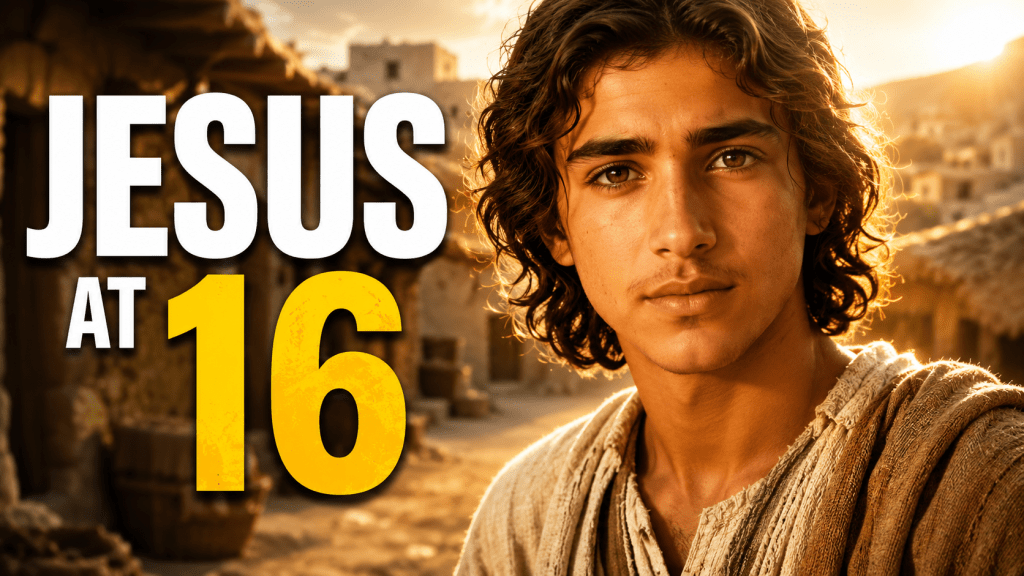
Chapter One: The Boy Who Would Not Speak
Jesus was sixteen when He rose before the sun and climbed the low slope beyond Nazareth, where the stones still held the night’s coolness and the wind moved softly through the scrub and olive branches. He knelt where the village sounds could not yet reach Him clearly, His hands resting open upon His knees, His face turned toward the Father in a stillness that seemed older than the hills. The stars had not all faded, and the eastern sky was only beginning to loosen from darkness, but He prayed as though morning had already been received and entrusted back to God.
If someone in a later age searched for a Jesus of Nazareth age 16 story, they might expect something loud enough to prove itself, something bright enough to make the hidden years feel less hidden. But the morning in Nazareth began with no spectacle. It began with a young man in prayer, with dust on His sandals, with the quiet obedience of a Son who did not need the world to notice Him in order to belong wholly to the Father.
There are stories that belong beside the quiet companion story about Jesus as a child, because they do not rush toward the public road or the crowded shore or the mountain where multitudes gathered. They stay in the years when Jesus was known to His neighbors as Mary’s son, the carpenter’s apprentice, the boy whose silence did not feel empty, the one who saw more than He was asked to see and carried that seeing without using it to draw attention to Himself.
Below Him, Nazareth began to stir. A goat complained from behind a wall. A woman shook out a woven mat near her doorway. Somewhere a child cried before being hushed against a mother’s shoulder. The village was small enough that one person’s grief could move through it like smoke and yet large enough that a guilty man could still hide if everyone was tired, busy, or afraid to ask the right question.
By the time Jesus opened His eyes, the first heat of the day had not yet come, but the pressure had already entered the lanes.
It came first in the form of a boy named Toviah, though no one would have called him the beginning of anything. He was nearly seventeen, narrow-shouldered from growth and hunger, with hair that fell over one eye and hands that had learned to close around things quickly. He had not slept. The skin beneath his eyes was dark, and there was dust on the hem of his tunic from where he had knelt behind the outer wall of the oil press before dawn, sick to his stomach, praying badly or maybe not praying at all. He had not known what to say to God, because all the words that came to him sounded like bargaining.
His younger sister, Liora, had coughed through the night until their mother pressed a cloth to her lips and whispered that the child must not wake the neighbors again. Their house was not really a house anymore but the back portion of one, divided by a patched curtain from the storage space of Toviah’s uncle, who had taken them in after Toviah’s father died. That was the way people said it. After his father died. They did not say after the beam slipped, after the rope frayed, after a son looked away at the wrong moment. They did not say that because Toviah had never told them enough for them to know.
He had told part of the truth. He had said the roof beam fell while he and his father were repairing the shed beside the press. He had said the old rope must have failed. He had said he had gone to fetch water when it happened, because that was close enough to what people could believe. He had not said he had been angry with his father that morning. He had not said he had thrown the coil of rope down hard because his father had corrected him in front of two other men. He had not said he noticed the rope catch against the corner of a broken stone and pretended not to see it because he wanted his father to struggle without him for a moment, just long enough to regret humiliating him. He had not said he heard the fibers tear.
His father had lived three days after the beam crushed him. Long enough to look at Toviah with fevered eyes. Long enough to try to speak. Long enough for Toviah to decide the unfinished words were accusation, even though no one else heard them.
Since then, Toviah had lived as if every room had a second room inside it where the truth waited. He worked where he could, carried water, hauled sacks, mended straps, swept the floor at the oil press, and bowed his head when men spoke sharply to him. But guilt had made him both hard and frightened. It had taught him that hunger did not ask whether a coin was clean before it spent. It had taught him that shame could become a hiding place. It had taught him that a boy who already believed himself cursed could do cursed things and call them survival.
That morning, he had stolen two small cakes of pressed figs from a merchant’s covered basket near the lower road. He had taken them because Liora had eaten almost nothing the day before. He had taken them because his mother had tried to stand and nearly fallen against the wall. He had taken them because he saw them unattended and because a hunger mixed with fear can make a hand move before the soul has time to protest.
But another boy had been seen near the basket. His name was Neri, the son of a widow who washed cloth for other families. Neri was eleven, maybe twelve, with a limp from a fever he had survived when he was small. He was often near the lower road because people sent him on errands and because he smiled too quickly, which made impatient men suspicious of him. By sunrise, someone had already said his name. By the time Toviah slipped the fig cakes beneath the mat in his mother’s room, the accusation had begun to move.
Toviah told himself it would pass. No one could prove anything. The merchant, Adin, was known for anger, and people grew tired of angry men when the sun became hot. Neri would cry, his mother would plead, the crowd would mutter, and by evening some new complaint would take its place.
Yet when Toviah stepped back into the lane, the sound near the well tightened something inside him.
Adin stood with one hand gripping Neri’s shoulder and the other raised toward the men gathering by the stone trough. His beard was uncombed, and the cords in his neck showed. “I saw him near the basket,” he said. “Do not tell me I do not know what my own eyes have seen. Twice this month something has gone missing. Twice. A poor widow’s son thinks pity will cover his fingers.”
Neri’s mother, Sela, stood a few steps away, her headscarf loosened from running. She had flour on one wrist and fear on her face. “He carried water for old Haggai,” she said. “Ask him. He went nowhere near your basket except to pass it.”
“He passed close enough,” Adin snapped.
The men around the well shifted with the uncomfortable silence of people who did not want injustice but also did not want to become responsible for sorting it out. A few women watched from doorways. Someone muttered that the boy had always been restless. Someone else said hunger made thieves of children. No one said hunger also made liars of older boys standing in the lane with stolen figs hidden under a mat.
Toviah stayed near the shadow of a wall. His mouth had gone dry. He could feel the small weight of the figs as if they were tied around his own throat.
Then Jesus entered the lane.
He came down from the slope without hurry. He had a water jar in one hand, because Mary had asked Him the evening before to draw before the line at the well grew long. His tunic was simple, the kind worn by any village son who worked with wood and stone and rough hands. Nothing about Him announced power. He did not raise His voice before He had heard the matter. He did not step into the center as though He needed to control the morning. Yet the space altered when He arrived, not because anyone bowed to Him, but because He brought with Him the same stillness that had rested on the hillside.
Toviah saw Him and looked away quickly.
He knew Jesus, as everyone in Nazareth knew everyone. He knew Him from the synagogue, from the carpenter’s yard, from the times Joseph had still been alive and had spoken kindly to boys who lingered near the sound of tools. He knew the shape of Jesus’ patience, which was different from other patience because it did not seem weak. He had seen younger children bring broken toys to Him and older men pause after speaking too harshly in His presence. Toviah had never understood it. He only knew that standing near Jesus made hidden things feel less hidden.
Adin noticed Him too. “Mary’s son,” he said, perhaps because he wanted another witness on his side. “You came by the lower road. Did you see this boy near my basket?”
Jesus set the jar beside the well. His eyes moved to Neri, whose chin trembled though he tried to hold it still. Then to Sela. Then to Adin. Then, for one brief moment, to Toviah in the shadow.
Toviah felt that glance like a hand placed gently on a locked door.
“I saw Neri carrying water,” Jesus said.
Neri made a small sound, almost a sob, and Sela covered her mouth with her fingers.
Adin’s face tightened. “You saw him carrying water where?”
“From Haggai’s house toward the upper lane.”
“That does not mean he did not come down again.”
“No,” Jesus said, and His voice remained quiet. “It does not mean that.”
The crowd shifted again. The answer did not rescue anyone completely. It did not strike Adin down or silence suspicion with a miracle. It left room for truth to become necessary. That room frightened Toviah more than accusation would have, because accusation could be resisted. Room could be entered.
Adin looked around as if gathering support. “Then let Haggai be asked. And let the boy’s hands be searched.”
Neri pulled back. “I did not take them.”
“You will not mind being searched if your hands are clean.”
Sela stepped forward. “He is a child.”
“He is old enough to steal.”
The sentence cut through the lane. Toviah watched Neri’s face change, not because the boy had been struck, but because something had been placed upon him that did not belong to him. Toviah knew that look. He had worn it since his father died. It was the look of someone being forced into a shape made by another person’s fear.
Jesus bent and lifted the water jar. For a moment Toviah thought He would leave. The thought filled him with both relief and disappointment so sharp that he hated it. But Jesus did not leave. He carried the jar to the trough, poured a little water for the animals waiting there, and then turned back.
“Adin,” He said, “if the figs are found elsewhere, what will you give back to the boy?”
Adin frowned. “What?”
“If his name is wounded before the village and he did not take what was yours, what will you give back?”
The question was not loud, but it made the air around the well grow heavy. Adin opened his mouth, then closed it. A man near him rubbed his beard and looked at the ground.
“I want what was stolen,” Adin said at last.
“Yes,” Jesus said. “And if you steal peace from the innocent while seeking it?”
Sela’s eyes filled with tears, but she did not speak. Neri stared at Jesus as if he could not understand why someone had placed words between him and the anger.
Toviah’s chest tightened until he thought he might cough. He wished Jesus had accused him directly. He wished the hidden thing would be dragged out by force, because then he could hate the one who dragged it. But Jesus did not look at him again. He let the question stand in the lane like a lamp lit too early in the morning.
Old Haggai arrived with a walking stick and a temper sharpened by age. He confirmed that Neri had carried water for him shortly after dawn. He had kept the boy longer than usual because a jar had cracked and needed binding. The timing made it difficult for Neri to have taken the figs, though not impossible. Suspicion loosened, but did not fall away.
Adin released Neri’s shoulder, not with apology but with annoyance. “Then someone else has quick hands.”
Someone laughed uneasily. No one looked at Toviah. That should have comforted him. Instead, it made him feel as if he were sinking.
The crowd thinned. People returned to bread, animals, work, family, heat, and the small duties by which a village survives its own sharpness. Sela pulled Neri close and pressed her face into his hair. Adin covered his basket with a cloth and tied the corners as if cloth could protect a man from every loss. Jesus filled the jar at the well, lifted it, and began walking toward the lane that led to His mother’s house.
Toviah waited until no one watched him. Then he moved.
He did not go home. He could not bear the thought of seeing the figs beneath the mat or Liora’s face when she found them. Instead he went behind the press, where the air was thick with the smell of crushed olives and old wood. The place had not changed enough since his father died. That was part of its cruelty. The same beam had been replaced, the same stone trough remained, the same corner of broken wall held warmth when the sun rose high. Men had gone on pressing oil. They had gone on laughing when the work was good. They had gone on living as though the place had not swallowed the last honest thing Toviah remembered loving.
He crouched near the wall and pressed his palms into his eyes.
He told himself he had not meant for Neri to suffer. He told himself Adin would forget. He told himself Liora needed food. He told himself a hundred things that had enough truth in them to hide the lie underneath.
A footstep sounded near the entrance.
Toviah stood quickly, wiping his face with the back of his wrist. Jesus was there, the water jar no longer in His hands. He had come quietly enough that Toviah wondered if He had been standing there for several breaths already.
“I am working here later,” Toviah said before Jesus could speak. “If you came for oil, Adin keeps the measures inside.”
“I did not come for oil.”
The words were simple. They left Toviah without something to answer.
Jesus stepped into the shade of the press. His eyes moved over the beam, the wall, the place where old stains had darkened the ground and never fully left. He did not ask what had happened there. That made Toviah angry, because the not asking felt like knowing.
“You should tell Adin to watch his baskets better,” Toviah said. “People are hungry.”
“Yes,” Jesus said. “People are hungry.”
“Then why ask him what he would give back? He lost figs. That is all.”
Jesus looked at him with a sadness that did not accuse and therefore offered no defense against it. “A name is not a fig cake.”
Toviah laughed once, harshly. “Neri still has his name.”
“Does he?”
The question struck him harder than it should have. Toviah turned away and kicked a small chip of stone into the dust. “You think because you speak softly people are less ashamed.”
“No,” Jesus said. “I know shame can hear a whisper.”
Toviah’s throat closed. For a moment the press, the wall, and the morning blurred. He hated that Jesus had said shame as if it were something sitting between them, not something hidden under Toviah’s ribs.
“You do not know what I carry,” he said.
Jesus did not move closer. “Your father loved you.”
The words tore through him so suddenly that he reached for anger like a man reaching for a weapon. “Do not speak of my father.”
“He loved you,” Jesus said again.
Toviah’s hands curled. “Everyone says that. They say it because the dead cannot correct them.”
“The dead are not the only ones who cannot speak,” Jesus said.
For a while, the only sound was the creak of a rope somewhere inside the press. Toviah stared at Jesus. He wanted to deny everything, but he did not know which thing to deny first. His father’s love. His own guilt. The stolen figs. The way Jesus had stood at the well and left a space in which truth could breathe.
At last he said, “Go home.”
Jesus’ face did not harden. “I will.”
Toviah expected relief. Instead, panic rose in him. “That is all?”
“For now,” Jesus said.
“You come here, say such things, and leave?”
Jesus looked toward the opening of the press, where sunlight had begun to gather in a bright line along the dirt. “I came because you were alone in a place where you keep returning, even when your feet are elsewhere.”
Toviah swallowed. He could not answer.
“And I came because Neri’s mother will remember this morning longer than Adin will remember his figs.”
That made Toviah flinch. He saw Sela’s face again, the flour on her wrist, the way she had stood helpless while her son was held before the village. He saw Neri trying not to tremble. He thought of Liora’s thin hands reaching for food that had cost another boy his peace.
“You want me to say I took them,” he whispered, and the words came out with contempt because he had no strength to let them come out as fear.
Jesus answered, “I want you to become true.”
Toviah stared at Him. The words were not what he expected. They were too large for a theft and too gentle for a threat. Become true. Not merely speak truth, not merely confess, not merely return what he had taken. Become true, as though falsehood had bent him out of his own shape and mercy was not willing to leave him crooked.
He shook his head. “You do not understand. My mother has nothing. My sister is sick. My uncle says we eat more than we bring in. Adin has baskets. Neri has a mother who believes him. I have…” He stopped because he almost said I have no father, and the sentence seemed childish even inside his own pain.
Jesus waited.
Toviah looked at the replaced beam above them. “I have work.”
“You have fear,” Jesus said.
The truth of it was so plain that Toviah could not bear to look at Him. He walked to the far side of the press and braced one hand against the wall. The stone was rough beneath his palm. He remembered his father’s hand closing around his shoulder on the day before the accident, not heavily, not angrily, but with a tired affection Toviah had shrugged away because he was sixteen and thought correction was hatred. He remembered the rope. He remembered the sound. He remembered his father trying to speak with breath that would not obey him.
“Fear keeps people alive,” Toviah said.
“Sometimes,” Jesus said. “And sometimes it keeps them from living.”
Toviah turned back. “Easy words from someone whose house is not hungry.”
Jesus’ expression changed then, not into offense, but into a quiet grief that made Toviah feel he had stepped carelessly on holy ground. Jesus knew hunger. Perhaps not his hunger, not the exact shape of it, but enough that the accusation did not stand cleanly between them. Toviah lowered his eyes first.
“I should not have said that,” he muttered.
Jesus did not use the apology to gain power over him. “Your sister needs bread,” He said. “That is true.”
Toviah’s jaw trembled once before he set it. “Then what would you have me do?”
Jesus looked toward the entrance again, where the village moved beyond them in ordinary sounds. “What belongs to Adin must be returned. What was placed on Neri must be lifted. What has been buried with your father must be brought before God.”
Toviah went cold.
“No.”
Jesus was silent.
“No,” Toviah said again, louder. “You speak as if truth is a clean thing. You speak as if people hear it and become merciful. They do not. They look. They remember. They decide who you are and never let you be anything else.”
Jesus said, “You have already decided who you are.”
That silenced him more completely than rebuke could have. He had decided. He had decided he was the son who killed his father. He had decided he was the brother who must steal if stealing kept Liora alive. He had decided he was beyond being known except as a warning, and every hidden sin since then had only served the first judgment he pronounced over himself.
But if that was true, then confession would not be the beginning of shame. It would be the end of being the only judge in the room.
The thought frightened him so badly that he rejected it.
“My mother cannot bear it,” he said. “If I speak of my father, it will break her.”
Jesus’ eyes held him steadily. “Your silence has not healed her.”
Toviah felt the anger rise again, but it had less strength now. It came with tears behind it, and he hated tears more than anger. “You do not know her.”
“I saw her yesterday,” Jesus said. “At the oven. She was trying to trade a clasp for flour. She turned it in her hand three times before she gave it away.”
Toviah looked down. The clasp had belonged to his father’s mother. His mother had told Liora she misplaced it. He had believed her because believing was easier than seeing.
“She did not want me to know,” he said.
“No,” Jesus answered. “She wanted you not to carry one more weight.”
Something inside Toviah shifted, not enough to free him, but enough to hurt differently. All this time he had imagined himself carrying the house alone. He had imagined his mother as fragile, Liora as helpless, his uncle as resentful, the village as watching, God as far. But perhaps everyone in the house had been hiding a burden from someone else, each silence pretending to be mercy while the truth starved between them.
A voice called from outside the press. Toviah’s uncle, Berek, shouted his name with irritation. “Toviah! If you are sleeping back there, I will give your place to someone with a stronger back.”
Toviah stiffened. Berek’s shadow crossed the entrance but did not come in. “Adin wants help loading before the heat,” he called. “And your mother sent word. Liora is worse.”
The words struck with immediate force. Toviah moved toward the entrance, then stopped, torn between the stolen figs, Neri’s wounded name, Adin’s anger, his mother’s hidden sacrifice, and the child coughing behind the curtain. The whole morning seemed to close around him like a fist.
Berek glanced inside and saw Jesus. His posture changed, though not into respect exactly. More into discomfort. “Mary’s son,” he said. “Did not know you were here.”
Jesus greeted him quietly.
Berek looked from Jesus to Toviah. “We need coin, not talk.”
Toviah walked past him into the sun. The village looked the same as it had before, but he did not. That was the trouble. Once a hidden thing had been touched by light, even gently, darkness no longer felt like shelter. It felt like delay.
He did not confess that morning. He did not run to Adin with the figs or kneel before Sela or tell his mother about the rope. He did what frightened people often do when truth first finds them. He returned to work. He lifted sacks. He avoided Neri’s lane. He told himself he would decide later. But while he bent under the weight of an oil jar, he saw Jesus across the road carrying a board toward the carpenter’s yard, and the words followed him more faithfully than any accusation could have done.
I want you to become true.
By midday the heat settled over Nazareth, pressing the smell of animals, bread, oil, and dust into every narrow place. Toviah worked until his shoulders burned. Once, Adin cursed him for nearly dropping a tied bundle, and Toviah almost shouted that he was the one Adin sought. Instead he lowered his head and tightened the rope. The old habit held. Silence first. Survival first. Truth later, if later ever became less costly.
Near the well, Neri sat with his bad leg stretched before him, mending a strap for a woman who did not look directly at him. The boy’s mother had stayed near their doorway most of the morning. People had not condemned Neri, but neither had they fully cleansed him. Suspicion had a way of remaining after evidence weakened it, like smoke in cloth.
Toviah saw him and looked away.
When he returned home in the late afternoon, the figs were gone.
For one terrible moment he thought Liora had eaten them. Then he saw them on the low table, untouched, beside his mother’s hand. She sat on the floor with her back against the wall, pale from weariness. Liora slept under a thin covering, her breath rough but steadier than it had been before. The room smelled of damp cloth and bitter herbs.
His mother looked at him without accusation. That was worse.
“Where did these come from?” she asked.
Toviah’s tongue felt thick. “Someone gave them.”
“Who?”
He looked toward the curtain. His uncle’s voice sounded faintly from the storage side, speaking with a neighbor. The house felt too small for a lie and too dangerous for truth.
“Toviah,” his mother said softly.
He hated the softness. He wanted anger because anger would tell him where to stand. But her voice held only exhaustion and love, and he found himself suddenly younger than sixteen, younger than the boy who had thrown the rope, younger than the son who had kept watch beside a dying father and mistaken every broken breath for condemnation.
“I brought them,” he said.
“From where?”
He could not answer.
His mother closed her eyes. A tear slipped down one side of her face, but she wiped it away quickly, as if even sorrow had to be rationed. “Take them back,” she said.
He stared at her. “Liora needs food.”
“She needs a brother who is not eaten by what he hides.”
The sentence felt impossible, because it sounded too close to what Jesus had said without using any of the same words.
Toviah backed toward the doorway. “I am trying to keep us alive.”
His mother opened her eyes. “So was your father.”
He stopped.
She seemed to regret the words as soon as they left her. Her face trembled, and she pressed one hand against her mouth. For nearly a year, they had moved around his father’s name as if it were a clay jar already cracked. Now it sat between them, and neither knew how to touch it without cutting themselves.
Toviah wanted to tell her everything then. He wanted to fall at her feet and pour out the rope, the anger, the sound, the three days, the stolen food, the terror that God had seen it all and turned His face away. But Liora stirred, and Berek laughed behind the curtain, and the late sun burned across the floor. The moment passed, not because it was false, but because courage sometimes arrives before a person is willing to open the door.
He grabbed the figs from the table.
“I will take them,” he said.
His mother did not ask where. She only nodded once and looked toward Liora.
Outside, the village had begun to soften toward evening. Shadows lengthened along the lane. Men returned from work with dust on their feet. Women pulled bread from the oven and called children close. The world was still the world, and yet Toviah walked through it carrying two fig cakes as if they weighed as much as the beam that had fallen on his father.
He did not go to Adin first. He went toward the carpenter’s yard.
Jesus was there, smoothing the edge of a small board while the last light touched the wall behind Him. The yard smelled of cedar shavings and sweat and sun-warmed wood. Mary moved inside the house, her presence quiet beyond the doorway. Jesus looked up before Toviah spoke, as if He had been waiting without impatience.
Toviah held out the figs.
“My mother found them,” he said.
Jesus set the tool down.
“She told me to take them back.”
“That is good.”
Toviah’s hand tightened around the figs. “Good would be if I had never taken them.”
Jesus came closer, but not too close. “Yes.”
The answer surprised him. He had expected comfort to cover the wrong quickly, but Jesus did not pretend the wound was smaller than it was. Somehow that made the mercy in His face more real, not less.
Toviah looked at the figs in his hand. “If I return them, Adin will want more.”
“Perhaps.”
“If I tell him Neri did not take them because I did, everyone will know.”
“Yes.”
“If I speak of my father, my mother will know I lied.”
Jesus was quiet for a long moment. “Your mother already knows there is pain you have not given words to.”
Toviah’s eyes burned. “And if God knows?”
“He does.”
The simplicity of it undid him. He had lived as if God’s knowing were the worst thing imaginable. He had imagined God storing the truth like a stone to throw at him when he finally became too tired to run. But Jesus spoke those two words without contempt. He does. Not as a threat. Not as an ending. As if being known by God was the only place where a ruined boy might still be gathered.
Toviah could no longer hold Jesus’ gaze. “Then why has He let me keep breathing?”
Jesus answered, “Because He is not finished calling you son.”
The fig cakes broke in Toviah’s hand. He had gripped them too tightly. Sweet paste stuck to his palm, and for one strange, humiliating moment, that small mess seemed to reveal everything about him. He was hungry. He was guilty. He was loved. He was not ready.
A sob rose in his chest, but he swallowed it down. “I cannot do it tonight.”
Jesus did not force the moment past what Toviah could bear. “Then do not call delay obedience.”
Toviah nodded, though the words hurt.
“Bring them to Adin,” Jesus said. “Say what is true about the figs. Let Neri’s name be lifted before another night covers it. The rest will come into the light when you are willing to stop guarding the grave alone.”
The grave. The word carried his father without naming him. Toviah looked toward the lane where Adin’s house stood. Evening smoke rose above the roofs. Somewhere Neri’s mother was preparing what little she had for supper. Somewhere his own mother sat beside Liora, waiting for a son she could not save from himself by silence.
He took one step backward, then another.
“Will you come with me?” he asked, and the question came out before pride could stop it.
Jesus picked up the water skin near the bench and handed it to him. “I will walk near you.”
Toviah wanted to ask why not with me, but he understood before he asked. This truth could not be carried for him. It could be witnessed. It could be surrounded by mercy. It could be strengthened by the presence of one who did not turn away. But it still had to pass through his own mouth.
They left the carpenter’s yard as evening settled over Nazareth. Jesus walked a little behind him, close enough that Toviah could hear His steps in the dust, far enough that the figs remained in Toviah’s hand and the choice remained his own. The road to Adin’s house was not long, but it felt longer than any road Toviah had ever walked.
At the bend near the well, Neri looked up and saw them.
Toviah stopped.
The younger boy’s face changed, cautious and wounded. Sela stood behind him with a bowl in her hands. Adin’s doorway waited farther down the lane, but the first debt was suddenly nearer than Toviah had expected. He had thought he would speak to Adin, return the figs, endure anger, and somehow let that count as enough for one night. But Neri was there, and the name that had been wounded was not an idea. It was a boy with a limp, a mother, and eyes that had learned too much about suspicion in a single morning.
Toviah looked back once.
Jesus did not nod in command. He did not gesture. He simply stood in the road with the quiet mercy of the Father shining through Him in a way Toviah could not understand and could not deny.
Toviah turned toward Neri.
The words did not come yet. His mouth opened, then closed. The evening sounds continued around them. A door shut. A donkey brayed. Someone called for a child. Dust moved in the low light.
Neri waited.
Toviah felt the old fear rise, fierce and familiar, telling him he could still choose another road, still say nothing, still carry the figs to Adin and leave Neri out of it, still survive another day without becoming true. Then he felt something else beneath the fear, smaller but steadier, like the first breath after being underwater too long.
He held out the broken figs.
“I need to tell you what I did,” he said.
Chapter Two: The Name He Could Not Give Back
Neri did not reach for the figs. His eyes moved from Toviah’s hand to Toviah’s face and then to Jesus standing behind him in the lane. Sela’s bowl remained held against her waist, tilted slightly, forgotten for the moment, and the thin broth inside it trembled with the small shaking of her hands. The evening had already softened the walls of Nazareth into amber and shadow, but the space between the two boys felt as bare as noon. Toviah understood then that confession was not only the act of pushing words out of one’s mouth. It was the terrible moment when another person had to decide what to do with the truth you had injured them with.
“I took them,” Toviah said, because if he did not say it quickly he feared he would lose the nerve. “Adin’s figs. I took them before sunrise. You did not.”
Neri’s lips parted, but no sound came. He looked younger than he had that morning, not because innocence made a child small, but because public shame had taken something from him and he did not yet know whether it would be returned. Sela set the bowl on the low ledge beside the doorway. Her face had gone pale, and for one instant Toviah thought she might strike him. He almost wished she would. Pain from a hand would have been easier than the look in her eyes.
“You let them hold my son before the well,” she said.
Toviah swallowed. “Yes.”
“You stood there.”
“Yes.”
“And you said nothing.”
The figs in his palm had become sticky and ruined. He lowered his hand because he could no longer bear to hold them out as though they were payment. “I was afraid.”
Sela’s face tightened. “So was he.”
The sentence entered him cleanly, without force, because it was impossible to resist. He remembered Neri’s shoulder trapped beneath Adin’s hand, the crowd’s silence, the way the village had waited for proof as if a frightened child’s face were not already enough to slow them down. He had thought of his own fear all morning and had not allowed Neri’s to become real inside him until now.
Neri glanced at his mother, then back at Toviah. “Why?”
The question was small, almost careful. It carried no accusation large enough for Toviah to hide behind. Why had he stolen? Why had he stayed silent? Why had he allowed another name to darken in his place? Toviah could have answered with hunger, Liora’s cough, his mother’s weakness, his uncle’s anger, all the things that were true but not complete. He looked down at the broken figs again and felt the poverty of every excuse.
“My sister is sick,” he said. “There was no bread. I saw the basket. I told myself Adin had enough. Then he took your shoulder at the well, and I told myself he would let go if I waited.”
Neri stared at him. “He did not.”
“No.”
“You could have said it then.”
“I know.”
Neri’s face changed, not into forgiveness, but into something sharper and sadder. “Everyone looked at me.”
Toviah nodded, though he knew nodding did nothing. “I know.”
“No, you do not,” Neri said, and for the first time his voice rose. “They looked as if they were already remembering it for later. As if when anything goes missing now, they will think of me first.”
Sela reached for him, but Neri stepped away from her touch. His limp made the movement uneven, and Toviah noticed what he had not let himself notice before. Neri’s body had already taught him what it meant to be watched. The accusation had not fallen on a boy with easy standing in the village. It had fallen on someone people could already reduce to a story that fit their impatience.
Toviah turned his head slightly toward Jesus, but Jesus was not there to speak in his place. He stood near enough to witness and far enough to keep Toviah from using Him as a shield. The road held all four of them in its hush, and the first lamps inside nearby houses began to glow.
“What do you want from us?” Sela asked.
The question surprised Toviah. He had expected her to demand something from him. Instead she understood the danger of a guilty person coming to the wounded with confession in one hand and need in the other. Did he want forgiveness so he could feel clean? Did he want them to soften the cost? Did he want Neri to carry mercy before anyone had returned his name?
“I do not know,” Toviah said, and the honesty embarrassed him. “I need to tell Adin. I needed to tell Neri first.”
“You needed,” Sela said.
He lowered his eyes. “Yes.”
Sela breathed in slowly. Her anger did not leave her, but grief sat beside it. “My son is not a step on your road to feeling better.”
Toviah felt the words press into him. “No,” he said. “He is not.”
Neri looked down the lane toward Adin’s house. “Will you tell him where people can hear?”
The question struck a place Toviah had tried to avoid even while walking there. He had imagined returning the figs and saying enough for Adin to stop suspecting Neri. But enough had a way of shrinking when fear was allowed to define it. If he confessed privately, Adin might believe him, might not. Adin might clear Neri, might not. The stain had been public. Perhaps the lifting had to be public too.
“I will tell him,” Toviah said, then forced himself to continue. “Where others can hear.”
Neri watched him carefully, as if testing whether the promise had bones in it. “Tonight?”
Toviah looked toward Jesus again, then back to Neri. “Tonight.”
Sela picked up the bowl from the ledge. She did not invite him nearer. She did not bless his courage. She said, “Then go before the village settles into its own version of the story.”
Toviah nodded. He stepped back, and for a moment he thought that would be the end of it. Then Neri spoke again.
“Toviah.”
He stopped.
The younger boy’s face was hard to read in the deepening light. “I am glad you told me.”
The words were not forgiveness. They were not peace. They were something more fragile, perhaps the first piece of a bridge no one yet trusted. Toviah felt them more deeply than comfort because they did not pretend the damage was gone.
“I am sorry,” he said.
Neri looked at the ground. “I know.”
That answer stayed with Toviah as he turned toward Adin’s house. Jesus fell into step behind him again, and the village seemed at once too familiar and utterly strange. Every doorway held a possible witness. Every face he passed might soon know. A few people glanced at him, then at Jesus, then at the figs crushed in his hand. Toviah wondered whether confession had a smell the way fear did, whether people could sense it before it arrived.
Adin was tying bundles beneath the awning beside his door when Toviah reached him. Two men stood nearby, one bargaining over oil, another waiting for a measure of lentils. Adin looked up with irritation that sharpened when he recognized the boy.
“You are late if you came for loading,” he said. “I found another back.”
Toviah’s first instinct was to accept the insult as a doorway out. He could say he had come for work, let Adin turn him away, return home with the confession still unspent, and tell himself the opportunity had been denied him. But Jesus’ words from the carpenter’s yard pressed gently and firmly against that escape. Do not call delay obedience.
“I came about the figs,” Toviah said.
Adin’s hands paused on the rope. “What about them?”
The two men nearby looked over. So did a woman passing with a covered basket. Toviah felt the first edge of public attention touch him, and his body wanted to flee. He saw Neri in his memory standing under the same attention. He held still.
“I took them before sunrise,” he said. “Neri did not. I let you accuse him.”
Adin straightened slowly. His face passed through surprise into anger, then into something darker, because anger that has found a rightful target often enjoys the relief too much. “You?”
“Yes.”
“You stood at the well while I held that boy?”
Toviah forced himself not to look away. “Yes.”
One of the men muttered under his breath. The woman with the basket stopped completely. Across the lane, a door opened. The village, which had seemed to be settling into evening, began to gather around the disturbance as naturally as water finds a low place.
Adin stepped closer. “Where are they?”
Toviah opened his hand. The crushed fig cakes lay in his palm, broken, dirty at the edges, no longer worth what he had stolen. A few people made small sounds of disgust. Adin stared at them, and his jaw tightened.
“You ruined them.”
“I know.”
“You stole from me and ruined what you stole.”
“Yes.”
“And you let me shame a lame boy in front of the well.”
The word lame made Toviah flinch, not for himself but because Neri had probably heard it used that way his entire life. “Yes.”
Adin looked past him and saw Jesus. Something in his expression shifted, perhaps embarrassment, perhaps resentment that Jesus had been present at both the accusation and the confession. “Did He bring you here?”
Toviah could have let the question carry some of the burden away. He could have said Jesus made him, Jesus found out, Jesus told him to confess. But that would have turned truth into another hiding place.
“No,” he said. “He walked near me.”
Adin gave a hard laugh. “Near you. That is good. A thief with holy company.”
The words struck the crowd in different ways. Some looked down. Some watched Jesus to see whether He would answer the insult. Jesus said nothing. He did not defend Himself, and He did not defend Toviah from the rightful heat of the moment. Toviah understood, with a fear that made him feel almost hollow, that mercy was not rescue from consequences. Mercy was the presence of God inside them.
“What do you want?” Adin demanded. “Forgiveness? Work? Bread? Shall I give you more to carry home?”
“No,” Toviah said. “I came to say Neri did not take them.”
“You came to say what saves him and condemns you.”
“Yes.”
Adin leaned close enough that Toviah could smell oil and old garlic on his breath. “Then hear me. You will pay for what you stole.”
“I will.”
“With what?”
The question exposed the foolishness of his courage. Toviah had not thought beyond the confession. He owned nothing. His wages, when he found work, went to Berek for household debt or to small purchases for Liora. The figs were not much, but for a family living against the edge, even little debts had teeth.
“I will work,” he said.
“You already work poorly.”
Toviah took the blow without answering. Several people were watching now, including old Haggai, who leaned heavily on his stick. Sela and Neri had come to the edge of the gathering but remained apart from it. Toviah saw them and felt both gratitude and shame. Neri had wanted witnesses. Now witnesses had come, and Toviah had to stand where he had left the younger boy standing.
Adin’s voice rose. “Let everyone hear. This one stole from my basket, let me accuse another, and now offers me broken fruit as if confession repairs a theft. His father was an honest man. It seems honesty was buried with him.”
The mention of his father struck Toviah so violently that he nearly stepped backward. The crowd’s murmur deepened. Berek appeared from the side lane, drawn by the noise. His eyes narrowed when he saw Toviah at the center.
Jesus’ face changed when Adin spoke of the dead, though He still did not interrupt. There was sorrow in Him, but also a waiting that felt almost severe. Toviah knew why. The first wound had been touched. Not healed. Not opened fully. Touched.
Berek pushed into the gathering. “What is this?”
Adin turned toward him with satisfaction. “Your nephew has quick hands.”
Berek looked at Toviah. “Tell me he lies.”
Toviah could have done so once. He had lied better under greater pressure. But confession, once begun, made certain old skills feel unusable. “He does not.”
Berek’s face darkened. “Idiot boy.”
Sela stepped forward then, surprising everyone. “He has told the truth.”
Berek rounded on her. “And that feeds anyone?”
“No,” she said. “But it gives my son back what your nephew let be taken.”
For a moment Berek had no answer. His anger needed a simpler room than this, one with only debt and shame in it. Sela’s wounded dignity complicated things. He looked at Neri, then away.
Adin was not finished. “He will repay double.”
Old Haggai snorted. “For two fig cakes?”
“For theft and insult,” Adin said.
Haggai leaned on his stick. “If you demand double from a hungry house, say plainly that hunger pleases you when it belongs to another.”
Adin flushed. “Stay out of it, old man.”
“I was brought into it this morning when you used my name to weigh a child’s innocence.”
The crowd stirred again. Toviah watched the argument begin to move beyond him, and a dangerous relief rose in his chest. If others fought, he could become smaller. If Adin and Haggai argued long enough, perhaps the focus would shift. Then Jesus spoke, not loudly, but with such clarity that the gathering quieted.
“What was stolen must be restored,” He said. “What was falsely placed must be removed. Let neither hunger excuse sin nor anger multiply it.”
The words settled over the lane. They gave no one everything they wanted. Adin could not use righteousness as a cloak for cruelty. Haggai could not use compassion to erase what Toviah had done. Berek could not reduce the matter to inconvenience. Toviah could not hide behind hunger. The truth stood in the center, and around it, every heart had to show itself.
Adin looked at Jesus with irritation and reluctance. “Then what would you call restoration?”
Jesus turned to Toviah. “Ask the one you wronged.”
Toviah looked toward Adin first, confused. Adin was the one who had lost property. But Jesus’ gaze guided him farther, to Neri.
Neri stiffened when every face turned toward him. Sela placed a hand lightly on his back, but she did not speak for him. The boy looked frightened, then thoughtful, then angry again in a way that seemed to give him strength.
“I want him to say it at the well tomorrow,” Neri said. “In the morning. When the people who heard it can hear.”
Adin made an impatient noise. “This is between my basket and his hands.”
Neri turned toward him. “You held my shoulder.”
Adin’s mouth closed.
“I want you to say you were wrong too,” Neri said.
The request moved through the gathering with the force of something small and just. Adin stared at the boy as if he had been asked to surrender his house. Toviah felt a strange and painful admiration for Neri. He had thought confession meant he alone would be exposed, but truth was wider than that. It touched the man who stole, the man who accused, the crowd that watched, the family that hid, the village that let suspicion fall where it was easiest.
Adin’s eyes hardened. “I will not be corrected by children.”
Neri lowered his head, and Toviah saw the hope in him falter.
Jesus looked at Adin. “Then be corrected by truth.”
The words were calm, but the lane seemed to grow still around them. Adin’s face flushed more deeply. He looked at the people watching him, perhaps measuring how much pride would cost him and how much humility would. He was not a cruel man in the whole of his life. Toviah knew that, and so did others. He had helped families after bad harvests, though he spoke of it too often. He had given oil for burials. He had also become a man who trusted his losses more than his neighbors, and this morning that distrust had found a child’s shoulder.
Adin looked away first. “Tomorrow,” he said, the word forced through his teeth. “At the well. I will say I was wrong about the boy. And this one will repay what he stole.”
The gathering released a breath. It was not peace, but it was movement. Toviah nodded. “I will repay.”
“With work,” Adin said. “Three mornings. Before heat. No wage until the debt is cleared.”
Berek started to object, perhaps because unpaid labor meant less brought into his own household, but Haggai cut him a look that made him stop. Toviah accepted. Three mornings for two figs was more than the fruit was worth and less than the damage done. He could bear it, he thought. At least he hoped he could.
The crowd began to loosen. People carried the story away in pieces, some softened by what they had seen, others eager to retell it with sharper edges. Sela took Neri home. Adin returned inside with the ruined figs, though what he intended to do with them Toviah did not know. Haggai touched Toviah’s arm as he passed and said nothing, which somehow steadied him more than advice would have.
Berek remained, and when the lane cleared enough for anger to become private, he seized Toviah by the sleeve and pulled him toward the side of the house. Jesus remained near the road, not intruding, not abandoning. Toviah felt the distance like a question.
“You fool,” Berek hissed. “Do you think we can afford your conscience?”
Toviah’s face burned. “Neri was blamed.”
“And now you are. Does that fill Liora’s belly?”
“No.”
“Does it buy medicine?”
“No.”
“Does it bring your father back?”
The words landed with old violence. Toviah’s eyes lifted sharply, and Berek saw something in them he did not understand. His uncle’s grip loosened, but his anger did not. “Your mother is nearly out of strength. Your sister coughs blood into rags. I have given you space under my roof and work when I can find it. And you choose this day to make yourself useless for three mornings?”
“I stole,” Toviah said. “I had to tell.”
Berek’s mouth twisted. “Had to. Listen to him. The boy discovers righteousness after theft.”
Toviah looked past him toward Jesus. He did not want Jesus to hear this, but of course He heard. Not merely the words. The fear beneath Berek’s anger. The shame beneath Toviah’s silence. The whole house of want and resentment in which none of them knew how to live kindly.
Berek followed his glance and lowered his voice. “Do not let Mary’s son make you proud of suffering consequences. Holy boys can afford clean hands when their mothers are not begging for flour.”
This time Toviah did not repeat the accusation. He had said something like it earlier, and the memory made him ashamed. Yet Berek’s words still found a mark. There was a kind of truth in them, enough to tempt him. Clean hands were costly. Maybe too costly. Maybe righteousness belonged to households with full jars.
Jesus came nearer then, only a few steps. “Berek,” He said.
Berek turned, defensive. “Will you pay the debt too?”
“No.”
“Then what will you say?”
Jesus looked at him with deep attention. “That bitterness charges interest poverty never asked for.”
Berek’s face tightened as if he had been struck, though Jesus had not raised His voice. “You know nothing of what I carry.”
“I know you took in your brother’s widow,” Jesus said. “I know you have reminded yourself of that kindness so often that it has become harder for you to offer it.”
Toviah stared at his uncle. Berek’s expression changed in a way he had never seen before. The anger remained, but something wounded showed beneath it, something humiliated by being seen accurately. For a moment he looked older, not merely stern but tired from keeping a count of every sacrifice.
Berek released Toviah’s sleeve. “Go home,” he said. “Your mother is waiting.”
He walked away before anyone could answer. Toviah stood in the side lane with his arm still tingling where Berek had gripped it. The confession had not freed him the way he had imagined freedom might feel. It had loosened one chain and revealed others. Neri’s name was not fully restored yet. Adin’s pride had only bent, not broken. Berek’s resentment had sharpened. His mother still waited in a room with a sick child. His father’s death still sat unspoken in the deepest part of him.
“I thought telling the truth would make the air easier to breathe,” he said.
Jesus looked toward the darkening sky. “Sometimes truth first shows us how long we have been holding our breath.”
Toviah rubbed his palm against his tunic, but the sweetness of the figs clung there. “Tomorrow at the well, I have to say it again.”
“Yes.”
“And Adin has to say he was wrong.”
“Yes.”
“He may not.”
“He has been invited into truth,” Jesus said. “You cannot obey for him.”
That sentence brought a strange relief. Toviah had spent the day discovering how many people his sin had touched, and the largeness of it had nearly crushed him. Now Jesus placed a boundary around what belonged to him. He could not repair every heart. He could not make Adin humble. He could not force the village to stop whispering. He could only refuse to keep lying.
“My mother will ask what happened,” Toviah said.
“Tell her what is true about tonight.”
The careful wording did not escape him. “Not everything?”
Jesus’ face held the gravity of the deeper wound. “Do not use one confession to hide forever from another. But do not tear open your house in panic and call it courage. Truth spoken in fear can still be selfish if it is only trying to escape the pain of carrying it.”
Toviah had not considered that. He had imagined silence and confession as simple opposites, one cowardly, one brave. Jesus made him see that even confession could bend toward the self if it demanded that others absorb what he had not brought to God with humility. His mother deserved truth, but not as a burden thrown at her because he could no longer stand the weight.
“How will I know when?” he asked.
Jesus answered, “You will know when love for her becomes stronger than fear for yourself.”
They walked toward Toviah’s house. The evening lamps had deepened into small fires behind cloth and doorway. Above them, the first stars appeared over the dark ridgeline. Nazareth was not large, but that night it felt like a world of hidden rooms, each person guarding something, each household carrying its own small sorrow, each silence deciding whether it was protection or prison.
At the doorway, Toviah paused. He expected Jesus to stop in the lane, but He came close enough to stand beneath the lintel. From inside came Liora’s rough breathing and his mother’s low murmur. The sound undid him more than Adin’s anger. Toviah had faced the village and still feared the room where he was loved.
“My hands are dirty,” he said, looking at the dried fig on his palm.
Jesus glanced toward the water jar near the entrance. “Then wash them before you touch your sister.”
The instruction was so practical, so ordinary, that Toviah almost laughed. Instead he poured a little water over his hands and rubbed until the stickiness loosened. The stain did not disappear fully from under his nails, but the worst of it went into the dust. He thought perhaps that was how the day had gone. Not clean yet. But no longer pretending.
His mother looked up when he entered. Her eyes searched him first for injury, then for news. Liora slept curled on her side, cheeks flushed. Berek was nowhere inside, which was mercy for the moment. The room felt smaller with Jesus at the doorway, not because He crowded it, but because truth seemed to enter with Him.
“I took them back,” Toviah said.
His mother closed her eyes briefly. “And?”
“I told Adin. I told Neri first.”
Her hand moved to her chest. “You told the boy?”
“Yes.”
“Was he angry?”
“Yes.”
She nodded slowly, as if anger made sense to her and therefore did not frighten her as much as silence had. “Good.”
The word startled him.
She saw his surprise. “He should not have to forgive you quickly so you can feel better.”
Toviah looked toward Jesus. A faint warmth touched Jesus’ eyes, not amusement exactly, but recognition. His mother, tired and poor and frightened, had understood what Toviah was only beginning to learn.
“Tomorrow I have to speak at the well,” he said. “Adin too.”
His mother absorbed this. Her face tightened with concern, but she did not tell him to avoid it. “Then you will go.”
“I will lose three mornings’ wages.”
“We have lost more than that to silence,” she said.
The room grew very quiet, and Toviah wondered whether she knew how close she had come to the hidden place. Perhaps mothers knew more than sons feared and less than sons needed. Perhaps grief had been speaking in the house all year, and only he had insisted it remain unnamed.
Liora stirred and opened her eyes. She saw Jesus near the doorway and smiled weakly. “You came.”
Jesus stepped inside then and knelt near her mat. “I came with your brother.”
“Did he bring food?” she asked, too young and too ill to understand the wound in the question.
Toviah’s face twisted. His mother reached for the child’s hand. “Not tonight, little bird.”
Liora looked disappointed but not surprised. Jesus touched the edge of the blanket near her shoulder, not in display, not as a performance of power, but with tenderness so complete that Toviah felt the room bow inward around it.
“You are tired,” Jesus said to her.
She nodded. “My chest is loud.”
“Yes.”
“Can You make it quiet?”
Toviah stopped breathing. His mother’s eyes lifted to Jesus with the sudden fear of hope. Even the night outside seemed to wait. The question was innocent, but it carried the desperation of the whole house. Toviah knew stories, whispered and half-understood, of God’s mercy, of prophets, of healings from older days. He knew prayers spoken over fever. He knew disappointment when morning came and sickness remained.
Jesus looked at Liora with such compassion that Toviah thought He might do it. He thought the child’s breathing might ease at once, that color might return to her cheeks, that the room might fill with awe and tears, that every wound in the house might be swallowed by visible mercy. But Jesus did not make Himself a spectacle for their fear.
He took the cup from beside her mat and held it while her mother lifted her head. “Drink a little,” He said.
Liora drank. Her breath still rasped afterward, though perhaps less from the water. Toviah could not tell. The hope that had leapt in him fell back, bruised by its own reaching.
Jesus remained beside her. “The Father hears you,” He said.
Liora looked at Him with heavy eyes. “Even when I cough?”
“Even then.”
She seemed to consider this as though it mattered more than medicine. “Does He hear Toviah?”
Jesus looked toward him. “Yes.”
Liora’s eyes drifted shut. “Good. He needs it.”
The words pierced the room gently. Toviah turned away, unable to bear his sister’s trust. His mother wiped her face with the corner of her scarf. Jesus stayed kneeling until the child slept again, then rose.
“There is an herb woman near Sepphoris,” Jesus said to Toviah’s mother. “Mara, wife of Eliab. She has helped children with rough breathing. I will ask Joseph’s old friend if he travels that way tomorrow, and whether word can be sent.”
Toviah’s mother nodded, gratitude and worry mingled. “We cannot pay much.”
“Ask what is needed when help arrives,” Jesus said. “Do not refuse help before it is offered.”
That sentence seemed to reach more than one person in the room. Toviah heard it and thought of confession. His mother heard it and looked down at her hands. Perhaps she had refused kindness in her mind a hundred times because she could not bear the shame of needing it.
Jesus stepped back toward the doorway. Toviah followed Him outside, not wanting Him to leave and not knowing how to ask Him to stay. The night had come fully now. A dog barked somewhere beyond the lower lane. The air had cooled, and smoke from evening fires lay low over the village.
“Why did You not heal her?” Toviah asked before he could stop himself.
Jesus turned to him. There was no offense in His face. “Is that what you wanted Me to do?”
“Yes.” Toviah’s answer came raw. “If You can.”
The words hung there. If You can. He did not know why he said them. He did not even know what he believed Jesus could do. He only knew that when Jesus was near, God did not feel distant in the same way, and that made hope dangerous.
Jesus looked toward the hills beyond Nazareth, their shapes dark beneath the stars. “The Father’s works are not done to spare every heart from trust.”
Toviah frowned, frustrated. “That sounds like something men say when they cannot help.”
“Many men do say such things,” Jesus answered. “Sometimes to excuse themselves.”
“Then what does it mean when You say it?”
Jesus looked back at him. “It means your sister is seen, your mother is seen, you are seen, and the Father is not absent because He has not obeyed your fear.”
Toviah wanted to reject the words. He wanted a God who would prove love by removing every threat before obedience became costly. Yet the day itself stood against him. Had Jesus been absent when Neri was accused? No. He had stood there and asked a question that made truth possible. Had He been absent in the press? No. He had found Toviah where shame kept returning. Had He been absent in Adin’s lane? No. He had spoken in a way that allowed justice without cruelty. Presence had not erased cost, but it had changed what cost meant.
“I am afraid she will die,” Toviah said.
Jesus did not soften the truth with easy promise. “I know.”
“If she does, my mother will break.”
Jesus’ voice lowered. “Your mother has bent under more than you know.”
“And me?”
Jesus looked at him with mercy that seemed to enter the question before answering it. “You have mistaken breaking for the end of being loved.”
Toviah’s eyes filled. He looked down quickly. “I do not want to be like this.”
“I know.”
“I do not know how to be different.”
“You have begun.”
The answer felt too small for the size of what remained, yet he could not deny that something had begun. Morning Toviah would have let Neri carry the suspicion. Evening Toviah had spoken, though badly and late. Morning Toviah had believed truth would destroy him. Evening Toviah was still standing. That did not make him whole. It did not even make him good. But it made the lie less complete.
Jesus began to leave, then paused. “Tomorrow, do not speak at the well to punish yourself.”
Toviah looked up.
“Speak to restore what you harmed. There is a difference.”
He nodded slowly. Punishing himself would still keep him at the center, even in shame. Restoration required him to consider Neri, Sela, Adin, the village, his mother, God. It was harder because it was less dramatic. It did not let him drown in his own guilt and call that humility. It asked him to stand, tell the truth, and then live differently afterward.
Jesus continued down the lane toward His own house. Toviah watched until the darkness folded around Him. Then he returned inside and lay near the doorway, not sleeping, listening to Liora’s breathing and his mother’s occasional movement beside her. Berek came in later without speaking. He stepped over Toviah as if he were an object left in the way and disappeared behind the curtain. The night stretched long, filled with the sound of breath, the memory of public shame, and the strange new fear that truth might keep asking for more.
Toviah dreamed of the beam again. In the dream his father stood beneath it, alive and whole, asking him to hold the rope steady. Toviah tried, but his hands were covered with figs, slick and sweet, and the rope slipped no matter how tightly he gripped it. He woke before the beam fell, gasping, with his mother’s hand on his shoulder.
“You cried out,” she whispered.
He sat up, shaking. The room was gray with the first hint of dawn. Liora slept. Berek snored beyond the curtain. His mother crouched beside him, hair loose around her face.
“What did I say?” Toviah asked.
She hesitated. “You said, ‘I saw it.’”
The words landed between them.
Toviah could not speak. His mother’s hand remained on his shoulder, light but steady. He thought she might ask, but she did not. Her restraint was not ignorance. It was love waiting at the edge of a door he had not yet opened.
After a while she said, “You should wash before the well.”
He nodded.
The village was still half asleep when Toviah stepped outside. The sky in the east had begun to pale, and the stones were cool beneath his feet. He washed at the jar, tied his tunic, and started toward the well before fear could persuade him that sickness at home excused him from public truth. As he walked, he saw Jesus already coming from the direction of the hill, His face quiet from prayer, the morning light gathering behind Him.
Toviah stopped until Jesus drew near.
“Did You pray for Liora?” he asked.
“Yes.”
“For me?”
“Yes.”
“For Adin?”
“Yes.”
Toviah looked down the lane toward the well, where the first women had begun to gather with jars and low voices. Soon men would come too. Soon Neri would stand where he had been accused. Soon Adin would have to decide whether his pride was stronger than truth.
“And for my father?” Toviah asked.
Jesus looked at him for a long moment, and the tenderness in His eyes made Toviah feel that heaven had not forgotten the man whose name their house barely spoke.
“Yes,” Jesus said.
Toviah nodded, though his throat tightened. Together, not side by side exactly but near enough for courage, they walked toward the well as Nazareth woke around them. This time Toviah did not carry stolen food in his hand. He carried only the truth he had promised to speak, and that was heavier than anything he had lifted at the press.
Chapter Three: The Morning at the Well
By the time Toviah reached the well, dawn had thinned the darkness into a gray-blue quiet, and Nazareth was gathering itself by small sounds. Water jars touched stone. A rooster called from somewhere beyond the lower lane. Women spoke in low voices that softened when they saw him coming. The well stood near the heart of the village, not because it was grand, but because need drew everyone eventually to the same place. No household could live without water. No hidden trouble could remain untouched forever in a village where every cup, every loaf, and every illness passed through the same narrow lanes.
Jesus walked near him, close enough that Toviah could feel the steadiness of His presence and far enough that no one could pretend the confession belonged to anyone else. The sky behind the ridge held a pale seam of gold. Jesus had already come from prayer, and something of that silence seemed to rest on Him still. Toviah envied it with a sharpness that surprised him. His own silence had always been heavy, crowded with fear and old images. Jesus’ silence was open, like a door that did not need to be forced.
Neri was already there with his mother. He sat on the low stone edge near the trough, his bad leg stretched carefully before him. Sela stood behind him with both hands around the neck of her jar. She had dressed him in a clean tunic, one Toviah recognized from feast days, though it had been patched at the shoulder with thread a shade lighter than the cloth. That small care wounded him. Sela had prepared her son to stand before the village again, not because he had done wrong, but because wrong had been placed on him and now had to be lifted where others could see.
Adin had not yet come.
That absence moved through the people like a whisper. A few women exchanged glances. Old Haggai leaned on his stick with the impatience of a man who had lived long enough to mistrust delayed righteousness. Berek appeared near the far wall, arms crossed, face closed. Toviah’s mother was not there. Liora had woken feverish, and she could not leave her. Toviah had been relieved when his mother stayed behind, then ashamed of the relief. He wanted her spared the public disgrace, but he also knew part of him had wanted one less pair of loving eyes to stand under.
A man named Joatham, who sharpened tools near the upper lane, looked at Toviah and then at Jesus. “Is Adin coming?”
Toviah did not know whether the question was meant for him. He answered anyway. “He said he would.”
Haggai gave a low grunt. “Men say many things when night lets them postpone morning.”
No one laughed. Neri looked down at his hands. Sela’s fingers tightened around the jar. Toviah felt the delay begin to work on him. The longer Adin stayed away, the more the village attention settled on the thief who had arrived on time. He could feel people measuring him, wondering how much truth he had told, whether hunger made him pitiable or dangerous, whether his father would have been ashamed. He told himself he deserved all of it. Then he remembered what Jesus had said the night before, that he must not speak to punish himself. He tried to move Neri back to the center of his concern, but shame kept pulling his own reflection into every thought.
Jesus stood beside the well, His hands folded loosely before Him. He did not fill the waiting with speech. That made the waiting harder and holier at the same time. Toviah had begun to learn that Jesus did not rush into every wound with words. Sometimes He allowed the truth to become uncomfortable enough that people had to see what they were doing with it.
Adin came when the first sunlight touched the upper stones.
He walked quickly, as though speed could make up for lateness. His beard had been combed, his tunic tied neatly, and his face arranged into the stern dignity of a man determined not to look ashamed. He carried no basket this time. His hands were empty, which made Toviah notice them. Yesterday those hands had gripped Neri’s shoulder. Yesterday they had tied the corners of cloth over the stolen figs. Yesterday they had pointed accusation into the morning. Now they hung at his sides, restless and unwilling.
He looked first at the gathered people, then at Neri, then at Toviah. He did not look at Jesus until last.
“Well,” Adin said. “We are here.”
Haggai tapped his stick once against the stone. “That is plain.”
Adin’s eyes flashed, but he did not answer the old man. His pride had already walked into the circle; it did not want to be led by another. He turned toward Toviah. “Speak what you came to speak.”
The command stung, because it made Toviah feel like a servant being ordered to pour out his own disgrace. He almost resented Adin for it. Then he remembered Neri standing with Adin’s hand on him, having no control at all over when the accusation began. Toviah stepped toward the well.
His throat tightened. The faces before him seemed too many, though there were only perhaps twenty people gathered. Behind them, others lingered near doorways, pretending to be busy while listening. In a city, perhaps a man could confess and disappear into alleys among strangers. In Nazareth, a confession took root in people who would know when you drew water, when you bought flour, when your sister coughed at night, when your mother’s lamp burned late. The village did not forget quickly. Sometimes that made it cruel. Sometimes it made repentance harder to fake.
Toviah looked at Neri. He decided he would not speak first to the crowd.
“Neri,” he said, and his voice sounded rough. “Yesterday morning I took the figs from Adin’s basket. I saw them before sunrise when no one watched. I hid them in my house. When Adin accused you, I stood there and said nothing. You did not steal them. I did.”
The words entered the morning with a weight that seemed to bend the space around the well. Neri’s face changed, but he did not look away. Sela lowered her head for one brief moment, perhaps in grief, perhaps in thanks, perhaps because hearing the truth publicly was better than silence but still painful.
Toviah turned to the others. “I let suspicion fall on him because I was afraid. I let his mother plead while I kept quiet. I let the village wonder whether he was guilty when I knew he was not. I brought back what I stole, but the figs were ruined. I will work for Adin to repay the loss. That does not repay what I let happen to Neri’s name.”
Berek shifted near the wall, clearly uncomfortable with the length of the confession. Adin’s jaw tightened too, though for a different reason. Toviah could feel the village responding in pieces. Some faces softened toward Neri. Some hardened toward Toviah. Some looked troubled because they recognized their own part in yesterday’s silence and did not like finding themselves inside the story.
Toviah faced Neri again. “I am sorry. Not because people know now. Because I let them look at you that way when it should have been me.”
Neri swallowed. His hands gripped the edge of the stone beside him. Toviah thought he might speak, but he did not. Perhaps he could not. Perhaps he should not have to. Toviah stepped back.
The morning did not immediately release him. He had imagined that once the words were spoken, something would happen to mark their completion. There would be a gasp, a declaration, a clean turning. Instead, life continued in smaller ways. Someone’s jar scraped against stone. A child behind the gathering asked his mother a question and was hushed. A goat nosed near the trough. Truth had been spoken, and still the world required people to decide what they would do next.
All eyes moved to Adin.
He noticed, and the irritation on his face deepened. Toviah understood that look from inside his own fear. Adin did not want to be changed by the truth. He wanted to acknowledge only the portion that preserved his authority. He took a slow breath, then turned toward Neri without stepping nearer.
“I was wrong about you,” he said.
The sentence was correct and almost empty.
Neri’s eyes lowered. Sela’s face tightened. The crowd remained quiet, but the silence had changed from waiting to disappointment. Even Toviah, who had no right to demand more from anyone, felt the lack in it. The words cleared a fact but did not touch the wound.
Adin seemed to sense this and bristled. “I said I was wrong.”
Jesus looked at him. “You named your error. You have not returned what your hand took.”
Adin’s face flushed. “My hand took nothing from him.”
Neri looked up then, and though he was still seated, something in him stood. “Your hand held me.”
The words were not loud. They did not need to be. The memory was public. Several people glanced at Adin’s hand before they could stop themselves. Adin saw them do it, and his fingers curled as if to hide.
“I was angry,” he said.
Sela answered, “So was I. I did not hold your child before the village.”
Adin looked toward her, and the defense in his face faltered. Perhaps it was the word child. Perhaps for the first time since the accusation, he saw not merely a poor boy near a basket but a son being gripped while his mother watched helplessly. A man may justify anger when he keeps the wounded faceless. It becomes harder when a mother speaks.
Adin’s shoulders lowered slightly. “Sela,” he said, and the use of her name softened the air more than his first apology had. “I was wrong to seize him. I was wrong to speak before I knew. I was wrong to let my anger decide what his poverty meant.”
A murmur moved through the gathering, not approving exactly, but recognizing that something real had begun.
Adin turned to Neri. It seemed to cost him more to look at the boy than to speak before the crowd. “Neri, I was wrong. You did not steal from me. I shamed you, and I should not have put my hand on you. If another speaks of you as the thief in this, send him to me.”
Neri stared at him with wide eyes. The words did not erase what had happened, but they did what the first sentence had not done. They stood in front of his name.
Sela exhaled shakily. She touched Neri’s shoulder, not to restrain him, but to steady herself.
Haggai nodded once. “That is better.”
Adin gave him a sharp look. “I did not do it for your approval.”
“No,” Haggai said. “That is why it may do you good.”
A few people almost smiled, though the morning was too serious for open laughter. Toviah felt the tightness in his chest ease for one breath. Then Berek stepped forward.
“Now that everyone has had their righteousness,” he said, “perhaps someone can tell me how a sick child eats while this boy works three mornings for no wage.”
The words dragged the gathering back into the practical world with painful force. Some looked away. Others glanced at Toviah with pity he did not want. Adin crossed his arms.
“A debt remains,” he said.
“I do not deny it,” Berek answered. “But if you take his mornings, you take from his mother and sister too.”
Adin’s face hardened. “He should have considered them before stealing.”
“And you should have considered the widow’s son before grabbing him. Yet here we are.”
The old irritation between men, poverty, pride, injury, and public shame began to gather heat. Toviah felt the moment slipping into something that would no longer restore Neri or correct him but would turn everyone’s fear into argument. He looked at Jesus. Jesus’ gaze had moved to Berek, not with blame alone, but with the same searching sorrow He had shown the night before.
“Berek,” Jesus said, “do you want mercy for the boy, or do you want the debt to prove you were wronged by taking him in?”
Berek’s face went still. The question exposed too much. A few people looked at him with new attention, and Toviah felt a strange protectiveness rise in him despite his uncle’s harshness. He did not like Berek being seen. Then he understood with a start that perhaps this was how Neri’s mother had felt yesterday: watching someone she loved stand exposed before people who might not be gentle with what they saw.
“That is not your matter,” Berek said.
Jesus did not press with cruelty. “It became the village’s matter when pain was turned into accusation.”
Berek glanced at Toviah. For a moment, the anger drained from his face and left only exhaustion. “You think I do not know I speak harshly?” he said, quieter now. “You think I do not hear myself? Every measure is smaller than the need. Every day I count bread before children wake. I took them in because they are blood, and some nights I resent them because I am not holy enough to stop being afraid.”
The confession was not the one anyone expected. It did not make Berek gentle, and it did not excuse him. But it was true enough that the crowd lost its appetite for judging him quickly. Toviah stared at his uncle, startled by the thought that Berek’s anger might have been another form of terror, one that had never been taught how to kneel.
Adin looked uncomfortable. “Fear does not pay for figs.”
“No,” Jesus said. “But neither does humiliation.”
Adin frowned. “Then what is justice?”
Jesus turned slightly, including them all without making a speech of it. “Justice tells the truth about the wrong and makes room for restoration. Pride uses the wrong to keep someone beneath it. Mercy does not deny the debt, and righteousness does not enjoy the debtor’s hunger.”
No one answered immediately. The words were too plain to admire and too searching to dismiss. Toviah felt them settle into him with both comfort and warning. If justice made room for restoration, then he could not hide from repayment. But if pride used the wrong to keep someone beneath it, then his own self-hatred could be pride too, a dark pride that insisted his sin was larger than God’s power to call him forward.
Adin rubbed one hand over his beard. “Two mornings,” he said at last. “Not three. Before heat. The debt will be done.”
Berek looked as if he wanted to argue more, but the concession had taken the edge from the crowd. Toviah bowed his head. “I will come.”
Adin looked at him. “You will come before dawn.”
“Yes.”
“And you will not touch what is not yours.”
Toviah met his eyes. “No.”
The answer was simple, but both of them knew theft had not begun with figs. It had begun somewhere in the heart where fear decided that need gave it permission to take, hide, or bend the truth. Toviah did not yet trust himself completely. That frightened him. But perhaps not trusting himself was better than trusting the desperate part of him too much.
The gathering began to break apart. A few people approached Sela and Neri, some with quiet apologies, others with awkward kindness that did not know where to place its hands. One woman who had muttered yesterday that hungry boys stole pressed a small barley cake into Neri’s palm and told him it was for the work he had done carrying water. Neri looked uncertain until Sela nodded. The gift was clumsy, but it was pointed in the right direction.
Toviah remained near the well, unsure whether to leave. He had confessed, but he did not feel finished. The morning had restored part of what had been harmed, yet his own name now lay open before people. He had wanted Neri cleared. He had not prepared for the way others would now look at him with the same suspicion he had allowed to fall on Neri. This was just, perhaps, but justice still hurt when it became personal.
Neri approached him slowly after most had gone. Sela stayed a few steps behind.
“I heard you,” Neri said.
Toviah nodded. “I should have spoken yesterday.”
“Yes.”
“I know.”
Neri looked at the ground, then back up. “When they look at me now, I think some will remember what Adin said instead of what you said.”
Toviah’s stomach tightened. “I am sorry.”
“I know,” Neri said again, using the same words as the night before, though they sounded different now. “But I think some will remember what you said too.”
Toviah did not know how to answer. Neri held up the barley cake the woman had given him. “She never paid me for carrying before.”
Despite himself, Toviah almost smiled. “Then perhaps truth improved her memory.”
Neri considered this, then gave the smallest smile in return. It disappeared quickly, but not before Toviah saw it. That brief movement seemed more merciful than if Neri had declared everything healed.
Sela stepped closer. “Do not make my son carry your gratitude either,” she said, though her voice was gentler than before.
Toviah bowed his head. “I will not.”
She studied him, and for the first time he saw weariness in her that resembled his mother’s. Different house, different sorrow, same strain under the eyes. “I pray your sister improves,” she said.
The kindness struck him harder than accusation. “Thank you.”
Neri and Sela left together, moving toward their doorway in the lower lane. Toviah watched them go. Neri still limped. Sela still carried a jar that would be heavy by the time she reached home. The village had not transformed into a place without harm. But something false had been interrupted, and that mattered.
Jesus came beside Toviah. “You spoke for his restoration.”
Toviah looked down. “I also spoke because You told me to.”
“I told you the truth. You obeyed.”
The distinction warmed and unsettled him. “It does not feel like enough.”
“Enough for what?”
Toviah did not answer quickly. He watched Adin return toward his house, Berek walk alone in the opposite direction, Haggai lower himself to sit in the shade. “Enough to make me not what I am.”
Jesus’ gaze rested on him. “You are not made new by pretending the wound was never there. You are made true by bringing it into the light and walking differently because mercy met you there.”
Toviah breathed slowly. “I do not know if I can bring the other thing into the light.”
Jesus did not ask which thing. “Not today at the well.”
The relief was immediate and troubling. “Then when?”
“When love tells you it is time.”
Toviah wanted a clearer command. Commands could be obeyed or disobeyed. Waiting on love required attention, humility, and courage that could not be measured by a single public act. He feared he would use waiting as another form of hiding.
Jesus seemed to know. “Do not keep asking when because you want the answer to become never.”
Toviah’s face heated. “I do not.”
Jesus did not contradict him aloud. He simply looked at him until Toviah’s denial lost strength.
“I might,” Toviah admitted.
“Yes,” Jesus said.
They walked from the well toward Toviah’s house. The village was fully awake now. Men carried tools, women moved between ovens and courtyards, children chased one another until called back sharply. Toviah noticed that people looked at him, but not all in the same way. Some looked with judgment. Some with curiosity. A few with pity. One old woman who had known his father touched two fingers to her lips and then to her heart when he passed, a gesture of sorrow he had seen at burials. He did not know whether it comforted or wounded him.
At his doorway, his mother was waiting.
She stood with one hand on the frame, thinner in the morning light than he wished to see. Behind her, Liora slept. Toviah could tell from the stillness in the room that Berek had not returned yet. His mother looked past him and saw Jesus, then lowered her head with gratitude that needed no words.
“It is done?” she asked.
Toviah nodded. “I spoke. Adin spoke too.”
“Truly?”
“Not at first.”
A faint, tired understanding crossed her face. “Most of us need more than one try.”
Toviah stepped inside. The room smelled of boiled water, damp cloth, and the faint sourness of sickness. He wanted to tell her every detail, partly because she deserved to know and partly because the telling might make him feel less alone. But he remembered Jesus’ warning against using confession selfishly. He chose his words with care, not hiding the truth but not spilling it wildly.
“Neri’s name was cleared. Adin will send people to him if they speak wrongly. I have two mornings of work without wage.”
His mother’s mouth tightened at the lost wage. Then she looked toward Liora and back at him. “We will bear two mornings.”
“I am sorry.”
“I know.”
Everyone kept saying that. I know. Sometimes with hurt. Sometimes with love. Sometimes with both. Toviah sat near the wall and rubbed his hands together, though they were clean now.
His mother noticed. “What is it?”
He could have said nothing. He could have said he was tired. He could have asked after Liora. Instead he said, “I saw the rope in my dream again.”
Her face changed so slightly that someone else might have missed it. Toviah did not. She went still around the eyes.
“What rope?” she asked softly.
The room narrowed. He had not meant to walk this near to the deeper truth. The words had come because the morning had loosened something and because his mother’s presence made hidden things hurt more honestly when love stood near them. He looked toward Jesus, who remained just inside the doorway. Jesus did not rescue him from the question. He did not push him into it either.
Toviah swallowed. “From the day Father fell.”
His mother sat slowly on the mat near Liora. Her hands folded in her lap. For almost a year she had avoided asking for details he had not offered. Perhaps she had believed the silence protected him. Perhaps she had feared the answer. Perhaps she had been waiting for grief to become less sharp, only to discover that buried grief does not dull so much as deepen.
“You dreamed of it?” she asked.
“I dream of it often.”
Her face crumpled for one breath before she mastered it. “I did not know.”
“I did not want you to.”
“Because you wanted to spare me?”
He could not answer. The question carried too much. Yes, he had wanted to spare her. No, that was not the whole truth. He had wanted to spare himself her face when she knew. He had wanted to preserve the last place where he might still be only a grieving son and not something worse.
His mother understood enough from his silence. She looked toward Liora, then back at him. “Not now,” she said gently.
The words startled him. “What?”
“Not while your sister is burning and your uncle is angry and the village is still speaking of this morning. Whatever truth is coming, it must not be thrown into the room because fear has chased you to the edge.”
Toviah stared at her. It was almost what Jesus had said, but in a mother’s voice, shaped by a mother’s knowledge of rooms, timing, and fragile children. She was not refusing truth. She was refusing panic.
Tears rose in his eyes. “You sound like Him.”
She looked at Jesus then, and something like reverence moved through her exhaustion. “Then perhaps I have spoken wisely by accident.”
Jesus’ expression was tender. “Wisdom is not always accident when love has suffered long.”
His mother lowered her eyes.
Toviah wiped his face quickly. “I do not want to hide.”
“I know,” she said. “But hiding and waiting are not the same if God is in the waiting.”
He nodded, though the distinction felt hard to hold. He had hidden so long that waiting honestly seemed almost impossible. How could he know the difference? The only answer he had was Jesus’ presence, the steady refusal to let him call delay obedience and the equal refusal to let him call panic courage.
A cough broke through the room. Liora turned on her mat, struggling for breath. His mother moved instantly, lifting her, pressing the damp cloth to her forehead. Toviah knelt beside them, his own troubles swept aside by the child’s small fight for air. Jesus came near and steadied the cup again while Liora drank. Her eyes opened halfway.
“Did you go to the well?” she whispered.
“Yes,” Toviah said.
“Was it scary?”
He let out a breath that almost became a laugh. “Yes.”
“Did you do it?”
“Yes.”
She closed her eyes, satisfied by the answer. “Good.”
His mother looked at him across the child’s bent head, and the look carried more than approval. It carried grief, fear, hope, and the beginning of trust that perhaps the son she loved was not lost beyond reach.
A shadow darkened the doorway. Berek had returned. His face was unreadable, which was more unsettling than anger. He stepped inside, glanced at Liora, then at Toviah, then at Jesus. He held a small pouch in one hand.
“Mara’s brother is passing through from Sepphoris tomorrow,” he said. “I heard at the lower road. He can carry word.”
Toviah’s mother stared at him. “You asked?”
Berek shrugged, uncomfortable. “I asked whether anyone knew of the herb woman. People talk when the whole village gathers to wash its conscience.”
The words were sharp, but the act beneath them was kind. Berek dropped the pouch beside the water jar. It made a faint clink.
“What is that?” Toviah’s mother asked.
“Coins,” he said. “Not many.”
“Berek.”
He held up one hand. “Do not make me speak gently. I am poor at it.”
Toviah looked at his uncle differently than he had the day before. Not softened completely. Not excused. But seen with a little more truth. Berek had publicly admitted fear that morning. Perhaps it had cost him something. Perhaps on the walk home he had decided to spend something else.
Jesus looked at him. “Mercy has begun to make you less afraid.”
Berek frowned. “Do not make a song of me.”
“No,” Jesus said. “Only a beginning.”
Berek looked away, but he did not reject the words.
The day unfolded with the unevenness that follows a morning of truth. Toviah went to the press because there was still work to do, though no wage would come from Adin until the two mornings were finished. Berek found a small task repairing a fence near the upper lane and took it without complaint. Toviah’s mother stayed with Liora. Jesus returned to His own work, but the memory of His nearness traveled with Toviah through the heat.
At the press, men watched him more closely than before. One tied his purse tighter when Toviah passed, then pretended he had not done it. Toviah saw and said nothing. The old shame rose, hot and defensive, but beneath it was the knowledge that trust, once damaged, could not be demanded. He would have to become the kind of person who could be trusted when no one was ready to trust him yet.
Adin gave him heavy work without conversation. Sacks had to be shifted. A cracked jar had to be cleaned and sealed. The pressing floor needed scraping where oil and pulp had gathered. Toviah bent to the tasks. Sweat ran down his back. Dust stuck to his legs. More than once he felt anger stir at the unfairness of being watched while others who had sinned in secret walked freely around him. Each time, the thought turned back on him. He had been one of those others yesterday.
Near midday, as the heat thickened, Adin came to where Toviah scraped the stone floor. “Tomorrow before dawn,” he said. “You start the first unpaid morning.”
“I know.”
Adin lingered. Toviah kept his eyes on the floor, uncertain whether the man wanted to scold him again.
After a moment Adin said, “The boy’s mother came by.”
Toviah looked up.
“She asked for a little oil. Said she would pay when she could.”
“Did you give it?”
Adin’s face tightened with irritation at being asked, then loosened. “Yes.”
Toviah nodded. “Good.”
Adin looked as if he might tell him not to approve or disapprove of his actions. Instead he glanced toward the beam above them. “Your father worked hard.”
The scraper stopped in Toviah’s hand.
Adin continued, perhaps unaware of what he had touched. “He did not speak much, but when he tied a load, it held. I trusted his knots more than most men’s promises.”
Toviah’s throat closed. He looked at the beam, then away. “Yes.”
“You were with him when he fell.”
The scraper slipped from Toviah’s fingers and struck the floor with a sharp sound.
Adin noticed then. His eyes narrowed, not with suspicion this time but with attention. “I did not mean to wound you.”
Toviah reached for the scraper. His hand trembled. “I have work.”
Adin studied him for another moment, then stepped back. “Then work.”
Toviah worked until his arms shook. The press became the world again, as it often did in his memory. The replaced beam above him. The stone corner. The smell of oil. The place where his father had fallen. He had avoided looking directly at certain parts of the room for nearly a year, but now every detail seemed to turn its face toward him. The knot his father had tied would have held, Adin said. Toviah knew that. His father’s knots held. The rope had not failed because his father tied poorly. It had failed because Toviah had thrown it down, watched it catch, and said nothing.
By the time the work ended, he felt as if the room had pressed him instead of the olives.
He went home by the longer path to avoid the well. This was cowardice, and he knew it, but he was too tired to challenge every fear in one day. The longer path led beyond the edge of the village, where the hillside opened and the wind moved more freely. He stopped there, looking toward the fields and the distant road that led toward larger places. Somewhere beyond the hills were towns where no one knew his father’s name, no one knew Adin’s figs, no one knew the sound of a beam falling. For a moment he imagined leaving. He imagined walking until the village disappeared behind him and becoming someone with no past except the one he chose to tell.
Then he heard footsteps behind him.
Jesus came along the path carrying a bundle of cut wood tied with cord. He did not seem surprised to find him there. Toviah wondered whether Jesus had followed him or whether obedience simply kept bringing Him to the places where Toviah ran out of strength.
“I was only resting,” Toviah said.
Jesus looked toward the road beyond the fields. “Were you?”
Toviah almost smiled despite himself. “No.”
Jesus set the wood down and stood beside him. For a while they looked at the road without speaking. The wind lifted dust along its edges. In the distance, a man guided a donkey beneath a load of brush. The world beyond Nazareth seemed large, but not necessarily free.
“I thought about leaving,” Toviah said.
“Yes.”
“You knew?”
“I saw you looking at the road as if it had promised not to know you.”
The sentence brought a painful laugh from him. “Would that be so wrong?”
“To leave?”
“To be unknown.”
Jesus considered him with mercy. “There are times when the Father sends a person from one place to another. But running from truth does not make a new life. It only teaches fear to walk farther.”
Toviah looked down at the dust around his sandals. “I do not know how to stay here if everyone knows what I did.”
“Everyone does not know all you have done.”
His stomach tightened.
Jesus continued, “And still the Father knows you more fully than they ever will.”
Toviah wrapped his arms around himself, though the day was warm. “That is the part I fear.”
“That is the part that can save you.”
He shook his head. “How can being known save anyone?”
Jesus looked toward Nazareth, where smoke rose from evening fires and the small houses clung to the slope as if held there by generations of need and memory. “Because the lie loses its throne when the truth stands before mercy.”
Toviah did not understand fully, but something in him wanted to. He thought of Neri’s name that morning, bruised but lifted. He thought of Adin’s hand, named honestly. He thought of Berek admitting fear. Truth had not destroyed them. It had humbled them, exposed them, cost them, but it had also opened the smallest path where there had been only accusation.
“What if mercy is not there when I tell my mother?” he asked.
Jesus looked at him. “Do you think your mother has loved only the parts of you she understands?”
The question entered him quietly. His mother had loved him through anger, silence, absence, sharp words, failed work, and the strange emptiness that had followed his father’s death. She had loved him while knowing there were rooms in him she had not been allowed to enter. Perhaps he had feared her love was too fragile because he knew his own was. Perhaps he had imagined that if she saw the worst, she would become like the judge he had already become toward himself.
“I think I cannot bear her pain,” he said.
“No,” Jesus answered. “You cannot bear it for her.”
The distinction hurt. “Then what do I do?”
“When the time comes, tell the truth with love. Then do not try to control what her grief must do.”
Toviah looked toward the village again. He could not see his house from there, but he imagined his mother beside Liora, Berek pretending not to worry, the small coin pouch near the jar. “I thought the sin was the rope,” he said softly.
Jesus waited.
“But maybe the sin is also that I have tried to decide what everyone is allowed to know, feel, grieve, and forgive.”
Jesus’ eyes rested on him with deep tenderness. “You are beginning to see.”
The words did not congratulate him. They steadied him. Beginning to see was not the same as seeing fully. It did not require him to pretend he was no longer afraid. It only meant blindness no longer had the whole room.
Jesus lifted the bundle of wood again. Toviah reached for one end without being asked, and together they carried it down the path toward the village. The weight was awkward between them, but shared weight changed the way a road felt. Toviah thought of his father teaching him to carry boards, telling him not to fight the other person’s pace, not to jerk the load, not to prove strength by making the work harder. The memory hurt, but not in the old way only. It carried warmth too.
At the edge of the village, Jesus paused.
“Tomorrow you begin Adin’s work before dawn,” He said.
“Yes.”
“Do it faithfully.”
“I will try.”
“Do not try as one proving he deserves mercy,” Jesus said. “Work as one who has received enough mercy to become honest.”
Toviah nodded. He wanted to keep walking with Jesus, but their paths divided near the lower wall. Jesus went toward His mother’s house. Toviah went toward his own.
When he entered, Liora was awake and eating a small piece of barley bread softened in water. His mother looked tired but less frightened. Berek sat near the doorway repairing a strap, his movements slow and careful. The coin pouch was still near the jar, untouched for the moment. No one spoke at first.
Then Berek said without looking up, “Adin told me two mornings.”
“Yes,” Toviah answered.
“Go early. Do the work well. Do not make him regret lessening it.”
“I will.”
Berek pulled the strap tight with his teeth and tied it off. “And after that, I know of a man near Cana who may need help repairing a shed. If Liora improves enough for your mother to spare you a day, you can go.”
Toviah blinked. “You found work?”
“I heard of it.”
“Why?”
Berek looked up then. His face remained stern, but the eyes were less guarded. “Because resentment does not buy bread either.”
Toviah felt something loosen in the room. Not forgiveness exactly. Not affection made easy. But a turn, small and real. “Thank you.”
Berek grunted and returned to the strap. “Do not thank me until he pays.”
Liora smiled faintly. “Uncle Berek is kind when he is angry.”
Berek muttered, “Sleep, little bird.”
His mother laughed softly, and the sound startled them all. It was brief, almost fragile, but it entered the room like air through a window that had been sealed too long. Toviah looked at her and saw tears in her eyes, but also life. The sight made him want to tell her everything again, immediately, to collapse the distance between them. Instead he sat beside Liora and helped hold the cup while she drank.
Waiting was not hiding, he told himself. Not if God was in the waiting. Not if love was growing stronger than fear.
That night, after the others slept, Toviah lay awake near the doorway and listened to the village settle. He thought of the well, the confession, Neri’s small smile, Adin’s apology, Berek’s coins, Jesus on the road saying that the lie loses its throne when the truth stands before mercy. The words moved through him slowly, finding places he had kept locked.
He did not sleep for a long time. When he finally did, he dreamed of the press again. The beam was there. The rope was there. His father was there, but this time his father did not stand beneath the falling weight. He stood beside Toviah, holding the other end of a board, waiting for his son to match his pace.
Toviah woke before dawn with tears on his face and the first unpaid morning ahead of him.
Chapter Four: The Rope in the Morning
Toviah arrived at Adin’s press before the sun had risen fully, when the village still seemed made of stone, breath, and shadows. He had walked there without eating, because Liora had woken coughing again and the small bread left in the house had gone to her with water. His mother had pressed the cup into his hands first, telling him to drink, but he had refused with the stubbornness of guilt disguised as sacrifice. She had looked at him for a long moment, then taken the cup back without arguing. That silence had followed him more sharply than any rebuke.
Adin was already at the press, which surprised him. The merchant stood near the outer wall with a lamp in his hand, checking the tied jars stacked beneath the awning. The early light had not yet reached the floor, and the lamp made his face look older, hollowed at the cheeks and stern around the mouth. He glanced up when Toviah entered and gave no greeting.
“You came,” Adin said.
“Yes.”
“I wondered if truth lasted past one morning.”
Toviah accepted the words because he had earned suspicion, though part of him still flinched. “What do you want done?”
Adin lifted the lamp and pointed toward the rear of the press. “The old ropes. Sort what can still bear weight from what should be cut for binding small bundles. Do not throw away what is useful. Do not keep what will kill a man by pretending it is strong.”
The instruction struck Toviah before Adin could have known why. His stomach tightened so quickly that he looked away. The old ropes were kept in a dry recess near the back, coiled on pegs or heaped in a clay bin when no one had taken time to hang them properly. He had avoided that corner whenever he could. The ropes there smelled of fiber, dust, oil, and the memory of labor. To other men, it was storage. To him, it was a mouth that could open.
Adin noticed his hesitation. “Is the work beneath you?”
“No,” Toviah said too quickly.
“Then begin.”
Toviah crossed the floor. The press was not yet alive with the full noise of the day. No men shouted over heavy jars. No animals circled the beam. No olives cracked beneath stone. The quiet made every movement too clear. He set the lamp on a low shelf and lifted the first coil from the bin. It was coarse and stiff, good enough for tying loads but not lifting weight. He placed it to one side. The next was newer, still smelling faintly of flax. The third had weakened where oil had soaked it. He ran it through his fingers and remembered his father’s hands doing the same, testing fiber by touch, teaching him that a rope could look loyal and still betray you if you never examined the strain.
The memory came with his father’s voice, low and patient. Do not trust what you have not tested, Toviah. Weight tells the truth.
He almost dropped the rope.
Adin moved near the entrance, busy with his own work, but Toviah felt watched even when no one looked at him. He sorted slowly, perhaps too slowly, but Adin did not correct him at first. Dawn grew outside. The first band of sunlight touched the upper wall and crept downward until the lamp’s flame became unnecessary. Toviah pinched it out and continued.
When he reached deeper into the bin, his fingers closed around a coil that had been shoved beneath the others. It was old, rougher than the rest, with one section darkened by oil and dust pressed into the twist. He pulled it free. At first he did not understand why his breath stopped. Then he saw the frayed place near one end, not freshly cut but torn under tension, the fibers stretched and whitened where they had parted.
The room moved around him.
He was no longer sixteen in the early morning with unpaid work before him. He was fifteen again, angry beneath a hot sky, his father above him calling for the rope to be steadied. He was throwing the coil down harder than necessary. He was seeing it catch against broken stone. He was hearing the small tearing sound before the great one. He was choosing not to speak because wounded pride wanted one moment of his father needing him. Then the beam shifted, the rope screamed, and the world became weight, dust, shouting, blood, and his father’s breath broken beneath wood.
“Toviah.”
Adin’s voice came from far away.
Toviah looked up. He was on his knees. The rope lay across his lap like a dead thing.
Adin stood several paces away. His expression held irritation at first, then uncertainty. “What is it?”
Toviah tried to answer, but no sound came. His hands had closed around the frayed section so tightly that the fibers pressed into his skin.
Adin stepped closer. “Where did you find that?”
“In the bin.”
Adin’s face changed. He recognized it. Perhaps not the whole story, but enough. He reached for the rope, then stopped before touching it. “That should have been burned.”
Toviah could not look away from the torn end. “Why was it here?”
“I do not know,” Adin said. “After your father fell, men cleared the place in grief and confusion. Someone must have thrown it with the old coils. I told them to burn what failed.”
What failed. The words entered Toviah like a blade. The rope had failed. That was what everyone had said because it was merciful, simple, and useful. The rope had failed. The accident had happened. The beam had slipped. Men had mourned and gone home to their families, and Toviah had let the rope carry the blame because rope could not defend itself and dead fathers could not ask questions.
Adin crouched slowly, his voice less harsh than before. “Did you think seeing it would be easy?”
Toviah swallowed. His throat hurt. “No.”
“Then why stare at it as if it will speak?”
The question was not meant cruelly, but it came too close to the truth. Toviah lowered the rope. “Maybe it should.”
Adin’s brow furrowed. “What does that mean?”
“Nothing.”
“Toviah.”
He hated hearing his name in that tone, not angry enough to resist, not gentle enough to collapse into. He stood abruptly and nearly stumbled. “I will cut it.”
Adin rose too. “Leave it.”
“You said what cannot bear weight should be cut.”
“That one bears nothing now.”
“It should be cut.”
“Toviah, leave it.”
The command struck like a hand against his chest. For a moment he thought he might shout. He wanted to cut the rope into pieces so small no one could ever see the torn place again. He wanted to burn it, bury it, grind it under stone. He wanted to destroy the witness because the witness was silent and still accused him.
Adin took a step nearer. “Your face has gone white.”
“I said I will cut it.”
“And I said leave it.”
The tension between them sharpened. Adin looked toward the entrance, perhaps considering whether to call another man. No one else had arrived yet. The press held only the two of them and the old rope between them.
Then Jesus entered.
He came carrying a small wooden yoke piece Adin had asked the carpenter’s house to repair weeks earlier. The timing was so exact that Toviah felt both relief and fear. Jesus paused at the entrance, His eyes moving from Adin to Toviah to the rope on the floor. He did not ask what had happened. His face carried the gravity of one who recognized the hour before anyone named it.
Adin exhaled. “Mary’s son. Good. Perhaps you can tell this boy to do the work assigned and not turn old rope into an enemy.”
Jesus stepped inside and set the repaired piece near the wall. “Old things become enemies when truth is kept from them.”
Adin looked at Him sharply, then back at Toviah. “What truth?”
Toviah shook his head. “No.”
The word came out like a plea, though he meant it as refusal. Jesus did not move toward him. That somehow made the space more serious. If He had taken the rope from him, or commanded him to speak, Toviah might have resisted in anger and felt powerful for resisting. Instead Jesus let him remain standing with the choice.
Adin’s voice lowered. “Is this about your father?”
The floor seemed to tilt. Toviah’s grip tightened again. “Do not ask me.”
“I worked beside him,” Adin said. “I helped lift the beam after it fell.”
Toviah closed his eyes, but the image sharpened behind them. Men shouting. Someone pulling him back. His father’s face pale beneath dust. Blood at the corner of his mouth. His hand moving weakly as if searching for something or someone.
“Do not,” Toviah whispered.
Adin looked unsettled now. “I am not trying to wound you.”
Jesus said, “Some wounds have been speaking without words for a long time.”
Toviah opened his eyes. Tears blurred the room, and he hated that Adin saw them. “I was angry,” he said, the words barely audible.
Neither man answered. The silence frightened him, but it also gave him room to hear himself. The first piece of the deeper truth had crossed his lips, and the world had not ended. He almost stopped there. He could say only that. I was angry. Many sons were angry. Anger did not kill men. But the rope lay at his feet, and mercy did not let half-truth feel like refuge anymore.
“My father corrected me,” Toviah said. “In front of men. He told me to stop pulling against the load and listen. They laughed. Not cruelly, but I heard it that way. I threw the rope down.”
Adin’s face had gone still.
“It caught on the broken stone,” Toviah continued. His voice sounded unlike his own, thin and far away. “I saw it catch. I heard it tear a little when he called for it. I thought he would struggle and then I would fix it. I thought he would see that he needed me.”
He pressed one hand over his mouth. The confession tried to retreat, but it was too late. Jesus’ eyes did not leave him. They held him not as a prison holds, but as hands hold a man who might fall.
“I did not tell him,” Toviah said. “I did not warn him. Then the beam shifted.”
Adin lowered himself onto a nearby stool as if his legs had weakened. He stared at the rope, then at Toviah. “You were a boy.”
Toviah shook his head violently. “I saw it.”
“You were angry and foolish, but you did not push the beam.”
“I saw it.”
Adin looked to Jesus, perhaps wanting help, perhaps wanting judgment. Jesus did not give him a simpler sentence.
“Toviah,” Jesus said, “say what is true without making yourself God over life and death.”
The words struck him strangely. He had expected Jesus to either condemn or comfort. Instead He corrected the shape of the confession itself. Toviah had wanted to declare himself murderer, cursed son, cause of everything, because that terrible certainty at least gave him control. Jesus would not allow even guilt to become a throne.
“I did not cut the rope,” Toviah said, shaking. “I did not mean for him to die.”
“No,” Jesus said.
“But I saw danger and kept silent because I wanted him humbled.”
“Yes.”
That yes broke him more than no would have. It named the sin without letting it grow into something false. Toviah sank to the floor beside the rope and wept with his head bowed, not loudly, not with the freedom of a child, but with the harsh, broken breathing of someone who had spent nearly a year holding back a flood that had turned poisonous in the holding.
Adin did not speak. Perhaps he did not know how. Perhaps he was remembering the day himself and seeing places where a different word, a repaired stone, a burned rope, a gentler correction might have changed nothing or everything. Men often seek one cause for sorrow because many causes are harder to carry.
Jesus knelt in front of Toviah. He did not touch him at first. He waited until Toviah’s breathing steadied enough for words to enter.
“Your father did not ask you to become his judge,” Jesus said.
Toviah covered his face. “He tried to speak before he died.”
“Yes.”
“You know?”
Jesus’ voice was quiet. “I know.”
Toviah looked up, terrified by hope. “What did he say?”
Adin leaned forward. The whole press seemed to hold its breath.
Jesus’ eyes filled with sorrow, but His answer did not come quickly. “Do not ask Me to give you words so you can avoid the road of truth with your mother.”
Toviah stared at Him. “But You know.”
“Yes.”
“Then tell me.”
Jesus’ face held compassion so deep it felt almost unbearable. “If I give you what you want in this hour, you will use it to decide what your mother no longer needs to hear from you. You will take comfort and call it restoration, while she remains outside the truth that has shaped her house.”
Toviah bent forward as if struck. The desire in him was so strong that it felt like hunger. One sentence from Jesus could have rearranged the whole year. One word from his father, if Jesus knew it, could free him from the worst possibilities. Forgiveness. Warning. Love. Accusation. Anything would be better than the unfinished breath that had haunted him. But Jesus saw the deeper temptation. Toviah wanted private relief without costly love.
Adin rubbed both hands over his face. When he lowered them, he looked older. “Your mother does not know?”
Toviah shook his head.
“Berek?”
“No.”
“Only you?”
Toviah looked at Jesus. “Now you. And Him.”
Adin seemed burdened by being included. “I did not ask for this.”
“I know.”
The merchant stood and walked to the entrance, staring out into the brightening day. For a while he said nothing. Toviah wiped his face with his sleeve and tried to breathe normally. Shame returned, but it had changed. It no longer felt like a secret chamber. It felt like standing wounded in the open and discovering that the air, though painful, did not refuse him.
Adin turned back. “I spoke of your father yesterday like a weapon. I should not have.”
Toviah could not answer.
“I spoke because I wanted your theft to hurt you more than my accusation hurt me.” Adin looked at the rope again. “Now I see I was striking near a grave I did not understand.”
Toviah swallowed. “I still stole from you.”
“Yes,” Adin said. “You did.”
The honesty steadied him. Mercy that erased everything would have felt false now. Adin looked toward Jesus. “What does a man do when the truth he asked for is heavier than the debt?”
Jesus answered, “He does not pretend the debt is gone. He carries it with reverence.”
Adin nodded slowly, though he seemed unsure he understood. “One morning,” he said to Toviah.
Toviah frowned. “What?”
“One unpaid morning. Today. The other is released.”
Toviah shook his head. “No. I owe two.”
“I am releasing one.”
“That is not fair.”
Adin’s mouth tightened. “Do not teach me fairness while kneeling beside rope.”
The words were sharp, but not cruel. Toviah fell silent.
Adin continued, “You will work today. You will finish the ropes. You will not destroy that one. When the day is done, I will burn it myself, unless…” He paused. “Unless your mother should see it first.”
Toviah’s body went cold.
Jesus looked at him but did not speak.
Adin seemed to regret saying it, but he did not take it back. “I do not know what is right. I only know it was part of the day.”
Toviah looked at the rope. He had wanted it gone. Now the thought of carrying it home made his chest tighten until breathing hurt. His mother seeing it. His mother touching it. His mother knowing the frayed place had not been an invisible accident but a visible warning her son ignored. He could not imagine surviving that moment.
“I cannot,” he said.
Jesus answered, “Not now.”
The words were merciful, but they did not close the door. Not now meant the day had its own obedience. Finish the work. Carry the truth already spoken. Do not widen the wound beyond what love had strength to hold. But not now also meant not never.
Toviah worked.
He sorted ropes with shaking hands while Adin moved in and out of the press, quieter than usual. Other men arrived, and the day grew noisy with labor, but Adin said nothing of what had happened. Neither did Jesus, who remained only long enough to make sure the yoke piece fit properly before leaving for His own work. When He passed Toviah, He paused.
“Do today’s obedience,” He said. “Do not borrow tomorrow’s terror.”
Toviah nodded. The sentence became a kind of rhythm for the morning. Do today’s obedience. Test the rope. Place the strong coils here. Cut the weak ones there. Do not borrow tomorrow’s terror. Lift the jar. Sweep the floor. Drink water when offered. Do not pretend thirst is holiness. Work until the debt of the day is honestly met.
The old rope remained on the shelf, separate from the others. He felt it there without looking at it. Once one of the men reached for it, and Adin stopped him with a sharp word. “Not that one.” The man shrugged and moved on, unaware that he had nearly touched the center of another person’s hidden life.
By midday, the heat pressed hard against the roof. Toviah’s stomach cramped with hunger, and Adin noticed. Without comment, he placed a piece of flatbread and a few olives on the edge of the sorting bench. Toviah stared at them.
“I cannot take that,” he said.
“It is not wage.”
“What is it?”
“Food.”
The plainness of the answer nearly broke him again. “Why?”
Adin looked irritated by the question, perhaps because kindness embarrassed him. “Because hungry hands sort poorly.”
Toviah understood there was more to it than that, but Adin would not say it, and perhaps he should not force him to. He ate slowly, each bite carrying both gratitude and discomfort. Receiving mercy from the man he had wronged was harder than receiving punishment. Punishment let him keep the story simple. Mercy required him to live after it.
When the first unpaid morning ended, Adin inspected the ropes. The useful coils hung neatly. The weakened ones had been cut and stacked for smaller bindings. The floor had been swept. The work was good because Toviah had needed it to be good, not to erase guilt, but to become someone who no longer used guilt as an excuse for carelessness.
Adin stood beside the old rope on the shelf. “I will keep it there today.”
Toviah nodded.
“If you decide it should be burned, tell me. If you decide your mother should see it, tell me. I will not speak before you do unless silence harms another.”
The condition was just. Toviah heard it and felt the boundary. Adin would not carry his secret as a toy or weapon, but neither would he let secrecy become harm. “Thank you,” Toviah said.
Adin gave a short nod. “Go home.”
Toviah stepped into the afternoon light. He expected to feel lighter with the morning’s debt completed, but the confession in the press had opened a deeper chamber. The day outside seemed almost offensively ordinary. Children argued over a scrap of cloth near the wall. A woman scolded a dog for nosing at a basket. Men discussed the price of oil beneath the awning as though ropes had not risen from the dead inside the press. Toviah wanted to resent the village for continuing, but then he remembered that everyone lived beside sorrows invisible to someone else.
He took the road home by the well this time. Avoiding it yesterday had felt like rest, but today avoidance would have felt like retreat. Neri was there, filling a jar slowly while Sela spoke with another woman. The boy saw him and stiffened, not in fear exactly but in uncertainty. Toviah stopped a respectful distance away.
“How is your leg?” he asked, then immediately regretted it because the question sounded foolish.
Neri looked at him strangely. “The same as yesterday.”
“Yes. I suppose it would be.”
A small smile tugged at Neri’s mouth. “Do you ask everyone that after stealing figs?”
Toviah blinked. Then, to his own surprise, he laughed once. It was not a happy laugh, but it was real. Sela glanced over, cautious but not displeased.
“I am poor at speaking now,” Toviah said.
“You were poor at not speaking before.”
“That is true.”
Neri lowered the jar to the ground. “People were different this morning.”
“At the well?”
“And after. Some too kind. That is also strange.”
Toviah nodded. “Kindness can feel like people are trying to wash their own hands on you.”
Neri studied him. “Yes.”
The shared understanding stood between them, unexpected and delicate. Toviah did not step closer. He had learned from Sela that gratitude could become another burden if he placed it where it did not belong.
“Adin gave your mother oil?” he asked.
“Yes.” Neri glanced toward Sela, then back. “She cried after he left.”
“Because he gave it?”
“Because he said my name before he gave it.”
Toviah looked down. “Good.”
Neri’s face grew serious. “Do you think they will forget?”
“No,” Toviah said, after a moment. “But maybe they will remember more truth than shame.”
Neri seemed to accept this, not as comfort but as possibility. He lifted the jar, struggled with its weight, and Toviah instinctively moved to help. Then he stopped, uncertain.
“May I?” he asked.
Neri looked surprised by the question. After a moment he nodded.
Toviah carried the jar to Sela, who watched him carefully. He set it down near her feet and stepped back. She looked at the jar, then at him.
“Thank you,” she said.
The words were simple. They did not absolve him. They did not invite closeness. But they allowed a small act of service to exist without suspicion swallowing it whole. Toviah walked away with a steadier heart than he had brought.
When he reached home, Mara’s brother was there.
He was a broad man with gray in his beard and a travel cloak dusty from the road. His name was Elior, and he stood near the doorway speaking with Berek while Toviah’s mother sat beside Liora. A pouch of herbs lay open on the low table, releasing sharp scents into the room: bitter leaves, dried root, something clean and almost sweet beneath the rest. Liora watched the pouch with the solemn attention of a child who had learned that adults become quiet around sickness.
Berek looked up when Toviah entered. “You are late.”
“Work ran long.”
Elior glanced at him with the direct eyes of a man used to entering worried houses. “You are the brother.”
“Yes.”
“The child’s breath is rough, but not beyond help if fever breaks. My sister has seen worse. These must be steeped carefully, not boiled to death. Small amounts. Often. Keep smoke from the room if you can.”
Toviah’s mother nodded, absorbing every word as if it were bread. “What do we owe?”
Elior waved a hand. “Pay when you can. Or do not. My sister said if the message came through Mary’s household, she would not have the child refused for lack of coin.”
Toviah looked toward the doorway instinctively, as if Jesus might be there. He was not. His kindness had arrived through other hands and left no demand to be noticed.
His mother’s eyes filled. “We will pay what we can.”
“Live first,” Elior said. “Settle accounts after breathing improves.”
Berek turned away, pretending to adjust a strap near the wall. Toviah suspected he did not want anyone to see his face.
Elior showed them how to prepare the herbs, then left for the road again before the heat failed. The room felt changed after he went, not safe exactly, but less abandoned. Toviah’s mother steeped the first cup with hands that trembled from hope. Liora complained of the bitterness, and Berek told her bitter things were proof adults had been involved. She made a face at him, and even Toviah smiled.
For the first time in many days, evening came without the house feeling as though it were closing around their throats.
Later, when Liora slept after drinking the herbs, her breathing remained rough but slower. His mother sat beside her, watching the rise and fall of the blanket. Berek had gone outside. Toviah knelt near the water jar washing dust from his arms.
“You worked well?” his mother asked.
“Yes.”
“Adin was harsh?”
“Not as harsh as he could have been.”
She looked at him. “That is not what I asked.”
He dried his hands slowly. “He was fair enough.”
His mother accepted the answer, but her eyes searched him. “Something happened.”
Toviah froze. The room seemed to tilt toward the press, toward the rope on the shelf, toward Adin’s face when the truth came out. He thought of Jesus’ warning not to use confession to escape his own fear. He thought of his mother saying not now. He thought of love becoming stronger than fear.
“I found something from the day Father fell,” he said.
Her face went still.
He could have retreated. He nearly did. But this was not the whole confession; it was a door opened a little, honestly, without throwing her through it.
“At the press,” he continued. “It shook me. Adin saw. Jesus was there.”
His mother’s hand tightened around the edge of her shawl. “What did you find?”
Toviah closed his eyes briefly. “The rope.”
The word entered the house with a soundless force. His mother looked toward Liora, perhaps to make sure the child slept, then back at him. Tears had already gathered, but she did not break. “I wondered where it had gone.”
“You wanted it?”
“I wanted to know whether it failed the way they said.” Her voice was almost a whisper. “Then I feared knowing would only give grief another shape.”
Toviah could not breathe normally. “Adin kept it there by accident. He said he thought it had been burned.”
“Was it broken?”
“Yes.”
She waited. He heard the question she did not ask. How? Why? What did you see? What do you know? The whole buried year pressed against the walls.
Toviah’s voice shook. “Mother, I cannot tell it rightly tonight.”
Pain crossed her face, but so did restraint. “Because of Liora?”
“Because if I speak now, I will speak to escape being alone with it. Not because I am ready to love you with the truth.”
She stared at him, and the tears slipped down. “Who taught you to say that?”
He looked toward the darkening doorway. “Jesus.”
Her face softened with sorrow and wonder. “Then listen to Him.”
He nodded, though the mercy of her answer almost made him confess everything at once. She reached out her hand, and after a moment he took it. They sat that way beside the sleeping child, not healed, not finished, but no longer pretending the locked door was not there.
After a while his mother said, “Your father’s name was Yonam before it was grief.”
Toviah looked at her.
“He laughed loudly when he was young,” she continued, her gaze resting somewhere beyond the room. “Too loudly, sometimes. He sang badly and believed he sang well. He could never mend a sandal without complaining, but he could shape a beam as if the wood had told him what it wanted. When you were born, he stood outside holding you because he said the house was too small for the thanks in him.”
Toviah’s tears came silently. He had not heard his father spoken of this way in so long that the memories felt like lamps being lit in rooms he had kept dark. His father had become only the accident, the dying bed, the unfinished words. His mother was giving him back the man, not to remove the wound, but to refuse letting the wound be all that remained.
“He loved you,” she said.
Toviah covered his face with his free hand.
“I know you know that,” she continued. “But grief makes even known things hard to hold.”
He shook his head, unable to speak.
She did not force him. She held his hand until Liora stirred and needed water. Then the room returned to cups, cloths, herbs, breath, and the ordinary mercy of staying near one another through the night.
Much later, after his mother slept upright against the wall and Berek snored beyond the curtain, Toviah stepped outside. The stars were bright over Nazareth. The village lay quiet, but not empty. Behind each wall someone carried fear, regret, hunger, hope, or prayer. He thought of the rope on Adin’s shelf. He thought of his father laughing too loudly. He thought of Jesus refusing to tell him the dying words because love required a harder road than private relief.
At the end of the lane, near the low rise beyond the houses, he saw Jesus standing alone beneath the night sky. He was not close enough for speech. His face was turned upward, and though Toviah could not hear Him, he knew Jesus was praying.
Toviah did not go to Him. For once, he did not need to. He stood outside his own wounded house, under the same stars, and allowed himself to whisper the name he had avoided.
“Father.”
The word hurt. It also lived.
Chapter Five: The Road That Did Not Promise Mercy
Toviah woke before the house stirred, though no one had called him and no unpaid debt remained to drag him from the mat. The room was dim, the air cool, and for a few blessed breaths he did not remember why his body had risen so early. Then Liora coughed in her sleep, his mother shifted against the wall, and the day returned to him with all its weight: the well, the confession, the rope, the press, the name of his father spoken aloud under the stars. He lay still for a moment, listening to the life around him, and wondered whether mercy always made a man feel more awake to what could still be lost.
His mother had slept sitting upright again. Her head leaned against the wall, and one hand rested near Liora’s blanket as if even sleep had not persuaded her to stop keeping watch. The herb drink had helped some. The child’s breathing was not easy, but it had lengthened during the night, and the fever had loosened enough that damp curls clung to her forehead instead of fire. Berek slept behind the curtain with the heavy, uneven breathing of a man whose worries followed him into his rest but could not keep him from it forever.
Toviah rose carefully and reached for the water jar. He meant to drink without waking anyone, but his mother opened her eyes before he lifted the cup.
“Do not leave hungry again,” she whispered.
He froze. “I did not mean to wake you.”
“You never mean to wake me. You only mean to disappear quietly.”
The words were not harsh, but they found him. He looked toward the doorway rather than at her. “I thought I would see if Adin needs work.”
“You have paid the morning he required.”
“I know.”
“Then why go before the sun?”
Because the press has the rope. Because Adin knows. Because working may make me feel less like a son who stood silent. Because if I stay here, you may ask me what I cannot yet say. None of those answers could be spoken cleanly. He poured water into the cup and drank, because refusing would turn his guilt into another kind of pride.
“We need coin,” he said at last.
His mother watched him with eyes that seemed too tired to miss anything. “Yes. We do. But need can become a cloak for many things.”
He set the cup down. “I am not running.”
“I did not say you were.”
The small room grew quiet. Toviah heard Liora breathe, heard someone outside leading an animal along the lane, heard the first low murmur of a neighbor beginning bread. He wanted to tell his mother that she was wrong, that this was only work, that a household with medicine to pay for could not afford to examine every motive before sunrise. But the denial would not come. He had begun to mistrust the ease with which he defended himself.
“I will come back,” he said.
His mother’s face softened, though sadness remained. “I know you will come back with your feet. I am asking what will come back in your heart.”
The question was too large for the doorway. Toviah took a small piece of bread from the covered dish where she had left it, though he knew she had saved it for him by eating less herself. He wanted to refuse it. Instead he ate, slowly, while she watched. That obedience felt embarrassingly small after the public confession at the well, but perhaps small obedience was harder to decorate with pride.
When he stepped outside, the eastern sky was barely pale. Nazareth lay in the hush before labor, and the hills beyond the village kept their dark outlines against the coming light. He looked toward the rise where he had seen Jesus praying the night before. For a moment he thought he saw a figure there, still and solitary, but the distance and dimness made it uncertain. Whether Jesus was there or not, the memory of Him in prayer steadied the morning. Toviah turned toward the press.
Adin was not surprised to see him.
The merchant stood beneath the awning with a ledger tablet in one hand, marking something by lamplight. He glanced up once and returned to his marks. “Your debt was settled yesterday.”
“I came for paid work if there is any.”
“There is always work. There is not always pay.”
“I will take what there is.”
Adin looked at him more carefully. “Do not turn generosity into a new debt I did not ask you to pay. I released the second morning.”
“I know.”
“Then speak plainly. Are you here because your house needs bread, or because you cannot bear staying home near the truth you have not told?”
Toviah had expected suspicion, not discernment. It angered him at first that Adin, of all people, would ask such a question. Then he remembered Adin kneeling near the old rope, shaken by a truth he had not sought, and the anger weakened.
“Both,” Toviah said.
Adin’s expression did not change much, but something in his eyes acknowledged the answer. “Both is better than a holy lie.”
Toviah lowered his head. “Will you give me work?”
Adin pointed toward three small jars near the wall. “Those go to the widow’s house. Sela paid for one. I am sending three.”
Toviah looked up. “Did she ask for three?”
“No.”
“Then why?”
Adin’s jaw tightened as if kindness were a stubborn animal he disliked leading in public. “Because one jar makes me less guilty, and three may help her cook.”
Toviah understood enough not to smile. “You want me to carry them?”
“I want you to carry them without making a speech in her doorway.”
“Yes.”
“And after that, come back. There are boards to shift and a cracked shelf to repair. I will pay the day wage if the work is worth it.”
Toviah lifted the first two jars and tied them carefully to a carrying pole. Adin watched his knots. Neither mentioned Toviah’s father, but the memory stood close. When Toviah tested the weight, Adin’s eyes flicked toward the back of the press, where the old rope still rested on the shelf. Toviah felt it there like a question with fibers.
“Not today,” he said, before Adin asked.
Adin nodded. “Then not today.”
Sela’s house sat near the lower edge of the village where the lanes narrowed and the ground sloped unevenly. Toviah walked slowly, balancing the oil so the jars would not strike one another. A few people were already outside, and more than one face turned toward him. Yesterday’s confession had not faded. He felt the looks as he passed, but he kept walking. A man mending a harness paused with the awl in his hand. Two children whispered, then fell silent when he glanced their way. Toviah wondered how long one truthful morning had to be lived before it became a life instead of an event.
Neri was outside when he arrived, sweeping dust away from the doorway with short, impatient strokes. The work looked half useful and half like something his mother had given him so he would not sit and think about being watched. When he saw Toviah with the oil jars, his expression tightened, then relaxed only a little.
“Adin sent these,” Toviah said. “Your mother paid for one. He sent three.”
Neri leaned the broom against the wall. “Why did he not bring them himself?”
“I think he is still learning how.”
That answer seemed to satisfy the boy more than a polished one might have. He turned and called for his mother. Sela came from inside, wiping her hands on her tunic. Her eyes moved from the jars to Toviah’s face.
“I paid for one,” she said.
“Yes.”
“I will not owe for three.”
“You do not,” Toviah answered. “Adin said one jar made him less guilty and three may help you cook.”
Sela’s mouth pressed into a line, but her eyes grew wet. “He said that?”
“Not in those exact words,” Toviah admitted. “But close enough.”
Neri looked away quickly, perhaps to hide a smile. Sela took the first jar from the pole and set it inside the doorway. “Tell him I receive them, and that I will not praise him loudly enough to injure his pride.”
Despite himself, Toviah smiled. “I will tell him carefully.”
He helped place the jars inside, then stepped back before his help could become too much presence. As he turned to leave, three boys came along the lane from the lower road, one of them carrying a sling tucked into his belt. Toviah knew them by sight. Malchi, the tallest, had a narrow face and restless eyes. His older brother had been at the press the day Toviah’s father fell. The other two were younger, eager in the way boys become eager when cruelty might win approval.
Malchi slowed when he saw Neri. “Guard your jars,” he said. “Some thieves come back to the place they were blamed.”
Neri stiffened. Sela turned sharply from the doorway, but Toviah spoke before she could.
“Neri was never the thief.”
Malchi looked at him with a quick grin. “I know. That is why I said some.”
The two boys beside him laughed too loudly. Toviah felt heat rise in his face. It would have been easier if Malchi had insulted him directly. That he used Neri as the path to reach him made the anger sharper.
“Say what you mean to me,” Toviah said.
Malchi stepped closer. “Gladly. Keep your hands where we can see them.”
Sela moved beside Neri. “Go on, Malchi.”
He ignored her. His eyes stayed on Toviah. “My brother said your father knew how to tie a rope. Strange that his son does not know what to do with one.”
The lane seemed to fall away beneath Toviah’s feet. Malchi could not know the full wound. He was only throwing stones in the dark, pleased when one struck flesh. But the words found the hidden place so precisely that for one moment Toviah saw red at the edges of his sight. He stepped forward, fists closing.
Neri said his name, but the sound came from far away.
Malchi smiled because he saw the anger and mistook it for victory. “There he is. The honest son.”
Toviah swung.
He did not strike Malchi’s face because a hand caught his wrist before the blow landed. The grip was firm enough to stop him and gentle enough not to shame him further. Jesus stood beside him, His other hand holding a length of newly cut wood against His shoulder. Toviah had not seen Him approach. Malchi took half a step back, startled, and the grin faded.
Jesus did not release Toviah immediately. He looked at Malchi first. “Do not use a dead man’s name to entertain your cruelty.”
Malchi flushed. “I was only talking.”
“No,” Jesus said. “You were looking for a wound large enough to make you feel powerful.”
The words silenced the younger boys at once. Malchi’s mouth tightened, but he did not answer. Jesus released Toviah’s wrist and turned to him.
“And you,” He said, not harshly, but with a seriousness that entered deeper than anger, “do not defend truth by surrendering yourself to the same darkness that mocked it.”
Toviah’s hand shook. Shame flooded him, different from before but just as hot. He had confessed at the well, sorted the ropes, carried oil, received mercy, and still violence had risen in him so quickly that he barely recognized the moment between insult and action.
“He spoke of my father,” Toviah said.
“Yes.”
“He spoke of Neri.”
“Yes.”
“I wanted him to stop.”
Jesus’ eyes held him steadily. “Then stop him without becoming him.”
Malchi shifted as if the rebuke had turned back on him as well. Sela stood very still. Neri’s face was pale, not because of Malchi now but because he had seen Toviah nearly turn the lane into another public wound.
Jesus looked again at Malchi. “Go home.”
Perhaps another boy would have laughed. Malchi did not. Something in Jesus’ command left no room for performance. He jerked his head toward the others and moved down the lane, muttering only after he was far enough to pretend distance made him brave. The two younger boys followed quickly.
Toviah stood breathing hard. His wrist still felt the memory of Jesus’ hand. He wanted to apologize to everyone at once and to no one because apology itself felt thin after the speed of his anger.
Sela spoke first. “You cannot repay my son by fighting beside my door.”
“I know,” Toviah said. “I am sorry.”
Neri looked at him with unsettled eyes. “Would you have hit him for me or for you?”
The question was painfully accurate. Toviah looked down. “I do not know.”
Jesus answered quietly, “Then begin there.”
Toviah swallowed. “I think for me.”
Neri nodded, not pleased but appreciative of the truth. “He has mocked me before. It did not begin with figs.”
This humbled Toviah more than he expected. He had imagined yesterday’s accusation as the beginning of Neri’s public pain, but Neri had been living with small cuts long before Adin’s hand held his shoulder. Toviah’s sin had not created all of it; it had joined it. That was almost worse, because it meant restoration required more than correcting one false story.
“I did not know,” Toviah said.
“No,” Neri answered. “Most people do not know what they step on.”
Sela rested a hand on her son’s shoulder. “That is enough for the morning.”
Toviah nodded and stepped back. Jesus lifted the wood again and began walking toward the upper lane. Toviah followed because he could not imagine returning to Adin immediately with the anger still alive in him.
They walked in silence until Sela’s doorway disappeared behind a bend. Then Jesus stopped where the lane opened near a fig tree growing from a walled courtyard. The tree’s leaves moved slightly in the morning air.
“I almost struck him,” Toviah said.
“Yes.”
“After everything.”
“Yes.”
The second yes wounded him more. “You could say something else.”
“What do you want Me to say?”
“That I am different now.”
Jesus looked at him with compassion. “You are becoming different. That is not the same as being beyond temptation.”
Toviah leaned against the wall, ashamed by how badly he wanted a quicker transformation. “I thought truth would make me clean.”
“Truth brought you to mercy. Mercy teaches you to walk. Walking takes more than one morning.”
The sentence entered him slowly. He wanted a single confession to become a new identity, finished and sealed. Instead he had been given a road. He disliked that because roads required steps, and steps could falter.
“What should I do?” he asked.
“Return to Adin. Work honestly. Later, when your anger has cooled, ask Neri whether there is a way to stand with him that does not make him smaller.”
Toviah looked back toward the lower lane. “He asked whether I would have hit Malchi for him or for me. I did not like the answer.”
“Many people call their own anger justice because the injured are nearby.”
The words were so plain that Toviah could not push them away. He thought of Adin grabbing Neri in the name of stolen figs. He thought of Berek speaking harshly in the name of feeding a household. He thought of himself nearly striking Malchi in the name of defending another boy’s name. Human beings were skilled at dressing fear in clean clothing.
“I will go back,” he said.
Jesus nodded and continued toward His work. Toviah returned to the press, where Adin looked up from shifting boards.
“You took long enough,” Adin said.
“There was trouble near Sela’s house.”
Adin’s face sharpened. “Because of the oil?”
“No. Because of words.”
Toviah told him enough, though not every detail. He did not hide that he had almost struck Malchi. Adin listened with an expression that moved between annoyance, concern, and reluctant recognition.
“Malchi’s tongue has needed discipline for years,” Adin said.
“So has my temper.”
Adin looked at him, then gave a short nod. “Good. Move those boards.”
The rest of the morning passed under labor. Toviah shifted boards, repaired the shelf with pegs Adin supplied, and swept the storage corner. Once he saw the old rope and felt the familiar pull of dread, but he did not stop working. Not today did not mean never, and knowing that made both work and waiting more honest.
At midday Adin paid him.
The coins were not many, but they were real. Toviah held them in his palm with a strange sense of being entrusted with something larger than money. Yesterday he had held stolen figs. Today he held wages earned after confession, anger, correction, and work. The coins did not make him righteous. They did not make the rope disappear. But they had passed into his hand cleanly, and that mattered.
Adin noticed him staring. “Have you forgotten how coin works?”
“No.”
“Then take it home before I find another task and pay you less for staring.”
Toviah closed his hand around the coins. “Thank you.”
Adin waved him away, but as Toviah reached the entrance, the merchant spoke again. “Malchi’s brother was there when your father fell.”
Toviah turned back slowly.
“He talked after,” Adin said. “Not cruelly. Men talk when they do not know what to do with shock. He said your father called your name before the beam came down.”
Toviah felt the room darken at the edges. “Why are you telling me this?”
“Because words about that day are already in the village. Not the truth you carry, perhaps, but pieces. If you think silence keeps your mother safe from all pain, you may be trusting a wall with cracks in it.”
Toviah’s hand tightened around the coins. “Did he tell others?”
“I do not know.”
The answer was honest and therefore frightening. Toviah had imagined the truth as something sealed in his own chest and now shared only with Adin and Jesus. But villages remembered in fragments. Men told wives what they had seen. Boys overheard. Someone might remember his father calling his name. Someone might remember the rope. Someone might not understand, yet still speak carelessly enough to wound his mother before love could prepare the room.
Adin looked almost sorry. “I said I would not speak before you unless silence harmed another. I thought you should know the silence may not be as complete as you think.”
Toviah nodded, though his throat had tightened. “Thank you.”
He left quickly, coins in hand, and walked home through the heat with Adin’s warning burning beside every step. The road no longer looked like escape. It looked like time narrowing. At the well, he saw Malchi’s younger companions drawing water without him. They looked away when Toviah passed. Near the oven, two women stopped speaking too abruptly. Perhaps it had nothing to do with him. Perhaps everything did. Suspicion could become a fever in the mind once secrecy had taught it to expect harm.
When he entered the house, Berek was there with a stranger’s message. Liora sat propped against their mother’s side, pale but awake, sipping the bitter herb drink with heroic disgust. His mother looked tired, yet relief had softened some of the strain around her eyes.
Berek pointed toward the coins in Toviah’s hand. “Paid?”
“Yes.”
“Good. The man near Cana needs help for three days. Maybe four if the roof is worse than he says. He will give food while you work and coin after. We leave before dawn tomorrow if you agree.”
Toviah stared at him. The offer had been mentioned before, but now it stood in the room with a time attached. Before dawn tomorrow. Three days. Maybe four. Food while he worked. Coin after. It sounded like provision, and perhaps it was. It also sounded like distance from the rope, from Adin’s warning, from his mother’s eyes, from the truth gathering near the door.
His mother looked at him carefully. She had heard something in Berek’s offer too.
“Liora?” Toviah asked.
The child made a face over the cup. “I will still be here being poisoned by plants.”
Berek snorted. “That means she is improving.”
His mother touched Liora’s hair. “The fever is lower. I do not want you gone, but we need the coin. Berek can take you and bring you back.”
Toviah looked at his uncle. “You are going?”
“For the first day. I know the man. After that, if the work holds, I may return and leave you there.”
The room seemed to divide before Toviah: stay and face a truth that might soon escape his control, or go and earn what the household needed while giving himself time to become braver. He knew how easily the second reason could hide the first. He also knew that refusing work when Liora needed medicine might be another kind of selfishness.
His mother said, “Do not answer quickly.”
Berek frowned. “He needs to answer before night.”
“He can take until then.”
Berek looked as if he wanted to argue, then saw her face and did not. He left to check the strap on the travel bundle. Liora dozed again after finishing the herbs. The room settled into the uneasy quiet of a decision waiting to be made.
Toviah placed the coins beside his mother. “Adin said something.”
She looked up.
“Men talked after Father fell. Malchi’s brother was there. Adin said he heard that Father called my name before the beam came down.”
His mother’s face changed, and for a moment he wished he had stayed silent. But this was not the whole wound thrown open in panic. It was a warning given with love, a crack in the wall named before someone else reached through it.
“I knew he called for you,” she said.
Toviah went still. “You knew?”
“When they carried him home, he asked where you were. Later, when fever took him in and out, he said your name more than once.”
Toviah could barely hear over the blood rushing in his ears. “Why did you never tell me?”
Her eyes filled. “Because you already looked as if the sound of your own name hurt you.”
He sat down hard near the wall.
She turned toward him fully. “Toviah, whatever you have not told me, do not imagine I believed your father died without loving you. He said your name the way a father calls for his son in the dark, not the way a judge calls the guilty.”
The words struck the deepest place, and for a moment he could not breathe. He had built nearly a year of terror around the possibility that his father’s unfinished words were accusation. His mother had carried a memory that did not erase the truth but changed the sound of it. His father had called for him. Not necessarily against him. Perhaps toward him. Perhaps because love, crushed and fevered, still reached for the one who had looked away.
Toviah covered his mouth with his hand. His mother did not come to him immediately. She let the words find their way through him.
At last he whispered, “I am afraid to go to Cana because I might use it to run.”
She nodded, tears on her face. “Yes.”
“I am afraid to stay because the truth may come without me choosing love first.”
“Yes.”
“I do not know what obedience is.”
His mother looked toward Liora, then toward the doorway where evening light had begun to gather. “Then ask Jesus before you answer Berek.”
Toviah almost protested that Jesus was not always waiting where he needed Him. Then he remembered every place Jesus had already been: the well, the press, Sela’s lane, the road, their doorway, the hillside in prayer. Perhaps Jesus had not made Himself available for convenience, but He had never been absent from the places where truth required mercy.
Toviah found Him near the carpenter’s yard as the sun lowered. Jesus was shaping a beam with careful strokes, His hands steady on the tool. The sight of the beam made Toviah pause, but it was not the same as the beam in the press. This one was clean, living wood prepared for shelter, not memory. Jesus looked up.
“You have a question,” He said.
“I have many.”
“Then bring the one that is asking the others to hide behind it.”
Toviah sat on a low stone near the wall. The yard smelled of wood shavings and warm dust. “Berek found work near Cana. Three days. Maybe four. We need the coin. Liora may need more herbs. My mother says I should ask You before I answer.”
Jesus set the tool aside. “And what do you fear?”
“If I go, I may be running from telling her.”
“Yes.”
“If I stay, we may lose coin we need.”
“Yes.”
“If I tell her before I go, I may be doing it only because I am afraid someone else will speak first.”
“Yes.”
The repeated answer would have irritated him yesterday. Today it showed him that Jesus would not simplify the matter falsely. Every part was true. Need, fear, timing, love, danger, provision. Real obedience had to pass through all of it.
“What should I do?”
Jesus looked at the beam before answering. “You are asking for a command because a command would let you stop listening.”
Toviah lowered his eyes. “Maybe.”
“Go to Cana if you go as a son who will return, not as a fugitive borrowing the name of provision.”
“How do I know which I am?”
“Tell your mother what you can truthfully promise before you leave. Not all that fear demands. Not less than love requires.”
Toviah thought about this. “I can promise to return.”
“Yes.”
“I can promise not to let another person tell the truth for me if I can prevent it.”
“Yes.”
“I can promise that when I return, I will speak with her about the rope.”
The last sentence came slowly, and once spoken, it seemed to stand outside him, waiting to see whether he would claim it. Jesus watched him with deep tenderness.
“Can you promise that in truth?” He asked.
Toviah imagined returning from Cana with coins in hand and terror still inside him. He imagined delaying again. He imagined Liora worse, Berek angry, his mother tired, Adin waiting, the rope on the shelf. He could not promise he would feel brave. He could not promise he would speak perfectly. But he could promise not to call silence mercy anymore.
“Yes,” he said, though his voice shook. “When I return, I will speak with her about the rope.”
Jesus nodded. “Then let the road serve obedience instead of hiding.”
Toviah breathed out, and the decision did not feel easy, but it felt named. He rose to leave, then stopped. “Will You be here when I return?”
Jesus’ eyes met his. “I will be where My Father gives Me to be.”
The answer was not the reassurance Toviah wanted. It was better and harder. He could not make Jesus an object kept in Nazareth for his courage. He would have to trust the Father Jesus trusted.
He returned home at dusk. Berek was tightening the travel cord around a small bundle. His mother looked up from Liora’s mat. The room seemed to wait with them.
“I will go,” Toviah said. “We need the coin.”
Berek nodded as if the matter were settled, but Toviah continued before practicality could swallow the rest.
“I am not going to run. I will come back. And when I return, Mother, I will speak with you about the rope and Father.”
Berek’s hands stopped on the cord. Liora’s eyes opened halfway. His mother’s face tightened with pain, but she held his gaze.
“You promise?” she asked.
“I promise.”
She nodded, and the tears in her eyes did not fall. “Then go earn bread and come back as my son.”
The words nearly broke him. Not come back clean. Not come back brave. Not come back fixed. Come back as my son. He knelt beside her, and for the first time in many months, she drew his head briefly against her shoulder. The embrace lasted only a moment because Liora complained that everyone was leaning on her blanket, and Berek muttered that sentiment would not pack the bundle. But the moment had happened. It could not be taken back.
Before dawn, Toviah would take the road toward Cana. Tonight, he lay awake beside the doorway with the promise beside him, heavier than fear and steadier than escape. Outside, Nazareth settled into darkness. Somewhere beyond the houses, Jesus prayed or worked or slept under the Father’s care. Toviah did not know. He only knew that the road no longer promised not to know him. It promised to test whether he would return known and still loved.
Chapter Six: The House Beyond the Hill
Before dawn, while Nazareth still slept under a thin veil of blue darkness, Toviah stood outside his house with a travel bundle tied against his shoulder and his promise sitting heavier than anything inside it. Berek waited near the lane with a staff in one hand and a small sack of bread in the other. He had already complained twice that early roads did not respect slow boys, but his voice carried less bite than usual, as if the house behind them had made even his impatience careful.
Toviah’s mother stood in the doorway with her shawl pulled tight. Liora had woken long enough to whisper that he should bring back something from Cana that was not bitter, then fallen asleep again before he could promise. The herbs had lowered the fever during the night, and though her breathing remained rough, the sound no longer seemed to scrape the walls. That improvement made leaving both easier and harder. If she had worsened, he could not have gone. Because she had improved, the road opened before him, and with it the possibility of obedience or escape.
His mother reached up and adjusted the cord of his bundle, though it did not need adjusting. “Eat when Berek gives you food,” she said.
“I will.”
“And do not give away your portion because guilt tells you hunger is holy.”
Toviah looked down, caught by the gentleness and accuracy of her warning. “I will try not to.”
“Do better than try.”
Berek shifted his weight. “If he faints on the road, I will drag him back by the ankles and charge Adin for the labor.”
Liora coughed inside, then muttered something about Uncle Berek being a goat. His mother almost smiled. Toviah wanted to hold that sound in his hands and carry it with him. The house had known too few almost-smiles.
His mother placed both hands on his face, and her palms were cool from the morning air. “Come back,” she said.
“I promised.”
“I know. I wanted to hear it once more.”
“I will come back.”
She searched his eyes as if looking not only for the son leaving but for the son who had been hidden beneath months of silence. Then she released him. Toviah stepped away before emotion could root him in the doorway. He turned once near the bend and saw her still standing there, a narrow shape against the dim interior, then the lane curved and the house disappeared.
The road to Cana ran through the hills and fields beyond Nazareth, familiar at first and then less so as the village fell behind. Berek walked with the steady pace of a man who had spent his life counting distance by work rather than wonder. Toviah followed beside him, the early cold touching his cheeks, the eastern sky gradually loosening into gray. Behind them, Nazareth held his mother, Liora, Adin, Neri, Sela, the well, the press, the rope on the shelf, and the promise that would wait for him no matter how far he walked.
For a while neither of them spoke. The silence was not comfortable, but it was not empty either. Birds moved in the brush. A distant dog barked from some unseen farm. Their sandals scuffed the road, and the sound became a rhythm against Toviah’s thoughts. With every step, he tested himself. Am I leaving as a son who will return? Am I leaving as a fugitive who has found a useful excuse? He could not always tell. Motives shifted inside him like shadows when the sun first rises. One moment he felt honest: the family needed coin, and work was provision. The next moment he felt the dark relief of distance and knew fear was traveling too.
Berek broke the silence after the sun had cleared the ridge. “You keep looking back.”
Toviah turned forward quickly. “I was not.”
“You were. If you are going to lie, choose something harder to check.”
Toviah exhaled. “I was looking back.”
“Good. We have discovered eyes.” Berek adjusted the sack on his shoulder. “Now discover whether your feet are still pointed forward.”
“They are.”
“For now.”
Toviah felt irritation rise, but it did not fully catch. “Do you want me to have gone or stayed?”
“I want bread in the house, herbs paid for, your mother resting, Liora breathing, and you not walking around as if every stone has been appointed to accuse you.”
“That is many things.”
“Yes. Life is inconsiderate that way.”
The dry answer might have made Toviah smile on another morning. Instead he watched the road ahead, where dust had begun to glow beneath the first warmth. “Do you think I should have stayed?”
Berek did not answer quickly. This surprised him. His uncle usually trusted quick words, especially sharp ones. When he finally spoke, his voice was lower. “I think some truths need a full table and some need an empty room. I do not know which one waits for your mother.”
Toviah glanced at him. “You know more than you say.”
“I know there is something about that day you have carried like a hidden coal. I know your mother knows there is something. I know your father’s death did not leave us clean lines to follow.”
“Do you know what it is?”
Berek looked toward the hills. “No. And I have told myself I do not want to. That may be true. It may also be cowardice wearing an old man’s face.”
“You are not old.”
“I feel old when debts wake before I do.”
They walked a while longer. The road climbed, and Nazareth slipped farther behind the land. Toviah’s lungs worked harder. He welcomed the physical strain because it gave his thoughts something to lean against. Berek did not slow for him, but neither did he push cruelly. When they reached a place where the road widened near a low stone wall, Berek stopped and took bread from the sack.
“Eat.”
Toviah accepted a piece. It was coarse and dry, but he ate without arguing. His mother’s warning returned to him, and obedience tasted like barley and dust. Berek watched just long enough to be satisfied, then ate his own portion.
The sun rose higher. The road changed as they moved away from the intimate knowledge of Nazareth. Fields opened on either side, some green, some already tired from dry weather. Farmers bent over early work. A woman drove two goats toward a patch of scrub. In the distance, the larger road toward Sepphoris carried travelers Toviah could see only as moving marks against light. The world seemed wider than the village had taught him, yet not gentler. Every place had labor. Every face they passed carried something.
By midmorning, they reached the house beyond the hill.
It belonged to a man named Ammiel, who had built too quickly on the edge of his father’s land and was now paying for haste in leaks, sagging boards, and a roofline that dipped where it should have held straight. The house stood outside Cana rather than in the village proper, close enough to belong and far enough to feel exposed when wind came across the fields. A fig tree leaned over one side, dropping shade against the wall. Several beams lay on the ground beside the house, along with bundles of reed, clay jars, tools, and a pile of old roofing that looked as if it had lost an argument with weather.
Ammiel was younger than Berek, broad-shouldered and anxious, with a wife who stood in the doorway holding an infant and watching the roof as though it might insult her personally. Two small children sat in the shade sharing a piece of fruit with solemn fairness. When Ammiel saw Berek, he came forward with relief that made Toviah wonder how bad the damage truly was.
“You came,” Ammiel said.
“I said I would,” Berek answered. “This is Toviah.”
Ammiel looked him over with the quick assessment of a man wondering whether a boy’s hands could be trusted above his roof. “You have repaired sheds?”
“Yes,” Toviah said.
Berek added, “He learns fast when he is not thinking himself into a grave.”
Toviah shot him a look, but Ammiel only seemed encouraged. “Good. The back corner sags. I thought it was only the covering, but the crosspiece has softened. I bought a replacement from a man who swore it was straight, which means it may be bent, cursed, or stolen from a better fool.”
Berek grunted. “Show me.”
The work began almost at once. Toviah climbed with Berek onto the low roof while Ammiel passed up tools and materials. The damage was worse than the owner had described, which did not surprise Berek. The old crosspiece had rotted where water had found a path through the covering. Several reeds had gone soft beneath the clay layer. If left alone, the next hard rain would open the roof above the sleeping place. Ammiel’s wife listened from below with increasing displeasure.
“You told me it was only a small leak,” she called.
Ammiel looked upward helplessly. “It was small when I first saw it.”
“Children are small when first seen too. Then they become expensive.”
Berek muttered, “I like her.”
For the first time that day, Toviah laughed without feeling guilty immediately afterward. It came out brief but real. The sound surprised him, and for a moment he felt almost disloyal to the sorrow waiting at home. Then he remembered his mother speaking of his father’s loud laughter, his bad singing, the thanks too large for the house when Toviah was born. Perhaps laughter was not betrayal. Perhaps grief lied when it said the dead were honored only by silence.
The roof work required careful lifting. Berek showed him where to brace the old frame before removing the damaged crosspiece. Ammiel had rope, of course. Every repair had rope. Toviah saw the coil before anyone touched it, and his body tightened. This rope was newer, pale and clean, with no frayed place that he could see. Still, when Ammiel tossed it up, Toviah let Berek catch it.
Berek noticed.
The old man’s face did not change much, but he held the coil between them for a moment longer than necessary. “You can climb off if you need water.”
“I do not need water.”
“I did not ask what pride needed.”
Toviah looked toward the fields rather than the rope. “I can work.”
“Then work with your eyes open.”
The words could have been ordinary instruction. They were not. Toviah reached for the rope. Berek let him take it. The fibers were rough against his palm, but not old, not oil-soaked, not torn. He ran it through his fingers the way his father had taught him. Test the rope. Test what will hold. Weight tells the truth. He found no weakness.
“It is sound,” he said.
Berek nodded. “Then tie the brace.”
Toviah tied it slowly, careful with each turn. His hands trembled at first, and Ammiel glanced up from below, perhaps noticing the delay. Berek merely watched. When the knot was finished, Berek leaned over and tested it hard. The brace held. He tested it again, harder. It still held.
“Good,” Berek said.
The word was plain, but it entered Toviah with force. It was not forgiveness. It was not healing. It was a rope tied correctly beneath the eye of a man who knew enough not to pretend ropes were harmless. It was a small faithful thing done in the presence of fear. Toviah returned to work.
They labored until the sun stood high and heat poured over the roof. Ammiel’s wife, whose name was Tirzah, brought water and bread with lentils. She insisted they climb down to eat in the shade, saying she would not have men fainting above her children and calling it devotion. Berek accepted without argument, which meant he was hungrier than he wanted to admit. Toviah ate slowly but fully, remembering his promise to his mother.
The children watched him with open curiosity. The older one, a girl with serious eyes, pointed to a scrape on his forearm. “Did the roof bite you?”
“Yes,” Toviah said. “But I bit it back.”
She considered this. “That is foolish. Roofs are dirty.”
Tirzah laughed. “You have been judged, boy.”
Toviah smiled. The house had its own strain, its own poverty of repairs and anxious calculations, but it also had a fullness that touched him unexpectedly. Children argued. A wife scolded. A husband tried to make the roof seem less bad than it was. Berek complained about the bread and ate two portions. Life pressed here too, but it had not forgotten ordinary speech.
After the meal, Ammiel asked Berek to inspect a storage lean-to behind the house. Berek went, warning Toviah not to fall asleep in shade and become useless. Toviah stayed near the fig tree, washing dust from his arms with water Tirzah gave him. The older child came near and watched him again.
“What is your name?” she asked.
“Toviah.”
“My brother is Uri. He puts stones in his mouth.”
Uri, sitting a few steps away, immediately removed something from his lips and hid it behind his back.
Toviah looked at him. “Do not eat stones. They are difficult to chew.”
The girl nodded solemnly. “That is what I told him.”
Tirzah called the children inside soon after, leaving Toviah alone beneath the tree. The shade moved gently over his hands. For the first time since leaving Nazareth, quiet settled without immediately becoming fear. He looked toward the road beyond the fields. It continued past Cana, joining other roads, going to places where no one knew him. The old temptation returned, though softer now. If he walked away while Berek inspected the lean-to, he could be beyond easy finding before anyone understood. He had food from the meal in his stomach and strength enough for miles. Work could be found somewhere. A new name could be given. The promise to return could become one more hidden thing.
The thought frightened him because it did not come with panic. It came almost peacefully, as if escape had learned to speak in a gentler voice.
He stood and took a few steps toward the road.
No one called him. No hand stopped his wrist. No holy command filled the air. The fields lay open. The road waited without judgment, which was part of its danger. Toviah walked to the low wall at the edge of Ammiel’s land and rested one hand on the stones. Beyond them, the road curved away, pale beneath the heat.
He imagined his mother at the doorway when the promised day passed and he did not return. He imagined Berek’s rage hardening into the familiar shape that protected grief from showing itself. He imagined Liora asking whether Cana had been farther than everyone said. He imagined Adin standing before the rope on the shelf, realizing silence had become harm. He imagined Neri hearing that Toviah had confessed publicly and then fled privately, learning one more reason not to trust grown words. He imagined Jesus in prayer, not surprised, not fooled, not chasing him as though love were panic.
The road did not promise mercy. It only promised distance.
Toviah took his hand from the wall and stepped back.
He returned to the shade and sat down heavily, shaken by how quiet the temptation had been. He had expected running to feel like rebellion. Instead it had offered itself as rest. That seemed more dangerous.
Berek found him there a little later. He looked from Toviah’s face to the road, then back again. “How far did you get?”
Toviah could have pretended not to understand. He was tired of pretending. “To the wall.”
Berek sat beside him with a groan, stretching one leg out. “Farther than I hoped. Less far than I feared.”
“You knew?”
“I know roads. I know boys. I know guilt. Between the three, I expected at least a conversation.”
“I almost went.”
“Yes.”
“I came back.”
“You had not gone enough to come back.”
Toviah looked at him, wounded by the precision. Berek’s face remained stern, but not cruel.
“Do not dress the wall as a long journey,” Berek said. “But do not despise the turn either. You stood where running became possible, and you turned around. That is not nothing.”
Toviah looked down at his dusty hands. “I wanted the road not to know me.”
“Roads know less than people and forgive less too.”
“That sounds like something Jesus would say.”
Berek snorted. “Then perhaps I should say something foolish quickly to restore balance.”
Toviah almost laughed, but the feeling faded into something more serious. “I promised Mother I would return and speak.”
“I heard.”
“I do not know if I can.”
“You can.”
The certainty startled him. “How do you know?”
“Because you are afraid you cannot. Men who truly cannot usually spend less time trembling over obedience and more time explaining why obedience is unnecessary.”
Toviah stared at him. “You should speak like this more often.”
“No. People would bring me their problems and expect mercy before breakfast.”
The answer was pure Berek, and it steadied him. They sat in the shade a while longer, two men not quite comfortable with tenderness and yet held by something close to it.
In the afternoon, they returned to the roof. The damaged crosspiece came free with effort and a shower of dust that made Ammiel cough theatrically from below until Tirzah told him he could dramatize after the roof was safe. The replacement beam was straighter than expected, though not perfect. Berek showed Toviah how to seat one end first, how to hold pressure without forcing the wood, how to let the frame accept the repair rather than brutalize it into place.
“Wood has memory,” Berek said. “Force it wrongly and it will fight you later.”
Toviah thought of people, but he did not say so. He held the beam while Berek worked. The weight trembled through his arms. Rope tightened. Pegs slid into place. Ammiel climbed up to help, nervous but willing. For several breaths the repair required all three of them moving together. If one pulled too soon, the beam would twist. If one let go, it would drop. Toviah listened carefully, not to his pride, not to the old need to prove himself, but to the instructions given.
“Hold,” Berek said.
Toviah held.
“Not against me. With me.”
The words entered him like memory. His father had said something similar once while they carried a board. Do not fight the other person’s pace. Toviah felt the grief rise, but he did not let it blind his hands. He shifted slightly, matching Berek’s pressure. The beam settled.
“There,” Ammiel breathed from the other side. “It holds.”
Berek tested the joint. Then he tested it again. “For now. Clay and covering tomorrow.”
Ammiel looked as if he might embrace them both and thought better of it because Berek’s face discouraged such adventures. Tirzah brought water again, and the children came out to inspect the roof from below as if their opinion mattered structurally.
The first day’s work ended with the frame secure but exposed. Berek decided he would stay the night and return to Nazareth the next morning after confirming the covering plan. Toviah would remain for the remaining days, sleeping in the storage lean-to, eating with the household, and finishing the roof with Ammiel’s help.
The news settled uneasily in Toviah. He had known this might happen, but knowing from a distance was different from watching Berek roll out a mat and announce that tomorrow the boy would be the responsible one. He wondered whether his uncle trusted him or simply needed the arrangement. Perhaps both. Most real things seemed to be both.
That evening, they ate outside beneath the fig tree. Tirzah served lentils, bread, and a small bowl of olives. Ammiel spoke of rain as if he could summon it by worrying correctly. Berek offered practical corrections to everything, including the angle of the roof, the storage of tools, and the weakness of Ammiel’s left knot. Tirzah told Berek he should charge extra for scolding since it was clearly his finest craft. The children fell asleep before the meal ended, one against Tirzah’s lap and one curled near a basket.
Toviah listened more than he spoke. The sky deepened into violet. Lamps appeared in Cana below. The road beyond the wall faded into darkness, losing its shape. Distance no longer tempted in the same way when night hid the path.
After the meal, Ammiel went to settle the animals, and Tirzah carried the children inside. Berek sat beside Toviah with his back against the fig tree.
“I go back tomorrow,” he said.
“I know.”
“Do the work well.”
“I will.”
“Do not make Ammiel regret paying you.”
“I will not.”
“Do not eat too little.”
Toviah glanced at him. “Mother told you to say that.”
“She did. I also have eyes.”
They sat quietly. The night insects began their small persistent song in the grass. Toviah looked toward the road, though he could barely see it now.
Berek spoke again, more softly. “When you tell your mother, do not speak of your father as if his whole life were the moment he died.”
Toviah turned to him.
“Your mother has been trying to keep him alive in memory. You have kept him trapped under the beam.” Berek’s jaw worked slightly, as if the words cost him. “I have done some of that too.”
Toviah looked down. “She told me he sang badly.”
“He sang terribly,” Berek said at once. “Once at a wedding, a dog howled back at him and people thanked the dog for improving the music.”
The laugh came before Toviah could stop it. It shook once in his chest, then became tears so quickly that he lowered his head. Berek did not touch him. He did not tell him to stop. He sat beside him and looked out at the dark fields until the tears quieted.
“He loved you,” Berek said.
Toviah wiped his face. “Everyone says that.”
“Because it is true.”
“I know, but truth can feel far away from what I did.”
Berek looked at him then. “I do not know what you did.”
Toviah went still.
“And I am not asking tonight,” Berek continued. “But I know this. Your father corrected you because he expected you to become a man. He did not correct strangers that way. He saved his patience for fools he loved.”
Toviah breathed unevenly. “I was angry at him.”
“Of course you were. Sons are often angry at fathers. Fathers are often clumsy with sons. That is not the whole story unless you make it the whole story.”
The words moved through Toviah slowly. Not the whole story. His mother had begun giving him pieces of Yonam before grief. Berek was giving another: father as corrector, impatient perhaps, loving through expectation. The rope told one part. The beam told one part. Toviah’s silence told one part. But perhaps no single part had the right to devour the man.
“I am afraid she will ask whether he blamed me,” Toviah said.
Berek’s eyes narrowed slightly. “Did he?”
“I do not know.”
“Then say you do not know.”
“I want to know.”
“Wanting to know is not the same as being owed certainty.”
Toviah thought of Jesus refusing to give the dying words. The same hard mercy met him again through Berek’s rough voice. “Jesus knows something,” he said. “He would not tell me.”
Berek did not seem shocked. Perhaps, after the past days, little about Jesus could be placed in ordinary categories. “Maybe He knows you would use it wrongly.”
“That is what He said.”
“Then He said it better than I did.”
Toviah looked toward the house where Ammiel and Tirzah moved in lamplight. “Do you think Jesus is only Mary’s son?”
Berek was silent for so long that Toviah wondered if he had offended him. When he answered, his voice had lost its dry edge.
“I do not know how to speak of Him without saying too little or too much. I have known kind men. He is not merely kind. I have known wise men. He is not merely wise. When He looks at a man, it is as if the truth has been waiting for permission to stand up.”
Toviah felt the words settle in him with solemn recognition. “Yes.”
Berek shifted, uncomfortable with his own reverence. “Do not repeat that. I have a reputation for being unpleasant.”
“I will guard it carefully.”
“You are learning.”
They slept under the lean-to, Berek near the entrance and Toviah farther inside. The ground was hard, but the day’s work had exhausted his body. Still, sleep did not come quickly. The roof frame above them held its new beam in shadow. Beyond the lean-to, the road lay invisible. Toviah thought of the wall where he had almost chosen distance. He thought of his mother’s hands on his face. He thought of Jesus’ answer: Go as a son who will return. He whispered the promise again, not to make God hear what He had missed, but to let his own soul hear what fear kept trying to blur.
“I will return.”
Berek’s voice came from the darkness. “I hope you are speaking to God and not the mice.”
Toviah smiled into the dark. “God.”
“Good. Mice are unreliable witnesses.”
The humor faded, but peace did not fully leave. Toviah closed his eyes. Sometime in the night, he dreamed again. The press was there, but its walls had become the frame of Ammiel’s roof. His father stood on one side of a beam, younger than Toviah remembered him near death, strong and dusty and alive in the way memory gives back what grief steals. Berek stood on the other side, grumbling. Jesus stood below, not lifting the beam, not replacing their hands, but watching with steady love. In the dream, the rope did not break because Toviah looked at it, tested it, and spoke when it began to fray.
When morning came, he woke before Berek. The sky was pale beyond the lean-to, and the road to Nazareth lay hidden behind the hill. He did not feel brave. He did not feel healed. But he felt the shape of return inside him, and for that morning, it held.
Chapter Seven: The Weight That Told the Truth
Berek left after the morning meal with his staff in one hand, a strip of dried bread wrapped in cloth, and a warning for nearly every part of Toviah’s body and character. He told him not to trust Ammiel’s judgment when Ammiel said something was almost straight. He told him not to stand beneath a loose beam, not to lift with his back twisted, not to accept praise as proof the work was finished, not to skip the noon meal, not to let shame do the thinking, and not to stare at the road so long that the road began to think it had been invited into the family.
Toviah listened without interrupting, partly because some of the warnings were useful and partly because he sensed Berek was speaking around the tenderness of departure. The older man had never been skilled at leaving gently. He packed concern inside complaint and handed it over as if it were ordinary instruction.
Ammiel stood nearby trying not to smile. Tirzah did not try. She leaned against the doorway with Uri on one hip and the older child, Dalia, pressed against her side, watching Berek as though he were a traveling performance paid for in irritation.
“You forgot to tell him not to swallow nails,” Tirzah said.
Berek looked at her gravely. “I assumed even he had reached that level of wisdom.”
Dalia raised her hand. “Uri has not.”
Uri, who had been chewing the edge of Tirzah’s scarf, looked offended by the accusation. Ammiel laughed, and even Berek’s mouth moved as if nearly betraying him. Then the moment passed, and the road waited.
Berek turned to Toviah. The humor faded. “I will tell your mother the roof holds for now, that you have food, and that you intend to return.”
“I do intend to return.”
“I know. I will tell her anyway because mothers trust reports better than intentions.”
Toviah nodded. He wanted to ask Berek to tell her more, that he had stood at the wall and turned back, that the rope held, that he had dreamed of his father beside the beam, that he was afraid but still coming. Yet all of that felt too large to put into Berek’s mouth. Some truths could be carried by another. Some had to wait for the one who owed them.
“Tell Liora I will bring something that is not bitter,” he said.
Berek grunted. “If I tell her that, she will expect honeyed figs and accuse you of betrayal when you return with a smooth pebble.”
“Then tell her I will try.”
“No. Trying is how disappointment dresses before entering a house.” Berek adjusted the sack on his shoulder. “I will tell her you are thinking of her. That is safer and still true.”
Toviah looked down briefly. “Thank you.”
Berek studied him. His eyes were stern, but there was something unguarded behind them now, a rough affection that had perhaps been there all along and buried beneath years of counting flour. “Do the work in front of you,” he said. “Do not finish tomorrow’s grief before it arrives.”
The words sounded so close to Jesus’ instruction at the press that Toviah felt their weight. “I will remember.”
“Remembering is easy. Obeying is harder.”
Then Berek turned and began the road back toward Nazareth. He did not look back for a long while. When he finally did, it was from the bend near the low wall where Toviah had nearly run the day before. Their eyes met across the morning distance. Berek lifted two fingers, not quite a farewell, not quite a blessing. Toviah lifted his hand in return. Then the bend took him.
For several breaths, Toviah stood still. The road that led home had swallowed the one person from Nazareth who remained near him, and the space he left behind felt larger than it should have. Ammiel cleared his throat.
“Well,” he said. “The roof will not repair itself because your uncle has departed with half the world’s complaints.”
Tirzah shifted Uri on her hip. “Do not sound cheerful. The roof may hear and become proud.”
Toviah turned back toward the house. The new beam they had set the day before held cleanly in the frame, but the covering remained open, and the sky had begun to gather a thin veil of cloud from the west. It did not yet promise rain, but it suggested the possibility strongly enough that Ammiel kept glancing upward as if he could shame the weather into patience.
They climbed to the roof shortly after sunrise. Without Berek, the work felt different. Ammiel was willing but anxious, and anxiety made his hands quick in the wrong moments. He wanted to cover the repaired corner before noon, perhaps because the sight of the exposed frame accused him of neglect. Toviah understood that impulse too well. A wound exposed makes a man eager to hide it under anything available.
“Slowly,” Toviah said when Ammiel began pulling reeds into place before the brace had been checked.
Ammiel paused, surprised by the firmness in his voice. “The brace held yesterday.”
“It held yesterday under one kind of weight. Today we shift the load.”
“The boy becomes master after one day.”
Toviah flushed, but he did not retreat. “No. The weight changes when we cover it. Berek said to test before adding more.”
Ammiel looked as if he might argue. Then Tirzah called from below, “Listen to the one who listened to Berek. That way I only have to suffer one stubborn man on the roof.”
Ammiel muttered something about households turning against their builders, but he let Toviah test the brace. The rope was still sound. The knot held. The crosspiece did not shift when pressure came. Toviah ran his hand along the new beam, feeling for movement where it met the old frame. One side sat well. The other had settled during the night, not dangerously, but enough to require a small wedge before the covering went on.
“There,” he said. “It needs packing.”
Ammiel frowned. “It is hardly anything.”
“Hardly anything becomes something when rain finds it.”
The words came out before he understood why they felt familiar. His father had said almost the same once about a roof seam in Nazareth. Hardly anything is where trouble begins if pride is tired. Toviah felt grief brush him, but it did not knock him over. He held the beam and let the memory pass through without becoming the whole morning.
They packed the joint with a shaped piece of wood and clay. Ammiel grew less defensive as the work proved itself. By midmorning, the repaired section was ready for reeds. Toviah settled into the rhythm of labor: lift, place, bind, smooth, check, then move again. The sun warmed the roof. Below, Tirzah prepared the clay mixture and called instructions to Dalia, who took the duty of carrying small amounts far more seriously than the amount required. Uri attempted to help by moving one reed from the pile to another and declaring it fixed.
For a while, the work became simple enough to feel merciful. Toviah did not forget Nazareth, but the house before him demanded attention. A roof that might leak did not care about a boy’s hidden guilt except insofar as guilt made him careless. The wood, rope, clay, and reed accepted no dramatic sorrow. They required clean work. He found relief in that.
Near midday, a wind came across the fields.
At first it was only a cooler breath beneath the heat. Then the fig leaves turned their pale undersides outward, and the clouds in the west thickened with sudden purpose. Ammiel stood on the roof and stared. “That was not there before.”
Toviah wiped sweat from his face. “It was there. It has grown.”
“If rain comes before the covering sets, the new clay will wash.”
“Then we need to cover what we can and protect the rest.”
Ammiel looked at the exposed section, then at the sky. His anxiety changed shape. It became urgency, and urgency made him less careful. “We can finish before it comes if we stop examining every finger’s width like priests inspecting sacrifice.”
Toviah stiffened at the sharpness. “If we hurry wrong, the roof will fail later.”
“If we do not hurry, it fails today.”
The argument had truth on both sides. That made it dangerous. A false thing is often easier to resist than a true thing bent by fear. The sky did threaten. The roof did need covering. The household did need shelter. But Toviah could feel Ammiel’s haste pressing against the work like a hand on a bruise.
Tirzah called up, “How long?”
Ammiel answered too quickly. “Soon.”
Toviah looked at him.
“What?” Ammiel snapped.
“Do not promise her a lie because clouds frighten you.”
The words were more direct than he intended. Ammiel’s face hardened. “You have been in my house one day.”
“Yes.”
“You do not speak to me as though you are the elder.”
Toviah’s own pride rose to meet him. For a moment he wanted to answer that age had not kept Ammiel’s roof from rotting. He wanted to remind him that Berek trusted his work. He wanted to be right loudly enough that fear in both of them would retreat. Instead he heard Jesus in Sela’s lane: stop him without becoming him. He drew a breath.
“I spoke too sharply,” Toviah said. “But the truth remains. Tell her what is true.”
Ammiel stared at him, anger unsettled by the apology. He looked down at Tirzah, who waited with one hand shielding her eyes. “The clouds may come faster than we like,” he called. “We are covering what we can. Bring the oiled cloth from the storage wall.”
Tirzah did not scold him. She simply moved, and that was answer enough.
They worked faster then, but not wildly. Reeds were laid, bound, and pressed. Clay was spread in a thinner layer where it could be finished before rain. The oiled cloth would protect the section that could not be sealed in time. Ammiel’s hands became steadier once he stopped pretending certainty. Toviah noticed this and thought of his mother. How many times had he made others less safe because he could not bear to tell them the truth of what he saw?
The wind rose again. Dust moved along the ground below. Uri began to cry because the gusts startled him, and Tirzah carried him inside while Dalia guarded the oiled cloth with both arms as if defending treasure.
Ammiel reached for a rope to pull the cloth up to the roof. The coil had been lying near the old roofing pile, not among the newer materials. Toviah saw it at the same moment Ammiel tossed one end down to Dalia.
Something in the rope’s movement caught his eye.
It did not fly cleanly. One part dragged and twisted near the edge where the fibers had flattened. A small dark stain marked the place. It could have been nothing. Oil, dirt, age. But weight tells the truth, and his father’s voice seemed to rise from the past so clearly that Toviah’s hand stopped in the air.
Ammiel tied one end around the folded cloth. “Pull when I say.”
Dalia gripped the lower end eagerly. “I can do it.”
Toviah stared at the flattened section of rope. The rain smell had entered the wind. The first small drops had not yet fallen, but the air carried them. Ammiel was already bracing himself to haul from above while Dalia fed the cloth upward. If the rope failed, the cloth would fall, perhaps harmlessly. Perhaps not. The heavier danger was not the cloth but Ammiel’s position. He stood near the open section of roof with one foot braced against the new beam and the other near old reed that had not been fully reinforced. If the rope snapped under a hard pull, he could stumble backward through the weak place. Toviah saw it all in an instant and then doubted himself just as quickly.
Perhaps the rope was sound. Perhaps fear had taught him to see fraying everywhere. Perhaps Ammiel would think him foolish. Perhaps they would lose time. Perhaps rain would come and damage the roof because Toviah could not bear a rope in motion. The old silence returned with a familiar voice. Wait. See. Do not shame yourself. Do not make trouble. It may hold.
Ammiel called, “Ready?”
Dalia answered, “Ready!”
Toviah’s mouth went dry.
The morning of his father’s fall opened inside him. The caught rope. The small tearing sound. The choice to wait. The beam moving. The breath leaving. He felt the same tiny space between seeing and speaking, the space where a life can change while pride argues that one more moment will not matter.
“No,” Toviah said.
Ammiel glanced at him. “What?”
“No. Stop.”
Ammiel’s face tightened with impatience. “We do not have time.”
“The rope is wrong.”
“It is rope.”
“Stop,” Toviah said louder, and this time the word carried enough force that Dalia released her end and stepped back. Ammiel swore under his breath, not foully but with frustration, and held the coil up.
“Where?”
Toviah moved carefully across the roof. The first drops began to fall, darkening the dust on the clay below. He took the rope in his hands and turned the flattened section toward Ammiel. “Here.”
Ammiel bent close. “That is a stain.”
“Test it.”
“It will take time.”
“Test it.”
The rain began as scattered drops, each one small but urgent. Tirzah appeared at the doorway with Uri pressed against her shoulder. “What is happening?”
Ammiel looked from the sky to the rope. “Toviah says the rope is bad.”
Tirzah’s face changed. “Then test it.”
That ended the argument more effectively than anything Toviah could have said. Ammiel looped the rope around a fixed peg and pulled. It held at first. He looked at Toviah as if preparing to prove him wrong. Then Toviah stepped closer and placed his hand over Ammiel’s.
“Harder,” he said. “As you would have pulled from the roof.”
Ammiel’s jaw tightened. He pulled harder.
The rope gave a small sound.
It was not loud. It was not dramatic. It was the dry inward sigh of fibers surrendering under strain. Toviah heard it with his whole body. Ammiel froze. Another pull and the flattened section opened, not fully snapping, but tearing enough that no honest man could call it strong.
Dalia’s eyes widened below. Tirzah pulled her closer with her free hand.
Ammiel stared at the rope. Rain darkened his hair and the shoulders of his tunic. For a moment he looked not angry but shaken. He lifted his foot slightly and glanced at the weak roof section behind him, understanding at last where his body had been positioned.
“I would have stepped back,” he said.
Toviah nodded, though his throat had tightened. “Maybe.”
Ammiel looked at him. “You saw that?”
“I saw enough.”
The rain began falling harder. There was no time to stand in the meaning of what had happened, yet the meaning had entered them all. Ammiel threw the bad rope aside and grabbed the newer coil from the proper pile. He tested it quickly but honestly. Toviah tested the knot after him. Together they hauled the oiled cloth and secured it over the unfinished section while Tirzah and Dalia tied the lower corners from below. The rain came steady for a short while, not a storm, but enough to prove the cloth necessary. Water ran over the covered place and dripped safely beyond the wall.
When the worst of it passed, the roof had held.
They climbed down wet, muddy, and quiet. Tirzah stood near the doorway with both children close. She looked at Toviah first, then at the torn rope lying in the mud where Ammiel had thrown it.
“You saw it before it bore weight,” she said.
“Yes.”
She closed her eyes briefly. When she opened them, there were tears there, though she did not let them fall. “Thank you.”
Toviah could not answer. Gratitude felt too large and too dangerous. Ammiel walked to the torn rope, picked it up, and held it in both hands. Rainwater ran from the fibers.
“I should have kept the old coils separate,” he said.
Toviah looked at the ground.
“I should have tested it,” Ammiel continued. “I wanted the roof covered, so I decided wanting was sight.”
The sentence went into Toviah deeply. He had done the same in reverse. He had wanted his father humbled, so he decided danger could wait. He had wanted Neri’s accusation to pass, so he decided silence might be harmless. He had wanted distance, so he decided work might be escape and obedience at the same time. Wanting was a powerful deceiver when no one made it bow.
Ammiel held out the torn rope. “What should be done with it?”
Toviah looked at it, and his stomach tightened. The question did not belong only to this house. He thought of the old rope on Adin’s shelf, still waiting. This rope had been caught before it killed or wounded. The other had not. Yet both told the same lesson: weakness hidden under use will eventually answer to weight.
“Burn it,” he said.
Ammiel nodded. “After it dries.”
“No,” Tirzah said from the doorway. “Now. Wet or not, it can sit in the fire until it learns.”
Ammiel almost smiled, though his face remained pale. He carried the rope to the small cooking fire sheltered near the side wall. It smoked more than burned at first, damp fibers resisting flame. Tirzah fed dry twigs beneath it. The children watched solemnly, perhaps sensing that the adults were not merely disposing of a tool. Toviah stood apart, rain dripping from his hair into his eyes, and watched smoke rise.
He had expected burning a bad rope to feel triumphant. It did not. It felt reverent, almost like burial. A thing that could not hold weight had been removed before it could betray anyone. He thought of the old rope in Nazareth and wondered whether it too needed fire, or whether his mother needed to see it first, or whether seeing it would only give grief another shape. He did not know. But he knew now that the decision could not be made to protect his fear.
Ammiel came beside him. “Your uncle said you had grief around ropes.”
Toviah looked at him sharply.
“He did not tell me more,” Ammiel said. “Only enough that I should not mock if your hands slowed.”
Toviah looked back at the smoking fibers. “My father died under a beam.”
Ammiel’s face sobered. “I am sorry.”
“There was rope.”
Ammiel understood enough not to ask further. “Then today cost you.”
“Yes.”
“Why did you speak?”
Toviah watched the smoke darken, then thin. “Because once I did not.”
Ammiel said nothing for a while. Then he nodded, not as if he understood fully, but as if the part he understood deserved silence. “My house thanks you.”
Toviah shook his head. “Do not make me larger than I am. I almost did not speak.”
“But you did.”
The answer echoed Berek at the wall. Do not dress the wall as a long journey, but do not despise the turn either. Toviah was beginning to see how humility could become dishonest if it refused to acknowledge obedience simply because fear had been present. He had almost stayed silent. That was true. He had spoken. That was also true.
The rain passed by late afternoon, leaving the fields darkened and fragrant. The roof had to dry before the remaining clay could be finished, so work ended earlier than planned. Ammiel was displeased by the delay but no longer willing to hurry blindly. Tirzah sent him to check the animals twice, perhaps because gratitude had made the house too tender and she needed him to be useful somewhere else. Dalia followed Toviah around asking whether every rope was bad or only secret ones. Uri tried to feed a twig to a goat and cried when the goat accepted it without appreciation.
By evening, the sky had cleared in the west, and the setting sun lit the wet leaves of the fig tree. The household ate inside because the ground outside remained damp. Tirzah served hot lentils with more generosity than the day before, placing an extra portion in Toviah’s bowl without asking permission. He ate it because refusing kindness had begun to feel like another way of insisting he was beyond the reach of good.
Ammiel spoke little during the meal. When the children slept, he took the lamp and led Toviah back outside to look at the roof from the ground. The oiled cloth lay secure over the unfinished section, glistening faintly in the lamplight. Water dripped from one corner exactly where it should.
“I was ashamed when you stopped me,” Ammiel said.
Toviah looked at him, surprised by the admission.
“Not because you were wrong,” Ammiel continued. “Because you were young and I needed you to be wrong so I could remain the one who knew my own house.”
Toviah understood that more than he wished. “It is hard to be corrected where you think you should already know.”
“Yes.” Ammiel glanced toward the doorway where Tirzah moved inside. “A man can love his house and still refuse to see what threatens it because he cannot bear needing help.”
The words were not aimed at Toviah, yet they found him. “Yes.”
Ammiel lowered the lamp slightly. “When you return home, do not make your mother ask for truth like a beggar.”
Toviah’s chest tightened. “Berek told you too much.”
“He told me nothing. Your face tells anyone with eyes that home is waiting for more than wages.” Ammiel’s voice was kind, but not soft in a way that let Toviah escape. “I nearly let a bad rope pull me through my own roof because I did not want to pause. Do not make your mother stand beneath what you refuse to test.”
Toviah looked at the dark shape of the roof. The day’s event had become a living parable, though no one had preached it. He had seen danger. He had spoken. The house had been spared. Now the unspoken truth in Nazareth stood before him with new urgency. Not panic. Not self-punishment. Urgency shaped by love.
“I promised her I would speak when I return,” he said.
“Then return.”
“I still have work here.”
“Yes. Finish what you agreed to finish. Then return.”
The balance steadied him. He did not need to abandon work in fear. He did not need to stay beyond the agreed work in hiding. Finish. Return. Speak. The path was not easy, but it was becoming clearer.
That night, after the household slept, Toviah lay in the lean-to listening to water drip from the roof edge. Berek was gone, and without his snoring the space felt unfamiliar. The road home lay somewhere beyond darkness and hills. The promise waited there. The old rope waited there. His mother waited there. Jesus might be at prayer on the slope, or at work in the carpenter’s yard, or somewhere Toviah could not imagine. The thought no longer frightened him as much as it had. Jesus’ absence from Cana had not meant abandonment. His words had been present in the moments where Toviah had needed to choose.
Still, he longed for Him.
He whispered into the dark, not loudly enough to wake anyone. “I spoke today.”
The night gave no answer, but Toviah did not feel unheard. He thought of Jesus in quiet prayer before dawn, carrying names before the Father without display. Perhaps prayer was not always the place where a person received an answer immediately. Perhaps sometimes it was the place where the soul told the truth in the presence of the One who already knew.
“I almost did not,” he added.
That mattered too.
He closed his eyes and saw the rope tearing under Ammiel’s hands, not his father falling, not the beam crushing, but the warning caught before disaster. For the first time, the memory of a rope did not end only in death. It ended in speech. It ended in a house still standing. It ended in children sleeping under a roof that would not betray them that night.
Toviah slept, and his dream was not of the press. He dreamed of the well in Nazareth at morning, but no one stood accused there. A rope lay across the stones, and water rose beside it, clear and deep. Jesus stood on the far side, not speaking, only watching with a face full of mercy. Toviah lifted the rope and saw that it was frayed. In the dream he did not hide it, cut it, or run from it. He carried it toward the light.
When he woke before dawn, the air smelled clean after rain. The roof still held. The road home was one day nearer.
Chapter Eight: The Promise That Walked Home
The morning after the rain came clear and washed, as if the fields around Cana had been rinsed of every careless word spoken over them. Sunlight moved across the wet stones outside Ammiel’s house and gathered in bright edges along the repaired roof. Drops still clung to the fig leaves and fell one by one when the breeze shook them loose. Toviah woke before the household, stiff from the hard ground beneath the lean-to, but his first thought was not escape. It was return.
That surprised him.
For many mornings, waking had meant the same inward recoil: the mind remembering what the body had carried through sleep, the old fear reaching for him before he was fully conscious. Since leaving Nazareth, he had expected distance to make the promise weaker, but the opposite had happened. Each day away had given the promise more shape. It no longer sat in him as a sentence he had spoken in a frightened room. It had become a road with his footprints on it, a mother’s hands on his face, a sick child asking for something not bitter, an old rope waiting on Adin’s shelf, and Jesus’ voice telling him to let the road serve obedience instead of hiding.
He rose quietly and stepped out from beneath the lean-to. The repaired corner of the roof held under the oiled cloth, which Ammiel had checked twice in the night with a lamp, pretending each time that he had gone outside for some other reason. The rain had not been hard enough to ruin the unfinished work, but it had been enough to reveal whether the covering had been secured honestly. It had. Water had run away from the sleeping area and fallen harmlessly beyond the wall.
Toviah stood beneath it for a while, looking up.
A house could be spared by a word spoken in time. He knew that now, not as an idea, but through his hands, his fear, and the torn rope that had smoked in Ammiel’s fire. Yet knowing this did not make returning to Nazareth easier. It made it more necessary. That was the mercy and the trouble of truth. Once it showed a man the shape of obedience, it did not let him call confusion by its old name.
Ammiel came out scratching his beard, hair flattened on one side from sleep. He stopped when he saw Toviah already awake. “If you are thinking of telling the roof another secret, wait until after breakfast. It may collapse from the burden.”
Toviah looked down, startled into a smile. “I was checking whether it held.”
“It held because you would not let me hurry, because my wife distrusts my confidence, and because God has mercy on children sleeping below poor decisions.”
The sentence was half jest and half confession. Ammiel seemed to hear that himself, because his smile faded. He looked up at the roof too. “We finish today if the sun stays with us.”
“Yes.”
“Then you can go home tomorrow.”
Toviah’s chest tightened. Tomorrow. The word arrived softly and stood before him like a messenger. “Yes.”
Ammiel glanced at him. “You look as though tomorrow has accused you.”
“It has reminded me.”
“Worse, then.”
Before Toviah could answer, Tirzah appeared in the doorway with Uri on her hip and Dalia holding the back of her tunic. “If the two of you are going to speak in riddles, do it while eating. Bread grows resentful when ignored.”
They ate beneath the fig tree because the ground had dried enough near the roots. Tirzah served bread warmed over the coals, lentils thickened from the night before, and a small cup of goat’s milk for each of them. Toviah ate everything placed before him. He noticed Tirzah noticing, and because he had begun learning not to insult kindness by refusing to receive it, he said, “Thank you.”
She nodded as if he had passed a test. “Your mother taught you some sense.”
“She is trying.”
“A mother’s work is never finished. Children are born unfinished and then become men who think roofs repair themselves.”
Ammiel looked wounded. “Again the roof enters every accusation.”
“It has earned the honor.”
Dalia turned to Toviah. “Will you go home when our roof is done?”
“Yes.”
“Why?”
“Because I promised my mother.”
“That is a good why,” she said with solemn approval. Then she added, “Uri promises things and forgets.”
Uri, who had no idea he was under judgment, dipped both hands into the lentils. Tirzah caught him by the wrists and sighed. “Some promises require more years than others.”
The simple conversation settled around Toviah more deeply than he expected. These people did not know the whole story. They knew only fragments: that he had grief around ropes, that he had almost walked to the road, that he had seen danger and spoken. Yet their house had held him for a few days without requiring him to be fully known before being fed. That humbled him. Perhaps every act of hospitality carried risk. Perhaps every table made a claim that a person was more than the worst thing not yet spoken.
After breakfast, they climbed to the roof and began the final covering. The sun stayed clear. The air warmed quickly, drawing dampness from the clay and reed. Ammiel worked more carefully than before, but not fearfully. When he reached for rope, he tested it without being told. When the covering looked finished, he pressed along the edges to feel for weakness. Once, he found a gap and corrected it before Toviah could speak. He looked almost annoyed by his own improvement.
“Do not smile,” Ammiel said.
“I was not.”
“You were preparing to.”
“I will restrain myself.”
“Good. I dislike young men witnessing my growth.”
Toviah did smile then, but he turned toward the work quickly enough that Ammiel only shook his head. The mood on the roof remained light for a while, though Toviah felt seriousness beneath it. They were finishing something that had nearly become harm. Every reed placed well, every seam smoothed, every knot tested became part of the same quiet act of repentance: not dramatic, not public, not easily praised, but real. Ammiel was repairing more than a roof, though no one said it aloud.
Near midday, a traveler came along the road below the house, leading a donkey with two empty baskets tied over its back. He called for water, and Tirzah gave it gladly, as custom and mercy required. The traveler drank, thanked her, then looked toward the roof.
“Good time to repair,” he said. “Rain may come again in a day or two.”
Ammiel, who had climbed down to fetch more clay, lifted his head. “From the west?”
“So men on the road say.” The traveler wiped his mouth with the back of his hand. “I came through Nazareth yesterday.”
Toviah’s hand stopped on the roof.
Ammiel glanced upward but said nothing. Tirzah, hearing the village name, looked toward Toviah before returning her attention to the traveler. “Did the road treat you well?”
“As well as roads do.” He adjusted the donkey’s lead. “There was talk in Nazareth.”
Toviah’s body tightened so suddenly that his fingers dug into the clay. Ammiel’s eyes moved to him again.
“There is always talk in villages,” Tirzah said.
The traveler laughed. “True enough. This was of a boy, a merchant, stolen figs, and some public apology at the well. Men at the lower road said even Adin bent his neck, which I would have paid to see.”
Ammiel looked down. Tirzah’s face remained carefully neutral.
The traveler continued, unaware of the silence above. “They also spoke of Yonam’s son. Said he confessed the theft. Some say the boy is turning honest. Some say guilt has made him strange. One man said Yonam called for him when he died and the boy has never been right since.”
The clay slipped from Toviah’s hand and struck the roof with a soft sound.
Ammiel stepped toward the traveler. “Road talk grows mold quickly. Drink your water and keep moving before you begin selling rot as news.”
The man blinked, surprised by the sharpness. “I meant no harm.”
“Most harm has claimed that at least once.”
Tirzah took the cup from him with more force than necessary. The traveler muttered thanks and led his donkey away, glancing back as though Ammiel’s house had become unexpectedly unfriendly. The sound of the donkey’s hooves faded along the road.
For a while, no one spoke.
Toviah remained crouched on the roof, hand still pressed into the clay, heart pounding. The words had reached Cana before he returned to Nazareth. Not the whole truth, perhaps, but enough to show that Adin’s warning had been right. Silence was not a sealed jar. People had already begun shaping him into stories. Some merciful, some suspicious, some careless. Yonam called for him when he died. The sentence had left his mother’s room, or someone else’s memory, and entered the road. It had become something a traveler could repeat between cups of water.
Ammiel climbed the ladder slowly and came near him. “Breathe.”
“I am.”
“No. You are holding air hostage.”
Toviah forced a breath into his lungs. His hands shook. Clay smeared across his fingers.
Ammiel crouched beside him. “You heard.”
“Yes.”
“Then hear this too. A traveler’s mouth is not your mother’s heart.”
The words steadied him slightly, but not enough. “It is already moving.”
“Yes.”
“I waited too long.”
“Perhaps.”
The honesty hurt more than comfort would have. Ammiel continued, “But panic is not repayment for delay. Finish the work you promised. Go home in the morning. Speak before another man’s version reaches the room ahead of your love.”
Toviah looked toward the road where the traveler had disappeared. “What if it already has?”
“Then speak truth into the wound that is there, not the wound you wished you had prevented.”
The sentence felt like something Jesus might have said, though Ammiel said it with a householder’s practicality rather than holy stillness. Toviah nodded, but the roof seemed suddenly too high and the distance home too long.
Tirzah called from below. “Toviah.”
He looked down.
“If you climb off that roof to run home in fear, I will send Ammiel after you, and he will make the road longer by explaining roofs.”
Ammiel said, “That is cruel even by your standards.”
“I am saving the boy from worse.”
Toviah almost laughed, but the sound did not come. Still, her words did what they were meant to do. They held him in the present task without pretending the fear was foolish. He wiped his hand on a scrap cloth and returned to the seam. The work had to be finished. Not because roofs mattered more than mothers, but because obedience did not become stronger by abandoning one promise to obey another in panic.
The afternoon passed slowly. Each task required more attention than it should have, because Toviah’s mind kept running ahead to Nazareth. He imagined his mother hearing a careless version from a neighbor: that he had gone strange, that men were discussing his father’s last words, that perhaps there was more to the fall than anyone knew. He imagined Berek returning with reports and seeing her face. He imagined Adin standing before the rope, uncertain whether silence now harmed another. He imagined Jesus on the slope, praying while the village spoke below.
At one point, Ammiel asked him to test a seam, and Toviah realized he had smoothed the same patch three times while missing a gap beside his knee. He cursed under his breath, then apologized. Ammiel did not scold him. “Fear makes men inspect the place already repaired while water enters beside them.”
Toviah looked at him.
Ammiel shrugged. “Do not stare. Wisdom visits me briefly and dislikes attention.”
The gap was corrected. The roof was sealed. By late afternoon, the final clay layer had been smoothed, the edges secured, and the repaired corner sat under the sun with the quiet dignity of work done well. Ammiel climbed down, walked into the house, then returned with a small pouch of coins. He held it out.
“Three days’ wage,” he said.
“I worked two and part of one.”
“You saved me from falling through my own roof and saved my children from sleeping under rain. Take three days.”
Toviah hesitated. “I do not want payment for the rope.”
“It is payment for work and for sight used rightly.” Ammiel’s face grew serious. “Do not refuse because you think mercy must always arrive empty-handed.”
Toviah accepted the pouch. It felt heavier than he expected. “Thank you.”
“Use it well.”
“I will.”
Tirzah brought a smaller cloth bundle and pressed it into his other hand. “For Liora.”
He looked at her. “What is it?”
“Dried figs. And two honey cakes from a neighbor who bakes better than I do, though if you repeat that, I will deny shelter to every traveler from Nazareth until the end of my life.”
Toviah stared at the bundle. Figs. He could not help it. His throat tightened. Tirzah seemed to understand only after she saw his face. Her expression softened.
“I can choose something else.”
“No,” he said quickly, holding the bundle carefully. “No. These are good.”
The first figs had been stolen in fear. These were given in kindness, meant for a sick child waiting at home. The difference felt holy in a way that did not need words. He bowed his head. “She will be grateful.”
“Children are rarely grateful properly,” Tirzah said. “But she may be pleased, and that is better.”
Dalia came forward with a small smooth stone, pale gray with a white line through it. “This is also for her. It is not bitter.”
Toviah took it with solemn care. “She specifically requested something not bitter.”
Dalia nodded. “Then I have succeeded.”
Uri held out a twig. No one knew whether it was a gift or a thing he wanted removed from his own hand. Toviah accepted it too. “This also is not bitter.”
Tirzah closed her eyes briefly, as if enduring the generosity of sons.
They ate the evening meal together under the repaired roof, because Ammiel wanted to sit inside and listen for leaks that did not come. The house felt different. Not perfect, not wealthy, not free of future trouble, but safer. Toviah found himself thinking that some repairs do not announce themselves loudly. They simply let a family sleep without water falling on their faces.
After the meal, Ammiel insisted Toviah sleep inside rather than in the lean-to, saying the roof should have the honor of sheltering the one who doubted it properly. Tirzah laid a mat near the storage wall. The children fell asleep quickly. Ammiel walked outside twice to look at the sky. Tirzah told him if he stared long enough, he might frighten the clouds into another village.
Toviah lay awake long after the household grew quiet. The pouch of coins rested near his bundle, and beside it lay the cloth of figs and honey cakes, the smooth stone, and Uri’s twig. He could smell the faint sweetness through the cloth. The scent brought back the morning of theft, but it did not leave him there. It carried him forward to Liora’s face, to his mother’s tired smile if the child managed one bite, to the possibility that what had once been a symbol of fear might return home as a gift.
Yet beneath that hope, the traveler’s words continued to move. There was talk in Nazareth. Some say the boy is turning honest. Some say guilt has made him strange. Yonam called for him when he died. Toviah felt those phrases circling like birds over a field. He wanted to leave before dawn, before breakfast, before anyone could say something that held him. But Ammiel had said morning, and Tirzah had already wrapped bread for the journey. Leaving secretly would turn urgency into flight.
He closed his eyes and tried to pray.
At first nothing came but fragments. Father. Mother. Rope. Liora. Jesus. Road. The words did not arrange themselves into anything worthy. Then he remembered Liora asking whether God heard her when she coughed, and Jesus saying even then. Perhaps God also heard a prayer that stumbled like a wounded animal. Perhaps He was not waiting for clean sentences.
“Father,” Toviah whispered.
He stopped because the word had changed since he first whispered it under the stars in Nazareth. It now held Yonam and God together in a way that made his chest hurt. His earthly father, whose name had been trapped under the beam. The Father Jesus prayed to in the hills before dawn. The Father who knew the whole truth and had not stopped calling him son, if Jesus’ words could be trusted. Toviah did not know how to speak into all of that, so he used the only honest words he had.
“Help me return.”
A small sound came from across the room. Ammiel shifted on his mat but did not wake. The house settled. The roof held. Toviah eventually slept.
He dreamed of Nazareth, but not the press. He dreamed of his mother standing by the well with a water jar. Neri stood beside her, holding the smooth stone Dalia had given for Liora. Adin stood near the road with the old rope in his hands. Berek stood behind him, saying nothing. Jesus stood farther up the slope, His face turned toward the Father in prayer, but in the dream Toviah knew He saw all of them even while praying. The rope began to smoke, though no flame touched it. His mother looked at him and asked, not with anger, “Will you bring it home, or will you make me meet it in the street?”
Toviah woke before dawn with his heart pounding.
For several breaths, he did not know where he was. Then the repaired roof came into view above him, its beams dark in the early light. The household slept. No water had entered. No one had fallen. The road home waited.
He rose quietly, but not secretly. He folded the mat, gathered his bundle, tied the coin pouch securely, and placed Tirzah’s gifts where they would not be crushed. When he stepped outside, the air was cool and clean. The eastern sky had just begun to pale.
Ammiel came out moments later, as if he had been listening for movement. “Leaving before my wife feeds you would be unwise. She would follow with bread and judgment.”
“I was not leaving yet.”
“Good. I prefer not to chase guests before sunrise.”
Tirzah woke soon after and packed bread, olives, and a small skin of watered milk for the road. She gave instructions with the seriousness of a mother sending out a boy who belonged only partly to her but still enough to worry over. Dalia pressed another stone into his hand, then took it back because she decided the first one had been better. Uri cried because the goat would not come say farewell.
When the sun touched the fields, Ammiel walked with Toviah to the low wall.
“You will take the road through the lower fields,” he said. “It is shorter than the ridge path and safer after rain.”
Toviah nodded.
Ammiel studied him. “Do not let road talk arrive before you if your feet can help it.”
“I know.”
“And do not arrive like a man chased by shame. Arrive as one bringing truth, wages, figs, and a roof’s lesson he did not ask to learn.”
Toviah managed a small smile. “That is a great deal to carry.”
“You are young.”
Tirzah came to the doorway and called, “And if your mother needs oil, send word through Berek. We owe him the pleasure of complaining about another errand.”
“I will tell her,” Toviah said.
Dalia lifted a hand. Uri lifted the twig, which had apparently returned to him at some point. Toviah held up his hand in farewell, then turned toward the road.
For the first stretch, Cana remained near enough behind him that he could hear Ammiel speaking to Tirzah and Tirzah correcting him before the words faded. Then the house slipped behind the rise, and Toviah walked alone.
The road home was not the road away. When he had first come, Nazareth had pulled at him from behind, full of unfinished truth. Now it pulled from ahead. Every step shortened the time between promise and obedience. He felt fear walk with him, but it no longer led. Sometimes it moved beside him, sometimes behind, sometimes it rushed ahead to show him imagined disasters. His mother collapsing under the truth. Berek raging. Liora coughing through the confession. Adin deciding the rope must be shown publicly. Neighbors whispering from doorways. Jesus absent when Toviah looked for Him.
He answered each fear as best he could, not with certainty, but with the promise. I am returning. I will speak with love. I will not let another man’s version arrive first if my feet can help it. I will not use the road to hide.
By midmorning, the fields around Nazareth began to come into view. The familiar ridge appeared first, then the clustered shapes of houses clinging to the slope. Smoke rose in thin lines. The sight struck him so sharply that he had to stop. It was only a village. Dust, stone, work, hunger, gossip, prayer, bread, sickness, memory. Yet it held the whole test of his life. It held the wound and the people wounded by it. It held Jesus of Nazareth, who prayed in quiet places and saw hidden sons without turning them into spectacles.
Toviah resumed walking.
Near the outer path, he passed two men headed toward Cana. One greeted him, then paused as if recognizing him. Toviah waited for a question, but the man only nodded and kept going. Perhaps the traveler’s words had not spread as far as fear claimed. Perhaps they had. Toviah could not govern every mouth before reaching home.
At the lower edge of Nazareth, Neri saw him first.
He was sitting near Sela’s doorway, carving a small peg with careful strokes. He looked up, and surprise crossed his face. “You came back.”
The words were plain, but they struck Toviah with unexpected force. “Yes.”
Neri seemed to hear more in the answer than one syllable. He set the peg down. “Did you bring oil from Cana?”
“No. Wages. And figs for Liora.”
Neri’s eyebrows lifted. The word figs stood between them, transformed but still tender. “Given?”
“Given.”
“Good.”
Sela appeared behind him. She looked at Toviah’s bundle, then at his face. “Your sister?”
“I am going to her now.”
“May she be better.”
“Thank you.”
Neri looked toward the upper lane. “There has been talk.”
Toviah’s breath caught. “I heard some reached the road.”
Neri nodded. “Not all cruel. But not all clean.”
“Did my mother hear?”
“I do not know. Berek came back yesterday. He went straight home. Later he went to Adin.” Neri hesitated. “Jesus went also.”
Toviah’s heart thudded. “To Adin?”
“Yes. I saw them near the press before evening.”
A dozen fears rose at once. Had Adin decided silence now harmed another? Had Jesus told him to bring the rope? Had Berek demanded to know what was being kept? Had his mother been told? Toviah nearly moved past Neri without another word, but caught himself.
“Thank you,” he said. “For telling me.”
Neri studied him. “Are you going to run the other way?”
“No.”
“You looked like you might.”
“I know.”
The younger boy nodded, satisfied by the honesty. “Then go.”
Toviah climbed the lane toward his house. The village watched in the ordinary way villages watch, with glances from ovens, walls, and half-open doors. Some people greeted him. Some did not. A woman asked whether the road was muddy after rain. An old man told him Berek had complained loudly enough to prove he returned alive. Toviah answered when needed and kept walking.
At the bend near the well, he saw Jesus.
He stood beside the stone trough, speaking quietly with Haggai. Morning light rested on His face. He looked up as Toviah approached, and their eyes met. Relief moved through Toviah so strongly that he almost stumbled. Jesus did not smile in the easy way of someone removing danger. His look held something deeper: welcome, yes, but also the solemn knowledge that the hour had come nearer.
Toviah stopped before Him. “I came back.”
Jesus’ eyes were gentle. “Yes.”
“There has been talk.”
“Yes.”
“Did You go to Adin?”
“Yes.”
The simple answers pressed against his fear, but did not inflame it. “Why?”
Jesus looked toward the lane that led to Toviah’s house. “Because the rope cannot remain a private terror if others are beginning to touch its shadow.”
Toviah’s mouth went dry. “Does my mother know?”
“She knows you are returning today. She knows Adin has kept something from the day your father died. She has not been told what you must tell her.”
Toviah closed his eyes briefly. Jesus had held the boundary. Not silence as hiding. Not truth stolen from him. A guarded space. A mercy severe enough to protect everyone from delay and tender enough to leave love its rightful voice.
“Where is the rope?” he asked.
“With Adin.”
Toviah opened his eyes. “Should I bring it?”
Jesus looked at him for a long moment. “Ask your mother whether she wants to see what has waited. Do not decide for her by fear or by force.”
Toviah nodded. His knees felt weak. “Will You come?”
Jesus answered, “I will walk near you.”
The same words as before. Not carrying the truth for him. Not standing so far that he was alone. Near.
They walked together toward Toviah’s house. The lane seemed longer than it had ever been. He could hear Liora cough once from somewhere ahead, then hear his mother’s voice answer. Berek stood outside the doorway with his arms crossed, face drawn and sleepless. When he saw Toviah, his expression shifted with relief so quick he tried to hide it by scowling.
“You took long enough,” he said.
“I came in the morning.”
“The morning is old.”
Toviah almost smiled, but the house behind Berek held the promise. “I have wages.”
“Good.”
“And figs for Liora.”
Berek blinked. “Figs?”
“Given.”
Something passed through Berek’s face as he understood enough of the significance. He stepped aside.
Toviah looked once at Jesus. Jesus stood just behind him in the lane, His presence quiet as dawn prayer and strong as truth. Toviah entered the house.
His mother was seated beside Liora’s mat. The child looked thinner but more awake, cheeks still pale, eyes brighter than when he left. When she saw him, she pushed herself up on one elbow.
“Did you bring something not bitter?” she asked.
Toviah knelt and opened the cloth bundle with hands that trembled. “Figs. Honey cakes. A stone from a girl named Dalia. And a twig from Uri, though I am not certain he meant to give it.”
Liora’s face filled with the first true delight he had seen in many days. “A twig?”
“He may want it back someday.”
“Then I will guard it.”
His mother watched the exchange with tears in her eyes. Toviah placed the coin pouch beside her. “Three days’ wage.”
“You were gone less than three days.”
“I know. Ammiel paid more because the work changed.”
Berek muttered from the doorway, “If you saved the man from his own roof, take the money and do not apologize.”
Toviah looked at him. Berek knew something of the event, then. Perhaps from the road, perhaps from reading his face. It did not matter now. The room grew quiet around the next thing.
His mother touched the coin pouch, then withdrew her hand. “You came back.”
“Yes.”
“You promised.”
“Yes.”
“And now?”
Toviah felt every path of escape rise inside him. Liora was awake. Berek stood nearby. Jesus waited at the doorway. His mother was tired. The figs had made one moment of joy. The coins had brought relief. He could say they should wait until evening. He could say Liora needed rest. He could say he should wash first. He could say Adin had the rope and they must go later. Each reason had some truth in it. Not enough.
He turned to Liora. “Little bird, eat one small piece of honey cake and then rest. Mother and I must speak.”
Liora looked from his face to their mother’s and seemed to understand that the room had changed. She nodded solemnly. Berek moved to help her with the cake, awkward but gentle. His mother rose slowly.
“Outside,” she said.
They stepped into the small space behind the house where a broken wall gave a little privacy from the lane. Jesus remained near the doorway, close enough to be called, far enough that mother and son stood before one another without using Him as a screen. Berek stayed inside with Liora, though Toviah suspected he listened with every part of himself.
His mother’s face was pale, but steady. “Tell me what you can tell truly.”
Toviah looked at her hands. They were work-worn, thin, and beautiful in the way hands become beautiful when they have held too much and still open. He remembered them adjusting his bundle. Holding his face. Pressing damp cloth to Liora’s forehead. Covering her own mouth when grief rose.
He forced himself to meet her eyes.
“The rope did not fail without warning,” he said.
Her breath changed.
“I was angry at Father. He corrected me while we worked. Other men were there. They laughed, or I thought they laughed. I threw the rope down hard. It caught on broken stone. I saw it catch. I heard it tear a little when weight came.”
His mother’s hand moved to the wall, but she did not fall.
“I thought he would struggle,” Toviah continued, voice shaking. “I thought I would let him need me for a moment. I thought I would fix it before anything happened. I did not warn him.”
Tears ran down his face now, but he did not let them stop the truth.
“Then the beam shifted. The rope tore. I did not push it. I did not want him dead. But I saw danger and stayed silent because I was proud and angry. Mother, I am so sorry.”
The words ended, but their force did not. His mother stood as if sound had left the world. Her eyes did not leave his face. The pain in them was so deep that he nearly reached toward her, then stopped because he did not know whether comfort from him would be welcome.
For several breaths, she said nothing.
Then she asked, “Did he know?”
The question entered the exact place he had feared. Toviah shook his head, tears falling. “I do not know. I do not know if he saw the rope catch. I do not know what he understood. I do not know what he tried to say before he died.”
His mother closed her eyes. Her lips parted, but no words came. When she opened them again, she looked older than she had moments before. Not because love had left her, but because truth had entered and demanded room.
“You carried this alone,” she said.
The sentence was not what he expected. It held grief, yes, but not only grief. It held horror that her son had lived almost a year beneath something that had twisted every breath.
“I deserved to carry it,” he whispered.
Her face tightened. “Do not answer me with a sentence that makes your punishment the center of your father’s death.”
He stared at her through tears. Even here, even wounded by the truth, she would not let him make guilt into a throne. She had learned more from Jesus than she perhaps knew, or perhaps love had always known it in some hidden way.
“I do not know what to do,” he said.
“Neither do I.”
The honesty frightened him until she continued.
“I know I am angry.” Her voice shook. “I am angry that you saw danger and did not speak. I am angry that my husband died beneath a beam while my son carried this inside his body and I did not know how to reach him. I am angry that poverty and sickness and fear have sat at our table while this sat beneath them. I am angry that you stole figs because shame taught you to hide instead of ask.”
Each sentence struck him, and he accepted them because they were true.
Then her face broke. “And I love you.”
Toviah made a sound like pain.
“I love you,” she said again, though the words cost her. “I do not know yet how to hold all that I feel. Do not ask me to be finished with grief today. Do not ask me to make this clean quickly. But you are my son.”
He covered his face. For almost a year, he had imagined truth ending with his mother’s love withdrawing, not because she was cruel but because he had believed the worst thing in him had more authority than the love that bore him. Now she stood wounded and loving, angry and mother, shaken and still present. Mercy did not feel light. It felt like standing under a weight that somehow did not crush him.
She stepped forward and placed one hand against his wet cheek. Her palm trembled.
“Your father called for you,” she said. “I told you that. I believe he called because he loved you. I cannot give you certainty beyond what I know. I will not invent words for the dying. But I know the man who held you when you were born. I know the man who corrected you because he wanted you to become strong and good. I know the man who tried to lift his hand when you entered the room after the fall. I do not believe his last reach toward you was hatred.”
Toviah wept openly then. His mother wept too, not collapsing, not absolving all at once, but grieving with the truth between them at last.
Behind them, the lane was quiet. At the doorway, Jesus stood with His head slightly bowed, not intruding on the holy sorrow of a mother and son, not turning away from it either. Toviah felt His presence there like a lamp burning in a room where no one had strength left to tend the flame.
After a long while, his mother lowered her hand. “I want to see the rope.”
Toviah’s fear returned, but it did not rule him. “Adin has it.”
“Then we will go.”
“Now?”
She looked toward the house where Liora rested and Berek waited. “Not with the whole village watching if we can help it. At dusk. Berek can sit with Liora.”
Toviah nodded. Dusk. Not now, not never. A chosen hour.
His mother wiped her face and straightened slowly. “Until then, we feed your sister a fig.”
He almost laughed through tears at the impossible ordinariness of it. “Yes.”
They went back inside. Berek looked at them both and said nothing. His eyes were wet, though he turned away quickly and pretended to adjust the curtain. Liora held the smooth stone in one hand and the twig in the other, guarding both treasures with great seriousness.
“Is it time for the fig?” she asked.
Toviah looked at his mother. She nodded.
He broke a fig into a small piece and gave it to his sister. She chewed slowly, eyes closing with pleasure, and for a moment the room held sweetness that had not been stolen, sweetness that did not hide from truth, sweetness given and received under a roof of grief, mercy, anger, fear, love, and the first fragile breath of restoration.
Outside, the day moved toward dusk, and the old rope waited.
Chapter Nine: What the Rope Remembered
Dusk came slowly to Nazareth, not as a curtain falling but as a mercy reluctant to rush the wounded into darkness. The heat withdrew from the stones by degrees. Smoke from cooking fires softened the lanes. Voices lowered as families gathered behind walls, and the village seemed to turn inward with the day’s last light resting on roofs, doorways, and the rough places where hands had repaired what weather and poverty kept breaking. Toviah stood in the small room of his house while his mother wrapped her shawl around her shoulders, and the whole world seemed to wait upon the simple act of a woman preparing to walk to a press.
Liora had eaten part of a fig and nearly half of one honey cake before weariness took her again. The sweetness had brightened her face for a little while, and she had insisted that the smooth stone from Dalia be placed beside her mat where she could reach it if dreams became boring. The twig from Uri had been given a place of equal honor for reasons no one understood. Her breathing was still rough, but the fever had remained lower through the afternoon, and that small improvement gave the room enough steadiness for the harder thing to happen.
Berek sat near the doorway sharpening a small blade that did not need sharpening. He had listened to what he could hear from the back of the house and had asked nothing when Toviah and his mother returned inside. That restraint had cost him. Toviah could see it in the way his uncle’s jaw worked and in the way his eyes kept moving toward them and then away. Berek was a man accustomed to forcing speech when fear pressed him. Silence chosen for another person’s dignity sat uneasily on him, but he held it.
His mother looked at him. “Are you ready?”
The question was kind, but it did not pretend readiness was required for obedience. Toviah thought of the old rope on Adin’s shelf, the torn place waiting like a mouth. He thought of his father’s hand trying to lift from the mat before death took the strength from it. He thought of Jesus refusing to give him words that would let him avoid the road of truth. Ready was too clean a word for what he felt.
“No,” he said.
His mother nodded. “Neither am I.”
Berek slid the blade into its sheath and stood. “I will stay with Liora.”
Toviah’s mother looked at him with something more tender than surprise. “Thank you.”
He shrugged as if gratitude were a garment too fine for him. “If she wakes, I will tell her the honey cakes are guarded by a dangerous uncle and must not be stolen.”
“She will ask for one anyway,” Toviah said.
“Then I will tell her dangerous uncles are also weak.”
The small exchange steadied the room. Toviah looked at Berek and saw a man trying, awkwardly and honestly, to become less ruled by resentment. It did not erase the hard months. It did not remove every sharp word. But it mattered that he stayed.
When Toviah stepped outside with his mother, Jesus was waiting near the bend in the lane.
He stood beneath the first evening shadow, not close enough to seem as though He had listened at the wall, not far enough for them to wonder whether He would come. The last light touched His face and left the rest of Him in the quiet of the narrow road. He had no water jar, no board, no tool in His hands. He seemed simply present, and that presence carried the same holy stillness Toviah had seen on the hillside before dawn, though now it came into the ordinary dust of a wounded family’s walk.
His mother lowered her head slightly. “You came.”
Jesus looked at her with such compassion that Toviah felt the lane itself grow tender. “You asked for truth to be brought into the light.”
“I asked to see the rope,” she said.
“Yes.”
Her mouth trembled, but she steadied it. “I do not know whether that was wisdom.”
Jesus answered, “Wisdom is not always the absence of trembling.”
She absorbed that, and the words seemed to help her breathe. Toviah stood beside her, unable to decide whether he wanted Jesus to speak more or remain silent forever. Every word from Him opened something. Every silence from Him required someone else to choose.
They began walking toward the press. Jesus walked near them, as He had promised. Not ahead as though leading a procession, not behind as though watching a failure, but near enough that the darkness in Toviah did not feel unaccompanied. The village noticed them. A woman gathering laundry from a low wall paused and watched. Two boys stopped throwing pebbles into a broken jar and fell quiet. An old man at a doorway lifted his eyes, then lowered them respectfully when he saw Toviah’s mother’s face. By morning, some would know they had gone to Adin’s press at dusk. Perhaps some already knew why. But the walk itself remained theirs.
Toviah’s mother did not hurry. Her steps were measured, not weak but deliberate, as if she refused to be dragged by grief. Toviah wanted to ask if she needed to stop, but the question seemed too close to wanting the walk delayed. Instead he matched her pace.
Near the well, she paused.
The stone trough had caught the last orange light. Water darkened the lip where animals had drunk. Toviah remembered standing there before the village, speaking Neri’s name back into truth. His mother seemed to remember it too, though she had not been present.
“This is where you spoke,” she said.
“Yes.”
“And where another mother watched her son be accused.”
“Yes.”
She looked at the stone for a long moment. “I did not see that morning, but I have lived enough mornings to know what it costs a mother not to be able to protect her child from another person’s certainty.”
Toviah’s throat tightened. “I gave Sela that.”
“You did.”
The answer was painful because it did not soften what he had done. Then she added, “And you went back to lift it.”
“Late.”
“Late matters,” she said. “So does going back.”
He looked at her, startled by the balance in her voice. She was not excusing him. She was not letting him drown. Perhaps this was what truth sounded like when love refused to become either blindness or cruelty.
They continued.
Adin stood outside the press when they arrived, as though he had been waiting long enough to look composed and not long enough to seem anxious. The door behind him was open. A lamp burned inside, its flame shifting in the low draft. The usual smells of oil, old wood, and crushed fruit drifted into the evening. When he saw Toviah’s mother, he bowed his head, not deeply, but with sincerity.
“Mara,” he said, using her name with more gentleness than Toviah had ever heard from him.
She returned the greeting. “Adin.”
His eyes moved briefly to Jesus, then to Toviah, then back to her. “It is inside. On the shelf where I placed it.”
“Have others seen it?”
“No. Only those who already knew it was there.”
The careful wording did not hide that he meant himself, Toviah, and Jesus. Mara nodded, though the knowledge of that small circle crossing into her grief seemed to wound her. “Thank you for not making it a story before it was brought to me.”
Adin’s face tightened. “I have made enough stories too quickly.”
The humility in the sentence stood awkwardly on him, but it stood. Jesus said nothing, and because He said nothing, no one could use His words to move too quickly through the moment. Adin stepped aside.
The press received them with dimness.
Toviah had entered that place countless times, but never with his mother. Her presence altered it. The beams above seemed lower. The replaced support near the back became more visible. The stone floor held old stains no scrubbing had fully removed. The air smelled of work and memory. Toviah’s mother stopped just inside the entrance and looked around. He realized then that she had likely avoided the press since Yonam died. Men had carried her husband home from this place. She had received the broken body but not the room that broke around him.
Her hand moved to her chest. “Here?”
Toviah knew what she meant. Not the building generally. The exact place. He pointed toward the rear, near the support and the section of floor where he had knelt with the rope across his lap. “There.”
She walked toward it slowly. Adin stayed near the entrance. Jesus remained a little behind Toviah, His presence steady and quiet. No one spoke as Mara approached the place where her husband had fallen. She stood beneath the replaced beam and looked upward.
For a long time, she did nothing else.
Toviah watched her face. Grief moved through it in waves: recognition, refusal, anger, longing, the disbelief that comes not at the beginning of loss but much later, when some new detail makes the old death happen again inside the body. She reached up toward the beam but could not touch it. Her hand stopped short and lowered.
“He left that morning irritated,” she said softly.
Toviah’s breath caught.
“He had argued with Berek over a measure of oil before sunrise. He snapped at Liora because she spilled water. Then he apologized and kissed her hair before he left. I remember thinking he would come home tired and ashamed of his temper, and I would pretend not to notice until after bread.” Her voice trembled. “That is the foolish mercy of marriage sometimes. You leave room for a person to come back from the small wrong because you trust there will be evening.”
No one answered. Toviah had never heard that part of the morning. His father had corrected him later, yes, but he had begun the day as a man already strained, already impatient, already human. The memory did not excuse Toviah. It made his father more real. Not an icon of innocence placed beyond reach. Not a judge beneath a beam. A man who had snapped at a child and kissed her hair. A man who would have needed forgiveness that evening for ordinary irritations if death had not stolen the ordinary chance.
Mara turned toward the shelf. “Where is it?”
Adin stepped forward and lifted the rope with both hands.
He did not toss it or hold it loosely. He carried it as though it were a fragile vessel, though it was only old fiber stained by oil and dust. The frayed section faced inward at first, hidden against his palms. When he reached Mara, he stopped.
“I should have burned it,” he said. “Or brought it sooner. I do not know which failure is mine, so I name both.”
Mara looked at him. “You were grieving too.”
“Yes,” Adin said. “But grief does not make all neglect harmless.”
She accepted this with a small nod. Then she extended her hands.
Adin placed the rope into them.
Toviah felt the moment through his whole body. His mother’s fingers closed around the coil. She looked down at it, and her face changed again. Her husband’s last day had become touchable. The accident had weight, texture, dirt beneath fibers, a torn place where strength had ended. She turned the rope slowly until she found the fray.
Her breath broke.
Toviah stepped forward without thinking, but Jesus’ hand lightly touched his arm. Not restraining him harshly. Reminding him. This was her grief too. He could not rush to manage it simply because seeing her pain hurt him. Toviah stopped.
Mara ran her thumb over the torn fibers. “This is where?”
Toviah’s voice was barely audible. “Yes.”
“Where it caught?”
“Yes.”
She closed her eyes. Tears fell onto the rope. “So small.”
The words undid him. The torn place was small. That was part of the horror. A small fray. A small pride. A small silence. A small delay in warning. A small moment in which a boy wanted his father humbled. Then weight came, and small things became a grave.
Mara opened her eyes and looked at Toviah. “Show me how you saw it.”
He stared at her. “Mother.”
“Show me.”
His legs felt weak. “Why?”
“Because my mind will invent what my eyes do not understand.”
Jesus’ hand left Toviah’s arm. The choice returned to him. He looked at the floor, the beam, the broken stone corner now worn smoother but still visible. He had told the truth in words. Now his mother asked for the shape of it. He wanted to refuse her, but refusal would force her imagination to build what truth could show more honestly. He walked to the place where he had stood that day.
“The rope came from there,” he said, pointing. “Father was above, guiding the beam. Men were there and there. I was told to hold the rope steady. I pulled wrong. He corrected me.”
His mother watched, the rope held against her chest.
“I threw the slack down,” Toviah continued. “There. It caught at the broken corner. I saw it twist. When weight came, I heard it strain. Not break. Not yet. Just enough to warn me.”
He stopped. The press blurred. His mother’s face, the lamp, the shelf, Adin near the entrance, Jesus beside him, all of it became layered over that other day.
“What did you do then?” Mara asked.
Toviah looked at her, devastated by the gentleness of the question. “Nothing.”
She closed her eyes again, absorbing the word.
“I thought I had time,” he said. “I thought he would struggle and I would speak. I thought he would need me.”
His mother opened her eyes. There was anger in them now, clean and terrible. “You wanted him frightened.”
Toviah flinched. “Yes.”
“You wanted him humbled.”
“Yes.”
“You wanted your father to feel small because you had felt small.”
The words struck him harder because they were truer than his own. He had said he wanted his father to need him, but beneath that had been the darker wish: to make Yonam taste the humiliation Toviah felt. He had never fully named it that way.
“Yes,” he whispered.
Mara looked at the rope, then at the place beneath the beam. Her grief sharpened, but it did not become wild. “And then he fell.”
“Yes.”
“Did he cry out?”
Toviah pressed his hand against his mouth. For a moment he could not answer. Jesus stood near him, silent, and the silence did not abandon him. “He said my name before the beam came down. I do not know whether it was command or warning or fear. After he fell, he could not speak clearly.”
Mara drew the rope closer. “He said your name before?”
“Yes.”
She looked toward Jesus. “You knew.”
Jesus’ face held deep sorrow. “I knew.”
“Why did You not tell him what it meant?”
“Because love cannot be healed by a word taken away from the place where it must be spoken.”
Mara held His gaze, and Toviah saw in her face the same temptation he had felt. She wanted Jesus to tell them. She wanted the holy certainty of what Yonam meant. She wanted to know whether her husband’s last clear word was fear, command, love, warning, accusation, or simple need. Jesus could answer, or at least Toviah believed He could. Yet He did not. He honored the mystery not because He was withholding compassion, but because certainty might become another way to avoid grief’s deeper surrender.
Mara looked away first, tears bright on her face. “Then we must live without knowing.”
Jesus answered, “You must live with what love already made known.”
The words entered the press like light entering a closed room. Mara’s face trembled. Toviah did not understand fully at first, then thought of what his mother had told him: Yonam holding him at birth, laughing too loudly, singing badly, shaping beams with patient hands, correcting him because he wanted him to become a man, calling his name from the dying bed not with hatred but with the reach of a father. Perhaps the meaning of one word in terror could not overturn the meaning of years of love.
Adin bowed his head. Toviah wondered whether he too was thinking of the names he had spoken in anger and the hands he had placed wrongly on a child’s shoulder.
Mara turned back to Toviah. “Your silence helped kill something in this room.”
The words struck like judgment, and he accepted them.
“But your father was not only killed here,” she continued. “He lived before here. He loved before here. He sinned before here. He repented before here. He held you before here. He belonged to God before here.”
Toviah began to weep again, quietly.
“I will not let the rope become larger than your father,” she said. “And I will not let your guilt become larger than God.”
He could not answer. His mother had come to see the rope, and in the seeing had found words neither of them had possessed that afternoon. They did not make the wound vanish. They did not remove his responsibility. They did not make grief simple. But they placed the rope back inside a larger truth, and that truth did not deny mercy.
Adin spoke from near the entrance, his voice rough. “What should be done with it?”
Mara looked at the rope in her hands. “I do not know.”
Toviah wiped his face. “Ammiel burned the rope that almost failed.”
“Ammiel?” Adin asked.
“The man near Cana. There was another rope. It was weak. I saw it before they used it.”
Mara looked sharply at him, hearing something important beneath the simple report.
Toviah continued, “I spoke. He tested it. It began to tear. If I had stayed silent, he might have fallen through the roof.”
The room changed around the story. Adin stared at him. Mara’s hands tightened around the old rope. Jesus watched him with quiet tenderness, as though this was not new to Him but was still precious.
“You spoke?” Mara asked.
“Yes.”
“Quickly?”
He swallowed. “Not as quickly as I should have. But before weight came.”
Mara closed her eyes, and a sob moved through her. Not only sorrow this time. Something like relief, painful and deep. She opened her eyes and looked at him as if seeing both the son who had once stayed silent and the son who had begun, tremblingly, to become true.
“Then the rope in Cana did not only test that roof,” she said.
“No.”
“It tested whether my son had learned to speak when danger showed itself.”
Toviah nodded, unable to bear the tenderness in her face.
Adin rubbed his eyes with thumb and forefinger. “And here I thought the boy had gone to earn coin.”
“He did,” Jesus said. “And more was entrusted to him.”
The words did not inflate Toviah. They humbled him. More had been entrusted to him, and he had nearly failed. He had reached the wall and considered running. He had hesitated before stopping Ammiel. Yet obedience had happened. The existence of fear had not erased it.
Mara looked down at the rope again. “I want Berek to see it.”
Toviah stiffened. “Mother.”
“He lived in the house with its shadow too. He has carried anger without knowing what fed it. He should see what we are deciding.”
Adin nodded. “I will bring it.”
“No,” Mara said. “We will carry it.”
Toviah felt the weight of that we. She did not hand it back to Adin. She did not thrust it at her son alone. She held the rope, then extended part of the coil toward Toviah. For a moment he could not move. Then he took it. The rope stretched between mother and son, not taut, not pulling, simply shared.
They left the press that way.
Adin walked behind them carrying the lamp. Jesus walked near, His presence quiet and grave. The village had darkened, but not fully. A few people saw them pass. Toviah knew what they saw: Mara and her son carrying old rope from the press where Yonam died, Adin behind them, Jesus beside them. The sight would become talk by morning. It could not be helped. Yet Toviah felt less terror than he expected. The rope was no longer hidden in a bin or on a shelf. It was being carried with truth by those to whom it belonged.
At the well, Neri and Sela were drawing water late. Sela saw the rope and went still. Neri’s eyes moved from the coil to Toviah’s face. He did not ask. Perhaps some burdens are recognizable even without names. Toviah looked at him and gave a small nod, not greeting exactly, not explanation, but acknowledgment. Neri returned it solemnly. Sela lowered her head in respect toward Mara, and Mara, though grief-struck, returned the gesture. Two mothers stood for one quiet moment across the stone space where accusation had once gathered. Then Mara continued walking.
When they reached the house, Berek was outside with Liora’s cup in his hand. He began to speak, then saw the rope.
His face changed completely.
The sharpness went out of him first. Then color. Then whatever defense he had prepared for the evening fell away. He looked from the rope to Mara, from Mara to Toviah, from Toviah to Jesus, and finally to Adin’s lamp burning in the dark.
“So this is it,” he said.
Mara answered, “Part of it.”
Berek swallowed. “Liora is asleep.”
“Good,” she said. “Then come inside.”
They entered the small room. Adin remained at the threshold until Mara looked back and said, “You may come. You helped carry the day too, whether you wished to or not.” He stepped inside awkwardly, holding the lamp. Jesus stayed near the doorway, where the light touched Him softly but did not place Him at the center. He had a way of making truth possible without making Himself an ornament of the moment.
Mara laid the rope on the floor.
Berek stared at it. His breathing grew heavy. “It was not burned.”
“No,” Adin said. “By negligence or providence, I do not know.”
Berek looked at Toviah. The question in his face was terrible. Toviah told him the truth as he had told his mother, not with every tremor of emotion, but plainly enough to honor what had happened. He spoke of anger, the correction, the rope catching, the warning sound, the silence, the beam. Berek listened without interrupting. His face hardened at the moment Toviah said he wanted Yonam humbled, and Toviah prepared for rage. But when he finished, Berek did not strike him with words or hands. He sank slowly onto the low stool near the wall.
“I was angry with him that morning,” Berek said.
Mara turned toward him.
“I argued over oil. He said I counted every measure as if generosity were theft. I told him easy words came from a man whose roof was not full of extra mouths.” Berek’s hands trembled. “He left my doorway with my bitterness in his ears.”
Mara closed her eyes.
Toviah stared at his uncle. He had never known this. The morning had been full of small injuries, each person carrying one into the next moment, none of them knowing death waited close enough to make every word permanent in memory.
Berek leaned forward, elbows on knees. “I have spent months angry at you, Mara, for needing what my brother would have provided if he lived. Angry at the child for coughing. Angry at Toviah for grieving wrong. Angry at Yonam for dying. Angry at myself for the last thing I gave him being resentment.” He looked at the rope. “And I did not even know the shape of the fire we were all breathing.”
No one spoke. Liora slept on, unaware that the adults in the room had finally begun naming the smoke that had filled her house.
Adin lowered the lamp slightly. His voice was quiet. “I corrected Toviah’s father once that morning about a load. He laughed it off. I remember thinking Yonam never stayed offended long. I wonder now whether I loved that in him because I stayed offended enough for three men.”
Berek looked at him with wet eyes and nearly laughed, but it broke into something else.
The room had become a place of many confessions, none of them equal, none of them competing. Toviah’s silence remained grave. It had mattered terribly. But it had not existed in a world where everyone else was pure and simple. Anger had moved through the morning before the beam fell. Poverty had sharpened words. Pride had touched more than one tongue. Death had frozen each person at the worst edge of an ordinary day and then grief had forced them to live there.
Jesus finally spoke.
“Do not use shared guilt to lessen the wrong, and do not use the wrong to deny shared sorrow.”
The words seemed to gather the whole room into truth. Toviah felt their balance. He could not say, everyone sinned, therefore my silence was small. He could not say, my silence mattered, therefore no one else’s grief has meaning. Truth was deeper and more merciful than either escape.
Mara knelt beside the rope. “I want it burned.”
Toviah’s breath caught.
“Not because we are done grieving,” she said. “Not because Yonam is less dead. Not because my son did no wrong. But because this rope has ruled our house long enough from the dark.”
Berek nodded slowly. “Tonight?”
Mara looked toward Liora. “Not in here. Outside.”
Adin said, “I can take it back and burn it at the press.”
“No,” Mara answered. “It came home. It will leave from here.”
They carried it outside together. Berek gathered a small fire in the open patch beyond the back wall, where sparks would not catch the roof or stored cloth. Adin supplied oil-soaked scraps from the press to help the flame take. Toviah stood beside his mother while Jesus watched from a few steps away. The sky above Nazareth had deepened into full night, and stars gathered over the hills.
When the fire was ready, Mara lifted the rope one last time.
“Yonam,” she whispered, and Toviah felt the name move through him as grief and blessing. “You were more than the day we lost you.”
Then she looked at Toviah. “My son, you are more than the day you stayed silent.”
He wept, but he did not look away.
Together, they placed the rope into the fire.
At first it smoked heavily, resisting flame as old fiber does. Then the oil caught, and the coils began to darken, curl, and collapse inward. The smell was sharp and unpleasant. No one moved away. They watched the thing that had ruled them burn not as magic, not as a cure, but as an act of truth made visible. Toviah did not feel his guilt vanish. That would have been false. He felt something else: the end of its secrecy, the end of its throne.
Berek stood on his other side. After a while, his uncle placed a rough hand on his shoulder. The hand was heavy, awkward, and shaking.
“I am still angry,” Berek said.
Toviah nodded. “I know.”
“I love you too.”
The words came out as if dragged over stones, but they came. Toviah covered Berek’s hand with his own. “I know.”
Adin watched the rope burn down. “Tomorrow,” he said quietly, “some will ask what fire was lit here.”
Mara looked at him. “Then tell them a family burned what belonged to its grief.”
Adin nodded. “That will not satisfy them.”
“No,” she said. “But not every hunger deserves feeding.”
Jesus’ eyes rested on her with approval so quiet it did not need to announce itself. Toviah saw it and felt his mother had been strengthened by something beyond herself.
When the rope had burned into blackened fragments, Berek scattered the ashes carefully with a stick so the fire would die cleanly. Liora called weakly from inside, asking whether anyone had remembered that sick children required another bite of honey cake before sleep. The sound broke through the solemnity with such ordinary life that Mara laughed and cried at once.
Toviah turned toward the doorway. “I will bring it.”
He entered the house, broke off a small piece, and brought it to his sister. She accepted it with royal seriousness, then noticed his face.
“Were you crying?” she asked.
“Yes.”
“Because of the honey cake?”
“No.”
She considered him. “Good. That would be wasteful.”
He smiled through tears. “Yes, little bird. Very wasteful.”
She ate the small piece and settled back, holding Dalia’s stone in one hand. Toviah sat beside her until her eyes closed. Outside, low voices continued near the dying fire. His mother, Berek, Adin, and Jesus remained under the stars, not finished with grief, not untouched by anger, but no longer pretending the old rope was hidden somewhere else.
Later, after Adin left and Berek went to wash the smoke from his hands, Toviah stepped outside again. His mother stood alone near the place where the rope had burned. Jesus was a little farther off, looking toward the dark hills. Toviah came beside her.
“I do not feel forgiven enough,” he said.
She looked at him, weary and tender. “Forgiveness is not a feeling large enough to hold all of tonight.”
“Then what is it?”
She turned her eyes toward Jesus. “Perhaps it is the door we agree not to close while God teaches us how to live in the room beyond it.”
Toviah followed her gaze. Jesus looked back at them, and the night around Him seemed to hold both sorrow and hope without confusion. He did not add to her words. He did not need to.
The ashes cooled behind the house. The village slept uneasily around them, full of stories, some true and some not. But in one small house in Nazareth, the hidden thing had been brought into the light, the rope had burned, a mother still called her son son, and the first true turning of Toviah’s life had begun.
Chapter Ten: The Morning After Fire
By morning, the village had already begun to smell the smoke.
It was not the ordinary smoke of bread ovens or cooking fires. Those smells belonged to Nazareth the way dust belonged to sandals and water jars belonged to women’s shoulders. This smoke had been sharper, darker, and strange enough that those who woke in the night had noticed it and those who had not noticed it were told by those who had. By the time the first light spread across the roofs, the question had moved ahead of the sun. Something had burned behind Mara’s house after dusk, and Adin had been there, and Mary’s son had been there, and old Berek had been seen carrying ashes away with a stick as if the remains themselves might speak if left alone.
Toviah heard the whisper before he left the doorway.
He stood inside the room watching his mother prepare the morning drink for Liora. The child was awake, pale but demanding a proper inspection of the remaining honey cake. Berek sat near the wall with his arms crossed and his face arranged into the expression he used when he intended to be unpleasant before anyone could ask him to be tender. The fire behind the house had gone cold, but its meaning had not. Ashes lay under a thin layer of dirt where Berek had covered them before sleep, and though the rope was gone, the space it left seemed to have entered every person in the house differently.
Mara moved slowly, but not as she had moved before the truth. Her grief had not become lighter. If anything, it had gained weight because now it had shape. Yet there was a strange steadiness in her, the steadiness of someone no longer wasting strength holding a door closed with her own body. She measured the herbs, poured water, waited, and looked toward Toviah only when the silence had become too tight.
“You do not have to stand there as if the room will command you,” she said.
“I was waiting to see what you needed.”
Her eyes softened. “I need Liora to drink this. I need Berek not to frighten the neighbors before midday. I need you to eat bread. After that, I will discover other needs.”
Berek grunted. “The neighbors may deserve frightening.”
“Most people deserve many things,” Mara said. “We do not have time to deliver them all.”
Liora, who had heard only the part that concerned her, looked into the cup and frowned. “I need less bitterness.”
“You need breath,” Mara answered.
“I also need joy.”
Toviah broke a small corner from a honey cake and held it near her. “Drink first.”
Liora narrowed her eyes. “That is bargaining.”
“Yes.”
“Is bargaining righteous?”
Berek said, “In this house it is breakfast.”
Liora accepted the terms with the grave dignity of a ruler making concessions for her people. She drank the bitter herbs, made a face so dramatic that even Mara’s mouth trembled toward a smile, and then received the honey cake as if justice had finally returned to the earth.
The moment warmed the room, but outside the whispers continued. A woman’s voice carried from the lane, low but not low enough. Another answered. Toviah could not make out the words, only the tone, and the tone was enough. Curiosity had dressed itself as concern and come near the door.
Berek rose at once.
Mara turned. “Sit down.”
“I am only going outside.”
“You are going outside with the face of a man preparing to correct creation.”
“Creation has become careless.”
Toviah stepped between him and the doorway. “I will go.”
Berek looked at him sharply. “You?”
“They are speaking about my father. About our house. About what burned. If you answer first, you will make it a fight.”
“And if you answer, you will make it a wound.”
Toviah did not deny it. He glanced at his mother. Her face held worry, but not refusal.
“Do not feed every hunger,” she said.
“I remember.”
“And do not hide because some hunger is ugly.”
“I remember that too.”
She came to him and placed a piece of bread in his hand. “Then eat as you walk. Your guilt does not get to declare another fast.”
The kindness nearly broke him because it was so ordinary. He took the bread, ate a bite under her watchful eyes, then stepped outside.
The morning air was cool, and the lane had already begun to fill with the movements of daily life. A woman from two houses down was shaking dust from a mat with unnecessary attention. A man near the corner adjusted the strap on his donkey’s load while looking anywhere but directly at Toviah. Two children stared openly until their mother pulled them close. The village had not become hostile, not exactly. It had become watchful in the way people become watchful after a hidden thing passes near them and they want to know whether it threatens their own rooms.
Jesus was not in the lane.
Toviah felt the absence immediately and was ashamed by how quickly disappointment rose. He had begun to lean toward Jesus whenever truth approached, and while that leaning was not wrong, perhaps it had become easier than standing. He looked toward the slope beyond the houses, half expecting to see Him in prayer, but the morning light held only stones, brush, and the path climbing upward.
The woman with the mat stopped shaking it. Her name was Hadassah, and she had known his mother for years in the loose way village women know one another through ovens, births, fevers, and borrowed salt. She looked at him with pity sharpened by curiosity.
“Toviah,” she said. “Is your mother well?”
The question was a doorway. Behind it stood others.
“She is grieving,” he said. “And caring for Liora.”
Hadassah’s face softened, but her eyes flicked toward the back of the house. “We saw fire last night.”
“Yes.”
“Was something from the press burned?”
He could have said no. He could have said it was not her concern. He could have told the whole story in a rush simply to escape the pressure of being watched. Instead he took another bite of bread, partly because his mother had told him to eat and partly because chewing gave him one more moment to choose truth without panic.
“We burned the rope from the day my father died,” he said.
Hadassah’s hand tightened on the mat. The man with the donkey stopped pretending not to listen. A door opened farther down the lane.
Hadassah whispered, “Why was it kept?”
“By neglect. Perhaps by providence. Adin found it among old coils.”
“And why burn it now?”
Toviah felt the lane leaning toward him. He remembered Mara’s words to Adin: tell them a family burned what belonged to its grief. He could use those words, and perhaps he would, but he also knew the village needed enough truth not to fill the gaps with poison.
“Because I saw danger that day and did not speak in time,” he said. “My mother knows. Berek knows. Adin knows. The matter belongs first to my father’s house and to God.”
Hadassah’s face changed. The curiosity dimmed beneath the shock of receiving more truth than gossip had prepared her to hold. The man near the donkey looked down. From the doorway across the lane, someone drew in a breath.
Toviah continued before silence could turn monstrous. “If people speak of my father, let them remember his life before they speak of his death. If they speak of me, let them speak truthfully and not for sport. If they do not know what is true, silence would be mercy.”
The words came steadily, though his hands shook. He did not feel noble. He felt exposed. Yet he also felt the boundary in the words. He had not hidden. He had not offered every detail to those who wanted a story more than healing. He had not made his mother’s grief into public bread.
Hadassah lowered her eyes. “I am sorry.”
Toviah did not know whether she meant for asking, for listening, for what had happened to Yonam, or for all of it. “Thank you.”
He turned toward the well because the house needed water and because he needed to walk somewhere after speaking or his knees might remember their weakness. As he moved down the lane, he heard no immediate whisper behind him. That did not mean none would come. It meant, perhaps, that truth had made the first mouths careful.
Near the well, the village was busier. Women filled jars, children moved in and out of the space with the useless urgency of childhood, and Haggai sat on the stone edge as if the well belonged to him by seniority. Neri was there too, helping Sela lift a jar. When he saw Toviah, his face searched him quickly.
“You came through the lane,” Neri said.
“Yes.”
“People asked?”
“Yes.”
“What did you say?”
“Enough.”
Neri nodded as though this answer made sense. “Enough is hard.”
“It is.”
Haggai tapped his stick against the stone. “Enough is what the foolish call too little and the wise often reach too late.”
Sela gave him a dry look. “Do you practice these sayings before dawn?”
“At my age, wisdom leaks out without invitation.”
Toviah almost smiled, but the morning would not let him stay light for long. On the far side of the well, Malchi stood with the two boys who had followed him in Sela’s lane. His face showed the restless excitement of someone who had found a new cruelty and was deciding whether to spend it. He glanced from Toviah to Neri, then toward a few others nearby.
“So it is true,” Malchi said. “The rope was his.”
Sela’s expression hardened. Neri looked down at the jar.
Toviah turned fully toward him. “The rope belonged to the press.”
Malchi smirked. “That is not what I mean.”
“I know what you mean.”
A few people quieted. Haggai’s stick stopped moving. Toviah felt the old heat rise, the same heat that had nearly driven his fist into Malchi’s face. This time it came with memory: Jesus’ hand on his wrist, His words in the lane, do not defend truth by surrendering yourself to the same darkness that mocked it. Toviah let his hands remain open.
Malchi stepped closer. “If my father died under a beam after I watched the rope tear, I would not show my face at the well.”
“No,” Toviah said. “You would show someone else’s face and make them pay for what frightens you.”
The words landed harder than he expected. Malchi flushed. The boys beside him looked uncertain now, their appetite for mockery disturbed by the accuracy of the answer.
Malchi’s mouth twisted. “You think confession makes you clean?”
“No.”
“Then what are you?”
The question struck the whole space still. It was cruel, but it was also the question Toviah had been asking beneath every prayer, every confession, every step toward Cana and back. What are you? Thief. Coward. Son. Brother. One who saw and did not speak. One who later spoke. One who was loved by a mother who still wept. One whom Jesus said the Father was not finished calling son. He did not know how to hold all those truths without dropping one.
Jesus’ voice answered from behind him.
“He is a son learning to walk in truth.”
Toviah turned. Jesus had come quietly, as He often did, carrying a water jar in one hand. He stood at the edge of the gathered space, the morning light on His shoulders, His face calm and grave. Relief moved through Toviah, but it did not make him step back. Jesus had answered, but not to replace him. The answer now stood before him, waiting to be received.
Malchi looked at Jesus and seemed to shrink without becoming smaller. “I did not ask You.”
Jesus set the jar near the well. “No. You asked a question too large for cruelty to hold.”
The people around the well were silent now. Malchi’s face reddened further. He looked as if he might say more, but his certainty had been damaged. Jesus came nearer, not threatening, not theatrical, simply present with such quiet authority that mockery found no place to rest.
“Malchi,” Jesus said, “why do you keep asking wounded people to become steps beneath you?”
The boy’s expression flickered. For one moment Toviah saw not only cruelty but fear behind it, raw and embarrassed. Malchi glanced at the others, then away. “I do not.”
“You did it to Neri. You do it to Toviah. You do it because another boy’s shame feels safer to look at than your own.”
Malchi’s hands curled. “You do not know me.”
Jesus’ face softened, and that softness seemed to frighten Malchi more than rebuke. “I know the Father sees you before you make yourself hard.”
The words changed something in the well yard. Toviah had expected Jesus to defend him by stopping Malchi. Instead Jesus had uncovered the boy beneath the mocker. It did not excuse him. It did not make his words harmless. But it made him human, and that disturbed the simple satisfaction of hating him.
Malchi’s eyes shone suddenly, whether with anger or tears Toviah could not tell. “Tell him to stop looking forgiven,” he said.
The sentence came out broken and strange. No one moved.
Toviah stared at him. “What?”
Malchi looked at him with a bitterness that seemed too old for his face. “You steal. You let Neri be accused. You say you saw the rope. Everyone gathers around your sorrow like it is holy. My brother was there when your father fell. He came home shaking and vomited behind our house. No one came to ask what he saw. No one burned anything for him.”
The revelation did not introduce a new wound so much as uncover the edge of one already present. Toviah remembered Adin saying men had talked after the accident because they did not know what to do with shock. Malchi’s brother had been among them. Toviah had imagined those men as witnesses, not as people carrying images they could not remove. Malchi had turned cruelty toward Toviah partly because his own house had also been touched by the beam’s fall, though at a distance no one had honored.
Jesus looked at him with deep sorrow. “Your brother was wounded by what he saw.”
Malchi’s jaw trembled. “He does not sleep well.”
The boys beside him stared at the ground, embarrassed by the sudden nakedness of pain where they had expected sport. Neri watched Malchi with wary surprise.
Toviah felt the old instinct to defend himself dissolve into something heavier. His father’s death had not only broken his house. It had marked other eyes. A village can be small enough that one beam falls and many roofs tremble.
“I did not know,” Toviah said.
Malchi wiped his face angrily with his sleeve. “Why would you?”
The words were meant as accusation, and perhaps they were deserved. Toviah had been so consumed by his own guilt that he had not considered the men who lifted the beam, the boys who heard their brothers retell it, the households where the accident entered through another person’s nightmares. His silence had not caused all those wounds, but it had helped keep the day trapped in darkness.
“What is your brother’s name?” Toviah asked.
Malchi looked suspicious. “Why?”
“Because I have spoken of my father and of myself. I should know the name of a man who carried that day too.”
Malchi hesitated. “Raman.”
Toviah bowed his head slightly. “Raman. I am sorry for what he saw.”
Malchi seemed unprepared for the answer. “That does nothing.”
“No,” Toviah said. “It does not.”
The honesty left no easy target. Malchi looked away, breathing hard.
Jesus turned to Toviah. “What can truth ask of you now?”
Toviah looked at Malchi, then at Neri, then at the well where his earlier confession had begun to restore a name. “If Raman wishes, I will speak with him. Not to make him forgive me. Not to ask him to carry me. To tell him what I have told my mother, and to hear what he saw if he wants it heard.”
Malchi’s eyes narrowed. “He may not want you near him.”
“Then I will not force it.”
Jesus nodded, and the approval was quiet but unmistakable. The path was narrowing, not widening into some great new conflict, but deepening into the consequences of the central wound. Toviah had thought telling his mother was the end of the hidden truth. Now he understood that truth might need to move carefully through those the silence had touched, not as spectacle, but as restoration.
Haggai leaned on his stick. “This is the trouble with light. Once let in, it shows dust in corners men had not planned to sweep.”
Sela sighed. “Haggai.”
“It was a good saying.”
“It was long.”
“Wisdom needs room.”
Neri looked at Malchi. His face did not soften completely, but something in it shifted. “You mocked me before the figs.”
Malchi swallowed. “I know.”
“Your brother’s pain did not make that right.”
“No.”
It was the first true no Toviah had heard from him. Small, resentful, but real.
Neri nodded. “Then stop.”
Malchi looked as if he wanted to resist the simplicity of the command. Then his shoulders dropped. “Fine.”
Sela raised an eyebrow. “Try again.”
Malchi looked at her, startled.
She waited.
The boy’s pride fought visibly with the eyes of the village upon him. At last he muttered, “I will stop.”
Neri held his gaze for a moment, then nodded once. It was not friendship. It was not healing. It was a boundary spoken and heard.
The gathering began to loosen. People who had come for water remembered their jars. Children returned to being children. The well yard exhaled, though not fully. Toviah filled his jar and lifted it carefully. The weight grounded him. Jesus filled His own jar beside him.
“I did not know about Raman,” Toviah said quietly.
“No.”
“Is this another thing I must fix?”
Jesus looked at the water in the well. “You must not make yourself the healer of every wound near your sin.”
Toviah absorbed that slowly.
Jesus continued, “But where truth invites humble repair, do not refuse because the wound is not yours alone.”
The balance was difficult. He could not chase every rumor, heal every witness, control every version, or make every grieving person whole. He also could not shrink his responsibility down to the smallest possible circle and call that humility. Love would have to teach him where to step.
“How will I know?” he asked.
Jesus lifted the jar. “Stay near the Father in truth. Pride rushes to control. Shame runs to hide. Love learns to listen.”
Toviah looked toward Malchi, who was leaving the well with the two younger boys, quieter than before. “Should I go to him?”
“Not now.”
“Why?”
“Because the wound was uncovered before many eyes. Let him carry his brother’s name home without you following so quickly that you make his pain serve your need to act.”
The instruction struck Toviah with the same kind of mercy he had received before. Not now did not mean never. It meant timing belonged to love, not panic.
He carried the water home. The lane felt different after the well, but not easier. More people knew now. More truth had been spoken publicly, yet boundaries had held. He had not told every detail for curiosity. He had not struck Malchi. He had learned of Raman without turning him into a project. He had accepted that the beam’s fall had cast a longer shadow than his own house, and that God had seen every person beneath it.
When he entered, Mara looked up from Liora’s mat. “You were gone long.”
“There was talk at the well.”
Berek rose halfway. “What kind?”
“The kind that wanted a fight and became something else.”
His mother studied him. “Tell me.”
He told them, carefully, with Liora awake enough to listen and ask whether Malchi was the boy who looked like he had swallowed a thorn. Berek’s face darkened when Toviah repeated the cruel words, but he stayed seated. When Toviah spoke of Raman, Berek’s anger changed into recognition.
“Raman helped carry Yonam home,” he said.
Mara closed her eyes.
“He was young,” Berek continued. “Older than Toviah, but not a man in the way grief demands. I remember his hands shaking.”
Toviah sat down slowly. “Why did no one speak of him?”
Berek’s face tightened. “Because when a dead man is carried home, everyone looks at the body and the widow. That is right. But sometimes those who carried him walk away with blood on their hands and no place to put the memory.”
Mara pressed a hand over her mouth. “We were drowning. I did not see.”
“You could not see everything,” Berek said, and for once his voice held no accusation. “None of us did.”
Toviah looked at the water jar he had carried home. “I said I would speak with him if he wishes.”
Berek nodded. “That may be good. Or he may throw you into a wall.”
“Berek,” Mara said.
“I am naming possibilities.”
Liora lifted the smooth stone. “He should bring a stone of peace.”
“No,” three adults said at once.
She frowned. “It worked for me.”
Despite everything, Mara laughed softly. The sound entered the room differently now. Not as escape, but as proof that grief did not own every corner. Toviah looked at her and saw sadness still heavy in her face, anger still alive beneath it, love still present, and something else beginning: a willingness to let the truth reshape the household without letting it destroy every ordinary mercy.
By afternoon, the talk had spread enough that Adin came to the house. He did not enter until invited. He stood at the doorway with a small jar of oil and a bundle of kindling under one arm, looking uncomfortable.
Mara looked at him. “Adin?”
He held out the items. “For the house.”
Berek narrowed his eyes. “Why?”
Adin scowled. “Because I brought oil scraps to burn the rope, and it seemed unfitting to leave a grieving house with less firewood than before.”
Berek looked at the kindling. “That is not how firewood works.”
“Take it or argue until I regret kindness.”
Mara rose and accepted the jar and wood. “Thank you.”
Adin shifted. “I heard what happened at the well.”
Toviah looked up.
“Malchi’s brother,” Adin said. “Raman. He was at the press that day. I had forgotten how young he was.”
“Will you speak with him?” Jesus’ voice came from the lane before anyone saw Him approach.
Adin turned, startled. Jesus stood just outside the doorway with a small bundle of wood shavings in His hand, likely from the carpenter’s yard. His presence filled the doorway with quiet.
Adin’s face tightened. “Me?”
“You were master of the press that day.”
Adin looked toward Toviah, then Mara, then the floor. “I suppose I was.”
Jesus did not soften the question. “Those who labor under a roof should not have to bury what they saw alone.”
Adin swallowed. “I did not think of that.”
“No,” Jesus said. “Now you are thinking.”
The merchant looked as if he preferred accusation to invitation because accusation could be resisted with pride. Invitation required movement. “I will ask Raman to come to the press tomorrow evening,” he said. “If he wishes. Not before a crowd.”
Jesus nodded. “That is good.”
Toviah felt the story narrowing again. Not toward public spectacle, not toward new enemies, but toward the remaining edges of the first wound. Raman had been there. Adin had responsibility as the man of the press. Toviah had responsibility as the son who saw and did not speak. Mara had grief, but not ownership over every other person’s pain. Berek had memory. Jesus held them all near truth without allowing any one of them to seize the whole.
Adin left after a few more awkward words. Jesus remained at the doorway. Liora brightened when she saw Him.
“You came back,” she said.
“Yes,” Jesus answered.
“Toviah came back too.”
“He did.”
“I have a stone that is not bitter.”
Jesus stepped inside and knelt near her mat. “That is a rare treasure.”
She placed it in His palm. “It is for guarding dreams.”
He received it with such seriousness that her face glowed. “Then I will hold it carefully and return it before night.”
Toviah watched Him with his sister and felt the pressure of the day loosen, not disappear, but make room for tenderness. Jesus did not live above human rooms as though their small objects and childish meanings were beneath Him. He received a child’s stone as if the Father saw it. Perhaps He did.
Mara watched too, and tears gathered again, though she did not hide them. Berek turned away, pretending to inspect the kindling Adin had brought.
After Jesus returned the stone, He stood. Toviah followed Him outside to the lane. The sun had lowered, and the stones held the day’s warmth. For a while they stood without speaking.
“I thought telling my mother would be the end,” Toviah said.
Jesus looked toward the well. “It was an end.”
“But not the end.”
“No.”
“I am tired.”
“I know.”
“I am afraid that truth will keep asking for more until there is nothing left of me.”
Jesus turned to him. “Truth does not take what the Father created. It takes what falsehood built around it.”
Toviah let the words settle. “It feels like losing myself.”
“You have been losing the self that learned to survive by hiding,” Jesus said. “That loss is painful because it protected you for a time. But it was never meant to become your home.”
The lane blurred with tears he did not shed fully. “And what is my home?”
Jesus’ eyes rested on him with the mercy that had followed him from the hillside to the well, from the press to Cana, from confession to fire. “To be known by the Father and made true in His love.”
Toviah breathed in slowly. The answer did not solve tomorrow. It did not remove Raman, Malchi, village talk, Liora’s illness, his mother’s grief, Berek’s anger, Adin’s responsibility, or his own guilt. But it gave them all a place beneath something larger.
Inside the house, Liora called for the stone because dreams might arrive early. Mara answered her. Berek complained that dreams should wait until after supper. The ordinary sounds reached the lane, wounded but alive.
Jesus looked toward the slope as the evening light gathered. “Come before sunrise tomorrow.”
“To pray?”
“Yes.”
Toviah felt fear and longing together. “I do not know how.”
Jesus answered, “Then come honestly.”
He left Toviah there and walked toward His mother’s house, carrying the quiet with Him. Toviah watched until the lane bent and hid Him. Then he went inside, where the room held bitter herbs, honey crumbs, a child’s stone, Adin’s kindling, his mother’s tired eyes, Berek’s rough presence, and the life that remained after fire.
Chapter Eleven: The Place Where Words Ran Out
Toviah woke while the sky was still dark and the house held the deep quiet that comes just before labor begins again. For a moment he did not move. He listened to Liora breathing, to Berek’s uneven sleep beyond the curtain, to his mother shifting softly beside the child. The room smelled of herbs, ashes faintly carried in from the yard, and the last sweetness of figs wrapped in cloth. It was not peace exactly. Peace seemed too complete a word for a house that had burned a rope the night before and still carried grief in every corner. But the room no longer felt sealed. The hidden thing had passed through fire. What remained was painful, but it could be breathed.
He remembered Jesus’ invitation before he sat up.
Come before sunrise tomorrow.
He had not known how to answer then, and he did not know how to rise now without feeling foolish. Prayer belonged to Jesus as naturally as breath. Toviah had prayed before, but most of his prayers had been bargains whispered from fear, or apologies with no courage attached, or sentences he abandoned because he suspected God had already heard enough to condemn him. To go to the hillside before dawn felt like bringing broken pottery to a master craftsman and calling it a vessel.
His mother’s voice came softly from the darkness. “You are going?”
He turned. She was awake, though she had not lifted her head.
“Yes.”
“To pray?”
“Yes.”
She was quiet for a moment. “Good.”
“I do not know what I am doing.”
“Most of us begin there and pretend otherwise.”
The answer settled him. He tied his sandals, wrapped his tunic against the early cool, and stood. Near Liora’s mat, the smooth stone from Dalia rested in the child’s palm even in sleep. Toviah looked at it briefly and wondered what children knew about guarding dreams that adults forgot.
At the doorway, his mother spoke again. “Toviah.”
He looked back.
“When you pray, do not only ask God to make you less guilty. Ask Him to make you more loving.”
The words entered quietly and remained. He nodded. “I will.”
Outside, Nazareth was blue with the last of night. The lane lay empty except for a cat moving along the wall and the faint shape of jars set out near doorways for morning water. Toviah walked toward the slope beyond the houses, his sandals whispering over dust and stone. He passed the place behind the house where the rope had burned. In the dimness, the covered ashes looked like nothing, just a patch of earth disturbed and smoothed again. It seemed strange that something could rule a house for nearly a year and then become a place in the dirt one might step over if he did not know.
He did know.
The path climbed. The air grew cooler as the village fell below him. By the time he reached the place where Jesus often prayed, the eastern edge of the sky had only begun to pale. Jesus was already there, kneeling among the stones, His face lifted slightly, His hands open. He did not turn when Toviah approached, but Toviah knew he had not startled Him. Nothing in Jesus’ stillness felt unaware. It felt wholly given.
Toviah stopped several paces away, uncertain whether to kneel, speak, wait, or leave. The silence around Jesus did not reject him, but it also did not bend to make him comfortable. It was the silence of One already in communion with the Father, and Toviah felt suddenly loud inside, full of questions, regret, fear, and the restless need to know what came next.
Jesus opened His eyes and looked at him.
“You came,” He said.
“Yes.”
“Come nearer.”
Toviah stepped forward and knelt beside Him, though not too close. The ground was cold through the fabric at his knees. Below them Nazareth slept or pretended to sleep, the houses clustered in shadow, the well hidden between walls, the press beyond the lower road, the place of his father’s death not visible from this height but present in him all the same.
For a while Jesus said nothing. Toviah tried to pray, but the effort made every thought scatter. He closed his eyes, then opened them. He folded his hands, then unfolded them. He tried to imagine God listening and found instead the memory of the rope burning, Malchi’s wounded anger, Raman’s name, his mother’s hand on his cheek, his father’s voice correcting him in front of men.
“I cannot make words stay still,” he said at last.
Jesus looked toward the paling horizon. “Then do not begin by chasing words.”
“What do I do?”
“Be true before the Father.”
Toviah almost laughed from helplessness. “That sounds harder.”
“It is simpler. Harder only because you have practiced hiding.”
The answer carried no cruelty, but it did not flatter him. Toviah lowered his eyes. “If I am true before Him, I do not know what He will see first.”
“He sees all.”
“That is what frightens me.”
“Yes.”
Jesus let the yes remain between them. Toviah had learned to hear that answer now. It did not dismiss fear. It named it without bowing to it.
After a moment Jesus said, “You have thought the Father sees your sin before He sees you.”
Toviah’s throat tightened. “Does He not?”
“The Father does not learn you by beginning with your wound. He knows the son He made, the sin that bent him, the fear that hid him, the mercy that calls him, and the road by which he may be restored. He sees truly. Not partially.”
Toviah looked down at his hands. In the dim light, they seemed older than they were, roughened by rope, wood, oil, dirt, confession, and fire. “I do not know how to let Him see me without trying to explain myself.”
“Then begin without explanation.”
“How?”
Jesus turned toward him fully. His face in the dawn’s first light held a tenderness that felt stronger than comfort. “Say, ‘Father, here I am.’”
The words were almost too few. Toviah had expected prayer to require more: sorrow arranged properly, repentance complete enough to be acceptable, promises shaped with care, grief disciplined into reverence. Here I am sounded like something a child would say from a doorway.
He swallowed. “That is all?”
“It is enough to begin.”
Toviah closed his eyes. For several breaths he could not speak. The word Father stood before him with two faces: Yonam beneath memory, God beyond sight. He feared confusing them, feared dishonoring one by speaking to the other, feared that the word itself would open more sorrow than the morning could hold. Then he remembered Jesus praying before dawn with no fear of the Father’s presence. He remembered Liora asking whether God heard her cough. He remembered his mother saying to ask not only to be less guilty but more loving.
He breathed in.
“Father,” he whispered.
The hillside did not tremble. The sky did not split. No sign came except the next breath, which arrived though he had not earned it.
“Here I am.”
The words fell into the quiet. He waited for shame to answer first, but it did not rush as quickly as before. Perhaps because Jesus was beside him. Perhaps because the Father had already known what the words only admitted. Toviah bowed his head.
“I stayed silent,” he said, and now the words began to come, not orderly, not beautiful, but true. “I let my anger become danger. I stole. I let Neri be blamed. I wanted to run. I still want people to think better of me than I deserve. I am afraid of Raman. I am afraid of what else my father’s death touched. I am afraid my mother will wake one morning and hate me after all. I am afraid You call me son only because Jesus says so and not because it is true.”
His voice broke. He stopped, ashamed of having said too much and not enough.
Jesus spoke softly. “Stay.”
Toviah had not realized his body had leaned back as if to flee the prayer itself. He remained kneeling. The first bird called somewhere below them.
“I do not want to be ruled by fear,” Toviah said. “I do not want to use guilt to keep looking at myself. I do not want to make every wound about whether I can be forgiven. I want Liora to live. I want my mother to rest. I want Berek to stop carrying anger like bread. I want Neri to be free of what I added to him. I want Adin to become kinder without being ashamed of kindness. I want Malchi to stop hurting people because his own house hurts. I want Raman to sleep.”
The last sentence surprised him. He had not known it was in him until it came out.
“I want Raman to sleep,” he said again, and tears rose. “If he cannot, because of what he saw, because of what I did not say, then Father, have mercy on him too. Before he speaks to me. Even if he never does. Have mercy on him.”
The prayer shifted there. Toviah felt it. His guilt had not vanished, but for a moment his concern had moved outward without using another person as a mirror. He was not asking only to be cleared, not asking only to survive confrontation, not asking only to be seen as changed. He was asking mercy for someone whose pain complicated his own. That did not make him holy. It made him more honest about love.
Jesus’ face was turned toward the horizon. The light had grown enough that Toviah could see His eyes glistening.
“The Father has heard,” Jesus said.
Toviah wiped his face. “How do You know?”
Jesus looked at him, and the answer seemed both simple and deeper than Toviah could reach. “Because He is Father.”
The sun’s first edge touched the ridge.
They remained there a while longer, not speaking. Toviah did not feel cleansed into ease. He felt emptied of some struggle he had not known how to set down. The day still waited below with all its questions, but the morning had placed him before God without explanation becoming his shield. Father, here I am. The words seemed to remain in him like a small lamp.
When they finally rose, Jesus began walking down the path with him. Nazareth had woken by then. Smoke rose from ovens. A woman’s voice called for a child. A hammer struck wood somewhere near the carpenter’s yard. The ordinary world had not paused for prayer, and yet Toviah felt as if he were entering it from a deeper place.
At the edge of the village, Jesus stopped. “Raman may come tonight.”
Toviah’s stomach tightened, though not as sharply as before. “Will You be there?”
“Yes.”
The answer steadied him more than he wished to admit.
Jesus continued, “Do not prepare speeches for him.”
“What should I prepare?”
“Room.”
Toviah looked toward the lower road where the press stood beyond a bend. “Room for anger?”
“Yes.”
“For blame?”
“Yes.”
“For silence?”
“Yes.”
“For not being forgiven?”
Jesus’ eyes held him. “Yes.”
That answer hurt. Toviah knew it was true. Raman’s wound could not be forced to become part of Toviah’s restoration. If Raman came only to speak pain and leave with no comfort offered, Toviah would still have to honor him. “And if he asks what happened?”
“Tell the truth without making his response responsible for your peace.”
Toviah nodded slowly. The instruction felt like a continuation of prayer. Father, here I am. Raman, here is the truth. Not as performance. Not as control. As presence without hiding.
They parted near the carpenter’s yard. Jesus went to His work, and Toviah carried the morning home.
His mother noticed immediately.
She was grinding grain slowly while Liora sat propped beside her with Dalia’s stone on her lap. Berek was outside splitting kindling with more force than necessary. Toviah entered quietly, but Mara looked up as if the room had changed.
“You prayed,” she said.
“Yes.”
“Did words come?”
“Some.”
“Were they clean words or true ones?”
He sat near the wall. “True ones, I think.”
“That is better.”
Liora lifted the stone. “Did you ask God to make the herbs taste good?”
“No.”
She looked disappointed. “You wasted the prayer.”
Mara laughed softly, and Toviah found himself smiling. “I asked Him to help Raman sleep.”
The laughter faded, not because the answer was wrong, but because it touched the serious center of the day. Mara lowered the grinding stone. “That was a good prayer.”
“I did not know I wanted it until I said it.”
“Sometimes love tells us the truth after our mouth opens.”
Toviah thought of the first confession to Neri, the words at Adin’s door, the prayer on the hill. Perhaps that was so.
The day moved slowly. Toviah worked where he could, repairing a shelf for Hadassah’s husband, carrying water, and splitting the rest of Adin’s kindling for his mother. People watched him, but the watching had changed again. Some greeted him carefully. Some avoided him. One man said he had heard the family burned the old rope and then stopped, embarrassed by his own boldness. Toviah answered, “Yes. We did.” The man nodded and did not ask more.
Near midday, Malchi appeared at the edge of the lane outside Toviah’s house.
He came alone, which made him look younger. Without the two boys beside him, without the performance of cruelty to hold his posture upright, he seemed uncertain what to do with his hands. Toviah was outside stacking split kindling when he saw him. Berek noticed from the doorway and immediately stood straighter, like a dog sensing a fox.
Toviah shook his head slightly toward his uncle. Berek scowled but stayed where he was.
Malchi stopped a few paces away. “Raman says he will come to the press tonight.”
Toviah set down the wood in his hand. “Thank you for telling me.”
“He is not coming for you.”
“I know.”
“He is coming because Adin asked.”
“I know.”
Malchi looked toward the ground. His face was still guarded, but the sharpness from the well had dulled into something tired. “He did not want to. Then he got angry that Adin had not asked before. Then he said he would come because if he did not, he would keep seeing it alone.”
Toviah nodded. “I am sorry.”
Malchi’s eyes flashed. “Stop saying that as if it fixes things.”
“It does not fix things.”
“Then why keep saying it?”
Toviah looked at him carefully. “Because not saying it would be another way of hiding.”
Malchi seemed to have no answer ready for that. He kicked at a small stone in the dust. “He wakes up at night. My mother tells him it was only a work accident. He says accidents still have sounds.”
Toviah’s throat tightened. “Yes.”
“He remembers your father looking for you.”
The words struck him hard, but he did not ask the question that rose first. What did he see? What did my father mean? He had prayed for room. He tried to make room now.
“If he wants to speak of that tonight, I will listen,” Toviah said.
Malchi looked at him with suspicion, grief, and something like reluctant relief. “Do not make him comfort you.”
“I will try not to.”
“Do not try. Do not.”
The command sounded childish and fierce, but Toviah received it. “I will not.”
Malchi looked toward the house. Mara had come to the doorway, and when he saw her, his face shifted with shame. He lowered his head. “I spoke badly at the well.”
Mara looked at him for a long moment. “Yes.”
“I spoke badly before too.”
“Yes.”
He swallowed. “I will not speak of Yonam that way again.”
Mara’s face softened, though she did not let him escape the weight. “His name is not a stone for boys to throw.”
“No.”
“And your brother’s pain is not a knife for you to use.”
Malchi flinched. Toviah saw that the words went in deeply, perhaps because they named the thing Jesus had uncovered without humiliating him before the whole well yard. The boy nodded.
Mara stepped fully into the doorway. “Does your mother have help with him?”
Malchi looked surprised. “With Raman?”
“With the nights.”
He shrugged, but the gesture failed. “She sits up when she hears him. Sometimes he goes outside before dawn. She pretends not to notice because he is a grown man.”
Mara’s eyes filled with sorrow. “Grown men still need to be noticed.”
Malchi stared at her, and Toviah thought he might cry. Instead he looked away quickly. “I should go.”
“Malchi,” Toviah said.
The boy paused.
“If Raman wants you near tonight, I will not object.”
Malchi’s face changed with surprise and wariness. “Why would I come?”
“Because he is your brother.”
The answer seemed to settle something in him. He gave a short nod and left without another word.
Berek came out after he was gone. “I still dislike him.”
Mara answered, “You can dislike him without turning him into less than a person.”
Berek picked up a piece of kindling. “That is inconvenient.”
“Yes,” she said. “Most righteousness is.”
Toviah carried the rest of the wood inside before Berek could reply.
As evening approached, the house grew quiet in a way different from the night before. The previous dusk had carried them toward the rope. This one carried them toward a living witness. The rope had held memory without voice. Raman would bring voice, silence, anger, or all three. Toviah found that he feared this more in some ways. A rope could be burned. A person had to be honored.
Liora’s breathing was better by then, though she was tired from a day of sitting up more than she should have. She insisted on giving Toviah the smooth stone for the meeting because, in her words, “Men make better choices when reminded that rocks are not food.” No one understood the logic, but Toviah accepted the stone and tucked it into his belt. It was cool against his side.
Mara wrapped her shawl again. Berek announced he was coming whether invited or not, because he had carried Yonam home too and had no intention of letting Adin host grief without supervision. Mara did not argue. Toviah suspected she was relieved.
They walked to the press near dusk, the same road as the night before, but the air felt different. There was no rope between mother and son. There was only the weight of what had not yet been heard. Jesus joined them near the well without surprise, and together they continued.
Adin had prepared the press carefully. The work floor had been swept. A lamp burned near the entrance and another near the rear beam, though not so close as to make the place harsh with light. There was water on a low table, and a cloth laid over a bench. Toviah noticed these small preparations and understood that Adin had been thinking about how to receive a wounded man without turning the place into an ordinary workroom. It moved him more than a speech would have.
Adin greeted Mara, Berek, and Jesus, then looked at Toviah. “He has not come yet.”
Toviah nodded.
They waited.
Waiting inside the press was harder than waiting at the well. The walls held too much. Every creak of wood seemed to belong to another day. Berek stood with arms crossed, but his face was less guarded than usual. Mara sat on the bench, hands folded tightly. Jesus stood near the entrance, where He could see both the road and the place beneath the beam. Adin moved once to adjust the lamp, then seemed to decide that touching things would not calm him.
At last footsteps sounded outside.
Raman entered alone.
He was in his early twenties, though grief and labor made him look older. He had Malchi’s narrow face but not his restless eyes. His eyes were tired, deeply set, and watchful in a way Toviah recognized from men who had seen something they could not place back into the world. He stopped just inside the entrance and looked at the room. His gaze moved first to the beam, then to the floor beneath it. Only after that did he look at the people waiting.
Malchi appeared in the doorway behind him but did not enter. Raman glanced back. “Stay there if you stay.”
Malchi nodded and remained outside, half in shadow.
Adin stepped forward. “Raman.”
Raman’s jaw tightened. “You asked me to come.”
“I did.”
“Because now everyone remembers I was here?”
Adin accepted the blow. “Because I should have remembered before.”
Raman’s face shifted, not softened but affected. He looked toward Mara and lowered his head. “Mara.”
She rose. “Raman. I did not know how much you carried.”
His eyes flickered. “You had your husband to bury.”
“Yes,” she said. “And still, you carried him.”
Raman swallowed hard. “I carried his shoulders.”
Toviah felt the room tighten. Berek looked down. Adin closed his eyes briefly. Mara did not move away from the pain in the sentence.
“Thank you,” she said.
Raman shook his head. “Do not thank me yet.”
Mara did not argue. She sat again slowly.
Raman turned to Toviah. For the first time, their eyes met fully. Toviah had known him by sight, but not like this. Raman had been one of the men around the day, a shape in memory blurred by dust and panic. Now he stood as a person whose nights had been altered by the same beam.
“You saw the rope,” Raman said.
“Yes.”
“You heard it.”
“Yes.”
“And you did not speak.”
The words had been said before, but in Raman’s mouth they carried the sound of the room itself. “I did not.”
Raman’s face tightened. “I was on the other side. I heard something. I thought it was wood. Then everything moved. I keep hearing that first small sound. Before the fall. Before shouting. Before blood. I told myself if I had known what it was, I would have cried out.”
Toviah could barely breathe. “You did not know.”
“No,” Raman said, anger rising. “You did.”
The blow was just. Toviah bowed his head. “Yes.”
Raman stepped closer. “Do you know what I remember? Not only the beam. Not only Yonam’s face. I remember you standing there after. You were so still. Men shouted at you to move, and you stood as if the world had emptied. I thought you were stunned. I pitied you.”
Toviah’s eyes burned.
“I pitied you,” Raman repeated, voice roughening. “Then I went home with his blood on my sleeve, and my mother scrubbed until the cloth tore. Malchi watched from the corner. I told him never to work under a careless roof. I told myself accidents happen. I told myself God decides and men endure. And now I hear you saw the rope.”
Toviah looked up because Raman deserved his face, not the top of his head. “I am sorry.”
Raman’s mouth twisted. “Your sorry came after my sleep left.”
“Yes.”
“After your mother buried him.”
“Yes.”
“After Malchi learned to make jokes from pain because none of us knew what else to do with it.”
“Yes.”
The yeses were all he had. They did not defend. They did not heal. They stood where lies would have stood before.
Raman turned away and walked toward the beam. He stood beneath it, looking up. “I hated this place after. I still came for work because men must eat. Every time a rope strained, my stomach turned. Adin told me I tied knots like an old woman.”
Adin flinched. “I did.”
“You did.”
Adin stepped forward. “Raman, I was wrong. I saw your hands shake and corrected the knot. I did not ask why they shook. I made your fear into poor work because I wanted the press moving again.”
Raman looked at him. “You were master here.”
“Yes.”
“You should have asked.”
“Yes.”
The silence after that was heavy, but different from concealment. It was the heaviness of responsibility finally given its name.
Raman looked toward Jesus. “And You? You knew too?”
Jesus answered, “I knew what each heart carried.”
Raman’s eyes sharpened. “Then why let us carry it?”
The question entered the room like an old cry. Toviah felt it in his own body. Why had God let the morning happen? Why had Jesus, who seemed to see what others did not, not spoken sooner, not healed Liora immediately, not told Yonam’s dying words, not prevented the rope from hiding in a bin, not spared Raman’s nights?
Jesus did not answer quickly. His silence did not dismiss the question. It honored its size.
At last He said, “The Father does not abandon the wounded because their healing comes through truth instead of escape.”
Raman’s face hardened. “That is not an answer to why.”
“No,” Jesus said. “It is a lamp for where you are.”
Raman looked away, anger and disappointment crossing his face. Toviah understood. Sometimes the answer a person wanted was a door out of pain. Jesus had given light inside it.
Raman turned back to Toviah. “Did Yonam know?”
Toviah’s body went cold. “I do not know.”
“Do not lie to make it easier.”
“I do not know,” Toviah said again. “He said my name before the beam fell. I do not know whether he saw the rope, or warned me, or needed me, or called because he was afraid. After he fell, he tried to speak, but I could not understand. Jesus knows more than He has told me, but He would not give me words to use instead of truth.”
Raman looked at Jesus again, startled by that. “You would not tell him?”
“No.”
“Why?”
Mara answered this time, voice trembling but steady. “Because one word from the dying cannot be made to carry more than a life of love already gave.”
Raman looked at her. Something in his face softened with grief. “He loved the boy.”
“Yes,” Mara said. “And the boy sinned against him. Both are true.”
Raman closed his eyes. His hands opened and closed at his sides. “I wanted to hate you,” he said to Toviah.
“I know.”
“No, I wanted it to be clean. If I hated you, then the sound in my head had a place to go.”
Toviah thought of his own guilt, how he had tried to make himself the single cause because certainty felt easier than helplessness. Raman’s hatred wanted the same false simplicity from the other side. “It is not clean,” Toviah said.
Raman looked at him. “No.”
For a moment, the two of them stood in the awful mercy of shared truth. It did not make them friends. It did not make the day undone. But it removed the lie that either could heal by turning the other into an object.
From the doorway, Malchi spoke, his voice small. “Raman.”
His brother turned.
Malchi stepped inside just enough for the lamplight to reach his face. “I used it wrong.”
Raman frowned. “What?”
“Your pain. I used it wrong. At the well. With him. With Neri before too.” He swallowed. “I was angry that no one saw you, so I tried to make people see me hurting others.”
Raman stared at his younger brother. The confession was clumsy, but it was real. Toviah saw Malchi’s hands shake and remembered how he had looked when Jesus told him the Father saw him before he made himself hard.
Raman’s face broke in a way Toviah had not expected. He crossed the room and pulled Malchi into his arms. Malchi stiffened first, then clung to him with the desperate embarrassment of a boy who had become cruel because tenderness had nowhere to go.
“I knew you were angry,” Raman said against his brother’s hair. “I did not know I had given you my ghosts.”
Malchi’s shoulders shook.
No one in the room moved. Even Berek held his tongue, which might have been the greatest miracle of the evening apart from the mercy itself.
After a while Raman released Malchi but kept one hand on his shoulder. He looked at Toviah again. “I do not forgive you tonight.”
Toviah nodded. The words hurt, but they did not destroy him. “I understand.”
“I may not for a long time.”
“I understand.”
“But I am glad I came.”
Toviah’s breath left him slowly. “I am glad you came too.”
Raman looked at the beam once more. “I want to wash my hands here.”
Adin seemed confused. “Here?”
Raman held up his hands, though they were clean. “I carried him. I washed that day. Many times. It never felt like washing. I want water here. Not because blood remains. Because memory does.”
Adin turned at once to the table and took the water jar. He brought it to the place beneath the beam and set a basin on the floor. His hands were careful. “Forgive me for not giving it sooner.”
Raman knelt. Malchi knelt beside him. Adin poured water slowly over Raman’s hands. The water ran clear into the basin. Raman rubbed his palms, fingers, wrists, not frantic as he had perhaps done in his mother’s house after the accident, but deliberately, in the presence of those who now knew why he washed. Malchi watched, tears on his face. When Raman finished, Adin poured water over Malchi’s hands too, though the younger boy had carried no blood that day. Perhaps he had carried what his brother brought home. Perhaps that too needed water.
Then Adin, after a hesitation, held out the jar to Berek. Berek looked surprised, then knelt and washed his own hands, rough and scarred from years of work, hands that had argued with Yonam that morning and helped carry resentment afterward. Mara knelt next, not because she had touched blood at the press, but because grief had touched everything in the house. Toviah came last.
He placed his hands over the basin.
Adin poured.
The water moved over his skin, into the lines of his palms, beneath his nails, across the places where rope had burned and work had roughened him. He did not imagine himself clean of consequence. He did not pretend water erased what truth had named. But he received the washing as a sign that hidden guilt no longer had the right to be the only thing that touched him.
Jesus stood near them, watching with eyes full of sorrow and hope. He did not turn the washing into ceremony. He did not explain it. The room understood enough without explanation. Water, truth, grief, mercy, hands that had carried too much.
When the basin was full, Adin carried it outside and poured it onto the ground beside the press. The earth received it without sound.
Raman prepared to leave soon after. At the doorway, he paused and looked back at Mara. “Yonam was kind to me once,” he said. “Before that day. I dropped a jar, and my father said I would pay for it from wages I did not have yet. Yonam told him boys should not spend their whole future on one broken thing. Then he paid half.”
Mara pressed a hand to her mouth. Toviah felt the words enter him like warmth and pain together. Another piece of his father returned. Not beneath the beam. Not dying. Living. Merciful. Practical. Remembered by someone outside the family.
“I had forgotten until tonight,” Raman said.
Mara’s voice was unsteady. “Thank you for giving that back.”
Raman nodded. He looked at Toviah. “Do not spend your whole future on one broken thing.”
The words were Yonam’s, returned through Raman, not as the final dying certainty Toviah had once begged Jesus to give, but as living witness from before the fall. They did not erase the rope. They did not answer what Yonam meant when he called Toviah’s name. But they sounded like his father. They carried the shape of the man his mother had been trying to remember.
Toviah wept without hiding it. “I will try.”
Raman’s face remained serious. “Do better than try.”
For a moment Toviah heard his mother in the words, and perhaps Raman did too, because the edge of his mouth moved faintly. Then he left with Malchi beside him, the brothers walking close but not speaking.
After they were gone, the press felt changed. Not healed completely. But the room had become something other than the place where silence began. It had held truth, anger, washing, memory, and the return of a forgotten mercy. Adin stood near the beam, looking around as if seeing his own workplace after a long absence.
“I have made men work here without asking what the room remembered,” he said.
Berek answered, “Rooms remember less than men. Men pretend less than rooms.”
Adin looked at him. “Was that wisdom or insult?”
“Yes.”
Mara gave a weary laugh, and even Adin’s face softened. Jesus looked toward the entrance, where the night had deepened. “It is enough for tonight.”
Enough. Toviah had begun to love and fear that word. It meant truth had done the work appointed for the hour, and fear did not get to demand more simply because it still felt restless.
They walked home under the stars. Toviah held his mother’s arm, not because she could not walk, but because she let him. Berek carried the empty cloth from the bench, claiming Adin would lose it otherwise. Jesus walked near them until the lane divided.
At the bend, Toviah stopped. “This morning I prayed for Raman to sleep.”
Jesus looked at him. “Yes.”
“Will he?”
“The Father heard before you asked.”
It was not a promise of an easy night. Toviah understood that now. It was a promise that Raman’s sleeplessness was not unseen, that Malchi’s anger was not unseen, that Mara’s grief, Berek’s bitterness, Adin’s neglect, Neri’s wounded name, Liora’s breathing, and Toviah’s hidden guilt had all been seen by the Father before any of them had words.
Jesus turned toward the hillside, and Toviah knew He would pray again before the village woke. Perhaps He was always carrying them before the Father in ways they could not measure.
When Toviah entered the house, Liora slept with her stone against her cheek. Mara sat beside her. Berek placed Adin’s cloth near the doorway and muttered that he had saved the merchant from disorder. The room was tired, tender, and alive.
Toviah lay down near the doorway. For the first time in many months, the press did not follow him into sleep as a place of only accusation. It remained a place of sorrow, but now water had run there. A man had remembered Yonam’s kindness there. Hands had opened there. And somewhere in the dark beyond the walls, Raman walked home with his brother beside him, no longer the only one who knew the sound he carried.
Chapter Twelve: The Breath That Asked for More
The night after Raman came to the press, Nazareth did not become quiet all at once. It settled in pieces, as if each house had to decide what to do with what had been spoken near the lower road. Some families barred doors and went to sleep because bread still had to be made before sunrise, animals still needed tending, and sorrow that did not belong directly to a household could only be carried so far by tired people. Others stayed awake longer than usual, speaking in low voices about Yonam, about the rope, about Raman washing his hands beneath the beam, about Malchi walking home beside his brother with his head lowered and no laughter following him. A village forgets many small things, but it does not easily forget when hidden grief is given water.
Toviah slept, though not deeply. His dreams were restless, but they were no longer only the same dream. The press came and went. The road to Cana appeared and disappeared. His father’s voice moved through one dream saying nothing he could understand, but the sound no longer seemed to condemn him. Once he dreamed of Raman washing his hands, and the basin overflowed until water ran out of the press and down the lane toward the well. In the dream, Neri stood there holding a jar, and instead of being accused, he filled it.
He woke before dawn with a strange heaviness behind his eyes and the feeling that some unseen labor had continued while he slept. The room was dim. Berek was already awake beyond the curtain, or perhaps had never fully surrendered to sleep. Mara sat beside Liora with one hand on the child’s forehead. That was what pulled Toviah upright before he understood it. His mother’s posture had changed. She was not merely keeping watch. She was measuring fear.
“How is she?” he whispered.
Mara turned, and even in the faint gray before morning he saw the answer. “Hot again.”
Toviah crossed the room quickly and knelt beside Liora. The child’s face was flushed, her lips dry, her hair damp against her temples. Her breathing had grown rougher, not as wild as on the worst night before the herbs came, but tight enough that each breath seemed to ask permission from her chest. The smooth stone lay near her hand, pushed away during sleep. The honey cake cloth had been folded carefully beside the wall, suddenly absurd in its sweetness.
“She was better,” Toviah said.
“Yes.”
The word held no accusation, only weary agreement. Better did not always mean safe. Better could be a small clearing in the storm, enough to fool hope into unpacking before the wind returned. Toviah reached for the water cup, but his mother stopped him gently.
“She drank a little. Too much makes her cough.”
Berek came through the curtain, hair disordered, face already set against dread. “The fever rose after midnight.”
“Why did you not wake me?” Toviah asked.
Mara did not answer at once. She adjusted the damp cloth on Liora’s forehead. “Because you slept.”
“I should have been awake.”
“You are not her savior because you can lose sleep.”
The sentence, spoken without harshness, entered him with the force of correction. He had thought the old guilt might be finished with the burning of the rope and the washing at the press. Instead it rose instantly in a new garment. If Liora worsened, he should have watched more closely. If the herbs failed, he should have earned more, walked faster, prayed better, confessed sooner, done something, anything, to hold back loss. The old throne of guilt had burned in one form and tried to rebuild itself beside his sister’s mat.
“I did not mean that,” he said softly.
“I know,” Mara answered. “But fear means many things before we hear them.”
Liora stirred. Her eyes opened halfway, unfocused at first, then finding him. “You came back,” she whispered.
Toviah swallowed. “Yes.”
“I dreamed the twig grew leaves.”
“That would make Uri proud.”
“He should not be proud. It was my dream.”
Berek turned away quickly, pretending to cough, but Toviah saw the sudden brightness in his eyes. Mara smiled and wiped Liora’s mouth with a damp cloth.
“Can I have water?” Liora asked.
“A little,” Mara said.
Toviah held the cup while his mother lifted the child’s head. Liora drank one small swallow, then another. The third brought coughing that bent her forward, and the sound tore through Toviah as if a hand had gripped his heart. Mara held her steady. Berek stepped toward the doorway, then back, helplessness making him angry before anyone had spoken.
“We need Mara’s sister,” Berek said.
“Mara is the herb woman,” Toviah said, confused.
“Mara of Sepphoris,” Berek snapped. “Not your mother. Too many Maras in a small world.”
Toviah closed his eyes briefly. The herb woman’s name had become tangled with his mother’s in his fear. “Elior said his sister had seen worse.”
“He said fever must break.”
“It broke.”
“It returned.”
The room tightened around them. Berek’s words were true, and truth without mercy can bruise even when it is accurate. Mara looked toward the doorway where dawn had begun to gather.
“I will send word again,” she said.
“With what coin?” Berek asked, then immediately regretted it. His mouth closed, and he looked toward the pouch Toviah had brought from Cana.
Toviah reached for it at once. “With this.”
Mara stopped him. “Not all.”
“All if needed.”
“Toviah.”
“She needs help.”
“Yes. And she may need food tomorrow, and oil next week, and more herbs after that. Fear spends the future in one breath.”
He stared at the pouch in his hand. Coins, rope, figs, water, breath. Everything became a test of whether love would act or panic would seize. He hated that even concern for his sister could be twisted by fear into a frantic desire to prove himself.
“What do we do?” he asked.
Berek answered before Mara could. “We send a boy to Elior. We ask whether his sister will come or send stronger instruction. We pay what is right, not what terror throws into the road.”
Mara looked at him with weary gratitude. “Yes.”
“I will go,” Toviah said.
“No,” Berek said. “You went to Cana and back. You slept little. If you run now, you will make haste your god and collapse before reaching anyone. Neri can carry a message faster through the lower path than you can in this state, and he knows Elior by sight from the first visit.”
Toviah flinched at Neri’s name, not because the suggestion was wrong, but because asking Neri for help after what had happened felt like placing another weight on him. “We cannot keep asking those I harmed to serve my house.”
Mara looked at him. “We will not ask him because you harmed him. We will ask because he is our neighbor, and we will give him the dignity of choosing.”
That was true. It still felt hard. The old guilt wanted to decide for Neri, to spare him, to control the shape of debt and help so Toviah would not feel the discomfort of needing mercy from the wounded. He realized this and lowered his head.
“I will ask,” he said.
Jesus was not in the doorway. Toviah noticed again and felt the same small pull of longing. But he also heard the instruction from the hill: Father, here I am. He did not need Jesus physically beside him for every step if the truth Jesus had given him remained.
Before leaving, he knelt by Liora. “I am going to ask Neri to carry word.”
She blinked slowly. “Give him a fig.”
Toviah almost smiled. “You want to pay him in your figs?”
“Not all. One bite. Maybe two if he runs fast.”
Mara brushed the hair from Liora’s forehead. “We will consider fair wages.”
Toviah took one of the remaining figs, wrapped it in a small cloth, and stepped into the lane.
Morning had come fully now, but the village had not yet reached its usual rhythm. The talk from the night before lingered in the way people looked toward him and then away, gentler in some faces, troubled in others. The air smelled of baking bread and damp earth from water thrown outside doorways. He walked to Sela’s house with the fig in one hand and a message in the other.
Neri was outside repairing the handle of a small basket. Sela sat nearby sorting lentils. When they saw Toviah’s face, both became still.
“Liora?” Sela asked.
“The fever returned.”
Sela rose at once. “What do you need?”
The speed of her response humbled him. No hesitation, no reminder of figs, no weighing of whether mercy was owed. “We need word carried to Elior, or to Mara near Sepphoris if Elior has gone. Berek thinks Neri may know the lower path and the man by sight. We can ask someone else if—”
“I will go,” Neri said.
Sela turned to him. “Your leg.”
“I can go by the lower path. I know where Elior’s cousin keeps goats. If he is there, he can send faster than any of us.”
Toviah shook his head. “Only if you choose freely. Not because of me.”
Neri looked at him with a seriousness that made him seem older than he was. “I am choosing because Liora is sick.”
“Yes.”
“And because when my name was wounded, your house did not remain silent forever.”
The words struck Toviah deeply. “Late,” he said.
Neri nodded. “Late. But not never.”
Sela took the message details carefully. Toviah explained what Elior had said, how the fever had fallen and returned, what herbs had been used, how Liora breathed, how much she drank. Sela repeated the details back with practical clarity, then tied them into memory as firmly as any written message might have done. Neri stood, stretched his bad leg, and took a small walking stick from near the doorway.
Toviah held out the fig. “Liora said to give you this. One bite, maybe two if you run fast.”
Neri looked at the cloth, then laughed softly. It was the first easy sound Toviah had heard from him. “Tell her I will consider the contract.”
Sela tucked bread into a pouch for him. “You will not run foolishly.”
“I will walk quickly.”
“You will not return by the rocky wash if your leg pains you.”
“I know.”
“You will stop at Hadassah’s cousin on the way back if the sun is high.”
“I know.”
“You will not argue with every goat as if it understands you.”
Neri sighed. “That was one time.”
Toviah watched the exchange with an unexpected tenderness. Sela’s concern sounded different from Mara’s, but love spoke the same language through different households. Neri left by the lower path, moving with practiced unevenness, quick despite the limp. Toviah stood until he disappeared behind the wall.
Sela looked at him. “Go back to your sister. I will come after I finish sorting these.”
“You do not have to.”
“I know.”
That answer ended the matter. Toviah returned home feeling both grateful and pierced by gratitude. Mercy from the wounded was not owed, which made it more sacred when given.
When he reached the house, Jesus was there.
He knelt beside Liora’s mat with the water cup in His hand while Mara supported the child’s shoulders. Berek stood near the doorway, arms crossed, eyes fixed on the floor. The room felt different with Jesus in it, not because fear vanished but because fear no longer had permission to fill every corner.
Liora’s eyes were open. She saw Toviah and tried to smile. “Did he take the fig?”
“Yes.”
“Did he agree to the terms?”
“He is considering them.”
“He is wise.”
Jesus looked up, and the faint warmth in His eyes did not diminish the seriousness of His face. “She has spoken more since you left.”
“Is that good?” Toviah asked.
“It is life moving,” Jesus said.
That answer was not enough to satisfy fear, but it was enough to steady love. Toviah knelt on the other side of the mat. “Neri went by the lower path. Sela will come too.”
Mara nodded. Her eyes were tired but less alone.
Jesus set the cup down. “She should be near air when the heat rises, not in the room where smoke and fear gather.”
Berek frowned. “Fear has a smell now?”
“Yes,” Jesus said.
Berek opened his mouth, then apparently decided against arguing theology with a sixteen-year-old who saw too much. “Outside where?”
“The shaded wall behind the house,” Jesus answered. “Lay a mat. Keep water near. Let fewer people speak over her.”
Mara looked toward the back. “The ground is uneven.”
“I will smooth it,” Toviah said at once.
Berek grunted. “You will help me smooth it. Do not steal all useful actions for your redemption.”
The words were rough, but the warning beneath them was real. Toviah nodded. “Together.”
They moved quickly, but not wildly. Berek cleared stones from the shaded patch behind the house. Toviah swept away dust, laid a mat, and hung a cloth from the broken wall to soften the light. Mara wrapped Liora carefully, and Jesus carried one side of the mat while Toviah carried the other, not lifting the child high enough to frighten her. She complained weakly that being transported like a basket was undignified. Berek told her baskets were useful and less opinionated. She stuck out her tongue at him, which improved everyone’s hope by a measure no herb could provide.
Outside, the air moved more freely. The shaded wall held the morning cool. Liora’s breathing did not become easy, but it seemed less trapped. Mara sat beside her. Jesus remained kneeling nearby, one hand resting lightly on the ground, His face attentive to every breath without anxiety ruling Him. Toviah watched Him and realized that Jesus’ compassion did not panic because it trusted the Father without loving less. That kind of love seemed almost impossible.
Sela arrived soon after with a small jar of broth, a clean cloth, and the firm expression of a woman who had not come to be decorative. She greeted Mara quietly and knelt on the other side of Liora. The child opened her eyes.
“You are Neri’s mother,” Liora whispered.
“Yes.”
“Is he bringing help?”
“He is.”
“Did he eat my fig?”
“I suspect he ate at least the legal portion.”
Liora seemed satisfied. “Good.”
Hadassah came next, holding a bundle of clean linen and looking uncertain. She stopped at the edge of the back space as if unsure whether she would be received after asking questions that morning. Mara looked at her for a long moment, then held out her hand. Hadassah came forward with tears in her eyes.
“I brought cloth,” she said. “And bread.”
“Thank you,” Mara answered.
“I spoke too curiously.”
“Yes,” Mara said. “And now you have come kindly.”
Hadassah bowed her head, and the matter did not vanish, but it found a better place to stand.
By midday, the shaded space behind the house had become something like a quiet watch. Not a crowd. Jesus did not allow that. When neighbors came, they were given tasks or gently turned away. One brought water, another brought a small portion of barley, another offered to sit with Mara later if the night grew long. Adin came with oil and stood awkwardly near the wall until Berek told him if he intended to hover, he could repair the loose hinge on the storage door. Adin looked offended, then repaired it better than Berek expected, which irritated both of them into a familiar rhythm almost resembling friendship.
Toviah moved between tasks. He fetched water, cooled cloths, held the cup, carried messages, and stepped away when his presence became more about his need to feel useful than Liora’s actual need. That last obedience was hardest. More than once Mara looked at him and said only, “Sit.” At first he resisted. Then he learned to sit.
Jesus remained near Liora through much of the day, though He also moved quietly among the others when needed. He lifted a jar for Hadassah. He steadied Sela when she rose too quickly. He listened to Berek’s complaint about Adin’s hinge repair as if even that belonged somewhere in the Father’s care. Yet He did not turn the sick child into a public sign. He did not gather the village to witness power. He did not speak words meant to impress anyone. His holiness seemed most visible in how completely He refused to use Liora’s weakness for anything but love.
In the afternoon, when the heat was strongest and Liora drifted in and out of uneasy sleep, Toviah found himself beside Jesus near the broken wall. The others spoke softly a few paces away. Mara had finally allowed Sela to take the cup from her for a while. Berek and Adin were arguing in whispers over whether the hinge had been repaired too tightly. Hadassah sat grinding a little grain with the determined quiet of someone trying to make repentance practical.
“She may die,” Toviah said.
The words came without warning, and once spoken they made the air colder.
Jesus looked toward Liora. “Yes.”
Toviah closed his eyes. He had expected the answer and still felt it like a blow. “I want You to say she will not.”
“I know.”
“Can You?”
Jesus was silent long enough that Toviah opened his eyes.
“The Father gives life,” Jesus said. “Every breath is held by Him.”
“That is not what I asked.”
“No.”
Toviah’s voice shook. “I have done what truth asked. Not perfectly, but I have tried. I told Neri. I told Adin. I told Mother. I went to Cana and returned. I spoke at the well. I listened to Raman. I prayed. I know I cannot earn mercy, but I keep wanting the world to answer somehow. I keep wanting obedience to mean she lives.”
Jesus turned to him, and the compassion in His face was almost unbearable. “You want the Father to become a bargain so fear can understand Him.”
Toviah looked away, ashamed because it was true. “Yes.”
“The Father is not less merciful because He will not be made smaller than love.”
Toviah struggled with the words. They did not comfort quickly. “Then what is obedience for?”
Jesus looked back at Liora. “For becoming true in love, whatever the day brings.”
“That sounds too hard.”
“It is harder than bargaining,” Jesus said. “It is also freedom.”
Toviah felt tears rise. “I do not feel free.”
“You are learning not to be ruled by the outcome you fear.”
The words entered him slowly and painfully. The outcome he feared was Liora’s death, but beneath that were other outcomes: his mother’s grief becoming too heavy, Berek turning bitter again, the house collapsing into blame, Toviah deciding that truth had failed because pain remained. He had thought obedience should purchase safety. Jesus was telling him obedience formed love strong enough to remain true even when safety was not guaranteed.
“I hate this,” he whispered.
Jesus’ eyes were gentle. “Yes.”
The yes held him where explanations could not.
Near evening, Neri returned.
He came limping more heavily than when he left, sweat darkening his tunic and dust caking his legs. Toviah saw him first and ran to meet him, then slowed before reaching him so he would not make the return another scene of panic. Neri held up one hand.
“She is coming,” he said, breathing hard. “Mara of Sepphoris. Elior found her. She comes with him and a donkey. They were behind me, but slower. I came ahead.”
Toviah felt relief hit him so strongly that he almost reached for Neri’s shoulders. He stopped himself. “Thank you.”
Neri gave him a tired look. “I ate the fig.”
“You earned more than that.”
“I know.”
Sela appeared behind Toviah and immediately moved to her son. “Your leg.”
“It is attached.”
“That is not the standard.”
He leaned into her hand for one brief moment before remembering he was old enough to be embarrassed. “I am fine.”
Mara heard the news and covered her face. Berek turned away, shoulders dropping with relief he did not want anyone to see. Jesus looked toward the road, His expression thankful but not surprised.
The herb woman arrived as the sun neared the hills. She was older than Elior, with sharp eyes, silver-streaked hair tied beneath a scarf, and a manner that made every anxious adult step aside without being asked twice. Elior led the donkey and greeted them with a tired nod. Mara of Sepphoris knelt beside Liora, asked three questions, touched the child’s forehead, listened to her breathing, smelled the prepared herbs, and looked at Toviah’s mother.
“You did well,” she said.
Mara’s face crumpled at the praise, but the herb woman did not pause for emotion. “The fever has turned stubborn, not victorious. We change the steeping, add this root, less at a time, more often. No smoke. No crowd. She must cough what loosens. It will frighten you. Let it. Fear is not always instruction.”
Toviah almost smiled through his exhaustion because the last sentence could have come from Jesus, though with less gentleness.
The next hours passed in careful work. The new preparation was bitterer than the first, which Liora declared a crime against children. The herb woman told her complaint required breath and was therefore encouraging. Liora seemed unsure whether she had been comforted or defeated. As evening deepened, the child coughed hard, then harder, until Mara nearly broke from holding her. But after the coughing passed, her breath came with a little more space in it.
No one declared victory. They had learned not to move too quickly. But hope entered the yard like a lamp shielded by two hands.
People began to leave as night settled. Hadassah took the grinding stone home. Adin left after placing the repaired hinge back in Berek’s hearing twice. Sela helped Neri limp home, though not before Liora solemnly promised him another fig when she could govern household distribution again. Elior slept near the outer wall, too tired to return. Mara of Sepphoris remained, seated upright like a watchman who had intimidated sleep into waiting.
Jesus rose after the stars appeared.
Toviah followed Him to the lane. “Are You leaving?”
“For now.”
“Will she live?”
Jesus looked at him, and Toviah realized what he had asked. Not because the question was wrong, but because it came from the old hunger for certainty. He breathed in and tried again.
“Will You pray for her?”
“Yes,” Jesus said.
“And for my mother?”
“Yes.”
“And Neri?”
“Yes.”
“And Raman?”
“Yes.”
“And me?”
Jesus’ eyes softened. “Yes.”
Toviah nodded. That was enough for the moment. Not because fear was satisfied, but because love had been answered.
Jesus placed one hand briefly on his shoulder. “You did not run from the day.”
Toviah’s throat tightened. “I wanted to.”
“I know.”
“I wanted to make it mean something about me.”
“I know.”
“I still do.”
Jesus’ hand remained steady. “Then tomorrow, love again.”
It was not a grand command. It was harder than grandeur. Tomorrow, love again. Not solve everything. Not control breath. Not purchase mercy. Love again. Fetch water. Tell truth. Receive help. Pray honestly. Sit when sitting is obedience. Move when moving is obedience. Let the Father be Father.
Jesus lowered His hand and walked into the night toward His own house. Toviah watched Him go until darkness folded around Him. Then he returned to the shaded place behind the house, where his sister slept under careful watch, his mother held a damp cloth, Berek pretended not to doze beside the wall, the herb woman listened like a soldier, and the village, imperfect and watchful and strangely kinder than fear had predicted, breathed around them.
Toviah sat beside Liora and did nothing for a while. That was the obedience given to him. Her breathing rasped, then eased, then rasped again. He did not count each breath as if counting could save her. He simply stayed.
Near midnight, Liora opened her eyes and whispered, “Did Neri get his second bite?”
Toviah smiled in the dark, tears slipping down his face. “Not yet.”
“Do not forget. A contract is a contract.”
“I will not forget.”
She closed her eyes again. Her next breath came a little easier.
Toviah looked up at the stars above the broken wall and whispered the prayer Jesus had given him, not because he had no other words now, but because all other words seemed to return to these.
“Father, here I am.”
The night held. The child breathed. The work of love remained.
Chapter Thirteen: When the Fever Broke
Morning came as if it had walked all night to reach them.
Toviah did not sleep so much as drift in and out of a watchful half-rest beside the shaded wall, his back against the rough stone, his ears tied to every breath his sister took. Liora slept in uneven stretches. Sometimes her breathing rasped until Mara of Sepphoris leaned close and listened with her sharp, calm face. Sometimes the child coughed so hard her small body curled around the sound, and Toviah had to press his hands into his own knees to keep from reaching in too quickly, too fearfully, too much like a man trying to pull life into place by force. His mother held Liora through those moments, whispering steady words that did not pretend the coughing was easy and did not let fear become the only voice the child heard.
Berek lasted until the deepest part of the night before sleep ambushed him where he sat. He fell asleep with his head tilted against the wall and one hand still wrapped around a cup he had meant to refill. Adin had gone home before midnight, but not before leaving more oil and kindling than the house needed, which Berek had described as suspicious generosity while accepting all of it. Sela and Neri had returned to their own house when the herb woman ordered them away, though Neri had limped back once after moonrise to ask whether Liora had improved. Toviah had told him she was still fighting. Neri had nodded, taken the second bite of fig owed under Liora’s contract, and gone home with the solemn satisfaction of a debt properly honored.
Jesus had not returned during the night, at least not where Toviah saw Him. Yet His words remained with such quiet strength that His absence did not feel empty in the same way it once would have. Tomorrow, love again. The sentence had become the rhythm by which Toviah endured the hours. When Liora coughed, love again. When Mara’s hands trembled, love again. When Berek woke ashamed that he had slept, love again. When Toviah’s own mind tried to turn each breath into a verdict on his worth, love again. Not bargain again. Not panic again. Not punish yourself again. Love again.
By dawn, Liora’s fever had not broken, but neither had she worsened.
Mara of Sepphoris accepted this as information, not defeat. She had spent the night like a commander in a small battle no one else fully understood, measuring the child’s breath, adjusting the steeping of roots, ordering water, refusing unnecessary voices, and correcting fear wherever it dressed itself as usefulness. When the first light touched the top of the wall, she looked at Toviah’s mother and said, “The day will tell us more than the night did.”
Mara’s face tightened. “Is that good?”
“It is honest,” the herb woman said. “Good can come inside honesty. It does not grow well in promises made too early.”
Berek opened one eye. “You speak like Haggai if Haggai frightened sickness for a living.”
Mara of Sepphoris did not look offended. “Then Haggai may have had one useful habit.”
“He would be unbearable if he heard that.”
“Most men become unbearable when praised. That is why I do it sparingly.”
Even Mara smiled faintly, though the smile faded when Liora stirred. The child opened her eyes and looked around the shaded space as if surprised the world had not moved indoors while she slept.
“Is it morning?” she whispered.
“Yes,” Toviah said.
“Did I win?”
The adults looked at one another, and no one knew whether to laugh or weep. The herb woman leaned over her. “You are still arguing, little one. That is not the same as winning, but it is not surrender.”
Liora seemed to consider this. “I am good at arguing.”
Berek muttered, “That is the family inheritance.”
Mara brushed the child’s damp hair from her forehead. “Drink a little.”
Liora accepted the cup, drank, coughed once, then kept the water down. That small victory moved through the yard more powerfully than a shout. Toviah saw his mother’s shoulders loosen. Berek looked away. Mara of Sepphoris merely nodded as if the body had answered one question and more remained.
After Liora settled again, Toviah stood and stretched his stiff legs. He felt old and young at once, as though the past days had pressed years into him without giving him wisdom enough to carry them gracefully. His tunic smelled of smoke, dust, herbs, and sleeplessness. His hands were dirty from the wall and the water jars. He wanted to do something large enough to match the fear he had endured, but the morning offered only small tasks.
So he did them.
He fetched water from the well while the village woke around him. The walk there felt strangely tender. People looked at him, but many looked with the softened caution of those who know a house is waiting on illness. Hadassah met him halfway with a jar of broth and placed it in his hands without asking whether he needed it. “For your mother,” she said. “Not for you to give away in some display of suffering.”
He almost smiled. “People have begun correcting that in me often.”
“Then listen often.”
At the well, Neri was already there with Sela, filling a jar. His limp seemed worse from the day before, though he tried to stand as if it were not. Toviah noticed and did not immediately apologize, because apologies could become another way of making Neri tend his guilt.
“How is your leg?” he asked.
Neri gave him a look. “You asked that badly once before.”
“I am asking better now.”
“It hurts.”
Toviah nodded. “Thank you for going.”
“You thanked me already.”
“I know. I am not asking you to carry the thanks. I am just placing it where it belongs.”
Neri studied him as if deciding whether the sentence was acceptable. “That is better.”
Sela looked toward Toviah’s house. “And Liora?”
“Still fighting. She drank water this morning.”
“Good.”
“Neri received his second bite.”
Sela’s eyebrow lifted. “Under whose authority?”
“Liora’s contract.”
“Ah. Then the law has spoken.”
Neri’s mouth twitched, and for a moment the well held something almost light. Then footsteps approached from the lower road, and the small ease shifted. Malchi came into view, alone again, carrying nothing, his face closed but not hostile. He stopped a careful distance from Neri and Toviah.
“My brother slept,” he said.
Toviah went still.
Malchi looked embarrassed by the importance of what he had said and stared at the ground. “Not all night. But longer. He woke once and went outside. Then he came back in. My mother cried after he slept again. Quietly. She thought no one heard.”
Neri looked at Malchi, and the old wariness in his face softened a little.
Toviah held the water jar between both hands. “I prayed for him to sleep.”
Malchi looked up sharply. “You did?”
“Yes.”
“Why?”
The question was honest, not mocking. Toviah took time before answering. “Because Jesus taught me not to make every wound about whether I am forgiven. Raman carried something too. He needed mercy before he needed anything from me.”
Malchi swallowed. “He said the washing helped.”
Toviah closed his eyes briefly. The words moved through him like water over hot stone. “I am glad.”
“He also said he still does not forgive you.”
Toviah opened his eyes. “I know.”
Malchi seemed to expect him to flinch or defend himself. When he did not, the boy’s shoulders eased. “He wanted me to tell you both things.”
“Thank you for telling me both.”
The answer seemed to matter. Malchi nodded, then looked at Neri. “I have not mocked you today.”
Neri stared at him. “The morning is young.”
Malchi flushed, and Toviah thought anger might rise, but instead the boy let out a breath. “True.”
Sela covered her mouth, and Toviah suspected she was hiding a smile. Neri looked surprised by his own boldness and Malchi’s restraint. It was not friendship, but it was a small turning. Sometimes grace looked less like an embrace and more like a cruel word swallowed before it could leave the mouth.
Malchi shifted his feet. “My mother sent bread for Liora. She said sick children should not have to survive on herbs and contracts.”
He pulled a small wrapped loaf from inside his tunic and held it out, not to Toviah but to Sela, as if unsure whether Toviah’s hands were the right place for anything from his house yet. Sela accepted it with grave kindness.
“Tell your mother we receive it,” she said.
Malchi nodded. He glanced once at Toviah, then left by the lower lane before the moment could demand more from him than he had strength to give.
Neri watched him go. “He is less terrible when alone.”
Toviah nodded. “Many people are less terrible when they stop performing.”
Neri looked at him sideways. “You too?”
The question held no cruelty. Toviah accepted it. “Yes.”
He returned home with water, broth, and bread from Malchi’s mother. The shaded space behind the house had taken on the rhythm of a temporary sickroom. Mara sat with Liora’s head in her lap. The herb woman prepared another dose. Berek had decided the back wall needed a stronger cloth covering and was tying cords with unnecessary intensity. Jesus had returned and stood near the entrance to the yard, speaking softly with Toviah’s mother. The sight of Him filled Toviah with relief, but not the desperate kind. More like the relief of seeing the sun after a long night and remembering it had been faithful beyond the horizon.
Toviah told them about Raman.
His mother closed her eyes. “Thank God.”
Berek’s face shifted. “He slept?”
“Longer than before, Malchi said.”
“Good.” Berek looked down at the cord in his hands. “A man should not have to fight the same sound every night.”
Jesus’ eyes rested on Berek, and Toviah wondered what sounds his uncle fought when no one heard him. Perhaps one day more truth would come there too, but not everything had to be opened in one hour. The story was narrowing toward mercy, not spreading into every possible sorrow.
Mara of Sepphoris took the bread from Malchi’s mother and examined it as though bread might reveal the condition of the giver. “This is good bread,” she said. “People who send good bread should be prayed for.”
Liora, half awake, whispered, “Can I pray after tasting it?”
“Later,” Mara said. “When swallowing is easier.”
“That is unfair.”
“So is fever.”
Liora seemed to accept the point unwillingly and drifted again.
The day lengthened. The fever rose once more near midday, and for a hard hour the yard lost its fragile ease. Liora coughed, struggled, drank, slept, woke, and coughed again. Mara’s face grew pale from the strain of holding her. Toviah sat where he had been told to sit and did not move unless asked. It was one of the hardest obediences of his life. Every part of him wanted to earn the right to remain by doing more. But the child did not need frantic motion. His mother did not need another fear to manage. The herb woman did not need a boy placing his guilt between her and the work. Jesus had told him to love again. For that hour, love meant staying available without taking over.
He sat.
Once, Liora cried out, not loudly, but with a frightened sound that made Toviah rise halfway before he caught himself. Jesus, sitting nearby, looked at him. No rebuke. Only remembrance. Toviah lowered himself again, hands trembling.
“She is afraid,” he whispered.
“Yes,” Jesus said.
“I can comfort her.”
“When your mother asks you.”
The answer felt almost cruel until Mara looked over and said, “Toviah, sing something low.”
He froze. “Sing?”
“Your father sang badly,” she said, tears in her eyes. “Perhaps you inherited enough of it to distract her.”
Berek made a sound that might have been grief or laughter. Toviah’s throat tightened. He knew no song fully, only fragments his father had sung while working, while walking, while pretending his voice belonged to a better musician. The thought of singing those fragments beside Liora’s mat felt unbearable. It also felt right.
He began softly.
His voice was not strong. It shook at first, then steadied around the old melody. It was a work song more than a lullaby, something Yonam used to hum while planing wood or tying bundles. The words spoke of morning bread, straight beams, stubborn donkeys, and God who remembered dust. Toviah had not known he remembered so much of it until the song came. His mother closed her eyes, and tears slipped down her face. Berek turned fully away now, not even pretending. Jesus listened with quiet attention. Liora’s breathing did not become easy, but her eyes opened and found him.
“Father sang that,” she whispered.
“Yes.”
“He sounded worse.”
Toviah almost broke on a laugh. “Yes, little bird. Much worse.”
She tried to smile, then coughed. The coughing was hard, but afterward something loosened. Mara of Sepphoris leaned close, listening. Liora drew a breath, rough but deeper than before. Then another. The herb woman’s sharp face changed almost imperceptibly.
“Again,” she said.
Toviah did not know whether she meant the song or the breath. He sang again.
This time, his mother joined on the part she remembered. Her voice was thin from exhaustion but tender. Berek, after a long struggle with himself, added a low line so off-key that Liora opened her eyes in alarm.
“Uncle,” she whispered. “No.”
The yard changed.
Mara laughed through tears. Berek looked wounded. “I am giving comfort.”
“You are giving danger,” Liora said.
Even the herb woman smiled, though only with half her mouth, as if she did not want illness to think she had relaxed. Jesus’ face shone with a joy so quiet and deep that Toviah felt he was seeing something holy in the most ordinary possible form: a sick child insulting her uncle’s singing while grief loosened around a dead father’s song.
The fever did not break then. Not suddenly. Not with drama. But the hour turned.
By late afternoon, Liora slept more deeply. Sweat gathered along her hairline, then dampened the cloth beneath her head. Mara of Sepphoris checked her forehead, her throat, her breathing, and finally sat back.
“Now,” she said.
Mara looked at her, afraid to understand. “Now?”
“The fever is breaking.”
No one moved at first. Hope can frighten a heart that has been holding itself ready for loss. Then Mara covered her face, and the sob that came from her was not the sound of despair but of a body releasing what it could no longer hold. Toviah bowed his head. Berek sat down hard against the wall. Sela, who had returned in the afternoon and had been standing with Hadassah near the back, began to weep quietly. Adin, who had arrived with another jar of water and had been pretending he was there only to deliver it, looked up at the sky and wiped his face with the back of his wrist.
Jesus did not step into the center of the moment. He remained near Liora, His eyes lifted briefly toward heaven in thanks so simple that it nearly passed unseen. Toviah saw it. That was enough.
Mara of Sepphoris raised one hand. “Do not begin celebrating like fools. The fever is breaking, not the child’s need for care. She must rest. She must drink. She must be watched. She must not be fed every sweet thing in the village because adults become ridiculous after fear.”
Liora, eyes still closed, whispered, “I heard sweets.”
The yard broke into soft, careful laughter.
Toviah moved closer only when his mother reached for him. He knelt beside her, and she put one arm around his shoulders while still keeping her other hand near Liora. He leaned into her carefully, like someone approaching a place that had been damaged and remained sacred.
“She is not gone,” Mara whispered.
“No.”
“We do not know tomorrow.”
“No.”
“But she is not gone.”
Toviah wept then, not as he had wept over guilt, not as he had wept beside the rope, but with the strange trembling gratitude of someone who knows he did not purchase mercy and still receives it. Liora’s life had not been given as payment for his obedience. It had not been withheld until he told enough truth. It was gift. Breath was gift. A fever breaking was gift. A mother’s arm around him was gift. Even the work that remained would be gift if love stayed awake.
As evening came, neighbors left quietly, one by one. Hadassah took empty jars to refill. Sela went to tell Neri the fever had broken. Adin placed the water jar near Berek and said nothing, perhaps because silence sometimes served kindness better than speech. Mara of Sepphoris remained, of course, because victory did not make her less practical. Elior returned from wherever he had slept and was ordered to fetch more clean water before he could be considered useful. He obeyed with the weary dignity of a younger brother accustomed to command.
When only family and Jesus remained in the shaded space, Berek looked at Toviah. “Sing the song again.”
Toviah stared at him. “You were forbidden.”
“I asked you to sing, not me.”
Liora opened one eye. “That is allowed.”
So Toviah sang softly as evening settled. His mother joined him. Berek hummed only when Liora appeared asleep enough not to protest. The song moved differently now. It carried Yonam back into the house not as accusation, not as a body beneath a beam, but as a man whose foolish tune still knew the way to his children. Toviah felt the grief of that, but also its grace. The dead were not honored by letting the worst day devour every song.
After the song ended, Jesus rose. Toviah followed Him to the lane, as he had the night before. The sky was deepening over Nazareth, and the first stars appeared. From behind the wall came Liora’s steadier breathing and his mother’s low voice thanking the herb woman again despite being told to conserve speech.
“She will live?” Toviah asked, then caught himself. The old hunger for certainty had not vanished. He lowered his eyes. “She is better tonight.”
Jesus’ face softened. “Yes. She is better tonight.”
“I almost asked wrongly.”
“You asked more truly after.”
Toviah looked toward the stars. “I wanted it to mean God forgave me.”
Jesus was quiet.
Toviah continued, “Then I saw it was mercy, but not a bargain. Her breath is not proof that I have paid enough. It is just mercy.”
“Not just mercy,” Jesus said. “Mercy is never small.”
The correction warmed him. “Mercy, then.”
Jesus nodded.
“I also thought if she died, it would mean truth failed.”
“And now?”
Toviah swallowed. “Now I think truth helped us love her better while we were afraid.”
Jesus looked at him with approval that did not need many words. “You are seeing.”
The phrase returned from earlier days, but it seemed to carry more now. Seeing had begun at the well when Neri’s name stood wounded. It had deepened in the press with the rope. It had widened in Cana when a second rope nearly failed. It had humbled him before Raman. It had held him beside Liora when he could not control her breath. Seeing did not mean understanding everything. It meant refusing to live blind where mercy had lit the room.
“Will You pray tonight?” Toviah asked.
“Yes.”
“For Liora?”
“Yes.”
“For Raman?”
“Yes.”
“For Malchi?”
“Yes.”
“For all of us?”
Jesus looked toward the village, where lamps flickered behind walls and sorrow and hope lived close together. “Yes.”
Toviah thought of Jesus beginning the story of each day in prayer, unseen by most, carrying names before the Father without applause. He wondered whether the hidden years of Jesus’ life were full of such unseen work, not lesser because no crowds gathered, not empty because no miracle was displayed. The Son was with the Father, and because of that, He could be with wounded people without needing their wounds to make Him important.
“I want to learn to pray that way,” Toviah said.
Jesus looked back at him. “Then come again before sunrise.”
“I will.”
This time, the answer did not feel like desperation. It felt like invitation.
Jesus left him and walked into the deepening night. Toviah returned behind the house, where Liora slept beneath the cloth shade, where his mother finally leaned against the wall with her eyes closed, where Berek guarded the honey cakes as if entrusted with treasure, and where the air no longer smelled only of fever but of damp earth, herbs, bread, sweat, and the first fragile peace after a hard day.
Toviah sat beside his sister and listened. Her breath was still rough, but it had room in it now. He did not count it as a bargain. He received it as mercy.
Chapter Fourteen: The Work That Remained
The next morning did not arrive with triumph. It came quietly, carrying the same dust, the same hunger, the same unfinished repairs, the same jars needing water, and the same small arguments that had lived in Nazareth long before fever, rope, confession, and fire had pulled hidden things into the open. Toviah woke expecting the world to feel remade because Liora’s fever had broken, but the first sound he heard was Berek muttering over an empty water jar, followed by Mara of Sepphoris telling him that if he complained with more rhythm she could use him to measure the steeping time for herbs.
Liora was asleep inside the room now, brought back from the shaded wall after the cool of night made the yard too damp. Her breathing still rasped, but the terrible tightness had loosened. Sweat had dried along her hairline, and her face, though pale, no longer burned with the same inward fire. Mara sat beside her, not relaxed, not yet, but less like a woman gripping the edge of a cliff. She had slept a little toward dawn, her head bowed near Liora’s mat, one hand resting on the child’s blanket as if she feared sleep might steal what mercy had given back.
Toviah lay still for a moment and watched them. The room was full of signs that life had not become perfect: the herb jars, the damp cloths, the crumbs from bread brought by neighbors, the coin pouch already lighter from paying Mara of Sepphoris, the soot still faint under his nails from the rope fire, the old sadness around his mother’s eyes. Yet none of those signs ruled the room completely. The honey cake cloth lay folded near Liora’s mat. Dalia’s stone rested beside the cup. Adin’s kindling had been stacked by the wall. Someone, probably Hadassah, had swept the floor while Toviah was not looking. The house had been entered by truth, and it had also been entered by help.
He sat up slowly.
Mara looked over. “You slept.”
“A little.”
“Enough?”
“No.”
“That is a common answer from people who have lived through a long night.”
Berek came in carrying the water jar he had been complaining about, now filled. “The well was crowded with people asking after the child as if concern becomes purer when repeated by the dozen.”
Mara gave him a look. “Did you answer kindly?”
“I answered briefly.”
“That was not the question.”
“It was the safest version of kindness I had available before breakfast.”
Liora stirred and opened one eye. “Did Uncle Berek scare people?”
“No,” Mara said.
“Yes,” Berek said at the same time.
The child seemed satisfied. “Good. Then they know we are guarded.”
Toviah smiled, but the smile carried tears beneath it. Liora’s voice was weak, and the fact that it could still tease felt like a gift too tender to hold tightly.
Mara of Sepphoris entered from outside with a bundle of fresh leaves in one hand. “If everyone is finished performing normal life, the child needs broth, water in small amounts, and no foolish excitement. She is better, not made of iron.”
Liora groaned. “I do not want iron. I want honey.”
“Then live long enough to argue again this afternoon.”
Liora closed her eye. “I accept.”
Toviah rose to help, but his mother touched his wrist as he passed. “Eat first.”
He almost said he was not hungry. The words reached his mouth and stopped there. He had learned the shape of that refusal now. Sometimes it was grief. Sometimes worry. Sometimes pride dressed as sacrifice. He took bread from the dish and ate while standing beside the wall. Mara watched until he swallowed.
“Better,” she said.
The morning settled into care. Liora drank, coughed, slept, complained, slept again. Mara of Sepphoris gave instructions with the firmness of a woman who had no interest in being admired while there was work to do. Berek went to tell Sela that the fever remained broken, though he claimed he was going only because Neri’s second-bite contract needed formal closure. Mara sent broth back with him for Sela’s house because she knew Neri’s leg would be worse after the message run. Hadassah came by with clean cloth and accepted correction for speaking too loudly near the sleeping child. Adin appeared with oil and then tried to leave quickly, but Berek caught him and made him inspect a warped peg near the doorway, because repentance, in Berek’s view, should never be allowed to stand idle.
Through it all, Toviah noticed something unsettling. He was no longer the center of the house’s suffering. The realization should have relieved him, and in some ways it did, but it also left him uncertain where to stand. While guilt had ruled him, it had given him a terrible kind of importance. Every sorrow could be traced back to what he had done or failed to do. Every moment could be measured by whether he deserved mercy. Now the room was larger. Liora’s illness was not about him. His mother’s grief was not only about him. Berek’s anger had roots before and beyond him. Neri’s dignity belonged to Neri. Raman’s sleep belonged to Raman. Adin’s repentance belonged to Adin. Truth had not made him irrelevant, but it had removed him from the throne of every wound.
That freedom felt strange.
Near midday, when Liora slept and the house had quieted, Jesus came to the doorway. He did not call attention to Himself. He simply stood where the light entered, and Toviah, who had been sorting clean cloths into piles, looked up and felt his heart steady before a word was spoken.
Mara rose, but Jesus lifted a hand gently. “Do not rise.”
She sat again, tired enough to obey.
Mara of Sepphoris looked at Him with direct interest. “You are the one who sent word through Mary’s household.”
“Yes.”
“The child breathes easier.”
“Yes.”
“She still must be watched.”
“Yes.”
The herb woman narrowed her eyes. “You agree too easily. That can hide ignorance or wisdom.”
Berek muttered from the corner, “With Him, assume the second and save time.”
Jesus’ eyes warmed slightly, though He did not answer the old man’s defense. He knelt near Liora and looked at the sleeping child. His face held the same compassion it had held when she asked Him to make her chest quiet, but now Toviah saw more clearly that compassion in Jesus was not measured only by whether suffering ended at once. It was present in the watching, in the water held to a child’s lips, in the refusal to turn illness into spectacle, in the prayer no one heard before sunrise.
Liora opened her eyes as if she had sensed Him. “You came.”
“I came.”
“My fever ran away.”
“It has loosened its hold.”
“Did You chase it?”
Jesus looked at her with tenderness. “The Father has been merciful to you.”
She seemed to consider this. “Did He use bitter herbs?”
“Yes.”
“That was severe mercy.”
Mara of Sepphoris gave a satisfied nod. “The child has sense.”
Jesus smiled softly. “Sometimes mercy comes wrapped in what we would not choose.”
Liora looked at Toviah. “Like his singing.”
Berek barked a laugh before he could stop himself. Mara covered her smile with her hand. Toviah lowered his head in mock shame. “My singing saved the household from your uncle’s.”
“That is true,” Liora whispered.
The moment passed into gentle quiet. Jesus stood and stepped back outside. Toviah followed Him into the lane, where the sunlight lay bright against the stones and the village moved in its ordinary rhythm around them.
“You came from prayer?” Toviah asked.
“Yes.”
“I meant to come again.”
“You stayed with your sister.”
“I did.”
“That was prayer also, if you stayed before the Father.”
Toviah looked at Him. The idea unsettled and comforted him at once. “Sitting beside a sick mat?”
“Yes.”
“Holding a cup?”
“Yes.”
“Eating when my mother tells me to eat?”
Jesus looked at him, and the faintest smile touched His face. “Especially if pride would rather fast.”
Toviah breathed out a laugh, then grew quiet. “I do not know what to do today. The fever broke. Raman came. The rope is gone. I feel as if something should be finished, but the house still needs everything.”
Jesus looked down the lane toward the well. “Then do the work that remains.”
“That sounds small.”
“It is often where truth proves it has entered the heart.”
Toviah looked at his hands. They had confessed, carried, washed, worked, and trembled. Now they were being asked to return to jars, cloth, bread, wood, and water. “I think I wanted a moment where everyone knew I had changed.”
Jesus’ gaze rested on him steadily. “Do you want to be changed or seen changing?”
The question entered without force and found its place. Toviah did not answer quickly. A few days earlier he might have been ashamed of wanting recognition and hidden that shame beneath humility. Now he tried to tell the truth without dramatizing it.
“Both,” he said.
Jesus nodded. “The Father knows both.”
“That is not flattering.”
“No.”
Toviah smiled faintly, then looked toward the lower road. “What should I do with that?”
“With being seen?”
“With wanting it.”
“Bring even that into truth. Then choose the unseen good when it is given to you.”
The answer did not condemn him for wanting people to know he was no longer hiding. It simply refused to let that desire govern him. Toviah thought of Jesus Himself, sixteen years old, known mostly as Mary’s son, working wood, carrying water, praying in hills before dawn while the world did not yet know the fullness of who He was. If anyone had the right to be seen rightly, it was Jesus. Yet He moved through the village without demanding recognition, fully known by the Father. Toviah could not comprehend that kind of freedom, but he could stand near it and learn.
Jesus turned slightly toward the press. “Adin will need help this afternoon.”
Toviah’s stomach tightened out of habit. “At the press?”
“Yes.”
“Is that where I should go?”
“Ask your mother. Ask whether the house needs you. If she releases you, go.”
Toviah looked toward his doorway. “Why the press?”
Jesus did not answer in a way that turned guidance into certainty he could hide behind. “Because places of sorrow must sometimes receive faithful work after tears.”
The words remained with him as he returned inside.
Mara listened when he asked. She looked at Liora, then at Mara of Sepphoris, then at the water jars and cloths. “We are not alone here.”
“I can stay.”
“I know.”
“Do you want me to?”
She studied him with the deep weariness and deep love that had become the face of their house. “I want you to stop asking fear to disguise itself as devotion. If Adin needs help and Jesus has pointed you there, go for the afternoon. Come back before supper.”
Toviah nodded. “I will.”
Berek, who had returned during the conversation and heard enough to insert himself, crossed his arms. “If Adin underpays you, tell him grief did not make you weak at counting.”
Mara sighed. “Berek.”
“What? The boy can be truthful and paid.”
Jesus, still near the doorway, said, “Yes.”
Berek looked pleased. “See? Wisdom supports wages.”
Toviah took the correction with a small smile and left for the press.
The road there felt different in daylight after the night of rope and washing. Yesterday the place had been a chamber of exposed memory. Today, from outside, it looked like a workplace again: jars under the awning, a cart near the side wall, sacks stacked crookedly, dust rising under the feet of men who had no desire to discuss anyone’s grief while there were loads to move. The ordinariness hurt at first. He almost resented it. Then he remembered Jesus’ words. Places of sorrow must sometimes receive faithful work after tears.
Adin saw him at the entrance and paused. “Your sister?”
“Better. The fever broke, but she is still weak.”
“Good.” Adin cleared his throat. “I mean, good it broke. Not good she is weak.”
“I understood.”
Adin frowned as if kindness had again put him at a disadvantage. “There are jars to move.”
“I came to work.”
“For pay,” Adin said quickly. “Your debt is finished, and I am not hiring your guilt.”
Toviah felt the correction land cleanly. “For pay.”
“Good.”
The afternoon was hot and heavy. Oil jars had to be shifted from the storage wall to the cart. A cracked shelf needed bracing. The floor near the rear had to be swept of old dust and straw. Men came and went. Some looked at Toviah with curiosity, especially near the place where the rope had been found and later brought home. No one spoke of it at first.
Then one man, older than Raman but younger than Adin, pointed with his chin toward the beam. “Strange to work under that after all this talk.”
The words were not cruel, but they were careless. The room quieted slightly. Toviah set down the jar he carried and looked at the man. Adin started to speak, but Toviah lifted a hand, not to silence him arrogantly, but to ask for room.
“It is strange,” Toviah said. “That is why the work should be done carefully.”
The man shifted. “I did not mean offense.”
“I know.”
“I only meant…” He looked upward, then around at the others. “A man thinks of things.”
“Yes,” Toviah said. “Then think with reverence.”
The man’s face flushed, but he nodded. “Fair.”
Adin watched the exchange with a look Toviah could not read. The work resumed. The moment did not become a speech, and because it did not, it seemed to do more good than one. Men tested knots more carefully. One asked another to check a load before lifting. Someone moved a cracked peg from the useful pile into the scrap. The room did not become holy in a way that announced itself. It became more honest in its labor.
Near the rear of the press, Raman arrived.
Toviah saw him at the entrance and stopped. The young man looked tired, but not as hollow as before. He carried a small tool roll under one arm. Malchi was not with him. Adin looked up from tying a jar.
“Raman.”
“I came for the hinge repair you said might need doing,” Raman said.
Adin blinked, then nodded. “Yes. The back hinge.”
Toviah realized Adin had offered him work. Not a meeting, not another night of grief, but work. A place under the same roof with something practical to repair. Raman’s eyes met Toviah’s briefly. Neither spoke at once.
Finally Toviah said, “I heard you slept.”
“Some.”
“I am glad.”
Raman looked away. “Malchi talks too much.”
“He said you told him to tell both things.”
Raman’s mouth moved faintly. “Then for once he obeyed exactly.”
The exchange was awkward, but not hostile. Raman went to the back hinge and opened his tool roll. Toviah returned to moving jars. For a while they worked in the same room without speaking. That was harder than conversation in some ways. It required each of them to allow the other to exist nearby without using words to manage the space.
After a time, Raman called, “This hinge was forced.”
Adin came over. “It was stuck.”
“So someone made it more stuck by insisting.”
Berek, had he been present, would have admired the sentence. Adin looked offended, then resigned. “Can it be repaired?”
“Yes. If you stop helping.”
Toviah almost smiled into the jar he was lifting. Raman glanced at him and caught it. For one brief moment, the two of them shared the smallest human understanding that Adin could be difficult around repairs. It vanished quickly, but it had existed.
The afternoon passed under work. Toviah became aware that healing, if that was the right word, did not always feel like warmth. Sometimes it felt like two men repairing different parts of the same room without pretending the room had no history. Sometimes it felt like being paid fairly by a man who had once accused too quickly. Sometimes it felt like a careless comment answered with reverence instead of rage. Sometimes it felt like sweat, splinters, and the refusal to let sorrow make work sloppy.
When the work ended, Adin paid both Toviah and Raman. He did it plainly, in front of the others, without ceremony. Toviah received the coins. Raman received his. Then Raman stood near the entrance as if uncertain whether to leave.
“My mother asked after your sister,” he said.
Toviah looked up. “Tell her the fever broke. And thank her for the bread.”
Raman nodded. “She will be glad.”
A pause followed.
Toviah did not rush to fill it.
Raman looked toward the beam. “I thought I would hate being here today.”
“Did you?”
“Yes.” Then after a moment, “Less by the end.”
“That is something.”
“It is.” Raman looked at him, and the tiredness in his face seemed more open now. “I still do not forgive you.”
“I know.”
“But I do not want you crushed either.”
Toviah could not speak for a moment. That distinction, small and difficult, felt like a mercy beyond what he had expected. “Thank you.”
Raman nodded once and left.
Adin stood beside Toviah, watching him go. “He worked well.”
“Yes.”
“I should have asked him sooner.”
“Yes.”
Adin gave him a sideways look. “You are quick with yes when it condemns me.”
“I learned from Jesus.”
Adin stared at him for one beat, then laughed once despite himself. It was short and rough and surprised both of them. Toviah smiled, not widely, but enough.
The walk home carried a different weight. He had coins in his pouch, dust on his tunic, and the smell of oil in his hair. He had worked in the press after the rope burned. He had stood beneath the beam without collapsing. Raman had worked there too. None of this erased the past, but it placed something beside it. Faithful work after tears.
At the well, he found Neri sitting with his leg stretched before him, Dalia’s smooth stone in one hand.
Toviah stopped. “How did you get that?”
“Liora sent it through Sela. She says I am to guard my dreams because I used my leg too much.”
Toviah shook his head, smiling. “She is governing from her mat.”
“She also sent word that I am owed one more bite when she is strong enough to supervise distribution.”
“That sounds like her.”
Neri looked toward the press road. “You worked there?”
“Yes.”
“Was Raman there?”
“Yes.”
“How was it?”
Toviah considered. “Not easy. Good, maybe. Not easy.”
Neri nodded, understanding more than his age should have required. “Malchi passed earlier. He did not say anything cruel.”
“That is good.”
“He looked as if the words were fighting to escape, but he won.”
Toviah laughed softly. “Then that is very good.”
Neri held out the stone. “I am supposed to return this before night.”
“I can carry it.”
Neri drew it back slightly. “She entrusted me.”
Toviah bowed his head gravely. “Then I would not interfere with sacred duty.”
Neri seemed pleased by this and rose carefully. They walked together toward Toviah’s house, slowly because of Neri’s leg and because neither was in a hurry to end the quiet companionship. Toviah did not try to make the walk into proof of reconciliation. He simply matched Neri’s pace.
At the house, Liora was awake and propped against her mother’s side. Her eyes brightened when Neri entered with the stone.
“You guarded it?” she asked.
“With my life,” Neri said.
“Were there dangers?”
“Mostly dust.”
She nodded. “Dust is everywhere.”
He handed it back. She inspected it, satisfied, then looked at Toviah. “Did you bring wages?”
“Yes.”
“Did you sing at the press?”
“No.”
“Good. They have suffered enough.”
Mara laughed, and even Mara of Sepphoris allowed herself a full smile this time. Berek, seated near the wall, pointed at Toviah. “The child improves and immediately abuses her brother. This is a strong sign.”
Toviah placed the coins beside his mother. “Paid fairly.”
Berek leaned forward. “Counted?”
“Yes.”
“Correctly?”
“Yes.”
Adin’s voice came from the doorway. “He was paid correctly, old thorn.”
Berek looked up. “I wondered how long before the merchant came to audit his own generosity.”
Adin stepped in with a small sack. “I brought lentils.”
“Of course you did. You cannot pass this house without delivering something and pretending it is inconvenient.”
Adin looked at Mara. “Do you want the lentils or shall I throw them at him?”
“Lentils first,” Mara said. “Throwing later if needed.”
The room, unbelievably, laughed.
Toviah stood in the middle of it and felt something settle that was not completion but belonging. Neri near Liora’s mat. Berek and Adin insulting one another into kindness. Mara of Sepphoris preparing herbs while pretending not to enjoy the household’s life returning. His mother receiving lentils without shame. Liora alive enough to make everyone obey her stone. It was not perfect. It was not untouched by grief. But it was life after truth, and that made it holy in a way Toviah had never expected holiness to look.
Jesus appeared at the doorway just as evening began to color the lane. He did not enter at first. He looked inside and saw them gathered there: the sick child improving, the wounded mother smiling through exhaustion, the bitter uncle softening without permission, the merchant learning generosity, the boy once falsely accused sitting near the mat, the son who had hidden now standing in the open. Toviah met His eyes.
Jesus’ face held deep gladness, but it was quiet, without possession. He did not step in as if to receive credit for the room’s mercy. He seemed to rejoice in what the Father was doing among them without needing it to be named aloud.
Mara saw Him and said, “Come in.”
Jesus entered and sat near the doorway, where the evening air moved gently behind Him. For a little while, no one asked Him to teach, solve, answer, or explain. He simply shared the room. That, Toviah thought, was another kind of mercy: God with us not only in confession, not only in crisis, but in lentils, teasing, weak laughter, counted coins, and the breathing of a child who was better tonight.
Later, when neighbors had gone and the room quieted, Jesus rose to leave. Toviah followed Him outside.
The sunset had deepened over Nazareth, laying rose and gold along the hills. The village sounded ordinary again, though perhaps ordinary would never mean quite the same thing. Somewhere a child cried over supper. Somewhere a woman sang while washing a jar. Somewhere a man laughed too loudly, and Toviah thought of his father without the memory turning instantly to the beam.
“I worked at the press,” he said.
“Yes.”
“Raman worked there too.”
“Yes.”
“He still does not forgive me.”
“Yes.”
“But he does not want me crushed.”
Jesus looked at him with tenderness. “Mercy has many first steps.”
Toviah nodded. “I thought healing would feel cleaner.”
“It often begins by teaching people how to remain in the same room truthfully.”
The words fit the day exactly. Toviah looked back toward the house, where Berek’s voice rose in complaint and Liora’s weaker voice answered with some command no one would dare ignore. “What now?”
“Love again,” Jesus said.
Toviah smiled faintly. “Tomorrow too?”
“Yes.”
“And the next day?”
“Yes.”
“That is a long road.”
Jesus looked toward the hills where morning prayer would come again. “The Father walks with His children one day at a time.”
Toviah let that rest in him. One day at a time. Not the whole future paid for by guilt. Not the whole past erased by one fire. Not every person healed in one night. Just truth, mercy, work, prayer, bread, water, confession when needed, silence when love required it, and the Father near.
“Will You pray before sunrise?” Toviah asked.
“Yes.”
“I will come if Liora sleeps well.”
Jesus’ eyes warmed. “Come if you can. Pray where you are if love keeps you here.”
That freed him from turning prayer into another proof. “I will.”
Jesus left down the lane, and Toviah stood outside a while longer. The air smelled of dust, lentils, oil, and the faint sweetness of the remaining figs. Behind him, the room lived. Ahead of him, the road of becoming true continued, not dramatic now, not public at every step, but real.
He went inside when his mother called his name, not with fear, not with accusation, but simply because supper was ready and he belonged at the table.
Chapter Fifteen: The Lesson His Father Left
Toviah came to the hillside before sunrise because Liora slept through most of the night, and because his mother, waking just enough to see him rise, told him not to turn gratitude into another kind of restlessness. She had said it with her eyes still half closed, one hand resting near Liora’s blanket and the other tucked beneath her cheek like a woman too tired to lift wisdom properly but too much a mother to let it remain unsaid. He had promised to come back before the first cup of herbs, then stepped into the lane while the village still held its breath.
Nazareth before morning no longer felt like a place that had hidden everything from him. It felt like a place still learning what to do with the things it knew. The well stood quiet in the dimness. The lower road toward the press lay pale beneath the fading stars. Behind doors and walls were people who had spoken truth, resisted it, misused it, received it, feared it, and gone on needing bread afterward. That had become one of the deepest surprises to Toviah. Truth did not remove the need for bread. Mercy did not repair a hinge unless someone still took up the tool. A fever breaking did not empty the water jar. Life continued, and the continuation itself became a place where obedience was tested.
Jesus was already on the hillside.
Toviah saw Him kneeling where the slope opened toward the east, His form still against the paling sky. The sight slowed him before he reached the place. He had come to pray, but he paused for several breaths simply to watch. Jesus’ prayer did not seem like an escape from the village below. It seemed like the hidden root from which His life among them grew. He did not pray because the world was quiet enough to ignore. He prayed because the Father was near enough to carry into every noise.
When Toviah came beside Him, Jesus opened His eyes.
“Your sister slept,” Jesus said.
“Yes.”
“And you?”
“Some.”
Jesus’ gaze held a warmth that made even the simple question feel known. “Enough for today?”
Toviah almost answered as Berek would have, with a complaint wrapped around humor, but the hillside drew honesty from him. “I do not know. I feel grateful and afraid of being grateful too quickly.”
Jesus looked toward the line of light gathering beyond the ridge. “Gratitude does not have to pretend tomorrow is safe.”
Toviah knelt. The ground was cold, familiar now beneath his knees. “Then what does it do?”
“It receives today without stealing control of what has not been given yet.”
Toviah let the words enter slowly. Below them, a rooster called. Somewhere a door opened with a faint scrape. “That is hard.”
“Yes.”
He had begun to understand that Jesus’ yes was not impatience with human difficulty. It was permission to stop pretending the hard thing was easy. He bowed his head and tried to pray as he had been taught. Father, here I am. The words came more readily this time, though not casually. They still opened him. They still required him to stand without explanation before God.
“Father,” he whispered, “here I am.”
The prayer did not rush forward after that. He did not fill the silence quickly. He let the names come one at a time. Liora. Mother. Berek. Neri. Sela. Adin. Raman. Malchi. Mara of Sepphoris. Elior. Hadassah. Even Ammiel and Tirzah in Cana, under the repaired roof. He did not know what to ask for each except mercy shaped rightly for them. That seemed enough for the moment.
After a while, his father’s name came.
“Yonam,” he said softly, and the name no longer entered the morning only as a wound. It came with fragments now: bad singing, loud laughter, straight beams, the saying Raman had returned, the correction Toviah once hated, the hands that held him when he was born. “Father, thank You for my father.”
The words broke something open, but not violently. Tears came, and Toviah let them. He had apologized, confessed, burned the rope, washed his hands, and heard others speak of Yonam, but thanking God for his father felt different from mourning him. It did not reduce the grief. It gave the grief a direction beyond itself.
Jesus remained beside him without speaking.
When the sun’s edge appeared, Toviah lifted his head. The village below was waking. Smoke began rising from the first ovens, thin and blue. He wiped his face with his sleeve and felt embarrassed, then decided embarrassment did not need to govern him.
“Adin wants me at the press this morning,” he said.
“Do you know why?”
“No.”
Jesus looked down toward the lower road. “He will ask you something that touches what your father taught you.”
Toviah’s chest tightened. “Is that why You had me come first?”
“I invited you to pray because the day would ask you to stand somewhere old without becoming old inside it.”
Toviah did not fully understand, but he understood enough to be afraid. “Will it be bad?”
Jesus looked at him with deep patience. “Do not ask fear to describe what obedience has not yet shown you.”
Toviah nodded. That was the kind of answer that would have annoyed him once. Now it steadied him, though not gently. He rose with Jesus, and they walked down the slope as the light spread over Nazareth.
At home, Liora was awake and displeased with the world, which Mara of Sepphoris took as a favorable sign. The child had slept long enough to regain her authority and was using it to object to the timing of herbs, the amount of broth, the absence of honey at the first meal, and Berek’s claim that recovery required listening to one’s elders.
“My elders are mostly wrong,” she whispered.
Berek pointed at her with the cup. “Strength returns and rebellion follows.”
Mara looked at Toviah from beside the mat. “You prayed?”
“Yes.”
“For Liora’s obedience, I hope,” Berek said.
“For all of us,” Toviah answered.
Berek grunted. “Ambitious.”
Toviah ate bread because his mother looked at him before he had the chance to refuse. Then he told her Adin had asked him to come to the press. She listened, then nodded. “Go. Come back for midday if you can. Mara says the child must rest, and your hovering makes her feel important.”
Liora opened one eye. “I am important.”
“Yes,” Mara said. “That is why you must rest instead of ruling every breath in the room.”
Toviah kissed the top of Liora’s hair. She complained that he had disturbed her thoughts, though she leaned faintly into the touch before turning away. He left with the sound of Berek and the herb woman disagreeing over how many people were necessary to prepare one cup, which meant the house was alive enough for argument.
Adin waited outside the press with Raman.
The sight made Toviah slow. Raman stood near the entrance with a coil of rope at his feet and a bundle of smaller cords over one shoulder. His face was serious, but not closed in the way it had been the first night. Adin looked uncomfortable, which had become one of the signs that he intended to do something better than his instincts preferred. Behind them, Malchi lingered near the wall, kicking dust with one sandal. Neri sat on a low stone a little distance away, his leg stretched before him, watching with guarded curiosity.
Toviah looked from one to the other. “What is this?”
Adin cleared his throat. “The press has been careless with rope.”
Raman said, “Careless with more than rope.”
Adin gave him a look, then accepted the correction with a stiff nod. “Yes. With more than rope. But today begins with rope because harvest work will grow, and if men are to lift and bind here, they will test what they use. Not from fear alone. From reverence.”
Toviah felt the word. Reverence. He had spoken it to a careless man only the day before, and now Adin was building work around it. “That is good.”
“Yes,” Adin said. “And you will show the younger ones how to test and tie properly.”
Toviah stared at him. “Me?”
“You learned from Yonam.”
The name struck him, not painfully only, but with such force that the press seemed to grow quiet around it. Raman looked at him steadily. Neri’s eyes lowered in respect. Malchi stopped kicking dust.
Adin continued, more gently than before. “I trusted your father’s knots. I said that once and did not understand what it would awaken in you. I say it now because it is true. If what he taught you remains, it should not be buried under the beam.”
Toviah looked toward the entrance of the press. The room within waited: the replaced beam, the swept floor, the shelf where the rope had rested before fire took it, the place where water had washed Raman’s hands. He felt fear rise, but it was not the old terror exactly. It was the fear of receiving something good from a place where he had expected only accusation.
“I do not know if I can teach it,” he said.
Raman answered before Adin could. “Then show it. Teaching can come after your hands remember.”
Toviah looked at him. Raman had not forgiven him. That remained true. Yet here he stood, giving him room to carry Yonam’s skill forward. Mercy had many first steps, Jesus had said. Perhaps this was one.
Toviah stepped toward the rope.
Malchi shifted. “Why is Neri here?”
Neri’s eyes narrowed. “Because Adin asked me.”
Adin sighed. “I asked Neri because boys sent for errands and smaller loads are often given old cords no one inspects. If a place learns safety only for strong men, it has learned pride, not care.”
Neri looked surprised by the defense. Malchi looked chastened before he could hide it.
“And I asked Malchi,” Adin continued, “because a mouth that has used wounds carelessly can learn to use warning rightly.”
Malchi flushed. “You could have just said I need to learn knots.”
“I could have,” Adin said. “But then I would be wasting all this honesty everyone keeps forcing upon me.”
Raman almost smiled. Toviah saw it and held the moment carefully.
Jesus came into the yard then, carrying nothing. He stood near the entrance, not leading the lesson, not replacing Adin’s responsibility, simply present. Toviah looked at Him. Jesus’ eyes held the answer to the fear Toviah had not spoken. Do not make shame the keeper of what wisdom gave you. He had not said those words aloud, but Toviah heard their truth.
He bent and lifted the rope.
It was new, strong, and pale. He ran it slowly through his hands, feeling the twist, the tension, the places where fiber held evenly. His father’s voice came to him, not as a ghost under a beam but as a man standing in sunlight with work before him. Do not trust what you have not tested. Weight tells the truth. He had remembered those words with dread. Now he spoke them.
“My father taught me that rope should be examined before work, not after something goes wrong,” Toviah said. His voice shook at first, then steadied. “You do not test because you expect failure. You test because lives, loads, and trust may rest on what you are holding.”
The others listened. Even Malchi.
Toviah turned the rope over his palm. “First, feel for places that flatten, swell, or twist differently from the rest. Your eyes may miss what your fingers find. Do not hurry this because someone is impatient. Impatience is not stronger than a falling beam.”
Adin lowered his eyes. Raman watched Toviah’s hands.
“Then pull in sections,” Toviah continued. “Not gently enough to flatter it. Not foolishly enough to damage what is sound. Enough to learn whether it speaks under strain.”
He looped the rope around a fixed post and showed them how to pull, how to listen, how to watch for fibers separating. The movement brought the old memory close, but it did not swallow him. He was doing now what he had failed to do then: seeing, speaking, inviting others to see.
Neri leaned forward. “What if someone tells you not to bother?”
“Then you bother,” Toviah said. “Respectfully if you can. Loudly if you must.”
Neri nodded with satisfaction.
Malchi looked at the rope. “What if you are wrong and they laugh?”
Toviah met his eyes. The question was not mockery. It was fear wearing the face of practicality. “Then they laugh at a careful person. Better that than mourning a silent one.”
Malchi swallowed and looked away.
Raman stepped forward. “Show the knot Yonam used for lifting jars.”
Toviah’s breath caught. “You remember it?”
“I remember the shape,” Raman said. “Not the making.”
Toviah took the rope and began the knot. His hands trembled when he first crossed the loop, and for one dreadful moment he thought he had forgotten. Then memory returned through motion. Under, around, hold the standing line, leave enough tail, tighten with purpose, test twice. His father had taught it to him by placing large hands over smaller ones, correcting too sharply sometimes, laughing when Toviah made a knot that looked like a sleeping lizard, praising rarely enough that each praise had stayed.
When the knot was finished, Toviah pulled it tight and handed it to Raman. “Test it.”
Raman did. Then Adin. Then Neri, who tugged with both hands and nearly pulled himself forward before Malchi steadied him by instinct. The two boys looked at each other, startled by the contact. Malchi released him quickly, but not with disgust.
“It holds,” Neri said.
“Yes,” Toviah answered.
“Show me,” Malchi said.
The request came quietly. Not demanded, not mocked. Toviah handed him the rope. Malchi fumbled the first turn and cursed under his breath. Raman corrected him sharply, then stopped himself. The brothers looked at each other.
“Again,” Raman said, gentler.
Malchi tried again. Toviah guided without taking over. “Not that way. Leave room. The knot must hold weight, not prove your hand is strong.”
Malchi frowned in concentration. “That sounds like something about people.”
Adin muttered, “Everything sounds like something about people lately.”
Jesus’ face warmed at the edge of the group.
Malchi finished the knot. It was ugly but close. Toviah tested it. It slipped slightly, then held. “Better. Again.”
They worked through the morning. Rope after rope came from storage. Some were sound. Some were not. Adin brought out every old coil, even ones he clearly wished no one would examine. A few were cut for small binding. Two were set aside to burn. One was strong enough for moderate work but not lifting. Toviah had Neri tie a colored thread near its end so no one would mistake it later. Neri accepted the task with seriousness, and Adin, seeing it, said he would keep a marked rack from that day forward: lifting, binding, scrap, burn.
“Words and racks,” Berek said from the entrance.
Everyone turned. Berek stood there with a small covered dish in his hands and the expression of a man who had arrived in judgment and curiosity both.
Toviah blinked. “Why are you here?”
“Your mother sent food because you forget eating when work becomes meaningful.” He looked around the yard. “I see the village has formed a council of rope philosophers.”
Adin scowled. “We are making the press safer.”
“With labels, apparently.”
“With labels,” Adin said, daring him to mock.
Berek looked at the sorted coils, the marked rack, the cut scrap, the boys practicing knots, Raman checking a line, and Toviah standing with rope in his hands. His face changed, not dramatically, but enough. He looked toward the beam, then back to Toviah.
“Your father would approve,” he said.
The words entered the yard with greater weight than Berek likely intended. Toviah could not answer at once. He looked down at the rope in his hands, then at his uncle.
“Do you think so?”
Berek’s jaw tightened. “Yes. He would complain that the rack should have been built years ago, but he would approve.”
Adin lifted one hand. “I accept the complaint from the dead and from the living, though the living one is more irritating.”
Berek handed the covered dish to Toviah. “Eat.”
Toviah opened it. Bread, olives, and a small piece of honey cake Liora had clearly authorized, because no one else would have risked reducing her supply. He ate while the others continued. Berek stayed longer than necessary, watching Malchi struggle through another knot and Neri correct him with great satisfaction. Once Berek stepped forward and adjusted the angle of the rack without asking. Adin protested, inspected it, and then grudgingly admitted it was better. This pleased Berek so much he pretended not to care.
Near midday, Jesus walked into the shade beside Toviah.
“You spoke of your father as teacher,” He said.
Toviah watched Malchi attempt the knot again. “It hurt.”
“Yes.”
“It also felt good.”
“Yes.”
“I thought saying what happened would make everything about his death. But today…” He stopped, searching for words. “Today it felt like something of his life was still useful.”
Jesus looked toward the ropes. “Love leaves more behind than grief first knows how to receive.”
Toviah’s eyes filled, but he did not look away from the work. “I wish I had received it sooner.”
“Yes,” Jesus said. “And today you received it.”
The answer did not erase regret. It refused to let regret swallow gratitude.
A sound from the yard drew their attention. Malchi had finished a proper knot at last. Neri tested it, leaning back with more force than necessary. The knot held. Malchi’s face lit before he remembered he was not supposed to care. Raman saw it and smiled openly, the first unguarded smile Toviah had seen from him. The sight seemed to startle Malchi into smiling too.
Adin clapped once. “Good. Again.”
Malchi groaned. “Again?”
“You want the knot to remember your hands when your pride forgets.”
“That is too many lessons for one rope,” Malchi said.
Neri answered, “Then use two.”
The boys looked at one another, and this time both almost laughed. Not friendship yet. Perhaps not ever. But the cruelty between them had been interrupted by shared work, and shared work was sturdier than apology alone.
When the lesson ended, Adin stood before the rack and looked at the sorted ropes. “From now on, no rope is used here unless tested and marked. No boy is given a load without being shown how to see what bears it. No man mocks another for stopping work to examine what may fail.”
Raman added, “And if a worker is shaken by the place or the task, someone asks why before calling him useless.”
Adin looked at him. “Yes.”
Neri raised a hand as if in a classroom that did not exist. “And no grabbing boys at the well?”
Adin sighed. “Yes, Neri. That also.”
Malchi muttered, “That was not about rope.”
Neri looked at him. “Everything sounds like something about people lately.”
This time even Adin laughed.
Toviah felt the laughter move through the yard and settle somewhere near the place where the old rope had once waited. Not over it. Not against it. Beside it. Sorrow remained, but another sound had entered the press, and that mattered.
After the others left, Raman stayed behind. He stood near the rack, running his fingers over the marked threads. Toviah waited, not forcing speech. Jesus had gone toward the carpenter’s yard. Adin and Berek were outside arguing over whether the rack needed another support. Neri and Malchi had gone in opposite directions, each carrying a short practice cord.
“My brother asked me to teach him again tonight,” Raman said.
“That is good.”
“He listened better to you than to me.”
“He was less afraid of failing before me.”
Raman looked at him, surprised. “Because you already know failure?”
Toviah nodded. “Maybe.”
Raman considered this. “I still do not forgive you.”
“I know.”
“But when I saw you teach him what Yonam taught you, I was glad the lesson did not die.”
Toviah’s throat tightened. “So was I.”
Raman touched the rack once, then turned to leave. At the entrance he paused. “I may forgive you someday.”
Toviah did not speak. He barely breathed.
Raman looked back. “Do not wait uselessly for it. Live rightly meanwhile.”
The words were severe and merciful. They sounded like a road, not a verdict. Toviah bowed his head. “I will.”
Raman left.
Toviah remained alone in the press for a few moments. He looked at the beam, the floor, the rack, the sorted coils, the place where the old rope had been. He thought of his father’s hands, his mother’s grief, Liora’s breath, Neri’s name, Malchi’s first proper knot, Raman’s almost forgiveness, Adin’s awkward leadership, Berek’s approval, and Jesus praying before sunrise. The room was not innocent. It would never be innocent. But it was no longer only the room where Toviah had stayed silent.
It had become a room where warning was taught.
He went home near midday with wages for the morning and a practice cord Adin had given him for Liora, who had requested proof that the entire village was not having interesting events without her. When he entered, she was awake, pale and imperious, resting against their mother’s side.
“What is that?” she asked.
“A rope for learning knots.”
She frowned. “I am sick, not a sailor.”
“It is from the press.”
Her face softened with a seriousness beyond her years. “Did you use Father’s knots?”
“Yes.”
“Did they work?”
“Yes.”
She took the cord and examined it. “Then I will learn one when I am stronger.”
Mara looked at Toviah over the child’s head, and tears gathered in her eyes. They were not only sorrow this time. Toviah sat beside them and showed Liora the simplest knot, guiding her small fingers loosely so she did not tire. Mara watched, one hand pressed to her mouth.
Berek stood in the doorway, pretending he had something in his eye. Mara of Sepphoris declared that knot-tying was allowed for only three breaths and then the patient must rest. Liora protested that three breaths was tyranny. The herb woman agreed and enforced it anyway.
That afternoon, as Liora slept with the cord near her stone, Toviah sat outside the house and looked toward the hills. He could not see Jesus from there, but he knew where He would go before dawn. The prayer place waited, not as escape from work, but as the root beneath it. Toviah understood that a little better now.
His father’s lesson had not died. It had nearly been buried beneath shame, but mercy had brought it out, washed it, tested it, and placed it in other hands. The thought did not remove the sorrow of the day Yonam fell. It did not make Toviah innocent. It did something more truthful. It allowed love to carry forward what guilt had tried to keep locked in the grave.
Mara noticed the change in him before supper. She waited until Liora had drifted into sleep and Berek had gone to return a borrowed jar before she came outside and sat beside Toviah on the low stone near the wall. For a while she said nothing. The evening light rested on her face, showing the weariness there and the gentleness that weariness had not conquered.
“You stood differently when you came home,” she said.
Toviah looked at his hands. “At the press?”
“Yes.”
“I was afraid at first.”
“I assumed that.”
“Adin asked me to show them how Father tested ropes and tied lifting knots.”
Her breath caught softly, though she had already understood some of it from the cord. “And you did?”
“Yes.”
Mara folded her hands in her lap. “That was not a small thing.”
“It felt small while I was doing it. Rope, knots, a rack, boys complaining.”
“Small things were part of the day he died,” she said. “It is fitting that small things also become part of the healing.”
Toviah looked toward the lane, where two children chased each other around a water jar until their mother called them back. “I spoke of him as my teacher. Not only as the one I failed.”
Mara closed her eyes, and tears slipped down her face. “Thank you.”
The gratitude startled him. “For what?”
“For letting him be more than your guilt.”
The words struck deeply, and he had no answer. He had thought his mother’s greatest need would be his confession, and then perhaps his sorrow. But she needed something beyond that too. She needed him to help keep Yonam’s life from being narrowed to the place where it ended. She needed the son who had been wounded by his father’s death to also remember his father’s wisdom, humor, craft, and love. Toviah had been so afraid of minimizing his sin that he had nearly magnified it beyond everything else, even beyond the man he had sinned against.
“I did not know how,” he said.
“I know.”
“I still do not, not fully.”
“None of us do. We will learn by remembering him truthfully.”
Berek returned before Toviah could answer, carrying the borrowed jar and wearing the look of a man who had overheard the last words and disliked being moved by them. “Remembering truthfully means someone should also remember that Yonam once tried to fix a door latch and locked himself inside the shed.”
Mara turned toward him, surprised. “I had forgotten that.”
“I had not. He shouted for half the afternoon that he was testing the latch from within.”
Despite herself, Mara laughed. Toviah stared at Berek, then began to laugh too. The image came easily: his father trapped in a shed, too proud to admit it quickly, turning embarrassment into declared craftsmanship. The laugh hurt, but it also gave back something grief had stolen. It gave back a living man in an absurd moment, not a body beneath weight.
Berek set the jar down and looked away. “He sang from inside so we would know he was alive. Unfortunately.”
Mara laughed harder, one hand over her mouth. Toviah’s tears came with the laughter now, and he did not try to separate them. Berek stood awkwardly, pretending to inspect the wall while the gift of memory did its work.
From inside, Liora’s sleepy voice called, “Who was locked in a shed?”
Mara wiped her eyes. “Your father.”
There was a pause. Then Liora said, “That sounds like Uncle Berek’s fault.”
Berek pointed toward the doorway. “The child recovers and immediately slanders the innocent.”
“You are not innocent,” Liora whispered.
“No one is,” Mara of Sepphoris called from within. “Now let the patient sleep before I prescribe silence for the whole house.”
The laughter quieted, but its warmth remained after the sound faded. Toviah looked at his mother and saw that grief had not left her face, yet memory had widened it. The room behind them, the lane before them, and the hills beyond Nazareth all seemed to hold more space than they had that morning.
When supper came, Toviah placed the wages from the press beside his mother. She did not take them immediately.
“You earned this by working,” she said.
“Yes.”
“Not by paying for sin.”
He understood the distinction now. “Yes.”
“Then receive the good of honest work before giving it away.”
He looked at the coins. “How?”
“By not despising that your hands brought something clean into the house.”
He touched the pouch lightly, then placed it in her hands. “My hands brought it cleanly.”
Mara received it with a nod that felt like blessing. “Then the house receives it with thanks.”
As evening approached, Liora called from inside, asking whether knots could be used to tie Berek’s mouth shut if he sang again. Berek answered that no rope in Galilee was strong enough. Mara laughed, the sound tired and real.
Toviah rose and went in, carrying the quiet knowledge that tomorrow would ask for love again.
Chapter Sixteen: The House That Learned to Remember
The days that followed did not come as a single clean season. They came one at a time, each carrying its own small demand, and Toviah began to understand that healing did not walk through a door once and settle permanently at the table. It had to be welcomed again in the morning, when someone woke tired and spoke too sharply. It had to be chosen again when a neighbor asked a question too curiously, when a memory returned without warning, when Liora coughed in her sleep and every adult in the room went still. It had to be practiced in water carried, bread shared, rope tested, apologies spoken without performance, and silence kept when silence served love instead of fear.
Liora improved slowly. Mara of Sepphoris stayed two more nights, then declared that the child’s strength had turned a corner but must not be trusted like a foolish relative with money. She left instructions for herbs, breathing, broth, rest, and the avoidance of unnecessary drama, which caused Berek to ask whether necessary drama remained permitted under supervision. She looked at him for a long moment and said he was the sort of man who made healing take longer by standing near it. Berek was so offended by the accuracy that he carried her bundle to Elior’s donkey without complaint.
When she left, Liora cried because she had grown fond of the stern woman in the way children sometimes attach themselves to those who refuse to be manipulated by illness. Mara of Sepphoris bent close and told her that tears were allowed in small amounts but must not be wasted when breath still needed rebuilding. Then she placed a tiny packet of sweet fennel seeds into Liora’s hand and said, “These are not medicine. That means you may enjoy them without pretending obedience.”
Liora looked at the packet with deep reverence. “You are kinder than you sound.”
“That is how I survive fools.”
Berek muttered, “A family trait, apparently.”
The herb woman looked at him. “You are less foolish than you sound.”
For a moment Berek appeared genuinely touched. Then she added, “But only barely.”
Liora laughed until she coughed, and though the coughing frightened them, it passed quickly. Mara of Sepphoris waited until the child recovered, nodded once as if the cough had behaved acceptably, and left with Elior before gratitude could make the farewell too soft.
After she was gone, the house felt larger and less protected. Toviah noticed how quickly everyone listened for Liora’s breathing now that the sharp-eyed woman no longer sat like a guard at the edge of the room. Mara tried to hide her worry by folding cloth that had already been folded. Berek tried to hide his by criticizing the placement of the water jar. Toviah tried to hide his by finding tasks outside and then returning too often to see whether Liora had shifted.
By the third return in one hour, Liora opened one eye and whispered, “I am still here.”
Toviah froze in the doorway.
She lifted Dalia’s stone weakly. “The stone is also still here. The twig is still here. The rope for knots is still here. You may inspect the whole kingdom later.”
Mara covered her mouth, but her eyes smiled. Berek turned toward the wall, shoulders shaking.
Toviah stepped inside and knelt beside her mat. “I was only checking whether you needed water.”
“I need people to stop looking at me like I am a lamp in wind.”
The words were too old for her small face, and they quieted the room. Mara reached to touch her hair. “We frightened you with our watching.”
Liora looked down at the blanket. “A little.”
Toviah felt sorrow rise, but he tried not to make it heavy for her to carry. “Then I will ask before hovering.”
She considered this. “You may hover twice a day without asking. More requires permission.”
Berek nodded. “A wise policy.”
Mara looked at him. “You too.”
“I am not hovering. I am guarding the household.”
“You are hovering with a frown.”
Liora whispered, “That counts.”
So the house made a rule, half playful and half holy, that concern must ask permission when the person receiving it had enough breath to answer. It seemed small, even silly, but it changed the air. Mara still watched. Toviah still listened. Berek still found reasons to stand near the doorway. Yet love began to loosen its grip enough for Liora to feel like a child recovering instead of a fragile object everyone feared touching with the wrong glance.
Jesus came each day, sometimes before work, sometimes near dusk, sometimes only for a few moments. He brought no display. He carried water once, helped Berek mend the outer latch another time, and sat with Liora while Mara slept for the length of one short dream. When Liora asked whether God liked fennel seeds, Jesus told her the Father had made many small things that people fail to thank Him for because they are too busy asking for larger ones. Liora received this as permission to thank God for fennel seeds aloud, which she did with solemn extravagance.
Toviah listened from the doorway, and something in him softened.
Prayer had begun to enter the house differently. It was no longer only the thing Jesus did on the hillside or the desperate thing people whispered when fever rose. Mara prayed while steeping herbs, but without the frantic bargains that had once filled the room. Berek prayed under his breath when he thought no one heard, usually in short sentences that sounded like complaints addressed upward. Liora prayed for strange and specific things: for Neri’s leg, for Raman’s sleep, for Malchi’s tongue to become less sharp, for Adin to bring lentils without looking embarrassed, for Berek not to sing unless God had strengthened the walls. Toviah prayed before dawn when he could, and when he could not, he prayed beside the water jar, at the press, or on the road between tasks.
Father, here I am.
The words remained the beginning. Sometimes they were all he had.
One afternoon, Sela came with Neri and brought mended cloth for Mara. Neri walked better than he had after the message run, though he still carried the limp in every step. Liora demanded to know whether he had guarded his dreams properly with the stone. Neri informed her that the stone had performed acceptably but required supervision. She approved and offered him a fennel seed as payment. He took it with exaggerated seriousness.
Malchi came by later, not with Raman but alone, carrying two practice cords and looking as if he had argued with himself the whole way there. Toviah was outside shaping a peg near the back wall when the boy stopped near him.
“My knot slipped,” Malchi said, holding out the cord as if presenting evidence in a trial.
Toviah looked at it. “Which one?”
“The lifting knot. Raman says I pull too hard before the loop is set.”
“Raman is right.”
Malchi scowled. “Everyone enjoys saying that lately.”
“It is true lately.”
The boy almost smiled, then saw Neri inside near Liora’s mat and stiffened slightly. Toviah noticed but did not comment. Malchi looked toward the doorway.
“He is here.”
“Yes.”
“I did not come for him.”
“No.”
“I came for the knot.”
“Yes.”
The short answers irritated him. “You sound like Jesus when you do that.”
Toviah looked down to hide a smile. “Then I should improve my answers before I become too pleased.”
Malchi sat on a low stone with the air of someone doing a difficult act casually. Toviah showed him where the loop had twisted. Malchi tried again. It slipped again. He cursed under his breath, caught himself, glanced toward the house where Mara might hear, and muttered an apology to no one in particular.
Neri stepped out with Liora’s cup in his hand. “You are pulling like you are angry at the rope.”
Malchi’s face tightened. “I did not ask you.”
Neri did not retreat. “The rope also did not ask you to strangle it.”
Toviah expected Malchi’s pride to flare. It did, but not fully. The boy looked at the cord, then at Neri. “Fine. Show me how your holy limp ties it.”
Neri’s eyes narrowed. “Do not call my limp holy.”
Malchi swallowed. “Right. I should not have said that.”
The apology was clumsy, but immediate enough to be real. Neri studied him, then sat on the other side of the stone and took the cord. His hands moved more slowly than Toviah’s, but carefully. “You leave room here. Then pull. Not before.”
Malchi watched. The moment was awkward and tender in a way neither boy could have borne if named. Toviah stepped back and let them wrestle with the cord. Liora called from inside that all rope lessons must be reported to her afterward for kingdom records. Berek, from the far side of the wall, said he refused to live under a child’s government. Liora answered that he already did.
Toviah looked toward the lane and saw Jesus standing there.
He had come quietly, as usual. His eyes rested on the two boys bending over the practice cord, on Liora inside the doorway, on Mara folding cloth, on Berek pretending to repair a wall section that did not require him to be close enough to listen. Jesus’ face held a kind of gladness that seemed both joyful and sorrowful, as if He saw not only the moment but everything it had cost to arrive there.
Toviah went to Him. “They are not friends.”
“No.”
“But they are sitting together.”
“Yes.”
“It seems small.”
Jesus looked at him. “Small seeds are not ashamed before the Father.”
Toviah watched Malchi try the knot again under Neri’s correction. This time it held. Neri nodded once. Malchi tried not to look pleased and failed. “I think I am beginning to love small things,” Toviah said.
“That is good.”
“I used to think if God was moving, everything would become large and undeniable.”
Jesus turned His gaze toward him. “Many miss the kingdom because they demand it arrive loudly enough to flatter them.”
The words entered Toviah deeply. He thought of Jesus Himself, hidden in Nazareth, sixteen years old, praying before dawn, carrying boards, honoring His mother, speaking truth without spectacle, seeing wounds no one else named. The kingdom was nearer than people knew, and most of it came without trumpet or crowd.
Later that week, Adin asked Toviah and Raman to help build the marked rope rack properly from new wood instead of the temporary frame Berek had adjusted. Berek insisted on coming because he did not trust Adin’s idea of straight, and because, as he said, someone had to represent common sense among merchants and boys. Raman came with tools. Malchi followed him. Neri arrived because Adin had asked him to mark the cords, and because Liora had appointed him inspector of small loads for reasons that no one in the press dared challenge.
They worked through the morning in the shade outside the press. The rack took shape slowly: lifting ropes on one side, binding cords below, scrap cut and tied separately, burn coils kept apart for evening disposal. Adin wanted the marks simple. Neri wanted them clear enough that even a man in a hurry could not pretend confusion. Berek agreed with Neri, which made Adin suspicious of the entire plan until Raman pointed out that being correct did not become wrong simply because Berek enjoyed it.
Jesus passed once carrying wood toward the carpenter’s yard. He paused long enough to look at the rack and then at the men and boys gathered around it.
“Good work should teach those who come after it,” He said.
Adin looked at the rack with new seriousness. “Then may this teach better than I did.”
No one mocked him for saying it. The restraint itself was a sign of growth, especially for Berek.
When the rack was finished, Adin asked Toviah to carve a small mark into the upper beam, not a name, not a memorial, but the simple shape Yonam had once used on tools he made: a short line crossed by two smaller ones, like a beam held steady. Toviah knew the mark. He had seen it on a plane his father used, on the handle of an old mallet, on the underside of a stool in their house. He had not thought of it in months.
His hand trembled as he held the carving tool.
Mara had come for this part, walking slowly with Liora leaning against her side, though the child was not supposed to be out long. Liora insisted that important marks required witnesses. Mara had argued, then yielded after Jesus said a short walk in morning air would not harm her if she rested after. So Liora sat on a stool near the press entrance with a cloth around her shoulders, looking pale and powerful.
Toviah looked at his mother. “Are you sure?”
Mara’s eyes were wet. “Your father marked what he made so people knew the work had been done with care. Put the mark there, not because death happened here, but because care must live here.”
He nodded and pressed the tool into the wood.
The first cut was shallow. The second steadier. The third completed the shape. It was not perfect, but Yonam’s marks had rarely been perfect. They had been practical, recognizable, alive with the hand that made them. Toviah ran his thumb gently over the carved lines and felt grief rise, but it came with gratitude now.
Liora whispered, “It looks like Father’s mark.”
Mara answered, “Yes.”
Berek cleared his throat. “He would say one line is crooked.”
Toviah looked at the mark. “It is.”
“Then it is accurate.”
Mara laughed softly through tears. Raman stood a few steps away, eyes fixed on the carving. After a moment, he bowed his head. Malchi saw and did the same, awkwardly but willingly. Neri rested one hand on the lower part of the rack, and Adin stood behind them all with the face of a man learning that repentance sometimes meant building something sturdy enough to outlast embarrassment.
That evening, the unusable ropes were burned at the press, not secretly and not as spectacle. Workers gathered, boys watched, and Adin spoke only one sentence before the fire was lit.
“What cannot bear weight must not be trusted with life.”
Then the ropes burned.
Toviah stood beside Raman and watched the smoke rise. This burning did not feel like the night behind his house. That had been grief leaving its throne. This was vigilance entering the future. Both were needed. Raman did not speak, but when the fire lowered, he placed one hand briefly on Toviah’s shoulder. It was not forgiveness. It was not nothing. Toviah received it without asking it to name itself.
As Liora strengthened, Mara began to speak of Yonam more often. Not constantly, not as if memory should flood every quiet place, but naturally. She remembered the shed latch story again and added that Yonam had blamed the latch for being overly loyal. Berek remembered a time Yonam traded good work for a goat that escaped three times in one day and was finally returned by a Roman soldier who looked deeply offended by the entire arrangement. Adin remembered Yonam refusing to overcharge a traveler because, as Yonam had said, “A man lost on the road already pays enough.” Raman remembered the broken jar. Hadassah remembered Mara laughing so loudly at her wedding because Yonam had forgotten part of a song and invented words about lentils.
Each memory gave Toviah back something. Not all at once. Not without pain. But piece by piece, his father became larger than the beam.
One evening, after supper, Mara brought out Yonam’s old mallet. It had been wrapped in cloth and stored behind a jar since his death. Toviah had known where it was but had not touched it. She placed it on the low table between them.
“I kept this hidden,” she said.
Berek looked at it and drew a slow breath. Liora leaned forward, fascinated. “Is it heavy?”
“Yes,” Mara said. “Too heavy for you now.”
Toviah did not reach for it. “Why bring it out?”
“Because hidden things become heavier than useful things.” She looked at him. “Your father used this. You may use it when the work is right. Not as punishment. Not as proof. As a tool.”
He stared at the mallet. The wood handle was worn where Yonam’s hand had gripped it. The head bore dents from years of labor. Near the base was the same mark he had carved into the rope rack. Toviah touched it with two fingers.
“I am afraid to use it,” he said.
“I know.”
“I want to use it.”
“I know.”
Mara smiled sadly. “Both can sit at the table.”
He lifted the mallet. It was heavy, but not impossibly so. The weight traveled up his wrist and into his arm, and for a moment he felt his father’s hand over his, not as accusation, but as teaching. He set it down carefully.
“Not tonight,” he said.
“No,” Mara agreed. “Not tonight.”
Liora looked disappointed. “Then why bring it out?”
Berek answered, “Because some things must be seen before they are used.”
The room went quiet. Berek seemed surprised by his own wisdom and immediately added, “Also because if we hide every tool, the house will fall apart.”
Mara smiled. “That too.”
A few days later, Adin paid Toviah for another morning of work at the press, and Toviah used part of the wage to buy flour without being asked. He carried it home, not as a grand offering, but as household provision. Mara received it with thanks and did not say he had done well in a way that made him a child seeking praise. She simply poured it into the jar, then placed one hand on his shoulder.
“This helps,” she said.
The words meant more than praise. They meant his work had entered the life of the house cleanly.
Neri came that afternoon to return one of Liora’s imagined royal messages, and Malchi came with him, pretending they had not walked together. The two boys argued over knots beside the wall while Liora judged from her mat. Toviah watched them and thought of the first morning at the well when Neri’s name had trembled beneath accusation. The boy was not fully free from that memory. No one was. Yet now he sat near the house, correcting Malchi’s hands with sharp patience, receiving fennel seeds from Liora, and carrying himself with a little more space around his name. That mattered.
Raman still did not forgive Toviah. He said so once more, not cruelly, when they worked together near the rack.
“I am closer,” Raman said, surprising him.
Toviah looked up from tying a bundle.
“I do not know if that is kindness or only less anger,” Raman continued.
“It does not have to be named quickly.”
Raman studied him. “You have learned that from Jesus?”
“Yes.”
“Good. I have not. I want names for things before they are ready.”
Toviah tied the bundle carefully. “So do I.”
Raman nodded. They worked on.
The village did not become a place without gossip. It did, however, become a place where certain kinds of gossip were challenged more quickly. Hadassah corrected a woman who repeated half the rope story with too much appetite. Haggai told two men at the well that ignorance was not improved by volume. Sela refused to let anyone speak of Neri’s accusation as if it had been a misunderstanding without responsibility. Adin, when a customer joked about checking his baskets near poor boys, set the measure down and said, “In this press, we do not purchase oil with another man’s shame.” The customer left offended and later returned quietly because Adin’s oil was still good.
Through all of this, Jesus remained Jesus.
He did not become the village reformer in the way men might have expected. He did not gather them to celebrate what had changed. He did not claim the healed relationships as proof of His wisdom. He worked. He prayed. He honored Mary. He spoke when truth required speech and remained silent when people needed to choose without using His voice as shelter. The more Toviah watched Him, the more he understood that Jesus’ hidden life was not empty waiting before a public one. It was obedience already full, holiness already complete, love already moving in rooms too small for history to notice.
On the seventh morning after the fever broke, Toviah returned to the hillside before dawn. Jesus was there, as He had been so many times, kneeling in quiet prayer. Toviah knelt beside Him without being told. For a long while, he said nothing. The silence did not feel as foreign now.
When words came, they were simple.
“Father, here I am. Thank You for today. Help me love again.”
He thought he was finished, but another sentence rose.
“And teach me to remember without becoming trapped.”
Jesus opened His eyes and looked at him. “That is a prayer the Father delights to answer.”
Toviah looked toward Nazareth below. Lamps were beginning to glow. Somewhere in the village, his mother would soon wake and touch Liora’s forehead. Berek would complain about something necessary. Adin would inspect the rope rack more often than needed. Neri might be stretching his leg before walking. Malchi might be practicing knots badly before Raman corrected him. The day would be full of ordinary tests. That no longer disappointed him as much.
“I used to think the wound would end when everyone knew,” Toviah said.
“And now?”
“Now I think the wound changes when love keeps telling the truth after everyone knows.”
Jesus’ face held quiet gladness. “Yes.”
Toviah breathed in the cool morning air. The hills around Nazareth held the first light gently, as if the day were being entrusted to them for only a moment before passing it into the village. He thought of the title no one would give this season, the hidden story no empire would record: a boy, a rope, a fever, a well, a press, a mother’s grief, a brother’s anger, a village learning reverence. Small things. Seeds, perhaps. Not ashamed before the Father.
When they rose, Jesus did not immediately descend. He looked toward the east, where the sun had not yet appeared but had already begun changing the sky.
“Your father’s lesson continues,” He said.
Toviah nodded. “In the rack?”
“In the rack. In your hands. In the boys who learned to test what carries weight. In the house that speaks his name. In every warning given before harm.”
The words filled Toviah with grief and gratitude together. “And my silence?”
Jesus turned to him. “It no longer rules the lesson.”
Tears came to Toviah’s eyes. He had not known he needed those words. His silence would always be part of the story. It could not be removed without lying. But it did not have to rule everything that came after. Mercy had not erased it. Mercy had dethroned it.
They walked down toward the village as morning opened.
At home, Liora was awake and sitting up with assistance, which she presented as evidence that she would soon resume full authority. Mara told her full authority required full bowls of broth, and Liora accused her of political manipulation. Berek asked whether politics was another word for making sick children drink what kept them alive. Liora said yes, probably. The house smelled of bread.
Toviah entered, and Mara looked up. She knew where he had been. She smiled, tired and true.
“Did you pray?” she asked.
“Yes.”
“For what?”
He looked at the room: his sister alive, his mother grieving and healing, his uncle rough and softened, his father’s mallet visible now on the shelf instead of hidden, the practice cord near Liora’s stone, the flour jar filled by honest wages.
“To remember without becoming trapped,” he said.
Mara’s eyes filled. “That is a good prayer.”
Berek poured water into a cup and handed it to him. “Pray also to work without becoming useless. Adin sent word. The rack needs another peg.”
Toviah took the cup. “The rack was finished.”
“Apparently truth revealed a flaw in the construction.”
“Did Adin say that?”
“No. I did. He said the peg loosened.”
Liora lifted one finger from her blanket. “Test what carries weight.”
Everyone turned toward her. She looked pleased with herself.
Toviah smiled. “Exactly.”
Mara laughed softly, and the sound moved through the house like morning light. Toviah drank the water, ate the bread his mother placed in his hand, and prepared to go to the press. Not to pay for the past. Not to run from the house. Not to prove his change before witnesses. To repair a peg. To do the work that remained. To love again.
Chapter Seventeen: Where the Morning Held Him
The peg in Adin’s rack had loosened because the wood around it had been cut too quickly, which Berek announced with the satisfaction of a man who had discovered a moral failure inside a piece of carpentry. Adin insisted the wood had settled after use. Berek replied that poor work often preferred to call itself settling. Raman stood between them with his arms crossed, looking at the rack as if it were a stubborn animal. Neri sat on a low stone nearby with a bundle of marked cords in his lap, and Malchi stood beside him holding the loose peg, trying not to look amused because Adin had already told him one more grin would earn him the privilege of sweeping the entire press yard.
Toviah arrived with bread still warm in his stomach, water in his body because his mother had watched him drink it, and his father’s old mallet wrapped in cloth beneath his arm.
He had not meant to bring it. At least, not when he first stood to leave the house. But as Berek spoke of the loose peg and the rack that needed repair, Mara had looked toward the shelf where Yonam’s mallet now rested in plain sight. She had not touched it. She had not commanded him. She had only looked at the tool and then at her son. Toviah understood the invitation and the terror of it at the same time.
“You may take it,” she had said.
His hand had hovered near the cloth. “For the rack?”
“For the work that is right.”
Liora, propped on her mat with the authority of a recovering queen, had lifted one weak finger and added, “Do not lock yourself in a shed.”
Berek had claimed from the doorway that the shed story was being misused against the innocent, though no one had asked him. Mara had smiled through the sorrow that still lived in her face. Toviah had lifted the mallet then. The weight of it had traveled into his arm, and for one brief moment he had felt as if he were holding not only a tool but all the days when his father’s hands had been alive in work. He had wanted to set it back down. Instead he wrapped it carefully and carried it through the village.
Now he stood before the rack where Yonam’s mark had been carved, and everyone seemed to notice what he carried before he unwrapped it. Adin’s complaint stopped. Berek’s mouth closed. Raman’s eyes lowered to the cloth. Malchi stopped turning the peg in his hand. Neri sat straighter.
Toviah felt his face warm. “It is only a mallet.”
Berek looked at him. “No tool is only a tool if men have told enough stories over it.”
Adin, perhaps wisely, said nothing.
Toviah knelt beside the rack and unwrapped the mallet. The handle was worn smooth where Yonam’s hand had held it through years of labor. The head was dented but sound. The mark near the base looked darker in morning light than it had inside the house, as if the grain of the wood had kept memory better than any of them. Toviah ran his thumb over it once, then set the tool down and inspected the loose peg.
Berek was right, which pleased him too much. The hole had been shaped hastily, and the peg had no clean shoulder to rest against. Under repeated use, it would loosen again. The repair would require cutting a new peg, widening the seat, and setting it with more patience than Adin’s first version had received.
Toviah looked up. “It needs more than hammering back in.”
Berek gave Adin a look that could have curdled milk. Adin stared at the rack as if betrayed by wood.
Raman crouched beside Toviah. “New peg?”
“Yes. Better seat.”
Malchi held out the old one. “Can this be reused?”
“No,” Neri said before Toviah could answer.
Malchi looked at him. “I asked him.”
Neri tilted his head. “And I answered correctly.”
Malchi opened his mouth, then closed it, then handed the peg to Toviah. “Is he correct?”
Toviah examined it. “Yes.”
Neri smiled with unbearable dignity. Malchi groaned. “I preferred you when you were quieter.”
“You preferred me when you were wrong without witnesses,” Neri said.
Adin turned sharply. “Both of you may carry scrap if this becomes theater.”
They quieted, though not completely. Their argument had no cruelty in it now, only the friction of boys learning how to stand near one another without old roles deciding everything. Toviah took a small piece of hardwood from the scrap pile and began shaping a new peg. Raman watched the angle of the cut. Berek corrected the placement of the shaving block. Adin corrected Berek’s correction out of habit and then stopped when he realized Berek was right again. Neri marked the new peg with a thread so it could be found if it loosened in the future. Malchi asked whether every piece of wood now required a history and was told by three people at once that it required care.
The mallet waited beside Toviah’s knee until the peg was ready.
When the time came to set it, everyone seemed to grow still. Toviah picked up the tool. The handle fit his hand differently than it must have fit his father’s, but not wrongly. He placed the peg into its seat, checked the angle, and lifted the mallet. His first strike was too soft. The peg barely moved. No one commented. That kindness nearly undid him. He breathed, adjusted his grip, and struck again. The sound moved through the press yard, wood into wood, clean and solid.
He struck once more. Then again.
The peg settled.
He tested it by hand. Raman tested it after him. Berek leaned his weight against the rack with unnecessary drama until Adin told him if he broke it, he would become the replacement support. The peg held. The rack stood firm.
Toviah lowered the mallet and felt tears rise, not from pain only, but from something larger than relief. He had used the tool. The world had not ended. His father had not been reduced to the accident by the act of carrying what he left behind. The mallet had done what tools are meant to do. It had helped repair something that needed to hold weight.
Raman looked at him. “It sits well.”
“Yes,” Toviah said.
“Yonam would still say the third strike was cautious.”
Berek nodded. “He would.”
Adin added, “He would then test it twice and pretend that was not caution.”
Mara’s voice came from the entrance. “And he would blame the wood if any of you noticed.”
They turned. Toviah’s mother stood just outside the press yard with Liora beside her, wrapped in a shawl and leaning lightly against her side. Sela stood behind them, one hand hovering near Liora in case the child’s strength failed before her pride admitted it. Jesus stood a few steps farther back, near the road, His face quiet in the morning light.
Toviah set the mallet down at once. “You should not have walked this far.”
Liora frowned. “I was carried part of the way by Uncle Berek’s reputation. People moved aside.”
Berek looked offended and pleased. “My reputation has finally become useful.”
Mara looked at the rack, then at the mallet, then at her son. Her eyes shone. “I wanted to see it standing.”
“The rack?”
“Yes,” she said. “And you.”
Toviah could not answer. He lowered his head, and for once, silence did not hide a lie. It held gratitude until words could bear it.
Liora insisted on inspecting the peg from her place beside the entrance. Neri explained the repair in great detail, including his contribution of the marking thread. Malchi interrupted only twice, which everyone accepted as progress. Raman stood near the rack, quieter than the others. His gaze moved from the repaired peg to the place beneath the beam and then to Toviah.
After a while, he came near.
“I have thought about the thing my mother said,” Raman told him.
Toviah waited.
“She said forgiveness may come slowly because some wounds have to stop bleeding before a hand can open.” Raman looked uncomfortable with the tenderness of the sentence. “She also said if I wait until I feel nothing, I may mistake numbness for peace.”
Toviah held the mallet against his side, feeling the weight of it. “That sounds wise.”
“It annoyed me.”
“That also sounds familiar.”
Raman’s mouth moved faintly. Then he looked toward Mara. “Your mother has been kinder to my house than I expected.”
“She knows grief.”
“Yes.” He breathed in slowly. “I do not wake every night now. Not every night.”
“I am glad.”
Raman nodded. “I still remember. I think I will always remember.”
“Yes.”
“I do not want to carry it as hatred anymore.”
The words entered the yard quietly, but Toviah felt them as surely as he had felt the mallet strike wood. He did not speak because the moment did not belong to him first.
Raman continued, voice lower. “I do not know if this is forgiveness fully. I do not know what fully means. But I release the wish that you remain crushed so my pain has somewhere to sit.”
Toviah’s eyes filled. “Raman.”
“Do not make me say more beautifully than I can.”
“I will not.”
Raman looked at him fully. “Live in a way that honors the warning you failed to give.”
“I will.”
“And if you fail in some other way, do not hide long enough for others to bleed.”
The words were severe, but there was mercy in their severity. “I will remember.”
Raman extended his hand.
For a moment, Toviah could not move. The offered hand did not erase the beam, the sound, the blood on Raman’s sleeve, the nights he had lost, or the silence Toviah had kept. It did not make the past harmless. It marked a turning. Not a forgetting. A release from hatred’s right to govern what came next.
Toviah took his hand.
Raman’s grip was firm and brief. When he released it, Malchi looked away quickly, wiping his face with the heel of his hand. Neri noticed and said nothing, which may have been his own act of mercy. Mara stood near the entrance with tears on her cheeks. Berek pretended to examine the rack’s side brace, though his shoulders had gone still. Adin looked toward the road, blinking hard. Jesus watched it all with the quiet gladness of One who had never doubted that truth could become a road for mercy, even when the people on it limped.
Liora broke the silence because she could not tolerate solemnity beyond its usefulness.
“Does this mean everyone gets fennel seeds?” she asked.
Mara laughed through tears. “No, little bird.”
“It should. Important things require food.”
Adin said, “I can bring bread.”
Berek turned on him. “Of course you can. The man cannot witness peace without trying to carry grain into it.”
Adin lifted both hands. “Would you rather I bring nothing?”
“I would rather you bring bread without looking ashamed of bread.”
Adin paused, considered this, and nodded. “Fair.”
He left for his house and returned with bread, olives, and a small jar of oil. No one called it payment, apology, or ceremony. They simply ate in the shade outside the press while the morning warmed around them. Liora had to sit after only a little while, but she received her small piece of bread with satisfaction. Sela watched Neri and Malchi argue over whether Malchi’s latest knot deserved approval. Raman corrected them both. Berek and Adin debated the rack’s future maintenance as if the safety of all Galilee depended on their agreement. Mara sat beside Toviah, and for a time neither of them spoke.
Jesus sat near the edge of the group, close enough to share the bread and far enough that no one could make Him the center of their gratitude in a way that avoided becoming grateful to the Father. Toviah looked at Him often. Jesus did not seem lesser for being unnoticed by some, nor greater when someone turned toward Him. He was simply present, holy and humble, hidden and radiant, Mary’s son and yet more than Nazareth knew how to name.
After the meal, Mara asked Toviah to walk her and Liora home. The child’s strength had faded, though she denied it until her own feet betrayed her. Toviah offered his arm, and Liora accepted as if granting him a public honor. Jesus walked with them until the well, where Sela stopped to fill a jar and Neri remained to help her. Malchi lingered near the well too, not speaking much, but not leaving. Raman went back toward his house after promising Adin he would return for work the next day.
At the well, Mara paused. The place had become layered with memory: accusation, confession, Malchi’s cruelty, his pain uncovered, Neri’s name restored, water drawn through all of it. She looked at the stone lip and then at Toviah.
“Do you remember what you said here?” she asked.
“Yes.”
“And what you did not say before that?”
“Yes.”
She nodded. “Then let this place remind you of both, but not imprison you in either.”
Toviah looked at the well. The water below was dark and unseen from where he stood, yet everyone trusted it enough to lower jars. “How?”
“Return to draw water,” Mara said. “Again and again. Let ordinary faithfulness answer what shame wants to make untouchable.”
Jesus, standing nearby, looked at her with quiet approval. Toviah smiled faintly.
“You speak like Him often now,” he said.
Mara looked toward Jesus, then back at her son. “Perhaps He taught me how to hear what love was already trying to say.”
They continued home.
The house received them not as a place fully healed but as a place open to healing. The mallet returned to the shelf, not hidden, not worshiped. The practice cord lay beside Liora’s stone. The flour jar was not full, but it was not empty. The air still smelled of herbs. The covered ashes behind the house had been scattered by wind until no clear mark remained, though Toviah knew the place. He would always know it. Knowing no longer felt like bondage.
In the afternoon, while Liora slept and Berek had gone to return a tool he had borrowed without admitting it was borrowed, Toviah sat with his mother just outside the doorway. The hills beyond Nazareth shimmered in the heat. A few children ran past, one carrying a stick as if it were a king’s staff. Somewhere nearby, Hadassah laughed. From the lower road came the faint sound of work at the press.
Mara held a piece of thread in her hands, twisting and untwisting it. “There will still be days I am angry,” she said.
“I know.”
“There will be days the memory comes sharply.”
“I know.”
“There may be days I ask a question and you cannot answer it.”
“I know.”
She looked at him. “And there may be days you feel forgiven and then days you do not.”
He swallowed. “I know.”
“On those days, do not make your feeling lord over what mercy has already begun.”
He let the words settle. “I will try.”
She gave him a look.
He smiled through the seriousness. “I will do better than try.”
“That is my son.”
The sentence entered him with such quiet force that he had to look away. My son. She had said it before, but now it rested differently. Not as denial of what he had done. Not as desperate clinging before truth. As a name that had passed through confession, anger, fire, water, fever, work, and had remained.
“I am sorry,” he said.
“I know.”
“I love you.”
She closed her eyes briefly. “I know that too.”
He leaned his head lightly against her shoulder, as he had not done since he was younger. She let him. They sat that way for a while, not speaking. The silence was no longer the locked silence of fear. It was the silence of two people resting after truth had done hard work and would do more later.
Toward evening, Jesus came to the house one last time in this season of their story. He brought a small board Berek had asked Him to smooth for the storage shelf, though Berek had insisted he could have done it himself if his tools had not been insulted by inferior wood. Jesus handed it to Mara, who received it with thanks. Liora asked whether He had prayed for fennel seeds yet. He told her He had thanked the Father for every good gift, including the ones children counted carefully. She seemed satisfied.
Toviah walked with Jesus to the edge of the lane as the sun lowered. The village lay gold and quiet around them. Not silent. Never silent. A donkey complained. A child cried over some injustice involving bread. A woman called for water. Men’s voices drifted from the press. Life continued, which had become one of the deepest mercies Toviah knew.
“I think this part is ending,” Toviah said.
Jesus looked at him. “Yes.”
“Not everything.”
“No.”
“Liora still has to regain strength. Mother still grieves. Raman may still have hard nights. Malchi may still speak wrongly. I may still fail.”
“Yes.”
Toviah breathed out slowly. “But the hidden thing is not hidden.”
“No.”
“And the rope does not rule the house.”
“No.”
“And Father is more than the day he died.”
Jesus’ eyes softened. “Yes.”
Toviah looked toward the hillside where Jesus prayed. “Will You still go before sunrise?”
“Yes.”
“May I come tomorrow?”
“If love gives you the morning, come.”
“And if love keeps me here?”
“Then pray here.”
Toviah nodded. He understood now, at least a little. Prayer was not escape from the house, the press, the well, or the work. Prayer was how he stood truthfully before the Father so he could return to those places without being ruled by fear. Jesus had shown him that, not with a lesson announced, but with a life hidden in plain sight.
“What should I do now?” Toviah asked.
Jesus looked toward the house, where Mara was settling Liora and Berek’s voice had risen in protest over something involving shelf placement. “Love again.”
Toviah smiled. “That is always Your answer.”
“It is the Father’s way.”
Jesus placed a hand on his shoulder for a moment, then withdrew it. The touch did not feel like farewell exactly. It felt like blessing for the ordinary road ahead. Toviah watched as Jesus turned toward the path beyond the houses.
He did not follow this time.
He returned inside. The shelf board fit well enough that Berek had to work hard to find fault. Liora was too tired to insult anyone properly, which concerned them until she whispered that she was saving strength for tomorrow. Mara prepared broth. Toviah carried water. The house moved around him, wounded and living. He belonged to it.
That night, after Liora slept and Mara finally rested, Toviah stepped outside once more. The stars were clear over Nazareth. The place behind the house where the rope had burned was quiet beneath the dark. He stood there for a while and spoke softly, not to the ashes, not to the past as if it could answer, but to the Father who had seen the whole road.
“Father, here I am. Thank You for my father. Thank You for my mother. Thank You for Liora’s breath. Teach me to love again tomorrow.”
He waited. The night did not answer in words. It held him.
Before dawn, while the village still slept, Jesus climbed the hillside beyond Nazareth. The stones were cool beneath His feet, and the first birds had not yet begun to call. He knelt where He had knelt at the beginning, above the small houses, above the well, above the press, above the room where a sick child breathed more easily, above the yard where an old rope had burned, above the rack where Yonam’s mark now taught young hands to test what carried weight.
He prayed in quietness to the Father.
The world did not notice. Nazareth did not wake to trumpet or sign. No crowd gathered. No record was carved into stone. But the Son prayed, and beneath the hidden mercy of that prayer, a mother slept, a boy became true, a village was seen by God, and morning came.
Your friend,
Douglas Vandergraph
Watch Douglas Vandergraph inspiring faith-based videos on YouTube
https://www.youtube.com/@douglasvandergraph
Support the Christian encouragement library through GoFundMe:
https://www.gofundme.com/f/help-douglas-vandergraph-build-a-christian-encouragement-lib
Support the ministry by buying Douglas a coffee
https://www.buymeacoffee.com/douglasvandergraph
 Douglas Vandergraph | Faith-Based Messages and Christian Encouragement
Leave a comment