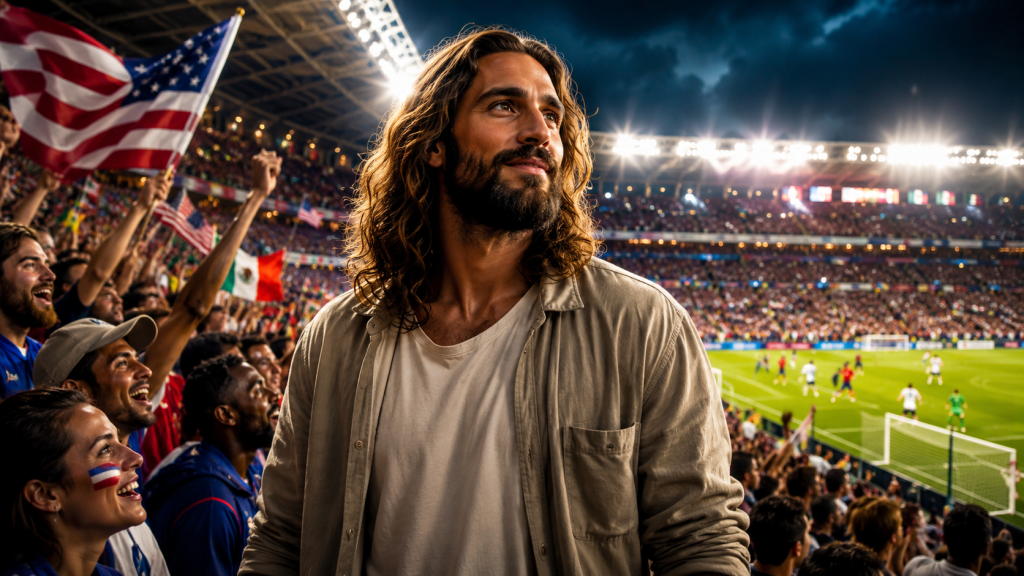
Chapter One: The Morning Before the Roar
Jesus knelt in the thin blue hour before sunrise, where the grass outside the stadium still held the night and the concrete service road had not yet begun to breathe heat. The flags above the upper deck hung almost motionless, each one waiting for wind, each one stitched with the colors of nations that would soon fill the place with songs, drums, painted faces, and the trembling hope of people who had crossed oceans, states, borders, and years of longing just to stand in one shared roar. Anyone searching for Jesus at World Cup Soccer in the United States would not have found Him beneath cameras or banners, but there, alone beside a locked maintenance gate, His hands open upon His knees, His face lifted quietly toward the Father.
The stadium was built to make people feel small and magnificent at the same time. In a few hours it would shine on phones around the world, a clean American monument of glass, steel, screens, suites, and impossible noise. Yet before the gates opened, before the first child begged for a jersey, before the first national anthem carried through the rafters, the place held a silence that seemed almost holy, the kind of silence that belonged near a related reflection on faith when responsibility feels too heavy, because beneath the celebration there were workers already afraid of making one mistake that could not be undone.
Jesus remained in prayer as the first shuttle buses hissed along the access road and the first employees badged through security. He did not hurry when the forklifts began to beep near the loading dock or when a vendor argued softly with a guard over an early delivery. The world was waking into pressure. He stayed with the Father until the eastern sky warmed above the stadium rim, and only then did He rise, dust the damp grass from His knees, and walk toward the entrance where people who were almost never seen would spend the day carrying the weight of everyone else’s joy.
Elena Morales had been inside the stadium since four thirty in the morning, though the match would not begin until noon. She wore black slacks, a navy operations polo, a radio clipped to her shoulder, and the expression of someone who had learned to make tiredness look like competence. On ordinary days she could pass through a crowd without drawing attention, but on this day almost everyone turned toward her when something was missing, delayed, blocked, broken, overheated, overfilled, misplaced, or about to become dangerous. She had spent the last eighteen months preparing for this match, and still the morning felt like a hand closing around her ribs.
Her job title was Senior Crowd Flow Coordinator, which sounded clean enough when printed on credentials. In real life it meant she knew where fear could gather. She knew which staircase narrowed too sharply after the west concourse, which portable barricades had to be angled away from the merchandise tent, which restroom lines could spill into food traffic, which train arrivals could overwhelm the north entrance if two supporter groups came through together. She knew the soft language people used when they did not want to say panic. They called it congestion, delay, density, pressure. Elena knew better. Pressure was only harmless until it found someone small.
At 5:12 a.m., she stood before a wall of screens in the operations center, one hand wrapped around a paper cup of coffee she had not tasted. Camera feeds flickered from empty gates, silent concourses, police staging areas, team arrival tunnels, medical rooms, concession corridors, and the fan plaza where overnight crews were still zip-tying sponsor signs to temporary fencing. The screens made the stadium look obedient. From above, every route seemed logical. Every arrow seemed clear. Every barrier seemed intentional. Elena distrusted screens because people did not move like diagrams.
“Gate C vendor lane is still pinched,” she said.
A young assistant named Priya looked up from a laptop. “They adjusted it at three. Fire marshal cleared the pedestrian width.”
“Elena,” said Mark Ellison from behind her, drawing her name out with a patience that did not feel patient. He was the event director, tall, polished, silver-haired, and skilled at sounding calm in rooms full of people who could not afford to be. “We’ve walked Gate C twice. The last inspection signed off.”
Elena did not turn away from the camera feed. A forklift had left a stack of branded cooler crates beside a barricade line that was supposed to hold a clean curve. Alone, the crates were nothing. With ten thousand people arriving from the train station while a drum line stopped to perform and a merchandise queue bent the wrong way, the crates could become a corner. Corners turned crowds into waves. Waves did not care who was sorry afterward.
“The cooler crates changed the shape,” she said. “I want them moved behind the vendor tent.”
“They belong to a sponsor,” Mark said.
“They can belong to the president of the moon. They are in the wrong place.”
Priya lowered her eyes to hide a smile, but Mark did not laugh. He stepped closer, and Elena could smell his mint gum and expensive aftershave. “This is exactly why we have chains of approval. If you want them moved, ask logistics. If logistics agrees, they ask sponsor relations. If sponsor relations approves, we move them.”
“By then gates will be open.”
“Then put a staffer there and monitor.”
Elena looked at him then. His badge had five colored ribbons hanging from it, each one giving him access to another place where decisions could be discussed without the people who would pay for them. “Monitoring is what people say when they do not want to change anything.”
Mark’s jaw tightened. “And panic is what people create when they keep seeing ghosts.”
The room seemed to go quiet around them, though the radios kept murmuring. Priya’s fingers stopped above her keyboard. A man from transportation turned halfway in his chair and then thought better of it. Elena stared at Mark until he looked away first. He had not meant to say it that plainly, or maybe he had. Everyone who worked major events for more than a month knew some version of Elena’s story, though most of them only knew enough to whisper it wrong.
She had been thirteen when she let go of her brother’s hand.
That was how her mind kept the memory, not because it was the whole truth, but because guilt preferred a single sentence. She and Daniel had gone with their father to a packed public watch party for a championship match years before, long before Elena ever imagined that soccer could be anything other than noise, flags, and the smell of grilled onions drifting over a city street. Daniel was six, bright-eyed, wearing a red scarf too large for him. When the winning goal came, strangers surged, lifted, shouted, stumbled, embraced. Their father turned to help an older woman who had fallen. Elena felt Daniel’s fingers slipping in sweat and celebration. She told herself she held on as long as she could. Her dreams told her she had let go.
Daniel lived, which was the mercy people offered when they did not know what else to say. He lived with a limp, seizures that came without warning, and a memory that never returned cleanly to that day. He lived in a small apartment with their mother now, watched matches with the sound low, and still smiled when Elena brought him team stickers from stadium offices. He had forgiven her before he understood what forgiveness cost. Elena had not forgiven herself because self-punishment felt more honest than receiving a mercy she could not repay.
“Move the crates,” she said to Priya, her voice quiet.
Mark exhaled through his nose. “Do not countermand me in my own operations center.”
“Then countermand yourself.”
“Elena.”
She turned fully toward him now, aware of the eyes in the room and the cameras on the wall and the great sleeping stadium around them. “A crowd does not care who approved the hazard. If somebody gets crushed against that barricade because we were protecting a sponsor display, none of your ribbons will mean anything.”
Mark’s face flushed, but before he could answer, the radio on Elena’s shoulder cracked alive. “Ops, this is South Loading. We have a volunteer group at check-in missing two credentials and one temporary badge printer down. Need direction.”
Another voice cut over it. “Medical staging needs confirmation on heat-response carts.”
Then another. “Transportation reports first supporter train ahead of schedule by twenty-seven minutes.”
Elena closed her eyes for half a second. The day had started moving without permission. When she opened them, Mark had recovered his composure, which in him was never peace but strategy.
“Handle the trains,” he said. “I’ll speak with logistics about your crates.”
It sounded like a concession. Elena knew it was a delay. She also knew that if she stayed in the room and fought another five minutes, the first supporter train would arrive into a plaza not yet staffed. She took her tablet from the desk, pressed the talk button on her radio, and began giving instructions as she walked out.
By the time she reached the lower concourse, the stadium had changed from structure to organism. Workers moved through corridors with boxes of programs, cases of water, coils of cable, trays of pastries for suites, folded flags, medical kits, rolls of wristbands, and bundles of plastic ponchos though the forecast had promised heat and clear sky. In one tunnel, two security guards argued over magnetometer placement. In another, a teenage volunteer stood frozen before a stack of multilingual wayfinding signs, unable to decide which arrow belonged where. Elena corrected three things before she reached the service elevator and forgot all three the moment she saw the boy.
He was standing beside a janitorial cart near Section 118, small enough that the cart handle rose nearly to his chin. He wore a yellow jersey with a number ten on the back, new sneakers with laces already coming undone, and a paper flag tucked into his waistband. He had one hand around the strap of a clear plastic stadium bag, the other pressed flat against his chest as if holding himself together. No adult stood near him. No volunteer seemed to have noticed him yet. His lower lip trembled with the effort of not crying.
Elena stopped so abruptly that the transportation update in her earpiece became meaningless noise. For a moment the concourse slipped away, and she saw a red scarf instead of a yellow jersey. She saw a little hand swallowed by motion. She saw strangers jumping, smoke from street vendors, spilled soda under shoes, her father shouting Daniel’s name until his voice broke. Her chest tightened so violently she almost reached for the wall.
A man was already kneeling before the boy.
Elena had not seen Him approach. He wore plain work clothes, the kind worn by temporary laborers who moved through major events without anyone asking their names unless something went wrong. His shirt was the color of undyed linen, His dark hair rested near His shoulders, and His hands were open, not touching the boy, not crowding him. He had placed Himself low enough that the child did not have to look up in fear.
“Your mother is looking for you,” the man said.
The boy swallowed. “I don’t know where she is.”
“But she is looking,” the man said. “That matters.”
Elena stepped closer, professional instinct returning with a force that felt almost like anger. “Sir, I need you to step back.”
The man looked up at her. His eyes were calm in a way that did not belong in a stadium hours before a World Cup match. They were not relaxed. Relaxed people often did not understand danger. His calm seemed to know danger fully and still not be ruled by it.
“He is afraid,” the man said.
“I can see that.”
“Yes,” He said, and the single word unsettled her because it held no accusation and somehow revealed one. “You can.”
Elena looked away first. She crouched beside the boy, keeping her voice even. “What’s your name?”
“Niko.”
“Okay, Niko. I’m Elena. I work here. We’re going to find your mom. Do you know her name?”
“Laila.”
“Last name?”
He shook his head, embarrassed by the failure, and his eyes filled.
“That’s all right,” Elena said quickly. “You’re doing fine. Did she have a jersey like yours?”
“No. She had blue. She was talking to the lady about the flags, and I saw the tunnel, and I thought my dad was there.” His breath hitched. “But he’s not here. He’s deployed. My mom said we’d send pictures.”
The man in the plain shirt lowered His gaze for a moment, as if receiving the child’s words somewhere deeper than hearing. Elena noticed then that a lanyard hung around His neck with a temporary worker badge turned backward. She could not read the name. She should have asked. She did not.
Her radio crackled again. “Elena, transportation needs you at south plaza. Trains are unloading.”
She pressed the button. “Send Luis. I’m handling a separated child at Section 118.”
There was a pause, then Priya’s voice. “Copy. Want guest services?”
“Send a supervisor and notify security. Female staff if available.”
“Copy.”
Niko stared at the man in work clothes. “Do you think she’s mad?”
“No,” the man said. “Fear can sound angry when love is trying to find what it lost.”
Elena felt the words land where she did not want them. She had spent years remembering her father’s voice shouting through the crowd, remembering the terror in it as anger, remembering the way he grabbed her shoulders afterward and asked where Daniel was. He had never blamed her when Daniel was found. He had only wept with his forehead against a police barricade. But guilt rewrote faces. It made every frightened voice into a verdict.
“What department are you with?” she asked the man, more sharply than necessary.
He stood slowly. He was not imposing in the way Mark tried to be imposing. He simply stood, and the space around Him seemed to remember order. “I came to serve.”
“That is not a department.”
“No,” He said. “It is not.”
The answer should have irritated her. Instead it frightened her a little because He seemed to mean it without performance. Before she could ask again, a woman’s voice tore through the concourse.
“Niko!”
The boy spun. A woman in a blue jersey ran toward them with a guest services supervisor behind her and a security guard trying to keep up. Her headscarf had loosened around her face, and one side of her credential pouch slapped against her hip as she ran. She fell to her knees before reaching her son, pulled him against her, then pushed him back just far enough to see his face.
“I told you to stay by me,” she said, but the words broke apart under tears. “I told you.”
“I’m sorry,” Niko sobbed.
“I know. I know.” She held him again, rocking slightly on the concrete. “I was so scared.”
Elena stood and gave the security guard a brief report because reports were safer than watching reunions. She stated the section, time, child’s name, apparent separation cause, parent located, no injury, no medical need. Her voice sounded clean, official, and distant. The woman, Laila, thanked her twice, then turned to thank the man in the plain shirt.
He was gone.
Elena looked down the concourse in both directions. Workers passed carrying rolled banners. A vendor pushed a cart of bottled drinks. A guard adjusted stanchions near a stairwell. There was nowhere the man could have disappeared so quickly without running, and He had not seemed like someone who ran from anything.
“Who was the other staff member?” the security guard asked.
Elena kept scanning. “I don’t know.”
“Should I include him?”
She hesitated. A proper report included every responding employee. A proper report did not include a nameless man with a backward badge who said he came to serve and vanished before anyone could identify him. “No,” she said finally. “Keep it simple.”
The guard nodded and moved away. Laila lifted Niko to his feet, still holding both of his shoulders, still trembling with leftover fear. Elena forced herself to smile at them, the kind of smile she had learned from years of calming strangers. It said the moment was over. It said the system had worked. It said there was nothing more to see.
But something in her had been seen, and that was the problem.
She returned to the service corridor with her tablet in one hand and the coffee she had forgotten in the other. Near the elevator, she leaned against a concrete wall where a painted arrow pointed toward team arrivals. Her breath would not settle. She told herself it was the train schedule, the sponsor crates, Mark’s careless comment, the early heat, the understaffed entrance, the endless pressure of a day that would be judged successful only if nothing terrible happened. She told herself all of that because the alternative was admitting that a frightened boy and a calm stranger had opened a door she had spent years nailing shut.
Her phone buzzed in her pocket. She knew before looking that it would be her mother because her mother always sent a message on match days, never long, never dramatic, always carrying more tenderness than Elena knew what to do with.
Daniel says the yellow team wins today. He wants you to bring a program if they have one. Be safe, mija.
Elena stared at the screen until the words blurred. Be safe. Her mother still said it as if safety were something Elena could enter and close behind her like a room. Daniel says the yellow team wins today. Of course he did. Daniel liked yellow because he said it was the color of morning. He said that after the injury, after the hospital, after the therapy rooms with rubber balls and balance rails, after seizures stole pieces of afternoons. He said yellow meant God had turned the lights back on. Elena had not known how to answer.
She typed, I’ll bring one, then deleted it. She typed, Tell him I love him, then deleted that too because love, when written, sometimes demanded a visit she had been avoiding for three weeks. Finally she wrote, I’ll try.
The answer looked cowardly, but she sent it anyway.
“Elena,” Mark’s voice came through the radio, controlled and clipped. “Need you at Gate C.”
She pushed off the wall. “Are the crates moved?”
“Need you at Gate C,” he repeated.
By the time she reached the lower exit toward the plaza, the first wave of sound had arrived. It came from beyond the concrete and glass, a rolling mixture of chants, drums, horns, laughter, instructions, police whistles, shuttle brakes, and the deep human hum of thousands becoming a crowd. The stadium no longer waited. It pulled. It promised people that if they entered, they would belong to something larger than their private grief. Elena understood that promise. She also knew how easily a crowd that promised belonging could forget the body pressed against the rail.
Gate C opened toward a broad fan approach from the train station. From a distance it looked festive and well managed. Flags crossed above the walkway. Volunteers in bright shirts waved and smiled. Food trucks steamed along the far edge. A percussion group had already gathered near the sponsor plaza, their rhythm drawing people closer. The cooler crates were still there.
Worse, someone had added a photo backdrop.
It stood just beyond the crates, a glossy wall printed with tournament logos and a giant silver image of the cup everyone wanted to touch but almost no one ever would. Fans had begun stopping before it, turning their backs to incoming foot traffic, raising phones, laughing, stepping sideways without looking. The pedestrian lane narrowed, not enough for a code violation on paper, but enough that Elena felt the old coldness move up her spine.
Mark stood near the entrance with a logistics manager and a sponsor representative whose white sneakers looked too clean for the morning. They were speaking with the serious expressions of people discussing optics. Elena walked past them and placed herself at the pinch point. For thirty seconds she said nothing. She watched bodies instead of faces. A family with two strollers slowed near the photo wall. A group of young men in matching jerseys stopped behind them. A drumbeat pulled another cluster to the right. Two volunteers tried to wave people through, but their gestures competed with the sponsor backdrop, the food line, and the emotional gravity of the stadium entrance.
There it was. Not disaster. Not yet. Just the beginning of a pattern.
Elena turned to Mark. “Close the photo backdrop and move the crates now.”
The sponsor representative blinked. “That activation is scheduled for pre-match engagement.”
“It is scheduled to block pedestrian flow.”
Mark lowered his voice. “We are not shutting down a sponsor activation because you watched one group slow down.”
“Then watch the next three groups.”
“I have watched enough.”
“No,” Elena said, feeling something in her sharpen, “you have looked. That is not the same thing.”
The logistics manager shifted uneasily. The sponsor representative crossed his arms. Behind them the crowd thickened by another few dozen people. A chant rose from the train side, joyful and wild. A volunteer laughed as someone handed him a small flag. The day wanted to be beautiful. That made Elena angrier, because beauty made people careless.
Mark stepped close enough that only she could hear him. “You need to decide whether you are managing today’s event or reliving your family history in public.”
Elena went still.
For a moment she could not hear the drums. She could not hear the chant. She could only hear Daniel’s name shouted years ago until it became less a name than a wound. Her hand tightened around the tablet. A professional answer waited somewhere in her training. A furious answer waited closer. She gave neither.
Then, over Mark’s shoulder, near the far edge of the crowd, she saw the man from Section 118.
He stood beside the temporary fencing, not pushing, not waving, not calling attention to Himself. People moved around Him as if He were simply one more worker in the morning rush. Yet His eyes were fixed on Elena with a grief so clean and steady that she felt no pity in it, only truth. He did not nod. He did not rescue her from the decision. He simply saw her, and being seen left her without the shelter of pretending she was only afraid for the crowd.
She turned from Him back to Mark. “I am managing today’s event,” she said. “That is why I am closing this lane.”
“You do not have authority to shut down sponsor property.”
“I have authority to stop an unsafe flow pattern.”
“I will remove you from this post.”
“You can do that after it is safe.”
She lifted her radio. Her thumb hovered over the button. If she called it in as a safety hold, it would go into the log. If it went into the log, Mark could not bury it as a personality issue or a trauma response. It would trigger questions, delays, angry executives, maybe a formal review. She would be accused of overreacting. Again. She would be remembered as the woman who saw ghosts. Again. She would likely lose the role she had sacrificed sleep, friendships, and any gentle part of herself to earn.
Her thumb pressed down.
“Operations, this is Morales at Gate C. Initiating immediate safety hold on sponsor photo activation and vendor crate position. Pedestrian flow compromised by fixed obstruction and crowd pause behavior. Redirect volunteers to widen lane. Logistics to move crates behind vendor tent. Security to support temporary closure.”
The radio answered with a burst of static, then Priya’s startled voice. “Copy, Gate C safety hold logged.”
Mark’s face hardened. The sponsor representative began protesting before Priya had finished repeating the instruction. Elena did not look at him. She stepped into the lane, raised both arms, and began moving people with calm, clear words that did not blame them for wanting a photograph near the shining cup. Volunteers followed her lead. One rolled the stanchions back. Another turned the photo line away from the entrance. The logistics manager, perhaps deciding that a logged safety hold was more frightening than a sponsor’s annoyance, barked for two workers to move the crates.
For ten minutes the day resisted her. Fans complained. One man cursed. A woman asked why everything fun was always closed. The sponsor representative threatened escalation into his phone. Mark stood apart, already preparing the version of the story in which Elena had become the problem. Yet the lane widened. The incoming flow loosened. Families stopped bunching at the corner. The drums moved farther from the entrance. People kept coming, still laughing, still singing, unaware that a small danger had been turned aside before it could acquire a name.
When the crates finally rolled behind the vendor tent, Elena lowered her arms. Sweat had gathered under her collar. Her radio was alive with other problems now, because the match day had no respect for emotional victories. She turned once toward the fence.
The man was still there.
For the first time, she walked toward Him.
“You need to show me your badge,” she said, though the words had less force than before.
He turned the lanyard slowly. The plastic sleeve was empty.
Elena should have called security. She should have stepped back. Instead she stared at the empty badge, then at His face.
“How did you get in?”
He did not answer the question she asked. “You knew the narrow place before others would name it.”
“That is my job.”
“It has also been your prison.”
The words struck so directly that she looked over her shoulder to make sure no one else had heard. People streamed through Gate C behind her, bright with expectation, waving flags beneath a sky now fully open and white with heat. Mark was on his phone. Priya was calling for her over the radio. The sponsor representative was glaring. Everything around her demanded motion, explanation, defense.
Elena’s voice dropped. “You don’t know me.”
Jesus looked at her with a sorrow that did not reduce her. “Elena, your brother’s hand was not the only thing you lost that day.”
She could not speak. The stadium seemed to tilt slightly, not because the ground moved, but because the foundation beneath her old story had cracked. She had never told this man her name beyond what others said on the radio. She had never mentioned Daniel. She had never mentioned a hand.
Her radio called again. “Elena, do you copy? We need you at operations.”
She took one step back. The crowd moved between them for a moment, a river of jerseys and flags and singing. When the path cleared, He was still there, patient and unhidden.
“What do you want?” she whispered.
Jesus looked toward the gate, where a small boy in a yellow jersey walked safely beside his mother, then back to Elena. “Not what you can control,” He said. “What you will finally bring into the light.”
The radio called a third time. This time Mark’s voice cut through, sharp enough to make nearby volunteers glance over. “Morales, report to operations now.”
Elena looked down at her tablet, at the incident log already marked by her own decision, then back toward the place where Jesus stood.
But He was no longer beside the fence.
Only the crowd remained, pouring toward the stadium with their flags lifted, believing the day had begun with songs.
Chapter Two: The Report No One Wanted
The operations center had grown brighter and colder by the time Elena returned, as if the room itself had decided that urgency required fluorescent light and no mercy. The screens still showed the stadium from impossible angles, but now the empty corridors were filling, the approach roads were pulsing, the gates had begun to swallow color, and the fan plaza looked less like a plan than a living sea broken into currents. The room held the low, continuous thunder of radios, keyboards, clipped instructions, and voices trying to sound calmer than the hour deserved.
Mark stood near the central table with his arms folded and his phone in one hand. Beside him were the sponsor representative from Gate C, a deputy from venue security, the logistics manager who had finally moved the crates, and Priya, who sat with her laptop open and her mouth pressed tight. Elena knew that look. Priya had been asked for the incident log. She had given it because logs did not belong to feelings, and now everyone in the room was pretending the log had become the problem.
“Elena,” Mark said, “close the door.”
She did. The click sounded too small for the weight in the room.
The sponsor representative spoke before Mark could continue. “You shut down a contracted activation without sponsor approval, disrupted a pre-match engagement sequence, and created a visible scene in front of international guests.”
Elena placed her tablet on the table. “I initiated a safety hold.”
“You embarrassed my team.”
“I widened a pedestrian lane.”
“You made a judgment call outside the agreed activation protocol.”
“Yes,” she said. “Because the agreed activation protocol was creating a pinch point.”
The man looked at Mark as if asking whether this was allowed to continue. Mark’s face had arranged itself into that polished expression he used when he wanted to appear fair while moving someone toward a corner. “We are not disputing that Elena had safety concerns,” he said. “We are discussing process, communication, and proportional response.”
Elena almost laughed, but the laugh would have come out wrong. “If a safety concern is real, proportional response is whatever stops it before someone gets hurt.”
The security deputy, a broad woman named Captain Shaw, looked up from the printed report. She had worked enough stadiums to know when language was being used as smoke. “The hold was logged. The obstruction was moved. No injuries reported. Flow improved after correction.”
The sponsor representative’s face tightened. “With respect, Captain, guest sentiment also matters.”
Captain Shaw glanced at the screens, where thousands of people moved through gates with bags held open and phones ready. “Guest survival matters more.”
For one dangerous second, Elena felt grateful. Gratitude almost softened her, and softness made her feel exposed. She looked down at the table instead.
Mark slid the printed report toward Elena. “The issue is that you escalated a condition without exhausting other remedies.”
“I asked for the crates to be moved before gates opened.”
“I said I would speak with logistics.”
“You spoke with logistics after the first train arrived.”
“Because there is an order to these decisions.”
“There is also an order to crowd movement,” Elena said. “When it breaks, it breaks faster than a phone call.”
The room fell into a hard silence. Outside the glass wall, an intern hurried past carrying credential sleeves against his chest. On one of the screens, a father lifted a child onto his shoulders near the north entrance. On another, a group of supporters sang with both hands raised, their faces shining. Everything that looked joyful from above still depended on people like Elena noticing the places where joy could become weight.
Mark leaned both hands on the table. “You are very good at seeing worst-case scenarios.”
“I was hired for that.”
“You were hired to manage them, not live inside them.”
The words were too close to what he had said at the gate. Priya glanced up quickly, then down again. Captain Shaw shifted her weight. The sponsor representative looked relieved, as if the conversation had finally reached a shape he understood. It was easier to deal with a difficult employee than a dangerous layout.
Elena felt heat rise in her neck. She could answer with diagrams, flow rates, photos, timestamps, and crowd-density math. She could build a case so clean no one in the room could deny it without sounding foolish. She could also feel something else underneath her, a tremor deeper than argument. The man with the empty badge had spoken her brother’s name without speaking it. He had told her that Daniel’s hand was not the only thing she lost. Now every word in this room seemed to press against the place where that truth had entered.
“I am not asking anyone to live inside anything,” she said. “I am asking that hazards be removed before they become incidents.”
Mark straightened. “And I am asking whether you can continue in this role today without making unilateral decisions driven by personal history.”
Captain Shaw’s eyebrows lifted slightly. Priya stopped typing.
Elena stared at him. She understood then that Mark had chosen his weapon. Not the report. Not the sponsor complaint. Not even authority. He had chosen the story people already half-knew about her, the one that could make every warning she gave sound like fear and every act of courage look like damage.
“You want me off the floor,” she said.
“I want a stable command structure.”
“No. You want me quiet.”
“Elena,” Priya said softly, not as a correction, but almost as a plea.
Mark picked up his phone, set it down, then folded his hands with careful patience. “I am reassigning you to internal monitoring for the next phase. Luis will take Gate C and exterior flow. You’ll remain in operations and advise as needed.”
The reassignment was presented as temporary, reasonable, protective. It was none of those things. Internal monitoring meant she would watch danger through screens and speak into channels controlled by others. It meant if she saw something wrong, she would have to ask permission from people who had already decided her sight was contaminated. It meant the stadium would keep moving while she sat in the glass room with her hands tied by courtesy.
The sponsor representative relaxed. Captain Shaw looked at Elena, and there was something like warning in her eyes, not against Mark, but against the kind of explosion that would only give him proof. Elena understood. If she argued too hard, she would become exactly what they needed her to be.
“Put it in writing,” Elena said.
Mark blinked. “Excuse me?”
“Put the reassignment in writing with the reason.”
His expression cooled. “This is an operational adjustment.”
“Then write that.”
“We are not wasting time drafting personnel notes in the middle of match ingress.”
“You had time to discuss my personal history.”
Priya’s face went pale. Captain Shaw looked toward the screens as if granting the room privacy she could not actually give.
Mark’s voice dropped. “Careful.”
Elena held his gaze. “I am.”
The radio on the table interrupted them before either could decide how far the moment would go. “Ops, this is North Gate screening. We have a language issue with a family, possible medical equipment in bag, line backing up. Need guest services.”
Priya reached for her headset. “Guest services north, respond.”
Another call came over it. “Fan plaza to Ops, drum group moving toward sponsor tent again. Need volunteer lead.”
Then a third voice, tight with stress. “Transportation reports second train arrived early. Heavy foot traffic heading to Gate C and north approach.”
The match did what all great public events did. It refused to wait for private wounds. Mark pointed toward the analyst station. “Internal monitoring. Now.”
Elena did not move for a heartbeat. Then she took her tablet and walked to the station beneath the west wall of screens. The chair there had been adjusted for someone taller. She sat anyway, pulled up the camera grid, and opened the incident map. Her hands knew the system so well they worked even while her mind remained at the fence where Jesus had stood.
Priya’s voice came through her headset, quieter than the room. “I’m sorry.”
“Don’t be.”
“I logged it exactly.”
“I know.”
“I can flag anything you see.”
Elena looked across the room at Priya, who was still pretending to focus on her laptop. “You already did enough.”
Priya swallowed and nodded once.
For the next hour, Elena watched the stadium fill. The work became both familiar and unbearable. Camera 12 showed Gate C flowing cleanly now that the crates were gone. Camera 17 showed a merchandise line curling too close to a stairwell, but Luis caught it after Elena marked the feed and Priya relayed the note. Camera 23 showed two supporters arguing near a concession stand until a volunteer separated them with the cheerful courage of someone too young to know how quickly cheer could fail. Camera 31 showed a woman in a wheelchair waiting too long beside an elevator while three staff members passed without seeing her. Elena called that one in herself, not asking Mark’s permission, and no one objected because compassion did not threaten a sponsor.
By 8:40 a.m., the sunlight had turned harsh. Heat gathered on the plaza pavement and rose in visible shimmer around the crowd. The stadium roof threw some shade, but not enough. Water distribution teams moved through lines with cases of bottles, and medical carts rolled in slow loops along the fan zones. Elena kept one camera tile pinned to the eastern approach because families tended to arrive there in uneven clusters, and uneven clusters were where lost children, fainting grandparents, and arguments began.
Her phone buzzed again.
This time it was not her mother. It was Daniel.
The message was full of uneven punctuation because he used voice-to-text and never corrected it.
Mom says you are busy but I saw the stadium on TV outside looks like bees all colors do you think Jesus likes soccer or only watches people
Elena stared at the message so long that Camera 18 went red for motion alert and Priya had to nudge her through the headset.
“You good?”
“Yes,” Elena lied.
She looked back at Daniel’s words. Do you think Jesus likes soccer or only watches people. Daniel often asked questions that sounded childish until they reached the part of a person no adult knew how to protect. He had done that since the injury. Doctors had measured memory, speech, gait, reflexes, neurological response. No one had measured the strange tenderness that survived in him, the way he could sit with a game on television and care more about whether a crying fan found his father than whether a striker found the net.
Elena typed, He probably watches people.
She read it and felt the sentence accuse her. She deleted probably and wrote, I think He watches people.
Daniel replied almost immediately.
Good then He can see you too
Elena set the phone face down.
The room seemed suddenly too small. She could hear Mark speaking to transportation, calm and precise. She could hear the sponsor representative laughing now with someone near the coffee station, his crisis apparently over because his activation had reopened in a new position. She could hear Priya dispatching a language-services volunteer to the north gate. She could hear the stadium beyond the walls, a swelling sound that reached even into the sealed room.
Good then He can see you too.
She did not want to be seen. She wanted to be useful, accurate, necessary, respected. She wanted to keep every lane open, every child found, every stairwell clear, every risk named before it could become grief. Being seen was different. Being seen meant the careful distance between Elena Morales the professional and Elena Morales the sister could collapse, and she had spent too many years building that wall to let it fall on a match day.
A notification blinked across her tablet. Incident review requested. Gate C safety hold. Mark had not waited until after the match. He had opened an administrative thread while the event was still active. She saw the attached sponsor complaint, the activation impact note, the phrase emotional escalation used twice in the preliminary summary. He had not written trauma response. He did not need to. Emotional escalation was enough to stain the record.
Her hand hovered over the tablet. She could respond immediately. She could attach the camera stills. She could cite pedestrian width standards, sponsor placement drawings, transportation timing, and the flow pattern after correction. She could defend herself so completely that no one would ever again accuse her of not having evidence.
But a child in yellow had asked whether his mother was angry. A man with an empty badge had said fear can sound angry when love is trying to find what it lost. Daniel had written that Jesus could see her too. The thread on the tablet waited like an invitation back into the only kind of safety she trusted: documentation, proof, control.
“Elena,” Priya said, “Camera 31 again.”
Elena looked up. The woman in the wheelchair was no longer alone, but the elevator bank had become tangled. Two elevators were running for suite deliveries, one was reserved for medical, and the remaining public elevator had a line that now included three older fans, the woman in the wheelchair, a father with a sleeping child, and a man on crutches. A volunteer stood nearby looking helpless, his radio probably tuned to the wrong channel.
“Accessible services to west elevator bank,” Elena said into the headset. “We need priority movement and delivery hold on service elevators until the mobility line clears.”
Mark turned from across the room. “Who authorized delivery hold?”
Elena did not look at him. “I did.”
“Elena.”
She turned then. “Are we really going to make the woman in the wheelchair wait while pastries go upstairs?”
No one spoke. Even the sponsor representative seemed to understand that this was not the hill he wanted to die on. Mark’s mouth tightened, but he turned away.
“Accessible services responding,” Priya said.
Elena watched as two staff members reached the elevator bank. One spoke to the woman in the wheelchair. Another redirected suite deliveries. The line loosened. A service elevator opened. The woman entered first, and as the doors closed, she placed a hand over her heart toward the staff member who had helped her. It was a small gesture, visible only because a camera happened to be watching from above. The operations room moved on immediately. Elena did not.
She thought of all the things cameras missed. Daniel’s hand slipping. Her father’s face at the barricade. Her mother sitting beside a hospital bed whispering prayers when she thought Elena was asleep. Daniel waking after a seizure, confused and gentle, apologizing to everyone for scaring them. Elena in the bathroom at eighteen, pressing a towel into her mouth so no one would hear her sob because she had just received a college scholarship and could not understand why good things still came to people who had failed their little brothers.
Her phone buzzed again.
This time her mother was calling.
Elena almost let it go. Her mother knew better than to call on event days unless something had happened, and that knowledge made answering feel like opening a door to a room already on fire. She stood and walked toward the narrow side corridor outside operations, keeping the headset around her neck.
“Mamá?”
Her mother’s voice came softly, but the softness was strained. “I am sorry to call you at work.”
“What happened?”
“Nothing terrible. Daniel had one of his spells. It passed. He is resting now.”
Elena leaned against the corridor wall. The concrete felt cool through her shirt. “A seizure?”
“A small one.”
“Did he hit his head?”
“No. I was there. He is all right.”
“Did you call the doctor?”
“Elena, he is all right.”
“You said spell, but you mean seizure. How long?”
A pause. “Maybe one minute.”
“Maybe?”
“I was watching him, not the clock.”
Elena closed her eyes. “You have to time them.”
“I know.”
“You have to time them every time.”
“I know, mija.”
The old irritation rose, hot and familiar, because irritation was easier than helplessness. “If it goes past five minutes—”
“I know.”
“Does he have his medication?”
“Yes.”
“Did he take it?”
“Yes.”
“Are you sure?”
Her mother’s silence changed. Elena could feel it over the phone. Not anger exactly. Weariness. A woman tired of being treated like a careless witness in her own son’s life.
“I have cared for him every day,” her mother said. “You do not have to talk to me as if I am someone from the stadium who forgot a sign.”
Elena opened her eyes. At the end of the corridor, through a narrow staff window, she could see a slice of concourse where fans were passing in bright waves. She watched a little girl run ahead of her father, then stop when he called her back. The girl took his hand again without drama.
“I’m sorry,” Elena said, but the apology came out stiff, as if unused.
Her mother sighed. “He wanted to hear your voice. That is why I called.”
Elena’s throat tightened. “Can he talk?”
“He is tired. But he asked if you were safe.”
Safe again. Always safe, as if the family had built its entire language from the one thing it could not guarantee.
“I’m working,” Elena said.
“I know.”
“I can come after the match.”
“You always say that.”
The words were gentle. They hurt more because of it.
Elena rubbed her forehead. “Mamá, today is not a normal match.”
“No day has been normal since Daniel got hurt,” her mother said. “But some days still need a sister.”
The corridor seemed to deepen around Elena. She heard the operations center behind the door, the radio calls, the movement of an event large enough to make everyone believe their own pain had to wait outside. She thought of Daniel asking whether Jesus watched people. She thought of the man with no badge saying that her prison had once been her job. She had no answer that would not expose her.
“I have to go,” she said.
“I know,” her mother replied, and there was no accusation in it. That was worse. “Be kind when you are afraid, Elena.”
The call ended.
Elena stood in the corridor with the phone still pressed to her ear. Be kind when you are afraid. Her mother said things like that because she had remained soft under a weight that had made Elena hard. Elena did not trust softness. Softness could not hold back a crowd. Softness did not widen lanes or stop sponsor crates from becoming corners. Softness did not time seizures, file reports, or make men like Mark write down what they were really doing. Softness sat beside hospital beds and forgave too quickly, and Elena had never known whether to admire it or resent it.
When she lowered the phone, Jesus was standing near the service stairs.
She did not gasp. Some part of her had begun expecting Him where she had no explanation for His presence. He stood with one hand resting lightly on the railing, as if He had been there long enough to hear the silence after the call, though not in a way that felt intrusive. His empty badge was gone now. Around His neck there was no lanyard at all.
“You cannot keep every loved thing from being hurt,” He said.
Elena’s first instinct was to look for a camera. Her second was to look for a guard. Her third was to answer Him with the kind of sentence that would restore normal life.
“You are not supposed to be back here.”
“No,” He said. “Many are not supposed to be where grief has left them.”
Her eyes stung, and she hated Him for that for half a second, though the hatred vanished as soon as she recognized it. “I don’t have time for this.”
“You have given time to many dangers today.”
“That is my responsibility.”
“Yes.”
He said it with such agreement that she had nowhere to push back.
From inside operations, someone called her name. She ignored it. “Who are You?”
Jesus looked at her, and the corridor seemed to grow quiet beneath the stadium noise. “You know enough to be afraid of the answer.”
She shook her head, but not because He was wrong. “People are depending on me.”
“And you have believed that means no one may touch the wound.”
Her lips parted, but the answer caught in her throat.
He stepped no closer. “Your brother’s suffering did not make you guilty for every crowd. His survival did not require you to become a wall. The child who was lost today needed help, not your punishment. The woman at the elevator needed passage, not your penance. Even the crowd at the gate needed truth, not the offering of your peace as payment.”
The words were quiet, but each one seemed to find a hidden room inside her. Elena looked away toward the staff window because looking at Him directly felt like standing beneath sunlight after years underground.
“You think I’m doing this for myself?” she asked.
“I know you have served many people.”
“Then why are You talking like that?”
“Because service can become a place to hide from mercy.”
The door to operations opened behind her. Priya stepped into the corridor, stopped, and looked from Elena to the empty stairwell.
“Elena?” Priya said.
Elena turned sharply. Jesus was no longer there.
Priya’s brow furrowed. “Were you talking to someone?”
Elena looked toward the stairs, then back at Priya. She could say yes. She could say no. Both answers felt dangerous. “I was on the phone.”
“With your mom?”
Elena nodded.
“Everything okay?”
“Daniel had a seizure.”
Priya’s face changed immediately. “Oh, Elena. Do you need to go?”
The kindness in the question nearly undid her. “No.”
“Are you sure?”
“No,” Elena said, then caught herself. She had not meant to tell the truth.
Priya stepped fully into the corridor and lowered her voice. “Mark is building a file. I saw the thread. He wants to keep you in the room until after kickoff, then probably write you up when the match ends.”
Elena looked through the open doorway. Mark stood near the central table, speaking into a headset, his posture controlled and confident. The screens behind him glowed with the movement of thousands. For a moment he looked less like an enemy than a man deeply committed to never appearing wrong. That did not make him harmless. It did make him human, and Elena did not want that complication.
“Let him,” she said.
Priya seemed startled. “That does not sound like you.”
“No,” Elena said. “It doesn’t.”
“You should answer the thread before he frames it.”
“I will.”
“Elena, I mean now.”
Elena almost agreed. The old reflex leaped inside her, eager for documents, time stamps, proof, defense. Then she looked at her phone and saw Daniel’s last message still on the screen. Good then He can see you too. She thought of Jesus saying service could become a place to hide from mercy, and for the first time all morning, the most frightening thing before her was not losing her job. It was being right in every report and still refusing the truth that might save her soul from its own locked room.
“I need ten minutes,” she said.
“For what?”
Elena did not know until the answer left her. “To call my brother.”
Priya’s face softened. “Take them.”
“What about Mark?”
“I’ll tell him you’re reviewing Camera 31.”
Elena gave her a tired look. “That is a lie.”
Priya glanced back into the operations center. “Then I’ll tell him you are attending to a medical family matter.”
“That will make him ask questions.”
“Then I’ll say it slowly.”
For the first time that day, Elena almost smiled. It was small, but it was real enough that Priya noticed and smiled back. Then she slipped into operations and closed the door.
Elena walked down the service corridor until she reached a quieter alcove near a storage room full of folded barricade covers. The concrete smelled faintly of dust, plastic, and industrial cleaner. Above her, the stadium crowd was becoming louder, more unified, more alive. She called her mother back.
Her mother answered on the second ring. “Mija?”
“Can he hear me?”
“One moment.”
Elena heard rustling, a television lowered, her mother murmuring gently in Spanish. Then Daniel’s breathing came onto the line, slow and uneven with post-seizure exhaustion.
“El?”
“Hey,” she said, and the word almost broke.
“You working?”
“Yes.”
“Lots of people?”
“So many.”
“Are they happy?”
“Most of them.”
“That’s good.”
Elena pressed her fingers against her eyes. “Danny, I’m sorry I haven’t come by.”
“It’s okay.”
“No,” she said, surprising herself with the firmness of it. “It isn’t.”
The line stayed quiet. She heard the distant television, a commentator’s voice, the hollow noise of pre-match coverage. Daniel breathed carefully.
“I get scared,” Elena said. “When I see you after a seizure. When Mom calls. When I think about that day. I get scared, and then I act busy because busy feels better than scared.”
Daniel did not answer right away. When he did, his voice was soft and a little slurred. “I get scared too.”
Elena lowered her hand from her face.
“Sometimes,” he continued, “I wake up and everybody looks like I left and came back wrong.”
The words moved through her with a pain so deep she had to sit on an overturned equipment case. She had spent years thinking Daniel’s injury was something she had to carry because she had caused it, something she had to manage around him and for him. She had not asked him what it was like to be the one everyone watched with careful eyes.
“You didn’t come back wrong,” she said.
“Sometimes you look at me like I did.”
Elena covered her mouth. No report had ever held a truth that severe. No crowd map, no camera feed, no operational plan. Just her brother, lying tired on a couch across the city, telling her what her guilt had done to his face in her eyes.
“I am sorry,” she whispered. “Danny, I am so sorry.”
“It’s okay.”
“No. Don’t say that yet. Please.”
He was quiet again, and this time she let the quiet stay. The crowd roared above her at something on the stadium screens. The sound poured through steel and concrete, but in the alcove Elena heard only her brother breathing.
“I don’t blame you,” Daniel said at last.
She squeezed her eyes shut. “I know you don’t.”
“No,” he said, with sudden strength. “You don’t know it right. You know it like words. Not like real.”
Elena bent forward until her forehead nearly touched her knees. Her radio crackled from her shoulder, someone asking for operations clearance on a team arrival route. She ignored it for one sacred second.
“How do I know it like real?” she asked.
Daniel made a small tired sound that might have been a laugh. “You come eat with us. And don’t look at me like a sad trophy.”
A sob escaped her, quiet but unmistakable.
“Sorry,” Daniel said immediately.
“No,” she said. “Don’t be sorry. That was funny.”
“It was a little funny.”
“It was.”
“Bring the program.”
“I will.”
“And yellow team wins.”
“You still think so?”
“Yes. Yellow is morning.”
Elena smiled through tears then, not because anything had become easy, but because her brother was still himself, and she had been so busy mourning what was damaged that she had failed to honor what remained bright.
“I love you,” she said.
Daniel breathed in. “I know. But say it more with your feet.”
Her mother must have been near him, because Elena heard her laugh softly in the background and then try to hide it. Elena laughed too, wiping her face with the heel of her hand.
“I will,” Elena said. “I promise.”
When the call ended, she sat for a moment in the storage alcove while the stadium shook with gathering joy. She did not feel healed. That was too clean a word for what had happened. She felt opened, which was more frightening. The wound had not vanished. It had been uncovered without being mocked. It had been touched without being used against her. She understood now why she had avoided mercy. Mercy did not let her stay in charge of the story.
Her radio crackled again, this time with Priya’s voice. “Elena, I need you back. We have a situation developing near the east supporter section.”
Elena stood, wiped her face once more, and forced her breathing steady. “What kind of situation?”
“Two supporter groups crossed routes after security opened the wrong divider. Lots of chanting, some pushing, no fight yet. Mark is sending Luis, but the camera angle is bad.”
Elena stepped into the corridor and began walking quickly. “Pull up east concourse, sections 132 through 138. Tell Shaw to hold mounted officers outside the gate unless it spills. Don’t flood uniforms inside too early. It will escalate.”
“Copy.”
She reached the operations door and stopped with her hand on the handle. Through the narrow window, she could see Mark at the main screen, Luis speaking into a radio, Captain Shaw pointing toward the east camera grid. For all Mark’s control, the room had shifted into a sharper kind of attention. The danger at Gate C had been quiet, structural, almost invisible. This one had a sound. Supporter chants could turn into challenge. Challenge could turn into pride. Pride, pressed shoulder to shoulder in heat and national colors, could become violence faster than people admitted afterward.
Elena opened the door and entered.
Mark looked at her. “Where were you?”
“With my family,” she said.
His face hardened at the honesty, but before he could respond, Camera 44 flickered onto the main screen. The east concourse was packed. Two rivers of color had met near a concession bend, one blue and white, the other yellow and green, each group singing louder because the other existed. Between them were families trying to pass, volunteers waving uselessly, and a row of portable dividers that had been opened at the wrong angle, funneling both groups into the same narrowed turn.
Elena moved toward the table. No one stopped her.
“Do not send Luis into the middle,” she said. “He’ll become the argument. Open the service cut behind 136 and bleed families out first. Move concessions line backward ten feet. Put bilingual volunteers at both chant leads, not security. Ask the percussion group at Gate C if they can draw yellow-green supporters toward the plaza entrance. Give blue-white a clean route to the upper stairs. Separate with invitation, not force.”
Mark stared at her. “You have no authority on this response.”
Captain Shaw did not look at Mark. She looked at the screen. “She’s right.”
The chant on the monitor grew louder. A man shoved another man’s shoulder. A child began crying near the concession bend. Elena felt the old terror rise, but this time she did not mistake it for command. It was fear, yes. It was also information. It told her where harm might gather, but it did not own her.
Mark’s jaw worked once. Then he lifted his radio. “Proceed with Morales plan. Shaw, coordinate security hold. Priya, get volunteers moving.”
The room came alive.
Elena leaned over the table, eyes fixed on the screen as the response unfolded. Volunteers reached the chant leaders, smiling, gesturing, speaking rapidly. One pointed toward a plaza entrance where drums could now be heard faintly even through the camera audio. The yellow-green group began to peel away, not because they had been pushed, but because the celebration had been given somewhere else to go. The blue-white supporters, still singing, turned toward the upper stairs. Families slipped through the service cut behind 136. A father lifted a crying child over a low divider into the cleared space. Concession staff rolled a cart backward. The pressure at the bend loosened.
For five minutes, no one breathed normally.
Then the two rivers separated.
The room released itself in pieces. Priya whispered, “Thank God.” Captain Shaw muttered something into her radio that sounded almost like praise. Luis appeared on one of the screens, arriving too late to be the hero and wise enough not to pretend otherwise.
Mark lowered his radio slowly.
Elena looked away from the screen and saw Jesus reflected in the dark glass of one of the unused monitors behind the room. He stood near the back wall, though no door had opened. His reflection was clearer than the room around Him. He looked not at the crowd, but at her.
She turned.
He was not there.
“Elena,” Mark said.
She faced him, ready for reprimand, accusation, strategy, or silence.
But Mark only said, “Good call.”
The words were small. They were not an apology. They did not erase what he had done or what he might still do. They were not enough, and yet they were something. Elena nodded once, accepting neither more nor less than what had been given.
Her tablet still carried the incident review thread. The administrative complaint still waited. The match had not even begun. Daniel was still tired on a couch across the city. Her mother was still carrying more than Elena had honored. Mark was still Mark. The stadium was still full of dangers she could not completely control.
But Elena’s hands, for the first time all morning, were not shaking.
She looked at Camera 44 one more time, where the east concourse had begun to breathe again, and then she opened a new report. Not a defense. Not yet. First she documented the truth of what had happened, cleanly, without fear making itself the author. The lane had narrowed. The crowd had shifted. The response had worked. A child had cried and then been carried safely through. Two supporter groups had separated without violence. The stadium had held.
Outside, somewhere beyond the screens, the teams must have begun warming up, because the first deep roar rolled through the building, rising from thousands of throats into one trembling sound. Elena heard it not as danger this time, though danger remained inside it. She heard longing. She heard the human need to belong, to hope, to lift color into the air and believe, if only for ninety minutes, that sorrow could be answered by a song.
And beneath that roar, quieter than radio static and steadier than steel, she heard again the words Jesus had left inside her.
What you will finally bring into the light.
Chapter Three: The Seat Left Empty
By the time the teams emerged for warmups, the stadium no longer belonged to operations diagrams. It belonged to voices. The sound rose through the concrete like weather, not a single roar yet, but thousands of separate hopes testing themselves against one another. Every screen in the operations center showed motion now. Flags snapped over railings. Children leaned forward with foam hands and painted cheeks. Vendors moved through aisles with trays strapped against their chests. Security guards stood at tunnel mouths with the practiced stillness of people who knew that stillness could calm a room before it ever became afraid.
Elena watched it all from the central table because nobody had told her to return to the side station after the east concourse cleared. Mark had not invited her back either. The room had simply made space around the need, and the need had made his authority less useful for a few minutes. She knew better than to confuse that with trust. In operations work, trust was not rebuilt by one correct call. It returned slowly, if at all, through the painful humility of being right without humiliating everyone who had doubted you.
She had not mastered that humility. Not yet.
A camera above the lower bowl caught a wide shot of the field, and Elena saw the American afternoon made ceremonial. The grass shone beneath rehearsed light. Ball kids stood in lines near the touchline, trying not to bounce with excitement. Officials checked communication packs. Television crews moved like insects around the player tunnel. On the far side, a section of yellow supporters had begun singing in a rhythm that spread outward until strangers who did not know the words clapped anyway. The game had not begun, but the world had already started pretending that everything outside the game could wait.
“Elena,” Priya said from beside her, “your reassignment note disappeared from the active board.”
Elena kept her eyes on the screens. “Mark removed it?”
“Looks that way.”
“That does not mean it is gone.”
“No,” Priya said. “But it means he does not want Shaw asking why you were sidelined right after your plan worked.”
Elena glanced toward Mark. He was speaking with a tournament liaison near the rear desk, one hand in his pocket, the other holding his phone. His posture had the slight forward lean of a man selling confidence. Elena wondered how many years he had spent learning to sound certain in front of people who controlled money. She had spent years learning to sound certain in front of people who could be trampled. Maybe they were not as different as she wanted them to be. The thought irritated her because mercy kept making enemies more complicated than she had authorized.
“Do we still have a Gate C complaint thread?” she asked.
Priya nodded. “Yes.”
“Attach the post-correction flow footage.”
“I already saved it.”
“Do not attach yet. Just preserve.”
Priya looked at her carefully. “You are not going to fight it now?”
“Not in the middle of ingress.”
“That is new.”
Elena almost answered with a sharp comment, but her phone vibrated on the table before she could speak. It was a photo from her mother. Daniel sat on the couch wearing an old yellow soccer scarf, one hand lifted in a crooked thumbs-up, his face pale from the seizure but still bright with mischief. On the coffee table in front of him were crackers, a sports drink, and the remote. The television behind him showed the stadium exterior, the same stadium Elena stood inside, framed by commentators who would never know that one of the faces in the crowd had just asked his sister to say love with her feet.
She stared too long. Priya saw the photo and softened. “He looks like he means business.”
“He always does on match days.”
“Yellow team still winning?”
“Apparently by divine decree.”
Priya smiled, then turned back to her headset as another call came in. Elena looked at the photo again and pressed her thumb gently over Daniel’s lifted hand on the screen. She wanted to drive to their apartment right then. The desire frightened her because it was clean. It did not come from panic or obligation or the need to inspect medication times. It came from wanting to sit beside him, to let the match play low, to bring the program and maybe a ridiculous souvenir he would pretend not to treasure. She could not leave yet. The stadium still needed her. But for the first time in years, needing to stay did not feel like proof that she had a right to stay away forever.
The stadium announcer’s voice rolled through the building, muffled inside operations but unmistakable. A rehearsal for national anthems. The crowd answered with a wave of cheers that rattled faintly through the glass. Mark ended his conversation and approached the main table.
“Team arrivals are complete,” he said. “Ingress is at eighty-three percent. Transportation says one final surge from remote parking in fifteen minutes. After that we stabilize.”
Captain Shaw studied the security grid. “East concourse is calm. Alcohol service is already heavier than I like in sections 240 through 244.”
“Noted,” Mark said.
Elena looked at the weather feed. “Heat index is climbing faster than forecast.”
Mark’s eyes flicked toward her, not hostile now, but guarded. “Medical has carts circulating.”
“Carts are reactive. We need water runners on upper deck ramps before halftime.”
“Halftime?”
“That is when people who sat in sun for an hour decide to move all at once.”
Captain Shaw nodded. “She is right. Upper ramps will be bad.”
Mark rubbed his jaw. “Fine. Priya, get guest services to coordinate water teams.”
Priya relayed the instruction. Elena felt the old satisfaction of being heard and noticed the smaller temptation hiding inside it. She wanted to turn the moment into evidence that she had been right all along. She wanted Mark to feel the discomfort she had felt in the meeting. She wanted the room to know who saw danger first. The desire rose quickly and then, under it, something quieter asked whether being vindicated was worth becoming cruel.
She said nothing.
The final pre-match surge arrived like a bright flood from remote parking, just as transportation had promised. It brought late families, frustrated fans, people jogging with tickets open on their phones, two men carrying a rolled banner between them, and a cluster of supporters whose flight delays had evidently not damaged their singing voices. The gates held. The lanes held. Gate C held. Elena watched closely but no longer felt the same need to grip every image with her whole body. She still cared. She still anticipated danger. Yet the care had begun to separate from punishment, and that separation felt fragile enough that one careless word might break it.
At 11:37 a.m., the first medical call came from the upper deck.
“Heat distress, Section 312 concourse, adult male conscious but dizzy,” Priya repeated. “Medical cart responding.”
Elena switched camera feeds and found the area. The man sat against a wall with his head lowered while his teenage son fanned him with a program. A volunteer knelt nearby, speaking into a radio. The concourse around them was not packed yet, but people slowed to look, creating the first small knot of curiosity.
“Move bystanders along,” Elena said. “Give medical a clean approach from the east ramp.”
Priya relayed it. Captain Shaw sent a guard. The knot loosened.
Then another call came from Section 328, a woman feeling faint in the restroom line. Then another from the west plaza, a child vomiting near a food truck. None of them were disasters. All of them were reminders that joy still had bodies, and bodies in heat could betray even the happiest people. Elena watched water teams begin moving up the ramps, late but moving, and made a note to document the response afterward.
A tournament liaison approached Mark with a tablet. “We have a special guest arrival issue.”
Mark turned. “What kind?”
“Former national team captain, broadcast segment, private escort to suite level. Her party is delayed at southwest entrance. They need elevator priority.”
Captain Shaw looked at the mobility camera before anyone else spoke. “West elevators are already strained.”
The liaison gave the thin smile of someone delivering pressure from people not in the room. “Broadcast needs her in position before anthems.”
Elena pulled up the southwest entrance. A black SUV idled near the credential checkpoint. Staff clustered around it. Through the camera angle she could see flashes of a tailored white jacket and sunglasses, but not much else. On the adjacent feed, the west public elevator line had re-formed, this time with several older fans and a boy using forearm crutches. The boy wore a yellow scarf. Elena looked away from him quickly, annoyed at herself for noticing.
“Use the service elevator behind suite kitchen two,” she said. “It bypasses public line.”
The liaison shook her head. “Kitchen two is locked for catering movement.”
“Unlock it.”
“Catering is in timed service.”
“Then hold catering for three minutes.”
The liaison looked to Mark, not Elena. Mark looked at the screens. Elena watched him weigh the invisible importance of a broadcast guest against the visible bodies in the elevator line. This was the kind of decision that rarely looked sinful from far away. Nobody wanted to hurt the boy on crutches. Nobody wanted to disrespect older fans. Nobody wanted to make the former captain late. Everyone simply wanted their own urgency honored first, and a crowd was often wounded by many reasonable urgencies stacked in the wrong order.
Mark lifted his radio. “Unlock service elevator behind suite kitchen two for broadcast escort. Catering hold three minutes. Public elevators remain public.”
The liaison frowned but did not argue. Elena felt another small shift in the room. Mark had made the right call without being forced into it. She did not know what to do with that except continue working.
At 11:52 a.m., the national ceremony began.
The operations center quieted in the strange way workrooms quiet during an anthem. No one stopped working entirely, but voices lowered, and even the radios seemed less harsh for a moment. On the main screen, players stood shoulder to shoulder, some singing boldly, some silent, some with eyes closed. Children in front of them held flags almost too large for their hands. Cameras moved across faces in the crowd, painted, tearful, laughing, solemn, far from home, at home, hoping to be seen by a world that often turned away when the song ended.
Elena had never liked anthems at large events. They made people emotional before making them dense in the aisles. But as the music rose, she found herself looking not at the field but at the stands. So many faces. So many hidden rooms. Every person in the stadium had arrived carrying more than a ticket. Grief sat beside celebration. Debt wore a jersey. Divorce sang with a flag around its shoulders. Loneliness bought popcorn for a child. Faith stood uncertainly in lines. Mothers watched exits. Fathers pretended not to cry. Workers in plain shirts held open doors and were forgotten by people who would remember every goal.
Near the lower concourse camera, she saw Jesus.
He stood at the back of a section entrance, partly shadowed by the concrete frame. No one around Him seemed startled. A boy squeezed past Him with nachos. A woman adjusted her scarf. A guard glanced in His direction and then away as if nothing were unusual. Jesus watched the field while the anthem continued, and Elena had the overwhelming sense that He was listening not only to the song but to every heart trying to rise with it.
Her breath caught.
Priya whispered, “What?”
Elena blinked, and the camera shifted to another angle. When she returned it manually, the entrance was empty. She could have told herself it was a worker who looked like Him. She could have decided stress had finally begun painting meaning onto strangers. She wanted that explanation. It would have been simpler than holiness entering camera feeds without permission.
The anthem ended. The stadium erupted.
Kickoff came with a sound so large it seemed to lift the building from underneath. For the first few minutes, the operation settled into the tense relief of a crowd finally seated. The most dangerous movement paused. People watched the field. Aisles cleared. Gate counts closed. Transportation confirmed arrivals complete. Even Mark exhaled, though he tried to hide it by sipping coffee.
“Halftime will be the next mountain,” Captain Shaw said.
“Before that, concessions surges after first ten minutes,” Elena replied. “People who arrived late and skipped food will move once the opening excitement drops.”
Captain Shaw glanced at her. “You really do watch patterns.”
Elena looked at the screen where the ball moved across the bright field. “Patterns are easier than people.”
Shaw studied her for a moment, then nodded as if accepting both the sentence and the confession beneath it.
The first goal came in the seventeenth minute.
It was sudden, beautiful, and disastrous in the way beauty can be when it arrives inside human bodies. A midfielder in yellow intercepted a pass near the center circle, drove forward, slipped the ball wide, and the cross came low through the box. The striker met it cleanly. Net. For half a second the stadium inhaled. Then yellow exploded.
Elena did not care about the score, but she cared about what scoring did to stairs, beer cups, railings, shoulders, and children. Her eyes went first to the yellow supporter section, then to the mixed family areas, then to the suite balconies where people often forgot that leaning over glass did not make them immune to gravity. In Section 119, a man lifted a child high enough that the child’s shoe nearly struck the row behind. In Section 237, two fans spilled into the aisle in an embrace that became a stumble. In Section 312, the heat-distressed man’s son jumped, then immediately looked down at his father and sat again. Small mercies, everywhere, if a person watched closely enough.
“Section 237 aisle,” Elena said. “Send usher before celebration becomes traffic.”
Priya relayed it.
The replay played on the massive screens. Yellow roared again. Daniel would be shouting at home if he had the strength. Elena imagined him raising both arms carefully from the couch, her mother telling him not to get too excited and then smiling because telling Daniel not to rejoice was like telling morning not to enter the room.
Her phone remained face down. She did not touch it.
Five minutes after the goal, the mood changed in the upper west bowl. At first it was only a few people standing, then turning, then pointing toward an aisle near Section 244. Elena noticed because pointing spread differently than cheering. Cheering opened upward. Pointing narrowed toward trouble.
“Camera 62,” she said.
Priya enlarged it. The angle showed a cluster near the aisle. A man in a blue jersey stood chest to chest with a man in yellow. Beer had spilled down someone’s shirt. A woman tried to wedge herself between them. Two rows above, a child cried with hands over his ears.
“Alcohol-service area I flagged,” Captain Shaw said.
“Send ushers first, security ten steps behind,” Elena said. “Separate the rows, not just the men. The people around them are feeding it.”
Mark nodded to Shaw, who relayed the response. But before ushers arrived, the man in blue shoved the man in yellow. The man in yellow swung and missed, striking the woman between them in the shoulder. The crowd around them surged back and then inward, phones rising. Security moved faster now, but the aisle clogged with people trying to film.
Elena’s chest tightened. Not because this was the worst thing that could happen, but because the shape of it was familiar. A small space. Emotion. Bodies pressing. Someone smaller caught between larger forces.
“Cut camera feed to board if they try to show crowd reaction,” she said.
“Already blocked,” Priya answered.
“Open the aisle above them,” Elena continued. “Move families up, not down. Down is clogged. Use Row K crossover. Medical stand by for the woman.”
On screen, security reached the men. One guard took the blue jersey, another the yellow, but the surrounding fans shouted competing versions of justice. The woman held her shoulder, embarrassed and angry. A child two rows down was still crying. Ushers began moving families upward through the crossover. The pressure loosened. Security removed both men separately. The woman refused medical twice before finally letting someone examine her shoulder.
Mark muttered, “Idiots.”
Elena nearly agreed, but then she saw something on the edge of the frame. The man in yellow had stopped resisting. He was looking not at security, not at the crowd, but toward the aisle entrance below him. Jesus stood there, one hand resting on the rail. The man’s face collapsed in a way Elena could see even through the camera. Not fear. Recognition, maybe, though that made no sense. Shame, but not the kind that destroys. The kind that tells the truth before the lie grows another layer.
Then security moved him out of frame, and Jesus was gone again.
Elena gripped the edge of the table.
This time Mark noticed. “What is it?”
She looked at him, then at the screen. “Nothing.”
It was not nothing. It was becoming the central fact of the day, and she had no operational category for it. Jesus was not moving like a trespasser. He was moving like the stadium belonged to His Father, which was impossible and yet more believable than any other explanation she had. He appeared at narrow places, frightened places, places where people were about to become less than themselves. He did not remove the match, the heat, the anger, the sponsor complaint, the seizure, the job threat, or the danger. He stood inside them with a calm that made every hidden thing less hidden.
The game continued. Yellow led one-nil. Blue pressed forward. The crowd entered that restless middle stretch where hope and impatience traded places every thirty seconds. Concession lines grew, as Elena had predicted. Water runners reported shortages on the upper east ramp. A restroom overflow alarm triggered in the family section. A lost wallet created more distress than several medical calls because the wallet held passports. The operations center moved through each problem with the focused fatigue of people doing work no one applauded.
Near the thirty-third minute, Priya leaned toward Elena. “Mark wants you in the side office.”
Elena looked up. Through the glass, Mark stood beside the small office used for private calls. He was not smiling.
“Now?”
Priya nodded. “I can cover your grid for five.”
Elena stood. Captain Shaw glanced over but said nothing. Elena walked across the operations center aware of every camera, every radio, every person pretending not to watch. Mark stepped into the office first. She followed and left the door half open until he reached back and closed it.
Inside, the room was barely large enough for a narrow desk, two chairs, a wall monitor, and a shelf of spare headsets. The glass facing operations had blinds, but they were open. Privacy without secrecy. Mark stood behind the desk, then seemed to think better of the power arrangement and moved to the side.
“I owe you a conversation,” he said.
Elena folded her arms. “Do you?”
“Yes.”
She waited.
He looked through the glass toward the main room. “Gate C was mishandled before it reached you. I should have moved the crates when you first flagged them.”
The apology, if it was one, was so controlled that Elena had to listen twice inside herself to identify it. “Yes,” she said.
His mouth tightened. “I am trying to acknowledge that.”
“I heard you.”
“You could make it easier.”
“I could.”
He gave a humorless breath. “Fair.”
The room hummed faintly with ventilation. On the wall monitor, the match continued silently. A blue attacker took a shot from distance and missed. The crowd on the screen rose and fell like a single organism disappointed by inches.
Mark rubbed his forehead. For the first time that day, he looked older than his polished version. “The sponsor complaint is still going to exist.”
“I know.”
“I can add a note that the correction improved flow.”
“That would be accurate.”
“It would also put some of the failure on my side.”
Elena studied him. “Is that why we are in here?”
“Partly.”
“What is the other part?”
He looked at her then, and something in his expression had changed. Not softened exactly. Made less defended. “My daughter was in a crowd incident four years ago at a concert.”
Elena did not move.
“She was not badly hurt,” he said quickly, in the reflexive way people minimized pain they had not processed. “Bruised ribs, sprained wrist, panic attacks for a while. She is fine now.”
Elena heard the lie because she had told its twin for years. “Is she?”
Mark looked away. “She does not go to concerts.”
The operations center moved beyond the glass. Priya pointed at a screen. Captain Shaw spoke into her radio. The stadium shook with another near chance. Inside the side office, something more fragile than authority entered the air.
“I did not know,” Elena said.
“No reason you would.”
“There was reason,” she said. “If we are making crowd-safety decisions together.”
He absorbed that. “Maybe.”
Elena watched him carefully. “Why did you say what you said about my family?”
His eyes closed briefly. Not long. Just enough to show the question had struck where he knew it belonged. “Because I was angry. Because you challenged me in front of people. Because I knew it would land.”
The honesty surprised her more than another excuse would have. She wanted to punish him with it. She wanted to say something clean and cutting, something deserved. Instead she remembered her mother’s voice. Be kind when you are afraid.
“It did,” she said.
“I am sorry.”
This time the apology stood without scaffolding.
Elena looked down at her hands. She had imagined receiving an apology from Mark in a dozen angry versions, and in all of them she knew exactly how she would answer. She would be dignified. She would be cold. She would make him understand that sorry did not repair the cost of being undermined in front of a room that needed to trust her. She still believed all of that was true. But truth without mercy was beginning to feel like another narrow lane where people could get crushed.
“I accept that,” she said. “I also need you not to do it again.”
“I will not.”
“And if you question my call, question the call. Do not turn my brother into your argument.”
Mark nodded once. “Agreed.”
The words were plain. No music swelled. No deep friendship formed. The conflict did not vanish. But something shifted from accusation into responsibility, and Elena felt the difference. She also felt the cost. Mercy required boundaries if it was going to remain mercy and not become permission for more harm.
Mark picked up a printed sheet from the desk. “I drafted the response to the complaint. Read it before I send.”
He handed it to her. Elena expected language protecting him. Some of it did. But the note also acknowledged delayed correction of a known obstruction, validated the safety hold, and included the sentence: Operational judgment by Crowd Flow Coordinator Morales prevented further crowd compression at Gate C. She read that sentence twice.
“This is accurate,” she said.
“That is the goal.”
She looked at him. “Since when?”
The smallest smile touched his face, tired and uncomfortable. “Since about nine minutes ago.”
Before Elena could answer, the operations room erupted beyond the glass. Not celebration. Alarm. Priya was standing, one hand pressed to her headset, the other waving toward them. Captain Shaw moved fast toward the main screen. Mark opened the door.
“What happened?” he called.
Priya’s voice shook. “Medical emergency in Section 312. Same heat-distress male from earlier. He collapsed in the aisle. CPR in progress.”
Elena was already moving.
The main screen showed Section 312 from a high angle. Fans had been pushed back. A medical team knelt around the man who had earlier sat with his head lowered while his son fanned him with a program. The teenage son stood nearby, held back by an usher, his hands locked behind his head in disbelief. Around them, the match continued on the field, and many fans in nearby rows were turned between the game and the crisis, trapped in that terrible human confusion where joy and fear occupy the same breath.
“Clear the section exit,” Elena said. “Get the son with a staff member now. Do not leave him watching alone.”
Captain Shaw relayed orders. Mark called for elevator priority. Priya coordinated medical transport. Elena pulled up adjacent cameras, mapping the path from Section 312 to the medical room and then to ambulance access. The nearest elevator was on the same bank they had protected earlier. Now it had to become a lifeline.
“Hold all upward movement on west elevators,” she said. “Bring medical down direct. Clear corridor behind 308. No media path through there.”
Priya repeated it.
The medical team worked. The son tried to step forward and was gently held back. The crowd nearby had gone subdued, a pocket of silence inside seventy thousand people. Elena could not hear the field anymore. She could only see the boy.
Not Daniel. Not Niko. Not every child she had ever failed or saved. A boy she did not know, standing in a World Cup stadium while his father’s life was fought for on concrete.
Then Jesus appeared beside him.
Not on the field. Not with spotlight or spectacle. He stood just behind the usher holding the boy back, close enough that the boy turned as if someone had spoken his name. Jesus placed no hand on him, yet the boy’s posture changed. His shoulders, which had been drawn up in terror, lowered slightly. His mouth trembled. Jesus looked toward the man on the ground, then back at the son, and Elena understood without hearing that He was not promising the outcome the boy wanted. He was giving him presence within the unbearable waiting.
“Elena,” Priya said softly. “You see that, right?”
Elena turned toward her.
Priya’s eyes were fixed on the screen, wide and wet. “Who is that?”
The room seemed to hold its breath. Mark looked from Priya to the screen. Captain Shaw, still speaking into her radio, glanced up. The camera angle shifted as someone in the booth adjusted zoom. For one second Jesus was clear on the main screen, standing with the boy in the aisle while medics worked at their feet and the stadium’s celebration dimmed around them.
Then the feed flickered.
When it returned, the boy stood with only the usher beside him.
No one spoke.
Priya whispered, “He was there.”
Mark’s face had gone pale. “Who?”
Elena could answer now. She could say the name that had been growing impossible to avoid since morning. She could bring into the light what she had seen, not as a report, not as proof, not as something she controlled, but as truth. The words rose and frightened her.
Before she could speak, the medical radio broke through.
“Pulse restored. Preparing transport.”
The operations center exhaled in a sound that was almost a sob. Priya covered her mouth. Captain Shaw bowed her head for one brief moment, then returned to command. Mark gripped the back of a chair. Elena closed her eyes, and the first prayer she had allowed herself in years came without elegance or bargain.
Thank You.
When she opened her eyes, the son was being guided down the aisle behind the medical team. He was crying hard now, no longer frozen. A staff member walked with him, one arm around his shoulders. The crowd near Section 312 began to clap, not loudly, not like a goal, but with a trembling gratitude that moved from row to row as people understood that a man had been pulled back from the edge of death in the middle of their celebration.
Elena looked toward Priya. Priya looked back with the terrified wonder of someone whose world had become larger without asking permission.
Mark’s voice was low. “What did we just see?”
Elena looked at the screen, then at the room full of people whose work had been to watch everything and who now had seen something no camera could explain.
She thought of Jesus at the fence. Jesus in the corridor. Jesus at the anthem. Jesus beside the angry man. Jesus with the boy in Section 312. She thought of Daniel saying He could see her too. She thought of her mother telling her to be kind when afraid. She thought of the sentence Mark had written, admitting what was true even when truth cost him.
Elena’s hands were steady, but her voice was not.
“I think,” she said, “we are not the only ones watching this stadium.”
No one laughed.
The match continued, because life often continues rudely beside holy things. The ball moved. The clock ran. Fans cheered again, softer at first and then with growing force as the game pulled them back. The man from Section 312 was transported. His son went with him. Medical confirmed the ambulance had departed. Operations documented the event. Water distribution expanded immediately. Alcohol service in the upper west bowl was reduced. Elevator controls were revised. Mark approved every correction without argument.
But the room had changed.
It was subtle, and no policy could name it. People spoke more carefully. Priya checked not only feeds but faces. Captain Shaw sent an officer to thank the volunteer who had stayed with the boy. Mark stood for several minutes behind Elena’s chair, watching the stadium not like a director guarding an event, but like a man who had remembered that every operational choice touched a soul. Elena kept working, yet something inside her no longer believed that work was the only acceptable form of repentance.
At halftime, the stadium rose.
This was the movement she had warned them about, the mountain Captain Shaw had named. Aisles filled. Restroom lines doubled. Concessions surged. Children begged. Adults hurried. People who had been sitting in sun moved too quickly toward shade. The second half of danger began not with violence but with thirst, hunger, impatience, and the confidence people had after surviving the first half without incident.
Elena guided the response with Mark beside her and Priya carrying instructions across channels. They opened overflow restrooms on the east side. They redirected two concession lines. They paused alcohol sales in one section after another spill. They moved water teams to ramps before heat could gather into another collapse. Nothing was perfect. Several people complained. One vendor shouted that operations was ruining sales. A guest services supervisor cried in a supply closet and returned three minutes later with red eyes and a stronger voice. The stadium breathed hard, but it did not break.
Near the end of halftime, Elena received a text from her mother.
Daniel saw the goal and yelled so loud the upstairs neighbor knocked. He says do not forget the program. I say come when you can, not when you are perfect.
Elena read the message twice. Then she typed, I will come tonight.
She did not delete it.
After she sent it, she looked up and found Mark watching her with quiet curiosity.
“Family?” he asked.
“Yes.”
“Everything all right?”
“No,” Elena said, and then, because truth was becoming less terrifying in small doses, she added, “But it might be.”
Mark nodded as if he understood more than the words gave him. Maybe he did.
The second half began under a different light. Clouds had gathered just enough to soften the harshness over the upper deck, and the crowd returned to its seats carrying drinks, food, arguments, laughter, and the thousand private burdens that never showed on ticket scans. Yellow still led. Blue attacked with desperation. The stadium rocked between hope and dread.
Elena watched, worked, and waited, though she was no longer sure what she was waiting for. Another incident. Another appearance. Another instruction. Perhaps none of those. Perhaps she was waiting for the courage to stop making Jesus prove He saw her before she believed Him.
In the sixty-fourth minute, blue scored.
The equalizer came from a corner kick, a header through bodies, a flash of net, and then the opposite half of the stadium rose in a roar that shook loose whatever restraint remained. Blue supporters erupted. Yellow supporters groaned, cursed, argued with fate. The match was level. The emotional temperature changed instantly. Every old rivalry, every national longing, every expensive journey, every family story attached to the game tightened around the final twenty-six minutes.
Elena leaned toward the screens. “This is where pride gets loud.”
Captain Shaw nodded. “We increase aisle presence?”
“Visible, not heavy. Calm faces. No clustering unless needed.”
Priya relayed the instructions. Mark stood beside Elena, silent for once. The cameras showed celebration, disappointment, taunting, consolation. A blue fan hugged a stranger in yellow who clearly did not want the hug and then apologized with both hands raised. A yellow supporter threw a cup and was immediately corrected by the older woman beside him, who smacked his arm so sharply that even Captain Shaw laughed. The stadium trembled, but held.
Then Elena saw the teenage son from Section 312 on one of the lower corridor cameras.
For a moment she thought the feed was delayed, but the timestamp was current. He stood near the medical corridor entrance, alone, still wearing the same blue jersey, his face swollen from crying. He should have been in the ambulance or with staff. He looked lost in the worst possible way, not geographically, but spiritually, as if the building had become too large for what had just happened to him.
“Why is the Section 312 son still in the venue?” Elena asked.
Priya checked the notes. “I thought he went with transport.”
“Camera 18. Medical corridor.”
Priya enlarged it. The boy turned in place. People passed nearby, most not noticing. One staff member glanced at him and kept walking, probably assuming he belonged to someone else because many failures began with that assumption.
Elena removed her headset.
Mark looked at her. “Where are you going?”
“To get him.”
“Send guest services.”
“He has already been missed once.”
Mark did not stop her.
Elena moved quickly through the operations door and into the service corridor. The stadium noise changed outside the room, becoming less filtered, more bodily. It rolled through walls and under doors. She passed catering staff, a security guard, two volunteers carrying empty water cases, and a maintenance worker pushing a mop bucket. At the turn toward the medical corridor, she slowed.
The boy stood where she had seen him, staring at a closed double door marked for authorized medical access. He looked about fifteen, maybe sixteen, with damp hair and a face trying to be older than it was. His phone was in his hand. His knuckles were white around it.
“Hey,” Elena said gently. “You were with the man from Section 312.”
“My dad.”
“I’m Elena. I work operations. We were told you went with him.”
The boy shook his head. “They wouldn’t let me in the ambulance because my aunt is meeting them at the hospital and there wasn’t room or something. A lady was supposed to take me to a car, but she got a radio call. I don’t know where I’m supposed to go.”
Elena felt anger rise, not wild but clear. Systems failed in small handoffs. A boy was not transported by intention; he was lost by interruption.
“What’s your name?”
“Mateo.”
“Mateo, I’m going to stay with you until we get you where you need to be. We’ll call your aunt, confirm the hospital, and get you transported by an approved staff vehicle or police escort. You are not going to handle this alone.”
His chin trembled, and he looked away quickly, ashamed of needing comfort.
“My dad was fine,” he said. “He said he just needed water. I told him we should go down before the half, but he wanted to see the rest. I should have made him go.”
Elena knew that sentence. Different details, same prison. I should have held tighter. I should have noticed sooner. I should have made him. I should have been older than I was, stronger than I was, God over a moment no human could fully command.
She crouched slightly so her face was level with his. “Mateo, listen to me. You can love someone with your whole heart and still not control what happens to their body.”
He looked at her, startled by the force in her voice.
“I should have done something,” he whispered.
“You did. You stayed. You called for help. You loved him in the middle of terror. That matters.”
The words sounded familiar as she said them. Not copied, exactly, but received. Jesus had told Niko that his mother was looking, and that mattered. Maybe mercy moved through people that way, entering one wound and then leaving by another door to find someone else.
Mateo wiped his face with his sleeve. “There was a man.”
Elena’s pulse changed. “What man?”
“When they were doing CPR. I don’t know. I thought he was staff, but he looked at me, and I could breathe again. I don’t know how to explain it.”
Elena looked down the corridor. No one stood there except a security guard at the far turn and a volunteer refilling a water station. “You do not have to explain it.”
“Do you know him?”
Elena took a breath. The truth was still too large, but lying had become smaller than she could live with. “I think He knows us.”
Mateo studied her face, searching for mockery and finding none. Then his phone rang. He flinched and looked at the screen. “My aunt.”
“Answer. Put it on speaker if you want help.”
He did. Elena spoke with the aunt, confirmed the hospital, confirmed that his father had arrived alive and was being treated, and arranged with Captain Shaw for a security escort to transport Mateo. While they waited, Mateo leaned against the wall and cried without trying so hard to hide it. Elena stood beside him, not touching him, not crowding him, just staying.
The stadium roared again at a near goal. Mateo looked toward the sound.
“My dad waited six years to come to this,” he said.
“I’m sorry.”
“He said even if his team lost, he just wanted to be here with me.”
Elena swallowed. “Then he was.”
Mateo nodded slowly. “Yeah.”
When the escort arrived, Elena gave instructions more sharply than necessary because she wanted no second failure. The officer listened well. Mateo thanked her, then hesitated.
“If you see that man again,” he said, “tell Him thank you.”
Elena felt the corridor become quiet around the request. “I will.”
Mateo followed the officer toward the exit. Elena watched until he turned the corner. Then she leaned against the wall and let the weight of the last few minutes pass through her. Not out. Not gone. Through. There was a difference.
A voice behind her said, “You told him the truth.”
She turned.
Jesus stood near the medical corridor door, His face grave and tender. The stadium shook above them with the final stretch of the match, but around Him there was a stillness that did not silence the noise so much as put it in its proper place.
Elena did not ask how He got there. She did not ask for His badge. She did not ask whether anyone else could see Him. Those questions had belonged to the earlier part of the day.
“I told him what I have not believed for myself,” she said.
Jesus looked at her with a mercy that held both sorrow and invitation. “Then you have begun to hear.”
Her eyes filled. “Was Daniel’s accident my fault?”
The question came out before she could stop it. It had lived in her for so long that speaking it felt less like asking and more like bleeding.
Jesus did not answer quickly. He stepped closer, not enough to crowd her, only enough that she could no longer hide inside the corridor’s distance.
“You were a child in a frightened crowd,” He said. “You were not the keeper of life and death. You were not strong enough to hold back a wave of bodies, and the Father did not ask you to be.”
Elena covered her mouth with one hand. The words entered her, and some part of her resisted them fiercely because guilt, for all its cruelty, had given her a role. If she was guilty, she could pay. If she could pay, she could pretend the world still operated by a ledger she understood. Innocence was more terrifying. Innocence meant Daniel had been hurt in a world where harm could happen without giving her control over it. Innocence meant grief had to be grieved instead of managed.
“I let go,” she whispered.
“You were torn away.”
“I should have found him faster.”
“You were lost too.”
The tears came then, not violently, not with the collapse she feared, but steadily, as if something frozen had begun to thaw and could not be commanded back into ice. She leaned against the wall because her knees felt unreliable.
“Why didn’t You stop it?” she asked.
Jesus’s face carried no defensiveness. “I was with him when he fell. I was with you when you searched. I was with your father when he cried out. I was with your mother beside the bed. I have been with Daniel in every seizure and every morning after. I have been with you in every room where you punished yourself and called it responsibility.”
Elena wept harder, but the tears no longer felt like proof of weakness. They felt like truth leaving a locked room.
“I don’t know how to stop,” she said.
“You begin by no longer calling punishment love.”
The corridor lights hummed. Somewhere far above, the crowd groaned at another missed chance. Elena wiped her face, though more tears came.
“What if something happens because I stop being afraid?”
“Fear has warned you at times,” Jesus said. “It has also ruled you. Love can make you watchful without making you a prisoner.”
She breathed unsteadily. “I don’t know how to do that.”
“Walk in the next faithful step.”
“My next step is back into operations.”
“Yes.”
“That’s all?”
His eyes held hers. “It is not small to return without hiding.”
For a moment she remembered Daniel’s instruction. Say it more with your feet. Maybe obedience was not always a grand sacrifice beneath dramatic light. Maybe sometimes it was returning to the room, telling the truth, finishing the work, bringing the program, eating dinner, and looking at her brother without turning him into evidence against herself.
The radio on her shoulder crackled. Priya’s voice came through, urgent but controlled. “Elena, final minutes. We need you. Crowd is getting volatile near yellow section after a hard foul.”
Elena pressed the button with a hand that still trembled. “On my way.”
She looked back to Jesus. “Will I see You again?”
He did not answer as if granting a schedule. “You will know when I am near.”
Then He turned His gaze toward the stairwell leading back to the roar, and Elena understood that He was not sending her away from Him. He was sending her back with Him into the place where people were still at risk, still singing, still afraid, still loved.
She ran toward operations, not because panic drove her, but because love had work to do.
Chapter Four: When the Whistle Broke the Sky
Elena returned to operations with tears still drying on her face and the final minutes of the match already pulling the room tight. No one looked at her long enough to ask why her eyes were red. The stadium had entered that dangerous emotional hour when people stopped being spectators and became witnesses to something they believed would be talked about for years. Yellow had been ahead. Blue had equalized. Every pass now seemed to carry a country’s pride, every whistle sounded like accusation, and every missed chance made seventy thousand bodies shift with the same restless hunger.
Priya glanced at Elena as she reached the main table, and her expression said more than her words could have. She had questions. She had seen the man on the screen. She had heard enough in Elena’s voice to know the world had changed somewhere outside the camera’s reach. But she did not ask, because the room needed Elena’s eyes more than it needed Elena’s explanation.
“Hard foul near midfield,” Priya said. “Yellow player down. Blue supporters think he is wasting time. Yellow section wants a card. Objects thrown from the upper corner, two cups confirmed, maybe one bottle.”
Captain Shaw stood close to the security grid. “Officers moving to section 248 and 249. Ushers holding lower aisle.”
Elena leaned over the table and watched the feeds. The field camera showed the injured player on the grass, one hand pressed to his shin while teammates circled the referee. The broadcast angle made it look dramatic and contained, but the stadium feeds told the truth underneath it. Yellow supporters were standing, shouting downward, pointing toward blue sections across the bowl. Blue supporters answered with mocking claps and chants. In the upper west corner, a young man lifted another cup as if deciding whether to throw it. Two rows below him, an older man in yellow turned and yelled for him to stop, and the young man laughed because shame had not reached him yet.
“Camera 71,” Elena said.
Priya enlarged it. The aisle beside Section 249 had begun to clog with fans who were not leaving but leaning out to see the argument. Security moved up from below, but the sight of uniforms stirred the crowd in two directions at once. Some people stepped aside gratefully. Others stiffened as if uniforms confirmed that this was now a battle worth joining.
“Slow them down,” Elena said.
Captain Shaw turned. “Security?”
“Your officers. They are moving like there is already a fight. Have them walk, not climb. Hands low. No clustering unless something lands. Put ushers ahead of them.”
Shaw pressed her radio. “West upper response, reduce pace. Ushers lead. Officers visible but not stacked. Hands low.”
Mark stood on Elena’s left, watching the same feed. “If they keep throwing, we have to remove them.”
“Yes,” Elena said. “But if we rush the aisle, everyone around them becomes part of the removal.”
The referee on the field reached into his pocket. For one breath, the entire stadium seemed to suspend itself. When he showed only a yellow card, half the building screamed in outrage and the other half screamed as if justice had survived. The sound crashed into the operations center a second later, muffled by walls and still strong enough to make the glass tremble.
On Camera 71, the young man threw the cup.
It arced badly, missing the field by a wide distance and striking a woman in the back of the shoulder three rows down. She turned, furious. Her husband rose beside her. The older man who had tried to stop the throw grabbed the young man’s wrist. The young man pulled away hard enough to stumble into the aisle. People reached for him, some to restrain him, some to defend him, some only because human hands often enter trouble before wisdom does.
“Now remove him,” Elena said. “Single officer with usher support. Not the whole row. Clear the woman and husband downward first so they do not become the second fight.”
Shaw relayed it. Her voice was steady, but Elena could hear the strain beneath it. Nobody wanted the final minutes of a global match remembered for a brawl in the stands. No one wanted a fan injured because a young man mistook attention for courage.
The removal worked until it did not. The young man, perhaps embarrassed by being handled in front of his friends, twisted away from the usher and shouted something at the officer. A friend in the row behind him stood, filming with one hand and gesturing with the other. The officer kept his hands low, just as instructed, but the crowd’s temperature rose around the hesitation. Elena watched the shape of it, the small expanding circle, the faces turning, the children ducking toward parents, the people who had been angry about the match becoming angry about the response.
Then the yellow team won a free kick in a dangerous position.
The entire stadium turned toward the field again, and that saved them. Attention broke away from the aisle. The young man’s resistance lost its audience. The usher spoke to him quietly. The older man in yellow said something close to his ear. The young man’s shoulders dropped. He allowed himself to be led out, still angry but no longer performing.
“Thank God for set pieces,” Priya whispered.
Elena almost smiled. “Document the object throw. Flag seat location. Check on the woman.”
“Already asking guest services.”
The free kick struck the crossbar.
For a moment Elena thought the stadium might split open. Yellow screamed in disbelief. Blue roared in relief. The ball bounced down, bodies collided in the box, the referee waved play on, and the final minutes became less like sport than judgment to the people who had given their hearts to it. Elena no longer watched as a fan. She could not. She watched shoulders, aisles, rails, exits, hands. Still, under all the trained attention, she heard something else now. She heard the longing inside the noise.
It would have been easy to despise the crowd. Workers often did by the end of large events. They saw the mess, the entitlement, the drunkenness, the arguments, the complaints from people who had never noticed the labor holding their joy together. Elena had despised crowds in the secret way of people who serve them while fearing them. She had called it professionalism, but Jesus had touched the lie. A crowd was not only danger. It was people, each one carrying the possibility of becoming gentle or cruel, brave or afraid, selfish or generous, depending on what the moment asked and what had been formed in them before the moment arrived.
The clock reached eighty-nine minutes. The fourth official lifted the board. Six minutes added.
“Six minutes,” Mark said quietly, as if the number had insulted him.
Captain Shaw shook her head. “Of course.”
Elena looked across the camera grid. “We hold all nonessential movement until final whistle plus two. Keep concourse staff positioned. No early breakdown. No sponsor reset. No cleaning crews in aisles.”
Mark lifted his radio and repeated the instruction himself. Elena noticed and let herself receive the small good in it.
In the second minute of stoppage time, blue nearly scored. The shot went wide, close enough that a blue supporter in the lower bowl fell to his knees with both hands on his head. Cameras caught him. The big screen did not. Someone in the booth had learned restraint after the fight. In the fourth minute, yellow broke on a counterattack and earned a corner. The yellow sections rose, flags shaking. Priya’s hands hovered above her keyboard. Mark muttered something that might have been a prayer if his pride would allow it to be called one.
The corner came in high. A defender cleared it badly. The ball dropped to the top of the box. A yellow midfielder struck it through traffic.
Goal.
The stadium detonated.
Elena had heard major-event noise before, but this was different. It came up through the floor, down from the roof, across the bowl, and through every wall, as if the entire building had been struck by one enormous bell. Yellow supporters leaped, embraced, wept, and surged toward one another. Blue supporters collapsed into silence or rage. Drinks flew. Flags whipped. Children disappeared inside the movement of adult bodies. The field became a storm of players running toward the corner flag. The bench emptied. Staff near the touchline scrambled to hold photographers back.
“Eyes everywhere,” Elena said, though everyone already knew.
Camera 44 showed yellow supporters pouring into an aisle near the east corner, not leaving, simply rushing toward the lower rail. Camera 52 showed blue supporters throwing scarves onto seats in disgust. Camera 61 showed a man slipping on spilled beer and being pulled up by strangers before he could be stepped on. Camera 73 showed two children separated from their father by a row of celebrating adults, their faces turned upward in alarm. Elena marked it, and Priya dispatched an usher before Elena finished speaking.
Then Camera 84 went gray.
“Lost feed,” Priya said.
“Where?”
“Southwest exit tunnel, lower bowl.”
Elena looked at the map. Southwest exit tunnel fed a major post-match egress route, but it should not have been loaded yet. The match had not ended. “Why do we have movement there?”
Priya switched to adjacent cameras. Camera 83 showed fans in blue beginning to leave early from nearby sections, angry and fast. Camera 85 showed a concession cart pulled slightly out from the wall, narrowing the approach to the tunnel. Camera 84 remained gray.
“Elena,” Mark said.
“I see it.” She pressed her headset closer. “Southwest tunnel staff, report.”
Static answered.
Captain Shaw tried security channel. “Unit at southwest lower, status.”
A broken voice came through. “Heavy blue egress, some yellow celebration crossing, concession obstruction, camera out, visibility poor.”
Elena’s mouth went dry. This was not yet a disaster. That mattered. It was also the kind of place disaster liked to hide. A broken camera. Emotional exit. Opposing supporters crossing. Obstruction. Poor visibility. The game still alive enough to keep half the staff looking toward the field.
“Clear the concession cart now,” Elena said. “Hold blue egress at section mouths if you can do it gently. Open alternate south corridor. Get two ushers to direct yellow celebrants away from the tunnel. Shaw, send officers but keep them at the outer edge until we know density.”
Mark was already relaying to venue services. Priya opened the map. Captain Shaw moved security. The room sharpened around the feed gap, everyone trying to see through absence.
The final whistle blew.
The sound of it was swallowed by the crowd, but its effect was instant. Yellow’s joy became total. Blue’s disappointment became movement. Thousands stood at once. Those staying to celebrate blocked those trying to leave. Those trying to leave pushed toward exits already absorbing early departures. The southwest tunnel, still half-blind, began to pull people in.
“Camera 84?” Elena asked.
“Still down.”
“Adjacent audio?”
Priya pulled it up. The feed gave them only a distorted roar, but under it Elena heard a tone she knew too well. Not cheering. Compression. Voices strained by bodies too close together.
“Shaw, I need eyes inside that tunnel.”
“Officer moving.”
“Elena,” Mark said, pointing to Camera 85. “There.”
The adjacent camera showed the edge of the tunnel entrance. People were not flowing. They were pulsing. Forward, stop, forward, stop. A woman near the wall turned sideways to protect a child. A man in blue tried to reverse direction and could not. A yellow flag on a pole dipped and vanished, then rose again at a wrong angle. The concession cart had been moved only halfway, one wheel caught on a cable cover.
Elena felt the old terror surge so hard that for one second the room blurred. Daniel’s hand. The red scarf. Her father’s voice. Bodies lifting her away from where she was supposed to be. The story tried to close over her again, tried to make her thirteen and guilty and responsible for every breath in the stadium.
Then another memory rose beside it, quieter and stronger.
You were a child in a frightened crowd.
She gripped the table, breathed once, and let fear become information instead of master.
“Stop inflow now,” she said. “Not at the tunnel mouth. Upstream at sections 118, 119, and 120. Use ushers with open palms. Tell them temporary delay for exit clearing. Send drum group or field celebration audio to hold yellow sections in place if available. Keep people celebrating where they are. Do not let joy become egress.”
Mark stared at the map. “We need public address?”
“Not yet. A broad announcement will send more people toward exits. Targeted staff first.”
Captain Shaw’s radio crackled. “Officer at southwest reports dense pack in tunnel, child crying, no visible injuries, but movement stalled. Concession cart blocking edge. Need immediate clearing.”
Elena’s voice stayed steady. “Send maintenance with cutters if the cable is trapped. Remove the cart any way possible. Open emergency side door into service corridor, but control the release. Do not dump them into another narrow hall. Priya, get service corridor cleared from loading bay to medical split. Mark, stop any team-family movement through southwest service routes.”
Mark’s head snapped up. “Team families are scheduled there.”
“Move them.”
He did not argue. He turned away, issuing orders.
The room moved with her now. Not because she had won some argument, but because the danger had become visible enough that pride had no room left. Elena watched the camera edges, building the unseen tunnel in her mind from old walkthroughs, measurements, door placements, and the memory of every narrow place she had ever feared. The southwest tunnel sloped slightly before widening near a service intersection. If they opened the side door too fast, people could spill into the service corridor and collide with staff or equipment. If they did not open it, the stalled crowd might panic. If security pushed inward, the pressure could worsen. If they waited for perfect information, the moment would decide without them.
Priya’s voice trembled but held. “Service corridor clearing. Maintenance en route. Guest services holding sections upstream. Some fans yelling.”
“Yelling is fine,” Elena said. “Moving is what matters.”
On Camera 85, an usher stood at the entrance with both arms out, speaking to people who wanted to leave. A man shouted in his face. The usher did not move. Another staff member joined him. Then another. Behind them, the pulse slowed. Not fixed, but slowed.
Captain Shaw listened to her earpiece. “Officer says pressure increasing at the center. People asking what is happening.”
Elena looked toward Mark. “Targeted PA to southwest lower only. Calm voice. Say exit clearing ahead, remain in place, staff will direct alternate routes. Do not say emergency.”
Mark nodded. “Approved.”
Priya sent the request. For a few seconds nothing changed. Then, faintly through adjacent audio, a calm announcement sounded over the southwest lower speakers. The words were indistinct through the feed, but the tone mattered. Some faces on Camera 85 turned upward. The shouting eased slightly. The usher’s arms remained open.
“Cart?” Elena asked.
“Maintenance has it,” Priya said. “Wheel is jammed.”
“Cut the cable cover if needed.”
“They are.”
Sweat ran down Elena’s back. The room was cold, but her body did not know that. On the screen, the cart lurched, stopped, then lurched again. A maintenance worker dropped to one knee with a tool. People pressed behind the entrance. A blue supporter helped pull a barrier away. A yellow supporter lifted the flagpole upright so it stopped striking people. Small decisions, Elena thought. The world turned on small decisions far more often than speeches admitted.
Then Camera 84 returned.
The image flickered, rolled, and cleared into the tunnel view.
The crowd was dense but not fallen. That was the first mercy. People were packed shoulder to shoulder along the narrowed throat of the tunnel, faces flushed, some angry, some frightened. Near the right wall, a mother held a child against her chest, the child’s face wet and open-mouthed. A teenager in blue had one hand braced against the wall to create a pocket of space for them. An older yellow supporter held his flag high and still, no longer waving it. A security officer stood near the trapped cart, speaking with both hands low. Maintenance cut away the cable cover, and the cart finally rolled free.
“Good,” Elena whispered. “Now do not release all at once.”
Captain Shaw relayed before Elena finished. “Controlled release through main tunnel and side door. Alternating pulses. Keep upstream holds.”
The side door opened. Staff in the service corridor guided the first small group through, mostly families and anyone who looked distressed. The mother with the child moved after them. The teenager in blue stayed back, still holding space until she passed. Elena marked his face without knowing why, perhaps because courage often looked ordinary on camera and deserved to be remembered by someone.
The main tunnel began to breathe. Not flow yet. Breathe. The dangerous pulse softened into movement. People stepped forward, stopped, then forward again with more room between them. The older yellow supporter lowered his flag. A woman laughed in the shaken way people do when fear begins to release its grip and they do not want to admit how close it came.
“Medical?” Elena asked.
“Standing by at both exits,” Priya said. “No injuries reported yet.”
“No injuries visible,” Elena corrected gently. “Keep watching.”
The correction was not harsh, and Priya nodded. Elena recognized the change in herself even as the crisis continued. Before, she would have used precision as a blade. Now it could be a handrail.
For twelve minutes, the southwest tunnel controlled the room. The match had ended. Yellow had won. The field celebration continued. Broadcaster interviews began. Confetti fired from somewhere near the presentation stage, though not for a final, only for spectacle. Most of the stadium thought the story was the late goal. Operations knew the story was also a concession cart, a dead camera, a child crying, a teenager making space with his arm, and a door opened slowly enough to save people from being rescued into another danger.
When the tunnel finally cleared into normal flow, the operations center did not cheer. The relief was too deep for that. Priya sat back and pressed both hands over her face. Captain Shaw walked to the side wall and rolled her shoulders as if removing a weight. Mark gripped the table and lowered his head for three seconds before lifting it again.
“Status summary,” he said, his voice rough.
Priya took a breath. “Southwest lower egress compression resolved. No reported injuries at this time. One child evaluated for distress. One adult evaluated for anxiety. Concession cart obstruction removed. Camera restored. Alternate route opened and controlled. Upstream sections releasing.”
Mark looked at Elena. “Anything to add?”
Elena kept her eyes on the tunnel feed. “Preserve all video. Identify the staff who held the section mouths and the teenager who helped create space by the wall if possible. They mattered.”
Mark nodded. “Do it.”
Captain Shaw’s radio sounded again. She listened, then glanced toward Elena. “Officer says the mother with the child is asking who to thank.”
Elena swallowed. “Tell her to thank the staff at the side door.”
Shaw studied her. “And?”
Elena knew what she meant. The room had not forgotten the image in Section 312. Priya had not forgotten. Mark had not forgotten. They were waiting, though no one was cruel enough to demand what Elena could barely explain.
“And thank God,” Elena said quietly.
Captain Shaw nodded once and relayed the message in her own way.
The egress continued. Most fans never knew how close the southwest tunnel had come to becoming a headline. They moved out into sunlight, arguing about the referee, replaying the winning goal, calling relatives, buying final souvenirs, lifting children onto shoulders, leaving cups beneath seats, singing in stairwells, and asking volunteers where the trains were. Life, after a danger passes unseen, rarely pauses to honor the mercy. Elena had once resented that. Now she was not sure mercy required applause. Perhaps much of God’s kindness passed through the world anonymously, like a worker with an empty badge opening a way where no one knew a way had been needed.
At 2:41 p.m., the stadium entered the long unraveling after spectacle. The field emptied slowly. Supporter sections thinned. Cleaning crews waited for clearance. Lost and found received phones, wallets, a child’s shoe, three passports, and one stuffed bear wearing a team scarf. Medical reported the man from Section 312 had arrived at the hospital with a stable pulse but uncertain condition. The report was careful. Stable did not mean safe forever. It meant the next breath had been granted and the next team had taken over.
Elena stepped away from the main table and drank water for the first time in hours. It tasted metallic from the bottle and sweeter than she expected. Priya joined her near the side counter.
“You should sit,” Priya said.
“So should you.”
“I am twenty-six. I can still abuse my body with optimism.”
Elena gave her a tired look. Priya smiled, but it faded quickly.
“I saw Him,” Priya said.
Elena held the water bottle with both hands. “I know.”
“I keep trying to make it make sense.”
“Stop trying for a minute.”
“That sounds like advice from someone who has not stopped trying to make anything make sense since childhood.”
Elena looked at her, surprised.
Priya shrugged. “I work beside you. Also, you terrify interns.”
A laugh escaped Elena before she could stop it. It came out thin and worn, but real. Priya’s face brightened with relief, as if laughter after the tunnel proved they had not left some part of themselves inside it.
“I am sorry for that,” Elena said.
“For terrifying interns?”
“For thinking fear made me better at protecting people.”
Priya leaned against the counter. “It did make you good at seeing things.”
“Yes,” Elena said. “But seeing is not the same as loving.”
Priya was quiet for a moment. “Did He tell you that?”
“Not in those words.”
“What did He tell you?”
Elena looked toward the screens, where the southwest tunnel now moved calmly. “That I was a child in a frightened crowd.”
Priya’s eyes softened. “Elena.”
“I have known the facts for years. I was thirteen. Daniel survived. My father never blamed me. My mother never blamed me. Daniel never blamed me. I knew all of that like information. Today I heard it like truth.”
Priya looked down at the floor. “That sounds like a miracle.”
Elena watched a cleaning supervisor on Camera 22 gather his crew near an aisle, instructing them to wait until the last fans cleared. “It does.”
“Are you scared?”
“Yes.”
“Of Him?”
Elena thought about the question carefully. She had been afraid of Jesus at first because He had crossed every boundary she trusted. He entered corridors without access, named wounds without permission, stood inside camera feeds as if surveillance could not reduce Him, and spoke truth in a way that left no hiding place intact. Yet the fear she felt now was not the fear of being harmed. It was the fear of being loved without defense.
“Not the way I expected,” she said.
Priya nodded as if that answer made sense to her, though perhaps both of them knew it did not fully make sense to anyone yet.
Mark called Elena from the central table before the conversation could continue. His voice was no longer sharp, but there was weight in it. “We need a debrief on southwest before memories start editing themselves.”
Elena capped her water. “That may be the wisest thing you have said all day.”
Priya coughed into her hand to hide a laugh. Mark heard it and pretended not to.
They gathered around the table: Elena, Mark, Priya, Captain Shaw, the logistics manager, a medical coordinator, a guest services lead, and the venue services supervisor who looked as if he expected to be blamed for the concession cart until the end of time. The sponsor representative was gone, perhaps to salvage reports about engagement metrics from a day that had nearly swallowed the word engagement whole.
Mark began. “This is immediate operational debrief, not final blame assignment. We document sequence, contributing factors, decisions, and corrections. We preserve video. We identify follow-up. We do not soften language to protect ourselves.”
Elena looked at him. He did not look back, but she saw his hand tighten around the pen. Truth was costing him. That mattered.
Priya read the timeline. Early blue egress began after yellow’s stoppage-time goal. Yellow celebration crossed adjacent lower concourse. Camera 84 failed. Concession cart remained partially in path because post-match breakdown staging had begun too early despite the hold. Cable cover trapped wheel. Inflow from Sections 118 through 120 continued for approximately ninety seconds after first signs of stalled movement. Staff at section mouths held further inflow. Targeted public address calmed the immediate zone. Emergency side door opened into service corridor after clearing. Controlled alternate release prevented sudden surge.
The venue services supervisor winced at the breakdown staging note. “My crew jumped early. They thought final whistle was seconds away and wanted to clear before the rush.”
Elena could have struck hard there. Earlier in the day she would have. “They were trying to be efficient,” she said. “The instruction did not reach them clearly enough. We need a red hold status that appears on their devices, not only radio.”
The supervisor blinked, almost suspicious of mercy. “That would help.”
Mark wrote it down. “Red hold status for breakdown crews.”
Captain Shaw added, “Security needs a direct camera-loss alert for major egress tunnels. We should not learn a feed is down only after adjacent motion changes.”
Priya nodded. “I can build a monitor flag for that if tech gives me access.”
“Put it in the report,” Mark said.
The logistics manager cleared his throat. “We also need stricter rules about carts near cable covers.”
Elena looked at him. “And fewer carts staged near egress before clearance.”
He nodded. “Yes.”
They worked through it piece by piece. The debrief was not painless, but it was cleaner than Elena expected. Nobody escaped responsibility entirely. Nobody was crushed under it either. She saw, perhaps for the first time, what accountability could look like when it was not driven by shame. It had edges. It named failures. It asked for repair. But it did not require a human sacrifice in the center of the room.
Near the end, Mark returned to Gate C.
Elena stiffened despite herself.
“I am adding Gate C to the same report,” he said. “Not as a disciplinary note. As an early example of obstruction risk and correction. The same pattern appeared later with higher stakes. We ignored the first warning too long.”
The sponsor representative would hate that. The tournament liaison might object. Mark would absorb heat for it. Elena could see the cost move across his face and not vanish.
“Thank you,” she said.
He nodded. “You were right.”
This time, she did not answer with another sentence that made him pay interest on the admission. She simply received it.
By 4:05 p.m., the stadium was mostly empty. The lower bowl looked bruised by celebration: flags draped over seats, cups under rows, programs folded and abandoned, confetti caught in cupholders, sunlight lying across the field with the indifferent beauty of a world that had no idea how much people had carried through the day. Cleaning crews moved in measured lines. A few staff members posed for photos near the edge of the pitch before the grass was closed. Somewhere in a suite corridor, someone was still arguing about catering invoices. In lost and found, Niko’s paper flag had somehow appeared, though Niko himself had long since left safely with his mother.
Elena asked for it.
The guest services lead gave it to her with a confused look. “You know the owner?”
“A little,” Elena said.
The flag was wrinkled and cheap, the kind handed out by the thousands and treasured by children as if it had been blessed. Elena folded it carefully and placed it beside the program she had managed to get from a staff box for Daniel. Yellow on the cover. Daniel would be insufferable about that. The thought made her smile with an affection that hurt only because it had been waiting so long to move freely.
She went alone to Section 312 before leaving.
The stadium bowl was nearly silent now. Without the crowd, the scale of the place became almost sorrowful, as if the seats remembered bodies and did not know what to do without them. Elena climbed the steps to the row where the man had collapsed. A faint dark mark remained on the concrete where something had spilled during the medical response. Otherwise the section looked ordinary. That troubled her. Places where lives nearly change forever should look different afterward, she thought. There should be some sign, some visible seam where mercy entered.
She stood by the aisle and pictured Mateo held back by the usher, his hands locked behind his head. She pictured Jesus beside him. She pictured the medical team working with fierce, practiced hope. She pictured the man’s pulse returning while the match continued and thousands shouted over the thin line between death and life.
“Thank You,” she whispered again.
This time she did not feel foolish.
A few rows below, a cleaner paused and looked up. Elena nodded in apology, but the cleaner only nodded back and continued gathering cups. Perhaps quiet prayers belonged in stadiums after all, even among trash bags and sticky concrete.
She descended slowly and crossed the lower concourse toward the operations exit. At the bend near Section 118, she stopped. This was where she had found Niko. Or where Jesus had found him first. The janitorial cart was gone. The floor had been mopped. No evidence remained of a frightened boy with a yellow jersey, no trace of the mother who ran calling his name. Elena looked down the corridor, almost expecting Jesus to stand there again.
He did not.
For a moment disappointment touched her. Then she understood the invitation inside His absence. She could not make faith into another camera feed, another system she monitored until she felt safe. She could not demand that Jesus appear at every turn before she obeyed what He had already spoken. She had seen enough for the next faithful step. The next step was not mystical. It was ordinary and costly. Leave the stadium. Go to Daniel. Bring the program. Eat with her family. Tell the truth with her feet.
At the operations exit, Mark caught up with her.
“Morales.”
She turned.
He held a folder in one hand and his phone in the other. The polished event-director version of him had returned in pieces, but not completely. Something tired and more honest remained around his eyes.
“Medical update,” he said. “The Section 312 guest is in cardiac care. Stable for now. His son reached the hospital. Aunt confirmed.”
Elena let out a breath. “Good.”
“Southwest child is fine. Mother sent thanks through guest services.”
“Good.”
“Gate C sponsor is furious.”
Elena looked at him.
Mark’s mouth twitched. “Also good, possibly.”
She laughed softly. He seemed relieved by it.
He shifted the folder. “I sent the report with the Gate C language included. You are copied.”
“Thank you.”
“I also removed the emotional escalation phrase from the administrative thread.”
Elena’s expression changed before she could hide it. “You put it there?”
“No. The sponsor did. I allowed it to sit there longer than I should have.”
It would have been easy to say yes, you did. It would have been true. But the truth did not require her to press the bruise simply because she had found it.
“I appreciate you removing it,” she said.
He nodded. Then, after a pause, he added, “I called my daughter.”
Elena looked up.
“During the debrief break,” he said. “I told her I was sorry I kept calling what happened to her ‘not that bad.’”
The corridor seemed to quiet. “How did she answer?”
“She said, ‘Finally.’ Then she cried. Then I cried in a storage room like a very dignified executive.”
Elena smiled with sadness and warmth together. “Storage rooms were popular today.”
“So it seems.” He looked toward the field entrance, then back at her. “Whatever happened in this stadium today, I do not have words for it.”
“Neither do I.”
“But you know Who it was.”
Elena did not answer quickly. She looked past him toward the dimming concourse, toward the place where crowds had moved, where children had been found, where men had fought, where a father’s pulse had returned, where a tunnel had nearly become a tragedy, where a worker with no badge had stood as if the whole place were held in a mercy larger than steel.
“Yes,” she said. “I know.”
Mark nodded, absorbing the answer as if it both frightened and steadied him. “I thought I believed in God,” he said. “In the respectable way. Holidays, funerals, moments when planes shake.”
“That may still count as a door.”
He looked at her with surprise, then a faint smile. “Did you just encourage me?”
“Do not make it strange.”
“I would not dare.”
They stood in silence for a moment, no longer adversaries in the same way and not yet friends. Perhaps they would never be friends. Perhaps that was not required. The day had not made life simple. It had made truth harder to avoid.
Mark stepped aside. “Go see your brother.”
Elena blinked. “How did you know?”
“You have been carrying a match program like it is classified evidence.”
She looked down at the program under her arm and laughed again, freer this time.
“I will see you at final debrief tomorrow,” he said.
“Yes.”
“And Elena?”
She paused.
“You are not the only one responsible for keeping people safe.”
The sentence entered her gently. It did not remove her calling. It returned it to its rightful size.
“I know,” she said, and this time she almost did.
She left the stadium through the employee exit into the late afternoon light. The city around the venue was still alive with post-match movement. Trains groaned at platforms. Vendors packed coolers. Police directed traffic. Fans in yellow sang from sidewalks. Fans in blue walked quietly, some bitter, some philosophical, some already arguing about substitutions. Helicopters thudded far above. Confetti clung to wet spots on the pavement. The world did not know that Elena Morales had stepped out of one prison and did not yet know how to walk freely. That was all right. Freedom, she suspected, began without applause too.
She reached her car, placed Daniel’s program carefully on the passenger seat, and sat behind the wheel without starting the engine. For a few minutes she let the day settle in her body. Her phone showed missed messages, operational updates, her mother’s last text, and one from Priya that read, For what it is worth, I am glad He came to our stadium.
Elena typed back, Me too.
Then she opened Daniel’s photo again, the one with the yellow scarf and the crooked thumbs-up. She looked at his face and tried not to see only what had happened to him. She tried to see him. His humor. His stubborn joy. His strange questions. His insistence that love be spoken with feet. His belief that yellow was morning.
Her fingers hovered over the screen before she called.
Her mother answered. “Are you still coming?”
Elena looked through the windshield toward the stadium, where flags moved at last in a warm wind.
“Yes,” she said. “I am on my way.”
Daniel’s voice sounded faintly in the background. “She better have the program.”
Elena laughed, and the sound filled the car like something returned.
“I have the program,” she said. “And a flag.”
Her mother relayed it, and Daniel cheered as if yellow had scored again.
Elena started the engine. Before pulling away, she looked once more toward the stadium. Near the employee gate, beyond a line of departing workers, she thought she saw a man in plain clothes standing with His head slightly bowed, as if praying over everyone leaving the place where they had shouted, served, failed, helped, feared, and been seen.
She blinked through tears.
Whether He was there in sight or only in the truth He had left behind, Elena did not know. She only knew that she was going to her brother, and for the first time in years, she was not going as a guard, a judge, or a ghost from the day everything changed.
She was going as a sister.
Chapter Five: The Table Where Yellow Was Morning
Elena expected the drive to her mother’s apartment to feel like escape from the stadium, but the stadium followed her through every mile. It stayed in the small tremor in her hands when she stopped at red lights. It stayed in the smell of sun-warmed fabric on her shirt, in the faint imprint of the radio clip against her shoulder, in the match program lying on the passenger seat as carefully as if it were evidence from a holy scene. It stayed in the roar that had not fully left her ears, though the roads between the venue and the older neighborhood where her mother lived were ordinary and tired, lined with gas stations, fast-food signs, pawn shops, chain pharmacies, bus stops, and apartments with balconies full of laundry, plants, bicycles, and plastic chairs.
The city had returned to its regular scale. That almost troubled her. After a day when nations had sung inside one building, a man had nearly died beside Section 312, a child had been lost and found, a tunnel had almost swallowed a crowd, and Jesus had walked through the hidden places like a quiet flame, it seemed wrong that traffic lights still changed without reverence and drivers still honked over lane changes. Yet perhaps that was how mercy moved. It entered the enormous and then followed people home into the ordinary, where the true test waited without cameras.
Her mother lived on the second floor of a brick apartment building with faded green railings and a courtyard where children left sidewalk chalk drawings to be blurred by sprinklers. Elena parked beneath a cottonwood tree shedding pale fluff onto the hood of her car. For several minutes she did not get out. She looked at the apartment windows, saw the yellowish glow behind the blinds, and felt the old resistance gather. The closer she came to Daniel, the harder it became to keep the truth clean. At the stadium she could say he had not blamed her. In the car she could believe it. But upstairs, in the room where his medication bottles sat beside the sink and his cane leaned against the couch, forgiveness would have a face, a limp, a history, and a voice that had once told her she looked at him like he had come back wrong.
She reached for the program, then stopped.
On the passenger seat beside it lay Niko’s little paper flag, wrinkled from the day. She had meant to save it for lost and found, then somehow carried it out with Daniel’s program. She picked it up and smoothed the crease with her thumb. A child had lost it and gone home safe. A small thing, but not small. The flag seemed to accuse and comfort her at the same time. How many small things had she guarded for strangers while refusing to carry love upstairs?
Her phone buzzed before she could answer herself. It was Priya.
Made it home? Also Mark sent the full report draft. It is honest. That is either a miracle or an early sign of heatstroke.
Elena smiled in spite of herself. She wrote back, Parking now. Drink water. Stop checking the report.
Priya answered almost instantly.
You first.
Elena placed the phone in her bag, took the program and flag, and stepped out of the car. The evening air smelled of cut grass, hot asphalt, someone’s onions frying, and rain that had threatened all afternoon but not arrived. Above the apartment roof, the sky had softened into a color Daniel would probably call almost yellow if he wanted to win an argument. She locked the car and climbed the stairs slowly, though nothing in her body wanted to go slowly. Fear preferred speed. It liked a task, a checklist, a door opened quickly before courage could reconsider. Love, she was beginning to understand, sometimes asked a person to climb each stair honestly.
Her mother opened the door before Elena knocked.
Rosa Morales was smaller than Elena remembered every time, though she had not actually shrunk. Caregiving had a way of making the person doing it seem both stronger and more breakable. Her gray-streaked hair was pulled back, and she wore the apron Daniel had bought her years ago from a church fundraiser, the one printed with red tomatoes and the words love served warm. Elena had always thought it too sentimental. Tonight she almost cried when she saw it.
“Mija,” Rosa said.
Elena lifted the program awkwardly, as if presenting documents at a meeting. “I brought it.”
Her mother looked at the program, then at Elena’s face. Whatever she saw there changed her expression. She stepped forward and pulled Elena into her arms.
Elena stiffened for half a second because her body still believed gentleness required warning. Then she let herself be held. Her mother smelled like soap, cumin, and the rose lotion she had worn since Elena was a child. The smell carried kitchens, school mornings, hospital rooms, folded laundry, whispered prayers, and every day Rosa had kept living after the world did not return her family to what it had been.
“You came,” Rosa said into her shoulder.
Elena closed her eyes. “I said I would.”
“You have said that before.”
The words were not cruel. That made them harder to bear.
“I know,” Elena whispered.
From inside the apartment, Daniel called, “If you are crying at the door, at least bring the evidence in here.”
Rosa laughed, and Elena pulled back, wiping her face with the back of her hand. “He sounds terrible.”
“He is feeling better.”
“He always sounds terrible when he is feeling better,” Elena said.
“He heard that,” Daniel called.
“You were meant to.”
Elena entered the apartment, and everything familiar struck her with more force than she expected. The living room was small, warm, and crowded with the evidence of lives adapted around one wounded body without allowing that body to become the only story. A narrow bookshelf held old family photographs, Daniel’s soccer magazines, a Bible with loose papers tucked inside, and a small framed print of Jesus calming the storm. A walker folded near the hallway though Daniel hated using it. His cane leaned within reach of the couch. A medication chart was clipped to the side of the refrigerator where magnets shaped like fruit held appointment cards and grocery notes in place. The television was muted, showing post-match analysis with dramatic arrows drawn across the field by men who would never analyze the southwest tunnel.
Daniel sat on the couch in sweatpants and the old yellow scarf from the photo. He was thirty-one now, though fatigue and mischief sometimes made him look both younger and older. His left hand rested slightly curled against his thigh, as it often did when he was tired. One side of his mouth lifted more slowly than the other when he smiled. His eyes, however, were entirely Daniel: bright, searching, and far too ready to make a joke if anyone became solemn enough to annoy him.
“Program,” he said, extending his right hand.
Elena held it out, then pulled it back just before he could take it. “What do we say?”
Daniel narrowed his eyes. “Thank you, powerful stadium lady, for remembering your poor suffering brother who predicted the yellow team victory with perfect prophetic accuracy.”
Rosa clicked her tongue. “Daniel.”
Elena laughed. “That is acceptable.”
She gave him the program. He took it carefully, smoothing the cover over his knee. The yellow team’s winning goal scorer was pictured from an earlier match, caught mid-stride, face intense, one boot just above the grass. Daniel studied the cover as if it were a sacred text.
“I told you,” he said.
“You did.”
“Yellow is morning.”
“I remember.”
He looked past the program to the paper flag in her other hand. “What is that?”
Elena sat in the chair beside the couch. “A boy lost it at the stadium. I think I accidentally brought it with me.”
“Did the boy get found?”
“Yes.”
“Then the flag is extra grace.”
Rosa went back toward the kitchen, shaking her head with affection. “Only you would theologize trash.”
“It is not trash,” Daniel said. “It is a rescued object.”
Elena looked at the wrinkled flag. “Maybe we should return it.”
“Maybe,” Daniel said. “Or maybe you keep it until you remember what it means.”
She looked at him sharply, but he had already opened the program and begun reading player names aloud with exaggerated seriousness.
Rosa had made chicken soup, rice, warm tortillas, and sliced avocado because that was what she made when someone was recovering, grieving, celebrating, or simply alive in her apartment. Elena stood to help, but her mother waved her down with one hand.
“Sit with your brother.”
“I can carry bowls.”
“You can sit.”
Elena almost argued. Work was easier than sitting. Bowls were safer than presence. She caught the reflex and let it pass, though not gracefully. She remained in the chair while Rosa moved between kitchen and table, setting out dishes with the quiet efficiency of someone who had performed love in repetitive motions for many years. Daniel watched Elena watching their mother.
“You are doing the thing,” he said.
“What thing?”
“Counting how tired she is.”
Elena’s face warmed. “I am not.”
“You are. Your eyes make spreadsheets.”
Rosa laughed from the kitchen. “He is right.”
Elena sighed. “Everyone is very brave now that I no longer have a radio.”
Daniel pointed the program at her. “You still have your face.”
“My face?”
“Your operations face. Like everyone is an exit route.”
Elena sat back. The joke landed too close to truth. Daniel noticed, and his expression softened.
“I am trying not to,” she said.
“I know.”
The simplicity of his answer made her chest tighten. She had come prepared for accusation because accusation at least gave her a role she understood. Daniel kept giving her something else, and it left her unsure where to stand.
Rosa called them to the table. Daniel rose slowly, waving away help before Elena could offer it. His left leg dragged slightly on the first step, then corrected as he found rhythm. Elena forced herself not to stand too quickly. She watched without leaping in, every muscle resisting. Halfway to the table, Daniel glanced back.
“You may breathe.”
“I am breathing.”
“You are supervising oxygen.”
Rosa set a bowl down harder than necessary because she was laughing. “Daniel, be merciful.”
“I am. This is my gentle plan.”
Elena lowered her eyes, but she smiled. The old apartment had not become painless. That would have been false. It had become alive in a way she had not allowed herself to experience because pain had convinced her that every laugh beside Daniel was a betrayal of what had happened to him. Tonight his limp did not disappear. His history did not vanish. The medication chart still hung on the refrigerator. The cane still leaned near the couch. But laughter moved among those things without asking permission, and Elena felt ashamed of how long she had treated joy as disrespect.
They sat at the small table by the window. Rosa prayed before they ate, as she always did, but Elena heard it differently now. Her mother did not pray like someone trying to impress heaven. She prayed like someone speaking across a table to a faithful presence she had learned to trust in the dark.
“Father, thank You for bringing Elena here safely, thank You for keeping Daniel through another hard moment, thank You for food, for mercy, for the people who helped at the stadium today, and for every person who went home without knowing how close they came to needing help. Teach us to receive what You give and to love each other better. Amen.”
Elena looked up. Daniel was watching her.
“What?” she asked.
“You said amen.”
“I always say amen.”
“Not always like you meant it.”
Rosa gave him a warning look, but Elena shook her head. “It’s okay.”
Daniel tore a tortilla carefully with one hand. “So tell us about the game.”
Elena almost began with the goal because that was what a normal person would do. Daniel had not asked about safety holds, sponsor complaints, medical corridors, or egress compression. He wanted the game, the color, the feeling of being there through his sister’s eyes. She took a spoonful of soup and let herself remember the field as something other than a risk map.
“The yellow goal at the end was ridiculous,” she said. “The whole place shook. I thought the roof might lift.”
Daniel grinned. “I knew it.”
“The blue equalizer changed everything. You could feel the air turn.”
“Because blue people do not understand destiny.”
“Apparently.”
“Did the yellow striker cry?”
“I could not see from operations.”
Daniel made a disappointed sound. “Useless access.”
“I was busy preventing civilization from collapsing.”
“Fine. Did anyone fight?”
Rosa looked at him. “Daniel.”
“It is soccer, Mamá.”
Elena hesitated. “A little. Nothing too serious. People got angry. Staff handled it.”
Daniel studied her more closely. “And you handled them.”
“Some.”
“You say some when it was many.”
“I say some because I was not alone.”
The sentence changed the table. Rosa paused with her spoon halfway to her mouth. Daniel’s eyes narrowed, not suspiciously, but with interest.
“That is new,” he said.
Elena looked down at her bowl. Steam rose between them, fragrant and ordinary. She could turn the conversation. She could ask Daniel about the broadcast, praise the soup, complain about Mark, describe the goals, and leave Jesus in the hidden room of her own heart for later. Yet if she did that, she would be visiting and still hiding. Jesus had not told her to return without hiding so she could practice a safer form of silence at the dinner table.
“I saw someone today,” she said.
Rosa set down her spoon.
Daniel did not move. “At the stadium?”
“Yes.”
“A worker?”
“At first I thought so.”
Elena told them slowly, not everything at once, because the day itself seemed too large to pour out without care. She told them about Niko near Section 118 and the man kneeling before him, speaking as if fear and love were not enemies. She told them about the empty badge, Gate C, the words that had found Daniel’s name without naming him. She told them about the corridor after Rosa’s call, about the man saying she could not keep every loved thing from being hurt. Her mother covered her mouth then, but she did not interrupt.
Elena told them about Section 312, the man collapsing, the son who saw Him too, Priya seeing Him on the screen, the pulse returning. She told them about Mateo in the medical corridor and the words she had spoken to him before she knew they were also for herself. She told them about Jesus standing there afterward, not as a symbol, not as an idea, not as a feeling produced by stress, but as Himself, holy and merciful and impossible to dismiss.
When she said His name, the apartment seemed to become very still.
Rosa’s eyes filled with tears immediately. Daniel looked down at the program on the table and rested his hand on the yellow cover. The muted television showed highlights from the match, men in suits gesturing at strategy while, in the Morales apartment, another kind of analysis was taking place, one no broadcast could carry.
“Elena,” Rosa said softly, “are you telling us you saw the Lord?”
Elena had expected doubt. She had even prepared for it. She had expected concern, perhaps a gentle suggestion that exhaustion, stress, and guilt could do strange things to the mind. She had expected Daniel to make a joke because sacred things made him nervous. She had not expected her mother to receive the sentence with trembling seriousness, as if Elena had not announced something absurd but confirmed a presence Rosa had been speaking to for years.
“Yes,” Elena said. “I think I am.”
Daniel looked up. His eyes were wet, but his mouth tilted slightly. “I asked if He liked soccer.”
Elena laughed once through tears. “I remember.”
“And you said He watches people.”
“I did.”
Daniel nodded. “Then He answered.”
Rosa reached across the table and took Elena’s hand. “What did He say to you?”
Elena could not look away from her mother’s hand over hers. Rosa’s fingers were rougher than she remembered, the knuckles slightly swollen, the nails short and unpainted. Caregiving had marked her hands. Elena had spent years noticing the marks as evidence of duties she was failing to relieve. Tonight she felt them as a history of love that had continued even when Elena was too frightened to join it fully.
“He said I was a child in a frightened crowd,” Elena whispered. “He said I was not the keeper of life and death.”
Rosa closed her eyes. Tears slipped down her face.
Daniel breathed in slowly, and Elena heard the slight catch that sometimes came after seizures. She almost turned the moment into a medical check, almost asked if he needed water, almost reached for his pulse as if the vulnerability of the room had to be converted into supervision. She stopped herself.
“I know everyone told me that,” Elena said. “I know you told me. Dad told me before he died. Mamá told me. Daniel told me. But I could not hear it. Not all the way.”
Rosa opened her eyes. “Your father prayed that you would someday.”
Elena stared at her. “He did?”
“Many times.”
The mention of her father entered quietly but with weight. He had been gone five years, and Elena still remembered him most clearly in fragments: his broad hand around a coffee mug, the way he whistled while repairing things badly, his silence after Daniel’s bad medical appointments, his face at the barricade on the day she had tried to forget and relive at the same time. She had known he did not blame her. She had not known he prayed for her freedom from the blame she carried herself.
“He thought I hated him,” Daniel said.
Elena turned toward him. “What?”
“Dad. Sometimes. After the accident.”
Rosa lowered her eyes.
Daniel traced the edge of the program with his thumb. “Because I would get mad at him. Therapy hurt. Doctors poked me. He kept telling me to try. I said bad things.”
“You were a child,” Elena said immediately.
Daniel looked at her. “So were you.”
The table became silent again.
He had not said it sharply. That made it enter deeper. Elena had given him the mercy of childhood without hesitation. She had denied the same mercy to herself for decades. The unfairness of it stood plainly between them, not as accusation, but as revelation.
“I don’t know how to live without paying for it,” she said.
Daniel’s face softened. “Then stop paying me with your absence.”
The words broke something cleaner than anger ever could.
Rosa wiped her face with the edge of her apron. Elena sat very still.
Daniel continued, his voice gentle but strained by honesty. “When you stay away, it feels like you are still at the crowd, still looking for the version of me before. I know that is not what you mean. But sometimes I feel like you love the brother you lost more than the brother eating soup in front of you.”
Elena’s hand tightened under Rosa’s.
“That is not fair,” Daniel said quickly, as if afraid his honesty had become cruelty. “Maybe it is not fair.”
“No,” Elena said. Her voice shook. “It is fair enough.”
Rosa looked between them, grief and relief mingled on her face. This conversation had been waiting in the apartment for years. It had sat beside the medication chart, beneath the television, inside the silences when Elena canceled visits, inside Rosa’s tired prayers, inside Daniel’s jokes. It had waited until love became brave enough to stop protecting everyone from the truth.
“I thought,” Elena said slowly, “if I looked at you too directly, I would see what I did.”
Daniel shook his head. “You would see me.”
She covered her mouth, but she did not look away. Daniel’s left hand rested curled against his thigh. His scarf was crooked. His soup was getting cold because he had been talking too much. He was not the six-year-old boy in the red scarf. He was not only the child who fell, not only the patient, not only the testimony to survival, not only the wound around which Elena had built her life. He was Daniel. Funny, infuriating, faithful in ways he pretended were accidental, wounded in body, alive in spirit, tired from a seizure, delighted by yellow victory, asking to be loved as himself rather than mourned as someone else.
“I see you,” Elena said.
Daniel stared at her, and for once he had no joke ready. His face folded with emotion, but he stayed seated, breathing through it. Rosa’s hand remained over Elena’s, steady and warm.
“I see you,” Elena said again. “And I am sorry for all the years I made you carry my guilt on top of your own pain.”
Daniel wiped his eyes with his right sleeve. “That was a better apology than your usual one.”
Elena laughed through tears. “What is my usual one?”
“You say sorry like a fire alarm. Loud and not comforting.”
Rosa made a sound between a sob and a laugh. Elena shook her head, crying and laughing at once because Daniel had somehow turned one of the most painful moments of their lives into something human enough to survive.
“I will work on that,” Elena said.
“Good.”
“I cannot promise I will do this perfectly.”
Daniel shrugged. “I do not need perfect. I need Tuesday.”
“Tuesday?”
“Dinner. We used to do Tuesdays.”
Elena remembered. Years ago, before work became her sanctuary and sentence, Tuesday had been the evening she brought takeout or groceries and stayed through a show Daniel liked. She had stopped after a seizure frightened her badly, telling herself her schedule had changed. Everyone had let the lie stand because naming it would have hurt.
“I can do Tuesday,” she said.
Daniel pointed at her. “Not can. Will.”
“I will do Tuesday.”
“Every Tuesday?”
Elena hesitated, not because she did not want to, but because the old fear of promising and failing rose up with legal force. Daniel saw it and softened.
“Most Tuesdays,” he said. “And if you cannot, you call like a human.”
“I will.”
Rosa squeezed Elena’s hand. “That is a good beginning.”
A good beginning. Not repair completed. Not pain erased. Not the family restored to the shape it had before one crowded day changed them. A beginning. Elena felt both humbled and relieved by the smallness of it. She had spent years trying to pay an unpayable debt. Jesus had asked for the next faithful step. Tuesday, apparently, was one of them.
They finished dinner slowly. Daniel replayed the winning goal on the television with the volume up this time, narrating the buildup as if Elena had not been inside the stadium when it happened. Rosa insisted everyone eat more. Elena carried bowls to the sink over her mother’s objection, then stopped herself from reorganizing the medication chart when she noticed one appointment card hanging crooked. The restraint cost her enough that Daniel applauded from the table.
“Very spiritual,” he said.
“Do not make me regret Tuesday.”
“You cannot. I am irresistible.”
Rosa handed Elena a towel. “Dry.”
The domestic command steadied her. She dried bowls while Rosa washed, and the sound of water running over dishes felt like another kind of prayer. Daniel returned to the couch, exhausted now, the day catching up with him. His eyelids lowered though he fought sleep because he still wanted to talk. Elena dried the last spoon and watched him from the kitchen.
This time, when she looked at him, she tried to let love remain love without turning into inventory. His breathing was a little uneven but not alarming. His posture was tired but familiar. His hand was curled, yes. His scarf was slipping, yes. He was alive, yes. She did not have to make any of those facts into a courtroom.
Rosa noticed. “That is better,” she said quietly.
Elena turned. “What?”
“The way you looked at him just now.”
Elena folded the towel slowly. “I am trying.”
“I know.”
“I am sorry I left so much to you.”
Rosa rinsed the sink and turned off the water. For a moment she seemed to consider giving the easy answer. Then she did not. “I was angry sometimes.”
Elena nodded. “You should have been.”
“I was lonely too.”
“I know.”
“No,” Rosa said gently. “You are learning.”
Elena accepted the correction. “I am learning.”
Rosa leaned back against the counter. “I did not want to make you feel worse. You already carried so much.”
“That is why no one told the truth.”
“We told pieces.”
“Not enough.”
“Maybe not.” Rosa looked toward Daniel, who had given up the fight and let his head rest against the couch cushion. “But we are telling more now.”
Elena nodded. The apartment felt tender and fragile, like a room after a storm when nothing broken has been repaired yet, but everyone has stopped pretending the roof did not leak.
A knock sounded at the door.
Daniel stirred. Rosa frowned slightly. “Are we expecting anyone?”
“No,” Elena said.
Her body reacted before her mind did. She moved toward the door with the same alertness she carried at the stadium, then stopped herself halfway and looked through the peephole. A delivery driver stood in the hallway holding a small insulated bag, looking bored.
Rosa wiped her hands. “That must be Mrs. Alvarez’s food. She always puts the wrong apartment.”
Elena opened the door enough to redirect him. The driver apologized and headed down the hall. Ordinary. Nothing holy. Nothing dangerous. She closed the door and let herself feel the almost comic disappointment of a person who had wondered, for half a heartbeat, whether Jesus would knock.
Daniel opened one eye from the couch. “Who was it?”
“Food delivery.”
“For us?”
“No.”
“Tragic.”
Rosa clicked off the kitchen light and moved toward him. “You need rest.”
“I need dessert.”
“You had a seizure today.”
“I still have values.”
Elena checked the freezer without being asked and found the mango ice pops Daniel liked. She brought him one. Rosa gave her a look.
“What?” Elena said. “He has values.”
Daniel accepted it with great dignity. “Tuesday is already improving.”
They stayed together until the sky outside the window darkened fully and the post-match coverage turned from analysis to repeated highlights. Elena did not rush. That alone felt like obedience. Her phone buzzed several times with emails and report updates, but she ignored them after one glance confirmed nothing was urgent. Daniel finished the ice pop and fell asleep with the scarf still around his neck. Rosa covered him with a thin blanket and stood for a moment beside the couch, her hand hovering over his hair before she touched it gently.
Elena watched her mother bless him without words.
When it was time to leave, Rosa walked her to the door. “You can stay.”
“I know.”
“And you can go.”
Elena looked at her mother. There was wisdom in that too. Love was not proven only by never leaving. It was proven by returning.
“I will come Tuesday.”
“I believe you,” Rosa said.
The words entered like grace she did not deserve and could not earn.
Elena hugged her mother again, longer this time. When she pulled back, Rosa held her face in both hands the way she had when Elena was a girl.
“Jesus has been kind to us,” Rosa said.
Elena’s eyes filled again. “Yes.”
“Do not be afraid if His kindness takes time to finish its work.”
Elena nodded because speaking would have broken her.
She stepped into the hallway and heard the apartment door close softly behind her. The corridor smelled faintly of old carpet and someone’s dinner. A television laughed behind one door. A baby cried behind another. Downstairs, the courtyard lights had come on, yellow pools on cracked concrete. She descended slowly, carrying the paper flag now folded inside the match program.
Outside, the air had cooled. The cottonwood fluff on her windshield glowed under the parking lot lamps. Elena walked to her car but did not get in. Across the courtyard, near the low wall where children had drawn chalk suns, Jesus stood in quiet stillness.
This time she did not wonder whether exhaustion had made Him. She did not look for a badge, a camera, a witness, or an explanation. She simply stood where she was, the match program held against her chest.
He was not dressed as a stadium worker now. His clothing remained plain, but without the disguise of event labor. The light from the courtyard lamps did not make Him dramatic. If anything, He seemed more humble in it, standing between parked cars and chalk marks, near a trash bin and a patch of dry grass, as if no place became too ordinary for His mercy once a wounded person lived there.
“You went in,” He said.
Elena nodded. “I almost inspected the medication chart.”
A tenderness touched His face. “But you did not.”
“Not out loud.”
He stepped a little closer. “That is also a beginning.”
She looked down at the program. “Daniel said I love the brother I lost more than the brother in front of me.”
Jesus’s eyes held sorrow, but not surprise. “He told you where love must now become flesh.”
“Tuesday.”
“Yes.”
“It feels too small.”
“Small obedience is often where the soul learns to walk.”
Elena breathed in the cool air. “Tomorrow there will be reports. Complaints. Reviews. Maybe consequences.”
“Yes.”
“What am I supposed to say?”
“The truth.”
She gave a shaky laugh. “That is broad.”
“Tell it without hiding. Tell it without striking. Tell it without making your fear the judge.”
The instruction settled over her with more weight than comfort. She knew immediately what it would cost. The report could not become only a weapon against Mark, the sponsor, venue services, or anyone else. It also could not become a polished document that buried danger beneath soft words. She would have to speak clearly without feeding the old hunger to prove herself. She would have to name failures without making people into enemies. She would have to tell the truth as service, not revenge.
“I do not know if I can do that,” she said.
Jesus looked toward the upstairs window where Daniel slept behind closed blinds. “You told your brother you would return.”
“Yes.”
“Return also to truth.”
Elena swallowed. “Will You be there?”
“I am not absent because you cannot see Me.”
She closed her eyes briefly. The words entered more deeply than she expected. Faith, perhaps, was not the constant sight of Jesus in every corridor. It was obeying what He had spoken when the corridor looked empty.
When she opened her eyes, He was kneeling near the chalk suns.
At first she did not understand. Then she saw that a small plastic toy had been left in the grass beside the sidewalk, perhaps by one of the children in the building. Jesus picked it up and set it gently on the low wall where it could be found. The gesture was so small that no one would ever know. It undid her more than a miracle might have. The Lord who stood in a stadium tunnel while crowds pressed together also noticed a toy in the grass.
He rose and looked at her.
“Nothing loved is beneath My care,” He said.
Elena held the match program tighter. For years she had believed the opposite without saying it plainly. She had believed that some losses were too old, some guilt too tangled, some family rooms too ordinary, some damaged bodies too complicated, some workers too invisible, some small flags too meaningless to belong to God’s attention. Today, in a stadium and an apartment courtyard, Jesus had contradicted her without thunder.
“I believe,” she whispered, and then, more honestly, “Help me believe more.”
His gaze warmed with a joy so quiet it did not break the night. “Come and see,” He said.
A car turned into the parking lot, headlights sweeping across the low wall. Elena blinked against the brightness. When the light passed, Jesus was no longer visible. The toy remained on the wall. The chalk suns remained beneath the lamps. The apartment window remained lit above her, and somewhere inside that building, Daniel slept under a blanket after a day when yellow had been morning and mercy had come home.
Elena stood there a little longer. Then she got into her car, placed the program carefully beside her, and drove home with the first honest peace she had felt in years, not because the wound was gone, but because she no longer sat alone with it in the dark.
Chapter Six: The Truth Without Teeth
The next morning did not roar. It clicked, hummed, and waited.
Elena arrived at the stadium before seven, though the formal debrief was not scheduled until eight thirty. The building had been transformed overnight from a living world into the aftermath of one. Without flags moving in human hands, without drums under the concourse, without voices swelling toward the field, the stadium felt enormous and almost embarrassed by its own silence. Cleaning crews had finished the lower bowl before dawn. Trash bags were stacked behind service doors. The field was covered in pale morning light. The sponsor tents outside looked smaller without crowds around them, their bright printed walls sagging slightly in the early air.
She parked in the employee lot and sat for a moment with both hands on the steering wheel. The seat beside her was empty now. Daniel had the match program. He had placed it on the coffee table like a trophy and told Rosa three times that Elena had brought proof of history. The paper flag was still with Elena, tucked inside her work bag. She had not decided what to do with it. Daniel had said it was extra grace. She had rolled her eyes when he said it, but she had not thrown it away.
Her phone buzzed. A message from Daniel.
Tuesday is a legal agreement now. I have witnesses.
Elena smiled and typed, I will bring dinner.
He replied, Yellow food.
She stared at the screen, confused, until another message arrived.
Mac and cheese. Mango. Corn. Think spiritually.
She laughed alone in the car, and the sound surprised her. It did not erase the pressure waiting inside the stadium, but it changed the way she carried it. She was not walking into the debrief as a woman who had to prove she deserved to exist. She was walking in as a sister who had promised dinner, a daughter who had been hugged at the door, a worker who had seen danger clearly, and a soul who had been told that punishment was not love.
That did not mean she was calm.
The debrief would not be a gentle gathering of people grateful to have avoided tragedy. It would be a room full of competing versions of yesterday. Every major event created a second event afterward, one made of reports, liability language, reputation management, sponsor pressure, security assessments, medical documentation, internal politics, and the quiet human instinct to place blame somewhere far enough away to feel safe. The match had ended with a dramatic late goal. The public story was already forming around that. The private story would be fought in conference rooms.
Elena reached into her bag and touched the folded paper flag. Then she stepped out of the car.
Inside, the stadium smelled of floor cleaner, stale popcorn, and damp concrete. Her shoes made small sounds in the service corridor. A maintenance worker nodded to her while rolling a cart of tools toward the southwest tunnel. Two volunteers from another match-day team passed carrying unused boxes of wristbands. A young cleaner sat against a wall eating a breakfast sandwich from foil, his eyes half closed with exhaustion. Elena almost walked past him without more than a nod. Then she stopped.
“Long night?” she asked.
He looked up, surprised to be addressed by someone with an operations credential. “Pretty long.”
“Thank you for staying with it.”
His expression shifted, first into confusion, then into a shy kind of pride. “Yes, ma’am.”
Elena continued down the corridor with a faint embarrassment at how small the exchange had been and how unnatural it had felt. She had thanked workers before, but usually as part of command etiquette, words thrown over her shoulder while already tracking the next failure. This had been different. She had paused long enough for gratitude to have a face.
Nothing loved is beneath My care.
The words came back as she reached the operations center.
Priya was already there, curled over her laptop with a paper cup of tea and a half-eaten granola bar beside her. Her hair was pulled into a loose knot, and her eyes carried the glazed look of someone who had slept but not deeply.
“You are early,” Priya said.
“So are you.”
“I had dreams about Camera 84 going gray.”
Elena set her bag down. “I had dreams about concession carts.”
“That sounds like our job has become unhealthy.”
“Our job became unhealthy long before carts entered the story.”
Priya smiled faintly, then turned the laptop toward Elena. “I pulled the preserved footage, the event logs, radio timestamps, medical summaries, and staff reports. Mark added his statement at midnight. Shaw added hers at one twenty. Venue services added theirs at two.”
“You slept when?”
“I refuse the question.”
Elena leaned over the laptop. The report folder was organized more cleanly than she expected. Priya had built the timeline in layers: Gate C obstruction, east supporter crossing, Section 312 medical emergency, upper west object throw, southwest tunnel compression. Each incident had time stamps, camera feeds, decisions, response outcomes, contributing factors, and recommended improvements. The language was precise. It did not exaggerate. It did not hide.
“Priya,” Elena said, “this is good work.”
Priya blinked and looked away too quickly. “Thanks.”
“I mean it. This is the kind of report that keeps the next crowd safer.”
The younger woman’s mouth tightened, and Elena realized the praise had landed somewhere tender. Priya had spent the previous day carrying instructions, logging conflict, seeing what others missed, and holding Elena’s place when Elena called Daniel. Yet debrief rooms often remembered the voices that gave commands, not the people who made sure the commands became action.
“You mattered yesterday,” Elena said.
Priya looked down at her tea. “I mostly typed fast and panicked internally.”
“You held the log when Mark wanted the story to blur. You moved volunteers before the east concourse became a fight. You saw Him on the screen and did not pretend you hadn’t. You held more than typing.”
Priya swallowed. “Please do not make me cry before eight in the morning.”
“I will schedule it for later.”
“Appreciated.”
Mark entered before Elena could answer. He wore a dark suit instead of event clothes, and the difference made him look like he had changed costumes for the second event. His face was shaved, his hair controlled, but fatigue had settled underneath the polish. He carried a leather folder, his laptop, and a paper coffee cup that looked untouched.
“Morning,” he said.
“Morning,” Priya answered.
Elena nodded. “I read your statement.”
Mark set his things on the table. “And?”
“It is honest.”
“I was afraid you would say it was too soft.”
“It has places that protect leadership language.”
He gave a weary half-smile. “That is not the same as dishonest.”
“No. It is not.”
They stood with that between them, not quite ease, not quite tension. Mark opened his laptop and connected it to the main display. The operations center screens, which yesterday had carried the live body of the stadium, now showed paused images of decisions already made: Gate C crates, east concourse crossing, the Section 312 aisle, the southwest tunnel. Seeing them frozen made them seem both clearer and less real. Elena knew that was dangerous. A still image could make a living crowd look manageable. A report could make fear look orderly after the fact.
Captain Shaw arrived next, still in uniform, her expression as direct as ever. Behind her came the venue services supervisor, the logistics manager, a medical coordinator named Dr. Harlan, two tournament liaisons, a legal representative from the venue, a communications director, and finally the sponsor representative from Gate C, whose name Elena had learned only from the complaint thread: Bryce Haddon.
Bryce wore a light gray blazer, no tie, and the tight expression of someone prepared to be reasonable in a way that cost everyone else. He placed his tablet on the table and did not sit.
“Before we begin,” he said, “I want to clarify that our concern is not with safety. We all support safety.”
Elena looked at Priya, who looked very hard at her laptop.
Mark gestured toward the chairs. “We will cover all concerns in sequence.”
Bryce remained standing for two more seconds, then sat as if choosing maturity at personal expense. The legal representative, a woman named Sloane, opened a notebook. The communications director checked her phone twice before the first sentence of the meeting had truly begun.
Mark stood at the front of the room. “Yesterday’s match concluded without public disorder, without mass injury, and with several significant operational interventions that prevented escalation. This debrief is intended to document what happened, what worked, what failed, and what changes are required before the next event. We are not here to protect feelings or build a press release. We are here to tell the truth early enough that it can help.”
The room settled.
Elena studied him. The sentence did not sound like yesterday morning’s Mark. It did not sound like a perfect man either. It sounded like someone repeating a truth before fear could talk him out of it.
Priya began the timeline. She spoke clearly, moving from pre-gate adjustments to ingress, from the Gate C obstruction to the east supporter crossing. She did not dramatize. She did not shrink. When she reached Gate C, Bryce leaned forward.
“I need to object to the word obstruction,” he said. “The activation footprint was approved.”
Priya stopped and glanced at Mark.
Mark said, “Approval is noted in the report. So is the changed field condition created by cooler crates and the photo backdrop placement after final inspection.”
Bryce’s jaw tightened. “The word obstruction implies negligence.”
Captain Shaw looked at him. “A thing can obstruct without someone intending negligence.”
“That distinction will not matter if the document is discoverable.”
Sloane, the legal representative, finally looked up. “Precision matters more in discoverable documents, not less.”
Elena liked her immediately and tried not to show it.
Bryce turned to Sloane. “With respect, there are reputation considerations. We cannot have a sponsor activation described as creating a crowd hazard when no incident occurred.”
Elena felt the old blade rise in her. The sentence offered itself fully sharpened: No incident occurred because I shut it down while you complained. It would have been satisfying. It would also have drawn blood for the sake of proving she had teeth. She breathed once and heard Jesus in the courtyard.
Tell it without hiding. Tell it without striking.
She leaned forward. “The reason no injury occurred at Gate C is that the hazard was corrected before the crowd reached higher density. That is the outcome we want. If the report avoids naming the hazard because the correction succeeded, we train ourselves to ignore the next warning until harm gives us permission to speak plainly.”
The room turned toward her.
Bryce opened his mouth, but Sloane spoke first. “That is a fair operational principle.”
Elena continued, keeping her voice level. “The report can distinguish approved footprint from changed condition. It can also note that sponsor staff cooperated after the safety hold was logged.”
Bryce frowned. “My staff did cooperate.”
“Then that should be included.”
He seemed unprepared for her to grant him anything. “Yes. It should.”
Priya typed the revision. Mark watched Elena with something like recognition, though he did not interrupt. Captain Shaw’s expression remained unreadable, but her pen moved once in a small approving tap against her notes.
The meeting continued.
The east supporter crossing produced less argument because the footage made the error clear. A divider had been opened by a temporary security worker trying to relieve one pressure point without seeing the second group approaching from the opposite side. The mistake had been human, fast, and nearly costly. Captain Shaw did not defend it.
“We need better route authority,” she said. “Temporary staff cannot alter dividers without visual clearance from operations or a designated floor lead.”
The logistics manager nodded. “We can color-tag fixed versus flexible dividers.”
Priya added it.
Dr. Harlan spoke during the Section 312 review, his voice calm but weighted. “The guest had warning signs before collapse. The first response treated it as heat distress, appropriately based on presentation. But we need a stronger follow-up protocol. Anyone evaluated for heat distress in upper deck conditions should receive a second check within fifteen minutes or be encouraged more firmly to relocate.”
The communications director looked uneasy. “Encouraged more firmly how? We cannot force guests to leave seats they paid for.”
Dr. Harlan nodded. “No. But we can improve language. People refuse help when they think accepting means losing the event. If we offer shaded viewing areas with live feed, water, and re-entry support, compliance may improve.”
Elena wrote that down for herself, though Priya was already typing. Offer a way that honors what people fear losing. It was a medical point. It was also something larger.
When the footage showed the moment after the collapse, the room changed. Even paused before the clearest frame, everyone knew what was coming. Priya’s hands stilled over the keyboard. Mark looked at the floor. Captain Shaw’s jaw tightened. The screen showed Mateo standing with the usher, his face turned toward the place where Jesus had appeared.
Mark cleared his throat. “We are not including unexplained visual anomalies in the formal report.”
Bryce frowned. “What visual anomalies?”
“No operational relevance,” Mark said.
Priya looked at Elena. Elena felt the question as if spoken aloud. Was Jesus operationally relevant? He had not moved a barricade. He had not performed CPR. He had not spoken into a radio. Yet no sentence in the report could hold what He had done in that aisle. He had stood with a boy while death hovered near his father. He had made presence visible. He had changed the room that watched Him.
Sloane looked at the screen. “Was there an unidentified person in the restricted response zone?”
Captain Shaw answered carefully. “The camera feed briefly shows someone near the son. On-site personnel could not identify him afterward.”
“That sounds operationally relevant,” Sloane said.
The room tightened.
Elena knew the danger. If they chased the unexplained image as a security breach, the meeting would turn toward access control, camera validation, and perhaps ridicule. If they buried it entirely, Priya and Mark and Elena would each carry the silent knowledge that the official record could not bear the day’s deepest truth. There was no clean place to put Jesus in a venue report. Perhaps there did not need to be. Not every holy thing belonged in an attachment.
Elena chose her words slowly. “The footage shows an unidentified figure near the family member during the medical response. No interference with medical care occurred. No staff reported obstruction. The family member was not left alone afterward, but the later handoff failed and he was found near the medical corridor. That failure is operationally relevant and must be included.”
Sloane wrote. “So note unidentified person visible, no interference observed, follow-up focuses on family escort protocol.”
“Yes,” Elena said.
Priya typed, but her eyes were wet.
The formal report could not say Jesus stood with him. It could say the son should not have been lost afterward. That was the truth Elena had authority to carry there. The other truth would have to be carried differently, perhaps in changed faces, softer voices, Tuesday dinners, and the refusal to leave frightened people alone simply because an incident had moved to the next phase.
They moved to the upper west object throw, then to the southwest tunnel. That was where the room sharpened again.
The footage of Camera 84 going gray played beside the adjacent feed of blue supporters leaving after the late yellow goal. On the third screen, the concession cart sat too far into the approach, trapped by the cable cover. The time stamp in the corner advanced second by second. Elena watched the stalled flow begin. Even knowing the outcome, she felt her body react.
Bryce, to his credit, said nothing.
The venue services supervisor spoke first. “My crew staged early. That is on me.”
Mark shook his head. “It is on the system first. They should not have been able to stage near a live egress tunnel without a red clearance.”
“Still,” the supervisor said, “I gave them the culture. Fast breakdown. Fast reset. We reward speed.”
Captain Shaw leaned forward. “Speed almost cost us.”
“Yes,” the supervisor said. His face reddened. “I know.”
Elena watched him. Yesterday, she might have pressed until he felt as afraid as she did. Today she saw a man already standing near the truth, ashamed but not running. The work was to keep him there without crushing him.
“We need the change attached to authority,” she said. “If crews are punished informally for waiting, they will stop waiting as soon as supervisors look away. The instruction has to be measurable. No breakdown staging within designated egress paths until operations clears the zone. No exceptions for sponsor, broadcast, catering, or speed metrics.”
Mark nodded. “Add it.”
The communications director looked up. “That will affect turnover timing.”
Captain Shaw’s eyes narrowed. “Good.”
Sloane added, “It will also help if there is ever a claim.”
The communications director returned to her phone, chastened but not hostile.
Priya played the tunnel footage from the moment Camera 84 returned. The room watched the dense pack, the mother holding the child, the teenager bracing his arm against the wall, the older supporter holding his flag still, the controlled release through the side door. No one spoke until the footage ended.
“That was close,” Dr. Harlan said.
“Yes,” Elena answered.
“How close?” Bryce asked, quieter than before.
Elena looked at him. It was the first real question he had asked all morning.
“Close enough that the official absence of injuries should not comfort us too much,” she said. “The people in that tunnel were one panic wave, one fall, one aggressive push, or one bad release away from a very different report.”
Bryce looked down at his tablet. “But staff prevented that.”
“Yes,” Elena said. “Staff prevented that.”
Mark added, “And some guests helped. We need to identify the blue supporter who created space by the wall if we can.”
The communications director brightened slightly, perhaps hearing a public story she could tell. “That could be a strong human-interest piece.”
Elena’s first reaction was resistance. She did not want the teenager turned into content to polish over failures. Then she thought of the boy’s arm against the wall, his choice to stay back until the mother passed. Hidden courage deserved honor if honor did not become exploitation.
“Only with family permission,” she said. “And not as a distraction from the safety recommendations.”
The communications director nodded. “Agreed.”
The debrief lasted nearly three hours. By the end, the report had grown more detailed, not softer. Gate C language remained. Sponsor cooperation was added. The east divider policy was rewritten. Heat follow-up protocols were strengthened. Family escort procedures after medical transport were assigned to a named role rather than whoever happened to be nearby. Camera-loss alerts for major egress routes were marked urgent. Breakdown staging rules received formal priority. Public address templates would be rewritten to avoid language that created wider panic. Staff gratitude would be included in the post-event communication, naming not only managers but ushers, cleaners, medical workers, guest services, maintenance, transportation, and volunteers who held pressure where most cameras never looked.
It was not the kingdom of God. It was a stadium report. But Elena no longer despised small obedience. A clearer report could become safer doors. Safer doors could become a mother carrying her child out of a tunnel instead of being trapped inside it. That mattered.
When the meeting ended, people left in clusters. Bryce lingered near the door, then approached Elena with the awkwardness of a man unused to apologizing to people he had hoped to overrule.
“Morales,” he said.
She turned. “Yes?”
“I still dislike the word obstruction.”
“I gathered that.”
His mouth twitched, but he did not quite smile. “I also watched the tunnel footage. I understand your point better than I did yesterday.”
“That is something.”
He nodded. “My team should not have pushed back as hard at Gate C.”
Elena heard the careful wording. My team. Not I. The old blade lifted again, eager to carve the missing subject into the sentence. She held it.
“Thank you for saying that,” she said.
He looked almost relieved. “We will adjust our activation plans for the next match.”
“Good.”
He hesitated. “And the staff cooperation note matters. Thank you for including it.”
“It was true.”
He left, and Elena stood with a strange mix of satisfaction and grief. Telling the truth without teeth did not mean truth became harmless. It meant she did not have to bite everyone to prove the truth had strength. The strength had been there without her anger dressing it up.
Priya closed her laptop with theatrical exhaustion. “I need a nap, a meal, and possibly a new nervous system.”
“You did well,” Elena said.
“You already made me almost cry once today.”
“Then I will say it again tomorrow.”
Priya groaned. “Growth is terrible.”
Mark approached them as Captain Shaw stepped out. “Elena, can you stay a minute?”
Priya looked between them, then lifted her bag. “I will go pretend not to hover in the hallway.”
“Go home,” Elena said.
“I will pretend to do that too.”
When Priya left, the operations center felt too large again. Mark stood at the main table, flipping his pen once between his fingers. The screens had returned to a neutral grid of empty stadium views. The southwest tunnel looked harmless in morning light. That almost angered Elena, but not as much as it would have before.
Mark slid a printed page toward her. “This is the personnel note I am adding to the file.”
Elena read it carefully. It summarized her Gate C safety hold, the east concourse intervention, the Section 312 transport coordination, and the southwest tunnel response. It included criticism too, though not unfairly. Direct communication style under pressure may create perceived escalation when challenged. Needs continued alignment with command hierarchy during live incidents. She looked at Mark over the page.
“Perceived escalation?” she asked.
“I removed emotional.”
“I noticed.”
“I also did not want to pretend you are easy in a room.”
Elena felt irritation and then, inconveniently, honesty. “I am not easy in a room.”
“No.”
“I have reasons.”
“Yes.”
“They are not excuses.”
“No,” Mark said. “They are not.”
She looked back at the note. The praise was real. The critique was real. A week ago, she might have experienced any critique as an attempt to erase the praise. Today it still stung, but it did not destroy her. That, too, felt like a small miracle.
“This is fair enough,” she said.
“I can revise wording if needed.”
“Leave it.”
Mark seemed surprised. “All right.”
She placed the page back on the table. “Your report was honest.”
“Fair enough?”
“More than fair enough.”
He accepted that with a tired nod. Then he looked toward the field feed. “I keep thinking about what you said yesterday. We are not the only ones watching this stadium.”
Elena said nothing.
“I watched the footage again last night,” he continued. “Section 312. I paused it. Zoomed. Tried to find an access record. Nothing. No credential scan. No staff assignment. No security report.”
“You will not find Him that way.”
Mark looked at her. “You sound certain.”
“I am not certain about many things.”
“But about Him?”
Elena thought about the corridor, the courtyard, the toy placed on the low wall, the words that had finally reached the thirteen-year-old still trapped inside her. “Yes.”
Mark leaned back against the table. “My daughter asked me if I wanted to go to church with her Sunday.”
Elena’s eyebrows lifted. “She asked after your call?”
“Yes. Apparently when a father apologizes after four years, daughters become bold.”
“Are you going?”
“I said I would.”
“That sounds like a legal agreement now. She has witnesses.”
Mark looked confused until he saw Elena smiling. Then he smiled too. “Family phrase?”
“Yes.”
His smile faded slowly into something more vulnerable. “I am afraid I will sit there and feel nothing.”
Elena could have given him a polished answer. She could have said faith is not about feelings or that showing up matters or that God works in silence. All of that would have been true. But Jesus had not spoken to her in slogans. He had met her in specific places.
“Then sit there and tell the truth,” she said. “If you feel nothing, tell Him that. If you are afraid, tell Him that. If you do not know how to pray, start there.”
Mark looked down. “That simple?”
“No. But simple is not the same as easy.”
He breathed a quiet laugh. “You are getting dangerously pastoral, Morales.”
“Do not spread that around.”
“I would not dare.”
The moment settled gently, but Elena could feel the day’s work still unfinished in herself. The report had been told. Mark had made his note. Priya had been seen. The sponsor had bent slightly toward truth. Yet the central wound had not simply vanished because one debrief went better than expected. She still had to live differently after the room emptied. She still had to return Tuesday. She still had to learn how to be watchful without being ruled. She still had to let her brother be Daniel.
Mark gathered his folder. “I have another call with tournament leadership. They will hate three of these recommendations.”
“Which three?”
“The three that cost money.”
“Then emphasize the one that saves lives.”
“That is usually the expensive one.”
“Lives often are.”
He nodded, then left her alone in the operations center.
Elena remained at the table, looking at the empty screens. The stadium sat in pieces before her: Gate C clear and sunlit, east concourse quiet, Section 312 ordinary, southwest tunnel harmless. Yesterday, every one of those places had held a moment when people could have been injured, lost, hardened, humiliated, or left alone. Today they looked like concrete. She wondered how often she had looked at people the same way after the danger passed, seeing only their function, not the holy weight they carried.
Her phone buzzed. Rosa.
Daniel is telling Mrs. Alvarez you personally caused yellow to win by moving a snack cart. Please correct him before Tuesday.
Elena laughed and called instead of texting. Rosa answered warmly.
“Mija.”
“I did not cause the yellow team to win.”
“I know that. He does not.”
“He is slandering me with greatness.”
“He says greatness runs in the family.”
Elena sat in one of the chairs near the table. “How is he today?”
“Tired. Better. His head hurts a little. I called the doctor. We are watching.”
Elena felt the old supervisory questions line up: How bad is the headache? Did he take medication? What time did you call? What exactly did the doctor say? She let them pass through her mind without turning them into an interrogation.
“Thank you for watching him,” she said.
Rosa was quiet for a second. “You are welcome.”
“I almost asked twelve questions.”
“I know.”
“I am trying.”
“I know that too.”
Elena looked toward Camera 84’s restored feed. “Mamá, did Dad really pray that I would stop blaming myself?”
“Yes.”
“What did he say?”
Rosa’s breath moved softly over the line. “Many things. But mostly, ‘Lord, give my daughter back to herself.’”
Elena closed her eyes.
Give my daughter back to herself.
She had expected some formal prayer of absolution, maybe words about guilt or healing or the accident. Her father, with his rough hands and poor repair skills, had asked God to return her not to the family, not to normal, not even to him, but to herself. The mercy in that undid her.
“I wish he could know,” Elena whispered.
“I think he knows more than we think.”
Elena did not argue. The world had become too large for her old dismissals.
After the call, she sat for a while without moving. The operations center air hummed around her. Somewhere down the hall, workers laughed. A forklift beeped in the distance. The stadium was already preparing for whatever came next, because public places rarely rested as long as souls needed them to. She opened her bag and took out Niko’s paper flag.
It had become more creased from being carried, but the color remained bright. She turned it over in her hands. Lost and found would likely never reunite it with him. Thousands of identical flags had been handed out. Returning it might be impossible. Keeping it felt strange. Yet throwing it away felt like refusing a lesson.
She placed it on the operations table and smoothed it once.
A voice behind her said, “You are learning to keep what points you toward mercy.”
Elena did not turn quickly. She knew.
Jesus stood near the doorway, plain and quiet, His presence filling the room without making it feel crowded. Morning light from the stadium bowl reflected faintly on the glass behind Him. He looked as He had in the corridor and courtyard, holy without display, gentle without weakness, nearer than explanation.
“I wondered if I would see You here again,” she said.
“You wondered if the seeing was finished.”
“Yes.”
He walked toward the table and looked down at the paper flag. “And if it had been?”
Elena answered honestly. “I would have been afraid I imagined it.”
“Is your brother less real when he is not in the room?”
“No.”
“Is mercy less real when it asks to be remembered?”
She looked down at the flag. “No.”
Jesus stood beside her, and for a moment they both looked at the empty stadium feeds. The sight felt almost like prayer, though neither had bowed their head. Elena thought of all the rooms where people monitored danger, all the hospitals where families waited, all the apartments where caregivers moved quietly, all the service corridors where workers ate breakfast from foil, all the debriefs where truth was softened until it could no longer save anyone. The world seemed full of places that needed mercy to become practical.
“I told the truth today,” she said.
“Yes.”
“I wanted to hurt Bryce with it.”
“I know.”
“I wanted to hurt Mark too, a little.”
“I know.”
“I didn’t.”
Jesus looked at her with warmth. “You let truth serve love instead of pride.”
Elena breathed in slowly. The affirmation did not inflate her. It steadied her. “It was harder.”
“Yes.”
“Will it always be harder?”
“When the old wound asks to rule, yes. But love grows stronger as it is obeyed.”
She looked toward the southwest tunnel feed. “I thought if I stopped punishing myself, I would become careless.”
“You have begun to see that mercy can make you more faithful, not less.”
“Because I am not spending all my strength fighting myself.”
Jesus’s gaze rested on her, and she felt seen again, not exposed for harm but known for healing. “A soul at war within itself has little peace left for others.”
Elena thought about yesterday’s Elena, sharp in every room, accurate and exhausted, saving strangers while avoiding her brother. “What do I do with the years I lost?”
“Do not make grief another prison.”
Her eyes stung. “That sounds like something I could do.”
“Yes.”
“How do I not?”
“Bring the grief to Me when it rises. Then walk where love is asking you to walk.”
“Tuesday.”
“And today.”
She looked around the operations center. “Today?”
“There are people here who carried yesterday and will be forgotten by tomorrow.”
Elena understood. The report named staff categories, but categories were not enough. There were faces. The usher who held the southwest section mouth while fans yelled at him. The maintenance worker who cut the cable cover. The guest services lead who found Niko’s mother. The cleaner who worked through the night. Priya, yes, but also many others whose names would vanish unless someone chose to remember them.
“I can thank them,” she said.
“You can see them.”
The correction was gentle and complete. Thanking could be another task. Seeing required presence.
Elena nodded. “I will.”
Jesus looked toward the field. “This stadium heard many songs yesterday.”
“It did.”
“Some were sung by crowds. Some were sung by workers who did not know their service was praise.”
She let that settle. The idea would have sounded sentimental to her before yesterday. Now it felt concrete. A hand held out in an aisle. A staff member staying with a child. A report written honestly. A mother cooking soup. Daniel asking for Tuesday. Service could be praise when it came from love instead of fear.
“Will You come to Tuesday dinner?” she asked, surprising herself.
Jesus looked at her, and a quiet joy touched His face. “When you break bread in love, do not think I am far.”
She smiled through tears. “Daniel will ask You about soccer.”
“I know.”
“He may argue.”
“I know.”
“He thinks yellow is morning.”
Jesus looked down at the paper flag again. “He has seen something true.”
Elena laughed softly, then wiped her face.
A knock sounded on the operations center doorframe. Elena turned. Priya stood there with her bag over one shoulder, frozen halfway through entering. Her eyes moved from Elena to the room.
Jesus was gone.
Priya looked at the table, at the paper flag, then back at Elena’s face. “Was He here?”
Elena did not look for Him on the screens. “Yes.”
Priya entered slowly. “I came back because I forgot my charger.”
“Very spiritual timing.”
“My charger is apparently part of providence.”
Elena smiled. Priya stepped beside her and looked toward the empty field feed. “What did He say?”
Elena considered how to answer. Some of it belonged to her. Some of it was for the work.
“That people here carried yesterday and will be forgotten by tomorrow,” Elena said. “And that seeing them matters.”
Priya’s face softened. “We could make a staff recognition list.”
“Yes,” Elena said. “But not just a list.”
“No hidden lists. Got it.”
Elena gave her a look, and Priya grinned.
“I mean,” Priya continued, “we could visit the teams. Guest services, maintenance, medical, cleaning, volunteers still on-site. Say thank you like humans. Get names for the report too, but not make it only about the report.”
Elena nodded. “That is exactly right.”
Priya set her bag down with a sigh. “So much for going home.”
“You can still go.”
“I know.” She looked at the screens, then at the folded flag. “But I think I want to walk.”
They started with guest services.
The office was tucked behind the north concourse, a cramped room with radios charging on shelves, half-empty coffee cups, a whiteboard of unresolved lost-and-found items, and three exhausted supervisors arguing gently about whether a box of unclaimed scarves should be sorted by color or section. When Elena and Priya entered, conversation stopped, not because they were important, but because operations people usually came to small offices when something had gone wrong.
“We are not here with a problem,” Elena said.
The supervisors looked unconvinced.
Priya smiled. “That may be a first.”
Elena asked about Niko and Laila. A supervisor named Ben remembered them immediately. “Mother cried so hard she scared him again. Then he cried because she cried. Then she thanked everybody, including a trash can by accident because she was overwhelmed.”
Priya laughed. Elena did too.
“Who found her?” Elena asked.
“A volunteer, Amara. She speaks three languages and somehow makes scared people breathe slower. She is probably asleep in her car right now. She worked seventeen hours.”
“Please send me her full name,” Elena said. “And tell her, if you speak with her first, that the child getting back to his mother mattered.”
Ben’s face changed. “I will.”
They went to maintenance next. The worker who had cut the cable cover was named Owen. He was in a storage bay repairing a wheel bracket, his hands black with grease. When Elena thanked him for the southwest tunnel, he shrugged first, embarrassed.
“Just cut what was stuck,” he said.
“You cut it fast enough to open the path,” Elena replied. “That mattered.”
He looked down at his hands. “My kid was watching the match at home. When I saw the child in that tunnel, I kept thinking, somebody’s kid. You know?”
“I know,” Elena said.
She knew better than he realized.
They found the usher who had held the section mouth during the southwest compression, a retired teacher named Howard who worked events because, in his words, he did not like sitting still and his wife said strangers listened to him better than grandchildren. Fans had cursed at him while he held the inflow. He had not moved because he had spent thirty-eight years in classrooms and knew the difference between noise and danger.
“They were angry,” he said, “but they were scared too. Most angry people are scared before they are anything else.”
Elena wrote that down after leaving, not for the report, but for herself.
They visited medical, where Dr. Harlan introduced them to the team that had worked Section 312. The lead paramedic, Simone, described the response clinically until Priya asked how she was doing. Then Simone’s face crumpled for half a second before she recovered.
“I have done CPR before,” she said. “But not with a stadium screaming around us and his son watching. I keep seeing the kid’s face.”
Elena thought of Jesus standing beside Mateo. “He reached the hospital,” she said.
“I heard.”
“You helped give him that chance.”
Simone looked away. “I hope it holds.”
“So do I.”
They did not promise what they could not promise. That, too, was a form of truth.
By early afternoon, Elena and Priya had walked more of the stadium than either intended. They spoke with cleaners, ushers, security, medical staff, guest services, transportation coordinators, elevator attendants, and two volunteers who had spent twenty minutes directing fans away from a closed restroom while being treated as if they personally had invented plumbing failure. Some were surprised by gratitude. Some deflected it. Some bloomed under it. Some were too tired to receive much of anything. But the act of seeing them changed Elena more than she expected. Yesterday she had watched crowds from above. Today she met the hands that had held the crowd together from below.
Near the southwest tunnel, they stopped.
The concession cart was gone. The cable cover had been replaced. Camera 84 watched silently from its mount, restored and indifferent. The tunnel looked ordinary again. Priya stood beside Elena, both of them facing the entrance.
“I keep thinking,” Priya said, “about how many people walked through there and never knew.”
“They do not have to know to have been spared.”
“That sounds like Him.”
Elena nodded. “I think it is.”
Priya leaned against the wall. “Do you think this changes everything?”
Elena considered the question. The old answer would have been dramatic because the day had been dramatic. The truer answer was quieter.
“I think it changes the next thing,” she said. “And then the next, if we let it.”
Priya nodded slowly. “Tuesday dinner.”
“Staff recognition.”
“Mark going to church.”
“Reports that tell the truth.”
“Charger-based providence,” Priya added.
Elena laughed. The sound echoed down the tunnel, softer than yesterday’s crowd and somehow more human.
As they walked back toward operations, Elena received a message from Mark.
Tournament leadership accepted most recommendations. Pushed back on costs. I used your line about lives. It helped.
A moment later, another message arrived.
Also my daughter says I am not allowed to wear a suit to church because I will look like I am auditing God.
Elena laughed so suddenly that Priya asked what happened. Elena showed her the message, and Priya laughed too.
“His daughter sounds excellent,” Priya said.
“She does.”
Elena typed back to Mark, Listen to your daughter.
Then she added, On both things.
When they returned to the operations center, afternoon light had shifted across the screens. The stadium no longer felt empty in the same way. It felt held by what had happened there, not haunted exactly, but marked. Elena gathered her bag, placed the folded flag back inside, and looked once more at the table where the report had been fought into honesty.
Priya picked up her charger from under a chair. “The holy object has been recovered.”
“Good.”
“Are you going home?”
“Yes.”
“Actually going home, or secretly reviewing footage until your skeleton is found here?”
“Actually going home.”
Priya studied her. “I believe you, which is unsettling.”
“Growth is terrible,” Elena said.
Priya grinned. “See? You listen.”
They parted in the employee corridor. Elena walked toward the exit at an unhurried pace. She passed the cleaner from the morning, now leaving with a backpack slung over one shoulder. He smiled when he recognized her.
“Heading out?” he asked.
“Yes. You?”
“Finally.”
“Rest well.”
“You too, ma’am.”
She stepped outside into the late sun. The flags above the stadium moved in a warmer wind than yesterday’s dawn. Beyond the employee lot, the city carried on: traffic, sirens, distant construction, people heading home from work, fans still wearing jerseys though the match had become memory. Elena stood near her car and looked back at the stadium.
She did not see Jesus.
For the first time since He had begun appearing, His absence did not feel like abandonment. It felt like trust. He had given her enough light for the steps in front of her. Report. Gratitude. Home. Tuesday. Truth without teeth. Mercy without hiding. Watchfulness without prison.
She opened her car door, then paused when her phone buzzed again.
Rosa had sent a photo. Daniel was asleep on the couch with the match program open on his chest, the yellow scarf still crooked around his neck. On the coffee table beside him, Rosa had placed a small plate of sliced mango.
Elena looked at the photo for a long time. Then she whispered, not to the phone, not to the stadium, but to the One she now knew was near whether or not the camera saw Him.
“Thank You for giving him back to me as he is.”
She got into the car and drove away from the stadium without leaving mercy behind.
Chapter Seven: Tuesday Had a Gate
By Tuesday afternoon, Elena had learned that mercy did not make a life quiet. It made the noise harder to ignore.
The stadium report had moved upward through layers of leadership, collecting comments, objections, edits, and political fingerprints. Tournament officials had accepted the camera-loss alert, the red hold status for breakdown crews, the revised medical follow-up protocol, and the family escort procedure. They had argued over costs, softened one phrase Elena had liked, sharpened another she had written too politely, and scheduled a second planning call for the next match as if safety could be negotiated into being by calendar invitation. Mark handled most of the leadership calls and copied Elena on the parts that mattered. Priya built a staff recognition tracker that began as a spreadsheet and somehow became a living record of hidden courage. Captain Shaw sent names from security. Guest services sent names with misspellings corrected three times. Maintenance sent only first names at first, then reluctantly admitted that their people had last names too.
Elena spent Monday and Tuesday moving between meetings, incident reviews, revised route maps, and quiet moments when the ordinary work of prevention felt different in her hands. She still saw hazards. She still corrected them. She still spoke directly enough to make careless people uncomfortable. But something had loosened. Not weakness. Not softness in the way she once feared. Something more like space. When a junior planner made a poor suggestion, Elena asked two questions before cutting it apart. When a volunteer coordinator admitted she had missed the red hold instruction during the southwest tunnel response, Elena corrected the process without making the woman’s face collapse. When Mark used the phrase guest experience before safety sequence in a draft, Elena circled it and wrote, Reverse these. He wrote back, Fair.
Nothing dramatic happened. That almost made it more difficult. The day after a miracle, emails still arrived. Printers still jammed. People still sent documents with old file names. Someone still left a yogurt cup behind the operations console. The world continued with such stubborn ordinariness that Elena sometimes wondered whether holiness had entered it precisely because it was ordinary, not because it had paused to become worthy.
Tuesday, however, had been waiting with a different kind of pressure.
At 5:40 p.m., she stood in a grocery store aisle holding a box of macaroni and cheese in one hand and a bag of fresh corn in the other, staring at the shelf as if yellow food had become a theological exam. Daniel had sent three additional messages that day, all expanding his argument that Tuesday dinner should honor the victorious team through color symbolism. He had requested macaroni and cheese, corn, mango, lemonade, and something he called victory pudding, which he refused to define because, according to him, inspiration should not be micromanaged.
Elena bought everything except the pudding because even growth had limits.
At the checkout, a man in a yellow jersey stood two customers ahead of her, talking loudly into his phone about the winning goal. Behind her, a mother distracted a toddler by letting him hold a small foam soccer ball from a display near the register. The child dropped it twice. Each time Elena saw the mother bend for it with the reflexive exhaustion of someone who had bent for many things that day. Elena almost looked away. Instead she picked it up the third time and handed it back.
“Thank you,” the mother said.
The toddler stared at Elena with solemn suspicion.
“You are welcome,” Elena told him.
He hugged the ball to his chest and hid his face in his mother’s leg. Elena smiled, then turned back to the conveyor belt. A week earlier, she might not have noticed the mother except as an obstacle in a slow line. Now she noticed the tiredness, the tenderness, the way the child trusted the leg beside him more than the whole bright store. Seeing people was becoming inconvenient. It interrupted her efficiency. It also made the world less empty.
When she reached Rosa’s apartment, Daniel had already placed a handwritten sign on the door.
TUESDAY IS REAL.
Under it, in smaller letters, he had written, Bring tribute.
Elena stood in the hallway looking at the sign for longer than necessary. Her brother’s handwriting had changed after the injury. Some letters leaned too far. Some were pressed darker than others. The unevenness used to make her sad in a way that turned quickly into guilt. Tonight it made her smile first. Sadness came too, but it did not arrive alone.
She knocked.
Daniel called from inside, “Password.”
Elena shifted the grocery bags against her hip. “Macaroni.”
“Partial credit.”
“Mango.”
“Enter, faithful one.”
Rosa opened the door, laughing under her breath. “He has been unbearable since four.”
“I have been preparing spiritually,” Daniel called.
The apartment smelled of onions, warm oil, and the lavender cleaner Rosa used on Tuesdays whether Elena came or not. That small fact landed quietly. Tuesdays had continued without her. Rosa had cleaned. Daniel had waited. Life had not stopped at the door she stopped opening. Elena stepped inside and lifted the grocery bags.
“I brought yellow food.”
Daniel sat at the table instead of the couch, which meant he was trying to prove strength before she could worry. He wore the yellow scarf again, though now it had been arranged like ceremonial clothing over a clean T-shirt. The match program lay beside his plate. Niko’s paper flag, which Elena had brought because she still did not know where else it belonged, rested near the napkin holder.
“You brought the flag back,” he said.
“I thought you might want to decide what it means since you appointed yourself theologian of rescued objects.”
He nodded gravely. “A heavy office.”
Rosa took the grocery bags from Elena before she could protest. “Wash your hands. Then you can cut mango.”
Elena did as she was told. In the bathroom mirror, she looked tired but not hollow. That was new enough to notice. She washed her hands slowly, listening to Rosa and Daniel in the kitchen, their voices overlapping in the old rhythm of family life. Daniel insisted the macaroni needed extra cheese because victory required abundance. Rosa told him victory also required vegetables. Daniel argued that corn counted both as vegetable and gold. Elena dried her hands and stood a moment longer at the sink, letting the sound of them exist without turning it into a debt.
Dinner unfolded with small tests. Daniel struggled to open a bottle of lemonade, and Elena waited three full seconds before asking if he wanted help instead of simply taking it. He gave her a suspicious look, then handed it over.
“That was almost normal,” he said.
“I am practicing.”
“Your face twitched.”
“Your bottle skills are poor.”
“My left hand filed a complaint.”
Rosa set plates on the table. “Can we have one meal without legal proceedings?”
“No,” Daniel and Elena said together.
They looked at each other, surprised into laughter.
For a while they talked about safe things. Daniel explained why the yellow team’s midfield had been underappreciated by commentators. Elena described the teenager in blue who had helped the mother and child in the southwest tunnel, careful not to turn the story into a sermon or a lecture about crowd dynamics. Rosa told them Mrs. Alvarez downstairs had become convinced that Elena worked directly for the World Cup itself and could get her a signed ball if she asked with enough sincerity. Daniel suggested they create a fake certificate naming Mrs. Alvarez Assistant to the Assistant of Ball Acquisition. Rosa said they would do no such thing. Elena wondered whether Tuesday had always been this strange and warm, or whether she had been too guarded to receive it.
After dinner, Daniel asked her to walk with him to the courtyard.
Rosa looked up quickly. “You are tired.”
“I know my body,” Daniel said.
“You had a seizure four days ago.”
“And I have sat under your supervision since then.”
Elena felt the old instinct rise. Rosa’s concern was reasonable. Daniel’s fatigue was visible. The stairs were not difficult on a good day but could become difficult after a long one. Elena nearly stepped in with a compromise plan before realizing no one had asked her to manage the moment.
Daniel looked at her. “Do not become a committee.”
She lifted both hands. “I said nothing.”
“Your eyebrows drafted policy.”
Rosa laughed despite herself, then sighed. “Only the courtyard. Elena goes with you. Take the cane.”
Daniel accepted the cane with theatrical suffering. “The terms are harsh but survivable.”
They went slowly down the stairs. Elena walked one step below him, close enough to help if he asked, far enough not to hover. That distance required more discipline than most emergency decisions she had made at the stadium. With crowds, she could turn fear into instructions. With Daniel on the stairs, fear had no radio channel. It had to become patience.
The courtyard was quiet under evening light. The chalk suns from the other night had faded but not disappeared. Children had added new drawings beside them: a house, a crooked dog, a row of stick people under a huge round ball that might have been a soccer ball or the moon. The toy Jesus had placed on the wall was gone. Elena noticed and felt a small gladness. Someone had found what was lost.
Daniel lowered himself onto the low wall with care. Elena sat beside him, leaving space between them because he disliked feeling boxed in. For a few minutes they said nothing. Traffic moved beyond the building. Somewhere above them, a television played a comedy loud enough for the laugh track to drift out an open window. The courtyard smelled of dry grass and someone’s dryer vent.
Daniel tapped the cane lightly against the concrete. “I want to go.”
Elena turned. “Where?”
He kept looking forward. “To the fan plaza for the next yellow match.”
The sentence entered her body before it entered her mind. Her chest tightened. Her hands went cold. The courtyard seemed to narrow into an exit route she had not mapped. She saw the old public watch party from years ago, then Gate C, then the southwest tunnel, then Daniel on the ground in memory, though she had not actually seen him fall. Her imagination supplied what guilt had spent years rehearsing. Crowds. Noise. A cane knocked aside. A seizure in the heat. Her brother disappearing beneath flags and bodies while she stood helpless again.
“No,” she said.
Daniel’s jaw tightened, but he did not look surprised. “That was fast.”
“Elena,” Rosa called from the balcony above, where she had apparently been pretending not to watch. “Listen first.”
Daniel looked up. “Thank you, balcony court.”
Rosa disappeared back inside, though Elena knew she was still near the door.
Elena gripped the edge of the wall. “A fan plaza is not like sitting in the stadium with assigned seats. It is open movement, heat, standing crowds, unpredictable flow, limited access points, alcohol, chanting, people stopping suddenly for screens, people turning without looking. It is not a good environment for you.”
Daniel was quiet for a moment. “For me because I am disabled, or for you because you are scared?”
The question was not cruel. It was worse. It was accurate.
“Both,” Elena said.
He nodded slowly. “That is more honest.”
“Daniel, I am serious.”
“I know. You are always serious when you are terrified.”
She looked away toward the chalk drawings. The stick people under the ball seemed happier than they had any right to be.
Daniel continued, “I am not asking to be dropped in the middle of a crowd with a whistle and a dream. I am asking to go with you, with a plan, to a public place where other people get to be alive.”
“You are alive here.”
He turned then, and the look on his face silenced her. It was not anger yet. It was the pain beneath anger, the one he usually protected with jokes.
“I know you did not mean that the way it sounded,” he said.
Elena closed her eyes briefly. “I am sorry.”
“You see how easy it is?”
“Yes.”
“I have been safe in this apartment many days. Not always alive.”
The words settled between them with the weight of something long carried. Elena looked at his cane, then at his face. Daniel was not reckless. He knew his body. He knew seizures, fatigue, stairs, strangers staring, the humiliation of needing help from people who spoke too loudly because they mistook disability for distance. He knew the cost of going out better than she did, because he paid it in his own muscles and nerves. She had mistaken her fear for superior knowledge.
“Why the fan plaza?” she asked.
“Because I watched that match and realized I want to be in the song once. Not just hear it through TV. Not forever. Not every game. Just once.”
Elena swallowed. “You were in a crowd when you got hurt.”
“I know.”
“Soccer crowd.”
“I know.”
“You could have a seizure.”
“I could have one here.”
“The heat could trigger one.”
“So we go where there is shade.”
“The noise—”
“I bring ear protection.”
“People could bump you.”
“I have been bumped by Mrs. Alvarez’s grocery cart and survived.”
“This is not funny.”
“No,” Daniel said. “It is not. That is why I am asking.”
Elena looked down at her hands. She could feel the old life offering its bargain. Say no and call it love. Keep him safe enough that you never have to face the terror of watching him live beyond your control. Let Tuesday become another apartment-sized mercy and refuse the next step. She understood now that the prison had more than one room.
“I do not know how to do this,” she said.
Daniel’s voice softened. “Then do not do it like a prison guard. Do it like my sister who happens to know crowd safety.”
A laugh escaped her, but it broke halfway. “That is still a lot of crowd safety.”
“I am counting on it.”
She looked at him. “You really want this.”
“Yes.”
“Does Mamá know?”
“Yes.”
“She agreed?”
“She cried first.”
“Of course she did.”
“Then she said we should ask what love requires, not only what fear forbids.”
Elena looked up at the balcony, though Rosa was hidden. “She has been talking to Jesus longer than us.”
Daniel smiled. “By a lot.”
Elena breathed slowly. She did not say yes. She could not. Not yet. But the no she had spoken so quickly had begun to lose its authority.
“I will look at the site plan,” she said.
Daniel’s eyes brightened, then narrowed. “Site plan sounds like maybe.”
“It sounds like I will look.”
“Looking is the cousin of maybe.”
“It is the distant cousin.”
“I accept this family relationship.”
She turned toward him, serious again. “If we do this, we do it with boundaries. Shade. Arrival before peak crowd. Exit before final whistle or after controlled release, depending on the flow. Medical location identified. Quiet route. Water. Ear protection. You tell me when you are tired. No pretending.”
“No pretending from you either.”
“What does that mean?”
“If you are scared, say you are scared. Do not turn it into twenty rules and pretend the rules are the whole truth.”
Elena felt the condition land in the deepest part of the request. “That is fair.”
“And if I need help, I will ask. But you do not get to help before I ask just because your nervous system writes fan fiction.”
She stared at him. “My nervous system writes what?”
“Catastrophe stories with bad pacing.”
Despite herself, she laughed. “You are impossible.”
“I am available Tuesday and selected international fixtures.”
Elena shook her head, but the laughter helped her breathe.
They sat until the courtyard lights came on. Daniel grew tired but did not say so until Elena noticed him rubbing his thumb against the cane handle. She opened her mouth, then closed it. He saw.
“Yes,” he said. “I am ready to go up.”
“Thank you for telling me.”
“Thank you for not announcing it first.”
They climbed back slowly. Halfway up, Daniel paused on the landing to breathe. Elena waited below him. She did not ask if he was okay. She did not reach. She watched the wall, the railing, the angle of his foot, the fatigue in his shoulders, and she let love stay present without grabbing the wheel.
At the apartment door, Rosa stood with a glass of water ready. Daniel took it and gave Elena a look.
“She is allowed,” he said. “She gave birth to me.”
Rosa rolled her eyes. “Very generous.”
Back inside, Daniel returned to the couch, tired but satisfied. Rosa followed Elena into the kitchen under the pretense of wrapping leftovers.
“You heard?” Elena asked quietly.
“Enough.”
“He wants to go.”
“I know.”
“You think it is wise?”
Rosa folded foil over a bowl of macaroni. “I think wisdom and fear sometimes wear similar coats. We have to ask which one is speaking.”
“I am afraid something will happen.”
“So am I.”
Elena looked at her mother, surprised by the plainness of the answer.
Rosa continued, “But I am also afraid he will live smaller than he has to because we love him with locked doors.”
Elena leaned back against the counter. “He said he has been safe here many days, not always alive.”
Rosa’s face tightened with pain. “I know.”
“You knew he felt that?”
“I knew pieces. Mothers know pieces they do not always have courage to name.”
Elena looked toward the living room, where Daniel pretended not to be exhausted by flipping through the match program. “What if I say yes and regret it forever?”
Rosa placed a hand over Elena’s wrist. “What if you say no and regret that too?”
There it was. The cruelty of freedom. There was no path that removed risk. There was only the question of what kind of risk love was asking them to bear.
After the dishes were done and leftovers packed, Elena sat with Daniel for another half hour while Rosa showered. Daniel’s energy faded quickly now. His speech slowed. His jokes became less elaborate. The television played another match in the background, teams neither of them cared about moving across a field in a country-shaped story still unfolding across the United States.
Daniel looked at her with heavy eyes. “You are thinking loudly.”
“I am always thinking loudly.”
“Fan plaza?”
“Yes.”
“I will not hate you if you say no.”
“That does not help.”
“It should.”
“It makes the choice more mine.”
“Good.”
She glanced at him. “You have become very wise and very annoying.”
“Pain made me deep.”
“That was almost a sermon.”
“I withdraw it.”
Elena smiled. Then she said the thing she had been avoiding. “I am not only scared you will get hurt. I am scared I will look away for one second and lose you again.”
Daniel’s face changed. Sleepiness gave way to attention.
“I know you are not six,” she continued. “I know this is not the same crowd. I know I was a child. I know all the true things. But my body does not always know them when I imagine you there.”
Daniel reached across the space between couch and chair. His left hand remained against his thigh. His right hand extended, palm up. Elena took it.
“Then if we go,” he said, “we do not pretend your body is calm. We just do not make it king.”
The sentence sounded so much like what Jesus had told her that Elena almost looked toward the doorway.
“Did Mamá tell you to say that?”
“No. I am naturally profound.”
“I am serious.”
“So am I. Maybe Jesus talks to people you are not supervising.”
Elena laughed softly, then wiped at her eyes with her free hand.
Daniel squeezed her hand. “I do not need the fan plaza more than I need you. But I need you to understand that being my sister cannot only mean making sure I do not fall. It has to mean standing with me while I try to walk.”
The living room blurred. Elena nodded because she could not speak.
When Rosa returned, Daniel was nearly asleep. Elena gathered her bag and leftovers, then stood by the couch. Daniel opened one eye.
“Tuesday is real,” he murmured.
“Tuesday is real,” she answered.
“Fan plaza is maybe.”
“Fan plaza is under review.”
“Bureaucracy of hope.”
“That is exactly what it is.”
Rosa walked Elena to the door. This time the goodbye did not feel like a test she might fail. It felt like a continuation.
Outside, the hallway was quiet. Elena descended the stairs with the leftovers in one hand and her bag in the other. At the bottom, near the courtyard door, she stopped because Jesus stood beyond the glass under the courtyard lights.
Her breath caught, not in fear this time but in recognition.
She stepped outside.
He stood near the low wall where Daniel had sat, looking at the fading chalk drawings. The night air moved gently around the courtyard. A few apartment windows glowed. Somewhere nearby, someone washed dishes with a radio playing softly. Jesus looked fully at home among those small sounds.
“He wants to go where I am afraid to take him,” Elena said.
Jesus looked at her. “Yes.”
“I want to protect him.”
“Yes.”
“I also want to control the world until nothing can hurt him.”
“Yes.”
She exhaled shakily. “You could make this clearer.”
His eyes were kind. “I have.”
Elena almost protested, then stopped. He had made it clear in Daniel’s words, in Rosa’s wisdom, in the quiet conviction beneath her panic, in the difference between love and locked doors. The answer was not a guarantee of safety. It was an invitation to obedience.
“What if something happens?” she asked.
“Then I will be there.”
“That is not the same as nothing happening.”
“No.”
The honesty hurt, but it did not feel cruel. It felt like the only answer strong enough to live in the real world.
“I hate that,” she whispered.
“I know.”
“I want faith to mean the people I love cannot be hurt.”
“Faith means they are never outside My care.”
Elena looked toward the apartment window. Daniel’s lamp was still on. “I am tired of learning that difference.”
Jesus’s gaze held her gently. “You are tired because you tried to carry what belongs to the Father.”
“I do not know how to put it down.”
“Begin by opening your hands.”
She looked at her hands. One held leftovers. The other held her work bag. The instruction was simple enough to seem almost foolish. She set the leftovers on the low wall and placed her bag beside them. Then she stood with both hands open in the courtyard night.
Nothing visible left her. No weight dropped to the ground. No voice thundered. Yet as she stood before Jesus with empty hands, Elena felt the truth of her posture accuse and heal her. So much of her life had been clenched: around Daniel’s hand in memory, around reports, radios, routes, guilt, evidence, apology, control. Open hands felt vulnerable, almost irresponsible. They also felt honest. She had never been able to hold life and death. She had only pretended that the strain in her fingers was proof of love.
Jesus stepped closer and placed His hands beneath hers, not taking them, not closing them, simply holding the space under their surrender.
“The Father is not careless with what you release,” He said.
Elena wept quietly. “I am afraid to trust Him.”
“Tell Him.”
She bowed her head. At first no words came. Then, slowly, without eloquence, she prayed.
“Father, I am afraid. I do not know how to love Daniel without trying to own every outcome. I do not know how to walk into a crowd with him and not become thirteen again. I do not know how to trust You with the people I love. But I want to. Help me want to more. Help me tell the difference between wisdom and fear. Help me stop calling locked doors love.”
The courtyard remained ordinary around her. A car door closed in the parking lot. Someone laughed upstairs. The radio in a nearby apartment moved into a commercial. Jesus did not interrupt the world to make her prayer feel special. He received it inside the world.
When she lifted her head, His hands were no longer beneath hers, though she still felt steadied.
“Look at him as he is,” Jesus said. “Plan with wisdom. Walk with love. Leave room for joy.”
Elena nodded. “I will look at the fan plaza site plan tomorrow.”
A faint smile touched His face. “And?”
She laughed through tears because He knew the rest. “And I will not turn it into a military operation.”
“Wisdom without imprisonment,” He said.
“I will try.”
“Try with Me.”
She looked at Him for a long moment. “Will You be there if we go?”
He looked toward the chalk ball drawn beneath the stick figures, then toward Daniel’s lit window. “Where two or three gather in My name, do not imagine that crowds can keep Me away.”
Elena understood that He had not answered like a scheduler. He had answered like the Lord.
When headlights swept through the courtyard from an arriving car, she blinked. Jesus was no longer visible. The leftovers and her bag remained on the low wall. Her hands were still open.
She picked up her things, but she did not clench them.
On the drive home, Elena did not make a checklist at every red light. She made one note on her phone before starting the car, simple enough to resist becoming a fortress.
Fan plaza: ask what love requires and what wisdom requires. Do not let fear answer for both.
Then she drove through the city with the windows slightly open, the night air moving over her face, and for once she let the road ahead remain unknown without treating the unknown as an enemy.
Chapter Eight: The Map That Asked for Mercy
The next morning, Elena printed the fan plaza site plan before she opened her email. That alone told her how much the request had entered her. Work emails could wait five minutes. Tournament revisions could wait. Even Mark’s message titled leadership cost response could wait, though the old Elena would have opened that first and let responsibility swallow breakfast whole. Instead she stood beside the operations printer while the large-format map emerged in slow bands of black lines, sponsor boxes, food zones, temporary stages, first-aid tents, restroom banks, entry lanes, merchandise queues, broadcast platforms, security posts, and arrows that promised movement with the confidence of drawings that had never been tired, overheated, frightened, or disabled.
When the map finished printing, she carried it to the central table and weighted the corners with radios. The fan plaza for the next yellow match would occupy the wide exterior space between the stadium and the train approach, spilling toward a fenced overflow zone with a large screen, two sponsor activations, a youth skills area, food trucks, a merchandise tent, and a music platform. On paper it looked festive and generous. In Elena’s mind, people began moving through it immediately. Families stopped where arrows expected them to continue. Fans drifted toward shade that was too small. Wheelchairs met cable covers. Strollers gathered near food trucks. People with canes moved slower than the crowd behind them wanted. Loud music pulled one current against another. A screen made everyone face the same direction until something happened behind them and no one turned in time.
She traced the route from accessible parking to the plaza entrance. It bent around a media compound, crossed a service lane, passed behind a food truck generator, and entered near the youth skills area. Daniel could do it on a good day if they arrived early. He could not do it safely if the crowd was already thick or if heat rose off the pavement the way it had on match day. The nearest shaded seating was marked as hospitality overflow, not public rest. The medical tent sat near the far side, visible on the map but not easily reached from the accessible entrance once the plaza filled. The quietest exit route, a service path behind the sponsor wall, was marked staff only.
Elena stood over the map for nearly twenty minutes without writing a word.
Priya arrived carrying two coffees and stopped at the sight of the paper spread across the table. “That looks like either planning or obsession.”
“Both are possible.”
Priya set a cup beside her. “Fan plaza?”
“Yes.”
“For Daniel?”
Elena looked up.
Priya lifted both hands. “You mentioned maybe looking at the plan. Also, you have the expression of a person trying to protect one brother and accidentally redesigning a city.”
Elena looked back at the map. “He wants to go to the plaza for the next yellow match.”
“Do you want him to?”
The question was simple. Elena hated that it did not ask whether he should go, whether the route was safe, whether medical coverage was sufficient, or whether the plaza had enough shade. It asked what her heart wanted before fear could put on a hard hat and speak for it.
“Yes,” she said slowly. “I think I do.”
Priya leaned beside her. “Then what is the problem?”
“Everything.”
“That narrows it down.”
Elena tapped the accessible route. “This entrance is technically compliant and practically foolish. It brings anyone with mobility challenges into the loudest crossing point. The shaded area is hospitality-controlled. Medical is on the wrong side for anyone who cannot move quickly through a packed plaza. The quiet service path is closed to the very guests who might need a low-stimulation exit. And this youth skills area is right where families will stop and block the accessible lane.”
Priya sipped her coffee. “So the problem is actually real.”
“Yes.”
“And Daniel helped you see it.”
Elena did not answer immediately. That was true, and it unsettled her. She had spent years thinking Daniel’s needs made the world more frightening. Now his request was revealing where the world had already been unkind to people who needed more than the fastest route and the loudest screen.
“He did,” she said.
Mark entered a few minutes later, reading something on his phone. “If this is about the cost response, I have already been told we are passionate, expensive, and somewhat dramatic.”
Priya pointed at Elena. “That one is passionate. I am expensive only emotionally.”
Mark looked at the map. “Fan plaza?”
Elena nodded. “We need to revise it.”
His face assumed the careful neutrality of a man guessing that his morning had just become difficult. “Why?”
She explained without mentioning Daniel at first. She walked through the accessible entrance, the family choke point, the generator placement, the lack of public shade, the medical location, the closed service path, and the dangerous assumption that anyone needing a calmer exit would be able to reach the same exit as everyone else once the plaza filled. Mark listened without interrupting. Priya took notes even though no one had asked her to. When Elena finished, the room was quiet except for the soft hum of the screens.
Mark rubbed his jaw. “This plan has already been approved by the plaza committee.”
“Then the plaza committee approved a problem.”
“You are asking to move sponsor walls, food trucks, medical, family programming, and access control for a match that is days away.”
“I am asking us to stop designing mercy as an exception.”
Mark looked at her more carefully.
Elena felt the sentence settle in the room. She had not planned it, but once spoken, she knew it was the center of the matter. So many public spaces offered help only after a person had already struggled loudly enough to be noticed. Assistance became a reaction instead of a welcome. Shade became a privilege. Quiet became a locked staff route. Medical care became visible but distant. People like Daniel were told they could come, but the place itself quietly asked them to pay more to belong.
Priya stopped typing. “Say that again.”
“What?”
“Designing mercy as an exception.”
Elena looked down at the map. “That is what this does.”
Mark leaned both hands on the table. “What do you recommend?”
The question came without resistance. Elena was so prepared for resistance that she needed a moment to adjust.
“We move the youth skills area twenty yards east, away from the accessible entrance. We shift the food truck line back and require generator covers and cable ramps that are actually navigable, not just legal. We convert this hospitality shade section into mixed public rest during peak heat, with reserved seating for mobility, elderly guests, families with small children, and anyone medical flags. We move medical closer to the accessible entrance or add a satellite tent here. We create a controlled quiet exit using the service path behind the sponsor wall, staffed by guest services, not security unless needed. We add water before the screen approach, not after. And we train volunteers to offer help without making people feel like problems.”
Mark looked at the map, then at Priya. “Can we model flow if youth skills moves east?”
Priya nodded. “Yes. It may actually improve the screen approach.”
“Cost?”
“Some staff. Some signage. Sponsor annoyance. Generator adjustments.”
Mark sighed. “Sponsor annoyance is becoming a budget line.”
Elena almost smiled. “It is cheaper than injury.”
“That line again.”
“It remains true.”
Mark studied the plan for another minute. “Call a meeting with plaza operations, medical, guest services, sponsor relations, and access control.”
Priya began typing. “For when?”
“Now if they are awake.”
“They will become awake.”
Elena looked at Mark. “You know they will push back.”
“Yes.”
“You are still calling it?”
He picked up one of the radios holding down the map and turned it in his hand. “My daughter told me yesterday that she only goes to church because a woman there knows where the quiet side door is when she starts feeling trapped. She said the side door is why she can sit through worship. I have not stopped thinking about that.”
Elena’s throat tightened.
Mark set the radio down. “So yes. We are calling it.”
The meeting began forty minutes later around the same table where the match-day report had been fought into honesty. Different people filled the room this time, though some faces repeated. The plaza operations lead, Everett, was a cheerful man whose optimism seemed genuine enough to be useful and dangerous enough to require supervision. Sponsor relations sent a woman named Celeste, sharper and more practical than Bryce. Guest services sent Ben. Medical sent Dr. Harlan again. Access control sent a quiet coordinator named Mina who carried three notebooks and spoke only when she had already solved half the problem in her head.
Everett opened with a smile. “I hear we are rescuing my beautiful plaza from itself.”
Elena appreciated the attempt at humor, but not enough to spare him. “We are making it safer for people who do not move through crowds the way your arrows assume they do.”
His smile faded into attention. “Fair.”
That was new too. Elena wondered how much of the previous match had already traveled through the organization in whispers. Perhaps the southwest tunnel footage had done what polite warnings could not. Perhaps Mark’s report had made denial more difficult. Perhaps Jesus had walked through more rooms than Elena knew.
She explained the issues again, this time with more detail. The first real pushback came from Celeste over the hospitality shade section.
“That shade was sold as a premium-adjacent experience,” Celeste said. “Sponsors expect visibility and controlled guest use.”
“People standing in heat because shade has been branded is not a guest experience I want to defend afterward,” Elena replied.
Celeste did not flinch. “I am not defending heat exposure. I am telling you where the contract pressure will come from. If we convert the entire shaded space, we have a sponsor problem. If we designate a portion as public rest with clear signage that says provided in partnership with the sponsor, I can probably sell it as goodwill.”
Elena paused. She had expected obstruction. Celeste had offered translation.
“That works,” Elena said.
Celeste nodded. “Then do not call it mixed public rest in the sponsor draft. Call it the community cooling area.”
Priya typed. Mark raised an eyebrow at Elena as if to say, mercy apparently needs branding. Elena ignored him because he was right and she disliked that.
Dr. Harlan supported the satellite medical tent immediately. “We can staff a two-person heat and mobility support point near the accessible entrance. It does not replace the main tent, but it gives us early contact.”
Mina spoke without looking up from her notebook. “The quiet exit through the service path requires temporary credential bypass. We can create wristband access issued by guest services, medical, or access staff. The challenge is preventing it from becoming a shortcut for everyone.”
Ben nodded. “Staff it with guest services at the entrance and one access control person behind them. Keep the language human. Quiet exit and assisted route, not VIP bypass.”
Everett studied the map. “Moving youth skills east affects the sponsor skills banner.”
Celeste waved one hand. “I can move a banner faster than I can move a lawsuit.”
Priya whispered, “I like her.”
Elena pretended not to hear.
For an hour, the plan changed in practical ways. Arrows moved. Tents shifted. Cable covers became wider. Water stations moved closer to where people would need them, not simply where delivery trucks preferred them. The large screen approach gained a family overflow pocket so strollers would not block the main lane. Volunteers would receive new language: Would a quieter route help you? instead of Do you need assistance? Medical would place cooling towels near the accessible entrance. The community cooling area would open to anyone during peak heat, with staff trained not to demand visible proof of need. The quiet exit would be tested before gates.
It was not perfect. It never would be. But the map began to look less like a place that merely allowed vulnerable people to attend and more like a place that had expected them with dignity.
Near the end, Everett leaned back. “This is a better plaza.”
The words hung in the room.
Elena looked at the revised plan, the lines now marked with practical kindness. “Yes,” she said. “It is.”
Celeste glanced at her. “Was there a specific incident that brought this up?”
The room shifted slightly. Elena felt it. Mark knew. Priya knew. Even Dr. Harlan, perhaps, suspected that the intensity of the changes came from more than theory. Elena could deflect. She could say the previous match revealed several design assumptions. That would be true. She could keep Daniel private, protected from being turned into a case study. That instinct was partly wise. It was also partly hiding.
“My brother wants to attend the fan plaza,” she said.
No one spoke.
Elena continued, not looking away. “He has mobility challenges and seizure risk from an injury he suffered in a crowd when we were children. I looked at this map first because I was afraid for him. Then I realized the plan would create unnecessary difficulty for many people whose names I do not know. My brother is not the exception. He is a person who helped me see the rule we should have noticed.”
Ben’s face softened. Dr. Harlan nodded slowly. Celeste looked down at the map with a different expression, less contractual now. Everett’s optimism had quieted into something more respectful.
Mark watched Elena from across the table, and she saw in his face that he understood the cost of saying it. Not because anyone in the room would attack Daniel. They would likely be kind. The cost was that Elena had brought the wound into a public working room without using it as a weapon or hiding it as a weakness. She had told the truth as a doorway.
Mina, still looking at her notebook, said, “Then we should test the route with someone using a cane before event day.”
Elena breathed in. “Yes.”
“Not your brother,” Mina added. “Unless he wants to. But we need a real movement test, not able-bodied staff pretending.”
“I can arrange that through accessibility services,” Ben said. “And Elena, if your brother attends, guest services can meet you.”
“He does not want to be treated like a dignitary,” Elena said.
Ben smiled gently. “Then we will treat him like a guest.”
She looked down because gratitude had risen too quickly.
After the meeting ended, Elena stayed at the table while the others left with their marked-up maps and new assignments. Priya packed slowly, stealing glances at her.
“You okay?” she asked.
“Yes.”
“That was a big thing to say.”
“Yes.”
“You did not sound like you were defending yourself.”
Elena folded one of the old maps in half. “I was not.”
“What were you doing?”
She looked toward the revised plan. “Letting Daniel’s life make room for other people.”
Priya’s eyes filled a little. “That is beautiful.”
“It is also going to create several annoying emails.”
“Most beautiful things do.”
Elena laughed softly.
Mark remained by the main screen after Priya left, reviewing the digital version of the revised plaza. He waited until they were alone before speaking.
“Thank you for trusting the room with that.”
“I did not do it for the room.”
“No. That is probably why it helped.”
Elena gathered her bag. “I still have to tell Daniel the plan changed.”
“You have not told him yes?”
“No. But I think I am close.”
Mark nodded. “Do you want advice?”
“From you?”
“That is why I asked first.”
She considered saying no. Instead she said, “Fine.”
“When my daughter first tried going back into a crowd, I treated the event like a threat assessment. I planned exits, parking, security locations, medical access, all of it. Useful things. But I forgot to ask what she hoped would happen there. She finally told me, ‘Dad, you prepared for everything except joy.’”
Elena became very still.
Mark’s voice softened. “Do not forget to prepare for joy.”
The sentence entered like light through a narrow place. It was exactly what she had been close to missing. She had planned shade, routes, exits, water, medical, quiet, timing, and contingencies. She had not imagined Daniel smiling in the song. She had not pictured him hearing the crowd and belonging to it for a few minutes without being reduced to risk. She had prepared for danger. She had not prepared her heart to let him enjoy being alive.
“I needed that,” she said.
“I wish I had learned it sooner.”
“So do I.”
He accepted the honesty with a small nod. “Me too.”
That evening, Elena went to Rosa’s apartment with no groceries, no tribute, and no yellow theme. Daniel opened the door himself, which startled her and pleased him visibly.
“Your face,” he said. “Worth the effort.”
“You walked to the door just to ambush me?”
“Yes. Rehabilitation requires goals.”
Rosa appeared behind him. “He nearly tripped over the rug.”
“I defeated the rug,” Daniel said.
Elena stepped in and hugged him carefully. He stiffened from surprise, then hugged her back with his right arm. It was not the first time she had hugged him since the accident. It was the first time in a long while that she did not feel herself apologizing with the embrace.
“I looked at the plan,” she said.
Daniel pulled back. “And?”
“And we need to talk.”
He groaned. “That sounds like policy.”
“It includes policy.”
“Tragic.”
“It also includes maybe yes.”
His expression changed so quickly that Elena almost cried. Hope made him look younger, but not like the child she had lost. Younger in the way joy makes any face new.
“Really?”
“Really. But we plan it together. Not me handing you a rulebook. Together.”
Daniel looked toward Rosa. “Witness?”
Rosa, who was pretending to adjust a plant on the windowsill, turned with tears already in her eyes. “Witness.”
Elena unfolded a smaller printed version of the revised map at the kitchen table. Daniel sat with great seriousness, as if reviewing battle plans. Rosa made tea and sat beside them. Elena walked them through the accessible entrance, the community cooling area, the satellite medical point, the quiet assisted exit, the water stations, the family overflow pocket, and the route that avoided the loudest crossing. Daniel listened carefully, asking better questions than she expected.
“Where is the biggest screen?”
“Here.”
“Can I see it from the cooling area?”
“Partly.”
“Partly is not in the song.”
Elena paused. There it was. Joy, asking not to be forgotten.
“Then we identify a viewing spot near the edge of the main crowd,” she said. “Close enough to hear and see. Not deep enough to trap us.”
Daniel nodded. “Good.”
Rosa pointed to the map. “Where would we leave if he gets tired?”
Elena showed her.
Daniel tapped the quiet route. “Can I decide when to leave?”
Elena looked at him. “Yes.”
“Can I decide before you think I should?”
“Yes.”
“Can I decide after you think I should?”
Elena hesitated.
Daniel raised an eyebrow.
She exhaled. “We discuss it honestly.”
“That is not yes.”
“No. Because if I see signs that you are not seeing, I need to say so.”
“Fair. But you say, ‘I am seeing signs,’ not, ‘We are leaving now because I am secretly terrified.’”
Rosa sipped her tea. “That seems reasonable.”
Elena looked at her mother. “Everyone is very calm about making this difficult.”
Daniel smiled. “This is the bureaucracy of hope.”
They continued for almost an hour. They planned arrival before peak crowd. They planned ear protection and cooling towels. They planned where to sit if Daniel’s leg tired. They planned what Elena would say if panic rose in her body. Daniel made her practice it.
“I am scared right now, but I am here with you,” she said, feeling ridiculous.
“Less like hostage video,” Daniel said.
Rosa covered her smile with her tea cup.
Elena tried again. “I am scared, but I am not leaving you alone with my fear.”
Daniel nodded. “Better.”
They planned what Daniel would say if he needed help. No jokes first. No minimizing. Clear words. I need to sit. I need quiet. I feel strange. I want to leave. They planned what Rosa would do if she came, though she had not decided whether she would. They planned a check-in with the doctor. They planned transportation. They planned joy too, though that part was harder for Elena. Daniel insisted they list what he hoped for, not on paper, because he said written joy sounded like homework, but aloud.
“I want to hear the crowd sing,” he said. “I want to wear the yellow scarf where it belongs. I want to eat something overpriced and complain about it. I want one picture where I do not look like a patient on a field trip. I want to watch my sister watch me be okay.”
Elena looked down at the map.
Daniel’s voice softened. “And if I am not okay, I want to know we tried.”
Rosa reached across the table and touched his arm. Elena could not speak for a moment.
Finally she said, “Then yes.”
Daniel stared at her.
“Yes,” Elena repeated. “We will go.”
Rosa closed her eyes, tears spilling immediately. Daniel sat back in his chair as if the yes had struck him harder than a no would have. His mouth opened, then closed.
“No joke?” Elena asked gently.
He shook his head.
She reached across the table, palm up. He placed his hand in hers.
“We will do it wisely,” she said. “And we will leave room for joy.”
Daniel looked at her sharply. “That sounds like Him.”
Elena smiled through tears. “It might be.”
They stayed at the table after the yes, not rushing to fill the silence. Elena expected fear to punish her immediately. It came, but not alone. It brought images of risk, yes, but also images she had not allowed before: Daniel under the open sky, yellow scarf in the wind, Rosa laughing despite tears, music rising, Elena beside him not as guard but sister. The fear did not vanish. It lost the chair at the head of the table.
When Elena left later, Daniel walked her to the door, cane in hand, slow but determined.
“Tuesday expanded,” he said.
“It did.”
“Fan plaza is real.”
“Fan plaza is planned.”
“That is your version of real.”
She hugged him again. This time he laughed into her shoulder. “You are getting clingy.”
“You asked for sister, not consultant.”
“True. The contract was vague.”
Rosa kissed Elena’s cheek at the door. “I am proud of you.”
Elena almost deflected. Instead she let the words land. “Thank you.”
In the courtyard, Jesus was not visible. Elena stood by the low wall for a moment anyway. The chalk drawings had faded further, but the large round ball remained, pale and stubborn against the concrete. She thought of the map on Daniel’s table, of the revised plaza, of the community cooling area, of the quiet exit, of a yes spoken with trembling.
She did not need to see Jesus to know He had been at the table.
Still, as she crossed toward her car, a warm wind moved through the courtyard and lifted the edge of a fallen leaf along the sidewalk. It skittered once, turned, and came to rest beside the chalk ball, as if even small things were being placed where they could be found.
Elena smiled and drove home carrying fear, wisdom, and the first fragile shape of joy.
Chapter Nine: The Song Beyond the Safe Place
The next yellow match arrived under a sky that looked harmless until a person stood long enough on the pavement to feel the heat climbing from below. Elena had watched the forecast all morning, then stopped herself after the fifth check because weather did not become more obedient through repetition. She had packed cooling towels, water bottles, electrolyte packets, ear protection, a small folding seat approved by guest services, medication information, an emergency contact card, a portable phone charger, and the paper flag Niko had lost and Daniel had promoted into a symbol. She had almost packed a second bag, then heard Daniel’s voice in her head accusing her eyebrows of drafting policy and took three things out.
Rosa rode in the back seat, quiet but not withdrawn. She wore a pale yellow blouse beneath a light cardigan and held her purse in both hands as if prayer could move through fingers into leather. Daniel sat in the front passenger seat wearing the yellow scarf, sunglasses, and an expression of sacred concentration. He had refused the old jersey because, as he explained, the scarf alone carried enough emotional authority. His cane rested between his knees. The match program from the stadium lay folded in his lap, though they were not going inside for this game. He said it reminded him that history had already proven him right once and might do so again.
Elena drove with both hands on the wheel, following the route she had chosen not because it was fastest but because it gave her the calmest arrival lane. The city around the stadium had shifted into match-day life again. Sidewalks filled with color. Vendors pushed carts beneath umbrellas. Police officers stood near intersections. Families moved toward the stadium in loose clusters, some laughing, some already tired, some with children wearing jerseys too large for them. A bus passed on their left, its windows full of faces and flags. Daniel turned to watch it.
“Do not narrate danger,” he said.
Elena blinked. “I did not say anything.”
“You inhaled like a documentary.”
Rosa laughed softly from the back seat. “He is right.”
“I am driving,” Elena said.
“And breathing in warnings,” Daniel replied.
She let the steering wheel rest more lightly in her hands. “I am scared.”
Daniel nodded, still looking out the window. “Thank you for using words.”
“I am also here.”
“That is the important part.”
The sentence steadied her more than any safety plan. They turned into the designated accessible drop-off lane, where Mina from access control had stationed two trained staff members instead of one overwhelmed volunteer. The first staff member approached with a calm smile, not bending too low toward Daniel, not speaking too loudly, not making the family feel like a problem to be processed.
“Welcome,” she said. “Are you here for the fan plaza assisted route?”
Daniel glanced at Elena. “That wording is much better.”
The staff member smiled, uncertain whether she had been praised by a guest or audited by one. “Thank you.”
Elena parked briefly, unloaded the folding seat and bag, and helped Rosa step onto the curb. She did not reach for Daniel. She stood near the passenger door and waited. Daniel took a breath, braced one hand on the seat, then lifted himself carefully. His left leg hesitated as it found the ground. Elena felt the old panic rise, sharp and immediate, but she kept her hands open at her sides.
Daniel looked at her over the top of his sunglasses. “Your soul left your body for a second.”
“It stayed nearby.”
“Good recovery.”
He adjusted his scarf and took the cane. Rosa moved beside him, not hovering, but close. Elena locked the car and turned toward the plaza entrance.
The revised route was already different from the first map. The youth skills area had been moved east, where children kicked balls into netted goals far enough from the accessible lane that their joy no longer collided with slower bodies. Cable ramps covered service lines with a width that would not punish wheels, canes, walkers, or tired feet. A water station stood before the screen approach, staffed by volunteers trained to offer without insisting. The community cooling area sat under the shade that had once belonged almost entirely to hospitality, now marked by a clean sign that thanked the sponsor without making rest feel purchased. Near the entrance, a smaller medical station stood with two chairs, a cooler, and staff who looked up as guests passed.
Elena saw every correction and felt each one twice: once as professional satisfaction, once as grief that such things had required argument to exist. Daniel saw the screen.
It was enormous, framed by flags and sponsor banners, showing pre-match coverage from inside the stadium. Supporters had gathered across the plaza, not densely yet, but in bright currents of yellow, blue, red, white, and green. The music platform played a drum rhythm that made the air feel alive. Food trucks smoked along the far edge. Children shouted from the skills area. A man with a painted face danced badly enough that strangers cheered him for courage rather than skill. The plaza was not safe in the way Elena’s fear defined safe. It was alive, which meant risk had entered with joy and could not be separated from it completely.
Daniel stopped at the edge of the main viewing area.
Rosa touched his elbow. “You okay?”
He nodded, but his eyes had filled behind the sunglasses. “It is louder than TV.”
“We can use the ear protection,” Elena said, then immediately wished she had waited.
Daniel smiled without looking at her. “I know.”
They stood there for a moment, just outside the strongest movement of the crowd. The large screen cut to supporters inside the stadium, and the plaza answered as if those people could hear them through the glass and distance. Daniel took in the sound with his whole face. It frightened Elena because she could see how much it meant to him. She had prepared for distress, fatigue, overheating, a seizure, a panic response, an inaccessible path, a blocked exit, and every old terror wearing a new shirt. She had not prepared for the pain of watching him receive joy.
He lifted one hand and touched the yellow scarf.
Rosa began to cry silently.
Daniel noticed. “Mamá.”
“I know,” she said, wiping her face. “I am behaving.”
“You are leaking.”
“I am allowed.”
Elena looked away because Rosa’s tears had opened her own. The plaza moved around them, unaware that one family had crossed a threshold larger than the entrance lane. A group of young supporters walked past singing, their voices rough and beautiful. One of them saw Daniel’s scarf and raised a hand. Daniel raised his in return, not high, but enough. The supporter grinned and kept moving.
“There,” Daniel said softly.
Elena turned back. “What?”
“I was in it.”
The words nearly undid her.
They moved to the edge-viewing spot they had chosen from the map. It offered a clear angle to the screen without placing them in the center of the crowd. Behind them, the quiet assisted route remained accessible through a staffed opening. To their right, the community cooling area held families, older fans, a woman with a walker, two children wearing headphones, and a man sitting with his eyes closed while his friend brought him water. Nobody asked for proof of need. Nobody looked like an exception. Elena felt a fierce gratitude for that, and with it a fierce determination never again to treat design as neutral when it could either welcome or quietly exclude.
The match began.
The plaza roared at kickoff. Daniel flinched, then laughed at himself. Rosa put in one earplug. Elena stood slightly behind Daniel’s right shoulder, close enough to hear him if he spoke, far enough not to turn herself into a wall between him and the world. For the first fifteen minutes, nothing happened except the impossible thing they had come for. Daniel watched soccer outside with other people. He complained about a missed pass. He cheered a tackle. He made a deeply unfair comment about the referee’s vision. He ate a soft pretzel that cost too much and declared it spiritually inferior to Rosa’s tortillas but acceptable under field conditions.
Elena tried to let each ordinary moment remain ordinary.
That was harder than crisis.
In crisis, she knew what to do. In ordinary joy, she kept wanting to check whether danger had arrived disguised as happiness. Every time Daniel shifted his weight, she wondered whether fatigue had begun. Every time he blinked slowly, she wondered about neurological signs. Every time the crowd swelled, she mapped the exit again. She did not shame herself for noticing; watchfulness was not the enemy. But each time fear tried to seize the moment, she opened her hands slightly and returned to the sentence she had practiced.
I am scared, but I am not leaving you alone with my fear.
At the twenty-second minute, yellow nearly scored. The plaza surged forward by instinct, not far, not dangerously, but enough that Daniel had to brace with his cane. Elena’s arm lifted before he asked. She stopped it in midair, a movement so awkward that Daniel saw and laughed.
“That was heroic restraint,” he said.
“Do you need help?”
“No. But I noticed you did not grab me.”
“I deserve a medal.”
“You may have one sticker.”
The shot missed. The plaza groaned, then laughed, then reset itself. Elena looked toward the assisted route and saw Ben from guest services watching from a distance. He gave her a small nod, not intrusive, just present. Good, she thought. Then she checked herself. Not everything had to be good because it reassured her. Ben’s presence was good because it meant the route was staffed for anyone who needed it.
At halftime, they moved to the cooling area. Daniel admitted he was tired, though he said it with the reluctance of a man confessing to a minor crime. Elena did not praise him too much for honesty because he had warned her that turning basic communication into a ceremony would become irritating. She unfolded the small seat, and he sat in the shade with a cold towel around his neck, looking both relieved and annoyed by relief.
Rosa handed him water. “Drink.”
He drank without protest, which worried Elena until she remembered he was allowed to be sensible.
A little girl with headphones sat nearby, holding a yellow balloon tied to her wrist. Her father fanned her with a folded paper sign while watching the screen from the corner of his eye. An older woman with a walker asked Rosa where she had gotten the scarf. Soon Rosa was telling the story of Daniel’s yellow prophecy with enough embellishment that Daniel accused her of building a legend without proper licensing. The older woman laughed and said every family needed a prophet who liked snacks.
Elena sat on the edge of the cooling area and let the scene teach her. This was what the revised map had made possible. Not perfection. Not a risk-free world. A place where tired people could rest without being removed from belonging. A place where a girl with headphones, an older woman with a walker, a recovering man with a cane, a mother who had prayed too many hospital prayers, and an operations worker learning mercy could share shade while the world played on a screen.
Priya arrived with two lemonades and a look of exaggerated innocence.
“Elena,” Daniel said, pointing at her with his cup. “Your work friend is here to spy.”
Priya handed Rosa a lemonade. “Absolutely. I am conducting a joy compliance audit.”
Daniel’s eyes brightened. “Finally, someone with authority.”
Elena looked at Priya. “You said you were off today.”
“I am. I came as a person.”
“That is allowed?”
“I am experimenting.”
Priya stayed for ten minutes, long enough for Daniel to interrogate her about Elena’s operations face and for Rosa to invite her to Tuesday dinner with the ease of a woman who considered most lonely people underfed until proven otherwise. Priya accepted so quickly that Elena wondered how long she had been waiting to be asked into a family room without knowing it.
When Priya left to meet friends near the screen, Daniel leaned toward Elena. “She is good.”
“She is.”
“She should come Tuesday.”
“I heard Mamá invite her.”
“I am confirming the motion.”
Rosa smiled. “The motion carries.”
Elena shook her head but felt warmth move through her. The circle was widening. That frightened her a little too, but not in the same way. Widening meant more people to love, more people to disappoint, more people who might see her without her professional armor. It also meant more room for grace to move.
The second half began with blue pressing hard. The plaza grew tense. Daniel chose to stand again near the edge-viewing spot, saying he wanted to be upright if yellow scored because celebration from a seated position lacked dignity. Elena disagreed on medical grounds. Daniel dismissed her with legal authority he did not possess. Rosa warned both of them that if they argued through the whole half, she would cheer for the referee.
For twenty minutes, the match remained scoreless. The sun dropped lower, easing the heat. The plaza thickened as more people arrived after work. The route still held. Volunteers redirected strollers away from the main lane. Water moved. The cooling area filled and emptied in slow rhythm. The quiet exit remained staffed. Elena watched all of it while also watching Daniel, and for the first time she began to feel that watchfulness and joy could occupy the same body without one murdering the other.
Then, in the seventy-fourth minute, Daniel’s face changed.
It was small. Anyone else might have missed it. His mouth tightened, and his eyes lost focus for half a breath. His right hand shifted on the cane. He swallowed twice.
Elena stepped closer but did not touch him. “I am seeing signs.”
Daniel looked at her, and she could tell he wanted to deny it. Pride moved across his face, then fear, then the promise they had made each other.
“I feel strange,” he said.
Rosa heard and turned immediately, but she stayed calm.
Elena’s training rose, and this time she welcomed it without letting it become a tyrant. “We are moving to shade. Slow steps. Daniel, keep talking to me.”
“I hate this,” he said.
“I know.”
“I do not want to leave yet.”
“We are not deciding the whole night right now. We are taking the next faithful step.”
He looked at her sharply despite the strain. “That one is from Him.”
“Yes.”
They moved toward the cooling area. Ben saw them and opened the path before Elena signaled. A volunteer brought water without crowding. Dr. Harlan’s satellite medical staff looked over, attentive but not rushing in dramatically. Daniel sat. Rosa knelt beside him, one hand near his knee but not gripping. Elena crouched in front of him.
“What do you feel?” she asked.
“Light in my head. Not spinning. Just wrong.”
“Any aura?”
“Maybe. Not strong.”
“Do you want medical?”
He hesitated.
Elena held his gaze. “No pretending.”
“Yes,” he said, the word angry and brave at once. “I want medical to check.”
She signaled. The medical staff approached, introduced themselves, and spoke to Daniel instead of over him. Elena noticed and felt gratitude sharpen into respect. They checked his pulse, asked about seizure history, heat, hydration, medication, warning signs. Daniel answered clearly, though frustration trembled beneath every word. The match continued on the screen. The plaza groaned at a blue chance. Daniel flinched, not from neurological warning but from the emotional insult of nearly missing a key moment.
“Can we move him through the quiet route?” the medic asked. “Less stimulation. He may settle, but I do not love the noise level right now.”
Daniel closed his eyes.
Elena waited. The decision belonged to him unless he could not make it.
He opened his eyes and looked at the screen. “If we leave now, yellow will score.”
“That is not medically relevant,” Elena said.
“It is spiritually relevant.”
Rosa wiped tears from her cheeks, smiling despite fear. “Mijo.”
Daniel breathed unsteadily. “I want the quiet route. But I do not want the night to be called a failure.”
Elena felt the moment open in front of her. Here was the test. Not a catastrophe, not a perfect triumph, but the real middle where joy and limitation met. The old Elena would have hurried him out with terror disguised as command, then driven home feeling both relieved and devastated. Another version of her might have forced cheerfulness and denied the risk to prove she had changed. Jesus had not asked for either lie.
She took Daniel’s hand. “This night is not a failure. You came. You heard the song. You complained about an overpriced pretzel. You stood in the crowd. You told the truth when your body asked for help. That is not failure. That is you living.”
Daniel’s face crumpled.
“I wanted the goal,” he whispered.
“I know.”
“I wanted one more roar.”
Before Elena could answer, the plaza erupted.
For half a second, she thought panic had spread. Then she saw the screen. Yellow had scored. A curling shot from outside the box had bent past the goalkeeper and into the far corner while Daniel sat in the cooling area with a medic’s fingers still near his wrist. The entire fan plaza lifted into sound. People jumped, hugged, screamed, spilled drinks, waved flags, and shook the evening air with joy.
Daniel stared at the screen, stunned.
Then he began to laugh.
It was not loud at first. It rose through tears, disbelief, frustration, relief, and wonder. Rosa sobbed openly, one hand over her mouth. Elena laughed too, though she was crying so hard the screen blurred. Around them, strangers celebrated without knowing that a smaller victory had happened in the shade: Daniel had not been punished for telling the truth. He had not missed the roar. The roar had come to him.
The little girl with headphones waved her yellow balloon. The older woman with the walker shouted something triumphant in a voice stronger than her frame suggested. Ben clapped from the route entrance. One of the medics smiled and said, “Well, that timing helps.”
Daniel looked at Elena through tears. “Yellow is morning.”
She squeezed his hand. “Yellow is morning.”
The celebration continued around them, but Elena did not lose herself in fear. The cooling area held. The volunteers kept the lane clear. The crowd near the screen surged and settled without reaching them. The revised map, the argued shade, the water station, the quiet route, the people trained to see instead of merely process, all of it held together in the exact moment it was needed. Not perfectly, but faithfully.
When the roar softened, Daniel wiped his face and looked at the medic. “I still think I should take the quiet route.”
The medic nodded. “I agree.”
Elena almost cried again, this time because Daniel had chosen wisely without having joy taken from him.
They moved through the assisted exit while the plaza continued singing. The route behind the sponsor wall was calmer, shaded by temporary panels and staffed by guest services. The noise dimmed but did not vanish. Daniel walked slowly, one hand on the cane, the other holding Elena’s arm because he had asked to. Rosa followed with the bags. Halfway down the route, Daniel stopped and looked back toward the plaza entrance, where the song still spilled through.
“I did it,” he said.
Elena’s throat tightened. “Yes, you did.”
“No,” he said, looking at her. “We did.”
The words entered the place where guilt had once insisted that everything broken belonged to her alone. We did. Shared risk. Shared wisdom. Shared joy. Shared leaving. Shared life.
At the quiet exit near the accessible drop-off, Priya appeared again, slightly out of breath. “I saw you move this way. Everything okay?”
Daniel lifted one hand weakly. “I survived joy.”
Priya’s eyes filled as she laughed. “That sounds exhausting.”
“It is. You are coming Tuesday.”
“I was told.”
“Good. Bring something not yellow. We need balance.”
Rosa thanked Ben and the medical staff. Elena thanked them too, not as an operations supervisor evaluating a process, but as a sister whose family had been held by the process. That difference mattered to her. It seemed to matter to them too.
They stayed near the drop-off until Daniel felt steadier. The medic recommended going home, quiet rest, and monitoring. Daniel accepted with only minor commentary, which Elena considered proof of either wisdom or fatigue. She brought the car around. This time, when Daniel entered the passenger seat, he did not look defeated. He looked tired, pale, and luminous with the strange dignity of someone who had touched a long-forbidden joy and left before it turned against him.
As Elena pulled away from the stadium district, the plaza song faded behind them. Rosa sat in the back seat, crying softly but peacefully. Daniel leaned against the headrest with his eyes closed, the yellow scarf across his chest.
“Do not let me sleep too hard,” he murmured.
“I won’t.”
“Do not stare at me like a haunted owl.”
“I will try.”
“Tell me what happened after we left.”
“We left thirty seconds ago.”
“Then predict responsibly.”
Elena smiled. “Yellow will defend too deep, blue will send everyone forward, and you will accuse the referee of crimes from the car.”
Daniel’s mouth curved. “Good sister.”
They drove in quiet for several minutes. At a red light, Elena looked in the rearview mirror and saw the stadium lights behind them, bright against the deepening sky. Near one of the pedestrian crossings, beyond a thinning line of supporters, Jesus stood beneath a streetlamp.
He was not watching the stadium.
He was watching their car.
Elena did not slam the brakes. She did not gasp. She did not ask Rosa or Daniel whether they saw Him. She simply looked, and for the brief moment before the light changed, Jesus bowed His head.
It was not a goodbye. It was a blessing.
Daniel opened his eyes slightly. “What?”
Elena looked back to the road as the light turned green. “Nothing loved is beneath His care.”
Daniel smiled without opening his eyes fully. “Told you the flag was theological.”
Rosa laughed through tears in the back seat.
Elena drove them home under the evening sky, not free from fear, but no longer ruled by it. The world remained dangerous. Bodies remained fragile. Crowds remained unpredictable. Love remained costly. Yet her brother had stood in the song, told the truth, received help, heard the roar, and left with dignity. Elena had not saved him from being human. She had walked beside him while he lived.
For the first time, that felt like love.
Chapter Ten: The Prayer That Stayed Awake
Daniel had a seizure at 2:13 in the morning.
Elena knew the time because she was awake when Rosa called, sitting at her kitchen table with a glass of water, her laptop closed, her work bag untouched, and the yellow scarf’s memory still moving through her mind like a song that refused to end. She had come home from the fan plaza too alert to sleep. Her body still carried the crowd, the heat, the narrow mercy of the quiet route, Daniel’s laughter when yellow scored, and the sight of Jesus beneath the streetlamp bowing His head over their car.
She had tried to rest. She had taken off her shoes, washed her face, changed clothes, and turned off every light except the small one above the stove. Then she had sat at the table, not working, not planning, not reviewing footage, just listening to the refrigerator hum and the city settle into its night noises. The old Elena would have opened the event map and adjusted three things before bed. She would have written notes about the cooling area, volunteer placement, exit timing, and Daniel’s warning signs. She would have turned gratitude into procedure before the warmth of it could make her feel too much.
Instead she had sat still with the knowledge that Daniel had been in the song.
That was where Rosa’s call found her.
The phone rang once, and Elena knew. Not in panic. Not in prophecy. She knew because some calls carry their meaning before a word is spoken. Her hand went cold as she answered.
“Mamá?”
Rosa’s voice was quiet but tight. “He is seizing.”
Elena stood so quickly the chair scraped hard against the floor. “How long?”
“Just started. I am timing.”
“Is he on the floor?”
“Yes. He was going to the bathroom. I helped him down before he fell.”
“Anything near his head?”
“No.”
“Turn him on his side if you can.”
“He is.”
Elena grabbed her keys from the counter. Her heart began hammering with such force that for a moment she could barely hear her mother’s breathing over the line. The old world opened under her feet. Daniel on the ground. Rosa alone. The fan plaza. The heat. The score. The decision to go. The yes. The quiet route. Every mercy from the day suddenly stood accused by fear, as if joy had been a mistake and the night had come to collect payment.
“I am coming,” Elena said.
“Elena,” Rosa said, and the way she said her name stopped her halfway to the door. “Listen to me. I called you because I promised we would not hide these things. Not because you have to race here like punishment.”
Elena stood in the dark entryway, keys in hand, breath shallow.
“How long?” she asked again.
“One minute.”
“Is he breathing?”
“Yes.”
“Color?”
“Okay. Not blue.”
“Did he hit his head?”
“No.”
The questions came, but she heard herself now. They were necessary, but they could easily become a wall. She closed her eyes and leaned her forehead against the door.
“I am scared,” she said.
“I know.”
“I am here with you,” Elena whispered, and realized she was speaking not only to Rosa, but to Daniel, to herself, to the thirteen-year-old still learning that fear did not have to become a throne. “I am not leaving you alone with my fear.”
Rosa’s breath trembled. “That is good.”
In the background, Elena could hear small sounds: the rustle of fabric, Rosa murmuring Daniel’s name, a muffled thump that might have been Rosa moving a pillow away, the quiet terror of a room waiting for a body to return to itself. Elena put the keys down on the small table beside the door. Not because she would not go, but because racing without thought would serve the old master. She needed to stay present in the moment they were actually in.
“Two minutes,” Rosa said.
“Still breathing?”
“Yes.”
“Any injury?”
“No.”
“I am going to stay on the phone. If it reaches five, call emergency services immediately. If anything changes before that, call.”
“I know.”
“I know you know,” Elena said, and the correction cost her more than she expected. “I am saying it because I am scared, not because you do not know.”
Rosa gave a small broken laugh. “That is also good.”
The seizure continued.
Elena slid down the wall until she sat on the floor beside the door, phone pressed to her ear. Her apartment was silent except for Rosa’s voice and her own breathing. She wanted to pray, but the first prayer that rose inside her was not faith. It was bargaining. Please stop it, please stop it, please stop it, I will never take him anywhere again, I will never ask for joy again, I will keep him safe, I will be better, just stop it. The old guilt reached for God like a contract.
She opened her free hand against her knee.
“No,” she whispered.
“What?” Rosa asked.
“Not you. I am praying badly.”
“There are worse things than praying badly.”
Elena almost laughed. Then tears came, hot and sudden. She bowed her head over the phone.
“Father,” she said, barely above breath, “I am afraid. Daniel is Yours before he is ours. I hate that I cannot make this stop. I hate that I cannot hold his body together by loving him. But I am here. Mamá is there. Help us love him without turning fear into a cage. Help him. Please help him.”
Rosa was quiet for a moment. Then Elena heard her mother praying too, soft Spanish words woven around Daniel’s name.
“Three minutes,” Rosa said.
Elena pressed her eyes shut. The number moved through her like a dark hallway. Three minutes was not five. Three minutes was still too long. Every second had weight. Every second asked whether she truly believed what Jesus had told her when nothing in the room looked like a miracle.
The Father is not careless with what you release.
She had released Daniel into joy that evening. She had opened her hands. Now fear told her release had been recklessness. It told her open hands were empty hands, useless hands, hands that had failed again. She knew enough now to hear the lie, but hearing a lie did not make it quiet. She had to refuse it while the seizure continued, while her mother timed, while Daniel’s body did what no love could command back into order by force.
“Three minutes thirty,” Rosa said. Her voice shook.
“I am with you.”
“I know.”
“Tell me what is happening.”
“His arms are easing. I think it is slowing.”
Elena bent forward until her forehead touched her knees. “Good. Keep watching.”
Another stretch of silence. Then Rosa exhaled in a way that was almost a sob.
“It stopped. Three minutes fifty.”
Elena did not stand. She could not. Relief came so sharply it hurt. “Is he breathing?”
“Yes. He is breathing.”
“Let him rest on his side. Do not give water yet. Stay with him.”
“I am.”
“Is he responsive?”
“Not yet. You know how he is after.”
“I know.”
And she did. Daniel returned slowly from seizures, often embarrassed before he was fully oriented, sometimes apologizing before he knew what had happened. Elena used to experience those minutes as accusation. Tonight they were still frightening, but they were also sacred in a hard way, because her brother was not an emergency to be solved and then hidden. He was a person returning from a place his body had taken him without permission.
“I am coming,” Elena said.
This time Rosa did not stop her. “Drive carefully.”
“I will.”
“And Elena?”
“Yes?”
“This was not because of the fan plaza.”
The sentence found the fear before Elena could bury it. She closed her eyes.
“We do not know that,” Elena said.
“We know he has seizures when he has good days and bad days. We know he had one before the plaza too. We know joy did not create his condition.”
Elena swallowed. “Mamá.”
“I am telling you before the guilt starts writing reports.”
A laugh broke through Elena’s tears, sudden and painful. “Daniel gets his language from you.”
“He gets his drama from your father.”
Elena wiped her face with her sleeve. “I am coming.”
She drove through nearly empty streets with the windows cracked open, not because she needed air, but because she needed the night to remind her that the world had not narrowed to one apartment floor. Traffic lights blinked over quiet intersections. A delivery truck idled behind a grocery store. A man walked a dog beneath a streetlamp. The city was asleep in pieces, awake in pieces, hurting in pieces. Elena kept both hands on the wheel and resisted the urge to punish herself by replaying every moment of the fan plaza. She had not ignored warning signs. Daniel had spoken the truth. Medical had checked him. They had left. He had rested. He had eaten. He had laughed. They had chosen wisdom and joy together.
A seizure had still come.
The fact sat beside her in the passenger seat, unwelcome and true.
By the time she reached Rosa’s building, the courtyard lights were glowing over the faded chalk drawings. She parked crookedly, corrected the car because some habits survived holy encounters, and hurried upstairs without running. Rosa had left the door unlocked. Elena entered quietly.
The living room lamp was on low. Daniel lay on his side on a blanket on the floor near the hallway, a pillow behind his back, another beneath his head. Rosa sat beside him, one hand resting near his shoulder, not holding him down, just staying close. Her face looked older in the lamplight. Not weaker. Older from love that had remained awake too many nights.
Daniel’s eyes were half open but unfocused. His hair stuck damply to his forehead. The yellow scarf lay on the couch where he must have left it before trying to go to the bathroom. Seeing it there nearly broke Elena again, not because it accused her, but because it had nothing to do with the seizure now. It was only a scarf. A beautiful, ordinary scarf. Fear had tried to turn it into evidence.
Rosa looked up. “He came around a little. He knows he is home.”
Elena knelt on Daniel’s other side, careful to keep her voice low. “Danny?”
His eyes moved toward her slowly.
“Hey,” she said. “It’s Elena.”
His mouth worked once before sound came. “Did yellow lose?”
Rosa let out a wet laugh.
Elena covered her face for half a second, then leaned closer. “No. Yellow is still morally undefeated.”
His mouth twitched. “Good.”
“Do you know what happened?”
His expression shifted, embarrassment beginning to rise through the fog. “Seizure?”
“Yes.”
“Bathroom?”
“You did not hit your head. Mom helped you down.”
He closed his eyes. “Sorry.”
There it was. The word he always tried to offer like a towel to clean up everyone else’s fear. Elena felt the old urge to say it’s okay quickly, to smooth the room, to move past the pain before it showed too much. Instead she remembered how he had told her not to accept forgiveness like words only. She placed her hand on the floor where he could see it, not on him unless he asked.
“You do not have to apologize for your body scaring us,” she said.
He opened his eyes again. “Still sorry.”
“I know. But you are not a burden because we love you through something hard.”
Rosa’s face crumpled. She turned away slightly, wiping her cheek.
Daniel looked at Elena for a long moment. His gaze was still cloudy, but something in him heard her. “You came.”
“Yes.”
“Fast?”
“Carefully.”
“Miracle.”
“A small one.”
He breathed out, almost a laugh, then winced with exhaustion. Elena watched him without turning the watching into interrogation. His color was returning. His breathing was steady. The seizure had passed. The postictal heaviness remained. Rosa had done everything right. The room was not a courtroom.
Daniel whispered, “Fan plaza was still worth it.”
Elena closed her eyes. The old answer rose: Do not say that yet. Wait until we know. Wait until the doctor confirms. Wait until I can prove the joy did not harm you. Wait until fear permits gratitude. She did not speak that answer.
She opened her eyes. “Yes,” she said. “It was.”
Daniel’s eyes filled, though he was too tired to cry much. “You mean it?”
“I mean it.”
Rosa looked at Elena then, and something like relief moved across her face, deeper than the relief after the seizure stopped. This was another kind of rescue. Not Daniel’s body returning from the seizure, but Elena refusing to let fear steal the meaning of the evening.
“I am tired,” Daniel murmured.
“I know.”
“Do not both stare.”
Rosa laughed softly. “Bossy even on the floor.”
“Need dignity.”
Elena smiled. “We will give you dignity and monitoring.”
“Acceptable.”
They stayed with him until he could move to the couch with help. This time Daniel asked for Elena’s arm and Rosa’s shoulder, and Elena let the request be what it was. Not proof he was fragile beyond living. Not proof she was needed enough to be forgiven. Just help. Human help. They lifted him slowly, waited when he needed to pause, and settled him onto the couch with a blanket. Rosa brought water when it was safe. Elena checked the time and wrote the seizure length on the notepad near the medication chart. She did not correct the chart. She did not reorganize the pill bottles. She wrote only what needed to be written.
Daniel slept within fifteen minutes, his breathing deep and heavy.
Rosa lowered herself into the chair with the exhaustion of someone whose body had completed the emergency before the heart had caught up. Elena sat on the floor near the couch because she did not want to leave yet and did not want to crowd him. For a while neither woman spoke.
Finally Rosa said, “You did not blame yourself out loud.”
Elena leaned her head back against the couch. “I did inside.”
“But you did not obey it.”
“No.”
“That is different.”
“Yes.”
Rosa looked at Daniel sleeping. “When he was little, after the accident, I used to think if I prayed correctly enough, he would wake up the way he had been before.”
Elena turned her head toward her mother.
“I did not tell anyone that,” Rosa continued. “Not your father. Not our pastor. Not even God, though of course He knew. I prayed for healing, but underneath I was asking to be returned to the morning before. I thought if God loved us, He would give us that.”
Elena listened, hardly breathing.
“But God did not take me backward,” Rosa said. “He stayed with us forward. I was angry about that for a long time.”
“You never seemed angry.”
Rosa smiled sadly. “Mothers hide many things behind soup.”
Elena let out a quiet laugh, then wiped at her eyes.
“I had to learn to love the son in front of me too,” Rosa said. “I learned earlier than you because I lived with him every day. But I had to learn. Do not think I was always gentle because I was better. I was gentle because God kept teaching me after I failed.”
Elena looked at Daniel, at the uneven rise and fall of the blanket over him. “I thought you had forgiven everything cleanly.”
“No. I forgave in pieces. Some days I picked the pieces back up and had to forgive again. Some days I was tired and became sharp. Some days Daniel forgave me. Some days your father did. Some days I only got through because Jesus did not leave the apartment when I became ugly.”
The honesty entered Elena with more comfort than a perfect testimony would have. Rosa’s faith had always seemed like a warm room Elena could visit but not build. Now she saw the beams beneath it: anger, exhaustion, confession, repetition, grace. Her mother had not floated above grief. She had walked through it with dishes, doctor calls, seizures, prayers, and soup.
“I saw Him tonight,” Elena said.
Rosa turned. “Where?”
“Under the streetlamp after we left the fan plaza. He bowed His head toward the car.”
Rosa closed her eyes, and a tear slipped down. “A blessing.”
“I think so.”
“Then this seizure happened under a blessing too.”
Elena stared at her mother. The sentence felt almost impossible and yet not false. Blessing did not mean nothing hard followed. Jesus had never promised that. He had stood in a stadium beside a boy whose father was near death, not to pretend death was unreal, but to make sure the boy was not alone in the waiting. He had stood beneath a streetlamp as Daniel rode home tired and victorious, not because the night would be free of seizures, but because the seizure would not be outside His care.
Elena bowed her head and let that truth enter slowly.
A soft knock sounded at the door.
Both women looked up. It was after three in the morning. Elena stood carefully, every sense alert. Rosa reached for her phone. Daniel slept on. The knock came again, gentle but real.
Elena moved to the door and looked through the peephole.
Jesus stood in the hallway.
For a moment she could not move. He was not in the courtyard this time, not across a plaza or inside a stadium feed. He stood outside the apartment door where Daniel slept after a seizure, where Rosa’s soup pots dried in the kitchen, where the medication chart hung crookedly and no one had fixed it. He stood in the hallway of the ordinary place where suffering had lived for years.
Elena opened the door.
Jesus looked at her with a tenderness so deep that she had to grip the doorframe.
“May I come in?” He asked.
The question nearly undid her. The Lord of heaven and earth, who had entered stadium corridors without access badges and stood inside camera feeds without permission from systems, now stood at her mother’s door and asked. Not because He lacked authority, but because love did not force the room where it wished to heal.
Elena stepped back. “Yes.”
Rosa rose from the chair when she saw Him. Her hand went to her mouth. For a moment she looked much younger, like a girl seeing the answer to prayers she had whispered over decades. Then she lowered her hand and bowed her head, not dramatically, but with the reverence of someone recognizing the One she had trusted in the dark.
“Lord,” she whispered.
Jesus entered quietly. The apartment did not glow. The walls did not shake. The television remained off. Daniel’s medication bottles remained beside the sink. The room stayed itself, and yet everything in it seemed more truly seen.
Jesus looked first at Daniel.
He walked to the couch and knelt beside him. Elena felt her breath catch because the story had begun days ago with Jesus kneeling near a frightened child in a stadium, and now He knelt beside her brother in the room Elena had avoided for years. Daniel slept heavily, unaware or perhaps aware in some deeper way. Jesus did not wake him. He placed one hand near Daniel’s shoulder, close enough that Elena could not tell whether He touched the blanket or simply blessed the space above it.
Rosa wept silently.
Elena stood near the door, unable to decide whether to come closer. Jesus looked over His shoulder at her.
“Elena,” He said.
Her name in His voice carried no command and no accusation, yet she moved immediately. She knelt on the floor across from Him, the couch between them, Daniel sleeping in the middle like the child, man, brother, son, and living soul he was.
Jesus looked at Daniel again. “He is not the wound,” He said.
Elena’s tears began at once.
“He is not the debt,” Jesus continued. “He is not the proof against you. He is not the life that should have been instead of the life that is. He is Daniel, beloved of the Father.”
Daniel stirred but did not wake.
Elena pressed both hands over her mouth. Every sentence entered places she had defended for years. She had known she saw Daniel wrongly, but Jesus named it with such mercy that the naming itself became release. Not release from love. Release from the false story that had wrapped itself around love until she could barely tell the difference.
Jesus looked at Rosa. “And you, Rosa, are not forgotten in the care you give.”
Rosa bowed her head lower, shoulders shaking.
“The nights counted,” He said. “The medicine counted. The meals counted. The prayers that sounded tired counted. The anger you brought Me counted. The times you stayed after everyone else went home counted. Nothing given in love was lost.”
Rosa sank back into the chair, overcome but not broken. Elena reached for her mother’s hand, and Rosa held it tightly.
Then Jesus looked at Elena again. “The seizure tonight did not undo obedience.”
She cried openly then. That had been the hidden fear beneath every other fear. That joy had been judged. That yes had been punished. That the fan plaza had been a test she had failed by allowing Daniel to live too widely.
“It felt like it,” she whispered.
“I know.”
“I thought maybe I had been selfish.”
“You walked with him in wisdom and love. You listened when he spoke. You left when his body asked. You did not abandon him to fear, and you did not worship fear as wisdom.”
The words settled over the fan plaza, the cooling area, the quiet route, Daniel’s laughter, the yellow goal, the drive home, the seizure, the phone call, the floor beside the couch. They did not make the night painless. They made it true.
“What do I do now?” Elena asked.
Jesus’s eyes were steady. “Stay awake in love, not in punishment.”
She understood immediately and not fully. The old Elena stayed awake to prevent disaster, to pay guilt, to prove vigilance. Jesus was inviting a different wakefulness: the kind that watched because a loved one might need water, because a mother might need rest, because prayer could sit in a room without controlling it, because love sometimes kept the lamp on without believing the lamp held the world together.
“I can stay tonight,” Elena said.
Rosa shook her head weakly. “You need sleep.”
“So do you.”
Daniel shifted under the blanket and murmured something none of them could understand. His face tightened, then eased. Jesus remained kneeling beside him, patient as breath.
Elena looked at her mother. “I will stay awake for a while. Not because you cannot. Because I can share it.”
Rosa searched her face. Perhaps she heard the difference. Perhaps she saw that Elena was not offering emergency control but presence. After a moment, she nodded.
“Then I will rest for one hour,” Rosa said.
“Good.”
Jesus rose. The apartment felt both emptier and fuller when He stood. He moved toward the small table where Daniel’s match program lay beside the folded paper flag. He touched the edge of the flag with one finger, smoothing a crease the way Elena had done in the car. The small gesture carried the same lesson again and again until it became impossible to miss. Lost children. Lost years. Lost flags. Lost courage. Lost sisters. Nothing beneath His care.
Daniel opened his eyes.
Not fully. Not clearly. But enough to see the room. His gaze moved past Elena, past Rosa, and stopped on Jesus. For a moment, no one breathed.
Daniel’s voice came rough and low. “I knew You liked soccer.”
Rosa made a sound that was half sob, half laugh. Elena covered her mouth again, but this time joy broke through the tears.
Jesus smiled.
It was not the smile of someone entertained by a clever line, though Daniel would later insist that he had made the Lord laugh. It was deeper, warmer, filled with such affection that the room seemed to rest inside it.
“I love what brings My children into honest joy,” Jesus said.
Daniel blinked slowly. “Yellow is morning.”
“Yes,” Jesus said. “And morning belongs to Me.”
Daniel’s eyes closed again, but peace had changed his face before sleep took him. Rosa lowered herself fully into the chair, weeping without shame. Elena stayed kneeling, one hand still holding her mother’s, the other resting open on the floor.
When she looked up, Jesus stood near the window. Dawn was not yet visible, but the glass had begun to lose some of its darkness. The city outside remained mostly asleep. The apartment behind Him was small, cluttered, tired, and holy.
“Will this happen again?” Elena asked, looking toward Daniel.
Jesus did not pretend not to understand. “There will be difficult nights.”
Her throat tightened. “And good days?”
“Yes.”
“And fear?”
“At times.”
“And You?”
His gaze held hers. “Always.”
The answer was not new. It was the promise beneath every appearance, every corridor, every map, every quiet route, every prayer. It was the truth she would have to remember when He was not visible in the room, when Tuesday became routine, when fan plazas were not possible, when Daniel was tired, when Rosa grew older, when work became sharp again, when reports became political, when fear returned with old handwriting. Always did not mean visible. It meant faithful.
Elena bowed her head. “Teach me to stay.”
Jesus stepped toward the door. “I am teaching you to love.”
When she lifted her head, He was gone.
The apartment did not collapse back into ordinary life all at once. It softened into it. Rosa slept in the chair first despite her promise to move to bed, her head tilted awkwardly against a cushion. Elena placed a blanket over her, then sat on the floor where she could see Daniel’s breathing without staring like a haunted owl. The phrase made her smile in the dim room. Daniel slept deeply. His color was good. The seizure note sat on the pad near the medication chart. The yellow scarf remained on the couch arm. The paper flag rested on the table, its crease smoothed.
Elena prayed without many words.
Not because she had become eloquent, but because the room itself had become a prayer. Her mother resting. Her brother breathing. The apartment holding years of pain and one impossible visit. The lamp staying on. Her hands open in her lap.
Near dawn, Daniel woke enough to ask for water. Elena helped him sit only after he nodded for help. He drank slowly, then leaned back.
“Did I dream Him?” he asked.
Elena shook her head. “No.”
“Good,” he whispered.
“Do you remember what you said?”
“That He likes soccer.”
“Yes.”
“Strong theology.”
“The strongest.”
He smiled faintly. “Tuesday still real?”
Elena’s eyes filled, but she smiled back. “Tuesday is still real.”
“Fan plaza still worth it?”
“Yes.”
He closed his eyes again. “Good sister.”
Elena sat beside him until morning entered the room, pale and gentle through the blinds. It touched the yellow scarf first, then the program, then the paper flag, then Daniel’s sleeping face. Yellow is morning, she thought, and for once the sentence did not feel like Daniel making poetry out of survival. It felt like a promise written in color.
Rosa woke as sunlight reached the kitchen floor. She looked at Elena, then at Daniel, then at the window.
“We made it to morning,” she said softly.
Elena nodded. “Yes.”
The words were simple, but they carried the whole night. They had not made it by control. They had not made it without fear. They had not made it because nothing hard happened. They had made it with prayer, truth, help, timing, water, tears, the Lord’s presence, and love that stayed awake without becoming punishment.
Elena stood and went to the kitchen. She did not reorganize the medication chart. She filled the kettle. Rosa watched her with tired amusement.
“Tea?” Elena asked.
“Coffee,” Rosa said. “Strong enough to raise the dead.”
Daniel murmured from the couch, “Too soon.”
Rosa laughed, and Elena laughed with her.
Outside, the city began another day. Cars started. Doors closed. A child shouted in the courtyard. Somewhere, a dog barked with unnecessary conviction. Elena moved through the kitchen, setting out mugs, finding coffee, opening the blinds a little more. She did not know what the next day would ask. She did not know how often fear would return or how many times she would have to relearn the same surrender in new rooms.
But Daniel was not the wound.
Rosa was not forgotten.
The seizure had not undone obedience.
And Jesus had entered the apartment, asked to come in, knelt beside the couch, and smiled when Daniel said yellow was morning.
Elena could live the next faithful step from there.
Chapter Eleven: The Name That Was Not a Case Study
By midmorning, Elena had slept for forty-three minutes in Rosa’s recliner and woken with a blanket over her knees, a stiff neck, and the strange peace of a person who had not solved anything and yet had not abandoned the room. Daniel was still asleep on the couch. Rosa moved quietly in the kitchen, making coffee strong enough to honor her promise and probably frighten a physician. The apartment held the soft disorder that followed a hard night: a folded blanket on the floor, a glass half full of water on the side table, the notepad with the seizure time written in Elena’s careful hand, and the yellow scarf draped across the arm of the couch like a small flag after battle.
Elena checked her phone only after she had helped Rosa carry coffee to the table. That was another small victory she would not have noticed a week earlier. Work had waited while her mother took the first sip. Work had waited while Daniel stirred, muttered something about unconstitutional sunlight, and fell asleep again. Work had waited while Elena stood by the window and watched children cross the courtyard with backpacks, their ordinary morning loud enough to make the night feel survivable. Then the phone would not wait any longer.
There were messages from Priya, Mark, Ben, and three email threads marked urgent. The fan plaza changes had worked well. That should have been good news, and it was, but good news in event work often attracted people who wanted to turn it into proof of their own wisdom. The communications team had seen social media posts from guests praising the cooling area and assisted route. Someone had taken a photo of the older woman with the walker laughing in the shade. Someone else had posted a video of fans cheering the yellow goal from the cooling area, and Daniel’s shoulder, scarf, and cane were visible at the edge of the frame. He was not the focus, but he was there, laughing with his head tilted back while Elena knelt beside him, crying and smiling at once.
The video had already been shared hundreds of times.
Elena watched it once with the sound low. The roar came through the tiny speaker thin and bright. Daniel’s laughter was barely audible under it, but she knew it by the shape of his face. The caption read: This is what inclusive fan zones should look like. Everyone deserves the roar.
Her throat tightened. It was true. It was also dangerous in the way public truth could become dangerous when it flattened people into symbols before they had agreed to be carried.
Mark’s message was brief.
Comms wants to highlight the plaza changes. They know your brother is partly visible in a viral clip. I told them no identifying, no use without consent. Need your guidance before noon call.
Priya’s message followed.
I already said Daniel is not a prop. More professionally than that, but barely.
Elena smiled despite the unease.
Rosa sat across from her, hands wrapped around her mug. “Work?”
“Yes.”
“Trouble?”
“Not exactly.” Elena turned the phone so Rosa could see the paused video.
Rosa watched silently. On the screen, Daniel sat in the shaded area, yellow scarf bright against his shirt, his mouth open in laughter as the plaza celebrated. Rosa’s eyes filled again, but her expression was not only tender. It became wary too.
“They want to use this?” she asked.
“They want to highlight the plaza.”
“And Daniel?”
“He is visible.”
Rosa looked toward the couch where Daniel slept. “He should decide.”
“Yes.”
The answer came quickly and cleanly. Elena felt grateful for that. A year ago, or even a month ago, she might have decided for him in the name of protection. She might have demanded the video be removed before he woke, filed a complaint, called Mark with instructions, and turned Daniel’s image into another danger she alone had to manage. Or perhaps, if she had been desperate to prove the changes mattered, she might have been tempted to let the clip stand as long as his name stayed hidden. Neither response honored him as a person. Both made him something to handle.
Daniel opened one eye. “I can hear people deciding my civil rights from the couch.”
Rosa startled. “I thought you were asleep.”
“I was supervising.”
Elena set the phone down. “There is a video from the fan plaza. You are partly in it.”
“Do I look heroic?”
“You look happy.”
“Better.”
Rosa moved to the couch. “Mijo, they may want to use it.”
Daniel blinked slowly, the post-seizure heaviness still in his face. “Who is they?”
“Stadium communications,” Elena said. “Maybe tournament people. No one has used your name. Mark stopped them from moving forward without consent.”
Daniel absorbed that, more awake now. “Show me.”
Elena hesitated only long enough to notice the hesitation, then brought him the phone. He watched the video twice. The first time he watched the goal. The second time he watched himself. His expression changed in a way Elena could not read easily. Pride, embarrassment, wonder, grief, and humor all moved through him without settling.
“I look like I am crying,” he said.
“You were.”
“I was laughing.”
“You were doing both.”
“Very cinematic.”
Rosa sat beside him. “How do you feel?”
Daniel handed the phone back and stared toward the window. “I do not want to be inspiration bait.”
Elena nodded. “Then we say no.”
He held up one hand. “Wait. I also do not want to hide like I am ashamed.”
Elena sat in the chair across from him, careful not to fill the silence. This was his narrow place now, not hers. She could stand near it, but she could not walk it for him.
Daniel continued slowly. “That cooling area mattered. The route mattered. The staff mattered. If people see that and make more places like it, that is good.”
“Yes.”
“But if they make it sound like, look at the brave disabled guy enjoying soccer because we are wonderful, I will haunt them with paperwork.”
Rosa looked at Elena. “He is your brother.”
“He is.”
Daniel pointed at her. “No, I am serious. I do not want a sad piano caption. I do not want people talking about my limitations like they discovered kindness. I do not want to be proof that the stadium cares. I want the place to care whether anyone films me or not.”
Elena felt the sentence land with force. “Then that is what we say.”
Daniel studied her. “We?”
“If you want me with you.”
His face softened. “Yes. But I talk too.”
“Good.”
“And you do not translate everything into operations language after I say it.”
“I will try.”
“You will succeed.”
Rosa smiled. “That sounded like faith and threat.”
“Both are useful,” Daniel said.
By noon, Daniel was sitting at Rosa’s table in a clean shirt with the yellow scarf folded beside him, because he said wearing it on the call might make him too powerful. Rosa had placed a plate of toast and sliced mango nearby. Elena sat beside him, laptop open. The video call included Mark, Priya, the communications director, Celeste from sponsor relations, Ben from guest services, Sloane from legal, and an accessibility coordinator Elena had not met before named Harper. Daniel had insisted on joining from audio only at first, then changed his mind thirty seconds before the call and turned the camera on because, as he said, nobody should be allowed to discuss his face without seeing it properly.
The communications director, Marla, began with warmth that sounded practiced but not false. “Daniel, first, thank you for joining. We are very glad you had a meaningful experience at the fan plaza.”
Daniel leaned toward the laptop. “Thank you. Please do not say meaningful too much. It makes me nervous.”
Priya looked down, clearly fighting a smile. Mark covered his mouth with his hand.
Marla adjusted quickly. “Fair enough. We wanted to talk because there has been public attention on a clip from the cooling area after the yellow goal. Our goal would be to highlight the design changes and staff support that made the plaza more welcoming.”
Daniel nodded. “That goal is good.”
Marla seemed relieved. “We would not identify you without permission, of course.”
“Good. But not enough.”
Elena felt pride and fear rise together. She kept quiet.
Daniel continued, his speech a little slower than usual because fatigue still sat in him. “I am not against people seeing me happy. I worked hard for that happy. My mom worked hard. My sister worked hard. A lot of staff worked hard. Jesus worked harder than everyone, but I understand that may not fit your press release.”
The call went very still.
Priya pressed her lips together. Mark looked at Elena with a helpless expression that almost made her laugh. Marla blinked twice. Celeste looked intensely interested. Sloane wrote something down, which Elena hoped was not a legal concern about divine attribution.
Daniel went on, unbothered. “What I do not want is for my body to become the story in a way that makes the stadium look kind because one disabled person smiled. The story is that the space changed. The story is that shade was not treated like luxury, a quiet exit was not treated like special treatment, and people were trained to talk to me like I was a guest instead of a problem. The story is not, Daniel was brave at soccer. I was brave, but that is private property.”
Rosa closed her eyes, tears already on her cheeks.
Ben nodded slowly on the screen. “That is very clear.”
Marla’s practiced warmth had given way to something more human. “You are right. Thank you for saying it that plainly.”
Daniel looked at Elena. “Did I use operations language?”
“No,” Elena said. “You used Daniel language.”
“Powerful dialect.”
Mark leaned forward. “Daniel, would you be comfortable if the public message focused on the plaza design, the staff, and the principle that accessibility should be built into the experience from the beginning, with no identifying use of your image beyond what already exists from public posts?”
Daniel considered. “Do you need to use the video?”
Marla answered, “No. It helps engagement, but no, we do not need it.”
“Then do not use it. Use a photo of the cooling area without faces, or a map, or staff. Better yet, name the staff.”
Priya whispered, “Amen.”
Daniel pointed at the screen. “I heard that.”
Priya lifted both hands. “I stand by it.”
Celeste spoke next. “From sponsor side, we can support a message about the community cooling area and guest dignity without using guest images. That may actually be stronger.”
Marla nodded. “Agreed.”
Harper, the accessibility coordinator, leaned closer to her camera. “Daniel, would you be willing to review the language before it goes out? Not as a spokesperson if you do not want that, but as someone who can tell us if we are drifting into the kind of framing you just named.”
Daniel sat back, surprised. “You would listen?”
Harper’s expression softened. “I would like to.”
He looked at Elena, then Rosa. “I can do that.”
Elena kept her hands folded in her lap so she would not reach for his shoulder on camera. “Only if you want.”
“I want,” he said. “But I charge in mango.”
Marla smiled. “We can probably arrange mango.”
Sloane looked up. “We cannot officially compensate in produce without paperwork.”
For one stunned second, everyone was silent. Then Daniel laughed, and the call loosened around him. Even Sloane smiled faintly.
The conversation shifted into specifics. No use of Daniel’s visible clip in official channels. No identifying guest stories without explicit consent. Public post to focus on accessible design as standard hospitality rather than special charity. Staff recognition to include guest services, medical, access control, volunteers, and the workers who implemented the route. Sponsor language would say the cooling area was opened for community use during peak heat, not presented as a benevolent exception. Future planning would involve accessibility review before final site approval, not after a family request exposed weaknesses.
Elena listened as Daniel contributed when he wanted and stayed quiet when he grew tired. He asked that the phrase special needs be avoided unless someone specifically used it for themselves. Harper agreed. He asked that quiet route not be described as hidden because hidden sounded like shame. Ben suggested assisted calm route. Daniel said it sounded like a yoga retreat but better than hidden. Priya typed it into the notes.
About thirty minutes in, Elena noticed Daniel’s eyelids lowering. He had given what he could. Now his body was asking for the next faithful step. She touched the table once, not him, and said, “Daniel needs to rest soon.”
He looked at her. “I do.”
The simplicity of his agreement moved through her like another sign of healing. No pretending. No performance. No shame.
Mark noticed too. “We have enough for next draft. Daniel, thank you. Truly.”
Daniel nodded. “Make it good.”
“We will.”
“And if you make me sound like a mascot, my sister knows where all your exits are.”
Mark glanced at Elena. “That threat has weight.”
“It should.”
The call ended with unexpected warmth. Daniel leaned back in his chair and closed his eyes immediately. Rosa took the plate from him and touched his hair. Elena shut the laptop and sat still.
Daniel spoke without opening his eyes. “How did I do?”
Elena’s throat tightened. “You told the truth.”
“With teeth?”
“No. With spine.”
He smiled faintly. “Better.”
Rosa helped him back to the couch, and this time Elena carried the yellow scarf. Daniel slept again within minutes. The seizure had left its shadow, but it had not stolen his voice. Elena stood by the couch and looked at him with a new kind of awe. Not the fragile awe of almost losing him. Not the guilty awe of what he had survived. The awe of seeing him become more fully himself in front of people who needed to hear him.
Rosa touched Elena’s arm. “You let him speak.”
“I wanted to protect him from the call.”
“I know.”
“I wanted to answer for him three times.”
“Only three?”
“Maybe eight.”
Rosa smiled. “But you did not.”
“No.”
Rosa looked at Daniel. “He needed that.”
“So did I.”
Elena’s phone buzzed again. A message from Priya.
Daniel just improved our entire communications strategy and possibly my faith.
A second message came from Mark.
Your brother has more authority than half the leadership team.
Then, after a pause, another.
Thank you for letting us hear him.
Elena showed Rosa. Her mother smiled through tired eyes.
“Letting people hear him,” Rosa said. “That is part of seeing him.”
Elena nodded. It was. She had thought seeing Daniel meant looking at him without guilt. That was only the beginning. Seeing him also meant allowing others to meet him as a person with voice, humor, conviction, limits, wisdom, and preferences. Protection could not mean keeping him invisible so the world would not mishandle him. It had to mean standing near him while he spoke, helping shape the room when needed, and trusting him to own what was his.
Later that afternoon, Elena went back to the stadium for the communications review. She considered joining remotely, but Daniel told her she was hovering by staying and Rosa told her the apartment had enough women with opinions for one day. So Elena drove in with the paper flag in her bag and a quieter heart than she expected.
The stadium offices were busy with the afterlife of two events: the completed match and the next one already approaching. Posters leaned against walls. Radios charged in neat rows. Someone had taped a printed meme of a concession cart with the words not today above the operations desk. Elena suspected Priya and decided not to investigate.
Marla had drafted the public post and internal recognition note. The first version was better than Elena feared. The headline read: Building Fan Spaces Where More People Can Belong. It described the community cooling area, assisted calm route, water placement, satellite medical support, trained guest services language, and the staff who made the changes work. It did not use Daniel’s name. It did not use his image. It included one sentence Elena paused over: These improvements helped guests of many abilities share the match-day experience with dignity, comfort, and joy.
She read it twice.
Priya watched her. “Too much?”
“No,” Elena said. “That is good.”
Harper joined by video and suggested adding that accessibility review would be included earlier in future planning. Celeste adjusted sponsor language without making it sound self-congratulatory. Ben added names of guest services staff. Dr. Harlan contributed a line about heat support without medicalizing the whole message. Mark sat quietly through most of it, speaking only when leadership phrasing tried to creep back in and make everything sound less human.
At the end, Marla said, “I think we have it.”
Elena looked around the room. “Send it to Daniel before posting.”
Marla nodded. “Already planned.”
Priya smiled at Elena from across the table, and Elena felt a warmth that had nothing to do with victory. The room had listened. Not perfectly. Not automatically. But it had listened.
After the meeting, Elena walked alone to the lower bowl. She had begun doing that when she needed to understand what the rooms could not say. The stadium was being reset again, seats checked, field protected, signage swapped, vendors restocked. In a few days another crowd would arrive, carrying different hopes into the same structure. Elena stood near the aisle at Section 118, where Niko had been found, and took the paper flag from her bag.
She had decided what to do with it.
Not keep it forever. Not throw it away. Not return it to a lost and found bin where it would become indistinguishable from other abandoned paper. She had asked Ben whether there was a staff board for lessons learned, not official reports, but human reminders. There was one in the guest services hallway, cluttered with thank-you notes, maps, photos of volunteers, jokes, and small things people had forgotten but staff had kept because public events left strange offerings behind. Elena would place the flag there with a note: A lost child went home safe. Design every route as if someone beloved may need to be found.
She did not know whether that was too sentimental. Daniel would probably call it liturgy for paper. She was beginning to accept that some sentiment was simply truth no longer embarrassed by tenderness.
Before she turned to leave, a voice spoke from the row behind her.
“You are learning what to keep and what to release.”
Elena closed her eyes briefly, then turned.
Jesus stood between two rows of empty seats, one hand resting lightly on the back of a chair. The stadium around Him seemed both vast and intimate, the way it had at dawn before the first match. He was not dramatic. He was simply there, as present among empty cupholders and folded seats as He had been in crisis.
“Daniel spoke today,” Elena said.
“Yes.”
“I almost stopped him.”
“I know.”
“He was tired.”
“Yes.”
“He still wanted to speak.”
“Yes.”
“I am learning that both can be true.”
Jesus stepped down one row. “Love does not erase weakness to honor strength. It honors the whole person.”
Elena looked at the flag in her hand. “I made him into a wound for so long.”
“You are now learning his name again.”
The words entered gently but deeply. Daniel. Not accident. Not seizure. Not limp. Not guilt. Not symbol. Daniel. Beloved of the Father. Brother. Son. Prophet of yellow food. Theologian of rescued objects. Man with a voice strong enough to redirect a communications strategy from a couch after a seizure.
“I think he helped more people today than I did,” she said.
Jesus’s eyes warmed. “Love is not diminished when another carries it farther.”
She smiled faintly. “That is something I would have turned into competition before.”
“You are being freed.”
The sentence should have sounded complete, but Elena knew freedom was still unfolding. She still felt fear. She still wanted control. She still imagined worst cases too easily. But the prison doors had opened, and she had begun walking through them one ordinary obedience at a time.
“Will there be a final test?” she asked.
Jesus looked toward the field. “There will be many moments to choose love.”
“That sounds less dramatic.”
“It is how souls are formed.”
She looked down at the flag again. “I am going to put this on the staff board.”
“Yes.”
“It is not much.”
“A seed is not much until it is received by the ground.”
Elena nodded slowly. “I want this place to remember.”
“Then let remembrance become mercy for the next person.”
When she looked up from the flag, Jesus was gone.
Elena stood alone in the lower bowl, but not lonely. She walked back through the concourse to the guest services hallway and found the board. It was exactly as Ben described: messy, crowded, human. She pinned the flag near a photo of volunteers in rain ponchos and a thank-you note written in a child’s handwriting. Then she wrote the sentence beneath it.
A lost child went home safe. Design every route as if someone beloved may need to be found.
She stepped back.
A guest services worker passing by stopped to read it. “That yours?”
Elena nodded.
The worker looked at the flag, then at the note. “That is good.”
“Thank you.”
“No,” the worker said, still looking at it. “I mean, that is good for us.”
Elena felt a quiet gratitude move through her. The flag had found its place.
That evening, Daniel approved the public post after removing one adjective he called emotionally suspicious. The statement went live without his image. Staff names were included. Guests praised the changes. Some people complained about sponsors getting credit. Others argued about whether assisted routes were necessary. A few asked why such measures had not always existed. Elena read only enough to know the message had entered the world, then stopped before public reaction could become another crowd she tried to manage from above.
She drove to Rosa’s apartment with soup because the night after a seizure required food that did not ask too much of the body. Daniel was awake, pale but pleased with himself.
“I edited the internet today,” he said.
“You edited one post.”
“The internet contains posts. Therefore, I edited the internet.”
Rosa handed Elena bowls. “Do not encourage him.”
“I am absolutely encouraging him,” Elena said.
Daniel smiled. “Good sister.”
They ate quietly. Tuesday was still days away, but the table did not object to extra grace. After dinner, Daniel asked for the public post to be read aloud. Elena read it, and when she reached the staff names, Rosa bowed her head slightly, as if each name deserved a blessing. Daniel listened with his eyes closed.
When Elena finished, he said, “No sad piano.”
“No sad piano.”
“Good.”
Rosa smiled. “It was dignified.”
Daniel nodded. “Dignity is underrated.”
Elena looked at him across the table and saw him. Tired. Funny. Wounded. Wise. Alive. Not safely reduced to any single one of those things. Just Daniel.
Later, when she left, there was no appearance in the courtyard. No streetlamp blessing. No visible Jesus near the chalk drawings. Elena paused anyway, not to wait for proof, but to pray.
“Thank You for his name,” she whispered. “Help me keep learning it.”
The night air moved softly through the courtyard. A window opened above her, and Daniel’s voice called down, weaker than usual but clear enough.
“Elena.”
She looked up. “What?”
“Tuesday.”
She smiled. “Tuesday.”
“And mango.”
“Yes, mango.”
“And tell Jesus I still have questions about stoppage time.”
Elena laughed. “I will.”
She walked to her car, and the laughter followed her down the path like a small, stubborn light.
Chapter Twelve: The Door That Cost Something
The next planning call began with a sentence Elena had learned to distrust.
“We all agree with the principle,” said one of the tournament executives on the screen.
The operations center had been rearranged for the call, though rearranged was too generous a word for what Priya had done with two rolling chairs, a speakerphone, three printed maps, and a bowl of mints left over from an executive suite. Mark stood near the main table with his arms folded, not in defiance but in preparation. Priya sat with her laptop open and her expression carefully neutral. Captain Shaw had joined in person, uniform pressed, face unreadable. Ben from guest services stood by the door because he claimed sitting made long calls feel like captivity. Harper, the accessibility coordinator, appeared on a large screen from another office, surrounded by binders and the quiet authority of someone who had spent years explaining obvious dignity to rooms that treated it as innovation.
Elena sat at the table with the revised fan plaza map in front of her. The assisted calm route was marked in green. The community cooling area was shaded in yellow. The satellite medical point, water station, and family overflow pocket were circled with notes from the last event. Daniel’s name did not appear anywhere on the map. It did not need to. His life had helped change it, but it did not belong to the organization as evidence.
The executive on the screen continued. His name was Paul Redding, and Elena had met him twice in passing. He was not cruel. That almost made the conversation more difficult. Cruel people were easy to recognize. Practical people could do great harm while sounding reasonable.
“We saw positive response to the adjustments,” Paul said, “and we appreciate the work that went into them. The question now is scalability. We have three additional matches, one with a higher projected attendance and a more complex sponsor footprint. We cannot convert premium-adjacent shade into open access every time without affecting contracted deliverables.”
Celeste, who had joined by video from sponsor relations, leaned closer to her camera. “To be clear, the sponsor did not object to the community cooling area after we framed it properly. They received positive feedback.”
“For one match,” Paul replied. “With one sponsor. We do not know whether that holds across all partners.”
Elena rested her hands flat on the table. Open, not clenched. She could feel the old answer forming: If a sponsor cannot tolerate people sitting in shade, find a better sponsor. It had the virtue of force and the weakness of making everyone defend the sponsor instead of the people. She let the sentence pass without giving it her voice.
Mark spoke first. “The cooling area reduced medical strain and gave guest services a place to direct people before distress became response. It was not cosmetic.”
“No one is saying it was cosmetic,” Paul said.
“Then we should not treat it as optional decoration.”
Priya glanced at Elena, eyebrows lifting slightly. Mark had developed teeth of his own, though he seemed to be learning when to use them.
Paul looked down at something offscreen. “The assisted route also required staffing beyond the original plan.”
Ben answered from the doorway. “It prevented multiple guests from trying to force their way through main flow when they needed calmer movement. Staff cost is real. So is unmanaged distress.”
Another executive, a woman named Dana, joined from the same conference room as Paul. “We are not proposing elimination. We are proposing that these measures be activated only when conditions require them.”
Harper’s face changed subtly. Elena had seen that look before on people who had heard the same wrong idea too many times.
“Conditions required them before the event opened,” Harper said. “Guests with mobility needs, sensory needs, heat sensitivity, age-related limitations, families with small children, and recovering medical conditions do not appear only after a threshold is met. They arrive with tickets.”
Dana nodded in the polite way of someone not yet moved. “Understood. But an always-on model has cost implications.”
Elena looked down at the map. A door that opened only after enough pain gathered was not welcome. It was rescue delayed until visible struggle justified the inconvenience. She thought of Daniel asking whether he would be able to decide when to leave. She thought of the little girl with headphones in the cooling area, the older woman with the walker, the man sitting with his eyes closed while his friend brought water. None of them had announced an emergency. The place had simply made room before emergency became the price of being noticed.
She looked up. “May I speak plainly?”
Mark looked at Paul. Paul gestured. “Please.”
“We keep using the word activation,” Elena said. “Activation makes this sound like a feature we turn on. It is not. It is a door. If the door exists only when leadership believes the crowd has become hot enough, loud enough, dense enough, or visibly distressed enough, then the people who need it most have to suffer first in order to prove they qualify.”
The room was quiet.
Elena continued, careful not to let anger become the author. “The fan plaza worked because the welcome was already built when people arrived. The cooling area did not require someone to collapse first. The assisted calm route did not require a panic attack at the main exit. Medical support did not require a guest to cross the whole plaza before being seen. The language did not require people to identify themselves as a problem before staff offered help. That is why it worked.”
Paul’s face was serious now, not dismissive. “I hear that. But I still have to answer cost.”
“Yes,” Elena said. “And I have to answer risk. More importantly, we all have to answer what kind of place we are building. If our design says some people belong only when they can keep up with the fastest, healthiest, least overwhelmed bodies in the plaza, then we are not managing a crowd. We are filtering one.”
Priya stopped typing for a moment. Captain Shaw looked down at the map with her jaw set. Mark did not rescue the room from the discomfort, which Elena appreciated.
Dana leaned forward. “What is your minimum recommendation?”
There it was, the negotiation point. Elena had expected it. Minimum often sounded wise. Sometimes it was. Sometimes it was the beginning of retreat.
Harper answered before Elena could. “Do not ask for minimum until you define the value being protected. If the value is dignity, the minimum is not the cheapest version that avoids a lawsuit.”
Elena looked at the screen with gratitude. Harper gave the smallest nod, as if they were both holding the same side of a door.
Celeste added, “From sponsor relations, I can build partner language around this. It will require earlier conversations, but not impossible ones. Some sponsors will like being attached to public rest and inclusive hospitality if we do not make it sound like they are losing inventory.”
“Can you guarantee that?” Paul asked.
“No,” Celeste said. “But no one here can guarantee that weather, crowd mood, transport, player behavior, or concession carts will behave either. We plan anyway.”
Priya made a sound that might have been a cough.
Mark stepped closer to the table. “Here is my proposal. We keep the cooling area always open, with sponsor-integrated language. We keep the assisted calm route staffed from plaza open through controlled post-match release. We keep the satellite medical point. We adjust staffing levels by projected attendance, but not existence of service. We test the route before each event. We include accessibility review in final site approval. And we document outcomes so leadership can see whether this reduces incidents.”
Paul looked toward Dana. They muted themselves on the screen, their faces still visible as they spoke to each other. The operations center exhaled slightly but did not relax.
Ben muttered, “Muted executives always look like weather systems.”
Captain Shaw almost smiled. “Storm front over budget.”
Elena looked down at her hands. They were open on the table. She had not clenched them once.
Priya leaned toward her. “That was strong.”
“That was expensive.”
“Sometimes strong is.”
The executives unmuted. Paul spoke. “We can approve the model for the remaining matches with event-by-event staffing adjustments. We will need sponsor language from Celeste by tomorrow, cost projections from Mark, and outcome metrics from operations and guest services.”
Dana added, “And we want communications prepared in case guests ask why certain shaded areas are open to the public in some places and not others.”
Harper’s eyes narrowed. “The answer should be that they are open because people need them.”
Dana gave a small, chastened smile. “That can be the first sentence.”
Elena felt the room shift toward resolution. Not triumph. Not full conversion. But a door that could have been narrowed had remained open. It would cost something. That mattered. Mercy that cost nothing was often only mood. Mercy that changed a map, a budget, a contract, a staffing plan, and a leadership call had begun to take on flesh.
The call ended with assignments and deadlines. When the screens went dark, Priya dropped her head onto the table with a dull thud.
“Elena,” she said into the wood, “your brother has accidentally made us revolutionaries for shade.”
Ben looked offended. “Shade was always revolutionary. People just forgot because it does not have a logo.”
Celeste, still on one smaller video window before disconnecting, pointed at him. “Do not tempt me. I can get a logo by lunch.”
“Please don’t,” Mark said.
Celeste smiled. “No promises.”
After everyone left, Elena stayed behind to gather the maps. Mark helped her without being asked. They worked in quiet for a minute, rolling the large printouts and securing them with rubber bands.
“You did not mention Daniel,” Mark said.
“No.”
“You did not need to.”
“No.”
He nodded. “That was the right balance.”
“I am not always sure where the line is.”
“I do not think lines stay still when people are involved.”
Elena looked at him. “That sounds like something church is doing to you.”
He gave a weary smile. “My daughter says I am in the irritating sincerity phase.”
“Accurate.”
“I thought so.” He set the rolled map beside her bag. “Sunday was good, by the way.”
Elena softened. “You went?”
“I went. I felt awkward. I felt nothing during the first song. Then a child dropped a crayon under my chair and asked me if I was new. I said yes. She said, ‘Jesus lets new people sit too.’ That was basically the sermon for me.”
Elena laughed softly. “Children are dangerous theologians.”
“Apparently.”
“Did your daughter approve your outfit?”
“She said I looked like a man trying not to audit God, which was progress.”
“That is generous.”
Mark’s smile faded into something quieter. “I prayed for the first time without bargaining.”
Elena did not speak. The words deserved space.
“I told Him I did not know how to be a father to the daughter I had minimized for four years,” Mark said. “That was all. No promises. No performance. Just that.”
“What happened?”
“Nothing dramatic.” He looked toward the field feed. “But my daughter held my hand during the last song.”
Elena felt tears press unexpectedly. “That sounds like something.”
“It was.”
They stood together in the operations center, surrounded by screens and maps and the hum of systems designed to manage crowds. Yet the room held other things now: a father learning to pray, a sister learning to open her hands, a daughter leading him toward a church pew, a brother teaching strangers how not to turn dignity into marketing, workers learning that shade could be a form of welcome.
Mark cleared his throat. “I should get the cost projections done before leadership remembers they approved things.”
“Good idea.”
Elena gathered her bag and left the operations center with the rolled map under one arm. She was almost to the elevator when her phone buzzed. Daniel.
Did the door stay open?
She stopped in the corridor.
He knew the leadership call had been that morning, though she had not given him all the details. She had told him only that they might try to scale back the plaza measures and that she would argue for what mattered. He had answered with one sentence: Doors that help people leave safely should not need a sad story to unlock them.
Elena typed back, Yes. It will stay open for the remaining matches.
His reply came slowly, with typos that suggested he was tired.
Good. Tell them I accept mango royalties.
Then another message.
Also proud of you.
Elena leaned against the corridor wall and let the words do their work. Proud of you. Daniel, whose life she had once turned into a sentence against herself, was proud of her. Not because she kept him safe from every harm, not because she paid enough guilt, not because she controlled the world, but because she had stood in a room and kept a door open for people whose names she might never know.
She wrote, Proud of you too.
He responded with a yellow heart and a mango emoji.
Elena smiled through tears, then put the phone away and continued toward the elevator.
On the ground level, she passed the guest services hallway and paused at the staff board. Niko’s paper flag remained pinned where she had placed it. Her note beneath it had already gathered two additions. Someone had written, And design every rest area as if someone beloved may need to breathe. Someone else had added, And every exit as if fear needs kindness to find the way out.
Elena read the lines twice. The flag had become what Daniel said it was: extra grace. Not because the paper was special, but because it had given people a place to remember mercy in practical language.
A young volunteer stood nearby reading the board. She had a new badge and the nervous energy of someone still afraid to ask where the break room was. Elena recognized the look from countless event mornings.
“First week?” Elena asked.
The volunteer turned quickly. “Yes. Is it obvious?”
“A little.”
“Oh no.”
“It is not a bad thing.”
The volunteer looked at the flag. “Do people really read this stuff?”
“Yes.”
“Does it help?”
Elena considered the question. “Only if we let it change what we do next.”
The volunteer nodded solemnly, as if Elena had given her official training. Maybe she had.
“What is your assignment?” Elena asked.
“Guest services, family zone.”
“Then that note is for you too. Lost children usually look less lost than people expect. Sometimes they are quiet. Sometimes they are trying very hard not to cry. Sometimes the parent is nearby and terrified. Move slowly enough to see.”
The volunteer swallowed and nodded. “Thank you.”
“What is your name?”
“Leah.”
“Thank you for being here, Leah.”
The young woman smiled in the startled way people did when their name was received rather than processed. Elena walked away before the moment could become awkward, but warmth stayed with her down the corridor.
By late afternoon, the stadium district was quiet under cloud cover. Elena drove to Rosa’s apartment with no emergency, no seizure, no official reason. It was not Tuesday. That had begun to matter less. Tuesday was real, but so were Thursdays, especially when a person had good news and a brother who accepted mango royalties.
Daniel was at the table when she arrived, working on what appeared to be a handwritten ranking of yellow foods. Rosa sat nearby folding laundry, pretending not to be invested in the outcome.
“Mango is number one,” Daniel announced before Elena had removed her shoes.
“Hello to you too.”
“Corn is under review because it is trying to be both cheerful and annoying.”
Rosa shook her head. “He has been at this for twenty minutes.”
Elena placed a small container of sliced mango on the table. “Royalty payment.”
Daniel opened it immediately. “Door stayed open?”
“Yes.”
He ate a piece of mango with great ceremony. “Excellent.”
Rosa looked at Elena. “They agreed?”
“For the remaining matches. Always open, staffing adjusted by crowd size, but the route, cooling area, medical support, and review stay.”
Rosa crossed herself softly. “Gracias a Dios.”
Daniel pointed his fork at Elena. “Did you use my line?”
“Which one?”
“That doors should not need sad stories to unlock.”
“Not exactly.”
“You paraphrased?”
“I lived the principle.”
He considered this. “Acceptable.”
Elena sat across from him. “How are you feeling?”
“Tired. Less foggy. Slightly famous in my own mind.”
“Any headache?”
“A little.”
She nodded, resisting the urge to ask five more questions.
Daniel noticed. “Good job.”
“I am not a dog.”
“You respond to training.”
Rosa laughed into a folded towel.
For a while they talked about ordinary things. Rosa’s neighbor had indeed asked about signed soccer balls. Daniel had decided Priya’s Tuesday role would be Director of Non-Yellow Balance. Elena explained Mark’s church outfit saga, which Daniel declared spiritually promising. The conversation wandered, as family conversations do when no one is trying to force meaning out of every sentence. Elena let it wander. She had missed so many wandering conversations by treating every visit as either medical review or emotional trial.
After dinner, Daniel asked to see the staff board note. Elena showed him a photo. He zoomed in on the paper flag, then on the two additions written beneath her sentence.
“It is becoming scripture,” he said.
“It is becoming a bulletin board.”
“Many sacred texts began with available materials.”
Rosa looked at Elena. “Do not argue. He will win by exhausting you.”
Daniel tapped the photo. “This is good.”
“It helped a new volunteer today.”
“Then the flag found its ministry.”
Elena smiled. “You are impossible.”
“You keep saying that as if it is not my gift.”
He grew quiet then, still looking at the photo. Elena waited.
“I used to think,” Daniel said slowly, “that if what happened to me did not become important somehow, then it was just waste.”
Rosa’s hands stilled over the laundry.
Elena felt the air change.
Daniel kept his eyes on the phone. “People say God can use pain. I believe that. But sometimes I hate it because it sounds like pain is only allowed to matter if it becomes useful to others.”
Elena leaned forward, listening carefully.
“I do not want my injury to be a ministry project,” he said. “I do not want seizures to be inspirational material. I do not want to have to make suffering productive so nobody feels uncomfortable about it.”
Rosa wiped her eyes with a towel she had been folding.
Daniel looked up at Elena. “But I also do not want nothing good to grow from it. That is the hard part. I want good to grow without people acting like the pain was good.”
Elena felt the sentence open a room she had not entered before. She had wrestled with guilt. Rosa had wrestled with caregiving and anger. Daniel had wrestled with the cruel pressure to make meaning out of a wound while still wanting his life to bless someone. He had carried a burden Elena had barely understood: the expectation that if he could not be fully healed, he should at least be inspiring enough to justify everyone’s sadness.
“I am sorry,” she said.
Daniel shook his head. “Do not fire-alarm sorry.”
She breathed in. “Right.” She tried again. “Thank you for telling me. I have not understood that enough.”
He nodded. “That was better.”
Rosa sat beside him and touched his shoulder. “Mijo, your life does not have to explain itself.”
Daniel’s face tightened. “I know.”
“No,” Rosa said gently, echoing words he had once given Elena. “You know it like words.”
Daniel closed his eyes, and tears slipped down his cheeks.
Elena stood and moved around the table, then stopped beside him. “Do you want me close?”
He nodded.
She knelt beside his chair. Rosa remained on his other side. For a while no one spoke. Daniel cried quietly, not like a man collapsing, but like someone finally allowed to grieve without turning grief into a lesson before it had been held.
Elena thought of Jesus saying, Do not make grief another prison. Perhaps this was one way not to. Let grief be grief before it became service. Let pain be named without forcing it to earn its place by helping someone else. Let good grow later if God brought growth, but do not call the wound good just because flowers appeared near it.
Daniel wiped his face with his sleeve. “I wanted to say that on the call, but it was too much.”
“It is not too much here,” Elena said.
“Good. Because I am very deep and will need snacks.”
Rosa laughed through tears. “I will get snacks.”
“No yellow,” Daniel said. “I need emotional contrast.”
Rosa went to the kitchen, and Elena remained beside him. Daniel looked at her.
“Do you think Jesus uses pain?”
Elena was quiet for a moment. A year ago she might have answered with something she had heard. A week ago she might have been afraid to answer at all. Now she thought of Jesus in Section 312, Jesus in the apartment, Jesus kneeling beside Daniel without calling the seizure good.
“I think Jesus enters pain,” she said. “I think He refuses to waste what we bring Him. But I do not think He needs us to pretend the pain itself was beautiful.”
Daniel nodded slowly. “That sounds right.”
“It might need Harper to review it.”
“She would improve the language.”
“Probably.”
Rosa returned with crackers and cheese, not yellow enough to be symbolic. They ate at the table while the evening deepened outside. No miracle interrupted them. No visible Jesus stood in the room. But Elena felt His nearness in the honesty that had not destroyed them, in the grief allowed to sit without being turned into a speech, in Rosa’s hand on Daniel’s shoulder, in the fact that a Thursday could become holy without planning.
When Elena left later, Daniel was tired but lighter. At the door, he said, “Do not turn tonight into a report.”
“I will not.”
“Maybe one sentence.”
“What sentence?”
He thought for a moment. “Pain does not have to become useful before it is worthy of mercy.”
Elena stared at him.
“What?” he asked.
“That is very good.”
“I know. Put it somewhere.”
“Where?”
“Not sure. Ask the flag.”
She laughed and hugged him gently. “Good night.”
In the courtyard, the air smelled like rain coming but not yet falling. Elena stood beneath the first cool drops as they began to mark the sidewalk. She looked toward the low wall, the chalk drawings nearly gone now under weather and time.
“Pain does not have to become useful before it is worthy of mercy,” she whispered.
The rain came a little harder, soft enough not to drive her inside, steady enough to darken the concrete. The chalk ball blurred, then spread, its edges loosening into colorless water. Elena watched it disappear without sadness. Some signs were meant to remain. Some were meant to do their work and wash away.
As she walked to her car, she saw Jesus beneath the cottonwood tree at the edge of the courtyard.
He stood in the rain without hurry.
Elena stopped. “Did You hear him?”
Jesus looked toward the apartment window. “I have always heard him.”
“He needed us to hear.”
“Yes.”
“I did not know he carried that.”
“You are learning to see the weight others carry without making it yours to own.”
Rain moved gently between them. Elena let it touch her face. “What do I do with what he said?”
“Honor it.”
“How?”
“Do not use his pain to comfort yourself. Do not hide his pain to protect yourself. Stand with him as he brings it to Me.”
Elena bowed her head. “And the good that grows?”
“Receive it as grace, not payment.”
The distinction entered her like rain into dry ground. Grace, not payment. Goodness did not justify suffering. It testified that suffering did not get the final word.
When she looked up, Jesus was gone. The rain remained. The apartment window glowed. Somewhere inside, Daniel was probably explaining to Rosa that crackers were emotionally balanced. Elena smiled, opened her car door, and drove home through wet streets, carrying no report, only a sentence worthy of remembering and a mercy that had not demanded usefulness before entering the room.
Chapter Thirteen: The Match She Could Not Hold
The last match assigned to Elena’s stadium arrived with a strange heaviness, not because it was the largest crowd of the tournament, though it was close, and not because leadership had finally stopped pretending the revised fan plaza model was an experiment, though that helped. It was heavy because everyone knew enough now to be afraid of the right things.
That was progress, Elena supposed.
The operations center woke before dawn with coffee, radios, screens, weather briefings, revised maps, staffing rosters, and the quiet tension of people who had learned that danger rarely announced itself honestly. Gate C had been rebuilt with a wider pedestrian curve and no sponsor objects inside the flow lane. The east supporter crossing had new divider authority rules. Heat teams had been doubled. The community cooling area opened with the plaza, not after complaints. The assisted calm route was staffed from the beginning. Camera-loss alerts were tested twice. Breakdown crews had red hold status on their devices, with large enough lettering that even Owen from maintenance said no one could pretend not to see it unless they tried professionally.
Priya had taped a small paper mango to the corner of her laptop for reasons she refused to explain. Mark had noticed and said nothing, which Elena considered evidence that church attendance was changing him in subtle ways. Captain Shaw arrived with a fresh security plan and a face that suggested she trusted no crowd but had made peace with loving the people inside one. Ben from guest services stopped by operations before gates, carrying a list of staff names he wanted included in whatever recognition followed the day, because he said gratitude worked better when it did not have to be rescued from memory afterward.
The stadium itself seemed to wait with the solemnity of a place that had been taught something. The flags moved in a cool morning wind. Outside, fans already gathered in the first lines, wrapped in colors, carrying drums, signs, small children, folded chairs, and private hopes. Inside, workers moved through corridors with the learned choreography of event day, checking locks, testing radios, filling water stations, aligning barriers, stocking medical rooms, wiping counters, placing signs, and doing all the small things that held a public miracle together without being called miraculous.
Elena stood at the central table, reviewing the map one more time. Not because the map would save anyone by itself, but because attention was a form of service when it stayed humble.
Priya slid a cup of coffee beside her. “Your brother has already texted me.”
Elena looked up. “Why does Daniel have your number?”
“Because Tuesday is a legally expanding institution.”
“What did he say?”
Priya turned her phone around. Daniel’s message read, Make sure she eats before becoming the patron saint of emergency exits.
Elena sighed. “He is enjoying himself too much.”
“He also sent a mango emoji and a yellow heart.”
“That is his whole ministry now.”
Priya smiled, then softened. “How is he?”
“Better. Tired. No seizures since that night.”
“Is he coming today?”
“No. He said one fan plaza victory per week is enough for a man of his stature.”
“That sounds wise.”
“It is. Also the doctor recommended rest.”
“And you are okay with him not being here?”
Elena looked toward the fan plaza feed. The cooling area was already visible on Camera P3, shaded and staffed before the crowd reached it. “Yes.”
Priya studied her. “That was fast.”
“I am learning that his life does not have to be near me to be honored.”
Priya’s expression changed with quiet approval. “That sounds expensive.”
“It cost a lot.”
Mark approached with his tablet. “If this becomes a feelings circle before gates, I will need to pretend I have a call.”
Priya lifted her cup. “We were discussing operational theology.”
“Worse.”
Elena glanced at him. “Did your daughter approve your outfit for church last Sunday?”
Mark looked wounded. “I am being attacked before sunrise.”
“You brought it on yourself.”
He tried to appear stern and failed. “She said I looked less like an auditor and more like a nervous substitute teacher.”
“That is progress,” Priya said.
“I was told.”
The moment passed lightly, but beneath it the room was steadier because people inside it were no longer only roles. Mark was still exacting and political when pressure climbed. Priya still absorbed too much. Elena still spoke too sharply when someone tried to bury danger under process. Captain Shaw still trusted plans only after she had imagined three ways they could fail. None of them had become simple. But they had begun to see one another, and the work had changed because of it.
At 8:00 a.m., gates opened.
The first hours moved with the controlled strain of a large event behaving just well enough to make everyone suspicious. The fan plaza filled in layers. The cooling area welcomed families, older fans, guests with canes and walkers, people wearing headphones, parents with overstimulated children, and several healthy-looking adults who sat in the shade with the guilty expression of people who thought rest needed a visible excuse. Staff did not question them. Elena saw that and felt something unclench.
The assisted calm route worked early and often. A father used it to move his son away from the music platform before the boy’s panic became visible to strangers. Two elderly women used it after deciding the main crowd was too thick for their walkers. A pregnant guest used it with her sister after feeling lightheaded. A man with no obvious limitation asked whether he was allowed through because his wife had died in a crowd years before and he could not make himself enter the main exit. Ben’s staff let him through without turning his grief into a credential.
Elena watched that from Camera P7 and had to step back from the table.
Priya noticed. “You okay?”
“Yes.”
“That one got me too.”
The man moved slowly through the assisted route, one hand over his mouth, a volunteer walking beside him without touching. He reached the quieter side, leaned against the barrier, and breathed like someone who had crossed more than pavement. No public post would ever tell his story. No sponsor would celebrate his safe exit. No metric would fully capture what it meant that a door had been open before he had to break himself against the wrong one.
“That is why it stays open,” Elena said.
Priya nodded. “Yes.”
The match itself began under bright afternoon light. The stadium crowd was louder than the earlier matches, more concentrated, more emotionally divided. The stakes were higher now. A win would send one team forward. A loss would end a dream years in the making. Elena watched the first fifteen minutes with the familiar double vision of her profession: the beauty of the field and the fragility of the stands, the ball moving across grass while bodies gathered in concrete bowls, the world cheering a pass while ushers quietly redirected a clogged aisle.
Then Daniel called.
Elena’s phone vibrated on the table. His name appeared, not Rosa’s. That mattered, but her body reacted before reason could. Heat flashed up her neck. Her fingers went cold. She looked at the screen and saw, for one terrible second, not her brother calling to make a joke, but the night of the seizure, Rosa’s voice saying he is seizing, the couch, the blanket, Jesus kneeling beside him.
Priya saw her face. “Go.”
Elena picked up the phone and stepped into the side corridor. “Danny?”
His voice came through calm but subdued. “I am okay.”
She leaned against the wall. “That is a cruel opening.”
“I know. But I wanted to say it before your organs resigned.”
“What happened?”
“Nothing. Mostly.”
“Daniel.”
“I had a strange feeling. Not seizure strange. Maybe tired strange. Mom is here. I am sitting. I drank water. I am okay.”
Elena closed her eyes and breathed slowly. “Do you need me?”
He did not answer immediately.
The silence touched every part of her that still wanted to become a rescuer before being asked. Through the door behind her, radios crackled. The stadium roared at an early chance. Thousands of people were moving under her responsibility. Across the city, her brother sat in the apartment with a strange feeling and their mother nearby. Both realities were true. She could not hold them both by force.
“Daniel,” she said, making her voice gentle, “do you need me to come?”
“No.”
The answer hurt and relieved her at the same time.
“Do you want me to stay on the phone for a minute?”
“Yes.”
That answer was different. Need and want. Emergency and presence. She was learning the vocabulary slowly.
“I can do that,” she said.
The stadium roared again, louder this time. Daniel heard it through the phone. “What happened?”
“Near goal. No score.”
“Which side?”
“Elena, I am offended you think that matters less than my neurological event.”
“You said you were okay.”
“I am. So answer.”
She smiled despite the fear. “Blue almost scored.”
“Good. Yellow is not playing, but I maintain loyalty to chaos.”
“You are impossible.”
“I am also sitting responsibly.”
“Is Mamá there?”
“Yes. She is pretending not to hover by folding the same towel for three minutes.”
Rosa’s voice sounded faintly in the background. “I heard that.”
Daniel whispered, “She heard that.”
“I heard that too,” Elena said.
For two minutes, she stayed on the line. Daniel described the sensation more clearly. It sounded like fatigue, maybe anxiety, maybe the after-shadow of a body still recovering from the week. Rosa had checked his color, orientation, and medication schedule. He did not want emergency services. He did not want Elena to leave the stadium. He wanted, he finally admitted with deep irritation, to hear her voice until the feeling passed.
So she gave him that.
Not instructions first. Not fear disguised as competence. Her voice. She told him the stadium was full, that the cooling area was working, that a man had used the quiet route because grief had made crowds hard, that Priya had a paper mango on her laptop, that Mark was pretending not to become a better person, that Captain Shaw had glared a food truck into compliance without speaking. Daniel laughed softly, and the sound steadied both of them.
After a few minutes, he said, “It passed.”
“Good.”
“You can go back.”
“I can stay another minute.”
“No. You are at a match. People need exits.”
“They do.”
“And I have Mom.”
“You do.”
“And Jesus.”
Elena swallowed. “Yes.”
“And Tuesday.”
“Yes.”
“And if I need you, I will call.”
“I believe you.”
He was quiet for a moment. “You do?”
Elena looked through the narrow corridor window toward the operations center, where Priya had stepped into her place at the table and Mark was pointing toward a screen. The work had not collapsed in her absence. Daniel had not collapsed in hers. The world had not required her to be everywhere in order for love to remain real.
“Yes,” she said. “I believe you.”
Daniel exhaled. “Good sister.”
The call ended.
Elena stood in the corridor with the phone still in her hand. She felt the old guilt waiting for permission to enter. It could argue either side. If she stayed, she was selfish. If she left, she was abandoning the crowd. If she did both badly, it would feel useful again. But she recognized the trick now. Guilt offered false omnipresence and called it love. Jesus had not.
She opened her hand around the phone.
“Father,” she whispered, “You are with him where I am not.”
Then she returned to operations.
Priya looked up immediately. “Okay?”
“He is okay. Tired. He wanted my voice for a minute.”
Mark glanced at her. “Do you need to leave?”
“No.”
He nodded, accepting the answer without suspicion or pressure. That, too, was a gift.
The match tightened. Blue scored in the thirty-first minute, and the stadium shifted into a dangerous joy on one side and restless bitterness on the other. Elena guided aisle presence. Captain Shaw moved officers to visible but nonaggressive positions. Guest services opened extra water distribution before halftime. The fan plaza remained stable. The cooling area filled and emptied. The assisted route carried people quietly around the loudest currents. Camera 84, now part of a permanent alert grid, stayed obediently alive.
At halftime, a new pressure emerged near the upper east concourse. A merchandise tent had underestimated demand for one team’s scarf, and a line had formed across a restroom approach. People began cutting around strollers. A man shouted at a volunteer. Elena saw the pattern immediately.
“Merchandise line east upper,” she said. “Close sales for five minutes, redirect line parallel to the wall, open restroom lane. Put a supervisor there who can apologize without debating inventory.”
Priya relayed it.
Mark looked at the feed. “If we close sales, retail will complain.”
“They can complain in a lane that does not block restrooms.”
“Fair.”
The correction happened quickly. A week earlier, Elena would have felt triumph. Now she felt gratitude that the room moved without making danger prove itself through injury. That was the work. That was always the work. See early. Act wisely. Protect dignity. Tell the truth. Do not make people pay for leaders to believe what is visible.
In the fifty-eighth minute, a weather alert flashed.
Lightning within range. Not immediate, but close enough to monitor.
The stadium roof provided partial cover, but not complete. The fan plaza was the greater concern. Large screens, metal structures, sponsor tents, open pavement, crowds reluctant to leave if the match remained close. Weather was different from crowd flow. People could be guided around other people. They could not negotiate with lightning. Elena pulled the radar feed to the main screen. A storm line moved faster than the earlier forecast had suggested.
Mark’s face hardened. “How long?”
Priya checked the update. “Potential strike radius within twenty-five minutes if it holds course.”
Captain Shaw joined the table. “Evacuation threshold?”
“Not there yet,” Mark said.
Elena studied the radar, then the plaza feeds. “We need pre-messaging now. Not evacuation. Preparedness. Identify covered routes. Open the assisted calm route wider. Move people from exposed sponsor structures toward covered concourse edges before panic language appears.”
Mark looked at the tournament weather liaison on another screen. “Can we do that without triggering premature exit?”
Elena answered before the liaison. “If we wait until the word evacuation, movement becomes fear. If we give people calm options now, some will self-select out of the exposed areas.”
The liaison nodded. “Recommend staged weather advisory.”
Mark approved it.
The fan plaza announcement went out in a calm voice: weather was being monitored, guests could move toward covered concourse areas, staff were available to assist, no immediate evacuation order had been issued. Volunteers repeated the message by the cooling area. Guest services widened the assisted route. Medical shifted closer to the covered edge. Some fans ignored it. Some looked upward and laughed. Some began moving, especially families and people who already knew they needed more time.
Elena watched a woman with a walker take the assisted route before the crowd thought it mattered. Good, she thought. Not because fear had won, but because wisdom had room to move before urgency shoved it.
On the field, the game continued. In the sky, the storm moved closer.
The second goal came in the sixty-sixth minute, tying the match.
The stadium’s roar collided with thunder.
For one surreal moment, the human sound and the weather sound seemed to answer each other. The crowd exploded over the equalizer while the sky darkened behind the open sections of the stadium. The fan plaza surged toward the screen, then hesitated as another thunder roll followed. On Camera P3, the cooling area staff began directing guests toward covered concourse, still calm but firmer now. On Camera P7, the assisted route filled quickly, not dangerously, but with more demand than earlier. Ben appeared at the route entrance, sleeves rolled, speaking with both hands open.
The weather liaison spoke sharply. “Lightning strike within threshold. Recommend suspension of fan plaza and movement to covered shelter areas.”
Mark did not hesitate. “Issue weather shelter order for plaza. Stadium bowl remains pending referee and tournament decision, but prepare concourse shelter plan.”
Priya triggered the message. Captain Shaw moved security to support open routes without blocking. Guest services shifted into weather protocol. The large plaza screen cut from match feed to weather instructions, and the disappointment was immediate. Fans booed, not because they wanted danger, but because emotion had already been raised by the goal and needed somewhere to go. Rain began as scattered drops, fat and dark on the pavement.
Elena’s phone vibrated again.
Daniel.
For one second, she thought the timing was cruel enough to be almost comic. Then she answered on speaker but held the phone close, eyes still on the plaza feeds.
“I see the weather delay on TV,” Daniel said. “Are you in control of lightning now?”
“No.”
“Growth.”
“I cannot talk long.”
“I know. I am okay. Mom says to tell you we are praying.”
Elena’s eyes filled so quickly she had to blink them clear. “Thank you.”
“And I am not scared right now.”
That sentence almost stopped her. She watched the fan plaza moving toward shelter while her brother, who had been uneasy earlier, told her he was not scared.
“I am glad,” she said.
“You sound busy. Go keep doors open.”
“I love you.”
“I know. Feet later. Exits now.”
The call ended.
Elena placed the phone face down and returned fully to the room.
The plaza movement intensified. Rain fell harder. The assisted route began to slow near the covered entrance because too many people tried to merge from three directions. This was the moment. Not the old accident repeated. Not Daniel’s body in danger. Not the exact wound from childhood. But the shape of Elena’s fear had returned in another form: a crowd needing movement, weather pressing, emotions high, no perfect control possible, and people she loved somewhere beyond her reach.
She did not become thirteen.
“Hold main merge,” she said. “Open secondary covered route behind food line. Move the cooling area staff to guide families and mobility guests first. Ben needs two more volunteers at the assisted route exit. Shaw, keep officers visible at the rear, not front. We do not want people thinking they are being driven.”
Priya relayed. Captain Shaw moved units. Mark called venue services. The secondary route opened in less than two minutes because they had argued for it days earlier and tested it that morning. The cooling area emptied in careful waves. The woman with the walker reached cover. The father with the overstimulated son moved behind her. The man who feared crowds paused at the threshold, and a volunteer stayed beside him, not rushing. Rain sheeted across the pavement now. The plaza screen continued instructions.
Inside the stadium bowl, the referee suspended play.
The crowd groaned in massive disappointment, then began moving toward concourse shelter. Now the challenge doubled. Bowl movement, plaza shelter, rain, thunder, and a tied match that no one wanted to leave emotionally. Elena watched the feeds multiply into one living problem.
“Concourse capacity?” Mark asked.
Priya pulled numbers. “North covered edge can take more. East concourse filling. South service shelter ready but not public-facing.”
“Make part of it public-facing,” Elena said.
Mark looked at her.
“We have staff barriers and signs staged from the fan plaza model. Use them. Open south service shelter for overflow, controlled entry, guest services lead. Not security first.”
Captain Shaw nodded. “I can support.”
Mark lifted his radio. “Open south service shelter overflow with guest services lead. Use staged barriers. Keep path clear for emergency movement.”
The next twenty minutes became a test of everything they had learned. Not one central crisis, but pressure everywhere. A child slipped on wet pavement and was helped up before panic formed. A group of fans tried to argue their way back toward the screen and were redirected with patience. A sponsor tent leaked and staff moved guests out before it sagged. A man in the stadium concourse began shouting that the match would be canceled and caused a small pocket of alarm until an usher corrected the rumor calmly. Medical treated one anxiety attack and two minor falls. The assisted calm route became not merely a kindness but a backbone of the plaza shelter response.
Elena moved from screen to screen, her voice steady. Fear was present. It gave information. It did not own the room.
Then Camera P7 showed a familiar figure at the assisted route entrance.
Not Jesus.
Leah, the new volunteer from the guest services hallway, stood in the rain with a poncho hood slipping over her eyes, guiding people toward the calmer path. A small boy clung to his father’s shirt nearby, crying hard, frozen at the edge of the movement. Adults streamed around them. Leah saw him. She did not wave wildly. She did not shout over him. She crouched low enough to meet his eyes, just as Jesus had knelt before Niko. She spoke, pointed gently toward the route, and waited until the father could breathe. Then she walked beside them through the entrance, one hand lifted to keep others from pressing too close.
Elena watched, unable to speak for a moment.
Priya saw it too. “That is Leah.”
“Yes.”
“She read the flag note.”
Elena nodded, throat tight. “She moved slowly enough to see.”
The boy and his father reached the covered edge safely. Leah turned back into the rain for the next person.
The storm continued, but the crowd held.
Forty minutes later, the lightning moved beyond range. The rain softened. The match resumed after a long delay. Some fans left; many stayed. The plaza reopened partially, but the cooling area remained sheltered and the assisted route stayed staffed through the restart. The match eventually ended in a draw that pushed tournament math into complexity Daniel would undoubtedly explain whether anyone asked or not. The egress after the weather delay was tired, damp, and less explosive than a dramatic win, though fatigue created its own hazards. Operations guided it carefully. No serious injuries. No compression. No lost child unresolved. No major disorder.
At 8:22 p.m., the final wave cleared.
The operations center sat in a silence that was not empty but spent.
Priya leaned back in her chair. Her paper mango had absorbed humidity and curled at the edges. “I never want to see weather radar again.”
Captain Shaw removed her cap and set it on the table. “Until next time.”
Ben’s voice came over the radio, hoarse but bright. “Guest services final sweep clear. Also Leah from family zone deserves a medal, a nap, and maybe ownership of the building.”
Elena pressed the talk button. “Agreed.”
Mark looked at the main screen, where the empty wet plaza reflected stadium lights. “The model held.”
Elena nodded. “The people held it.”
“Yes,” he said. “They did.”
Her phone buzzed.
Daniel again.
She answered. “We’re clear.”
“I know. Priya texted me a rain-soaked mango.”
“Of course she did.”
“You did good.”
“So did a lot of people.”
“That means you are becoming less annoying.”
“Careful.”
He laughed, then grew softer. “I prayed when the storm hit.”
Elena stepped slightly away from the table. “You did?”
“Yes. I told Jesus to stand near all the scared kids because you were busy with maps.”
Elena closed her eyes. “I think He did.”
“Good. Also I felt strange earlier and then it passed. I told you. That is growth.”
“It is.”
“And you did not come running. That is also growth.”
“It was hard.”
“I know.”
“I wanted to.”
“I know.”
“I stayed.”
“I know.” His voice softened. “I am proud of you.”
This time, the words did not break her open with surprise. They entered a place that had begun to believe them.
“I am proud of you too,” she said.
After the call, Elena left the operations center alone and walked down to the fan plaza. The rain had stopped, leaving the pavement dark and shining beneath temporary lights. Workers moved through the aftermath, collecting signs, stacking barriers, checking cables, draining water from tent edges. The community cooling area was empty now, chairs damp, sponsor banner fluttering. The assisted route remained open until final staff sweep, just as planned.
Leah stood near the route entrance, soaked despite her poncho, holding a radio with both hands as if afraid someone would take it before she finished being useful.
Elena approached her. “Leah.”
The young volunteer turned, eyes widening. “Did I do something wrong?”
“No.”
“Oh. Good.”
“I saw you with the boy in the rain.”
Leah looked down. “He was scared.”
“Yes.”
“I remembered the note on the board. About lost children and routes. And what you said about moving slowly enough to see. His dad was trying, but the crowd was moving around them, and I thought if I rushed him, he might freeze more.”
Elena felt warmth and grief together. “You were right.”
Leah’s face changed. “Really?”
“Really. You helped them find the way through.”
“I did not do much.”
“You saw them. That is much.”
Leah’s eyes filled, and she laughed nervously. “Sorry. I am tired.”
“Tears after event day are legally permitted.”
“Is that in the manual?”
“It should be.”
Leah smiled. Elena thanked her again and made sure Ben had her full name for the recognition note. Then she walked through the assisted route herself, from the plaza entrance to the covered edge. It felt different empty, less like infrastructure and more like a path after its purpose had been fulfilled. She imagined all the feet that had used it that day: canes, sneakers, small children’s shoes, volunteers’ wet boots, the steps of people who might never know that the route existed because one man named Daniel wanted to stand in a song and one sister was afraid enough to study the map.
At the covered end of the route, Jesus stood waiting.
Elena stopped beneath the shelter. Rain dripped from the edge of the roof behind Him. The plaza lights reflected in small puddles. He stood without spectacle, the same holy stillness in His face, the same sorrow and joy mingled in His eyes.
“You stayed,” He said.
Elena knew He did not mean only at the stadium. He meant when Daniel called. When the storm came. When fear rose. When the crowd moved. When she could not be everywhere.
“I wanted to leave,” she said.
“Yes.”
“I wanted to be with Daniel.”
“Yes.”
“I wanted to hold this crowd too.”
“Yes.”
“I could not hold both.”
“No.”
She breathed in the damp air. “You were with him.”
“I was.”
“And here.”
“Yes.”
“How?”
His expression held the gentle patience of One who had never been divided by human distance. “Love is not less present because you are finite.”
Elena let the words settle into the deepest wound. She had lived as if her limits were betrayals. As if not being everywhere meant failing somewhere. As if love had to become control because she was not God and could not forgive herself for it. Now, beneath the shelter after a storm, with the route open behind her and Daniel safe at home, she heard the truth more clearly.
Her limits were not sin.
They were the place where trust began.
“I am not the keeper of life and death,” she said.
Jesus’s eyes warmed. “No.”
“I am not Daniel’s savior.”
“No.”
“I am not this stadium’s savior.”
“No.”
“But I am still called to serve.”
“Yes.”
She smiled through tears. “That balance is very inconvenient.”
“It is also freedom.”
A laugh escaped her, wet and tired. “It feels like needing more sleep.”
“That too.”
She looked back along the assisted route. “Leah helped a boy today because of the flag.”
“Yes.”
“So the mercy moved.”
“It always does when it is received and given.”
Elena thought of Niko, Mateo, Daniel, Rosa, Mark and his daughter, Priya and her paper mango, Harper, Ben, Leah, the man afraid of crowds, the woman with the walker, the child in the rain. The story had never belonged only to her wound. Jesus had entered her wound, yes, but not to make her the center. He had opened it into mercy that could move through a stadium, a staff board, a map, a family table, a shaded area, a quiet route, and a volunteer kneeling in rain.
“What now?” she asked.
Jesus looked toward the stadium, then toward the wet pavement where the crowd had been. “Now you live what you have seen.”
“That sounds like the hardest part.”
“It is the daily part.”
She nodded. “Tuesday.”
“And every narrow place where love asks you to make room.”
She looked at Him, wanting to hold the moment and knowing she could not. “Will I keep seeing You?”
“You will keep knowing where to look.”
Before she could answer, Ben called her name from the far end of the route. She turned instinctively. He waved, pointing toward a staff huddle forming near guest services. When she looked back, Jesus was gone.
The route remained.
Elena stood under the shelter a moment longer, then walked toward the others. Staff had gathered in a loose, damp circle: guest services, volunteers, maintenance, medical, access control, security, operations. People who had spent the day being cursed at, thanked, ignored, drenched, and needed. Mark stood near the edge of the group with Priya and Captain Shaw. Leah hovered near Ben, still holding the radio. Owen from maintenance had a towel around his neck. Simone from medical looked exhausted but upright.
Mark glanced at Elena as she joined them. “Want to say something?”
The old Elena might have given a precise recap. Incidents avoided. Routes held. Weather response successful. Staffing recommendations. Next steps. The words were true and would come later. But the people in front of her needed something else first.
Elena looked around the circle. “You saw people today.”
The group quieted.
“You saw them before they became incidents,” she continued. “You saw the child who froze in the rain. You saw the guests who needed shade before they collapsed. You saw the people who needed a calmer way out before fear became panic. You saw that a crowd is never only a crowd. It is mothers, sons, daughters, fathers, strangers carrying grief, children trying not to cry, people who want joy but need help reaching it safely. You held doors open. You slowed down enough to notice. That mattered.”
Leah wiped her eyes. Owen looked at the ground. Priya cried openly because Priya had stopped pretending not to be that kind of person. Mark bowed his head slightly. Captain Shaw’s face remained firm, but her eyes shone.
Elena took a breath. “The match mattered to the fans. The score mattered. But what you did today mattered too. Some people went home safe because you were willing to serve without being seen by most of them. Thank you.”
No one applauded at first. The words did not ask for applause. Then Ben began clapping softly, not for Elena, but for the circle. Others joined. It was awkward and damp and tired, and somehow more sacred than a polished ceremony would have been.
Afterward, as people dispersed, Priya came to Elena’s side.
“That was not a report,” Priya said.
“No.”
“It was better.”
Elena looked at the wet plaza. “Daniel would say it needed mango.”
“Most things do.”
Mark joined them. “Leadership will want numbers tomorrow.”
“They can have numbers,” Elena said. “Tonight they get people.”
Mark nodded. “Fair.”
Elena went home late, but not hollow. At a red light, she called Daniel.
“Still awake?” she asked.
“Obviously. Tournament math is complicated.”
“The route held.”
“I know.”
“Leah helped a boy in the rain.”
“Good.”
“The staff gathered after. I said thank you.”
“Did you cry?”
“A little.”
“Good. Hydration of the soul.”
“That is terrible.”
“It is late.”
She laughed softly. “I will see you Tuesday.”
“And before, maybe.”
“Yes. And before, maybe.”
“Good sister.”
The light turned green.
Elena drove through the wet city, past dark storefronts, bus stops, puddles reflecting traffic signals, and sidewalks emptied after the storm. She no longer believed love required her to hold every life in her hands. She no longer believed her limits were failures. She no longer believed Daniel’s suffering had to become useful before mercy could enter it. She no longer believed safety and joy were enemies.
She believed, not perfectly but truly, that Jesus was present in every place love made room.
And that was enough for the road in front of her.
Chapter Fourteen: The Place Where Her Hand Opened
The old public square was smaller than Elena remembered.
That was the first mercy and the first insult. For years, the place had lived in her mind as a vast, roaring mouth, large enough to swallow a child, a father’s voice, a family’s future, and the last uncomplicated version of herself. But when she parked along the curb on Saturday morning and looked across the street, it was only a city square with cracked paving stones, young trees planted in metal grates, a small fountain that had not been running the day of the accident, benches with chipped paint, and a bronze statue of a local founder nobody seemed to notice except pigeons.
A coffee shop occupied one corner now. A bank had become a pharmacy. The old electronics store whose window televisions had shown the match years ago was gone, replaced by a fitness studio with cheerful lettering across the glass. The square still hosted public events sometimes, but that morning it held only a few walkers, a man reading on a bench, two children chasing each other near the dry edge of the fountain, and a city worker emptying trash cans with slow indifference to memory.
Daniel sat beside Elena in the passenger seat, quiet for once. Rosa sat in the back, her hands folded around a rosary she did not move through in the formal way. She held it the way a person holds a rail on stairs. Daniel had asked for this visit the night before, not dramatically, not as a challenge. He had simply said, “I think we should go there.” Elena had known immediately where he meant.
She had not said yes quickly. She had asked whether he was sure. He had said no, which somehow made the request more honest. Rosa had cried, then made sandwiches because in her theology every hard pilgrimage required food. Elena had almost turned the visit into a site assessment, checking parking, shade, benches, restrooms, medical proximity, and traffic patterns. Then Daniel had looked at her and said, “We are not reopening a cold case. We are visiting a wound.” So she had planned enough to be wise and stopped before wisdom became armor.
Now they were there, and Elena could not get out of the car.
Daniel looked at the square through the windshield. “It got shorter.”
“What?”
“The place. In my head it was taller.”
“Places are not tall.”
“This one was.”
Rosa leaned forward slightly from the back seat. “It feels different.”
Elena nodded. Different was too gentle a word. It felt wrong that people could cross it carrying coffee, that children could run over stones where Daniel had fallen, that the city had replaced storefronts and planted trees while Elena’s memory had kept everything frozen in noise. She wanted the square to confess. She wanted some visible mark on the pavement. Instead a man in running clothes stretched near the fountain and checked his watch.
“I hate it,” Elena said.
Daniel turned toward her. “Good start.”
She almost laughed. “That is not the phrase I expected.”
“Honesty is a strong opening chapter.”
Rosa made a small sound in the back seat, somewhere between sorrow and amusement.
Elena turned off the engine. The silence after the car stopped felt final. She looked down at her hands. They were clenched in her lap. Slowly, deliberately, she opened them.
Daniel noticed but did not comment.
They got out carefully. Daniel took his cane, Rosa took the small bag with water and sandwiches, and Elena locked the car. The morning air was cool enough to be kind. A bus sighed at the next corner. Somewhere nearby, a delivery truck beeped in reverse. The ordinary sounds seemed almost disrespectful until Elena remembered that ordinary life had been happening that day too. Vendors had sold food. Strangers had laughed. Someone had probably complained about parking. Someone had dropped change. The world had not known it was becoming the day her family would divide time into before and after.
They waited for the crosswalk signal. Daniel stood between Elena and Rosa, though not because either had placed him there. A gust of wind lifted the end of his light jacket. He had not worn the yellow scarf. He had chosen a plain gray shirt, dark pants, and the shoes with extra support he hated but admitted were useful. His face was tired from the week but alert.
When the signal changed, Elena stepped forward too quickly and then slowed to match Daniel’s pace. The adjustment felt like a confession. Not dragging him. Not leaving him. Walking with him.
They entered the square from the south side.
“This is where the food carts were,” Rosa said softly, pointing toward the pharmacy corner. “There was smoke everywhere.”
Elena nodded. She remembered the smell suddenly, so vividly that her stomach turned. Grilled onions, meat, sugar, spilled soda, hot pavement, cheap flags, sweat. The smell of celebration before it became fear.
“The big screen was there,” Daniel said, gesturing toward the fitness studio. “Or maybe there?”
Elena stared at him. “You remember?”
“Pieces.”
“You never said.”
He shrugged, but the gesture was not casual. “People get strange when I say what I remember.”
Rosa lowered her eyes. Elena felt the sentence enter all three of them. They had treated Daniel’s memory like a fragile museum artifact, approaching only when necessary, afraid to touch anything that might break. Perhaps he had protected them from what belonged to him because they had not known how to receive it without turning pale.
“What pieces?” Elena asked.
Daniel looked at the fountain. “Noise. Red scarf. Dad’s hand on my shoulder before the goal. You telling me not to step in spilled soda. A man with a blue hat blocking the screen. Someone lifted me a little, but I do not know who. Then the goal. Everybody jumped. I remember your hand.”
Elena could not breathe for a moment.
Daniel turned toward her. “I remember holding it.”
Her vision blurred. The square shifted under sunlight and memory. “I tried.”
“I know.”
“I thought I let go.”
“I do not remember you letting go.” His voice was careful but firm. “I remember the crowd pulling.”
Rosa covered her mouth.
Elena stared at Daniel as if he had opened a door in the middle of the air. She had known the facts. Jesus had told her. Her father had never blamed her. Rosa had never blamed her. Daniel had forgiven her. But Daniel’s own memory, broken though it was, did not contain the accusation Elena had spent decades obeying. He remembered her hand. He remembered the crowd.
“I was so scared,” Elena whispered.
“Me too.”
They stood near the fountain while city life moved around them. A woman walked past with a stroller. A cyclist rolled slowly along the square’s edge. The two children playing nearby argued over a toy car. Ordinary life made room for confession without stopping.
Daniel looked toward the north side of the square. “I remember falling over there.”
Rosa’s face tightened. “Mijo.”
“It is okay.” He took a breath. “Not okay. But okay to say.”
Elena nodded because the distinction mattered.
They moved slowly toward the north side. With each step, Elena’s body seemed to walk through two mornings at once. The present morning was cool, thinly populated, manageable. The other morning was hot, crowded, wild with victory. Her father shouted Daniel’s name. Elena tried to move against bodies larger than hers. Someone cursed. Someone laughed, not knowing. Someone’s flag struck her face. A siren wailed too late and also immediately, memory no longer obeying time.
She stopped near a seam in the paving stones.
“This is where I lost sight of you,” she said.
Daniel stopped beside her. Rosa remained a few steps back, tears moving quietly down her face.
Elena looked down at the stones. They were not the same stones, perhaps. The city might have replaced them. It did not matter. Her body knew the place.
“I stood here,” Elena said, “or near here, and I could not see you. I screamed your name, but no sound felt loud enough. People were still cheering. I remember hating them for cheering.”
Daniel leaned on his cane. “That makes sense.”
“I hated myself more.”
“I know.”
She looked at him through tears. “I am sorry for losing sight of you.”
Daniel’s jaw tightened. “Elena.”
“No. I need to say this. Not because I caused everything. Not because I am taking back the guilt. But because you were little, and you were scared, and I was your sister, and I hate that I could not reach you.”
Daniel’s eyes filled.
“I am sorry,” she continued, “for the moment you were alone in that crowd. I am sorry for every year after when I made my guilt so large that you had to comfort me instead of being fully heard. I am sorry for loving the brother I remembered in a way that sometimes made the brother in front of me feel unseen. I am sorry for staying away when I should have come to dinner. I am sorry for turning care into inspection and fear into rules. I am sorry for making you feel like your pain had to become useful before I could bear to look at it.”
Daniel’s face crumpled, but he did not look away.
Elena opened both hands at her sides. “I am not asking you to tell me it is okay quickly. I am not asking you to make me feel better. I am bringing it into the light because Jesus told me to stop hiding in responsibility and because you deserve a sister who tells the truth.”
The square seemed very still, though it was not. Cars moved. Leaves shifted. A child laughed near the fountain. Rosa wept softly behind them.
Daniel wiped his face with the back of his hand. “That was not a fire-alarm apology.”
“No.”
“That was a whole emergency management reform.”
Elena laughed through tears because he had found humor again, but Daniel did not let the moment escape into it.
He stepped closer, slowly, with the cane planted carefully. “I forgive you for the years after.”
Elena bowed her head. The words entered with such force that her knees nearly weakened.
“I do not forgive you for the crowd,” Daniel said.
She looked up, startled.
His voice trembled, but his eyes held hers. “Because I do not blame you for the crowd. I was little, but I know that. I do not need to forgive you for being thirteen and scared and pulled by people bigger than you. I will not help you keep calling that sin.”
Rosa sobbed openly now.
Daniel continued, “But the years after hurt. I forgive you for those. And I need you to keep coming back, because forgiveness is not a time machine. It is a door.”
Elena covered her mouth, unable to speak.
“A door,” Daniel repeated, “that opens from both sides. I have to open mine too. I forgive you. I also forgive myself for being angry that your guilt made me feel lonely. I forgive Mom for being tired. I forgive Dad for pushing therapy when I hated him for it. I forgive my body slowly, which is rude because my body started it.”
Elena laughed and cried at once. Rosa came forward then, unable to stay back. She put one arm around Daniel and one around Elena, and for a moment the three of them stood together on the stones where memory had once scattered them. Not fixed. Not returned to before. Joined in the truth after.
“I am sorry too,” Rosa whispered. “For the pieces I could not carry well. For the times I hid my anger and called it peace. For the times I let both of you think I was stronger than I was.”
Daniel leaned his head lightly against hers. “We forgive you, Mamá.”
Elena nodded, her face against Rosa’s shoulder. “We do.”
A bell rang from the coffee shop door as someone entered. The sound was small and absurdly normal. Elena almost laughed because grief and healing had chosen a place where people were buying lattes.
Then Daniel stepped back, breathing carefully. The emotion had cost him. Elena noticed and did not pounce.
“Do you want to sit?” she asked.
“Yes.”
They moved to a nearby bench beneath one of the young trees. Rosa sat on Daniel’s left, Elena on his right. For a while they drank water and watched the square. No one spoke much. There was nothing to add quickly. The words had entered the air and needed room to settle.
After several minutes, Daniel reached into the small bag Rosa had brought and took out something wrapped in tissue.
“I brought this,” he said.
Elena looked at Rosa, but Rosa seemed as surprised as she was.
Daniel unfolded the tissue slowly. Inside was a red scarf, faded and frayed along one edge.
Elena stopped breathing.
“It is not the same one,” Daniel said quickly. “That one was lost. Mom found this years later at a thrift store and bought it because she cried in public, which is apparently how our family shops.”
Rosa wiped her face. “I forgot you knew that.”
“I know many things.”
Daniel held the scarf in both hands. “I used to hate it. Then I wanted it. Then I hated that I wanted it. Very complicated textile journey.”
Elena smiled weakly through tears.
“I brought it because I think red can stop being only that day,” he said. “Yellow is morning. But red does not have to be the accident forever.”
“What do you want it to be?” Elena asked.
Daniel looked toward the square. “I do not know yet. Maybe courage. Maybe blood and life. Maybe stop signs, because you need them.”
“That was beautiful until the insult.”
“I contain multitudes.”
He placed the red scarf on the bench between them. Not around his neck. Not in Elena’s hands. Between them. A thing no longer owned by fear alone.
Elena touched one frayed edge. She expected the old memory to strike harder. It came, but softened by the present: Daniel beside her, alive; Rosa breathing steadily; sunlight on the square; the apology spoken; the forgiveness given; the red scarf no longer a noose around memory but a cloth on a bench, waiting for new meaning.
A shadow fell gently across the paving stones in front of them.
Elena looked up.
Jesus stood near the fountain.
He was not hidden, though no one else in the square seemed startled. The children continued playing. The man with the book turned a page. The city worker pushed his trash cart toward the next bin. Jesus stood in the ordinary morning as if He had been there all along, which, Elena realized, He had. Not always visible. Always present.
Rosa saw Him and grew still.
Daniel saw Him too. His hand tightened slightly on the cane.
Jesus walked toward them. Slowly. Not because He needed time, but because every step seemed to honor the ground. When He reached the bench, none of them stood. It did not feel disrespectful. It felt as if He had come to sit with the truth they had finally allowed to rest among them.
He looked at the red scarf, then at Daniel. “You brought what hurt you.”
Daniel swallowed. “I brought what I was tired of letting hurt me alone.”
Jesus’s eyes warmed. “That is courage.”
Daniel looked down, overcome.
Jesus turned to Rosa. “You brought your children back to the place where you could not keep them from pain.”
Rosa nodded, tears on her face. “I did not want to come.”
“I know.”
“I am still angry,” she whispered. “Sometimes.”
Jesus’s face held no rebuke. “Bring Me anger before it hardens into distance.”
Rosa bowed her head. “I will try.”
Then Jesus looked at Elena.
She could not hide from His gaze, but she no longer wanted to. The place itself had exposed everything. The square, the apology, Daniel’s forgiveness, Rosa’s confession, the red scarf, the opened hands. There was nothing left to perform.
“You opened your hands here,” He said.
Elena looked down. Her hands were indeed open in her lap.
“I could not hold him,” she whispered.
“No.”
“I could not save him from what happened.”
“No.”
“I could not return us to before.”
“No.”
The word no, from Him, did not crush her. It released the false task.
Jesus stepped closer. “But you can love him now.”
Elena nodded, crying quietly. “Yes.”
“You can see him now.”
“Yes.”
“You can walk with him now.”
“Yes.”
“You can let the wound become a place where mercy enters, without calling the wound good.”
The sentence gathered so much of what Daniel had said, what Rosa had lived, what Elena had feared, that all three of them seemed to receive it together.
Daniel looked up. “Pain does not have to become useful before it is worthy of mercy.”
Jesus smiled at him. “No.”
“But mercy can still grow things.”
“Yes.”
“Without making the pain right.”
“Yes.”
Daniel breathed out, satisfied and undone. “Good. That was bothering me.”
A tenderness like laughter moved through Jesus’s face. “I know.”
Elena reached for the red scarf. She did not pick it up. She simply rested her fingertips on it. “What do we do with this?”
Jesus did not answer immediately. He looked toward the children near the fountain, then toward the pharmacy corner where the old screen had once been, then toward the street where traffic moved beyond the square.
“Do not use it to live in the past,” He said. “Do not throw it away to pretend the past did not happen. Let it remind you that love remained.”
Rosa whispered, “Love remained.”
Daniel looked at the scarf. “Maybe it goes on the wall at home. Not hidden.”
Elena felt the idea settle. Not a shrine to tragedy. Not a symbol of guilt. A witness. Something that said the day happened, the pain was real, the family was changed, and love remained.
“I like that,” she said.
Rosa nodded. “So do I.”
Jesus sat beside them then, on the other side of Daniel. No one in the square turned to stare. A passerby might have seen only a man sharing a bench with a family on a Saturday morning. Elena saw the Lord sitting beside her brother at the place where she had once believed God had only watched from far away. His presence did not rewrite the accident. It rewrote the lie that they had been abandoned inside it.
Daniel looked at Him. “Were You here that day?”
Jesus looked across the square. “Yes.”
Daniel’s voice shook. “With me?”
“Yes.”
“With Elena?”
“Yes.”
“With Dad?”
“Yes.”
“With Mom at the hospital?”
“Yes.”
Rosa covered her face.
Daniel nodded slowly, tears falling freely now. “I thought maybe.”
“You were never outside My sight.”
Elena felt the last deep root of the old story loosen. Not vanish without pain. Loosen. Jesus had been there. Not preventing every harm in the way she wished. Not undoing human limits, crowd movement, bodily injury, fear, or grief. Present. Holding what none of them could hold. Counting tears. Staying through the years when they could not speak plainly. Coming again when they finally could.
The children near the fountain began chasing the toy car across the pavement. It rolled close to the bench and bumped Daniel’s shoe. One of the children stopped, suddenly shy.
“Sorry,” the boy said.
Daniel picked up the toy car with his right hand and held it out. “Good driving. Questionable brakes.”
The boy grinned, took it, and ran back to the fountain.
Elena watched him go, her heart trembling at the ordinariness of it. A child ran across the square and returned safely to play. That was all. That was enormous.
When she looked back, Jesus had risen.
“Stay together a little longer,” He said.
“We will,” Elena replied.
“And then go home.”
Daniel tilted his head. “With sandwiches?”
Jesus looked at him with open affection. “With sandwiches.”
Rosa laughed through tears.
Jesus turned as if to walk away, then paused and looked at Elena once more. “You are not thirteen anymore.”
The sentence entered more deeply than she expected. She had known it chronologically, professionally, intellectually. But some part of her had remained frozen at that age, standing in a crowd with an empty hand. Jesus spoke to that child and to the woman she had become.
“You may leave this place as the woman I have been forming,” He said.
Elena bowed her head. “I want to.”
“Then come.”
He walked toward the fountain. For a moment sunlight moved across the waterless stone basin, and Elena thought of morning, red scarf, yellow scarf, rain, stadium lights, Daniel’s laughter, Rosa’s soup, Mark’s daughter, Priya’s mango, Leah in the storm, Mateo in the aisle, Niko’s lost flag, and every narrow place where mercy had stood still long enough for someone to see.
When she looked again, Jesus was gone.
The three of them stayed on the bench, as He had told them. Rosa unwrapped the sandwiches. Daniel complained that grief sandwiches needed better mustard. Elena said she would file a condiment improvement plan. They ate in the square where memory had once starved them, and the act felt almost defiant. Bread, turkey, cheese, water from a bottle, napkins Rosa had packed too many of, the red scarf resting beside them, not hidden. Life, in the place where life had changed.
After they ate, Daniel asked to walk once around the square.
They moved slowly. Rosa carried the bag. Elena carried the red scarf folded over one arm. Daniel used his cane and stopped twice, not from crisis, only from fatigue and thought. When they reached the spot where Elena had lost sight of him, he paused.
“Goodbye, old terrible version,” he said.
Elena looked at him. “To the square?”
“To everything that thinks it gets to be the only story.”
Rosa nodded. “Goodbye.”
Elena looked at the paving stones. She did not feel dramatic enough for a speech. She only whispered, “Goodbye.”
Then they crossed the street back to the car.
Before getting in, Elena turned for one last look. The square was still small. Still ordinary. Still holding its fountain, trees, benches, pigeons, coffee shop, pharmacy, walkers, children, and old ghosts now less powerful than before. It did not apologize. It did not need to. The apology had been spoken by those who could speak. The mercy had been given by the One who had never left.
Daniel settled into the passenger seat with a tired sigh. “I want to go home.”
Rosa touched his shoulder. “Me too.”
Elena placed the red scarf gently on Daniel’s lap. He looked down at it, then at her.
“You can hold it for the drive,” she said.
He nodded and rested his hand over it.
As Elena pulled away from the curb, she did not feel as if the past had been erased. She felt as if the past had finally been placed where it belonged: behind them, true but no longer driving.
At the first red light, Daniel spoke without opening his eyes.
“Elena.”
“Yes?”
“You did not lose me today.”
She looked over at him.
He opened his eyes, tired and clear. “You brought me back.”
Elena’s throat tightened, and for a moment she could not answer. Rosa reached forward from the back seat and placed a hand on Elena’s shoulder.
The light turned green.
Elena drove them home, both hands on the wheel, not clenched, not empty, simply ready for the road.
Chapter Fifteen: The Wall That Did Not Hide
Rosa chose the hallway wall because it was the first place everyone passed and the last place anyone could pretend not to see.
The red scarf lay across the kitchen table that afternoon while the three of them stood around it with the seriousness of people deciding where history should live. Daniel had wanted the living room at first, above the bookshelf near the old family photographs and the print of Jesus calming the storm. Rosa had considered the bedroom hallway, where it could be near but not too visible. Elena said little because every possible place seemed to carry a meaning she did not fully trust herself to choose. Hidden meant shame. Displayed too grandly could turn it into a shrine. Folded away would feel like fear winning by becoming tidy.
So Rosa chose the hallway.
“It belongs where we walk past it,” she said.
Daniel leaned on his cane and studied the narrow stretch of wall between the kitchen doorway and the living room. “That is either profound or evidence that Mamá wants to supervise our symbolism.”
“Both,” Rosa said.
Elena smiled, but her eyes stayed on the scarf. It looked smaller in the apartment than it had on the bench in the square. Red cloth, frayed edge, thrift-store replacement for the one lost in the crowd. It had no power by itself. That was important. It was not holy because it had touched suffering. It was not dangerous because it resembled a painful day. It was cloth. But human hearts gave rooms to objects, and sometimes healing meant deciding what kind of room an object was allowed to occupy.
Rosa had found a simple frame in the closet, one that had once held a faded landscape print. Daniel objected to glass because he said the scarf should not look imprisoned. Elena agreed more quickly than she expected. They settled on a shallow open frame with the scarf folded loosely inside, held by two small fabric loops Rosa stitched by hand while Daniel offered commentary and Elena resisted the urge to measure everything twice.
“It is slightly crooked,” Daniel said when they first held it against the wall.
Rosa stepped back. “It is not.”
“It is spiritually crooked.”
Elena looked at it. “It is physically a little crooked.”
Rosa sighed. “Fine. Fix it, both of you, since your souls require geometry.”
Daniel handed Elena the pencil as if conferring responsibility upon a royal engineer. She marked the wall carefully, then paused before making the second mark. The hallway was quiet. The apartment smelled faintly of coffee and laundry soap. Sunlight came through the blinds in narrow stripes across the floor. Daniel stood beside her. Rosa waited with the frame in both hands. No one was crying, which made the moment feel almost more fragile.
Elena made the second mark.
The nail went in with three taps. The sound was small, but each strike seemed to enter memory. Not violently. Firmly. A place being made. Rosa lifted the frame. Elena guided it onto the nail. Daniel stepped back and tilted his head.
“Better,” he said.
Rosa placed both hands on her hips. “Approved by the Department of Redemptive Wall Alignment?”
“Provisionally.”
Elena stepped back beside him.
The scarf hung there, not hidden, not worshiped, not explained by a plaque. Just present. The hallway changed around it. The apartment had always held the accident in invisible ways: in the medication chart, in Daniel’s cane, in Rosa’s tired shoulders, in Elena’s careful visits and long absences. Now one piece of the story had become visible without being allowed to own the room.
Rosa bowed her head briefly. Elena and Daniel did the same, not because anyone announced a prayer, but because silence asked for reverence.
“Lord,” Rosa said softly, “thank You that love remained.”
Daniel added, “And thank You for decent wall anchors.”
Elena laughed, and Rosa swatted the air near him without opening her eyes.
They stood together until the prayer dissolved into daily life. Rosa went to warm soup. Daniel returned to the couch with the slow, relieved fatigue that followed emotional courage. Elena remained in the hallway a moment longer, looking at the scarf. She did not feel the old punch of guilt. She felt sadness, yes, and tenderness, and the unsettling openness of a room where truth had been invited to stay. She reached up and touched the frame lightly.
“You do not get to be the only story,” she whispered.
From the couch, Daniel called, “I heard that, and I support the motion.”
Elena smiled. “Stop supervising symbolism.”
“Never.”
That evening, Elena stayed through dinner though it was not Tuesday. She helped Rosa wash dishes, then sat with Daniel while he ranked weather delays by dramatic value and insisted that lightning had improved the tournament narrative without receiving proper credit. He was tired, and she could see it in the slower turn of his head, the way his left hand rested heavier against his thigh, the way words sometimes took an extra second to arrive. She noticed without letting fear turn every sign into a siren. When he said he needed to rest, she accepted it. When he asked her to stay while he fell asleep, she did. When Rosa nodded off in the chair before nine, Elena covered her with a blanket and did not make a speech about caregiver exhaustion.
The hallway scarf watched them all without speaking.
It became part of the apartment quickly. The next morning, Daniel sent Elena a photo of it with the caption: Red has been domesticated. By the afternoon, Rosa had placed a small hook beneath it for Daniel’s yellow scarf, not because red and yellow had to explain each other, but because, as she texted Elena, morning should be near what survived the night. Daniel replied in the family thread that Rosa was becoming dangerously poetic and should be monitored.
Elena saved the photo.
Work resumed on Monday with the steady insistence of things that did not know a family had visited the past and come home changed. The stadium had another smaller event, not a World Cup match, but enough to require operations oversight. Then there were final tournament summaries, staffing reviews, leadership calls, sponsor reports, and a growing internal conversation about how the fan plaza model might influence future events. The public post about accessible design had circulated widely enough that other venue teams requested the planning template. Harper began drafting a broader accessibility review checklist. Ben asked if guest services could keep the assisted calm route language as standard practice. Celeste found sponsors willing to fund cooling areas when she stopped presenting them as lost inventory and started presenting them as visible care.
The machinery of change was imperfect, slow, and occasionally ridiculous. It still mattered.
On Monday afternoon, Priya rolled her chair toward Elena’s station with a printed email in one hand.
“I need you to read this before I become dramatic.”
Elena took it. “You became dramatic when you printed an email.”
“Read.”
The message was from Leah, the new volunteer who had helped the frightened child in the rain. It was addressed to guest services but forwarded through Ben to operations. Leah wrote that she had almost quit after her first training because the stadium felt too big and she worried she would freeze if something went wrong. She wrote that the staff board note about the lost flag had stayed with her, especially the line about moving slowly enough to see. She wrote that when she saw the boy in the rain, she remembered that lost children sometimes looked quiet, not only panicked, and that she had crouched because she had once been a scared child in a hospital hallway and hated when adults towered over her. She ended by saying she wanted to keep volunteering, but only if she could be trained better, because she now understood that kindness needed practice too.
Elena read the last sentence twice.
Kindness needed practice too.
She handed the paper back to Priya, but Priya did not take it immediately.
“Well?” Priya asked.
“That belongs on the board.”
“Right?”
“With her permission.”
“Already asked. She said yes, but only if we remove the hospital part.”
“Good.”
Priya sat in the chair beside Elena instead of rolling away. “You know what is happening, right?”
“Work.”
“No.” Priya looked toward the empty screens. “A culture is changing.”
Elena did not answer quickly. The word culture was used too often in leadership rooms by people who meant slogans, incentives, compliance modules, or posters nobody read. But something was changing. A volunteer’s note had influenced another action. A family’s request had altered a route. A staff board had become training without being called training. Mark’s apology to his daughter had changed how he spoke in planning rooms. Daniel’s insistence on dignity had changed communications language. Rosa’s sentence about love and locked doors had found its way into Elena’s thinking every time access was treated as inconvenience. Jesus had moved through it all, often unseen, leaving changed decisions behind Him.
“Maybe,” Elena said.
Priya narrowed her eyes. “That is your emotionally cautious yes.”
“It is.”
“I will accept it.”
Elena looked again at Leah’s email. “Kindness needing practice is a strong line.”
“Daniel-level strong?”
“Do not start a competition.”
“Too late. I am building a rubric.”
Elena laughed and returned to her work, but the line stayed with her. Kindness needed practice. So did truth. So did apology. So did restraint. So did seeing. She had spent years practicing fear until it became fluent. Now she was practicing mercy, and some days she spoke it with an accent.
That evening brought the final tournament leadership summary. Mark asked Elena, Priya, Harper, Ben, Captain Shaw, Celeste, and a handful of department leads to join. The call covered numbers first because numbers made executives feel safer. Reduced heat-related escalations after cooling area implementation. Improved voluntary movement through assisted routes. Faster response to camera loss. Fewer crowd compression warnings in revised zones. Increased guest services contacts, which one executive first treated as negative until Ben explained that early contact prevented later crisis. Staff feedback improved. Sponsor response mixed but manageable. Public reaction largely positive. Costs higher than original plan, lower than emergency response would have been if failures had escalated.
Then Paul Redding asked the question Elena had been expecting.
“How much of this was specific to World Cup conditions, and how much should become standard for other major events?”
The room paused.
Mark looked at Elena, then Harper. To his credit, he did not answer first.
Harper spoke with measured clarity. “Major events differ, but human bodies do not become less human at concerts, rivalry games, festivals, ceremonies, or watch parties. Guests still need shade, calmer routes, early medical contact, clear signage, staff trained to see distress before it becomes spectacle, and spaces that welcome people who cannot move with the fastest part of the crowd. The scale may change. The principle should not.”
Ben added, “Guest services can adapt language and staffing levels. But if we remove the concept, we go backward.”
Captain Shaw said, “From security, early humane routing reduces confrontation. People who have a dignified way out are less likely to become desperate in the wrong place.”
Celeste said, “Sponsors can work with this if they are brought in early. Late changes create conflict. Early integration creates partnership.”
Priya added quietly, “The systems also helped staff. When there is a clear calm route, a volunteer does not have to invent mercy under pressure.”
Elena looked at her, struck by the sentence.
Paul’s face shifted on the screen. He wrote something down. “And operations?”
Mark looked at Elena again. This time she answered.
“We should stop treating vulnerable guests as edge cases,” she said. “Every crowd contains people who need more time, quieter movement, medical awareness, shade, dignity, patience, and help that does not embarrass them. Some needs are visible. Many are not. The World Cup made the stakes obvious because the crowds were global and emotional, but the lesson is not event-specific. Build the mercy into the plan before anyone has to beg for it.”
No one spoke for a moment.
Paul nodded slowly. “Put that in the recommendation.”
Elena glanced at Mark.
Mark smiled faintly. “Exactly as said?”
Paul hesitated, then said, “Yes. Exactly as said.”
Priya’s eyes widened. Ben gave a silent fist pump. Harper smiled with restrained triumph. Elena felt less victorious than humbled. A sentence born from Daniel, Rosa, a red scarf, a lost flag, a storm, and Jesus in narrow places would now become part of a recommendation read by people who might never know where it came from. That was all right. Mercy did not need attribution to keep moving.
After the call, Mark lingered in the operations center while the others left. He stood near the screens, looking at the empty stadium bowl.
“That may actually become policy,” he said.
“Maybe.”
“There is your cautious yes again.”
“It has served me well.”
He smiled, then turned serious. “I have been thinking about leaving event direction.”
Elena looked at him, surprised. “What?”
“Not immediately. Not dramatically. But I have spent a long time being good at protecting institutions from embarrassment. Yesterday, today, this whole stretch, I started wondering what it would mean to protect people without needing a crisis to make it respectable.”
“That sounds like a reason to stay.”
“Maybe. Or a reason to stay differently.” He rubbed his forehead. “My daughter says I should not make major career decisions while in the irritating sincerity phase.”
“She is wise.”
“She is.” He looked at Elena. “What about you?”
“What about me?”
“Do you stay differently?”
The question unsettled her because it named what she had not fully faced. Work had been her penance, then her hiding place, then a field where mercy began changing decisions. Did staying mean slipping back into old patterns? Did leaving mean freedom? She did not know. For once, she did not need to know that hour.
“I think I learn the next faithful step,” she said.
Mark nodded. “That sounds like Him.”
“It does.”
“Annoyingly nonstrategic.”
“Extremely.”
They laughed softly, two people who had entered the tournament as adversaries and were leaving it as something harder to define. Not close friends exactly. Not merely colleagues. Witnesses, perhaps. People who had seen each other confronted by grace and could no longer pretend ordinary professionalism was enough.
On Wednesday, Priya came to Tuesday dinner even though it was Wednesday because Daniel declared calendar mercy flexible. She arrived with a bag of green grapes, saying the table needed non-yellow balance. Daniel received them with suspicion, then admitted they were acceptable. Rosa fed her as if she had been expected for years. Elena watched Priya enter the apartment carefully at first, then relax as Daniel interrogated her about operations gossip and Rosa asked whether she had family nearby. Priya admitted her parents lived across the country and that most of her meals came from takeout, protein bars, or whatever snacks survived in the operations center. Rosa looked personally offended and sent her home with enough leftovers to alter her week.
After dinner, Daniel showed Priya the red scarf in the hallway. Elena stood behind them, uncertain how it would feel to have someone outside the family see it.
Daniel pointed with his cane. “This is red. It used to mean bad things only. Now it means love remained and also that wall alignment can be a spiritual discipline.”
Priya looked at the scarf with deep seriousness. “It is good that it is not behind glass.”
Daniel turned to Elena triumphantly. “See? She understands.”
Elena smiled. “Apparently.”
Priya looked at the yellow scarf hanging beneath it. “And this?”
“Morning,” Daniel said.
Priya nodded as if no further explanation were needed. “Of course.”
Elena felt something settle. The hallway did not reject another witness. The scarf remained itself. Pain did not become performance because someone kind saw it. That was another small lesson.
Later, while Rosa packed leftovers, Priya stood with Elena near the kitchen sink.
“Thank you for inviting me,” Priya said.
“Rosa invited you.”
“You let it happen.”
“That is my new spiritual gift.”
Priya laughed, then grew quiet. “I did not realize how much I missed being in a home where people argue about food like it matters.”
“It does matter here.”
“I can tell.” Priya looked toward the hallway. “Your family is different from what I imagined.”
“What did you imagine?”
Priya shrugged. “More sadness, I guess.”
Elena looked toward Daniel, who was explaining to Rosa why grapes should not be trusted in theological contexts. “There is sadness.”
“I know. But it is not the only story.”
Elena smiled. “No. It is not.”
That night, after Priya left, Elena helped Rosa finish the dishes. Daniel had gone to the couch, tired but pleased with the evening. The red and yellow scarves hung in the hallway, visible from the kitchen if Elena turned slightly.
Rosa handed Elena a wet bowl to dry. “You are quieter.”
“I am thinking.”
“Dangerous.”
“I may stay in operations,” Elena said.
Rosa rinsed another bowl. “I thought you liked operations.”
“I did. I do. But it was not healthy before.”
“No.”
The honesty did not sting the way it once might have.
“I thought maybe I had to leave to prove I changed,” Elena said.
Rosa turned off the water and looked at her. “Sometimes changed people leave. Sometimes changed people stay and stop worshiping what hurt them.”
Elena leaned against the counter. “How do I know which one I am doing?”
“You pray. You listen. You watch what kind of fruit grows. And you keep Tuesday.”
Elena smiled. “Tuesday as spiritual diagnostic.”
“Better than many meetings.”
From the couch, Daniel called, “I endorse this framework.”
Rosa rolled her eyes. “He hears everything.”
“I am a wounded prophet with excellent range.”
Elena dried the bowl slowly. Staying differently. Loving differently. Working differently. Not as a prison. Not as proof. As service. As watchfulness under mercy. As one part of a life that also included dinner, family, prayer, rest, and laughter about grapes.
On the drive home, she did not see Jesus in the courtyard or under a streetlamp. She did not expect to. The visible appearances had become less frequent since the square, but His nearness had not thinned. It had spread into things. A policy sentence. A volunteer’s note. A scarf on a wall. Priya at the table. Rosa’s framework. Daniel’s jokes. The freedom to decide slowly.
When she reached her apartment, she found an email from Harper waiting in her inbox. Attached was the first draft of the new accessibility and dignity review checklist. The title made Elena pause.
Built Before They Ask.
She opened it and read the first page. The language was practical, clear, and human. It asked planners to identify heat relief before event day, calm routes before crowd pressure, medical access before distress, accessible viewing before overflow, family reunification points before separation, staff language before panic, and quiet support before shame. On the second page, Harper had included a quotation without attribution.
Build the mercy into the plan before anyone has to beg for it.
Elena sat at her kitchen table and read the line several times. Then she bowed her head.
“Lord,” she said softly, “let it help someone I will never meet.”
The apartment was quiet. No vision came. No voice answered. Yet peace rose slowly, not as emotion only, but as trust. Mercy had moved beyond the visible story. It had entered documents, maps, training, and people. It had moved beyond Elena’s hands, which meant it was safer than if she could control it.
She thought of Jesus telling her love was not less present because she was finite. She believed that more now.
The next morning, she arrived at the stadium and walked first to the staff board. Leah’s note, with the hospital line removed, had been placed near Niko’s flag. Another worker had added a small drawing of an open door. Someone else had written beneath it: Kindness needs practice too.
Elena smiled.
Then she noticed a new note pinned at the bottom, written in Priya’s handwriting.
Mercy is not an exception. It is part of the route.
Elena touched the edge of the paper lightly, then stepped back as workers passed behind her, heading into another day of practical problems and hidden opportunities to serve. The stadium was no longer in World Cup roar, but the work remained. So did the calling.
She turned toward operations.
For the first time in years, she did not feel as if she were entering a control room where she had to hold the world together.
She felt as if she were entering a place where love could be practiced.
Chapter Sixteen: The Morning Held by Mercy
Jesus knelt in quiet prayer before dawn, not beside the roaring stadium this time, but on the narrow strip of grass beyond the employee entrance, where the great building rose dark and still against the paling sky. The tournament banners had begun to come down. The temporary fences were stacked in sections near the loading dock. The fan plaza screen was gone, leaving behind only rectangular marks on the pavement where its supports had stood. A few flags still moved from the upper rim, slower now, as if the wind itself understood that the season of shouting had passed.
No crowd gathered near Him. No drums tested the morning. No vendors rolled carts toward the plaza. The stadium was between worlds, no longer full of nations and not yet returned to ordinary use. It held the after-silence that follows great human noise, the kind of silence that does not erase what happened but lets it settle. Jesus prayed there with His hands open, His head bowed, and His face turned toward the Father who had seen every child frightened in a crowd, every worker ignored in a corridor, every sister imprisoned by guilt, every mother awake beside a couch, every brother asking to be loved as himself, every door opened before someone had to beg for mercy.
Inside the building, Elena arrived carrying no emergency. That felt strange enough to be noticed.
She had come early because the final closeout meeting would begin at eight, but she had not come early from panic. She had slept six hours, eaten breakfast at her own table, answered Daniel’s morning message about mango procurement, and driven to the stadium without checking the weather three times. She still reviewed the day in her mind as she parked, because attention had become part of her vocation. But the old pressure, the need to arrive before fear accused her of laziness, had loosened. Work waited. She came to meet it, not to be consumed by it.
The employee entrance smelled faintly of damp concrete and coffee. A security guard named Miles looked up from the desk and smiled.
“Morning, Elena.”
She stopped. Months ago she might have nodded and kept walking because names at entrances belonged to the machinery of the day. Now she heard her own name and offered his back.
“Morning, Miles. How was your weekend?”
He blinked, then smiled more fully. “My daughter’s team won their tournament.”
“Soccer?”
“Softball. But I will accept the overlap.”
“Congratulations to her.”
“I will tell her operations approves.”
Elena laughed and continued down the corridor. The exchange was small, ordinary, and exactly the kind of thing she had missed for years while scanning past faces in search of dangers. She still noticed the emergency exit half blocked by a stack of folded sign stands and made a mental note to have them moved. Seeing people did not require pretending hazards no longer mattered. It only changed the spirit in which she noticed them.
The operations center had been cleaned thoroughly, which made it feel both better and less honest. The coffee cups were gone. The paper mango had disappeared from Priya’s laptop, though Elena suspected it lived somewhere in a drawer. The big screens showed default venue feeds: empty concourses, closed gates, the lower bowl washed in gray morning light, the fan plaza area stripped to pavement, Gate C clear and wide. The place where so much had happened looked ready to deny all of it.
Priya arrived five minutes later with two coffees and a small container of sliced mango.
“I am not explaining this,” she said, placing the container on the table.
“You do not need to.”
“It is for morale.”
“Whose?”
“The room’s.”
Elena opened the lid and took a piece. “The room appreciates it.”
Priya smiled and dropped into a chair. “Daniel texted me that today is a solemn mango occasion.”
“Daniel should not have everyone’s number.”
“Too late. He is building a cross-functional network.”
“He is dangerous.”
“He is helpful and dangerous. Like you, but with better snacks.”
Elena gave her a look, but the warmth behind it was real. Priya looked less worn than she had after the storm match. Not untouched, not suddenly free from the strain of event work, but more rooted somehow. She had begun eating dinner with the Morales family once a week, which Rosa had already turned into a nonnegotiable expectation. Priya still joked about it, but Elena had seen the way she softened when she entered the apartment, as if her shoulders recognized a table before she did.
Mark entered with Harper on speakerphone, then Ben came in carrying a folder thick with guest feedback. Captain Shaw arrived last, not because she was late, but because she had been walking the exterior with security, as she always did before a closeout meeting. Celeste joined by video. Owen from maintenance had been invited for the first half hour and looked deeply suspicious of being included in a meeting with chairs. Leah came too, at Ben’s insistence, wearing her volunteer badge and holding a notebook with both hands.
Elena looked around the room and felt the quiet weight of the circle. These were not all the people who had mattered. No room could hold them all. But each person represented a thread of the mercy that had moved through the story: operations, guest services, security, accessibility, sponsor relations, maintenance, volunteers, the practical hands of a place learning not merely to manage crowds but to make room for souls.
Mark began without theatrics. “This is final World Cup venue closeout for our operating group. We will cover metrics, incidents, recommendations, and carry-forward practices. But before numbers, I want to say something plainly. We became better because people told the truth before the truth was convenient.”
No one joked. Even Priya stayed quiet.
Mark continued. “Gate C taught us not to call an obstruction acceptable because it had been approved earlier. Section 312 taught us that medical response includes the family member watching. Southwest tunnel taught us that a small breakdown shortcut can become a crowd problem in seconds. The fan plaza taught us that accessibility and dignity cannot be afterthoughts. The storm taught us that calmer routes matter most when people are least calm. Staff taught us that kindness is not mood. It is training, attention, and practice.”
Leah looked down at her notebook, her face red.
Mark glanced toward Elena, then back at the group. “And some of us learned things we do not know how to put into a report.”
The room held that sentence carefully. Priya’s eyes moved once toward Elena. Captain Shaw’s face remained still, but Elena saw the memory there too. Section 312. The figure on the screen. The pulse restored. The boy not left alone in the unseen sense, even before systems failed and had to be corrected. Not every truth belonged to a report, but truth did not become unreal because paper could not hold it.
They moved into the closeout. The numbers were better than Elena expected. Heat escalations decreased after cooling areas became standard for the remaining matches. Guest services logged more early assistance but fewer urgent distress calls in the plaza. The assisted calm route had been used by more people than any original estimate predicted, including guests with mobility needs, sensory distress, panic history, family needs, age-related fatigue, and grief-related crowd difficulty. Camera-loss alerts worked. Red hold status prevented premature breakdown staging in two later events. Medical follow-up protocols resulted in several guests relocating before distress worsened. Volunteer feedback strongly favored clearer language, calmer routes, and specific training on how to approach frightened children and overwhelmed adults.
Celeste reported that sponsor response had been mixed in private but surprisingly positive in public. “Once partners saw that community care did not reduce visibility but deepened goodwill, the argument changed. Not for everyone. Some still saw it as lost footprint. But several asked how to be included earlier next time.”
“Mercy with branding,” Priya murmured.
Celeste heard and smiled. “Sometimes branding opens the budget door.”
Ben presented guest comments. A mother said her son with sensory sensitivity lasted longer than at any major event they had ever attended because there was a route away from sound that did not feel like exile. An elderly fan wrote that the cooling area let her stay long enough to watch the end of the match with her grandson. A man described using the calm route during the storm and said, without extra detail, that crowds had been hard for him since losing his wife. A guest using a cane wrote that the staff member at the entrance spoke to him like a person, not a delay.
When Ben finished reading, the room was quiet.
Owen shifted in his chair. “I just want to say the wider cable ramps were less stupid.”
Everyone turned toward him.
He looked uncomfortable. “That is my contribution.”
Priya typed something. “Wider cable ramps: less stupid.”
“Eliminate that from the minutes,” Mark said.
“Never,” Priya replied.
Even Captain Shaw laughed. The laughter mattered. It did not cheapen the work. It let people breathe inside it.
Harper spoke next, her voice coming through the speaker with calm force. “The checklist is already being reviewed for broader venue use. It will need refinement, but the strongest element is philosophical, not technical. We ask before the event: Where will people breathe? Where will people leave without shame? Where will families reunite? Where will someone be seen before they become an emergency? Those questions should shape the design before anyone prices the signage.”
Elena wrote the questions down though she already knew them. There were some truths a person wrote not to remember them, but to honor them.
Then Mark turned to Leah. “Would you share what you learned in the storm?”
Leah looked as if she might vanish into her notebook. Ben gave her an encouraging nod. She stood slowly, though no one had asked her to stand.
“I learned that scared people do not always move,” she said. “I thought panic meant running or yelling, but sometimes it means stopping. The boy in the rain was not in the way on purpose. He was just frozen. His dad was trying to help, but everyone was moving around them. I remembered the staff board note about lost children and moving slowly enough to see. So I crouched, because adults standing over you in a loud place can make everything worse. I asked if he wanted the quiet route. He nodded. That was it.”
“That was not it,” Ben said gently.
Leah’s eyes filled. “I guess I also learned that if staff are not trained, kindness has to improvise. Sometimes it works. Sometimes it might not. I want us to practice before people need us.”
Elena felt the sentence enter the room like another stone laid in a foundation. Kindness had to be practiced before people needed it. That belonged in the future.
Mark looked at Priya. “Capture that.”
“Already did.”
The meeting continued for another hour, but its center had already landed. Recommendations became assignments. Assignments became timelines. Timelines became names. Names mattered because unnamed mercy often evaporated after applause. Harper would own the checklist revision. Ben would update guest services training. Captain Shaw would integrate calm-route support into security posture. Celeste would build sponsor language for community care. Owen would review cable and cart staging standards. Priya would maintain the staff board archive and convert select stories into training prompts with permission. Elena would lead an operations working group on early hazard correction and dignified crowd movement.
When Mark said that last part, Elena felt a faint echo of the old prison. Lead. Own. Be responsible. The words still had teeth if she let them. Then she looked around the room. Priya with her coffee. Leah holding her notebook less tightly now. Owen pretending not to care. Ben nodding. Harper waiting on speaker. Mark learning to lead without only protecting his image. Captain Shaw watching everything. This was not Elena alone in a glass room trying to hold back disaster through sheer guilt. This was shared work.
“I will lead it,” she said. “With Priya as co-lead.”
Priya nearly dropped her pen. “What?”
“You heard me.”
“I am not prepared for this ambush of confidence.”
“You will recover.”
Mark smiled. “Agreed. Priya as co-lead.”
Priya looked terrified and touched. “I accept under protest.”
“Noted,” Mark said.
The meeting ended with action items, because even transformed rooms still needed calendars. People gathered their things slowly, not rushing to escape. Celeste signed off. Harper promised to send the revised checklist. Owen asked whether being invited meant he had to attend future meetings and looked relieved when told only the useful ones. Leah thanked Elena on her way out, then seemed unsure whether to shake her hand, hug her, or salute. Elena solved it by saying, “You did good work,” which made Leah smile and flee before emotion overtook her.
When the room emptied, Priya remained.
“Co-lead?” she asked.
“Yes.”
“You could have warned me.”
“You would have prepared a speech declining.”
“Accurate.”
“You are ready.”
Priya looked at the screens. “I am scared.”
“Good.”
“That is not comforting.”
“It means you know it matters.”
Priya looked at her then. “Is this how you feel all the time?”
“Less than before.”
“Also not comforting.”
Elena smiled. “You will not lead alone.”
Priya’s face softened. “Neither will you.”
The words reached Elena because they were true in more ways than Priya knew. Neither will you. Not at work. Not at Rosa’s table. Not in prayer. Not in fear. Not in the places where Jesus was visible, and not in the places where He asked her to remember.
They left operations together and walked to the guest services hallway. The staff board had grown crowded. Niko’s paper flag remained near the center. Leah’s note had been pinned beside it. Priya’s line, Mercy is not an exception. It is part of the route, had been written larger by someone with better handwriting and taped along the top. Other notes surrounded it now: a thank-you from a family, a printed photo of the cooling area with faces blurred, a child’s drawing of a soccer ball under a sun, a quote from Harper’s checklist, and Owen’s contribution, printed by Priya against all good judgment: wider cable ramps are less stupid.
Elena laughed when she saw it.
“You did not.”
Priya folded her arms. “It is wisdom from the field.”
“It is barely a sentence.”
“It is memorable.”
Ben appeared behind them. “People love that one.”
“I am surrounded,” Elena said.
She looked at the board for a long time. It had become messy, imperfect, alive. A wall that did not hide. Not unlike Rosa’s hallway, where red and yellow hung together, not explaining everything but refusing silence. Elena thought of the scarf, the flag, the maps, the board, the checklist, all these small physical witnesses that grief had been met by mercy and mercy had been asked to become practical.
Her phone buzzed. Daniel had sent a photo.
The red scarf hung in the hallway. Beneath it, the yellow scarf. Beneath both, on a small piece of paper taped crookedly to the wall, Daniel had written: Love remained. Morning came. Bring mango.
Elena laughed so hard Priya demanded to see. When she did, Priya’s eyes filled.
“Your brother should write policy,” Priya said.
“He would require snack clauses.”
“He would be right.”
Elena saved the photo. Then she sent one back: the staff board, with the flag visible. Daniel replied almost immediately.
The flag has tenure.
Then another message.
Proud of you. Now go home before you become furniture.
She smiled.
That afternoon, Elena did go home. Not to Rosa’s apartment first, not back to operations after one more check, not to the plaza for a final walk. Home. Her own apartment, which she had neglected so long it felt more like a staging area for work than a life. She opened the windows. She washed dishes. She threw away expired food. She placed a small bowl on her kitchen table and filled it with mangoes because humor, apparently, could become decor if repeated long enough. Then she sat down and let the quiet be quiet.
For years, quiet had been dangerous. It had allowed memory to speak. So Elena filled it with work, noise, reports, training, anything that kept the old square from returning. Now quiet still held memory, but memory no longer arrived alone. It brought Jesus kneeling in prayer before the stadium. Jesus beside Niko. Jesus in the corridor. Jesus with Mateo. Jesus in Rosa’s apartment. Jesus in the square. Jesus under the storm shelter. Jesus asking to come in. Jesus saying Daniel was not the wound. Jesus saying love was not less present because Elena was finite.
She bowed her head at her own table.
“Thank You,” she said.
No more words came for a while. Gratitude did not need to become articulate to be real.
That evening was Tuesday.
Elena arrived at Rosa’s apartment with dinner, mango, and green grapes for Priya, who arrived ten minutes later carrying bread and looking proud of herself. Mark did not come, but he sent a message through Priya that his daughter had approved his latest church outfit as normal enough to enter unnoticed, which Daniel declared a major spiritual milestone. Rosa made room at the table as if the table could stretch by faith. Daniel sat beneath the hallway scarves with the satisfied expression of a man whose theology had acquired interior design.
They ate slowly. They argued about whether mango belonged in salad. They listened while Priya described accepting the co-lead role with only moderate panic. Daniel gave her an elaborate blessing as Director of Non-Yellow Balance and Assistant Keeper of Calm Routes. Rosa told Elena that Mrs. Alvarez had seen the hallway scarves and cried, then asked whether red and yellow together meant Spain, which Daniel said proved symbolism needed supervision.
After dinner, Elena carried plates to the sink. Daniel stopped her.
“Before dishes,” he said. “Sit.”
Elena sat.
Daniel looked more serious than usual, though humor remained close, as if ready to help if needed. “I have an announcement.”
Rosa sighed. “Lord, give us strength.”
Priya whispered, “Should I take minutes?”
“Yes,” Daniel said. “But emotionally.”
Elena leaned back. “Proceed.”
Daniel rested his right hand on the table. “I want to volunteer.”
Elena went very still.
Rosa’s eyes widened. “Mijo.”
“Not tomorrow. Not in a crowd. Not without training. Not as a heroic mascot. Calm down, everyone’s eyebrows.”
Elena closed her mouth.
Daniel continued, “I want to help with accessibility review. Maybe from home at first. Maybe reading language. Maybe telling people when they sound like sad piano. Maybe someday sitting in a cooling area and asking guests what helped. I do not want my pain to have to be useful. We said that. I still mean it. But I want my voice to be useful when I choose to give it.”
Elena looked at him across the table. The old fear rose, but softer now, no longer an army. She saw the fatigue in his body, yes. The risk of overextension, yes. The possibility that organizations could mishandle him, yes. She also saw Daniel. Not the wound. Not the debt. Daniel, beloved of the Father, asking for a way to serve without being consumed.
Priya spoke first, carefully. “I think Harper would listen.”
Daniel nodded. “Harper is sensible.”
Rosa looked at Elena. Not asking her to decide. Asking her to stay honest.
Elena took a breath. “What would wisdom require?”
Daniel smiled, because he recognized the question. “Clear limits. Rest. No using me in public stories without permission. No meetings after seizure days. No emergency requests. Mango clause.”
“What would love require?” Elena asked.
“That you do not say no just because fear found a clipboard.”
Priya looked down at her plate to hide a smile.
Elena nodded slowly. “Then I think we ask Harper what a wise first step could be.”
Daniel’s face lit, not with the intense joy of the fan plaza, but with something steadier. Purpose without pressure. Service without proving. A voice offered freely.
Rosa reached for his hand. “I am proud of you.”
“Me too,” Elena said.
Priya lifted her glass of water. “To sad-piano prevention.”
They toasted with water, coffee, and one half-empty lemonade. Daniel insisted the toast was legally binding. Rosa said nothing was legally binding until dishes were done. The room moved into laughter, and Elena let it.
Later, after Priya left with leftovers and Daniel had gone to the couch, Elena stood in the hallway before the scarves. Red above. Yellow below. Love remained. Morning came. Bring mango. The crooked paper made her smile every time she saw it.
Rosa came to stand beside her. “It looks strange,” she said.
“It does.”
“I love it.”
“Me too.”
Rosa leaned her head lightly against Elena’s shoulder. “You are staying differently.”
Elena looked at the scarves. “I am trying.”
“You are.”
In the living room, Daniel called without opening his eyes, “Both things can be true.”
Rosa laughed. “He is impossible.”
“Yes,” Elena said. “He is.”
When Elena left that night, she did not feel the story ending like a door closing. It felt more like the end of a long day when the lamp remains on because people still live there. She drove home under a clear sky. The stadium lights were visible far off from one stretch of road, though no match was being played. They glowed quietly in the distance, no longer a place where mercy had to stand against a roaring crowd, but a place changed in small ways by what mercy had done.
She did not turn toward it. She drove home.
The next morning, before dawn, Elena woke without an alarm. She did not know why until she found herself thinking of the stadium. Not with dread. With a pull she had learned to recognize. She dressed simply and drove through empty streets toward the venue. The sky was still dark when she parked near the employee entrance.
Jesus was there.
He knelt on the grass beyond the gate, just as He had at the beginning, hands open, head bowed, praying quietly before the Father. The stadium rose behind Him, vast and silent, its seats empty, its corridors resting, its screens dark. No crowd came. No crisis gathered. No child cried in a tunnel. No radio called Elena’s name. The place held only morning and prayer.
Elena stood several yards away, not wanting to interrupt. The air smelled of wet grass and concrete cooling after the night. A bird called from somewhere near the upper structure. The first thin light touched the edge of the stadium roof.
After a while, Jesus lifted His head.
He looked at her, and Elena understood without words that she had been allowed to see the ending as she had seen the beginning: not with spectacle, but with prayer. Before the roar, He had prayed. After the roar, He prayed. Beneath every intervention, every map, every apology, every open door, every restored family table, there had been communion with the Father.
She stepped closer slowly.
“I thought I was coming to say thank You,” she said.
Jesus rose. “You may.”
“Thank You,” she whispered.
His eyes held the warmth of morning. “Walk in what you have received.”
“I will not do it perfectly.”
“No.”
“I will be afraid again.”
“Yes.”
“I will probably make more reports than necessary.”
A quiet joy touched His face. “Perhaps fewer.”
She smiled through tears.
He looked toward the stadium. “Many came here seeking a game. Many left with only memories of the score. But the Father saw every hidden thing. He saw the workers. He saw the frightened. He saw the proud humbled and the weary strengthened. He saw the doors opened. He saw the family restored in truth. He saw the mercy that moved from one wound into room for many.”
Elena looked at the building too. “It feels strange that most people will never know.”
“Much of the kingdom grows unseen.”
She nodded. The sentence did not sadden her the way it once might have. Hidden did not mean wasted. Unseen did not mean uncounted.
“What should I do with this story?” she asked.
Jesus looked back at her. “Live it before you tell it.”
The answer settled with the weight of command and gift together.
Elena thought of Daniel’s voice, Rosa’s prayers, Priya at the table, Mark in church with his daughter, Leah crouching in rain, the staff board, the checklist, the red scarf, the yellow scarf, the paper flag, the quiet route, the open door. Live it. Tuesday. Work. Prayer. Rest. Truth. Mango. Mercy built before anyone had to beg.
“I can do the next faithful step,” she said.
“Yes.”
The first sunlight reached the grass. Jesus turned slightly toward the east, toward the waking sky beyond the stadium, and Elena knew the conversation was complete. Not because everything possible had been said, but because enough had been given for obedience.
He knelt again.
Elena did not speak. She stood quietly as Jesus bowed His head before the Father. No cameras saw Him. No crowd applauded. No report recorded the moment. The Savior of the world prayed beside the stadium where mercy had stood still, where a sister’s hand had opened, where a brother’s name had been restored, where a mother’s years had been counted, where workers had learned to see, and where ordinary routes had become signs of a kingdom that makes room before the wounded have to plead for a place.
The city woke slowly around them. A truck passed beyond the fence. A worker arrived at the employee entrance and paused only to badge in, unaware of the holiness near the grass. The flags above the stadium stirred in the morning wind. Elena remained still, hands open at her sides.
Jesus continued in quiet prayer.
And the morning held.
Your friend,
Douglas Vandergraph
Watch Douglas Vandergraph inspiring faith-based videos on YouTube
https://www.youtube.com/@douglasvandergraph
Support the Christian encouragement library through GoFundMe:
https://www.gofundme.com/f/help-douglas-vandergraph-build-a-christian-encouragement-lib
Support the ministry by buying Douglas a coffee
https://www.buymeacoffee.com/douglasvandergraph
 Douglas Vandergraph | Faith-Based Messages and Christian Encouragement
Leave a comment