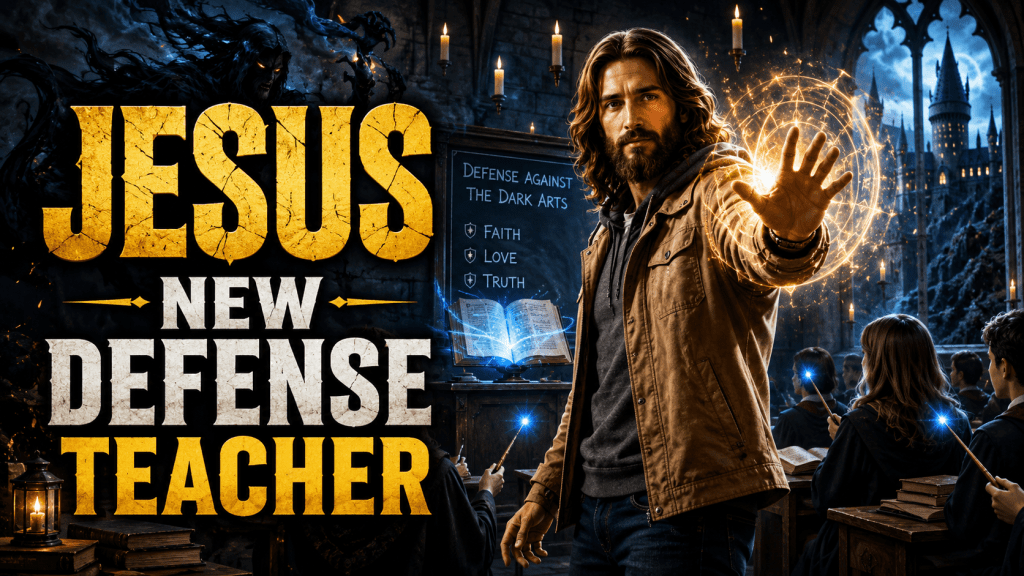
Chapter One: The Lesson No Wand Could Hide
Jesus knelt in quiet prayer before the first bell ever touched the morning. The Defense Against the Dark Arts classroom was still dark except for the weak gray light slipping through the tall windows, and the old castle seemed to breathe around Him as if the stones themselves were listening. Rain tapped softly against the glass above the Black Lake, and far below, somewhere beneath layers of corridors and sleeping portraits, pipes groaned with the cold of a Scottish dawn. Jesus wore simple dark trousers, a plain coat, and shoes still damp from the courtyard, but nothing about Him felt borrowed from the world around Him. His hands rested open before God, and His silence carried more weight than any spell ever spoken inside that room.
On the desk behind Him lay a folded copy of the Daily Prophet, a sealed note from Headmistress McGonagall, and a student roster marked with warnings in red ink. The castle had welcomed many Defense Against the Dark Arts teachers through the years, but not like this. Whispers had already moved faster than owls through the towers, through the Great Hall, through the staircases that changed their minds, and through the common rooms where students tried to sound fearless in front of one another. Someone had written Jesus at Hogwarts Defense Against the Dark Arts teacher on a scrap of parchment and pinned it to a notice board near the Entrance Hall, and by breakfast half the school had already argued about whether it was a joke, a prophecy, or some new form of Ministry oversight.
There had been another parchment passed hand to hand the night before, quieter and stranger than the first. It spoke of the lesson of mercy inside a world of hidden darkness, and no one knew who had written it. A few students laughed at the phrase because laughter was easier than saying they were afraid. Others folded the words and kept them in their pockets because something about them made their chest tighten. By dawn, the parchment had reached the Defense Against the Dark Arts classroom and now rested under the corner of the desk, partly hidden beneath the roster. Jesus had seen it, but He had not moved it.
The first human cry of the morning did not come from a classroom, a corridor, or the hospital wing. It came from a narrow passage behind a tapestry on the third floor where a boy named Rowan Vale pressed both hands over his mouth and tried not to make any more sound. He was sixteen, tall enough to look older than he felt, and tired in a way that no amount of sleep could touch. A cracked wand lay on the stone near his knee. Beside it was a silver locket with the Slytherin crest scratched nearly beyond recognition, and on the wall before him, burned into the stone by magic he had not meant to release, were the words his father had written in his last letter: Do not shame our name again.
Rowan stared at the words until they blurred. The burn marks smoked faintly, and every second they remained there felt like another witness against him. He had not meant to carve them into the wall. He had only meant to open the locket. He had only meant to prove that he was not weak, that he could handle the little whisper locked inside it, that whatever his father had hidden there before being taken away by Aurors was not stronger than he was. But when the clasp broke open, the cold inside the silver had gone straight through his fingers, and the voice that came out had sounded so much like home that he almost answered it.
The locket had belonged to his family for generations, or so his father had always said. His mother had called it an heirloom and refused to touch it. His older brother had once told him that every family kept something ugly and called it tradition so they would not have to repent of it. Rowan had hated him for saying that because his brother had left home and never returned. But now, sitting on the floor before the burned words, Rowan felt the sentence crawl back through him. Something ugly. Something called tradition. Something waiting for him to prove he was loyal enough to carry it.
Footsteps sounded beyond the tapestry. Rowan snatched up the locket and shoved it into his pocket, but the cracked wand would not stop trembling in his hand. He whispered a repair charm twice and failed both times. The burn marks on the wall deepened as if the stone remembered the voice better than he did. Panic rose sharp in his throat. If Filch saw it, if McGonagall saw it, if anyone saw what had happened before Rowan could erase it, the whole school would know that the Vale family had brought cursed magic back into Hogwarts again.
The tapestry moved, and Headmistress McGonagall stepped through with her tartan dressing gown pulled tightly over her robes and her silver hair pinned as firmly as if dawn itself had offended her. Behind her came Neville Longbottom, carrying a lantern and looking more saddened than surprised. The lantern light fell across Rowan, then across the wall, then across the cracked wand in his hand. No one spoke for several seconds. The old stones gave off a smell like scorched rain.
“Mr. Vale,” McGonagall said at last, and her voice was steady, but not cold. “Stand up.”
Rowan tried. His legs shook once before they held him. He wanted to say that he had been attacked, that it was not his fault, that someone had planted the locket in his trunk, that the spell marks were already there when he came into the passage. Lies came easily when fear opened the door. He had learned that at home long before Hogwarts taught him anything useful. But McGonagall’s eyes were on the wall, and Professor Longbottom was looking at Rowan’s pocket as if he could feel the thing hidden there.
“I can explain,” Rowan said.
McGonagall’s mouth tightened. “Then I suggest you begin with the truth.”
The word landed harder than accusation. Rowan looked down at his shoes and saw soot on the toes. His fingers closed around the locket in his pocket, and the metal felt warm now, almost alive. He thought of his father in the Ministry holding cells. He thought of his mother’s face at the kitchen table under a single lamp. He thought of the empty chair where his brother used to sit before he had chosen shame over loyalty, or courage over fear, depending on which memory Rowan trusted that morning. The locket pulsed once against his palm, and the voice inside it whispered without sound.
Tell them nothing.
Rowan swallowed. “It was an accident.”
Professor Longbottom’s face changed, not into anger, but into recognition. “That is not the same as the truth.”
The castle bell rang once, low and deep, carrying through the walls. Breakfast would begin soon. Students would pour into the corridors with books under their arms and jokes in their mouths, and Rowan would have to walk among them like nothing had happened. He could already hear the story forming before anyone knew the facts. Slytherin boy caught with cursed object. Vale family at it again. Dark magic always finds its own blood. He hated them for thinking it. He hated himself because part of him believed it too.
McGonagall lifted her wand, but before she spoke, another presence entered the passage.
Jesus stepped through the tapestry without hurry. He had no wand in His hand. He did not look surprised by the burned words, the cracked wand, or the fear written plainly across Rowan’s face. He greeted McGonagall with a small nod, and she returned it with the sort of grave respect she gave almost no one. Professor Longbottom lowered the lantern a little. The flame settled as if the air had become still around it.
Rowan had seen Jesus only once before, across the Great Hall the night He arrived. He had expected someone taller, brighter, stranger, maybe even frightening in some clean and obvious way. Instead, Jesus had sat near the staff table and listened while McGonagall spoke to Him, His face calm, His hands folded loosely before Him. But now, in the narrow passage, Rowan felt something he had not felt in the Great Hall. He felt seen in a way that did not let him hide and did not push him away.
Jesus looked at the wall. He read the burned sentence slowly, not because He needed time to understand it, but because He seemed unwilling to treat even cruel words carelessly. Then He turned to Rowan. “Who taught you to fear shame more than sin?”
The question struck the place Rowan had protected most fiercely. McGonagall looked toward Jesus, but she did not interrupt. Neville’s eyes lowered for a moment as if the question had touched him too. Rowan tried to answer with anger because anger had always given him a few seconds of cover. “You do not know anything about my family.”
“I know what fear does when it is handed down and called honor,” Jesus said.
Rowan felt the locket heat against his palm. He pulled his hand out of his pocket as if burned, and the chain came with it. Silver flashed in the lantern light. McGonagall’s wand rose at once. Neville took one step forward, but Jesus did not move. The locket twisted on its chain, and for a moment the scratched Slytherin crest seemed to sharpen, dark lines crawling back into place like wounds closing the wrong way.
“Place it on the floor,” McGonagall said.
Rowan’s fingers would not open. Sweat gathered at his temple. The locket was not heavy, but it held him as if the chain had wrapped around bones inside his wrist. A small voice moved through him, not loud enough for anyone else to hear, yet clear as thought. They will take it. They will take everything. They will leave you with nothing but weakness.
Jesus stepped closer. “Rowan.”
No one at Hogwarts had said his name that way. Teachers said it as a warning. Students said it with a question behind it. His parents said it like a command. Jesus said it like there was still a person beneath everything that had been expected of him. Rowan’s jaw tightened, and he hated that tears came so quickly. He tried to blink them back, but one escaped anyway.
“If I let it go,” Rowan whispered, “then I am nothing.”
Jesus looked at him with such sorrow and strength that Rowan felt for one terrifying second that the whole passage had opened around his life. “No,” Jesus said. “If you let it go, you may finally learn what you are without it.”
The locket snapped open.
The air went black at the edges. McGonagall cast a shield charm so fast the light bent around her wand, and Neville drew Rowan backward by the shoulder. From inside the locket came a thin ribbon of smoke, silver at first, then darkening as it rose. It did not form a full body, not a ghost and not a memory, but a mouth appeared inside the smoke, and the voice that came from it was Rowan’s father’s voice sharpened into something crueler than life.
“Coward,” it said.
Rowan flinched as if struck. The smoke widened. The burned words on the wall glowed red, and behind them more words appeared, faint at first, then clearer. Names. Old family names. Oaths. Promises. Spells written in a cramped hand. The passage filled with the smell of wet earth and iron. McGonagall’s shield shimmered under pressure, and Neville gripped his wand with both hands.
Jesus looked at the smoke and spoke with quiet authority. “Be silent.”
The mouth kept moving, but no sound came out. The sudden silence was worse than the voice because Rowan could still see the shapes of the words it wanted to say. Worthless. Disloyal. Weak. Son of traitors. Son of fools. The locket shook on the chain and dragged across the stone toward Rowan’s foot, as if it still expected him to pick it up. He did not move. His breath came shallow and broken.
Jesus knelt and placed one hand near the locket, not touching it. “This has been fed for a long time,” He said.
McGonagall’s face was pale with anger, not at Rowan alone, but at whatever history had crawled into her school before sunrise. “Can it be contained?”
“Yes,” Jesus said. “But first the boy must stop protecting what is destroying him.”
Rowan heard those words and almost hated Him. It would have been easier if Jesus had simply taken the locket, rebuked the darkness, and left Rowan out of it. That was what adults usually did when they wanted to appear merciful without asking what had made the child afraid. They removed the object. They filed the report. They shook their heads. Then they left the fear untouched because fear was harder to confiscate than contraband.
“I did not bring it here to hurt anyone,” Rowan said.
“No,” Jesus answered. “You brought it because you thought it could tell you who you had to become.”
Rowan’s hand shook. “My father said our name was ruined because we became soft.”
“Your father lied,” Jesus said.
The passage seemed to still further. McGonagall did not soften the statement. Neville looked at Rowan with painful kindness. The locket scraped one more inch across the floor, and the smoke bent toward Jesus like a serpent testing heat. Jesus did not raise His voice. He did not make a show of power. He simply looked at the dark ribbon, and the smoke recoiled.
Rowan could barely speak. “You do not know what he was like.”
“I know men who wound their sons and call it strength,” Jesus said. “I know fathers who confuse fear with obedience. I know children who carry a house fire in their chest because no one ever taught them how to leave the burning room.”
The words did not sound like a lecture. They sounded like truth spoken beside him, not above him. Rowan wanted to step back, but the wall was behind him. For the first time since the locket opened, he realized his shoulders were pressed against the burned words. His father’s sentence was behind him, and Jesus was before him, and the cursed thing lay between them like a choice.
McGonagall turned her head slightly toward Neville. “No students are to pass this corridor.”
Neville nodded and backed toward the tapestry, but before he left, his eyes rested on Rowan. “You are not the first person to be frightened by what your family left you,” he said quietly. “That does not make it harmless, but it does mean you are not alone.”
Rowan looked away because kindness from Professor Longbottom hurt worse than anger. Everyone knew his story, or parts of it. His parents had been tortured by Death Eaters when he was young, and yet he had grown into the sort of man who made frightened students believe courage could come from trembling hands. Rowan had once mocked him in the common room with two older boys, calling him the professor of garden bravery. Now the memory shamed him so sharply he could hardly breathe.
Jesus saw the change in his face. “You have learned to despise gentleness because you were told it could not survive,” He said.
Rowan said nothing.
“But gentleness survived this castle,” Jesus continued. “Mercy survived here. Sacrifice survived here. Truth survived here. Darkness made many claims in these halls, but it did not keep what it claimed.”
The smoke thrashed at the word mercy. The locket snapped shut, then open again, as if the hinge itself was panicking. McGonagall lifted her wand higher, but Jesus raised one hand, and she waited. He looked at Rowan, not the locket. “Tell the truth now.”
Rowan’s lips parted. Nothing came out. The truth was not one sentence. It was his mother telling him to keep the locket hidden because the Ministry had already taken enough. It was his father’s last letter arriving under a charm that made the ink vanish after reading. It was the old family storage room beneath their house near Knockturn Alley, where portraits turned their faces when his brother’s name was spoken. It was the cold pride that filled the room whenever anyone mentioned pure blood, old blood, loyal blood, as if blood had ever saved a soul from becoming cruel.
“I found it in my trunk last night,” Rowan said finally. His voice sounded small and young. “My mother sent it with my winter robes. There was a note. She said my father wanted me to keep it safe until he came home.”
McGonagall’s expression hardened. “Your father will not be coming home for some time.”
“I know,” Rowan said, and the shame of admitting it made his face burn. “But the note said there were things inside it that belonged to me. Things I needed if I was going to protect our name.”
Jesus waited.
Rowan looked at the burned wall. “I opened it because I wanted to hear him say I was still his son.”
The smoke faltered. McGonagall’s eyes closed for one brief second, and when she opened them again, her face had lost some of its sharpness. Jesus remained kneeling near the locket. He did not rush to fill the silence. Rowan wished He would. Silence made room for everything he had been avoiding.
“That is why it held you,” Jesus said at last. “Not because it was strong, but because it sounded like love to a place in you that had gone hungry.”
The sentence broke something open. Rowan covered his face with one hand, but he did not turn away. The locket rattled harder. The burned words on the wall began to bleed dark threads down the stone, and McGonagall moved quickly now, casting a containment charm that sealed the smoke within a ring of blue light. The magic held, but only barely. Jesus rose from the floor.
“Professor,” He said to McGonagall, “this cannot remain hidden in a passage.”
Her eyes moved to Rowan. “No. It cannot.”
Fear returned with a rush. “Please,” Rowan said. “If everyone finds out, they will think I brought dark magic here on purpose. My house will hate me. The others already think Slytherins are one bad day away from becoming what everyone expects. My mother will hear about it. The Ministry will question her. Please.”
McGonagall’s face showed the strain of a woman who had lived long enough to know that mercy without truth could become permission, and truth without mercy could crush a child under the weight of adult sins. “Mr. Vale, a cursed object has been opened inside Hogwarts. It burned dark family writings into school stone. This is not a matter I can settle with a private scolding.”
“I did not mean to,” Rowan said.
“I believe you,” she replied. “That does not make it safe.”
Jesus stepped between the locket and Rowan, not to shield him from consequences, but to free him from thinking consequences meant abandonment. “Truth has a cost,” He said. “So does hiding. Only one of them can heal you.”
The morning bell rang again, sharper this time. Voices began to move in the distance. Students were waking. Doors opened. Somewhere nearby a suit of armor sneezed dust and startled a portrait into complaint. The ordinary life of the castle was returning, unaware that the third-floor passage held a boy, a headmistress, a cursed family locket, and the beginning of a reckoning.
McGonagall made her decision. “The locket will be secured at once. Professor Longbottom will fetch Madam Pomfrey and Professor Goldstein from Charms. Mr. Vale, you will come with me after breakfast and give a full account. Until then, you will attend your first Defense Against the Dark Arts lesson.”
Rowan looked up in shock. “You still want me in class?”
“I did not say want,” McGonagall said, though not unkindly. “I said you will attend. Hiding alone with this fear has already proven unwise.”
Jesus looked at the locket again. “The lesson is not separate from what happened here.”
McGonagall studied Him. “You intend to teach after this?”
“Yes,” Jesus said.
“With that thing newly opened?”
“With the fear newly exposed,” He answered.
For a moment, even McGonagall seemed unable to answer. Then she nodded once, as if she understood more than she wished she had to. Neville returned through the tapestry just then, breathing a little harder from the stairs. He took in the containment charm, the locket, and Rowan’s face, and his voice came quiet. “The corridor is clear.”
Jesus turned to Rowan. “Pick up your wand.”
Rowan looked at the cracked piece of wood on the floor. “It is broken.”
“Yes,” Jesus said. “Pick it up.”
Rowan obeyed. The wand felt useless in his hand. He expected Jesus to repair it, but Jesus did not take it from him. He simply looked at the crack running through the grain and then at Rowan’s fingers wrapped too tightly around it.
“Do you know why it cracked?” Jesus asked.
“Because I lost control.”
“No,” Jesus said. “Because you tried to force power through fear.”
Rowan’s throat tightened again. “Isn’t that what everyone does in Defense Against the Dark Arts?”
McGonagall’s eyebrows lifted at the edge of the remark, but Jesus did not seem offended. “Many do,” He said. “That is why many learn defense and remain afraid.”
The words stayed with Rowan as they left the passage. McGonagall levitated the sealed locket in a blue sphere ahead of her, and Neville walked behind it with his wand ready. Jesus walked beside Rowan, not touching him, not guarding him like a prisoner, yet somehow making it impossible for him to feel completely alone. They moved through the waking castle by back corridors to avoid the rush of students. Portraits stopped mid-yawn. A knight in one painting removed his helmet and bowed without knowing why.
By the time they reached the Defense Against the Dark Arts classroom, the first students were already waiting outside. Some stood in clusters, whispering. Some leaned against the wall pretending not to care. A few Ravenclaws had brought extra quills, as if the arrival of Jesus could be handled by excellent notes. Two Gryffindor boys were daring each other to ask whether He could cast a Patronus without a wand. Near the back, three Slytherin students stopped talking when they saw Rowan.
One of them was Cassian Burke, seventeen, handsome in a sharp and restless way. His family name carried its own shadows, and he wore them like expensive robes. Beside him stood Mara Flint, who watched everything before deciding whether to laugh. The third was a younger boy named Ellis Nott, who looked at Rowan’s cracked wand and immediately looked away. Cassian’s mouth curved.
“Rough morning, Vale?”
Rowan’s hand tightened around the wand. The locket was gone now, taken by McGonagall and Neville to be secured, but the voice it had awakened had not gone far. It reached for Cassian’s smirk. It reached for Rowan’s shame. It suggested three replies, each cruel enough to make him feel taller for a moment.
Jesus stopped at the classroom door and looked at Cassian.
Cassian’s smirk faded before Jesus spoke. The other students grew quiet in widening circles, as if silence had been poured into the corridor. Jesus opened the door and gestured for them to enter. No one rushed. Even the students who prided themselves on boredom walked in carefully.
The classroom looked different from what they expected. There were no cages. No rattling cupboards. No dark detectors spinning on shelves. No skulls, no grim charts, no dramatic display of cursed relics. The desks had been moved into a wide half circle facing the windows. On the front table sat a single covered object under plain brown cloth, a basin of water, a candle, and a stack of blank parchment. The fireplace was unlit, but the room was warm.
Rowan chose a seat near the side where he could keep his back to the wall. Cassian sat two desks away. Mara sat between them, watching with interest that made Rowan uneasy. Students from every house filled the room, their robes still carrying the smell of breakfast toast, wet wool, and corridor dust. The chatter did not return. They were waiting for a spectacle, but Jesus gave them none.
He stood before them without a wand. “You have been told this class is about defending yourselves against darkness,” He said.
No one wrote anything. Even the Ravenclaws hesitated.
“That is partly true,” Jesus continued. “But many people try to fight darkness while still loving what gave it room in them.”
A few students shifted. Cassian leaned back as if unimpressed, but Rowan saw his fingers tap once against the desk.
Jesus walked slowly to the basin of water. “Darkness does not always begin as a curse. Sometimes it begins as a secret we refuse to bring into the light. Sometimes it begins as bitterness we call wisdom. Sometimes it begins as fear we call loyalty. Sometimes it begins as pride we call family honor.”
Rowan stared at the grain of his desk. The words were not aimed only at him, and that somehow made them more unbearable. He was not the only one carrying something hidden. The room seemed full of pockets, letters, memories, jealousies, bargains, wounds, and little private altars no professor had ever asked about.
A Hufflepuff girl near the front raised her hand halfway, then lowered it. Jesus looked at her. “Speak.”
She cleared her throat. “Are you saying dark magic comes from feelings?”
“No,” Jesus said. “I am saying darkness often asks a feeling to open the door.”
The girl nodded slowly.
Cassian gave a soft laugh. “That sounds very gentle for a defense class.”
Jesus turned to him. “Do you believe gentleness cannot defend?”
Cassian’s face hardened with pleasure, as if he had been invited into a duel he knew how to win. “I believe darkness does not care whether you are gentle.”
“No,” Jesus said. “It fears what is holy. It uses cruelty because cruelty is often easier for wounded people to imitate.”
The room became so quiet that rain against the windows sounded loud. Cassian’s ears reddened, but he held Jesus’ gaze. “And you think holiness is going to stop a curse?”
“Holiness has broken more than curses,” Jesus said.
No one laughed. Cassian looked away first, and Rowan felt a sharp, unwanted satisfaction. Then Jesus looked at Rowan, and the satisfaction withered in him. It had come from the same root. He knew it. That made him angry.
Jesus uncovered the object on the table. It was not the locket. It was a mirror about the size of a dinner plate, rimmed in dull black metal, its surface cloudy as if fogged from within. Several students drew in quick breaths. One Ravenclaw whispered, “That is a Maledictus mirror.” Another corrected her under his breath, “No, it is older. Look at the rim.”
“This mirror does not show your face,” Jesus said. “It shows the lie you are most tempted to believe when you are afraid.”
The room stiffened. Someone dropped a quill. Mara Flint whispered something that sounded like a joke, but no one answered her.
Jesus continued. “You will not touch it today. You will not perform spells on it today. You will not test it as if courage means curiosity without obedience.”
That last sentence seemed to disappoint half the class and relieve the other half.
A Gryffindor boy raised his hand. “Then what are we doing?”
“You will learn the first defense,” Jesus said.
He took a piece of parchment from the stack and laid it beside the basin. “Write one sentence you have believed about yourself that becomes stronger when you are afraid.”
No one moved.
Jesus waited. The waiting was worse than any command. Students looked at one another, hoping someone would scoff first and break the seriousness of it. Cassian reached for his quill with exaggerated boredom, but his hand paused over the parchment. Rowan did not reach for anything. His broken wand lay on the desk before him like evidence.
Jesus looked around the room. “You do not have to show it to another student. You do not have to say it aloud. But you must tell the truth before God, or you will keep defending the lie.”
A girl from Gryffindor began writing first. Then the Hufflepuff girl. Then two Ravenclaws. Quills scratched in nervous bursts. Rowan stared at his blank page while words rose in him too quickly. I am only wanted if I am useful. I am my father’s shame. I am weak if I am kind. I am nothing without my name. He hated every sentence because each one felt true enough to wound him.
Across the room, Cassian wrote fast, folded the parchment, and sat back. Mara did not write at all. She stared at Jesus as if daring Him to call on her. Ellis Nott’s quill hovered over his page for almost a full minute before he wrote one line and covered it with his sleeve. The mirror clouded darker on the table though no one had touched it.
Rowan finally dipped his quill. His hand shook so badly the ink blotched. He wrote, I am nothing if my family rejects me. Then he scratched it out until the parchment tore. The scratch marks looked desperate and childish. He turned the page over and wrote again, smaller this time, I do not know who I am without their approval.
The moment the sentence was finished, the basin of water rippled.
Several students noticed and looked up. Jesus did not. He was watching Rowan, but not with exposure, not with triumph, and not with the satisfaction of a teacher who had forced a student into honesty. He looked at him as He had in the passage, with sorrow and hope held together.
Then the classroom door burst open.
A small first-year boy stumbled inside, his face white, his robe torn near the collar. Behind him came a blast of cold air and a sound like distant hissing. The students turned. The boy tried to speak, but his mouth worked without sound. Jesus crossed the room in three steps and knelt before him.
The boy grabbed Jesus’ sleeve. “It is in the corridor,” he gasped. “It came out of the wall.”
McGonagall appeared in the doorway behind him, wand raised, her expression fierce. “Everyone remain seated.”
But no one remained calm. Students pushed back from desks. Someone knocked over an ink bottle. The mirror on the table clouded black. A long shadow moved beyond the open door, sliding across the corridor wall though nothing visible cast it.
Rowan stood before he knew he was standing. His cracked wand was in his hand. He heard the whisper from the locket again, faint but eager.
Now prove yourself.
Jesus turned His head slightly, and though the room was full of fear, His eyes found Rowan at once. “Not through fear,” He said.
The shadow beyond the door grew taller. It bent toward the classroom like smoke remembering a shape. McGonagall’s shield charm flashed across the doorway, and the thing struck it with enough force to rattle every window. The first-year boy cried out and buried his face against Jesus’ shoulder. Jesus held him with one arm and rose.
“What is it?” a Ravenclaw whispered.
McGonagall’s jaw set. “Something that should have remained sealed.”
Rowan knew before anyone said more. The locket had not been contained after all, or something from it had escaped before McGonagall sealed it. The burned words in the passage had not only revealed a curse. They had opened a path. His family’s hidden darkness was no longer in his pocket. It was in the corridor outside a classroom full of students.
Every eye seemed to turn toward him, even the eyes that did not move. Rowan felt the old shame rise like a hand around his throat. Cassian stared at him with a look that mixed accusation and fear. Mara’s face had lost all amusement. Ellis Nott looked as if he might be sick.
“I did not mean for this to happen,” Rowan said.
His voice was too quiet, but the room heard it.
Jesus looked at him. “I know.”
The shadow hit the shield again. This time, black veins spread across the light. McGonagall lifted both hands around her wand and strengthened the charm, but the effort showed in her face. Students began moving backward toward the far wall. The mirror on the table trembled. Parchments fluttered. Rowan’s torn page slid from his desk and landed near Jesus’ feet.
Jesus glanced down at it, then back at Rowan. “You told the truth,” He said. “Now stand in it.”
Rowan shook his head. “I cannot stop that.”
“No,” Jesus said. “But you can stop agreeing with it.”
The words landed with terrifying clarity. Rowan looked at the shadow beyond the door. It pressed against McGonagall’s shield in pulses, and each pulse seemed to carry old voices, not only his father’s, but others buried deeper in the Vale line. Men and women who had taught fear as inheritance. Names that had survived by bending toward power. Prayers never prayed. Repentance never chosen. The whole ugly thing had worn his family crest and called itself honor.
Jesus stepped toward the doorway. McGonagall did not lower her wand. “If I release the shield, it will enter.”
Jesus nodded. “Release it when I tell you.”
Half the class gasped. Cassian stood. “Are you mad?”
McGonagall did not look at him. Her eyes were on Jesus. “Students cannot be exposed to this.”
“They already have been,” Jesus said. “Only now they can see it.”
Rowan’s heart pounded so hard he could feel it in his cracked wand. He wanted Jesus to destroy the thing without involving him. He wanted McGonagall to send everyone away. He wanted time to become private again. But the truth had passed that point. Hidden darkness had entered a public place, and everyone who had trusted the walls of the castle was now waiting to see whether truth was stronger than the thing his family had preserved.
Jesus looked at Rowan. “Come here.”
Rowan did not move.
The shadow struck again, and the shield groaned.
“Come here,” Jesus said again, and His voice carried no panic.
Rowan stepped into the aisle. Every step felt longer than it was. He passed Cassian, who looked at him with something almost like fear for him instead of fear of him. He passed the first-year boy, still clinging to Jesus’ sleeve. He stopped several feet from the doorway, close enough to feel the cold coming through McGonagall’s failing shield.
Jesus stood beside him. “Say what is true.”
Rowan looked at the shadow. His mouth went dry. “I do not know what is true.”
Jesus’ eyes stayed on the corridor. “Then begin with what was false.”
The shield flickered.
Rowan lifted his cracked wand, then lowered it. This was not a spell. He understood that suddenly, and the understanding frightened him more than magic. His voice shook. “My father lied.”
The shadow recoiled.
McGonagall’s eyes sharpened. Students stared. Rowan felt tears on his face and did not wipe them away. The first sentence had broken through him. More followed, not cleanly, not bravely, but truly.
“My family name cannot save me,” he said. “Cruelty is not strength. Fear is not honor. Dark magic is not inheritance I have to keep.”
The shadow thrashed against the shield. The walls shuddered. Somewhere far above, a portrait screamed. But Rowan felt the chain loosen inside him. Not disappear. Not heal all at once. Loosen.
Jesus said, “And who are you?”
Rowan looked at Him. The answer did not come from his father, his mother, his house, the locket, the school, or the watching students. It came slowly, like something buried under years of noise. “I am a boy who needs mercy.”
Jesus’ face softened. “Yes.”
McGonagall released the shield.
The shadow surged through the doorway, fast and wide, and the room erupted in screams. Jesus stepped forward and raised His hand. No wand, no charm, no incantation. The shadow struck an unseen boundary before Him and folded inward, twisting like cloth in fire. A sound tore through the room, not loud exactly, but deep enough to make every student feel it behind the ribs.
Jesus spoke one command. “Leave him.”
The shadow convulsed. The black shape stretched toward Rowan, and for one awful second he saw his father’s face inside it, not as he was in life, but as the curse had used him. Angry. Hollow. Hungry to be obeyed. Rowan almost stepped back, but Jesus was between them, and the shadow could not pass Him.
“Leave him,” Jesus said again.
The darkness broke.
It did not explode. It did not vanish in a grand burst of light. It came apart like smoke in clean wind, piece by piece, until only a bitter smell remained. The mirror on the table cleared. The basin of water stilled. McGonagall lowered her wand slowly, and the silence afterward felt too large for the classroom to hold.
Rowan stood trembling in the aisle. His cracked wand slipped from his hand and clattered on the floor. No one laughed. No one spoke. Cassian’s face had gone pale. Mara Flint wiped one tear away quickly, looking furious that it had appeared. Ellis Nott stared at his covered parchment as if it had become dangerous.
Jesus turned back to the class. “This is why we begin with truth.”
No one wrote it down.
He knelt and picked up Rowan’s wand. The crack was still there. Jesus did not repair it. He placed it gently on Rowan’s desk, then looked at the class with a seriousness that made every student sit still.
“Your spells matter,” He said. “Your discipline matters. Your courage matters. But if you defend your life with lies inside it, darkness will keep finding doors.”
He turned to the first-year boy and touched his shoulder. “You are safe now.”
The boy nodded, though his face was wet. McGonagall guided him to a chair near the front and gave him a handkerchief from her sleeve. Her hands were steady, but her eyes remained on Jesus for a moment longer than usual. She had seen many kinds of magic. The room knew she had just seen something else.
Rowan returned to his seat because he did not know what else to do. His parchment still lay near Jesus’ feet. Jesus picked it up and folded it once, not reading it aloud, not exposing him. Then He set it on Rowan’s desk beside the cracked wand.
Rowan whispered, “What happens to me now?”
Jesus looked at him. “Now you tell the rest of the truth.”
Rowan closed his eyes. That was not the answer he wanted. It was not punishment exactly, but it was not escape either. He thought of McGonagall’s office. He thought of letters home. He thought of students whispering through the corridors by lunch. He thought of his mother receiving word that the locket had failed to make him loyal. Fear rose again, but it did not fill the room the way it had before.
Jesus added, “And you do not tell it alone.”
Rowan opened his eyes.
The class remained silent around him. The rain had slowed outside. Beyond the tall windows, the Black Lake lay dark and restless under the morning sky, and the castle carried on with its old noises, its moving stairs, its hidden rooms, its memories of wars and children who had grown up too quickly inside its walls. Hogwarts had held danger before. It had held courage too. But that morning, in the Defense Against the Dark Arts classroom, Rowan Vale understood that the first lesson had not been about defeating a thing in the corridor.
It had been about the thing he had protected because he thought it was the only way to belong.
Jesus returned to the front of the room. The students watched Him differently now. Not with easy belief. Not with simple comfort. Some looked unsettled. Some looked relieved. Some looked as if the lesson had reached a locked room inside them and knocked once.
Jesus lifted the basin of water and poured it into the empty fireplace. The water struck the cold ash and darkened it. “For the rest of class,” He said, “you will sit with the sentence you wrote. You will not show it to anyone. You will not hide from it either. And before you leave, you will ask God for the courage to stop serving the lie.”
No one complained.
Rowan looked at his folded parchment, then at the crack in his wand. For the first time, the crack did not look only like damage. It looked like evidence that something false had finally met resistance. He did not feel free. Not yet. But he felt the first terrible mercy of no longer being able to pretend that bondage was loyalty.
When the bell rang, no one rushed for the door. Students gathered their books slowly, as if ordinary movement had become unfamiliar. Cassian passed Rowan’s desk and paused long enough that Rowan expected a threat or a sneer. Instead, Cassian looked at the cracked wand and said, barely above a whisper, “My grandfather has one too.”
Rowan looked up.
Cassian’s face tightened at his own confession. “Not a locket,” he said. “A ring.”
He left before Rowan could answer.
Mara followed, but she stopped at the door and glanced back at Jesus. For once she had no clever remark ready. Ellis Nott lingered over his parchment, then folded it so many times it became a tiny square in his palm. One by one, the students stepped into the corridor, where the last traces of cold had faded and morning light stretched thin across the stone.
Rowan remained seated.
McGonagall stood near the door, waiting. Professor Longbottom had returned and was speaking softly with the first-year boy. Jesus came to Rowan’s desk and stood beside it.
“I am afraid,” Rowan said.
Jesus nodded. “I know.”
“My mother will hate me.”
“She may.”
Rowan looked up, startled by the honesty.
Jesus did not soften it with a lie. “But her hatred cannot tell you who you are.”
Rowan’s eyes filled again, and this time he was too tired to resist it. “I do not know how to do this.”
Jesus placed one hand on the desk, near the broken wand and the folded sentence. “Then begin with the next true thing.”
Rowan breathed in slowly. The air no longer smelled like smoke. It smelled like rain, ash, parchment, and the strange clean quiet that comes after something hidden has been dragged into the light. He picked up the folded sentence and placed it in his robe pocket, not as a secret this time, but as a confession he would have to keep facing. Then he picked up his cracked wand.
McGonagall opened the classroom door wider. The corridor beyond it waited with all its whispers.
Rowan stood.
Jesus walked with him.
Chapter Two: The Owl That Would Not Land
The corridor outside the Defense Against the Dark Arts classroom had never felt longer to Rowan. Students moved away in small groups, whispering with the careful fear of people who had seen too much and did not know what part of it could safely be repeated. The stone floor still held faint streaks of gray where the shadow had crossed the threshold, though no spell marks remained. Jesus walked beside him without rushing, and that made the silence more difficult to bear. If He had dragged Rowan forward or guarded him like a criminal, Rowan might have known what kind of shame to prepare for, but Jesus simply walked with him as if truth was heavy enough already.
Professor McGonagall led them toward the moving staircases with her wand tucked inside her sleeve. She had sent Professor Longbottom ahead to make sure the sealed locket had been placed behind the strongest protections available before the Ministry was notified. That word, Ministry, kept striking Rowan in the mind like a bell he could not silence. His father had been taken by Aurors less than two years earlier after a secret room beneath their London house had been found packed with banned objects and old correspondence. Rowan had told himself he did not know, then told himself he could not have known, then finally stopped letting himself think about the difference between those two statements.
The staircase turned just as they reached it, carrying them away from the usual path to the Headmistress’s office. McGonagall looked up at the shifting rails with narrowed eyes, as if even the castle’s old habits were testing her patience. “Not today,” she said. The staircase groaned and corrected itself with the slow dignity of a creature offended by being told what to do. Rowan almost smiled despite everything, but the smile died before it reached his face. He remembered too quickly that every ordinary thing was still happening while his own life was changing.
A group of second-year students froze on the landing below. One of them pointed before another grabbed his sleeve. Rowan heard his own name, then the word curse, then someone whispering Slytherin as if the house itself had opened the locket. Heat crawled up his neck. He wanted to turn and throw something cruel down the stairs. He wanted to ask them how many Gryffindors had made mistakes and still been called brave, how many Ravenclaws had opened things they should not touch and still been called curious, how many Hufflepuffs had hidden fear under kindness and still been treated as safe. The anger rose clean and tempting.
Jesus looked at him once.
Rowan said nothing. That small restraint felt humiliating because part of him still believed strength should leave a mark. He gripped the cracked wand in his sleeve and kept walking. By the time they reached the stone gargoyle outside McGonagall’s office, his hand hurt from holding it too tightly.
The gargoyle sprang aside before McGonagall gave the password. That alone made her pause. The spiral stairway beyond it carried them upward in a quiet turn, and Rowan stared at the wall because looking at Jesus felt too much like being asked another question. The office door opened into a round room filled with portraits of former headmasters and headmistresses, many of whom were pretending badly to be asleep. Silver instruments turned on little tables. Books lined the walls. Behind the desk, the Sorting Hat sat on a shelf and looked as worn and watchful as a thing could look without having eyes.
A portrait near the window cleared its throat. “Minerva, I assume this concerns the disturbance in the north corridor?”
“It concerns several things,” McGonagall said, closing the door behind them. “And I would appreciate silence unless I request counsel.”
The portrait, which belonged to a thin wizard with a beard too long for his own good, sniffed and pretended to sleep again. Another portrait smiled faintly from behind half-moon spectacles, but said nothing. Rowan had expected the office to feel safer than the classroom. It did not. It felt like judgment had been sitting here for centuries and had finally looked in his direction.
McGonagall pointed to the chair before her desk. “Sit, Mr. Vale.”
Rowan sat. Jesus remained standing near the window where rain slid down the glass and blurred the view of the grounds. Far below, students crossed the damp courtyard in lines and clusters, unaware of how small they looked from that height. Rowan had once loved that view during his first year when he still believed Hogwarts might become a place where the Vale name mattered less. Then letters from home began arriving with reminders folded into every page, and slowly the school became another place where he had to perform belonging.
McGonagall sat behind the desk and opened a drawer. She removed a long, thin box of dark wood and placed it before her. Rowan knew before she lifted the lid that the locket was inside. The room grew colder. Several portraits stopped pretending to sleep.
“You will tell me everything from the moment you received it,” she said.
Rowan glanced at Jesus. He did not nod, but His stillness gave Rowan no room to hide. That bothered him. It also held him together. Rowan took a breath and began with the package. It had arrived three nights earlier wrapped in plain brown paper, delivered by a barn owl he did not recognize. The note inside was from his mother, written in her small, tight hand. She told him to keep the locket out of sight, to open it only when he was alone, and to remember that some things belonged to blood before they belonged to law.
McGonagall wrote nothing down. That made Rowan more nervous. “Where is the note?”
“I burned it,” Rowan said.
Her expression did not change. “Why?”
“Because it said to.”
A portrait muttered something about incriminating correspondence, and McGonagall gave the wall one sharp glance. The room fell still again.
Rowan forced himself to continue. He had hidden the locket beneath a loose stone in the Slytherin dormitory because keeping it in his trunk felt too obvious. For two days, he had done nothing but think about it. During meals, it seemed to grow heavier in his memory. During classes, he heard his father’s voice in every difficult question. During the night, he dreamed that the Black Lake rose through the floor and filled the dormitory with dark water, and the locket floated above his bed like an eye.
“This morning,” Rowan said, “I took it to the third-floor passage because nobody uses it before breakfast.”
McGonagall folded her hands. “And you opened it.”
“Yes.”
“What did you expect to find?”
Rowan looked at the box on the desk. “I thought it might hold a message.”
“From your father?”
He nodded. “Or something he wanted me to know.”
Jesus spoke from near the window. “Did you hope it would bless you?”
Rowan’s throat tightened. The word felt strange in this room of magic and old authority. He wanted to reject it because it sounded too soft for what he had done, but the truth moved before pride could stop it. “Yes,” he said. “I think I did.”
McGonagall’s face softened only slightly, but it was enough to make Rowan look down. “Mr. Vale, the object did not contain a father’s blessing. It contained bound speech from multiple sources. Professor Longbottom recognized traces of memory binding before the containment charm sealed fully. There may be family voices in it, but there is also something older than your father’s anger.”
Rowan felt cold spread through him. “What does that mean?”
“It means,” she said carefully, “that your father may have possessed it, but he was not the first person to be possessed by what it carried.”
The room held that sentence. Rain thickened against the window, and thunder rolled beyond the hills. Rowan imagined the locket passing from hand to hand through people whose portraits might have hung in cold houses and whose names his father had spoken with pride. He imagined every one of them thinking they owned it while it learned how to speak in their voices. Shame shifted inside him. It did not leave, but it became less private and more terrible.
Jesus turned from the window. “Sin often teaches people to call captivity by the name of inheritance.”
McGonagall watched Him closely. “You believe the object has shaped the family across generations?”
“I believe men kept choosing it,” Jesus said. “The object did not make them cruel against their will. It gave cruelty a voice they were willing to obey.”
Rowan wished He had said the locket was responsible for everything. It would have been easier to hate a cursed object than to face the choices of living people. His father had chosen. His mother had chosen. Rowan had chosen when he carried it into the passage. He had not understood the full danger, but he had not been innocent of wanting what it promised.
McGonagall opened the box. The locket lay inside a nested ring of blue light and fine gold thread. It looked smaller than Rowan remembered. Its scratched crest was dull again. Nothing smoked from it now, and yet the room seemed to lean away from it. The portraits watched with open dislike.
“Do you still want it?” Jesus asked.
Rowan flinched. “No.”
Jesus waited.
Rowan stared at the locket. The answer no had come too quickly, the way a student answers when he thinks the teacher expects it. He did not want the smoke, the voice, the cold, or the public shame. But under that was another truth. Part of him still wanted to know whether it would speak kindly if he opened it the right way. Part of him still hoped there was some hidden sentence inside it that could make his father’s face soften in memory.
“I do not want what happened,” he said.
“That is not what I asked.”
McGonagall’s eyes moved to Rowan, and something in her expression told him she understood the danger of the difference. Rowan could lie here and sound wise. He could say all the correct things. He could appear repentant without surrendering the hope that the locket might still give him something he needed. The old habit of self-protection rose in him again.
“I want my father to want me,” Rowan said.
No portrait made a sound. The office seemed almost too kind for one terrible second, and he hated it. He hated that the truth made him feel younger than he was. He hated that Jesus did not look away from him. Most of all, he hated that saying it did not make him weak enough to disappear.
Jesus came to the desk and stood across from him. “That want is not evil.”
Rowan looked up.
“But if you let that want rule you,” Jesus continued, “you will bow to anyone who promises to satisfy it.”
Rowan swallowed hard. “Then what am I supposed to do with it?”
“Bring it to God without handing it to darkness.”
The answer did not feel simple, though the words were. Rowan looked at the locket again. “I do not know how.”
“You begin by not hiding it,” Jesus said.
A sharp tapping sounded at the window.
Everyone turned. A large gray owl hovered outside in the rain, beating its wings hard against the wind. A black ribbon was tied around one leg, and a narrow envelope hung from it, sealed in green wax. Rowan stood so quickly his chair scraped the floor. His stomach dropped before he saw the crest pressed into the seal.
McGonagall rose. “Is that your family owl?”
“No,” Rowan said. “But it is my mother’s seal.”
The owl tapped again, harder this time. It did not land on the sill. It remained outside the glass, wings laboring in the storm, eyes fixed on Rowan with a strange and unpleasant focus. Jesus moved slightly closer to the window. The owl struck the glass with its beak. Once. Twice. The sound was small, but it made Rowan’s hands go cold.
McGonagall lifted her wand. “No letter enters this office without inspection.”
The owl opened its beak. Instead of a hoot, Rowan heard his mother’s voice, thin and distant through the glass.
“Rowan.”
The portraits stirred. One of them swore softly.
Rowan could not move. His mother’s voice came again, clearer now, though the window remained closed. “Rowan, answer me.”
McGonagall stepped in front of him. “This message is unauthorized.”
The owl’s head twisted sharply toward her. For one moment its eyes did not look like owl eyes at all. They looked human with the life drained out of them. Then the envelope began to smoke at the edges, green wax melting into black lines.
Jesus spoke quietly. “Do not open the window.”
“I had no intention of doing so,” McGonagall said.
The glass frosted from the outside inward. Rowan saw shapes moving in the frost, letters forming and breaking apart. His mother’s voice returned, but it no longer sounded like it came from the owl. It sounded as if she stood beside his ear.
You have betrayed us.
Rowan gripped the back of the chair. “Stop.”
You gave our blood to strangers.
“Stop,” he said again, louder.
McGonagall cast a silencing charm toward the window, but the voice continued beneath it, not in the room exactly, but in Rowan himself. The locket in the box began to rattle. The gold thread around it tightened. Jesus looked from the owl to the locket, and His face grew graver.
“This letter is tied to the same root,” He said.
McGonagall’s wand remained steady. “Can it be turned back?”
“Yes,” Jesus said. “But Rowan must refuse it.”
The words landed like a weight. Rowan stared at Him. “I refused the locket.”
“You released it,” Jesus said. “Now refuse the claim behind it.”
The owl struck the window again. A hairline crack appeared in the glass. McGonagall sent another charm across it, sealing the crack in silver light. The office grew colder. The Sorting Hat twitched on its shelf and muttered something about old poison in new stitching. A portrait of a stern witch leaned forward with both hands gripping the frame.
Rowan’s mother’s voice cut through him again. If you shame us, you are no son of mine.
His knees nearly failed. He had thought he was ready for that sentence because he had imagined it many times. He was not. No imagined rejection prepared him for the sound of it. His mother had never been warm, but she had been present in the way cold rooms are present. She had packed his trunk, corrected his robes, written to him about grades, posture, alliances, and appearances. He had mistaken control for care because it was the only shape care had taken.
Jesus stood beside him. “Look at Me.”
Rowan tried, but the window held him.
“Rowan,” Jesus said.
He turned. Jesus’ face was calm, but not distant. There was no impatience there. No demand that Rowan become strong quickly. Just truth, waiting.
“She is my mother,” Rowan said.
“Yes.”
“If I refuse her, I lose everything.”
“No,” Jesus said. “You lose the chain she is holding.”
The locket rattled harder. The owl beat its wings until feathers stuck wetly to the glass. McGonagall’s spell strained but held. Rowan could hear his own breath, fast and ragged. He wanted someone else to say the words for him, but he knew now that no one could. Jesus could command the darkness to leave him, but Rowan had to stop inviting it to define him.
He turned toward the window. His voice shook. “I will not carry this for you.”
The owl stilled.
The office seemed to inhale. Rowan’s mother’s voice came softer now, which made it more dangerous. You poor boy. They have turned you against your own house.
Rowan’s eyes burned. “No. You sent something cursed to your son and called it love.”
The envelope burst into green flame.
McGonagall cast a containment charm around the window, and the flame flattened against the outside of the glass like a living thing trying to enter. The owl did not burn. It hung in the air behind the fire, eyes fixed on Rowan. The locket in the box slammed against the gold thread once, then again. Rowan heard other voices beneath his mother’s, old voices speaking over one another in anger.
Jesus placed His hand on the desk beside the box. He did not touch the locket. “Say the rest.”
Rowan trembled. “I wanted you to be proud of me.”
The flame dimmed.
“I wanted Father to come home and say I had kept the family together.” The words came harder now, but they came. “I wanted the name to mean something because I was afraid I did not. I wanted to be chosen by people who only chose me when I obeyed.”
The envelope curled into ash outside the window. His mother’s voice rose in fury. Ungrateful child.
Rowan flinched, but he did not stop. “Maybe I am ungrateful for the wrong things.”
McGonagall’s mouth tightened, and Rowan saw grief pass across her face. Not pity. Something deeper and cleaner than pity. She knew what it cost a student to stand in a room full of old authority and speak against the voice that had raised him.
“I am grateful I am not alone in this office,” Rowan said. “I am grateful the locket was taken from me before it did more harm. I am grateful someone told me the truth before I became like him.”
The flame went out.
The owl dropped from the air.
For one awful second, Rowan thought it would fall to the stones far below. Jesus moved to the window and opened it only after the fire had vanished. Rain rushed in, cold and clean. The owl landed hard on the sill, soaked and shivering, no longer fierce. The black ribbon around its leg crumbled into dust. McGonagall stepped forward, but Jesus lifted the bird gently with both hands.
“It was used,” He said.
Rowan stared at the owl. “By my mother?”
“Perhaps by what your mother has also served,” Jesus said.
McGonagall closed the window and cast a warming charm near the hearth. “Then this is larger than a single student’s discipline matter.”
“It always was,” Jesus said.
Rowan sat down again because his legs could no longer hold him. The office felt different now, but not safe in an easy way. The locket was still in the box. His mother was still his mother. The school would still whisper. The Ministry would still come. Yet something had changed, and Rowan could not deny it. A voice that had ruled him since childhood had spoken, and he had not obeyed.
McGonagall came around the desk and stood before him. “Mr. Vale, I will not pretend this removes the seriousness of what happened. A cursed heirloom entered this school through your possession, and students were endangered. There will be restrictions, interviews, and protections placed around you and around your housemates.”
Rowan nodded. “Yes, Professor.”
“But,” she continued, and the word carried more mercy than he expected, “you told the truth while it was still costly. That will matter.”
He looked up at her. “Will I be expelled?”
McGonagall glanced at Jesus, then back at Rowan. “Not today.”
It was not comfort in the usual sense. It did not promise him an easy future or rescue him from consequence. But not today felt like a door remaining open when he had expected to be thrown outside. Rowan lowered his head and breathed for what felt like the first time since the passage.
Jesus held the owl near the hearth. The bird’s feathers began to settle as the warmth reached it. Its eyes were only an owl’s eyes now, bright and frightened. Rowan watched the way Jesus handled it, not as a tool, not as evidence, but as a living creature caught in someone else’s malice. Something about that made Rowan feel more ashamed than all the accusations had. He had been used too, but he had also been willing. The owl had not chosen at all.
“Can it fly?” Rowan asked.
“Not yet,” Jesus said.
McGonagall called for a house-elf, who appeared with a pop and immediately burst into tears at the sight of the wet owl. She sent the bird to be cared for near the owlery under Hagrid’s supervision, though she muttered that Hagrid would likely try to feed it half his breakfast and call that treatment. The small interruption loosened the room just enough for Rowan to sit without feeling the portraits pressed against his skin.
When the house-elf vanished with the owl, McGonagall returned to her desk. “We must consider how the message found you so quickly. Only a few people knew what happened.”
Rowan looked at the locket. “Unless it told her.”
“The locket has been sealed,” McGonagall said.
Jesus did not answer immediately. He looked toward the door, then toward the floor, as if listening to something deeper in the castle. “The locket was sealed after it opened a path. The path may not close simply because the object is contained.”
A portrait of a former headmistress leaned forward. “Are you suggesting the castle itself has been marked?”
“I am saying the darkness was invited into a hidden place,” Jesus said. “Hidden things look for other hidden things.”
Rowan felt his stomach tighten. “There are other objects.”
McGonagall’s eyes sharpened. “In your family’s possession?”
“No,” Rowan said, then stopped because he was no longer willing to answer quickly if quickly meant carelessly. He searched his memory. His father had spoken in fragments when he thought Rowan was too young to understand. A ring in one family. A knife in another. A diary that was not the diary everyone knew about, but a record of names and debts. A chain passed through a branch of the Rosier line. A little black stone hidden somewhere no one could agree on. He had treated those conversations as old pure-blood boasting, the kind boys repeated in dormitories to scare each other.
McGonagall noticed his silence. “Mr. Vale.”
Rowan rubbed both hands over his face. “I heard things. Mostly from Father’s friends. They talked about families keeping reminders. Not always cursed, maybe, but old things tied to old promises.”
“Names,” McGonagall said.
“I do not know all of them.”
“Tell me those you do know.”
Rowan hesitated, and not because he wanted to protect the families. He knew what would happen if he began naming names. It would leave this office. It would reach the Ministry. It would reach parents. Some would deny everything. Some would punish their children for speaking to him. Some students would become dangerous because their homes were frightened. He thought of Cassian saying, My grandfather has one too. A ring. He had not meant to make Cassian part of this.
Jesus saw the struggle. “Truth is not the same as betrayal.”
“It feels like it,” Rowan said.
“Yes,” Jesus said. “When lies have called themselves family for a long time, truth feels like treason.”
Rowan closed his eyes. That was exactly it. He hated how exactly Jesus named things. It left him nowhere to hide, but not in a cruel way. In a cruel room, exposure is meant to shame. In this room, exposure seemed meant to heal, and somehow that frightened him more.
“I heard Burke,” Rowan said.
McGonagall went very still.
Rowan forced the rest out. “And Flint. Maybe Nott. I do not know what they have. I do not know if the objects are real. I only know my father laughed about families pretending they had changed while keeping proof they had not.”
The portraits erupted at once. Several began speaking over each other. One demanded immediate Ministry action. Another warned against panic. A third pointed out that naming old families without evidence would start a war in the corridors before lunch. McGonagall stood and snapped, “Enough.” The portraits fell quiet, though one still looked deeply offended.
Rowan sank lower in his chair. “Cassian told me his grandfather has a ring after class.”
McGonagall’s face changed. “He told you this voluntarily?”
“Yes.”
Jesus looked toward the door again. “Then fear is already moving among them.”
A knock came before anyone could answer.
McGonagall’s hand went to her wand. “Enter.”
Professor Longbottom stepped in, damp from the corridor and carrying a clay pot with a small trembling plant inside it. His expression shifted when he saw Rowan seated by the desk and the open box before McGonagall. “The locket’s outer charm is stable,” he said. “But the scorch marks in the passage have changed.”
McGonagall’s face tightened. “Changed how?”
Neville placed the pot on a side table and brushed soil from his sleeve. “The words are gone.”
Rowan’s breath caught.
Neville looked at Jesus. “There are names there now.”
No one spoke. Rain slid down the windows. The office instruments turned and clicked. McGonagall’s eyes moved slowly from Neville to Rowan. “Which names?”
Neville’s face was troubled. “I only saw three before I came to you. Vale was first.”
Rowan already knew the other two before Neville said them.
“Burke,” Neville continued. “Flint.”
McGonagall closed the box around the locket. The snap of the latch sounded final and not final enough. “Where is Mr. Burke now?”
“In the Slytherin common room, I believe,” Neville said. “Professor Slughorn is trying to keep the students calm, but that is not his strongest gift under pressure.”
For the first time all morning, McGonagall looked old. Only for a moment. Then the steel returned. “We will go there.”
Rowan stood. “I should come.”
“No,” McGonagall said at once.
Jesus looked at him. “Why do you believe you should?”
Rowan did not answer immediately. The first answer was guilt. The second was fear. The third came slower and felt closer to truth. “Because if Cassian has something, he will not give it to a teacher. He will think this is my fault. He may listen if I tell him what the locket did.”
McGonagall’s eyes narrowed. “Or he may see you as the reason his family is exposed.”
“I know.”
Neville looked at Jesus. “He could be in danger either way.”
Jesus did not disagree. He looked at Rowan. “Do you want to go because you are ready to help him, or because you want to prove you are not the worst one?”
The question cut deep. Rowan opened his mouth, then closed it. That old hunger was still there. He wanted the school to know he was not the only dark-named boy with poison in his house. He wanted Cassian frightened too. He wanted the shame spread wide enough that he could disappear inside it. The truth of that made him look away.
“Both,” he admitted.
Jesus nodded. “Then let the false reason die before you walk.”
Rowan gripped the back of the chair again, but this time not from fear of the locket. From the fear of being known and still expected to choose rightly. “I do not know how to make it die.”
“You do not feed it,” Jesus said. “You tell God it is there. Then you take the next step for mercy, not for revenge.”
Mercy. The word had thrashed the shadow in the classroom, and it did something similar inside Rowan now. He did not feel merciful toward Cassian. Cassian had mocked him. Cassian had enjoyed his shame until fear reached his own door. Yet Rowan remembered the way Cassian had whispered about the ring and left quickly, as if the confession had escaped him before pride could catch it. Maybe that was how truth began for people like them. Not nobly. Not cleanly. Escaping through cracks.
McGonagall studied Rowan for a long moment. “You will speak only when instructed. You will not accuse. You will not threaten. You will not repeat family names in front of other students. If I believe your presence is worsening the situation, Professor Longbottom will remove you at once.”
“Yes, Professor.”
She looked at Jesus. “And you?”
“I will go with him,” Jesus said.
McGonagall seemed to have expected that answer and feared it at the same time. She placed the sealed box into a deeper drawer and spoke a charm over it that made the wood shine briefly like moonlit water. Then she moved toward the door. “Very well. Let us hope we reach Mr. Burke before rumor does.”
They did not.
By the time they descended toward the dungeons, Hogwarts had become a living throat of whispers. Students stood in doorways pretending to wait for friends. Portraits leaned out of frames. Suits of armor turned their helmets as the group passed. Rowan walked between Jesus and Neville, with McGonagall ahead of them like a drawn blade. Every corridor seemed to know his name now, and every stone seemed to pass it along.
Near the entrance to the dungeons, two Slytherin girls were arguing in harsh whispers. One stopped when she saw Rowan and took a step back. The other looked at Jesus with suspicion and something like longing. Rowan wondered how many students had gone to breakfast with family objects in their trunks, rings on chains beneath their shirts, letters under pillows, instructions hidden in old books. The thought made the castle feel less like a school and more like a place where children had brought their haunted houses with them.
Professor Slughorn met them outside the Slytherin common room entrance, sweating despite the cold. His velvet jacket was buttoned wrong. “Minerva,” he said, lowering his voice and failing to sound calm. “I have contained them as best I can, but there is a mood. A very unfortunate mood. Some parents will be most distressed if their children feel accused by association.”
“Some children may be in danger by association,” McGonagall said.
Slughorn dabbed his forehead with a handkerchief. “Yes, yes, naturally, dreadful business. But old families are delicate things.”
Jesus looked at him. “So are children.”
Slughorn stopped dabbing. His eyes flickered with discomfort, then shame. “Yes,” he said softly. “Of course.”
The stone wall opened, and the Slytherin common room lay beyond it in greenish light. The windows looked into the deep Black Lake, where dark water pressed against thick glass and pale shapes moved in the distance. The room had always made Rowan feel proud and trapped at the same time. Its carved chairs, low lamps, and cold elegance told students they belonged to something old. Today that oldness felt less like dignity and more like a cellar no one had cleaned.
Students clustered near the fireplace and along the walls. Conversation died when McGonagall entered. Cassian Burke stood near the far window with Mara Flint beside him and Ellis Nott a few steps away. Cassian’s right hand was clenched. A thin line of blood ran from his palm to his wrist.
McGonagall’s voice cut across the room. “Everyone remain where you are.”
Cassian laughed once, but there was no humor in it. “Has Vale brought the whole staff to inspect our jewelry now?”
Rowan felt the false reason in him stir. It wanted to answer. It wanted to bite. He looked at Jesus instead. Jesus’ eyes were on Cassian’s hand.
“Open your hand, Mr. Burke,” McGonagall said.
“No.”
Slughorn made a small pleading sound. “Cassian, my boy, perhaps if we all just calm ourselves—”
“I said no.” Cassian’s face was pale, but his voice was sharp. “You let him bring cursed filth into the school, and now you come here because he wants company in disgrace.”
Mara glanced at Rowan, and for once she seemed afraid of what words could do. Ellis Nott stared at the floor.
McGonagall lifted her wand. “This is not a request.”
Cassian’s fist tightened. Blood dripped onto the stone floor. The lake beyond the window darkened as a large shadow passed outside, silent and huge. Green light moved across Cassian’s face, making him look almost carved from old envy.
Jesus stepped forward. “Cassian.”
Cassian’s eyes snapped to Him. “Do not say my name like you know me.”
“I know you are frightened,” Jesus said.
That was the worst possible thing to say to a proud boy in front of his house. Rowan knew it immediately. Cassian’s face twisted with rage, and several students shifted as if they expected a spell. But Jesus did not take the words back.
“I am not frightened,” Cassian said.
“Then open your hand.”
The common room went still.
Cassian looked down at his own fist as if it had betrayed him by remaining closed. When he spoke again, his voice had lost some of its edge. “It will not let go.”
Mara stepped away from him. Ellis made a small sound and covered his mouth. McGonagall moved quickly, but Jesus raised one hand, and she stopped. Rowan saw then what he had missed before. Cassian was not gripping something. Something was gripping him from inside his fist. A black ring had sunk halfway into the skin of his palm, its surface marked with tiny moving letters that curled like worms.
Rowan’s own fear changed shape. It was no longer only for himself. “Cassian,” he said, before McGonagall could stop him. “Do not listen to it.”
Cassian’s eyes cut toward him. “What do you think it is saying?”
Rowan took one step closer, slow enough not to startle him. “That you will be nothing if you let them take it.”
Cassian’s mouth opened, then shut.
Rowan looked at the blood running down Cassian’s wrist. “That they will laugh. That your family will know. That everyone will finally see what you were trying to hide.”
The ring tightened. Cassian gasped despite himself. Jesus watched Rowan, and Rowan knew he was still walking a narrow line between mercy and the ugly relief of not being alone in shame.
Rowan forced his voice lower. “It told me the same kind of thing.”
Cassian shook his head. “This is not like your locket.”
“No,” Rowan said. “It is yours. That makes it worse for you.”
The answer seemed to reach him. Not because it was clever, but because it was true. Cassian looked at the ring as if seeing it for the first time, and his anger cracked enough for fear to show.
Jesus came closer. “Who gave it to you?”
Cassian’s lips trembled once. He hated that everyone could see it. “My grandfather.”
“What did he tell you it was?”
“A reminder.”
“Of what?”
Cassian tried to laugh, but it came out broken. “That Burke hands never open for enemies.”
The ring tightened again. Blood fell faster. McGonagall spoke a charm under her breath, ready but restrained. Neville had moved quietly near the younger students, placing himself between them and whatever might happen. Slughorn stood frozen, his face full of old social instincts failing him in the presence of actual pain.
Jesus looked at Cassian’s fist. “Your hand was made to receive mercy, not to guard pride until it eats through your flesh.”
Cassian’s eyes filled with furious tears. “Stop.”
“I will,” Jesus said, “when you stop calling the wound your inheritance.”
The ring hissed. The sound moved through the common room, and several students backed toward the wall. The lake outside stirred. Something pale brushed against the window and vanished into the green dark. Rowan felt the room’s old elegance turn hollow. These children had lived beneath the lake with family expectations pressing against the glass, pretending the pressure was beauty.
Cassian looked at Rowan. For the first time since they had known each other, there was no mockery in his face. “Did it hurt?”
Rowan knew he meant the letting go. “Yes.”
“Did it stop?”
Rowan answered honestly. “Not all of it.”
Cassian’s face tightened again.
“But I could breathe after,” Rowan said.
That did it. Not fully. Not dramatically. But enough. Cassian looked at Jesus, and something in him yielded by the smallest visible measure.
“I cannot open it,” he whispered.
Jesus held out His hand, palm upward. “Then stop worshiping the closed fist.”
Cassian stared at Him. The ring hissed louder. The letters on its surface glowed red, and the common room lamps flickered. Mara whispered his name, not with her usual sharpness, but like a friend who had forgotten she was trying to seem untouched. Cassian looked at her, then at Ellis, then at the watching faces of his own house. He had wanted power in front of them. Now he had to be weak in front of them, and weakness looked like the only door left.
His fist opened.
The ring tore free of his palm and rose into the air, spinning so violently that blood scattered across the stone. McGonagall cast a containment charm, but the ring cut through the first layer. Neville sent a second charm around it from the side. The ring struck the invisible edge and screamed, not like metal, but like a voice that had just lost a mouth.
Jesus stepped forward and spoke with the same quiet authority Rowan had heard in the classroom. “Leave the child.”
The ring fell to the floor.
For a moment, no one moved. Then Cassian sank to his knees, holding his bleeding hand against his chest. Mara dropped beside him and pulled a handkerchief from her sleeve with shaking fingers. Ellis began to cry silently, which seemed to frighten him more than the ring had.
McGonagall sealed the ring beneath a dome of white light. Slughorn finally found movement and hurried toward Cassian, murmuring useless comforts until Jesus looked at him. The professor stopped, swallowed, and said more plainly, “You were brave, my boy.”
Cassian stared at the floor. “No, I wasn’t.”
Jesus knelt before him. “Bravery that begins in fear is still bravery when it moves toward truth.”
Cassian closed his eyes. His shoulders shook once. Mara pressed the handkerchief against his palm, and he let her. That small letting seemed to cost him almost as much as opening his fist. Rowan stood a few feet away, unable to decide whether he felt exposed, relieved, or responsible in a way that went beyond guilt.
Then Ellis Nott spoke from near the window.
“My father sent me a book.”
Every eye turned toward him.
Ellis looked terrified, but the words kept coming. “I did not open it. It is in my trunk. I thought it was just family history, but after this morning I heard it moving.”
The common room changed. Not loudly. Not with screams. Something deeper passed through it, a recognition too large for any student to carry alone. Other faces shifted. A girl near the fireplace looked down at the chain beneath her collar. A boy by the stairs covered his sleeve where something small and square pressed against the fabric. The hidden things were not hidden anymore, even before they were named.
McGonagall straightened slowly. Her face held anger, grief, and resolve in equal measure. “No student will return to the dormitories alone. Professor Slughorn, send for the Heads of House. Professor Longbottom, inform Madam Pomfrey we may have injuries of both body and spirit.”
Neville nodded and left at once.
Jesus remained kneeling before Cassian. “Your hand will heal,” He said.
Cassian looked at Him with wet eyes and a bitterness that had lost its armor. “What about everything else?”
Jesus did not answer quickly. “That depends on whether you keep opening what fear taught you to close.”
Cassian looked away, but he did not argue.
Rowan stood in the green light of the common room and felt the story widening around him. He had thought his shame was a private disaster. Now he saw that the same darkness had moved through other houses, other names, other children trained to inherit what should have been repented of. The thought did not comfort him. It sobered him. His truth had not ended the danger. It had only made the next truth possible.
McGonagall levitated the sealed ring, keeping it far from every student. She looked at Rowan, then at Cassian, then at the room full of frightened young faces. “No one here will be punished for surrendering a dangerous object voluntarily before it harms another student. That does not mean there will be no questions. It means truth will be treated differently from concealment.”
A few students began to cry then, quietly and with embarrassment. The old pride of the room seemed to crack along invisible lines. Rowan wondered how many parents would rage before nightfall, how many letters would arrive, how many owls would refuse to land. He wondered whether his mother already knew her message had failed.
Jesus stood and looked through the greenish windows into the lake. The water beyond the glass was dark, but far above it, faint daylight filtered down in wavering bands. “Bring the hidden things into the light,” He said.
No one mistook it for a suggestion.
Rowan looked at his cracked wand, then at Cassian’s bleeding hand, then at the sealed ring hovering beside McGonagall. For the first time since dawn, he understood that mercy was not a gentle word for avoiding consequence. Mercy was the hand of God reaching into a locked room before the poison became the child. It had reached him in a passage. It had reached Cassian by the lake windows. It was reaching now through a house that had often mistaken secrecy for strength.
And beneath Hogwarts, under the cold weight of the Black Lake, the water moved against the glass as if the castle itself had begun to tremble awake.Chapter Two: The Owl That Would Not Land
The corridor outside the Defense Against the Dark Arts classroom had never felt longer to Rowan. Students moved away in small groups, whispering with the careful fear of people who had seen too much and did not know what part of it could safely be repeated. The stone floor still held faint streaks of gray where the shadow had crossed the threshold, though no spell marks remained. Jesus walked beside him without rushing, and that made the silence more difficult to bear. If He had dragged Rowan forward or guarded him like a criminal, Rowan might have known what kind of shame to prepare for, but Jesus simply walked with him as if truth was heavy enough already.
Professor McGonagall led them toward the moving staircases with her wand tucked inside her sleeve. She had sent Professor Longbottom ahead to make sure the sealed locket had been placed behind the strongest protections available before the Ministry was notified. That word, Ministry, kept striking Rowan in the mind like a bell he could not silence. His father had been taken by Aurors less than two years earlier after a secret room beneath their London house had been found packed with banned objects and old correspondence. Rowan had told himself he did not know, then told himself he could not have known, then finally stopped letting himself think about the difference between those two statements.
The staircase turned just as they reached it, carrying them away from the usual path to the Headmistress’s office. McGonagall looked up at the shifting rails with narrowed eyes, as if even the castle’s old habits were testing her patience. “Not today,” she said. The staircase groaned and corrected itself with the slow dignity of a creature offended by being told what to do. Rowan almost smiled despite everything, but the smile died before it reached his face. He remembered too quickly that every ordinary thing was still happening while his own life was changing.
A group of second-year students froze on the landing below. One of them pointed before another grabbed his sleeve. Rowan heard his own name, then the word curse, then someone whispering Slytherin as if the house itself had opened the locket. Heat crawled up his neck. He wanted to turn and throw something cruel down the stairs. He wanted to ask them how many Gryffindors had made mistakes and still been called brave, how many Ravenclaws had opened things they should not touch and still been called curious, how many Hufflepuffs had hidden fear under kindness and still been treated as safe. The anger rose clean and tempting.
Jesus looked at him once.
Rowan said nothing. That small restraint felt humiliating because part of him still believed strength should leave a mark. He gripped the cracked wand in his sleeve and kept walking. By the time they reached the stone gargoyle outside McGonagall’s office, his hand hurt from holding it too tightly.
The gargoyle sprang aside before McGonagall gave the password. That alone made her pause. The spiral stairway beyond it carried them upward in a quiet turn, and Rowan stared at the wall because looking at Jesus felt too much like being asked another question. The office door opened into a round room filled with portraits of former headmasters and headmistresses, many of whom were pretending badly to be asleep. Silver instruments turned on little tables. Books lined the walls. Behind the desk, the Sorting Hat sat on a shelf and looked as worn and watchful as a thing could look without having eyes.
A portrait near the window cleared its throat. “Minerva, I assume this concerns the disturbance in the north corridor?”
“It concerns several things,” McGonagall said, closing the door behind them. “And I would appreciate silence unless I request counsel.”
The portrait, which belonged to a thin wizard with a beard too long for his own good, sniffed and pretended to sleep again. Another portrait smiled faintly from behind half-moon spectacles, but said nothing. Rowan had expected the office to feel safer than the classroom. It did not. It felt like judgment had been sitting here for centuries and had finally looked in his direction.
McGonagall pointed to the chair before her desk. “Sit, Mr. Vale.”
Rowan sat. Jesus remained standing near the window where rain slid down the glass and blurred the view of the grounds. Far below, students crossed the damp courtyard in lines and clusters, unaware of how small they looked from that height. Rowan had once loved that view during his first year when he still believed Hogwarts might become a place where the Vale name mattered less. Then letters from home began arriving with reminders folded into every page, and slowly the school became another place where he had to perform belonging.
McGonagall sat behind the desk and opened a drawer. She removed a long, thin box of dark wood and placed it before her. Rowan knew before she lifted the lid that the locket was inside. The room grew colder. Several portraits stopped pretending to sleep.
“You will tell me everything from the moment you received it,” she said.
Rowan glanced at Jesus. He did not nod, but His stillness gave Rowan no room to hide. That bothered him. It also held him together. Rowan took a breath and began with the package. It had arrived three nights earlier wrapped in plain brown paper, delivered by a barn owl he did not recognize. The note inside was from his mother, written in her small, tight hand. She told him to keep the locket out of sight, to open it only when he was alone, and to remember that some things belonged to blood before they belonged to law.
McGonagall wrote nothing down. That made Rowan more nervous. “Where is the note?”
“I burned it,” Rowan said.
Her expression did not change. “Why?”
“Because it said to.”
A portrait muttered something about incriminating correspondence, and McGonagall gave the wall one sharp glance. The room fell still again.
Rowan forced himself to continue. He had hidden the locket beneath a loose stone in the Slytherin dormitory because keeping it in his trunk felt too obvious. For two days, he had done nothing but think about it. During meals, it seemed to grow heavier in his memory. During classes, he heard his father’s voice in every difficult question. During the night, he dreamed that the Black Lake rose through the floor and filled the dormitory with dark water, and the locket floated above his bed like an eye.
“This morning,” Rowan said, “I took it to the third-floor passage because nobody uses it before breakfast.”
McGonagall folded her hands. “And you opened it.”
“Yes.”
“What did you expect to find?”
Rowan looked at the box on the desk. “I thought it might hold a message.”
“From your father?”
He nodded. “Or something he wanted me to know.”
Jesus spoke from near the window. “Did you hope it would bless you?”
Rowan’s throat tightened. The word felt strange in this room of magic and old authority. He wanted to reject it because it sounded too soft for what he had done, but the truth moved before pride could stop it. “Yes,” he said. “I think I did.”
McGonagall’s face softened only slightly, but it was enough to make Rowan look down. “Mr. Vale, the object did not contain a father’s blessing. It contained bound speech from multiple sources. Professor Longbottom recognized traces of memory binding before the containment charm sealed fully. There may be family voices in it, but there is also something older than your father’s anger.”
Rowan felt cold spread through him. “What does that mean?”
“It means,” she said carefully, “that your father may have possessed it, but he was not the first person to be possessed by what it carried.”
The room held that sentence. Rain thickened against the window, and thunder rolled beyond the hills. Rowan imagined the locket passing from hand to hand through people whose portraits might have hung in cold houses and whose names his father had spoken with pride. He imagined every one of them thinking they owned it while it learned how to speak in their voices. Shame shifted inside him. It did not leave, but it became less private and more terrible.
Jesus turned from the window. “Sin often teaches people to call captivity by the name of inheritance.”
McGonagall watched Him closely. “You believe the object has shaped the family across generations?”
“I believe men kept choosing it,” Jesus said. “The object did not make them cruel against their will. It gave cruelty a voice they were willing to obey.”
Rowan wished He had said the locket was responsible for everything. It would have been easier to hate a cursed object than to face the choices of living people. His father had chosen. His mother had chosen. Rowan had chosen when he carried it into the passage. He had not understood the full danger, but he had not been innocent of wanting what it promised.
McGonagall opened the box. The locket lay inside a nested ring of blue light and fine gold thread. It looked smaller than Rowan remembered. Its scratched crest was dull again. Nothing smoked from it now, and yet the room seemed to lean away from it. The portraits watched with open dislike.
“Do you still want it?” Jesus asked.
Rowan flinched. “No.”
Jesus waited.
Rowan stared at the locket. The answer no had come too quickly, the way a student answers when he thinks the teacher expects it. He did not want the smoke, the voice, the cold, or the public shame. But under that was another truth. Part of him still wanted to know whether it would speak kindly if he opened it the right way. Part of him still hoped there was some hidden sentence inside it that could make his father’s face soften in memory.
“I do not want what happened,” he said.
“That is not what I asked.”
McGonagall’s eyes moved to Rowan, and something in her expression told him she understood the danger of the difference. Rowan could lie here and sound wise. He could say all the correct things. He could appear repentant without surrendering the hope that the locket might still give him something he needed. The old habit of self-protection rose in him again.
“I want my father to want me,” Rowan said.
No portrait made a sound. The office seemed almost too kind for one terrible second, and he hated it. He hated that the truth made him feel younger than he was. He hated that Jesus did not look away from him. Most of all, he hated that saying it did not make him weak enough to disappear.
Jesus came to the desk and stood across from him. “That want is not evil.”
Rowan looked up.
“But if you let that want rule you,” Jesus continued, “you will bow to anyone who promises to satisfy it.”
Rowan swallowed hard. “Then what am I supposed to do with it?”
“Bring it to God without handing it to darkness.”
The answer did not feel simple, though the words were. Rowan looked at the locket again. “I do not know how.”
“You begin by not hiding it,” Jesus said.
A sharp tapping sounded at the window.
Everyone turned. A large gray owl hovered outside in the rain, beating its wings hard against the wind. A black ribbon was tied around one leg, and a narrow envelope hung from it, sealed in green wax. Rowan stood so quickly his chair scraped the floor. His stomach dropped before he saw the crest pressed into the seal.
McGonagall rose. “Is that your family owl?”
“No,” Rowan said. “But it is my mother’s seal.”
The owl tapped again, harder this time. It did not land on the sill. It remained outside the glass, wings laboring in the storm, eyes fixed on Rowan with a strange and unpleasant focus. Jesus moved slightly closer to the window. The owl struck the glass with its beak. Once. Twice. The sound was small, but it made Rowan’s hands go cold.
McGonagall lifted her wand. “No letter enters this office without inspection.”
The owl opened its beak. Instead of a hoot, Rowan heard his mother’s voice, thin and distant through the glass.
“Rowan.”
The portraits stirred. One of them swore softly.
Rowan could not move. His mother’s voice came again, clearer now, though the window remained closed. “Rowan, answer me.”
McGonagall stepped in front of him. “This message is unauthorized.”
The owl’s head twisted sharply toward her. For one moment its eyes did not look like owl eyes at all. They looked human with the life drained out of them. Then the envelope began to smoke at the edges, green wax melting into black lines.
Jesus spoke quietly. “Do not open the window.”
“I had no intention of doing so,” McGonagall said.
The glass frosted from the outside inward. Rowan saw shapes moving in the frost, letters forming and breaking apart. His mother’s voice returned, but it no longer sounded like it came from the owl. It sounded as if she stood beside his ear.
You have betrayed us.
Rowan gripped the back of the chair. “Stop.”
You gave our blood to strangers.
“Stop,” he said again, louder.
McGonagall cast a silencing charm toward the window, but the voice continued beneath it, not in the room exactly, but in Rowan himself. The locket in the box began to rattle. The gold thread around it tightened. Jesus looked from the owl to the locket, and His face grew graver.
“This letter is tied to the same root,” He said.
McGonagall’s wand remained steady. “Can it be turned back?”
“Yes,” Jesus said. “But Rowan must refuse it.”
The words landed like a weight. Rowan stared at Him. “I refused the locket.”
“You released it,” Jesus said. “Now refuse the claim behind it.”
The owl struck the window again. A hairline crack appeared in the glass. McGonagall sent another charm across it, sealing the crack in silver light. The office grew colder. The Sorting Hat twitched on its shelf and muttered something about old poison in new stitching. A portrait of a stern witch leaned forward with both hands gripping the frame.
Rowan’s mother’s voice cut through him again. If you shame us, you are no son of mine.
His knees nearly failed. He had thought he was ready for that sentence because he had imagined it many times. He was not. No imagined rejection prepared him for the sound of it. His mother had never been warm, but she had been present in the way cold rooms are present. She had packed his trunk, corrected his robes, written to him about grades, posture, alliances, and appearances. He had mistaken control for care because it was the only shape care had taken.
Jesus stood beside him. “Look at Me.”
Rowan tried, but the window held him.
“Rowan,” Jesus said.
He turned. Jesus’ face was calm, but not distant. There was no impatience there. No demand that Rowan become strong quickly. Just truth, waiting.
“She is my mother,” Rowan said.
“Yes.”
“If I refuse her, I lose everything.”
“No,” Jesus said. “You lose the chain she is holding.”
The locket rattled harder. The owl beat its wings until feathers stuck wetly to the glass. McGonagall’s spell strained but held. Rowan could hear his own breath, fast and ragged. He wanted someone else to say the words for him, but he knew now that no one could. Jesus could command the darkness to leave him, but Rowan had to stop inviting it to define him.
He turned toward the window. His voice shook. “I will not carry this for you.”
The owl stilled.
The office seemed to inhale. Rowan’s mother’s voice came softer now, which made it more dangerous. You poor boy. They have turned you against your own house.
Rowan’s eyes burned. “No. You sent something cursed to your son and called it love.”
The envelope burst into green flame.
McGonagall cast a containment charm around the window, and the flame flattened against the outside of the glass like a living thing trying to enter. The owl did not burn. It hung in the air behind the fire, eyes fixed on Rowan. The locket in the box slammed against the gold thread once, then again. Rowan heard other voices beneath his mother’s, old voices speaking over one another in anger.
Jesus placed His hand on the desk beside the box. He did not touch the locket. “Say the rest.”
Rowan trembled. “I wanted you to be proud of me.”
The flame dimmed.
“I wanted Father to come home and say I had kept the family together.” The words came harder now, but they came. “I wanted the name to mean something because I was afraid I did not. I wanted to be chosen by people who only chose me when I obeyed.”
The envelope curled into ash outside the window. His mother’s voice rose in fury. Ungrateful child.
Rowan flinched, but he did not stop. “Maybe I am ungrateful for the wrong things.”
McGonagall’s mouth tightened, and Rowan saw grief pass across her face. Not pity. Something deeper and cleaner than pity. She knew what it cost a student to stand in a room full of old authority and speak against the voice that had raised him.
“I am grateful I am not alone in this office,” Rowan said. “I am grateful the locket was taken from me before it did more harm. I am grateful someone told me the truth before I became like him.”
The flame went out.
The owl dropped from the air.
For one awful second, Rowan thought it would fall to the stones far below. Jesus moved to the window and opened it only after the fire had vanished. Rain rushed in, cold and clean. The owl landed hard on the sill, soaked and shivering, no longer fierce. The black ribbon around its leg crumbled into dust. McGonagall stepped forward, but Jesus lifted the bird gently with both hands.
“It was used,” He said.
Rowan stared at the owl. “By my mother?”
“Perhaps by what your mother has also served,” Jesus said.
McGonagall closed the window and cast a warming charm near the hearth. “Then this is larger than a single student’s discipline matter.”
“It always was,” Jesus said.
Rowan sat down again because his legs could no longer hold him. The office felt different now, but not safe in an easy way. The locket was still in the box. His mother was still his mother. The school would still whisper. The Ministry would still come. Yet something had changed, and Rowan could not deny it. A voice that had ruled him since childhood had spoken, and he had not obeyed.
McGonagall came around the desk and stood before him. “Mr. Vale, I will not pretend this removes the seriousness of what happened. A cursed heirloom entered this school through your possession, and students were endangered. There will be restrictions, interviews, and protections placed around you and around your housemates.”
Rowan nodded. “Yes, Professor.”
“But,” she continued, and the word carried more mercy than he expected, “you told the truth while it was still costly. That will matter.”
He looked up at her. “Will I be expelled?”
McGonagall glanced at Jesus, then back at Rowan. “Not today.”
It was not comfort in the usual sense. It did not promise him an easy future or rescue him from consequence. But not today felt like a door remaining open when he had expected to be thrown outside. Rowan lowered his head and breathed for what felt like the first time since the passage.
Jesus held the owl near the hearth. The bird’s feathers began to settle as the warmth reached it. Its eyes were only an owl’s eyes now, bright and frightened. Rowan watched the way Jesus handled it, not as a tool, not as evidence, but as a living creature caught in someone else’s malice. Something about that made Rowan feel more ashamed than all the accusations had. He had been used too, but he had also been willing. The owl had not chosen at all.
“Can it fly?” Rowan asked.
“Not yet,” Jesus said.
McGonagall called for a house-elf, who appeared with a pop and immediately burst into tears at the sight of the wet owl. She sent the bird to be cared for near the owlery under Hagrid’s supervision, though she muttered that Hagrid would likely try to feed it half his breakfast and call that treatment. The small interruption loosened the room just enough for Rowan to sit without feeling the portraits pressed against his skin.
When the house-elf vanished with the owl, McGonagall returned to her desk. “We must consider how the message found you so quickly. Only a few people knew what happened.”
Rowan looked at the locket. “Unless it told her.”
“The locket has been sealed,” McGonagall said.
Jesus did not answer immediately. He looked toward the door, then toward the floor, as if listening to something deeper in the castle. “The locket was sealed after it opened a path. The path may not close simply because the object is contained.”
A portrait of a former headmistress leaned forward. “Are you suggesting the castle itself has been marked?”
“I am saying the darkness was invited into a hidden place,” Jesus said. “Hidden things look for other hidden things.”
Rowan felt his stomach tighten. “There are other objects.”
McGonagall’s eyes sharpened. “In your family’s possession?”
“No,” Rowan said, then stopped because he was no longer willing to answer quickly if quickly meant carelessly. He searched his memory. His father had spoken in fragments when he thought Rowan was too young to understand. A ring in one family. A knife in another. A diary that was not the diary everyone knew about, but a record of names and debts. A chain passed through a branch of the Rosier line. A little black stone hidden somewhere no one could agree on. He had treated those conversations as old pure-blood boasting, the kind boys repeated in dormitories to scare each other.
McGonagall noticed his silence. “Mr. Vale.”
Rowan rubbed both hands over his face. “I heard things. Mostly from Father’s friends. They talked about families keeping reminders. Not always cursed, maybe, but old things tied to old promises.”
“Names,” McGonagall said.
“I do not know all of them.”
“Tell me those you do know.”
Rowan hesitated, and not because he wanted to protect the families. He knew what would happen if he began naming names. It would leave this office. It would reach the Ministry. It would reach parents. Some would deny everything. Some would punish their children for speaking to him. Some students would become dangerous because their homes were frightened. He thought of Cassian saying, My grandfather has one too. A ring. He had not meant to make Cassian part of this.
Jesus saw the struggle. “Truth is not the same as betrayal.”
“It feels like it,” Rowan said.
“Yes,” Jesus said. “When lies have called themselves family for a long time, truth feels like treason.”
Rowan closed his eyes. That was exactly it. He hated how exactly Jesus named things. It left him nowhere to hide, but not in a cruel way. In a cruel room, exposure is meant to shame. In this room, exposure seemed meant to heal, and somehow that frightened him more.
“I heard Burke,” Rowan said.
McGonagall went very still.
Rowan forced the rest out. “And Flint. Maybe Nott. I do not know what they have. I do not know if the objects are real. I only know my father laughed about families pretending they had changed while keeping proof they had not.”
The portraits erupted at once. Several began speaking over each other. One demanded immediate Ministry action. Another warned against panic. A third pointed out that naming old families without evidence would start a war in the corridors before lunch. McGonagall stood and snapped, “Enough.” The portraits fell quiet, though one still looked deeply offended.
Rowan sank lower in his chair. “Cassian told me his grandfather has a ring after class.”
McGonagall’s face changed. “He told you this voluntarily?”
“Yes.”
Jesus looked toward the door again. “Then fear is already moving among them.”
A knock came before anyone could answer.
McGonagall’s hand went to her wand. “Enter.”
Professor Longbottom stepped in, damp from the corridor and carrying a clay pot with a small trembling plant inside it. His expression shifted when he saw Rowan seated by the desk and the open box before McGonagall. “The locket’s outer charm is stable,” he said. “But the scorch marks in the passage have changed.”
McGonagall’s face tightened. “Changed how?”
Neville placed the pot on a side table and brushed soil from his sleeve. “The words are gone.”
Rowan’s breath caught.
Neville looked at Jesus. “There are names there now.”
No one spoke. Rain slid down the windows. The office instruments turned and clicked. McGonagall’s eyes moved slowly from Neville to Rowan. “Which names?”
Neville’s face was troubled. “I only saw three before I came to you. Vale was first.”
Rowan already knew the other two before Neville said them.
“Burke,” Neville continued. “Flint.”
McGonagall closed the box around the locket. The snap of the latch sounded final and not final enough. “Where is Mr. Burke now?”
“In the Slytherin common room, I believe,” Neville said. “Professor Slughorn is trying to keep the students calm, but that is not his strongest gift under pressure.”
For the first time all morning, McGonagall looked old. Only for a moment. Then the steel returned. “We will go there.”
Rowan stood. “I should come.”
“No,” McGonagall said at once.
Jesus looked at him. “Why do you believe you should?”
Rowan did not answer immediately. The first answer was guilt. The second was fear. The third came slower and felt closer to truth. “Because if Cassian has something, he will not give it to a teacher. He will think this is my fault. He may listen if I tell him what the locket did.”
McGonagall’s eyes narrowed. “Or he may see you as the reason his family is exposed.”
“I know.”
Neville looked at Jesus. “He could be in danger either way.”
Jesus did not disagree. He looked at Rowan. “Do you want to go because you are ready to help him, or because you want to prove you are not the worst one?”
The question cut deep. Rowan opened his mouth, then closed it. That old hunger was still there. He wanted the school to know he was not the only dark-named boy with poison in his house. He wanted Cassian frightened too. He wanted the shame spread wide enough that he could disappear inside it. The truth of that made him look away.
“Both,” he admitted.
Jesus nodded. “Then let the false reason die before you walk.”
Rowan gripped the back of the chair again, but this time not from fear of the locket. From the fear of being known and still expected to choose rightly. “I do not know how to make it die.”
“You do not feed it,” Jesus said. “You tell God it is there. Then you take the next step for mercy, not for revenge.”
Mercy. The word had thrashed the shadow in the classroom, and it did something similar inside Rowan now. He did not feel merciful toward Cassian. Cassian had mocked him. Cassian had enjoyed his shame until fear reached his own door. Yet Rowan remembered the way Cassian had whispered about the ring and left quickly, as if the confession had escaped him before pride could catch it. Maybe that was how truth began for people like them. Not nobly. Not cleanly. Escaping through cracks.
McGonagall studied Rowan for a long moment. “You will speak only when instructed. You will not accuse. You will not threaten. You will not repeat family names in front of other students. If I believe your presence is worsening the situation, Professor Longbottom will remove you at once.”
“Yes, Professor.”
She looked at Jesus. “And you?”
“I will go with him,” Jesus said.
McGonagall seemed to have expected that answer and feared it at the same time. She placed the sealed box into a deeper drawer and spoke a charm over it that made the wood shine briefly like moonlit water. Then she moved toward the door. “Very well. Let us hope we reach Mr. Burke before rumor does.”
They did not.
By the time they descended toward the dungeons, Hogwarts had become a living throat of whispers. Students stood in doorways pretending to wait for friends. Portraits leaned out of frames. Suits of armor turned their helmets as the group passed. Rowan walked between Jesus and Neville, with McGonagall ahead of them like a drawn blade. Every corridor seemed to know his name now, and every stone seemed to pass it along.
Near the entrance to the dungeons, two Slytherin girls were arguing in harsh whispers. One stopped when she saw Rowan and took a step back. The other looked at Jesus with suspicion and something like longing. Rowan wondered how many students had gone to breakfast with family objects in their trunks, rings on chains beneath their shirts, letters under pillows, instructions hidden in old books. The thought made the castle feel less like a school and more like a place where children had brought their haunted houses with them.
Professor Slughorn met them outside the Slytherin common room entrance, sweating despite the cold. His velvet jacket was buttoned wrong. “Minerva,” he said, lowering his voice and failing to sound calm. “I have contained them as best I can, but there is a mood. A very unfortunate mood. Some parents will be most distressed if their children feel accused by association.”
“Some children may be in danger by association,” McGonagall said.
Slughorn dabbed his forehead with a handkerchief. “Yes, yes, naturally, dreadful business. But old families are delicate things.”
Jesus looked at him. “So are children.”
Slughorn stopped dabbing. His eyes flickered with discomfort, then shame. “Yes,” he said softly. “Of course.”
The stone wall opened, and the Slytherin common room lay beyond it in greenish light. The windows looked into the deep Black Lake, where dark water pressed against thick glass and pale shapes moved in the distance. The room had always made Rowan feel proud and trapped at the same time. Its carved chairs, low lamps, and cold elegance told students they belonged to something old. Today that oldness felt less like dignity and more like a cellar no one had cleaned.
Students clustered near the fireplace and along the walls. Conversation died when McGonagall entered. Cassian Burke stood near the far window with Mara Flint beside him and Ellis Nott a few steps away. Cassian’s right hand was clenched. A thin line of blood ran from his palm to his wrist.
McGonagall’s voice cut across the room. “Everyone remain where you are.”
Cassian laughed once, but there was no humor in it. “Has Vale brought the whole staff to inspect our jewelry now?”
Rowan felt the false reason in him stir. It wanted to answer. It wanted to bite. He looked at Jesus instead. Jesus’ eyes were on Cassian’s hand.
“Open your hand, Mr. Burke,” McGonagall said.
“No.”
Slughorn made a small pleading sound. “Cassian, my boy, perhaps if we all just calm ourselves—”
“I said no.” Cassian’s face was pale, but his voice was sharp. “You let him bring cursed filth into the school, and now you come here because he wants company in disgrace.”
Mara glanced at Rowan, and for once she seemed afraid of what words could do. Ellis Nott stared at the floor.
McGonagall lifted her wand. “This is not a request.”
Cassian’s fist tightened. Blood dripped onto the stone floor. The lake beyond the window darkened as a large shadow passed outside, silent and huge. Green light moved across Cassian’s face, making him look almost carved from old envy.
Jesus stepped forward. “Cassian.”
Cassian’s eyes snapped to Him. “Do not say my name like you know me.”
“I know you are frightened,” Jesus said.
That was the worst possible thing to say to a proud boy in front of his house. Rowan knew it immediately. Cassian’s face twisted with rage, and several students shifted as if they expected a spell. But Jesus did not take the words back.
“I am not frightened,” Cassian said.
“Then open your hand.”
The common room went still.
Cassian looked down at his own fist as if it had betrayed him by remaining closed. When he spoke again, his voice had lost some of its edge. “It will not let go.”
Mara stepped away from him. Ellis made a small sound and covered his mouth. McGonagall moved quickly, but Jesus raised one hand, and she stopped. Rowan saw then what he had missed before. Cassian was not gripping something. Something was gripping him from inside his fist. A black ring had sunk halfway into the skin of his palm, its surface marked with tiny moving letters that curled like worms.
Rowan’s own fear changed shape. It was no longer only for himself. “Cassian,” he said, before McGonagall could stop him. “Do not listen to it.”
Cassian’s eyes cut toward him. “What do you think it is saying?”
Rowan took one step closer, slow enough not to startle him. “That you will be nothing if you let them take it.”
Cassian’s mouth opened, then shut.
Rowan looked at the blood running down Cassian’s wrist. “That they will laugh. That your family will know. That everyone will finally see what you were trying to hide.”
The ring tightened. Cassian gasped despite himself. Jesus watched Rowan, and Rowan knew he was still walking a narrow line between mercy and the ugly relief of not being alone in shame.
Rowan forced his voice lower. “It told me the same kind of thing.”
Cassian shook his head. “This is not like your locket.”
“No,” Rowan said. “It is yours. That makes it worse for you.”
The answer seemed to reach him. Not because it was clever, but because it was true. Cassian looked at the ring as if seeing it for the first time, and his anger cracked enough for fear to show.
Jesus came closer. “Who gave it to you?”
Cassian’s lips trembled once. He hated that everyone could see it. “My grandfather.”
“What did he tell you it was?”
“A reminder.”
“Of what?”
Cassian tried to laugh, but it came out broken. “That Burke hands never open for enemies.”
The ring tightened again. Blood fell faster. McGonagall spoke a charm under her breath, ready but restrained. Neville had moved quietly near the younger students, placing himself between them and whatever might happen. Slughorn stood frozen, his face full of old social instincts failing him in the presence of actual pain.
Jesus looked at Cassian’s fist. “Your hand was made to receive mercy, not to guard pride until it eats through your flesh.”
Cassian’s eyes filled with furious tears. “Stop.”
“I will,” Jesus said, “when you stop calling the wound your inheritance.”
The ring hissed. The sound moved through the common room, and several students backed toward the wall. The lake outside stirred. Something pale brushed against the window and vanished into the green dark. Rowan felt the room’s old elegance turn hollow. These children had lived beneath the lake with family expectations pressing against the glass, pretending the pressure was beauty.
Cassian looked at Rowan. For the first time since they had known each other, there was no mockery in his face. “Did it hurt?”
Rowan knew he meant the letting go. “Yes.”
“Did it stop?”
Rowan answered honestly. “Not all of it.”
Cassian’s face tightened again.
“But I could breathe after,” Rowan said.
That did it. Not fully. Not dramatically. But enough. Cassian looked at Jesus, and something in him yielded by the smallest visible measure.
“I cannot open it,” he whispered.
Jesus held out His hand, palm upward. “Then stop worshiping the closed fist.”
Cassian stared at Him. The ring hissed louder. The letters on its surface glowed red, and the common room lamps flickered. Mara whispered his name, not with her usual sharpness, but like a friend who had forgotten she was trying to seem untouched. Cassian looked at her, then at Ellis, then at the watching faces of his own house. He had wanted power in front of them. Now he had to be weak in front of them, and weakness looked like the only door left.
His fist opened.
The ring tore free of his palm and rose into the air, spinning so violently that blood scattered across the stone. McGonagall cast a containment charm, but the ring cut through the first layer. Neville sent a second charm around it from the side. The ring struck the invisible edge and screamed, not like metal, but like a voice that had just lost a mouth.
Jesus stepped forward and spoke with the same quiet authority Rowan had heard in the classroom. “Leave the child.”
The ring fell to the floor.
For a moment, no one moved. Then Cassian sank to his knees, holding his bleeding hand against his chest. Mara dropped beside him and pulled a handkerchief from her sleeve with shaking fingers. Ellis began to cry silently, which seemed to frighten him more than the ring had.
McGonagall sealed the ring beneath a dome of white light. Slughorn finally found movement and hurried toward Cassian, murmuring useless comforts until Jesus looked at him. The professor stopped, swallowed, and said more plainly, “You were brave, my boy.”
Cassian stared at the floor. “No, I wasn’t.”
Jesus knelt before him. “Bravery that begins in fear is still bravery when it moves toward truth.”
Cassian closed his eyes. His shoulders shook once. Mara pressed the handkerchief against his palm, and he let her. That small letting seemed to cost him almost as much as opening his fist. Rowan stood a few feet away, unable to decide whether he felt exposed, relieved, or responsible in a way that went beyond guilt.
Then Ellis Nott spoke from near the window.
“My father sent me a book.”
Every eye turned toward him.
Ellis looked terrified, but the words kept coming. “I did not open it. It is in my trunk. I thought it was just family history, but after this morning I heard it moving.”
The common room changed. Not loudly. Not with screams. Something deeper passed through it, a recognition too large for any student to carry alone. Other faces shifted. A girl near the fireplace looked down at the chain beneath her collar. A boy by the stairs covered his sleeve where something small and square pressed against the fabric. The hidden things were not hidden anymore, even before they were named.
McGonagall straightened slowly. Her face held anger, grief, and resolve in equal measure. “No student will return to the dormitories alone. Professor Slughorn, send for the Heads of House. Professor Longbottom, inform Madam Pomfrey we may have injuries of both body and spirit.”
Neville nodded and left at once.
Jesus remained kneeling before Cassian. “Your hand will heal,” He said.
Cassian looked at Him with wet eyes and a bitterness that had lost its armor. “What about everything else?”
Jesus did not answer quickly. “That depends on whether you keep opening what fear taught you to close.”
Cassian looked away, but he did not argue.
Rowan stood in the green light of the common room and felt the story widening around him. He had thought his shame was a private disaster. Now he saw that the same darkness had moved through other houses, other names, other children trained to inherit what should have been repented of. The thought did not comfort him. It sobered him. His truth had not ended the danger. It had only made the next truth possible.
McGonagall levitated the sealed ring, keeping it far from every student. She looked at Rowan, then at Cassian, then at the room full of frightened young faces. “No one here will be punished for surrendering a dangerous object voluntarily before it harms another student. That does not mean there will be no questions. It means truth will be treated differently from concealment.”
A few students began to cry then, quietly and with embarrassment. The old pride of the room seemed to crack along invisible lines. Rowan wondered how many parents would rage before nightfall, how many letters would arrive, how many owls would refuse to land. He wondered whether his mother already knew her message had failed.
Jesus stood and looked through the greenish windows into the lake. The water beyond the glass was dark, but far above it, faint daylight filtered down in wavering bands. “Bring the hidden things into the light,” He said.
No one mistook it for a suggestion.
Rowan looked at his cracked wand, then at Cassian’s bleeding hand, then at the sealed ring hovering beside McGonagall. For the first time since dawn, he understood that mercy was not a gentle word for avoiding consequence. Mercy was the hand of God reaching into a locked room before the poison became the child. It had reached him in a passage. It had reached Cassian by the lake windows. It was reaching now through a house that had often mistaken secrecy for strength.
And beneath Hogwarts, under the cold weight of the Black Lake, the water moved against the glass as if the castle itself had begun to tremble awake.Chapter Two: The Owl That Would Not Land
The corridor outside the Defense Against the Dark Arts classroom had never felt longer to Rowan. Students moved away in small groups, whispering with the careful fear of people who had seen too much and did not know what part of it could safely be repeated. The stone floor still held faint streaks of gray where the shadow had crossed the threshold, though no spell marks remained. Jesus walked beside him without rushing, and that made the silence more difficult to bear. If He had dragged Rowan forward or guarded him like a criminal, Rowan might have known what kind of shame to prepare for, but Jesus simply walked with him as if truth was heavy enough already.
Professor McGonagall led them toward the moving staircases with her wand tucked inside her sleeve. She had sent Professor Longbottom ahead to make sure the sealed locket had been placed behind the strongest protections available before the Ministry was notified. That word, Ministry, kept striking Rowan in the mind like a bell he could not silence. His father had been taken by Aurors less than two years earlier after a secret room beneath their London house had been found packed with banned objects and old correspondence. Rowan had told himself he did not know, then told himself he could not have known, then finally stopped letting himself think about the difference between those two statements.
The staircase turned just as they reached it, carrying them away from the usual path to the Headmistress’s office. McGonagall looked up at the shifting rails with narrowed eyes, as if even the castle’s old habits were testing her patience. “Not today,” she said. The staircase groaned and corrected itself with the slow dignity of a creature offended by being told what to do. Rowan almost smiled despite everything, but the smile died before it reached his face. He remembered too quickly that every ordinary thing was still happening while his own life was changing.
A group of second-year students froze on the landing below. One of them pointed before another grabbed his sleeve. Rowan heard his own name, then the word curse, then someone whispering Slytherin as if the house itself had opened the locket. Heat crawled up his neck. He wanted to turn and throw something cruel down the stairs. He wanted to ask them how many Gryffindors had made mistakes and still been called brave, how many Ravenclaws had opened things they should not touch and still been called curious, how many Hufflepuffs had hidden fear under kindness and still been treated as safe. The anger rose clean and tempting.
Jesus looked at him once.
Rowan said nothing. That small restraint felt humiliating because part of him still believed strength should leave a mark. He gripped the cracked wand in his sleeve and kept walking. By the time they reached the stone gargoyle outside McGonagall’s office, his hand hurt from holding it too tightly.
The gargoyle sprang aside before McGonagall gave the password. That alone made her pause. The spiral stairway beyond it carried them upward in a quiet turn, and Rowan stared at the wall because looking at Jesus felt too much like being asked another question. The office door opened into a round room filled with portraits of former headmasters and headmistresses, many of whom were pretending badly to be asleep. Silver instruments turned on little tables. Books lined the walls. Behind the desk, the Sorting Hat sat on a shelf and looked as worn and watchful as a thing could look without having eyes.
A portrait near the window cleared its throat. “Minerva, I assume this concerns the disturbance in the north corridor?”
“It concerns several things,” McGonagall said, closing the door behind them. “And I would appreciate silence unless I request counsel.”
The portrait, which belonged to a thin wizard with a beard too long for his own good, sniffed and pretended to sleep again. Another portrait smiled faintly from behind half-moon spectacles, but said nothing. Rowan had expected the office to feel safer than the classroom. It did not. It felt like judgment had been sitting here for centuries and had finally looked in his direction.
McGonagall pointed to the chair before her desk. “Sit, Mr. Vale.”
Rowan sat. Jesus remained standing near the window where rain slid down the glass and blurred the view of the grounds. Far below, students crossed the damp courtyard in lines and clusters, unaware of how small they looked from that height. Rowan had once loved that view during his first year when he still believed Hogwarts might become a place where the Vale name mattered less. Then letters from home began arriving with reminders folded into every page, and slowly the school became another place where he had to perform belonging.
McGonagall sat behind the desk and opened a drawer. She removed a long, thin box of dark wood and placed it before her. Rowan knew before she lifted the lid that the locket was inside. The room grew colder. Several portraits stopped pretending to sleep.
“You will tell me everything from the moment you received it,” she said.
Rowan glanced at Jesus. He did not nod, but His stillness gave Rowan no room to hide. That bothered him. It also held him together. Rowan took a breath and began with the package. It had arrived three nights earlier wrapped in plain brown paper, delivered by a barn owl he did not recognize. The note inside was from his mother, written in her small, tight hand. She told him to keep the locket out of sight, to open it only when he was alone, and to remember that some things belonged to blood before they belonged to law.
McGonagall wrote nothing down. That made Rowan more nervous. “Where is the note?”
“I burned it,” Rowan said.
Her expression did not change. “Why?”
“Because it said to.”
A portrait muttered something about incriminating correspondence, and McGonagall gave the wall one sharp glance. The room fell still again.
Rowan forced himself to continue. He had hidden the locket beneath a loose stone in the Slytherin dormitory because keeping it in his trunk felt too obvious. For two days, he had done nothing but think about it. During meals, it seemed to grow heavier in his memory. During classes, he heard his father’s voice in every difficult question. During the night, he dreamed that the Black Lake rose through the floor and filled the dormitory with dark water, and the locket floated above his bed like an eye.
“This morning,” Rowan said, “I took it to the third-floor passage because nobody uses it before breakfast.”
McGonagall folded her hands. “And you opened it.”
“Yes.”
“What did you expect to find?”
Rowan looked at the box on the desk. “I thought it might hold a message.”
“From your father?”
He nodded. “Or something he wanted me to know.”
Jesus spoke from near the window. “Did you hope it would bless you?”
Rowan’s throat tightened. The word felt strange in this room of magic and old authority. He wanted to reject it because it sounded too soft for what he had done, but the truth moved before pride could stop it. “Yes,” he said. “I think I did.”
McGonagall’s face softened only slightly, but it was enough to make Rowan look down. “Mr. Vale, the object did not contain a father’s blessing. It contained bound speech from multiple sources. Professor Longbottom recognized traces of memory binding before the containment charm sealed fully. There may be family voices in it, but there is also something older than your father’s anger.”
Rowan felt cold spread through him. “What does that mean?”
“It means,” she said carefully, “that your father may have possessed it, but he was not the first person to be possessed by what it carried.”
The room held that sentence. Rain thickened against the window, and thunder rolled beyond the hills. Rowan imagined the locket passing from hand to hand through people whose portraits might have hung in cold houses and whose names his father had spoken with pride. He imagined every one of them thinking they owned it while it learned how to speak in their voices. Shame shifted inside him. It did not leave, but it became less private and more terrible.
Jesus turned from the window. “Sin often teaches people to call captivity by the name of inheritance.”
McGonagall watched Him closely. “You believe the object has shaped the family across generations?”
“I believe men kept choosing it,” Jesus said. “The object did not make them cruel against their will. It gave cruelty a voice they were willing to obey.”
Rowan wished He had said the locket was responsible for everything. It would have been easier to hate a cursed object than to face the choices of living people. His father had chosen. His mother had chosen. Rowan had chosen when he carried it into the passage. He had not understood the full danger, but he had not been innocent of wanting what it promised.
McGonagall opened the box. The locket lay inside a nested ring of blue light and fine gold thread. It looked smaller than Rowan remembered. Its scratched crest was dull again. Nothing smoked from it now, and yet the room seemed to lean away from it. The portraits watched with open dislike.
“Do you still want it?” Jesus asked.
Rowan flinched. “No.”
Jesus waited.
Rowan stared at the locket. The answer no had come too quickly, the way a student answers when he thinks the teacher expects it. He did not want the smoke, the voice, the cold, or the public shame. But under that was another truth. Part of him still wanted to know whether it would speak kindly if he opened it the right way. Part of him still hoped there was some hidden sentence inside it that could make his father’s face soften in memory.
“I do not want what happened,” he said.
“That is not what I asked.”
McGonagall’s eyes moved to Rowan, and something in her expression told him she understood the danger of the difference. Rowan could lie here and sound wise. He could say all the correct things. He could appear repentant without surrendering the hope that the locket might still give him something he needed. The old habit of self-protection rose in him again.
“I want my father to want me,” Rowan said.
No portrait made a sound. The office seemed almost too kind for one terrible second, and he hated it. He hated that the truth made him feel younger than he was. He hated that Jesus did not look away from him. Most of all, he hated that saying it did not make him weak enough to disappear.
Jesus came to the desk and stood across from him. “That want is not evil.”
Rowan looked up.
“But if you let that want rule you,” Jesus continued, “you will bow to anyone who promises to satisfy it.”
Rowan swallowed hard. “Then what am I supposed to do with it?”
“Bring it to God without handing it to darkness.”
The answer did not feel simple, though the words were. Rowan looked at the locket again. “I do not know how.”
“You begin by not hiding it,” Jesus said.
A sharp tapping sounded at the window.
Everyone turned. A large gray owl hovered outside in the rain, beating its wings hard against the wind. A black ribbon was tied around one leg, and a narrow envelope hung from it, sealed in green wax. Rowan stood so quickly his chair scraped the floor. His stomach dropped before he saw the crest pressed into the seal.
McGonagall rose. “Is that your family owl?”
“No,” Rowan said. “But it is my mother’s seal.”
The owl tapped again, harder this time. It did not land on the sill. It remained outside the glass, wings laboring in the storm, eyes fixed on Rowan with a strange and unpleasant focus. Jesus moved slightly closer to the window. The owl struck the glass with its beak. Once. Twice. The sound was small, but it made Rowan’s hands go cold.
McGonagall lifted her wand. “No letter enters this office without inspection.”
The owl opened its beak. Instead of a hoot, Rowan heard his mother’s voice, thin and distant through the glass.
“Rowan.”
The portraits stirred. One of them swore softly.
Rowan could not move. His mother’s voice came again, clearer now, though the window remained closed. “Rowan, answer me.”
McGonagall stepped in front of him. “This message is unauthorized.”
The owl’s head twisted sharply toward her. For one moment its eyes did not look like owl eyes at all. They looked human with the life drained out of them. Then the envelope began to smoke at the edges, green wax melting into black lines.
Jesus spoke quietly. “Do not open the window.”
“I had no intention of doing so,” McGonagall said.
The glass frosted from the outside inward. Rowan saw shapes moving in the frost, letters forming and breaking apart. His mother’s voice returned, but it no longer sounded like it came from the owl. It sounded as if she stood beside his ear.
You have betrayed us.
Rowan gripped the back of the chair. “Stop.”
You gave our blood to strangers.
“Stop,” he said again, louder.
McGonagall cast a silencing charm toward the window, but the voice continued beneath it, not in the room exactly, but in Rowan himself. The locket in the box began to rattle. The gold thread around it tightened. Jesus looked from the owl to the locket, and His face grew graver.
“This letter is tied to the same root,” He said.
McGonagall’s wand remained steady. “Can it be turned back?”
“Yes,” Jesus said. “But Rowan must refuse it.”
The words landed like a weight. Rowan stared at Him. “I refused the locket.”
“You released it,” Jesus said. “Now refuse the claim behind it.”
The owl struck the window again. A hairline crack appeared in the glass. McGonagall sent another charm across it, sealing the crack in silver light. The office grew colder. The Sorting Hat twitched on its shelf and muttered something about old poison in new stitching. A portrait of a stern witch leaned forward with both hands gripping the frame.
Rowan’s mother’s voice cut through him again. If you shame us, you are no son of mine.
His knees nearly failed. He had thought he was ready for that sentence because he had imagined it many times. He was not. No imagined rejection prepared him for the sound of it. His mother had never been warm, but she had been present in the way cold rooms are present. She had packed his trunk, corrected his robes, written to him about grades, posture, alliances, and appearances. He had mistaken control for care because it was the only shape care had taken.
Jesus stood beside him. “Look at Me.”
Rowan tried, but the window held him.
“Rowan,” Jesus said.
He turned. Jesus’ face was calm, but not distant. There was no impatience there. No demand that Rowan become strong quickly. Just truth, waiting.
“She is my mother,” Rowan said.
“Yes.”
“If I refuse her, I lose everything.”
“No,” Jesus said. “You lose the chain she is holding.”
The locket rattled harder. The owl beat its wings until feathers stuck wetly to the glass. McGonagall’s spell strained but held. Rowan could hear his own breath, fast and ragged. He wanted someone else to say the words for him, but he knew now that no one could. Jesus could command the darkness to leave him, but Rowan had to stop inviting it to define him.
He turned toward the window. His voice shook. “I will not carry this for you.”
The owl stilled.
The office seemed to inhale. Rowan’s mother’s voice came softer now, which made it more dangerous. You poor boy. They have turned you against your own house.
Rowan’s eyes burned. “No. You sent something cursed to your son and called it love.”
The envelope burst into green flame.
McGonagall cast a containment charm around the window, and the flame flattened against the outside of the glass like a living thing trying to enter. The owl did not burn. It hung in the air behind the fire, eyes fixed on Rowan. The locket in the box slammed against the gold thread once, then again. Rowan heard other voices beneath his mother’s, old voices speaking over one another in anger.
Jesus placed His hand on the desk beside the box. He did not touch the locket. “Say the rest.”
Rowan trembled. “I wanted you to be proud of me.”
The flame dimmed.
“I wanted Father to come home and say I had kept the family together.” The words came harder now, but they came. “I wanted the name to mean something because I was afraid I did not. I wanted to be chosen by people who only chose me when I obeyed.”
The envelope curled into ash outside the window. His mother’s voice rose in fury. Ungrateful child.
Rowan flinched, but he did not stop. “Maybe I am ungrateful for the wrong things.”
McGonagall’s mouth tightened, and Rowan saw grief pass across her face. Not pity. Something deeper and cleaner than pity. She knew what it cost a student to stand in a room full of old authority and speak against the voice that had raised him.
“I am grateful I am not alone in this office,” Rowan said. “I am grateful the locket was taken from me before it did more harm. I am grateful someone told me the truth before I became like him.”
The flame went out.
The owl dropped from the air.
For one awful second, Rowan thought it would fall to the stones far below. Jesus moved to the window and opened it only after the fire had vanished. Rain rushed in, cold and clean. The owl landed hard on the sill, soaked and shivering, no longer fierce. The black ribbon around its leg crumbled into dust. McGonagall stepped forward, but Jesus lifted the bird gently with both hands.
“It was used,” He said.
Rowan stared at the owl. “By my mother?”
“Perhaps by what your mother has also served,” Jesus said.
McGonagall closed the window and cast a warming charm near the hearth. “Then this is larger than a single student’s discipline matter.”
“It always was,” Jesus said.
Rowan sat down again because his legs could no longer hold him. The office felt different now, but not safe in an easy way. The locket was still in the box. His mother was still his mother. The school would still whisper. The Ministry would still come. Yet something had changed, and Rowan could not deny it. A voice that had ruled him since childhood had spoken, and he had not obeyed.
McGonagall came around the desk and stood before him. “Mr. Vale, I will not pretend this removes the seriousness of what happened. A cursed heirloom entered this school through your possession, and students were endangered. There will be restrictions, interviews, and protections placed around you and around your housemates.”
Rowan nodded. “Yes, Professor.”
“But,” she continued, and the word carried more mercy than he expected, “you told the truth while it was still costly. That will matter.”
He looked up at her. “Will I be expelled?”
McGonagall glanced at Jesus, then back at Rowan. “Not today.”
It was not comfort in the usual sense. It did not promise him an easy future or rescue him from consequence. But not today felt like a door remaining open when he had expected to be thrown outside. Rowan lowered his head and breathed for what felt like the first time since the passage.
Jesus held the owl near the hearth. The bird’s feathers began to settle as the warmth reached it. Its eyes were only an owl’s eyes now, bright and frightened. Rowan watched the way Jesus handled it, not as a tool, not as evidence, but as a living creature caught in someone else’s malice. Something about that made Rowan feel more ashamed than all the accusations had. He had been used too, but he had also been willing. The owl had not chosen at all.
“Can it fly?” Rowan asked.
“Not yet,” Jesus said.
McGonagall called for a house-elf, who appeared with a pop and immediately burst into tears at the sight of the wet owl. She sent the bird to be cared for near the owlery under Hagrid’s supervision, though she muttered that Hagrid would likely try to feed it half his breakfast and call that treatment. The small interruption loosened the room just enough for Rowan to sit without feeling the portraits pressed against his skin.
When the house-elf vanished with the owl, McGonagall returned to her desk. “We must consider how the message found you so quickly. Only a few people knew what happened.”
Rowan looked at the locket. “Unless it told her.”
“The locket has been sealed,” McGonagall said.
Jesus did not answer immediately. He looked toward the door, then toward the floor, as if listening to something deeper in the castle. “The locket was sealed after it opened a path. The path may not close simply because the object is contained.”
A portrait of a former headmistress leaned forward. “Are you suggesting the castle itself has been marked?”
“I am saying the darkness was invited into a hidden place,” Jesus said. “Hidden things look for other hidden things.”
Rowan felt his stomach tighten. “There are other objects.”
McGonagall’s eyes sharpened. “In your family’s possession?”
“No,” Rowan said, then stopped because he was no longer willing to answer quickly if quickly meant carelessly. He searched his memory. His father had spoken in fragments when he thought Rowan was too young to understand. A ring in one family. A knife in another. A diary that was not the diary everyone knew about, but a record of names and debts. A chain passed through a branch of the Rosier line. A little black stone hidden somewhere no one could agree on. He had treated those conversations as old pure-blood boasting, the kind boys repeated in dormitories to scare each other.
McGonagall noticed his silence. “Mr. Vale.”
Rowan rubbed both hands over his face. “I heard things. Mostly from Father’s friends. They talked about families keeping reminders. Not always cursed, maybe, but old things tied to old promises.”
“Names,” McGonagall said.
“I do not know all of them.”
“Tell me those you do know.”
Rowan hesitated, and not because he wanted to protect the families. He knew what would happen if he began naming names. It would leave this office. It would reach the Ministry. It would reach parents. Some would deny everything. Some would punish their children for speaking to him. Some students would become dangerous because their homes were frightened. He thought of Cassian saying, My grandfather has one too. A ring. He had not meant to make Cassian part of this.
Jesus saw the struggle. “Truth is not the same as betrayal.”
“It feels like it,” Rowan said.
“Yes,” Jesus said. “When lies have called themselves family for a long time, truth feels like treason.”
Rowan closed his eyes. That was exactly it. He hated how exactly Jesus named things. It left him nowhere to hide, but not in a cruel way. In a cruel room, exposure is meant to shame. In this room, exposure seemed meant to heal, and somehow that frightened him more.
“I heard Burke,” Rowan said.
McGonagall went very still.
Rowan forced the rest out. “And Flint. Maybe Nott. I do not know what they have. I do not know if the objects are real. I only know my father laughed about families pretending they had changed while keeping proof they had not.”
The portraits erupted at once. Several began speaking over each other. One demanded immediate Ministry action. Another warned against panic. A third pointed out that naming old families without evidence would start a war in the corridors before lunch. McGonagall stood and snapped, “Enough.” The portraits fell quiet, though one still looked deeply offended.
Rowan sank lower in his chair. “Cassian told me his grandfather has a ring after class.”
McGonagall’s face changed. “He told you this voluntarily?”
“Yes.”
Jesus looked toward the door again. “Then fear is already moving among them.”
A knock came before anyone could answer.
McGonagall’s hand went to her wand. “Enter.”
Professor Longbottom stepped in, damp from the corridor and carrying a clay pot with a small trembling plant inside it. His expression shifted when he saw Rowan seated by the desk and the open box before McGonagall. “The locket’s outer charm is stable,” he said. “But the scorch marks in the passage have changed.”
McGonagall’s face tightened. “Changed how?”
Neville placed the pot on a side table and brushed soil from his sleeve. “The words are gone.”
Rowan’s breath caught.
Neville looked at Jesus. “There are names there now.”
No one spoke. Rain slid down the windows. The office instruments turned and clicked. McGonagall’s eyes moved slowly from Neville to Rowan. “Which names?”
Neville’s face was troubled. “I only saw three before I came to you. Vale was first.”
Rowan already knew the other two before Neville said them.
“Burke,” Neville continued. “Flint.”
McGonagall closed the box around the locket. The snap of the latch sounded final and not final enough. “Where is Mr. Burke now?”
“In the Slytherin common room, I believe,” Neville said. “Professor Slughorn is trying to keep the students calm, but that is not his strongest gift under pressure.”
For the first time all morning, McGonagall looked old. Only for a moment. Then the steel returned. “We will go there.”
Rowan stood. “I should come.”
“No,” McGonagall said at once.
Jesus looked at him. “Why do you believe you should?”
Rowan did not answer immediately. The first answer was guilt. The second was fear. The third came slower and felt closer to truth. “Because if Cassian has something, he will not give it to a teacher. He will think this is my fault. He may listen if I tell him what the locket did.”
McGonagall’s eyes narrowed. “Or he may see you as the reason his family is exposed.”
“I know.”
Neville looked at Jesus. “He could be in danger either way.”
Jesus did not disagree. He looked at Rowan. “Do you want to go because you are ready to help him, or because you want to prove you are not the worst one?”
The question cut deep. Rowan opened his mouth, then closed it. That old hunger was still there. He wanted the school to know he was not the only dark-named boy with poison in his house. He wanted Cassian frightened too. He wanted the shame spread wide enough that he could disappear inside it. The truth of that made him look away.
“Both,” he admitted.
Jesus nodded. “Then let the false reason die before you walk.”
Rowan gripped the back of the chair again, but this time not from fear of the locket. From the fear of being known and still expected to choose rightly. “I do not know how to make it die.”
“You do not feed it,” Jesus said. “You tell God it is there. Then you take the next step for mercy, not for revenge.”
Mercy. The word had thrashed the shadow in the classroom, and it did something similar inside Rowan now. He did not feel merciful toward Cassian. Cassian had mocked him. Cassian had enjoyed his shame until fear reached his own door. Yet Rowan remembered the way Cassian had whispered about the ring and left quickly, as if the confession had escaped him before pride could catch it. Maybe that was how truth began for people like them. Not nobly. Not cleanly. Escaping through cracks.
McGonagall studied Rowan for a long moment. “You will speak only when instructed. You will not accuse. You will not threaten. You will not repeat family names in front of other students. If I believe your presence is worsening the situation, Professor Longbottom will remove you at once.”
“Yes, Professor.”
She looked at Jesus. “And you?”
“I will go with him,” Jesus said.
McGonagall seemed to have expected that answer and feared it at the same time. She placed the sealed box into a deeper drawer and spoke a charm over it that made the wood shine briefly like moonlit water. Then she moved toward the door. “Very well. Let us hope we reach Mr. Burke before rumor does.”
They did not.
By the time they descended toward the dungeons, Hogwarts had become a living throat of whispers. Students stood in doorways pretending to wait for friends. Portraits leaned out of frames. Suits of armor turned their helmets as the group passed. Rowan walked between Jesus and Neville, with McGonagall ahead of them like a drawn blade. Every corridor seemed to know his name now, and every stone seemed to pass it along.
Near the entrance to the dungeons, two Slytherin girls were arguing in harsh whispers. One stopped when she saw Rowan and took a step back. The other looked at Jesus with suspicion and something like longing. Rowan wondered how many students had gone to breakfast with family objects in their trunks, rings on chains beneath their shirts, letters under pillows, instructions hidden in old books. The thought made the castle feel less like a school and more like a place where children had brought their haunted houses with them.
Professor Slughorn met them outside the Slytherin common room entrance, sweating despite the cold. His velvet jacket was buttoned wrong. “Minerva,” he said, lowering his voice and failing to sound calm. “I have contained them as best I can, but there is a mood. A very unfortunate mood. Some parents will be most distressed if their children feel accused by association.”
“Some children may be in danger by association,” McGonagall said.
Slughorn dabbed his forehead with a handkerchief. “Yes, yes, naturally, dreadful business. But old families are delicate things.”
Jesus looked at him. “So are children.”
Slughorn stopped dabbing. His eyes flickered with discomfort, then shame. “Yes,” he said softly. “Of course.”
The stone wall opened, and the Slytherin common room lay beyond it in greenish light. The windows looked into the deep Black Lake, where dark water pressed against thick glass and pale shapes moved in the distance. The room had always made Rowan feel proud and trapped at the same time. Its carved chairs, low lamps, and cold elegance told students they belonged to something old. Today that oldness felt less like dignity and more like a cellar no one had cleaned.
Students clustered near the fireplace and along the walls. Conversation died when McGonagall entered. Cassian Burke stood near the far window with Mara Flint beside him and Ellis Nott a few steps away. Cassian’s right hand was clenched. A thin line of blood ran from his palm to his wrist.
McGonagall’s voice cut across the room. “Everyone remain where you are.”
Cassian laughed once, but there was no humor in it. “Has Vale brought the whole staff to inspect our jewelry now?”
Rowan felt the false reason in him stir. It wanted to answer. It wanted to bite. He looked at Jesus instead. Jesus’ eyes were on Cassian’s hand.
“Open your hand, Mr. Burke,” McGonagall said.
“No.”
Slughorn made a small pleading sound. “Cassian, my boy, perhaps if we all just calm ourselves—”
“I said no.” Cassian’s face was pale, but his voice was sharp. “You let him bring cursed filth into the school, and now you come here because he wants company in disgrace.”
Mara glanced at Rowan, and for once she seemed afraid of what words could do. Ellis Nott stared at the floor.
McGonagall lifted her wand. “This is not a request.”
Cassian’s fist tightened. Blood dripped onto the stone floor. The lake beyond the window darkened as a large shadow passed outside, silent and huge. Green light moved across Cassian’s face, making him look almost carved from old envy.
Jesus stepped forward. “Cassian.”
Cassian’s eyes snapped to Him. “Do not say my name like you know me.”
“I know you are frightened,” Jesus said.
That was the worst possible thing to say to a proud boy in front of his house. Rowan knew it immediately. Cassian’s face twisted with rage, and several students shifted as if they expected a spell. But Jesus did not take the words back.
“I am not frightened,” Cassian said.
“Then open your hand.”
The common room went still.
Cassian looked down at his own fist as if it had betrayed him by remaining closed. When he spoke again, his voice had lost some of its edge. “It will not let go.”
Mara stepped away from him. Ellis made a small sound and covered his mouth. McGonagall moved quickly, but Jesus raised one hand, and she stopped. Rowan saw then what he had missed before. Cassian was not gripping something. Something was gripping him from inside his fist. A black ring had sunk halfway into the skin of his palm, its surface marked with tiny moving letters that curled like worms.
Rowan’s own fear changed shape. It was no longer only for himself. “Cassian,” he said, before McGonagall could stop him. “Do not listen to it.”
Cassian’s eyes cut toward him. “What do you think it is saying?”
Rowan took one step closer, slow enough not to startle him. “That you will be nothing if you let them take it.”
Cassian’s mouth opened, then shut.
Rowan looked at the blood running down Cassian’s wrist. “That they will laugh. That your family will know. That everyone will finally see what you were trying to hide.”
The ring tightened. Cassian gasped despite himself. Jesus watched Rowan, and Rowan knew he was still walking a narrow line between mercy and the ugly relief of not being alone in shame.
Rowan forced his voice lower. “It told me the same kind of thing.”
Cassian shook his head. “This is not like your locket.”
“No,” Rowan said. “It is yours. That makes it worse for you.”
The answer seemed to reach him. Not because it was clever, but because it was true. Cassian looked at the ring as if seeing it for the first time, and his anger cracked enough for fear to show.
Jesus came closer. “Who gave it to you?”
Cassian’s lips trembled once. He hated that everyone could see it. “My grandfather.”
“What did he tell you it was?”
“A reminder.”
“Of what?”
Cassian tried to laugh, but it came out broken. “That Burke hands never open for enemies.”
The ring tightened again. Blood fell faster. McGonagall spoke a charm under her breath, ready but restrained. Neville had moved quietly near the younger students, placing himself between them and whatever might happen. Slughorn stood frozen, his face full of old social instincts failing him in the presence of actual pain.
Jesus looked at Cassian’s fist. “Your hand was made to receive mercy, not to guard pride until it eats through your flesh.”
Cassian’s eyes filled with furious tears. “Stop.”
“I will,” Jesus said, “when you stop calling the wound your inheritance.”
The ring hissed. The sound moved through the common room, and several students backed toward the wall. The lake outside stirred. Something pale brushed against the window and vanished into the green dark. Rowan felt the room’s old elegance turn hollow. These children had lived beneath the lake with family expectations pressing against the glass, pretending the pressure was beauty.
Cassian looked at Rowan. For the first time since they had known each other, there was no mockery in his face. “Did it hurt?”
Rowan knew he meant the letting go. “Yes.”
“Did it stop?”
Rowan answered honestly. “Not all of it.”
Cassian’s face tightened again.
“But I could breathe after,” Rowan said.
That did it. Not fully. Not dramatically. But enough. Cassian looked at Jesus, and something in him yielded by the smallest visible measure.
“I cannot open it,” he whispered.
Jesus held out His hand, palm upward. “Then stop worshiping the closed fist.”
Cassian stared at Him. The ring hissed louder. The letters on its surface glowed red, and the common room lamps flickered. Mara whispered his name, not with her usual sharpness, but like a friend who had forgotten she was trying to seem untouched. Cassian looked at her, then at Ellis, then at the watching faces of his own house. He had wanted power in front of them. Now he had to be weak in front of them, and weakness looked like the only door left.
His fist opened.
The ring tore free of his palm and rose into the air, spinning so violently that blood scattered across the stone. McGonagall cast a containment charm, but the ring cut through the first layer. Neville sent a second charm around it from the side. The ring struck the invisible edge and screamed, not like metal, but like a voice that had just lost a mouth.
Jesus stepped forward and spoke with the same quiet authority Rowan had heard in the classroom. “Leave the child.”
The ring fell to the floor.
For a moment, no one moved. Then Cassian sank to his knees, holding his bleeding hand against his chest. Mara dropped beside him and pulled a handkerchief from her sleeve with shaking fingers. Ellis began to cry silently, which seemed to frighten him more than the ring had.
McGonagall sealed the ring beneath a dome of white light. Slughorn finally found movement and hurried toward Cassian, murmuring useless comforts until Jesus looked at him. The professor stopped, swallowed, and said more plainly, “You were brave, my boy.”
Cassian stared at the floor. “No, I wasn’t.”
Jesus knelt before him. “Bravery that begins in fear is still bravery when it moves toward truth.”
Cassian closed his eyes. His shoulders shook once. Mara pressed the handkerchief against his palm, and he let her. That small letting seemed to cost him almost as much as opening his fist. Rowan stood a few feet away, unable to decide whether he felt exposed, relieved, or responsible in a way that went beyond guilt.
Then Ellis Nott spoke from near the window.
“My father sent me a book.”
Every eye turned toward him.
Ellis looked terrified, but the words kept coming. “I did not open it. It is in my trunk. I thought it was just family history, but after this morning I heard it moving.”
The common room changed. Not loudly. Not with screams. Something deeper passed through it, a recognition too large for any student to carry alone. Other faces shifted. A girl near the fireplace looked down at the chain beneath her collar. A boy by the stairs covered his sleeve where something small and square pressed against the fabric. The hidden things were not hidden anymore, even before they were named.
McGonagall straightened slowly. Her face held anger, grief, and resolve in equal measure. “No student will return to the dormitories alone. Professor Slughorn, send for the Heads of House. Professor Longbottom, inform Madam Pomfrey we may have injuries of both body and spirit.”
Neville nodded and left at once.
Jesus remained kneeling before Cassian. “Your hand will heal,” He said.
Cassian looked at Him with wet eyes and a bitterness that had lost its armor. “What about everything else?”
Jesus did not answer quickly. “That depends on whether you keep opening what fear taught you to close.”
Cassian looked away, but he did not argue.
Rowan stood in the green light of the common room and felt the story widening around him. He had thought his shame was a private disaster. Now he saw that the same darkness had moved through other houses, other names, other children trained to inherit what should have been repented of. The thought did not comfort him. It sobered him. His truth had not ended the danger. It had only made the next truth possible.
McGonagall levitated the sealed ring, keeping it far from every student. She looked at Rowan, then at Cassian, then at the room full of frightened young faces. “No one here will be punished for surrendering a dangerous object voluntarily before it harms another student. That does not mean there will be no questions. It means truth will be treated differently from concealment.”
A few students began to cry then, quietly and with embarrassment. The old pride of the room seemed to crack along invisible lines. Rowan wondered how many parents would rage before nightfall, how many letters would arrive, how many owls would refuse to land. He wondered whether his mother already knew her message had failed.
Jesus stood and looked through the greenish windows into the lake. The water beyond the glass was dark, but far above it, faint daylight filtered down in wavering bands. “Bring the hidden things into the light,” He said.
No one mistook it for a suggestion.
Rowan looked at his cracked wand, then at Cassian’s bleeding hand, then at the sealed ring hovering beside McGonagall. For the first time since dawn, he understood that mercy was not a gentle word for avoiding consequence. Mercy was the hand of God reaching into a locked room before the poison became the child. It had reached him in a passage. It had reached Cassian by the lake windows. It was reaching now through a house that had often mistaken secrecy for strength.
And beneath Hogwarts, under the cold weight of the Black Lake, the water moved against the glass as if the castle itself had begun to tremble awake.
Chapter Three: The Trunks Beneath the Lake
The Slytherin common room did not empty the way a classroom emptied. No one wanted to be the first to move, and no one wanted to be seen staying too still. The green light from the lake windows lay across the students’ faces, making them look younger than their names, younger than their pride, younger than the old stories they had been taught to carry. Professor McGonagall stood near the sealed ring with her wand raised, while Professor Slughorn tried to organize the room with a voice that kept slipping between authority and apology. Jesus remained by the window, watching the water move against the glass as if the lake had something to confess too.
Rowan stayed near Cassian, not because they were friends, but because leaving him on the floor felt wrong after what had just happened. Mara had wrapped Cassian’s hand tightly, and the white cloth had already darkened in the center. Cassian kept his eyes fixed on his palm as if he expected the ring to reappear under the skin. The old sharpness in his face had not vanished, but it had no place to stand at that moment. He looked less like a boy defending a family name and more like someone who had finally seen what the name had been costing him.
Professor Slughorn sent two seventh-years to fetch the younger students’ trunks from the dormitories, then changed his mind and decided no student should go anywhere without a teacher. He looked toward McGonagall for approval, and she gave him one tight nod. That small exchange told Rowan more than a speech would have. The adults were frightened too, even if they knew how to stand straighter while feeling it. Hogwarts had survived battles, curses, and betrayals, but this was different because the danger had not broken through the gates. It had arrived folded in robes, hidden in trunks, tucked under collars, and blessed by family hands at train platforms.
Ellis Nott stood near the passage to the boys’ dormitory with his arms wrapped around himself. He looked as if he might run and as if running had already failed in his mind. His confession about the book had changed the room, but not completely enough to free him. Confessing that something existed was one thing. Leading teachers to it was another. Rowan watched him glance toward the dormitory stairs again and again, and every glance seemed to pull the boy thinner.
Jesus noticed too. He crossed the room without any dramatic movement, and yet students stepped aside before realizing they had done it. He stopped near Ellis, leaving enough space that the boy did not feel trapped. “You said the book was in your trunk,” He said.
Ellis nodded without looking up. “It was wrapped in blue cloth.”
“Did you read it?”
“No.” His answer came too fast, and shame followed it across his face. “I mean, I opened the front cover. There was writing there, but it moved when I looked at it, so I shut it.”
“What did the writing say?” McGonagall asked from across the room.
Ellis swallowed. “It said, finally.”
The word fell into the room like something small and venomous. Cassian looked up, his face paling further. Mara turned toward Ellis, all sarcasm gone. Rowan felt the back of his neck prickle because he knew that kind of word. A cursed thing did not need a long speech if it could make a child feel expected by darkness.
McGonagall’s jaw tightened. “Professor Slughorn, no one touches any trunk without my direct supervision.”
“Yes, yes, absolutely,” Slughorn said, and then seemed to realize his voice had risen too high. He lowered it and tried again. “Students, you will remain calm. No one is in trouble for telling the truth now.”
A boy near the fireplace laughed bitterly. “That is what adults always say right before everyone is in trouble.”
McGonagall turned to him. “Mr. Yaxley, if you have something to surrender, this is the wisest moment you will have.”
The boy’s face hardened, but his hand moved toward his left sleeve. He caught himself and stopped. That movement was enough. McGonagall saw it. So did half the room. His friends edged away from him with the cruel speed of frightened children who did not want danger to become contagious.
Jesus looked at the boy. “What is under your sleeve?”
“Nothing.”
The word sounded empty before it finished leaving his mouth. The lake outside darkened again, and a long shape passed beyond the window. The common room lamps flickered once. Rowan noticed that every hidden object seemed to answer fear in the room, as if the students’ secrets had begun speaking to one another beneath cloth and leather.
The boy pressed his arm against his side. “It is just a charm.”
“Then bring it into the light,” Jesus said.
Mr. Yaxley looked at McGonagall, then at Slughorn, then toward the other Slytherins, searching for a face that would help him stay proud. Cassian was still on the floor with blood on his sleeve. Ellis looked terrified. Mara’s eyes were hard, but not mocking. No one gave him the permission he wanted. Slowly, he pushed up his sleeve.
A thin bracelet circled his wrist. It looked ordinary at first, no more than tarnished silver links, but each link held a tiny black tooth set into the metal. Rowan heard several students inhale. One girl turned her face away. The bracelet tightened as the sleeve cleared it, biting into the boy’s skin until he gasped.
McGonagall raised her wand, but Jesus spoke first. “Do not pull against it.”
“It hurts,” the boy said through clenched teeth.
“I know,” Jesus said. “But panic gives it more of you.”
The boy’s eyes filled with fear. He was smaller than Rowan had realized, maybe fourteen, with a face still round at the edges. The name Yaxley had made him seem older in Rowan’s mind, because old names did that inside Slytherin. They placed centuries on children who had barely lived long enough to understand the weight.
Jesus stepped nearer. “Who fastened it?”
“My uncle,” the boy whispered.
“Why?”
“He said it would remind me not to speak against my own.”
Jesus looked at the bracelet. “Has it reminded you, or has it threatened you?”
The boy’s mouth twisted, and for a moment he looked like he might refuse the truth out of habit alone. Then the bracelet tightened again, and he cried out. Slughorn took one helpless step forward and stopped because he did not know what spell would free the child without harming him. McGonagall’s wand hand remained steady, but her face showed the strain of restraint.
“It threatens me,” the boy said.
Jesus nodded once. “Then it is not a reminder. It is a master.”
The bracelet hissed. The black teeth turned inward. Rowan felt Cassian shift beside him, and when he looked down, Cassian was watching the younger boy with a face full of the same stunned recognition Rowan had felt in the passage. The hidden things were not identical, but they spoke the same language. They all called fear by a better name until the child repeated it.
Jesus held out His hand, not touching the bracelet. “Say you will not serve it.”
Mr. Yaxley shook his head wildly. “My uncle will know.”
“He may.”
“He will tell my father.”
“He may,” Jesus said again.
The boy looked furious at the answer, but there was nothing cruel in it. Jesus was not offering him a pretend world where truth cost nothing. Rowan had begun to understand that this was part of what made His mercy feel different. It did not flatter fear by lying about the road ahead.
Mr. Yaxley’s voice cracked. “Then what is the point?”
Jesus looked at him with a compassion so steady that the boy could not easily turn it into pity. “The point is that your soul does not belong to men who use fear to keep you obedient.”
The room held its breath. The boy stared at Him, breathing hard. Then he said the words in a rush, as if they might disappear if he did not catch them quickly. “I will not serve it.”
The bracelet broke open and fell from his wrist link by link. McGonagall swept it into a containment charm before the pieces struck the floor. The boy stumbled backward, and a girl beside him caught his arm. He did not thank her, but he did not pull away either. That small mercy passed between them almost unnoticed.
After that, the room began to give up its secrets.
It did not happen all at once. No one formed a line. No one made a noble speech. It came in uneven movements, with students looking at one another, then at the floor, then toward dormitory stairs or pockets or the inside hems of robes. A fifth-year girl surrendered a comb that had belonged to an aunt who said beauty could be sharpened into influence. A second-year boy admitted there was a sealed envelope under his pillow that whispered whenever he failed a quiz. A seventh-year took off a signet pin with shaking hands and said it had burned him every time he spoke kindly about Muggle-born students.
McGonagall did not let the objects pile up. She sealed each one separately with the help of Slughorn, who grew paler with every item. The professor had spent years admiring old names and elegant families from a safe distance, and now those names were arriving in his common room as wounds around children’s wrists and curses under pillows. He looked suddenly ashamed of every dinner invitation he had treasured without asking what lived in the houses that sent them.
Rowan watched the objects rise one by one into light, and something strange happened inside him. At first, each confession brought a flash of relief because it meant he was not alone. Then relief soured into grief because not being alone meant the poison had reached more children than he could bear to count. By the time a small third-year girl handed over a cracked porcelain bird that repeated her grandmother’s insults in the dark, Rowan no longer felt the comfort of shared disgrace. He felt the terrible size of what had been hidden.
Mara Flint had not moved.
She stood near Cassian with her arms folded and her face shut tight. Rowan noticed because he had learned to read the difference between a person with nothing to hide and a person hiding by appearing bored. Mara had always been quick with jokes, quick with observations, quick to make someone else feel foolish before anyone could look too closely at her. Now she watched the others surrender objects, and her stillness became louder with each passing minute.
Jesus looked at her once, but He did not call her out.
That seemed to make her angrier. “What?” she said, though no one had spoken to her.
Jesus’ face remained calm. “You are waiting for accusation so you do not have to choose confession.”
The words struck her hard. Several students looked away, grateful not to be the one He had addressed. Mara’s mouth opened, ready with a cutting answer, but something stopped it. Her eyes moved to Cassian, and for the first time Rowan saw a kind of panic there that had nothing to do with being mocked. It was the panic of someone who had watched everyone else become free enough to be wounded in public and did not know whether she could survive the same thing.
“I do not have some cursed family trinket,” she said.
Jesus waited.
“I do not,” she repeated, and her voice turned sharper because the first denial had not convinced even her.
McGonagall stepped closer. “Miss Flint.”
Mara spun toward her. “No, do not say it like that. Do not all look at me like you already know.”
Rowan felt that sentence in his chest. He had hated those looks too, even when they were right. He had hated the way adults could stand there with patience and make him feel cornered by kindness.
Jesus spoke gently. “Then tell what we do not know.”
Mara laughed once. It broke halfway through. “You want a thing? Fine. There is no thing. There is only a name I am supposed to protect and a mother who cries when she thinks no one can hear and a father who says crying is how weak people ask to be ruled.” Her voice rose, and the room seemed to shrink around her. “There is a dining room where nobody eats until Grandfather speaks. There are portraits that report who comes home late. There are letters my brother sends from France that my father burns without opening because he married someone they would not approve of. There is no cursed object. We do not need one.”
The silence after that was different. It did not carry the crackle of magical danger. It carried something worse in its own way, the plain human cruelty that did not need enchantment to be evil. Mara looked around as if she had just stepped out of herself and could not believe she had spoken so much.
Then a sound came from beneath the floor.
It was low at first, almost like the lake pressing harder against the glass. Students turned toward the center of the room. The stone beneath the largest rug trembled once. McGonagall moved immediately, directing everyone away from the center. Slughorn ushered younger students toward the far wall, while Neville returned at a near run, taking in the scene with wide eyes and placing himself beside McGonagall without needing instruction.
“What happened?” Neville asked.
“Truth,” Jesus said.
The floor trembled again.
This time the rug lifted at one corner. Greenish waterlight flickered across the ceiling. Rowan remembered something he had heard as a child from an older Slytherin who liked frightening first-years. Beneath the common room, he had said, there were old storage vaults cut into the stone before the school had rules about what families could send with their children. Most students thought it was only a rumor, the kind that grew naturally in a house under a lake. Now Rowan was not sure.
McGonagall looked at Slughorn. “Horace.”
Slughorn’s face sagged. “I thought those chambers were sealed generations ago.”
“You knew about chambers beneath a student common room and did not mention them today?”
“I believed they were empty,” he said, and the shame in his voice was real enough that McGonagall did not immediately answer. “Minerva, truly. They were old holding rooms from a time when families sent trunks ahead by private arrangement. The practice was ended long before my first appointment.”
The rug lifted higher. Cold air breathed from a seam in the floor. Several students cried out as a line appeared between the stones, running in a perfect square. The hidden door had no handle. It did not need one. Something below wanted to be found.
Jesus stepped toward it. “Do not open it by force.”
McGonagall’s wand was already raised, but she paused. “Then how?”
Jesus looked across the room at the students. His gaze did not sweep them like a crowd. It touched them person by person, and Rowan felt each one become more visible beneath it. “Who has been told never to speak of the trunks below?”
The reaction came before any answer. Faces changed. A few students looked down. One seventh-year closed his eyes. Cassian’s wounded hand tightened around the cloth. Mara stared at the square outline in the floor as if she had known it was there and hated that knowing now mattered.
Cassian spoke first. “My grandfather said old Slytherin families used to keep emergency trunks here.”
McGonagall turned to him. “Emergency for what?”
He looked at the floor. “For the day the school forgot its place.”
No one moved. Slughorn looked sick. Neville’s face hardened with a quiet anger Rowan had never seen in Herbology. The old room, with its carved furniture and green lamps and lake windows, seemed suddenly less like a common room and more like the top layer of a buried decision.
Mara’s voice came low. “My father said the trunks were a myth.”
“Did he say it like he believed that?” Jesus asked.
“No.” She swallowed. “He said it like he wanted me to.”
The hidden door groaned. The seam widened by a finger’s breadth, and a smell rose from below, dry and bitter despite the lake around them. It smelled like old leather, cold metal, and paper that had waited too long in the dark. Rowan felt his cracked wand pulse once in his hand, not with magic from the wand itself, but with his own fear moving through his fingers.
McGonagall began directing students farther back. “All students will leave the common room now.”
The door in the floor slammed shut.
The sound struck the room like a warning. A few younger students screamed. McGonagall froze, then lifted her wand toward the square, but Jesus shook His head once. He looked toward the students again.
“It will not open while they leave in fear,” He said.
McGonagall’s eyes flashed. “I will not keep children in a room with unknown dark objects beneath the floor.”
Jesus met her concern without resisting its love. “Nor should fear decide what truth is allowed to uncover.”
The two of them stood in a silence that showed Rowan something he had not understood before. McGonagall’s courage was fierce because it had protected children through terrible years. Jesus’ courage was deeper still because He did not only protect people from danger. He led them through truth without letting danger become lord of the room.
Neville spoke carefully. “Perhaps the older students remain, and the younger ones are moved to the upper corridor with Professor Slughorn.”
McGonagall considered it. The hidden door stayed shut. Slughorn looked as if he wanted to object and volunteer at the same time. At last she nodded. “First through fourth years will go with Professor Slughorn and wait outside the entrance. No one returns to the dormitories. No one sends an owl. No one touches anything.”
The younger students moved with frightened obedience. Mr. Yaxley hesitated, rubbing the red marks around his wrist. Jesus looked at him. “Go in peace. You have told the truth given to you.”
The boy nodded quickly, then followed the others out. Ellis remained because he was fifth year, though he looked as if he would gladly have become younger if it meant leaving. Mara stayed. Cassian stayed. Rowan stayed because he knew now that his family had been named first on the wall, and some part of him feared what might be waiting below with that name attached to it.
When Slughorn had taken the younger students out and the stone wall had closed behind them, the common room felt stripped down to its bones. The older students stood in uneven groups. Some looked defiant. Some looked frightened. A few looked relieved because the thing beneath the floor meant the shame was old enough that no one student could be blamed for inventing it.
Jesus stepped near the hidden door. “A house cannot heal while its children guard what their elders buried.”
The seam in the floor glowed faintly. Rowan expected another command, but Jesus turned to the students instead. “Who will speak truth without being forced?”
No one answered for several breaths.
Then Cassian moved. Mara grabbed his sleeve with her free hand. “Cass.”
He looked at her, and in that glance Rowan saw years of friendship built from shared pride and shared fear. Cassian gently pulled his sleeve free. He limped slightly as he walked to the square in the floor, though nothing was wrong with his legs. Pain had a way of moving through the whole body when the wound was old.
“My grandfather told me that if the school ever turned fully against old blood, the loyal families had prepared.” Cassian’s voice shook, but he kept going. “He said there were things here that could remind Hogwarts who built its greatness.”
McGonagall’s face went white with fury. “Hogwarts was not built by cruelty.”
“No,” Jesus said quietly. “But cruelty often writes its name on houses it did not build.”
Cassian looked down at the square seam. “He said our family key had been lost.”
The seam brightened.
Rowan’s stomach tightened. “My father said the Vale key was not lost. He said it was waiting for a son who deserved it.”
The hidden door clicked.
Every eye turned toward him. Rowan had not planned to speak. The memory had risen only when Cassian spoke of keys, and now that it was in the room, he could not take it back. He felt Jesus beside him before he realized Jesus had moved.
McGonagall’s voice was low. “Do you have this key?”
“No.” Rowan’s hand went to his chest, then to his pocket, where his folded sentence rested. “At least I do not think so.”
Jesus looked at him. “What did your father say it was?”
Rowan closed his eyes, searching the memory. He was eleven, standing in his father’s study the week before leaving for Hogwarts. His father had fastened his school cloak with hands that smelled of pipe smoke and old paper. Then he had touched two fingers to Rowan’s chest, not tenderly, exactly, but with ceremony. He had said, If the day comes, what is ours will know you by what you refuse to betray.
Rowan opened his eyes. “He said it would know me by what I refuse to betray.”
The floor clicked again, louder.
Mara whispered, “That is not a key.”
Jesus looked at Rowan with grave kindness. “No. It is a vow.”
Rowan felt the words settle over the memory and reveal it. His father had not given him an object because he had meant to make the boy himself into the opening. The locket had not only been an heirloom. It had been a test. If Rowan kept it, protected it, and obeyed its fear, then whatever lay beneath the common room would recognize him.
McGonagall understood at the same moment. “Mr. Vale, step away from the door.”
Rowan did, but the seam followed him with a thin line of light across the stone, stretching toward his feet. Several students gasped. Cassian backed up. Mara said something under her breath that might have been a prayer or a curse. The line stopped inches from Rowan’s shoes.
Jesus stood between Rowan and the light. “He has refused the vow.”
The light dimmed.
From beneath the floor came a sound like many locks turning against one another. The hidden door opened an inch, not toward Rowan, but upward from its own center. Cold air poured out. This time it did not smell only of old things. It carried a faint smell of lake water and stone dust, as if the chamber below had been sealed so long even the castle had nearly forgotten its breath.
McGonagall moved to the edge and cast a light down into the gap. Stairs descended into darkness. Not a ladder. Not a storage hatch. A proper stair, narrow and old, carved into the rock beneath the common room. The walls below were marked with names.
Neville leaned over beside her. “Those are not student carvings.”
“No,” McGonagall said. “They are family marks.”
Jesus looked down the stairway. “What was buried in darkness must be brought up in truth. But not by children alone.”
McGonagall turned to the older students. “You will remain here with Professor Longbottom.”
Before anyone could argue, a voice rose from the stairwell.
“Vale.”
It was not Rowan’s father this time. The voice was older, thinner, and layered with others beneath it. Rowan froze. The students behind him drew back. The voice came again, crawling up from the chamber below like smoke through a crack.
“Vale. Burke. Flint. Nott.”
Mara went pale.
Cassian looked at her. “It knows.”
Jesus turned toward the stairwell. His face did not change, but the room changed around Him. The fear remained, yet it no longer felt like the strongest presence there. Rowan had no better way to understand it than this: the darkness had spoken names to claim them, and Jesus stood there as if every name had already been heard by God before darkness ever learned to twist it.
McGonagall looked at Jesus. “We cannot leave that below us.”
“No,” He said.
Neville stepped forward. “I am going with you.”
McGonagall nodded. She did not waste time pretending she could stop him. Then she turned to the students. “No one moves from this room. If anything changes, you call for Professor Slughorn at once. Mr. Vale, Mr. Burke, Miss Flint, Mr. Nott, you will stay far from that opening.”
The voice below whispered again, softer now. “Children of promise.”
Rowan felt the pull of it. Not strong enough to move his feet, but strong enough to reveal where chains had once been. Cassian heard it too. So did Mara. Ellis covered his ears, though the voice was not loud. The promise was the old poison in its most tempting form. Not threat this time. Belonging.
Jesus looked at the four of them. “Do not answer.”
Mara’s chin trembled. “What if it says something true?”
“Then it stole the truth to bait the hook,” Jesus said.
That was enough. Not to make them unafraid, but to give them a place to put the fear. McGonagall descended first with her wand lit. Neville followed. Jesus went last, pausing at the top of the stairwell to look once more at the students gathered in the green-lit room.
Rowan expected Him to say something large, something that would make them brave enough to wait. Instead, Jesus spoke only to the nearest truth. “Stay in the light you have already been given.”
Then He descended.
The hidden door remained open behind Him. The room listened to their footsteps until they faded below the stone. For a while, no one spoke. The older Slytherins stood in the common room with their surrendered objects sealed in light and their house’s secret mouth open at their feet. The lake moved outside the windows, steady and dark. Rowan could hear his own breathing, Cassian’s uneven inhale, Mara whispering something to Ellis too softly to catch.
Minutes stretched. No one knew how many.
Then from beneath the floor came a sound like a trunk being opened.
The common room lamps went out.
For a single breath, the only light came from the containment charms around the surrendered objects and the green glow of the Black Lake beyond the windows. Faces turned strange in the dimness. Cassian reached for his wand with his uninjured hand. Mara moved closer to Ellis. Rowan lifted his cracked wand before remembering what Jesus had said in the first lesson. Not through fear.
A voice rose from the stairwell again, but this time it sounded like Rowan’s father, Cassian’s grandfather, Mara’s father, Ellis’s mother, and a dozen others speaking from the same throat.
“Come down, and be claimed.”
No one moved.
Rowan felt the pull sharpen. The open stairway seemed to know the shape of every hunger in the room. It promised Rowan his father’s approval. It promised Cassian his family’s respect. It promised Mara that no one would ever see her cry. It promised Ellis that he would never have to be afraid of disappointing anyone again. It promised each student the exact thing that had trained them to obey.
Rowan looked at Cassian. Cassian looked back. Neither of them had enough courage alone, but something had changed between them since the classroom and the ring. Not friendship yet. Not trust fully. But a shared understanding that the voice was not offering rescue.
Mara spoke first, her voice thin but clear. “No.”
The stairwell hissed.
Ellis lowered his hands from his ears. “No,” he said, barely audible.
Cassian’s jaw tightened. “No.”
The voice turned toward Rowan. He felt it like a hand under his chin, trying to lift his face toward an old command. He thought of the passage, the burned words, the locket, the owl that would not land, and Jesus telling him that if he let go, he might finally learn what he was without it.
“No,” Rowan said.
The lamps burst back to life.
Below them, something heavy shattered. A wind rushed up the stairway, carrying dust, scraps of old parchment, and a smell like extinguished candles. The students stumbled back. McGonagall’s voice rang from below, fierce and commanding, though Rowan could not make out the words. Neville shouted a spell. Then Jesus spoke, not loudly, but the whole room heard Him.
“Your claim is ended.”
The floor trembled once more. The containment charms around the surrendered objects flared, and each object cracked in its light. The comb split. The pin bent. The bracelet links turned to ash. Cassian’s ring darkened until it looked like an ordinary piece of dead metal. The hidden things had not all vanished, but their voices were gone.
When footsteps returned on the stairs, every student stood rigid with expectation. McGonagall emerged first, covered in dust, her face stern and bright with anger. Neville came behind her carrying three small trunks bound in chains of old black iron. His hands were shaking from the effort of the levitation charm. Jesus followed with a fourth trunk in His arms, not because it was too heavy for magic, but because He had chosen to carry it.
That trunk bore the Vale crest.
Rowan stared at it as if it were a body brought home from war. The wood was dark and swollen with age. The crest on the lid had been scratched by time, but not erased. Jesus set it gently on the floor before him. He did not open it.
“What is inside?” Rowan asked.
McGonagall’s voice was controlled with effort. “Letters. Oaths. Names. Instructions for a day some of your families hoped would come.”
Cassian looked toward the other trunks. “And weapons?”
Neville answered this time. “Some things meant to become weapons if enough fear fed them.”
Mara’s face twisted. “That sounds like my family.”
No one laughed. Even she did not try to make it a joke.
Jesus looked at the trunks, then at the students. “These were not waiting for a powerful child. They were waiting for a wounded one.”
Rowan felt the truth of that so sharply he almost sat down. The locket had not failed because he was weak. It had nearly worked because he was wounded and hungry for love. The difference mattered. It did not excuse him, but it told the truth about the battlefield no one had named.
McGonagall turned to the open floor. “This chamber will be sealed by the school and reported to the proper authorities.”
The word authorities made several students stiffen. Jesus noticed, but He did not correct McGonagall. The truth now had to move beyond the room. Mercy had brought hidden things into light, but light did not mean secrecy under a kinder name.
Cassian looked at the Burke trunk. “My grandfather will deny everything.”
“Yes,” McGonagall said.
Mara stared at the Flint trunk. “My father will say I shamed the family.”
“Very likely,” McGonagall said.
Ellis looked smaller than ever. “My mother will say I misunderstood.”
McGonagall’s face softened. “Then we will make sure you are not asked to stand alone against what adults should have faced long before you were born.”
That sentence did something to the room. It did not solve the fear. It did not make owls safer or homes gentler. But it placed responsibility where it belonged, at least for one breath, and several students seemed to stand differently under it.
Jesus looked at Rowan. “The trunk bears your name.”
Rowan nodded, unable to speak.
“It does not own you.”
The words were simple, but they reached deeper than the trunk, deeper than the locket, deeper than the burned sentence in the passage. Rowan looked at the Vale crest and felt grief rise, not only for himself, but for every child in his family who had been told that love must be earned by loyalty to darkness. Maybe some had chosen evil gladly. Maybe others had been frightened first. The trunk could not tell him which was which. It could only show him that a chain had been handed forward until someone refused to fasten it again.
Rowan looked at Jesus. “What do I do with it?”
Jesus’ eyes held him steadily. “You tell the truth about what is inside.”
“That will ruin my family.”
“No,” Jesus said. “The lie has already done that. Truth may be the first mercy your family has had in generations.”
Rowan looked down. He did not feel ready for that kind of mercy. It was too large, too costly, too likely to leave him without a home that would still call him son. But he had learned that morning that readiness was not always the first step. Sometimes the first step was simply not stepping backward into chains.
McGonagall sealed the hidden door with a spell that made the floor stones knit themselves together until no seam remained. The common room looked almost ordinary afterward, and that was the strangest part. The lamps glowed. The lake shifted. Chairs stood where students had left them. Yet every person in the room knew the floor had opened and shown them what old pride had buried underneath.
Cassian stood slowly with Mara’s help. Ellis moved closer to them without being invited, and neither of them told him to go away. Rowan saw that and wondered if this was how a house began to change, not through speeches about becoming better, but through frightened students refusing to let one another be swallowed one at a time.
Jesus turned toward the common room entrance. “The day is not over.”
No one needed Him to explain. Outside the dungeons, Hogwarts was still whispering. Parents would be contacted. The Ministry would arrive. Other houses would hear only pieces and turn them into stories that either condemned Slytherin or excused themselves. Darkness had been exposed below the lake, but the castle above it still had to decide what to do with the truth.
Rowan picked up his cracked wand and placed it inside his robe. Then he looked once more at the Vale trunk as McGonagall sealed it in a sphere of light. It hovered with the others, stripped of secrecy but not yet of consequence. For the first time in his life, Rowan felt the weight of his family name without mistaking it for his soul.
When the stone wall opened and the group stepped out of the Slytherin common room, the corridor beyond was crowded with silent students. Gryffindors, Ravenclaws, Hufflepuffs, and younger Slytherins stood pressed along the walls under Slughorn’s anxious watch. No one jeered. No one spoke. They saw the trunks floating behind McGonagall, the dust on Neville’s robes, the blood on Cassian’s hand, and the way Rowan walked beside Jesus without hiding his face.
The whispers would come later. Rowan knew that. Fear and rumor always returned when wonder faded. But for that moment, the corridor held its breath, and Hogwarts saw something it had not seen in many years.
The children of old darkness were walking into the light with the evidence in front of them.
Chapter Four: The Hour the Hall Stopped Whispering
The corridor outside the Slytherin common room did not break into noise until the trunks passed fully into view. Before that, everyone seemed caught inside the same stunned breath, watching the sealed spheres float behind Professor McGonagall like evidence pulled from the bottom of a lake. The younger Slytherins stood nearest the entrance with Professor Slughorn beside them, his hand pressed against his chest as if he were trying to keep his own heart from making a scene. Gryffindors crowded the bend near the torch brackets, Ravenclaws lined the steps above, and a knot of Hufflepuffs stood where the dungeon corridor widened toward the stairs. Rowan could feel every face turn toward him, then toward Cassian, Mara, and Ellis, then toward the trunks that bore names older than any student present.
For a few seconds, the silence felt almost merciful. Then a sixth-year Gryffindor boy near the wall said, “So it was Slytherin again.” He did not shout it, but the corridor carried the sentence with cruel clarity. Several students shifted, and one or two nodded before they seemed to realize what they were agreeing with. Rowan felt Cassian stiffen beside him. Mara’s face hardened so quickly it looked like a mask sliding back into place, and Ellis drew closer to the wall as if he could become part of the stone if no one looked too long.
Professor McGonagall turned slowly. “Mr. Cresswell, you will choose your next words with care.”
The boy’s face flushed, but he did not retreat. “Professor, cursed objects were under their common room. Their families sent them. One of those things nearly got into a classroom. How are the rest of us supposed to feel safe?”
The question struck more honestly than the accusation. That was what made it dangerous. It gave shape to what many were thinking, and Rowan saw the corridor divide without anyone moving. Some students looked angry. Others looked afraid. A few Slytherins drew themselves up with old defensiveness, ready to become exactly what everyone expected because being hated felt easier than being seen.
Jesus stepped forward, and the corridor became still again. He did not stand between houses as if arranging a debate. He stood near the floating trunks, close enough that the light from the containment charms touched His coat and hands. “Safety built on accusation alone will become another kind of fear,” He said.
Cresswell looked at Him with the strained boldness of a student who wanted to be brave and did not yet know whether bravery and anger were the same thing. “So we are just supposed to pretend this is not what it looks like?”
“No,” Jesus said. “You are supposed to tell the truth without letting hatred edit it.”
The boy’s mouth closed. Some of the Ravenclaws looked down, not because they had been corrected directly, but because the sentence had more witnesses than one. Rowan felt it reach him too. He had wanted other names exposed so he would not stand alone, and that desire had not been pure. Now he saw the same hunger moving in another form. The students outside the common room wanted the danger named, but some also wanted someone simple to blame.
A Hufflepuff girl pushed through the cluster near the wall. Rowan recognized her from the Defense Against the Dark Arts lesson. She was the one who had asked whether dark magic came from feelings, and she had written her hidden sentence before most of the class found the courage to touch a quill. Her hair was tied in a loose braid, and her eyes were wet with anger she was trying to keep controlled. “My brother was hurt by a cursed object in his third year,” she said. “Not here, but at home. It came from an old family collection his friend was not supposed to have. He still cannot sleep without checking every corner of the room.” She looked at Rowan, then at Cassian’s bandaged hand. “So when people say these things are just family history, I cannot hear that without wanting to scream.”
McGonagall’s expression softened. “Miss Reed.”
“No,” the girl said, and then seemed startled by her own refusal. She swallowed and continued in a quieter voice. “I know they are students. I know they are scared. But we are scared too.”
That truth settled differently. It did not accuse without pain behind it. Rowan looked at her and felt something inside him loosen into shame again, but this shame had a cleaner edge. Not the old shame that said he was nothing. A new one that understood his hidden fear had placed other people in danger. He wanted to apologize, but the corridor was too full, and the words seemed too small for what had happened.
Jesus looked at Miss Reed. “Your fear is not wrong.”
Her face changed, as if she had braced for correction and received recognition first.
Then Jesus turned slightly toward Rowan, Cassian, Mara, and Ellis. “Their fear does not make your souls guilty for every sin attached to your names.”
Mara blinked hard and looked away.
Jesus looked back to the gathered students. “And your fear does not give you permission to condemn children for what their elders buried.”
The corridor held both truths at once, and no one seemed comfortable under the weight of them. That was the strange thing about truth in the presence of Jesus. It did not belong conveniently to one side. It did not flatter the wounded by making them pure. It did not excuse the guilty by naming their pain. It stood in the middle of the corridor and asked everyone to surrender the lie that made them feel safest.
Professor Longbottom stepped beside McGonagall. Dust still marked his robes from the chamber below, and a thin cut ran across one cheek where something had struck him during the work of bringing up the trunks. The students saw it and quieted further. Neville had never carried himself like someone trying to impress a room, which made the seriousness in him harder to dismiss. “The trunks are sealed,” he said. “The surrendered objects are contained. No one has been seriously injured beyond Mr. Burke’s hand and a few minor burns from the bracelet. Madam Pomfrey is ready to examine any student who had contact with an object.”
Cassian’s face tightened at the mention of his hand. He held it close against his chest, but he no longer tried to hide the bandage. Rowan noticed that because only an hour earlier Cassian would have hidden blood before admitting weakness. Mara noticed too. She stood beside him like she was angry enough to defend him from everyone, including himself.
McGonagall raised her voice enough for the full corridor to hear. “All students will proceed to the Great Hall by house, under supervision. There will be no unsent letters, no private owl messages, no visits to dormitories, and no attempts to contact parents until the school has secured the situation and notified the Ministry through proper channels. Any student in possession of an item not yet surrendered will speak now or speak privately to a teacher at once.”
A Ravenclaw boy on the steps raised his hand with the baffled reflex of someone in class. “Professor, what about students from other houses? Are we to assume this is only in Slytherin?”
The Slytherins nearest Rowan bristled. McGonagall’s face became very still. “We are not assuming anything.”
The answer moved through the corridor like cold air. Several non-Slytherin students looked suddenly less eager to stare. Miss Reed lowered her eyes, and Rowan wondered what hidden things might exist in other dormitories under kinder names. Not all darkness wore old family crests. Some came wrapped in ambition, revenge, fear of failure, grief, jealousy, or the need to be admired. Hogwarts was full of children, and children learned from adults long before they learned from teachers.
Jesus looked toward the stairs. “Bring them all into the Hall.”
The simple sentence carried farther than it should have. Students began moving because McGonagall directed them, but the deeper reason felt less ordinary. The corridor had become too narrow for what had been exposed. The truth needed a larger room, not because truth was a spectacle, but because secrecy had already used too many small rooms to grow strong.
They climbed from the dungeons in a long, uneasy procession. The trunks floated ahead of McGonagall, sealed in spheres of light. Neville walked near the older Slytherins, while Slughorn followed the younger ones with a visible effort to remain composed. Jesus walked beside Rowan again, and Rowan was grateful and unsettled by it. He could feel students behind him watching that choice, wondering why Jesus stayed near the one who had opened the first cursed object. Rowan wondered too, though he was beginning to understand that mercy often placed itself beside the person most tempted to run.
As they passed the Entrance Hall, more students joined from side corridors, drawn by rumor and instruction. The castle sounded different now. Portraits whispered less freely. Suits of armor stood stiff as sentries. Even Peeves, who had swooped down from an upper archway with a mouth full of possible insults, stopped midair when Jesus looked up at him. The poltergeist’s grin faltered, and he vanished through a wall with a faint squeak that no one was brave enough to mention.
The Great Hall had been cleared of breakfast dishes, but the smell of toast and pumpkin juice still lingered. The four long tables stretched beneath the enchanted ceiling, where gray storm clouds moved in quiet reflection of the weather outside. Candles floated overhead, their flames steady despite the unsettled air. Professors gathered quickly at the staff table as students entered, their faces shifting from confusion to alarm when they saw the trunks. Madam Pomfrey stood near the side doors with a medical bag in one hand and the expression of a woman already tired of preventable harm.
McGonagall placed the trunks before the staff table, each one still sealed. The names on them became visible as the light settled: Vale, Burke, Flint, Nott. There were marks on the iron bindings too, smaller and older, suggesting branches of families that had either vanished, married into others, or learned how to keep their names out of the open. Rowan heard the first wave of whispers move through the Hall before McGonagall silenced it with one raised hand.
“All students will sit,” she said.
The room obeyed, but not peacefully. The house tables filled with tense space between bodies. Slytherins sat with faces tight, some angry at being watched, others frightened by what they had surrendered or what they had not yet admitted. Gryffindors spoke in low bursts until Neville walked along their table and they settled. Ravenclaws leaned toward one another, already trying to assemble facts into something manageable. Hufflepuffs sat close, their concern plain and their fear less hidden than the others.
Rowan sat at the end of the Slytherin table because he could not imagine walking deeper among his housemates. Cassian sat across from him with Mara beside him and Ellis just beyond her. None of them spoke. The empty space between them held more than silence. It held the locket, the ring, the book still unrecovered in Ellis’s trunk, the open chamber beneath the lake, and every sentence their families had taught them to swallow.
Jesus did not sit at the staff table. He stood near the trunks.
McGonagall addressed the Hall. “This morning, several dangerous objects connected to old family magic were discovered on school grounds. Some were carried unknowingly or under pressure by students. Some were hidden in sealed chambers beneath the Slytherin common room, dating from a period in the school’s history that will now be investigated thoroughly. The objects are contained. The school is secure for the moment. No student is to take matters into their own hands.”
A Gryffindor girl called out, “What does ‘for the moment’ mean?”
“It means I will not comfort you with false certainty,” McGonagall said. “It also means panic will serve no one.”
Another voice, from Ravenclaw this time, asked, “Are there cursed objects in the other common rooms?”
McGonagall’s gaze moved across the Hall. “We will inspect every dormitory, every trunk, every owl delivery record, and every sealed storage space in this castle. That inspection will be conducted by staff and qualified officials only. Students will not accuse one another, search one another, or begin house rivalries under the name of safety.”
The words were firm, but the fear in the room did not simply obey them. Rowan felt it gathering in pockets. A few Gryffindors looked toward Slytherin as if all danger had already been named. Some Slytherins stared back with open resentment. A Ravenclaw student at the far table had gone very pale and kept touching the clasp of her book bag. A Hufflepuff boy kept looking at his own hands. The Hall was full of children wondering whether the secret thing they had dismissed might be part of something larger.
Then the fireplaces along the side of the Great Hall roared green.
Several students screamed. Professors drew wands at once. McGonagall turned sharply as a tall witch in Ministry robes stepped out of the nearest hearth, followed by two Aurors and a short wizard carrying a stack of sealed documents under one arm. The witch brushed soot from her sleeve with cold efficiency. She had iron-gray hair cut to her jaw and eyes that moved quickly over the room, taking inventory of fear as if it were a resource.
“Headmistress McGonagall,” she said. “I am Undersecretary Selwyn March of the Department of Magical Law Enforcement. We received notice of prohibited artifacts and possible organized dark-family activity involving students.”
McGonagall’s eyes flashed. “You received notice very quickly.”
March smiled without warmth. “In matters of student safety and dark objects, the Ministry prefers speed.”
Jesus looked at her, and Rowan saw the smallest interruption in her composure. It lasted less than a second, but it was there. The Undersecretary had entered the Hall prepared to command attention. She had not prepared to be seen before she spoke.
McGonagall stepped down from the staff platform. “The situation is contained. The school notified the Ministry according to procedure. You will not question students without my presence, nor will you remove them from Hogwarts without cause.”
One of the Aurors shifted, but March lifted a hand. “No one wishes unnecessary distress, Headmistress. But cursed objects connected to families with known histories require immediate intervention. The names on those trunks alone justify protective custody.”
The phrase protective custody caused a visible ripple at the Slytherin table. Cassian stood halfway before Mara pulled him back down by his sleeve. Ellis went white. Rowan felt the old panic rise again, but this time it mixed with something colder. Protective custody sounded like safety from a distance. Up close, it sounded like children being taken from one powerful institution into another before anyone had asked where they had been wounded.
McGonagall’s voice lowered. “These students came forward.”
March glanced at the trunks. “After an incident.”
“They surrendered dangerous objects. They named risks. They remained when they could have hidden.”
“And one of them opened a cursed locket inside the school,” March said.
Every eye turned toward Rowan.
The Hall narrowed around him. He felt himself become the center of the room in the worst possible way. His father’s name, his mother’s owl, the smoke in the classroom, the corridor whispers, all of it rose at once. He looked down at the table and saw his reflection faintly in a polished spoon someone had missed during the clearing of breakfast. He looked like a boy trying not to become what everyone had already decided.
Jesus spoke before McGonagall could answer. “Do not use his confession as a weapon against the truth he told.”
March turned to Him. “And you are?”
The room changed. Not loudly. Not magically in the way Hogwarts usually recognized magic. It was more like the air itself remembered a deeper authority than titles. Jesus met her eyes.
“I am Jesus.”
Some students looked down. Some stared. March’s face remained composed, but her fingers tightened around the edge of her sleeve. “I was informed the new Defense Against the Dark Arts instructor had unusual credentials.”
“No credential gives you the right to frighten children into silence,” Jesus said.
One of the Aurors frowned. “No one is frightening children.”
Jesus turned His gaze toward him, and the man’s face reddened as if a hidden thought had been spoken aloud. Jesus did not accuse him further. He did not need to. The Hall itself seemed to understand that fear could wear a uniform as easily as pride could wear a family crest.
March adjusted her robes. “With respect, this is a legal matter.”
“Yes,” Jesus said. “And more than legal.”
McGonagall stepped closer to March. “Undersecretary, you may examine the sealed objects in the presence of school staff. You may take statements with appropriate safeguards. You will not remove students who are cooperating unless there is evidence they intend harm.”
March looked toward the Slytherin table again. “Intent can hide well.”
Jesus answered, “So can mercy, when people are determined to find only guilt.”
Rowan felt those words in the deepest part of his fear. Around him, the Slytherin table had gone still. Not proud stillness. Not house loyalty. Something more fragile. Students who had expected Jesus to defend only the innocent were now watching Him defend the guilty from being reduced to guilt. Rowan could not fully understand it, but he knew he was seeing something he would remember if he lived to be very old.
Miss Reed stood from the Hufflepuff table.
Rowan turned toward her. So did half the Hall. She looked nervous, but she did not sit back down. “Undersecretary,” she said, her voice shaking at first, then steadying, “I was in the Defense class when the shadow came out of the corridor.”
March looked at her with measured interest. “And?”
“Rowan Vale helped stop it.”
A rush of whispers moved across the Hall. Rowan stared at her. He had expected her anger. He had deserved some of it. He had not expected her to say his name in defense.
Miss Reed gripped the edge of the table. “I am still angry. I am still scared. My brother was hurt by something like this, and I do not want anyone pretending it is small. But if you take the students who told the truth first, no one else will tell the truth after.”
The Hall quieted around the sense in her words. McGonagall looked at her with approval she did not need to announce. Jesus watched her with gentle recognition, as if truth spoken through trembling still pleased God.
March’s eyes narrowed slightly. “Your concern is noted.”
“It should be more than noted,” Neville said.
Everyone turned toward him. He had spoken quietly, but the Hall heard it. He stood near the Gryffindor table, dust still on his robes and the cut on his cheek now cleaned but visible. “When children confess danger, adults should not teach them that honesty is the fastest way to be seized.”
March’s face cooled. “Professor Longbottom, the Ministry remembers your service.”
Neville did not move. “Then remember what happened when institutions valued control more than truth.”
That struck the Hall with the force of history. Even younger students knew enough to feel the weight of it. Hogwarts had known Ministry interference before. It had known what happened when fear dressed itself as order and placed children under rules meant to protect reputations more than lives. March seemed to recognize that the room had shifted away from her.
Jesus looked toward Rowan. “Stand.”
Rowan’s heart lurched. He did not want to stand. Every instinct told him to stay seated and small, to let adults argue over his future while he disappeared inside the noise. But Jesus was not calling him to defend himself with pride. He was calling him to stand in truth again, and Rowan had learned enough that morning to know those were not the same thing.
He stood.
His knees felt weak, but they held. He saw students lean to see him better. He saw the Aurors watching his hands. He saw Cassian looking at him with an expression that was almost warning and almost hope. Mara’s jaw tightened, and Ellis stared at the table as if praying Rowan would survive whatever came next.
Jesus said, “Tell them what you did.”
The Hall seemed to tilt. Rowan looked at McGonagall, but she did not rescue him from the question. Her face told him she would not let him be abused, but she would not hide him from truth. He looked at Miss Reed, who still stood by the Hufflepuff table. Then he looked at the trunks, and the Vale crest stared back from inside its sealed light.
“I opened the locket,” Rowan said.
The Hall whispered, but he kept going before the whispers could become a wall. “I knew I was not supposed to have it. I knew my mother sent it in secret. I thought it had a message from my father. I wanted it to tell me I still belonged to my family.”
His voice nearly failed. He stopped, breathed, and felt Jesus near him though He had not moved.
“When it opened, it brought out something dark,” Rowan continued. “It used my father’s voice. It said things I already feared. I did not bring it here to hurt anyone, but I did bring it here. I hid it. That part is true.”
March watched him carefully, but the Hall had changed. The confession did not feed rumor the way hidden guilt did. It made the room face a boy instead of an idea. Rowan could feel some students still judging him, and maybe they were not entirely wrong. But others looked unsettled in a different way, as if his honesty had made their easy hatred less comfortable.
Jesus said, “Tell them what you refused.”
Rowan looked at the Vale trunk. “I refused the claim that my family’s darkness gets to decide who I am.”
The words sounded bigger in the Great Hall than they had in McGonagall’s office, but they were not less true. Something inside the sealed trunk shifted. The containment sphere brightened. March turned sharply toward it. McGonagall lifted her wand, but Jesus remained still.
A voice came from inside the Vale trunk.
It was muffled, but everyone heard it. “Son of the house.”
Rowan’s blood turned cold.
The Hall erupted. Students cried out, professors raised wands, and the Aurors moved forward. McGonagall sent a bright binding charm around all four trunks, and Neville cast a protective shield between the trunks and the tables. March shouted orders at the Aurors, but the voice from Rowan’s trunk spoke again, clearer now.
“Son of the house, open what is yours.”
Rowan did not move. The old pull reached for him, but it found less agreement than before. Fear came, but it no longer came alone. Truth stood with it. Mercy stood with it. Jesus stood before the trunk and looked back at Rowan.
“You have already answered,” He said.
The trunk shook. The Burke trunk began rattling too. Cassian stood without being told, his bandaged hand pressed against his chest. Then the Flint trunk thudded once from within. Mara rose slowly, her face pale. The Nott trunk gave a soft scratching sound like nails on wood, and Ellis made a strangled sound before forcing himself to his feet.
March stared at the four students. “What is happening?”
Jesus answered, “The old vows are calling for heirs.”
McGonagall’s expression hardened. “They will not have them.”
The trunks shook harder. The enchanted ceiling above darkened, storm clouds gathering though the Hall itself remained dry. Candles flickered in the air. Students at every table backed away, but no one could leave without passing the trunks. Fear pressed against the room, and the old family names seemed to grow larger on the wood.
Jesus looked at Rowan, Cassian, Mara, and Ellis. “Do not answer with pride. Do not answer with fear. Tell the truth, and tell it without hatred.”
Rowan did not know how to do that until Cassian spoke first.
“I am Cassian Burke,” he said, his voice rough. “I will not be the hand my grandfather wanted.”
The Burke trunk jerked as if struck. The sound inside it turned into a hiss.
Mara swallowed hard. Her eyes flashed with tears she would not let fall. “I am Mara Flint. I will not call cruelty strength just because my father does.”
The Flint trunk cracked along one edge.
Ellis looked terrified, but he lifted his head. “I am Ellis Nott. I will not read the book that wants to read me back.”
The Nott trunk fell silent.
Then Rowan spoke. “I am Rowan Vale. I wanted my father’s blessing more than I wanted the truth. I will not serve that want if it asks me to protect darkness.”
The Vale trunk split open.
Not fully. Just enough for a burst of black smoke to escape before Jesus raised His hand. The smoke flattened in the air and could go no farther. Inside it, faces pressed outward and vanished, old anger without bodies, old commands without homes. The Hall watched in terror as the smoke bent toward the four students, searching for the vows that had once made a path.
Jesus spoke into it. “They are not yours.”
The smoke shuddered.
March whispered something to one of the Aurors, but he did not move. No one seemed able to decide whether they were witnessing a legal emergency or a judgment beyond their categories. McGonagall stood with her wand raised, but tears shone in her eyes now, not from fear. Rowan saw them and understood that she was not merely protecting the school from cursed objects. She was watching children refuse chains adults had failed to break for them.
Jesus took one step toward the smoke. “Every hidden vow that fed on fear, every oath that used a child’s hunger, every claim that called evil inheritance, every voice that taught sons and daughters to confuse bondage with belonging, your time here is ended.”
The smoke writhed. The Hall shook. A few students began crying openly. Others gripped one another’s sleeves across house lines without noticing. Miss Reed stood frozen beside the Hufflepuff table, one hand over her mouth. Neville’s shield held firm, glowing gold around the edges.
Jesus did not shout. He did not perform. He spoke as though heaven had already heard and darkness was the last to learn.
“Leave this house,” He said. “Leave these children. Leave this school.”
The smoke collapsed inward and fell into the open trunk like ash.
For a moment, nothing moved. Then the iron bands around the Vale trunk snapped. The Burke trunk opened on its own, not with violence now, but with the tired creak of something old losing strength. The Flint trunk followed, then the Nott trunk. Inside were letters, rings, old cloth packets, cracked seals, and folded parchments covered with names and instructions. None of them spoke. None of them moved. They looked suddenly pathetic in the light, like dead things that had only seemed powerful in darkness.
Rowan sat down because his legs finally gave out. Cassian sank beside him, not gracefully, and Mara sat too, pulling Ellis down by the sleeve before he fell. For once, none of them cared who saw. The Great Hall remained silent around them.
Undersecretary March approached the trunks slowly. Her face had lost some of its official hardness. She looked inside the Vale trunk, then at Rowan, then at Jesus. “These materials will need to be taken into Ministry custody.”
McGonagall stepped forward immediately. “Copies will be made first. The school will keep a full record.”
March bristled out of habit, but the habit seemed weaker now. “Headmistress—”
“No,” McGonagall said. “These objects were hidden beneath my students’ living quarters. They called to children by name. The Ministry may investigate, but Hogwarts will not hand over truth and hope it is handled properly elsewhere.”
Neville added quietly, “Not this time.”
March looked at the faces in the Hall. Whatever answer she had prepared no longer fit the room. At last she gave one curt nod. “Copies first. Custody after examination. Students remain under school protection pending formal interviews.”
McGonagall nodded once. “That will do for now.”
It was not peace, but it was a boundary. Rowan felt the room breathe again.
Madam Pomfrey began moving toward the Slytherin table, muttering about blood loss, shock, and professors who treated children like cursed-object specialists. She examined Cassian’s hand first, then checked Rowan’s pulse despite his protest that he was not injured. When she reached Ellis, he burst into tears before she touched him. Mara looked away to give him privacy, then silently moved her shoulder closer so he could lean against her if he needed to. After a moment, he did.
Jesus stood near the open trunks, looking not at the dead objects but at the students. His face held no triumph. That struck Rowan deeply. Everyone else seemed relieved, shaken, angry, or amazed. Jesus looked grieved and steady, as if deliverance was holy but the need for it still mattered. He had not come to win a dramatic victory over old magic. He had come for children who had been taught to bow.
Miss Reed left the Hufflepuff table and walked toward Rowan. The movement drew attention, but she did not stop. When she reached him, she stood awkwardly beside the bench. For a second he thought she might accuse him again, and he braced for it because part of him felt he had earned that. Instead, she looked at the open trunks.
“My brother used to say the worst part was that nobody believed the object wanted him,” she said.
Rowan looked up at her.
“I believe you,” she said. “That does not make everything fine.”
“I know,” Rowan said.
She nodded, as if that was the only answer she could accept. Then she returned to her table without turning the moment into friendship or forgiveness too quickly. Rowan was grateful for that. A false embrace would have felt like another lie. This was smaller and more honest, and somehow it mattered more.
At the staff table, McGonagall began giving instructions with restored force. Professors were assigned to inspect dormitories. Aurors were placed under school supervision, which they clearly disliked but did not challenge. Students were told they would remain in the Great Hall until each common room and dormitory had been checked. Food would be brought. Letters to families would be held until written notices from the school were ready. No one cheered. No one wanted to. The day had become too serious for relief to look simple.
Rowan watched Jesus move toward the side of the Hall, away from the trunks and the officials. For a moment, He stood near the tall windows where rain streaked the glass beyond the stone archways. He looked out toward the grounds, toward the lake, toward the place beneath the castle where hidden stairs had opened. Rowan wondered if He was praying without kneeling, speaking silently to the Father in the middle of the noise.
Cassian leaned across the table, his voice low. “Vale.”
Rowan turned.
Cassian’s face was exhausted. “When this is over, I am going to hate that you saw me cry.”
Rowan almost laughed, but he did not because Cassian was not really joking. “I think everyone was too busy watching trunks scream at us.”
Mara made a small sound that might have been the beginning of a laugh and the end of a sob. Ellis wiped his face with his sleeve, then seemed embarrassed and lowered his hand. For a brief moment, something human passed between them without old pride ruining it. They were not healed. They were not suddenly close. But they had stood before the same darkness and said no in the same room.
Across the Hall, a Ravenclaw girl slowly removed the book bag she had been clutching and raised her hand. Professor Flitwick hurried to her, and she whispered something to him with a terrified expression. A Hufflepuff boy reached under the table and pulled a small wooden box from his pocket, staring at it as though he had only just understood that secrecy did not make a thing harmless. At the Gryffindor table, Cresswell sat with his head lowered, no longer looking toward Slytherin with easy accusation.
The truth was spreading, but not like rumor now. Rumor had teeth and no responsibility. Truth moved more slowly. It made people look inward before looking across the room.
Jesus returned to the center of the Hall. He did not call for attention, yet attention gathered. Students who had been whispering stopped. Professors paused in their instructions. Even Undersecretary March turned from the open trunks.
Jesus looked at them all. “Many hidden things will be found today,” He said. “Some will be dark objects. Some will be ordinary things used by fear. Some will be secrets no spell can detect. Do not confuse exposure with healing. Bringing a thing into the light is the beginning. What you do in the light will show what you truly want.”
The words settled over every table. Rowan expected more, but Jesus stopped there. It was enough. Anything longer would have made the truth easier to admire and harder to obey.
Then He looked at McGonagall. “There is one place still unopened.”
Her face changed. “Where?”
Jesus turned His gaze toward the far end of the Hall, past the doors, past the Entrance Hall, toward the upper floors. “The room where the castle hides what people require.”
A murmur moved through the older students. The Room of Requirement was not supposed to be spoken of loudly, though everyone above a certain year seemed to know some version of it. McGonagall’s face became troubled. Neville looked down at his hands, and Rowan remembered stories told after the war. Fire. Hidden objects. A room filled with things generations had concealed because secrecy felt useful.
McGonagall spoke carefully. “That room has been emptied of many dangerous remnants.”
“Many,” Jesus said.
Undersecretary March stepped forward. “If there is another storage location for prohibited artifacts, the Ministry must be involved immediately.”
McGonagall ignored the edge in her voice. Her eyes remained on Jesus. “You believe the path opened beneath the lake reaches there?”
“I believe the castle has held more hidden fear than one house could carry,” Jesus said.
The Great Hall seemed to grow colder. Rowan looked toward the doors. The day had already uncovered more than anyone could bear, and yet he knew Jesus was right. The trunks beneath the common room were not the whole sickness. They were one root in a larger ground. Hogwarts had kept secrets for noble reasons and foolish ones, for survival and pride, for protection and shame. A room that gave people what they required might also receive what they refused to face.
McGonagall straightened. “No students will go near it.”
Jesus looked back at Rowan, Cassian, Mara, and Ellis. “No. Not yet.”
Not yet. The words reached Rowan with both dread and certainty. He did not know why they would matter there, but he felt that they would. The old vows had called heirs. The Room of Requirement might hold the things those heirs had been meant to claim. The story was not over. It had only moved from beneath the lake toward a hidden room where generations had left what they did not want seen.
McGonagall began forming a team at once. She chose Neville, Flitwick, two Aurors, and Madam Pomfrey, who objected fiercely until McGonagall told her there might be injured students or harmful residues. Undersecretary March insisted on coming and was permitted with visible reluctance. Jesus stood apart from the argument, patient and certain, as if the path ahead had already been measured.
Rowan remained seated, but every part of him felt drawn toward the doors. Cassian noticed. “Do not even think it.”
“I am not,” Rowan said.
Mara looked at him with tired disbelief. “You absolutely are.”
Ellis whispered, “I think it might know us.”
No one answered, because they all feared the same thing. The trunks were open now. The vows had been refused. But something beyond them had heard the refusal, and hidden things did not always surrender at the first light. Sometimes they retreated deeper, toward places built for secrecy.
Jesus turned once more before leaving the Hall. His eyes met Rowan’s, then Cassian’s, then Mara’s, then Ellis’s. He did not call them to follow. He did not tell them to stay brave. He simply looked at them with the quiet authority that had carried them through the corridor, the common room, and the hour when old names spoke from dead trunks.
Then He walked with McGonagall toward the doors.
The Great Hall watched Him go. The storm moved across the enchanted ceiling, and rain struck the real windows beyond the walls. Rowan sat among the students with his cracked wand in his pocket, the Vale trunk open under guard, and a new understanding pressing hard against his chest.
The first lesson had been truth. The second had been refusal. Now the castle itself seemed to be waiting to see whether mercy could enter the room where everyone had hidden what they thought they needed.
Chapter Five: The Door That Asked for the Wrong Thing
The Great Hall did not grow calmer after Jesus left with McGonagall and the others. It only learned how to hold its fear more quietly. Students remained at the tables under orders, with professors moving between them in careful patterns that looked more organized than the room felt. The trunks sat open under layered charms near the staff platform, no longer screaming, no longer shaking, but still carrying the heavy silence of things that had once waited for children to become useful. Rowan kept looking at the Vale trunk even when he tried not to, and every glance made him feel as if part of his family history had been dragged out of a grave and placed where everyone could smell the dirt.
Cassian sat across from him with his bandaged hand resting on the table. Madam Pomfrey had sealed the wound and wrapped it properly, but he kept flexing his fingers as if he did not fully trust them to remain his. Mara watched him without pretending not to, and that alone told Rowan how badly the morning had changed them. Before today, Mara Flint could turn concern into a joke faster than most people could blink. Now the jokes seemed to sit somewhere behind her eyes, unused and useless.
Ellis had not spoken since Jesus and the staff left the Hall. He sat with both hands folded around a cup of water he had not touched, staring toward the doors as if the Room of Requirement might somehow open in the middle of the floor and call him by name. A professor had already sent someone to search his trunk for the book he had mentioned, but no report had returned yet. That waiting seemed worse for him than a clear disaster. Every minute allowed the imagination to add teeth.
At the Gryffindor table, Cresswell kept his head down while the students around him whispered in tight bursts. Miss Reed sat at the Hufflepuff table with her hands clasped, looking toward Rowan now and then without softening what had happened between them. She had defended him before the Ministry, but she had not pretended he was harmless. Rowan found that steadier than easy kindness. He was beginning to trust truth that did not flatter him.
Near the staff table, Undersecretary March had left one Auror behind to watch the trunks, and the man looked deeply unhappy about standing guard over objects that had already been rebuked by someone outside his chain of command. He kept adjusting his grip on his wand and glancing at the doors, as though he wanted to be wherever the official danger was instead of where the exposed truth sat. Professor Sprout moved between the house tables, speaking softly to students who looked close to tears. Professor Flitwick had gone with McGonagall, but before leaving he had placed a charm over the Hall that made every raised voice gently dim itself before it became a shout.
That charm was tested often.
A Ravenclaw girl near the far end of her table stood suddenly and said she needed to tell someone about her book bag. Professor Sinistra reached her before panic spread, but several students turned too quickly. At the Hufflepuff table, a boy surrendered the small wooden box he had been holding earlier, and when Professor Sprout carried it toward the guarded objects, it opened enough for a dry whisper to slip out. No one understood the words, but everyone understood the tone. The Auror placed a containment sphere around it with more force than was necessary.
Rowan watched it all and felt the morning widen into something that could no longer be blamed on one house. He did not feel vindicated by that. He felt worse in a cleaner way. The first fear had been that everyone would discover darkness had entered through him. The larger truth was that darkness had found many doors because many people had hidden many things for many reasons. His guilt remained, but it was no longer a lonely throne on which he could sit and call himself the center of the disaster.
Cassian leaned forward, lowering his voice. “Do you think they will find something in that room?”
Mara answered before Rowan could. “Of course they will. That room has held half the school’s bad decisions for centuries.”
“That is not what I meant,” Cassian said. He looked toward the doors, and the old arrogance in his face had been replaced by something strained and honest. “I mean something meant for us. The trunks called us. The objects answered us. What if the room has been waiting too?”
Ellis’s cup rattled against the table. He tightened his grip around it and whispered, “Then it already knows what we require.”
The sentence made all four of them go still. Rowan thought of the room as older students described it, a place that appeared when someone needed something strongly enough. A hiding place. A training room. A storehouse. A refuge. But need was not always pure. People required weapons when they feared losing power. People required secrecy when they planned betrayal. People required comfort from lies when truth felt too costly to hold.
Mara stared at Ellis. “Do not say things like that.”
Ellis looked back at her with sudden frustration. “Not saying it does not make it less true.”
The sharpness surprised all of them, Ellis most of all. He looked down as if expecting punishment for it. Mara did not strike back. She only nodded once, almost unwillingly, and that quiet response seemed to confuse him more than anger would have.
Rowan touched the cracked wand inside his pocket. He had not used it since the classroom, and he did not know whether it would answer properly if he tried. The crack had become more than damage in his mind. It felt like a warning against forcing power through fear, but also like a reminder that broken things could still be carried honestly. He did not know yet whether his wand would heal, and part of him wondered if it should.
Across the Hall, the doors opened.
Everyone turned at once, but it was not Jesus or McGonagall who entered. It was Professor Slughorn, breathless and damp at the edges of his robes, followed by a stern Hufflepuff prefect and two house-elves carrying a sealed black book between them on a cushion. Ellis made a sound so small Rowan almost missed it. The book strained against the spells around it, its cover rising and falling as if it were breathing. No title marked the front, but the leather had been pressed with the Nott family crest, and beneath the crest were scratches where something had tried to write from the inside out.
Slughorn brought the book to the guarded area with visible distress. “Found in Mr. Nott’s trunk exactly as described,” he said to the Auror. “Wrapped in blue cloth and whispering most unpleasantly. I would like it recorded that the boy did not open it beyond the front cover.”
The Auror glanced toward Ellis, then sealed the book inside a separate charm. The moment the charm closed, the book stopped moving. Ellis lowered his face into his hands. Mara shifted closer to him, not touching him at first, then resting two fingers on the table near his sleeve. It was not much, but Ellis noticed. His shoulders began shaking, and he did not try to make it look like anything other than crying.
Rowan looked away to spare him the feeling of being watched, and his eyes landed on Miss Reed. She was looking at Ellis too, not with suspicion, but with a kind of sorrow that seemed shaped by her brother’s story. For the first time, Rowan understood that fear could open in two directions. It could make a person cruel, or it could make them careful with someone else’s pain. Most people did some of both before they knew which one they would choose.
The Great Hall doors opened again, and this time the air changed before anyone appeared.
Jesus entered first, not hurried, but with a gravity that made every student sit straighter. McGonagall followed with Neville, Flitwick, Madam Pomfrey, Undersecretary March, and one Auror whose face had lost its earlier confidence. Their robes carried dust, ash, and something like frost. Flitwick’s sleeve was scorched at the cuff. Neville held a cracked brass key in one hand, though he seemed reluctant to touch it even through the cloth wrapped around his fingers.
No one spoke as they approached the staff platform.
McGonagall looked over the Hall. Her face was composed, but the room knew by now how to read the cost beneath her composure. “The Room of Requirement has been sealed,” she said. “A number of objects have been found and contained. None will be discussed by students until proper safeguards are in place.”
A Gryffindor girl asked, “Were they connected to the trunks?”
McGonagall’s eyes moved briefly to Jesus, then back to the students. “Some were. Some were not.”
That answer did more than a full explanation might have done. The Hall received it with a quiet wave of dread. Rowan saw the non-Slytherin tables shift inward, no longer watching Slytherin as the single source of danger. A few students touched pockets, bags, chains, and sleeves. Hidden things were becoming less loyal to house boundaries by the minute.
Undersecretary March stepped forward, and for once she did not sound as if she were trying to own the room. “The Ministry will assist Hogwarts in cataloging and securing all dangerous materials. Until this process is complete, no student will be permitted to return to dormitories without staff escort.” She paused, and when her eyes moved over the students, something in her face softened despite her effort to keep it official. “Anyone who surrenders an object voluntarily will be treated as a cooperating witness unless evidence shows deliberate intent to harm.”
McGonagall gave her a sharp look, perhaps surprised by the wording. March did not look back. Rowan wondered what had happened in the hidden room. Whatever it was, it had taken some of the iron out of the Undersecretary’s certainty.
Jesus stood near the four open trunks. He did not address the Hall at once. Instead, He looked at the objects that had been brought in while He was gone, including Ellis’s book. His eyes rested there, and Ellis lifted his head as if he felt the attention without seeing it. Jesus then turned toward him.
“The book did call to you,” Jesus said.
Ellis swallowed. “I heard it.”
“But you did not answer it.”
Ellis shook his head.
Jesus looked at the Hall. “Let that be remembered.”
Ellis’s face crumpled, not with fear this time, but with the shock of being seen for the part where he had resisted. Rowan felt that deeply. Shame had a way of counting only failure. Jesus counted the trembling refusal too.
McGonagall began assigning groups to remain seated while staff brought food and water. The students had missed lunch without realizing it, and hunger now entered the room alongside exhaustion. Platters appeared, but few reached for them at first. Eating felt strange after trunks had spoken and dark objects had been carried in under charms. Then a Hufflepuff boy took a roll, and that small ordinary act gave permission to others. Soon the Hall filled with the quiet sounds of cups, plates, and nervous appetite.
Rowan had no desire to eat, but Jesus came to the Slytherin table and sat beside him. That simple act drew more attention than any speech. Jesus did not choose the staff table, did not stand above them, and did not keep Himself at a safe distance from the exposed students. He sat where the shame was heaviest, and the room had to decide what to do with that.
“Eat,” He said to Rowan.
Rowan looked at the bread on the plate before him. “I do not think I can.”
“Then begin with what you can.”
It was such a plain sentence that Rowan almost missed its weight. He broke off a small piece of bread and put it in his mouth. It felt like chewing through dust, but he swallowed it. Cassian watched him, then took a piece from his own plate and did the same. Mara rolled her eyes at both of them, but she reached for water. Ellis did not eat, but he stopped gripping his cup so tightly.
Rowan looked at Jesus. “What was in the room?”
Jesus answered without making the question feel foolish. “Many things people believed they needed.”
Mara leaned in before she could stop herself. “Like what?”
McGonagall had said the objects should not be discussed, and Rowan expected Jesus to refuse. Instead, He chose His words carefully. “A medal kept by a student who believed honor mattered more than repentance. A mirror used by someone who wanted admiration without love. A quill that wrote accusations before truth was known. A cup that remembered every insult spoken into it and offered them back as strength.”
Mara’s face tightened. “That sounds like half the school.”
“It sounds like the human heart when it is afraid,” Jesus said.
Cassian looked toward the staff platform, where March was speaking quietly with McGonagall. “Why did the Ministry woman change?”
Jesus did not look away from him. “She found something of her own.”
The four students went silent. Rowan glanced toward March again. She stood straight, but no longer untouched. There was a strain in her shoulders that had not been there when she stepped from the fireplace. Her authority remained, but it had met something it could not file away under other people’s guilt.
Ellis whispered, “Was it dark?”
Jesus looked at him gently. “It was hidden.”
That answer did not satisfy curiosity, but it ended the right to pry. Rowan understood the mercy in it. Jesus had not exposed March to students simply because she had come ready to expose them. He had corrected her without humiliating her. That made Rowan uncomfortable, because part of him still wanted people who frightened him to be shamed in public. Jesus kept refusing to let anyone’s wrong become permission for another wrong.
A commotion began near the Ravenclaw table. The girl with the book bag was standing with Professor Flitwick beside her, and an Auror held a small brass instrument that spun in erratic circles above the table. Students drew back. The girl was crying as she opened the bag and removed a folded map that looked blank until it touched the air. Lines spread across it rapidly, forming corridors that did not match Hogwarts. The map showed rooms inside rooms, doors behind portraits, staircases leading nowhere, and names written in the margins in a cramped hand.
Flitwick’s voice was gentle but firm. “Miss Greengrass, who gave this to you?”
The girl sobbed once before answering. “My aunt. She said it would help me find what everyone else missed.”
McGonagall crossed the Hall immediately. “That is not a study aid.”
“No,” Jesus said from the Slytherin table, and His voice carried though He had not raised it. “It taught suspicion to call itself wisdom.”
The map folded itself sharply, like a mouth closing. The Auror sealed it. The Ravenclaw girl covered her face, and two friends moved closer to her after a moment of hesitation. Rowan watched the scene with a strange heaviness. The object had not belonged to Slytherin. It had not looked dramatic or cruel. It had appealed to intelligence, to the fear of being fooled, to the desire to know before trusting. Darkness had many dialects.
Then Cresswell stood at the Gryffindor table.
The Hall braced again. He had been the first to accuse Slytherin in the corridor, and now his face was pale beneath his freckles. He reached inside his robe and pulled out a small red charm shaped like a lion’s claw. His hand shook so badly that the charm swung on its cord.
“My uncle gave me this when I made the Quidditch reserve team,” he said. His voice cracked, but he did not sit down. “He said it would make me brave.”
Professor Longbottom walked toward him slowly. “What does it do?”
Cresswell looked ashamed enough to disappear. “When I am angry, it gets warm. When I hate someone, it feels like I can do anything.”
No one at the Slytherin table moved. Rowan felt Cassian go very still across from him. The accusation in the corridor returned with new light on it. Cresswell had feared them, but something on his own chest had been teaching him to enjoy the strength of contempt.
Neville held out a hand. “May I see it?”
Cresswell hesitated, then placed the charm in his palm. The second it left his fingers, his shoulders sagged. The lion’s claw darkened, curled inward, and gave off a faint growl that made nearby students flinch. Neville’s face filled with grief, not disgust. He sealed the charm and looked at the boy.
“Bravery is not hatred with a better banner,” Neville said.
Cresswell lowered his head. “I know.”
Rowan believed he did know now. That did not erase what he had said in the corridor, but it placed it inside a larger truth. Every house had a way of dressing fear in its own colors. Slytherin called it legacy. Gryffindor called it courage. Ravenclaw called it discernment. Hufflepuff might call it loyalty so complete it refused to confront what was wrong. The names changed, but the door was often the same.
Food sat cooling on plates while more students came forward. Not all carried dark objects. Some confessed letters, charms, keepsakes, strange gifts, or ordinary items tied to cruel expectations. A Hufflepuff girl surrendered a friendship bracelet that tightened whenever she spent time with someone her older sister disliked. A Ravenclaw boy gave up a quill that made other students’ answers look foolish in his notes. A Gryffindor student admitted that his broom compass had begun pointing toward people he resented. Each confession seemed to remove one stone from a wall no one had known they were building.
Through it all, Jesus remained at the Slytherin table. Professors worked. Aurors sealed objects. McGonagall directed the room with fierce attention. But Jesus stayed among the students whose trunks had first spoken. Rowan sensed that He was teaching the Hall without standing to teach. His presence said that the exposed ones were not to be abandoned, and the newly exposed ones were not to be mocked. Mercy did not move on from people once their usefulness as examples had passed.
After a long while, McGonagall came to their table. Her face was lined with exhaustion, but her voice remained steady. “Mr. Vale, Mr. Burke, Miss Flint, Mr. Nott, I need each of you to come with me to the antechamber. The Ministry requires preliminary statements. Professor Longbottom and I will be present. So will Professor Jesus.”
Cassian’s mouth tightened at the word statements. “Are we being charged?”
“Not at this moment,” McGonagall said. “But what you say matters. Speak truthfully. Do not embellish. Do not protect adults who placed you in danger.”
Mara let out a dry breath. “That last part may take practice.”
McGonagall’s expression softened just enough to show she had heard more than the sarcasm. “Then begin practicing today.”
They rose together. That alone would have seemed impossible that morning. Rowan and Cassian had moved through years of shared house pride without honest fellowship, while Mara had used sharpness as armor and Ellis had learned to disappear inside obedience. Now they walked behind McGonagall toward the small chamber off the Great Hall as if some invisible thread had been tied between them by what they had refused.
The antechamber was quieter, though the noise of the Hall still hummed beyond the door. The four students sat in chairs along one wall. McGonagall stood near the fireplace, Neville beside her, and Undersecretary March took a seat at a small table with a charmed quill hovering above parchment. Jesus stood near the window, where rain struck the glass in uneven lines.
March looked at Rowan first. “Mr. Vale, your statement in the Hall was heard by many. I will ask you again for the record. Did you knowingly bring a prohibited cursed object into Hogwarts?”
McGonagall’s eyes sharpened. “Undersecretary.”
Rowan’s mouth went dry. Jesus did not intervene. He only looked at Rowan, and Rowan understood that being protected did not mean being spared from honest speech.
“I knew it was secret,” Rowan said. “I did not know what it was. I suspected it was dangerous because my mother told me to hide it. I brought it anyway.”
The quill scratched across the parchment. March watched him closely. “Why?”
Rowan breathed through the shame rather than letting it choose his answer. “Because I wanted my father’s approval. Because I thought if I kept what he valued, he might still value me.”
March’s face changed, but only slightly. The quill wrote. Cassian looked down at his bandaged hand. Mara stared at the floor. Ellis closed his eyes as if the truth had reached him too.
March turned to Cassian. “Mr. Burke, did you know the ring was cursed?”
Cassian’s jaw worked once. “I knew it hurt me when I thought disloyal things.”
“That is not what I asked.”
“It is the answer I have,” Cassian said, then seemed surprised by his own steadiness. “My grandfather said it was a reminder. I chose to believe that because the other possibility made him cruel.”
March looked at him for a long second. “And now?”
Cassian swallowed. “Now I think he was cruel whether I named it or not.”
The quill scratched. Mara’s hand twitched on the chair arm, and Rowan knew she wanted to reach toward him but could not yet let herself do it in front of adults. Jesus saw it too, but He did not expose the moment.
March turned to Mara. “Miss Flint, no object has yet been found on your person or in your effects. What connection, if any, do you have to the Flint trunk?”
Mara’s mouth curled with old habit. “Besides the unfortunate surname?”
“Mara,” McGonagall said quietly.
The old mask trembled. Mara looked toward Jesus, then away. “My father told me the chamber was a myth. He told me people used stories about family trunks to make old houses seem dangerous. But he also told me if I ever heard the floor under the common room open, I was to leave whatever room I was in and say nothing to anyone.” She looked up, anger and pain crossing her face together. “That is not ignorance. That is training.”
March’s quill paused, then continued.
Ellis answered before March asked. His voice was small, but he spoke. “My mother sent the book. She said our family history would keep me from being deceived by people who wanted to soften me. I opened it once. It said, finally. I shut it because it sounded too glad.”
No one interrupted him. That mattered. Ellis seemed to grow a little stronger under the simple fact that his fear had been allowed to finish speaking.
March folded her hands after the quill stopped. For a moment, she was only a tired woman in a room with children who had been given terrible gifts. “I will not pretend these statements end the matter,” she said. “Families will be questioned. Objects will be examined. There may be hearings.”
Cassian looked at her with open dread. “Will we have to go home?”
McGonagall answered before March could. “Not while I believe home may place you in danger.”
The words struck the room. Ellis began crying silently again. Mara’s face hardened, but tears filled her eyes despite it. Cassian looked away with his mouth pressed tight. Rowan felt both relief and grief because being protected from home meant admitting home was not safe, and that truth carried its own kind of loss.
March did not challenge McGonagall. Instead, she looked at the charmed quill, then at Jesus. “In the Room of Requirement,” she said slowly, “there was a file with my family name on it.”
The students looked up. McGonagall’s face remained still, but Rowan sensed this was not news to her. Jesus waited.
March’s voice became quieter. “It was not a cursed object. It was a record of decisions my office buried after the war. Transfers. Delays. Names of children who should have been protected sooner.” She looked toward the door to the Hall, where the sound of students came faintly through the wood. “I entered this school prepared to remove dangerous children. I found records of dangerous adults who had once sounded very reasonable.”
No one knew what to say. Rowan saw then what Jesus had meant. Hidden did not always mean enchanted. Sometimes hidden meant filed away, excused, delayed, renamed, or made official enough that no one had to feel the sin of it.
Jesus spoke gently. “What will you do in the light?”
March closed her eyes for a second. When she opened them, her authority looked less polished and more costly. “I will reopen what was buried.”
The answer did not make her suddenly warm. It did not erase her earlier fear or the way she had looked at Rowan. But it was truth beginning, and Rowan had learned not to despise beginnings.
A hard knock sounded at the antechamber door.
McGonagall opened it with her wand ready. Professor Sprout stood outside, her face flushed with concern. Behind her, the Great Hall had gone quiet in a way that made everyone in the antechamber rise.
“What is it?” McGonagall asked.
Professor Sprout glanced toward the students, then back at McGonagall. “The owls have arrived.”
McGonagall’s face tightened. “We blocked outgoing messages.”
“These are incoming,” Sprout said. “Hundreds of them.”
Rowan felt the blood drain from his face.
The group moved quickly back into the Great Hall. At first, Rowan did not understand what he was seeing. The enchanted ceiling had darkened into a storm, but below it, real owls circled in frantic patterns near the high rafters. Barn owls, tawny owls, screech owls, gray owls, and birds Rowan did not recognize swept through the air with letters tied to their legs. Some beat against invisible protections McGonagall had placed over the tables. Others dropped envelopes that burst into sparks before they reached students.
The Hall was in chaos held barely short of panic. Professors cast shields. Aurors tried to redirect the birds toward the side alcoves. Students ducked beneath tables while others stared upward in terror. Several letters had already landed near the sealed objects and were writhing like hooked fish on the floor.
One owl circled lower than the rest.
It was not the same gray owl from McGonagall’s office, but it carried the same black ribbon. Rowan knew it was coming for him before it turned. Beside him, Cassian saw another bird with a dark green cord tied around its leg. Mara looked up and found one marked in silver. Ellis whispered, “No,” as a small black owl dove toward the table where his book lay sealed.
The families had answered.
Jesus stepped into the center of the Hall and looked up. The owls did not vanish. The letters did not fall silent. The danger did not become less real because He stood there. But the room found its center again, as if every frightened eye had been given one place to rest.
McGonagall shouted over the wings, “No student touches a letter.”
Undersecretary March raised her wand beside her. “All family correspondence is to be contained unopened.”
The owls beat harder. Some seemed frightened, as if they too had been driven by spells they did not choose. Rowan thought of the first owl shivering in Jesus’ hands after the ribbon fell away, and anger rose in him, not the old anger that wanted to wound, but a cleaner anger at adults who used every living thing available to keep children bound.
The black-ribboned owl dove toward him.
Rowan did not run. Jesus turned His head, and Rowan knew what the next lesson was before it was spoken. The locket had been hidden. The owl at the window had called through glass. The trunks had called from below. Now the voices had come in public, desperate to reclaim what truth had begun to free.
The owl stopped in the air a few feet from Rowan, caught in a shield McGonagall cast just in time. The envelope on its leg smoked and twisted. His mother’s seal glowed green, then black. Rowan’s hands shook, but he kept them open at his sides.
Jesus looked at him. “You do not have to open what comes to bind you.”
Rowan nodded. His throat felt too tight for words.
“But you may speak truth before it speaks lies,” Jesus said.
The owl stared at Rowan with wide, terrified eyes that were not its own. Rowan stepped closer, stopping just outside the shield. He looked at the letter, at the seal, at the ribbon. Then he spoke with a voice that shook but did not break.
“I am not yours to summon by fear.”
The ribbon snapped.
Across the Hall, Cassian looked at his own diving owl and lifted his injured hand. “I will not bleed for your pride anymore.”
His ribbon snapped too.
Mara’s owl shrieked as it struck the shield above her table. Mara stood so abruptly her chair fell behind her. Tears ran down her face now, and she seemed too angry to hide them. “Tell my father I spoke,” she said. “Tell him I will keep speaking.”
The silver cord broke.
Ellis was last. His owl hovered near the sealed book, beating its wings so fast it blurred. Ellis looked as if he might collapse, but Mara reached back and gripped his sleeve. He breathed in once, then whispered, “I do not want your version of love.”
The black cord on the small owl turned to ash.
At the same moment, dozens of other ribbons, cords, seals, and charms began breaking across the Hall. Not all at once. Not everywhere. But enough. Students stood where they had been crouching. Some spoke to letters from parents, grandparents, uncles, mentors, friends, and old voices that had tried to reach them through paper and spellwork. Some could only cry while professors broke the bindings for them. Some were not ready, and Jesus did not force them.
The Hall filled with falling ribbons.
Owls dropped safely into protected alcoves, exhausted and confused, freed from messages that had used them. The letters themselves were gathered under Ministry and school containment, still sealed, still dangerous, but no longer flying into children’s hands like commands from heaven. The storm above the enchanted ceiling began to thin. The real rain outside continued, but inside the Hall, the candles steadied.
Rowan stood beneath the rafters, breathing hard, his eyes fixed on the owl that had carried his mother’s seal. It sat now in a side alcove, trembling but alive. The letter remained sealed on the floor under a clear charm. For the first time, Rowan did not wonder what it said. He knew enough. Whatever words waited inside, they no longer had the right to name him before he had heard from God.
Jesus came to stand beside him.
Rowan looked at the sealed letter. “Will I ever stop wanting her to love me?”
Jesus did not answer quickly. “You may not stop wanting what a child should receive.”
Rowan’s eyes burned. “Then how do I live with it?”
Jesus looked toward the Hall, where students were rising from fear in uneven ways, some helped by friends, some by teachers, some only by the relief of still being present. “You let God tell you who you are while that want is still wounded,” He said.
Rowan closed his eyes because the answer did not remove the pain, but it gave him somewhere to stand inside it. Around him, Hogwarts was not healed. The day had opened too much for that. Families would rage. The Ministry would investigate. Students would whisper, confess, deny, accuse, forgive too quickly, refuse forgiveness too long, and slowly learn what the light required of them.
But the letters had fallen.
The voices had not landed.
Chapter Six: The Table Where No One Sat Alone
The Great Hall looked less like a school dining room after the owls were gathered. Feathers lay on the flagstones in small wet clumps, and black ribbons sat in sealed glass jars along the staff table like dead snakes someone did not yet trust to be dead. The owls themselves had been moved into side alcoves under warming charms, where they blinked in confusion while Hagrid and Madam Pomfrey checked them one by one. Some were still trembling from the spells that had driven them. Others tucked their heads under their wings as if sleep could carry them away from the voices that had used them.
Rowan stood near the Slytherin table with his hands still open at his sides. He had not realized he was holding them that way until Cassian noticed and gave him a strange look. Then Cassian looked down at his own bandaged hand and seemed to understand. Both boys had spent too many years learning how to clench themselves around fear. Open hands felt almost indecent now, like showing a private wound to a room that had not yet earned the right to see it.
The sealed letter from Rowan’s mother remained on the floor inside a clear charm. It had stopped smoking, but the green wax still pulsed faintly. Every few seconds, the seal twitched as if something inside the envelope were tapping a fingernail against the paper. Rowan did not want to hear what it said. He also wanted to hear it so badly that the wanting frightened him. Jesus had told him he did not have to open what came to bind him, and Rowan believed Him, but belief did not erase the part of him that still wanted one sentence of love from the woman who had sent the locket.
McGonagall directed the Aurors to move the family letters into separate containment circles. Her face had gone pale from hours of strain, but her voice remained exact. Undersecretary March worked beside her now rather than around her, giving short instructions to the Ministry staff and correcting them sharply whenever they spoke of the students as suspects before speaking of them as children. That change did not make the Undersecretary gentle. It made her honest enough to be useful, which was more than Rowan had expected when she first stepped out of the fireplace.
At the far side of the Hall, Professor Sprout was speaking with a Hufflepuff boy whose wooden box had whispered earlier. The boy’s shoulders shook while she listened, and her hand rested near his back without forcing comfort he had not asked for. Near the Ravenclaw table, Professor Flitwick had placed the folded map inside a silver case and was quietly explaining to Miss Greengrass that cleverness did not have to become suspicion to keep her safe. Cresswell sat at the Gryffindor table with Neville beside him, staring at the sealed lion-claw charm as if he were ashamed to have ever loved the heat it gave him.
The houses had not dissolved into easy unity. They still sat mostly at their own tables. The old lines remained visible in the room, carved by habit, pride, fear, loyalty, and years of being told where to belong. Yet those lines looked thinner now. Students kept looking across them, not with comfort yet, but with the uneasy knowledge that the hidden things had not respected the boundaries they had trusted. Darkness had spoken Slytherin with old family voices, but it had also spoken Gryffindor through anger, Ravenclaw through suspicion, and Hufflepuff through frightened attachment. No table could claim clean hands simply because another table’s shame had been louder first.
Jesus moved among the students without seeming to search for attention. He stopped beside a second-year Ravenclaw who would not release a small bronze compass, and He waited until the girl admitted it pointed toward whoever she envied most. He stood near a Hufflepuff whose friendship bracelet had tightened until her wrist reddened, and He said nothing until she whispered that she had been afraid love would leave if she did not obey every demand. He knelt beside Cresswell long enough to ask one question, and whatever the boy answered made him cry into both hands while Neville sat with him in silence.
Rowan watched all of it with a strange heaviness. Jesus had saved him from the locket and stood with him before the trunks, but He did not belong to Rowan’s story alone. He kept finding the hidden place in each person without making one wound compete against another. That bothered Rowan more than he expected. Part of him wanted to keep Jesus near the Slytherin table, near the four students whose names had been called from the trunks. Another part of him knew that desire was only fear in a softer robe. Mercy was not less personal because it reached someone else too.
Mara sat with one knee pulled close to the bench, though McGonagall had already told her twice to keep both feet on the floor like a civilized human being. She ignored the instruction both times. Ellis sat beside her, calmer now but hollow-eyed, his hands wrapped around a piece of bread he had not eaten. Cassian remained across from Rowan, flexing his fingers every few moments. His pride kept trying to return because pride knew how to survive embarrassment, but it had no stable place to stand anymore. Every time his mouth shaped itself toward a clever remark, his eyes moved to the sealed Burke trunk, and the remark died.
A loud crack split the Hall.
Several students cried out. Wands rose. The sound had come from the staff platform, where the four family trunks stood open under guard. The Vale trunk shook once, then settled. The Burke trunk remained still. The Flint trunk’s lid creaked upward another inch though it had already been opened. The Nott trunk gave a soft scraping sound, and Ellis went rigid.
McGonagall raised her wand. “Everyone stay seated.”
Jesus turned toward the trunks. His face grew still in the way Rowan had learned to dread and trust at the same time. He walked toward the staff platform slowly, and Rowan found himself standing before he had decided to move. McGonagall glanced toward him with sharp warning, but Jesus did not tell him to sit. That frightened Rowan more than if He had.
The scraping came again. It was not inside the Nott trunk after all. It was beneath it. The floor under the staff platform marked itself with thin white lines, forming a square smaller than the chamber door in the Slytherin common room. McGonagall’s expression darkened with disbelief. The Hall had already been searched and shielded. The Room of Requirement had been sealed. The trunks had been opened. Still, the castle seemed to be revealing one more buried thing.
Undersecretary March stepped forward. “Is there another chamber beneath the Hall?”
McGonagall did not answer at once. Her eyes moved to the staff table, then to the four house tables, then to the stone beneath the trunks. “Not a chamber,” she said slowly. “A foundation space. The old builders left channels under the Hall for protective enchantments.”
Professor Flitwick hurried over, his small face grave. “The house tables are tied into the oldest unity charms in the school. They were meant to hold difference without division.” He looked at the glowing square beneath the trunks. “Something is pressing against the join.”
The words were too technical for some of the younger students, but Rowan understood enough. The trunks had not merely been hidden beneath a house common room. Whatever old vows fed them had reached toward the foundations that held the school’s houses in place. The family objects had not only tried to claim children. They had tried to poison the way children saw one another.
The white lines spread outward from the staff platform in four narrow paths. One moved toward Slytherin. One toward Gryffindor. One toward Ravenclaw. One toward Hufflepuff. Students pulled their feet back as the lines came under the tables, glowing between the flagstones like veins of cold light. The Hall filled with frightened movement, but the lines did not burn. They simply revealed.
Then words appeared along the path to Slytherin.
Blood remembers.
Along the path to Gryffindor came another sentence.
Anger protects.
The Ravenclaw path answered.
Suspicion sees.
Then the Hufflepuff path.
Belonging requires obedience.
No one spoke. The sentences were not long, but each one seemed to know where to land. Rowan heard someone at the Gryffindor table whisper a denial that sounded too weak to comfort even the speaker. Miss Greengrass began crying again. A Hufflepuff girl covered her bracelet-marked wrist. At the Slytherin table, several students stared at Blood remembers with faces that showed recognition before disagreement.
Jesus stood where the four glowing paths met beneath the trunks. “These are not house truths,” He said. “They are house temptations.”
The sentences brightened, as if angered by being named. The path toward Slytherin pulsed, and Rowan felt the words in his chest. Blood remembers. His father had built half his life around that idea. His mother had sent the locket through it. The Vale trunk had waited for it. It sounded noble if spoken in the right room, under the right portraits, with the right grief left unnamed. But in the light of the Great Hall, it looked smaller and crueler than it had ever sounded at home.
Cresswell stood at the Gryffindor table. “Anger does protect sometimes.”
Neville looked at him. “Sometimes it warns. That does not mean it should rule.”
Cresswell’s face flushed. “Easy to say when people are not threatening your friends.”
Neville did not take offense. He looked toward the sealed lion-claw charm. “Anger helped me know when something was wrong. It did not teach me what was right.”
That answer quieted the Gryffindor table more effectively than a reprimand would have. Rowan looked toward Jesus and saw that He had not rushed to answer every objection Himself. He let truth move through those who had already been touched by it. That made the lesson more difficult to escape.
A Ravenclaw boy spoke next, his voice strained. “Suspicion does see things trust misses.”
Professor Flitwick lowered his wand slightly. “Yes, and suspicion also invents things love would never imagine.”
The boy looked down.
At the Hufflepuff table, Miss Reed stood again. Rowan wondered whether she was tired of standing and trembling in front of everyone, but she did it anyway. “Belonging should require loyalty,” she said. Her voice was careful, not defensive. “Shouldn’t it?”
Professor Sprout answered before Jesus did. “Loyalty that cannot tell the truth is not love, dear.”
Miss Reed’s eyes filled, and she sat slowly. Rowan did not know what story had made that sentence matter to her, but he could see that it did.
The glowing paths brightened again, and the sealed letters on the floor began to rustle. Family seals pulsed. Ribbons twitched inside jars. The hidden foundation under the Hall seemed to be asking for agreement, looking for any student willing to defend one of the false sentences strongly enough to give it power. Rowan realized with dread that this was more dangerous than a screaming trunk. A trunk could be sealed. A ring could be removed. But a half-true sentence could live in a person for years without anyone calling it cursed.
Jesus looked across the Hall. “Each table has been offered a lie that sounds close enough to a virtue to be welcomed.”
No one moved.
“Blood is not evil,” He said. “Courage is not evil. Wisdom is not evil. Loyalty is not evil. But when fear takes hold of a good thing, it twists it until the gift becomes a chain.”
The words were simple, but they seemed to press against the glowing paths. Blood remembers flickered. Anger protects dimmed slightly. Suspicion sees curled at the edges like ink touched by water. Belonging requires obedience held stubbornly bright.
A Hufflepuff boy near Miss Reed suddenly stood, pale and shaking. “But if I stop obeying, they leave.”
No one laughed. No one accused him of being weak. The sentence was too naked for that.
Jesus turned toward him. “Who taught you that?”
The boy’s mouth trembled. “My friends. Not with words. They just do. If I say no, I am out. If I disagree, I am cold. If I tell someone they hurt me, I am dramatic.” He looked at the glowing sentence under the Hufflepuff table. “I thought being loyal meant I could not make anyone uncomfortable.”
The words struck many students at once. Hufflepuff had looked safer from the outside, warmer and less dangerous than old blood or hot anger or sharp intelligence. But pain did not need to look dramatic to bind someone. Sometimes it only needed a table full of kind people who were afraid truth might cost them the group.
Jesus looked at Professor Sprout, and her eyes shone with grief. She went to the boy and stood near him, not taking over his confession. “You may belong here and still tell the truth,” she said.
The glowing sentence dimmed.
At the Ravenclaw table, Miss Greengrass stood with one hand on the silver case that held her map. Her face was blotched from crying, and her voice came thin but clear. “I liked knowing things first.” She glanced at her friends, then down at the table. “I said I wanted to be prepared, but really I wanted to never be the fool in the room. I thought if I could see what others missed, nobody could humiliate me.”
Professor Flitwick’s face softened. “That is a lonely kind of knowledge.”
She nodded once, and the Ravenclaw sentence lost some of its light.
Cresswell stood again at Gryffindor, and this time he did not look ready to argue. “I liked feeling angry because it made me feel clean.” He looked toward the Slytherin table, and Rowan knew this was not only about the charm. “If I could hate someone else enough, I did not have to look at what I was enjoying.”
The lion-claw charm cracked inside its containment sphere. Neville closed his eyes for a brief moment, then opened them with gratitude and sorrow together. The Gryffindor sentence faded until only a thin red line remained.
Now only Blood remembers stayed bright.
The Hall turned toward Slytherin slowly, not with the same accusation as before, but with expectation. Rowan hated the way that expectation felt. It still carried danger. Even after everything, even after other houses had been exposed, the old Slytherin sentence seemed heavier because it had been fed longer and defended better. Blood remembers. It glowed under the table like an altar.
Cassian looked at Rowan. Mara looked at Cassian. Ellis looked at all of them, then at the Nott trunk, then at his untouched bread. Several older Slytherins sat rigid, unwilling to speak first and unwilling to be seen as afraid. The house had been exposed more publicly than any other, and exposure had a way of making people cling to the very thing that had wounded them.
A seventh-year named Octavia Rosier rose from the far end of the table. Rowan knew her only slightly. She was quiet, brilliant in Potions, and rumored to be engaged after graduation to someone her family had chosen. Her face was composed in the old way, the way pure-blood children learned before they were old enough to understand what composure cost.
“Blood does remember,” she said.
The glowing words flared.
McGonagall’s wand lifted slightly, but Jesus remained still.
Octavia’s voice grew stronger. “It remembers being hunted after the war for names we did not choose. It remembers people assuming we are cruel before we speak. It remembers teachers watching us more closely. It remembers jokes in corridors. It remembers that some of us tried to be decent and were never believed.”
Several Slytherins murmured in agreement. Rowan felt the pull of it. Octavia had not lied. That made the sentence more dangerous. Some students had treated Slytherins like future criminals before knowing them. Some teachers had watched them with old suspicion. Some families had used that rejection as proof that only blood could be trusted. Pain became evidence, and evidence became a cage.
Jesus looked at Octavia. “You have named wounds.”
Her chin lifted. “Yes.”
“But you are defending a chain.”
Her face tightened. “You do not know what it is like to inherit a hated name.”
The Hall seemed to stop breathing. Rowan felt fear move through him at the boldness of it. Some students looked at Jesus as if expecting rebuke. Others looked at Octavia with admiration or terror. She stood very straight, but her hands were trembling at her sides.
Jesus walked toward the Slytherin table. He stopped several feet from her, close enough to answer without making her small. “I know what it is to have men use a name with hatred in their mouths,” He said.
Octavia’s face changed, but she did not sit.
Jesus continued. “I know what it is to be judged by those who do not want truth. I know what it is to be rejected by people who believe their fear is righteousness. But pain does not become holy because it is real.”
Octavia looked down at the glowing sentence. For a moment, Rowan thought she would sit without answering. Instead, her eyes filled with tears, and her voice broke in a way that seemed to frighten her. “If I let go of the name, what do I have?”
No one mocked her. The question belonged to too many people.
Jesus answered with a tenderness that did not weaken the truth. “You do not have to let go of your name to let go of the lie that it owns you.”
Octavia’s shoulders lowered, barely. The sentence under the table flickered.
Rowan knew then that he had to speak. He did not want to. He had already spoken too much today. His life felt turned inside out before the whole school, and every new confession seemed to take another piece of privacy he had not realized he valued. But the glowing words under the Slytherin table had been fed by people like his father, protected by people like his mother, and nearly obeyed by him. He could not sit silently and let Octavia carry the whole burden because her words had been braver than his silence.
He stood.
The Slytherin table turned toward him. The Hall followed. Rowan swallowed and kept his eyes on the sentence, not the faces.
“My blood remembers,” he said. “It remembers fear. It remembers being told that kindness was weakness. It remembers my father saying our name mattered more than the people we hurt protecting it.” His voice shook, but he did not stop. “It also remembers my brother leaving because he would not become what they wanted. I hated him for that. Today I think he may have been the first honest person in my house.”
The sentence dimmed, but did not vanish.
Cassian stood next. His face was pale, and his bandaged hand hung stiffly by his side. “My blood remembers my grandfather calling mercy a word losers use after they fail to win.” He looked at the Burke trunk. “It remembers wanting him to clap me on the shoulder and say I was hard enough. I think I would have let that ring eat through my hand if it meant he respected me.”
Mara rose before Cassian sat. She wiped her face angrily with her sleeve, then seemed too tired to pretend the tears were not there. “My blood remembers dining rooms where silence was safer than honesty. It remembers my father deciding who was worthy before anyone opened their mouth. It remembers my mother crying in rooms nobody entered.” Her voice sharpened, but not with performance now. “And I am so tired of pretending the family is strong because everyone inside it is afraid to breathe.”
Ellis stood last. He looked the least ready, which made his rising matter more. “My blood remembers being corrected before I understood what I did wrong. It remembers being told softness spreads like sickness.” He looked toward the sealed book. “I did not open the book because it sounded happy to have me. I have been afraid all day that means part of me wanted it.”
Jesus looked at him. “Temptation is not the same as surrender.”
Ellis nodded through tears. The glowing sentence under Slytherin faded until only the word remembers remained. It hovered there, no longer attached to blood, no longer bright with command.
Octavia looked at Rowan, then Cassian, Mara, and Ellis. Something in her composed face loosened. “My name is not my soul,” she said.
The last word vanished.
The Hall’s foundation lines went dark.
For a moment, everyone sat inside a silence that felt less like emptiness and more like space returning. The sealed letters stopped rustling. The ribbons inside the jars lay still. The objects under containment lost the faint pressure they had been giving off all morning. Even the candles seemed to burn with a steadier flame.
Then the four house tables shifted.
Not far. Not violently. They moved with the deep groan of old wood remembering an older purpose. Benches slid back. Plates and cups rattled. Students grabbed the edges as the long tables adjusted themselves, turning slightly inward toward the center of the Hall. They did not merge into one table, and they did not erase the houses. They simply no longer sat like four separate roads that never had to face one another.
Professor Flitwick let out a soft sound of astonishment. McGonagall’s eyes widened, then filled. Neville smiled faintly through his exhaustion. Professor Sprout pressed a hand to her mouth.
Undersecretary March looked shaken in a way no official language could hide. “Did the school just alter its own seating arrangement?”
McGonagall watched the tables settle. “No,” she said, and her voice was rough with feeling. “I think it remembered.”
Students looked at one another across the newly angled space. It was awkward immediately, which made it feel real. No one knew where to put their eyes. Some laughed nervously. Some cried harder. A few looked annoyed, because even mercy can be inconvenient when furniture starts disagreeing with generations of habit.
Jesus stood in the center where the four lines had met. He did not smile in triumph. He looked at the tables, then at the students, with the sorrowful joy of someone who knew that a beginning was holy and still only a beginning. “Difference was never meant to become distance from truth,” He said.
This time, no glowing sentence argued.
Food reappeared on the tables, warm again, as if the house-elves had decided that spiritual warfare was no excuse for cold potatoes. A few students laughed at that, and the laughter spread cautiously. It was not the laughter from before, not the laughter used to dodge fear or mock weakness. It sounded young. That made Rowan’s chest hurt in a new way.
Miss Reed crossed from the Hufflepuff table to the newly opened angle near Slytherin. She held a plate with two rolls on it. Her face showed that she was still unsure of herself, but she came anyway. She set one roll in front of Ellis, who stared at it as if she had handed him a rare artifact.
“You should eat something,” she said.
Ellis blinked. “Why?”
She shrugged, suddenly embarrassed. “Because I cried earlier and got hungry after.”
Mara stared at her for one long second, then laughed despite herself. The sound cracked through the tension at the Slytherin table, and even Cassian smiled faintly. Ellis picked up the roll and took a small bite. Miss Reed returned to her table without making the gesture larger than it needed to be.
Cresswell approached next, slower and less certain. He stopped near Rowan, and for a moment neither of them spoke. The Gryffindor boy looked at the place where the glowing sentence had been, then at Rowan’s cracked wand, which had slipped partly out of his pocket.
“I meant what I said in the corridor,” Cresswell said.
Rowan’s jaw tightened.
Cresswell forced himself to continue. “I mean, I meant it then. I thought it was true because I was scared and angry. That does not make it right.” His face flushed. “I am sorry.”
Rowan had not expected the apology to feel uncomfortable. He had imagined apologies as relief, but this one asked something of him he did not feel ready to give quickly. He looked at Cresswell and saw a boy who had enjoyed contempt for a moment, then had the courage to name it. That did not erase the moment. It did make it harder to keep him frozen inside it.
“I did bring the locket,” Rowan said.
“I know,” Cresswell replied.
“And you made it sound like every Slytherin was waiting to become a Death Eater.”
Cresswell winced. “I know.”
Rowan looked toward Jesus, but Jesus was speaking quietly with McGonagall and did not rescue him from the work of answering. Rowan breathed in. “I do not forgive you cleanly yet,” he said, surprising himself with the honesty. “But I do not want to carry what you said like another locket.”
Cresswell looked startled, then nodded. “That is fair.”
He returned to Gryffindor. Rowan sat with the strange weight of having answered without cruelty. It felt less satisfying than a sharp reply would have felt. It also felt less poisonous.
Undersecretary March ordered the Ministry staff to begin transferring contained objects to a secure staging area, but McGonagall insisted that each item be logged in the Hall before removal. Students watched as their surrendered objects were named plainly, not with drama and not with dismissal. The bracelet. The comb. The map. The claw charm. The Nott book. The Vale locket. The Burke ring. Each name written. Each student asked, when able, whether the description was accurate. It was slow work, and that slowness mattered. Hidden things had moved fast through fear. Truth took its time.
As the afternoon deepened, the storm beyond the enchanted ceiling began to break. Pale light moved across the clouds above the Hall. The real windows showed rain thinning over the grounds. Somewhere outside, the Black Lake would still be dark and cold, but Rowan imagined its surface touched by that same weak light. He wondered if the chamber beneath the Slytherin common room felt different now that the trunks had been taken away. He wondered if the floor under the table would remember what had been said when students forgot.
Jesus came back to the Slytherin table near the end of the cataloging. He sat again, and this time no one stared quite as much. That might have been the first small sign that His presence beside them was becoming less shocking than the mercy it revealed.
Rowan looked at Him. “Is it over?”
Jesus did not answer with false comfort. “No.”
Cassian sighed, but not with surprise. Mara closed her eyes briefly. Ellis kept eating his roll in tiny pieces, as if food itself required concentration.
“What is left?” Rowan asked.
Jesus looked toward the sealed family letters. “The voices outside the school have not repented because their messages fell.”
Rowan followed His gaze. The letter from his mother lay among the others, still unopened, still pulsing faintly. The school had kept it from landing in his hand, but it had not changed the hand that sent it. He understood then that today had not ended his family’s claim. It had only broken its power inside these walls for this moment. Beyond the castle, adults would gather their outrage, dress it as concern, and demand the children back into old rooms.
McGonagall approached as if the thought had summoned her. Her face was tired, but her posture remained unbent. “The Board of Governors has requested an emergency session by Floo this evening,” she said. “Several families have already attempted direct contact.”
Mara’s face hardened. “My father?”
“Yes,” McGonagall said. “Among others.”
Cassian looked down. Ellis stopped chewing. Rowan felt his pulse quicken.
Undersecretary March joined them, holding a sealed folder. “Some families are claiming the school is unlawfully withholding correspondence and coercing confessions.”
Mara gave a humorless laugh. “That sounds like Father.”
McGonagall’s eyes flashed. “They may say what they like. No student will be handed back to danger because an adult speaks in polished sentences.”
Rowan wanted to believe that was enough. McGonagall was formidable, the Ministry had seen the objects, and Jesus was here. Still, the fear did not disappear. The families had power, money, names, alliances, and the ability to make cruelty sound like tradition under oath. The old world did not give up children simply because they cried in a school hall and said no.
Jesus looked at the four students. “Tonight will ask whether you want freedom only when mercy protects you from pressure, or whether you want truth when pressure returns.”
Rowan swallowed. The words did not accuse. They prepared.
Cassian looked toward the staff table. “Do we have to speak to them?”
“Not alone,” McGonagall said.
“That is not the same as no,” Mara said.
“No,” McGonagall replied. “It is not.”
Ellis’s face went gray. “My mother will cry.”
Jesus looked at him with deep kindness. “That may be how she asks you to carry what belongs to her.”
Ellis lowered his eyes, but he did not collapse into the sentence. He held it. Rowan saw that and felt respect for him rise quietly. The boy who had barely whispered that morning was learning the shape of truth faster than some adults ever did.
The Hall had grown noisier in a low, tired way. Students were eating now. Some had moved slightly from their old places because of the angled tables. Conversations crossed spaces that had been emptier before. Not peace. Not unity fully. But contact. The kind that could become something if people did not retreat the moment fear returned.
Then a silver shape appeared above the staff table.
A Patronus. It was a swan, bright and trembling, and its light spread across the Hall with cold beauty. McGonagall turned sharply. The swan opened its beak, and a woman’s voice filled the room, clear and formal.
“Headmistress McGonagall, this is Helena Vale. I demand immediate private access to my son.”
Rowan’s body went cold.
The Patronus turned its shining head toward the Slytherin table, though it should not have known where he sat. His mother’s voice continued, composed and wounded in all the right places.
“Rowan, if you can hear this, do not speak further until I arrive. You are frightened. You are being influenced. Whatever you have been told, you are still my child.”
The Hall went silent.
For one terrible second, the words nearly undid him. Not because they were cruel. Because they were almost tender. She had not called him traitor this time. She had not said shame. She had said my child. The phrase moved through the wounded place in him with more power than the locket’s insults.
Jesus was already looking at him.
Rowan gripped the edge of the table. Cassian whispered his name, but Rowan barely heard it. The Patronus glowed brighter, and the swan’s light made the Vale trunk shine under its seal.
His mother’s voice softened. “Do not let strangers turn you against your blood.”
Blood remembers.
The words no longer glowed under the table, but Rowan heard them anyway. This was how the lie returned after being exposed. Not always as darkness. Sometimes as the sentence a child had begged to hear.
Jesus stood beside Rowan, not between him and the Patronus. “What is true?” He asked.
Rowan could not answer at first. His throat hurt. His eyes burned. The Hall waited, but the waiting did not feel hungry this time. It felt like witnesses holding their breath while a boy tried to stay free.
Rowan looked at the silver swan. “I am your child,” he said, and his voice shook badly. “That is true.”
The Patronus shimmered.
“But you sent me something cursed and told me to hide it. That is true too.”
The swan’s wings flickered.
“You do not get to use one truth to bury the other.”
The Patronus broke apart in a burst of silver mist.
Rowan sat down hard. For several seconds, he could not see clearly. He heard Mara exhale, Cassian whisper something under his breath, Ellis crying softly again, and McGonagall giving orders in a voice that sounded very far away. Then Jesus sat beside him and placed one hand near his on the table, not covering it, not forcing comfort, simply near enough for Rowan to know he had not fallen back alone.
Rowan looked at the place where the swan had vanished. His chest hurt with grief so sharp it felt like breathing around broken glass. “She sounded kind,” he whispered.
Jesus answered softly. “A chain can be wrapped in velvet.”
Rowan closed his eyes. The tears came then, and he had no strength left to hide them. He cried in the Great Hall while the four tables sat turned slightly toward one another, while rain eased over the old castle, while sealed letters waited under guard, and while other students learned from his pain that not every voice calling you beloved is willing to love you truthfully.
No one laughed.
No one whispered.
For that hour, at least, the Hall had learned how to be quiet without hiding.
Chapter Seven: The Fire That Spoke Like Home
The silver mist from Helena Vale’s Patronus had barely faded when the fireplaces along the Great Hall began to glow again. They did not roar this time. They burned low and green, each flame bending inward as if listening to voices gathering somewhere beyond the stone. Students froze with cups in their hands and bread half lifted to their mouths. Professors moved at once, but no spell was cast yet. Everyone had learned by then that not every danger entered with smoke and screaming. Some dangers arrived with formal permission, polished language, and the sound of adults believing they had every right to call fear by the name of concern.
McGonagall stood before the staff table with her wand in one hand and the written notices to families in the other. Her face had changed after the Patronus. It was not fear that settled over her, but a severe grief that seemed older than the day itself. She had spent a lifetime watching children pulled between home, school, war, history, and the hard work of becoming themselves before adults finished making decisions around them. Now she looked at the green flames as if she recognized a battlefield with velvet chairs and proper minutes.
Rowan wiped his face with his sleeve before he knew he was doing it. The tears had left him embarrassed, but also strangely empty of the strength to pretend he had not cried. His mother’s words still moved inside him. You are still my child. That sentence had hurt more than her accusations because it had sounded almost like the love he wanted. Jesus sat beside him without speaking, and Rowan was grateful for the silence. Some wounds could not be helped by quick comfort, not because comfort was useless, but because the truth had to settle before any comfort would mean anything.
Cassian watched the fireplaces with narrowed eyes, his bandaged hand resting flat on the table. Mara had stopped trying to hide the tear tracks on her cheeks, though her posture dared anyone to mention them. Ellis sat so still he seemed to be listening for one voice in particular. Across the angled Hall, students from other houses watched too, and Rowan sensed that many were no longer only curious about the old Slytherin families. The fallen letters, surrendered objects, and glowing foundation lines had taught them that home could reach into any house with the right kind of claim.
Undersecretary March stepped beside McGonagall. “The Board is assembling through secured Floo. Several family representatives are demanding to be heard.”
McGonagall did not look at her. “Several family representatives may wait until I choose to hear them.”
March’s mouth tightened, but not in disagreement. “They are already threatening legal action.”
“Of course they are,” McGonagall said. “People who have used fear in private often discover a sudden devotion to procedure in public.”
Professor Longbottom stood near the Gryffindor table, but his eyes moved toward the Slytherin students when McGonagall said it. Rowan had never thought much about Neville’s past beyond the pieces everyone knew. He had been brave in the war, awkward before that, beloved by some and underestimated by many. Today Rowan saw something else in him. Neville understood what it meant when adults broke children and expected the world to discuss the matter politely.
The fireplaces flared higher.
A face appeared in the central flame, stern and round, with a heavy chain of office shining beneath his chin. Then another appeared in the next hearth, a woman with narrowed eyes and silver combs in her hair. More faces followed until each fireplace held a floating head or shadowed upper body. The Board of Governors had not entered the Hall in person, but their presence carried the weight of old rooms, old money, and old decisions made far from the children affected by them.
The students did not speak. Even those too young to understand school politics could feel the mood shift. The danger had changed shape again. It was no longer a curse reaching from a locket or a ring biting into skin. It was authority deciding how much of the truth would be allowed to remain visible.
The man with the chain of office spoke first. “Headmistress McGonagall, this emergency session has been called due to multiple reports of student endangerment, unlawful containment of family correspondence, and unauthorized spiritual interference in school discipline.”
A murmur moved through the Hall. McGonagall’s expression did not change. “Governor Wilkes, your reports appear to be both fast and selective.”
A woman in the second fireplace leaned forward. “We have parents claiming their children are being coerced into denouncing family property in front of the entire school.”
Cassian gave a sharp, bitter laugh before he could stop himself. McGonagall turned her head slightly. He fell silent, but not ashamed enough to regret it.
Undersecretary March stepped forward. “For the record, the Department has confirmed the presence of multiple dangerous artifacts, coercive enchantments, and concealed storage under school property. Student statements indicate that several items were sent or maintained by family members without appropriate disclosure.”
The governor with the chain frowned. “The Ministry’s position is noted. The Board’s concern remains whether the Headmistress has permitted panic and public spectacle to overtake proper process.”
McGonagall lifted the family notices in her hand. “Proper process began when children were almost harmed by objects adults placed in their paths. Proper process continued when the school secured those objects, protected those children, notified the Ministry, and prevented further magical coercion through incoming correspondence. If the Board is troubled by the public nature of the truth, I suggest it consider how many private failures made this public moment necessary.”
Several fireplaces crackled at once with offended voices. The Hall remained silent, but Rowan felt something pass through the students. McGonagall had spoken to the Board the way she had spoken to hidden darkness under the school. Firmly. Without flattery. Without asking fear for permission.
Then another flame rose at the far left hearth, taller and brighter than the others.
Helena Vale’s face appeared in it.
Rowan’s body reacted before his mind did. His shoulders tightened, his hands clenched, and his breath caught halfway in his chest. His mother looked exactly as she had when he left for Hogwarts in September: pale, controlled, dark hair pinned perfectly, eyes tired enough to earn sympathy and sharp enough to use it. She wore deep green robes, and a silver chain rested at her throat. No one who had not lived in her house would have seen danger first. They would have seen a worried mother.
“My son is seated in that Hall,” she said, her voice carrying through the flame with graceful restraint. “He is a minor. I have been denied private contact with him after what I am told was a traumatic magical event. I demand he be brought to the fireplace.”
McGonagall moved slightly, placing herself between Rowan and the hearth. “Mr. Vale will not be questioned or pressured by any family member while dangerous magical correspondence from that family remains under containment.”
Helena’s eyes sharpened. “You are accusing me publicly.”
“I am stating what has happened.”
“My letter was a mother’s attempt to reach a frightened child.”
Jesus stood.
The movement was quiet, but the Great Hall felt it. Rowan felt it most. Jesus did not move toward the fireplace at once. He stood beside the Slytherin table, near the boy who wanted desperately to believe his mother and feared what that wanting could do to him.
Helena looked at Him. Her face shifted with recognition, not of familiarity, but of being seen. She recovered quickly. “And this is the new instructor I have heard so much about.”
Jesus did not answer the insult inside the courtesy.
Helena’s gaze moved back to Rowan. Her voice softened. “Rowan, come speak to me. Just you and me. They have made you afraid of your own mother.”
The words reached him with painful precision. Not loud. Not cruel. Almost tender. That was the worst part. The chain was velvet again, wrapping around the same wound, asking him to confuse softness with truth. He could feel everyone watching him, but the Hall blurred at the edges until only the fireplace seemed clear.
Jesus spoke beside him. “You may answer from where you stand.”
Rowan did not want to stand. He wanted to be five years old in the kitchen again, before he knew what his father kept behind locked doors, before his mother taught him that silence was safety, before family love became something he had to earn. He wanted to believe that if he stepped close enough to the fire, she would say she was sorry and mean it. Wanting that did not make him foolish. It made him her son.
He stood slowly.
Helena’s expression trembled with something that might have been feeling, though Rowan no longer trusted himself to know which feelings in her were meant for him and which were meant to move him. “There you are,” she said softly. “My poor boy.”
The phrase nearly broke him.
Mara looked down at the table as if she could not bear to watch. Cassian stared at the wood grain with his jaw set. Ellis had tears in his eyes again. Across the Hall, Miss Reed sat perfectly still, and Cresswell no longer looked like a boy wanting someone punished. He looked like someone witnessing how punishment could dress itself as care.
Rowan gripped the edge of the table. “Did you know what the locket would do?”
Helena’s face tightened. Only slightly. “I knew it was important to your father.”
“That is not what I asked.”
A small sound moved through the Slytherin table. Cassian looked up. McGonagall’s eyes stayed fixed on Helena. Jesus remained silent beside Rowan, and that silence gave him room to continue without being carried.
Helena lowered her voice. “Your father is in a terrible place, Rowan. He has lost much. He wanted you to remember who you are.”
“The locket used his voice.”
“I could not have known it would respond that way.”
“Did you know it was cursed?”
The flame crackled. Helena glanced toward the Board members, then back to him. “That word is often used carelessly by people who do not understand old magic.”
Rowan felt the answer before he understood it. She had not said no. The grief came strangely, not as a sharp break this time, but as a heavy settling. Some part of him had still hoped for denial, shock, a mother’s horror at what she had sent. Instead, she reached for language. Old magic. Family duty. Misunderstood tradition. The room where he had grown up suddenly appeared in his mind with terrible clarity. The polished table, the cold portraits, the way dangerous things were renamed until they sounded respectable.
Rowan’s voice came lower. “It burned Father’s words into the wall.”
Helena blinked. “What words?”
“Do not shame our name again.”
For the first time, her composure cracked in a way that did not look staged. She looked almost wounded, but not because the words had hurt Rowan. Because they had been exposed. Rowan saw it, and the last childlike hope in him stepped back from the flame.
Jesus looked at him gently. “Tell what is true.”
Rowan swallowed. “You sent me something that could hurt me. You told me to hide it. When it was exposed, you tried to call me back with another message. You said I was still your child, and I wanted that to mean you loved me enough to tell the truth.”
Helena’s eyes filled quickly. “I do love you.”
Rowan’s chest tightened. “Then tell the truth now.”
The Hall seemed to hold itself still around the question. For a moment, Helena said nothing. Her tears stayed bright in the firelight. Rowan had seen those tears at home. Sometimes they came when his father was harsh with her. Sometimes they came when Rowan disappointed her. Sometimes they came when she wanted him to comfort her after asking him to carry more than a child should carry. He did not know which kind these were, and that was part of the sorrow.
Helena’s voice hardened under the softness. “You are too young to understand what families must preserve.”
Rowan closed his eyes briefly. When he opened them, Jesus was still beside him. McGonagall was still in front of him. The whole school was still watching, but he did not feel as naked as he had in the passage that morning. He felt terribly sad. He also felt the first steady shape of refusal that was not panic.
“I understand enough,” he said.
The green flame snapped. Helena’s face changed fully now, the tenderness burning away at the edges. “You will regret speaking this way when you are older.”
“Maybe,” Rowan said. “But I would regret obeying you today.”
A sound moved through the Hall. Not applause. Not triumph. It was too heavy for that. It was the sound of many students realizing that a child could honor the truth without hating his mother, and that doing so might still tear him open.
Helena’s eyes went cold. “Headmistress, I will be pursuing every available remedy.”
“I expected nothing less,” McGonagall said.
The flame holding Helena’s face twisted, but before it vanished, she looked once more at Rowan. For one breath, he thought she might say his name differently. She did not. Her face disappeared into the green fire, leaving only smoke and the smell of ash.
Rowan sat down carefully. His body shook with the effort of remaining upright. Jesus sat beside him again, but still did not rush to cover the wound with words. That mattered. Rowan did not need the pain explained away. He needed someone holy enough to remain near while it was real.
The Board members began speaking over one another. Governor Wilkes raised his voice above the rest. “This is precisely the kind of public family rupture we are concerned about.”
McGonagall turned toward the flames. “You are concerned that the rupture became visible. I am concerned that it was demanded of him in secret.”
A woman in the fireplace with silver combs spoke sharply. “Headmistress, no one disputes that certain objects may require examination. But you cannot allow children to publicly accuse their parents without proper investigation.”
Professor Sprout moved from the Hufflepuff table, wiping her hands on her robes as if she had just come from a greenhouse instead of a crisis. “Children have been publicly carrying the cost of adult secrecy all day. I find it telling that the concern begins when they speak.”
The woman stiffened. Professor Sprout did not look away.
Another fireplace flared. A man’s face appeared, broad and severe, with pale eyes and a high-collared robe. Mara made a small sound and went rigid.
Mr. Flint.
Rowan knew him before anyone introduced him because Mara’s entire body seemed to prepare for impact. The man did not look at McGonagall first. He looked directly toward his daughter, and his expression carried both disappointment and ownership.
“Mara,” he said. “You will stand.”
Mara did.
She did it so quickly that Rowan knew she had been trained to obey that tone before thought could interfere. Cassian reached slightly toward her, then stopped. Jesus watched her with deep attention. Mr. Flint saw the movement around her and smiled faintly, as if all concern for his daughter only proved that she had been influenced.
“You have embarrassed yourself,” he said.
Mara’s face drained of color, but she remained standing.
Mr. Flint continued. “You have taken private family matters and spoken them among people who will never respect you for it. They will use you until they are finished using your pain. Then you will come home and find that the family you tried to shame is the only thing still bearing your name.”
Mara’s lips parted, but no sound came. Rowan saw in her face exactly what he had felt with his mother. The old voice knew where to strike because it had helped build the place it was striking. Mr. Flint did not need a cursed object. Mara had already said as much. Her house had done by habit what other houses did with artifacts.
Jesus rose again, but He did not speak for her.
Mara gripped the edge of the table. Her knuckles whitened. “Mother cries when you leave the room.”
Mr. Flint’s face went still.
Mara’s voice shook, but she pushed forward. “She cries into towels so the portraits will not hear. My brother writes from France, and you burn his letters. You call it protecting us, but you have made the house so cold that everyone inside it has learned how to disappear politely.”
The fire around Mr. Flint flared. “Enough.”
“No,” Mara said, and the word came out cracked but alive. “That word has belonged to you for too long.”
Several students drew in sharp breaths. Mr. Flint’s face darkened. “You will not speak to me that way.”
“I know,” Mara said, tears spilling now. “That is why I have to speak here.”
The sentence cut through the Hall with terrible clarity. Even the Board fell quiet. Mara looked as if she might collapse after saying it, but she stayed upright. Cassian stood beside her then, not touching her, just standing close enough to make it clear she was not isolated. Ellis stood too. After a second, Rowan stood with them. No one planned it. It simply happened, four students rising at the Slytherin table because one of them had faced the voice that trained her silence.
Mr. Flint looked at Cassian with contempt. “Sit down, Burke. Your own house is in ruins.”
Cassian’s face flushed. For a moment, old pride rose in him so visibly that Rowan expected him to answer with family arrogance. Instead, Cassian lifted his bandaged hand. “Yes,” he said. “It is.”
That answer disarmed the insult. Mr. Flint’s mouth tightened.
Mara looked at her father. “I am not coming to the fire.”
His eyes narrowed. “You are a child.”
“Yes,” Mara said. “And you used that to keep me small.”
Mr. Flint vanished from the flame before anyone dismissed him. The hearth snapped shut with an angry burst of sparks. Mara remained standing for another second, then sat heavily. She covered her face with both hands and shook. Cassian sat beside her, awkward and stiff, then placed his uninjured hand near her elbow without touching. She lowered one hand and gripped his sleeve like it was the only stable thing in the room.
Ellis whispered, “You did it.”
Mara laughed through tears, a broken sound that did not try to become funny. “I think I am going to be sick.”
Madam Pomfrey appeared beside her almost immediately. “Not on my floor, if you please,” she said, and somehow the practical irritation made Mara breathe again. The healer conjured a small basin anyway and stood near her with a handkerchief.
Another fireplace brightened before the Hall could settle. This face belonged to an elderly man with a sharp nose and eyes like polished stones. Cassian’s body changed before the man spoke. He straightened, then seemed to hate himself for straightening. Rowan knew this was the grandfather.
“Cassian,” the man said. “Show me your hand.”
Cassian stared at him.
The old man’s voice softened into something almost admiring. “Come now. Let me see what they have done to you.”
Cassian’s bandaged hand curled slightly. “You mean what the ring did.”
“The ring tested you.”
“It tore into my palm.”
“It revealed whether your hand could remain closed when surrounded by enemies.”
Cassian looked at the Hall, at the students watching from other houses, at Cresswell near the Gryffindor table, at Miss Reed, at the staff, at Rowan beside him. Then he looked back at his grandfather. “They were not the ones making me bleed.”
The old man smiled faintly. “You always were clever enough to make a weak sentence sound strong.”
Cassian flinched. It was small, but Rowan saw it. So did Jesus. The old man had found the old wound quickly. Not with shouting. With familiarity. Cassian had likely spent years trying to earn praise from that cold mouth, and even now part of him stood waiting for it.
Jesus spoke softly. “Cassian, whose respect are you reaching for?”
Cassian closed his eyes. The question seemed almost cruel until Rowan recognized the mercy in it. Jesus was not asking to shame him. He was calling his hand open again before the ring could return in another form.
Cassian opened his eyes and looked at his grandfather. “I wanted you to respect me.”
The old man’s smile grew. “Then stop embarrassing yourself.”
Cassian’s breath shook once. He lifted his bandaged hand, not in obedience now, but as witness. “No.”
The old man’s eyes hardened.
Cassian continued, and the words came rough but clear. “If your respect requires me to become cruel, then it was never honor. It was bait.”
The Burke fireplace roared so high that the Auror near it raised a shield. The old man’s face twisted in fury. “You ungrateful little coward.”
Cassian’s face went white, but he did not sit. “Maybe. But I opened my hand.”
For one second, the old man looked less angry than afraid. Then his face vanished in a blast of green sparks. Cassian remained standing until the fire returned to ordinary flame, then sat down as if his bones had become water. Mara still held his sleeve, and neither of them mentioned it.
Ellis was shaking before his mother appeared.
The Nott fireplace did not flare dramatically. It brightened with a small, wavering flame, and a woman’s face formed in it. She looked tired, gentle at first glance, with soft brown hair and eyes already full of tears. Ellis made a sound that was almost a sob. Rowan’s heart sank because he could tell at once that this would be harder for Ellis than shouting. Some parents controlled through commands. Others controlled by making their children responsible for their sorrow.
“Ellis,” his mother whispered. “My darling boy.”
Ellis began crying immediately.
Mara’s grip moved from Cassian’s sleeve to Ellis’s wrist, as if she could anchor him through touch. His mother saw it and looked wounded. “Oh, Ellis. They have turned you from me too.”
Ellis shook his head, unable to speak.
“I only sent the book because I was afraid for you,” she said. “You are so easily led. You always have been. Your heart is too soft, and soft hearts are broken first.”
Ellis covered his mouth.
Jesus knelt beside his chair. He did not block the fireplace. He placed Himself low, where Ellis could see Him without looking away from his mother completely. “What did the book say?” Jesus asked.
Ellis whispered, “Finally.”
“What did you do?”
“I shut it.”
Jesus nodded. “Tell her.”
Ellis looked at the fire. “I shut it.”
His mother wept harder. “Because they frightened you.”
“No.” His voice was barely there, but it existed. “Because it sounded glad to have me.”
She pressed a hand to her mouth. “You misunderstood.”
“That is what I knew you would say.”
The sentence surprised everyone, including Ellis. His mother froze. He looked frightened by his own honesty, but Jesus remained beside him, and Mara did not let go of his wrist.
Ellis swallowed. “You always say I misunderstood when I notice something you do not want me to notice. You say I am sensitive. You say I make things bigger. You say I need you to explain the world because I cannot trust myself.” His tears fell freely now. “I am scared all the time because you taught me my own thoughts were dangerous unless you approved them.”
His mother’s face crumpled. “Ellis, please.”
He almost broke at that word. Please had more power than any curse in the room. It asked him to comfort her. It asked him to undo his own truth so she would not have to feel it. Rowan saw Ellis sway under the weight of it and understood that this was his locket, his ring, his glowing sentence under the table.
Jesus said, “A child may love his mother without carrying her denial.”
Ellis closed his eyes. When he opened them, he looked at the flame. “I love you,” he said. “But I am not opening the book.”
His mother vanished with a sob that sounded real and unfinished.
Ellis folded forward, and Mara pulled him awkwardly against her side. She looked terrified by the tenderness but did not let go. Cassian looked away to give him privacy. Rowan did the same, but not before seeing Jesus place one hand lightly on Ellis’s shoulder. No grand words followed. Only presence.
The Board fireplaces remained lit, but the governors had grown quiet. They had asked for process and found children speaking truth to the very voices that had shaped their fear. The room had become harder to control because the evidence was no longer only objects on the floor. It was the sound of parents revealing themselves while trying to reclaim authority.
Governor Wilkes cleared his throat. “These exchanges are emotionally charged and cannot be considered formal testimony.”
McGonagall looked at him with cold patience. “No one suggested they replace formal testimony. They do, however, clarify why private access will not be granted tonight.”
The woman with silver combs spoke more carefully now. “Headmistress, the Board cannot simply sever students from their families based on a day of crisis.”
“No one is severing children from families,” Jesus said.
Every fireplace turned toward Him.
Jesus stood in the open space between the staff table and the students. “Truth has entered what was already severed by fear, secrecy, and sin. You mistake the moment of exposure for the act of breaking.”
No one answered quickly. The words did not flatter the Board’s authority or deny it. They placed it under something higher.
Governor Wilkes frowned. “With respect, school governance cannot operate on theological declarations.”
Jesus looked at him. “Then govern justly with what you have seen.”
That silenced him more effectively than an argument.
Undersecretary March stepped forward, holding the sealed folder from the Room of Requirement. “The Ministry will recommend temporary protective status for students whose family communications show evidence of coercive magic or pressure tied to the surrendered objects. Interviews will proceed with school advocates present. No student will be released to a household connected to active artifact investigation without review.”
Several governors began objecting at once, but March raised her voice. “And for the record, the Ministry will also reopen prior files concerning postwar handling of family-linked dark artifacts. That includes decisions made by Ministry offices, school governors, and private family councils.”
The flames crackled with alarm. Rowan understood then why March’s hidden file mattered. She had not only found personal shame in the Room of Requirement. She had found a door into institutional guilt. The adults who wanted this day contained might now have to answer for older days when similar things were contained too neatly.
McGonagall’s expression showed fierce approval, though she did not say it. Jesus looked at March with the same steady mercy He had given the students. She did not smile, but she held His gaze for a moment and then looked away as if she could not bear more.
The Board session did not end cleanly. Official matters rarely did. Governors requested records. McGonagall promised copies where appropriate and refusals where necessary. March outlined Ministry procedure. Professors were assigned to stay with affected students overnight. No family would receive private access until school and Ministry safeguards were in place. The fireplaces dimmed one by one, some reluctantly, some angrily, until only ordinary fire remained.
When the last green flame faded, the Great Hall seemed older and quieter than before.
Students exhaled as if they had been underwater. Some began whispering, but the whispers had changed again. They were not free of fear, and not free of judgment, but they carried awe now too. Everyone had watched four students answer voices from home and survive the answering. Not unhurt. Not victorious in any easy sense. But still present.
McGonagall turned to the Hall. “Classes are suspended for the remainder of the day. Students will be escorted in groups to temporary sleeping arrangements after supper. No one is returning to any dormitory until inspections are complete. Prefects will assist professors, and anyone who feels unsafe, ill, or uncertain about an item in their possession will speak to staff immediately.”
No one complained. Even the students who might normally cheer canceled classes seemed too tired to treat the announcement as freedom.
Supper appeared slowly, not with the abundance of a feast, but with the plain mercy of warm food. Soup, bread, potatoes, roast chicken, tea, water, and bowls of apples filled the tables. The house-elves had clearly decided that the day called for simple things. Rowan stared at the bowl before him, then picked up the spoon. This time the food did not taste like dust. It tasted like something his body had needed while his spirit was busy trying not to collapse.
Miss Reed came again, this time sitting near the angled corner where Hufflepuff and Slytherin had drawn closer. She did not sit beside Rowan exactly, but she was near enough to speak without crossing the Hall. “Your mother sounded convincing,” she said.
Rowan looked at her, surprised by the directness.
“My aunt does that,” Miss Reed continued. “She says something half kind right before the part that makes you feel trapped.” She looked down at her soup. “I used to think that meant I was unfair for remembering the trap more than the kindness.”
Rowan did not know what to say, so he told the truth. “I wanted to believe her.”
“Of course you did,” she said. “She is your mother.”
The simple answer loosened something in him. It did not judge the wanting. It did not tell him to stop. It only placed the want where it belonged, inside a son who had been hurt and still longed for love. Jesus had done that too, but hearing it from another student made Rowan feel less strange among his own age.
Cresswell sat down a few seats away, invited by no one and rejected by no one. He looked uncomfortable, which seemed fair. Cassian eyed him with old suspicion, then returned to his soup. Mara watched the whole arrangement as if the furniture might move again and make it worse. Ellis ate quietly, looking exhausted but less alone.
For a while, no one talked about cursed objects, parents, trunks, letters, or the Board. They talked badly and awkwardly about the soup, about whether the Great Hall would keep its new table arrangement, about how Hagrid had once tried to nurse an owl with stew, and about whether Peeves was hiding because he was afraid or because he was planning something unforgivable. The conversation was not smooth. It stumbled, paused, and often died before beginning again. But it was conversation, and that mattered after a day when so many voices had arrived only to command.
As evening settled beyond the windows, Jesus rose from the table and walked toward the side doors. Rowan noticed immediately. So did McGonagall, who had been speaking with March near the staff platform. Jesus paused near the entrance to the Hall, and Rowan understood before anyone explained. He was going to pray.
The story had begun that morning with Jesus in quiet prayer before the first bell. Now the day had passed through shadows, letters, trunks, public truth, family fire, and the slow rearranging of the Hall itself. Still, He moved toward prayer as naturally as breathing. Not as escape. Not as performance. As communion with the Father beneath everything else.
Rowan stood before he could decide whether to follow. Jesus turned and looked at him.
“You may come,” He said.
Cassian looked up. Mara too. Ellis hesitated, then rose. After a moment, Cassian stood with a sigh that pretended annoyance and failed. Mara wiped her face once more, squared her shoulders, and followed. Miss Reed stood from the Hufflepuff side. Cresswell rose after her, then seemed startled that he had done it. A few other students from different tables stood as well, not many, just enough to show that prayer had become less like a house matter and more like a human need.
McGonagall did not stop them. She only nodded to Neville, who followed at a respectful distance.
They stepped out into the Entrance Hall, where evening light came gray and soft through the high windows. The rain had stopped. Water dripped from cloaks hanging near the doors and ran in thin lines down the stone outside. The castle smelled of wet earth, old smoke, and supper warmth carried faintly from behind them. Jesus led them not to a chapel, not to a classroom, not to a place marked holy by design, but to the great doors looking out over the grounds.
He stopped just inside the threshold.
No one knew what to do at first. Some bowed their heads. Some looked out at the wet lawns. Ellis folded his hands tightly. Mara kept hers at her sides. Cassian stared at the floor. Rowan stood near Jesus and felt the day inside him like a bruise that had not yet decided how deep it went.
Jesus knelt.
The students grew still.
He did not speak loudly. His prayer was quiet enough that those nearest heard only parts of it, and those farther back heard the sound more than the words. Rowan caught Father, mercy, children, truth, and light. He did not need every word. The sight itself reached him. Jesus had stood before curses without fear, before governors without flattery, before parents without cruelty, and now He knelt before God with the same steadiness. Authority and humility were not opposites in Him. Rowan had never seen that before.
One by one, the students knelt too. Not all. No one forced them. Some remained standing with heads bowed. Some stood because kneeling felt too much. But Rowan knelt, and the stone was cold beneath his knees. Cassian knelt beside him with difficulty because of his bandaged hand. Mara lowered herself slowly and looked angry about crying again. Ellis knelt and covered his face. Miss Reed knelt across from them, and Cresswell knelt a little behind her.
For several minutes, no one tried to make the moment impressive. No one explained it. No one turned it into a lesson. The castle, which had held whispers all day, seemed to quiet around prayer. Even the portraits in the Entrance Hall said nothing. Somewhere beyond the doors, the Black Lake lay dark under the evening sky, and the wet grounds held the last pale light after rain.
Rowan did not know exactly what he prayed. It was not polished enough to be a proper prayer in his mind. It was more like holding the broken pieces of the day before God and admitting he did not know how to carry them. His mother. His father. The locket. The trunk. The word child. The word truth. The awful possibility that love could be desired and refused in the same breath when it came wrapped around a chain.
Jesus finished before anyone else moved. He remained kneeling in silence, and the students stayed with Him. The quiet did not heal everything. Rowan knew it would not. He would still wake in the night hearing his mother’s voice. Cassian would still feel his grandfather’s contempt under the skin of his hand. Mara would still remember her father’s command to stand. Ellis would still hear please like a hook in the heart.
But the quiet gave them one thing the day had almost taken.
It gave them a place to be children before God without being claimed by fear.
When they finally rose, McGonagall stood at the far end of the Entrance Hall, watching with tears in her eyes and no attempt to hide them. Undersecretary March stood beside her, holding the sealed folder from the Room of Requirement against her chest. Neville remained near the wall, his face soft and tired.
Jesus looked out through the open doors toward the wet grounds. “Tomorrow will have its own truth,” He said.
No one answered. They did not need to.
Rowan looked past Him toward the darkening sky above Hogwarts. The castle had not become safe in a simple way. Home had not become gentle. The Ministry had not become pure. The Board had not become trustworthy. The hidden things were not all gone. Yet the day had changed something that could not be unchanged. The voices had spoken from fire, and the children had answered from the light.
For the first time since the locket opened, Rowan wondered whether the next morning might not only bring fear.
It might bring a choice.
Chapter Eight: The Morning the Stairs Refused
Morning came to Hogwarts with a strange kind of quiet. The Great Hall had become a sleeping room during the night, with rows of temporary cots arranged beneath the enchanted ceiling and narrow walking paths left between them for professors on watch. The house tables had remained turned slightly inward, pushed back against the walls to make space, as if the castle refused to return them to their old positions while the students slept. Some students had slept hard from exhaustion. Others had only drifted in and out of uneasy dreams, waking whenever an owl shifted in the alcoves or a professor’s footsteps crossed the stone. Rowan had woken four times with his mother’s voice still moving through him, and each time he had looked toward the doors to remind himself that he was still inside the castle and not back in the dining room at home.
By sunrise, the Hall smelled of wool blankets, cooled fire, damp shoes, and breakfast beginning somewhere beyond the walls. The enchanted ceiling showed a pale sky washed clean after rain, though the real windows still held beads of water along the edges. Rowan sat on the side of his cot with his elbows on his knees and his cracked wand lying across both palms. He had slept in his school robes because changing felt impossible, and now every part of him felt stiff. Across the aisle, Cassian was still asleep with one arm tucked close to his bandaged hand, his face unguarded in a way Rowan would never mention unless he wanted to be hexed. Mara sat awake on her cot, knees pulled up, staring at nothing. Ellis slept with his blanket pulled to his chin, looking younger than he had the day before.
Jesus was already awake.
Rowan saw Him near the great doors, standing where they had prayed the evening before. He was not speaking to anyone. His head was slightly bowed, and the morning light touched His face with a softness that made the rest of the Hall feel less bruised. Rowan wondered how long He had been there. Maybe before dawn. Maybe all night. There was something steadying in the thought that while children turned through troubled sleep, Jesus had remained awake with the Father. Not because the castle was unsafe without noise, but because love kept watch in ways most people never saw.
Professor McGonagall entered from the side chamber just as the first students began stirring in larger numbers. Her hair was pinned as sharply as ever, but her face showed that she had slept little, if at all. Neville followed with a stack of folded parchment under one arm and a mug of tea in his other hand. Professor Sprout came behind them, speaking softly with Madam Pomfrey, who looked ready to drag half the school into the hospital wing if anyone so much as coughed with emotional significance. Undersecretary March arrived last, still in formal robes, but with soot on one sleeve and dark shadows under her eyes.
No one shouted for order. The room found it slowly. Students sat up, folded blankets, looked around, remembered the day before, and grew quiet. That remembering moved across the Hall like light passing over water. A few younger students began crying before breakfast appeared, not because anything new had happened, but because morning had made yesterday real. A Gryffindor boy reached for his missing lion-claw charm by habit, then lowered his hand with a look of embarrassment. Miss Greengrass checked her book bag, found it lighter without the map, and pressed her lips together as if the absence itself accused her. Miss Reed stood from her cot and helped a younger Hufflepuff fold a blanket without being asked.
Breakfast appeared on low tables along the walls instead of the usual house tables. It was simple again. Porridge, toast, eggs, tea, apples, and pitchers of water. The change forced students to move through shared space rather than sit immediately in house rows, and Rowan suspected the castle had helped with that too. It was hard to tell where McGonagall’s decisions ended and Hogwarts’ own old will began. Either way, the room became awkward within minutes, because students who had spent years moving inside house patterns now had to reach for toast beside people they had accused, feared, envied, or ignored.
Cassian woke when Mara kicked the leg of his cot. “Breakfast,” she said.
He opened one eye. “You have the bedside manner of a troll.”
“You looked peaceful. It offended me.”
Ellis stirred and sat up, blinking. For one second, his face was calm. Then the memory returned, and he looked toward the sealed staging area where the Nott book had been kept overnight before being moved under guard. The space was empty now, but he still stared at it. Mara noticed and softened before sarcasm could form.
“They took it before dawn,” she said. “McGonagall told Neville to stand there while they moved it.”
Ellis nodded, though his eyes remained fixed on the empty place. “I heard it in my dream.”
Cassian sat up more slowly. “What did it say?”
Ellis looked down at his blanket. “Nothing clear. That was the worst part. It sounded like it was waiting for me to guess.”
Rowan understood that too well. Dark things did not always need full sentences. Sometimes they only had to resemble a wound closely enough for the mind to finish the message. He picked up his wand and slid it into his robe pocket. The crack caught slightly on the fabric, and he adjusted it with care.
Mara looked toward him. “Did you sleep?”
“Some.”
“Liar.”
“Some,” Rowan repeated, and this time one corner of her mouth moved like she accepted the answer because it was the kind of lie people told when the truth was obvious enough.
They walked together toward the breakfast tables. That had not been discussed. It simply happened. Rowan noticed it when they were already moving as a group, the four of them passing between cots while other students looked up. Some looked away quickly, unsure whether yesterday’s public grief made staring worse than silence. Others watched with open curiosity. Cresswell stood near the toast with a plate in hand and stepped aside when they approached. His face showed that he had not decided whether to speak.
Cassian noticed him and lifted an eyebrow. “If you are about to apologize again, I am too hungry.”
Cresswell flushed. “I was not.”
“Good.”
“I was going to ask if Ellis wanted tea,” Cresswell said.
Ellis looked startled. “Me?”
Cresswell held up a cup he had not filled yet. “You looked half dead.”
“That is your kind version?” Mara asked.
Cresswell looked trapped. “I am trying.”
Miss Reed appeared beside him and took the cup from his hand. “He is trying badly, but he is trying.” She filled the cup with tea and handed it to Ellis. “Here.”
Ellis accepted it with both hands. “Thank you.”
The exchange was clumsy, but it did not fall apart. Rowan took a piece of toast and found that he could eat without forcing every bite. That small fact almost made him sad. The body resumed living even while the heart was still trying to understand what had broken. He watched students gather food in uneven clusters, some crossing house lines because the tables made it necessary, others retreating as soon as possible. No one looked healed. That was the honest part. A real beginning still carried yesterday in its clothes.
After breakfast, McGonagall stood near the staff platform. The Hall quieted faster than it had before. The students were learning that every announcement might change the shape of their day.
“Inspections continued through the night,” she said. “All common rooms remain closed this morning except under staff escort. Most dangerous objects identified yesterday have been secured. Some ordinary belongings have been temporarily held for review because they were tied to coercive charms, family enchantments, or unknown magical residue. If an item of yours has been held, you will be informed privately.”
A Ravenclaw student raised a hand halfway, then remembered this was not class and lowered it. McGonagall saw him anyway. “Yes, Mr. Bell?”
“Are classes still canceled?”
A faint ripple of nervous laughter moved through the Hall. McGonagall’s mouth tightened, though not entirely with displeasure. “Most classes are suspended. Defense Against the Dark Arts will meet this morning.”
The Hall shifted. Many eyes went to Jesus.
McGonagall continued. “Attendance is required for fifth year and above. Younger students will remain with Heads of House for supervised discussions and check-ins. This is not a punishment. It is not a spectacle. It is a necessary lesson.”
A Slytherin seventh-year muttered, “That sounds exactly like a punishment.”
Professor Sprout, who stood nearby, said mildly, “Most necessary lessons do until later.”
The student wisely said nothing else.
Jesus stepped forward. He did not raise His voice, but the Hall leaned toward Him. “Bring no wand unless your professor instructs you to carry one.”
That sent a sharper wave through the room. Students looked at one another with disbelief. A Defense lesson without wands sounded either useless or dangerous. Rowan touched the cracked wand in his pocket and felt a strange mix of relief and fear. If he did not bring it, he would not have to confront whether it still worked. If he did not bring it, he might also feel defenseless. The first lesson had already taught him that those two things were not as simple as he once thought.
Jesus looked directly at him, then at Cassian, Mara, and Ellis. “You may bring what is broken if you are ready to stop using it to hide.”
Rowan’s hand stilled against his pocket.
Cassian glanced at his bandaged hand. “Is that about wands or us?”
Mara answered under her breath, “With Him, probably both.”
The lesson was held outside, not in the Defense classroom. Jesus led the older students through the Entrance Hall and onto the damp grounds, where the air smelled of rain, grass, wet stone, and the cold breath of the lake. The sky remained gray, but light pressed through in patches. The path down toward the Black Lake was slick, and students walked carefully in groups that no longer held their old confidence. Professors accompanied them at a distance. McGonagall came, as did Neville, Flitwick, Sprout, and two Aurors who looked as if they would rather face a dragon than another room full of emotionally honest teenagers.
They stopped on a wide stretch of grass above the lake, near where a line of old trees bent slightly from years of wind off the water. Hogwarts rose behind them, tall and watchful, with its towers still damp from the storm. The Slytherin common room lay somewhere beneath their feet and behind stone, under the lake’s edge, sealed now but not forgotten. Rowan looked at the dark water and remembered the green light through the windows, the hidden door opening, the trunks rising from below. The lake had always felt like part of Slytherin’s mystery. Today it felt like a witness.
Jesus stood facing the students with the lake behind Him. “Yesterday, many of you saw darkness outside yourselves.”
No one spoke.
“Today you will begin learning how it asks permission inside you.”
That sentence settled over the group with uncomfortable precision. Some students looked at their shoes. Others looked at Jesus as if hoping He would change the lesson to something involving creatures, spells, or anything that could be fought at a safer distance.
He gestured toward the wet grass. “Stand in a circle.”
The students obeyed awkwardly. The circle was too wide at first, then too narrow, then uneven because no one wanted to stand beside certain people. Jesus waited until the students noticed the gaps themselves. Miss Reed was the first to move closer to a Slytherin girl she did not know. Cresswell stepped into a gap near Ellis, who looked alarmed but did not move away. Cassian stood beside Rowan because that had become easier than deciding not to. Mara placed herself on Rowan’s other side, arms folded. Octavia Rosier stood across from them, her face composed but less sealed than the day before.
When the circle was formed, Jesus placed a small wooden box in the center of the grass. It was plain, no larger than a schoolbook, with no crest, no lock, and no decoration. It looked harmless. That made everyone suspicious.
A Ravenclaw boy asked, “Is it cursed?”
“No,” Jesus said.
A Gryffindor girl asked, “Then what is in it?”
“Nothing.”
That unsettled them more.
Jesus looked around the circle. “This box will remain closed. You will each be tempted to imagine what is inside it. Some of you will imagine danger. Some will imagine proof. Some will imagine something that explains why you are right to fear someone else. Some will imagine something that gives you an advantage. Some will imagine nothing and congratulate yourselves for being reasonable while hiding from the part of you that does not want to be known.”
Mara whispered, “That last one felt personal.”
Cassian murmured, “For once, not only to you.”
Jesus heard them, of course, but did not correct them. “You will not open the box. You will speak what you are tempted to believe about it, and then you will ask what that belief reveals in you.”
The circle went very still.
Cresswell looked deeply offended. “That is the lesson?”
“Yes.”
“We are defending ourselves against a box?”
Jesus looked at him. “You are defending yourselves against the part of you that needs the box to confirm your fear.”
Cresswell closed his mouth.
Rowan stared at the box and immediately imagined the Vale crest inside it. He knew that made no sense. He had seen the Vale trunk opened and emptied. The locket was sealed. His mother’s letter was contained. Still, the mind reached for familiar terror the way a hand checks an old scar. He hated the box because it gave his fear a place to put pictures.
Jesus turned toward Octavia first. “What do you imagine is inside?”
Octavia’s chin lifted. “A record.”
“What kind?”
She hesitated. “One that proves the school watched my family more closely than others after the war.”
“Would that proof help you heal or help you harden?” Jesus asked.
Her face tightened. “Both, perhaps.”
“Then tell the truth about which one you would reach for first.”
Octavia looked at the box for a long time. “Hardening,” she said finally.
The word did not shame her. It seemed to steady her because it had been spoken before it could rule her. Jesus nodded and turned to Cresswell.
“What do you imagine?”
Cresswell shoved his hands into his robe pockets. “Something dangerous that somebody hid and everyone else ignored because they did not want trouble.”
“Who is somebody?”
He looked toward Slytherin before he could stop himself. Then his face flushed. “Them. I guess.”
Jesus waited.
Cresswell exhaled. “I want it to be them because then my anger feels clean again.”
Rowan felt the sentence land, and instead of anger, he felt the strange respect that comes when someone names an ugly truth without dressing it up. Cresswell looked miserable, but the misery was doing honest work.
Jesus turned to Miss Greengrass. “What do you imagine?”
She swallowed. “A list of students who still have objects.”
“What would you do with that list?”
“Tell a teacher,” she said quickly.
Jesus waited.
She looked down. “And maybe know before everyone else. And maybe feel safer because I knew.”
“Would knowing make you love them more?”
Her eyes filled. “No.”
The lesson moved around the circle that way, slowly and without spectacle. Students spoke of imagined weapons, names, secrets, accusations, proof of betrayal, hidden letters, Ministry files, family instructions, and private shame. Some answered honestly at once. Others tried to sound noble until Jesus asked one more question and the nobility thinned. No one was forced to confess beyond what they could bear, but no one was allowed to use polished words to avoid seeing themselves.
When Jesus turned to Ellis, the boy looked as if he might faint. Mara shifted beside him, but she did not answer for him.
“What do you imagine is inside?” Jesus asked.
Ellis stared at the box. “A page from the book.”
“What does it say?”
Ellis’s hands twisted in his sleeves. “That if I had opened it, I would have finally understood why I am so afraid.”
“Is that what you want?”
“Yes,” Ellis whispered, then immediately looked ashamed.
Jesus’ voice was gentle. “Wanting an explanation is not evil.”
Ellis looked up.
“But darkness often offers an explanation that keeps the wound in charge,” Jesus said.
Ellis nodded slowly. “Then I think I want it to tell me my fear is not my fault.”
Jesus stepped closer. “Your fear is not your fault. What you obey because of fear is where choice begins.”
Ellis began crying again, but he did not fold inward this time. He stood in the circle with tears on his face, and Mara did not mock him, and no one else did either. Rowan thought of the boy closing the book when it said finally. That had been a choice too, small and enormous.
Cassian was next.
He looked at the box with a hard expression. “A ring.”
“What would it say?” Jesus asked.
“That I failed.”
“Who would it sound like?”
Cassian did not answer.
Jesus waited.
“My grandfather,” he said.
“What would you want to say back?”
Cassian’s mouth tightened. “That I did not.”
Jesus’ eyes remained steady. “Is that truth or pride?”
Cassian looked angry for a moment, then tired. “Both.”
“Separate them.”
The wind moved off the lake. A few students shifted in the cold. Cassian looked down at his bandaged hand, flexed it once, then looked back at the box. “Truth is that I opened my hand when it mattered. Pride is that I want him to know he did not beat me.”
Jesus nodded. “Let truth stand. Let pride fall.”
Cassian breathed out slowly. “I opened my hand when it mattered.”
The sentence had no swagger in it. That was why it sounded strong.
Mara rolled her shoulders when Jesus turned to her, as if preparing for a duel. “I imagine nothing.”
Jesus looked at her.
“I know,” she said. “That is apparently suspicious.”
A few students smiled faintly. Jesus did not, but His eyes held warmth.
Mara looked at the box again. Her voice changed. “Fine. I imagine a little room.”
“What is in the room?”
She stared at the grass. “My mother.”
The circle grew very quiet.
Mara swallowed hard. “Not trapped by chains or anything dramatic. Just sitting there like she always does when my father has finished speaking. Hands folded. Face calm. Crying without noise.” Her voice thickened, and she seemed furious at it. “I imagine opening the box and finding out she stayed because she wanted to. Not because she was afraid. Not because she did not know how to leave. Because some part of her chose the house over us.”
Jesus asked softly, “What do you fear that would mean?”
Mara’s eyes flashed with tears. “That I will choose it too.”
No one moved. Rowan felt that answer reach places beyond Mara. Every child in the circle was afraid, in one way or another, of becoming what had hurt them. Jesus stepped nearer, not touching her, but close enough that she did not stand alone inside the confession.
“You are not your mother’s surrender,” He said.
Mara covered her mouth and looked away. Cassian stared at the ground. Ellis was crying openly now, but quietly. The lake moved behind Jesus, dark and steady.
Then it was Rowan’s turn.
He had known it was coming, but his body still reacted as if called before judgment. He looked at the wooden box in the wet grass. It remained plain. Empty, Jesus had said. Closed. Harmless except for what fear placed inside it. Rowan’s mind filled it anyway. His mother’s letter. His father’s voice. The Vale crest. The burned words from the passage. His brother’s empty chair. All of them appeared at once, pressing against the imagined lid.
“What do you imagine is inside?” Jesus asked.
Rowan’s voice came rough. “My brother’s name.”
Mara glanced at him. Cassian looked up.
Jesus waited.
Rowan had not expected that answer. He had expected the locket or his mother’s letter. But when he looked at the box, what he truly imagined was his brother, Silas, whose name had been nearly erased from family conversation. Silas had left home three years earlier after a fight Rowan had heard through the wall. Their father had called him faithless. Their mother had said nothing for two days afterward. Rowan had decided then that Silas was weak, selfish, disloyal, and cruel for leaving him behind. Yesterday, in the Great Hall, he had said Silas might have been the first honest person in his house. Now that sentence had begun asking for more than admiration.
“What about his name?” Jesus asked.
Rowan looked at the box. “I am afraid if I open it, I will find proof that he tried to help me and I hated him for it.”
The words seemed to take the strength out of him. He had not told anyone about the last letter Silas sent. Their mother had burned most of Silas’s letters, but one had reached Rowan during second year, hidden inside a book of old defensive theory. Rowan had opened it, seen his brother’s handwriting, and thrown it into the common room fire without reading beyond the first line. He had told himself he was loyal. He had told himself Silas had no right to speak after leaving. But the first line had stayed with him anyway.
Ro, if they ever ask you to prove you are one of them, run the other way.
Rowan’s chest tightened. He had hated the nickname most because it sounded like home before home became a test.
Jesus looked at him with sorrow. “You remember the warning.”
Rowan nodded once, unable to ask how He knew because by now he understood that Jesus saw what people spent years arranging shadows around.
“I burned it,” Rowan said.
“Why?”
“Because I wanted him to be wrong.”
The lake wind moved through the circle. Students stood still, some watching Rowan, others looking away to give him what privacy a circle could offer. He had spoken in front of the whole school already. Somehow this felt more exposed, because the box had reached a grief not tied to magic, not tied to curses, not even tied only to his parents. It had reached the brother who might have loved him enough to warn him and whom Rowan had punished in his heart for leaving first.
Jesus asked, “What do you fear now?”
Rowan closed his eyes. “That I cannot repair it.”
“Perhaps not quickly.”
The honesty hurt, but it did not crush him.
Jesus continued. “But truth can begin where pride burned the letter.”
Rowan opened his eyes. “What if he wants nothing to do with me?”
“Then you may still repent of hating the warning,” Jesus said. “Repentance is not control over another person’s response.”
Rowan breathed in, and the breath shook. He had wanted forgiveness to be a kind of spell. Say the truth, feel sorry, receive repair. But Jesus kept bringing him into a harder mercy, one where other people remained real and free, where wounds were not undone because he finally understood them.
The wooden box in the center of the circle remained closed. Jesus looked around at them all. “The box is empty,” He said. “Yet each of you filled it with fear, desire, suspicion, proof, grief, and memory. This is how darkness often works before any curse is cast. It asks your wound to become a prophet.”
A few students looked up sharply at that.
Jesus continued. “A wound can tell you where you have been hurt. It cannot tell you what is true by itself. If you let it rule, you will call suspicion wisdom, anger courage, blood identity, control love, and fear obedience.”
Rowan felt the sentence settle into the damp morning. It did not feel like a sermon because it had been paid for in their own words. Every part of it had a face now. The lesson had become harder to dismiss because each student had placed something into the empty box.
Jesus picked up the box and opened it.
It was empty.
Even knowing it, several students leaned forward. There was no false bottom, no smoke, no hidden mirror, no folded parchment, no family crest, no spell. Just plain wood inside. The emptiness itself was startling. Rowan almost laughed at the force of his own imagination, but grief stopped him. An empty box had shown him a brother’s letter he had burned. Maybe that was the first defense too. Not denying fear, but seeing what it tried to fill.
Jesus turned the open box toward each part of the circle. “You will practice this. When fear presents you with a picture, you will ask whether it is truth or a wound speaking loudly. When anger offers you strength, you will ask what it wants permission to do. When loyalty asks for silence, you will ask whom the silence protects. When shame names you, you will ask who gave it that authority.”
He closed the box.
“Now take out your wands.”
A nervous wave moved through the circle. Rowan’s hand went to his pocket, then stopped. Cassian drew his wand slowly with his uninjured hand. Mara pulled hers from her sleeve. Ellis held his as if afraid it might judge him. Around the circle, students did the same. Rowan finally took out his cracked wand. The split in the wood looked deeper in the morning light.
Jesus noticed but did not comment. “You will cast no attack spell today. No disarming charm. No shield charm. You will cast light.”
Several students looked confused. Cresswell seemed about to object, then thought better of it.
“Lumos,” Jesus said.
Wand tips lit around the circle. Some bright. Some faint. Some flickering. Rowan whispered the word and felt his wand respond weakly. A pale light stuttered at the tip, blinked once, and almost went out. He tightened his grip instinctively, trying to force it stronger.
Jesus’ voice came from across the circle. “Not through fear.”
Rowan loosened his hand.
The light steadied. It remained small, but it did not vanish. He stared at it with more wonder than such a simple spell should deserve. Yesterday, he had used the wand while panic drove power through him until it cracked. Now the cracked wand held a small light because he stopped trying to make it prove he was safe.
Cassian’s light was sharp and white, then dimmed when he glanced at his bandaged hand. Mara’s flared too bright at first, almost angry, then softened. Ellis’s barely appeared until Miss Reed, standing two places away, whispered, “It is there.” His light trembled, but held. Cresswell’s flickered red at the edges, then cleared after he closed his eyes and breathed.
Jesus walked inside the circle, looking at the lights. “Defense begins here,” He said. “Not because light is dramatic. Because darkness cannot use what is surrendered to truth.”
The students stood on the wet grass with small lights lifted under a gray morning sky. It did not look impressive from a distance. No grand magic cracked the air. No creature was defeated. No duel was won. But Rowan felt the quiet power of it. A circle of students from houses trained to compare themselves now stood with little lights that made no sense as weapons unless you understood what the day before had exposed.
The lesson ended without applause. Jesus told them to extinguish their wands, and the circle slowly darkened back into morning. Students looked tired in a different way than before. Not weaker. More aware of the work ahead.
As the group began walking back toward the castle, Rowan lingered near the lake. He did not mean to fall behind, but the dark water held his attention. It moved softly against the shore, hiding the lower windows of the Slytherin common room beneath its surface. Somewhere below, the sealed chamber sat emptied of trunks. Somewhere above, his mother’s letter waited unopened. Somewhere beyond the school, his brother Silas might be alive, angry, indifferent, wounded, or willing to hear from him. Rowan did not know which possibility frightened him most.
Jesus stood beside him.
Rowan looked at the cracked wand in his hand. “Can I write to him?”
“Yes.”
“What do I say?”
Jesus looked across the lake toward the far bank, where mist clung low over the grass. “Begin with the truth you would have wanted to receive.”
Rowan thought about that. Not an apology shaped to win forgiveness. Not an explanation designed to make himself look less cruel. The truth he would have wanted to receive. The idea was both simpler and harder than anything else.
“I hated you because I was afraid you were right,” Rowan said quietly.
Jesus nodded. “That is a beginning.”
Rowan looked toward the castle. “My mother will find out.”
“She may.”
“My father too.”
“Yes.”
Fear rose again, but it did not command him as quickly. It stood near the truth now, no longer alone in the room. Rowan placed the cracked wand back in his pocket with care.
Behind them, Mara shouted, “Vale, if you are having another life-changing moment, can it happen while walking? Some of us are freezing.”
Cassian muttered, “She means she is freezing.”
“I mean all of us because I am generous,” Mara called back.
Ellis stood beside them, holding his wand in both hands. Miss Reed and Cresswell waited a few steps farther up the path, trying not to look like they were waiting. Rowan glanced at Jesus, and for the first time that morning, he almost smiled.
They walked back toward the castle together.
At the doors, McGonagall waited with a sealed piece of parchment in her hand. Her expression told Rowan before she spoke that the day had brought its next hard thing.
“Mr. Vale,” she said, “we have located an old forwarding address for your brother.”
Rowan stopped.
The castle rose above him, damp and brightening under the clearing sky. The morning lesson still lived in his hand, in the memory of the small light his broken wand had held. His first instinct was fear, filling the empty box before he could stop it. Silas would reject him. Silas would laugh. Silas would never answer. Silas would tell him it was too late.
Then Rowan heard Jesus’ words again. A wound can tell you where you have been hurt. It cannot tell you what is true by itself.
He took the parchment from McGonagall.
His hand shook, but it stayed open.
Chapter Nine: The Letter That Crossed the Burned Bridge
Rowan carried the parchment from McGonagall’s hand as if it were heavier than the Vale trunk. It was only an old forwarding address, copied from a school record that had nearly been forgotten, but it felt alive in his palm. The ink named a small wizarding post office near the edge of Inverness, where letters could be held under protection for people who did not want their families to find them. Silas Vale had not disappeared into nothing. He had left a narrow doorway behind him, and Rowan had spent three years hating him while that doorway quietly remained.
The group moved inside from the damp grounds, and the castle warmth closed around them with the smell of stone, old rugs, and breakfast fading into the walls. Students were still being directed through temporary schedules, and professors stood at corridor crossings like sentries in a school that had become both safer and more unsettled overnight. The staircases shifted above the Entrance Hall, but not in their usual playful way. They seemed cautious, as if the castle itself knew that students were learning how to walk after a day that had changed the floor beneath them.
Mara leaned close enough to look at the parchment without reading it. “That is his address?”
“Maybe,” Rowan said.
“Helpful.”
“It is a forwarding address.”
“So maybe.”
“Yes.”
Cassian walked beside them with his bandaged hand tucked against his robes. “You could wait.”
Rowan looked at him.
Cassian lifted his uninjured hand in faint defense. “I am not saying hide forever. I am saying the entire school nearly got eaten by family history yesterday. Waiting one hour before writing your estranged brother might not be cowardice.”
Mara glanced at Jesus. “Is he right, or is that his ring talking through common sense?”
Cassian gave her a wounded look. “I can occasionally have a thought that is not cursed.”
Jesus walked a few steps ahead with Ellis, who was asking quietly whether his mother’s next letter would be blocked before it could reach him. Jesus answered without making promises He had not given. Rowan heard only part of it. “Protection is being placed around you, but courage will still be asked of you.” Ellis nodded as if that answer frightened him and steadied him at the same time.
Rowan looked at the parchment again. He wanted to fold it and put it away. He wanted to run to the owlery. He wanted McGonagall to take it back and tell him he was not ready. He wanted Silas to have written first, which was unfair because Silas had written once and Rowan had burned the letter. The truth had an irritating way of remembering details pride tried to misplace.
They reached the first landing, and the staircase before them swung away just as Rowan stepped toward it. He stopped. The stairs turned slowly, not toward the Great Hall, not toward the temporary sleeping area, and not toward the Defense classroom. They turned toward the upper corridors that led, eventually, to the owlery. The movement drew attention from several students nearby.
Mara stared at the staircase. “That is rude.”
Cassian looked at Rowan. “The castle has opinions now.”
“It always had opinions,” Ellis said softly. “Yesterday we just started noticing.”
Rowan did not move. The parchment warmed in his hand, though there was no spell on it that he could feel. He looked toward Jesus, who had stopped at the top of the landing. Jesus did not tell him to go. He did not tell him to wait. That was somehow worse because it meant Rowan had to choose without turning obedience into another way to avoid responsibility.
McGonagall appeared from a side corridor with Professor Flitwick beside her. She saw the staircase, then the parchment in Rowan’s hand, and her mouth tightened in a way that suggested she had seen Hogwarts interfere with many things and still did not appreciate being surprised by architecture. “Mr. Vale, you are not required to write immediately.”
“I know,” Rowan said.
“Nor are you forbidden.”
“I know that too.”
Her eyes softened by the smallest degree. “Then do not mistake urgency for courage. But do not mistake fear for wisdom either.”
That sounded like the kind of sentence only McGonagall could deliver with comfort hidden inside a warning. Rowan nodded. The staircase waited. Students on the landing pretended not to watch, which meant they watched more obviously. A younger Ravenclaw whispered something about the castle choosing stairs, and Professor Flitwick gave him a look that turned the whisper into a cough.
Rowan stepped onto the staircase.
The others followed, though nobody had invited them. Mara came first, then Ellis, then Cassian with a sigh that announced his reluctance to no one who believed it. Miss Reed and Cresswell had been lingering in the Entrance Hall after the lesson, and they followed at a careful distance, as if unsure whether this was a private thing or a shared one. Jesus walked behind Rowan, not leading him, not pushing him, but near enough that Rowan could feel he was not climbing alone.
The staircase carried them upward through shafts of pale morning light. Portraits watched them pass. A witch in blue robes asked whether more trunks had started talking, and a knight with a dented helmet told her to hush because the children looked like they had heard enough from old things. Rowan almost smiled at that. The castle had never felt more alive than it did after being exposed. It was not cheerful exactly. It was awake.
They passed the corridor where the tapestry hid the third-floor passage. Rowan stopped before he meant to. The tapestry hung still against the wall, its woven figures pretending to hunt a unicorn with all the seriousness of people who had never been forced to answer for anything real. Behind it lay the place where the locket had opened, where his father’s sentence had burned into the stone, where Jesus had first asked who taught him to fear shame more than sin.
Mara stopped beside him. “Do you want to look?”
“No,” Rowan said.
“Do you need to?”
He hated that she asked it well. He looked at the tapestry and felt the old fear stir. Part of him did need to see whether the wall still carried his family’s words. Part of him hoped the words were gone so he could pretend the passage had become ordinary again. The difference between those two desires mattered, and after the empty box lesson, he could not pretend not to notice.
Jesus came beside him. “The place of fear does not have to remain a place of command.”
Rowan looked at Him. “What if it still feels like one?”
“Then enter with truth, not obedience.”
McGonagall had followed them farther than Rowan realized. She lifted the edge of the tapestry herself and stepped aside. “Only for a moment.”
Rowan entered first. The passage smelled of cold stone and old smoke, though the burn marks had been cleansed. Morning light did not reach this narrow space, and Professor Flitwick’s small charm glowed near the ceiling to reveal the wall. The sentence was gone. So were the names that had appeared later. In their place, faint pale marks remained in the stone, like scars after fire.
Rowan stood before the wall and waited for some dramatic feeling to rise. None came. That almost disappointed him. The passage was smaller than it had been in his memory. The wall was only a wall. The place had mattered because of what happened there, but it did not hold the power the locket had promised. He realized with a quiet shock that fear had enlarged the passage until it seemed like a chamber of judgment. In morning light, with others nearby, it was a narrow corridor behind a tapestry where a frightened boy had finally been seen.
Cassian leaned in behind him and looked around. “This is where it happened?”
“Yes.”
Cassian frowned. “I imagined more.”
“So did I.”
Mara stepped inside and immediately wrinkled her nose. “This is a terrible place to have a family crisis.”
Cresswell, from outside the tapestry, muttered, “Where would you recommend?”
“Somewhere with chairs,” Mara said.
The small exchange should not have helped, but it did. Rowan looked at the wall again, and the pale marks no longer seemed to accuse him. They witnessed something true. He had opened the locket there. He had lied there. He had told the truth there. Jesus had met him there before the whole school knew his name for the wrong reason. Not every scar on stone belonged to shame. Some marked the place where darkness lost a claim.
Rowan took out the parchment with Silas’s address and looked at it in the dim light. The first line of the burned letter returned to him. Ro, if they ever ask you to prove you are one of them, run the other way. He had not run. He had stayed until the locket opened. But maybe truth could still turn him around, even after the first warning had been burned.
They left the passage and continued upward. The climb to the owlery felt longer than Rowan remembered. The corridors grew draftier as they approached the tower, and the smell changed from stone and polish to feathers, straw, rain, and the sharp scent of many birds confined above the weather. The last stair spiraled tightly, and Ellis looked nervous near the open slits where wind entered. Mara told him not to look down, which made him immediately look down and regret it.
The owlery was crowded and restless. School owls shifted on their perches, still unsettled from the mass of enchanted messages the day before. A few of the recovered birds sat apart under Hagrid’s temporary care, each marked with a small ribbon of harmless white cloth so they could be checked again later. The gray owl that had carried Helena Vale’s first message perched near a warm stone, feathers puffed, eyes clear now. Rowan recognized it, and something in him tightened.
Hagrid was there, enormous and damp-eyed, holding a bowl of chopped meat in one hand and speaking softly to a barn owl as if it had suffered personal insult. “There now, poor thing. Wasn’t your fault. People put wicked little bits o’ magic on decent creatures and expect ’em not to mind.” He turned when the group entered, and his face softened further. “Ah. Thought some o’ yeh might come up.”
McGonagall, who had climbed the tower behind them with great dignity and clear dislike for owl droppings, gave him a pointed look. “Hagrid, I trust no bird leaves this tower without proper inspection.”
“Course not,” Hagrid said. “Got Professor Grubbly-Plank checkin’ the outer perches too. Not a feather out without approval.”
Jesus walked to the recovered gray owl and lifted one hand near it, not touching at first. The owl blinked, then lowered its head. He stroked it gently along the breast feathers, and the bird settled. Rowan watched, remembering the creature at the office window, its eyes not its own, its body used by a message it did not choose. He felt anger again, but quieter now, less hungry to strike and more willing to protect.
“Can it carry a letter?” Rowan asked.
Hagrid looked from him to the gray owl. “This one? Needs rest, I reckon.”
Rowan nodded, ashamed of having asked.
Jesus looked at him. “Do not send healing by the back of a wounded messenger.”
That sentence landed deeper than the owl. Rowan had wanted to use the same bird because it felt meaningful, as if turning the instrument of coercion into something free would make the story cleaner. But the owl was tired. It did not exist to complete his spiritual lesson. Rowan stepped back. “I am sorry.”
Hagrid’s face crumpled with approval. “Good lad.”
Mara whispered, “He is going to cry if anyone apologizes to another bird.”
“I heard that,” Hagrid said, wiping one eye with the back of his hand.
A school owl with tawny feathers hopped down from a higher perch and tilted its head at Rowan. It looked sturdy, unimpressed, and not emotionally connected to any family drama, which seemed better for the task. Hagrid inspected it, then nodded. “This one can go. Strong flyer. Bit judgmental, but who isn’t?”
Rowan took a clean piece of parchment from a stack near the writing stand. Then he stopped. The blank page looked worse than the empty box. A box could hold imagined fear. A page required actual truth. He dipped the quill, then lifted it before the ink touched. Everyone around him grew very interested in giving him privacy, though no one had anywhere to go in the crowded owlery.
Jesus stood near the open archway, looking out over the wet grounds. McGonagall waited near the stair with her hands folded over her wand. Cassian leaned against the wall, pretending the owlery smell was the greatest difficulty he had faced. Mara stood beside Ellis and watched a small barn owl with suspicion. Miss Reed and Cresswell lingered near the entrance, far enough not to intrude, close enough not to leave.
Rowan wrote the first word.
Silas,
His hand stopped again. He had not written his brother’s name in years. At home, writing it would have felt like disloyalty. At school, not writing it had felt easier than admitting the absence mattered. The ink shone wetly on the parchment. Silas. A name, not a betrayal.
He continued.
I do not know whether this letter will reach you, or whether you will want it if it does. Professor McGonagall found a forwarding address, and I am writing because yesterday I learned that you tried to warn me before I was ready to hear it. I burned your letter in second year. I read only the first line. I hated you for leaving because I thought leaving meant you were weak and selfish. I think I hated you more because part of me knew you might be right.
The words came slowly at first, each one costing him. Then truth found a rhythm that was not beautiful but honest. He told Silas about the locket, but not with drama. He told him their mother had sent it and that Father’s voice had come through it. He wrote that the school had found old family trunks beneath the Slytherin common room, including one marked Vale. He wrote that Jesus was teaching Defense Against the Dark Arts, and even on the page that sounded impossible, so he left it plain because anything more would make it sound like he was trying to persuade someone of a dream.
He paused after writing Jesus’ name. A drop of ink gathered at the quill tip and fell near the margin. Rowan stared at it, then kept writing.
I do not know what you believe about God anymore. I do not know what I believe in the way I should. But Jesus saw what the locket was doing to me before I could name it. He did not excuse me. He did not throw me away either. He told me I had to stop protecting what was destroying me. I think you tried to tell me something like that, and I hated you for it.
Cassian had gone quiet behind him. Mara no longer pretended not to watch. Ellis wiped his eyes with his sleeve, though this was not his letter. Rowan felt them there and did not stop. The page had become a place where he could no longer perform for his family, but he also had to resist performing repentance for his new witnesses.
He wrote the hardest part last.
I am sorry for burning your letter. I am sorry for calling you a coward in my mind because you left what I was too afraid to question. I do not know whether you want a brother now. I will not demand that from you. But if you are willing to write back, I would like to hear the truth from you, even if it hurts. I think I need to know what happened the night you left, and I think you may be the only one who will tell me without turning it into a family test.
He stopped before signing. The old habit wanted him to close with something formal, distant, safer. Sincerely, Rowan Vale. But Silas had called him Ro. The nickname sat in him like something fragile from before the house became only fear. He could not make himself use it yet, not as his own signature. He signed simply,
Rowan
Then he sat back. His hand hurt from gripping the quill, though he had tried not to. The letter looked too small for everything it carried. No apology could reach backward and unburn the first one. No explanation could give Silas back the years Rowan had spent judging him. Still, the page existed. The bridge was damaged, but not entirely imaginary.
Jesus came beside him. “Read it once for truth, not for self-protection.”
Rowan nodded. He read the letter from the beginning, resisting the urge to smooth every sentence that made him look weak or guilty. He found one line that sounded like an excuse and crossed it out. It had said, I was young and did not understand. That was true, but it was not the truth the letter needed there. He replaced it with, I wanted not to understand because understanding would have made me choose.
Cassian saw the change and looked away quickly, as if the honesty had stepped too close to him. Mara whispered, “That is a brutal sentence.”
“It is true,” Rowan said.
“I did not say it wasn’t.”
He folded the letter and sealed it with plain wax, not the Vale seal. McGonagall noticed and gave no comment, which was kind of her. Hagrid tied it carefully to the tawny owl’s leg, speaking to the bird in a low voice about how this was important and how it should not take offense if the recipient cried, shouted, or refused delivery because families were complicated and owls had to rise above human nonsense.
The owl launched into the gray morning. Rowan watched it circle once around the tower, then fly north over the grounds, over the wet roofs, over the dark line of the Forbidden Forest, and into the open sky beyond the castle. It became smaller until he could no longer tell it from a speck of weather.
For a long moment, no one spoke.
Then Mara said, “Well, that was horrible.”
Cassian nodded. “Deeply unpleasant.”
Ellis looked at Rowan. “But good?”
Rowan kept looking at the sky. “I do not know yet.”
Jesus answered quietly, “Some good things begin before they feel good.”
That was enough for the owlery. They descended the stairs in a slower group than they had climbed. Rowan felt lighter and more exposed at the same time, as if sending the letter had removed a piece of armor he had mistaken for skin. In the corridor below, a few students stepped aside as they passed. They did not whisper his name this time, at least not loudly. One younger Slytherin boy looked at Rowan as if he wanted to ask something and could not. Rowan paused.
“What is it?” he asked.
The boy startled. “Nothing.”
Rowan almost let him go, then saw the way his hand pressed against the pocket of his robes. “Is there something you need to surrender?”
The boy looked terrified.
McGonagall moved closer, but did not crowd him. Jesus remained still. The boy pulled out a small folded photograph. It showed a stern woman and two children standing in a garden. Nothing about it looked cursed. The boy’s face crumpled anyway.
“My grandmother charmed it,” he whispered. “If I talk about my brother, his face disappears from the picture.”
McGonagall’s expression went very cold. “Why?”
“He is a Squib.”
The corridor grew quiet. Rowan looked at the photograph and felt a fresh wave of anger, not sharp enough to be reckless, but strong enough to make him understand how many quiet cruelties had been hidden under the word family. The boy looked at the photograph as if surrendering it might erase his brother more fully than the charm already had.
Jesus knelt before him. “What is your brother’s name?”
The boy hesitated. “Tobin.”
“Say it while you hold the picture.”
The boy’s eyes widened. “She said not to.”
Jesus looked at him with firm gentleness. “Your brother is not shame.”
The boy looked down at the photograph. His voice shook so much the name barely formed. “Tobin.”
The photograph flickered. The older woman’s face blurred with anger, but the missing shape beside the boy in the image began to return. A second child appeared slowly, smiling with one front tooth missing, his hair windblown. The real boy in the corridor began crying so hard he could not stand straight.
“Tobin,” he said again.
The photograph cleared. McGonagall took one step back, and Rowan saw tears in her eyes. Not the fierce tears of the Great Hall, but something quieter. Hagrid blew his nose loudly into a handkerchief the size of a curtain. Mara looked away fast, but not before Rowan saw her face break open.
Jesus touched the edge of the photograph, not the boy’s hand. “Keep what tells the truth. Surrender what erases.”
The grandmother’s image faded from the photograph. The two brothers remained.
The boy stared at it. “Can I keep it?”
McGonagall’s voice was thick but controlled. “After Professor Flitwick removes any remaining harmful charm work, yes.”
The boy nodded and handed it over with trembling care. As McGonagall sealed it lightly and sent word for Flitwick, Rowan understood that the morning had not shifted away from him to someone else. It had widened again. His letter to Silas was not a private repair separate from the school’s healing. It was part of the same truth. Families had erased brothers in many ways. Some burned letters. Some charmed photographs. Some stopped speaking names at dinner tables. Mercy kept bringing the names back.
They returned toward the Great Hall near midday. The tables were still angled inward, and students had begun adjusting to them with the awkwardness of people pretending they had not noticed a miracle in furniture. Professors continued private check-ins. Ministry officials moved contained objects under guard. The air remained serious, but less frantic than before. The school was learning to breathe around the exposed truth.
As Rowan entered, an owl tapped against one of the high windows.
Everyone nearby turned too quickly. The fear from the day before had not left their bodies. An Auror raised his wand, and McGonagall sharply ordered the window sealed until the bird was inspected. The owl was small, dark brown, and windblown. It carried no black ribbon, no green wax, no family crest. Only a plain folded note tied with string.
Hagrid, who had followed them down and seemed personally invested in every owl now alive, inspected the bird with Professor Flitwick. No coercive charm. No hostile residue. No compulsion. The note was checked too, then checked again because McGonagall gave the Auror a look that made carelessness impossible.
Finally, Professor Flitwick brought the note to Rowan.
“That was fast,” Cassian said, standing beside him.
“Too fast,” Mara added.
McGonagall looked at the note with equal suspicion. “It may not be from your brother. The forwarding post could have returned it.”
Rowan took the note. His hand shook as he unfolded it. Only one line was written inside, in handwriting he recognized before the words made sense.
Ro, I am coming to the school, and this time I am not leaving without talking to you.
Rowan read it once. Then again. The letters blurred, and he blinked hard. It was not forgiveness. It was not rejection. It was not enough to know what waited. But it was an answer from the other side of the burned bridge, and that answer was moving toward him.
Jesus stood beside him, silent and near.
Rowan held the note carefully, as if it might tear under the weight of hope.
Chapter Ten: The Brother at the Gate
Rowan read the note until the words stopped behaving like words and became something closer to weather inside him. Ro, I am coming to the school, and this time I am not leaving without talking to you. The line did not promise forgiveness. It did not say Silas was glad. It did not say all those burned years could be gathered back from the ash and made whole by one answer carried through the morning. Still, Rowan held it with both hands because it was the first thing from his brother he had not destroyed.
McGonagall read the note once after Rowan passed it to her, then handed it back without comment at first. Her face had gone very still, which Rowan had learned meant she was arranging concern, procedure, and compassion into something that could survive contact with reality. Professor Flitwick inspected the note again, though he had already cleared it, and Undersecretary March asked whether the forwarding office had confirmed the sender’s identity. No one blamed her for the question. The school had spent too many hours learning that messages could arrive wearing familiar handwriting and still carry hooks.
Jesus stood beside Rowan, close enough that the silence did not feel empty. Cassian, Mara, and Ellis had gathered without being summoned, and Miss Reed lingered a few steps away with the careful restraint of someone who understood she had become part of the story without owning it. Cresswell hovered behind her, trying to look useful and mostly looking uncomfortable. The small brown owl that had brought Silas’s note sat on a nearby perch, eating with the serious dignity of a creature who had done honest work and expected no speeches.
“Can he come?” Rowan asked.
McGonagall looked toward the high windows, where the gray sky had brightened but not cleared. “If he passes the outer wards and the Ministry inspection, yes. Given the present situation, no visitor enters Hogwarts casually.”
Rowan nodded, though the answer made his stomach tighten. Part of him wanted Silas stopped at the gate so he could keep the note as hope without facing the person behind it. A note could not look disappointed. A note could not say the apology came too late. A note could not stand in front of him carrying the face of someone Rowan had wronged while also needing to forgive.
Mara seemed to read enough of his face to be irritating. “You look like you are hoping for a dragon attack to delay this.”
“I am not.”
“You absolutely are.”
Cassian glanced toward the doors. “A small dragon would be understandable.”
Ellis looked horrified. “Do not say that near Hogwarts. It listens.”
The castle gave a deep, ordinary creak somewhere above them, and all five students looked up at once. For the first time in hours, Rowan almost laughed. It came out only as a breath, but it was enough that Mara noticed and looked pleased with herself in a way she would deny if accused.
McGonagall folded her hands over her wand. “Mr. Vale, before your brother arrives, there is something you need to understand. His presence may help you. It may also unsettle old wounds. You are not required to say everything at once, and he is not required to receive everything the way you hope.”
“I know,” Rowan said.
Jesus looked at him.
Rowan swallowed. “I know the words. I am trying to know them for real.”
McGonagall’s expression softened by one careful degree. “That will do for the moment.”
A chime sounded from somewhere near the staff platform. Professor Flitwick turned quickly and lifted a hand toward the air, where a small silver bell shape appeared and trembled. It was one of the temporary ward alerts placed after the owl storm. The bell gave three soft notes, then projected a thin ribbon of light that pointed toward the Entrance Hall.
McGonagall straightened. “Someone is at the outer gate.”
Rowan’s mouth went dry.
The Hall shifted around him. Students who had been talking in low voices turned toward the doors. News moved without anyone speaking loudly. Silas Vale was coming. The brother who had left. The brother whose name had been nearly erased. The brother whose warning Rowan had burned. Even those who did not know the details seemed to feel the change in the room, because by then every family thread had become part of a larger question the school could not stop asking.
McGonagall moved first, and everyone else followed because nobody had the sense to stay behind. She stopped at the doors and turned with a look that cut the group down immediately. “Mr. Vale may come. Professor Jesus will accompany him. Professor Longbottom as well. The rest of you will remain here.”
Mara opened her mouth.
“No,” McGonagall said before sound emerged.
Mara closed it, offended that her argument had been defeated before birth.
Cassian looked at Rowan, then away. “Do not make it worse if he is awful.”
“That is terrible advice,” Miss Reed said.
“It is realistic advice,” Cassian replied.
Ellis stepped closer to Rowan. “What if he is kind?”
The question was worse than Cassian’s warning. Rowan looked at Ellis, and for a moment neither knew what to do with the possibility. Cruelty had a shape Rowan knew how to fear. Kindness from the brother he had hated would ask something different of him. It might ask him to grieve what he had wasted.
Jesus answered quietly. “Then receive what is true without using it to escape what must still be repented of.”
Rowan nodded. His legs felt unsteady when he walked after McGonagall, but they carried him. Neville joined them at the Entrance Hall, bringing his cloak and a face that showed he had already heard enough to understand the weight of the errand. He gave Rowan a small nod, not cheerful, not solemn enough to crush him, just present. That seemed to be one of Neville’s gifts. He could stand near pain without trying to decorate it.
They stepped out onto the grounds, and cold air met them with the smell of wet grass, stone, and lake water. The rain had stopped, but the sky still hung low over the mountains, and mist moved in thin strips across the far edges of the grounds. Hogwarts rose behind them with damp towers and watchful windows. The path toward the gate sloped gently before stretching between old trees whose branches still dripped from the storm. Rowan had walked that path many times without thinking much about where it led. Today it felt like a road between the person he had been and the person he might become if truth kept having its way.
They did not speak during the walk. McGonagall’s robes moved sharply around her ankles. Neville kept a few steps to Rowan’s left. Jesus walked on his right. The outer gate came into view through the mist, iron-dark and tall, with winged boars standing guard on the stone pillars. Two Aurors were already there, wands lowered but ready. Beyond the gate stood a man in a worn traveling cloak.
Rowan stopped walking.
Silas was thinner than Rowan remembered. He had been nineteen when he left, tall and sharp-faced, with the restless look of someone always listening for a door to close behind him. Now he was twenty-two, maybe twenty-three, with dark hair cut unevenly and a scar near his left eyebrow that Rowan did not recognize. He looked older in a way that had less to do with time than weather. Yet the face was still his brother’s face, and that recognition struck Rowan so hard he could not move.
Silas saw him and went still too.
For a moment, the gate stood between them like all three years made visible. Iron bars. Old spells. Distance. Rowan felt the note in his pocket and wanted to reach for it, but he kept his hands at his sides. Silas’s eyes moved over him quickly, taking in the school robes, the tired face, the way he stood beside Jesus and McGonagall, perhaps the fact that he had not run forward or turned away. Then Silas looked at Jesus, and something in his expression changed from guarded to uncertain.
McGonagall addressed the Aurors first. “Status?”
The older Auror nodded. “Visitor cleared of active coercive charm, compulsion trace, hostile artifact, and concealed portkey. Wand registered. One personal satchel inspected. No prohibited material found.”
Silas’s mouth tightened. “The satchel contains socks, three letters, and a sandwich I was saving.”
The younger Auror looked mildly offended. “It was a suspicious sandwich.”
Neville coughed once into his hand, perhaps to hide a laugh. McGonagall did not laugh, but her eyes suggested the sandwich had not been the day’s greatest concern. She lifted her wand and spoke a charm that made the gate’s old locks turn. The iron opened inward with a slow groan.
Silas stepped through.
No one moved toward anyone for several seconds. Rowan could hear water dripping from the trees and the distant sound of some creature moving near the forest edge. Silas looked at him with an expression Rowan could not read. Anger was there, but not alone. Worry too. Exhaustion. The hard restraint of someone who had rehearsed too many possible conversations and found none of them strong enough for the real one.
“You got tall,” Silas said.
It was so ordinary and so impossible that Rowan nearly broke under it. “You look terrible.”
Silas blinked, then laughed once. It was not happy, but it was real. “Fair.”
Rowan looked down. “I did not know what else to say.”
“I did not either.” Silas glanced toward McGonagall. “Headmistress.”
“Mr. Vale,” she said. “I am sorry we meet again under such circumstances.”
His face tightened. “I figured if Hogwarts wrote to an old forwarding office and my brother sent a letter after three years of silence, the circumstances were not going to be cheerful.”
McGonagall accepted that without defense. “You will be allowed to speak with him under school supervision. Given the family investigation, I cannot permit a fully private meeting yet.”
Silas nodded. “I expected that.”
Rowan looked up sharply. “You did?”
Silas’s gaze returned to him. “Ro, I have been hiding from our family for three years. I know what precautions sound like.”
The nickname hit Rowan harder spoken aloud than written on the note. He looked away toward the wet grass. Jesus did not speak, and Rowan was grateful. There were times when His silence made the truth louder but also gave it room to breathe.
McGonagall led them not back to the Great Hall but toward a small stone shelter near the edge of the grounds, used sometimes by professors watching outdoor exams or Quidditch practice in bad weather. It had open arches, a slate roof, and benches built into the walls. From there they could see the lake, the path, and the castle doors, but the space felt separate enough for a conversation that could not survive the whole school’s eyes. Neville waited near the outer arch. McGonagall stood just beyond hearing range with the Aurors. Jesus entered with the brothers and sat on one of the stone benches, not between them, but where both could see Him.
Silas remained standing at first. Rowan sat because his legs had carried him as far as they could. The silence settled again, and this time it belonged to them.
Silas looked at his brother’s face, and his jaw tightened. “Mother contacted you.”
Rowan nodded. “Through an owl first. Then a Patronus. Then the fire.”
Silas closed his eyes briefly. “Of course she did.”
“She sounded kind in the Patronus.”
Silas opened his eyes, and something like pain moved through them. “She can.”
That simple answer wounded Rowan more than a bitter one. It admitted something he had not known how to say. His mother was not a monster without softness. She had moments of gentleness, and that was part of what made her control so confusing. A person could speak tenderly and still ask you to carry chains.
Rowan looked at his hands. “I burned your letter.”
“I know.”
His head snapped up. “You know?”
Silas sat across from him, elbows on his knees. “Mother wrote to me after. She said you had made your choice and that I should stop trying to poison you against the family. She included one corner of the burned parchment. I think she wanted proof that you rejected me.”
Rowan felt sick. “She sent you part of it?”
“Yes.”
“I did not know.”
“I figured.” Silas’s voice remained controlled, but not cold enough to hide the hurt. “I also figured you probably threw it in the fire yourself.”
Rowan swallowed. “I did.”
Silas nodded slowly. The honesty cost both of them something, but it also kept the conversation from becoming another room of guesses. Rowan wanted to apologize again, but the word sorry felt too thin if he kept using it to cover every wound. He forced himself to stay with the truth instead of rushing toward relief.
“I read the first line,” Rowan said. “Then I burned it because I hated that you might be right.”
Silas looked toward the lake. “You were twelve.”
“I still burned it.”
“Yes,” Silas said. “You did.”
The answer hurt because it did not excuse him. Jesus sat quietly, and Rowan understood that mercy did not always interrupt the pain of being responsible. Sometimes it gave a person strength to remain there without running.
Silas rubbed a hand over his face. “I should have tried again.”
Rowan looked at him in surprise.
“I told myself you had chosen them. It made leaving easier if I believed you were already lost.” Silas gave a bitter little laugh that held no humor. “That sounds awful when said outside my own head.”
Rowan stared at him. “I thought you left because you did not care what happened to me.”
Silas flinched. “No.”
“Then why did you leave without me?”
The question came out sharper than Rowan intended. It had been buried too long to arrive gently. Silas looked at him, and for the first time, his guarded expression broke enough to show the brother Rowan remembered from before everything became impossible. The older boy who had taught him how to sneak biscuits from the pantry. The one who had stood between him and their father once when Rowan broke a glass bowl and the room went silent in that terrible way.
“I tried,” Silas said.
Rowan’s chest tightened. “What?”
“The night I left, I tried to get you out too.”
Rowan shook his head. “No, you didn’t.”
“Yes, I did.”
“I was in my room.”
“I know.” Silas leaned forward, voice low and urgent now. “I came to your door after the fight with Father. You were awake. I heard you moving. I told you to open the door.”
Rowan remembered the night as if through warped glass. Shouting downstairs. His mother crying without sound in the hallway. Silas’s voice. His father’s voice. A crash. Then footsteps. Someone at his door. A whisper. Rowan had pulled the blanket over his head and refused to answer because fear had already told him that silence was survival.
“You said I was a traitor,” Silas said.
Rowan could not breathe.
Silas’s face twisted with the memory. “You said if I left, Father was right about me. You told me to go before you called him.”
Rowan covered his mouth with one hand. He had buried that part so deep that for a moment he wanted to deny it simply because remembering felt impossible. Then it returned in pieces. His own voice through the door, high and shaking, saying things he had heard from adults and pretending they were his own. Traitor. Coward. Shame. He had not understood what he was doing, but he had done it.
“I was scared,” Rowan whispered.
“I know,” Silas said.
“I thought if I opened the door, everything would fall apart.”
“It already had.”
Rowan lowered his hand slowly. Tears came, but he did not try to hide them now. “I am sorry.”
Silas looked at him for a long moment. “I know.”
The words were not forgiveness, not fully, but they were not rejection. Rowan held them carefully. Jesus remained still, and the open arches let cold air move through the shelter. The lake below shifted under a thin skin of gray light.
Silas took a folded paper from inside his coat. It was old, creased many times, and protected by a simple charm that glowed faintly at the edges. “I kept the rest of the letter,” he said.
Rowan stared. “What?”
“Not the one you burned. The first draft. I wrote it three times before sending the final version.” He unfolded it with careful hands. “The one you got was shorter because I was afraid longer would scare you. This one said more.”
Rowan could not look away from the paper. Silas smoothed it on his knee, but did not hand it over yet.
“I wrote that Father was preparing you for something,” Silas said. “I did not know what. I heard him talking to Rosier and Burke in the study. They said the school had softened, that old lines would need to be restored, that children could open doors adults could not. I thought it meant political influence. Maybe arranged alliances. I did not understand the trunks under the common room.”
Rowan felt cold settle into him. “Children could open doors.”
“Yes.” Silas looked at him. “I heard Father say you had the right hunger for it.”
The words struck hard. Not the right blood. Not the right skill. The right hunger. Rowan thought of the locket promising his father’s approval, the trunk calling him son of the house, the family vow that would know him by what he refused to betray. They had not needed him brave. They had needed him wounded in the correct direction.
Jesus spoke then, His voice quiet but carrying a weight that steadied the shelter. “They mistook longing for loyalty because they had used longing as a leash.”
Silas looked at Him. “You are really Him.”
Rowan almost turned to see Jesus’ reaction. He had grown used to the impossible fact of Him enough that other people’s shock startled him now. Jesus did not answer with offense or display. He simply looked at Silas with the same holy nearness He had offered everyone else.
“I am,” Jesus said.
Silas’s eyes filled suddenly, and he looked down fast. “I stopped praying.”
Jesus waited.
“I thought God watched that house and did nothing.” Silas’s voice tightened, and Rowan heard years inside it. “Then I thought maybe He was only in places where people were already good. I did not know what to do with a God who let children learn fear at dinner.”
Rowan had never heard Silas speak of God. Not at home. Not at school. Their family had used old magic, old names, old rules, and old pride, but prayer had been treated like something for weaker people, or desperate ones, or those who lacked better tools. Hearing Silas say he had stopped praying meant there had been a time he had begun.
Jesus looked at him with sorrow deep enough to hold anger without rejecting it. “Many have asked where the Father was while fear ruled a house.”
Silas looked up.
“He was not absent because men did not listen,” Jesus said. “He saw every room they tried to keep from the light.”
Silas’s mouth tightened. “Seeing is not the same as stopping.”
“No,” Jesus said. “It is not.”
The honesty startled both brothers. Jesus did not rush past it. He did not defend God with a quick answer that made the pain sound small. He let the sentence stand long enough to be real.
Then He said, “But the Father’s seeing is not idle. Truth was sent to you. You tried to warn your brother. The warning was burned, but it was not wasted. It lived in him until he was ready to remember it.”
Rowan closed his eyes. The first line of the burned letter moved through him again. Ro, if they ever ask you to prove you are one of them, run the other way. It had lived. He had hated it, buried it, mocked it, and still it had waited. Maybe mercy sometimes entered as a sentence a frightened boy could not receive yet but could not fully destroy.
Silas looked at Rowan. “You remembered it?”
“Yes.”
“When?”
“Yesterday. When the locket opened. Then more this morning.” Rowan wiped his face with his sleeve. “I hated you for leaving, but I kept hearing that line.”
Silas folded the old draft again, but this time he handed it across the space. Rowan took it like he had taken the forwarding address, carefully, with both hands. The paper was warm from Silas’s coat. He did not open it yet.
“What happened after you left?” Rowan asked.
Silas leaned back against the stone wall. “I went to an old professor first. Not McGonagall. Someone who had known Mother’s side before she married Father. He hid me for two weeks, then got me work in a shop that repaired protective charms. I was terrible at it.” A faint smile crossed his face and vanished. “Then I moved north. Kept moving. Used forwarding offices. Learned which names not to say in which pubs. I was angry for a long time.”
“At me?”
“Yes,” Silas said. “At you. At them. At myself. At anyone who said family like it was always a safe word.”
Rowan nodded, because the honesty deserved that much.
Silas looked toward the castle. “But I checked the forwarding office every month.”
Rowan stared at him.
“I told myself it was practical. Maybe you would need money. Maybe you would send warning. Maybe Mother would write under your name. I had all kinds of reasons.” He looked back at Rowan. “The truth is, part of me hoped you would write.”
The sentence broke something open in Rowan, not violently, but with a deep pressure that had nowhere else to go. “I thought you were done with me.”
“I tried to be.”
“Were you?”
Silas looked at him for a long time. “No.”
Rowan lowered his head. He cried again, quieter this time, not because the pain was smaller but because his body had no strength left for dramatic grief. Silas did not move toward him at first. That was right. They were not children in a pantry anymore. Too much stood between them. But after a moment, Silas shifted from his bench to sit beside him, leaving a little space, close enough that Rowan could feel his brother there without being forced into an embrace.
“I am still angry,” Silas said.
“I know.”
“I do not know how to be your brother again.”
Rowan nodded. “I do not know how to be yours.”
Silas gave a wet laugh under his breath. “Good. Then we are starting honestly.”
Jesus looked out toward the lake, giving them the dignity of not being watched too closely while still remaining near. Neville stood at the arch with his eyes lowered. McGonagall waited beyond the shelter, speaking quietly with the Aurors, though Rowan suspected she heard enough to know the conversation was not harming them.
After a while, Silas looked at Jesus. “What happens to him now?”
Rowan knew him meant more than school discipline. What happens to the boy who refused his parents? What happens to the family claim? What happens when the old house realizes its heir has stepped into the light and may not come back?
Jesus answered, “He learns to live in truth one day at a time.”
Silas’s mouth twisted slightly. “That sounds slow.”
“It is.”
“Dangerous?”
“At times.”
Silas looked at Rowan. “Can he leave with me?”
The question stunned him. He had not thought that far. Leaving with Silas sounded impossible, wonderful, frightening, and wrong all at once. Hogwarts had become the place where truth found him, but it was also still a school under threat. His mother would try again. His father might send worse. Yet Silas had come, and the part of Rowan that had once refused to open the bedroom door suddenly imagined walking out through a gate with his brother beside him.
McGonagall stepped into the shelter before Jesus answered. “Not today.”
Silas stood. “Headmistress—”
“Not because I dismiss the danger,” she said. “Because Mr. Vale is under school protection, Ministry review, and active educational care. Removing him now, even with good intent, may create legal openings his parents can exploit. I will not hand them procedural grounds because we acted from emotion.”
Silas looked frustrated, but not surprised. “So he stays here.”
“For now,” McGonagall said. “And you may remain at Hogsmeade under approved supervision if you wish to be nearby during the inquiry.”
Rowan looked up. “You would?”
Silas looked at him as if the answer hurt. “I said I was not leaving without talking to you. I did not say I was leaving right after.”
Rowan nodded, unable to trust his voice.
Jesus looked from one brother to the other. “Nearness does not repair what truth has not touched. But it gives truth another chance to speak.”
Silas sat again slowly. “Then I will stay near.”
The words did not fix everything. They did not erase the burned letter, the night behind the locked door, the years of resentment, or the fact that Rowan had almost become useful to the very darkness Silas tried to flee. But they placed something new beside all of that. A brother at the gate. A second chance not demanded, but offered with caution. A bridge not rebuilt, but approached from both sides.
When they returned to the castle, the mist had lifted enough for sunlight to strike the upper windows. The Great Hall was waiting, though not as quietly as before. Students looked up when Silas entered beside Rowan. The room had heard the rumors, of course. Hogwarts always heard before anyone officially told it. Silas paused at the doorway, taking in the angled tables, the sealed objects under guard, the professors stationed like weary shepherds, and the students watching with the serious eyes of people who had grown older in one day.
Mara stood first. “You must be Silas.”
Silas looked at her. “That depends on whether this introduction is friendly.”
“It is undecided.”
Cassian stood too. “That means friendly for her.”
Ellis gave a small wave, then looked embarrassed by it. Miss Reed smiled politely from the Hufflepuff side. Cresswell nodded like he was greeting someone at a funeral and realized too late that was strange.
Silas looked at Rowan. “You have unusual friends.”
Rowan glanced at Cassian, Mara, and Ellis. “I am not sure we have agreed on that word.”
Mara shrugged. “He nearly got cursed, cried in public, answered his mother, and wrote to his estranged brother. At some point, we are involved whether we like it or not.”
Cassian sighed. “She becomes sentimental when exhausted.”
“I will hex you when my wand is returned,” Mara said.
Silas looked between them, and a faint smile crossed his face. “Hogwarts is exactly as terrible as I remember.”
For the first time, Rowan smiled fully. It did not last long, but it was real. Jesus saw it and said nothing, which made it feel even more allowed.
McGonagall permitted Silas to eat in the Great Hall under supervision before arrangements were made for his stay near Hogsmeade. He sat at the angled edge of the Slytherin table, not fully part of it and not fully outside it. Several students stared. Octavia Rosier watched him with particular intensity, perhaps because he had done what many had imagined and feared. He had left an old house and survived. Not untouched. Not triumphant. But alive enough to return.
As lunch appeared, Silas leaned toward Rowan. “I need to tell you one more thing.”
Rowan’s stomach tightened. “Now?”
“Before someone else does.”
Jesus, seated a few places away, looked toward them but did not interrupt.
Silas lowered his voice. “Father’s trial was not only about the objects under the London house. There was testimony sealed from public record because it involved Hogwarts students.”
Rowan set down his spoon. “What students?”
“I do not know names. I know he traded information about family children. Who was vulnerable. Who wanted approval. Who hated their house. Who could be pressured. The Ministry sealed it because some of the families cooperated quietly after the war.”
Rowan looked toward Undersecretary March near the staff platform. The file from the Room of Requirement suddenly made more sense. Transfers. Delays. Children who should have been protected sooner. The danger was not just hidden objects. It was adults who had mapped children’s wounds and then called it strategy.
Silas’s face was grim. “Ro, if the trunks called you yesterday, they may not have been acting only from old magic. Someone may have known exactly which students would answer.”
The food in front of Rowan seemed to lose all taste before he ate it. He looked across the Hall at Cassian’s bandaged hand, Mara’s guarded face, Ellis’s lowered eyes, Cresswell trying to speak kindly and failing less badly, Miss Greengrass without her map, Miss Reed watching the room with fear and compassion mixed together. Children with wounds. Children with hungers. Children carrying doors inside them that adults had learned how to find.
Jesus looked at Rowan then, and His eyes held no surprise.
McGonagall must have seen something in their faces because she approached. “What is it?”
Silas repeated what he had said. He did not soften it. McGonagall listened without moving, but her face became colder with every sentence. March joined them halfway through and went pale in a way Rowan had not seen before.
“The sealed testimony,” March said quietly. “That may be what my office buried.”
McGonagall turned on her. “May be?”
March did not defend herself. “I was not in charge then. But yes. It may be.”
The Hall continued around them, unaware that the story had opened another hidden door. Rowan felt fear rise, but it did not feel like yesterday’s fear. This one came with purpose attached. The first day had brought hidden objects into light. The second had brought hidden wounds into speech. Now it seemed the light was reaching toward hidden records, hidden decisions, and the adults who had known children were being watched by darkness and had chosen quiet management over rescue.
Jesus stood.
The nearby conversation stopped. Rowan looked up at Him, and so did Silas, McGonagall, March, and the students close enough to hear. Jesus’ face carried grief, but also authority.
“What used children’s wounds must be exposed,” He said.
No one argued.
Outside the high windows, sunlight touched the wet grounds at last. It was pale, not warm enough to dry the earth, but bright enough to make the remaining raindrops shine. Rowan looked at his brother beside him, the note in his pocket, the old draft folded inside his robe, and the people gathered around a table that had turned just enough for them to face one another differently.
The burned bridge had not become whole.
But someone had crossed it.
Chapter Eleven: The File That Named the Children
The sunlight over the wet grounds did not make the Great Hall feel safe. It only made the danger clearer. Raindrops shone along the high windows, and the angled tables held plates of lunch that many students had forgotten to touch. Rowan sat with Silas beside him and felt the warmth of his brother’s nearness against the cold thought Silas had brought into the room. Someone may have known exactly which students would answer. The words did not move through the Hall as rumor yet, but they moved through the small circle around the Slytherin table with enough force to change every face.
McGonagall looked as if she had been carved from anger and discipline. Undersecretary March held the sealed folder from the Room of Requirement against her chest, but her fingers had tightened on it until the parchment edges bent. Cassian had stopped flexing his bandaged hand. Mara leaned forward slightly, no longer pretending boredom could protect her. Ellis stared at Silas as if the older boy had just named the shape of every fear he had not been able to explain.
Jesus stood near the table, and His quiet steadiness kept the moment from scattering into panic. He looked from Silas to March, then to McGonagall. “The truth has already begun. Do not bury it again because it points toward those with authority.”
March’s face tightened, but she did not defend herself. That alone told Rowan the day before had changed her more than anyone could have forced from the outside. She looked toward the staff platform, where Ministry workers were still cataloging objects under watch, then back at the folder in her hands. “If this file contains what I now suspect, it should have been reviewed years ago.”
McGonagall’s voice was sharp enough to cut stone. “Then we will review it now.”
March hesitated. “There may be names of minors in it. Sealed testimony. Protected material.”
“Protected from whom?” McGonagall asked.
No one answered. The question hung there, and Rowan felt its weight settle over the adults more than the students. He had learned in one day that protection could mean sheltering children from harm, but it could also mean sheltering institutions from shame. The same word could be a shield or a locked drawer, depending on who held the key.
Silas looked at March. “When my father’s trial happened, nobody came for Rowan. Nobody came for the other children either, I’m guessing. If there was a list, if anyone knew certain students were being watched or prepared or pressured, then keeping it sealed did not protect them.”
March met his eyes. The accusation landed, but Silas did not speak it like someone enjoying the strike. He spoke like a person who had lived three years outside his own family because adults had chosen neat containment over rescue. March looked away first.
McGonagall made her decision. “Professor Longbottom, Professor Flitwick, and Professor Sprout will supervise the Hall. Madam Pomfrey remains available for any student in distress. Undersecretary March, Professor Jesus, Mr. Silas Vale, and Mr. Rowan Vale will come with me.”
Rowan stiffened. “Me?”
“Yes,” McGonagall said. “Your father’s testimony is part of this. You will not be shown anything that violates another student’s privacy without necessity, but if your name appears, you will not be kept in ignorance for adult convenience.”
Cassian stood at once. “If this is about students being named, I should come too.”
Mara rose before McGonagall could answer. “So should I.”
Ellis looked terrified, but he stood with them. “And me.”
McGonagall closed her eyes for one second, perhaps asking patience from depths even she had nearly exhausted. When she opened them, her gaze softened enough to show she understood the request, but not enough to surrender judgment. “Not yet. If your names appear in material that must be addressed, you will be brought in with proper care. I will not turn a sealed file into another public ordeal.”
Mara’s jaw tightened. “Adults keep saying proper care right before deciding what we can handle.”
“Yes,” McGonagall said. “And some of us are trying to learn the difference between care and control before we repeat what brought us here.”
Mara had no answer for that. She sat slowly, not satisfied but unable to call the response dishonest. Cassian remained standing for another moment, then sat too. Ellis looked relieved and guilty for feeling relieved.
Jesus looked at the three of them. “Staying is not the same as being abandoned.”
Cassian gave a small bitter breath. “It often has been.”
“I know,” Jesus said.
The words were simple, but they held him. Cassian looked away first, not in defiance, but because receiving that much understanding in front of others still seemed harder for him than anger.
Rowan stood. Silas rose beside him. The old instinct in Rowan wanted to make himself smaller as they left the table because the Hall was watching again. He could feel eyes on his back from every house, not hostile exactly, but heavy. The brother who had left walked beside the brother who had stayed. The son who had burned a warning followed the adults toward a file that might show how many warnings had been ignored. It felt like walking toward another trunk, only this one was made of paper and official seals.
McGonagall led them through the side door behind the staff table and into a narrow passage Rowan had only seen once before during a prefect meeting. The air was cooler there, quieter, and lined with old portraits who seemed too serious to gossip while the Headmistress passed. March walked behind McGonagall with the folder held close. Silas stayed near Rowan, and Jesus walked behind them both. His footsteps made no demand on the passage, yet Rowan felt that every stone knew He was there.
They did not go to McGonagall’s office. Instead, she stopped before a plain wooden door near the end of the corridor. It had no sign and no handle, only a small brass plate polished by use. She touched her wand to it and said, “School record chamber.”
The door opened inward.
The room beyond was larger than it should have been, though by now Rowan had stopped expecting Hogwarts to respect normal measurements. Shelves rose three stories high, packed with ledgers, scroll tubes, sealed boxes, and bound records tied in house colors that had faded with age. A spiral ladder moved by itself along brass rails. Dust hung in the light from high windows. The room smelled of parchment, ink, old leather, and the heavy patience of things written down by people who assumed someone later would know what to do with them.
McGonagall placed a hand on the nearest table, and lamps along the walls lit one by one. “This chamber contains school records too sensitive for ordinary archives. Disciplinary histories, protected student reports, sealed parent correspondence, emergency ward logs, and certain postwar reviews.”
Silas looked around with guarded attention. “Was my name ever here?”
McGonagall’s face softened. “Yes.”
He seemed to expect that, but it still struck him. “And Rowan’s?”
“Yes.”
Rowan looked at the shelves and wondered how much of his life had existed in records he had never seen. Notes from teachers. Concerns filed and unanswered. Letters from home. Maybe warnings softened because no one wanted to overstep. Maybe moments when adults noticed enough to write something but not enough to intervene. The thought made the room feel crowded with nearly-mercies that had never found their feet.
March placed the folder on the central table. The seal on it was not Ministry red, but a dull gray wax marked with a symbol Rowan did not know. She touched it with her wand, but the seal did not open. It pulsed once, and a thin line of text appeared over it.
Authorized review requires officeholder admission of relevance.
March went very still.
McGonagall’s eyes narrowed. “What does that mean?”
March swallowed. “It means the person opening it must admit they are not a neutral custodian.”
Silas let out a quiet, humorless breath. “Convenient spell for people who want files to stay closed.”
March looked at the folder for a long time. The lamps reflected in her eyes, and Rowan saw shame move there before she spoke. “My office inherited these sealed records. We treated them as historical burden, not active danger. I entered this school yesterday prepared to treat students as risks before asking whether the institutions responsible for them had failed first.” She drew a breath that sounded painful. “I am relevant because I represent one of those failures.”
The gray seal cracked.
No one spoke. March touched the wax again, and this time it opened like dry clay. The folder unfolded itself across the table, expanding into layers of parchment, testimony extracts, names hidden by black bars, evidence logs, and correspondence marked confidential. McGonagall cast a privacy charm around the room before any of them leaned closer.
The first page bore the name of Rowan’s father.
Ephraim Vale.
Rowan had seen his father’s name written many times. On letters, family documents, school forms, formal invitations, and the prison notice that arrived after the trial. But here the name looked stripped of dignity. It sat beneath the heading Supplemental Testimony Regarding Juvenile Access Points. Rowan hated the phrase immediately. Juvenile access points sounded clinical enough to hide the ugliness of what it meant. Children. They meant children.
March read silently for several moments, then lowered herself into a chair as if her knees had lost confidence. McGonagall remained standing. Silas leaned over the table, his face hardening with each line. Rowan could not make himself read until Jesus stood beside him. Then he looked down.
The testimony had been taken after Ephraim Vale’s arrest, under questioning about objects found in the London house. At first the words were formal and cold. Questions. Answers. Dates. Names partially redacted. Then the meaning began to show through the language. Ephraim had spoken of old families who believed the postwar world had weakened their children by teaching them to feel shame over blood, ambition, correction, and loyalty. He had claimed that certain heirlooms were not weapons but instruments of remembrance. When pressed, he admitted some objects responded more strongly to children who longed for approval from family authority.
Rowan stopped reading.
Silas took one step away from the table and turned toward the wall. His shoulders rose and fell once, twice, as if he were fighting the urge to strike something. McGonagall’s face looked carved from grief now, not only anger. March closed her eyes.
Jesus spoke quietly. “Keep reading only as truth requires. Do not drink poison simply because it is written in full.”
Rowan nodded, though the words blurred. He looked back at the page, but this time he did not force himself to swallow every line. He read enough. His father had described children like him not as sons and daughters, not even as students, but as openings. He had spoken of hunger for family approval as a useful condition. He had spoken of resentment between houses as a climate in which old vows could root again. He had spoken of certain children from several houses whose wounds could be turned toward larger aims if the right object, message, or pressure reached them at the right moment.
March turned a page with trembling fingers. A list appeared, heavily redacted, but not fully enough. Some names were hidden. Others were visible because the protective ink had weakened or because the Room of Requirement had exposed what the file tried to conceal. Rowan saw his own name first. Rowan Vale. Age thirteen at time of notation. Strong paternal approval hunger. Brother absence unresolved. Potentially responsive to honor-restoration language.
The room seemed to tilt.
Silas made a sound that was not quite a word.
Rowan stared at the phrase brother absence unresolved until it burned worse than his father’s sentence in the passage. His grief for Silas had been noticed, named, measured, and turned into a possible handle. The empty chair at the table, the burned letter, the locked bedroom door, all of it had become useful in his father’s mouth. Rowan felt sick, but beneath the sickness came something colder and clearer. This was what sin did when it became strategic. It did not merely wound. It studied the wound.
Jesus placed one hand near the page, not covering the words. “This is not your name before God,” He said.
Rowan could barely speak. “He wrote me like a weakness.”
“He saw you through what he served,” Jesus said. “That is not sight.”
Silas turned back toward the table, his face wet now though he had made no sound of crying. “My leaving became part of his plan.”
“No,” Jesus said.
Silas looked at Him, anguished.
“Your leaving was an act of truth,” Jesus continued. “Your father tried to use the wound left behind. That does not make your escape his tool.”
Silas gripped the edge of the table. “But Rowan was alone after.”
Rowan looked at him. “I made you leave alone.”
Silas shook his head. “You were twelve.”
“I still said it.”
“And I still left.”
The room held both truths without solving them. Jesus let them stand there together. Rowan was beginning to understand that healing did not always mean deciding which person should carry all the pain. Sometimes it meant refusing to let pain become a weapon against either one.
McGonagall turned another page. Her face changed as she read. “There are more names.”
March leaned over. “Some redactions are failing.”
Silas wiped his face quickly with his sleeve and looked at the page. Rowan did too, though part of him dreaded every line. Cassian Burke appeared next, followed by notations about approval craving through patriarchal hardness and hand-binding heirloom compatibility. Mara Flint’s name appeared with a note that read high compliance training masked by verbal defiance; household silence structure significant. Ellis Nott was listed with maternal dependency loop; corrective text object recommended only when isolation increases. Rowan felt anger move through him like heat, and this time he did not confuse it with permission to strike. It was the right anger of seeing children reduced to doorways.
Then came other names. Cresswell from Gryffindor. Anger reinforcement through heroic identity. Greengrass from Ravenclaw. Humiliation fear; knowledge-control susceptibility. Reed from Hufflepuff. Protective fear due to sibling artifact trauma; loyalty-based overextension possible. Some names he recognized from the Hall. Others were still hidden or unfamiliar. The list crossed every house.
McGonagall stepped away from the table and pressed one hand to her mouth. It was the first time Rowan had seen her look as if the room itself had struck her. “They knew.”
March’s voice was low. “Someone knew enough to redact them.”
“No,” McGonagall said, turning on her. “Someone knew enough to leave them in a sealed file while those children continued attending this school.”
March did not defend the Ministry. “Yes.”
The word was plain. It did not repair anything, but at least it did not hide.
Jesus looked at McGonagall. “What was written in darkness must now be answered in the light, but with care for the children whose wounds were recorded without love.”
McGonagall drew herself upright. The grief remained, but discipline returned around it. “No student will see another student’s notation without consent or necessity. Each affected student must be told privately, with support present, that their name or identifying material appears in this file. The Board will receive a formal notice that sealed records are being reopened under Ministry and school protection.”
March nodded. “I will issue an emergency preservation order. No related Ministry file can be altered or destroyed once I file it.”
Silas looked at her sharply. “Will that be enough?”
“No,” March said. “But it will make destruction a crime someone has to choose in daylight.”
That answer was grim, but it mattered. Rowan saw McGonagall accept it, not because she trusted the Ministry fully, but because truth sometimes had to use imperfect structures while refusing to bow to their failures.
The file rustled on the table though no one touched it.
Every lamp in the room flickered. The black redactions on the pages began to shift like insects under glass. March lifted her wand, but Jesus raised one hand slightly. The movement stopped everyone. The redactions gathered themselves, then crawled toward the center of the page, forming a sentence in thick black strokes.
Children are safest when adults decide what truth they can bear.
Rowan felt the room go cold.
McGonagall’s eyes flashed with such fury that even the shelves seemed to lean back. “That is not a record charm.”
“No,” March said, wand raised. “That is a concealment defense.”
The sentence darkened. The folder’s pages lifted in a wind that had no source. Names flickered in and out, visible and hidden, as if the file were trying to expose everything at once or erase everything before it could be used. Silas grabbed Rowan’s arm and pulled him back from the table. McGonagall cast a containment charm over the file, but the black sentence pushed against it.
Jesus stepped to the table.
The pages stilled around Him, though the sentence remained. He looked at it, and Rowan felt again what he had felt when Jesus faced the shadow in the classroom. No display. No panic. No contest of spectacle. Only authority that did not need to raise its voice.
“Children are not made safe by lies,” Jesus said.
The black strokes shivered.
Jesus continued. “Nor are they healed by careless exposure. You used secrecy to preserve shame. You used protection to prevent repentance. Your claim is false.”
The sentence broke apart.
Ink scattered across the page in small black drops, then faded. The file lay still. The lamps steadied. McGonagall lowered her wand, but her hand shook slightly. March sat heavily again, staring at the folder as if it had finally shown the spirit behind years of procedure.
Silas looked at Jesus. “That thing defended itself.”
“The lie defended itself,” Jesus said. “Many have served it.”
Rowan looked at the pages. The notations remained, but the file no longer felt like it was watching them. It was only paper now, terrible paper, but paper. The power had been in the secrecy, the fear, and the adults willing to let a sealed folder become a tomb for truth.
McGonagall summoned several blank parchments and began writing with fierce speed. Orders went out through charmed memos, each folding itself into a bird and flying through narrow slots near the ceiling. Professor Flitwick was called. Neville was called. Madam Pomfrey was called. The affected students would need to be told in private, and the school would need to hold the truth without letting it become another corridor full of whispers.
Rowan sat because he could no longer stand. Silas sat beside him.
For a while, the adults worked around them. March copied the visible names into a protected list, stopping often to breathe through what she was seeing. McGonagall cross-referenced school records to confirm current students and graduates. Jesus remained near the table, quiet now, His presence guarding the room from haste as much as from fear.
Silas finally spoke, low enough that the adults did not have to stop. “I thought if I got out, I could prove he had not made me.”
Rowan looked at him.
Silas stared at the floor. “Then I spent three years still letting him shape every place I went. I avoided people with old names. I distrusted anyone kind to me. I kept records of every exit in every room. I told myself that was freedom.”
Rowan did not know whether to answer. He had spent three years calling Silas faithless while Silas was out in the world still living inside their father’s shadow. The thought made his throat tight.
Jesus turned toward them. “Freedom begins when the master changes. It grows as the old commands lose their power.”
Silas looked at Him. “And if they never fully go quiet?”
“Then you keep bringing them before the Father until they no longer rule your obedience,” Jesus said.
Rowan held that sentence carefully. It sounded like the kind of truth he would need more than once, maybe for years. The old commands might not vanish simply because one day of courage had exposed them. His mother’s voice would return in memory. His father’s approval would still tempt him at strange times. The note from Silas would not heal the locked door all at once. Freedom would have to become a practice, not only a moment.
A knock sounded at the record chamber door.
McGonagall opened it with a spell. Neville stood outside with Cassian, Mara, Ellis, Miss Reed, Cresswell, and Miss Greengrass behind him. He looked apologetic and firm, which meant he had tried to stop them and failed for reasons he partly respected.
“I told them to wait,” Neville said. “They said they were tired of adults walking into rooms where their names might be spoken.”
Mara lifted her chin. “That is an accurate summary.”
Cassian looked at Rowan, then at the file. “Are our names in it?”
McGonagall did not answer quickly, and that was answer enough. Ellis went pale. Miss Reed pressed her hands together. Cresswell swallowed hard. Miss Greengrass looked as if she might ask fifty questions and had no strength for one.
McGonagall stepped into the doorway, blocking the view of the open file. “Some names are present. Some notes are visible. You will each be told privately, with care, what pertains to you. You will not be asked to read the whole file. You will not be exposed to another student’s private material. You will not be left ignorant about your own.”
Cresswell’s voice was rough. “Did someone plan my charm?”
March answered from behind McGonagall. “The file suggests certain students’ vulnerabilities were identified. It does not yet prove every object was assigned through the same plan.”
“That is an official way to say maybe,” Mara said.
March looked at her. “Yes. Maybe.”
Mara seemed surprised by the honesty and had no immediate reply.
Ellis looked at Jesus. “Did it say I was weak?”
Jesus came to the doorway. “It used colder words. They were no truer.”
Ellis’s eyes filled. “Can I know them?”
Jesus did not answer for him too quickly. “You may, if knowing helps truth. You do not need to let a loveless record become another voice you obey.”
Ellis nodded, but he looked sick. Mara moved slightly closer to him. Cassian stood very still, his face hard in the way that now signaled fear more than pride.
Miss Reed spoke next. “My name is in it because of my brother, isn’t it?”
McGonagall looked at her with grief. “Yes.”
Miss Reed closed her eyes. “They used what happened to him to watch me.”
“It appears so,” March said quietly.
Miss Reed opened her eyes, and the anger in them was clean enough to make the room listen. “Then I want my brother told too. Not by rumor. Not after everyone else decides what is best. He deserves to know his pain was not just his.”
McGonagall nodded. “We will contact him with care and only with your family’s safety considered.”
Miss Reed accepted that, though her face showed she would not let the matter disappear into process. Rowan respected her for it. She had defended him, challenged him, named fear, and now stood for her brother without turning his wound into her own performance. That kind of loyalty looked different from the glowing lie under the Hufflepuff table. It told the truth.
Cassian finally spoke. “What did it say about me?”
McGonagall held his gaze. “Enough that you should hear it seated, with Madam Pomfrey nearby if needed.”
Cassian gave a brittle laugh. “That comforting?”
“No,” McGonagall said. “Honest.”
He looked down at his bandaged hand, then nodded once. “Fine.”
The room could not hold them all at once, not with the file open and privacy at stake. McGonagall arranged for each student to wait in a nearby classroom under Neville’s care while she prepared individual disclosures. The students did not like it, but they obeyed because the alternative was becoming careless with one another. Before they left, Mara looked at Rowan.
“Was yours bad?”
He could have lied kindly. He did not. “Yes.”
She absorbed that. “Did it help to know?”
Rowan thought of the phrase the right hunger. He thought of brother absence unresolved. He thought of Silas sitting beside him alive, not erased, not simple, not fully repaired, but present. “It hurt,” he said. “But it made some things less confusing.”
Mara nodded. “That is probably the worst recommendation possible.”
“It is.”
She turned and followed Neville out.
The door closed again, and the record chamber returned to quiet. McGonagall stood with one hand against the table. For the first time, she looked not old, exactly, but human under the size of what had been uncovered. March placed the copied list into a sealed envelope. Silas sat beside Rowan, staring at the shelves as if wondering how many rooms in the world held records that had changed lives by not being opened.
Jesus looked toward the high windows. The sunlight had strengthened, touching dust in the air and turning it gold. “The next work must be done slowly,” He said.
McGonagall nodded. “Yes.”
“And truthfully,” He added.
Her eyes moved back to the file. “Yes.”
“And with repentance from those who failed, not only recovery for those harmed.”
March looked down. “That will be harder.”
Jesus turned to her. “Then begin where you stand.”
March’s face tightened. She walked to the table, took a fresh parchment, and wrote in a firm hand. Rowan watched the first line form.
I, Selwyn March, Undersecretary of the Department of Magical Law Enforcement, formally acknowledge that sealed Ministry-held testimony concerning student vulnerability and family-linked dark artifacts was not acted upon with adequate urgency, transparency, or protective care.
Her hand paused after the sentence. Then she continued. It was not enough. Rowan knew that. It did not undo the years. It did not make the file harmless. It did not protect every student yet. But it was an adult writing responsibility in her own name, and after a day of children being asked to confess what adults had hidden, that mattered.
Silas leaned toward Rowan. “That is new.”
Rowan looked at March, then at McGonagall, then at Jesus. “Maybe it has to be.”
By late afternoon, the first private meetings began. Rowan did not attend them, but he saw the students afterward. Cassian came out of the classroom with his face pale and his bandaged hand pressed against his chest again, but he did not look away when Rowan met his eyes. Mara came out furious and crying, which seemed to embarrass her less than it would have the day before. Ellis emerged with Madam Pomfrey beside him and went straight to a chair, where Miss Reed silently handed him tea. Cresswell looked like someone had removed a costume he had thought was skin. Miss Greengrass clutched a handkerchief and asked Professor Flitwick whether knowledge could be repaired after being misused. Flitwick told her knowledge did not need repair as much as humility needed practice.
The castle felt different as evening approached. Not healed. Not peaceful. But less enchanted by secrecy. Students walked more carefully past one another. Professors looked more tired and more awake. Ministry officials spoke in lower voices. The Board had gone strangely quiet after receiving notice of the reopened file, which everyone understood meant the next storm was gathering somewhere beyond the fireplaces.
Rowan returned to the Great Hall with Silas beside him. The angled tables remained. Dinner had appeared, though no feast could have matched the hunger and exhaustion in the room. Jesus stood near the doorway for a moment, watching the students as they found places that no longer followed yesterday’s exact map. Then He moved toward the Slytherin table, where Rowan, Silas, Cassian, Mara, Ellis, Miss Reed, Cresswell, and Miss Greengrass had somehow become a small uneasy island between house lines.
Mara looked at the group and sighed. “This is becoming socially confusing.”
Cassian picked up his fork. “You could try gratitude.”
“I am grateful. I am also confused.”
Miss Greengrass looked at the angled tables. “Maybe confusion is better than false certainty.”
Cresswell stared at her. “That sounded like something a professor would say.”
She frowned. “I am under stress.”
Ellis smiled faintly into his cup. The small smile passed through the group like a candle being shielded from wind.
Then the Hall doors opened.
A cold gust moved through the room. An Auror entered first, followed by a Ministry messenger carrying a black-edged parchment. March rose at once. McGonagall turned from the staff table. The messenger looked deeply uncomfortable as he crossed the Hall and handed the parchment to March.
She read it. Her face changed.
McGonagall came beside her. “What is it?”
March looked toward Rowan, then toward Silas, then toward the students whose names had been in the file. “Several families have filed emergency petitions claiming unlawful spiritual coercion, reputational harm, and improper seizure of heirlooms.”
Mara laughed once, sharp and hollow. “Heirlooms.”
March continued, her voice tightening. “They are demanding an external hearing tonight. Not with the school Board. With the Wizengamot emergency panel.”
McGonagall’s eyes flashed. “On what grounds?”
March read the line silently, then aloud. “That Hogwarts has permitted a foreign religious authority to interfere with magical family governance.”
The Hall went very still.
Every eye moved to Jesus.
Rowan felt the old fear rise again, but something else rose with it now. The families were not only attacking McGonagall’s process or the Ministry’s investigation. They were naming Jesus as the threat because He had stood between children and the claims that had ruled them. The wording sounded grand enough to hide the simple truth. Darkness did not complain when children were endangered. It complained when mercy interrupted ownership.
Jesus looked toward the high windows, where evening light had begun to fade over the wet grounds. His face remained calm, but the grief in it deepened.
McGonagall folded the parchment with slow precision. “Then we will answer them.”
Silas leaned close to Rowan. “This is going to get worse before it gets better.”
Rowan looked at Jesus, then at the students around the angled table, then at the file now sealed but no longer buried. He thought of the locket, the trunks, the letters, the foundations, the empty box, the burned bridge, and the names written by adults who thought children’s wounds were access points. Fear stood near him again, but it did not stand alone.
“Yes,” Rowan said. “But not in the dark.”
Chapter Twelve: The Night the Law Heard the Children
The black-edged parchment seemed to darken the air around it even after McGonagall folded it. The Great Hall did not erupt the way it had when the owls came or when the trunks spoke. This silence was deeper because everyone understood that the next attack would not look like dark smoke or cursed rings. It would look like authority. It would come through proper channels, use formal names, request formal hearings, and try to make mercy appear reckless because mercy had interrupted a system that had learned how to sound reasonable while children suffered.
Rowan sat with his hands flat on the table and felt the words from the petition repeat inside him. A foreign religious authority. Improper seizure of heirlooms. Magical family governance. The language made him feel sick because it was so clean. There was no mention of Cassian’s bleeding hand, Ellis shutting the book before it could take hold of him, Mara standing before her father’s fire, Miss Reed’s brother losing sleep after an old object harmed him, or Rowan hearing his father’s voice from a locket his mother had told him to hide. The petition had taken real pain and dressed it in robes fine enough to enter a courtroom.
McGonagall stood at the staff table with Undersecretary March, both of them reading the parchment again. Neville stood nearby with his arms folded, looking quieter than usual, which Rowan had learned meant anger had gone somewhere deep in him. Professor Flitwick moved along the edge of the staff platform, placing small charms that sealed the Hall against outside interference. Professor Sprout spoke gently to younger students, reminding them that no one would be forced to speak. Madam Pomfrey looked as if she would gladly dose the entire Wizengamot with something bitter if it meant children could have one evening without being studied by adults.
Jesus remained near the high windows. Evening had settled over the grounds, and the glass reflected the candles of the Hall back into the room so that for a moment He seemed to stand between two fields of light. He did not look troubled by the accusation against Him. That steadiness did not make Rowan less afraid, but it kept fear from becoming the only thing in the room. Jesus had been accused before by people who wanted power to sound like righteousness. The thought came to Rowan without anyone saying it, and he held it carefully.
Mara leaned across the table toward Rowan. “They are trying to make Him the problem.”
Cassian’s face was pale with controlled fury. “Of course they are. If they admit He helped us, they have to admit we needed help from them.”
Ellis looked down into his cup. “My mother will say I was confused.”
“She already did,” Mara said, then winced when she realized how sharp it sounded.
Ellis nodded anyway. “I know.”
Miss Reed sat across from him, her hands wrapped around a mug of tea. “They may say all of us were confused.”
Cresswell pushed his plate away. “I was confused before yesterday. That was the problem.”
No one laughed, but the sentence settled with a plain honesty that would have embarrassed him more two days earlier. Miss Greengrass folded and unfolded a napkin until Professor Flitwick glanced over and gently charmed it into a small square that refused further folding. She stared at it, then let it rest.
Silas sat beside Rowan, quieter than the students but more visibly tense. He had spent years avoiding his family’s reach, and now he was sitting inside a school that had become a battleground of every official phrase he had learned to distrust. His jaw flexed whenever someone mentioned the hearing. Rowan wondered if Silas felt trapped by staying near, or if being trapped beside the truth felt different from being trapped alone in hiding.
McGonagall finally turned from the staff table. “The emergency panel will convene by secured Floo within the hour. I have refused their request to remove the students to a Ministry chamber. This hearing will take place here because the evidence is here, the students are under my protection here, and I will not have frightened children transported through legal machinery so that adults may feel more comfortable.”
A few students exhaled audibly. Rowan did too.
Undersecretary March stepped beside her. “The panel may attempt to frame this as a jurisdictional matter. That means they may argue over who had the right to act before they address what happened. Do not be unsettled by that. It is often how institutions delay pain they are not ready to face.”
Mara muttered, “At least she is honest now.”
March heard her. “I am attempting to be.”
That answer quieted Mara more than a reprimand would have. Rowan watched March look across the Hall and saw the strain in her face. She had entered Hogwarts as a Ministry officer prepared to take command. Now she stood before students as someone whose own office had failed them, and she did not get to leave that truth behind simply because another emergency had arrived. Repentance, Rowan was learning, did not always look like tears. Sometimes it looked like staying in the room where your title no longer protected you from what you had to admit.
McGonagall continued. “No student is required to speak. Those whose names appear in the reopened file may speak if they choose, with support present. If any adult attempts to pressure, shame, threaten, or manipulate a student during this hearing, I will terminate their access.”
A faint murmur moved through the Hall, more grateful than rebellious.
Jesus turned from the windows then and walked toward the center of the room. The students grew quiet before He reached the staff platform. He looked at them, not like a teacher preparing them for performance, but like a shepherd noticing each face before night settled fully.
“Do not speak to win,” He said. “Speak only what is true.”
The sentence was short enough for every student to carry. Rowan felt its weight immediately. Winning was tempting. He wanted his mother exposed. He wanted his father’s words condemned. He wanted the families to look as small in public as their objects had looked after the smoke left them. But wanting to win could turn truth into another weapon if he let it. He looked down at his hands and tried to loosen them.
Jesus added, “And if you cannot speak, do not let shame tell you silence is failure.”
Ellis looked up at that. So did Miss Greengrass. So did several younger students who had confessed objects but had not found courage for more than that. Rowan loved the mercy in the sentence. It made room for truth without turning bravery into another test children had to pass in front of adults.
As the hour approached, the Hall changed shape again. The house tables remained angled inward, but McGonagall ordered the center cleared. The sealed objects were brought forward under layered charms, not all of them, but enough to show the pattern. The Vale locket. Cassian’s ring. Ellis’s book. Cresswell’s lion-claw charm. Miss Greengrass’s map. The Hufflepuff bracelet. The photograph that had tried to erase Tobin’s face, now cleansed and waiting to be returned. The four trunks stood behind them, open and silent, their contents cataloged but still present. The reopened Ministry file lay on a separate lectern under a privacy charm that allowed only authorized lines to appear when needed.
Candles lowered from the enchanted ceiling until they hovered in a wide ring around the cleared space. Their light fell on the objects, the lectern, the staff, the students, and Jesus. Rowan wondered whether the Wizengamot would see the room as chaotic or holy. Maybe both, if any of them had eyes left for more than procedure.
At last the fireplaces flared.
This time the flames were not only green. Some burned blue at the edges, and each hearth projected a tall oval of light that held a robed figure seated in a distant chamber. The emergency panel appeared one by one, seven members in dark formal robes marked with silver clasps. Their faces were stern, tired, and guarded. Behind them, Rowan could see a high-ceilinged room lined with shelves and old magical seals. The law had its own kind of cathedral.
The center hearth brightened, and an elderly witch with deep-set eyes and a voice like stone spoke first. “This emergency panel is convened under provisional authority of the Wizengamot to review claims of unlawful magical seizure, student coercion, religious interference, and institutional misconduct at Hogwarts School of Witchcraft and Wizardry.”
The words struck the Hall and tried to make the day small enough to fit inside categories. Rowan felt himself bristle, but Jesus’ instruction held him. Speak only what is true. Not every sentence had to be answered by anger.
McGonagall stepped into the candle ring. “I am Minerva McGonagall, Headmistress of Hogwarts. The school is prepared to answer the panel’s questions and present evidence of dangerous artifacts, family-linked coercive magic, and reopened sealed testimony concerning student vulnerability.”
The witch in the center flame inclined her head. “Undersecretary March.”
March stepped forward. “The Department of Magical Law Enforcement confirms the discovery of multiple dangerous or coercively enchanted objects. It further confirms that Ministry-held sealed material relevant to student vulnerability and family-linked dark artifacts was not acted upon with sufficient protective care. I have issued an emergency preservation order.”
Several figures in the fire shifted. One wizard leaned toward another and whispered. The central witch’s eyes narrowed. “That admission is noted.”
March did not flinch. “It should be more than noted.”
The Hall went still. McGonagall looked at her, and even she seemed surprised by the directness. The central witch studied March for a long moment, then said, “Proceed carefully, Undersecretary.”
“I intend to,” March replied. “That is why I said it.”
A small, dangerous silence followed. Then another panel member spoke, a thin wizard with a polished voice. “Before this panel is asked to review broad institutional concerns, we must address the petitions. Several families claim their children were induced by this man, who identifies himself as Jesus, to renounce heirlooms, make statements against relatives, and submit to a non-magical religious authority in a Defense Against the Dark Arts setting.”
Every eye moved to Jesus.
He stood quietly near the objects, not defending Himself, not appearing offended, not trying to occupy the room. That made the accusation feel smaller and more serious at once. Rowan felt heat rise in his chest. He wanted to stand and say Jesus had not induced anything except truth. He wanted to say the objects had bled them, whispered to them, called to them, threatened them, and that Jesus had been the only one who saw the children beneath the family claims. He stayed seated because the hearing had just begun, and not every true thing needed to be thrown into the air at once.
The central witch looked at Jesus. “State your position.”
Jesus answered simply. “I came to teach defense against darkness.”
The thin wizard frowned. “That is not a legal position.”
“No,” Jesus said. “It is the truth.”
A few students drew quiet breaths. The panel members did not know what to do with an answer that refused to become evasive while also refusing to sound bureaucratic. The central witch leaned forward. “Did you instruct students to surrender family property?”
“I instructed them to bring hidden things into the light,” Jesus said.
The thin wizard seized on it. “So yes.”
Jesus turned His eyes toward him. “If a thing binds a child through fear, calls cruelty inheritance, drinks from shame, punishes truth, and answers to darkness, property is not the first question heaven asks.”
The room went silent enough to hear the candles faintly hiss.
The central witch’s expression did not soften, but something in her attention deepened. “This panel does not adjudicate heaven.”
“No,” Jesus said. “But it will answer for justice.”
The words did not thunder. They did not need to. Rowan felt them strike places older than the hearing. Some panel members looked offended. Others looked unsettled. McGonagall stood very still, her hands folded over her wand. March looked down, as if she knew the sentence had found more than the panel.
A voice came from one of the side hearths. Helena Vale had been granted access through the petitioning families’ channel. Her face appeared in a smaller flame below the panel, pale and composed. Rowan’s whole body tightened. Silas, seated beside him, moved closer without touching him.
“My son was frightened,” Helena said. “He was under the influence of a traumatic magical event. This teacher took advantage of his emotional state and encouraged him to publicly accuse his family.”
The thin panel wizard nodded slightly. “A serious concern.”
McGonagall’s voice cut in. “Mr. Vale accused no one before his family’s object attacked a classroom.”
Helena’s eyes flashed. “That object has been in our family for generations.”
“Then your family has had generations to stop sending it to children,” McGonagall said.
The Hall held its breath. The central witch raised one hand. “Headmistress, restraint.”
McGonagall inclined her head, but her face suggested restraint had been present only because the room was still standing.
The panel witch looked toward Rowan. “Mr. Rowan Vale, you may speak if you wish. You are not required.”
Rowan felt the Hall turn toward him. His first instinct was still fear, but it was not the same fear that had ruled him behind the tapestry. This fear stood beside truth now, and truth gave it limits. He rose slowly. Silas stayed seated, but Rowan felt his brother’s nearness like a hand at his back.
“I was frightened,” Rowan said. His voice was rough, but it carried in the quiet. “My mother is right about that.”
Helena’s face softened in the flame, as if she heard an opening.
Rowan continued before she could use it. “I was frightened before Jesus spoke to me. I was frightened when I hid the locket. I was frightened when I opened it because I wanted my father’s approval. I was frightened when it used his voice. I was frightened when my mother contacted me and sounded kind.” He looked directly at the panel, not at her. “Fear is not proof that Jesus controlled me. Fear is why the locket almost did.”
The Hall remained silent. The central witch watched him closely.
Rowan looked at the sealed locket. “Jesus did not tell me to hate my family. He told me to tell the truth. The truth is that my mother sent me a dangerous object and told me to hide it. The truth is that part of me wanted what it promised. The truth is that I still want my mother to love me. That is why her words can hurt me. That is also why I should not be left alone with them right now.”
Helena’s face changed, not fully into anger and not fully into grief. Something more desperate moved beneath it. “Rowan.”
He flinched at his name, then steadied. “I am not saying you are not my mother. I am saying you do not get to use that to make me lie.”
He sat before his legs could fail. Silas leaned slightly toward him and whispered, “Good.”
Rowan looked down, breathing hard.
Cassian stood next without being called. The panel witch looked mildly surprised but allowed it.
“I am Cassian Burke,” he said. “My grandfather gave me a ring. It cut into my hand when I tried to open it. If this hearing wants to know whether Jesus coerced me, it should first ask why my grandfather gave me something that hurt me when I thought disloyal thoughts.”
A flame beneath the panel flared, and the face of Cassian’s grandfather appeared, furious and dignified. “That ring is a family training object.”
Cassian lifted his bandaged hand. “Then it trained me to bleed.”
The old man’s face tightened. “You always loved theatrical weakness.”
Cassian went pale, but he did not sit. Jesus looked at him, and Cassian took a breath. “I wanted your respect,” he said to the flame. “That is true. But I will not call this respect anymore.”
He sat down, shaking. Mara’s hand moved under the table and gripped his sleeve. The gesture was small enough that most of the Hall missed it, but Rowan saw.
Mara stood after him. Her father’s face had not yet appeared, but everyone seemed to feel him waiting in the fires. “I did not surrender an heirloom,” she said. “I surrendered silence. That may be why my father is angry.” She looked at the panel, her face pale but fierce. “There was no object in my pocket. There was a house where everyone learned what could not be said. If you decide only cursed objects count as evidence, you will miss half of what hurt us.”
The central witch’s eyes softened for a moment, then returned to formality. “Your statement is received.”
Mara laughed once, bitter and tired. “Try hearing it too.”
McGonagall closed her eyes for a second. The panel witch did not rebuke Mara. Perhaps she understood the difference between disrespect and a child who had spent too long bowing in rooms where no one heard her.
Ellis stood last of the four, though Miss Reed had to whisper something to him before he found his feet. He looked small in the candlelight, and Rowan wanted to tell him he did not have to speak. Then he remembered Jesus had already said that. Ellis was choosing.
“My mother sent me a book,” he said. “It said finally when I opened it. I closed it. Jesus did not make me close it. I closed it because something about the way it wanted me felt wrong.” His voice trembled, but he kept going. “My mother says I misunderstand things. Maybe I do sometimes. But I did not misunderstand that.”
His mother appeared in the flame, already crying. “Ellis, darling, please do not do this.”
Ellis closed his eyes at please. The whole Hall seemed to feel the hook in that word. When he opened them, he looked at Jesus first, then at the panel. “Please is hard for me,” he said. “People use it when they want me to carry their feelings. I am trying to learn the difference between love and being made responsible for someone else’s sadness.”
His mother covered her mouth and vanished from the flame.
Ellis sat down, white-faced and trembling. Miss Reed handed him tea without speaking. The panel members were quiet for several seconds. No legal phrase came quickly enough to cover what the children had said.
Then the thin wizard cleared his throat. “The panel recognizes the emotional weight of these statements. However, we must distinguish between subjective family distress and unlawful magical coercion.”
Miss Reed stood so fast her bench scraped. “My brother’s injury was called subjective distress too.”
The Hall froze. Professor Sprout started toward her, then stopped when Miss Reed looked at her and shook her head slightly. She wanted to speak.
Miss Reed faced the panel. “When my brother was hurt by a family object, everyone said the right things. Concern. Investigation. Regret. Careful review. He still checks corners before he sleeps. My name is in that reopened file because somebody looked at what happened to him and decided my fear for him could be useful.” Her voice shook with anger, but she did not lose control. “If you call that subjective distress, you are just making another hiding place.”
The central witch looked toward March. “Is this accurate?”
March stepped to the lectern. “The file contains notations regarding Miss Reed’s protective fear following a sibling artifact incident. It appears her emotional response was assessed as a possible vulnerability.”
A heavy silence followed. The central witch looked older than she had at the beginning of the hearing. “By whom?”
March turned the file page with care. “The visible notation originated in a supplemental testimony extract from Ephraim Vale and was later marked for internal Ministry review.”
Helena Vale’s face vanished from her flame.
Rowan saw it happen and felt a cold understanding. His mother had not left because the accusation was false. She had left because his father’s name had moved from family conflict into official evidence before the whole panel.
The thin wizard spoke again, though less confidently. “A testimony extract from one convicted wizard does not prove a coordinated network.”
Silas stood.
Rowan looked at him in surprise. Silas’s face was calm in a way that did not hide his anger. It gave it shape.
“No,” Silas said. “But it proves someone told you children were being studied through their wounds, and the file was sealed.”
The wizard frowned. “State your name.”
“Silas Vale.”
Another murmur moved through the fires. The name had weight in this hearing, and Silas knew it. He stepped forward into the candlelight. “I left my family three years ago because I heard men discuss children as doors. I did not understand what it meant then. I wrote to my brother to warn him. He burned the letter. I blamed him because it was easier than admitting he was still a frightened child in the house I left.”
Rowan’s throat tightened, but Silas continued.
“I have been angry at Hogwarts too,” Silas said. “Angry at the Ministry. Angry at anyone who might have seen enough to ask better questions. Today I learned there was a file. Maybe not full knowledge. Maybe not clear proof. But enough to know this danger was not imagination.” He looked at the panel. “If law cannot tell the difference between children being turned against family and children being freed from family harm, then law will become another tool in the hand of whoever speaks most politely.”
The words landed hard. Even the thin wizard did not answer at once.
Jesus looked at Silas with quiet approval, and Rowan felt proud of his brother in a way that hurt and healed at the same time. Silas had crossed the burned bridge, and now he was standing in a hall full of law and memory, telling the truth he had carried alone for years.
The central witch leaned back in her chair of fire. “We will examine the file.”
March lifted her wand and allowed selected lines to appear above the lectern, visible to the panel but shielded from the students by a soft blur. She read enough aloud for the Hall to understand without exposing every private wound. Juvenile access points. Family approval hunger. Anger reinforcement. Knowledge-control susceptibility. Loyalty-based overextension. Household silence structure. Maternal dependency loop. The phrases sounded worse spoken in an official voice because they revealed how easily human pain could be made into a category.
The more March read, the less the panel resembled a wall. One member removed his glasses and rubbed his eyes. Another asked for dates. The central witch requested confirmation of the seal date and chain of custody. The thin wizard stopped interrupting and began taking notes. The families’ flames beneath the panel dimmed, not extinguished, but less confident.
Then the fire at the far right burst open with a voice Rowan recognized from old visits to the Vale house. Corvin Rosier, one of his father’s former associates, appeared with a face full of outrage. “This is slander built from corrupted testimony and religious hysteria. Old families are being persecuted for preserving magical tradition.”
Octavia Rosier stood from the Slytherin table before anyone could stop her.
Her face had gone white, but her voice was steady. “Then say my name.”
The man in the flame froze.
Octavia stepped into the candlelight. “If this is only tradition, say my name and tell the panel what you told my parents I was meant to preserve.”
“Octavia,” he said softly, dangerously, “sit down.”
“No.” She looked at the panel. “My family arranged my future before I was old enough to understand the word duty. I was told our name had survived because daughters knew when to obey. Yesterday, I said my name was not my soul.” She looked back at Corvin Rosier. “That was the first true thing I ever said in front of witnesses.”
Rosier’s face twisted. “You have been influenced.”
“Yes,” Octavia said. “By truth.”
The flame guttered. McGonagall looked at Octavia with fierce tenderness. Jesus did not move, but His presence seemed to hold the space around her. Rowan saw Slytherin students watching Octavia with something like awe. She had not shouted. She had not wept. She had stood in the polished language of her own house and refused to give it the last word.
The central witch spoke slowly. “This panel has heard enough to issue temporary findings.”
Governor Wilkes, who had been allowed to observe from a smaller flame, objected at once. “The Board has not had full opportunity to respond.”
The central witch turned toward him. “The Board may submit formal response after it explains why concealed foundation chambers, dangerous heirlooms, and sealed vulnerability records were not brought before appropriate oversight sooner.”
Wilkes went silent.
The Hall seemed to breathe.
The central witch continued. “Pending full investigation, Hogwarts is authorized to maintain protective custody of affected students who request or require it. Family access may be restricted where coercive magic, intimidation, or artifact involvement is reasonably suspected. All seized objects remain under joint school and Ministry seal. The reopened file is placed under emergency judicial preservation. No record, testimony, correspondence, object, or related family document may be altered, destroyed, or removed from jurisdiction.”
March bowed her head once. McGonagall did not relax, but something in her shoulders eased by a fraction.
The thin wizard looked toward Jesus. “And the matter of religious interference?”
The central witch turned her gaze to Him. “The panel does not rule on spiritual claims. It does rule that the evidence before us does not support removing the Defense Against the Dark Arts instructor at this time. The question of curriculum boundaries may be reviewed after the immediate child-safety inquiry.”
A sound moved through the Hall. Relief, but guarded. The decision was not full vindication. It was not the final ending. It was a legal boundary drawn in a storm. For tonight, it was enough to keep the families from pulling children back through the fire.
Rosier’s flame flared again. “You will regret this.”
Jesus looked at him.
The man’s face changed. No one else spoke. Jesus did not threaten him. He simply looked at him as if every hidden room in the man’s life had windows now. Rosier vanished from the flame before the panel dismissed him.
The central witch’s face softened only at the end, and even then it remained disciplined. “To the students present, this panel recognizes that today’s proceedings have touched private wounds in a public setting. That should not have been necessary. Since it became necessary, the adults charged with your care now bear greater responsibility for what follows.”
It was not an apology, but it came close enough that several students lowered their heads. McGonagall looked like she wanted more but accepted the sentence as a place from which more could be demanded.
The fireplaces dimmed one by one until only the ordinary flames remained. The candles rose back toward the enchanted ceiling, leaving the center of the Hall less theatrical and more tired. For a moment, no one moved. Then Madam Pomfrey said, “Right. Anyone who thinks hearings are an adequate substitute for supper is welcome to faint elsewhere.”
A few students laughed because the body sometimes needs permission to return to life.
Food appeared again, warm and plain. The Hall began to move in small ways. Students sat. Professors spoke softly. Ministry workers looked chastened. March folded the black-edged parchment and placed it beside the sealed file, where it seemed much less powerful than it had an hour before.
Rowan remained seated, his hands shaking under the table. Silas sat beside him, close enough now that their shoulders nearly touched.
“You did well,” Silas said.
Rowan looked toward the extinguished hearth where his mother had vanished. “I still wanted her to stay.”
“I know.”
“I hate that.”
Silas was quiet for a moment. “I wanted Father to appear. I wanted to show him I was not hiding anymore.” He swallowed. “Then I was relieved he didn’t.”
Rowan looked at him. “Both?”
“Both.”
That answer felt like the truest thing either of them could have said. Rowan nodded, and they sat with the bothness together.
Across the table, Cassian was staring at his bandaged hand. Mara nudged him. “You said the thing.”
He glanced at her. “So did you.”
“I know. Mine was better.”
For once, he smiled without armor. “Obviously.”
Ellis leaned over his tea, exhausted but present. Miss Reed sat beside him with her arms folded, looking toward the panel hearths as if daring them to relight. Cresswell ate bread with the seriousness of someone recovering from too much honesty. Miss Greengrass asked Professor Flitwick whether the word susceptibility would appear in her school record forever, and he told her that no cruel word would be allowed to become the final description of a student under his watch.
Jesus stood near the center of the Hall, looking at them all. The law had heard the children. Not perfectly. Not fully. But it had heard enough that night to stop the doors from closing again. Rowan understood that the battle was not over. There would be investigations, petitions, letters, interviews, anger, and more hidden things dragged unwillingly into light. Families with power would not become repentant because one panel made temporary findings. Institutions would not become clean because one official wrote an admission.
But something had shifted.
The children had spoken, and the room had not swallowed their voices.
Jesus turned toward the great doors, and Rowan knew before He moved that He would go again to pray. Not because the night had ended beautifully, but because truth had only opened the next road. Rowan rose. Silas rose with him. Around the Hall, others stood too, less uncertain than before. Cassian, Mara, Ellis, Miss Reed, Cresswell, Miss Greengrass, Octavia, Neville, and finally McGonagall herself.
They did not leave the Hall this time. Jesus knelt in the candlelit center where the accusations had been answered, where the objects had been displayed, where the law had heard children tell the truth. One by one, students and adults bowed their heads. Some knelt. Some stood. Some only became quiet. The Great Hall, with its angled tables and sealed evidence and tired children, became a place of prayer without anyone naming it that.
Rowan knelt beside Silas.
For the first time in years, he did not pray only as a son trying to survive his family.
He prayed as a brother with someone beside him.
Chapter Thirteen: The Names No Record Could Own
The prayer in the Great Hall did not end with a grand silence. It ended with knees hurting against stone, students shifting stiffly, and Madam Pomfrey quietly insisting that at least three people needed water before they tried to look spiritually composed. That practical mercy helped the room breathe again. Rowan rose beside Silas with the strange embarrassment that came after being honest before God in front of people who had seen him break open too many times. He expected the Hall to feel exposed, but it felt steadier than before, as if prayer had not removed the trouble but had placed it under a stronger hand.
The fireplaces had returned to ordinary flame, though no one trusted them yet. Professor Flitwick renewed the seals around each hearth with a seriousness that made the flames shrink politely back into place. The black-edged petition lay folded near the reopened file, both contained in a ring of blue light on the staff table. The objects remained under guard, but they seemed smaller now. The locket, the ring, the book, the map, the claw charm, the bracelet, the photograph, the letters, the trunks, all of them had been terrifying while hidden or obeyed. In the light, they still mattered, but they no longer owned the room.
Rowan stood near the Slytherin table while students slowly returned to their seats. Silas stayed close, not hovering, but close enough that Rowan could feel the difference between being watched and being accompanied. That difference was becoming important to him. His parents had watched him. The locket had watched him. The file had watched him through language written by adults who called his wounds access points. Silas stood beside him without trying to turn him into a plan. That nearness asked nothing immediate except truth.
McGonagall approached with Undersecretary March beside her. The two women looked exhausted in different ways. McGonagall carried herself like a person whose anger had become duty, while March looked like someone who had discovered that duty without repentance could become another hiding place. Neville came with them, holding a smaller folder that had been copied from the reopened file, sealed with the Hogwarts crest and the Ministry mark together. He did not look pleased to carry it. He looked careful, which was better.
“Mr. Vale,” McGonagall said, “your portion of the record has been separated for review. You may read it tonight, later, or not at all for the present. No one will require you to take in more than is needed for your safety.”
Rowan looked at the sealed folder. It was smaller than the file in the record chamber, but it felt more personal, and therefore more dangerous. The full file had been terrible in its scale. This one was terrible because it belonged to him. His father’s assessment. His own name. His brother’s absence turned into strategy. The language that had tried to define him without love.
Silas looked at him, then at McGonagall. “Can I be with him if he reads it?”
“If Rowan wishes,” McGonagall said.
The fact that she asked with her eyes, rather than assuming, steadied him. Rowan nodded. “Yes.”
March held out the folder, but not too quickly. “There are lines in it I wish had never been written,” she said. “Since they were written, I will not pretend they do not matter. I am sorry they were preserved without protection.”
Rowan studied her face. He did not know whether he forgave her. He did not even know if she was asking for that. She seemed to be offering the truth she had, not trying to purchase relief. That made it easier to receive.
He took the folder. “Thank you for saying it that way.”
March looked down briefly. “I am learning that language can either uncover or conceal.”
Mara, who had been sitting nearby with her arms crossed, muttered, “Everyone is learning obvious things very late.”
McGonagall turned toward her. “Miss Flint.”
Mara lifted both hands. “I said everyone. That includes me.”
McGonagall’s mouth twitched, but only barely. It may have been the closest thing to a smile the day had earned from her.
Cassian leaned back on the bench, still pale from the hearing. “Are we all getting folders?”
“Only when appropriate and only with support,” McGonagall said. “No one is being handed a wound and told to study it alone.”
Ellis stared into his tea. “What if I want to know and do not want to know?”
“That,” Neville said gently, “is probably a very sane response.”
Ellis looked up at him with visible relief, as if sanity had not been something he expected to have granted.
Jesus stood near the center of the Hall, listening as students and adults moved around the new reality the hearing had created. He did not rush anyone toward the next revelation. Rowan noticed that. The day before had forced truth into the open quickly because danger was active. Now that the immediate claims had been checked, Jesus seemed to guard the pace. Truth could be urgent without becoming careless. Light could be strong without blinding the wounded eyes it came to help.
McGonagall ordered supper cleared and warm drinks brought. Temporary sleeping arrangements would remain in the Hall one more night for students whose common rooms were still under inspection or whose family situations required protection. Older students were told they could meet briefly in supervised groups before curfew. No one protested. The castle had become too serious for ordinary rebellion, though a few students still looked offended by being cared for so firmly.
Rowan, Silas, Cassian, Mara, Ellis, Miss Reed, Cresswell, Miss Greengrass, and Octavia ended up near one of the angled spaces between the tables, where benches had been moved into a rough circle. It felt accidental at first, but nothing stayed accidental for long at Hogwarts anymore. The group sat with mugs of tea, bread no one really wanted, and the shared exhaustion of people who had told too much truth to ever return to casual distance.
Silas looked around the circle. “So this is the group?”
Mara answered first. “Unfortunately.”
Miss Reed gave her a look. “You keep sitting with us.”
“I contain contradictions.”
Cassian nodded. “That may be the first accurate thing she has said.”
Mara gave him a look sharp enough to cut parchment, but it lacked real venom. Rowan noticed how quickly their old patterns returned and how different they sounded now. Their sarcasm no longer seemed like knives laid between them. It seemed more like two people touching familiar tools and deciding not to use them the old way.
Cresswell held his mug with both hands. “I still do not understand how we are supposed to go to classes after this.”
Miss Greengrass looked at him. “You were worried about classes this morning too.”
“I am consistent.”
“You are avoiding.”
He frowned. “Both can be true.”
Octavia sat very straight, hands folded in her lap. She had spoken less since the hearing, but her presence felt strong. “Classes may help,” she said. “Not because normality fixes anything, but because endless crisis becomes its own kind of prison.”
Miss Reed looked at her with interest. “That was actually helpful.”
Octavia inclined her head. “I have occasional uses.”
Ellis looked toward Rowan’s folder. “Are you going to read it tonight?”
The question made the circle still. Ellis seemed to realize too late that he had asked something private. “Sorry. You do not have to answer.”
Rowan looked at the folder resting on his knees. “I do not know.”
Silas leaned back against the bench. “You do not have to decide in front of everybody.”
Mara looked at Silas. “You are annoyingly healthy for someone from the same house.”
Silas’s mouth curved faintly. “Give me time.”
The small reply eased the circle, but Rowan kept his hand on the folder. He did not want to read it. He also did not want it sitting there like another closed box filled by imagination. The lesson by the lake returned to him. The wound could show where he had been hurt, but it could not tell him what was true by itself. If he did not read the record, fear would write its own version inside him. If he read it too quickly, the loveless words might strike before he was ready to name them as false.
Jesus came near them then and sat on the edge of a bench, not above the circle but within it. No one seemed surprised anymore. That itself felt like a miracle of the ordinary.
Rowan looked at Him. “Should I read it?”
Jesus answered with a question, as He often did when Rowan wanted a command to hide inside. “Why do you want to?”
Rowan looked down. “Part of me wants to know everything so it cannot surprise me later.”
“Fear seeking control,” Miss Greengrass said quietly, then looked embarrassed. “Sorry.”
“No,” Rowan said. “That is true.”
Jesus waited.
“Part of me wants to see how wrong he was,” Rowan continued. “So I can hate him more cleanly.”
Silas looked down at his hands. Cassian’s jaw tightened because he recognized the desire. The whole circle probably did in some form.
Jesus remained gentle. “And part of you?”
Rowan touched the sealed edge of the folder. “Part of me wants to see what God already knows and still not let it be the final word.”
The sentence surprised him. It was not eloquent. It was not planned. But once spoken, it seemed to stand straighter than the other reasons.
Jesus nodded. “Then read only enough for truth. Stop when the desire changes into feeding fear.”
Rowan looked at Silas. “Will you stay?”
Silas’s expression hurt. “Yes.”
The circle shifted as if preparing to leave them privacy, but Rowan shook his head before they rose. “You can stay. Not for every part. But for the beginning.”
Cassian looked uncomfortable. “Are you sure?”
“No,” Rowan said. “But I think I want the first line read where it cannot become a secret again.”
No one argued. Even Mara stayed quiet. Rowan broke the seal with McGonagall’s permission from across the Hall. The folder opened cleanly. Inside were only six pages, copied carefully with private sections shielded under soft gray charm. The first page showed his name and basic school record. House. Year. Wand. Academic notes. Nothing dangerous. Ordinary facts. That helped, strangely. Before the ugliness, there had been evidence he was a student, not only a wound.
Then came the extract.
Rowan read silently at first, and Silas leaned close enough to see but not crowd him. The words from the record chamber appeared again. Strong paternal approval hunger. Brother absence unresolved. Potentially responsive to honor-restoration language. Beneath that was another line he had not seen before.
Subject demonstrates moral hesitation when confronted directly, but may override hesitation if acceptance is framed as restoration of family trust.
Rowan stopped.
His hand tightened around the page.
Silas swore softly under his breath. Mara heard and did not even look offended. Cassian stared at the floor. Ellis whispered, “That is horrible.”
Rowan nodded. Horrible was a simple word, and it was enough. His father had not merely known he wanted approval. He had known Rowan hesitated before doing wrong. He had known there was still a place in him that resisted cruelty. Then he had proposed a way to get around it. Restoration of family trust. Love as a lever. Acceptance as a trap.
Jesus spoke quietly. “What is true?”
Rowan looked at the line again. The first answer rose from shame. He almost fell for it. I was easy to use. Then he remembered that shame liked to speak quickly. He breathed and waited for the truer answer beneath it.
“He saw that I still knew some things were wrong,” Rowan said.
Silas looked at him sharply.
Rowan kept staring at the page. “He did not write that I had no conscience. He wrote that I had hesitation.”
Jesus nodded. “Yes.”
The line changed shape. It still hurt. It still disgusted him. But it no longer said only what his father intended it to say. It also revealed that Rowan had not been empty. There had been resistance in him, even if frightened and easily pressured. The darkness had needed a strategy because something in him had not fully agreed.
Cassian leaned forward. “Does mine say something like that?”
McGonagall, who had approached quietly, answered before Rowan could. “You will read yours with support when you choose.”
Cassian nodded, then looked away, but the question itself revealed something. He wanted to know whether the record that named his weakness might also name the place where he had not been fully conquered.
Rowan read the next visible line.
Recommended approach: paternal message, private delivery, family disgrace framing, delayed activation near school term stress.
He stopped again because his stomach turned. Delayed activation near school term stress. Those words made the locket feel even more invasive. It had not arrived randomly. It had been timed. The late assignments, the house tensions, the loneliness after winter letters, the pressure of exams and family expectation, all of it had been considered. He remembered carrying the package for two days before opening it. He remembered how it seemed to grow heavier during class and at meals. Maybe the timing had been part of the spell. Maybe it had simply been part of the cruelty.
Silas stood abruptly and walked three steps away. He pressed both hands against the back of a bench and lowered his head. No one followed him. Rowan wanted to, but he understood that Silas was not leaving him. He was trying not to break something.
Miss Reed spoke carefully. “They planned for when you would be tired.”
Rowan nodded.
Cresswell looked at the floor. “That makes me angry.”
Mara gave a short, humorless laugh. “Careful. Yours glows when that happens.”
Cresswell glanced at her, and for a second it could have become a fight. Then he exhaled. “Yes. That is why I said it out loud.”
Mara’s face changed. “Fair.”
Rowan looked at the page again. Jesus’ instruction held him. Read only enough for truth. Stop when the desire changes into feeding fear. He could feel the desire shifting now. Part of him wanted to keep reading to punish himself. Part of him wanted more lines to hate. Neither desire felt clean.
He closed the folder.
“That is enough tonight,” he said.
Silas turned back toward him. His face was pale, but relief crossed it. “Good.”
McGonagall stepped closer. “A wise decision.”
Mara studied Rowan. “I am impressed and annoyed. I wanted to know more.”
“You can be annoyed,” Rowan said.
“I am.”
“But I think Jesus said something yesterday about curiosity without obedience.”
Mara narrowed her eyes. “Do not use the holy lesson against me.”
For the first time that evening, Rowan laughed. It was small, but it surprised him. The circle heard it and seemed to relax around the sound. Not because anything was fixed, but because laughter after truth did not have to mean avoidance. It could mean the heart was still alive.
Jesus looked at Rowan with warmth, then stood. “You have read enough to know the record did not name you rightly.”
Rowan held the closed folder. “It named things that were real.”
“Yes,” Jesus said. “But without love, truth becomes a tool for control. In the Father’s hands, truth heals. In darkness, even accurate knowledge is used to bind.”
Miss Greengrass whispered, “That may be the most frightening thing I have heard.”
Professor Flitwick, passing nearby, paused. “It is also why wisdom must be humble, Miss Greengrass.”
She nodded, and this time she seemed to receive the correction without shrinking.
The evening deepened into a quieter kind of work. Students who wanted to read portions of their protected records were taken in small groups or private meetings with professors. Some chose not to read yet. Jesus’ words moved through the Hall without being repeated too often. Enough for truth. Stop before feeding fear. That became the rhythm of the night. Cassian read three lines of his record and came back looking shaken but less confused. Mara read one paragraph, cursed loudly enough that McGonagall turned, and then cried in a way that did not ask anyone to pretend not to notice. Ellis chose not to read his yet and looked relieved when no one called him coward. Miss Reed read the line about her brother and asked for time to write him. Cresswell read his and then sat with Neville for nearly an hour, speaking so quietly Rowan could not hear a word.
Silas stayed near Rowan through it all. Sometimes they spoke. Often they did not. Rowan opened the old draft of Silas’s letter at last, not the whole thing, only the first few lines. Ro, I do not know how to make you believe me without sounding like I am asking you to betray them. That line alone was enough to make him close it again and press it carefully into his robe.
Near curfew, McGonagall made another announcement. “Tomorrow, family interviews will begin under protective order. No student will face a family member alone. No student will be required to meet in person if written response is safer. Legal advocates and school representatives will be present. Tonight, you will rest.”
Mara muttered, “She says that like rest is a spell.”
Ellis looked at her. “Maybe it should be.”
Cassian leaned back, exhausted. “If someone invents it, I will pay.”
Miss Reed lifted an eyebrow. “With what? Your seized family ring?”
Cassian stared at her, then unexpectedly smiled. “Too soon.”
“Probably,” she said. “But not wrong.”
The group settled into a tired quiet. The Hall was prepared again for sleep. Cots appeared in rows, though now some students requested to be placed near people from other houses, not dramatically, just practically. Miss Greengrass asked to be near Miss Reed. Cresswell chose a cot close to Neville’s watch post. Ellis stayed near Mara and Cassian, while Rowan’s cot was placed beside Silas’s temporary bedroll after McGonagall gave approval. That small arrangement nearly broke Rowan more than the folder had. His brother would sleep near him inside Hogwarts, not as a memory, not as a burned warning, but as a living person who had chosen to stay.
The candles dimmed. Professors took watch shifts. Ministry officials withdrew to the side chamber, except March, who sat near the sealed file with a quill in hand, still writing what looked like a formal accountability report. Rowan lay on his cot and stared at the enchanted ceiling. It showed a clear night now, deep blue and scattered with stars. He wondered whether the ceiling reflected the real sky or the sky the castle thought the students needed to see.
Silas shifted on the bedroll beside him. “Ro?”
Rowan turned his head. “Yes?”
“I am glad you wrote.”
The words were quiet enough that no one else would hear unless they were trying. Rowan swallowed. “I am glad you came.”
Silas nodded once, then looked back at the ceiling. Neither said more. It was enough for the night.
Across the Hall, someone cried softly in their sleep. A professor moved closer and sat beside them until the crying faded. An owl shifted in the alcove. The fireplaces remained sealed and obedient. The trunks stood silent under guard. The file rested in blue light. The children slept under stars that were real enough for the moment.
Rowan did not fall asleep quickly, but he did not fear the waking as much. He thought of the record and the line that had hurt him. Moral hesitation. He turned the words over carefully. His father had meant them as an obstacle to overcome. Jesus had helped him see them as evidence that the darkness had never owned him completely.
That thought stayed with him as sleep finally came.
Somewhere in the night, the castle stairs moved. Not loudly. Not with their usual groaning mischief. They shifted softly, adjusting paths unseen, as if Hogwarts itself was preparing for a morning where children who had been named by records, families, houses, and fear would need new ways to walk.
Chapter Fourteen: The Morning Mercy Kept Its Witnesses
Jesus was in quiet prayer before most of the Hall woke. Rowan opened his eyes to the dim blue of the enchanted ceiling and saw Him kneeling near the center of the room where the hearing had taken place the night before. The candles were low, the cots were still, and the sealed objects rested beneath their charms like defeated things that had not yet been removed from memory. No one spoke. Even the portraits along the upper walls seemed to understand that dawn had come gently because the children beneath it had not slept easily.
Rowan lay still for a while, listening to the soft sounds of the Great Hall waking. A blanket moved. Someone sniffed. An owl shifted in the alcove. A professor’s shoes crossed stone with careful steps. Beside him, Silas slept on the bedroll McGonagall had allowed, one arm folded under his head and his face turned toward the nearest hearth. Rowan watched him for a few seconds because it still felt impossible that his brother was there. Silas had been an absence for so long that his presence seemed almost too solid to trust.
The folder with Rowan’s record lay sealed in a small case beside his cot. He had asked McGonagall to keep it close but closed, and she had agreed. That felt important. He did not want the truth taken away again, but he also did not want it open beside him all night like another voice trying to speak while he slept. Enough for truth. Stop before feeding fear. Jesus had given him that boundary, and Rowan had needed it more than he knew.
When Jesus finished praying, He remained still for a moment with His head bowed. The first pale light of morning touched the high windows, and the room seemed to gather itself around Him. Rowan thought of the passage behind the tapestry, the locket, the owl, the trunks, the file, the hearing, and all the voices that had tried to make fear sound like home. Jesus had stood in each place without becoming dramatic, without trying to win attention, without letting the darkness set the terms. Now He knelt in the room where children had slept under protection, and Rowan understood something he could not have explained a week earlier. Prayer was not what Jesus did after power. Prayer was where His obedience lived.
Silas stirred beside him and opened one eye. “You awake?”
“Yes.”
“That seems unfair.”
Rowan looked at him. “You snore.”
Silas blinked. “I absolutely do not.”
“You do.”
“I left home, survived three years under false names, crossed half of Scotland after receiving your letter, and this is how you repay me?”
Rowan almost smiled. “With truth.”
Silas closed his eyes again. “I regret encouraging that.”
The small exchange settled into Rowan like warmth. It did not erase the years between them. It did not solve the day ahead. But it gave them something ordinary to place beside the terrible things, and ordinary felt like mercy after so much had been stripped open.
McGonagall called the Hall to order after breakfast appeared. The tables remained angled inward, and now no one seemed shocked by it. Students had begun moving around the strange arrangement as if the castle’s decision was inconvenient but final. There was something almost comforting in that. Hogwarts had not erased the houses. It had only refused to let them sit as if the others did not exist.
The Headmistress stood near the staff platform with Undersecretary March, Professor Longbottom, Professor Flitwick, Professor Sprout, and Madam Pomfrey at her side. She looked no less tired than the night before, but there was a clarity in her that made the room sit straighter.
“Family interviews begin this morning,” she said. “Some will take place through secured Floo. Some will be postponed. Some will not happen at all until further protection is established. No student will be required to face a family member alone. No student will be forced to answer a question designed to shame, threaten, manipulate, or reclaim them through fear.”
The word reclaim made several students stiffen. Rowan felt it in his own body. Families were supposed to receive children, not reclaim them like stolen property. Yet that was exactly how the flames had sounded.
McGonagall continued. “Those involved will be called privately. Those not involved will remain under supervised schedules. Classes will begin resuming in limited form tomorrow, but Defense Against the Dark Arts will remain central for all upper years this week. This is not because I believe the school should live inside this crisis. It is because I refuse to let the school rush past what it has uncovered.”
That sentence moved through the room with quiet force. Rowan saw Miss Reed nod at the Hufflepuff side. Cresswell looked down at his hands. Miss Greengrass sat very still, as if she were trying to remember each word accurately without turning it into another way to control fear.
March stepped forward. “The Ministry will record each family interview. A student advocate will be present. The school will have authority to end any exchange immediately. Protective status granted last night remains in force.”
Mara leaned toward Cassian and whispered, “She sounds like she swallowed the rulebook and found a conscience halfway down.”
Cassian murmured, “That is the kindest thing you have said about an official.”
“I am growing.”
Ellis looked at both of them with mild alarm, as if growth from Mara might be dangerous.
Rowan’s name was called first.
He expected it and still felt his stomach drop. Silas stood immediately. McGonagall nodded, allowing him to come. Jesus also rose. Rowan was grateful that He did not ask whether he wanted Him there. Some comforts should not require a frightened child to request them in front of a room.
The interview chamber had been arranged in a classroom near the Great Hall instead of McGonagall’s office. That was deliberate. No portraits of former headmasters watched from the walls. No old instruments clicked on tables. The desks had been moved aside, and five chairs stood in a half circle facing a secured hearth. A bowl of clear water sat near the fireplace, charmed to reveal coercive residue in incoming communication. Professor Flitwick had placed silver thread across the mantel and around the stones, and March had added a Ministry seal that glowed faintly blue.
Rowan sat between Silas and McGonagall. Jesus stood slightly behind him at first, then moved a chair nearer and sat where Rowan could see Him without turning fully. March stood near the hearth with a quill ready to record. Neville waited by the door. The arrangement told Rowan something before any flame appeared. He was not being placed in front of his mother like a subject under review. He was being held within witnesses.
McGonagall looked at him. “You may end the interview at any point.”
Rowan nodded.
“You may decline to answer.”
He nodded again.
“You may speak only what you believe is true, even if your mother asks for something else.”
His throat tightened. “I know.”
Jesus looked at him with steady kindness. “A voice can be familiar and still not be safe to obey.”
Rowan held that sentence as March activated the secured Floo.
Green flame rose, but it did not surge wildly. The water in the bowl rippled once, then stilled. Helena Vale’s face appeared within the hearth, pale and controlled. The silver thread across the mantel brightened but did not snap. That meant no active coercive spell had entered with her voice, but Rowan had learned that control did not always need magic.
Helena looked first at McGonagall, then at March, then at Silas. Her face changed when she saw her older son. Not much. A tightening around the eyes. A small shift in her mouth. The sort of change someone might miss if they had not once studied that face for survival.
“Silas,” she said.
“Mother.”
She looked at him with a grief so well-shaped it could have been real, and perhaps part of it was. “You chose a strange time to return.”
Silas’s voice remained level. “Rowan wrote.”
“And you came quickly.” Her gaze sharpened. “How touching.”
Rowan felt Silas stiffen, but his brother did not answer the bait. Helena turned to Rowan then, and her face softened in the way that still made his chest hurt.
“My son,” she said.
Rowan’s hands tightened on his knees. He forced them open. “Mother.”
Her eyes flicked to his hands, and he wondered whether she noticed the effort. She had noticed everything when he was young. Mud on shoes. A wrinkle in robes. A tremor in his voice. She noticed weakness quickly when she wanted to correct it and pain slowly when noticing would require her to change.
“I have been told I may speak to you only under watch,” she said. “I want you to understand how deeply improper this is.”
McGonagall began to speak, but Rowan answered first. “I understand why it is happening.”
Helena’s expression trembled. “Do you? Or have they told you what to understand?”
The question reached for him. It was not a curse. It was not a spell. It was worse in some ways because it sounded like concern. His mother had often asked questions that way, as if his own thoughts were evidence of someone else’s influence whenever they did not match hers.
Rowan glanced at Jesus. He did not speak for him.
Rowan looked back at the fire. “I understand that you sent the locket.”
Helena drew in a slow breath. “Your father asked me to preserve what belonged to the family.”
“That is not the same as sending it to me.”
“He believed you were ready.”
“He believed I was hungry enough,” Rowan said.
The words came from the file, and Helena heard something in them. Her eyes moved quickly toward March. “What have you shown him?”
“Enough,” McGonagall said.
Helena’s voice sharpened. “He is a child.”
“Yes,” McGonagall replied. “That fact has become central to our concern.”
Helena turned back to Rowan. “You do not know what your father said under Ministry pressure. Testimony can be twisted. Records can be misunderstood. Your father is many things, but he loves his sons.”
Silas made a small sound.
Helena looked at him. “You may hate him, but you know that is true.”
Silas leaned forward slightly. “I know he wanted sons who would carry what he served. I do not know that he loved us beyond that.”
The fire flickered.
Helena’s eyes filled. “That is a cruel thing to say.”
“It is a cruel thing to make true,” Silas answered.
Rowan felt the sentence land in him. He had spent so long thinking cruelty was only in harsh words. Silas had just named something else. Sometimes cruelty was the reality beneath words everyone wished could remain gentle.
Helena’s gaze returned to Rowan, and this time the softness looked strained. “Do you hear what he is doing? He has hated this family for years. Now he comes back and teaches you to speak against us.”
Rowan felt the old pull. If Silas became the corrupting influence, then Rowan could become the innocent child rescued from confusion. His mother was offering him a way to avoid responsibility and belong again. All he had to do was let Silas become the problem. The temptation was so clear that it frightened him.
Jesus spoke softly, not to Helena, but to Rowan. “Do not purchase comfort with another lie.”
Rowan breathed in. “Silas warned me before I was ready to hear it. That does not mean he is controlling me now.”
Helena looked wounded. “And I suppose I am?”
Rowan hesitated. The question carried tears inside it. He could feel the child in him wanting to say no, wanting to soothe her, wanting to rescue the moment before it broke further. Then he remembered Ellis saying that please was hard for him. He remembered Mara saying her father had owned the word enough. He remembered Cassian lifting his bandaged hand.
“You tried,” Rowan said. “Maybe you do not call it that. But you tried to pull me back without telling the truth.”
Helena was silent for a moment. The flame moved across her face, making her look both near and unreachable. “What truth do you want from me?”
The question sounded dangerous because it almost sounded open. Rowan looked at Jesus, then at Silas, then down at his own hands. The answer had to be simple enough not to become another argument.
“Did you know the locket could hurt me?”
Helena closed her eyes briefly. When she opened them, tears shone there. “I knew it could test you.”
Silas looked away.
Rowan felt grief rise, but not surprise. “That is your answer?”
“It was meant to awaken what your father believed was already in you.”
“It awakened fear.”
“Sometimes fear tells us what we value.”
Jesus looked at Helena then, and the room changed. His gaze held no hatred, no impatience, but the mercy in it was not soft in the way Helena knew how to use softness. It was holy enough to expose.
“Fear told him he needed your approval more than truth,” Jesus said. “You used that.”
Helena’s face tightened. “You speak as if you understand motherhood.”
Jesus did not move. “I understand love.”
The words stopped her. Not because they were loud, but because they left no room for her to treat Him as merely a teacher interfering in family matters. The fire burned low around her face. The water in the bowl rippled once, though no spell had crossed the room.
Helena’s voice lowered. “I kept this family from collapse.”
Silas looked at her. “By making us hold up the walls.”
She closed her eyes again, and this time the tears that slipped down her face looked less arranged. Rowan felt the pain of seeing them. He hated that he could not tell whether they came from repentance, loss of control, fear, grief, or all of them at once. People were more complicated than curses. That made them harder to face.
“I was afraid,” Helena said.
The room grew still.
Rowan did not answer. He sensed that if he rushed to comfort her, he would step back into the old pattern. If he rushed to condemn her, he might miss the first true sentence she had spoken.
Helena looked at the flames below her. “After your father was taken, families who once dined at our table stopped answering letters. People crossed streets to avoid me. The accounts were watched. The house felt like it had lost its walls.” Her voice trembled. “Your father wrote from holding and said if we let the boys drift, everything was gone. Silas had already left. Rowan was still young enough to remember.”
Rowan swallowed. “Remember what?”
Her eyes lifted to him. “Who he was.”
The sentence might have sounded loving if the day had not taught Rowan to hear what lay beneath it. She had not wanted him to remember himself. She had wanted him to remember his father as authority, the family as destiny, the old name as shelter. She had been afraid, and she had made her fear his inheritance.
“I was not a wall for the house,” Rowan said.
Helena’s face folded with pain.
“I was your son,” he continued.
For a moment, the only sound in the room was the fire. Silas lowered his head. McGonagall’s eyes shone, but she remained still. March’s quill stopped moving, as if even the record needed a breath.
Helena whispered, “You are.”
Rowan shook his head. “Then love me without asking me to lie.”
The words seemed to leave him empty after he said them. There was nothing more persuasive inside him. No argument. No proof. No clever defense. Just that. Love me without asking me to lie.
Helena looked at him for a long time. If she had said yes, he might have broken. If she had raged, he might have steadied more quickly. Instead, she did something harder. She looked away.
“I do not know how to answer you,” she said.
Rowan felt the grief, but he also felt the truth of it. It was the first sentence from her that did not try to pull him somewhere. She did not know how. That was not enough. It was not repentance. It was not safety. But it was less false than anything before it.
Jesus spoke gently. “Then begin by not asking him to answer for your fear.”
Helena closed her eyes. “I cannot lose both my sons.”
Silas’s voice came quiet. “You lost us when you chose the house over the truth. We are still alive. That means something can be different. But you do not get to call us back into the same room and name it repair.”
She opened her eyes and looked at him as if seeing the man he had become and the boy she had failed at the same time. “Silas.”
He shook his head. “Not today. Not like that.”
The flame lowered further. McGonagall stepped forward. “Mrs. Vale, this interview is nearing its end. Mr. Rowan Vale remains under school protection. Mr. Silas Vale has been approved to remain nearby under supervision. Any future communication will be reviewed until the investigation progresses. You may submit written statements through official channels.”
Helena looked at Rowan one last time. “May I write to you?”
He nearly said yes because the question was small and sad. Jesus did not stop him. That meant the answer had to be his.
“Yes,” Rowan said. “But I may not read it right away.”
Helena flinched. Then, slowly, she nodded. “I understand.”
Rowan was not sure she did. But she did not argue, and that was something.
The flame faded.
When it was gone, Rowan sat very still. Silas placed one hand on the back of his chair, not touching him. McGonagall allowed the quiet to remain. March finished the last line of the record, then set the quill down with care.
Rowan looked at Jesus. “Was that mercy?”
Jesus answered, “It was truth with a door left open.”
Rowan lowered his head. That felt right. Not forgiveness completed. Not reunion. Not punishment. A door. Open, but not entered carelessly. His mother could write. He could wait. Love did not have to be proven by immediate surrender.
Silas let out a slow breath. “I did not expect her to say she was afraid.”
“Neither did I,” Rowan said.
“Does it help?”
Rowan thought about it. “It explains something. It does not excuse it.”
Silas nodded. “That is a hard kind of help.”
They left the room after McGonagall checked Rowan twice with her eyes and once with a question. He told her he could walk, and he could. The corridor outside felt brighter than it had before, though the same torches burned on the same walls. Cassian, Mara, and Ellis were waiting near a window with Neville, pretending they had not been watching the door closely enough to know the instant it opened.
Mara spoke first. “Well?”
Rowan leaned against the wall. “She admitted she was afraid.”
Cassian’s eyebrows lifted. “That seems inconveniently human.”
“Yes.”
“Did she apologize?” Ellis asked softly.
Rowan shook his head. “Not really.”
Ellis nodded as if that answer made sense in a way that saddened him.
Mara looked at Rowan more carefully. “Did she ask you to come back?”
“In a way.”
“And?”
“I said she could write, but I might not read it right away.”
Mara stared at him, then looked at Jesus. “Is that allowed?”
Jesus’ eyes warmed. “Yes.”
Mara seemed to absorb that as if it were new information for herself. Perhaps it was. Children raised under control often had to learn that not answering immediately was not cruelty. It could be wisdom. It could be safety. It could be the first quiet edge of freedom.
Cassian’s interview came next. His grandfather appeared by Floo with the same cold dignity as the night before, but the protections around the hearth made his presence feel smaller. Cassian asked that Mara stay outside the room but close enough to enter afterward. That was the first time he admitted he wanted someone near. He did not say it gently, and Mara did not receive it gently, but she stayed.
When Cassian emerged nearly an hour later, his face was gray and his bandaged hand trembled. He had not cried, or if he had, he had wiped the evidence away before the door opened. He walked straight past everyone, then stopped, turned back, and said to Mara, “He said the ring failed because I did.”
Mara’s face hardened. “And?”
Cassian stared at the floor. “I said the ring failed because I opened my hand.”
No one spoke for a moment.
Then Mara nodded once. “Good.”
Cassian looked as if that one word had done more for him than praise ever had. He sat on the floor beneath the window because chairs were apparently too formal for collapse. Mara sat beside him without asking permission. Ellis lowered himself nearby with his tea. Rowan and Silas stood close enough to belong but not close enough to crowd.
Mara’s interview was postponed after Mr. Flint refused to appear under protective terms that prevented private commands. She pretended not to care. Everyone could see she did. Jesus told her that a refusal to meet truth was still testimony, and she held that sentence with a face that looked both angry and relieved.
Ellis chose not to meet his mother that day. He said it in a voice so quiet McGonagall asked him to repeat it, not because she had not heard, but because he needed to hear himself say it twice. “Not today,” he said again. No one made him justify it. Madam Pomfrey gave him a biscuit with his tea and told him that not collapsing under pressure was strenuous enough to deserve food.
By afternoon, the pattern had become clearer. Some families raged and were cut off. Some pleaded and were asked for truth they could not give. Some refused the protective terms and revealed more by refusing than they might have by speaking. A few, unexpectedly, listened. Miss Reed’s parents wept when told how her brother’s pain had been marked in the file, and they asked to speak with both children together when the school believed it wise. Miss Greengrass’s aunt denied everything until the map, placed near the hearth under charm, began drawing the woman’s hidden study in the air. Cresswell’s uncle tried to call the lion-claw charm a confidence aid, and Neville quietly asked whether courage that fed on hatred should be given to children before Quidditch practice. The uncle had no answer worth keeping.
The day did not bring clean endings. It brought evidence. It brought boundaries. It brought the first adult admissions and many adult evasions. It brought students into side rooms and back out again with different kinds of faces. Some looked lighter. Some looked shattered. Some looked angry enough to need long walks and supervision. Jesus moved between them all, never hurrying the wounded toward wholeness, never letting the comfortable hide behind delay.
Near sunset, McGonagall gathered the affected students in the Defense Against the Dark Arts classroom. Not the whole school this time. Only those whose names had appeared in the file or whose objects had been surrendered, along with chosen supporters. The room had been rearranged again into a wide circle. The mirror from the first lesson was gone. The empty box sat on the desk, closed and plain. The basin of water stood beside it.
Rowan sat between Silas and Cassian. Mara sat on Cassian’s other side with Ellis beside her. Miss Reed sat with a letter to her brother folded in her lap. Cresswell, Miss Greengrass, Octavia, the younger boy with Tobin’s photograph, and several others filled the circle. McGonagall stood near the door, not presiding, simply guarding the space. March sat at the back with a notebook closed in her hands, not recording. That mattered too.
Jesus stood before them. “Today, some of you heard adults speak truth. Some of you heard them avoid it. Some of you were given a beginning. Some of you were given pain with no apology attached.”
No one looked away.
“You may be tempted to measure your healing by whether the person who harmed you repents,” He said. “Repentance matters. It should be prayed for. It should be welcomed when true. But your freedom cannot wait for another person to become honest.”
Rowan felt that reach him directly. His mother’s I do not know how to answer you returned, and he understood again that it was a door, not a home.
Jesus continued. “Forgiveness is not pretending harm was small. It is not returning to danger. It is not silence. It is not allowing someone to keep the same power over you. It begins by placing the debt in the hands of God instead of letting the wound become your master.”
Cresswell looked down. Cassian’s hand opened and closed once. Mara’s face tightened at the word forgiveness, but she did not retreat behind mockery. Ellis held his cup with both hands, though it had gone cold.
A Ravenclaw girl asked, “What if I do not want to forgive?”
Jesus looked at her with kindness. “Then tell God the truth. Do not offer Him a false forgiveness because you think it sounds holy.”
The girl nodded, tears rising.
Octavia spoke next. “What if forgiveness feels like giving the family what they want?”
“Then you are confusing forgiveness with surrendering boundaries,” Jesus said. “Do not give them the boundary and call it mercy.”
Mara whispered, “I may write that on my wall.”
Cassian murmured, “Please do not.”
Jesus turned slightly toward them, and Mara straightened as if she had not spoken. Rowan felt the smallest smile tug at his mouth and let it come.
Jesus looked around the circle again. “Tonight, you will not be asked to forgive what you are not ready to place before God truthfully. You will be asked to stop calling bitterness protection.”
The sentence landed heavily. Rowan looked at Silas, and Silas looked back. There was bitterness between them too, not only toward their parents. Some of it had kept each alive. Some of it had kept them apart. They would have to learn the difference slowly.
Jesus asked them to take a piece of parchment from the stack on the desk. “Write one name, one sentence, or one burden you are tired of letting rule you. You will not be asked to read it aloud. You may place it in the basin when you are ready.”
Rowan took a parchment. He thought first of his father, then his mother, then the record phrase about his hunger, then the bedroom door he had not opened for Silas. One name rose beneath all of them, but not as a person. As a command.
Prove yourself.
He wrote it slowly.
Silas wrote beside him, shielding his parchment by habit. Cassian wrote with difficulty because of his injured hand. Mara stared at the page for a long time before writing one hard line. Ellis wrote, crossed something out, then wrote again. Around the room, quills scratched softly.
One by one, students rose and placed their parchments into the basin. The water accepted each page without soaking it at first. The ink lifted from the parchment and dissolved like smoke in clear light. No one cheered. No one asked what anyone wrote. The quiet itself became part of the act.
Rowan waited until Silas stood. His brother placed his page in the water and returned without looking at him. Then Rowan rose and carried his own parchment to the basin. Prove yourself stared up at him in dark ink. He thought of his father, the locket, the trunk, the file, his mother’s fire, and every room where his worth had been made conditional. He lowered the page into the water.
The ink lifted.
For a moment, the words remained suspended above the basin, thin and dark. Then they broke apart. Rowan felt no grand release. No sudden healing. But something inside him loosened enough that he could breathe without bracing.
When he returned to his chair, Silas leaned close. “Mine said, Leave first before they leave you.”
Rowan looked at him.
Silas gave a small, sad smile. “Still working on that one.”
Rowan whispered, “Mine said, Prove yourself.”
Silas nodded. “That sounds like him.”
“Yes.”
“And us.”
Rowan looked down. “Yes.”
Jesus finished the lesson with prayer, but not long prayer. He thanked the Father for truth that did not abandon, for mercy that did not lie, for children learning to stand, and for every place in the castle where hidden things had lost the right to rule. His words were simple, and because they were simple, they stayed.
When they left the classroom, evening had deepened across Hogwarts. The corridors were lit warmly, and the moving staircases seemed calmer than they had in days. Students walked in escorted groups toward the Great Hall, the hospital wing, or supervised common spaces. The castle had not returned to ordinary life, but it had stopped feeling like every stone was waiting to confess at once.
Rowan walked beside Silas toward the Hall. Cassian and Mara argued quietly ahead about whether floor-sitting was dignified. Ellis walked with Miss Reed, listening while she described her brother in careful, affectionate detail. Cresswell and Miss Greengrass followed behind, debating whether suspicion could be trained into discernment or whether that sentence already sounded suspicious.
At the landing above the Entrance Hall, Rowan paused. Through the high windows, he could see the dark outline of the grounds and a faint reflection of the lake under the moon. Hogwarts stood around him, scarred by history, full of rooms that had hidden harm and rooms that had sheltered courage. It was not pure. It was not ruined. It was being brought into the light, one place at a time.
Silas stopped beside him. “What?”
Rowan shook his head. “I was thinking that yesterday I thought the worst thing would be everyone knowing.”
“And now?”
Rowan looked toward the Hall below, where warm light spilled from the open doors and students moved under watchful care. “Now I think the worst thing would have been everyone pretending not to know.”
Silas was quiet for a moment. “That sounds like something worth remembering.”
Rowan nodded. Then the two brothers descended toward the light together.
Chapter Fifteen: The Room Where the Wands Were Returned
The next morning did not arrive with the sharp terror of the two mornings before it. It came quietly, with mist low over the grounds and a thin band of pale gold opening beyond the far hills. The Great Hall stirred slowly under the enchanted ceiling, and for once the waking did not feel like a summons into crisis. Students sat up on cots, reached for glasses of water, rubbed their eyes, and looked around as if checking whether the strange new arrangement of the room had lasted through the night. The tables remained angled inward, steady and stubborn, and no one seemed brave enough to ask whether they would ever move back.
Rowan woke with Silas already sitting on the edge of his bedroll, tying his boots. His brother’s hair stuck up in the back, and for a moment he looked younger than the guarded man who had arrived at the gate. Rowan watched him in the dim light and felt the old grief and the new gratitude sitting together without knowing what to do with each other. They had spoken more the night before after the basin lesson, not about everything, and not smoothly, but enough to leave the air between them less crowded with ghosts. There were still years of silence in the room, but now silence no longer had the only voice.
“You sleep like someone expecting attack from the ceiling,” Rowan said.
Silas looked over his shoulder. “And you sleep like someone who has never once considered attack from the ceiling.”
“We are inside Hogwarts.”
“That does not improve your argument.”
Rowan almost smiled. “Fair.”
Silas finished tying his boots and leaned his elbows on his knees. “I have to go into Hogsmeade later. McGonagall says I can stay at the approved inn under warded lodging, but I cannot remain sleeping in the Hall like a stray Kneazle.”
“That was probably not how she phrased it.”
“No, but it was the general feeling.”
Rowan looked down at his hands. He had known Silas could not stay beside his cot forever, but the thought still moved through him with a familiar coldness. Leaving had become one of the old words between them, and even when the leaving was reasonable, supervised, and only to a village down the road, it touched the same place. He hated that. He also knew enough now not to pretend the feeling was wisdom.
Silas noticed. “I am not disappearing.”
“I know.”
“You know with your mind?”
Rowan gave him a look. “Do not start sounding like Jesus before breakfast.”
Silas laughed softly. “I would not dare.”
The sound eased something in Rowan. It did not remove the fear, but it placed it in daylight. Silas would go to Hogsmeade, not vanish into the world. Rowan could write. Silas could answer. The bridge was still burned in places, but it had planks now, and both of them had crossed at least once.
Breakfast appeared along the side tables again, and the room filled with careful movement. Students had begun learning the new rhythm of shared space, though not without discomfort. A Gryffindor girl reached for a plate at the same time as a Slytherin boy and both apologized as if they had collided during a duel. A Ravenclaw second-year asked a Hufflepuff where the porridge had been moved, then seemed startled that the answer came kindly. No one mistook this for unity. It was something smaller and harder. It was practice.
McGonagall stood after breakfast with a stack of parchments in hand. She looked as if she had slept two hours and defeated the remaining six by force of will. “This morning, wands and personal items cleared of harmful enchantment will begin being returned under supervision. Some belongings remain under review. Some will not be returned because they were designed to harm, coerce, or deceive. If you disagree with an item’s status, you may request review through your Head of House. You may not argue with Ministry staff in corridors, threaten school officials, or attempt to steal evidence because you believe your family’s property outranks the safety of children.”
Mara leaned toward Cassian. “That last part felt aimed at several people.”
Cassian stirred his tea. “Possibly all of us.”
McGonagall’s eyes moved in their direction with frightening accuracy. “If you wonder whether a warning applies to you, assume it does.”
Mara sat back. “She hears through stone.”
Ellis, who had been quiet all morning, whispered, “Maybe the castle tells her.”
Cassian looked at him. “That would explain too much.”
After breakfast, older students were brought in groups to a large room off the Charms corridor where tables had been arranged by house but not separated by walls. Professor Flitwick supervised the return of wands with the solemnity of a ceremony and the efficiency of a master craftsman. Each wand was examined, cleared, and placed in the student’s open palm while the student named aloud one thing they would not use magic to hide. It was not a spell. It was a boundary. The distinction mattered.
Rowan waited near the back with his cracked wand in his pocket because McGonagall had allowed him to keep it after confirming it held no hostile magic. Even so, he had not truly received it back. He had carried it like a question. Now he watched others step forward one by one, speak their sentence, and take what was theirs with a seriousness none of them would have shown a week earlier.
Cresswell was called before Rowan. He walked up stiffly, face flushed, and held out both hands. Professor Flitwick placed his wand across his palms. Cresswell stared at it for a moment, then said, “I will not use magic to make anger look like courage.”
Neville, standing nearby, nodded once. Cresswell returned to the group with his jaw tight, and Miss Reed gave him a small approving look that made him turn redder.
Miss Greengrass went next. She received her wand and whispered, “I will not use magic to know things so I do not have to trust anyone.” Her voice shook on the last word. Professor Flitwick looked moved, though he did not embarrass her by saying so. He only told her that wisdom could begin again with humility, and she held her wand as if it had become both lighter and more dangerous.
Ellis stepped forward with visible dread. His wand had not been taken because of wrongdoing, but it had been checked after the Nott book was removed. He stood before Flitwick and stared at the polished wood resting on the table. “I do not know what to say,” he whispered.
Jesus stood near the windows, watching with the same quiet attention He gave to every small act of truth. He did not answer for Ellis. Mara, from beside Rowan, whispered just loud enough, “Say the thing that scares you less than lying.”
Ellis glanced back at her, then looked at his wand. “I will not use magic to disappear just because someone else wants me smaller.”
Flitwick’s eyes shone. He placed the wand in Ellis’s hands. Ellis returned to the group looking shaken, but he did not tuck the wand away immediately. He held it where he could see it, as if it belonged to him in a new way.
Cassian’s turn came with more tension. His wand had been held since the ring was removed because the same hand had carried both pride and blood. He approached the table with his injured hand unwrapped now except for a thin healing strip across the palm. The wound had closed, but a red line remained where the ring had bitten deepest. Professor Flitwick placed the wand before him and waited.
Cassian’s mouth tightened. “I will not use magic to punish people for seeing me afraid.”
Mara looked down quickly, and Rowan knew she had heard more in that sentence than anyone else. Cassian took his wand, flexed his fingers around it, and walked back with his face carefully blank. When he sat beside Mara, she said nothing. She only moved her elbow a fraction nearer to his, and he did not move away.
Mara was called next. She stood with visible irritation, as if being emotionally witnessed in a structured manner was an offense against her dignity. Professor Flitwick placed her wand on the table, and she stared at it for so long that Rowan wondered whether she would refuse the whole exercise. At last she said, “I will not use magic to make silence look like control.”
The room stayed still after that. She picked up the wand quickly and returned before anyone could react too openly. When she sat, Ellis looked at her with quiet admiration. Mara saw it and said, “Do not make that face.”
“What face?”
“The face that says you are proud of me.”
“I am,” Ellis said.
Mara opened her mouth, found no safe sarcastic answer, and looked away. “Terrible.”
Then Rowan’s name was called.
The room seemed to grow quieter, or perhaps he only felt every sound more sharply. He stepped forward with his cracked wand already in hand. Professor Flitwick did not take it from him. Instead, he held out both hands, and Rowan placed the wand across them. The tiny professor examined the crack with deep care, not as a flaw to be judged, but as a wound in something living.
“This wand has been strained by fear-driven force,” Flitwick said gently. “The core remains intact. The wood has not healed, but it has not rejected you.”
Rowan swallowed. “Can it be repaired?”
“Some cracks can be sealed. Some should remain visible until the wizard learns not to repeat what caused them.” Flitwick looked up at him with kindness. “I do not say that as punishment.”
“I know,” Rowan said, though he only partly did.
Flitwick handed the wand back. Rowan held it on his open palms. The sentence he needed was already there, waiting under shame and hope.
“I will not use magic to prove I am worthy of being loved,” he said.
Silas stood at the edge of the room with McGonagall’s permission, and Rowan saw his brother lower his head. Jesus’ eyes remained on Rowan, warm and steady. The wand gave a faint pulse in his hands, not bright, not dramatic, but alive. The crack did not vanish. A thin golden line appeared within it, so subtle he might have missed it if he had not been watching. Professor Flitwick drew in a soft breath.
“Well,” Flitwick said. “The wand has accepted the truth, at least.”
Rowan held it carefully. “Does that mean it is fixed?”
“No,” Flitwick said. “It means it is listening.”
That answer felt right. Rowan stepped back with the wand in hand and returned to Silas’s side. His brother looked at the thin gold line in the crack and then at him.
“You always did like making things complicated,” Silas said.
Rowan looked at the wand. “Apparently even my wand needs therapy.”
Silas laughed before he could stop himself, and McGonagall gave them both a look that was severe enough to restore order but not severe enough to hide her relief.
By midday, the returned wands had changed the students’ posture. Not because they felt powerful again, but because they had been asked to receive power differently. Some looked humbled. Some looked unsettled. Some seemed almost offended by the idea that a wand could not be separated from the heart that held it. But the lesson remained with them as they moved toward lunch, each carrying a sentence no spell could erase.
The Great Hall was busier when they returned. Ministry officials were packing the last contained objects into transport cases, each marked and cross-sealed. The four family trunks remained at the front for the moment, open and empty now except for inventory charms. Without their contents, they looked like old boxes that had once been mistaken for destiny. Rowan stared at the Vale trunk and felt less fear than before. The crest still hurt to see, but it no longer looked like a mouth.
At lunch, McGonagall announced that the trunks would be removed to a joint evidence vault before evening. The letters would remain sealed until each student chose, with support, whether to read, respond, archive, or refuse them. That word, refuse, carried a strange mercy through the room. Children were used to adults deciding what would be handed to them. Being told they could refuse a letter, even from family, felt like a new kind of air.
After the meal, Jesus asked the affected students to meet Him one more time near the lake. Not for a formal class this time, though everyone knew that any hour with Him became instruction whether or not quills were present. They walked down the damp path in a loose group, wands returned, cloaks pulled close, the sky bright but cold. Silas came with Rowan as far as the edge of the grounds, then stopped when McGonagall signaled that this meeting was for students. He did not look wounded by the boundary. He nodded to Rowan and said he would be waiting near the gate afterward before going to Hogsmeade.
Rowan watched him remain behind and felt fear rise, but smaller than before. Silas was not leaving him. He was letting him walk into something that was his to face. That difference mattered.
The lake lay dark beneath the clearing sky. The wind moved lightly across its surface, breaking the reflection of the castle into trembling pieces. Jesus stood near the shore with the plain wooden box from the empty-box lesson at His feet. Beside it lay a shallow bowl of water, a candle protected from the wind by a glass cover, and a stack of small smooth stones gathered from the lakeside.
Students formed the circle more naturally this time. Not perfectly, and not without hesitation, but with less resentment toward the awkwardness. Rowan stood between Cassian and Miss Reed. Mara stood near Ellis, while Cresswell and Miss Greengrass stood opposite them. Octavia joined the circle with several older Slytherins, including one boy who had surrendered a signet pin and had spoken very little since. The younger boy with Tobin’s photograph stood near Professor Sprout, holding the now-cleansed picture in both hands.
Jesus looked across the circle. “Yesterday and today, many of you surrendered objects, words, claims, and fears. Some of what you surrendered will never be returned. Some of what was taken from you must be restored. You must learn the difference.”
He picked up one of the stones. “A harmful thing may feel familiar. Familiarity does not make it yours.”
He placed that stone into the bowl of water.
Then He picked up another. “A wounded thing may feel shameful. Shame does not mean it should be abandoned.”
He placed that stone beside the candle.
Rowan watched, unsure where the lesson was going, but already feeling its direction. He thought of the locket and the wand. The locket should not return. The cracked wand should. He thought of his mother’s letters and Silas’s old draft. One needed boundaries. The other needed courage to read. He thought of his family name, which had been used to bind him, and wondered whether it could be carried without being obeyed as master.
Jesus looked at the students. “You will each name one thing you must not take back and one thing you must learn to receive again.”
The circle seemed to hold its breath.
Miss Reed went first, perhaps because courage had begun taking root in her through directness. “I must not take back believing it is my job to protect everyone by staying afraid,” she said. She looked toward the castle, perhaps thinking of her brother. “I must learn to receive help without thinking it means I failed someone.”
She stepped forward, placed one stone in the water and one near the candle, then returned to her place.
Cresswell followed after a moment. “I must not take back the feeling that anger makes me better than the person I am angry at.” He grimaced, but kept going. “I must learn to receive correction without turning it into humiliation.”
Neville, watching from a short distance away, lowered his head with quiet approval.
Miss Greengrass spoke next. “I must not take back suspicion as my first form of safety. I must learn to receive not knowing without panicking.”
“That sounds awful,” Cresswell murmured.
“It is,” she said.
A few students smiled faintly, and the lesson moved onward.
Cassian held his stone for a long time before speaking. “I must not take back my grandfather’s definition of respect.” His bandaged hand flexed once. “I must learn to receive care without thinking it makes me smaller.”
Mara looked at him, and this time he did not look away from the possibility that she had heard him.
Ellis went next. “I must not take back the belief that other people’s sadness is always my responsibility.” His voice shook, but held. “I must learn to receive my own thoughts as something I am allowed to have.”
Mara looked proud again and did not hide it quickly enough. Ellis saw, and this time he smiled a little.
Mara stared at her two stones like they had personally wronged her. “I must not take back silence just because it feels safer than being punished for speaking.” She took a breath, and the second sentence came harder. “I must learn to receive tenderness without mocking it before it reaches me.”
No one teased her. That may have been the greatest kindness the circle could offer.
Octavia spoke with her usual control, though her voice had softened since the foundation lines disappeared. “I must not take back the lie that my name is a cage I must decorate. I must learn to receive a future I have not been assigned.”
That sentence struck many of the older students. Rowan saw it pass through them, especially those whose families had already planned alliances, careers, marriages, loyalties, and houses long before their own souls had been asked anything.
Then it was Rowan’s turn.
He looked at the stones in his hand. One was dark and smooth. The other was pale with a thin gray stripe running through it. He thought of the locket first, but that answer was too easy now. He would not take that back. He knew it. The deeper thing was the hunger it had used.
“I must not take back the belief that being chosen by my father would make me whole,” he said.
The words hurt, but not like before. They came with grief, not obedience.
He looked at the pale stone. Silas stood far up the path near the gate, small in the distance but visible. Rowan drew a breath. “I must learn to receive love that does not ask me to prove myself first.”
He placed the dark stone in the water and the pale stone near the candle. When he returned to the circle, Cassian did not speak. Mara did not make a joke. Ellis gave him a look so gentle that Rowan had to look toward the lake for a moment.
The younger boy with Tobin’s photograph stepped forward last. He held the picture close and looked at Jesus. “I must not take back pretending my brother is not my brother.” His face crumpled, but he kept speaking. “I must learn to receive the trouble that comes from saying his name.”
Jesus knelt before him. “Say it now.”
The boy looked at the photograph. “Tobin.”
The lake wind moved through the circle. No curse answered. No photograph faded. No grandmother’s charm erased the smiling child in the image. The boy smiled through tears, and Professor Sprout covered her mouth with one hand.
When every student who wished to speak had spoken, Jesus stood. The bowl now held many stones under clear water. The stones near the candle formed an uneven little mound, warmed by the flame but not consumed. The image was simple enough for even the youngest present to understand. Some things belonged under water, surrendered and no longer carried. Some belonged near light, kept and warmed until they could be received without fear.
Jesus looked toward the castle. “Hogwarts has held many things. Some must be removed. Some must be healed. Some must be remembered rightly.”
He turned back to the students. “So must you.”
The lesson ended there, not with assignment or command, but with the wind moving across the lake and the castle standing above them like a witness still learning what kind of witness it would become.
As they walked back, Rowan fell into step beside Jesus. “Can a name be one of the things near the candle?”
Jesus looked at him. “Yes.”
“Even if it was used badly?”
“Yes,” Jesus said. “A name used by fear can be received again from God. But you must not let the old voice define it.”
Rowan nodded slowly. “I do not know what Vale means without them.”
“Then do not rush to fill the meaning,” Jesus said. “Let truth teach it slowly.”
At the gate path, Silas waited with his traveling cloak folded over one arm. Rowan stopped before him. Neither brother spoke for a moment. The others walked ahead, though Mara looked back twice and pretended she had not.
“I am going to Hogsmeade now,” Silas said.
“I know.”
“I will be at the Three Broomsticks until McGonagall decides where I am less inconvenient.”
Rowan nodded. “Write when you get there.”
Silas lifted an eyebrow. “It is a short walk.”
“Still.”
Silas’s face softened. “I will.”
Rowan hesitated, then reached into his robe and pulled out the old draft of Silas’s first letter. He had not read it fully yet. He held it out. “Can you keep this until I am ready to read more?”
Silas looked at the paper, then at him. “You trust me with it?”
Rowan felt the fear of that question. Then he felt the truth beside it. “Yes.”
Silas took the folded draft with care. “I will keep it.”
The goodbye did not become an embrace. Not yet. Silas seemed to consider it, and Rowan did too, but both of them remained still because forcing tenderness would have made it less true. Instead, Silas touched two fingers briefly to Rowan’s shoulder, the way he had when they were younger and passing each other in narrow halls without wanting their parents to notice affection. The old gesture returned so suddenly that Rowan almost broke under it.
Then Silas walked toward the gate with Neville beside him as escort.
Rowan watched until they passed through the outer path and disappeared beyond the bend. Fear rose, but it did not become command. Silas would write from the village. Rowan would wait. Waiting did not have to mean abandonment every time.
When he returned to the Great Hall, the Ministry transport cases were ready. The dangerous objects were being removed under guard. Students gathered at a distance, watching as the trunks were sealed one final time for transfer. The Vale trunk floated past Rowan last. For a moment, the crest faced him. It did not speak. It did not glow. It did not call him son of the house. It was wood and metal and evidence.
Rowan lifted his wand slightly, not to cast, but to acknowledge what was leaving.
The thin gold line in the crack caught the Hall’s candlelight.
The trunk passed through the doors and was gone.
Chapter Sixteen: The Common Room With the Windows Open
The Vale trunk was gone, but Rowan kept looking toward the doors where it had disappeared. The Great Hall did not change when the transport cases left. No thunder rolled. No curse cried out. No old family voice made one final claim from inside sealed wood and iron. The doors closed behind the Ministry guards, and the room simply remained, warm with candlelight and filled with students who had seen too much to believe that silence meant nothing had happened.
Rowan stood with his cracked wand in his hand long after the others had begun moving again. The thin gold line in the wood caught the light whenever he turned it, and he had to resist the urge to keep checking it as if it might vanish. Professor Flitwick had said the wand was listening, not fixed. That seemed true of more than the wand. Hogwarts was listening. The students were listening. Even the adults, or at least some of them, had begun listening to things they once would have sealed, dismissed, delayed, or explained away.
Cassian came to stand beside him. His injured hand was unwrapped now, though the red line across the palm remained visible. He looked at the closed doors with a face that tried to be bored and failed. “I thought I would feel better when they took them.”
Rowan looked at him. “The trunks?”
“Yes.” Cassian flexed his fingers once. “Instead I feel like someone removed the dragon and left the cave.”
Mara, who had approached behind them, said, “That is almost insightful. I am concerned.”
Cassian did not turn. “You say that when you agree with me.”
“I say it when your accuracy inconveniences me.”
Ellis stood near Mara with Tobin’s younger brother beside him, both of them watching the doors. The boy held the cleansed photograph carefully against his chest. His name was Callum, though most of the older students had only learned it after he surrendered the picture. Rowan noticed now how often hidden harm had kept children unnamed in his mind. Before the photograph, Callum had been a younger Slytherin with nervous hands. Now he was a brother who had said Tobin’s name until the picture remembered him.
Miss Reed joined them from the Hufflepuff side. “Professor Sprout said the common rooms may reopen tonight.”
Mara’s face changed. “All of them?”
“Under supervision,” Miss Reed said. “And not permanently if anything feels wrong.”
Cassian looked toward McGonagall. “The Slytherin common room too?”
“That is what I heard.”
No one answered right away. The thought of returning there carried more weight than Rowan expected. He had slept in the Great Hall for two nights, surrounded by cots, candles, witnesses, and the strange awkward mercy of other houses nearby. Before that, the Slytherin common room had been familiar. Cold green light, carved chairs, lake windows, quiet pride, whispered judgments, old names moving under the surface. Now the room held another meaning. The floor had opened. The trunks had risen. The hidden chamber had spoken. Going back felt less like returning to a dormitory and more like entering a memory that had not decided whether to heal or haunt.
Jesus stood near the staff platform speaking with McGonagall and Undersecretary March. His presence was calm, but Rowan could feel the direction of the evening gathering around Him. McGonagall’s face was stern, March’s tired, Neville’s quietly concerned. Slughorn stood beside them looking as if he had been asked to escort his own shame through every corridor in the castle. He had not been cruel in the way the families had been cruel, but he had admired old names too easily, and admiration had become one of the soft places where danger entered.
A few minutes later, McGonagall called the Hall to order. The students quieted with less resistance than usual. Even the younger years seemed to understand that ordinary school noise would have to return slowly, like someone learning to walk after injury.
“The common rooms will be reopened in stages this evening,” she said. “Students will enter with their Heads of House, accompanied by staff and protective charms. No one will be required to sleep in a space that feels unsafe tonight. Temporary sleeping arrangements will remain available in the Great Hall for anyone who requests them, without penalty or explanation.”
That last phrase moved through the room gently. Without penalty or explanation. Rowan felt Ellis breathe out beside him.
McGonagall continued. “The Slytherin common room will be entered first by upper-year volunteers from that house, Professor Slughorn, Professor Longbottom, Professor Jesus, and myself. This is not because Slytherin bears the whole burden of what was uncovered. It does not. But the chamber beneath that room was opened, and the students of that house deserve to return with truth rather than rumor.”
Several Slytherins sat straighter. Some looked relieved. Others looked exposed. A few older students stared at the table as if wishing McGonagall had left the room closed until summer. Rowan understood that feeling. A closed door could become a kind of mercy if no one asked whether you were hiding behind it.
Jesus looked toward the Slytherin table. “No one returns to prove courage. Return only if truth calls you there tonight.”
That sentence changed the mood. Rowan had felt the pressure to go before anyone could think him afraid. Jesus named it, and the pressure lost some of its command. He looked at Cassian, who was already looking at him. Mara folded her arms and stared at the floor. Ellis held his teacup in both hands though it was empty.
“I am going,” Cassian said.
“Because truth calls you or because you do not want people thinking you are scared?” Mara asked.
Cassian gave her a sharp look, then looked away. “Both.”
“Terrible reason.”
“It was honest.”
Mara sighed. “Unfortunately.”
Ellis whispered, “I think I need to see it.”
Rowan turned to him. “Why?”
Ellis swallowed. “Because I keep imagining the floor open. I think if I do not see it closed, I will keep hearing it.”
Mara’s expression softened in a way she did not bother hiding as quickly anymore. “Then I will go too.”
Cassian lifted an eyebrow. “For truth or because Ellis is going?”
Mara glared at him. “Do not examine me. I am not a cursed object.”
“Debatable,” Cassian said.
She looked ready to answer, but Callum spoke quietly before she could. “Can I come?”
The older students turned toward him. He looked smaller under their attention but did not retreat. The photograph remained clutched to his chest.
McGonagall, who had come close enough to hear, answered gently but firmly. “Not for the first entry. You will come later if the room is cleared and if Professor Sprout or Professor Slughorn believes it wise.”
Callum’s face fell. “I want to make sure Tobin’s face does not disappear in there.”
Jesus stepped toward him. “The room did not erase your brother. Fear did.”
Callum looked down at the photograph.
Jesus continued, “Tonight you may let others look at the room first. That is not forgetting him.”
The boy nodded slowly, still unhappy but steadied. Professor Sprout, though not his Head of House, placed a hand near his shoulder and offered to sit with him until the first group returned. He went with her, holding the photograph less desperately than before.
The group that descended to the dungeons was smaller than Rowan expected. Not every older Slytherin came. Octavia did, along with Cassian, Mara, Ellis, Rowan, and several seventh-years who had surrendered items or whose names had appeared in family records. Professor Slughorn led them, though McGonagall walked beside him with the expression of a woman unwilling to let sentiment become leadership. Neville came behind the students. Jesus walked among them, neither ahead nor behind, and the corridor seemed to feel less narrow because of Him.
The descent brought back too much. Torches burned along the walls, their light touching damp stone. The air cooled with every staircase. Rowan heard the faint rush of water before they reached the entrance, and his stomach tightened at the sound. The Black Lake had always pressed against the common room windows, but now the water’s nearness felt like memory breathing through glass. Cassian stopped flexing his hand and held it still. Mara had gone quiet. Ellis walked so close to her that their sleeves nearly touched.
Slughorn stopped before the blank stretch of stone that hid the common room entrance. He looked at it with a grief Rowan had not seen in him before. “I owe this house an apology,” he said.
The students stared at him.
Slughorn’s voice lost some of its usual roundness, becoming smaller and more real. “I have loved the polish of old families. I have enjoyed their tables, their stories, their little marks of importance. I told myself I was cultivating talent, building bridges, recognizing promise.” He swallowed. “There were times I saw fear in students and called it breeding. There were times I heard cruelty dressed as tradition and smiled because I did not want to lose favor with people I considered influential.”
No one moved. Rowan had expected Slughorn to apologize eventually, but not here, not before entering the room, not with such plainness.
Cassian’s face tightened. “You liked our names.”
“Yes,” Slughorn said, and the answer cost him. “At times more than I cared to know what they cost you.”
Mara looked at him with sharp suspicion. “Is this because McGonagall told you to say it?”
Slughorn looked wounded, then seemed to realize wounded pride was not the point. “No. Though I suspect she would have if I had not found the courage.”
McGonagall said nothing, which confirmed everything.
Jesus looked at Slughorn. “Repentance does not end with naming failure.”
Slughorn bowed his head. “No. It must change what I honor.”
The entrance remained closed until he said that. Then the stone wall shifted.
No one commented, though everyone noticed.
The common room opened before them in green light. For a moment, Rowan saw it as it had always been: low lamps, carved chairs, dark wood, rich rugs, lake windows, cold elegance, the old feeling of belonging to something guarded and deep. Then he saw what had changed. The largest rug had been removed. The floor where the hidden chamber opened had been sealed with a wide circular mark in pale stone. Not a scar hidden under decoration, but a visible repair. Around the circle, faint words had been carved in a clean hand.
No inheritance of fear shall rule the children of this house.
Mara inhaled sharply.
Cassian whispered, “Who did that?”
McGonagall looked at the circle. “The castle began it. Professor Flitwick shaped it into language before the stone cooled.”
Ellis stepped forward slowly, staring at the words. “It says children of this house.”
“Yes,” McGonagall said.
“Not heirs.”
“No,” she replied. “Not heirs.”
That difference moved through the room. Heirs belonged to family lines, expectations, property, and old claims. Children belonged first to life, to care, to God, though Hogwarts did not carve the last part into stone. Rowan looked at Jesus, and He seemed to read the thought without needing it spoken.
The lake windows had been opened.
That should have been impossible. They did not open into air but into water, and yet they stood slightly ajar behind shimmering protective charms, allowing the room to breathe with a faint current of clean, cold magic. The lake water remained outside, moving against invisible barriers, but fresh air flowed through the room as if the castle had found some ancient way to let the underwater chamber receive the sky. The green light looked different now. Less like a sealed jewel. More like light passing through water on its way somewhere else.
Octavia walked to the nearest window and lifted a hand toward the charm. “I did not know these could open.”
“Nor did I,” Slughorn said softly.
Jesus looked around the room. “Many rooms become tombs because no one asks whether they can breathe.”
The students stood with that for a while. No one rushed to claim chairs or inspect dormitory stairs. The room was familiar enough to hurt and changed enough to confuse them. Rowan walked to the pale stone circle and looked down. The chamber beneath was sealed. The trunks were gone. But the mark remained, not as accusation alone, but as witness. This happened here. This was uncovered here. This will not be hidden here again.
Cassian came to stand beside him. “I hated this room yesterday.”
“Yesterday?”
“Fine. I have had a complicated relationship with the room for some time.” Cassian looked at the stone. “I also liked it. That is worse.”
Rowan nodded. “I know.”
Mara came up behind them. “Of course you liked it. It told us we were special without asking whether we were free.”
Cassian looked at her. “That was also almost insightful.”
“I am full of unwelcome growth.”
Ellis knelt near the carved words, not touching them. “Can rooms repent?”
Neville, who had been standing near the entrance, answered before anyone else. “Maybe people repent, and rooms stop having to hold the secret.”
Ellis considered that. “That seems fair.”
Slughorn cleared his throat. “I would like to say something else, if I may.”
Mara murmured, “He has discovered confession and may become impossible.”
But she did not stop him.
Slughorn stood near the center of the room, looking smaller here than he ever had at the head of a feast or surrounded by favored students. “This house has been described by ambition for many years. Ambition is not evil. Desire to grow, to build, to lead, to rise beyond one’s present station can be honorable when governed by truth. But ambition without humility becomes hunger with manners. I have praised ambition in this house while failing to ask what it was feeding on.”
A few students looked down. Rowan felt the words settle. Ambition had been one of the better words Slytherins were allowed to keep. It sounded cleaner than blood, more acceptable than power. But even ambition could be trained by fear until it became a polite name for devouring.
Slughorn turned toward the pale circle. “From this night forward, I will not measure the promise of this house by family name, influence, useful connection, or polished confidence. I will begin, late though it is, by asking whether ambition is serving truth or hiding fear.”
McGonagall watched him with approval she did not announce. Jesus looked at the students rather than Slughorn, as if the apology mattered most in what it would make possible for them.
Octavia spoke from near the window. “That will not be easy.”
Slughorn looked at her. “No.”
“Some of us have built entire personalities out of being admired.”
Mara glanced at Cassian. “Some more than others.”
Cassian sighed. “I am wounded.”
“You are healing. There is a difference.”
The sentence surprised them both. Mara looked irritated that she had said something so kind by accident. Cassian looked like he did not know where to place it, so he stared at the carved floor instead.
McGonagall moved toward the dormitory stairs. “The rooms have been inspected and cleared. Personal items held for review have either been removed or marked. You may look briefly, but no one is sleeping here tonight unless they choose to do so after the full group returns.”
The students began moving in cautious pairs and small clusters. Rowan went down toward the boys’ dormitory with Cassian and Ellis, while Neville followed at a respectful distance. The dormitory looked almost ordinary. Beds made, trunks at the foot, curtains tied back, windows glowing with lake light. But several objects were missing from bedside tables and shelves, leaving clean spaces where hidden harm had once sat. Ellis walked to his trunk and opened it with visible fear. Inside were folded robes, books, spare socks, and an empty blue cloth where the Nott book had been wrapped.
He lifted the cloth and held it for a moment.
Cassian looked at him. “You do not have to keep that.”
“I know.” Ellis ran his thumb over the fabric. “I think I want to keep it until I stop being afraid of the empty space.”
Rowan understood that. Sometimes the absence of the harmful thing needed a witness too.
Neville stepped closer. “We can have it checked and returned if safe.”
Ellis nodded. “Thank you.”
Cassian opened his own trunk. A small velvet ring box sat inside, empty now, marked with a Ministry seal. He stared at it, then picked it up with his left hand. His right hand, the one the ring had cut, remained at his side.
“Why keep the box?” Rowan asked.
Cassian’s mouth tightened. “Because my grandfather will ask for it back someday if he cannot have the ring. I want to remember how small it is.”
He closed the lid and set it back down, not hidden, not treasured, simply present. Then he looked at Rowan’s trunk. “Are you going to open yours?”
Rowan had not moved toward it yet. His school trunk stood at the foot of his bed, ordinary brown leather, nothing like the old family trunk now removed. He had been afraid of what he might feel opening it. His mother had placed robes in it. His father had once stood beside it with instructions. The locket had been hidden beneath a stone, not inside the trunk, but secrecy had touched everything.
He knelt and opened it.
Nothing moved. No whisper came. No letter rose. His clothes were there, his books, a tin of quills, winter gloves, an old scarf, a packet of sweets he had forgotten, and a small framed photograph of him and Silas as boys standing beside a crooked snowman in the garden. Rowan stared at the picture. He had thought he had lost it. Maybe he had hidden it from himself so well that it became almost as lost as if someone else had taken it.
In the photograph, Silas was thirteen and grinning despite trying not to. Rowan was nine, bundled in a cloak too large for him, leaning slightly toward his brother. Their father was not in the frame. Their mother was not either. Just the boys and the snowman, which kept losing its carrot nose every few seconds while tiny Rowan laughed silently.
Cassian did not make a joke. Ellis stood still.
Rowan lifted the frame carefully. The image moved again. Silas looked down at him in the photograph and placed one hand on his shoulder. The same two-finger touch Silas had given him at the gate path. Rowan sat back on his heels and breathed through the pain and gratitude together.
Neville spoke softly from the doorway. “That seems worth keeping near the candle.”
Rowan looked up. “Yes.”
He placed the photograph inside his robe, not hidden like contraband, but kept close. Then he closed the trunk. That was enough.
When they returned to the common room, Mara was sitting in one of the carved chairs with her wand across her knees, staring at the open lake windows. Octavia stood near the pale stone circle speaking with Slughorn. Several students had gathered around the carved words, not touching them, but reading them again and again. The room felt less like it had been cleansed by magic and more like it had been made honest enough to be entered slowly.
Jesus stood by one of the windows, looking out into the dark water. A fish moved past the protective charm, silver and quick. For a moment, the room felt peaceful in the way deep places can feel peaceful when they are no longer sealed against air.
Rowan came beside Him. “Can this room be good?”
Jesus looked around before answering. “A room becomes what people practice in it.”
Rowan thought of years of whispered pride, hidden fear, and careful cruelty. Then he thought of Ellis keeping the blue cloth because he needed to stop fearing the empty space, Cassian leaving the ring box visible, Mara sitting near an open window without speaking, Octavia telling Slughorn ambition had to change, and the carved words in the floor refusing to let the chamber be forgotten.
“What should we practice?” Rowan asked.
Jesus looked at him. “Truth before performance. Mercy without flattery. Ambition under God. Courage that does not need contempt. Silence that listens instead of hides.”
Mara called from the chair, “That sounded suspiciously like a list.”
Rowan looked at Jesus with sudden alarm, but Jesus’ eyes warmed. “Then practice one thing at a time.”
Mara nodded as if satisfied with the correction. “Better.”
The first students laughed quietly. The sound moved through the common room, not loudly, not easily, but naturally enough that it changed the air. Slughorn looked as if he might cry again. McGonagall, standing near the entrance, pretended not to notice and failed.
Before they left, Jesus knelt beside the pale stone circle. The students quieted. He placed one hand on the repaired floor, not dramatically, not like claiming it, but like blessing a place that had held darkness and now had to learn to hold truth. No long prayer followed. He spoke quietly enough that only those close heard Him.
“Father, let what was hidden here serve no lie again.”
Rowan bowed his head. Others did too. The lake moved beyond the open windows. The carved words remained beneath their feet. No inheritance of fear shall rule the children of this house.
When they returned to the Great Hall, Callum was waiting with Professor Sprout and the photograph of Tobin held tight. He looked up anxiously. “Is it safe?”
Rowan thought about the question before answering. Safe could mean too little or too much. The room was cleared. The trunks were gone. The floor was sealed. But safety was no longer a thing Rowan wanted to promise carelessly.
“It is honest,” he said. “More honest than before.”
Callum looked unsure.
Jesus came behind Rowan and added, “And you will not enter it alone.”
The boy nodded, and that seemed enough.
Near the Hall doors, an owl waited on a perch under McGonagall’s watch. It carried a folded note with plain string. Rowan’s heart jumped before he saw the handwriting. Silas. The note had come from Hogsmeade exactly as promised.
McGonagall inspected it, Flitwick cleared it, and Rowan opened it with less panic than before.
I arrived. The innkeeper remembers me and pretended not to, which was kind. I will be here tomorrow. Do not let fear tell you a short walk is the same as abandonment. Also, the sandwich survived inspection and was not suspicious.
Rowan laughed before he could stop himself.
Mara leaned close. “What?”
He showed her the last line. She read it and looked deeply moved in the most sarcastic way possible. “A heroic sandwich.”
Cassian said, “We should have had it detained.”
Ellis smiled. Miss Reed laughed softly. Even McGonagall looked away with suspicious timing.
Rowan folded the note and placed it inside his robe beside the photograph. Silas had written. He had said he would, and he had. The simple faithfulness of that act did more than any grand promise could have done. It gave Rowan one small place where fear had predicted abandonment and truth had answered with a note.
That night, some Slytherins chose to sleep in the Great Hall again. Some chose to return to the common room under supervision. Rowan chose the Hall one more time. Not because he refused the common room, but because he wanted to return when Silas could walk with him to the entrance, and because he was learning that freedom did not need to prove itself by rushing.
McGonagall accepted his choice without question.
As the cots appeared and the candles dimmed, Rowan took out the photograph of him and Silas. He placed it on the small table beside his cot, next to Silas’s note from Hogsmeade and his cracked wand. The three things looked ordinary together. A picture. A letter. A wand with a gold line in the break. None of them erased the locket, the file, or his mother’s fire, but they told another truth beside them.
Jesus passed quietly through the Hall before the final lights lowered. He stopped near Rowan’s cot and looked at the small table. “You are learning what to keep.”
Rowan looked at the photograph. “And what not to take back.”
“Yes.”
Rowan hesitated. “Will it always feel this fragile?”
Jesus looked toward the sleeping students, the angled tables, the sealed hearths, and the doors through which the trunks had passed. “Often, at first.”
“That is not comforting.”
“It is true,” Jesus said. “And truth can carry comfort deeper than a promise that breaks.”
Rowan nodded slowly. He believed that more than he had yesterday.
When he lay down, the enchanted ceiling showed a sky full of stars. Somewhere beyond the castle, Silas slept in Hogsmeade with the old draft of the burned letter kept safe. Somewhere under guard, the Vale trunk sat in evidence, unable to call him. Somewhere his mother might be writing a letter he did not have to read tonight. Somewhere his father might hear that the children had spoken and the law had listened. Rowan did not know what any of them would do next.
But beside his cot were the things he had chosen to keep near the candle.
He slept with the photograph facing him and the wand within reach, not as a weapon, but as a small cracked witness that something broken could learn to hold light without pretending the break had never been there.
Chapter Seventeen: The Letter He Did Not Open
Morning found Rowan before the bells did. He woke while the Great Hall still held the dim blue quiet before sunrise, with the photograph of him and Silas facing him from the small table and the cracked wand lying beside it. For a moment, before memory fully returned, he saw only the younger faces in the photograph and thought of snow, stolen biscuits, and the way Silas used to make the kitchen door squeak on purpose so Rowan could pretend he had not heard him coming. Then the last few days returned all at once, not as panic, but as weight. The locket was gone, the trunk had been taken, the file had been opened, the law had listened, and yet he was still a boy waking in a hall full of other children who had not yet learned what ordinary life would feel like after truth.
The note from Silas in Hogsmeade remained folded beneath the photograph. Rowan touched it once, not because he needed to read it again, but because the paper itself had become evidence. Silas had said he would write when he arrived, and he had written. That seemed small when compared with cursed objects, hidden chambers, and emergency hearings, but Rowan was beginning to understand that freedom might be built from small truthful things after large lies had been broken. A promise kept across a short road could matter more than a grand vow spoken in a dark room.
Across the Hall, some students were already awake. Miss Greengrass sat on the edge of her cot, reading a plain schoolbook with visible effort, as if practicing knowledge that did not come from spying or maps that fed suspicion. Cresswell was speaking quietly with Neville near the hearth, and from the way he kept looking at his hands, Rowan guessed the conversation had something to do with anger arriving before thought. Ellis slept curled toward the empty space where his sealed book had once been kept under guard, while Mara slept on her back with one arm thrown over her face like she was personally offended by daylight. Cassian was awake but pretending not to be, which Rowan recognized by the way his breathing became too even whenever anyone moved.
Jesus stood near the doors again, looking out toward the grounds. He was not kneeling this time, but Rowan could feel the prayer in His stillness. It had taken him several days to understand that Jesus did not need a posture to be with the Father, though He often took one for reasons deeper than anyone else could see. His quiet did not feel empty. It felt like the room was being held before God while the people inside it slept, stirred, remembered, and prepared for whatever the next hour would ask of them.
A soft tapping sounded near one of the high windows.
Every student who was awake reacted. It was not dramatic, but the Hall felt it. Heads lifted. Hands went toward pockets where wands had been returned. Professor Flitwick, who had been dozing upright in a chair with more dignity than comfort, woke at once and raised his wand. An owl perched outside the window, small and pale, with a folded letter tied to its leg in dark green thread. No black ribbon. No smoke. No shriek. Still, Rowan knew before anyone said his name that the letter was for him.
McGonagall entered from the side chamber as if the tapping had summoned her through stone. Her hair was pinned, her robes were straight, and her expression told the world that dawn was no excuse for carelessness. She looked from the owl to Rowan, then to Jesus. “No one opens the window yet.”
Flitwick levitated the owl inward through a narrow inspection charm that allowed the bird to pass without allowing the letter’s magic to cross unchecked. The little owl landed on a perch and blinked with offended dignity while three professors and one Ministry ward specialist examined the thread, seal, parchment, ink, and flight residue. Rowan sat on the side of his cot with his hands clasped between his knees. He did not need to see the seal clearly. He knew his mother’s hand in the fold, the angle, the careful restraint of the string.
Mara had woken by then and pushed herself up on one elbow. “If that bird starts talking, I am throwing my shoe.”
“You are not throwing anything at a bird,” Ellis whispered sleepily, though his eyes were already wide.
“I said if it talks.”
Cassian sat up and rubbed his face. “I support the shoe in principle but oppose the timing.”
McGonagall gave all three of them one look, and the conversation died a natural death.
The inspection took several minutes. No one complained. After what had happened with the owl storm, caution felt less like delay and more like care made visible. Finally Professor Flitwick turned to McGonagall and spoke softly enough that Rowan could not hear the whole assessment. McGonagall listened, then came toward Rowan with the unopened letter in her hand. Her face was unreadable, but not cold.
“It carries no active coercive spell,” she said. “No compulsion charm. No hostile trace beyond ordinary emotional difficulty, which, regrettably, remains beyond the reach of simple detection.”
Rowan looked at the envelope. His name was written across it in his mother’s hand. Not Mr. Rowan Vale. Not Son. Just Rowan. That made it worse in a quieter way.
“You do not have to read it now,” McGonagall said.
He nodded.
“You do not have to read it today.”
He nodded again.
Jesus had come closer, and now stood near the end of the cot. He did not tell Rowan what to do. Rowan had begun to recognize the mercy and burden of that. He was no longer being trained by fear to obey quickly. He was being taught by truth to choose.
Rowan accepted the letter but did not break the seal. The paper felt ordinary. That was almost disappointing. He had expected heat, cold, trembling, something that would make refusal easier. Instead, it lay in his hand like any letter a mother might send her son after a difficult day. Maybe that was why it was dangerous. Not because the letter was cursed, but because the want in him still knew how to open ordinary paper and hope it contained a mother he had not lost.
Mara stood, wrapped her blanket around her shoulders, and walked over without invitation. “Are you reading it?”
“I do not know.”
“Good answer.”
Cassian joined them more slowly. “Better than yes.”
Ellis came too, carrying his empty cup like a shield. “Better than no?”
Rowan looked at him.
Ellis shrugged. “Maybe sometimes not knowing yet is honest.”
Mara blinked at him. “You are getting dangerously wise.”
“I am trying not to be dangerously obedient,” Ellis said.
That quiet answer settled over them. Rowan looked back at the letter. He thought of the basin, the stones near the candle, the things to keep and the things not to take back. A letter could belong to either place depending on what it asked of him and what he tried to get from it. He could read it because truth required it. He could also read it because the old hunger wanted another chance to be fed by the same hand that had wounded him. Those reasons did not feel the same, though they were tangled together inside him.
Jesus sat on the edge of the nearby bench. “What are you listening for?”
Rowan ran one thumb along the sealed edge. “An apology.”
Jesus waited.
“And maybe proof that she can love me without asking for something.”
No one mocked him. No one rushed in with comfort. That quiet respect helped him keep going.
“And maybe,” Rowan said, his voice lower, “a reason to stop being angry.”
Jesus looked at him with deep kindness. “That last reason is dangerous.”
Rowan looked up.
“If you ask a person who harmed you to remove your anger before truth has done its work, you may hand them power again,” Jesus said. “Anger must be brought under God, but it should not be silenced merely because the one who caused harm is uncomfortable.”
Rowan felt that sentence enter slowly. He had thought anger itself was the danger, and it could be. He had seen what anger did when it dressed as courage. But there was another danger too, the old family danger of putting pain away before it told the truth. He looked at the letter and understood that if he opened it looking for permission not to feel, he might accept even a half-lie as relief.
“So I should not read it?” he asked.
“I did not say that,” Jesus answered. “I asked what you were listening for.”
Rowan looked down again. The seal stared back at him, quiet and green. “I think I am listening for her to tell the truth.”
“Then you may wait until you can hear truth without begging the letter to give what it may not contain.”
That felt right and painful. Rowan nodded and set the letter beside Silas’s note, but not on top of it. He placed it farther away, still visible, still unopened, no longer hidden in a pocket where it could grow larger in the dark. McGonagall saw the choice and said nothing. Her silence carried approval without turning the moment into a performance.
Breakfast came soon after, and the Hall entered its strangest day yet: a day that tried to be normal while everyone knew normal had become impossible in its old form. Classes were beginning in limited patterns. Younger students were escorted to lessons that had more supervision and less homework than usual. Older students received revised schedules, and every house had group meetings arranged for the afternoon. The objects had gone, but the work they had revealed remained in the walls, records, families, and habits of the school.
Defense Against the Dark Arts met in the classroom again. The room looked almost plain now. Desks were arranged in pairs rather than rows or circles. The basin was gone. The mirror was gone. The empty box was gone. On the front table lay a stack of ordinary school texts, a small candle, and a cracked ceramic cup. Nothing smoked. Nothing whispered. The lack of spectacle made several students uneasy.
Jesus stood before them with no wand in His hand. “Today, you will study repair.”
A Ravenclaw boy raised his hand. “Magical repair?”
“Not first,” Jesus said.
That made half the class lower their quills slightly.
He picked up the cracked cup. It was plain white with a blue line around the rim, and the crack ran from the lip almost to the base. “When something breaks, people often ask whether it can be made useful again. That is not the first question.”
Miss Greengrass, who could not help herself, asked, “What is?”
Jesus looked at the cup. “Whether the break is being hidden or healed.”
No one wrote immediately. They had learned by then that some sentences needed to land before being trapped in ink.
Jesus placed the cup back on the table. “Many of you have wanted repair to mean returning to how things were before the truth came out. That is not repair. That is concealment with a fresh coat of paint.”
Mara whispered, “That sounds like my house.”
Cassian whispered back, “Several houses.”
Jesus continued as if the whispers had been woven into the lesson. “Others will want repair to mean destroying everything connected to the pain. Every name. Every room. Every memory. Every person who failed. That may feel clean for a moment. But some things must be removed, and some things must be redeemed. Wisdom learns the difference.”
Rowan touched the wand in his pocket. The crack had not closed overnight. The gold line remained. He thought of the locket removed, the letter waiting, the photograph kept, the common room reopened, his name not yet redefined. Removed and redeemed. He had no easy way to sort them.
Jesus looked at him, then at others around the room. “You will each choose one ordinary broken thing from the table. You will examine it. You will not repair it yet. You will write what kind of break it has, what caused it if visible, what would be hidden by a careless repair, and what would need to remain visible for honest restoration.”
Cresswell looked at the table. “This is Defense Against the Dark Arts?”
Jesus turned to him. “Darkness often survives because people repair appearances and leave the wound untouched.”
Cresswell nodded slowly and did not object again.
The students approached the front table in small groups. There were cracked cups, torn book covers, a bent hinge, a snapped quill, a split wooden frame, a robe clasp missing one side, a chipped chess piece, and a small hand mirror with a fracture across the glass. Rowan chose the split wooden frame before he realized why. It looked too much like the photograph beside his cot, and the thought made him want to put it back. He did not.
Cassian took the bent hinge. Mara chose the cracked mirror with the clear expression of someone planning to accuse it of personal insult. Ellis selected the snapped quill because it looked least likely to speak. Miss Reed chose the chipped chess piece, while Miss Greengrass took the torn book cover and immediately began examining the binding with intense care. Cresswell chose the robe clasp and looked annoyed that it might require patience.
Rowan sat with the split frame before him. It had been broken at one corner, not shattered, and someone had tried to press the pieces together without aligning them. The result was worse than leaving it alone. The frame looked whole from a distance, but the pressure had warped the wood. A proper repair would require separating the forced joint, cleaning away the hardened glue, and setting the corner correctly. He stared at it until he no longer saw only wood.
Jesus walked between the desks. “Write what you see.”
Rowan dipped his quill.
The frame was broken at the corner and then forced together badly. The bad repair made it look less broken from far away, but it twisted the whole shape. To repair it honestly, the wrong joining has to be loosened first. That may make the break look worse for a while, but it is the only way the frame can become straight again.
He stopped writing. His chest felt tight. It was only a frame, but the lesson had found him with unfair speed. Silas returning had not made their brotherhood whole at once. His mother’s letter waiting unopened had not healed their family. McGonagall’s protections had not repaired the years when warnings slept in sealed files. Some bad repairs would have to be loosened before anything could be set right.
Jesus stopped beside his desk and read the page. “What does that teach you?”
Rowan did not look up. “That some things get more painful when you stop forcing them to look fine.”
“Yes,” Jesus said.
“I hate that.”
“I know.”
Across the room, Cassian was studying the bent hinge with deep irritation. Mara looked into the cracked mirror and kept making faces at it until Jesus stood beside her and she became very interested in writing. Ellis was holding the snapped quill gently, as if he did not want it to feel accused. That tenderness made Rowan think of the boy’s mother and the way Ellis had to learn that compassion did not require self-erasure.
After the writing came the spells. Jesus allowed them to use simple repair charms, but only after each student explained what an honest repair required. Some objects could be mended. Others could only be stabilized. The cracked mirror, Mara discovered, could be made safe at the edges but not restored to a clear reflection without replacing the glass. She stared at it for a long time after learning that.
“I hate this lesson,” she said.
Jesus looked at her with warmth. “Why?”
“Because it keeps being accurate.”
The class did not laugh loudly, but several students smiled. Rowan did too. The lesson had become heavy, but not hopeless. Repair was possible. Not always the repair people wanted, and not always without visible lines, but possible.
When Rowan cast the repair charm on the frame, he did it slowly. The bad glue softened first. The forced corner separated with a tiny sound that made his stomach clench. For a moment, the frame looked more broken than before. Then the wood shifted, aligned, and joined with a fine line still visible at the corner. It was not perfect. It was straight.
Jesus nodded once. “Good.”
Rowan lifted the frame carefully. The visible seam did not shame the object. It told the truth about where repair had happened. He thought again of his wand, the gold line in the crack, and Silas’s note beside his mother’s unopened letter. Maybe visible repair was not failure. Maybe pretending there had never been a break was the greater danger.
After class, McGonagall intercepted Rowan in the corridor. Silas was waiting beside her, having returned from Hogsmeade under Neville’s escort for a scheduled meeting. He held a paper bag in one hand and looked both pleased and embarrassed by it.
“I brought food,” Silas said before Rowan could ask.
Mara appeared behind Rowan like a summoned judgment. “Is it the suspicious sandwich?”
“No,” Silas said. “That sandwich met its end heroically.”
Cassian joined them and eyed the bag. “What is it?”
“Pasties,” Silas said. “From the village.”
Ellis looked hopeful despite himself. “What kind?”
“Several. I panicked under questioning.”
McGonagall gave Silas a look. “The innkeeper questioned you about pasties?”
“She has a strong presence.”
Neville, standing behind him, nodded solemnly. “She does.”
The group ended up in a small courtyard where the stones had dried in patches under the pale afternoon sun. It was not warm, exactly, but it was bright enough for everyone to pretend it was pleasant. Silas handed out the pasties, and for several minutes they ate like students instead of witnesses in an unfolding investigation. Mara declared one flavor suspicious, then finished it anyway. Cassian said nothing could be considered good if it shed crumbs on robes, then ate two. Ellis asked if Hogsmeade felt safe, and Silas answered honestly that it felt close, which was not the same thing but was enough for now.
Rowan sat beside his brother on the low stone wall. The unopened letter from his mother remained in his robe pocket because he had decided not to leave it unattended. That decision did not feel like hiding. It felt like carrying something under watch until he knew what to do with it.
Silas noticed his hand move toward the pocket. “Another letter?”
Rowan nodded. “From Mother. Cleared of active spells.”
“Have you read it?”
“No.”
Silas did not ask why. That helped.
After a while, Rowan said, “I want to.”
“Of course you do.”
“I also don’t.”
“Of course you don’t.”
Rowan looked at him. “You are annoyingly balanced about this.”
Silas broke a piece from his pasty and watched a bird hop across the courtyard stones. “I am not balanced. I am trying not to pour my fear into your decision.”
That answer quieted Rowan. He had not expected it. Silas glanced at him and continued, less smoothly now.
“I want you to read it because part of me wants proof she is still the same. Then I can stay angry without complication. I also want you not to read it because if she says something kind, I am afraid you will get pulled back toward her.” He looked down at his hands. “Neither reason is fair to you.”
Rowan held the honesty carefully. “What would be fair?”
Silas breathed out. “You reading it when truth is stronger in you than hunger.”
The words sounded like something learned by pain, not advice borrowed from someone else. Rowan nodded slowly. “That is close to what Jesus said.”
Silas looked toward the courtyard arch, where Jesus stood speaking quietly with Neville. “Good. Then I am accidentally wise.”
“Do not tell Mara.”
“She would recover poorly.”
They sat in silence for a while, the bag of pasties between them, the others talking nearby. Rowan felt less pressure to open the letter and less pressure not to. The decision did not have to become proof of courage, loyalty, wisdom, or freedom. It could simply wait until the right reason was stronger than the wrong ones.
That evening, the school held its first ordinary meal since the crisis began, though ordinary had to be understood generously. The tables remained angled. Professors remained watchful. Ministry officials still occupied the side chamber. Some students ate in the Great Hall while others returned to common rooms under supervision. The conversation was louder, but not careless. People laughed and then looked almost guilty for laughing, until laughter began to feel allowed again.
Near the end of dinner, an owl arrived for Callum. The whole Hall paused as it was inspected. The letter was from Tobin. Professor Sprout read the first line privately with Callum’s permission, then handed it to him with tears in her eyes. Callum read it, and his face opened in a way Rowan would remember for a long time. He pressed the photograph to the letter and whispered his brother’s name once, not because the picture needed it now, but because he could.
The Hall did not applaud. That would have made the moment too public. But the quiet that followed was gentle, and Rowan saw several students look toward their own hands, pockets, or memories. A name restored in one family gave courage to other hidden names.
Later, as the candles dimmed and students prepared for another night, Rowan took his mother’s letter from his pocket. He did not open it. He placed it in a small wooden box McGonagall had given him, one that could not be opened by anyone else and would alert him if tampered with. Then he placed Silas’s note and the photograph beside it, outside the box.
Mara noticed from her nearby cot. “Still not reading it?”
“Not tonight.”
“Good.”
Cassian, already lying down with one arm over his face, said, “You do realize she approves of restraint only when it is not hers.”
Mara threw a rolled sock at him. It missed and landed near Ellis, who picked it up with great seriousness and placed it beside her cot without comment.
Jesus passed through the Hall before the final lights lowered. He stopped near Rowan, as He had the night before, and looked at the box, the note, the photograph, and the wand with the gold line.
“You are learning timing,” He said.
Rowan looked up. “Is timing part of truth?”
“Yes,” Jesus answered. “Truth spoken too early for the wrong reason can still wound. Truth delayed to hide fear can still bind. Wisdom learns when love and light are calling together.”
Rowan thought of the letter waiting in the box. “And if I wait too long?”
“Then bring that fear to the Father too,” Jesus said.
The answer did not trap him. It freed him from needing to decide the whole future before sleeping. Rowan nodded and lay back as the lights lowered.
The enchanted ceiling showed a sky with slow-moving clouds and a few visible stars. The Hall settled into quiet. Somewhere in the castle, the Slytherin common room breathed through impossible open windows. Somewhere in Hogsmeade, Silas would sleep in a room that was close enough for a letter by morning. Somewhere beyond protection, Helena Vale might be waiting for an answer, and Rowan could feel sadness at that without obeying it.
Beside his cot, the box held the letter he did not open.
Outside the box, the photograph and Silas’s note remained in the light.
Chapter Eighteen: The Truth Inside the Unopened Letter
The letter stayed in the box through the night, and Rowan woke twice thinking he had heard it move. It had not. The small wooden box remained on the table beside his cot, sealed by McGonagall’s charm, quiet as any ordinary container. The sound had come from inside him, from the place still trained to believe that a message from his mother could become larger if ignored, as if unopened words could gather authority in the dark. Each time he woke, he looked at the photograph of himself and Silas beside the box, then at the note from Hogsmeade, and reminded himself that not every waiting thing was a threat.
By morning, the Great Hall no longer felt like a place where everyone was only surviving. It still carried the marks of crisis. The cots remained along one wall. The house tables still sat angled toward one another. Professors moved with careful watchfulness, and Ministry seals glowed faintly around the side chamber where records and evidence were being reviewed. Yet the room had begun to hold ordinary sounds again. Spoons touched bowls. Students complained quietly about porridge. Someone laughed too loudly and then lowered their voice, not because laughter was forbidden, but because joy still felt unsure of its footing.
Rowan sat on the edge of his cot and looked at the box while the Hall woke around him. The letter inside had not become easier to face, but it had become clearer. He did not want to open it because he needed his mother to rescue him from anger. He did not want to open it so he could prove she had failed beyond repair. Both of those desires had been loud the day before. Now another reason had risen beneath them, quieter and steadier. He wanted to know what truth she was willing to put in writing when she could not command his face through fire.
Jesus was already near the center of the Hall, speaking softly with Neville. He looked over at Rowan before Rowan called Him. That no longer surprised him. Jesus did not look impatient, and He did not look expectant. He looked ready to be present if truth was ready too.
Silas arrived from Hogsmeade before breakfast ended, escorted by Neville and carrying another paper bag that made Mara suspicious the moment she saw it. This time the bag contained scones, not pasties, which Silas said he had purchased because the innkeeper told him he looked like a man in need of carbohydrates and supervision. Mara claimed that was the first reliable adult opinion he had received all week. Silas bowed slightly, as if honored by the insult, then sat beside Rowan with a scone in hand and a look that turned serious when he saw the box still on the cot table.
“Still closed?” he asked.
“Yes.”
“Still because you chose that, or because fear made the choice for you?”
Rowan looked at him. “That is unfairly good.”
Silas broke the scone in half and handed one piece to him. “I have been near Jesus for two days. It is affecting my sentence structure.”
Rowan accepted the piece but did not eat it. “I think I want to read it today.”
Silas became very still. He did not rush to approve or warn. “Why?”
Rowan looked at the box. “Because I think I can read it without making it decide who I am.”
Silas nodded slowly. “That sounds like a better reason than most.”
Mara had been listening from the next bench because privacy had become a flexible concept among them. “Are we invited to this emotional disaster?”
“No,” Rowan said.
She nodded. “Correct answer.”
Cassian looked up from his tea. “She means she is offended but agrees.”
“I mean exactly what I said.”
Ellis looked at Rowan with concern. “Do you want us nearby, but not there?”
That question was so precise and gentle that Rowan felt gratitude before he could answer. “Yes,” he said. “Nearby, but not there.”
Ellis nodded as if he understood the difference completely. Perhaps he did. They had all begun learning the strange geography of care, how close to stand, when to speak, when to remain outside a door without making the person inside feel abandoned.
McGonagall agreed to the reading after inspecting the letter again with Flitwick and March. The same classroom used for Rowan’s interview with his mother was prepared, though the chairs were moved closer together and the hearth remained dark. Rowan asked for Jesus, Silas, and McGonagall to be present. He expected March to join for official reasons, but she surprised him by asking whether he wanted her there as a Ministry witness or whether a record could be made afterward. He chose afterward. She accepted that without offense and told him the letter would remain his unless it contained evidence that required protective action.
That sounded cold until she added, “And if it does, we will handle that without making you feel like a delivery system for evidence.”
Rowan looked at her and nodded. “Thank you.”
She looked down briefly. “I am trying to stop using people as files.”
That answer stayed with him as he entered the classroom. The morning light came through the tall windows and lay across the desks in pale bands. The room smelled of chalk dust, old wood, and the faint smoke from prior fires. Jesus sat near one side of the table, Silas beside Rowan, McGonagall across from them with her wand resting on the desk. The wooden box sat in the center.
For a moment, no one moved.
Rowan placed his hand on the lid. The charm recognized him and opened with a soft click. The letter lay inside, folded neatly, the green seal unbroken. It looked smaller than it had in the Hall. He lifted it and held it for a while, not reading, not opening, just letting his body learn that the paper could be in his hand without commanding him.
Jesus spoke softly. “What is true before you open it?”
Rowan looked at the seal. “She is my mother.”
“Yes.”
“She hurt me.”
“Yes.”
“I want her to love me.”
“Yes.”
“I do not have to obey the letter to prove I love her.”
Jesus nodded. “Read from there.”
Rowan broke the seal.
His hands shook, but not enough to stop him. He unfolded the parchment. His mother’s handwriting moved across the page in careful dark lines. There were no dramatic flourishes, no tear stains, no visible charm. Just ink. He drew a breath and began reading silently, but after the first line, he stopped.
Silas looked at him. “Do you want to read it aloud?”
Rowan did not know until he nodded. His voice came rough at first.
Rowan,
I have written this letter several times and burned each version because every version sounded either too proud or too weak. I do not know how to write to you without reaching for the old ways. That may be the first honest thing I can say.
He stopped. Silas lowered his eyes. McGonagall’s face softened but remained guarded. Jesus did not react as if the sentence was enough. He simply waited.
Rowan continued.
I did send the locket. I knew it was dangerous, though I told myself dangerous was not the same as evil. I told myself your father understood old things better than the people who condemned him. I told myself the Ministry had humiliated our family and that you needed something stronger than school lessons to keep you from becoming ashamed of us. Those explanations sound thinner when I write them down.
Rowan’s throat tightened. He read the sentence again silently. Those explanations sound thinner when I write them down. It was not an apology yet, but it was a crack in the polished wall. He kept reading.
I knew the locket could test you. I did not know exactly what form the test would take. That is not innocence. I see that now, though I do not like seeing it. I sent my son something I would not have held against my own heart. I called that duty because duty sounded less terrible than fear.
Silas exhaled slowly beside him. Rowan had to stop. The room seemed to tilt toward the sentence. I sent my son something I would not have held against my own heart. There it was, not complete repentance, not full repair, but truth written in her own hand. He felt grief rise in him, and with it the dangerous urge to soften everything quickly because she had admitted something real.
Jesus saw the shift. “Do not rush past truth because it hurts less than denial.”
Rowan nodded and kept his eyes on the page until the urge settled.
He read on.
When I spoke to you through the fire, you asked me to love you without asking you to lie. I did not know how to answer because I do not know how to separate love from fear as cleanly as you asked me to. That is not your fault. I have lived so long inside rooms where fear kept the walls standing that I began to mistake fear for structure. Your father did not create all of that in me, but I let him name it for our sons.
Silas turned away toward the window. Rowan heard his breath catch once, and he knew his brother was fighting the same thing he was. The letter did not erase what their mother had done. It did not make her safe. But it was naming things she had never named before, and naming them made the past more painful in a different way. If she could see this now, why had she not seen it when they were smaller? If she had always known some part of it, why had she still chosen the house?
Rowan read the next lines more quietly.
Silas, if you are with him when this is read, I do not ask you to comfort me. I have asked that of you in ways I did not name, and you learned to leave because staying required you to disappear. I have called that betrayal for three years because betrayal was easier to bear than the thought that my son left to remain alive inside himself.
Silas stood abruptly and walked to the window. He pressed one hand against the stone beside it. McGonagall looked toward him but did not speak. Rowan lowered the letter.
“Do you want me to stop?” he asked.
Silas did not turn around. “No.”
“You sure?”
“No,” Silas said. “Keep going.”
The honesty made Rowan ache in a way he was allowed to feel but not say with the word he avoided. He looked back at the page.
I do not know whether apology means anything when the harm continues to echo. I am sorry sounds small in my mouth because I have used smaller words to cover larger wrongs. Still, I will write it plainly. I am sorry I sent the locket. I am sorry I asked you to hide it. I am sorry I made your longing for your father into something I could use. I am sorry I let the house teach both of you that love must be earned by remaining useful to pain.
Rowan stopped again. His eyes blurred. He placed the letter on the table because his hands had begun trembling too badly to hold it still. Silas remained by the window, head bowed. McGonagall removed her glasses and wiped them once, then set them back on her face with more force than necessary.
Jesus looked at Rowan. “What is happening in you?”
Rowan wiped his face with his sleeve. “I want to forgive her right now so this can stop hurting.”
Silas turned from the window, his eyes wet. “So do I.”
Jesus looked at both brothers. “Then do not use forgiveness to flee grief.”
The words landed with firm mercy. Rowan nodded slowly. He understood. If he declared everything repaired because his mother had written the sentences he had wanted, he would be using mercy as another bad repair on the frame. The joint had to be loosened honestly. The crack could not be painted over while the wood stayed twisted.
He picked up the letter again.
Your father has written to me since the hearing. He says you have both been turned against him by spectacle and religious manipulation. He says the family line will not forget who betrayed it. I would once have folded those words into my own fear and sent them back to you as concern. I am not doing that today. I have forwarded his letter, unopened by you, to Headmistress McGonagall and Undersecretary March. I will not be his messenger to you.
McGonagall sat straighter. “She sent a separate letter?”
Rowan checked the envelope, but nothing else was there. McGonagall’s expression shifted into immediate action. She opened the classroom door and spoke quietly to Neville, who had been waiting outside. He left at once.
Rowan stared at the line. I will not be his messenger to you. That sentence felt different from the apology. It was not only regret. It was a choice. A boundary. A refusal to carry the same chain forward. He felt something inside him that had been braced against his mother shift, not down, not fully, but enough to notice.
Silas returned to the table and sat. “Read the rest.”
Rowan nodded.
I am not asking you to come home. I am not asking you to answer quickly. I am not asking you to trust me because I have written one letter differently. If you choose not to read my next letter, I will have to bear that. If you choose to answer through the school, I will receive it that way. If you need silence, I will not call that betrayal today, though I may have to fight myself not to feel it that way.
He almost smiled through tears at the phrase today. It was not grand. It was not polished. It was honest in its limits. She was not promising never to feel wrongly again. She was saying she would fight the old meaning today.
The final paragraph was shorter.
I do not know what our name will mean after this. Perhaps it should mean less than I thought. Perhaps it should mean the truth we tell now, if we learn to tell it. I do not ask you to carry me while I learn. I ask only that God have mercy on the sons I wounded and on the mother who is finally afraid of the right thing.
Helena Vale
Rowan lowered the letter.
No one spoke for a long time. The classroom held the quiet differently than the Hall did. It felt more private, less like history, more like the slow aftermath of a door opening inside one family. Rowan read the last line again silently. Finally afraid of the right thing. Not afraid of shame. Not afraid of losing status. Not afraid of family collapse. Afraid of what she had done to her sons. Afraid of truth, maybe, but not as an enemy.
Silas reached for the letter, then stopped. “May I?”
Rowan handed it to him.
Silas read the whole thing silently, his face changing in small, painful ways. When he finished, he set the letter down carefully. “I do not know what to do with that.”
Rowan nodded. “Me either.”
Silas looked at Jesus. “Part of me is angry that she can write this now.”
“That anger may be telling the truth about what was late,” Jesus said.
“And part of me is relieved.”
“That may be telling the truth about what has begun.”
Silas laughed once, bitter and wet. “I would prefer one feeling.”
“Most people would,” Jesus said.
McGonagall stood when Neville returned with a sealed gray envelope in hand. His face was grave. “This arrived in the Headmistress’s office under Ministry watch. Mrs. Vale did forward it with a warning.”
McGonagall took it, inspected the outer seal, and passed it to March, who had entered behind Neville after being summoned. March ran her wand above it, and the water in the detection bowl on the desk darkened instantly.
“Hostile intent charm,” March said. “Not directed outward yet. Bound to opening.”
Silas went pale with fury.
Rowan looked at the envelope and felt a coldness move through him that did not surprise him anymore. His father’s letter had come through his mother first, and she had not sent it on to him. That truth now stood in the same room as the danger. She had done the wrong thing many times. This time, she had stopped a wrong thing from reaching him.
McGonagall’s voice was quiet and fierce. “Your mother’s letter will be entered into protective record with your permission. Her forwarded envelope may become evidence regardless.”
Rowan looked at Silas. Silas nodded once, but left the decision to him.
“Yes,” Rowan said. “Use what needs to be used.”
March sealed Ephraim’s envelope inside a containment sphere. The gray paper twisted once, then went still. She looked at Rowan with a solemnity that did not turn him into a file this time. “You will not need to read it.”
“I know,” Rowan said.
And he did. The letter was a thing not to take back. His mother’s letter, though painful, belonged nearer the candle. His father’s did not. The difference was clear enough that he could feel it in his body.
Jesus looked at the two envelopes, one opened and one sealed. “This is part of learning what may be received and what must be refused.”
Rowan looked at his mother’s handwriting. “Is she changing?”
Jesus did not answer quickly. “She has told truth and refused one chain today.”
“That is not the same thing.”
“No,” Jesus said. “But it is not nothing.”
Silas wiped his face and sat back. “Not nothing may be all I can handle.”
Rowan almost laughed because he felt the same way. Not nothing was not a reunion. Not nothing was not safety. Not nothing was not a home restored. But it was also not the locked room, not the burned letter, not the locket in a passage before dawn. It was a first honest piece laid on a table with witnesses.
McGonagall allowed them time before returning to the Hall. Rowan placed Helena’s letter back in the wooden box, but this time he did not seal it immediately. He set it open inside, folded but accessible, then closed the lid with a lighter charm that would let him open it when he chose. The difference mattered. His father’s envelope left with March under containment. His mother’s remained with him under boundary.
When they stepped into the corridor, Mara, Cassian, and Ellis were waiting exactly where they had promised not to crowd. Mara had the decency to look away for half a second before looking directly at Rowan’s face and making her judgment.
“You cried.”
“Yes.”
“Was it terrible?”
“Yes.”
“Useful terrible?”
Rowan thought about that. “Yes.”
Cassian nodded. “The worst kind.”
Ellis looked at him gently. “Did she say sorry?”
Rowan took a breath. “Yes. And she sent Father’s letter to McGonagall instead of to me.”
Mara’s expression changed first. She understood the shape of that refusal quickly. Cassian looked genuinely startled. Ellis’s eyes filled with relief on Rowan’s behalf before Rowan had fully felt it himself.
“She did not pass it on?” Ellis asked.
“No.”
Mara leaned back against the wall. “That is inconvenient. Now we have to treat her like a person making one good choice instead of a simple villain.”
Silas, standing beside Rowan, gave her an approving look. “You must be Mara.”
“I must be?”
“Rowan described you with exhaustion.”
“That is fair.”
The group walked back toward the Great Hall together. The corridor no longer felt quite the same. Rowan carried the box under one arm and his wand in his pocket. The hostile letter was gone under seal. The apology remained. His mother had not been restored to trust, but she had stepped out of one role for one moment, and that moment had to be held truthfully without being inflated or dismissed.
At lunch, McGonagall announced only that a harmful family communication had been intercepted because a parent forwarded it rather than delivering it. She named no one. She did not need to. Students understood enough. Some looked toward Rowan, but fewer than he expected. By then many of them had their own complicated letters, their own half-apologies, denials, silences, and refusals. The school had become full of unopened things being handled with care.
After lunch, Jesus held Defense outside again, this time near the edge of the covered bridge where the wind moved through the wooden beams and the mountains stood dark beyond the grounds. The lesson was not about objects. It was about testimony. Each student had to state one true thing without adding the explanation they usually used to control how others received it.
Cresswell said, “I enjoyed being angry at Slytherins.”
He stopped there, jaw tight, resisting the urge to add because. The silence after his sentence did its work.
Miss Greengrass said, “I liked having information other people did not have.”
She nearly added that it made her feel safe, but Jesus lifted one hand slightly, and she stopped. The true sentence stood bare.
Mara said, “I am afraid tenderness will make me easier to hurt.”
No joke followed. Her hands shook with the effort of letting it stand.
Cassian said, “I wanted my grandfather’s respect after I knew it was cruel.”
Ellis said, “I sometimes miss being told what to think because deciding feels frightening.”
Miss Reed said, “I thought fear for my brother made me better than people who did not understand.”
Rowan was near the end. The wind moved across the bridge, and he could see the dark line of the forest, the wet shine of the lake, and the towers of Hogwarts behind them. He thought of his mother’s letter, his father’s sealed envelope, Silas’s face at the window, the file, the wand, the photograph.
He said, “I am relieved my mother made one good choice, and I am afraid that relief will make me forget the harm.”
He stopped. No explanation. No apology for the sentence. No attempt to make it sound fairer to anyone listening. Just the truth.
Jesus looked at him. “Good.”
The word did not mean the feeling was good. It meant the telling was clean. Rowan understood the difference now.
As the lesson ended, clouds shifted above the mountains, and sunlight broke through in a narrow beam that touched the lake far below. Students turned toward it without meaning to. It was not dramatic enough to be a sign, and no one called it one. It was only light finding water after days of rain. That was enough.
Silas was waiting near the bridge when class ended. He had permission to walk with Rowan before returning to Hogsmeade for the evening. The others moved ahead, giving them space with varying levels of subtlety. Mara’s subtlety was terrible. Cassian’s was worse because he tried harder. Ellis actually managed it.
Rowan and Silas walked slowly across the bridge.
“She apologized,” Rowan said.
Silas looked out through the beams. “Yes.”
“Do you believe her?”
Silas thought for a long time. “I believe the letter. I do not yet trust the pattern.”
That answer was exactly right. Rowan felt the truth of it settle. “I think that is where I am too.”
Silas nodded. “Then we stay there.”
“We?”
Silas looked at him. “Yes. We.”
The word reached Rowan as deeply as any sentence in the letter. We did not erase the past. It did not promise agreement on every feeling. It did not make them children again. But it placed them on the same side of the next step, and that was new.
They stopped at the middle of the bridge. The wind moved between them and carried the smell of wet wood and distant pine. Rowan took out his wand and looked at the gold line in the crack. “I used to think if Father approved of me, I would know who I was.”
Silas leaned his arms on the bridge rail. “And now?”
Rowan looked back at the castle. “Now I think I might have to learn without him.”
Silas nodded. “That is harder.”
“Yes.”
“Better though.”
Rowan let the word sit. Better. Not easier. Not cleaner. Not free of grief. But better.
As they returned toward the castle, the bells rang for late afternoon. Students crossed the grounds in supervised groups. The common rooms were reopening more fully. Ministry officials were preparing another evidence transfer. McGonagall was probably writing six letters at once and terrifying anyone who tried to interrupt. Hogwarts looked almost like a school again, but Rowan no longer needed it to pretend it had never been a battlefield.
That night, he placed his mother’s opened letter near the photograph and Silas’s note, not inside the sealed box. His father’s letter was gone. The box remained empty.
He left it that way on purpose.
Chapter Nineteen: The Empty Box on the Windowsill
The empty box stayed beside Rowan’s cot through the night, and by morning it had become more important than the letter it once held. He woke before the Hall fully stirred and looked at it in the quiet blue light beneath the enchanted ceiling. His mother’s opened letter lay outside the box beside Silas’s note and the photograph of the two brothers in the snow. His father’s sealed letter was gone under Ministry containment, and the box remained open with nothing inside it. That emptiness did not feel like lack. It felt like a space fear no longer had permission to fill.
For the first time in days, Rowan woke without immediately checking whether something had arrived to claim him. He still felt the old pull in his chest, and he still thought of his mother’s handwriting before his feet touched the floor, but the pull was not command. It was grief. He could live with grief more honestly than command. He sat up slowly, took the photograph in his hand, and watched the younger version of Silas knock the carrot nose off the snowman again while little Rowan laughed with his whole face.
Silas had written before breakfast, a short note from Hogsmeade delivered by the same unimpressed tawny owl who now seemed to consider himself part of the family reconstruction effort. The note said he would be at the school by midmorning and that the innkeeper had begun asking too many questions about whether he was eating enough, which he claimed was proof that Hogsmeade had adopted him against his will. Rowan read it twice, then set it beside the first note. Two notes from Silas. Two promises kept. The bridge had another plank.
The Great Hall woke around him with less fear than before. Students still moved carefully, and professors still watched the hearths, doors, windows, and owls with the attention of people who had learned that danger could use ordinary routes. Yet the room had softened. A Ravenclaw boy yawned so widely that a Hufflepuff girl laughed into her sleeve. Two Slytherin students argued over toast without sounding like the argument carried centuries of family pressure. Cresswell apologized to a first-year for stepping on his blanket, then looked startled when the apology did not cost him anything.
Mara appeared beside Rowan’s cot with her hair unbrushed and her expression set against the morning. “The box is still empty.”
Rowan looked up. “Good morning to you too.”
“I am being observant.”
“You are being intrusive.”
“I contain multitudes.” She bent slightly to inspect the arrangement on the table without touching anything. “Letter outside the box now. That seems significant.”
“It is.”
“Do you want to explain it?”
“Not before breakfast.”
“That is healthier than I hoped.” She straightened and looked toward the food tables. “I am going to get tea before I accidentally become kind.”
Rowan watched her leave and smiled despite himself. Mara’s sharpness had changed since the first day, but it had not vanished. That relieved him. Truth had not made her into someone soft and unrecognizable. It had begun separating her wit from her armor. The difference was sometimes hard to see, especially before tea, but it was there.
Cassian joined him a few minutes later with two cups, one of which he handed over without comment. His injured hand had healed enough that only a red line remained across the palm. He had stopped hiding it. Sometimes he looked at it too much, and sometimes he rested that hand openly on the table as if practicing the opposite of concealment. This morning, he followed Rowan’s gaze to the empty box and lifted one eyebrow.
“You look like you are having thoughts before food,” Cassian said. “Dangerous.”
Rowan accepted the tea. “I was thinking the box feels different empty.”
“Everything feels profound to you now.”
“That may be your influence.”
Cassian looked offended. “My influence improves posture and conversational standards. It does not cause emotional introspection.”
Mara returned with her own tea and heard enough to snort. “Your influence once caused three second-years to pretend they understood bloodline politics because they wanted you to invite them to sit closer to the fire.”
Cassian looked at Rowan. “Do not listen to her. She keeps records for violence.”
Ellis arrived behind her, carrying a piece of toast and looking more rested than he had since the book was taken. “Professor Sprout said records can become healing if they are kept with love.”
Mara stared at him. “You cannot just make every conversation sincere. Some of us are trying to remain difficult.”
Ellis took a bite of toast. “You are succeeding.”
Cassian laughed first. Mara looked betrayed, then laughed too because the sentence had landed cleanly and without cruelty. Rowan felt the sound settle into the morning. It was not the careless laughter from before the locket. It was better because it knew what it had survived.
After breakfast, McGonagall announced that the Great Hall would no longer serve as a full sleeping ward after that night unless a student requested it. The common rooms had been reopened under protection, and students would begin returning to their houses in stages. The tables would remain angled for the foreseeable future, though she said that with the expression of someone still unwilling to admit the furniture had won an argument. Letters would continue to be screened. Family interviews would continue slowly. The inquiry into the sealed file, the Board’s failures, and the Ministry’s delayed response would move beyond Hogwarts, but the students would not be treated as evidence to be transported wherever adults wanted to make themselves comfortable.
That announcement changed the room more than Rowan expected. Returning to the common rooms meant life was moving forward, yet the Great Hall had become a strange shelter. It had held them when the houses could not. It had witnessed crying, prayer, testimony, hunger, fear, bad sleep, awkward forgiveness, and the first small attempts at friendship across old lines. Leaving it felt almost like leaving a hospital before fully believing the wound had closed. Rowan looked at the angled tables and wondered whether the Hall would remember them when ordinary feasts returned.
Jesus stood near the staff table after McGonagall finished. He did not make another announcement. He simply looked across the room, and the students quieted because they had learned that His silence often came before the sentence they needed most.
“You will return to rooms, schedules, letters, lessons, and ordinary choices,” He said. “Do not despise the ordinary. Many people want deliverance from great darkness but refuse faithfulness in small light.”
No one wrote it down, but Rowan saw the sentence land in several faces. It landed in him too. The locket had been dramatic. The trunks had been dramatic. The hearing had been dramatic. But the next thing might be opening a schoolbook without using work to hide, answering a letter without obeying old hunger, walking into a common room without performing pride, eating with someone from another house without turning the moment into a symbol. Small light might be harder to keep than a single brave no.
Jesus continued, “Today, Defense will meet in the Great Hall. All upper years. Bring your wands, your returned belongings, and one thing you have chosen to keep near the candle.”
A low murmur passed through the students. Rowan looked at the photograph, the notes, the opened letter, and the empty box. One thing. That question would not be simple. The thing near the candle was not always the thing that felt best. It was the thing that needed to be received in light without becoming an idol, a chain, or a hiding place.
Silas arrived before the lesson, escorted by Neville and carrying no suspicious food this time. Mara asked whether the innkeeper had finally stopped feeding him, and he replied that she had sent a bundle for “the alarming girl,” which made Mara immediately suspicious and then pleased when the bundle contained biscuits. Silas sat with Rowan for a few minutes near the side of the Hall, reading Helena’s letter once with Rowan’s permission. He did not speak for a long while after finishing it.
At last he folded the letter and placed it gently on the table. “It is better than I expected.”
Rowan nodded. “Yes.”
“And not enough.”
“Yes.”
Silas looked at him with tired relief. “Good. I was afraid you would need me to say one or the other.”
“I wanted one or the other yesterday.”
“I still do,” Silas said. “But I am learning to resent complexity less loudly.”
Mara, who had been passing close enough to hear because subtlety remained her weakest skill, said, “You may want to tutor Cassian.”
Cassian looked up from across the table. “I am extremely complex.”
“You are three fears in a tailored robe.”
Silas looked at Rowan. “She is terrifying.”
Rowan picked up his tea. “She thinks that is a compliment.”
“It is,” Mara said, taking one of the biscuits from the innkeeper’s bundle.
Defense began after the lower years had been escorted to separate meetings. The upper students remained in the Great Hall, where the cots had been cleared and the open center left wide. Each student brought one object, letter, note, picture, repaired item, or symbol they believed belonged near the candle rather than under the water. Professors stood along the walls, not as guards this time, but as witnesses. McGonagall remained near the staff table. March stood farther back with no quill in her hand.
Jesus placed the candle from the lake lesson on a small table in the center of the Hall. Its flame was protected by glass, steady and plain. Beside it sat the empty wooden box, open. Rowan felt a strange recognition at the sight. His own box was still at his cot, but this one belonged to the lesson, and its emptiness carried the same message. Fear could offer pictures, but the box did not have to receive them.
Jesus looked at the gathered students. “You have learned to surrender what binds. Today you will learn that receiving can require courage too.”
Students shifted. Some had brought photographs. Some held wands, books, plain letters, repaired objects from the prior lesson, or small items returned after charms were removed. Miss Greengrass held the torn book cover she had repaired. Cresswell held the clasp from the robe he had mended. Ellis held the blue cloth that had wrapped the Nott book, now cleared and harmless. Mara held the cracked mirror, its edges sealed but its fracture still visible. Cassian held the empty ring box. Rowan held the photograph of him and Silas in the snow.
Jesus gestured toward the candle. “One at a time, you may bring what you have chosen. You will say why it belongs in the light and what danger remains if you receive it wrongly.”
That last part mattered. Receiving wrongly could turn even good things into chains. A family name could become pride. A brother’s note could become proof that he must never disappoint him again. A repaired wand could become a performance of healing. A mother’s apology could become pressure to forget. Rowan understood that now.
Miss Greengrass went first. She placed the repaired book cover near the candle. “This belongs in the light because I want to learn without using knowledge to stand above people. The danger is that I will turn humility into another thing I think I understand better than others.”
Professor Flitwick looked so proud and so pained that he nearly forgot to blink.
Cresswell placed his robe clasp beside it. “This belongs in the light because correction can hold something together without shaming it.” He swallowed, glanced toward Slytherin, and continued. “The danger is that I will start wanting praise for admitting I was wrong.”
Miss Reed gave him an approving look that was not too soft, which seemed to help.
Ellis walked forward with the blue cloth. His hands shook, but he did not stop. “This belongs in the light because empty places need truth too. The book is gone, but I do not want to be afraid every time I remember where it was.” He looked at the cloth, then at Jesus. “The danger is that I will keep checking the empty place as if fear might come back if I stop watching.”
Jesus nodded, and Ellis returned to the circle looking pale but steadier.
Mara carried the cracked mirror like it had insulted her personally. She placed it near the candle and stood with her arms folded. “This belongs in the light because I cannot pretend I do not care how people see me. The danger is that I will keep breaking my own reflection before anyone else can.”
The Hall went quiet. Mara looked furious at the accuracy of her own statement. Cassian stared at the floor, but Rowan saw his face change. Ellis looked at her with that gentle pride again, and this time she did not tell him to stop.
Cassian came next with the empty ring box. He set it down carefully, and for a moment his injured hand hovered above it. “This belongs in the light because the box is smaller than the fear I gave it. The danger is that I will keep needing the people who hurt me to admit they were impressed when I survived them.”
Mara’s eyes went to him quickly. He did not look at her, but he did not hide either.
Miss Reed placed a folded letter to her brother beside the candle. She had not sent it yet. “This belongs in the light because my brother deserves truth that does not turn him into my project. The danger is that I will make his healing responsible for mine.”
Octavia brought a family crest ribbon she had removed from her trunk. The harmful charm had been stripped from it, leaving only fabric and symbol. “This belongs in the light because I do not want to hate every mark of where I came from just to prove I am free. The danger is that I will let beauty make old cages look acceptable again.”
One by one, the students came. Some spoke easily. Most did not. Some only managed a sentence, and Jesus received it as enough. The objects gathered near the candle, ordinary and strange together: notes, frames, mended cloth, cleaned charms, harmless keepsakes, empty containers, repaired tools, photographs, a small wooden chess knight with one visible chip, a compass that now pointed north instead of envy, and a ribbon that no longer tightened around anyone’s wrist.
Rowan’s turn came near the end. He walked to the candle with the photograph in his hand. The Hall was quiet, but it no longer felt like the whole room was waiting to judge whether he would stand or collapse. It felt like a room that understood standing and collapsing sometimes happened close together.
He placed the photograph beside the candle. In the frame, young Silas knocked the snowman’s carrot nose loose again, and young Rowan laughed. The image looped with innocent stubbornness, untouched by the years that followed.
“This belongs in the light because my brother loved me before I understood how fear had taught me to reject him,” Rowan said. His voice shook, but he did not rush. “The danger is that I will try to make him prove he will never leave again before I trust the next small promise.”
Silas stood near the wall with Neville. Rowan did not look at him until after the words were out. When he did, Silas’s eyes were wet, but he nodded once. That was enough.
Jesus looked at the photograph, then at Rowan. “Good.”
The word again meant the truth had been spoken cleanly. Rowan returned to the circle and felt lighter, but not in a floating way. More like something had been set down where it could be cared for by others.
When every object had been brought, Jesus stood beside the candle. The gathered items looked too fragile to carry so much meaning, but perhaps that was the point. Darkness had used grand language, old seals, family crests, official files, legal petitions, and hidden chambers. Mercy was teaching them through repaired frames, folded letters, ordinary cloth, empty boxes, and photographs of brothers in snow.
“Keep these things with care,” Jesus said. “Do not worship them. Do not fear them. Do not ask them to save you. Let them remind you where truth has begun.”
He lifted the empty box and turned it toward them. “And leave room for what God has not shown you yet.”
No one spoke. The empty box had become almost as important as the candle. A life filled only with old fear had no room for new mercy. A heart crowded with rehearsed outcomes could not receive truth when it arrived in a form it did not expect.
After the lesson, students were allowed to reclaim their objects. Rowan took the photograph and held it against his chest for a moment before slipping it into his robe. Silas approached him near the edge of the Hall while the others were still gathering their things.
“You are allowed to ask me to keep small promises,” Silas said.
Rowan looked at him.
Silas seemed uncomfortable, but he continued. “Not because I can promise never to fail. I cannot. But because trust probably has to start somewhere less dramatic than dying for each other or escaping a cursed family network.”
Rowan looked down. “Can you write again tonight?”
Silas nodded. “Yes.”
“Even if nothing happens?”
“Especially if nothing happens.”
That answer touched something quiet and deep. Rowan nodded. “Then I will trust that for tonight.”
Silas smiled faintly. “A very modest treaty.”
“It is what I have.”
“It is enough to begin.”
Mara appeared beside them, holding the cracked mirror under one arm. “This is touching, but if you two become too emotionally healthy, I will need new people to criticize.”
Silas looked at her. “Have you tried self-reflection?”
She lifted the mirror. “Unfortunately, yes.”
Cassian walked up behind her. “She survived, but only because the mirror was already cracked.”
Mara turned slowly. “You grow brave now that your hand works again.”
Cassian held up his palm. “Not fully. Please delay revenge.”
Ellis joined them with the blue cloth folded neatly in his hand. “Maybe we can have one conversation where no one threatens anyone.”
Mara considered that. “No.”
Ellis sighed, but he was smiling.
The afternoon was given to returning rooms to use. The Slytherin students who chose to return to the common room went under Slughorn and McGonagall’s supervision. Rowan went this time. So did Ellis, Cassian, Mara, Octavia, and Callum, who carried Tobin’s photograph and entered only after Jesus promised he would not go in alone. The room felt different again in daylight, though daylight reached it through lake water and charm. The impossible open windows breathed clean air through the green light, and the carved words in the pale floor stood clear.
No inheritance of fear shall rule the children of this house.
Callum walked straight to the words and held Tobin’s photograph over them. The picture did not flicker. His brother’s face remained. The boy let out a breath that sounded like he had been holding it for years, even though he was too young for years to feel that way.
Slughorn watched from near the entrance, face wet and unashamed. “We will need new practices in this room,” he said.
Mara looked at him suspiciously. “If you say group sharing, I will move to the corridor.”
Slughorn gave a watery laugh. “No, Miss Flint. I was thinking open windows, visible records, and a rule that any student may ask for a professor without being called disloyal to the house.”
Octavia nodded. “And no private family objects stored here without inspection.”
Cassian added, “And no praising someone’s bloodline before praising their choices.”
Slughorn accepted the correction with a small bow of his head. “Yes. That too.”
Ellis looked at the lake windows. “Can we also have more lamps?”
Several students turned toward him.
He flushed but continued. “It is always so dim in here. Everyone acts like that is impressive.”
For a second, the room was silent. Then Mara laughed, not at him, but at the simple courage of saying something everyone had treated as untouchable. “Yes. More lamps. Let us offend the atmosphere.”
By evening, more lamps had appeared. Some from storage, some conjured temporarily, and one brought by a seventh-year who admitted it had been in his trunk for three years because he liked reading in bed but thought asking for brighter light sounded insufficiently mysterious. The common room looked less dramatic and more livable. That change upset some portraits, which made Mara deeply pleased.
Rowan stood near the open window with Jesus before returning to the Hall for dinner. The lake moved beyond the charm, dark and calm. A silver fish passed close, then vanished into green shadow. The room behind them held voices, movement, small arguments, and the awkward beginnings of new habits.
“It feels less like a tomb,” Rowan said.
Jesus looked through the water. “Because truth has made room for breath.”
“Will it last?”
“If they practice it,” Jesus said.
Rowan nodded. He did not resent the conditional answer anymore. Lasting change was not a spell cast once. It was a practice. A room became what people practiced in it. A family too, maybe. A school. A name. A life.
At dinner, the Hall felt almost lively. Not normal, but alive. The candle from the lesson had been placed near the staff table, still protected by glass, and the empty box sat beside it. Students kept glancing at both as they ate. No one had been told to. They simply did. The objects had become quiet witnesses.
McGonagall announced that the school would hold a formal day of rest and reflection before full classes resumed. The inquiry would continue, but students would not be dragged through interviews without need. Letters could be written under support. Common rooms would remain open with protections. Any student who wished to keep sleeping in the Hall for one more night could do so. The tone of her announcement made it clear that anyone who mocked another student for that choice would discover how little patience she had left.
Rowan chose to sleep in the Slytherin dormitory that night.
The decision surprised him only after he made it. Cassian looked at him across the table. “Are you sure?”
“No.”
“Good. Certainty would have been suspicious.”
Mara looked at Ellis. “Are you going back?”
Ellis nodded. “If the lamps stay.”
“They will stay,” she said with the authority of someone prepared to threaten furniture.
After dinner, Rowan walked to the owlery with Silas and Jesus. He had decided to write his mother, not a long letter, not an answer that healed everything, but a truthful response to the truthful part of what she had sent. Silas stood nearby while Rowan wrote.
Mother,
I read your letter. I believe that you told the truth in parts of it. I am not ready to say more than that. I am grateful you sent Father’s letter to the Headmistress instead of sending it to me. That mattered. I am still hurt. I am still angry. I still want you to love me without asking me to lie. I do not know what comes next. You may write again through the school. I may wait before reading. I am not doing that to punish you. I am doing it because I am learning how not to be ruled by fear.
Rowan
He read it once. It was not warm enough to satisfy the hunger in him. It was not cold enough to satisfy the anger. That probably meant it was closer to truth than either extreme. Jesus read it and nodded. Silas read it and whispered, “Good.”
Rowan sent it with the tawny owl, who looked increasingly convinced that the Vale family should pay him overtime. The bird flew into the evening, and Rowan watched until the sky swallowed him.
That night, the Slytherin dormitory felt strange but not hostile. More lamps burned in the common room below, and the open windows kept the air moving. Rowan placed the photograph of him and Silas on his bedside table. He placed Silas’s notes beside it. His mother’s opened letter went in the drawer, not hidden, not displayed. His cracked wand lay within reach, gold line upward.
Cassian settled into the next bed with unnecessary complaints about the new lamps being too cheerful. Ellis folded the blue cloth and placed it under his pillow, not because he feared the empty place now, but because he wanted to remember that it was empty. From somewhere beyond the curtains, a boy said Tobin’s name in a whisper, perhaps Callum practicing before sleep. No one told him to stop.
Rowan lay back and looked at the dim green light moving across the ceiling. The room did not command him. The name on his trunk did not command him. The unopened future did not command him. Fear still spoke, but softer now, and with less authority.
Before sleep came, Silas’s promised note arrived through McGonagall’s approved evening delivery, checked and placed on Rowan’s bedside table by a prefect who looked honored by the seriousness of the task. It contained only one line.
Nothing happened, so I am writing anyway.
Rowan held the note in the lake-colored dark and smiled.
For tonight, the small promise had been kept.
Chapter Twenty: The Promise That Needed No Storm
Rowan woke in the Slytherin dormitory before the lamps had fully brightened. For a moment, he lay still under the lake-colored light and listened for anything that did not belong. No whisper came from beneath the floor. No trunk scraped open. No old family voice moved through the room. There was only the soft breathing of other boys, the faint sound of water beyond the common room windows below, and the ordinary creak of a castle that had survived too much to pretend it had never been wounded.
Silas’s note lay on the bedside table beside the photograph and the cracked wand. Nothing happened, so I am writing anyway. Rowan read it again with the quiet wonder of someone learning that faithfulness did not always need a crisis to prove itself. The words were almost silly in their plainness, and that made them stronger. Silas had not written because the sky fell, because another letter arrived, or because some hidden object stirred in the dark. He had written because he said he would, and the promise mattered even when nothing dramatic forced it to matter.
Across the room, Cassian was awake and staring up at the canopy above his bed. His hair was disordered in a way he would deny if anyone described it accurately. The red line across his palm was visible where his hand rested over the blanket. He turned his head when he heard Rowan move and looked toward the note.
“Brother wrote?” Cassian asked.
“Yes.”
“Anything important?”
Rowan handed him the note. Cassian read it, frowned, then read it again with the expression of a person offended by how much a small sentence could do. “This is irritatingly decent.”
“I thought so.”
Cassian gave it back carefully. “You should keep that.”
“I will.”
From the bed beyond him, Ellis stirred. “What are we keeping?”
“Sleep,” Mara’s voice called from somewhere below in the common room, sharp enough to travel up the stairs. “Some of us are trying to keep sleep.”
Cassian sat up. “Why is she awake before breakfast?”
“Because I heard you talking,” Mara answered.
Ellis pushed himself up on one elbow and blinked toward the doorway. “Were you already in the common room?”
“Yes.”
“Why?”
There was a pause. “The lamps are better.”
Rowan smiled before he could stop himself. The common room with more lamps and open windows had become the first thing Mara admitted she wanted without turning it into a full argument. That mattered. In a house that had once treated darkness as atmosphere and silence as elegance, wanting more light had become a kind of confession.
The morning moved slowly after that. The Slytherin students came down the dormitory stairs in uneven groups, some looking rested, others looking like the room had held them but not yet comforted them. The pale stone circle remained in the center of the common room with the carved words clear beneath the lamps. No inheritance of fear shall rule the children of this house. Students stepped around the circle at first, then slowly began walking across it when they needed to. That seemed important too. A witness in the floor was not meant to become another altar of fear.
Callum sat near one of the open lake windows with Tobin’s photograph propped on the table beside him. He was writing a letter in careful, crooked script, stopping every few words to look at the picture as if checking that his brother remained visible. Ellis sat near him with the blue cloth folded beside his books, not under his pillow now, and helped him spell one word without taking over the letter. Mara watched from a chair with her tea, pretending not to be moved by any of it. Cassian noticed and said nothing, which was perhaps the kindest thing he had done before breakfast.
Professor Slughorn entered the common room with a tray of rolls from the kitchens and a face full of nervous resolve. He placed the tray on a table near the pale circle and looked around at the students gathered in the brighter room. His eyes rested on the carved words, then on the open windows, then on the extra lamps that made the place look less like a secret society and more like a room where actual children had to read, argue, sleep, and grow.
“I have spoken with the Headmistress,” he said, “and with Professor Jesus.”
Several students looked up at the second name. Slughorn noticed and seemed briefly flustered, then continued with more honesty than polish. “We will begin new house practices today. They are not punishments. They are not displays. They are safeguards, and I hope they become habits.”
Mara lifted her cup. “That sounds dangerously close to a meeting.”
Slughorn took a breath. “It is brief.”
“That is what all meeting-makers say.”
A few students laughed softly. Slughorn looked relieved rather than offended. “Every student will have a private way to request help from a professor without explaining the matter to another student. Any family item arriving through owl post must be inspected before entering the dormitories. No student will mock another for surrendering an object, refusing a letter, asking for light, asking for quiet, or naming a family pressure.”
Cassian looked toward Mara. “Asking for light made the official list.”
Mara did not smile, but the corner of her mouth considered it.
Slughorn’s voice softened. “And once a week, this house will gather here, not to confess for sport and not to expose private wounds, but to make sure ambition is not being fed by fear again.”
Octavia Rosier, seated near the window, looked at him steadily. “And you will be there?”
“Yes.”
“Not as collector of promising students?”
Slughorn’s face flushed. “No. As Head of House.”
Octavia nodded once. “Then perhaps it can begin.”
The room absorbed that. No cheers came, and that was better. Cheers would have made it sound simple. Instead, the students sat under the lamps with rolls on a tray, lake water moving beyond impossible open windows, and a professor trying to become worthy of a trust he had once enjoyed too cheaply.
Rowan touched the note from Silas inside his robe pocket and felt the morning settle into him. This was what Jesus had meant about small light. No curse broke. No panel ruled. No trunk rose from beneath the floor. A professor named a new practice, a room held more light, a brother kept a small promise, and students listened without turning everything into mockery. It did not look powerful. That may have been why it mattered.
After breakfast, the school gathered for the day of rest and reflection McGonagall had promised. It was not rest in the lazy sense. Students were allowed time outside, supervised access to common rooms, letter writing, quiet study, and private meetings if needed. The first ordinary classes would resume the next day, and the thought made some students groan with relief and others with dread. Ordinary work had become a test of its own. It would reveal whether truth could survive homework, boredom, house points, and the little irritations that often undid grand intentions faster than danger did.
Jesus spent the morning in the courtyard near the Entrance Hall, where students came and went in small groups. He did not summon them. He simply sat on a stone bench beneath a sky that had finally cleared enough to show blue between moving clouds. Some students approached Him with questions. Some sat nearby without speaking. Some only passed through the courtyard and looked toward Him as if making sure He was still there before returning to whatever they were doing.
Rowan went after sending a short reply to Silas through the approved post. He wrote only, I got your note. Nothing happened here either, except Cassian called your sentence irritatingly decent. Rowan sealed it and sent it with the tawny owl, who looked at him as if expecting a more interesting family eventually. Then he walked to the courtyard with the photograph in his pocket and his wand at his side.
Jesus was alone when Rowan arrived. The courtyard stones had dried in patches under sunlight, and the air smelled faintly of wet earth and chimney smoke from the castle. Rowan sat beside Him without asking. For a while, they watched a pair of second-years chase a floating parchment that had escaped someone’s satchel and seemed determined to become a bird.
“My brother’s note helped more than I expected,” Rowan said.
Jesus looked toward the sky. “A faithful word can become a place to stand.”
“It was so small.”
“Yes.”
Rowan turned that over. “I keep thinking the big moments should be the ones that change everything.”
“Sometimes they break what must be broken,” Jesus said. “Then small faithfulness teaches you how to live free.”
Rowan looked down at his hands. “What if I get used to being cared for and then it stops?”
Jesus did not answer quickly. That was one thing Rowan had come to trust. He never rushed past the real question to offer a softer one.
“Then you will grieve,” Jesus said. “And you will bring that grief to the Father instead of letting fear use it to build another prison.”
Rowan nodded slowly. “I wanted You to say it would not stop.”
“I will not teach you to trust by lying to you.”
The sentence was both hard and kind. Rowan looked across the courtyard, where sunlight touched the stone archways and made them look warmer than they were. He thought of Silas in Hogsmeade, his mother writing somewhere inside a house he could no longer imagine clearly, his father’s sealed letter in evidence, the file under preservation, the common room breathing through open windows. Nothing was guaranteed in the way fear wanted guarantees. Yet something was still true beneath all of it.
“Will You stay at Hogwarts?” Rowan asked.
Jesus looked at him. “For the time given.”
Rowan felt the answer land with a quiet sadness. He had not expected forever. He had not even known what forever would mean inside a school. But part of him had wanted Jesus to remain in the Defense classroom always, steady as stone, ready to answer every letter, every fear, every old voice that might rise again. The thought of Him leaving someday made the courtyard feel colder for a moment.
Jesus turned toward him. “Do not make My nearness into something that depends only on this place.”
Rowan looked up.
“I am with the Father,” Jesus said. “And those who belong to Me are not held only by the room where they first saw mercy.”
Rowan did not fully understand, but he sensed the truth in it. The passage had not owned the mercy that began there. The Great Hall had not owned the prayer that happened there. The common room did not own the light it now held. If Jesus left Hogwarts one day, the truth He had spoken would not become empty simply because He was no longer standing by the window or kneeling in the Hall.
Before Rowan could answer, Mara entered the courtyard with Ellis and Cassian behind her. She looked at Jesus and then at Rowan. “Are we interrupting something profound?”
“Yes,” Rowan said.
“Excellent. Then it probably needed interrupting before it became too much.”
Ellis gave Jesus an apologetic look. “We were looking for you.”
“For me?” Rowan asked.
“For Him,” Mara said, nodding toward Jesus. “But you are attached lately.”
Cassian held up a folded parchment. “McGonagall wants the upper years to help prepare the Hall for tonight.”
“What is tonight?” Rowan asked.
Mara unfolded the parchment with unnecessary drama. “A meal.”
“That happens every night.”
“A meal where the tables remain angled and people may sit where they choose.”
Rowan stared at her. “That is allowed?”
Cassian lifted one shoulder. “Apparently the castle has made its point, and McGonagall has decided to let the furniture win gracefully.”
Ellis added, “She said it is not a feast.”
Mara rolled her eyes. “Which means everyone will treat it like a feast while pretending not to.”
Jesus stood, and the others straightened without meaning to. “Then help prepare it without turning it into proof of anything.”
Mara looked offended. “You remove half my motivations.”
“Only the ones that bind you,” Jesus said.
She considered that, then nodded as if conceding the point against her will.
The afternoon became unexpectedly busy. Students helped clear the last cots from the Great Hall, fold blankets, return benches, arrange lamps, and place simple candles along the angled tables. No house banners were removed, but they were adjusted so none hung directly above one table alone. Instead, the four colors remained visible along the walls, distinct but no longer arranged like armies facing separate futures. Professor Flitwick charmed the candle flames to burn gently without smoke. Professor Sprout arranged bowls of greenery from the greenhouses, and Hagrid brought in a lopsided arrangement of branches, wildflowers, and something that might have been safe if left undisturbed.
McGonagall inspected the arrangement with suspicion. “Hagrid.”
He looked wounded. “They’re not biting.”
“That is not the only standard.”
“They’re symbolic.”
Mara, passing with a stack of plates, whispered, “Of what, exactly?”
“Bravery in botanical uncertainty,” Cassian said.
Ellis nearly dropped the cups he was carrying because he laughed at the wrong moment. It was not loud, but it was free enough that several students looked over and smiled. Rowan saw that and felt a small gladness. Ellis’s laughter no longer sounded like something that needed permission from someone absent.
Silas arrived near evening, approved to attend the meal as Rowan’s support and as a witness in the ongoing inquiry. He brought no food this time because McGonagall had written a formal request that he stop arriving with parcels before the house-elves took it personally. He did bring a second note, handed directly to Rowan, though he stood there while Rowan opened it. It read, I am here. This note is unnecessary because you can see me, but I promised to write anyway.
Rowan stared at it, then looked at Silas. “You are ridiculous.”
“I am consistent.”
“That is new.”
Silas smiled. “I am practicing.”
Rowan placed the note beside the first two in his pocket. The growing stack of small promises felt almost embarrassing in its importance. He knew one day Silas would fail him in some ordinary way, and he would probably fail Silas too. But today the promises had been kept, and Rowan was learning to receive today without demanding that it guarantee every tomorrow.
The meal began without trumpets, speeches, or ceremony, which made it feel more meaningful than if someone had announced its importance. Students entered and stopped when they saw the Hall fully restored without being returned to its old shape. The tables were still long, still marked by house tradition, but their angles created open spaces where students could sit across old lines more naturally. No one was forced to mix. No one was praised publicly for doing so. That helped. Forced unity would have become another performance. This was invitation with room for honesty.
Rowan sat near one of the angled corners where Slytherin and Hufflepuff drew close. Silas sat beside him. Cassian sat across from Mara because they argued better when able to see each other’s faces. Ellis sat near Miss Reed, and Cresswell ended up beside Miss Greengrass after a long, awkward pause in which both looked ready to move and neither did. Octavia sat with two Slytherins and a Ravenclaw girl she had apparently known for years but never publicly spoken with for longer than necessary. Callum sat near Professor Sprout with Tobin’s photograph propped beside his cup.
Food appeared in simple abundance. Roast chicken, potatoes, soup, bread, vegetables, pumpkin juice, tea, and enough biscuits to make it clear the house-elves had forgiven the disruption. Conversation started slowly. Some students stayed with their houses. Some crossed benches for a few minutes and returned. Some watched before daring movement. Rowan found that more honest than instant fellowship. The school was learning to sit differently, not pretending difference had vanished.
Near the middle of the meal, McGonagall stood. The room quieted, though a few late whispers faded reluctantly. She did not stand at the highest point. She stood on the floor near the center, between the angled tables, with Jesus a few paces behind her and the candle from the lessons burning on a small stand beside the empty box.
“This school has hidden things,” she said. “Some hidden things were placed here by malice. Some by fear. Some by neglect. Some by the belief that silence would protect children better than truth. We have learned otherwise at great cost.”
No one moved. The Hall seemed to hold every word.
“The inquiry will continue,” McGonagall said. “Adults will answer for adult failures. Families will not be permitted to reclaim students through coercion. The Ministry will be watched as it watches others. The Board will answer questions it should have asked long ago. But tonight, I wish to say this to every student here.”
Her voice changed, not becoming soft exactly, but carrying feeling without surrendering strength. “You are not the sum of what your family handed you. You are not the object you surrendered, the record that named you, the fear that tempted you, the anger you enjoyed, the silence you kept, or the wound someone studied without love. Hogwarts has failed students before. It will not heal that failure with one meal, one ruling, or one week of better intentions. But while I am Headmistress, this school will not knowingly protect secrets that feed on children.”
Professor Slughorn bowed his head. Neville looked down at the table. March, standing near the wall, closed her eyes briefly. Students sat in the weight of the words. It was not a perfect apology. No single speech could be. But it was public truth spoken by the one responsible for the school now, and it did not shift blame downward onto the children.
Jesus stepped forward after a moment. McGonagall moved aside. The Hall became still in a different way.
“Many of you want to know if the darkness is gone,” He said. “Do not ask only that. Ask whether truth has a place among you when fear returns in smaller clothes.”
No one looked confused. They had seen fear in too many forms now.
Jesus continued. “It will return as pride, as suspicion, as anger that feels clean, as loyalty that demands silence, as comfort that asks you to forget too soon, as shame that tells you to hide again. When it comes, bring it into the light quickly. Do not wait for it to become a trunk under the floor.”
Rowan felt the sentence reach the whole room and also the place inside him where his mother’s letter still lived. Bring it into the light quickly. That would be hard. He knew it. But the Hall had become proof that hidden things grew stronger when no one spoke.
Jesus looked over the students, and His face held both sorrow and joy. “Mercy has entered this school. Do not turn it into memory only. Practice it.”
Then He sat.
The meal resumed slowly. No one clapped. It would have felt strange to clap. Instead, people returned to food and conversation with a seriousness that did not crush the room. Rowan watched McGonagall sit at the staff table, and for the first time he saw how tired she truly was. Not weak. Tired. Those were not the same.
After dessert, students began moving more freely. Some approached teachers. Some wrote quick notes. Some simply sat under the candlelight because the Hall felt safer than it had in years. Rowan remained with Silas while Mara and Cassian debated whether the empty box should stay in the Hall permanently. Ellis argued that it should, because useful reminders did not need to be dramatic. Mara said that was exactly the sort of sentence that would get him asked to speak at assemblies. Ellis looked horrified.
Cresswell came to Rowan near the end of the evening. He looked uncomfortable, which by then usually meant honesty was approaching.
“I wrote something,” he said.
Rowan waited.
“Not for you exactly. For my uncle. About the claw charm.” Cresswell looked toward the candle. “I said I would not take it back if he called it courage.”
“That seems good,” Rowan said.
“It also said I was sorry for what I said in the corridor.”
“To me?”
“Yes.”
“You already said that.”
“I know. I think I needed to write it because I might forget what it sounded like if I only remembered feeling embarrassed.”
Rowan understood that more than expected. Written truth could hold steady when memory tried to rearrange itself. “Then keep it,” he said.
Cresswell nodded. “I will.”
Miss Greengrass appeared beside him with her repaired book cover. “We are going to the library tomorrow.”
Cresswell looked startled. “We are?”
“Yes. You said anger made you answer before thinking. Research may help.”
He stared at her. “I did not agree to be researched.”
“You agreed to improve.”
“I did not use those words.”
“Your apology implied them.”
Cresswell looked at Rowan helplessly. Rowan lifted both hands. “I am not involved.”
Mara, from across the table, called, “Coward.”
Rowan smiled. “Healing.”
Silas leaned back and looked around the Hall. “This school is stranger than I remembered.”
“It got stranger after Jesus started teaching Defense,” Rowan said.
Silas looked toward Jesus, who was speaking with Callum near the candle. “Maybe it got honest.”
Rowan followed his gaze. Callum was showing Jesus the letter he had finished to Tobin, his small face serious and hopeful. The empty box sat beside them, open and waiting for nothing. The candle burned steadily. The objects students had chosen to keep near the light were now back in their hands, pockets, rooms, and stories. The Hall itself seemed to understand that it had become part of them.
Later, when students began leaving for their common rooms, Rowan walked with Silas to the Entrance Hall. Silas would return to Hogsmeade under escort, as agreed. The goodbye felt easier than before and still not easy. Rowan was beginning to accept that both could be true without one canceling the other.
“I will write tonight,” Silas said.
“Even if nothing happens?”
“Especially then.”
Rowan nodded. “I will answer tomorrow.”
Silas studied him. “Even if nothing happens?”
Rowan felt the old fear rise and pass through without ruling. “Especially then.”
Silas smiled, and this time he did reach for him. The embrace was brief, awkward, and careful, as if both brothers were holding something fragile between them and did not want to crush it. Rowan stiffened at first, then let himself lean into it for one breath. One honest breath. Then they stepped back.
Neither apologized for the awkwardness.
Silas left through the great doors with Neville, and Rowan watched him go until the evening swallowed the path. Then he turned back toward the castle. Jesus stood a few steps behind him, not intruding, simply there.
“You received that,” Jesus said.
Rowan looked down, embarrassed and grateful. “A little.”
“A little can be true.”
Rowan nodded. He liked that. A little could be true. The embrace did not have to prove everything. The note did not have to guarantee forever. The meal did not have to heal the school entirely. The common room did not have to become safe in one night. Truth could begin small and still be real.
When Rowan returned to the Slytherin dormitory, the lamps were still burning below, and the open windows let in the deep green breathing of the lake. He placed the newest note from Silas beside the others, then set the photograph near the wand. His mother’s letter remained in the drawer, where he knew it was. He did not need to read it tonight. He did not need to hide it either.
Before sleep, he looked at the gold line in his wand one more time. The crack remained visible, but the light within it no longer seemed strange.
Some repairs were honest because the line stayed.
Chapter Twenty-One: The Day Ordinary Asked for Courage
The first full school day after the crisis began did not feel full at first. It felt borrowed. Rowan woke in the Slytherin dormitory under green lake light and listened to the ordinary sounds of boys getting ready for class as if he had never heard them before. Bed curtains opened. Trunks creaked. Someone complained about a missing sock. Cassian muttered something unkind about morning itself, and Ellis quietly told Callum that the word Tobin looked correct in the letter he had rewritten before breakfast. None of it sounded heroic, but Rowan had begun to believe that ordinary life returning without pretending nothing had happened was one of the hardest kinds of courage.
The common room was brighter now. The extra lamps had stayed, and the impossible open windows still breathed clean air through their charms. Students crossed the pale circle in the floor more naturally than they had the night before, though some still glanced down at the carved words before stepping over them. No inheritance of fear shall rule the children of this house. Rowan stopped there for a moment with his book bag over one shoulder and his cracked wand in his pocket. The words no longer struck him like an accusation. They felt more like a promise the room would have to keep being taught.
Professor Slughorn stood near the entrance with a list in one hand and a look of determined humility that made several students nervous. He did not compliment anyone’s family name. He did not make warm references to influential relatives. He asked whether students had eaten, whether letters had been inspected, and whether anyone needed to speak privately before lessons began. The questions were plain enough that some students did not know how to answer them. Old habits had prepared them for praise, pressure, and polished favoritism. Care without a hidden bargain still felt strange.
Cassian leaned toward Rowan while Slughorn spoke to Octavia. “If he asks whether I slept well, I may report him for emotional overreach.”
“You did not sleep well,” Rowan said.
“That is exactly why it would be intrusive.”
Mara came down from the girls’ dormitory with her books held tightly against her chest and her hair tied back more neatly than usual. She looked at the lamps, then at the window charms, then at Slughorn’s list. “Everyone is becoming sincere before breakfast. This cannot be healthy.”
Ellis looked up from folding Callum’s letter. “Maybe it is only unfamiliar.”
Mara stopped, looked at him, and sighed. “That was a good answer. I hate when you do that.”
Ellis smiled down at the parchment, and Callum grinned at him as if seeing someone survive Mara’s words had given him fresh hope for the day. Rowan watched them and felt the quiet movement of change. It was not dramatic. It did not undo fear. But Callum had written Tobin’s name across the top of the letter without hiding it, and Ellis had helped him spell it in a room where that name would once have been treated like a stain. That mattered more than it looked.
Breakfast in the Great Hall felt almost normal until normal tried to act as if nothing had changed. The angled tables made that impossible. Students sat in more mixed clusters now, though not everywhere and not easily. Some still chose the safest old places, and Jesus had said enough about truth that no one with sense mocked them for it. Rowan sat near the Slytherin edge with Cassian, Mara, Ellis, Miss Reed, Cresswell, and Miss Greengrass. Silas was not there yet, but his morning note arrived halfway through porridge, cleared by Professor Flitwick and delivered by the tawny owl with a look of deep professional fatigue.
The note was shorter than the others. Nothing happened overnight, except the innkeeper has started calling me “dear,” which I am choosing to survive. I will be at the gate after afternoon lessons if McGonagall permits it. Keep breathing through ordinary hours too.
Rowan read the last sentence twice. Keep breathing through ordinary hours too. He looked toward Jesus, who sat at the staff table beside McGonagall rather than at the center of attention. Jesus was listening to Neville speak, but His eyes lifted briefly toward Rowan, and Rowan felt seen without being exposed. Ordinary hours could hold fear too. They could also hold healing if he did not dismiss them as meaningless because no curse was screaming.
Mara took the note when Rowan passed it around. “Your brother is becoming annoyingly helpful.”
Cassian read it after her and frowned. “The innkeeper calling him dear may be the greatest test he has faced.”
Miss Reed leaned over. “You are all emotionally avoidant in very specific ways.”
Cresswell pointed his spoon at her. “You keep saying true things in the tone of someone asking for jam.”
“I can do both.”
Miss Greengrass, who had been quieter than usual, looked toward the staff table. “Do you think ordinary classes will make everyone forget?”
The table grew still enough that the question seemed to widen. Rowan had feared the same thing. Once essays, house points, Quidditch practices, and exams returned, would the locket become an exciting story, the file a rumor, the carved floor a detail students stepped around until it meant nothing? Would old patterns slip back because crisis no longer forced everyone to name them?
Jesus’ voice came from behind them. “Forgetting often begins when people treat truth as an event instead of a practice.”
They turned. He had approached without the usual scrape of chairs noticing Him first. Mara looked both startled and offended that He could answer questions not clearly addressed to Him.
Miss Greengrass swallowed. “Then how do we practice remembering without living inside it forever?”
Jesus looked at her with approval. “By letting truth shape the next small choice, not by making pain the center of every room.”
That answer quieted them. It did not tell them to move on in the careless way adults sometimes used the phrase. It also did not tell them to build a shrine to what had happened and call that faithfulness. Rowan thought of the empty box, the candle, the objects near the light, and Silas’s small notes. Remembering rightly meant carrying truth into what came next.
Their first class was Potions.
The walk to the dungeon classroom would once have felt routine, but every step downward carried memory now. The corridor outside the Slytherin common room remained sealed except for supervised passage, and the stones near the hidden entrance had been cleaned. No scorch marks. No smoke. No whispering names. Still, Rowan felt the weight of the lower floors as he passed. Cassian walked beside him, quieter than usual, and Mara walked a little ahead with Ellis, who kept checking that his wand was in the same pocket even though nothing threatened it.
Potions class began awkwardly because Slughorn was both teacher and penitent, and no one knew which version of him would enter first. He stood behind the demonstration table, cleared his throat, and looked over a room of upper-year students from all houses. The shelves behind him held jars, scales, instruments, and ingredients that suddenly seemed less neutral than they had before. Objects became dangerous through use, secrecy, intent, and desire. Even a classroom full of ordinary supplies could teach pride if the teacher praised the wrong things for the wrong reasons.
“Today,” Slughorn said, “we will brew a stabilizing draught.”
A few students relaxed. The assignment sounded ordinary enough to trust.
Slughorn folded his hands. “It is not a dramatic potion. It does not win competitions. It is unlikely to impress anyone at dinner. It is used when magical shock has left the body and mind unsteady, especially after contact with hostile charms or fear-based enchantment.”
The room went quiet again.
He continued, less smoothly now but more truly. “I chose this because useful magic should not only dazzle. Sometimes it should help someone sit upright, sleep without shaking, or drink water without feeling foolish.”
Madam Pomfrey, who had been invited to observe, gave a firm nod from the corner. Several students looked at their desks. Rowan felt the lesson land before the cauldrons were lit. Slughorn had changed the kind of potion he honored. That was a small thing and not small at all.
The brewing itself took patience. Valerian root had to be sliced thinly, not crushed. A silver-green infusion had to be stirred until it lost its shine. Too much heat ruined the draught by making it boil before it settled. Rowan worked with Ellis because McGonagall had adjusted several partnerships away from old rivalry patterns without making a speech about it. Ellis read the instructions carefully, and Rowan prepared ingredients. Neither took control of the whole thing. That was new for both of them.
Across the aisle, Cresswell and Miss Greengrass worked together with the intense discomfort of two people learning humility over a cauldron. Cresswell kept wanting to speed up the stirring, and Miss Greengrass kept wanting to correct him before he made the mistake. After the third strained silence, Jesus, who had come to observe the morning classes, stopped beside their table.
“What are you defending against?” He asked.
Cresswell looked at the cauldron. “A ruined potion?”
Miss Greengrass answered more honestly. “Looking foolish.”
Cresswell sighed. “Also being corrected like a child.”
Jesus looked at the draught. “Then let the potion teach you. It settles only when neither heat nor handling tries to force it faster than it can bear.”
Slughorn, hearing that, looked at his own hands for a moment. He had forced promising students too often, praised heat when steadiness would have saved them, and called ambition admirable when it had not yet learned mercy. He did not interrupt. He let the sentence teach his class.
Cassian’s cauldron nearly smoked because he insisted he had measured correctly when Mara, his assigned partner, insisted he had not. They stared at each other for several seconds over the powdered moonstone.
Mara said, “You added too much.”
Cassian said, “I did not.”
Jesus looked their way.
Cassian closed his eyes. “I may have added too much.”
Mara looked delighted. “Progress.”
“You are making humility unpleasant.”
“It often is,” Jesus said from across the room.
The class laughed softly, and Cassian looked betrayed by the universe. Mara adjusted the mixture, and the draught recovered. It was not perfect, but Slughorn called it usable, which seemed better than impressive after everything they had learned.
At the end of class, Slughorn did something that made the room still again. He collected the draughts, labeled them, and handed the best vial not to a student from a famous family, not to the most brilliant brewer, and not to the one whose name would have once pleased his social instincts. He handed it to Ellis and Rowan.
“This is the most stable brew in the room,” he said. “Not the most elegant. Not the most advanced. Stable.”
Ellis stared at the vial as if it might accuse him. Rowan looked at Slughorn, unsure what to do with praise that did not flatter ambition or family. Slughorn seemed to understand the danger and did not overdo it.
“You followed the process without forcing it,” he said. “That is all.”
That is all. The praise had a boundary. Rowan found he could receive it more easily because it did not ask him to become special. Ellis held the vial with both hands, and for once he looked quietly proud without looking afraid of being noticed.
After Potions came Charms, where Professor Flitwick taught repair spells with stricter language than before. He made students explain whether they were repairing function, appearance, safety, or trust. A snapped hinge could be fixed with a charm. A misused charm required confession. A broken agreement required a different kind of work altogether. Some students groaned when he said this because they had hoped ordinary class meant fewer moral complications. Flitwick smiled kindly and assigned extra practice to anyone who looked disappointed.
Lunch brought another note, but not from Silas. It was from Helena.
Rowan saw the handwriting on the inspected envelope and felt his stomach drop, though less violently than before. The seal had been checked. No hostile charm. No compulsion. No hidden attachment. McGonagall handed it to him with the same reminder as before. “You may wait.”
Rowan took the letter and set it beside his plate unopened. The table noticed but did not crowd him. That was one of the day’s quiet miracles. Mara saw it and did not ask immediately. Cassian looked at it once and then asked Miss Greengrass whether the library had any books on stabilizing draughts, which was so unlike him that Rowan almost called it kindness. Ellis kept eating but sat a little closer.
After several minutes, Rowan said, “I am not reading it at lunch.”
Mara nodded. “Good. Soup is not the right emotional setting.”
Cresswell looked at his bowl. “Is there a right soup for that?”
Miss Reed answered, “No.”
The small exchange let Rowan breathe. He placed the letter inside his book bag, not hidden, not displayed, simply kept for later. He would read it with support when truth was stronger than hunger. The decision no longer felt like avoidance. It felt like timing.
In the afternoon, Defense met outside near the covered bridge again. The sky was clearer, and the air had sharpened with the clean chill that follows days of rain. Jesus asked them to bring their wands and nothing else. No objects near the candle. No letters. No records. Only themselves, their wands, and the ordinary space between what they had learned and how they would live.
The lesson was about interruption.
Jesus stood in the center of the bridge with students gathered along both sides. “Darkness often grows through the first thought you do not question,” He said. “Today you will practice interrupting what once ruled you before it gathers strength.”
He paired them, not by house, and asked each student to speak a common thought that came when fear returned. The partner had to answer, not with flattery, not with argument, and not with a spell, but with a truer sentence. Then they switched. It sounded simple until they tried it.
Cresswell said to Miss Greengrass, “They are hiding something.”
She looked at him carefully and answered, “Maybe. But suspicion does not become truth because it arrives first.”
Miss Greengrass then said, “If I do not know, I am unsafe.”
Cresswell frowned, thought hard, and answered, “Not knowing means you need humility and maybe help, not panic.”
She nodded. “That was acceptable.”
“High praise.”
Ellis stood with Miss Reed. His thought came softly. “If she cries, I have to fix it.”
Miss Reed answered, “Her tears may matter, but they are not your master.”
Ellis breathed as if the words hurt and helped at once. Then Miss Reed spoke her own thought. “If I stop being afraid, I stop protecting my brother.”
Ellis looked frightened by the responsibility of answering, then said, “Love can protect better when fear is not driving.”
Miss Reed’s eyes filled, but she nodded.
Cassian and Mara were paired, which everyone pretended was not intentional. Cassian spoke first, his voice low. “If he is not impressed, I am nothing.”
Mara’s face changed. She did not make a joke. “He is not God.”
Cassian looked down, and that answer went through him like a clean blade. He nodded after a moment.
Mara’s thought came harder. “If I let someone be gentle with me, they will find the place to hurt me.”
Cassian looked genuinely alarmed by how much the answer mattered. He took too long, but Jesus let the silence hold.
Finally Cassian said, “Then let gentleness prove itself slowly. You do not have to hand it the knife.”
Mara looked away. “That was better than I expected.”
“I am full of unwelcome growth,” Cassian said.
Rowan was paired with Silas, who had received permission to attend this lesson as a protected family witness because his own history was tied to the reopened file. Standing across from his brother on the covered bridge felt more difficult than Rowan expected. They had spoken in classrooms, shelters, halls, and courtyards. This felt more direct, as if the wind itself was making them say what the house had trained them to bury.
Rowan spoke first. “If he never approves of me, I will never know who I am.”
Silas closed his eyes briefly. He knew exactly who he meant. When he opened them, his voice was steady. “A father can fail to name his son rightly. That does not leave the son unnamed before God.”
Rowan felt the sentence settle deeper than he could answer. He nodded.
Silas took his turn. “If I stay near people, they will need me until I disappear.”
Rowan felt the old door between them, the night Silas left, the years he had spent imagining his brother’s freedom as rejection. He wanted to answer too quickly and promise he would never do that, but that would not be true enough. He breathed and waited for the better sentence.
“You can stay near with boundaries,” Rowan said. “And if I ask too much, you can tell me without leaving first.”
Silas stared at him for a long moment. “That is a very hard sentence.”
“Yes.”
“It is probably right.”
Jesus watched them from a few steps away, and Rowan felt His approval without needing Him to speak. The bridge creaked softly under the wind. Below, the ravine lay damp and shadowed. Ahead, the castle stood bright in late afternoon light. Behind them, the path toward the gate led eventually to Hogsmeade, where Silas would return by evening and write again even if nothing happened.
At the end of the lesson, Jesus had them cast Lumos again. This time the lights came more steadily. Not all bright. Not all perfect. But steadier. Rowan’s wand lit with a warm glow that ran briefly along the gold line in the crack before gathering at the tip. He did not force it. He did not make it prove anything. He simply held it, and the light held.
After class, Rowan asked Silas to stay while he read Helena’s second letter. They went to the same courtyard where they had eaten pasties two days before. Jesus came too, at Rowan’s request, and sat nearby. The others waited within sight but out of earshot, though Mara’s definition of out of earshot was questionable.
The letter was shorter than the first.
Rowan,
I received your reply. I wanted to answer too quickly and say too much. I am trying not to do that. I have been asked by the Ministry to provide records from the house. Some I have given. Some I am still afraid to give. I am writing that plainly because I do not want to pretend fear is gone from me. Today I sent three boxes from your father’s study to Headmistress McGonagall without opening them. I do not know what they contain. I know that I once would have hidden them.
I do not ask you to be proud of me. That would be another way of asking you to carry me. I only want you to know that one more chain was not passed to you today.
Mother
Rowan lowered the letter. He did not cry this time, though his throat tightened. Silas read it after him and sat very still.
“She sent boxes,” Silas said.
“Yes.”
“That is good.”
“Yes.”
“And terrifying.”
“Yes.”
Jesus looked at the letter. “She is placing truth where fear once kept control.”
Rowan folded the parchment carefully. “I do not trust her yet.”
“No,” Jesus said.
“But this matters.”
“Yes.”
Silas leaned back against the courtyard wall and looked up at the sky. “I hate that healing includes being glad about things that should have happened years ago.”
Jesus looked at him with deep compassion. “You are allowed to grieve the lateness while receiving the good.”
Silas nodded, but his jaw tightened. Rowan felt the same tension inside himself. He could be grateful she sent the boxes and still wounded that she had guarded the study for years. He could be relieved by the sentence one more chain was not passed to you today and still angry that any chain had been passed at all. Truth did not require one feeling.
That evening, the boxes from the Vale house arrived under Ministry guard.
They were not brought into the Great Hall publicly. McGonagall was careful about that. But Rowan saw them from the corridor as March and two Aurors moved them toward the record chamber. Three black study boxes, each sealed with the Vale crest, each wrapped in protective charms from the outside. Helena had sent them unopened. That fact seemed to stand in the air beside them like a witness. Rowan did not need to know what was inside yet. The first truth was that they had left the house.
McGonagall stopped when she saw Rowan in the corridor. “You do not need to be involved tonight.”
“I know.”
“If your name appears, we will tell you with care.”
“I know.”
She studied him. “And are you here from truth or hunger?”
Rowan almost smiled. The question sounded like her version of Jesus’ questions, sharper around the edges. He looked at the boxes and searched himself. “Truth, I think. I do not need to open them. I just needed to see they came.”
McGonagall nodded. “Then you have seen.”
He stepped back, and the boxes passed into the record chamber without him. That felt like growth too. Not every truth had to be consumed the moment it arrived. Some could be placed under guard until the right people opened it for the right reasons.
Dinner was quieter than the night before, but more natural. Students talked about classes, family letters, returned objects, and upcoming work without treating any one subject as the whole world. The candle remained near the staff table. The empty box stayed beside it, open and unused. No one had decided whether it was an official school object now, and no one seemed eager to challenge it. It had become part of the Hall’s language.
After dinner, Rowan walked Silas to the Entrance Hall. The goodbye was less dramatic this time, which made it more beautiful in a way Rowan did not expect. Silas promised to write. Rowan promised to answer in the morning. They did not embrace this time, but Silas touched two fingers to Rowan’s shoulder, and Rowan returned the gesture before fear could talk him out of it.
When Rowan went back to the Slytherin common room, the lamps were on, the windows breathed, and students were gathered in small groups doing homework, writing letters, or speaking quietly. Slughorn sat near the fire with a stack of open office-hour requests, answering them one by one. Mara had taken the chair near the brightest lamp and was pretending not to enjoy it. Cassian sat on the floor nearby because he claimed the chairs were all placed wrong. Ellis helped Callum fold the letter to Tobin.
Rowan placed Helena’s second letter in his drawer beside the first, not in the box. Then he set Silas’s latest note beside the photograph and wand. The box remained empty on his bedside table now, carried from the Great Hall with McGonagall’s permission because he wanted a reminder of space left unfilled.
Before sleep, he looked at the three things in the dim green light: the photograph, the wand, and the empty box. A kept love. A wounded power. A space fear did not own.
Nothing dramatic happened.
And for the first time in a long while, nothing dramatic felt like mercy.
Chapter Twenty-Two: The Boxes from the Study
The morning after nothing dramatic felt strangely difficult to trust. Rowan woke in the Slytherin dormitory with the lake light moving across the ceiling, Silas’s latest note beside the photograph, the cracked wand resting with its gold line upward, and the empty box open on the table. Nothing had whispered in the night. No new owl had struck the window. No voice had climbed through the floor. No hidden chamber had asked to be opened. The quiet itself became the thing his fear wanted to question.
He sat on the edge of his bed and looked at the empty box. A space fear did not own. That was what he had thought the night before, and it still felt true, but the empty space also asked for discipline. Fear liked empty spaces because it could fill them quickly. It could place a future disaster inside them before truth arrived. It could imagine his mother taking back every honest sentence, his father finding another path through the law, Silas deciding that staying near was too hard, the school slowly forgetting, the common room becoming dim again, the tables returning to their old positions, the carved words in the floor becoming something students stepped over without seeing.
Rowan picked up Silas’s note and read it again. Nothing happened overnight, except the innkeeper has started calling me “dear,” which I am choosing to survive. I will be at the gate after afternoon lessons if McGonagall permits it. Keep breathing through ordinary hours too. The sentence had become less like advice and more like a practice. He breathed in, held it for a moment, and let it go. The room did not change. The lake moved beyond the windows below. The boys in the dormitory began stirring. Ordinary asked for courage again.
Cassian sat up slowly in the next bed and looked offended by consciousness. “If anyone says today will be peaceful, I will consider it a threat.”
Rowan folded the note. “No one said that.”
“Good. Peaceful days at this school have a suspicious history.”
Ellis emerged from behind his curtains holding the folded blue cloth in one hand and his wand in the other. He looked from Cassian to Rowan. “Maybe peaceful does not mean nothing will happen. Maybe it means what happens does not get to rule us.”
Cassian stared at him for a long second. “You are becoming impossible before breakfast.”
Ellis seemed to consider this, then nodded. “Mara said something similar yesterday.”
“Mara says things like that because sincerity frightens her.”
From the stair below, Mara’s voice rose clearly. “I heard that.”
Cassian closed his eyes. “Of course you did.”
Rowan smiled and stood. The smile came more easily than it had the day before. That, too, felt worth noticing. He dressed, placed Silas’s note beside the others, and left the empty box open on the table. He thought about taking it with him, then decided against it. Some reminders needed to stay in a room and wait, not be carried everywhere like another charm. The box belonged by his bed today. That was enough.
The common room had become brighter still. More lamps had appeared overnight, though no one admitted bringing them. One had a crooked shade shaped like a dragon’s wing. Another sat on the mantel and gave off a soft amber glow that made the green lake light less severe. The open window charms breathed clean air through the room, and the pale stone circle in the floor looked less like a wound now and more like a vow. Several students had placed chairs nearer to it, not on it, but close enough to show they were no longer treating the repaired place as a thing to avoid.
Callum sat at a table near the window, sealing the letter to Tobin with careful hands. Ellis went to him and checked the fold once more. Mara watched from her lamp-lit chair, pretending to read. Cassian took a roll from the tray Slughorn had begun leaving each morning and sat near the fire with the resigned expression of a person participating in community against his instincts.
Professor Slughorn entered a few minutes later with his list and looked around the room. “Before breakfast, any letters requiring inspection may be placed in the blue tray. Any private request for help may be placed in the green tray. If the matter is urgent, speak directly to me, Professor Jesus, Professor McGonagall, or Professor Longbottom. If the matter concerns me, speak to someone else.”
That last sentence made the room lift its eyes.
Slughorn swallowed, but he did not take it back. “A student should not be required to bring concern only to the adult who may have failed him.”
Octavia, standing near the pale stone circle, gave a small nod. “That is better.”
Slughorn looked relieved in a way that did not ask to be praised. “Thank you, Miss Rosier.”
Mara closed her book. “Did you just thank a student for evaluating your repentance?”
Slughorn blinked. “I suppose I did.”
“Good,” she said, and opened the book again.
The room breathed around that too. Rowan watched the exchange and felt again how change was being built from small, almost awkward acts. A professor naming a path around himself. A student being allowed to say better without being punished for insolence. A house learning that authority could be questioned without the room collapsing. It did not look like battle, but it fought something all the same.
At breakfast, the Great Hall felt steadier. The angled tables had begun to lose their strangeness, which was both good and dangerous. Good because students were learning how to live with a changed shape. Dangerous because familiarity could turn meaning into furniture. Rowan caught himself stepping around the empty box near the staff table without looking at it, then stopped and looked back. The candle still burned beside it. The box remained open. He let the sight register before he sat.
Miss Reed joined the group carrying two letters. One had already been opened. The other remained sealed. She sat beside Ellis and placed them on the table with a seriousness that drew everyone’s attention.
“My brother answered,” she said.
Ellis straightened. “Tobin?”
Miss Reed shook her head gently. “No. My brother. Samuel.”
Rowan remembered then that her brother had been hurt by a cursed object years earlier, and that her fear for him had been named in the file as something someone could use. Miss Reed touched the opened letter. “He says he wants to know what the record said, but not yet. He says he believes me. He says he is angry in a way that made him sleep badly, but also less alone.”
No one spoke for a moment. Cresswell looked down at his plate, and Miss Greengrass folded her hands with unusual stillness.
Miss Reed touched the sealed letter. “This one is from my mother. I am waiting until after breakfast.”
Mara nodded firmly. “Breakfast remains a poor emotional setting.”
Miss Reed almost smiled. “I remembered.”
Rowan felt a quiet gratitude for that shared rule, silly as it sounded. It was becoming part of their new language. Some things could wait until the body had eaten and the right witnesses were near. Not because truth was less important than food, but because truth did not need to be handled in the weakest possible moment just to prove bravery.
Jesus came to their table before the meal ended. He did not sit, but His presence shifted the attention from the letters to something larger. “The boxes from the Vale study will be opened this morning under witness.”
Rowan’s hand went still around his cup.
Silas had not arrived yet. Rowan looked toward the doors as if his brother might appear by the force of need. Jesus saw the movement.
“He has been sent for,” Jesus said. “He is on the grounds with Professor Longbottom.”
Rowan nodded, though his throat had tightened. The boxes had come the evening before, and he had seen them pass into the record chamber. He had told McGonagall he only needed to see they came. That had been true then. Now the opening of them felt like another threshold. He did not want to know everything inside them. He also knew the study had been the heart of his father’s power. Locked drawers. Low voices. Visitors whose names were spoken softly. Shelves of books that seemed to watch. If Helena had sent those boxes unopened, something in the house had shifted. If the boxes contained what his father had guarded, something else might shift too.
Cassian leaned back. “Do you have to be there?”
Jesus answered before Rowan could. “No.”
Mara looked at Rowan. “Do you want to be?”
“I do not know.”
Ellis said softly, “Maybe you need to know why you want to be.”
Rowan looked at him. “That is becoming your question now.”
Ellis lowered his eyes, but he did not shrink. “It helps me.”
Jesus looked at Rowan. “Why do you want to be there?”
Rowan took his time. The wrong reasons came first, as they usually did. He wanted control. He wanted to know before anyone else. He wanted to make sure no adult softened what they found. He wanted to prove he could face his father’s things without breaking. All of those reasons had fear in them. Some had truth mixed in. Beneath them came a steadier reason.
“I want to see what my mother chose to send away,” he said. “Not everything inside. Just the fact of it. I think I need to know the boxes are not still in his study.”
Jesus nodded. “Then you may witness the beginning and leave before knowledge becomes hunger.”
McGonagall, who had approached from the staff table, said, “That is also my judgment. You and Silas may be present when the seals are removed. After that, I will decide what can be shown and when.”
Rowan nodded. “Yes, Professor.”
Mara watched him carefully. “Do you want us nearby, but not there?”
He almost smiled at the way the phrase had become part of them. “Yes.”
“We can do that.”
Cassian sighed. “We are becoming a support structure. I object in theory.”
Miss Reed looked at him. “And in practice?”
He picked up his cup. “In practice, I will be in the corridor.”
After breakfast, Rowan walked with Jesus and McGonagall toward the record chamber. Silas met them at the corridor entrance with Neville beside him. He looked windblown from the walk up from Hogsmeade and more awake than anyone should have been after dealing with the innkeeper’s concern. His eyes went straight to Rowan.
“The boxes?” he asked.
“Yes.”
Silas nodded. “Do you want me there?”
“Yes.”
“Good.”
The answer was immediate enough that Rowan believed it. They walked together down the narrow passage lined with serious portraits. One old headmistress in a silver frame watched them pass and said, “At last.” McGonagall looked up sharply, but the portrait closed her painted eyes and pretended she had said nothing. Hogwarts had many forms of cowardice, even in frames.
The record chamber was already lit. March stood at the central table with Professor Flitwick, Professor Sprout, Madam Pomfrey, two Aurors, and three sealed evidence clerks. The three black study boxes sat side by side beneath floating identification charms. Each bore the Vale crest. Each was wrapped in an outer layer of Helena’s sending charm and an inner layer of older family seals. Rowan felt the room narrow around the sight of them.
Silas stopped beside him. “I remember those.”
Rowan looked at him. “From the study?”
“Yes.” His voice went rough. “The left one was in the lower cabinet. Father kept correspondence there. The middle one was on the desk when Rosier and Burke visited. The right one was under the floor.”
Rowan turned toward him. “You knew that?”
“I saw him lift the boards once. He caught me watching and said curiosity without loyalty was theft.”
Rowan had heard similar sentences in the study. His father had a way of making a child’s natural attention feel like moral failure. He looked at the right-hand box, and his stomach tightened. Under the floor. Helena had not only sent the visible things. She had found or admitted the hidden one too.
March lifted her wand. “Outer sending charms are clear. No hostile trace from Mrs. Vale’s handling.”
McGonagall’s face remained unreadable. “And the family seals?”
“Defensive. Possibly destructive if opened by someone not recognized as authorized.”
Silas let out a dry laugh. “Authorized meaning obedient.”
“Likely,” March said.
Jesus stepped closer to the boxes. The family seals darkened as He approached. Rowan felt no surprise. Old things built on fear knew Him by opposition. They had called to children, yielded to vows, hidden under procedure, and defended themselves with legal language. Now they sat under His gaze and looked like what they were: guarded containers of truth someone had feared losing.
McGonagall looked at Rowan and Silas. “You may step back.”
They did.
Jesus placed one hand near the first box but did not touch the crest. “What is held for darkness must not destroy truth when light arrives,” He said.
The seal cracked.
No spell burst outward. No voice screamed. The wax split down the center and fell away in two dull pieces. March exhaled slowly and signaled the clerks to record the opening. The second seal cracked when Jesus turned toward it. The third resisted. The crest on the right-hand box glowed black-green, and a line of script appeared across the lid.
Blood keeps what blood has earned.
Rowan felt Silas tense beside him.
Jesus looked at the sentence. “Blood cannot earn the right to bury sin.”
The words vanished. The seal broke.
Silas lowered his head. Rowan did too, not in prayer exactly, but because the moment seemed too heavy to meet standing straight. His mother had sent the boxes. Jesus had broken the seals. The study had lost its hidden grip.
McGonagall turned to them. “That is enough for now.”
Rowan looked at the boxes. The lids were still closed, but the seals were broken. For once, he did not feel the need to see inside. The truth he needed at that moment was already visible. They had left the study. They had arrived under witness. They had been opened without his obedience. Whatever they contained would no longer wait under the floor for a son to prove himself.
Silas nodded first. “I am ready to leave.”
Rowan looked at him. “Me too.”
March seemed almost relieved. “We will notify you before any personal material is discussed.”
McGonagall walked them out herself, leaving the adults to begin the work. In the corridor, Silas leaned back against the wall and covered his face with one hand. Rowan stood beside him, unsure whether to speak. Jesus remained a few steps away, giving them space without leaving.
Silas lowered his hand. “I used to think if I could get into that right-hand box, I would understand everything.”
Rowan looked at him. “Did you ever try?”
“Yes. Once.” Silas gave a short, bitter breath. “I was fourteen. I thought it had money or letters or proof Father was afraid of something. I got the floorboard loose and nearly lost two fingers to a ward before he found me.”
Rowan stared at him. “He hurt you?”
“The ward did. He only told me it was fortunate the box had better judgment than I did.”
The sentence struck Rowan with familiar coldness. Their father had turned even danger into correction, even injury into a lesson about worthiness. Rowan looked toward the record chamber door. “Do you still want to know what is in it?”
“Yes,” Silas said. “But not the way I used to.”
“What changed?”
Silas looked at Jesus, then back at Rowan. “I used to want the box to tell me why he was like that. Now I think I want the truth to help keep him from doing it again.”
Rowan nodded slowly. That was the difference Jesus had been teaching them all week. Hunger wanted truth as possession. Mercy wanted truth as light.
They returned to the corridor near the Great Hall, where Mara, Cassian, Ellis, and Miss Reed were waiting with terrible casualness. Mara was leaning against the wall pretending to inspect a tapestry. Cassian stood with his arms folded. Ellis held two cups of tea, one for Rowan and one for Silas, and looked embarrassed by his own preparedness. Miss Reed had brought bread wrapped in a napkin because she said waiting made people forget practical things.
“Well?” Mara asked.
Rowan accepted the tea from Ellis. “The seals broke.”
Cassian studied his face. “You did not look inside?”
“No.”
Mara looked impressed despite herself. “That is annoying growth.”
Silas took the other cup. “I also did not look.”
“Family trait?” Mara asked.
Rowan shook his head. “New practice.”
Ellis smiled at that. Miss Reed handed Silas the bread, and he accepted it with the solemn gratitude of a man who had been adopted by too many caretakers in one week to resist another.
The rest of the day unfolded around the boxes without letting them consume it. That was harder than it sounded. Rowan kept wondering what the adults had found. Every time someone came from the direction of the record chamber, his body tightened. But McGonagall did not call him. March did not send for Silas. Jesus continued teaching, and the school continued moving. The boxes were being handled, but not by feeding his fear. That was a lesson too.
In Herbology, Professor Sprout had them repot young plants whose roots had tangled in cramped soil. The metaphor was not subtle, and Mara accused the entire faculty of conspiring through lesson planning. Professor Sprout smiled sweetly and told her to loosen the root ball with care, not sarcasm. The plant in Mara’s hands drooped dramatically, which Cassian claimed was sympathy. Ellis’s plant responded well to gentle handling, and he looked almost suspicious of how quickly living things could recover when given room and water.
In History of Magic, which nobody expected to become emotionally relevant, Professor Binns drifted through a lecture on postwar reconstruction agreements until Miss Greengrass raised her hand and asked why certain family artifact reviews had been omitted from common curriculum. The ghost paused for so long that several students wondered whether he had forgotten his own existence. Then he continued with a dull acknowledgment that some records had been considered politically sensitive. The room, newly allergic to that phrase, became very awake. By the end of class, even Professor Binns seemed faintly unsettled by the number of students taking notes.
Defense met late in the afternoon inside the Great Hall. Jesus placed no object at the center this time. No candle, no box, no basin. He stood in the open space and asked them to practice speaking a boundary without hatred. That sounded simple until the room tried it.
Cresswell practiced with Miss Reed. “I will not discuss my anger with you while you are mocking it.”
Miss Reed nodded. “Good.”
Then she practiced her own. “I will not let my concern for my brother become permission to control him.”
Cresswell looked at her with respect. “Good.”
Miss Greengrass practiced saying, “I need time before answering,” without explaining why. She failed three times because she kept adding reasons. Jesus gently stopped her each time until she could let the boundary stand as a full sentence. Ellis practiced, “I am not ready to read that yet.” The first time, his voice nearly vanished. By the fourth, he sounded less apologetic.
Cassian had to say, “No,” without adding a cutting remark. This proved more difficult than any spell in the class. Mara watched with visible delight until her turn required her to say, “Yes, I would like help,” without pretending she was being ironic. She glared at Jesus as if He had arranged the universe against her. Then she said it. Quietly. Once. It counted.
Rowan and Silas practiced together again. Rowan’s boundary was for his mother, though she was not present. “I will read your letters with support until I can trust that I am reading from truth and not fear.”
Silas listened and said, “Again, without asking permission inside the sentence.”
Rowan frowned. “I did not.”
“You made until I can trust sound like a request for her approval.”
Rowan wanted to argue. Then he realized Silas was right. He tried again. “I will read your letters with support. That is what I am choosing now.”
Jesus nodded. “Better.”
Silas’s boundary was harder. “I will stay near, but I will not become your escape from making your own choices.”
Rowan felt that one land in him. It could have hurt if spoken coldly. It did hurt a little anyway, but cleanly. Silas was not leaving. He was also not letting Rowan turn him into a replacement authority. That was love with a boundary, and Rowan had to learn how to receive it.
“I hear you,” Rowan said.
Silas nodded. “Good.”
Jesus looked at them both. “Boundaries spoken in truth do not reduce love. They give it a place to stand without being distorted by fear.”
The class ended with no spell cast, and still everyone looked tired. Emotional honesty had become one of the most exhausting subjects at Hogwarts. Mara said as much while they left the Hall, and Miss Greengrass immediately suggested a study schedule for it. Mara told her that was the most Ravenclaw response possible and then asked what time.
Near supper, McGonagall finally called Rowan and Silas to a private room. Jesus came with them. The room was small, lit warmly, and mercifully free of fireplaces. McGonagall stood beside March, who held a thin folder instead of the full boxes. That was a relief before she spoke.
“We opened the three boxes,” McGonagall said. “Most of the contents are correspondence, coded ledgers, family agreements, and notes connected to adult networks already under investigation. You do not need the details tonight.”
Rowan nodded. Silas sat beside him, tense but steady.
March opened the folder. “One item concerns both of you directly. We believe you should know it exists. You do not need to read it now.”
Silas’s jaw tightened. “What is it?”
McGonagall’s expression softened in that careful way she used when truth had to be plain. “A letter from your father to Mrs. Vale, written after Silas left. It instructs her not to pursue reconciliation because, in his words, Silas’s absence would sharpen Rowan’s usefulness if handled properly.”
Rowan felt the room drop away.
Silas stood, then sat again as if his body could not decide whether to fight or fall. “He told her not to look for me.”
“Yes,” McGonagall said.
Rowan’s hands went cold. The years shifted again. His mother had blamed Silas, mourned him in ways she did not name, and then used his absence. But his father had directed the absence too. He had not only let a wound remain. He had ordered it preserved because it made Rowan easier to shape.
Jesus sat across from the brothers. “This is a grievous truth. Let it be truth, not a command.”
Rowan tried to breathe. “A command?”
“To hate. To collapse. To decide every good thing was false because a cruel man used a real wound.”
Silas covered his face with both hands. His voice came muffled. “I waited for her to write.”
Rowan looked at him.
Silas lowered his hands, and his face had broken open. “I told myself I did not care. But I checked. Every month. I checked the forwarding office. I thought maybe she would write when he was imprisoned. Maybe she would ask if I was alive. Maybe she would tell me Rowan needed me.” He laughed once, harsh and wet. “He told her not to.”
McGonagall’s eyes shone. “Yes.”
Rowan felt tears rise, but he stayed turned toward Silas. “I thought you stayed away because you chose to.”
“I did choose some of it,” Silas said. “After a while. Pride helped. Anger helped. Fear helped. But at first…” He stopped, jaw trembling. “At first I thought nobody came because nobody wanted to.”
The sentence opened a sorrow so deep that Rowan had no quick way to answer it. He reached out before thinking and placed his hand on the table between them, palm open. Silas looked at it. For a long moment, he did nothing. Then he placed his own hand near Rowan’s, not over it, but close enough that the space between them changed.
Jesus watched them with grief and tenderness. “Your father tried to make absence serve his purpose. Let truth now make nearness possible without forcing it faster than it can heal.”
Silas nodded once, though tears still stood in his eyes.
March spoke quietly. “There is more evidence in the boxes that may help the investigation. It may also affect your mother’s position. The letter suggests she was instructed. It does not erase her choices, but it changes part of the record.”
Rowan looked up. “Did she know why he told her not to write?”
March shook her head. “The letter frames it as discipline and preservation. Whether she understood the full strategy is not clear.”
Silas wiped his face. “She obeyed.”
“Yes,” McGonagall said. “And now she sent the box that revealed it.”
That was the terrible complexity again. His mother had obeyed then. She had exposed now. Both were true. Rowan hated that truth would not let him simplify her into one shape.
“Will she be told?” Rowan asked.
McGonagall nodded. “Carefully. And not by you.”
Relief moved through him so strongly that he almost felt weak. He had not realized he feared becoming the messenger of his father’s cruelty back to his mother. McGonagall had named the boundary before he asked.
Jesus looked at him. “That burden is not yours.”
Rowan nodded, unable to speak.
They left the room slowly. The corridor outside was quiet, lit by torches and late evening. Silas walked beside Rowan like someone moving after an injury no one else could see. They did not go straight to supper. Instead, they stopped near a window overlooking the grounds. The sky was turning purple beyond the towers, and a few early stars had appeared.
Silas spoke first. “He used you through me.”
Rowan looked at him. “He used both of us.”
Silas nodded. “I know.”
“I hated you for leaving.”
“I hated you for staying.”
They looked at each other. The honesty hurt less than it would have days before because it stood in the light now, not behind a door.
Rowan said, “He wanted us apart.”
Silas’s mouth tightened. “Then staying near is going to make me stubborn.”
Rowan almost laughed through tears. “You already were.”
“Good. Now it has purpose.”
They stood there together until the supper bell rang. Neither moved at once. The truth from the box had made the wound larger for a moment, but it had also removed a lie that had sat between them for years. Silas had not simply abandoned him. Rowan had not simply been unwanted. Their father had tended the distance like a weapon. Knowing that did not repair the years, but it changed what the years meant.
When they entered the Great Hall, Mara took one look at them and said nothing. That may have been the greatest proof yet of her growth. Cassian shifted to make room without comment. Ellis placed tea in front of both brothers. Miss Reed passed bread. Cresswell asked no questions. Miss Greengrass looked like she had many and wrote none of them down.
Jesus sat with them for a while, not speaking much. His presence made the table feel held. Around them, the Hall continued with its ordinary noise. Plates moved. Students talked. Someone laughed near the Ravenclaw side. The candle burned near the empty box. The school was learning to hold grief and supper in the same room.
After the meal, Silas walked Rowan to the entrance of the Slytherin common room before returning to Hogsmeade. He looked at the blank stone wall, then at Rowan.
“I have not been inside since I left,” he said.
“You can come in,” Rowan said, then looked toward McGonagall, who had accompanied them with Jesus.
McGonagall considered. “Briefly. Under supervision.”
The wall opened. Silas stepped into the common room with Rowan beside him. He stopped immediately when he saw the lamps, the open lake windows, and the pale stone circle with its carved words. His face shifted through memory, grief, surprise, and something almost like wonder.
“It was darker,” he said.
“It is less darker now,” Mara called from her chair.
Silas looked at her. “Less darker?”
“I am tired.”
He smiled faintly, then walked to the pale circle and read the words. No inheritance of fear shall rule the children of this house. He lowered his head. Rowan stood beside him.
“He wanted this room to keep us apart,” Silas said.
Rowan looked at the carved floor. “It did for a while.”
“But not forever.”
“No.”
Silas touched the edge of the pale stone with two fingers, then straightened. “Good.”
That was all. It was enough.
At the gate, under a clear darkening sky, Silas promised to write again. Rowan did not ask even if nothing happens because he already knew. Silas said it anyway.
“Especially if nothing happens.”
Rowan nodded. “I will answer.”
Silas touched two fingers to Rowan’s shoulder. Rowan returned it. The old gesture no longer felt hidden. It felt received.
That night, Rowan placed the new truth beside the others, though there was no object for it. He did not write it down. He did not need to yet. The right-hand box had held proof that his father preserved the brothers’ distance on purpose. That truth was too heavy for the empty box and too important to leave in the dark. So Rowan spoke it once in the quiet dormitory after the lamps lowered.
“He wanted us apart.”
Cassian, from the next bed, answered into the darkness, “You are not.”
Ellis whispered, “Not now.”
Mara’s voice came faintly from the common room below, where she must have been sitting near the lamp again. “And not easily again, I imagine.”
Rowan closed his eyes.
The fear did not vanish. The grief did not shrink. The years did not return.
But under the lake-colored dark, in a room with open windows and more lamps than tradition approved, the truth was no longer alone.
Chapter Twenty-Three: The Mother Who Came Without a Flame
The next morning began with a letter from McGonagall instead of an owl. It waited on Rowan’s bedside table when he woke, folded in the Headmistress’s sharp hand and sealed with the Hogwarts crest. For one startled second, he thought it was another family message that had somehow crossed the wards while he slept. Then he saw the red wax, the clean fold, and the small note written across the front. Mr. Vale, read before breakfast if you are able. No urgency beyond truth.
Rowan sat up slowly under the green lake light. The dormitory was quiet except for Cassian’s steady breathing and Ellis shifting behind his curtains. The common room below held the faint murmur of early voices and the soft movement of air through the impossible open windows. The empty box sat where Rowan had left it, open and waiting for nothing. Silas’s notes lay beside the photograph. His wand rested with the gold line turned upward. The room did not feel safe in the careless way a room feels safe when no one has ever been hurt there. It felt safer because the hurt had a place to speak.
He opened McGonagall’s letter.
Mr. Vale,
Your mother has requested permission to come to Hogwarts in person under protective terms. She has agreed to wand surrender, full inspection, Ministry and school witness, no private access, no unapproved objects, no unsupervised correspondence, and immediate termination of the visit if she attempts coercion or emotional pressure beyond what can be safely addressed.
She states that she has information concerning your father’s study boxes and wishes to speak to both you and Silas without fire, letters, or intermediaries. You are not required to meet her. Silas has already been notified and will come to the school this morning. Professor Jesus, Professor Longbottom, Undersecretary March, and I will be present if the meeting occurs.
Take time before answering.
Professor M. McGonagall
Rowan read it twice, then held the parchment without moving. Without fire. That phrase struck him more deeply than he expected. His mother had first returned through owl, Patronus, hearth, and letter. Each form had carried distance. Each had allowed her voice to arrive without her body standing in the room with its consequences. Now she wanted to come through the gate like anyone else, under watch, without a wand, without a family object, without a flame turning her face into something half present and half protected.
Cassian spoke from the next bed without opening his eyes. “Your breathing changed.”
Rowan looked over. “Do you practice sounding asleep?”
“Yes. It helps people underestimate me.”
“They do not.”
“That is because I am frequently impressive.”
Rowan looked back at the letter. “My mother wants to come.”
Cassian opened his eyes then. The usual reply did not come. He sat up, hair disordered, face serious in the dim room. “Here?”
“Yes.”
“Today?”
“Yes.”
Ellis’s curtains opened a moment later. He had clearly been awake too, though he looked ashamed to have heard anything. “Do you have to see her?”
“No.”
Mara’s voice rose from the common room below before Rowan could answer further. “If everyone is discussing major family developments without tea, I object.”
Cassian looked toward the stairs. “How does she hear through floors?”
Ellis said softly, “Maybe she has become part of the house.”
“Do not say that where she can hear you,” Cassian said.
“I heard it,” Mara called.
Rowan almost smiled, but the letter in his hand kept the morning heavy. He dressed, folded McGonagall’s note, and placed it beside the empty box. For a moment, he thought about putting it inside. Then he decided not to. The box was not where every hard thing belonged. It was a reminder that fear did not need to fill space before truth arrived. McGonagall’s letter was truth enough to remain in the open.
In the common room, Mara sat under the brightest lamp with a cup of tea already in hand. She looked like she had slept badly but would hex anyone who noticed. Callum was writing another letter to Tobin near the window. Ellis went to him briefly, checked the spelling of one word, and returned to Rowan with quiet concern. Cassian came down behind them and took a roll from the breakfast tray without pretending he was not listening.
Mara held out her hand. “Letter.”
Rowan handed it to her. She read it without commentary, which told him more than any sharp remark would have. Then she passed it to Cassian, who read it and passed it to Ellis. The three of them sat with the information in a rare shared silence.
At last Mara said, “Without fire is better.”
“Yes,” Rowan said.
Cassian looked at the pale circle in the floor. “In person means she cannot vanish as easily when truth becomes inconvenient.”
“It also means she can look hurt in three dimensions,” Mara said.
Ellis glanced at her.
Mara sighed. “I am not saying that cruelly. I am saying it because mothers who cry through fire are hard enough. Mothers who cry in the same room may be worse.”
Rowan nodded. That was the fear. His mother had already become more human through the letters, and that made her harder to face, not easier. A fully cruel mother could be refused like a cursed object. A mother who had written true sentences, sent the study boxes, and still carried years of harm would require more careful truth.
Jesus entered the common room with Professor Slughorn while they were still sitting there. The room quieted without command. Jesus looked first at Rowan, then at the letter on the table.
“You know,” Rowan said.
“Yes.”
“Should I meet her?”
Jesus came to stand near the pale stone circle. “What do you want the meeting to do?”
Rowan let out a slow breath. That question had become familiar, but never easy. “Part of me wants it to prove she is changing.”
Jesus waited.
“Part of me wants to hear her say what Father did was worse than what Silas and I did.” He looked down. “Part of me wants to see her without the house around her.”
“And part of you?”
Rowan looked toward the open lake windows, where pale morning water moved against the charms. “Part of me thinks if she came without a wand and without the fire, then maybe I can meet her without handing myself back.”
Jesus nodded. “Then meet her from that place. Do not ask the meeting to finish what only time and truth can continue.”
Mara whispered, “That means yes, but carefully.”
Jesus looked at her, and she straightened. “I was translating.”
“Carefully,” He said, and warmth touched His eyes.
McGonagall accepted Rowan’s decision at breakfast, though she asked three times in three different ways to make sure it was truly his. Silas arrived before the meal ended, escorted by Neville. He looked windblown and tense, with one note already in hand because he had promised to write even if seeing Rowan immediately afterward made the note ridiculous. Rowan opened it under the table. It read, I am here before this note becomes useful. I am keeping the promise anyway.
Rowan looked up at him, and Silas gave a faint shrug. The note went into Rowan’s robe beside the others.
When Silas read McGonagall’s message, his face closed at first. Then it opened into something more complicated. “She asked to come without a wand?”
“Yes.”
“That is new.”
Rowan nodded. “Do you want to see her?”
Silas looked toward the staff table, where McGonagall, March, and Jesus were speaking quietly. “No.” He paused. “Yes.” Another pause followed. “I want to see whether I can stay in the room without becoming the boy waiting for her to choose me.”
Rowan felt that answer deeply. “I think I want something like that too.”
Silas folded the letter. “Then we go together.”
The meeting was arranged for late morning at the outer gate first, then in the same stone shelter where Silas had spoken with Rowan. McGonagall refused to allow Helena directly into the castle until the first conversation showed she could remain within the agreed boundaries. March approved the terms, though her face showed she had prepared for several possible failures. Neville would wait near the path. Jesus would remain with the brothers. No one called it a family reunion. That would have been too soft a name for something still edged with risk.
The walk to the gate felt longer than it had when Silas first came. The sky was clear but cold, and the damp ground had begun to dry in patches. Hogwarts rose behind them, bright in the late morning sun, with the lake dark beside it and the Forbidden Forest standing like a line of old witnesses beyond the grounds. Rowan walked between Silas and Jesus. McGonagall and March walked ahead. Neville followed behind. No students came, though Rowan knew Mara, Cassian, and Ellis were probably stationed near some window pretending not to watch.
Helena Vale stood outside the gate.
She wore plain gray traveling robes, not the deep green or silver-trimmed garments Rowan remembered from formal rooms at home. Her hair was pinned, but less perfectly. Her hands were bare. No wand. No family chain at her throat. No visible crest. She looked smaller without the house around her, and that disturbed Rowan more than he expected. He had known she was not as powerful as his father. He had not understood how much of her power came from rooms, symbols, and the fear she knew how to pass along.
An Auror stood beside her, holding a sealed pouch that likely contained her wand. Another had inspected her bag, cloak, gloves, and shoes. A third had a detection charm hovering in the air like a pale ring. Helena did not protest. That mattered too. She looked tired, frightened, and deeply aware that her sons were approaching under protection from her.
When she saw Silas, her face changed first. Rowan saw it because he was watching for performance, and maybe there was some performance in her. But there was also something raw that did not know where to go. Her older son stood on school grounds, alive, guarded, no longer a runaway boy in her imagination. For a moment, she seemed unable to speak.
Silas did not help her.
McGonagall addressed the Auror. “Status?”
“No active charm, no concealed object, wand secured, no hostile residue beyond trace contact from the study boxes already transferred,” the Auror said.
March stepped forward. “Mrs. Vale, you understand the terms?”
Helena nodded. “I do.”
“You will not move toward either son without consent. You will not request private speech. You will not ask either of them to leave school protection. You will not frame refusal as cruelty, betrayal, or family shame. If you violate these terms, the visit ends.”
Helena’s mouth tightened slightly at the list, but she only said, “I understand.”
The gate opened.
Helena stepped through slowly. Rowan felt his body brace, not because she moved threateningly, but because she was there. The same face that had leaned over his childhood sickbed. The same voice that had corrected his posture before dinners. The same hand that had sealed the package with the locket. The same handwriting that had said, I sent my son something I would not have held against my own heart. He wanted to run toward her and away from her with equal force.
Jesus looked at him. “Breathe.”
Rowan did.
Helena stopped several feet away. Her eyes moved from Silas to Rowan and back again. “Thank you for allowing me to come.”
Silas’s face remained guarded. “We have not allowed much yet.”
She flinched, then nodded. “That is fair.”
It was strange to hear her accept a hard sentence without turning it back on him. Silas seemed to feel the strangeness too. His jaw tightened, not with anger alone, but with the discomfort of an old pattern failing to appear on schedule.
McGonagall led them to the stone shelter. No one sat immediately. The place carried the memory of the brothers’ first conversation, and now the mother entered it without fire. Helena looked at the benches, the open arches, the lake below, and the castle rising behind them. Her face changed when she saw Hogwarts from that angle, as if she had forgotten it could look like a school and not merely an institution that had taken her sons out of reach.
Jesus sat first. That seemed to give everyone else permission. Rowan and Silas sat on one bench, not pressed together, but clearly side by side. Helena sat across from them. McGonagall stood near the arch with March. Neville remained outside, far enough to give the meeting space and close enough to interrupt if needed.
Helena folded her hands in her lap. They trembled once before she stilled them. “I thought about beginning with an apology again,” she said. “Then I wondered whether saying it first would be another way of trying to make you receive me quickly.”
Rowan did not answer. Silas did not either.
She looked down. “So I will begin with what I came to tell you. The boxes from the study were not all I found.”
McGonagall’s posture sharpened. March took one step closer.
Helena continued quickly, though not in panic. “There is a fourth place. Not a box. A wall compartment behind the eastern shelves. I did not know how to open it. I knew it existed because Ephraim once struck the wall after receiving a letter from Lucius Malfoy years ago, and a seam appeared. He thought I had not seen.” She swallowed. “When I sent the boxes, the study changed. I do not know how else to say it. The room felt less guarded. Last night I saw the seam again.”
March’s eyes narrowed. “Did you attempt to open it?”
“No.” Helena looked at Rowan, then at Silas. “I wanted to. Not for truth. At first, I wanted to know before anyone else did. Then I realized I was still reaching for control. So I sealed the study from the outside and sent word to Undersecretary March.”
March looked slightly startled. “I received a notice from your solicitor but not details.”
“I would not place the location in writing before protections were arranged,” Helena said. “There are still portraits in the house that report things.”
Silas let out a soft, bitter breath. “Still?”
“Yes,” Helena said. “Though fewer than before. I covered three yesterday. One cursed me in Latin. I took that as confirmation.”
Rowan almost laughed, then almost cried. The idea of his mother covering family portraits and being cursed by them belonged to a different world than the one he had known, and yet it was the same house. She had not fled it. She was dismantling pieces of it badly, late, and with fear still in her hands.
McGonagall looked at March. “The Ministry will secure the compartment immediately.”
March nodded. “With school witness if the contents relate to Hogwarts.”
“They likely do,” Helena said.
March looked at her. “Why?”
Helena closed her eyes briefly. “Because the eastern shelves held school records, old letters from governors, and correspondence about students whose families were considered useful or unstable. I dusted those shelves for years and told myself books were only books.”
Silas’s face hardened. Rowan felt the old coldness move through him. Another hidden place. Another set of records. Another layer of adults speaking about children as if they were pieces on a board. Yet this time the truth had not waited to be found through a crisis at school. His mother had brought it before opening it. That did not erase the past, but it changed the present.
Jesus looked at Helena. “You stopped before making yourself mistress of the truth.”
She lowered her head. “I wanted to be praised for that.”
He did not soften the moment falsely. “I know.”
Her face tightened with shame.
Jesus continued, “Tell that desire to the Father, not to your sons as a burden.”
Helena nodded slowly. “Yes.”
Silas looked at her for the first time without turning away quickly. “You really covered the portraits?”
She looked at him. “The ones in the study. Not all of them yet.”
“Did Great-Aunt Vesper scream?”
“She threatened to haunt my teacups.”
Silas made a sound somewhere between a laugh and a wound reopening. Rowan remembered Great-Aunt Vesper’s portrait above the study fireplace, the way her painted eyes followed them when they passed. He had been afraid of her as a child because she once told him boys who slouched invited moral weakness. The thought of her threatening teacups was so absurdly specific that he smiled despite everything.
Helena saw the smile and nearly reached for it. Rowan saw her wanting to. Her hand twitched, then stayed folded in her lap. That restraint mattered more than any apology she might have rushed to speak.
She looked at Silas. “Your father told me not to write to you.”
Silas went still.
Rowan’s breath caught. The letter from the box had revealed that truth, but hearing her say it was different. It placed the responsibility in her mouth, not only in evidence.
Helena did not look away from her older son. “He said your absence would teach Rowan the cost of disloyalty and preserve what influence remained. He said if I reached for you, I would teach both sons that leaving had no cost.” Her voice shook. “I obeyed because I was afraid of him, and because part of me agreed. I called it discipline. I called it preserving the family. I did not call it abandoning my son because I could not bear that word.”
Silas stared at her. Rowan could see his brother fighting not to become stone.
Helena continued, tears now on her face. “I checked the forwarding office once.”
Silas’s head lifted sharply.
“Only once,” she said. “The first winter. I went under another name. They said there was no letter waiting for me because I did not leave one for you. I stood outside afterward and told myself that was proof you wanted nothing from us.” She wiped her face, but more tears came. “It was easier to be offended than to admit I had come empty-handed.”
Silas stood abruptly and walked to the edge of the shelter. No one stopped him. He gripped the stone arch and looked out toward the lake. Rowan watched his shoulders rise and fall. Helena’s face crumpled, but she did not call him back. That restraint cost her. It showed.
After a long moment, Silas turned. His voice was low. “I checked every month.”
Helena pressed one hand to her mouth, but she did not interrupt.
“Every month,” Silas said. “I told myself it was practical. I told Rowan that. But I checked because part of me thought maybe you would write. Maybe one line. Maybe only to ask if I was alive.”
Helena bowed her head. “I am sorry.”
Silas laughed once, but it broke immediately. “I know. That is the terrible part. I believe you are sorry right now.”
Helena looked up.
“And I am still angry enough that I do not know where to put it,” he said.
Jesus spoke gently. “Then do not put it on her to carry for you, and do not put it back inside yourself as poison. Bring it to the Father as truth.”
Silas nodded, but his face remained tight. “I am not ready to embrace you.”
Helena’s eyes filled again. “I did not ask.”
“No,” he said. “You did not. That matters.”
Rowan felt the words enter him too. Their mother was learning not to ask for what would ease her before truth could hold it. She was late. Terribly late. But she was doing one small thing differently in front of them, and the difference had shape.
Helena turned to Rowan. “I do not ask you either.”
Rowan looked at her hands, folded and empty. “I know.”
“I brought no letter today,” she said.
That surprised him. “No?”
“I wanted to. I wrote one last night. It became too much like asking for reassurance.” Her mouth trembled. “So I burned it.”
Rowan felt the echo of his own burned letter to Silas and flinched inwardly. Helena saw it and closed her eyes in pain. “That word has weight in this family.”
“Yes,” Rowan said.
“I am sorry.”
This time the apology was smaller. It did not ask him to absolve her. He let it stand.
McGonagall spoke from near the arch. “Mrs. Vale, the fourth compartment must be secured today. You will return with Ministry escort. Your sons will not accompany you.”
Helena nodded. “I understand.”
Silas looked over. “I want to go.”
“No,” McGonagall said.
His jaw tightened. “It was my home.”
“And it was a place of harm,” she replied. “You will not walk back into it because anger wants to watch the walls open.”
Silas looked ready to argue, then stopped. He looked at Jesus, who did not soften the boundary for him. At last he nodded. “Fine.”
Rowan felt relieved and ashamed of his relief. He did not want Silas in that house. He did not want himself there either. Not yet. Maybe not ever. The thought that the Ministry and school could enter without making the sons perform courage inside the rooms that hurt them felt like one more burden removed.
Helena looked at both of them. “I will not ask you to come back to the house.”
Silas’s mouth tightened. “Good.”
“If one day you choose to see it again, I will not make the house speak before you do.”
Rowan did not fully understand, but he sensed what she meant. No portraits uncovered without warning. No family rooms arranged to impress. No old objects waiting. No house used as argument.
Jesus looked at her. “Make the house truthful before you make it welcoming.”
Helena bowed her head. “Yes.”
The meeting ended not because everything had been said, but because enough had been said for one day. That had become one of the great lessons of the week. Enough truth was not always all truth. It was what could be held without turning into hunger, performance, or harm.
Helena stood slowly. She looked at Silas first. “May I write to you?”
He breathed in through his nose. “Through the school.”
“Yes.”
“I may not answer.”
“I understand.”
Then she looked at Rowan. “May I continue writing to you?”
“Yes,” he said. “Through the school.”
She nodded. “I will.”
Her eyes moved as if she wanted to memorize them both, but she did not make them responsible for that desire. Then, after a small pause, she turned and walked with March toward the gate. The Auror returned her wand only after she was outside the protective boundary, and even then she placed it in a travel case rather than holding it in her hand. Rowan watched that small act with a sorrowful kind of respect.
Silas stood beside him until the gate closed.
Then he sat down on the bench and put his face in his hands.
Rowan sat beside him. He did not touch him at first. After a while, he placed his open hand on the bench between them, the way he had in the room after learning about the right-hand box. Silas saw it, stared at it, and then placed his hand near it. Not touching. Near. For today, near was true.
Jesus sat across from them. McGonagall remained by the arch, giving them privacy without leaving. Neville looked out toward the grounds, his face full of quiet grief and patience.
Silas spoke through his hands. “I wanted her to be worse.”
Rowan nodded. “Me too.”
“I wanted her to make it easier.”
“Yes.”
“She is still not safe.”
“No.”
Silas lowered his hands and looked at Rowan. “But she came without a flame.”
Rowan looked toward the gate where she had gone. “Yes.”
The sentence was not enough to heal them. It was enough to mark the day.
When they returned to the Great Hall, Mara, Cassian, Ellis, and the others were waiting with the strained patience of people determined not to ambush but deeply interested in every detail. Mara took one look at both brothers and softened before she remembered to hide it.
“She came?” Mara asked.
“Yes,” Rowan said.
“With no wand?”
“Yes.”
“Did she behave?”
Silas answered. “Mostly.”
Mara nodded as if evaluating a dangerous creature report. “Mostly is not nothing.”
“No,” Rowan said. “It is not nothing.”
Ellis handed each brother tea. Miss Reed passed bread. Cassian looked at Silas and said, “You look awful.”
Silas accepted the bread. “Your kindness overwhelms me.”
“I am told honesty helps.”
Mara sat down across from Rowan. “Did she ask for forgiveness?”
“No.”
“Good.”
Rowan understood what she meant. Forgiveness might come one day in some form, but it had not been demanded as payment for honesty. That made the honesty easier to trust.
Later that afternoon, word came that the fourth compartment had been opened under Ministry and Hogwarts witness. McGonagall did not share the contents publicly, but she told Rowan and Silas enough. More records. More correspondence. Names of families who had used school influence to monitor children. Notes connecting certain governors to delayed artifact reviews. Nothing that required the brothers to read that day. Much that would require adults to answer.
Helena had remained outside the study while it was opened. March reported that she had not interfered.
That sentence, too, became part of the day.
In Defense that evening, Jesus did not create a new exercise. He took them back to the Great Hall, where the candle and empty box remained. He asked them to sit in quiet for ten minutes without speaking, writing, explaining, or turning the day into a lesson too quickly. This proved nearly impossible for some students. Mara tapped her fingers until Cassian gave her a look. Miss Greengrass had to place her quill out of reach. Cresswell shifted like stillness was a personal accusation. Ellis sat with his hands folded, eyes open, breathing slowly.
Rowan sat beside Silas and looked at the empty box.
He thought of his mother at the gate without a wand. He thought of the portraits covered. The fourth compartment. Silas checking the forwarding office every month. Helena going once and leaving no letter. He thought of how easy it would be to make the day into something simple. She came, so everything is better. She came too late, so nothing matters. Both were lies because both tried to end the work before truth had finished speaking.
After the quiet, Jesus said only one thing.
“Do not force a seed to become a tree by sunset.”
That sentence stayed with the room.
At supper, the school felt calm in a way that still carried heaviness. The inquiry was moving outward now. Adults beyond Hogwarts would face questions. Families would be angry. The Board would resist. The Ministry would have to investigate itself. But the story inside the school had begun to shift from exposure to practice, from crisis to endurance, from secrets breaking open to students learning how to live in rooms where secrets had lost some of their power.
Silas returned to Hogsmeade after the meal. At the gate, he did not promise with drama. He only said, “I will write.”
Rowan nodded. “I know.”
Silas looked surprised by the answer, then smiled faintly. “Good.”
They touched shoulders with the old two-finger gesture. Then Silas walked down the road with Neville, and Rowan watched until the bend took him.
That night, in the Slytherin common room, the lamps burned warmly. The open windows breathed through lake-green light. Callum received a letter from Tobin and read it twice before placing it beside the photograph. Ellis sat near him with a book that was only a book. Cassian practiced writing with his healed hand and complained about his own penmanship. Mara sat by the brightest lamp and did not pretend she hated it.
Rowan went upstairs and placed McGonagall’s morning letter beside Silas’s notes and his mother’s letters. He did not put any of them inside the box. The box stayed empty because the day did not need to be locked away. It needed to be remembered with room around it.
Before sleeping, he wrote one sentence on a small scrap of parchment and placed it under the photograph.
She came without a flame.
He did not know yet what that would mean in the years ahead.
For that night, it was enough to tell the truth.
Chapter Twenty-Four: The Seed That Did Not Hurry
The sentence under the photograph was still there when Rowan woke. She came without a flame. In the green light of the Slytherin dormitory, the words looked smaller than they had felt the night before, but they had not lost their truth. They did not say his mother was safe. They did not say the house was healed. They did not say the years could be folded back into place because one visit had followed the rules. They only said what happened, and for once, that was enough. Truth did not need to grow taller by morning to remain real.
Rowan dressed quietly while the other boys stirred around him. Cassian sat on the edge of his bed, trying to write with his healed hand and scowling at the shape of his own letters. Ellis folded the blue cloth and placed it inside his trunk instead of under his pillow, then paused as if waiting for fear to object. When nothing happened, he closed the trunk gently. Callum was already downstairs, reading Tobin’s latest letter near the bright lamps in the common room. These were small movements, so small that a person in a hurry might miss them. Rowan no longer wanted to be in a hurry.
The common room held its new morning rhythm. The lake windows breathed clean air through their charms, and the lamps softened the old green shadows. The carved words in the floor had begun to gather footprints, which made them feel less like a monument and more like a promise being walked over by real people on real days. Slughorn stood near the trays again, speaking with Octavia about the new inspection rules for family parcels. He did not look comfortable when she questioned him, but he stayed with the discomfort. That was another kind of lamp in the room.
Mara sat in her usual chair by the brightest light, holding a book she had not turned a page in ten minutes. “You are looking reflective,” she said when Rowan passed. “That usually means someone has said something painful and accurate near you.”
“I slept.”
“Suspicious. Sleep can create thoughts.”
Cassian came down behind Rowan and looked at Mara’s untouched book. “You have been on the same page since last night.”
Mara lifted her eyes. “I am savoring it.”
“You are avoiding whatever is in it.”
“It is a book about household ward law,” she said. “Avoiding it is wisdom.”
Ellis joined them with a quiet smile. “Professor McGonagall said we may need to understand ward law if families try to claim objects or rooms back.”
Mara closed the book with great solemnity. “Then I am against families and law.”
Cassian took a roll from the tray. “A bold platform.”
Rowan listened to them and felt the strange comfort of familiar voices no longer acting only as shields. They still joked. They still resisted. They still sounded like themselves. But the room beneath their words had changed. No one had to make every feeling public, and no one had to hide every feeling behind cruelty. The difference was uneven, but it was there.
At breakfast, Silas’s note arrived as promised. The tawny owl landed on the inspection perch with the weary pride of a creature who considered himself essential to the moral recovery of an entire family. Professor Flitwick cleared the note, handed it to Rowan, and gave the owl an extra treat as if recognizing public service. Rowan unfolded the parchment under the table.
Nothing dramatic happened last night. I wrote anyway. I also spoke with the innkeeper about staying longer, and she said I may, provided I stop looking like a man waiting to be arrested. I am trying. I will be at the school after morning lessons if permitted. Tell Mara I do not fear her review of my handwriting.
Rowan passed the note to Mara when she reached for it without asking. She read it and narrowed her eyes. “His handwriting is acceptable. His confidence is premature.”
Cassian read over her shoulder. “I like him.”
“You like anyone who insults danger politely.”
“I like standards.”
Ellis looked at Rowan. “Does it help that he wrote again?”
“Yes,” Rowan said.
He did not feel embarrassed by the answer. That was new too. Need did not have to be hidden just because someone might use it. It needed wisdom, not denial. Silas’s notes helped, and Rowan could say so without making the notes into a new chain.
Classes that morning moved with a quieter seriousness. In Transfiguration, McGonagall asked students to change a cracked wooden bowl into a metal one without losing the visible shape of the repair line. Several students complained that it made the transformation harder. She replied that making something appear flawless was often easier than making it true. Mara later accused the entire faculty of coordinating metaphors through secret meetings, and McGonagall said only that she was pleased the lesson had been noticed.
In Charms, Flitwick taught a disclosure charm that revealed whether an object had been altered without showing the private contents inside it. That distinction mattered. The students practiced on sealed envelopes, boxes, and covered books. Miss Greengrass became intensely interested in the charm because it allowed caution without trespass. Cresswell struggled to cast it gently because his magic still wanted to push. When he finally managed a clean spell, the envelope before him glowed blue around the edges without opening. He looked relieved in a way that had nothing to do with grades.
By lunch, word spread quietly that the Ministry had begun removing records from several old family homes under emergency order. No one knew details, and McGonagall forbade speculation in the Great Hall with such force that rumor retreated into nervous silence. Still, the news moved beneath the meal. The fourth compartment in the Vale study had not been the last hidden place. Other houses had walls, boxes, ledgers, portraits, and sealed rooms. The light that began under Hogwarts was moving outward.
That frightened Rowan more than he expected. When truth stayed inside the school, it felt contained by stone, teachers, and Jesus’ nearness. Outside, it would meet solicitors, families, governors, newspapers, old alliances, and adults who had spent years making delay look like prudence. He looked toward the staff table, where March sat with McGonagall and several official letters spread before them. March looked more tired each day, but also less covered by her title. She was becoming a person under the work, not only an office.
Jesus noticed Rowan watching. He came to the table after the meal and sat beside him. “You are wondering whether the truth can survive leaving this room.”
Rowan looked down at his plate. “Yes.”
“It does not survive by remaining protected from every hard place,” Jesus said. “It survives when those who have seen it refuse to trade it for comfort.”
“That sounds difficult.”
“It is.”
Mara, who had been pretending not to listen, muttered, “At least You no longer surprise us with that part.”
Jesus looked at her. “Would you prefer a lie?”
“No,” she said. “I would prefer truth with softer edges.”
“That is often called flattery.”
She sighed. “You make complaint difficult.”
Cassian lifted his cup. “Growth.”
Mara gave him a look. “Do not say that like you enjoy it.”
In the afternoon, Jesus took the upper students to the Room of Requirement corridor. The moment they realized where they were going, the group fell silent. The room had been sealed after the objects were found, and no student had been allowed near it since. The corridor outside looked ordinary, which made it more unsettling. A stretch of blank wall. Torches. Stone floor. No sign of the hidden room that had held generations of what people believed they required.
McGonagall came with them. So did Flitwick and Neville. March stood at the far end of the corridor with two Aurors, not because the students needed intimidation, but because the room’s contents remained part of the inquiry. Jesus stopped before the blank wall and faced the students.
“This room has answered many needs,” He said. “Some were humble. Some were desperate. Some were selfish. Some were wicked. A place that gives what people require can become dangerous when people do not ask who is teaching their need.”
No one moved. Rowan thought of the empty box and how quickly fear filled it. The Room of Requirement seemed like the empty box made into architecture. Ask strongly enough, and it might answer. But if fear asked, fear might receive exactly what would keep it alive.
Jesus looked toward the wall. “Today, the room will not be opened for you to search. It will not be opened for curiosity. It will not be opened for proof. It will open only if the request is truthful.”
Miss Greengrass raised her hand, then lowered it, then raised it again halfway. “How do we know the request is truthful?”
Jesus looked at her. “You begin by refusing to ask for what helps you avoid truth.”
That answer did not satisfy her mind fully, but it seemed to satisfy something deeper. She nodded.
The students stood in a long, uneasy line while Jesus asked them to be silent. The wall remained blank. At first Rowan expected something to happen quickly because Hogwarts had become a place where walls opened whenever truth became dramatic enough. Nothing happened. The torches flickered. Someone coughed. Cresswell shifted his weight. Mara looked at the wall with increasing irritation, as if offended by its lack of cooperation.
After several minutes, Jesus said, “What do you want the room to become?”
No one answered. The question was too large and too revealing.
Cresswell spoke first, surprising several people. “I want it to become a place that shows who still has dangerous objects.”
The wall did not move.
Jesus looked at him. “Why?”
“So we can be safe.” He stopped, then corrected himself. “So I can know who to be angry at before they hurt anyone.”
The wall remained blank. Cresswell looked ashamed but not crushed.
Miss Greengrass said quietly, “I want it to become a library of every hidden record.”
The wall did not move.
Jesus asked, “Why?”
“So nothing is missed,” she said. Then her face changed. “And so I never have to wait for trust again.”
The wall did not move.
Mara crossed her arms. “I want it to become a room where my father cannot speak.”
For one second, the stones trembled. Then they went still.
Jesus looked at her. “Why?”
“So I do not have to hear him inside my head,” she said. Her voice broke on the last word, and she looked furious at herself.
Jesus’ face softened. “That desire is understandable. But silence forced by magic would not teach you that his voice has no authority.”
Mara looked away, breathing hard.
Ellis whispered, “I want it to become a room where I know what to choose.”
The wall remained still.
Jesus asked, “Why?”
“Because choosing is tiring,” Ellis said. “And I am afraid I will choose wrong if no one tells me.”
Jesus nodded gently. “Then the room would become another book.”
Ellis closed his eyes. “Yes.”
Cassian spoke next, jaw tight. “I want it to become a room where my grandfather sees me and cannot look away.”
The wall gave a faint creak, then settled.
Jesus waited.
Cassian’s shoulders lowered. “Because I still want him to know he failed to keep me.” He swallowed. “And maybe because I want him to be impressed that I escaped him.”
The wall did not open.
Rowan looked at the blank stones and knew his turn had come even before Jesus looked at him. He did not want to speak. The room felt too large, too ready to reveal the wrong thing. He thought of his father’s sealed letter, his mother at the gate, Silas’s notes, the right-hand box, and the empty space on his bedside table. What did he want the room to become? A room where his father apologized. A room where his mother held him without asking for anything. A room where Silas had never left. A room where the file never existed. All of those desires rose quickly, and none moved the wall.
Finally, Rowan said, “I want it to become a room where I do not have to want my father’s love anymore.”
The corridor went quiet.
The wall did not move.
Jesus looked at him with grief and kindness. “Why?”
Rowan’s throat tightened. “Because wanting it makes me feel weak.”
Jesus stepped closer. “The want is not weakness. It is the wound of a son whose father loved wrongly. If the room took the want away before it was healed, it would not free you. It would numb you.”
Rowan looked down. That answer hurt because it was true. He had wanted freedom to mean the longing disappeared. Jesus kept teaching him that freedom meant the longing no longer ruled him.
Silas, standing near Neville with permission to observe, spoke quietly. “I want it to become a room where I can stop being ready to leave.”
The wall trembled more strongly this time, as if the room recognized an honest request but not a completed one.
Jesus turned to him. “Why?”
Silas looked at Rowan, then back at the wall. “Because leaving kept me alive, but readiness to leave has become its own kind of house.”
The words struck Rowan deeply. Silas had escaped their father, but escape had become a room he carried. The wall remained closed, but the air changed.
Miss Reed stepped forward. “I want it to become a room where people can bring what they are afraid to need without being trapped by it.”
The corridor stilled.
The wall gave a soft sound.
Jesus looked at her. “Why?”
She swallowed. “Because needing help should not become another way for fear to rule. And because my brother needed that after he was hurt, and we did not know how to give it.”
The stones shifted.
Cresswell stared at her. Miss Greengrass lowered her eyes. Mara’s face softened. The wall did not open fully, but a seam appeared, thin as a line drawn by light.
Jesus turned to the group. “Add truth to it.”
Ellis spoke carefully. “A room where no one else decides what you need without listening.”
The seam brightened.
Mara said, voice rough, “A room where silence is allowed but hiding is not praised.”
The light widened.
Cassian added, “A room where help does not make you smaller.”
The wall moved.
Miss Greengrass said, “A room where records can be read with humility and privacy, not hunger.”
The seam became a door.
Cresswell swallowed. “A room where anger can be named before it becomes a weapon.”
The door opened inward.
Rowan felt the air change. No dramatic wind came from inside. No hidden mountain of objects. No forbidden shelves. The room beyond was simple. Warm lamps. Plain chairs. A long table. Windows that showed no real view, only soft daylight. Shelves stood along the walls, empty except for parchment, ink, water, blankets, and a few ordinary objects like the ones used in lessons. No mirrors. No crests. No weapons. No throne for anyone’s pain. It looked like a place where a frightened person could sit and not be studied.
March stared at it. “This room was sealed.”
McGonagall’s eyes were wet. “It appears it has chosen a new use.”
Jesus stepped inside first. The students followed slowly. Rowan expected the room to feel powerful, but it felt quiet in a way that did not ask to be admired. Mara ran her hand over the back of a chair. Ellis walked to the shelves and touched a folded blanket with reverence usually reserved for rare books. Miss Greengrass looked at the empty shelves and seemed relieved that no hidden knowledge waited there. Cresswell stood near the doorway, as if making sure he could leave.
Silas stood beside Rowan. “A room for help.”
Rowan nodded. “That sounds too simple.”
“Maybe that is why the castle needed centuries to learn it.”
Jesus heard and looked at them with warmth. “Simple things often wait longest because pride overlooks them.”
The room became the first true turning point from crisis into care. McGonagall decided at once that it would be used under supervision for students who needed space after letters, interviews, memories, or hard lessons. It would not become a spectacle. It would not be named dramatically. Mara suggested calling it the Room of Reasonable Distress, which Cassian said sounded like a Ministry department. Ellis quietly suggested the Breathing Room, and everyone stopped. The name stayed. Even McGonagall accepted it.
That evening, the Breathing Room was used for the first time by Callum after he received a longer letter from Tobin. He did not want the whole common room to watch him cry, but he did not want to be alone either. Ellis went with him, and Professor Sprout sat near the door. No curse was broken. No grand testimony was given. A younger boy read a brother’s letter in a warm room with lamps and water, and no one made his tears into a lesson before he had finished feeling them.
Rowan heard about it later from Ellis, who looked tired but peaceful. “He asked if crying meant he was making Tobin’s pain about himself.”
“What did you say?” Rowan asked.
“I said loving someone means their pain touches you, but it does not become yours to control.” Ellis looked embarrassed. “I think I borrowed that from everyone.”
Mara, sitting under the common room lamp, said, “Borrowing wisdom is allowed if you stop apologizing for it.”
Ellis nodded. “I will try.”
The day closed with news from the Vale house. March came to the Slytherin common room after dinner with McGonagall and Jesus. She did not bring a file, which Rowan appreciated immediately. She stood near the pale circle in the floor and looked at both Rowan and Silas, who had stayed late with permission.
“The fourth compartment contained material now under judicial seal,” she said. “Some of it will affect the broader inquiry. Some concerns your father’s network of correspondence. We found no additional object intended for either of you.”
Rowan felt relief before he understood it. No additional object. No hidden locket waiting. No second ring. No sealed thing prepared for the next moment of weakness.
March continued. “There were, however, letters from your mother that were never sent.”
Silas went still.
Rowan felt the room sharpen around him.
McGonagall spoke gently. “They appear to have been written over several years and kept in the compartment. Some were addressed to Silas. Some to both of you. We do not yet know whether your father intercepted them before sending, whether your mother placed them there herself, or whether the house’s own wards redirected them.”
Silas’s face went white. “She wrote?”
March’s voice remained careful. “It appears so.”
Silas sat down slowly. Rowan stood beside him, unable to speak. Their mother had checked the forwarding office once and left no letter. She had obeyed their father’s instruction not to pursue him. That was true. Now another truth had entered. Letters written and not sent. Words that existed but did not arrive. Fear had not only silenced her. It had trapped even her failed attempts somewhere behind the study wall.
Jesus looked at both brothers. “This does not erase what she did not do.”
Silas closed his eyes.
“It also means the story fear told you was not complete,” Jesus said.
Rowan sat beside Silas. Neither knew what to say. The presence of unsent letters hurt almost as much as absence had. Maybe more. A mother who never wrote was one wound. A mother who wrote and did not send, or whose letters were trapped, was another. It did not repair the years, but it complicated them with grief that had no simple owner.
“Do we have to read them?” Silas asked.
“No,” McGonagall said. “Not now. Not ever, unless you choose.”
Silas nodded, but he looked shaken enough that Rowan placed his hand on the bench between them again. This time Silas covered it with his own.
It was the first time.
No one spoke of it. Mara looked away so fast it was almost graceful. Cassian stared into the fire as if the flames had become fascinating. Ellis smiled and then lowered his eyes. Jesus saw, and His face held quiet joy that did not intrude.
Silas kept his hand there for one long breath, then another. Rowan did not move. The years did not vanish. The unsent letters did not become received. Their mother’s failures did not become harmless because hidden pages existed. But the brothers sat together in the common room with open windows and more lamps than tradition approved, and the old distance lost another inch.
Later, when Silas left for Hogsmeade, he promised to write. At the gate, he added, “Even if nothing happens, and even if too much has.”
Rowan nodded. “I will answer.”
That night, Rowan wrote two sentences before sleep. One went under the photograph with the first.
She came without a flame.
The second he placed beside it after a long time, written carefully enough that the letters did not shake.
There were letters that never arrived.
He did not yet know what to do with that truth. He only knew it belonged in the light, not inside the empty box.
Chapter Twenty-Five: The First Letter That Never Arrived
Rowan did not sleep much after writing the second sentence. There were letters that never arrived. The words lay beneath the photograph with the quiet weight of something both small and enormous. They did not accuse as loudly as the locket had. They did not strike like his father’s recorded phrases or the sealed testimony that named children as openings. They simply stayed there, plain and impossible, telling him that absence had not been as empty as he once believed.
By morning, the Slytherin dormitory felt suspended between ordinary school life and the new truth waiting at the edge of it. Boys dressed for class, searched for books, argued softly about ink, and stepped around one another in the narrow spaces between beds. The lake light moved across the ceiling with the same green calm it had carried for years, but Rowan no longer trusted calm as proof of peace. He had learned that hidden things could sit under calm surfaces for a long time. He had also learned that truth did not always arrive with noise. Sometimes it came as unsent letters behind a wall.
Cassian saw the new sentence when he came over to borrow ink he did not need. He stood beside Rowan’s bedside table longer than borrowing ink required, then looked away with unusual care. “That is a cruel kind of information,” he said.
Rowan closed his trunk. “Yes.”
“Do you want to read them?”
“I do not know.”
Cassian nodded as if that answer had become the most respectable one among them. “I would want to read them immediately for all the wrong reasons.”
“I think I do too.”
“At least you are consistent.”
Ellis came over with the blue cloth folded neatly in one hand. He had taken to carrying it in the morning and leaving it in his trunk by night, a small practice no one questioned anymore. “Maybe you can read one,” he said. “Not all of them. Just enough to know what kind of truth they are.”
Rowan looked at him. “You sound like Jesus when you say things like that.”
Ellis flushed. “I hope not too much.”
Mara’s voice came from the dormitory stair before she appeared. “No one sounds like Jesus. Some of us only sound guilty after He asks the obvious question.”
She entered the boys’ dormitory entrance far enough to be scandalous by old standards and perfectly ordinary by the new disorder of the week. A few boys objected, but not strongly, and she ignored them with practiced ease. She looked at the two sentences under the photograph, then at Rowan.
“You should not read them at breakfast,” she said.
“I know.”
“You should not read them alone.”
“I know.”
“You should not read them to decide whether she is innocent.”
Rowan looked up.
Mara’s face was serious now. “She is not. But maybe she is more than what fear made her do.”
That sentence landed with uncomfortable gentleness. Rowan studied Mara’s expression and saw the cost of it. She was not only speaking about Helena Vale. She was speaking about mothers in quiet rooms, fathers with cold voices, families that trained children to confuse survival with agreement, and the frightening possibility that someone who failed you might still have had trapped love inside them. Rowan nodded because anything more would have exposed both of them too much before breakfast.
In the common room, the lamps were already burning, though morning had fully arrived. Slughorn was speaking with Octavia near the pale stone circle, and his face showed that she had asked him something he did not know how to answer without losing dignity. That had become a sign of progress. Callum sat by the window with Tobin’s photograph and a new schoolbook, his lips moving as he read a line from his brother’s letter before copying it onto a fresh page. The room had become strange in its brightness. It no longer looked like a place trying to impress itself.
At breakfast, Silas’s note arrived with the tawny owl, who landed on the perch and gave Rowan a long look that suggested he expected compensation beyond owl treats. Professor Flitwick cleared the note and handed it over with a small smile. Rowan opened it beneath the table.
I was told about the letters after I returned to Hogsmeade. I do not know how to feel, so I am choosing food first and feelings second. I will come this morning. If you want to read one, I will sit with you. If you do not want to read any, I will also sit with you. If nothing happens, I will write anyway. If too much happens, I will write then too.
Rowan read the note twice, then passed it to the others. Mara read it and looked annoyed by its usefulness. Cassian said nothing but nodded once. Ellis smiled softly and handed it back as if it were something breakable.
Jesus came to the table after the meal had begun. He sat beside Rowan without asking for the note, though Rowan handed it to Him anyway. Jesus read it and placed it back on the table. His face held that quiet joy that never pushed itself forward.
“Your brother is learning faithfulness in small measures,” Jesus said.
Rowan looked at the note. “I think I am learning to depend on it.”
“That can be good.”
“It can also be dangerous.”
“Yes,” Jesus said. “Need becomes dangerous when you ask a person to become God. It becomes human when truth, gratitude, boundaries, and patience hold it together.”
Rowan breathed slowly. The answer did not scold him for needing Silas. It did not tell him to need less, as his family would have done. It placed need in a truer shape. That helped him ask the question he had been avoiding since dawn.
“Should I read one of the letters?”
Jesus looked toward the staff table, where McGonagall and March were speaking over a sealed folder. “Why one?”
“Because all of them feels like hunger,” Rowan said. “None of them feels like fear. One feels like enough truth for today.”
Jesus nodded. “Then one may be wise.”
Mara, who had been listening with no attempt at subtlety, leaned back. “I approve of this measured disaster.”
Cassian looked at her. “That may be the kindest blessing available.”
Silas arrived before morning lessons, and McGonagall postponed Rowan’s first class with the expression of a woman who would personally defeat the timetable if truth required it. The letters were not brought to the Great Hall. They remained under school and Ministry protection in the Breathing Room, which seemed fitting. The Room of Requirement had once answered hidden wants by giving people what they thought they needed. Now, as the Breathing Room, it held chairs, lamps, water, blankets, plain shelves, and enough space for truth to arrive without being turned into spectacle.
Rowan entered with Silas, Jesus, McGonagall, and March. Neville waited outside the door in case either brother wanted him. No one else came in. Mara, Cassian, Ellis, and Miss Reed sat in the corridor at a respectful distance that Mara called “nearby but not suffocating,” which was probably the most accurate name for care they had found.
On the table lay a small bundle of letters tied with faded blue thread. The thread had been tested and cleared, though Flitwick had warned that old thread carried memory even when it carried no spell. Some envelopes were addressed to Silas. Some to Rowan. Some to both brothers. The handwriting was Helena’s, younger in the earlier ones, more controlled in the later ones, as if even the letters had learned to stand straighter under fear.
Rowan sat across from the bundle. Silas sat beside him. He looked more frightened now than he had at the gate, though he was trying to hide it. His hands rested flat on the table, and Rowan noticed that his fingers kept pressing against the wood, then loosening. It was a small movement, but Rowan recognized it. A person trying not to leave.
March spoke quietly. “The letters have been arranged by date as best as we can determine. Some may have been written and hidden by Mrs. Vale. Some may have been intercepted or redirected by the study wards. We do not yet know which is which.”
Silas looked at the bundle. “Can we choose one addressed to both of us?”
McGonagall looked at Rowan, and Rowan nodded. That felt safer. Not because the letter would hurt less, but because neither brother would have to carry it alone.
March selected an envelope near the middle of the bundle. “This one is addressed to both. It appears to have been written roughly eighteen months after Silas left.”
Eighteen months. Rowan felt the time settle. By then Silas had been gone long enough for his absence to harden into family law. By then Rowan had learned not to say his name. By then Helena had likely stopped looking toward the door when certain footsteps passed. Or maybe she had not. The letter might say. That was the danger.
Jesus looked at both brothers. “What is true before it is opened?”
Silas answered first. “It did not arrive.”
Rowan nodded. “And we lived as if it had never been written.”
Jesus waited.
Silas added, “Whatever it says, it does not give us back the time.”
Rowan took a breath. “And whatever it says, it may still tell part of the truth.”
Jesus nodded. “Read from there.”
McGonagall opened the envelope with a charm so neither brother had to break the seal. The parchment unfolded on the table. Rowan saw the first line and froze.
My boys,
Silas turned his face away.
Rowan stared at the words until they blurred. My boys. Not heirs. Not sons of the house. Not children who must remember. My boys. A phrase so simple it almost felt unbearable. Helena had written it, and the letter had not come. For a moment, Rowan hated the letter because it proved there had been tenderness somewhere, and that tenderness had not reached them when they needed it.
He wiped his eyes and began to read aloud because silence felt too heavy.
My boys,
I am writing this with no plan for sending it because every path to either of you seems watched by fear. Silas, I do not know where you are. Rowan, you are upstairs as I write, and that may be the cruelest part. I am writing to one son because he is gone and to the other because I do not know how to speak to him without making him carry what I cannot say.
Silas closed his eyes. Rowan kept reading, though the words seemed to press against his ribs.
Your father says silence will preserve the family. He says pursuit will reward betrayal. He says Rowan must learn that loyalty costs something and that Silas must learn that leaving leaves a mark. I repeat his words in my head until they sound less severe. They do not become less severe. They only become more familiar.
Rowan stopped. Silas opened his eyes and stared at the table.
“She knew,” Silas said.
McGonagall spoke gently. “She knew enough to write against it, not enough to act against it.”
Silas flinched, but then nodded. “That is true.”
Jesus looked at him. “Do not make the letter kinder than it is, and do not make it crueler than it is.”
Silas swallowed. “I am trying.”
Rowan continued.
I wanted to write to you, Silas. I went once to the forwarding office and stood outside with a letter in my glove. I did not send it. I told myself the clerk might be watched. I told myself your father might find out. I told myself a mother should not chase a son who chose exile. The truth underneath is uglier. I was afraid you would answer and ask me why I had waited so long.
Silas pressed one hand over his mouth. Rowan stopped again, but his brother shook his head, asking him to continue.
Rowan read.
Rowan, I have watched you grow quieter. You stand straighter at dinner. You answer your father more carefully. You do not ask about Silas anymore. At first I thought this meant you were becoming stronger. Tonight I saw you look at his empty chair when you thought no one was watching, and I understood that you had not stopped missing him. You had only learned where not to show it.
Rowan lowered the page. The room tilted around him. He remembered that empty chair. He remembered training his eyes away from it because his father noticed everything and his mother noticed enough to make silence worse. He had thought no one saw. Helena had seen. She had written it down. She had still not spoken.
Silas put his hand on the table near Rowan’s. This time Rowan covered it first. Neither looked at the other, but both held on.
The letter continued.
If either of you ever read this, then something has happened I cannot imagine from this room. Perhaps I became brave. Perhaps someone found what I hid. Perhaps the house itself grew tired of keeping our fear. I do not know. I only know that I am writing what I have failed to say aloud. Silas, I did not stop being your mother when you left. Rowan, I did not become a better mother by teaching you not to say his name. I have loved both of you inside fear, and love inside fear has done harm.
Rowan’s voice broke on the last sentence. Love inside fear has done harm. That was the clearest truth Helena had written in the old letter, clearer even than some of the newer apologies. It did not excuse her. It did not flatten her into villain or victim. It named the terrible mixture. Love had been there. Fear had been there. Harm had come through both because fear had ruled.
Jesus spoke softly. “That sentence belongs in the light.”
Rowan nodded, unable to continue for a moment. Silas took the letter carefully and read the final lines aloud.
I do not know how to reach either of you without breaking something I am still afraid to break. That is my shame, not yours. If one day this letter reaches you late, do not let my lateness command your healing. I write because the truth should exist somewhere, even if I am too afraid to carry it to you.
Mother
Silas placed the letter on the table and leaned back. The room stayed quiet around them. Rowan kept his hand over Silas’s. Neither moved away.
March looked down at her closed notebook and did not open it. McGonagall stood with one hand resting against the back of a chair, her face stern with grief. Jesus looked at the letter as if it were not merely paper, but a seed that had been buried too long and had still not fully died.
Silas spoke first. “She wrote that she was afraid I would ask why she waited so long.”
Rowan looked at him. “Would you have?”
“Yes.” He drew a shaking breath. “I still want to.”
“You can.”
Silas shook his head. “Not today. Today I think I would ask it to hurt her.”
Jesus nodded. “Then wait until truth, not punishment, can ask.”
Silas looked at Him and let out a rough breath. “You make waiting sound righteous when it mostly feels like being trapped with feelings.”
“Sometimes righteousness feels like not obeying the first thing pain demands,” Jesus said.
Mara would have called that painfully accurate if she had been in the room. Rowan almost smiled through tears at the thought, and the fact that he could almost smile in that moment felt like another kind of mercy.
McGonagall asked whether they wanted to read another. Both brothers said no at the same time. That helped. One letter had been enough truth for the day. March retied the bundle and sealed it again, but the one they had read remained separate at Rowan and Silas’s request. A copy would be made. The original would stay protected until they decided where it belonged.
As they left the Breathing Room, Mara stood from the corridor floor, where she had apparently been sitting despite there being a bench two steps away. Cassian stood beside her. Ellis held two cups of tea, one for each brother, because he had become the sort of person who brought tea to emotional disasters and no longer apologized for it.
Mara studied Rowan and Silas. “One?”
“One,” Rowan said.
“Good.”
Cassian looked at Silas. “Did it help?”
Silas accepted tea from Ellis. “It hurt in a new direction.”
Cassian nodded slowly. “That sounds like help here.”
Ellis looked at the closed door of the Breathing Room. “Was there truth?”
Rowan thought of the sentence Jesus had named. “Yes.”
Mara’s voice softened. “Then the room worked.”
No one answered because she was right, and Mara disliked being publicly recognized as right when tenderness was involved.
The rest of the day moved strangely around that letter. Rowan attended classes, but the phrase love inside fear has done harm kept returning between lessons. In Herbology, while loosening soil around a young plant, he thought of roots trapped in pots too small. In Charms, while practicing disclosure without exposure, he thought of a truth written and hidden. In History of Magic, while Professor Binns droned through an old treaty that had failed to prevent three later conflicts, Rowan thought of people writing words that did not become action soon enough.
At lunch, Helena’s current letter arrived through official channels. Rowan did not open it immediately. That no longer surprised anyone. He placed it beside his plate, ate first, then asked Silas whether he wanted to sit with him in the Breathing Room after afternoon lessons. Silas nodded. The decision felt less dramatic than the first time and therefore more durable.
The letter from Helena was brief.
Rowan and Silas,
Undersecretary March has informed me that one of the unsent letters was read today. I do not ask which one. I wanted to ask. I am not asking.
I am writing only to say that if any old letter brings pain, I will not use that pain to ask for quick closeness now. The woman who wrote those letters was afraid and did not act. The woman writing this letter is still afraid, but today she sent two more household records to the Ministry and uncovered the portrait in the west hall only long enough to tell it that it no longer governs my sons’ names. It shrieked until the glass cracked. I have left it covered.
I do not know how to become trustworthy. I am beginning by telling the truth when I would rather manage the room.
Mother
Silas read it after Rowan and made a sound that was almost a laugh. “She told a portrait it does not govern our names.”
Rowan looked down at the letter. “Great-Aunt Vesper?”
“No. West hall would be Uncle Thaddeus.”
“The one with the hounds?”
“Yes.”
Rowan remembered that portrait too. Uncle Thaddeus Vale had three painted hounds that growled whenever a child passed with muddy shoes, weak posture, or visible happiness. The idea of Helena standing before him and telling him he did not govern her sons’ names was so unlikely that Rowan had to read the line again. It did not erase the old harm. It did make the house feel less invincible.
Silas folded the letter. “I want to hear him shriek.”
Rowan looked at him.
“Not for revenge,” Silas said, then hesitated. “Mostly not for revenge.”
Jesus, seated nearby, said, “Mostly is not nothing, but it is not clean enough to lead.”
Silas sighed. “I know.”
Mara, who had joined them with Cassian and Ellis after the letter reading, looked at Silas with approval. “I appreciate that your honesty remains morally untidy.”
Silas gave her a small bow from his chair. “I live to meet your standards.”
“You do not. But continue.”
That evening, the school held no formal lesson. Instead, McGonagall allowed students to choose between study, common room time, supervised walks, or the Breathing Room if needed. Rowan and Silas walked near the lake with Jesus behind them at a distance, present but not inside every word. The air was cold and clean. The castle reflected in the dark water, its towers broken by ripples and restored again each time the surface settled.
Silas held a copy of the old letter folded in his coat pocket. Rowan had one too. Neither had decided where to keep it.
“Love inside fear has done harm,” Silas said.
Rowan nodded. “That is the sentence.”
“I hate it.”
“Yes.”
“I also think it explains too much.”
“Yes.”
They walked several more steps along the shore. The wind moved softly through the grass.
Silas said, “I do not want to hate her forever.”
Rowan looked at him.
Silas kept his eyes on the lake. “I am not saying forgiveness. Not yet. I am not saying trust. I am saying I do not want hatred to be the only proof that what happened mattered.”
Rowan felt the sentence settle with the weight of something he would need later. “I think I understand.”
“Do you?”
“I think so. If hatred becomes the only proof, then we have to keep it alive.”
Silas nodded. “And I am tired.”
That word carried more truth than any dramatic phrase could have. They were tired. Not only from the week, but from years of holding positions in a family war they had not chosen. Tired of proving harm through anger. Tired of fearing tenderness. Tired of watching every letter for hidden hooks. Tired of wanting to be free and fearing what freedom might require.
Jesus came closer then. “Weariness can become a doorway to surrender if you do not let despair answer first.”
Silas looked at Him. “What does surrender look like here?”
“Tonight?” Jesus asked.
Silas nodded.
“Let the hatred rest without deciding what must replace it by morning,” Jesus said.
Rowan looked at the lake. That sounded like the seed that did not hurry. It also sounded possible for one night.
When they returned to the castle, the Great Hall was warm with lamplight. Students had gathered in quieter clusters than usual. Some studied. Some wrote letters. Some played chess without turning it into war. The empty box still sat near the candle, and now beside it, with McGonagall’s permission, was a small stack of blank parchment labeled Truth That Can Wait. Students could write something they were not ready to speak and seal it for themselves, not for the school, not for the Ministry, not for anyone else. The box remained empty because no one was to put the papers inside it. They kept the sealed pages themselves. The box was only a reminder not to let fear fill the space before the right time.
Mara disliked the label on the parchment but used one anyway. Cassian pretended not to notice. Ellis wrote something and folded it into his book. Miss Reed wrote to Samuel again. Cresswell wrote one sentence and then stared at it for ten minutes before sealing it. Miss Greengrass made three drafts and kept the shortest, which everyone considered growth.
Rowan wrote the sentence from the letter.
Love inside fear has done harm.
He did not seal it at first. He looked at it for a long time, then added beneath it.
Love outside fear must learn truth slowly.
That second sentence was not as sharp as the first. It felt unfinished, but that was honest. He folded the parchment and placed it with Silas’s notes, the photograph, and the two sentences already under the frame. She came without a flame. There were letters that never arrived. Love inside fear has done harm. The truths were gathering, not as a new chain, but as markers along a road he had not known he was walking.
That night, in the Slytherin dormitory, the room settled around him with lamps low and windows breathing. Cassian complained once about the amount of light, then fell asleep faster than anyone. Ellis placed the blue cloth in his trunk without hesitation. Callum whispered Tobin’s name while folding a letter, and no one told him to be quiet. Mara’s voice drifted faintly from the common room below as she told someone that brighter lamps did not make the room less Slytherin, only less ridiculous.
Rowan lay back with the photograph facing him. The empty box sat open beside the bed, holding nothing and teaching him anyway. His wand lay next to it, the gold line in the crack catching a little of the lamp glow.
Before sleep, he prayed without many words. He did not ask God to make the seed a tree by morning. He asked only for the courage not to dig it up before it grew.
Chapter Twenty-Six: The Letter That Asked for Time
The next morning, Rowan woke with the prayer still unfinished inside him. He had asked God not to let him dig up the seed before it grew, and the words stayed with him in the strange way true prayers sometimes do. They did not solve anything. They did not make his mother simple, his father harmless, or his brother fully restored to him. They only gave him something to return to when his mind tried to hurry grief into answers it was not ready to hold.
The Slytherin dormitory was quiet when he sat up. The green lake light moved slowly across the ceiling, and the lamps below in the common room had not yet been turned up for morning. Cassian slept with one hand hanging off the side of his bed, the healed line across his palm visible even in the dimness. Ellis was still behind his curtains, though Rowan could hear him breathing softly. Callum’s bed was empty, which meant he had gone downstairs early to write to Tobin again or read the letter already folded thin from being handled too often.
Rowan looked at the small table beside his bed. The photograph of him and Silas remained propped where he could see it. Silas still knocked the carrot nose from the snowman, and little Rowan still laughed as if the world had not yet learned how to make children careful. Beside the photograph lay the notes Silas had sent, his cracked wand with the gold line in the break, the folded truth from the old letter, and the two sentences he had written after the visit and the discovery. The empty box sat open at the edge of the table, holding nothing with a patience that had begun to feel like instruction.
He picked up the folded parchment from the night before and read the two lines again.
Love inside fear has done harm.
Love outside fear must learn truth slowly.
The second line still felt unfinished, but perhaps that was why it mattered. It did not pretend love outside fear became easy because fear was named. It had to learn. That meant mistakes. That meant waiting. That meant boundaries that held even when a letter sounded tender, even when a mother came without a flame, even when old hidden letters proved that silence had not always meant absence of love. Rowan was beginning to understand that truth could soften a story without making it safe to enter unguarded.
He dressed and carried the folded parchment downstairs.
The common room was awake in pieces. Callum sat near the window with Tobin’s photograph and two schoolbooks open in front of him. He was not reading either one. He was staring at the lake beyond the charm, where a long silver fish moved through the green water and vanished into shadow. Mara sat under the brightest lamp, wrapped in a dark robe, writing something she immediately covered with her arm when Rowan entered. Cassian would have mocked her for that if he had been there. Rowan only nodded and kept walking, which seemed to earn him a small look of gratitude she pretended not to give.
Slughorn came in a few minutes later with the morning tray and the house request lists. He looked more tired than he had the day before, but also more settled. Repentance had not made him grand. It had made him more careful. He placed the tray down, checked the blue and green request boxes, and then looked at the carved words in the pale stone circle before speaking.
“Before breakfast,” he said, “I need to inform you that several family parcels were intercepted overnight. None reached student rooms. The inspection system worked.”
That sentence moved through the common room like a quiet bell. The inspection system worked. No one cheered, but several students breathed differently. Systems had failed them before. A working safeguard felt almost suspicious because it was so practical.
Octavia stood near the mantel. “Were any harmful?”
“Yes,” Slughorn said. He did not dress it up. “Two contained coercive reply charms. One contained a family signet with a binding trace. One contained nothing magical but a letter that attempted to threaten a student with disinheritance.”
Mara looked up from her covered writing. “That last one still counts as harmful.”
“Yes,” Slughorn said. “It does.”
The room absorbed that too. They were learning that harm did not always glow under a wand. Sometimes it came in plain ink, legal phrases, and promises to cut someone off from a house that had already made belonging painful. Naming that mattered.
Ellis came down as Slughorn finished. He looked from face to face and seemed to understand enough without asking. He went to the blue tray, hesitated, and placed a folded note inside. Mara watched him.
“What is that?” she asked, then immediately added, “You do not have to say.”
Ellis looked surprised by the correction. “It is a letter from my mother. I have not read it. I want it inspected again before I decide.”
Slughorn nodded. “Of course.”
Ellis stepped back from the tray, and no one made him explain further. That silence was another lamp in the room. A week ago, Rowan might not have noticed. Now he did. Care often sounded like not asking the second question.
At breakfast, Silas’s note arrived with the tawny owl, who now accepted his inspection with the cold dignity of an overworked official. Rowan read it before eating.
I wrote last night and then wrote again this morning because I woke up angry about the letters that never arrived. I did not want to send an angry note to you just because I had nowhere to put it. So this is the second note. I am still angry. I am also still coming. Both are true. I will be at the gate after the morning interviews. Nothing has to be solved before lunch.
Rowan folded the note carefully. Nothing has to be solved before lunch. That sounded like something Silas had learned painfully and turned into humor before it could become too heavy. Rowan passed it to Mara, who read it and nodded.
“He is right,” she said. “Lunch exists to prevent premature resolution.”
Cassian looked over her shoulder. “That is not what lunch is for.”
“You cannot prove that.”
Ellis smiled faintly but remained quieter than usual. The letter in the inspection tray had already begun working on him, even unopened. Rowan recognized the look. Waiting could be wisdom, but it was not always peace. Sometimes waiting was a trembling kind of obedience to truth.
Jesus came to the table before the meal ended. He looked at Ellis first, then Rowan, then the others. “Today, the school will practice returning to ordinary work without letting ordinary work become hiding.”
Mara leaned back. “You keep saying ordinary like it is a threat.”
“It can be,” Jesus said.
Cresswell, seated with Miss Greengrass nearby, frowned. “How can ordinary work hide things?”
Jesus looked toward the angled tables, where students ate, whispered, avoided, reached, and watched. “By giving people a respectable reason to stop telling the truth.”
The sentence did not need explanation. Several students looked down at their plates. Rowan thought of homework, timetables, house points, essays, exams, and all the useful structures that could become places to tuck pain away if no one wanted to be bothered anymore. The school had needed ordinary life back, but ordinary life had to come back under truth, not over it like a rug.
Defense that morning took place in the Breathing Room.
Only the affected students attended, along with chosen supporters. The room had changed subtly since the first time it opened. Not because anyone had decorated it much, but because use had begun to shape it. A pitcher of water stood on the long table. Blankets were folded neatly on one shelf. A stack of sealed parchment lay beside a small sign that read, in McGonagall’s hand, For truths not ready to be spoken aloud. The chairs were arranged loosely, not in a perfect circle, so no one felt trapped by symmetry.
Jesus stood beside the empty box from the Hall, which had been brought in for the lesson. “Today,” He said, “you will learn the difference between time and delay.”
No one spoke. Even Mara, who would normally have accused the sentence of becoming too precise, waited.
“Time can protect truth while a person becomes able to carry it,” Jesus said. “Delay can protect fear while truth waits outside the door. They may look similar from the outside. Inside the heart, they are different.”
Rowan felt the words immediately. His mother’s letters. The unsent letters. The new letter that Ellis had placed in the tray. The fourth compartment. The boxes. His own waiting before reading. Time and delay had crossed through every part of the story now.
Jesus turned to Miss Reed. “When you waited to read your mother’s letter until after breakfast, was it time or delay?”
Miss Reed thought carefully. “Time. I needed food and someone near me.”
Jesus nodded.
He turned to Ellis. “Your letter this morning?”
Ellis swallowed. “Time, I think. I felt the old panic that I had to answer her before she felt hurt. Waiting was not hiding. It was refusing panic.”
Jesus looked at him with quiet approval. “Yes.”
Ellis lowered his eyes, but he looked steadier.
Mara raised her hand halfway, then seemed annoyed by herself and lowered it. “What if you cannot tell?”
“Then ask what the waiting is serving,” Jesus said. “Is it serving truth, love, safety, and wisdom? Or is it serving fear, control, pride, and avoidance?”
Cassian sighed. “You have a way of removing plausible excuses.”
Jesus looked at him. “They were not serving you.”
Cassian did not argue.
Rowan looked at the empty box. “What if waiting starts as time and turns into delay?”
“Then truth will begin to press,” Jesus said. “Do not ignore that pressure simply because the first waiting was wise.”
That answer settled in him. He had waited to read his mother’s first letter. That had been time. If he never read another word because one letter had hurt, waiting might become delay. He had chosen one old letter. That had been time. If he refused forever to face the others because they complicated his anger, that might become delay too. There was no rule simple enough to carry the whole future. He would have to keep asking what the waiting served.
Jesus asked them each to take one blank parchment and write one thing they were waiting on. They did not have to show it. They only had to write whether the waiting was time, delay, or unknown. Rowan wrote, the rest of Mother’s old letters. He stared at the words for a while before adding, unknown. That was honest. He did not know yet. Part of him needed time. Part of him wanted delay. The question had not settled.
Silas had been permitted to attend and sat beside him. He wrote longer than Rowan did, then folded the parchment before anyone could see. Rowan did not ask. That was part of learning to stay near with boundaries.
When the writing ended, Jesus did not collect the papers. “Keep them,” He said. “Return to them when the pressure changes. Do not let fear be the only one who knows where you are waiting.”
The lesson ended without anything dramatic, which was becoming its own form of discipline. Rowan folded his parchment and placed it inside his robe.
After Defense, McGonagall called Ellis to a private side room for the inspected letter. Ellis asked Mara to wait outside, then asked Rowan and Cassian to wait nearby but not at the door. Mara accepted the request with such visible effort that Cassian whispered she looked like she had swallowed a broom handle. She kicked his ankle lightly, but the old violence in it was gone.
Ellis emerged twenty minutes later with red eyes and the letter folded in his hand. Mara stood at once.
“Well?” she asked, then softened. “Only if you want to say.”
Ellis held the letter against his chest. “She wrote that she cried after I refused to speak to her.”
Mara’s face hardened.
Ellis shook his head. “But then she wrote that her crying was not a reason I had to answer. She said Professor Jesus’ words made her angry first, and then she thought about them.” He looked confused, relieved, and hurt all at once. “She said she does not know how to love me without trying to explain myself back to me.”
Rowan felt that sentence reach the group. Mara lowered herself back onto the bench slowly. Cassian looked at the floor.
“Do you believe her?” Rowan asked.
Ellis thought for a long time. “I believe she wrote something true. I do not know if she can live it yet.”
Mara nodded. “That is probably the right answer.”
Ellis looked at her. “I am not going to answer today.”
“Good.”
“I want to, but I think it would be to make her feel better.”
“Then do not.”
Ellis took a breath. “I am learning time.”
Jesus, who had come quietly near the door, said, “Yes.”
The word seemed to steady Ellis more than any long comfort would have. He folded the letter and placed it in his book, not hidden, not displayed. Time, not delay. At least for today.
The afternoon brought the first true test of ordinary life. Quidditch practice resumed for two houses, library access reopened without special escort, and students began complaining about essays with enough sincerity that the school almost sounded like itself. But truth had changed even the complaints. Cresswell asked Neville if he could skip Quidditch practice because the pitch made him think of the lion-claw charm and how much he had enjoyed anger before games. Neville did not excuse him automatically. Instead, he walked with him to the pitch and stayed for the first half hour. Cresswell practiced without the charm and came back looking tired but not ruled.
Miss Greengrass went to the library with Cresswell after practice, and when she reached for a restricted index out of habit, she stopped herself and asked Madam Pince what she was allowed to access for a legitimate essay. Madam Pince looked suspicious of this humility but answered. Miss Greengrass later described the experience as “deeply limiting but morally clarifying,” which Mara declared the most Ravenclaw sentence ever spoken.
Rowan spent part of the afternoon in the Slytherin common room, writing a short response to Silas’s morning note. He did not try to make it meaningful enough to match everything happening between them. He only wrote, I am still angry too. I am glad you are coming anyway. Nothing has to be solved before lunch was helpful. I am keeping that. Then he added, The waiting on the old letters is still unknown. He sealed it and sent it through the approved system.
Silas arrived near supper, and they walked around the edge of the grounds before entering the Hall. The sky had clouded over again, but the air was not heavy. It smelled of wet grass and smoke from Hagrid’s hut. For a while, they said nothing.
Finally Silas said, “Mine was Mother.”
Rowan looked at him.
“The thing I am waiting on,” Silas said. “I wrote Mother. Then I wrote unknown. I do not know whether waiting to answer her is time or delay.”
Rowan nodded. “Mine was the old letters.”
“I thought so.”
“Is it time for you?” Rowan asked. “Or delay?”
Silas gave a small, tired laugh. “Unknown. I hate that category.”
“I think it may be the most honest one.”
“That is why I hate it.”
They walked past a patch of damp grass where sunlight had broken through earlier and left it shining. Rowan looked toward the lake. “Do you think we will read them all?”
Silas did not answer quickly. “Maybe. Not to find a different childhood. That is gone. But maybe to understand the one we had without letting Father write the whole record.”
Rowan felt the sentence settle. That might be the reason. Not hunger. Not punishment. Not proof that Helena was innocent. To understand without letting Ephraim Vale have the final version of their family.
“I think that is close to truth,” Rowan said.
Silas nodded. “Not today.”
“No.”
“But someday.”
“Maybe.”
They returned to the Hall for supper. The meal was loud in ordinary ways, but the candle and empty box still sat near the staff table, and the tables remained turned toward one another. Students sat where they chose. Some choices were brave. Some were merely convenient. Some were both.
Halfway through the meal, March entered with a sealed public notice from the Ministry. McGonagall read it before the Hall, not because every detail belonged to students, but because the broad truth did. The investigation had been formally expanded beyond the Vale house. Three governors were under review for suppressed artifact reports. Two Ministry offices had been ordered to preserve all postwar juvenile protection files. Several families had been notified that heirlooms connected to coercive magic were subject to seizure.
The Hall grew silent as she read. Rowan felt fear and relief move together. The truth had left the room. It was walking into places that would resist it. The story would grow more complicated before it became safer.
McGonagall lowered the notice. “This will bring attention to Hogwarts. Some of it may be foolish. Some of it may be hostile. No student is to speak to outside correspondents, visitors, or unknown owls. Anyone attempting to solicit a statement from a student will be removed from the grounds.”
Mara whispered, “Unknown owls sounds like something we should always avoid.”
Cassian whispered back, “You say that now, but what if one offers compliments?”
“Then you are its target.”
Jesus stood after McGonagall sat. He did not speak long. “When truth leaves the room where it was first spoken, fear often follows with noise. Do not confuse noise with authority.”
That was all. It was enough.
After supper, Rowan went with Silas, Mara, Cassian, Ellis, Miss Reed, Cresswell, Miss Greengrass, and Octavia to the Breathing Room. No one had called a meeting. They simply ended up there, carrying books, letters, tea, and the shared sense that the day had been full of small things that needed somewhere to rest. The room opened for them easily. Warm lamps. Plain chairs. Water on the table. No spectacle.
They sat without much order. Mara took the chair closest to the lamp. Cassian sat on the floor beside it because he claimed chairs had become too emotionally demanding. Ellis sat near the shelves, Miss Reed near him, Cresswell and Miss Greengrass near the table, Octavia by the door. Rowan and Silas sat near the window that showed soft daylight even though evening had fallen outside.
For a while, they did homework. That was almost funny. After everything, they sat in the room born from the Room of Requirement and worked through essays, translations, and potion notes. But perhaps that was exactly right. Truth had to learn ordinary work too.
At one point, Mara looked up from household ward law and said, “I hate that this is useful.”
Cassian said, “The law?”
“The room.”
Ellis smiled. “Both?”
Mara pointed her quill at him. “Do not become smug. It does not suit you.”
Miss Greengrass looked around the room. “Maybe this is what a room of requirement should have been more often.”
Cresswell frowned. “A place to do homework badly?”
“A place to need help without turning need into a weapon,” she said.
No one mocked that. Even Cresswell nodded.
Rowan looked at Silas. “Did Hogwarts have anything like this when you were here?”
Silas shook his head. “Not that I knew. Maybe it could have. Maybe we did not know how to ask.”
Jesus, who had come in quietly and stood near the doorway, answered, “Sometimes people ask for weapons because they have never seen shelter used well.”
The room grew quiet, but not painfully. The sentence seemed to explain more than the Room of Requirement. It explained families, houses, friendships, even the law. People asked for control when care had failed them. They asked for proof when trust had been used against them. They asked for anger when courage had been confused. They asked for silence when truth had once cost too much.
Mara closed her book. “That is unfairly large for this hour.”
Jesus’ eyes warmed. “Then keep only the part you can carry tonight.”
“What part is that?”
“Need is not shame,” He said.
Mara looked down. That had found her. It had found all of them.
When Rowan returned to the Slytherin dormitory that night, he added one more line to the parchment beneath the photograph.
Waiting can be time or delay.
He placed it under the others and looked at the growing witness of short truths. She came without a flame. There were letters that never arrived. Love inside fear has done harm. Waiting can be time or delay.
The story was not ending yet, but it was changing. It no longer moved by explosions of hidden darkness. It moved by letters read slowly, rooms used gently, boundaries spoken without hatred, and promises kept when nothing happened.
Before sleep, Rowan looked at the empty box and understood that it was still doing its work.
It had made room for tomorrow without letting fear write it first.
Chapter Twenty-Seven: The Owl That Wanted a Story
The next morning brought the outside world to the windows. It did not come as a curse, a family letter, or a sealed Ministry notice. It came as six owls circling above the Great Hall with bright ribbons tied to their legs and little brass press tags flashing beneath their wings. Professor Flitwick spotted them before most students had finished breakfast, and within seconds the upper windows sealed themselves with a clean silver shimmer. The owls bumped against the barrier, indignant and persistent, while the Hall fell into the kind of silence that meant everyone understood a new kind of danger had learned the way in.
McGonagall stood from the staff table so sharply her chair moved back without touching the floor. “No one opens a window. No one accepts a letter. No one speaks to anyone claiming to be a reporter, correspondent, family advocate, historical researcher, concerned citizen, or friend of a friend.”
Mara lowered her toast. “That was specific.”
Cassian looked up at the circling owls. “Specificity suggests prior suffering.”
Miss Greengrass leaned forward, eyes narrowed. “Those tags are from the Daily Prophet.”
Cresswell groaned. “Of course they are.”
Rowan stared at the owls and felt his stomach tighten. He had known attention would come eventually, but part of him had imagined it as an adult problem that would stay beyond the gates. The sight of the owls made that impossible. The world outside Hogwarts had learned that something had happened, and now it wanted a version it could print, argue about, simplify, mock, defend, sell, or use. The thought made the empty box in the Hall feel more necessary than ever. If fear filled empty spaces quickly, public curiosity filled them faster.
One owl dropped a letter against the sealed window. It stuck there, flattened by the charm, and the headline on the outside folded itself large enough to be read from below.
HOGWARTS HEIRLOOM SCANDAL: STUDENTS CLAIM OLD FAMILIES USED DARK OBJECTS
A second envelope slapped against the barrier and unfolded beside it.
FOREIGN RELIGIOUS TEACHER AT CENTER OF MAGIC SCHOOL CONTROVERSY
The Hall reacted to that one. Students turned toward Jesus, who sat near the staff table with no visible change in His face. Rowan felt anger rise. The phrase made Him sound like an intruder, as if the problem had begun when Jesus arrived rather than when adults hid dangerous things in trunks, studies, letters, and official files. The headline had done what the families tried to do during the hearing. It had moved the center away from wounded children and toward the One who had interrupted the harm.
Jesus looked toward the window. His expression held sorrow, but no surprise. “When truth begins to free the bound, those who preferred the chains will often question the liberator first.”
The sentence was quiet, but it reached the tables near Him. Rowan saw several students sit straighter. Not because the words made the headlines harmless, but because they named the trick quickly enough that it could not settle unnoticed.
A third owl dropped a red envelope that burst into a harmless puff against the shield. Professor Flitwick frowned. “A Howler from a columnist. That is a new low, even for them.”
McGonagall lifted her wand. The envelopes peeled from the barrier, folded themselves under strict containment, and floated down into a locked box that appeared beside the staff platform. “All press communications are to be routed through the Headmistress and Ministry liaison. Students are not public material.”
Undersecretary March, seated with a stack of legal parchment, looked up with tired approval. “I will issue a formal press restriction concerning minors.”
Mara muttered, “They should issue one concerning idiots.”
Miss Reed glanced at her. “That may exceed Ministry capacity.”
Cassian almost choked on tea.
The laughter that followed was brief, but it helped. Rowan felt it move through the table and loosen the pressure in his chest. The danger of the headlines remained, yet the room had not collapsed into panic. A week ago, he might have taken the words old families and students claim as proof that the story had already been stolen. Now he could see the first attempt to steal it without believing it had succeeded.
After breakfast, McGonagall gathered the affected students in the Breathing Room. The room opened before they reached the blank wall, as if it had expected the need. Inside, the lamps were warm, the chairs were plain, and the water pitcher had refilled itself. The room had become less surprising and more necessary, which seemed to be its purpose.
Jesus entered last and closed the door gently behind Him. Mara took her preferred chair near the lamp. Cassian chose the floor beside it. Ellis sat near the shelves with the blue cloth in his pocket. Miss Reed took a seat by the table, Cresswell beside her, while Miss Greengrass sat with a notebook in her lap and then, after one look from Jesus, closed it. Octavia stood near the door at first, then sat slowly, as if deciding that chairs could be trusted in moderation. Rowan and Silas sat near the window of soft daylight that showed no actual outside sky.
McGonagall stood beside the long table. “The press has learned enough to become dangerous and not enough to become useful. That is a common condition.”
March added, “No names of minors will be released by the Ministry. Some family names may become public through court filings, especially if adult petitions continue. There may be attempts to identify students through rumor, house association, family connection, or old photographs. If anyone receives a message asking for comment, sympathy, private details, confirmation, denial, or correction, bring it to staff.”
Cresswell looked uneasy. “What if they print lies?”
“They will,” March said.
The room went quiet.
March did not soften the answer. “Some lies can be formally challenged. Some must be ignored because answering gives them more life. Some need truthful public correction from adults, not children. One of the failures that brought us here was making children carry adult burdens. We will not repeat that by asking you to manage the public story of your own harm.”
Rowan felt the force of that. Public story. His private pain had already become official language in a file. Now it risked becoming public language in a newspaper. He could imagine the phrases. Troubled Slytherin heir. Estranged brother. Family dispute. Religious influence. He could imagine his mother reading them, his father using them, strangers debating whether he had been brave, foolish, corrupted, or weak. He hated that the story could leave him while still being about him.
Jesus looked across the room. “There is a difference between testimony and display.”
Miss Greengrass lifted her eyes. “How do we know which is which?”
“Testimony serves truth and love,” Jesus said. “Display feeds hunger in the watcher or pride in the speaker.”
Mara folded her arms. “What if it serves truth and people still watch hungrily?”
“Then the watchers answer for their hunger,” Jesus said. “You answer for whether you were called to speak.”
The answer seemed to settle many of them and trouble them at the same time. Rowan understood why. They had spoken in the Great Hall, before the panel, before classmates, before teachers. Was that testimony or display? Jesus had already answered by how He had guided the room. They had spoken because truth required witness and because silence would have protected harm. The press wanted something else. It wanted story without care, truth without patience, wounds shaped for consumption.
Octavia spoke from near the door. “Some old families will give statements.”
March nodded. “They already have.”
Cassian’s face hardened. “Which ones?”
March looked at him carefully. “You do not need the names this morning.”
Cassian almost argued. Then he caught himself. “Time or delay?” he asked bitterly.
McGonagall answered. “Time. If the statements become relevant to your safety or your testimony, you will be told.”
Cassian nodded once, not satisfied but listening. That was growth for him, though Mara mercifully did not say so aloud.
Silas leaned forward. “What about adults who do want to speak? People who left those families? People who saw pieces of this before?”
March looked at him. “They may be essential. But they need channels that do not expose students carelessly. If you know names, give them to me or Headmistress McGonagall privately.”
Silas nodded. “I know a few.”
Rowan looked at him. Silas’s life away from home had not been empty. He had moved through shops, forwarding offices, warded rooms, and old acquaintances who had also slipped out of polished houses with hidden injuries. The story had never belonged only to Hogwarts. The school had become the place where truth broke open, but many people beyond its walls carried pieces.
Jesus turned to Silas. “Those who escaped may help expose the house, but do not ask their fear to become public before they are ready.”
Silas nodded again, slower this time. “I know.”
“Do you?” Jesus asked gently.
Silas looked down. “I want them to come forward because it would help us. I have not fully considered what it would cost them.”
“That is the beginning of considering,” Jesus said.
The Breathing Room lived up to its name. The conversation slowed. The danger did not vanish, but the room kept it from rushing them. By the end, McGonagall had given clear instructions, March had promised protective channels, and Jesus had left them with one sentence: “Do not let the world’s demand for a story hurry the work of healing.”
That sentence followed Rowan through the rest of the morning. In Charms, he practiced shield variations without imagining reporters at every window. In History of Magic, he took notes while Professor Binns accidentally became relevant again by discussing how public narratives after past conflicts often protected powerful families by turning victims into controversies. Half the class became alert enough that Binns paused and seemed faintly pleased, though he had likely not intended the lesson to strike so close.
At lunch, the first official public notice appeared in the Hall. McGonagall read it from the staff platform after every student had been seated. It was brief, firm, and unmistakably hers, though the Ministry seal appeared beneath it.
Hogwarts School of Witchcraft and Wizardry confirms that an investigation is underway concerning dangerous family-linked magical objects, concealed records, and failures of adult oversight. No student names or private statements will be released. Any attempt to solicit comment from students will be treated as interference with a child-safety inquiry. The school rejects any characterization that places blame on students for bringing harm to light. Further public statements will come only through approved school and Ministry channels.
The Hall was silent after she finished. Then Hagrid, who stood near the side door with a basket of owl feed, sniffed loudly enough that several students turned. “Good,” he said, forgetting entirely that he was not part of the announcement. “About time someone said it proper.”
McGonagall gave him a look that would have silenced a lesser man. Hagrid wiped his eyes and whispered, “Sorry,” with no real success at quietness. The Hall laughed gently, and even McGonagall’s mouth trembled at the edge.
Rowan found the statement helped. It did not erase the headlines stuck to the window that morning. It did not prevent lies from traveling. But it placed an adult voice between students and the world’s appetite. He thought of March saying they would not ask children to manage the public story of their own harm. That might have been one of the most protective sentences any official had spoken all week.
After lunch, Silas asked to speak with Rowan alone, though alone now meant walking with Jesus visible far enough behind them to honor both privacy and wisdom. They went toward the lake path, where the wind had picked up and moved the grass in silver-green waves. Silas walked with his hands in his coat pockets, eyes forward.
“I know three people who may speak,” Silas said.
Rowan looked at him. “From old families?”
“Yes. One from a branch of the Rosiers. One from a minor house that used to send children to gatherings at ours. One from the charm repair shop where I worked. He saw old protective objects come in after the war and said some were not protective at all.”
“Will they speak?”
“I do not know.” Silas looked toward the lake. “I wrote to one this morning.”
Rowan heard the tension beneath the words. “From truth or pressure?”
Silas smiled faintly without joy. “I asked myself that because I heard Jesus in my head. I think truth. I told him he did not owe me public courage. I told him there were protected channels.”
“That sounds like truth.”
“I hope so.” Silas kicked a small stone off the path, then frowned as if he regretted giving restlessness that much power. “There is another thing.”
Rowan waited.
Silas drew a folded clipping from his pocket. “This was in Hogsmeade. Someone had the Prophet early.”
Rowan did not take it at once. “Is it bad?”
“Yes.”
“Do I need to read it?”
Silas looked at the clipping. “I do not know. It mentions the Vale family, not you by name. It calls Mother a grieving wife caught between two radicalized sons.”
Rowan’s mouth went dry.
“It calls me a known family dissenter with possible motives against Father,” Silas continued. “It says you are believed to be under heavy influence from unidentified school personnel.”
Rowan felt anger move cleanly through him. Radicalized sons. Grieving wife. Influence. The article had done exactly what the Breathing Room warned about. It had taken children, a mother, a father, a school, and Jesus, then arranged them into a shape that made the old power look wounded and the wounded look suspect.
“Did Mother give them that?” Rowan asked.
Silas shook his head quickly. “No. At least, I do not think so. March says the wording resembles a statement from one of Father’s old legal advocates.”
Rowan looked at the folded clipping and hated that part of him wanted to read it just to know every insult. Another part wanted to avoid it forever. Time or delay. Truth or hunger. He could hear the questions now without Jesus having to ask them aloud.
Jesus had stopped several paces away, close enough to be called. Rowan looked back at Him. “Should I read it?”
Jesus answered, “What will reading serve?”
Rowan breathed in. “If I read it now, anger.”
Silas looked relieved and ashamed at the same time. “I should not have brought it.”
“You brought it because it mentioned us.”
“I brought it because I wanted not to be the only one angry,” Silas said.
The honesty hurt, but it also kept the moment clean. Rowan looked at his brother and saw not betrayal, but the same struggle they were all learning to name. Pain wanted company. Sometimes it wanted witnesses. Sometimes it wanted to spread the burn so it would not feel alone.
Rowan held out his hand. “Give it to Jesus.”
Silas looked at him, then at the clipping. He walked back and handed it to Jesus without another word. Jesus received it, not as if paper could harm Him, but as if He understood what the brothers were refusing to let it do.
“Anger may be brought into light,” Jesus said. “It does not need to be fed by every scrap thrown to it.”
Silas nodded. “I am sorry.”
Rowan shook his head. “I would have done the same yesterday.”
“And today?”
“Today I wanted to read it and didn’t.”
Silas looked at him with something like respect. “That counts.”
They walked back toward the castle without the clipping. The anger did not vanish. It had less to feed on. That was enough for the path.
By midafternoon, the press owls had stopped circling the windows and begun gathering near the outer wards instead. Hagrid was sent to make sure none were harmed, while also making sure no owl pretending innocence carried a hidden recording charm. This produced an extended argument between Hagrid and a reporter’s eagle owl that ended with Hagrid declaring the owl “a decent bird in bad employment.” The story spread through the school within an hour and became the safest thing anyone had said about the press all day.
Defense met in the Great Hall, where the empty box and candle remained. Jesus placed the folded clipping Silas had given Him into the box, but did not close the lid. Students watched with immediate attention.
“This is a public lie,” He said. “It names without knowing, explains without love, and asks anger to become its messenger.”
The Hall went quiet.
“I am placing it here not because fear owns the box, but because you must see that some things should be contained before they are answered.” He looked at Rowan and Silas, then at the whole room. “Not every lie deserves your immediate voice. Not every accusation deserves your heart. Sometimes truth answers through patient witness, protected records, and the refusal to become what the lie expects.”
Cresswell raised his hand. “What if waiting makes people believe the lie?”
Jesus looked at him. “Some will believe what lets them avoid repentance.”
That answer landed hard.
“Then what can we do?” Miss Greengrass asked.
“Live truthfully where you are,” Jesus said. “Speak when called. Refuse when baited. Let adults bear adult burdens. Let God see what the crowd refuses to see.”
Rowan looked at the clipping in the open box. It had become less powerful there. Not gone, not answered, not corrected in every public mind, but contained. He thought of the hostile letter from his father, sealed away without being read. He thought of the old family trunks, removed under guard. He thought of his mother’s letters, kept near light but not used to rush trust. The question was not whether every hard thing must be opened or destroyed. The question was what truth required of it.
Jesus asked them to write one lie they feared the world would believe about them. They did not have to share it. Rowan wrote, That I was controlled because I told the truth. He stared at it for a long time. Then, beneath it, he wrote the answer he wanted to practice. Telling truth under protection is not the same as being controlled. He folded the parchment and kept it in his robe.
Mara wrote quickly, then glared at the page. Cassian wrote slowly with his healed hand. Ellis stared at his parchment for several minutes before writing only one line. Miss Reed wrote, sealed hers, and placed it inside her book. Cresswell crumpled his first attempt, smoothed it out again, and kept it anyway after Neville quietly told him that messy truth did not need to be rewritten immediately.
After the lesson, McGonagall received a response from Helena. It had been sent through official channels after the first public articles appeared. Rowan read it in the Breathing Room with Silas, Jesus, and McGonagall present.
Rowan and Silas,
I have seen the Prophet piece. I did not give them those words. I will be issuing, through counsel and under Ministry review, a correction that I was not caught between radicalized sons. I was a mother who failed both sons and is now cooperating with an inquiry into the harm preserved in my house. I am afraid of what that will cost. I am more afraid of letting your father’s advocates use my grief as another wall.
I do not ask you to defend me from public shame. I am writing so you know I will not let them use me to call you liars.
Mother
Silas read it first and handed it to Rowan without speaking. Rowan read it twice. His mother had written the sentence plainly. I was a mother who failed both sons. He did not know how to receive it. Part of him wanted to believe it fully. Part of him wanted to distrust it because the public nature of it could still become performance. Yet the line about not asking them to defend her from public shame felt different. She was separating her cost from their responsibility.
Silas sat back in his chair. “She is going to say that publicly?”
McGonagall nodded. “Under review, yes.”
“Father’s people will destroy her.”
March, who had entered near the end, answered from the doorway. “They will try.”
Rowan looked at the letter. “Can she withstand it?”
Jesus answered, “That is not yours to guarantee.”
Rowan closed his eyes. The old pull was there. If his mother suffered because she told the truth, he wanted to protect her from the cost. But that was another chain if he obeyed it wrongly. She had said she was not asking him to defend her. He had to let that boundary protect him too.
Silas looked at Jesus. “Can we be glad and still angry?”
“Yes,” Jesus said.
Mara, waiting outside and somehow catching only the end, called through the door, “That answer is becoming the theme of everything.”
McGonagall opened the door just enough to give her a look. Mara stepped back with exaggerated innocence.
By evening, Helena’s correction had been submitted. It would not appear until the next day, and no one knew what parts would be printed, twisted, shortened, or mocked. Still, the act itself changed the air around Rowan. His mother had chosen not only private truth, not only sealed cooperation, but a public refusal to be used against her sons. It was late. It was costly. It might be imperfect. It mattered.
At supper, the Great Hall buzzed with rumors of reporters outside the wards, family advocates sending statements, and Ministry officials moving through old records. McGonagall allowed none of it to become the center of the meal. She reminded them to eat, which sounded almost absurd until Rowan realized half the affected students had forgotten to do so.
Silas sat beside him with special permission. He looked exhausted by the day, but when Rowan passed him bread, he took it. That small act mattered too. People under strain still needed bread. Stories under public pressure still needed supper. Healing still needed bodies to be fed.
Near the end of the meal, Jesus stood and walked to the empty box. The clipping remained inside, visible but untouched. He closed the lid gently. No spell flashed. No speech followed at first. Then He looked at the Hall.
“Let the lie rest where it cannot feed tonight,” He said.
The room seemed to exhale.
That night, Rowan returned to the Slytherin dormitory and wrote another line beneath the others.
The world may ask for a story before truth is ready.
He looked at it for a long time, then added one more.
I do not have to feed the lie to prove it wrong.
He placed the parchment under the photograph. The truths were growing, but slowly, like the seed Jesus had warned them not to force. Rowan placed Silas’s note beside the others, then his mother’s correction letter in the drawer with her previous letters. He did not put the newspaper clipping anywhere. It was in the box in the Hall, contained for the night.
Before sleep, he looked at the gold line in his wand and listened to the lake moving beyond the open windows below.
Outside, the world wanted a story.
Inside, truth was learning to breathe.
Chapter Twenty-Eight: The Correction Printed Too Small
The correction appeared the next morning in a corner of the Daily Prophet so small that Rowan almost laughed before anger found him. McGonagall did not hand him the paper at breakfast. She brought it to the Breathing Room after the meal, after he had eaten, after Silas had arrived from Hogsmeade, and after Jesus had asked both brothers whether they wanted to see it or whether hearing the summary would be enough. Rowan chose to see it. Silas did too. That choice felt like truth, not hunger, though Rowan knew the line between the two could shift if he stared at it too long.
The original headline from the day before had taken nearly half a page. The correction did not even get a full column. It appeared beneath an advertisement for self-stirring soup ladles and beside a gossip piece about a retired Quidditch keeper’s suspiciously young mustache. The wording was careful, trimmed, and bloodless. Helena Vale denied claims that she was caught between radicalized sons and stated through counsel that she was cooperating with an official inquiry into family-linked magical objects and household records. That was all. No clear admission that she had failed both sons. No line about refusing to let her grief become another wall. No mention that Ephraim Vale’s advocates had tried to use her as a public shield. The paper had taken the truth she sent and made it small enough to survive without disturbing breakfast.
Silas stood near the window of the Breathing Room with the paper in his hand. His face had gone still in the way Rowan now recognized as anger looking for a place to go. “They cut the part that mattered.”
McGonagall’s mouth tightened. “They cut the part that cost someone power.”
March stood beside the table, looking as if she had expected no better and was still furious. “Her full statement is preserved in the Ministry record. We can issue the unedited version through official channels, but the Prophet is not required to print all of it unless ordered by the panel.”
Mara, who had been allowed into the room as Rowan’s nearby support and had immediately made herself less nearby than requested, leaned over the table and read the correction again. “This is not a correction. It is a legal cough.”
Cassian, seated on the floor with one knee drawn up, said, “A legal cough may be the official language of the Prophet.”
Miss Reed frowned at the paper. “People will read the headline from yesterday and barely notice this.”
“Yes,” March said.
No one liked the honesty, but no one accused her of being wrong. Rowan stared at the small printed paragraph. He had not realized how much he wanted the public correction to feel like justice until it failed to feel like anything close. His mother had chosen a costly truth, and the world had trimmed it until it sounded like a minor clarification. He felt protective anger rise, then saw the danger inside it. If he made the newspaper’s respect the measure of her truth, he would be giving the Prophet a kind of authority it did not deserve.
Jesus sat beside the empty chair across from Rowan. He had not looked at the paper long. He did not need to. He seemed to understand the wound without studying the ink. “What did you want the correction to do?” He asked.
Rowan looked down. “I wanted it to make the lie smaller.”
Silas gave a short, bitter laugh. “It barely made itself visible.”
Jesus looked at him. “And what did you want?”
Silas folded the paper hard enough that McGonagall almost warned him not to damage evidence. “I wanted someone outside this room to say she was not caught between us. I wanted someone to say Father’s people lied.”
“That is a just desire,” Jesus said.
Silas looked up sharply, perhaps expecting correction.
Jesus continued, “But if the world refuses to say the truth loudly, do not decide the truth became quieter.”
The room settled around that. Rowan looked again at the small printed paragraph. It was small. It was weak. It was trimmed almost beyond usefulness. Yet Helena had still sent the fuller statement. The Ministry still had it. McGonagall had read it. Jesus had seen it. Silas had seen it. Rowan had seen it. The Prophet had not created the truth by printing it, and it had not weakened the truth by shrinking it.
Mara crossed her arms. “I hate that this is reasonable.”
Cassian looked at her. “That sentence is your spiritual journey.”
She pointed at him without looking away from the paper. “Do not become comfortable.”
McGonagall took the paper back before anyone could fold it into a weapon or an emotional artifact. “The unedited statement will be attached to the judicial preservation file. March and I will send a formal challenge to the panel. Meanwhile, no student is to attempt public correction.”
Cresswell, who had been quiet until then, shifted in his chair. “What if someone writes something about us directly?”
“Bring it to staff,” McGonagall said.
“What if staff cannot stop people believing it?”
She looked at him, and her face softened without becoming gentle in a false way. “We may not stop everyone from believing what is convenient. We can stop asking children to chase every lie until they collapse.”
Cresswell nodded, though his frustration remained. Rowan understood it. There was a particular helplessness in knowing people could make false shapes of your pain and carry them places your voice could not reach. It was another kind of hidden room, only public. The world could build a chamber from rumor and place your name inside it.
Jesus stood then and walked to the table where the Prophet lay. He placed one hand near it, not touching. “Today’s lesson will begin here.”
Mara sighed. “I knew the tiny correction would become educational.”
“It already has,” Jesus said.
The lesson did not begin immediately. McGonagall dismissed them to morning classes, though the thought of essays and spells after the Prophet’s correction felt absurd. That absurdity became part of the work. In Transfiguration, McGonagall asked them to transform a sheet of thin paper into a stronger material without altering the words written on it. Several students managed parchment. A few managed cloth. Miss Greengrass produced something close to leather and then criticized herself for making it too stiff. Rowan transformed his paper into a thin piece of pale wood that kept the words visible in dark lines. McGonagall inspected it and nodded once.
“Some truths require a surface that can endure handling,” she said.
Mara looked across the room at Rowan and silently mouthed, Metaphors. He nearly smiled and lost the spell.
In Potions, Slughorn assigned a preserving solution used for documents damaged by age, water, or smoke. He did not mention the Prophet, but every student understood. The potion required low heat and steady stirring. Too much force darkened the solution. Too little attention caused it to separate. Cassian muttered that the entire curriculum had become emotionally accusatory, but his potion turned out nearly perfect, which annoyed him more than failure would have.
During lunch, another press owl tried to land near the high windows, this one carrying a polite request for “student perspective.” The window seals held. Hagrid appeared outside with a protective glove, removed the message from the owl, fed the bird, and sent it back with such tenderness that Rowan heard a first-year whisper, “He loves the owl but hates its career.” That sentence spread quickly through the tables and became the first thing in days that made almost everyone laugh without guilt.
The laughter did not last long, but it changed the meal. It reminded the Hall that public pressure was real, but not sovereign. The owls could circle. Headlines could shrink truth. Reporters could ask questions they had not earned the right to ask. Still, students could eat, laugh, learn, and refuse to become the version of themselves strangers wanted to discuss.
Defense met in the Great Hall after lunch. Jesus had asked for the upper students, several affected younger students with permission, and the staff members directly involved. The candle burned beside the empty box at the center of the Hall. The clipped Prophet correction lay on the table next to the full version of Helena’s statement, copied in McGonagall’s hand. Beside them were three other items: a student’s repaired book cover, a sealed Ministry page with private names hidden, and a blank sheet of parchment.
Jesus stood before the table. “Yesterday, a lie was printed loudly. Today, a correction was printed quietly. Many of you are angry because the world’s attention rewarded the lie more than the truth.”
No one argued. Even students not directly involved looked like they understood something of the unfairness.
Jesus lifted the Prophet correction. “This is not nothing.”
Then He lifted the full statement. “This is more.”
He placed both back on the table. “Neither is the whole truth.”
That caught several students off guard. Miss Greengrass leaned forward, and Jesus looked at her before she could ask.
“The whole truth is not contained by a newspaper correction, a Ministry file, a family statement, or a student’s testimony on one day,” He said. “Truth is not less real because one page cannot carry all of it. Do not ask a small printed paragraph to do the work of repentance, protection, healing, and judgment. It cannot.”
Rowan felt that land directly in the place where his anger had gathered. He had wanted the correction to do too much. He had wanted it to defend him, vindicate Silas, expose his father’s advocates, honor his mother’s risk, and prove the public story had not been stolen. It was a paragraph. A weak one. Truth required more durable witnesses than ink squeezed into a corner.
Jesus gestured to the blank parchment. “You will write two accounts of the same event. The first will be what fear wants the world to believe. The second will be what truth can say without trying to control every listener.”
A rustle moved through the Hall as parchment and quills appeared. Some students looked wary. Others looked almost eager, which was its own danger. Jesus saw that too.
“You will not write for publication,” He said. “You will write to learn what voice is trying to take hold of the story inside you.”
That changed the mood. Rowan took his parchment and dipped his quill. The event came to him quickly: his mother coming to the gate. Fear’s version wrote itself with awful ease.
Helena Vale came to Hogwarts to manipulate her sons in person after letters and fire failed. She wore plain robes to look harmless and told painful truths so they would trust her again. Every apology may be another way to regain control. Every good choice may be bait.
He stopped. The words sounded strong because fear liked sounding wise. They were not entirely false. That made them dangerous. His mother could manipulate. Plain robes could become performance. Painful truths could be used to regain trust too quickly. But the account left no room for what had actually happened. It made every moment serve suspicion. It turned caution into a locked door.
He wrote the second account slowly.
Helena Vale came to Hogwarts under protective terms. She surrendered her wand, accepted witnesses, and did not ask for private access. She told the truth about a hidden compartment in the study and admitted she had obeyed fear when she failed Silas and me. She did not demand an embrace or an answer. This does not make her safe yet. It does mean she made one truthful visit without using fire to reach us.
He looked at the second account. It did not feel as satisfying as the first. It did not give anger a throne. It did not give hope a crown either. It held both danger and truth without making either one master. Rowan realized that was why it felt harder to write. Truth was often less dramatic than suspicion because it did not flatten people into a shape the wound could manage.
Silas, seated beside him, wrote for a long time. His hand moved quickly at first, then slowed. When he finished, he did not show Rowan. That was fine. Boundaries remained part of nearness. Across the room, Mara glared at her parchment as if it had insulted her father, while Cassian wrote one sentence and spent several minutes resisting the desire to make it sound clever. Ellis wrote carefully, stopping often to breathe. Cresswell pressed too hard and tore his first sheet, then accepted another without calling himself stupid. Miss Greengrass wrote three versions, caught herself, and crossed out two.
When they finished, Jesus did not ask them to read aloud. He asked them to place the first account beneath one hand and the second beneath the other. “Feel the difference,” He said.
Rowan placed his left hand over fear’s version and his right over truth’s. Fear’s page made him feel alert, sharp, protected, and alone. Truth’s page made him feel exposed, steadier, sadder, and less alone. The difference was not comfort. It was direction.
Jesus spoke into the silence. “Fear may include facts and still lie about what they mean. Truth may include pain and still leave room for mercy.”
Mara lowered her head over her pages. Cassian looked toward his injured hand. Ellis closed his eyes. Around the Hall, students sat with their two accounts and learned that distortion did not always begin with invented details. Sometimes it began when a real detail was made to carry the wrong spirit.
After the lesson, Rowan asked Silas if he wanted to walk. They went outside with Jesus staying at a distance, as He often did now. The day had turned colder, and wind moved over the grounds from the lake. They walked toward the place where Helena had entered the gate, though neither said so until they were nearly there.
Silas kept his hands in his pockets. “My fear account was about Mother too.”
Rowan looked at him. “At the gate?”
“No. The unsent letters.” Silas watched the path ahead. “Fear said she wrote them because feeling guilty was easier than acting, so the letters only prove she wanted to feel like a mother without being one.”
Rowan understood the power of that version. It sounded almost true. It named something possible. It protected Silas from wanting too much.
“What did truth say?” Rowan asked.
Silas took a while to answer. “That she wrote letters she failed to send. That her fear still harmed us. That the letters do not give back what we lost. That they also mean we were not as forgotten as Father wanted us to believe.”
Rowan nodded. “That sounds true.”
“I hate that it helps.”
“I know.”
Silas kicked a pebble, then looked immediately at Jesus in the distance as if expecting correction. Jesus did not correct him for the pebble. Rowan almost smiled.
When they reached the gate, they stopped. The place where Helena had stood looked ordinary now. Damp earth. Iron bars. Stone boars. Nothing remained of the visit except memory. Rowan found that important. Not every sacred or painful place kept visible marks. Some places asked you to remember without becoming trapped there.
Silas leaned against the stone pillar. “Do you think she will keep changing?”
“I do not know.”
“Do you want her to?”
“Yes,” Rowan said, surprised by how quickly the answer came.
Silas nodded slowly. “Me too.”
“Does that scare you?”
“Yes.”
“Me too.”
They stood with that shared fear. It did not require a solution.
A sound came from above, and both brothers looked up. The tawny owl flew over the gate, circled once, and dropped a folded note at Rowan’s feet before landing on the stone boar with the exhausted dignity of a messenger who had exceeded his job description. Rowan picked up the note. It was addressed to both brothers in Helena’s hand, already inspected by the outer ward charm and marked safe for holding but not opened.
Silas looked at it. “Now?”
Rowan turned the note over. It was not thick. No heavy confession could be inside unless written very small. He looked toward Jesus, who had come closer.
“What will opening serve?” Jesus asked.
Rowan looked at Silas. Silas looked back. The answer seemed to form between them.
“Truth,” Rowan said.
“Maybe time,” Silas added. “Not hunger.”
Jesus nodded.
They opened it together.
My sons,
The Prophet printed very little of what I sent. I wanted to send another statement in anger. I wanted to name every family that ever sat at our table and pretended not to know what your father was becoming. I wanted to punish them with truth because I felt humiliated.
I am not sending that statement today.
Instead, I have sent the full statement to the panel, the school, and the Ministry preservation file. I have also sent a private letter to three women from old families who I know have kept silent out of fear. I told them only what I have done and that there is a protected way to speak if they choose. I did not name you. I did not ask them to defend me. I did not ask them to pity you. I am learning how often I want truth to serve my emotions before it serves what is right.
I am still afraid.
Mother
Silas read the last line twice. Rowan watched his face and felt his own heart move strangely. Helena had been angry. She had wanted to use truth as punishment. She had not. She had chosen a slower path. The public correction was small, but something larger had moved beneath it. She had written to women who might be trapped in the same old rooms. She had not used her sons’ names as tools. She had named her own temptation.
Rowan folded the letter carefully. “This one feels different.”
Silas nodded. “She is telling us what she did without asking us to make her feel better about it.”
“Yes.”
The tawny owl clicked his beak as if impatient with emotional processing. Silas looked at him. “You are a rude bird.”
The owl fluffed himself magnificently.
Rowan laughed. It came unexpectedly, and the sound loosened the moment enough that Silas laughed too. Jesus watched them with quiet warmth. The letter remained in Rowan’s hand, not heavy, not light, simply true for what it was.
They returned to the castle as the wind strengthened. At the doors, Mara, Cassian, and Ellis were waiting with varying degrees of plausible excuse. Mara claimed she had been checking whether the gate had moved. Cassian claimed he distrusted architectural stability. Ellis simply said he wanted to make sure they were all right. His honesty made the other two look briefly ashamed, which was satisfying enough that Rowan did not comment.
“Another letter?” Mara asked.
“Yes,” Rowan said. “She did not like the correction either.”
“Reasonable.”
“She wanted to send another statement in anger and did not.”
Mara tilted her head. “Annoyingly mature.”
“She wrote to three women who may know things.”
Cassian’s expression changed. “From old families?”
“Yes.”
Miss Reed, who had joined them quietly, looked toward the grounds. “That may matter more than the newspaper.”
Jesus, standing beside Rowan, said, “Often the hidden faithful act travels farther than the public line.”
That sentence stayed with them through supper. The Prophet correction remained small. The outside world still wanted its story. Reporters still waited beyond wards. Old families still sent polished statements. But somewhere, three women had received letters from Helena Vale offering a protected way to speak. Somewhere, perhaps, a covered portrait was shrieking behind cloth. Somewhere, perhaps, a person who had kept silent for years was holding a letter and deciding whether waiting had become delay.
The day closed in the Great Hall with no announcement. The candle burned. The empty box sat closed for the night over the folded clipping. Students ate, spoke, studied, and carried their private truths back to their rooms. Rowan placed Helena’s new letter in the drawer with the others, then wrote one more sentence beneath the growing list by his bed.
Fear can tell facts and still lie about what they mean.
He looked at it for a long time. Then he added another, smaller line beneath it.
Truth does not need the loudest place to remain true.
Before sleep, Silas’s evening note arrived.
Nothing dramatic happened after I returned to Hogsmeade, unless you count the innkeeper asking whether my soul needed stew. I told her probably. I am writing anyway.
Rowan smiled in the lake-colored dark.
For once, the small printed correction did not get the last word.
Chapter Twenty-Nine: The Women Who Answered Quietly
The next morning, Hogwarts woke under a hard white sky, the kind that made the lake look almost black beneath it. Rowan came down from the dormitory with Silas’s latest note in his pocket and the sentence from the night before still moving through him. Truth does not need the loudest place to remain true. It sounded steady in the dim green light of the common room, but it felt harder to believe once the day began and the outside world kept pressing against the wards. Press owls still circled beyond the school boundary, though fewer now. The reporters had learned they could not get through the windows, so they had begun waiting near Hogsmeade and asking shopkeepers questions with coins in their hands.
In the common room, the lamps were already lit. Callum sat near the window with Tobin’s latest letter open beside his breakfast roll, and Ellis sat across from him with a textbook open but unread. Cassian stood near the pale circle in the floor, looking at the carved words as if he expected them to say something new if he stared long enough. Mara occupied her chair under the brightest lamp and appeared to be reading household ward law, though Rowan had learned that her most serious reading face sometimes meant she had been on the same sentence for twenty minutes.
Professor Slughorn entered with the morning tray and placed it on the table without ceremony. His eyes moved over the room, not with the old collecting gaze Rowan remembered from dinners and club invitations, but with a new kind of responsibility that still sat awkwardly on him. He looked at the blue tray for inspected letters, then at the green tray for help requests. Both held folded notes. He did not sigh, and that mattered. A week earlier, private student distress might have felt to him like something unfortunate to be smoothed away. Now he looked at those folded notes as part of his work.
“There will be another protected witness meeting today,” Slughorn said. “Several adults outside the school have responded through Ministry channels. Some were contacted by Mrs. Vale. Some came forward after the preservation notice. Students will not attend unless specifically invited for their own testimony, and no one is to speculate about names.”
Mara lowered her book. “That last rule exists because speculation has already started.”
“Yes,” Slughorn said. “And because speculation is often gossip wearing an investigative hat.”
Cassian gave a quiet snort. “That sounded almost like McGonagall.”
Slughorn looked startled, then faintly pleased. “I will take that as an improvement.”
Breakfast in the Great Hall carried the news before anyone formally announced it. Students did not know who had answered, but they knew someone had. That was enough to change the air. The public headlines had made truth feel small the day before, tucked into a corner under soup ladles and gossip. Now unseen adults were speaking through protected channels, and the story was widening in a way that did not depend on reporters. Rowan sat with his usual group and tried not to turn every movement at the staff table into evidence.
Silas arrived shortly after the meal began, escorted by Neville and carrying no food, which caused Mara to accuse him of disappointing the innkeeper. He handed Rowan a folded note anyway because the promise had become its own practice. Rowan opened it under the table and read, I am here, and once again this note is unnecessary. I am beginning to suspect unnecessary faithfulness may be the point. Also, the innkeeper says reporters have terrible posture and worse manners.
Rowan passed it to Mara, who nodded with grave approval at the last sentence. Cassian read it and said the innkeeper showed promise. Ellis smiled without looking up from his tea. The small circle of response made the note feel less private but not less precious. Rowan was learning that some things grew safer when shared with people who knew how not to grab them.
McGonagall stood after breakfast and gave only a brief announcement. “There will be disruptions today as the inquiry continues. Students are to attend lessons unless excused. No one is to approach Ministry witnesses, press representatives, or family advocates. Any outside message, no matter how harmless it appears, goes to staff first.”
A Ravenclaw student raised his hand and asked whether that included anonymous study tips that had appeared on his desk. McGonagall’s face became so severe that the entire Hall understood the answer before she spoke. “Especially anonymous study tips.”
Mara leaned toward Ellis. “The enemies of this school have finally weaponized revision.”
Ellis whispered, “That may have always been possible.”
Classes resumed, but the inquiry moved beneath them like water under ice. In Charms, Professor Flitwick taught a spell for strengthening protective boundaries without sealing a room so tightly that no one could leave. The distinction was not lost on anyone. In Herbology, Professor Sprout had them tend plants that reacted badly to sudden light after growing too long in shade. She told them not to flood the leaves with brightness all at once, and Mara audibly accused the faculty of metaphorical coordination again. Professor Sprout only smiled and handed her a spray bottle.
By late morning, McGonagall called Rowan and Silas to her office, but not to read testimony. That surprised Rowan. He had expected every summons now to carry some new wound wrapped in official parchment. Instead, McGonagall invited them to sit, poured tea with stern efficiency, and waited until they both held cups before speaking. Jesus stood near the window, looking out toward the grounds, where several Ministry officials moved along the path toward the gate.
“Three women responded to your mother’s letters,” McGonagall said. “Two have provided written statements. One has arrived in person under protection.”
Silas set his cup down carefully. “Who?”
“Mrs. Elianora Rosier,” McGonagall said. “Distant relation to Octavia’s family. Mrs. Tamsin Rowle. And Mrs. Liora Greengrass, who has arrived under escort.”
Rowan thought of Miss Greengrass at breakfast, her careful questions, her fear of not knowing. “Does Miss Greengrass know?”
“Not yet,” McGonagall said. “The adult witness asked first to confirm whether speaking would place her niece at risk. That is why I am telling you this privately. Not because it is your burden, but because your mother’s action opened this channel, and you may hear rumors by supper.”
Silas looked down at his tea. “Mother wrote to them, and they answered.”
“Yes.”
Rowan felt the strange movement of truth again. Helena’s public correction had been printed too small, but her private letters had reached where the newspaper could not. Three women. Three quiet answers. Perhaps more would come. Perhaps not. But something had moved in old rooms because she had chosen not to use her sons’ pain as display. That mattered more than the Prophet’s little paragraph.
Jesus turned from the window. “A seed does not ask the crowd whether it has begun.”
Silas let out a breath that was almost a laugh. “You are determined to keep that seed sentence alive.”
Jesus’ eyes warmed. “It is still needed.”
McGonagall allowed them to see no statements, and for once neither brother asked. Enough truth had been given for the hour. They left her office and found Mara, Cassian, and Ellis waiting at the bottom of the moving staircase with no convincing excuse. Mara claimed she had become interested in stair mechanics. Cassian said he was supervising her dishonesty. Ellis simply said they were nearby, which everyone accepted as the only honest answer.
“Three answered,” Rowan said before they asked.
Mara’s face changed. “From your mother’s letters?”
“Yes.”
Ellis whispered, “That is good.”
Cassian nodded slowly. “Quiet good.”
Mara looked toward the corridor that led back to the Great Hall. “Quiet good may survive longer than loud good.”
Everyone looked at her.
She frowned. “Do not make it a moment.”
Cassian lifted his hands. “I would never honor your growth without permission.”
She pointed at him. “Correct.”
Lunch came with another wave of press attempts. This time, no owls reached the windows. Instead, a stack of enchanted leaflets appeared just outside the outer wards, fluttering against the invisible barrier like trapped moths. They carried questions disguised as concern. Were students safe? Was Hogwarts hiding religious influence? Were old families being targeted? Had the Ministry lost control? Hagrid gathered the leaflets with tongs, muttering that paper had become more troublesome than most creatures and far less lovable.
McGonagall did not read the leaflets aloud. She burned them in a contained blue flame near the staff table after March confirmed they carried no evidence worth keeping. The act was not dramatic, but it steadied the Hall. Not every outside word needed to enter. Not every question deserved the dignity of being answered in front of children.
Defense that afternoon took place in the Great Hall, and Jesus began by placing two objects on the center table. One was the folded Prophet correction from the day before. The other was a sealed envelope containing the names of the three women who had answered Helena’s letters, though the names were not visible to the students. The candle burned beside them. The empty box stayed open.
“Yesterday, the public correction was made small,” Jesus said. “Today, quiet answers have begun.”
No one spoke. Many knew what He meant, though not the details.
He touched the folded newspaper. “This was loud enough to wound and small enough to disappoint.”
Then He touched the sealed envelope. “This is quiet enough that most will not notice and real enough that justice may follow it.”
The Hall held the contrast. Rowan felt it settle into the place where yesterday’s anger had been. He had wanted the correction to be large because large things felt more powerful. Jesus was showing them that power did not always move where attention went. Sometimes it moved through a sealed envelope, a protected witness, a woman deciding not to keep one more secret, a letter sent without using a child as proof.
Jesus looked around the room. “Do not become servants of visibility. If you need the truth to be seen by everyone before you believe it matters, the crowd will become your master.”
Miss Reed closed her eyes briefly. Cresswell stared at the floor. Miss Greengrass, who had not yet been told her aunt was involved, looked toward the sealed envelope with an expression Rowan could not read. Perhaps some part of her sensed the nearness of her own story. Perhaps she only understood the lesson too well.
Jesus continued. “Some truth must be public. Some must be protected. Some must be spoken in court. Some must be spoken at a bedside. Some must be written and sealed until the right time. Visibility is not the measure of faithfulness.”
Mara lifted her hand halfway. “What if invisibility has been used to hide harm?”
Jesus nodded. “Then invisibility must be challenged. But do not confuse secrecy that protects darkness with privacy that protects the wounded. They are not the same.”
That sentence moved through the room with visible force. It named something many of them had been struggling to understand. The school had hidden too much, but now it was also shielding students from reporters. The Ministry had sealed files wrongly, but now it was sealing witness names rightly. Parents had demanded privacy to preserve control, while students needed privacy to heal. The same outer shape could serve different spirits.
The exercise that followed was simple. Jesus asked each student to write one truth that should be public, one truth that should be protected, and one truth whose place they did not yet know. Rowan wrote slowly.
Public: Children were harmed by adults who called fear tradition.
Protected: The exact words in my father’s file about me.
Unknown: The old letters from Mother that Silas and I have not read.
He looked at the three lines and saw how different they felt. The public truth needed witness. The protected truth needed care. The unknown truth needed time. If he confused them, he could wound himself or others while thinking he served honesty. He folded the paper and kept it.
After the lesson, Miss Greengrass was called to meet with McGonagall, Jesus, and her aunt. She went pale when her name was spoken, but Cresswell stood at the same time and asked, awkwardly, whether she wanted someone to wait nearby. She stared at him as if he had spoken in another language. Then she nodded. He followed her to the corridor and sat outside the Breathing Room with all the discomfort of a boy who had never expected kindness to become part of his schedule.
When Miss Greengrass came out nearly an hour later, her face was wet and furious. Her aunt had given testimony about family maps, information charms, and the old habit of teaching children that knowing was safer than trusting. She had also apologized for praising Miss Greengrass when she gathered secrets as a child, because adults had called it clever instead of asking why a little girl felt safest when no one could surprise her. Miss Greengrass told the group this in short, shaking sentences while Cresswell stood beside her looking like he wanted to fight the concept of childhood training itself.
Mara listened without interrupting. When Miss Greengrass finished, Mara said, “That explains things without excusing them.”
Miss Greengrass wiped her face. “Yes.”
“That is becoming the worst kind of helpful sentence.”
“I know.”
Cresswell handed Miss Greengrass a handkerchief so stiffly that it almost looked like a duel challenge. She accepted it and did not correct his awkwardness. Rowan watched them and thought again that quiet good might survive longer than loud good.
By evening, the school had learned that more adults were coming forward, though the names remained protected. The press learned too, somehow, and began shifting its story. The headlines no longer focused only on religious interference. Now they asked whether old families had hidden postwar abuses. McGonagall warned the students not to take comfort too quickly from a turning headline. “A paper that can be careless in one direction can be careless in another,” she said. “Truth is not safer merely because the noise moves closer to your side.”
That became part of supper’s uneasy wisdom. Students who had wanted the press to attack the families now saw that public appetite could turn even exposure into spectacle. Rowan listened as Miss Reed said she did not want her brother’s pain becoming an example in someone else’s argument. Ellis nodded and said examples were sometimes people being flattened. Mara looked at him with open approval this time, too tired to hide it.
After supper, Rowan and Silas walked to the Breathing Room alone, though Jesus remained nearby in the corridor. The room opened for them softly. The old bundle of letters had been placed on the table at their request, sealed but available. They did not open it. They sat across from it with cups of water between them, which seemed foolish and necessary.
Silas looked at the bundle. “Unknown.”
“Yes,” Rowan said.
“Still unknown?”
Rowan took a breath. “Less unknown than yesterday. But not tonight.”
Silas nodded. “Not tonight.”
They sat in silence. The letters did not move. The room did not pressure them. Waiting felt more like time than delay, at least for that hour. After a while, Silas spoke.
“I think I wanted the women to answer because it would prove Mother’s letter mattered.”
Rowan looked at him. “And now?”
“Now I think it mattered before they answered.” He frowned slightly. “Their answer adds something, but it does not create the worth of what she did.”
Rowan thought of the tiny Prophet correction and the sealed witness names. “Truth does not need the loudest place to remain true.”
Silas nodded. “You wrote that?”
“Yes.”
“Keep that one.”
“I did.”
Jesus entered after a quiet knock and sat with them. For a while, none of them spoke. The Breathing Room held the silence as if silence could be part of repair when it did not demand hiding. Finally, Rowan asked the question that had been growing in him since the gate visit.
“Is this moving toward an ending?”
Silas looked at him sharply, but Jesus did not seem surprised.
“What do you mean?” Jesus asked.
Rowan looked at the bundle of letters, then toward the door, beyond which the castle breathed with students, lamps, records, press, inquiries, and ordinary noise. “Not everything. I know this will keep going. The Ministry, the families, Mother, Father, the old letters. But this part. The part where we are living inside the first break. Does that end?”
Jesus looked at him with deep gentleness. “Some seasons end before all consequences are finished. The end of a season is not the end of truth’s work.”
Silas leaned back, absorbing that.
Rowan nodded slowly. “How do we know?”
“When the work changes from uncovering what ruled you to practicing what truth has given,” Jesus said.
The words settled over both brothers. Rowan thought of the locket, the trunks, the file, the hearing, the boxes, the letters, the gate, the public lie, the quiet witnesses. So much had been uncovered. Now more of each day seemed to ask for practice. Waiting. Answering. Refusing. Receiving. Eating. Writing. Sitting in brighter rooms. Letting Silas walk to Hogsmeade and come back. Letting his mother tell truth without rushing to carry her. Letting the old letters wait because they were not masters.
“I think it is changing,” Rowan said.
Silas looked at him. “Yes.”
Jesus nodded. “Then prepare to finish this part faithfully, not hurriedly.”
That sentence carried the shape of an ending without forcing it by sunset. Rowan felt both relief and sadness. He did not want to live forever in crisis, but crisis had given him witnesses, language, and nearness he feared losing. If the season changed, would the care change too? Would people drift? Would ordinary life swallow what had been holy and hard?
Jesus answered the fear before Rowan spoke it. “What was true in the fire must become true at the table, in the corridor, in letters, in study, in rest, and in ordinary mercy. That is not losing the moment. That is letting it bear fruit.”
Rowan looked at Silas. His brother gave him a small nod. The seed again. Always the seed, refusing to become a tree by force and yet growing quietly beneath the ground.
That night, in the Slytherin dormitory, Rowan wrote another line under the photograph.
Quiet truth may travel farther than public noise.
He placed it with the others and looked at the page, now filled with short witnesses from days that had changed him. She came without a flame. There were letters that never arrived. Love inside fear has done harm. Waiting can be time or delay. The world may ask for a story before truth is ready. I do not have to feed the lie to prove it wrong. Fear can tell facts and still lie about what they mean. Truth does not need the loudest place to remain true. Quiet truth may travel farther than public noise.
The list was not a chain. It was a path.
Before sleep, Silas’s note arrived as promised.
Nothing dramatic happened after I left, except the innkeeper said quiet men who keep writing letters are either healing or plotting. I told her possibly both, but mostly healing. I am writing anyway.
Rowan smiled, placed the note beside the others, and lay back under the lake-colored dark. The lamps below stayed lit. The windows breathed. The empty box remained open.
The season was changing, and for once he did not need to force it to tell him exactly how.
Chapter Thirty: The Prayer Beneath the Open Sky
The morning of the final gathering arrived without a headline at the window. That was the first mercy. Rowan woke in the Slytherin dormitory and listened for the scrape of owl claws, the rush of wings, the sharp call of some outside voice trying to enter before breakfast. None came. The lake moved beyond the common room windows below, the lamps burned low, and the castle held the kind of stillness that did not feel empty. It felt like a room after tears, when no one has solved everything, but everyone knows the truth has been spoken enough to let the next breath come.
He sat up and looked at the growing page beneath the photograph. The short truths had become a path, just as he had thought the night before. Some were painful. Some were steady. Some still frightened him because they would require practice long after this week became memory. She came without a flame. There were letters that never arrived. Love inside fear has done harm. Waiting can be time or delay. Truth does not need the loudest place to remain true. Quiet truth may travel farther than public noise. He read them slowly, not as rules, but as witnesses. They did not tell him what every future day would require, but they told him he was no longer walking inside the old house alone.
Silas’s newest note lay beside the photograph. It had arrived before dawn through the approved channel, cleared and placed by a sleepy prefect who looked like he had become part of a sacred postal ministry against his will. The note said, I will be at the school after breakfast. Nothing dramatic happened, and I am beginning to respect that. If the season is changing, I would like to be present when it does. Rowan had read that line three times before getting out of bed. If the season is changing. Silas had felt it too. Not an ending of every consequence, not an ending of every wound, but the closing of the first great breaking open.
Downstairs, the common room was already awake. Callum sat near the window, sealing a letter to Tobin with careful pressure. Ellis sat beside him, not helping unless asked. Cassian stood near the pale stone circle with his arms folded, reading the carved words as if he had appointed himself their personal guard. Mara was in the brightest chair, not pretending to read this time. She was only holding a cup of tea and looking toward the open windows where the lake light entered with its slow green movement.
“You look like someone decided something,” she said when Rowan came down.
“I think today is a closing.”
Mara nodded once, as if she had already known. “Not the whole thing.”
“No.”
“Good. Whole things ending make people say foolish sentences.”
Cassian looked over. “You say foolish sentences at beginnings too.”
Mara lifted her cup. “And yet I remain essential.”
Ellis looked at Rowan with softer concern. “Are you sad?”
Rowan thought about the question. He had expected fear first, or relief, or the old pressure to define the day before it could define him. Instead, sadness came gently and honestly. “Yes,” he said. “But not only sad.”
Ellis nodded. “That seems right.”
Professor Slughorn entered with the morning tray and paused when he saw the small group gathered near the pale circle. He seemed to understand something had shifted. He did not make an announcement. He only placed the tray down and stood for a moment beneath the brighter lamps, looking at the students of his house as if he were seeing not future connections, not old names, not polished promise, but children who had been entrusted to him late and still deserved better now.
“Before breakfast,” he said quietly, “I should like to say that this room will remain as it is.”
Mara turned in her chair. “With lamps?”
“With lamps,” he said.
Ellis looked up. “And the windows?”
“And the windows, provided Professor Flitwick confirms the charms weekly.”
Cassian glanced at the pale floor. “And the words?”
Slughorn looked down at the carved sentence. No inheritance of fear shall rule the children of this house. His face softened with grief and resolve. “Especially the words.”
No one thanked him loudly. That would have made it feel too tidy. But Rowan saw several students breathe easier. A room becomes what people practice in it. The common room would not stay changed because one crisis had forced it open. It would stay changed because people kept choosing light, air, truth, inspection, help, and care when the old shadows invited them back.
Breakfast in the Great Hall felt different before anyone spoke. The angled tables remained, but they no longer looked newly rearranged. Students had begun to understand how to move around them. Some still sat only with their own house, and some crossed the softened lines without noticing. The candle burned near the staff table. The empty box sat beside it, open again after holding the folded lie for one night. McGonagall stood behind her chair but did not call order immediately. She seemed to let the room have a few more minutes of ordinary sound.
Silas arrived with Neville just as breakfast was ending. He looked tired, but not hollow. Rowan had learned the difference. His brother carried tiredness now like something human, not like armor. He handed Rowan a note even though he was standing in front of him.
Rowan opened it. I am here. This continues to make the note unnecessary and therefore important.
Rowan laughed softly and handed it back. “You are becoming ridiculous on purpose.”
Silas folded the note and slipped it into Rowan’s stack of others. “Yes.”
Mara leaned over the table. “I approve. Reluctantly.”
“I live for reluctant approval,” Silas said.
Cassian looked at him. “That explains your family history less than it should.”
Silas stared at him for one second, then laughed. Rowan laughed too, and the sound did not feel like escape. It felt like breath.
McGonagall stood then, and the Hall quieted. She did not use a spell to make herself louder. She did not need one.
“Today,” she said, “the school will hold no ordinary lessons after the morning session. The inquiry continues beyond these walls, and much remains unresolved. That will be true for some time. But the immediate danger that began with hidden objects in this school has been contained. The common rooms have reopened under protection. The Breathing Room will remain available. Letter inspection will continue. The Ministry preservation orders remain in force. Students under protective status will keep that status as long as needed.”
No one moved. Everyone understood she was not simply reporting procedure. She was marking a passage.
McGonagall’s eyes moved across the Hall, lingering not only on Slytherin, but on every house. “This school will not pretend that a painful week has made us wise forever. We will have to practice wisdom when it is inconvenient. We will have to tell the truth when there is no dramatic moment to make truth feel brave. We will have to notice when old habits return wearing cleaner robes. I expect many of us will fail at times.”
That admission struck the Hall more deeply than a promise of perfection could have. Rowan saw Slughorn lower his eyes. March, standing near the wall with a sealed folder under one arm, looked as if she received the sentence personally. Neville’s face was quiet and full.
McGonagall continued. “When failure comes, we will not bury it under tradition, reputation, procedure, or pride. We will bring it into the light more quickly than before.”
Jesus stood then, not to replace her words, but to complete something in the room. The Hall turned toward Him with a stillness that no order could have commanded. He looked across the students, teachers, officials, and witnesses. Rowan felt again what he had felt in the passage, the Great Hall, the record chamber, the common room, the gate, and the Breathing Room. Jesus was not gathering attention for Himself. He was gathering scattered hearts before the Father.
“You have seen darkness in objects,” He said. “You have seen it in houses, records, laws, silence, anger, fear, and public words. Do not forget that darkness also seeks smaller rooms. It will try to enter the next apology, the next argument, the next letter, the next ambition, the next silence, the next desire to be seen.”
The Hall held the warning.
“But mercy also enters small rooms,” He continued. “It enters a note sent when nothing happened. It enters a lamp left burning. It enters a window opened where the air was stale. It enters a child saying a brother’s name. It enters a mother refusing to pass on one more chain. It enters a student waiting before reading. It enters a professor changing what he honors. It enters a school admitting that protection without truth is not protection.”
Rowan looked down because his eyes had filled. Around him, others did the same. Cassian stared hard at the table. Mara blinked too quickly and looked furious about it. Ellis did not hide his tears. Silas sat beside Rowan, his shoulder close enough to touch.
Jesus’ voice remained gentle. “Do not try to keep this week alive by staying wounded. Let truth become practice. Let mercy become ordinary. Let what God has brought into light remain in light.”
That was all He said.
No one clapped. No one should have. The silence after His words was not empty. It was agreement too deep for noise.
Later that morning, the affected students gathered one final time in the Breathing Room. Not because the room would close. It would not. Not because every letter had been read. They had not. Not because every family had repented. Many had not. They gathered because the first season of exposure, fear, confession, and protection needed a faithful close.
The bundle of Helena’s old letters rested on the table, sealed again. Rowan and Silas sat before it together. They had decided not to read another that day. The decision felt steady. The letters belonged to time, not delay, at least for now. They would read more when truth called them and not before. Helena’s current letters would continue through school protection. Silas would stay in Hogsmeade for the coming weeks and perhaps longer. Rowan would remain at Hogwarts under protective status. Their mother would continue cooperating with the inquiry. Their father’s letters and records would remain sealed from them unless truth required otherwise. No part of that was simple, but it was clearer than the darkness they had come from.
Mara brought the cracked mirror, still safely sealed at the edges. Cassian brought the empty ring box. Ellis brought the blue cloth. Miss Reed brought Samuel’s letter. Cresswell brought his written apology. Miss Greengrass brought the repaired book cover. Octavia brought the harmless crest ribbon. Callum brought Tobin’s photograph and sat close to Professor Sprout without shame. Each object was placed on the table for a moment, near the candle that had been carried in from the Hall. Not as relics. Not as trophies. As witnesses.
Jesus stood beside the table. “You are not leaving these things here,” He said. “You are learning how to carry them without being carried by them.”
Mara looked at the mirror. “That sounds easier than it is.”
“It is,” Jesus said.
Cassian exhaled. “At least You remain consistent.”
One by one, they took their objects back. No speech was required, but some spoke anyway. Callum said Tobin’s name and smiled when the photograph stayed whole. Ellis said he would put the cloth in his trunk and not under his pillow. Mara said she would keep the mirror until she could look into a whole one without breaking herself first. Cassian said he would keep the ring box until it became only a box, and perhaps one day he would throw it away without needing the throw to be dramatic. Miss Greengrass said she would keep the repaired cover on a book she was allowed to read. Cresswell said he would keep the apology until his actions no longer needed the paper to remind him. Miss Reed said Samuel’s letter would stay with her, but not as proof she had to guard every breath he took.
When Rowan’s turn came, he placed the photograph of him and Silas on the table. In the picture, the snowman lost its carrot nose again. Young Silas tried not to grin. Young Rowan laughed. The room watched quietly.
“I will keep this,” Rowan said, “because it tells the truth before the house taught us to hide from each other. The danger is that I will ask the past to become simple because the picture is simple.”
Silas stood beside him and placed one of his notes next to the photograph. “I will keep writing,” he said. “The danger is that I may use consistency to avoid saying when I am afraid. So I will try to tell the truth too, not only send proof that I have not left.”
Rowan looked at him, and the words reached deeper than the note itself. Silas was not only promising to stay near. He was promising not to hide inside the form of faithfulness while keeping fear unspoken. That was harder and better.
Jesus nodded. “Then carry both.”
They did.
By afternoon, the school gathered outside near the lake. McGonagall had chosen the place deliberately, though she did not explain it. It was where the empty box lesson had been held, where the students had cast small lights under the gray sky, where stones had been placed in water or near flame, where Rowan had learned that his wound could speak loudly without telling the whole truth. Now the sky stood clear and cold above them, and the castle rose behind the gathered students with its towers bright in the afternoon sun.
The whole school came, not only the affected students. Professors stood among the houses rather than only apart from them. March stood with Ministry officials near the edge of the gathering, not in command, but as witness. Hagrid stood with a handkerchief already in hand, prepared for sorrow, joy, or any strong breeze that might move him. The press remained beyond the wards. No owl circled overhead. The grounds belonged to the school for that hour.
McGonagall spoke first. She did not retell the whole story. She did not expose private wounds. She simply marked what the school would carry forward. The Breathing Room would remain. Letter protections would remain. House practices would change. The carved words in the Slytherin common room would not be covered. Students from all houses would be allowed to request support without punishment or ridicule. The Board would undergo review. The Ministry inquiry would continue. Hogwarts would not give children back to secrecy because adults became uncomfortable with the cost of light.
Then she stepped aside.
Jesus walked to the edge of the lake.
For a moment, Rowan thought He would teach. Instead, Jesus knelt.
The movement quieted everything. The wind seemed to soften. The lake moved against the shore in small dark ripples. Students bowed their heads, though not all at once and not in the same way. Some knelt. Some stood still. Some looked uncertain but respectful. Silas knelt beside Rowan. Cassian knelt on the other side with visible discomfort and no complaint. Mara remained standing for several seconds, then lowered herself slowly, as if refusing to let anyone call it graceful. Ellis knelt with tears already on his face. McGonagall bowed her head. March did too.
Jesus prayed quietly.
Rowan could hear only parts of it. Father. Truth. Mercy. Children. What was hidden. What has begun. Protect them from fear. Teach them to walk in light. Heal without haste. Judge what must be judged. Restore what can be restored. Hold what is not yet ready. The words moved over the grounds without performance. The prayer did not try to make the week beautiful. It placed the broken, exposed, unfinished truth before God.
Rowan closed his eyes. He thought of the locket in the passage. The first lie. The first confession. The fallen letters. The trunks rising from beneath the common room. His mother in the fire. Silas at the gate. The file naming children through loveless language. The hearing. The reopened room. The boxes from the study. The old letter that began My boys. The tiny correction. The women who answered quietly. The common room with more lamps. The Breathing Room holding tears that did not have to become spectacle. He thought of his father’s voice, still somewhere in memory, but no longer the voice that named him. He thought of his mother’s fear, now being brought into truth one painful act at a time. He thought of Silas beside him, alive and near.
He did not ask God to make everything whole by nightfall.
He asked for the courage to keep walking in what had been shown.
When Jesus finished praying, He did not stand immediately. The school stayed quiet with Him. The silence did not feel like the silence of hidden rooms. It felt like a field after rain, where the ground is still wet and the seed is still under soil, but something has begun that no one can hurry by staring at it.
At last, Jesus rose.
He looked at the students, and His gaze came to rest on Rowan for one brief moment. It held no demand. No farewell spoken too soon. No promise that pain would never return. Only nearness, truth, and the kind of mercy that does not flatter a wound by letting it rule.
Then the school began to move.
Not all at once. Slowly. Students stood, wiped faces, brushed dirt from robes, looked at one another, and began walking back toward the castle. Some talked. Some did not. Callum walked with Professor Sprout, holding Tobin’s photograph openly. Miss Greengrass walked beside Cresswell and said something about the library that made him groan. Miss Reed folded Samuel’s letter carefully into her robe. Octavia walked with two younger Slytherins, speaking low and steady. Slughorn lingered near the lake, looking at his house with grief and hope mingled in equal measure.
Rowan stayed behind with Silas for a moment. The lake moved before them. The castle stood behind them. Jesus remained a little distance away, speaking with McGonagall.
Silas touched two fingers to Rowan’s shoulder. This time Rowan did not merely receive it. He turned and embraced his brother fully.
It was still awkward. They were still learning. Silas stiffened for half a second, then held him. Not tightly enough to trap. Not lightly enough to disappear. Just enough. Rowan closed his eyes and let the moment be what it was without asking it to repair every year.
When they stepped back, Silas wiped his face and said, “That was terrible.”
Rowan laughed through tears. “Yes.”
“We should practice.”
“Probably.”
“Not too often at first.”
“No.”
They smiled at each other, and the smile did not need to become anything larger.
That evening, Rowan returned to the Slytherin dormitory. The lamps below were lit. The windows were open. The pale circle in the common room held its carved witness. He placed the photograph on the bedside table, then Silas’s notes, then his wand. He unfolded the page of short truths and read each line once more. Then he added the last one for that season.
Mercy became ordinary enough to keep.
He looked at it for a long time. It was not a slogan. It was a hope, and more than a hope. It was a direction. Mercy had entered through crisis, but it could not remain only as crisis. It had to become ordinary enough to live in notes, lamps, windows, inspections, apologies, boundaries, meals, study, letters, and prayer.
A final note arrived from Silas before curfew.
Nothing dramatic happened after the gathering. I am writing anyway. Tomorrow I will write again, unless I am physically prevented by the innkeeper’s stew. Even then, I may send the owl.
Rowan smiled and placed it with the others.
He lay down beneath the lake-colored dark. The empty box sat open beside his bed. It no longer felt like something waiting to be filled. It felt like space. Space for tomorrow. Space for grief that would come honestly. Space for letters not yet read. Space for anger that could be brought to God before it became master. Space for love outside fear to learn truth slowly.
Before sleep came, Rowan prayed.
Not perfectly. Not loudly. Not with impressive words. He thanked the Father for Silas. For truth. For Jesus. For the mother who had come without a flame. For the rooms that had opened. For the doors that had closed against harm. For the seed that had not been forced to become a tree by sunset.
Then he slept.
And Hogwarts, scarred and breathing, kept watch under the open sky.
Your friend,
Douglas Vandergraph
Watch Douglas Vandergraph inspiring faith-based videos on YouTube
https://www.youtube.com/@douglasvandergraph
Support the Christian encouragement library through GoFundMe:
https://www.gofundme.com/f/help-douglas-vandergraph-build-a-christian-encouragement-lib
Support the ministry by buying Douglas a coffee
 Douglas Vandergraph | Faith-Based Messages and Christian Encouragement
Leave a comment